
THE PARDONER’S TALE Prepared By- Dr. Sanchaita


Description: THE PARDONERS TALE Prepared By- Dr. Sanchaita Tripathy School of English G. M. University, Sambalpur The Pardoners tale Historical Background Time Period: Middle Ages in England (500 1500 CE) Class Structure: King Nobility (thanes)
Related Topics
Download Presentation
"THE PARDONER’S TALE Prepared By- Dr. Sanchaita" is the property of its rightful owner. Permission is granted to download and print the materials on this website for personal, non-commercial use only, and to display it on your personal computer provided you do not modify the materials and that you retain all copyright notices contained in the materials. By downloading content from our website, you accept the terms of this agreement.
Presentation Transcript
slide1. THE PARDONER’S TALE Prepared By-
Dr. Sanchaita Tripathy
School of English
G. M. University, Sambalpur<br>
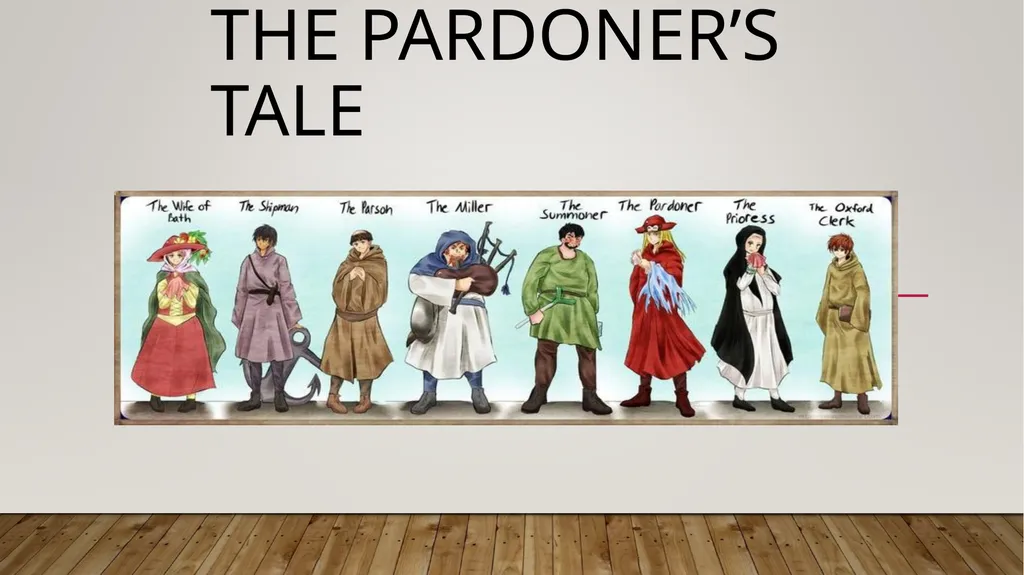
slide2. The Pardoner’s tale<br>
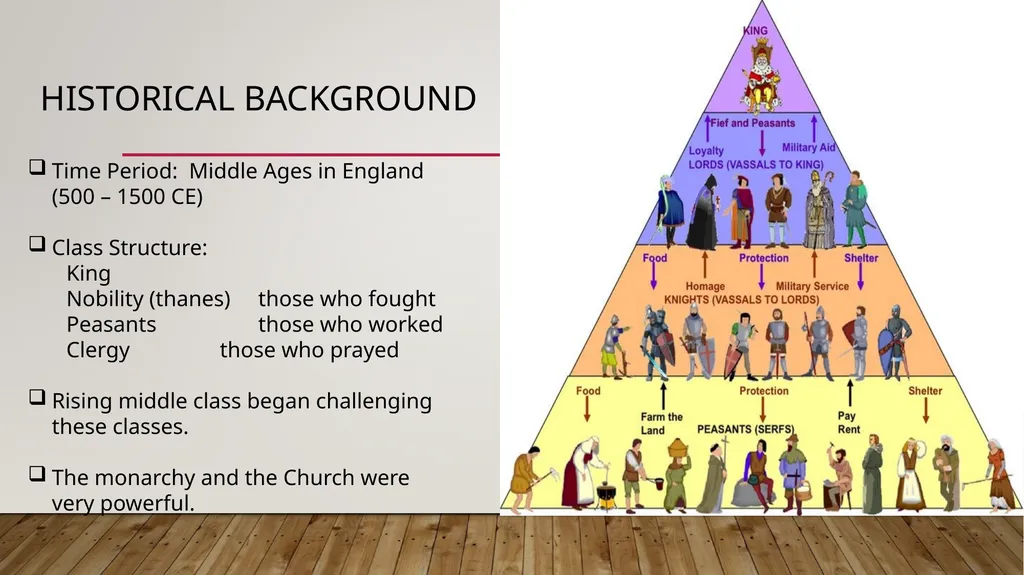
slide3. Historical Background Time Period: Middle Ages in England (500 – 1500 CE)
Class Structure:
King
Nobility (thanes) those who fought
Peasants those who worked
Clergy those who prayed
Rising middle class began challenging these classes.
The monarchy and the Church were very powerful.<br>
slide4. Role of the pardoner (during Medieval times) A Pardoner….
was a church official
was authorized to preach and distribute indulgences that absolve people from sin
Indulgences were written pardons for sins
Indulgences were granted in exchange for services or donations ($$) to the Church
Corrupt pardoners (like the one in Chaucer's story) sold indulgences for their own profit.
Chaucer’s Pardoner displays/sells relics, or holy objects.<br>
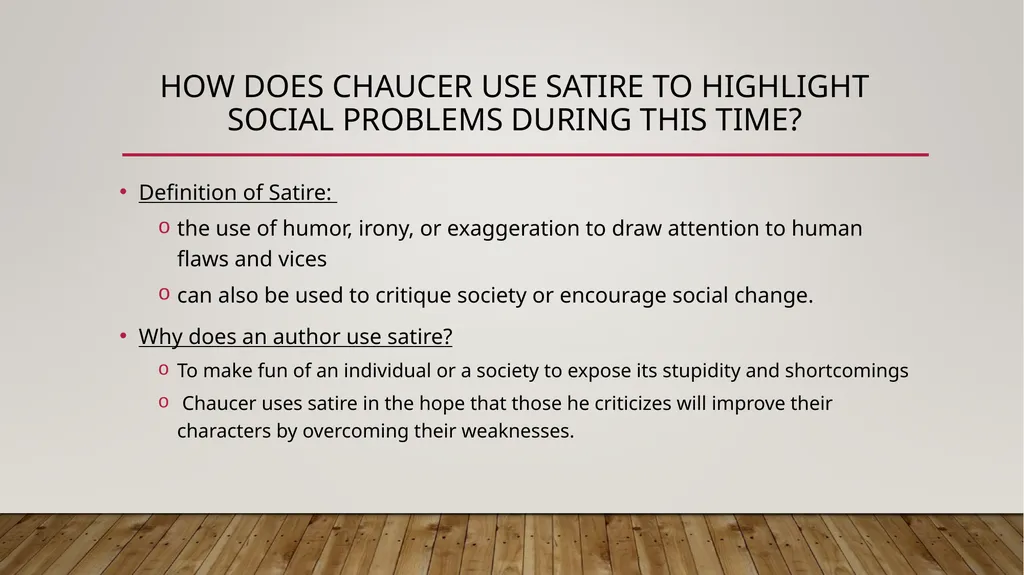
slide5. How does Chaucer use satire to highlight social problems during this time? Definition of Satire:
the use of humor, irony, or exaggeration to draw attention to human flaws and vices
can also be used to critique society or encourage social change.
Why does an author use satire?
To make fun of an individual or a society to expose its stupidity and shortcomings
Chaucer uses satire in the hope that those he criticizes will improve their characters by overcoming their weaknesses.<br>
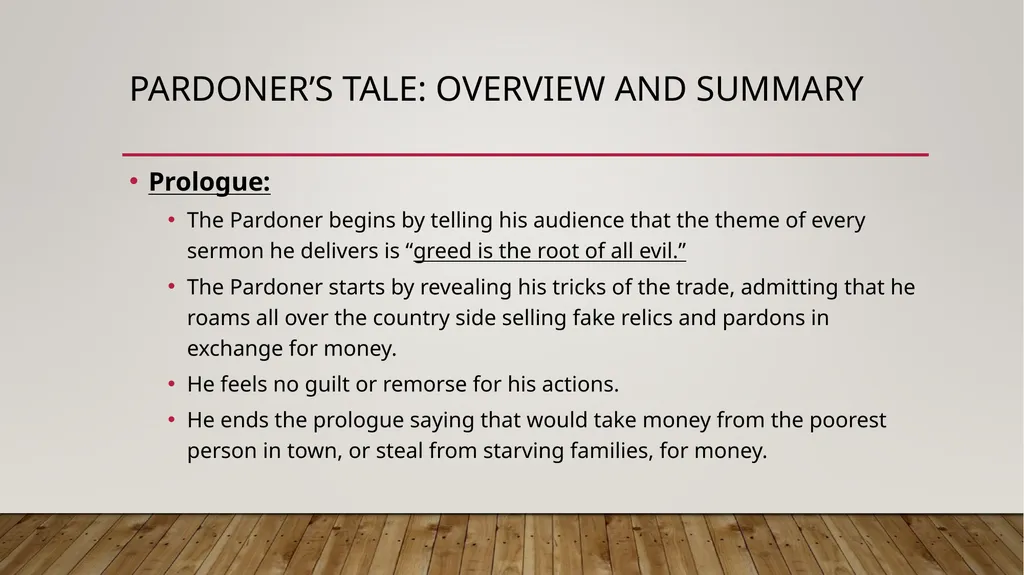
slide6. Pardoner’s Tale: Overview and Summary Prologue:
The Pardoner begins by telling his audience that the theme of every sermon he delivers is “greed is the root of all evil.”
The Pardoner starts by revealing his tricks of the trade, admitting that he roams all over the country side selling fake relics and pardons in exchange for money.
He feels no guilt or remorse for his actions.
He ends the prologue saying that would take money from the poorest person in town, or steal from starving families, for money.<br>
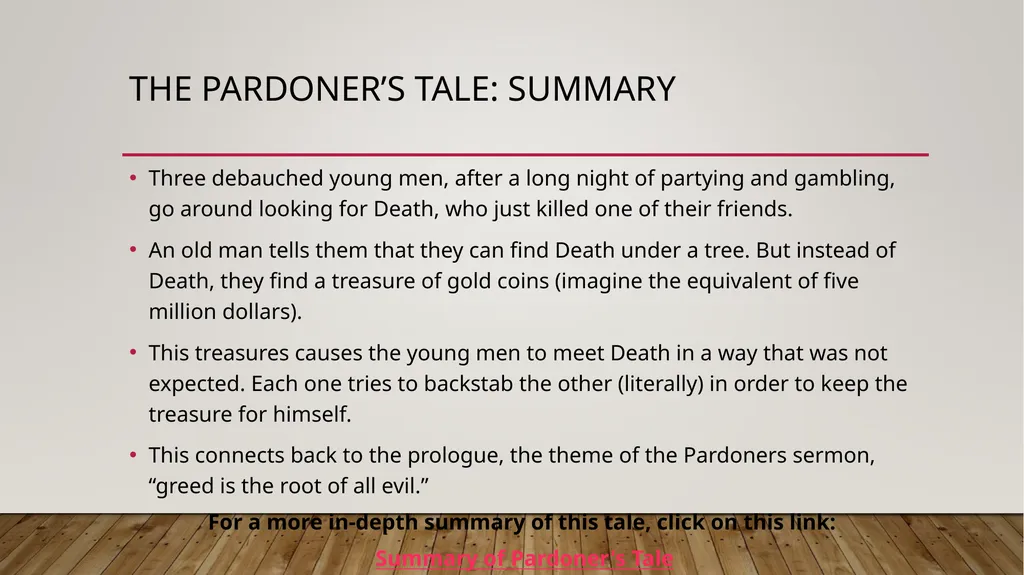
slide7. The Pardoner’s Tale: Summary Three debauched young men, after a long night of partying and gambling, go around looking for Death, who just killed one of their friends.
An old man tells them that they can find Death under a tree. But instead of Death, they find a treasure of gold coins (imagine the equivalent of five million dollars).
This treasures causes the young men to meet Death in a way that was not expected. Each one tries to backstab the other (literally) in order to keep the treasure for himself.
This connects back to the prologue, the theme of the Pardoners sermon, “greed is the root of all evil.”
For a more in-depth summary of this tale, click on this link:
Summary of Pardoner's Tale<br>
slide8. Satire in The Canterbury tales The prologue of the Pardoner’s tale The Pardoner describes his corrupt work to the other pilgrims
He admits that he sells indulgences and displays false relics
He explains how he tricks people into money. The Pardoner’s tale The Pardoner delivers a sermon.
To show that avarice is the root of all evil, he tells a story about three friends who betray each other for money.
He then asks the other pilgrims to give him money.<br>
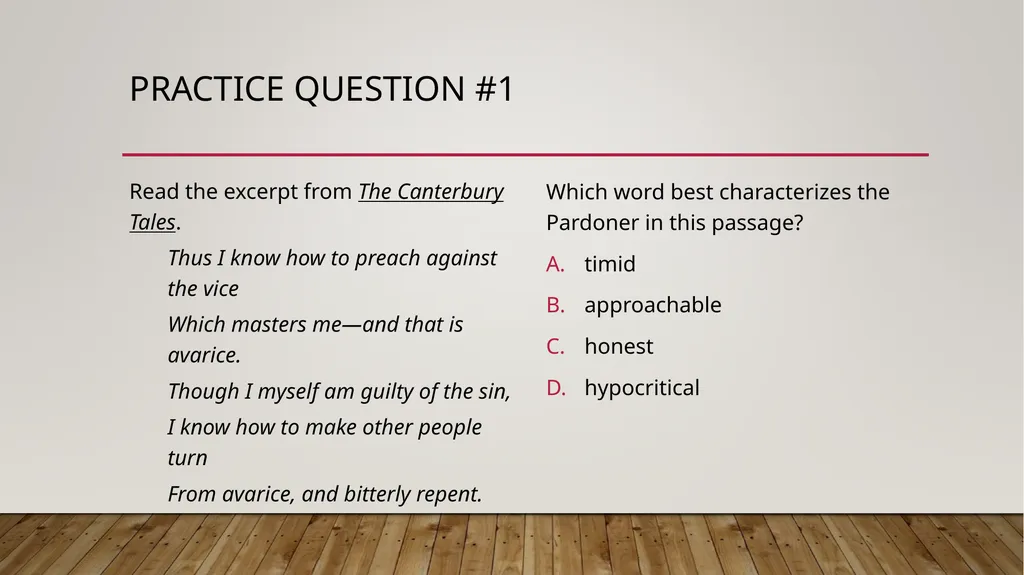
slide9. Practice question #1 Read the excerpt from The Canterbury Tales.
Thus I know how to preach against the vice
Which masters me—and that is avarice.
Though I myself am guilty of the sin,
I know how to make other people turn
From avarice, and bitterly repent. Which word best characterizes the Pardoner in this passage?
timid
approachable
honest
hypocritical<br>
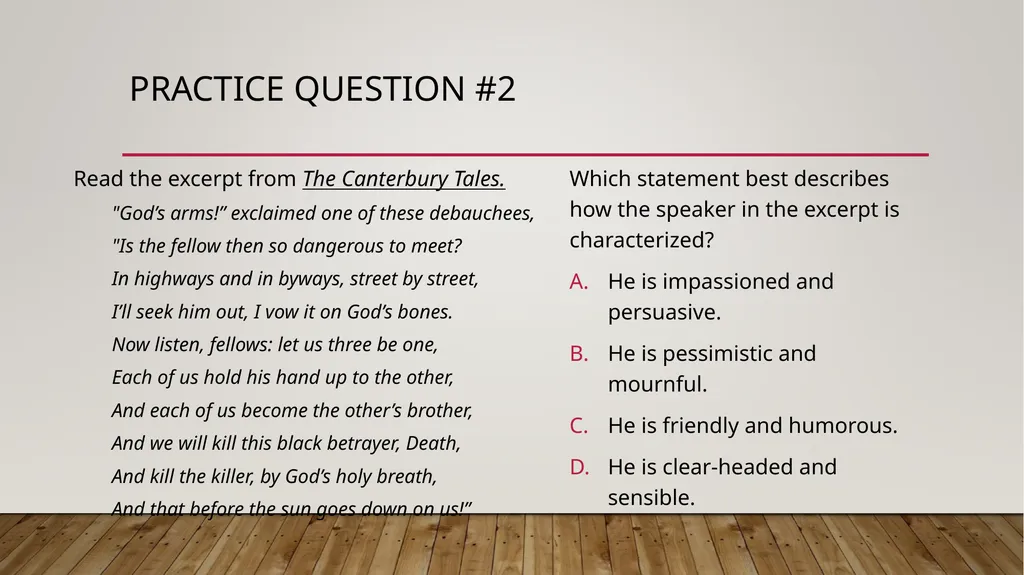
slide10. Practice question #2 Read the excerpt from The Canterbury Tales.
"God’s arms!” exclaimed one of these debauchees,
"Is the fellow then so dangerous to meet?
In highways and in byways, street by street,
I’ll seek him out, I vow it on God’s bones.
Now listen, fellows: let us three be one,
Each of us hold his hand up to the other,
And each of us become the other’s brother,
And we will kill this black betrayer, Death,
And kill the killer, by God’s holy breath,
And that before the sun goes down on us!” Which statement best describes how the speaker in the excerpt is characterized?
He is impassioned and persuasive.
He is pessimistic and mournful.
He is friendly and humorous.
He is clear-headed and sensible.<br>
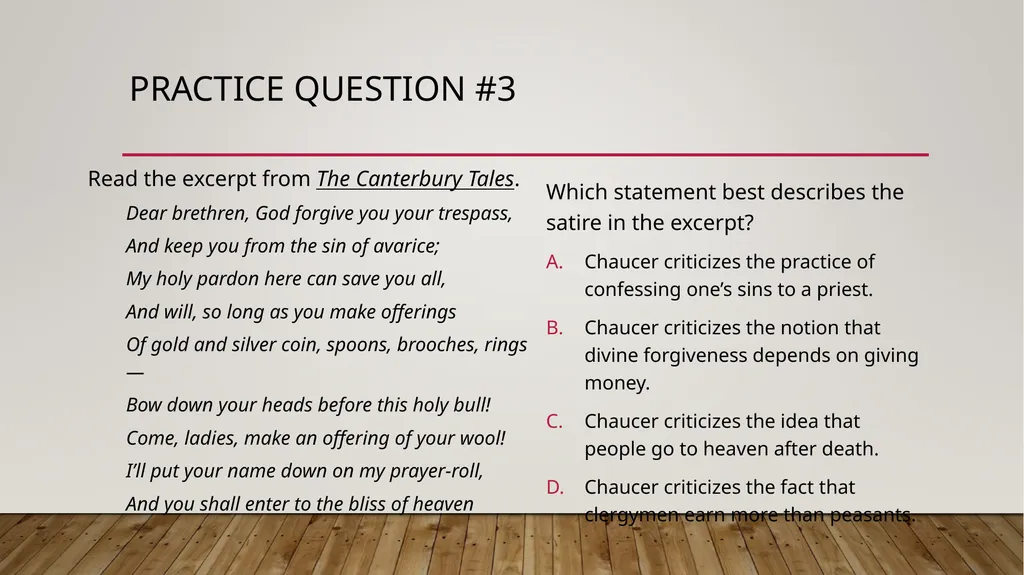
slide11. Practice question #3 Read the excerpt from The Canterbury Tales.
Dear brethren, God forgive you your trespass,
And keep you from the sin of avarice;
My holy pardon here can save you all,
And will, so long as you make offerings
Of gold and silver coin, spoons, brooches, rings—
Bow down your heads before this holy bull!
Come, ladies, make an offering of your wool!
I’ll put your name down on my prayer-roll,
And you shall enter to the bliss of heaven Which statement best describes the satire in the excerpt?
Chaucer criticizes the practice of confessing one’s sins to a priest.
Chaucer criticizes the notion that divine forgiveness depends on giving money.
Chaucer criticizes the idea that people go to heaven after death.
Chaucer criticizes the fact that clergymen earn more than peasants.<br>
Dr. Sanchaita Tripathy
School of English
G. M. University, Sambalpur<br>
slide2. The Pardoner’s tale<br>
slide3. Historical Background Time Period: Middle Ages in England (500 – 1500 CE)
Class Structure:
King
Nobility (thanes) those who fought
Peasants those who worked
Clergy those who prayed
Rising middle class began challenging these classes.
The monarchy and the Church were very powerful.<br>
slide4. Role of the pardoner (during Medieval times) A Pardoner….
was a church official
was authorized to preach and distribute indulgences that absolve people from sin
Indulgences were written pardons for sins
Indulgences were granted in exchange for services or donations ($$) to the Church
Corrupt pardoners (like the one in Chaucer's story) sold indulgences for their own profit.
Chaucer’s Pardoner displays/sells relics, or holy objects.<br>
slide5. How does Chaucer use satire to highlight social problems during this time? Definition of Satire:
the use of humor, irony, or exaggeration to draw attention to human flaws and vices
can also be used to critique society or encourage social change.
Why does an author use satire?
To make fun of an individual or a society to expose its stupidity and shortcomings
Chaucer uses satire in the hope that those he criticizes will improve their characters by overcoming their weaknesses.<br>
slide6. Pardoner’s Tale: Overview and Summary Prologue:
The Pardoner begins by telling his audience that the theme of every sermon he delivers is “greed is the root of all evil.”
The Pardoner starts by revealing his tricks of the trade, admitting that he roams all over the country side selling fake relics and pardons in exchange for money.
He feels no guilt or remorse for his actions.
He ends the prologue saying that would take money from the poorest person in town, or steal from starving families, for money.<br>
slide7. The Pardoner’s Tale: Summary Three debauched young men, after a long night of partying and gambling, go around looking for Death, who just killed one of their friends.
An old man tells them that they can find Death under a tree. But instead of Death, they find a treasure of gold coins (imagine the equivalent of five million dollars).
This treasures causes the young men to meet Death in a way that was not expected. Each one tries to backstab the other (literally) in order to keep the treasure for himself.
This connects back to the prologue, the theme of the Pardoners sermon, “greed is the root of all evil.”
For a more in-depth summary of this tale, click on this link:
Summary of Pardoner's Tale<br>
slide8. Satire in The Canterbury tales The prologue of the Pardoner’s tale The Pardoner describes his corrupt work to the other pilgrims
He admits that he sells indulgences and displays false relics
He explains how he tricks people into money. The Pardoner’s tale The Pardoner delivers a sermon.
To show that avarice is the root of all evil, he tells a story about three friends who betray each other for money.
He then asks the other pilgrims to give him money.<br>
slide9. Practice question #1 Read the excerpt from The Canterbury Tales.
Thus I know how to preach against the vice
Which masters me—and that is avarice.
Though I myself am guilty of the sin,
I know how to make other people turn
From avarice, and bitterly repent. Which word best characterizes the Pardoner in this passage?
timid
approachable
honest
hypocritical<br>
slide10. Practice question #2 Read the excerpt from The Canterbury Tales.
"God’s arms!” exclaimed one of these debauchees,
"Is the fellow then so dangerous to meet?
In highways and in byways, street by street,
I’ll seek him out, I vow it on God’s bones.
Now listen, fellows: let us three be one,
Each of us hold his hand up to the other,
And each of us become the other’s brother,
And we will kill this black betrayer, Death,
And kill the killer, by God’s holy breath,
And that before the sun goes down on us!” Which statement best describes how the speaker in the excerpt is characterized?
He is impassioned and persuasive.
He is pessimistic and mournful.
He is friendly and humorous.
He is clear-headed and sensible.<br>
slide11. Practice question #3 Read the excerpt from The Canterbury Tales.
Dear brethren, God forgive you your trespass,
And keep you from the sin of avarice;
My holy pardon here can save you all,
And will, so long as you make offerings
Of gold and silver coin, spoons, brooches, rings—
Bow down your heads before this holy bull!
Come, ladies, make an offering of your wool!
I’ll put your name down on my prayer-roll,
And you shall enter to the bliss of heaven Which statement best describes the satire in the excerpt?
Chaucer criticizes the practice of confessing one’s sins to a priest.
Chaucer criticizes the notion that divine forgiveness depends on giving money.
Chaucer criticizes the idea that people go to heaven after death.
Chaucer criticizes the fact that clergymen earn more than peasants.<br>