
The Platform Design Problem Christos





Description: The Platform Design Problem Christos Papadimitriou, Kiran Vodrahalli, Mihalis Yannakakis Columbia University Strategic ML Workshop NeurIPS 2021 The Data-Collection Problem Modern machine learning requires large amounts of high-quality
Related Topics
Download Presentation
"The Platform Design Problem Christos" is the property of its rightful owner. Permission is granted to download and print the materials on this website for personal, non-commercial use only, and to display it on your personal computer provided you do not modify the materials and that you retain all copyright notices contained in the materials. By downloading content from our website, you accept the terms of this agreement.
Presentation Transcript
slide1. The Platform Design Problem Christos Papadimitriou, Kiran Vodrahalli, Mihalis Yannakakis
Columbia University
Strategic ML Workshop @ NeurIPS 2021<br>
slide2. The Data-Collection Problem Modern machine learning requires large amounts of high-quality data
Collecting supervised labels is expensive
Unsupervised learning is challenging to use
Is it possible to create environments which generate useful data?
Ex: Reddit users provide sarcasm labels using the “/s” tag<br>
slide3. The Data-Collection Problem Modern machine learning requires large amounts of high-quality data
Collecting supervised labels is expensive
Unsupervised learning is challenging to use
Is it possible to create environments which generate useful data?
Ex: Reddit users provide sarcasm labels using the “/s” tag Modern tech companies try to solve this problem.<br>
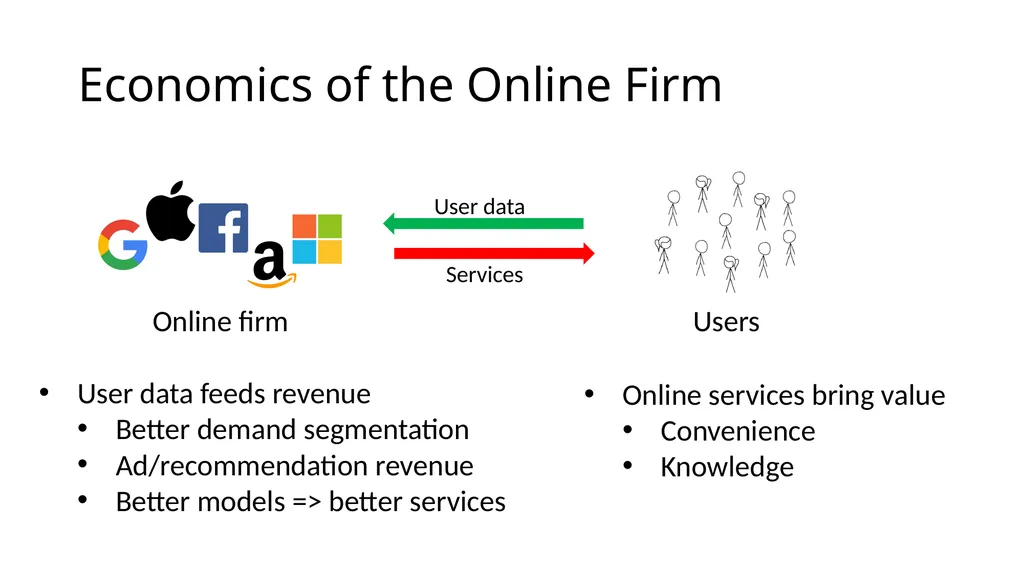
slide4. Economics of the Online Firm User data feeds revenue
Better demand segmentation
Ad/recommendation revenue
Better models => better services Online services bring value
Convenience
Knowledge User data Services<br>
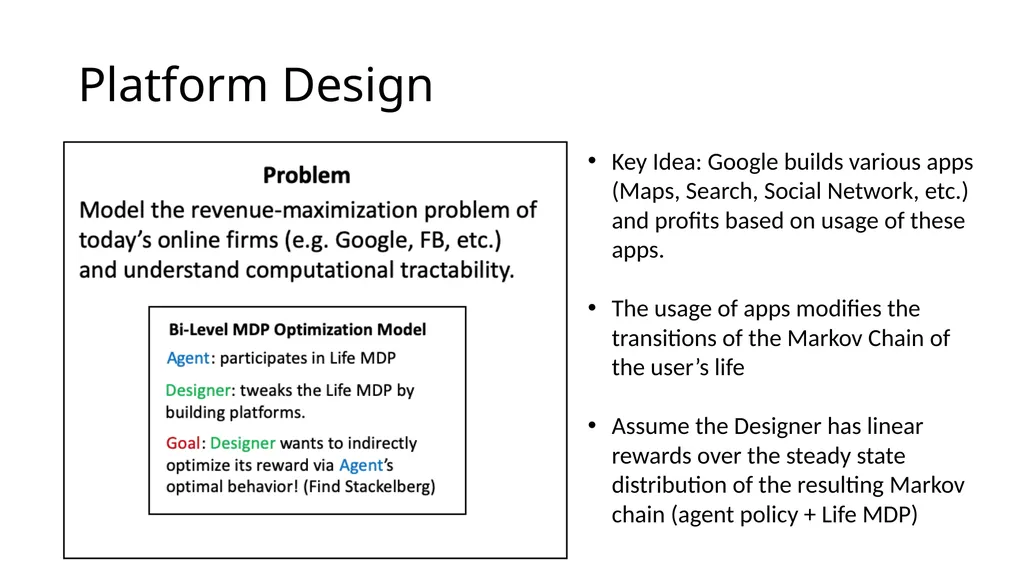
slide5. Platform Design Bi-Level MDP Optimization Model Agent: participates in Life MDP Designer: tweaks the Life MDP by building platforms. Goal: Designer wants to indirectly optimize its reward via Agent’s optimal behavior! (Find Stackelberg) Key Idea: Google builds various apps (Maps, Search, Social Network, etc.) and profits based on usage of these apps.
The usage of apps modifies the transitions of the Markov Chain of the user’s life
Assume the Designer has linear rewards over the steady state distribution of the resulting Markov chain (agent policy + Life MDP)<br>
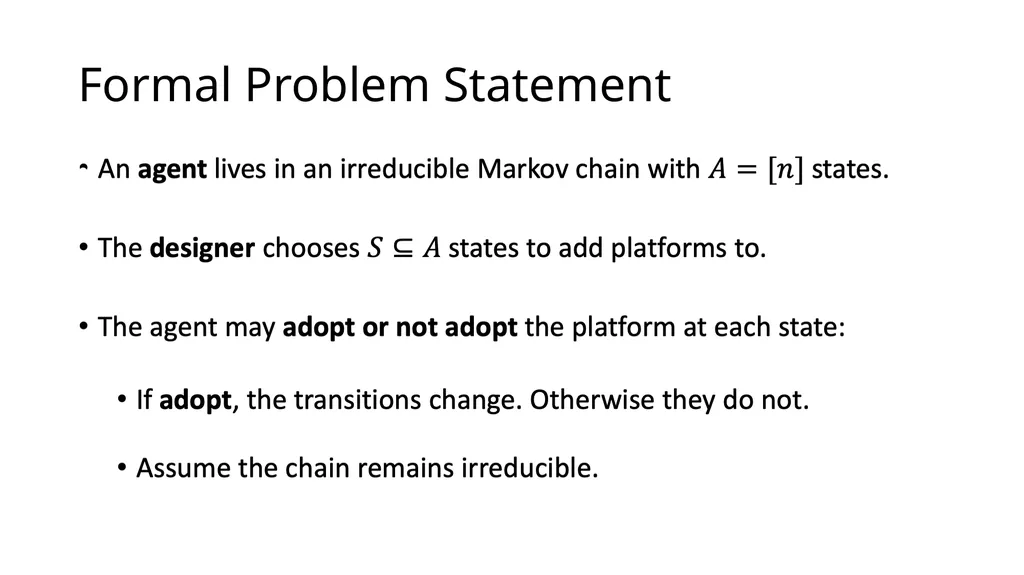
slide6. Formal Problem Statement<br>
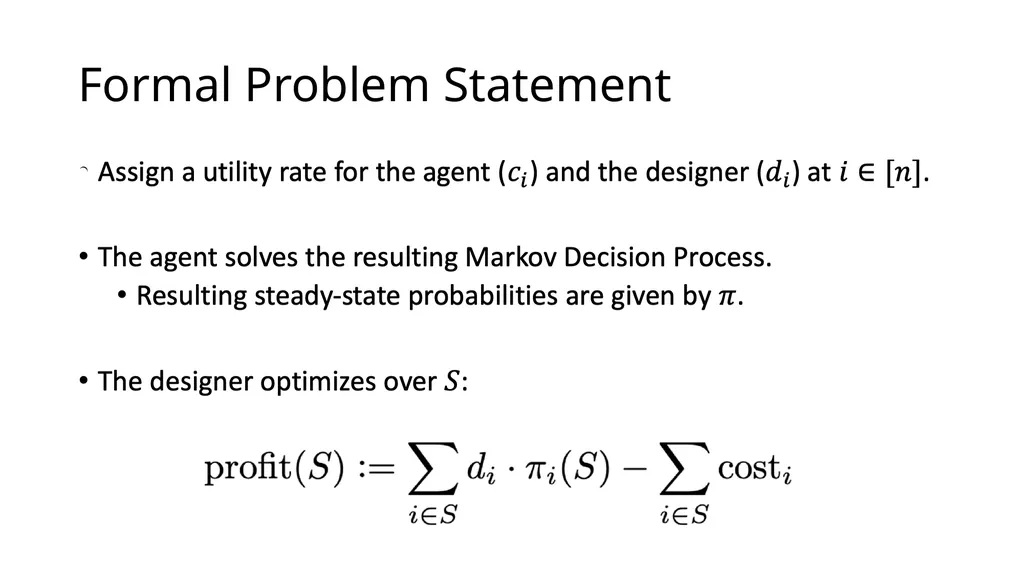
slide7. Formal Problem Statement<br>
slide8. General Case<br>
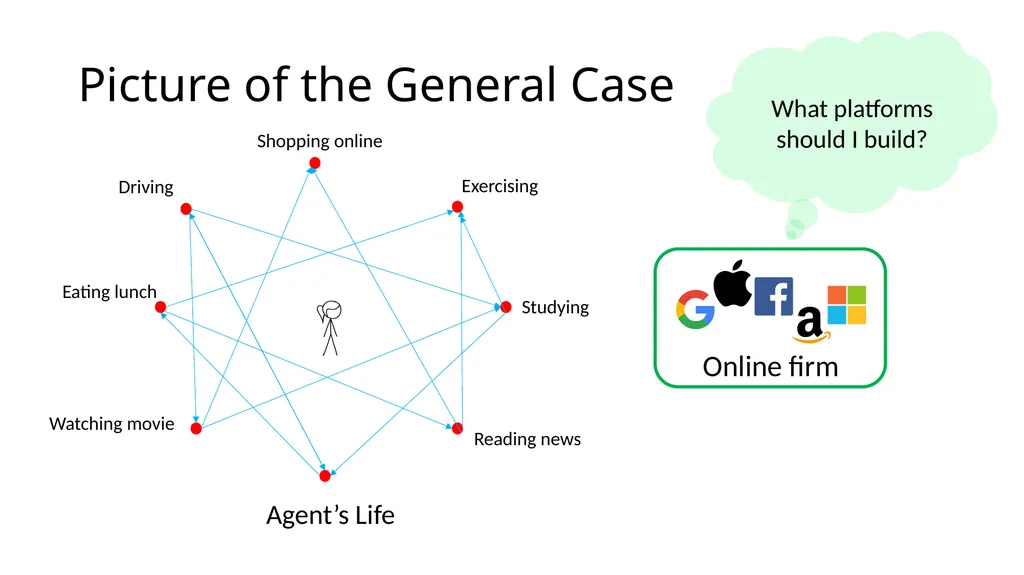
slide9. Picture of the General Case What platforms should I build?<br>
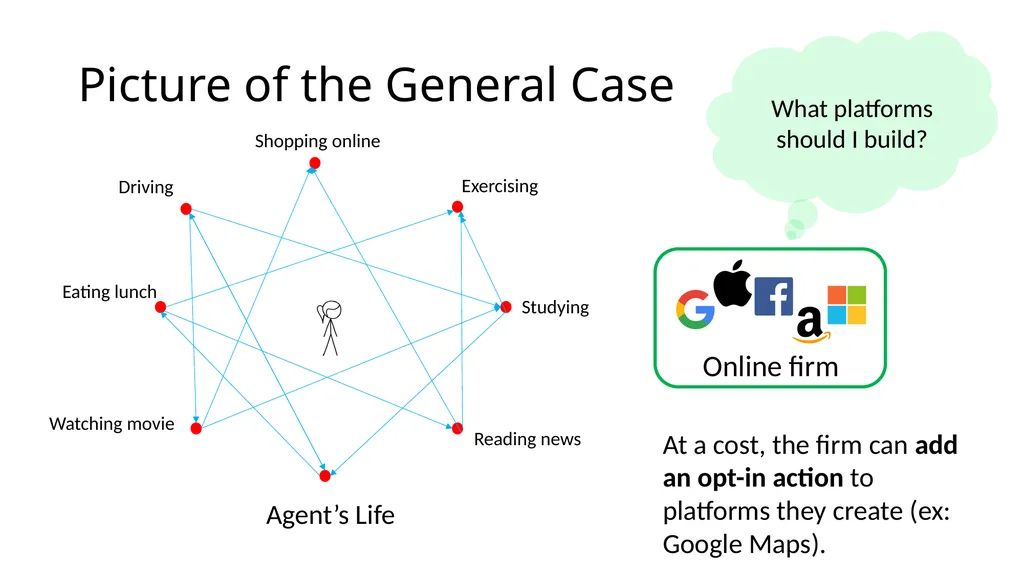
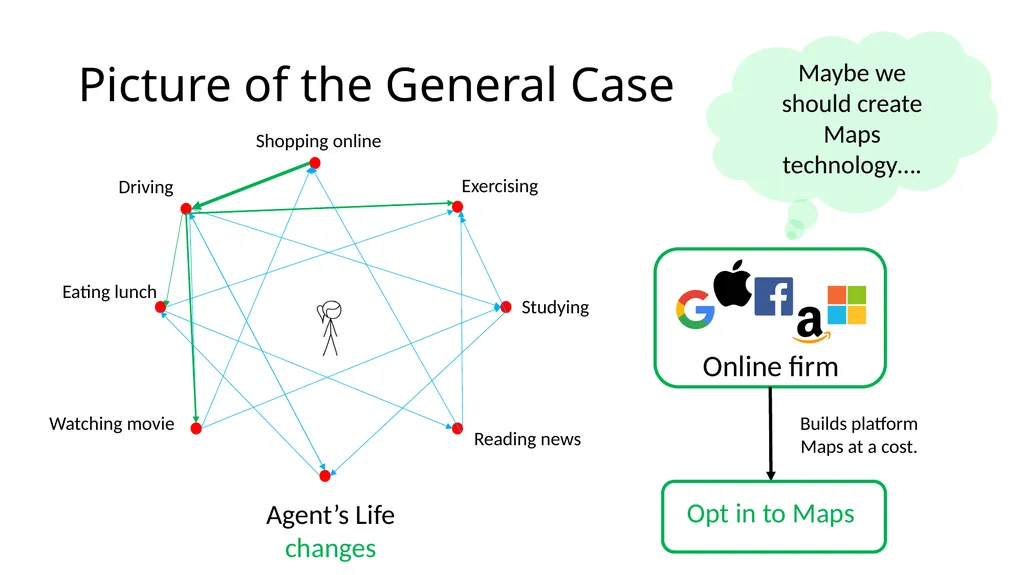
slide10. Picture of the General Case Shopping online Agent’s Life Driving Eating lunch Watching movie Exercising Studying Reading news What platforms should I build? At a cost, the firm can add an opt-in action to platforms they create (ex: Google Maps).<br>
slide11. Picture of the General Case Shopping online Agent’s Life changes Driving Eating lunch Watching movie Exercising Studying Reading news Maybe we should create Maps technology…. Opt in to Maps Builds platform Maps at a cost.<br>
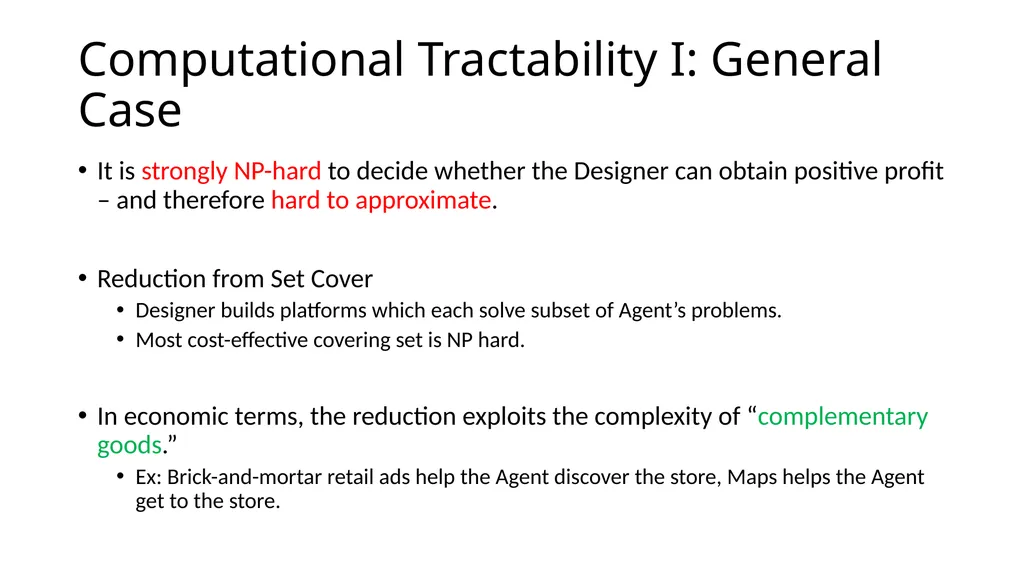
slide12. Computational Tractability I: General Case It is strongly NP-hard to decide whether the Designer can obtain positive profit – and therefore hard to approximate.
Reduction from Set Cover
Designer builds platforms which each solve subset of Agent’s problems.
Most cost-effective covering set is NP hard.
In economic terms, the reduction exploits the complexity of “complementary goods.”
Ex: Brick-and-mortar retail ads help the Agent discover the store, Maps helps the Agent get to the store.<br>
slide13. Tractable “Flower” Case<br>
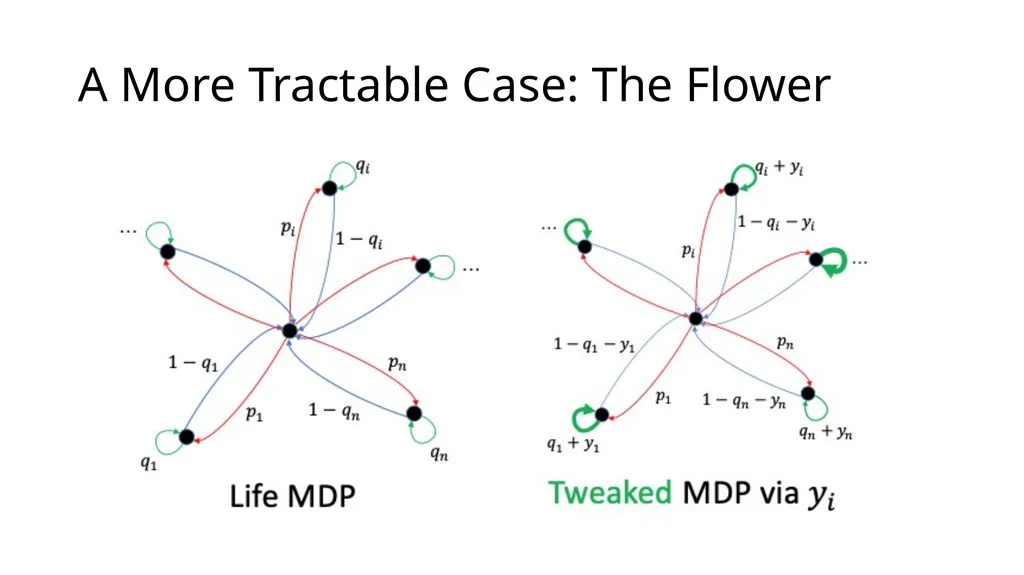
slide14. A More Tractable Case: The Flower<br>
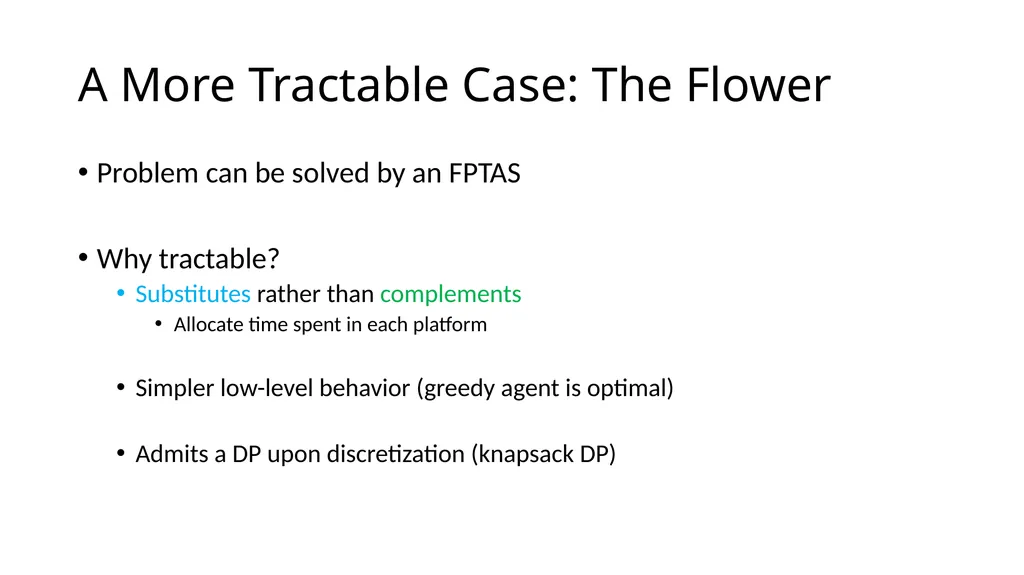
slide15. A More Tractable Case: The Flower Problem can be solved by an FPTAS
Why tractable?
Substitutes rather than complements
Allocate time spent in each platform
Simpler low-level behavior (greedy agent is optimal)
Admits a DP upon discretization (knapsack DP)<br>
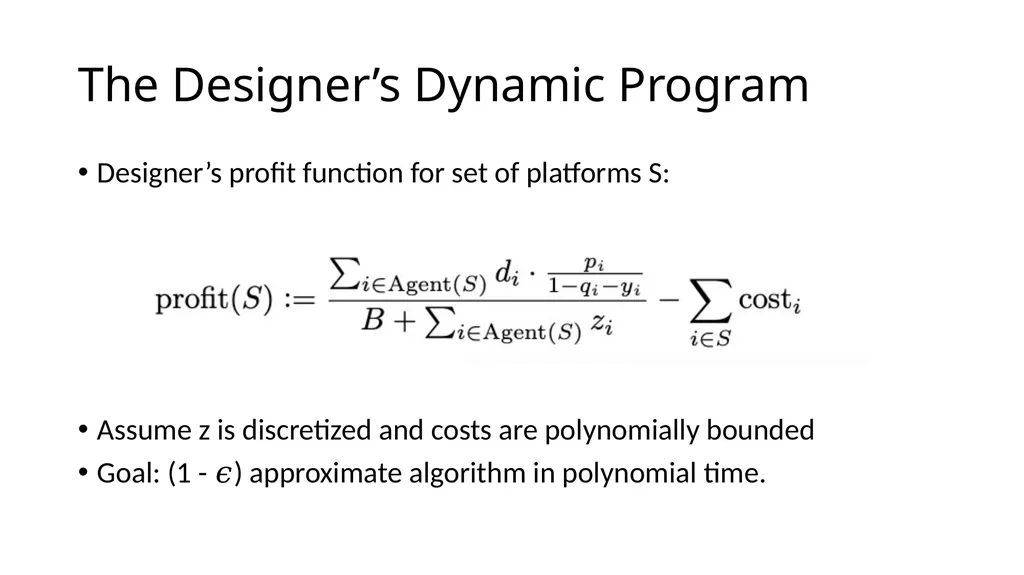
slide16. The Designer’s Dynamic Program Designer’s profit function for set of platforms S:
Assume z is discretized and costs are polynomially bounded
Goal: (1 - 𝜖) approximate algorithm in polynomial time.<br>
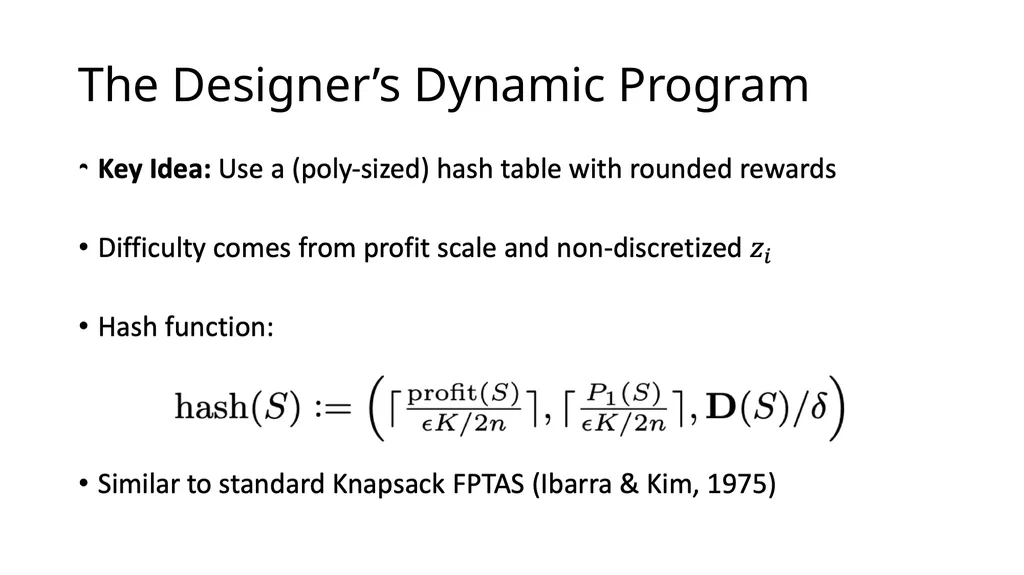
slide17. The Designer’s Dynamic Program<br>
slide18. Extensions<br>
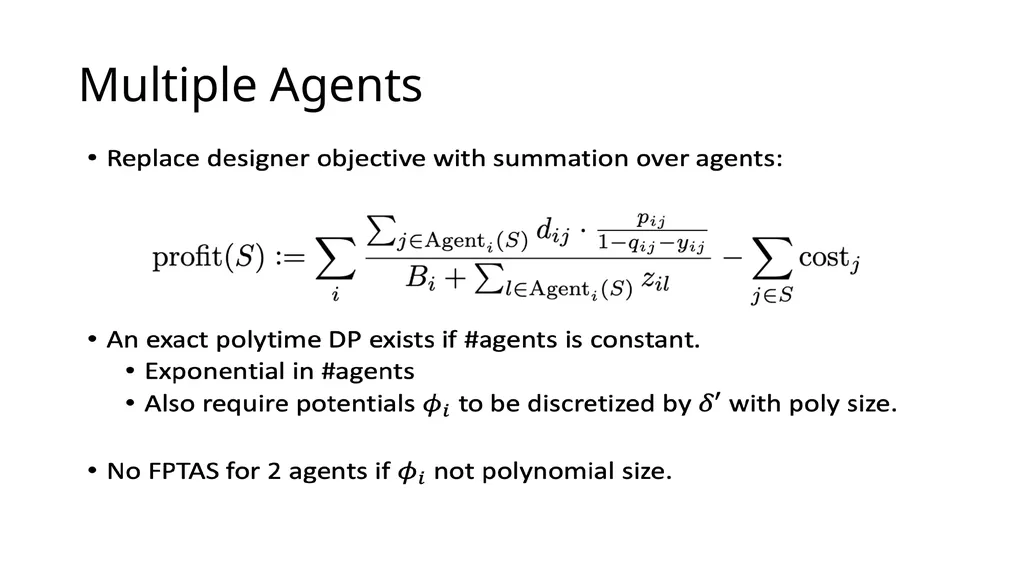
slide19. Multiple Agents<br>
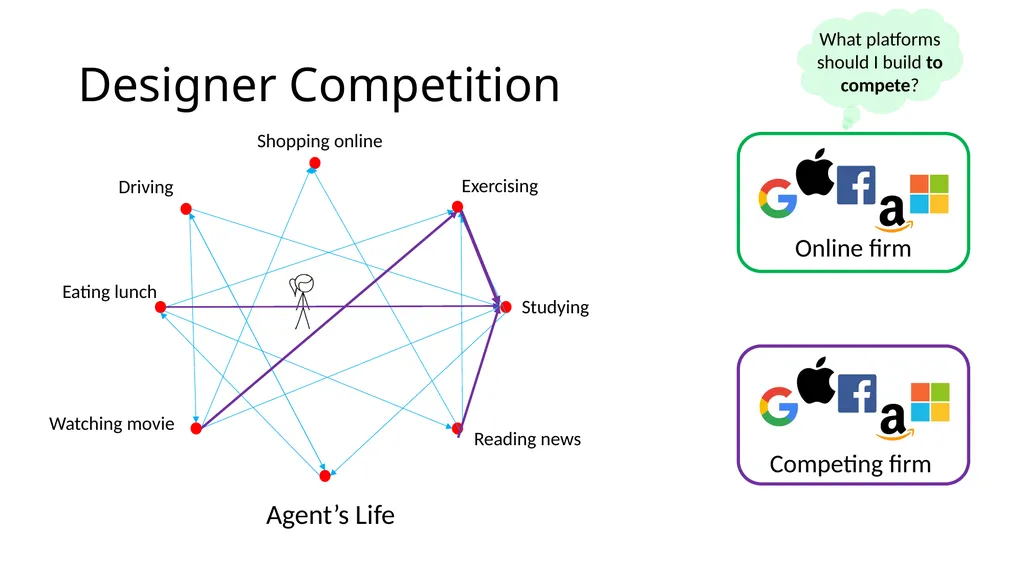
slide20. Designer Competition<br>
slide21. Future Work Designer vs. Designer
Complexity of pure Nash
Repeated game settings
Privacy/fairness questions for Agent
Unknown rewards for Designer and Agent
Learning in games
Strategic Agents
And many more… please reach out at kiran.vodrahalli@columbia.edu if you would like to chat!<br>
Columbia University
Strategic ML Workshop @ NeurIPS 2021<br>
slide2. The Data-Collection Problem Modern machine learning requires large amounts of high-quality data
Collecting supervised labels is expensive
Unsupervised learning is challenging to use
Is it possible to create environments which generate useful data?
Ex: Reddit users provide sarcasm labels using the “/s” tag<br>
slide3. The Data-Collection Problem Modern machine learning requires large amounts of high-quality data
Collecting supervised labels is expensive
Unsupervised learning is challenging to use
Is it possible to create environments which generate useful data?
Ex: Reddit users provide sarcasm labels using the “/s” tag Modern tech companies try to solve this problem.<br>
slide4. Economics of the Online Firm User data feeds revenue
Better demand segmentation
Ad/recommendation revenue
Better models => better services Online services bring value
Convenience
Knowledge User data Services<br>
slide5. Platform Design Bi-Level MDP Optimization Model Agent: participates in Life MDP Designer: tweaks the Life MDP by building platforms. Goal: Designer wants to indirectly optimize its reward via Agent’s optimal behavior! (Find Stackelberg) Key Idea: Google builds various apps (Maps, Search, Social Network, etc.) and profits based on usage of these apps.
The usage of apps modifies the transitions of the Markov Chain of the user’s life
Assume the Designer has linear rewards over the steady state distribution of the resulting Markov chain (agent policy + Life MDP)<br>
slide6. Formal Problem Statement<br>
slide7. Formal Problem Statement<br>
slide8. General Case<br>
slide9. Picture of the General Case What platforms should I build?<br>
slide10. Picture of the General Case Shopping online Agent’s Life Driving Eating lunch Watching movie Exercising Studying Reading news What platforms should I build? At a cost, the firm can add an opt-in action to platforms they create (ex: Google Maps).<br>
slide11. Picture of the General Case Shopping online Agent’s Life changes Driving Eating lunch Watching movie Exercising Studying Reading news Maybe we should create Maps technology…. Opt in to Maps Builds platform Maps at a cost.<br>
slide12. Computational Tractability I: General Case It is strongly NP-hard to decide whether the Designer can obtain positive profit – and therefore hard to approximate.
Reduction from Set Cover
Designer builds platforms which each solve subset of Agent’s problems.
Most cost-effective covering set is NP hard.
In economic terms, the reduction exploits the complexity of “complementary goods.”
Ex: Brick-and-mortar retail ads help the Agent discover the store, Maps helps the Agent get to the store.<br>
slide13. Tractable “Flower” Case<br>
slide14. A More Tractable Case: The Flower<br>
slide15. A More Tractable Case: The Flower Problem can be solved by an FPTAS
Why tractable?
Substitutes rather than complements
Allocate time spent in each platform
Simpler low-level behavior (greedy agent is optimal)
Admits a DP upon discretization (knapsack DP)<br>
slide16. The Designer’s Dynamic Program Designer’s profit function for set of platforms S:
Assume z is discretized and costs are polynomially bounded
Goal: (1 - 𝜖) approximate algorithm in polynomial time.<br>
slide17. The Designer’s Dynamic Program<br>
slide18. Extensions<br>
slide19. Multiple Agents<br>
slide20. Designer Competition<br>
slide21. Future Work Designer vs. Designer
Complexity of pure Nash
Repeated game settings
Privacy/fairness questions for Agent
Unknown rewards for Designer and Agent
Learning in games
Strategic Agents
And many more… please reach out at kiran.vodrahalli@columbia.edu if you would like to chat!<br>