The Relational Model and Relational Algebra Nothing is so practical as a good theory Kurt Lewin, 1945 The relational model Overcame shortcomings of earlier database models Has a strong theoretical base Codd was the major developer Problems
"The Relational Model and Relational Algebra" is the property of its rightful owner. Permission is granted to
download and print the materials on this website for personal, non-commercial use only, and to display it
on your personal computer provided you do not modify the materials and that you retain all copyright
notices contained in the materials. By downloading content from our website, you accept the terms of this
agreement.
Presentation Transcript
01
The Relational Model and Relational Algebra Nothing is so practical as a good theory
Kurt Lewin, 1945<br>
02
The relational model Overcame shortcomings of earlier database models
Has a strong theoretical base
Codd was the major developer<br>
03
Problems with other models Programmers worked at a low level of detail
No commands for multiple record processing
Little support for ad hoc querying by users<br>
04
Objectives of relational model research Data independence
Logical and physical models are separate
Communicability
A simple model understood by programmers and users
Set-processing
Increase programmer productivity<br>
05
Relational model concepts Data structures
Integrity rules
Operators<br>
06
Data structures Domain
A set of values all of the same data type
All the legal values of an attribute
Defines what comparisons are legal
Only attributes from the same domain should be compared The domain concept is rarely implemented<br>
07
Data structures Relations
A table of n columns and m rows
A relation’s cardinality is its number of rows
A relation’s degrees is its number of columns
A relational database is a collection of relations
No explicit linkages between tables Cardinality is easy to change but not degrees<br>
08
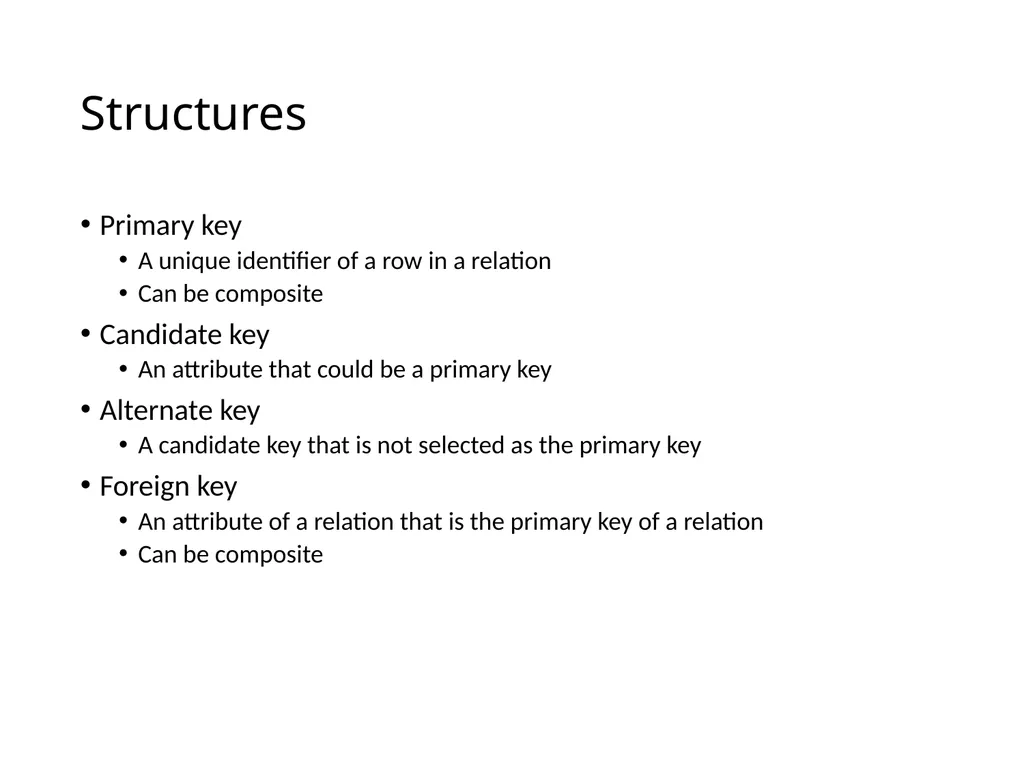
Structures Primary key
A unique identifier of a row in a relation
Can be composite
Candidate key
An attribute that could be a primary key
Alternate key
A candidate key that is not selected as the primary key
Foreign key
An attribute of a relation that is the primary key of a relation
Can be composite<br>
09
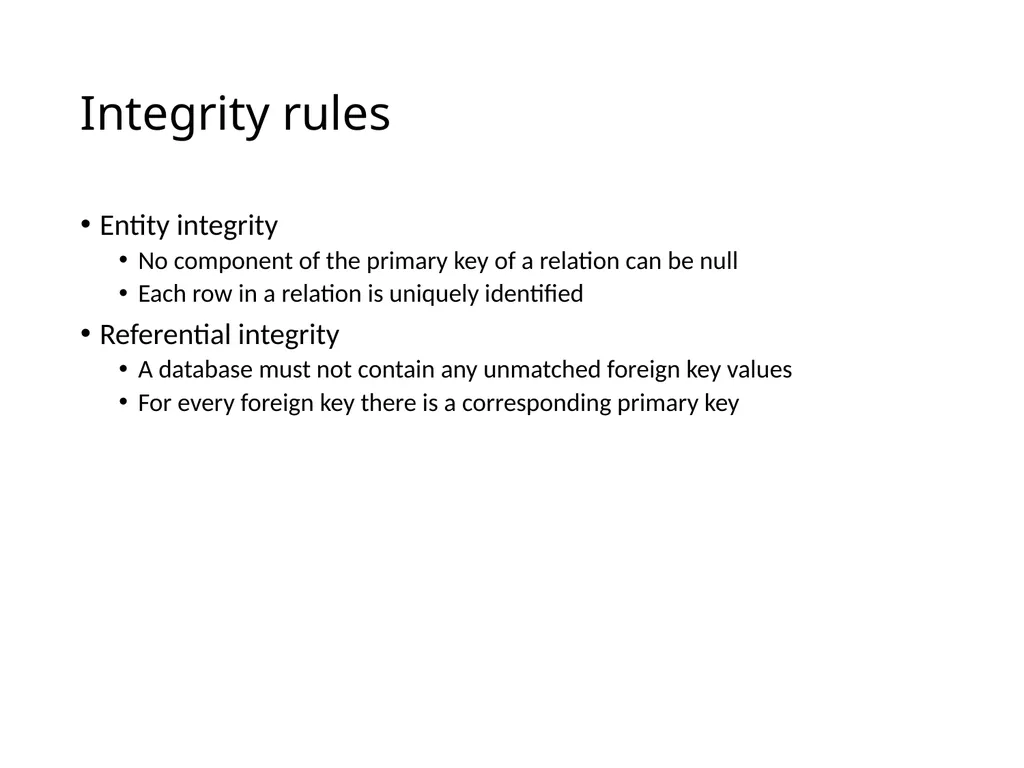
Integrity rules Entity integrity
No component of the primary key of a relation can be null
Each row in a relation is uniquely identified
Referential integrity
A database must not contain any unmatched foreign key values
For every foreign key there is a corresponding primary key<br>
10
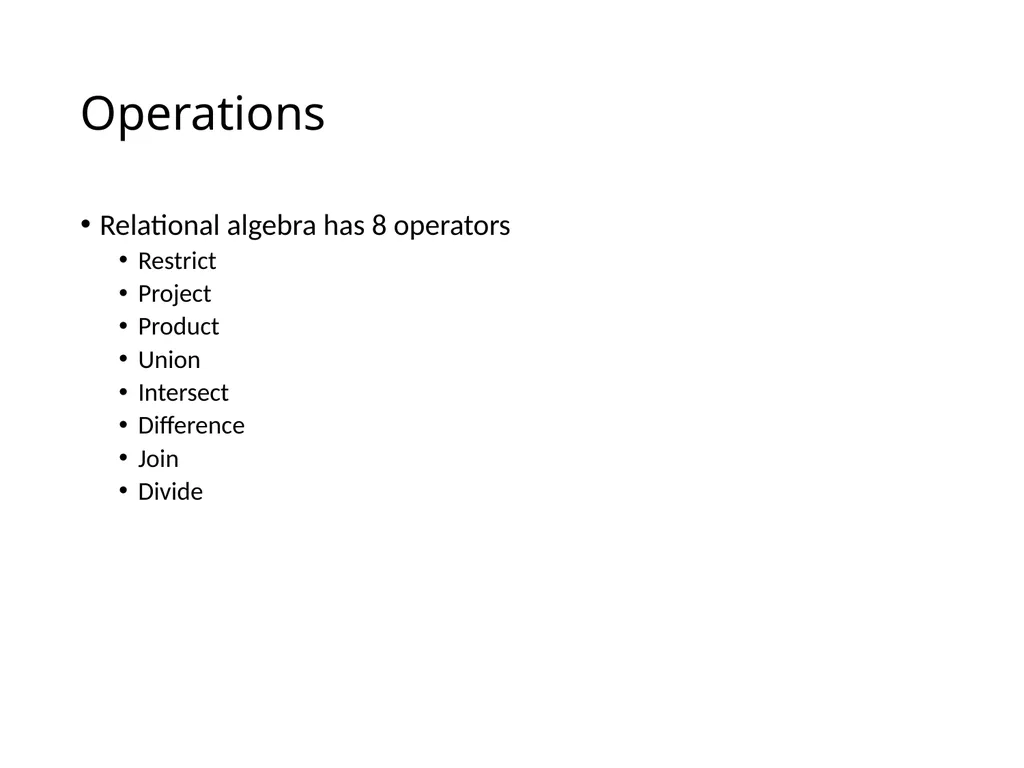
Operations Relational algebra has 8 operators
Restrict
Project
Product
Union
Intersect
Difference
Join
Divide<br>
11
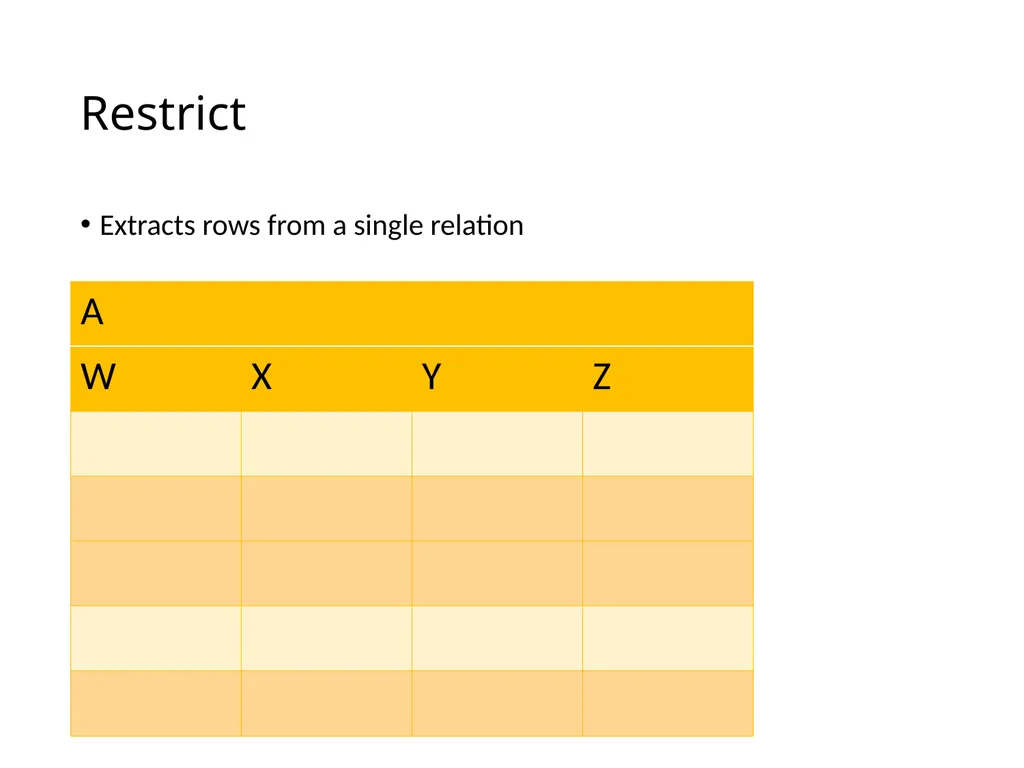
Restrict Extracts rows from a single relation<br>
12
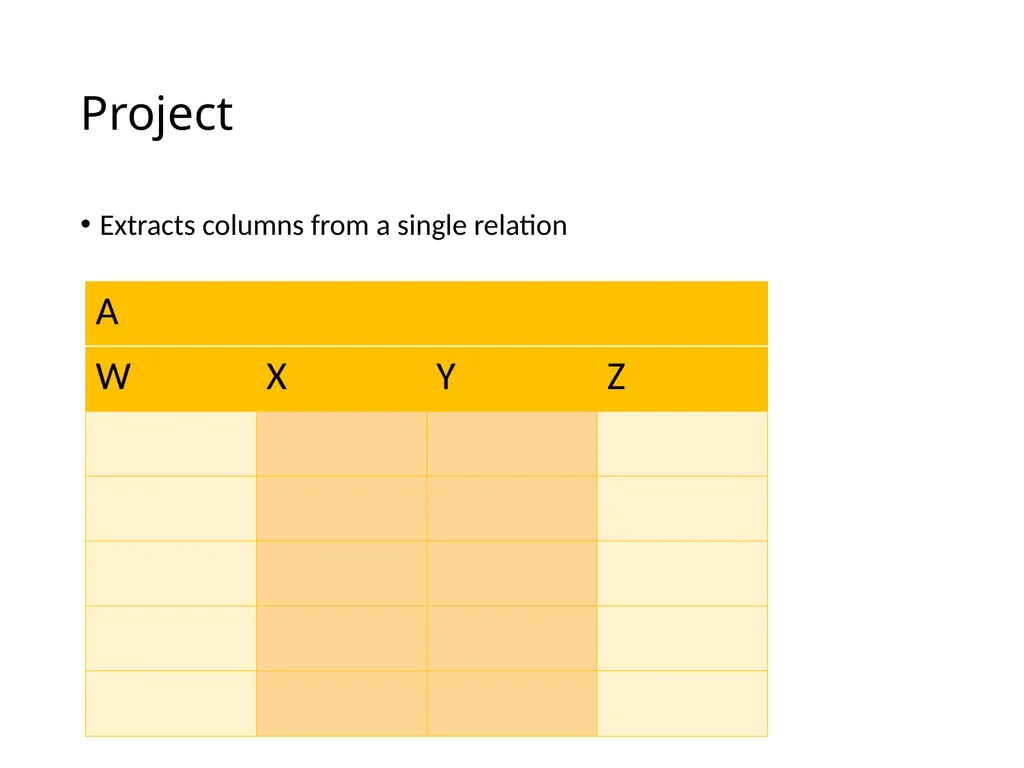
Project Extracts columns from a single relation<br>
13
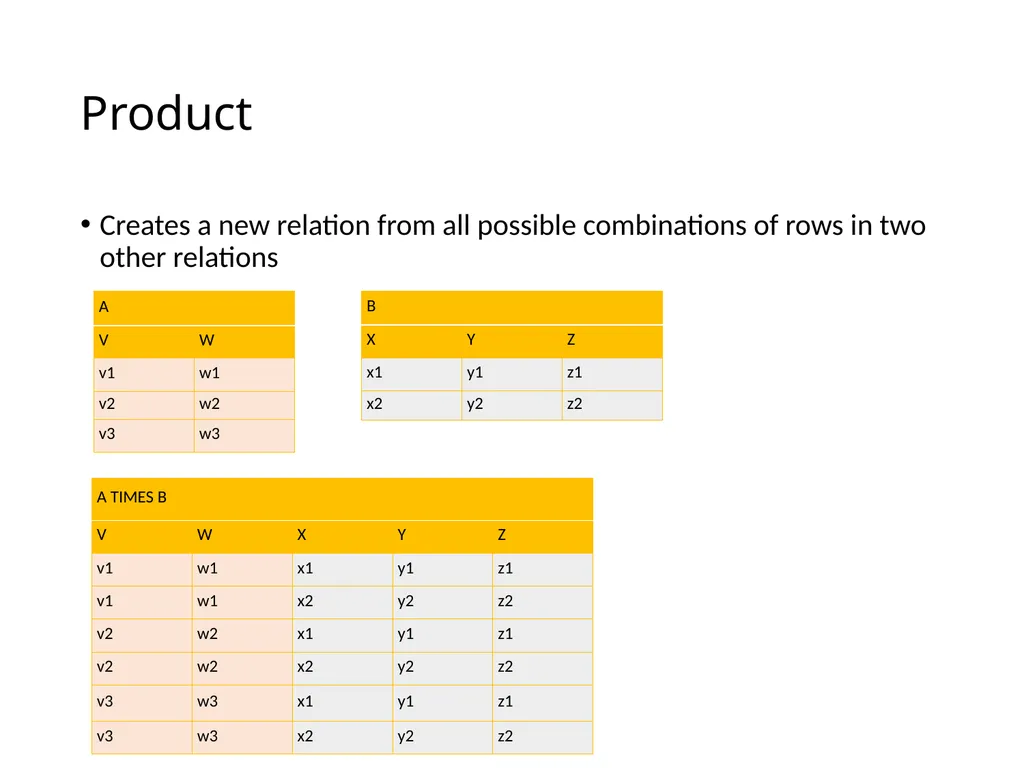
Product Creates a new relation from all possible combinations of rows in two other relations<br>
14
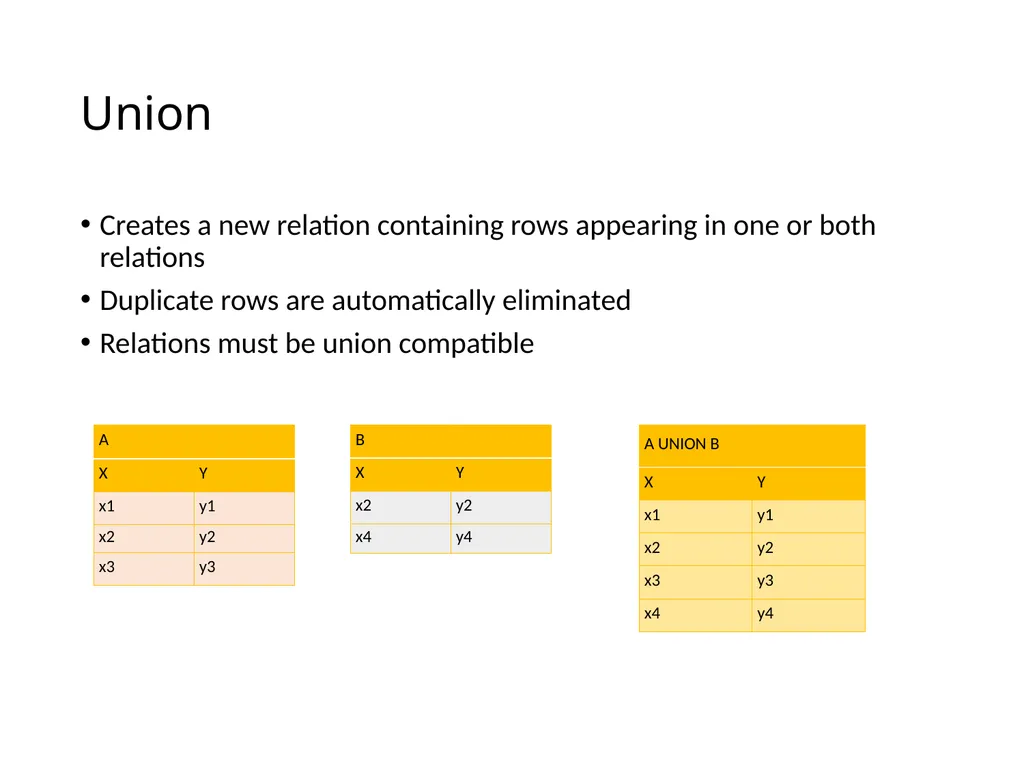
Union Creates a new relation containing rows appearing in one or both relations
Duplicate rows are automatically eliminated
Relations must be union compatible<br>
15
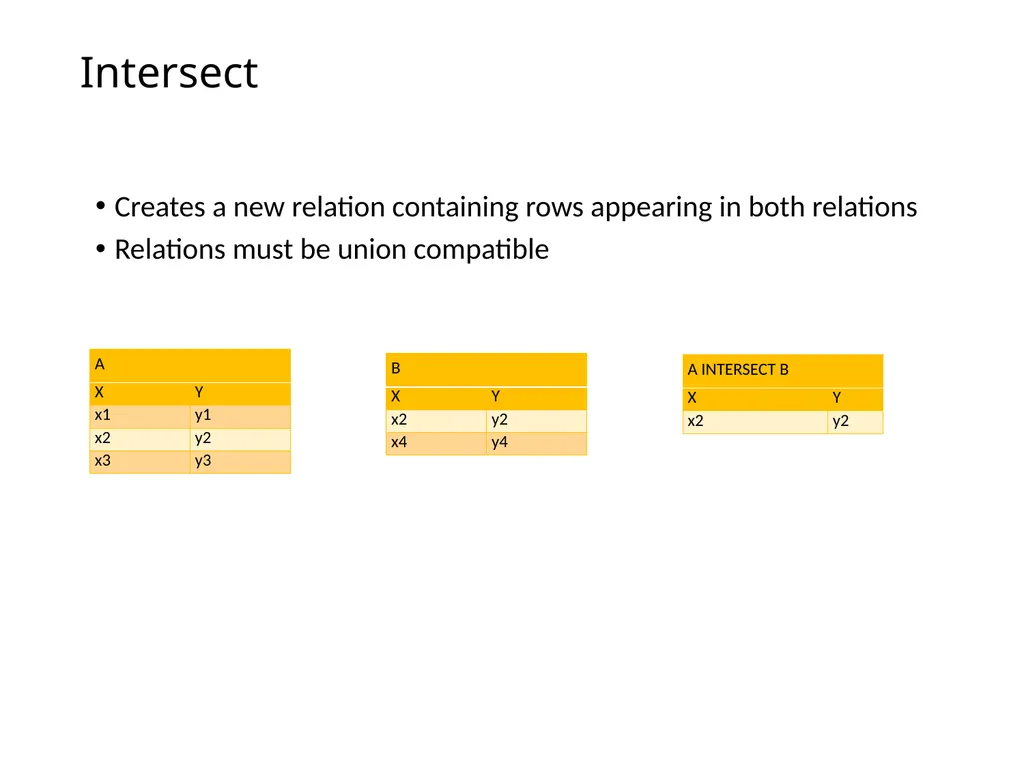
Intersect Creates a new relation containing rows appearing in both relations
Relations must be union compatible<br>
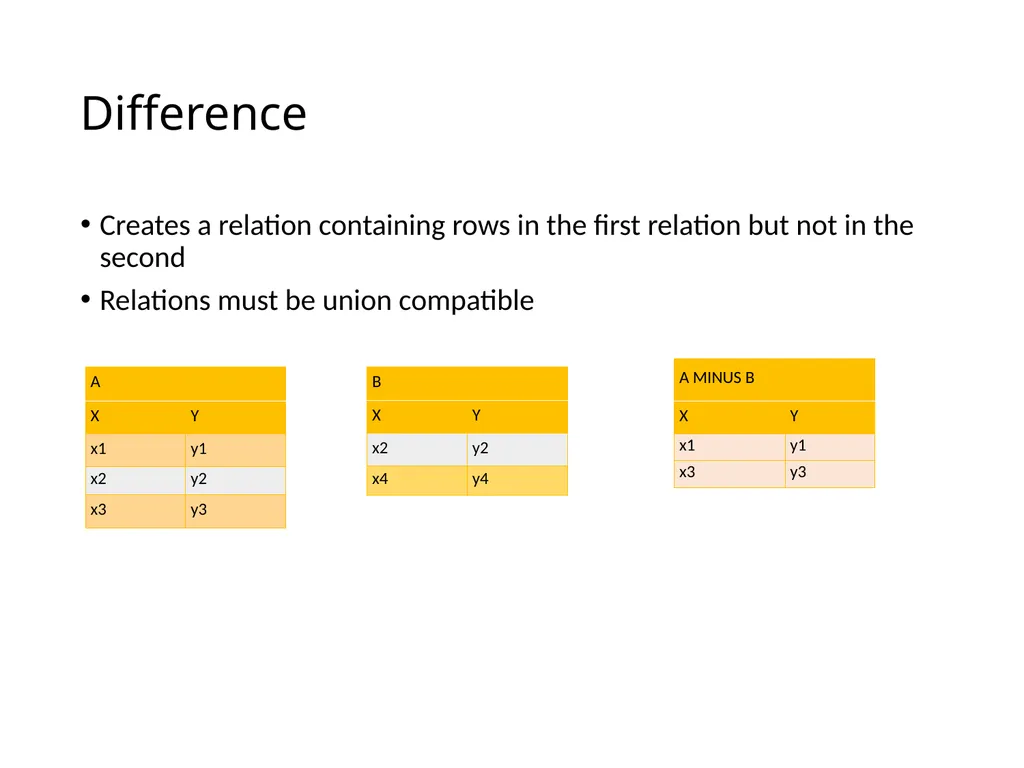
16
Difference Creates a relation containing rows in the first relation but not in the second
Relations must be union compatible<br>
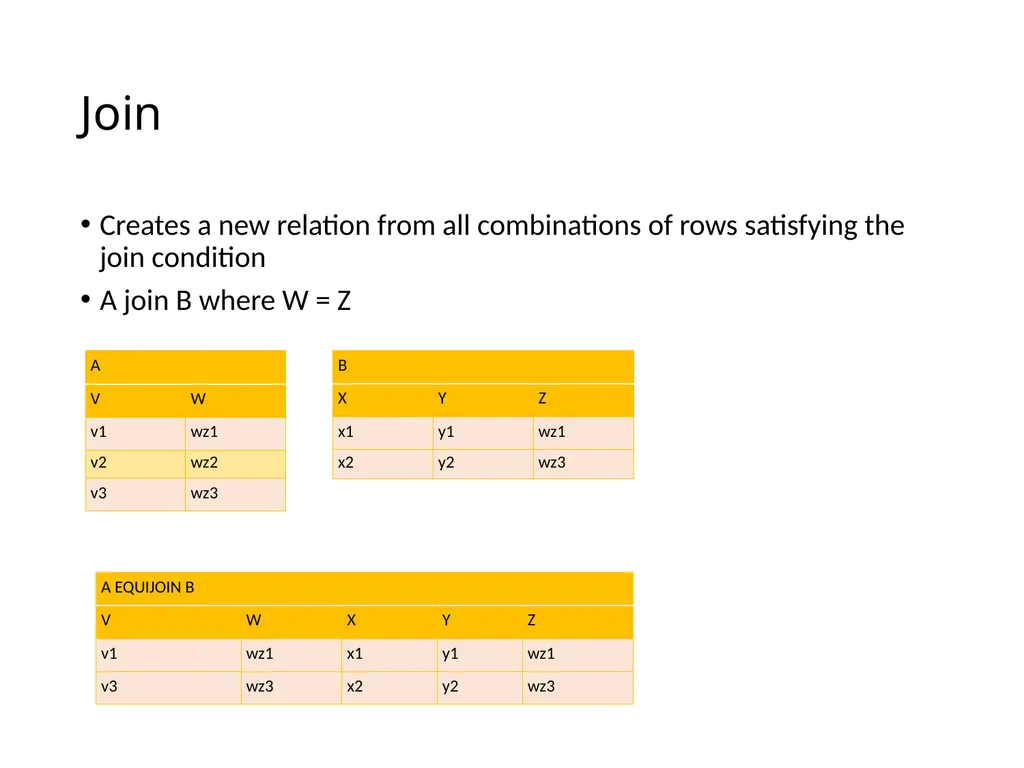
17
Join Creates a new relation from all combinations of rows satisfying the join condition
A join B where W = Z<br>
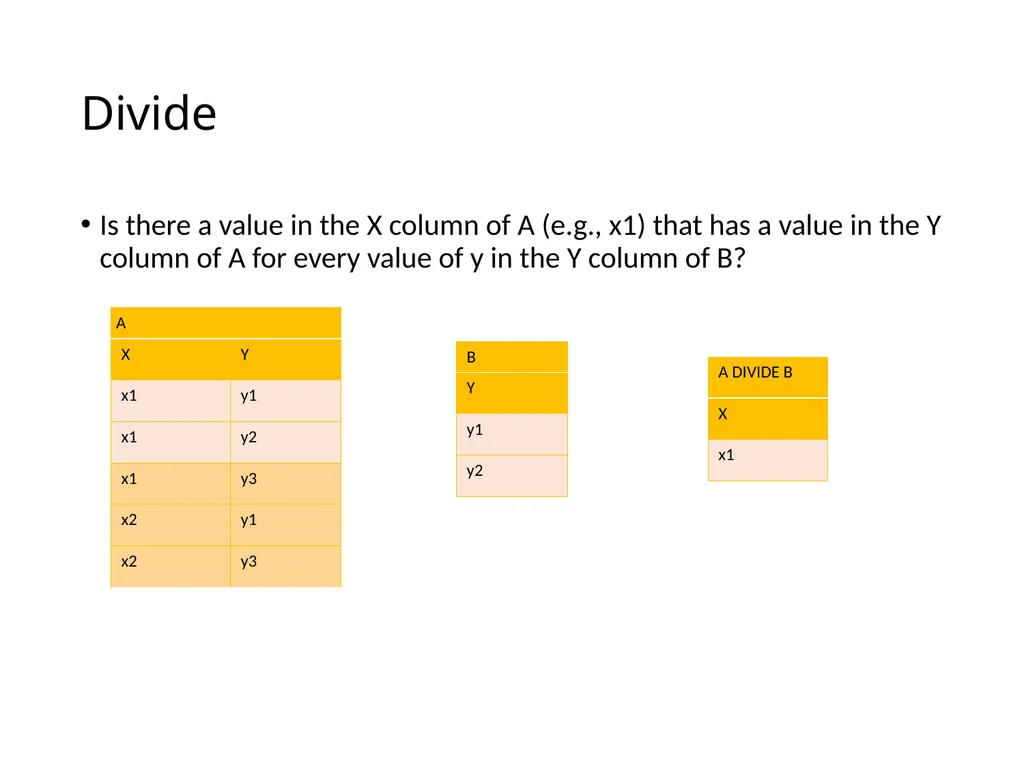
18
Divide Is there a value in the X column of A (e.g., x1) that has a value in the Y column of A for every value of y in the Y column of B?<br>
19
A primitive set of operators Only five operators are required
Restrict
Project
Product
Union
Difference<br>
20
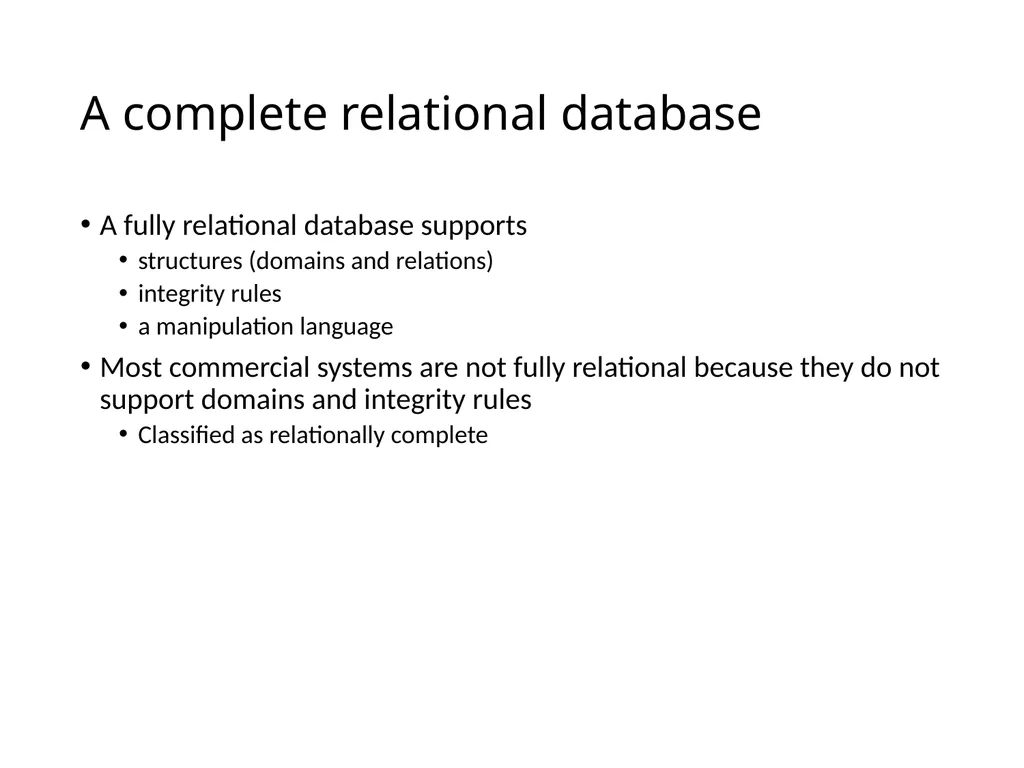
A complete relational database A fully relational database supports
structures (domains and relations)
integrity rules
a manipulation language
Most commercial systems are not fully relational because they do not support domains and integrity rules
Classified as relationally complete<br>
21
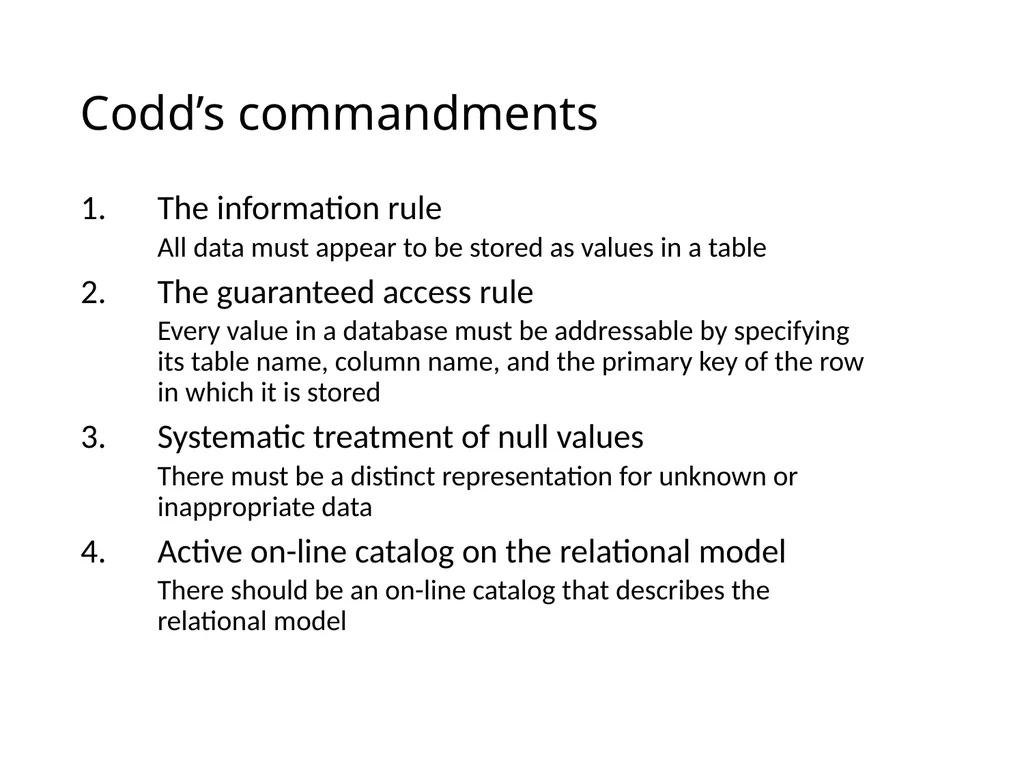
Codd’s commandments 1. The information rule
All data must appear to be stored as values in a table
2. The guaranteed access rule
Every value in a database must be addressable by specifying its table name, column name, and the primary key of the row in which it is stored
3. Systematic treatment of null values
There must be a distinct representation for unknown or inappropriate data
4. Active on-line catalog on the relational model
There should be an on-line catalog that describes the relational model<br>
22
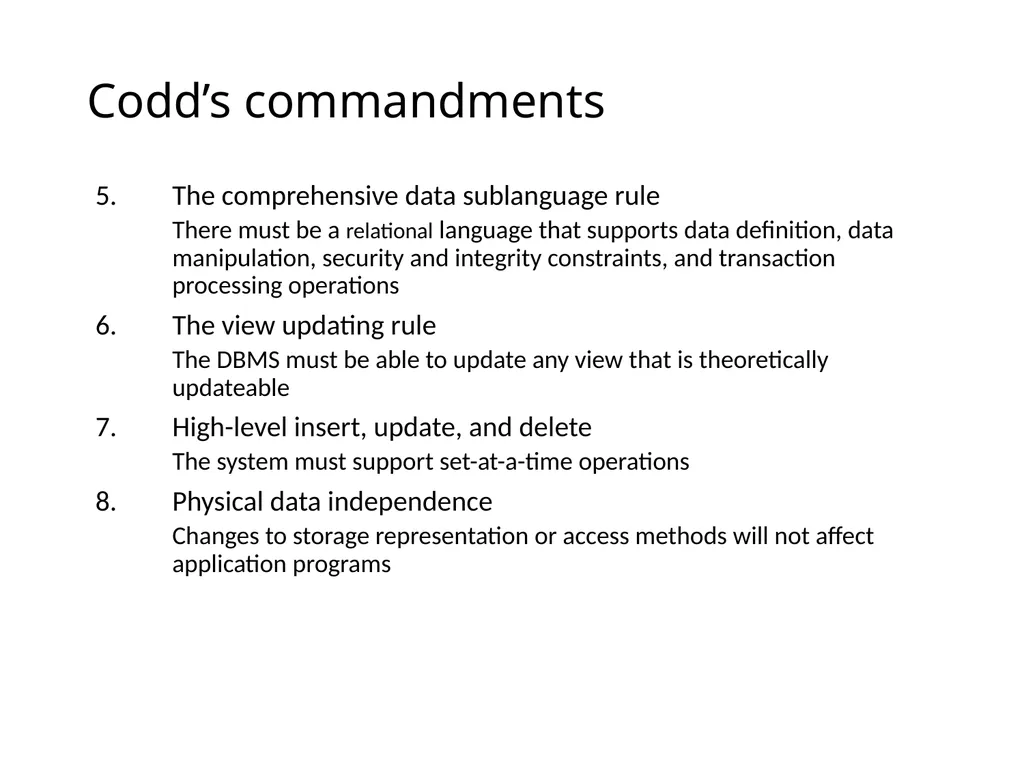
Codd’s commandments 5. The comprehensive data sublanguage rule
There must be a relational language that supports data definition, data manipulation, security and integrity constraints, and transaction processing operations
6. The view updating rule
The DBMS must be able to update any view that is theoretically updateable
7. High-level insert, update, and delete
The system must support set-at-a-time operations
8. Physical data independence
Changes to storage representation or access methods will not affect application programs<br>
23
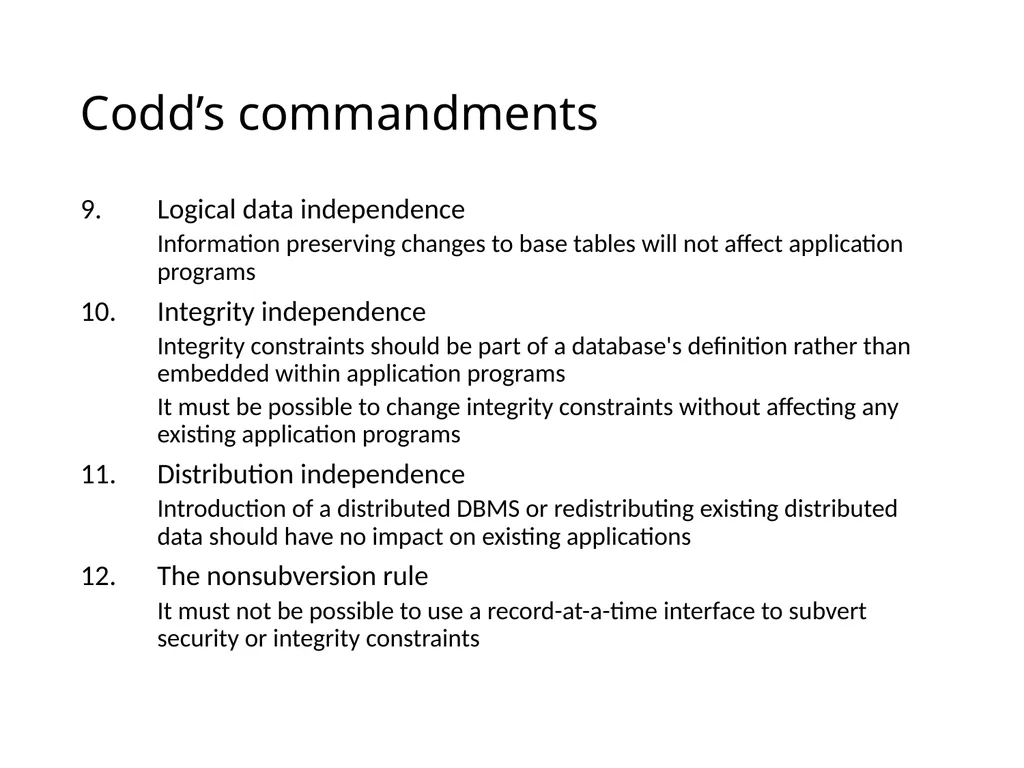
Codd’s commandments 9. Logical data independence
Information preserving changes to base tables will not affect application programs
10. Integrity independence
Integrity constraints should be part of a database's definition rather than embedded within application programs
It must be possible to change integrity constraints without affecting any existing application programs
11. Distribution independence
Introduction of a distributed DBMS or redistributing existing distributed data should have no impact on existing applications
12. The nonsubversion rule
It must not be possible to use a record-at-a-time interface to subvert security or integrity constraints<br>
24
Codd’s Rule 0 A relational DBMS must be able to manage databases entirely through its relational capacities
A DBMS is either totally relational or it is not relational<br>
25
Key points The relational model is theoretically grounded and practically relevant
Relational algebra is the foundation of SQL
A relational DBMS should satisfy a range of requirements to be fully relational<br>