The right of all to Roofs and Floors: Housing and
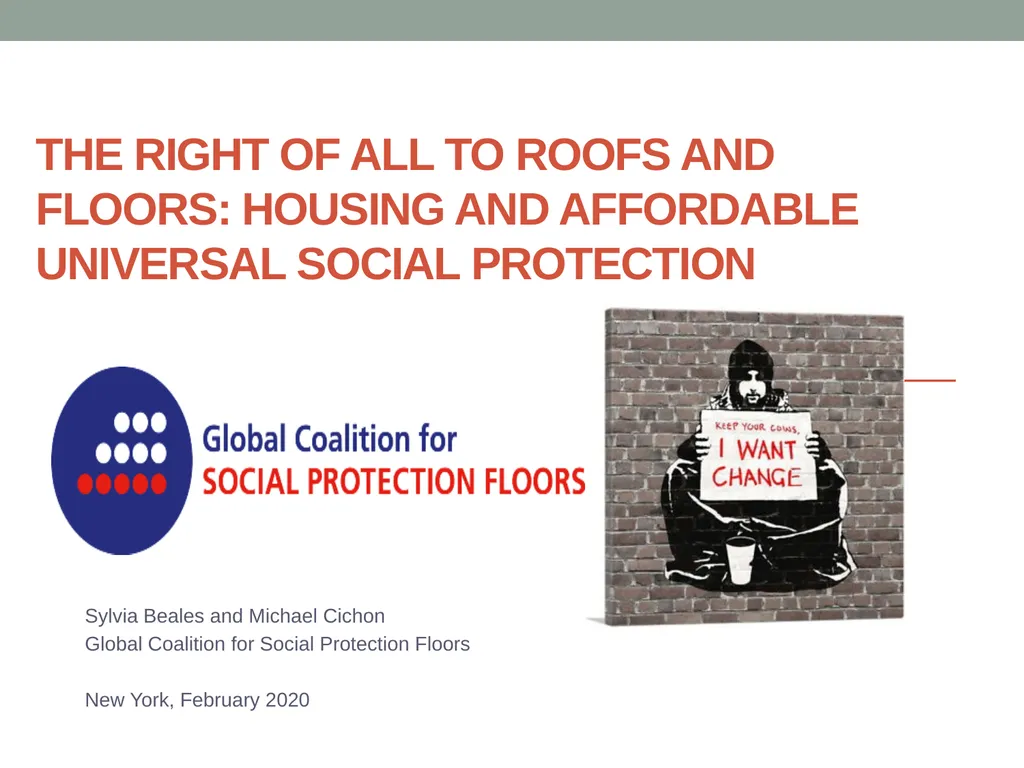
Description: The right of all to Roofs and Floors: Housing and Affordable Universal Social Protection Graffiti by Banksy Sylvia Beales and Michael Cichon Global Coalition for Social Protection Floors New York, February 2020 Global Coalition of Social
Related Topics
Download Presentation
"The right of all to Roofs and Floors: Housing and" is the property of its rightful owner. Permission is granted to download and print the materials on this website for personal, non-commercial use only, and to display it on your personal computer provided you do not modify the materials and that you retain all copyright notices contained in the materials. By downloading content from our website, you accept the terms of this agreement.
Presentation Transcript
slide1. The right of all to Roofs and Floors: Housing and Affordable Universal Social Protection Graffiti by Banksy
Sylvia Beales and Michael Cichon
Global Coalition for Social Protection Floors
New York, February 2020<br>
slide2. Global Coalition of Social Protection Floors Over 100 organisations with a vision to promote the implementation of social protection floors and the extension of social protection to all.
Our Mission is working strategically, collaboratively and in spirit of global solidarity, to provide a space and virtual platform for coalition members united by the common purpose of promoting the consolidation of social protection floors from a human rights perspective
From the basis of UDHR Articles 22 and 25, human rights instruments, international labour standards, ILO Recommendation No.202 and the 2030 Agenda for Sustainable Development. 11.02.2020 2<br>
slide3. Linking roofs and floors – reality check The right to roofs over one’s head is an indispensable and inseparable part of universal social protection
Social Protection is a Human Right as formulated in the Universal Declaration of Human Rights (UDHR, Art. 22 and 25)
Right to adequate shelter is articulated in Article 25
The Human Right to Water and Sanitation (HRWS) was recognised as a human right by the United Nations General Assembly on 28 July 2010 11.02.2020 3<br>
slide4. The state of the world in 2020 Homelessness affects 2 billion people, with millions housed in informally built shelters and refugee camps that lack adequate and accessible services and that fail all tests of adequacy
71% of people live in social and economic insecurity
4 billion people have no access to even one social protection benefit
Forty-five per cent of the global population receives only one social protection benefit.
1.3 billion children do not have social protection
Only 28 per cent of persons with disabilities receive social protection benefits
2.1 billion people have no access safe water or basic sanitary services
About 900 million people have no access to safe drinking water
815 million suffer from chronic hunger
100 million fall into poverty annually because they have to pay health services 11.02.2020 4<br>
slide5. National social protection floors:At least four nationally-defined guarantees The social protection floors should comprise at least the following basic social security guarantees: (para. 5) national definition of minimum levels Guarantees should be provided to at least all residents and children, as defined in national laws and regulations, subject to Members’ existing international obligations. (para. 6) 5<br>
slide6. A key point: the term guarantees encompasses transfers in cash and in kind... Para 4 of the recommendation states: national definition of minimum levels The guarantees should ensure at a minimum that, over the life cycle, all in need have access to essential health care and to basic income security which together secure effective access to
goods and services
defined as necessary at the national level. Health security education Food security Housing
security Water and sanitation Other ess. services 6<br>
slide7. Obligations of duty bearers to rights holders Overall and primary responsibility of the State 7<br>
slide8. Cost? Asia example of expected resource requirements – in % of GDP Estimate ! 11.02.2020 8<br>
slide9. Affordability of the SPFs Fiscal Size of the SP gaps according to civils society’s SPF Index = minimum resource required to close the gaps:
Of 137 countries 116 countries would theoretically be able to close their social protection gaps with national social protection spending increases of less than 4% of GDP (with 32 countries requiring less than 1% of GDP);
21 countries would require increases in spending of more than 4% of GDP to close their social protection gaps.
Among the latter, only a small number of countries would likely require some temporary international support … Support amounting to around 50% of their social protection bills, or an annual amount of US$10 – 15 billion, would be needed – an amount equivalent to roughly 1% of the estimated global military spending of about US$1.7 trillion.
Recent ILO study shows that in 57 countries even categorical cash benefits would cost less than 4% of GDP…
Most countries can afford do something 11.02.2020 9<br>
slide10. Tasks for the Actors…Ideally… National governments and parliaments to:
(1) Create strong legislative frameworks that ensure universal, non-discriminatory protection and reliable and adequate benefit entitlements as a right;
(2) Create or facilitate representative and transparent, encompassing and inclusive, national social dialogues;
(3) Build the administrative and governance capacities to operate effective, responsive and efficient national protection systems;
(4) Mobilize the necessary resources for social protection by prioritising social spend and increasing fiscal space - taxation
(5) International responsibility to ensure that social protection floors can be maintained despite structural poverty, and humanitarian and climate related disasters 11.02.2020 10<br>
slide11. Tasks for the Actors…Ideally International Financial Institutions to:
(1) Provide – whenever necessary – resources in the form of grants or concessional loans to facilitate investments in the set-up of national social protection systems that protect the entire resident population;
(2) Help assure necessary and sustainable resources to close national social protection gaps … ensure ‘ring fencing” of these resources in times of crises;
(3) Support the conceptualization and negotiation of international financial instruments, such as the International Financial Transaction Tax, or similar measures;
(4) Make the collaboration with relevant UN agencies and consultations with all national stakeholders a mandatory part of advisory activities and lending programmes;
(5) Contribute through their advisory and investment activities to the implementation of the SDGs and the globally or regionally agreed international instruments on social protection. 11.02.2020 11<br>
slide12. Tasks for the Actors…Ideally… The United Nations System and its specialized agencies ILO, WHO, to:
(1) Turn the ILO Recommendation on Social Protection Floors into a new International Convention on Universal Social Protection Floors, building upon the relevant commitments of the Sustainable Development Goals, ILO Recommendation 202;
(2) Create a Global Fund for Social Protection that helps countries with very low income and countries financing for essential social transfers;
(3) Support countries to develop representative, constructive and transparent national social dialogues;
(4) Intensify the collaboration within the UN system on social protection and wider social policy matters and monitor the national and international funding of social protection and the actions of the International Financial ;
(5) Increase their technical and advisory capacity to support member states on the development and financing of national social protection systems;
(6) Place stronger emphasis on supporting national capacity building for social protection planning, management and financing;
(7) Support the establishment of an international tax cooperation body at the United Nations. 11.02.2020 12<br>
slide13. Civil social should… Civil society and trade unions in coalition, to
(1) Raise awareness of and promote adherence to international instruments on social protection by national governments and international organizations and promote the further development of global standards, inter alia a new SPF convention;
(2) Pursue the set-up and continuation of national dialogues on social protection;
Demand cohesion of social protection policies with other social and economic policies, e.g. the reduction of informality and demanding wage levels that abolish in-work poverty;
Train trade unions and civil society representatives in the design, planning, financial and general management, supervising and monitoring of social protection systems as needed;
Monitor national and international efforts to extend social protection systems inter alia through organizing regular national and international “accountability” meetings that review national progress towards universal social protection for all 11.02.2020 13<br>
slide14. Some conclusions Not acting is not an option
Social protection systems are a sine-qua-non condition for wellbeing and social and economic development:
We can be aware of and use global rights frameworks to underpin policy
Political will required to make the right to social protection for all a political reality – examples exist
Social protection is affordable but resources have to be mobilized
National action includes adequate taxes, combatting tax evasion and re-prioritizing public expenditure – putting people first
International mechanisms can be activated to ease governments fiscal burden 12.02.2020 14<br>
slide15. Options to consider High profile ILO or UN Convention of social protection that will keep the topic on the international agenda for at least one decade…
Develop a global fund for Social Protection
Consider whether citizens can kickstart or crowd-fund such a fund 11.02.2020 15<br>
slide16. Final thought … There is nobody to poor to share…
Social protection for all is affordable,
but …
The price we have to pay for social
justice, we have to pay in sharing
our riches through taxes… 11.02.2020 16 Photo by Mike Marquez on Unsplash<br>
Sylvia Beales and Michael Cichon
Global Coalition for Social Protection Floors
New York, February 2020<br>
slide2. Global Coalition of Social Protection Floors Over 100 organisations with a vision to promote the implementation of social protection floors and the extension of social protection to all.
Our Mission is working strategically, collaboratively and in spirit of global solidarity, to provide a space and virtual platform for coalition members united by the common purpose of promoting the consolidation of social protection floors from a human rights perspective
From the basis of UDHR Articles 22 and 25, human rights instruments, international labour standards, ILO Recommendation No.202 and the 2030 Agenda for Sustainable Development. 11.02.2020 2<br>
slide3. Linking roofs and floors – reality check The right to roofs over one’s head is an indispensable and inseparable part of universal social protection
Social Protection is a Human Right as formulated in the Universal Declaration of Human Rights (UDHR, Art. 22 and 25)
Right to adequate shelter is articulated in Article 25
The Human Right to Water and Sanitation (HRWS) was recognised as a human right by the United Nations General Assembly on 28 July 2010 11.02.2020 3<br>
slide4. The state of the world in 2020 Homelessness affects 2 billion people, with millions housed in informally built shelters and refugee camps that lack adequate and accessible services and that fail all tests of adequacy
71% of people live in social and economic insecurity
4 billion people have no access to even one social protection benefit
Forty-five per cent of the global population receives only one social protection benefit.
1.3 billion children do not have social protection
Only 28 per cent of persons with disabilities receive social protection benefits
2.1 billion people have no access safe water or basic sanitary services
About 900 million people have no access to safe drinking water
815 million suffer from chronic hunger
100 million fall into poverty annually because they have to pay health services 11.02.2020 4<br>
slide5. National social protection floors:At least four nationally-defined guarantees The social protection floors should comprise at least the following basic social security guarantees: (para. 5) national definition of minimum levels Guarantees should be provided to at least all residents and children, as defined in national laws and regulations, subject to Members’ existing international obligations. (para. 6) 5<br>
slide6. A key point: the term guarantees encompasses transfers in cash and in kind... Para 4 of the recommendation states: national definition of minimum levels The guarantees should ensure at a minimum that, over the life cycle, all in need have access to essential health care and to basic income security which together secure effective access to
goods and services
defined as necessary at the national level. Health security education Food security Housing
security Water and sanitation Other ess. services 6<br>
slide7. Obligations of duty bearers to rights holders Overall and primary responsibility of the State 7<br>
slide8. Cost? Asia example of expected resource requirements – in % of GDP Estimate ! 11.02.2020 8<br>
slide9. Affordability of the SPFs Fiscal Size of the SP gaps according to civils society’s SPF Index = minimum resource required to close the gaps:
Of 137 countries 116 countries would theoretically be able to close their social protection gaps with national social protection spending increases of less than 4% of GDP (with 32 countries requiring less than 1% of GDP);
21 countries would require increases in spending of more than 4% of GDP to close their social protection gaps.
Among the latter, only a small number of countries would likely require some temporary international support … Support amounting to around 50% of their social protection bills, or an annual amount of US$10 – 15 billion, would be needed – an amount equivalent to roughly 1% of the estimated global military spending of about US$1.7 trillion.
Recent ILO study shows that in 57 countries even categorical cash benefits would cost less than 4% of GDP…
Most countries can afford do something 11.02.2020 9<br>
slide10. Tasks for the Actors…Ideally… National governments and parliaments to:
(1) Create strong legislative frameworks that ensure universal, non-discriminatory protection and reliable and adequate benefit entitlements as a right;
(2) Create or facilitate representative and transparent, encompassing and inclusive, national social dialogues;
(3) Build the administrative and governance capacities to operate effective, responsive and efficient national protection systems;
(4) Mobilize the necessary resources for social protection by prioritising social spend and increasing fiscal space - taxation
(5) International responsibility to ensure that social protection floors can be maintained despite structural poverty, and humanitarian and climate related disasters 11.02.2020 10<br>
slide11. Tasks for the Actors…Ideally International Financial Institutions to:
(1) Provide – whenever necessary – resources in the form of grants or concessional loans to facilitate investments in the set-up of national social protection systems that protect the entire resident population;
(2) Help assure necessary and sustainable resources to close national social protection gaps … ensure ‘ring fencing” of these resources in times of crises;
(3) Support the conceptualization and negotiation of international financial instruments, such as the International Financial Transaction Tax, or similar measures;
(4) Make the collaboration with relevant UN agencies and consultations with all national stakeholders a mandatory part of advisory activities and lending programmes;
(5) Contribute through their advisory and investment activities to the implementation of the SDGs and the globally or regionally agreed international instruments on social protection. 11.02.2020 11<br>
slide12. Tasks for the Actors…Ideally… The United Nations System and its specialized agencies ILO, WHO, to:
(1) Turn the ILO Recommendation on Social Protection Floors into a new International Convention on Universal Social Protection Floors, building upon the relevant commitments of the Sustainable Development Goals, ILO Recommendation 202;
(2) Create a Global Fund for Social Protection that helps countries with very low income and countries financing for essential social transfers;
(3) Support countries to develop representative, constructive and transparent national social dialogues;
(4) Intensify the collaboration within the UN system on social protection and wider social policy matters and monitor the national and international funding of social protection and the actions of the International Financial ;
(5) Increase their technical and advisory capacity to support member states on the development and financing of national social protection systems;
(6) Place stronger emphasis on supporting national capacity building for social protection planning, management and financing;
(7) Support the establishment of an international tax cooperation body at the United Nations. 11.02.2020 12<br>
slide13. Civil social should… Civil society and trade unions in coalition, to
(1) Raise awareness of and promote adherence to international instruments on social protection by national governments and international organizations and promote the further development of global standards, inter alia a new SPF convention;
(2) Pursue the set-up and continuation of national dialogues on social protection;
Demand cohesion of social protection policies with other social and economic policies, e.g. the reduction of informality and demanding wage levels that abolish in-work poverty;
Train trade unions and civil society representatives in the design, planning, financial and general management, supervising and monitoring of social protection systems as needed;
Monitor national and international efforts to extend social protection systems inter alia through organizing regular national and international “accountability” meetings that review national progress towards universal social protection for all 11.02.2020 13<br>
slide14. Some conclusions Not acting is not an option
Social protection systems are a sine-qua-non condition for wellbeing and social and economic development:
We can be aware of and use global rights frameworks to underpin policy
Political will required to make the right to social protection for all a political reality – examples exist
Social protection is affordable but resources have to be mobilized
National action includes adequate taxes, combatting tax evasion and re-prioritizing public expenditure – putting people first
International mechanisms can be activated to ease governments fiscal burden 12.02.2020 14<br>
slide15. Options to consider High profile ILO or UN Convention of social protection that will keep the topic on the international agenda for at least one decade…
Develop a global fund for Social Protection
Consider whether citizens can kickstart or crowd-fund such a fund 11.02.2020 15<br>
slide16. Final thought … There is nobody to poor to share…
Social protection for all is affordable,
but …
The price we have to pay for social
justice, we have to pay in sharing
our riches through taxes… 11.02.2020 16 Photo by Mike Marquez on Unsplash<br>