THE ROLE OF FINANCIAL INSTITUTIONS IN PROMOTING

Published  . 0 views
↓ Download
THE ROLE OF FINANCIAL INSTITUTIONS IN PROMOTING
1 / 1
THE ROLE OF FINANCIAL INSTITUTIONS IN PROMOTING - slide 1 of 24 THE ROLE OF FINANCIAL INSTITUTIONS IN PROMOTING - slide 2 of 24 THE ROLE OF FINANCIAL INSTITUTIONS IN PROMOTING - slide 3 of 24 THE ROLE OF FINANCIAL INSTITUTIONS IN PROMOTING - slide 4 of 24 THE ROLE OF FINANCIAL INSTITUTIONS IN PROMOTING - slide 5 of 24 THE ROLE OF FINANCIAL INSTITUTIONS IN PROMOTING - slide 6 of 24 THE ROLE OF FINANCIAL INSTITUTIONS IN PROMOTING - slide 7 of 24 THE ROLE OF FINANCIAL INSTITUTIONS IN PROMOTING - slide 8 of 24 THE ROLE OF FINANCIAL INSTITUTIONS IN PROMOTING - slide 9 of 24 THE ROLE OF FINANCIAL INSTITUTIONS IN PROMOTING - slide 10 of 24 THE ROLE OF FINANCIAL INSTITUTIONS IN PROMOTING - slide 11 of 24 THE ROLE OF FINANCIAL INSTITUTIONS IN PROMOTING - slide 12 of 24 THE ROLE OF FINANCIAL INSTITUTIONS IN PROMOTING - slide 13 of 24 THE ROLE OF FINANCIAL INSTITUTIONS IN PROMOTING - slide 14 of 24 THE ROLE OF FINANCIAL INSTITUTIONS IN PROMOTING - slide 15 of 24 THE ROLE OF FINANCIAL INSTITUTIONS IN PROMOTING - slide 16 of 24 THE ROLE OF FINANCIAL INSTITUTIONS IN PROMOTING - slide 17 of 24 THE ROLE OF FINANCIAL INSTITUTIONS IN PROMOTING - slide 18 of 24 THE ROLE OF FINANCIAL INSTITUTIONS IN PROMOTING - slide 19 of 24 THE ROLE OF FINANCIAL INSTITUTIONS IN PROMOTING - slide 20 of 24 THE ROLE OF FINANCIAL INSTITUTIONS IN PROMOTING - slide 21 of 24 THE ROLE OF FINANCIAL INSTITUTIONS IN PROMOTING - slide 22 of 24 THE ROLE OF FINANCIAL INSTITUTIONS IN PROMOTING - slide 23 of 24 THE ROLE OF FINANCIAL INSTITUTIONS IN PROMOTING - slide 24 of 24
Description: THE ROLE OF FINANCIAL INSTITUTIONS IN PROMOTING ENTREPRENEURSHIP ZICA CONFERENCE AUGUST 2018 Presented By: Simangolwa Shakalima Managing Director Investrust Bank Plc Institutionsorganizations that provide financial services for their

Related Topics

Download Presentation

"THE ROLE OF FINANCIAL INSTITUTIONS IN PROMOTING" is the property of its rightful owner. Permission is granted to download and print the materials on this website for personal, non-commercial use only, and to display it on your personal computer provided you do not modify the materials and that you retain all copyright notices contained in the materials. By downloading content from our website, you accept the terms of this agreement.

Presentation Transcript

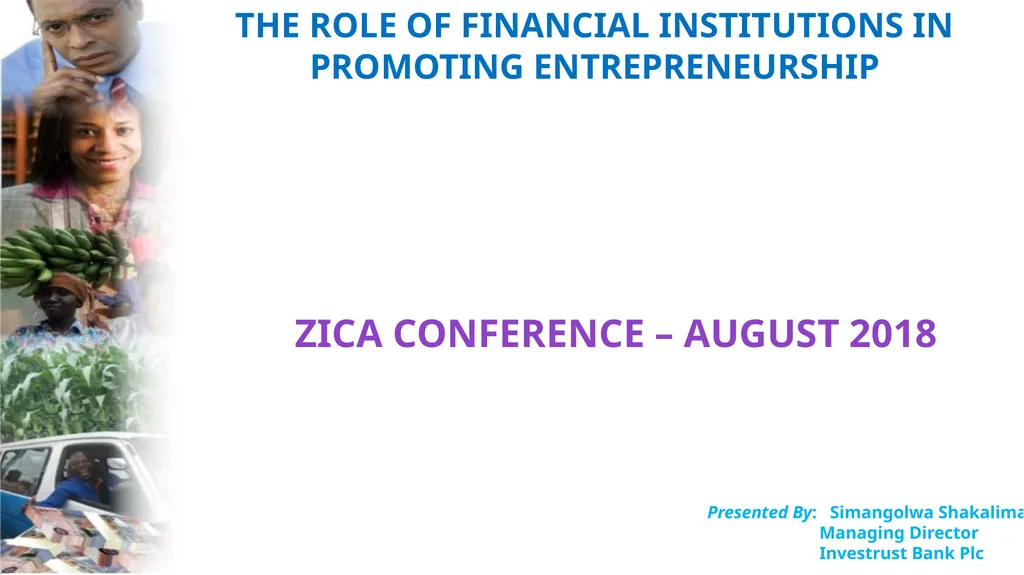
slide1. THE ROLE OF FINANCIAL INSTITUTIONS IN PROMOTING ENTREPRENEURSHIP ZICA CONFERENCE – AUGUST 2018 Presented By: Simangolwa Shakalima
Managing Director
Investrust Bank Plc<br>
slide2. Institutions/organizations that provide financial services
for their clients, members and society.

Most important financial service provided is acting as financial
intermediaries – collect funds from the public and place them
in financial assets such as deposits, loans and bonds (rather than
tangible property)

Plays an indispensable role in overall development of a country

Conduit for transfer of resources from net savers to net borrowers
(i.e. from those who spend less than their earnings to those who
spend more than their earnings

Mostly regulated by government Financial institutions – what are they? 2<br>
slide3. FI’s: include Banks, microfinance entities, credit unions, asset management firms, building societies and stock brokerages

Responsible for distributing financial resources in a planned way to potential users

Performed in following ways:
Accepting deposits

Providing Agricultural loans

Providing Commercial loans

Providing Real estate Loans

Providing Mortgage loans

Collaterised financing

Issuing Share Certificates Functions of Financial Institutions 3<br>
slide4. 4 FI LANDSCAPE IN ZAMBIA<br>
slide5. Transformative function of Financial Institutions 5<br>
slide6. COMMERCIAL BANKS

Banking institutions that accept deposits (repayable on demand) and grant short-term loans and advances to customers

In addition to giving short-term loans, commercial banks also give medium-term and long term loans to business enterprises

Increasingly, they are also providing housing loans on a long-term basis to individuals.

Providers of depository and transaction services. These activities are major sources of creating money. Major source of providing loans and other credit facilities to clients TYPES OF COMMERCIAL BANKS

Public Sector Banks: where majority stake is held by government e.g. ZICB (IDC) Investrust (ZCCM-IH), ZANACO, IZB:

Private Sector Banks: majority of share capital of the Bank is held by private individuals. Registered as companies with limited liability Commercial Bank’s Role as a Financial Institution 6<br>
slide7. Primary functions

Accepting deposits

Granting loans and advances

Secondary functions

Issuing letters of credit, bank drafts, bank guarantees, travelers cheques etc

Undertaking safe custody of valuables, important document and securities by providing safe deposit vaults or lockers

Providing customers with facilities of foreign exchange dealings

Transferring money from one account to another; and from one branch to another branch of the bank through cheque, pay order, demand draft (transfers and payments) Banking products/functions of Commercial Banks 7<br>
slide8. Background Factors Economic Factors Rewards Motivational Factors Entrepreneurship Education, training & experience
Family background
Support System
Financial conditions Need for achievement
Locus of control
Business environment Supportive government policies
Availability of funds
Availability of technical factors
Ancillary support Recognition
Status Entrepreneur: Person who sets up a business or businesses, taking on financial risks in the hope of profit ..An agent who buys factors of production at certain prices in order to combine them into a product with a view to selling it at uncertain prices in future All entrepreneurs are business persons but not all business persons are entrepreneurs Factors affecting Entrepreneurship 8<br>
slide9. Environmental
Raw material
Labour
Machinery
Land & Building
Financial

Personal
Lack of confidence
Lack of motivation
Lack of patience
Inability to Dream

Social
Pressure from:
- community, family, peers Commitment & Determination
- Tenacious, decisive, persistent

Leadership
- Self starter, high standards

Opportunity obsession
- Intimate knowledge

Tolerance of Risk
- Calculated risk taker

Creativity/Adaptability
- Open minded, no fear of failure

Motivation to Excel
- Goal oriented, drive for results DESIRABLE ATTRIBUTES BARRIERS Barriers and attributes of Entrepreneurs 9<br>
slide10. Financing Entrepreneurs

Credit is the prime input for sustained growth
Short term credit/working capital for day to day requirement for purchasing raw materials and other inputs e.g. electricity, water, payment of salaries and wages
Long term credit for creation of fixed assets like land, building plant and machinery.
Financial assistance on easy terms and hassle-free procedures
Indirect schemes: Refinance, Bills rediscounting

Loans for importing equipment to export oriented
Confirmed Export orders by way of pre-shipment credit / letter of credit
Venture capital fund – innovative indigenous technology and expertise Attractive schemes for availability of finance
Other Assistance:
Technical Know how
Training
Sales Financial Institutions support to Entrepreneurs 10<br>
slide11. VENTURE CAPITAL FUNDING

Venture Capital: means of equity financing for rapidly-growing private companies

Finance may be required for start-up, development/expansion or purchase of a company

VC firms invest funds on a professional basis, often focusing on limited sector of specialization (e.g. IT, Infrastructure, health/life sciences, clean technology)

Goal is to build companies so that shares become liquid (through IPO or acquisition) and provide a rate of return to the investors (in form of cash or shares) consistent with level of risk taken Venture Capital Funding 11<br>
slide12. DEBT:
Amount borrowed by one party from another
Used by many corporations and individuals as a method for making large purchases that they could not afford under normal circumstances
Debt arrangement gives the borrowing party permission to borrow money under condition it is to be paid back at later stage usually with interest

FORMS OF DEBT:
Loans (mortgages, auto loans): borrower required to repay balance of loan by a certain date, typically several years – amount of interest to pay annually expressed as a percentage of loan amount
Credit Cards: same as a loan except borrowed amount changes over time up to predetermined limit and has a rolling or open ended repayment date
Corporate Debt: Bonds and Commercial paper. Bonds: debt instrument that allows a company to generate funds by selling the promise of repayment to investors, They typically carry a set interest or coupon, rate. Bondholders are promised repayment of face value of the bond at a certain date in the future, (maturity date) in addition to promise of regular interest payments throughout the intervening years. Commercial Paper: short term corporate bond with a maturity of 270 days or less Debt and its Role in Entrepreneurship 12<br>
slide13. A company that has a large amount of debt may not be able to make its interest payments if fundamentals change e.g. sales drop, putting the business in danger of bankruptcy

Conversely a company that uses no debt may be missing out on important expansion opportunities

Right amount of debt varies from business to business. Various metrics used to determine if level of debt, or leverage, the company uses to fund operations is within a healthy range

Debt Service
Cash required to cover repayment of interest and principal on a debt for a particular period.
Ability to service debt is a factor when a company needs to raise additional capital to operate the business
Debt service coverage ratio compares the company’s net income to amount of principal and interest the firm must pay. (Earnings from normal business operations)

Debt Consolidation
Lumping debts into a single payment
Use of one form of financing to pay off other debts (especially where a borrower has difficulty managing the number or size of outstanding debts Good –vs- Bad Debt 13<br>
slide14. Proper use of debt financing is beneficial to the business in a number of different ways.
First, debt financing almost always costs substantially less than equity financing (the exception being when the business is approaching bankruptcy or very high levels of debt). much more readily available
The second benefit of proper use of debt financing is the potential for enhanced return on assets (ROA). If the company could borrow at a rate that, after tax, is lower than the return of the financed asset, then it would be very prudent to do so.

One big problem with debt financing occurs when business owners start using short-term financing for long-term assets or long-term financing for short-term financial goals. Term debt financing should be used for long term asset financing and short-term debt, like lines of credit, should only be used for working capital financing. Total annual interest expense (relative to revenues) should never exceed the net operating income margin. This is negative leverage and must be avoided at all costs.
Few companies can financially function without the use of debt financing and even those that produce enough cash flow to avoid the use of debt should seriously reconsider that choice. Debt financing is just far cheaper than equity financing. A prudent financial balance is essential but outright avoidance of debt because of what the misuse of debt can cause is shortsighted and damaging to the company.
Use your debt capacity wisely!
Avoid negative leverage and make sure that the business’s next big purchase doesn’t eat up expensive equity. Building a healthy, efficient debt portfolio and making sure that financing doesn’t eat the return on assets is critical.

Short term financing is commonly used by businesses who tend to have temporary cash flow issues when sales revenues are insufficient to cover current expenses.
Startup businesses are particularly prone to cash flow management problems. Uses of Debt Financing<br>
slide15. Debt is Used by many corporations and individuals as a method for making large purchases that they could not afford under normal circumstances
Debt arrangement gives the borrowing party permission to borrow money under condition it is to be paid back at later stage usually with interest
Right amount of debt varies from business to business.
Ability to service debt is a factor when an entity needs to raise additional capital to operate the business
Various metrics used to determine if level of debt, or leverage, the company uses to fund operations is within a healthy range
Long Term Debt Financing usually applies to assets your business is purchasing, such as equipment, buildings, land, or machinery.
Short Term Debt Financing usually applies to money needed for the day-to-day operations of the business, such as purchasing inventory, supplies, or paying the wages of employees.
DO NOT use long term debt for financing short term needs and vice versa
Avoid negative leverage
Liquidity influences supply of debt and cost thereof. Recent BOZ monetary policy interventions aiding liquidity in the market
Non-performance has devastating effects on supply, credit policies and cost of money Summary – debt financing 15<br>
slide16. MARKET DEPOSITS (LIABILITIES): Good growth up to 2014 but rather flat since 2015 wrt to Kwacha but consistent growth in dollar deposits 16<br>
slide17. MARKET ASSETS (LOANS): Significant & consistent growth since 2012 until end of 2015 in the face of liquidity challenges 17<br>
slide18. TREND OF NON PERFORMING LOANS / ADVANCES 18<br>
slide19. The Investrust Line of Credit ZAMBIA SME/ENTREORENEUR SUPPORT PROGRAMME

In partnership with the ADB, Investrust Bank was advanced USD3.5m.

The funding was aimed at expanding SME/Entrepreneur access to affordable and long dated finance. This would help tackle the prohibitive cost of finance to Entrepreneurs.

As part of the package, a technical assistance package was attached to achieve:
Credit scoring capabilities for the Bank when assessing SMEs, and
Training of qualifying Entrepreneurss in key areas of their business; basic accounting, marketing, human resources etc. 19<br>
slide20. Review of the performance of the Credit Line The full US$3.5 million has been disbursed to SMEs/Entrepreneurs
23 Entrepeneur’s have benefited
Sectors include:
Hospitality
Manufacturing
Transport
Construction
Wholesale
All the loans are performing
We have supported women such as Ndanji Fashions and Eva’s Salon Limited and Alame Investments Ltd
We have supported youths such as Movajo General Trading who are a young couple.
We have sent in excess of 250 SME’s for ADF Training 20<br>
slide21. The Challenges and issues in implementing the credit line 21 How The Banks View SMEs/Entrepreneurs
Very risky lending to SMEs hemerally.
They have no proper and verifiable accounting and other records.
Most have no acceptable forms of collateral.
They are normally locally owned, owner managed and owner controlled. Issues of succession planning are critical.
They have no cross border, transnational businesses acumen. Has less appreciation of the role of science and technology in enhancing product value, quality and competitiveness.
Not formally registered and not tax compliant. Usually in an inappropriate legal form.
Challenge is project viability pre and post credit.<br>
slide22. Improving project implementation 22 Training to address among other the below challenges:

Proper and verifiable accounting and other records.
Not formally registered and not tax compliant. Usually in an inappropriate legal form.
Challenge is project viability pre and post credit.

Developing SME analysis tool - SME Credit Scoring Software<br>
slide23. Results against the objectives 23 Developing SME Credit Scoring Software – International Trade Centre in conjunction with ILO

Training in excess of 250 SME’s for ADF Training
Disbursed full amount<br>
slide24. Financial Institutions
Very essential part of financial system
Play a vital role in economic development
Zambian FI’s are very strong but can improve use in effective manner

Small scale enterprises lack sufficient finance to run their enterprises
Important types of assistance are term finance, refinance, working capital finance
Finance as life blood is important but not magic wand to run an enterprise. Require supportive facilities and services rendered by financial institutions: consultancy and training services, appraisals
Financial Institutions crucial and unavoidable for development and growth

Structural issues to be addressed by FIs & stakeholders to support entrepreneurs:
Venture Capital
Incubators Conclusion 24<br>