04
There may be many reasons why we might want to test ideas. They may include:
Curiosity
Personal motivation
Addressing a societal issue or an everyday problem
Testing someone else’s idea
A surprising observation Reasons for Testing Ideas<br>
05
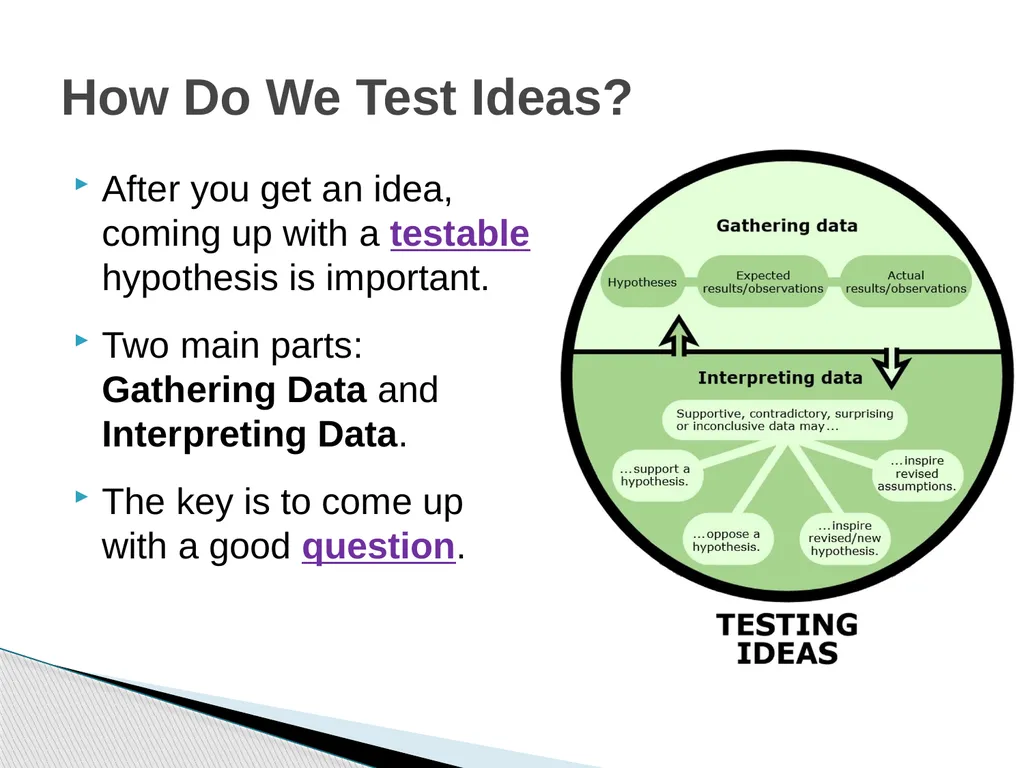
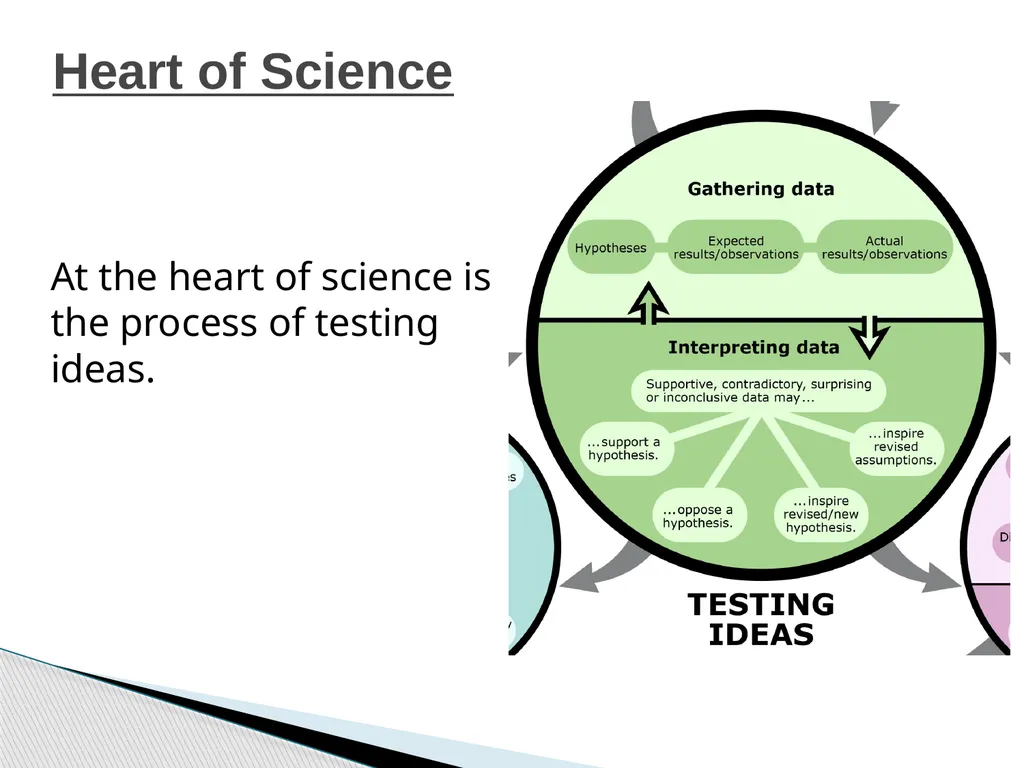
After you get an idea, coming up with a testable hypothesis is important.
Two main parts: Gathering Data and Interpreting Data.
The key is to come up with a good question. How Do We Test Ideas?<br>
06
There are generally 3 types of experiments:
A Controlled Experiment
A Quasi-Experiment
An Observational Study Experiment Types<br>
07
All experiments have some parts in common:
Hypothesis or a research question
Identification of variables
Observations
Interpretation of data<br>
08
A variable is any factor that could affect what it is you’re studying.
Some variables you can control or change, some you cannot.
The types of experiment vary in terms of the amount of control over variables the experimenter has. Variables<br>
09
Experimenter is able to control or account for all aspects of the experiment.
Allows us to establish cause-effect relationships and therefore claim causation.
Example
Does sunlight affect plant growth? Controlled Experiments<br>
10
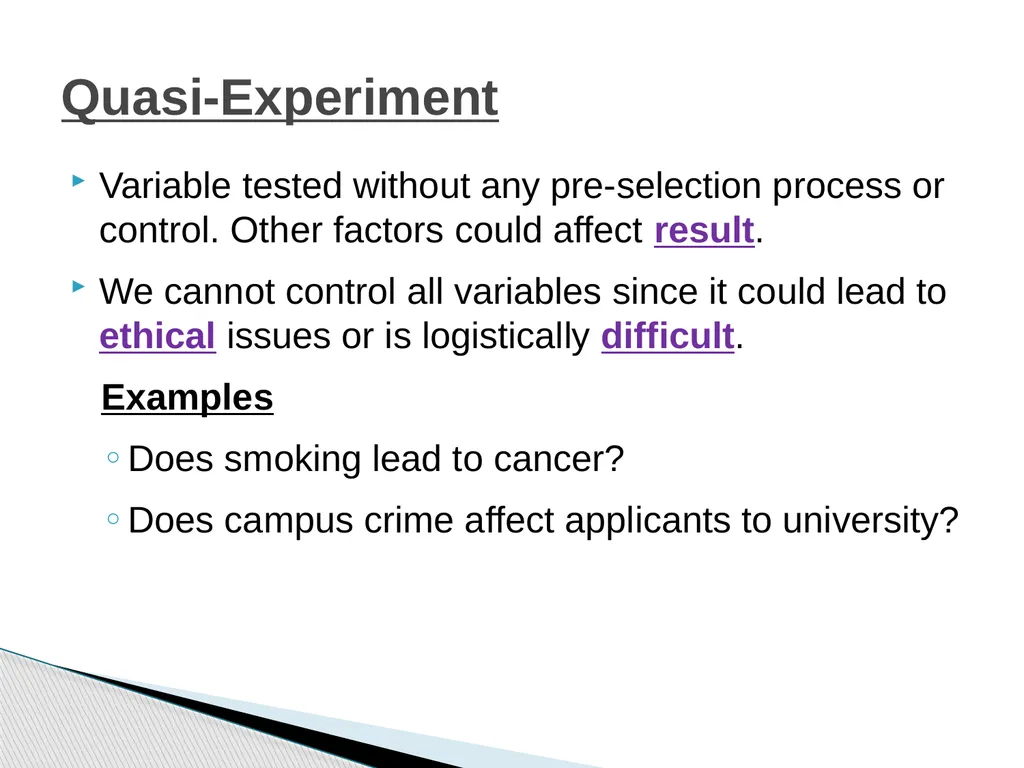
Variable tested without any pre-selection process or control. Other factors could affect result.
We cannot control all variables since it could lead to ethical issues or is logistically difficult.
Examples
Does smoking lead to cancer?
Does campus crime affect applicants to university? Quasi-Experiment<br>
11
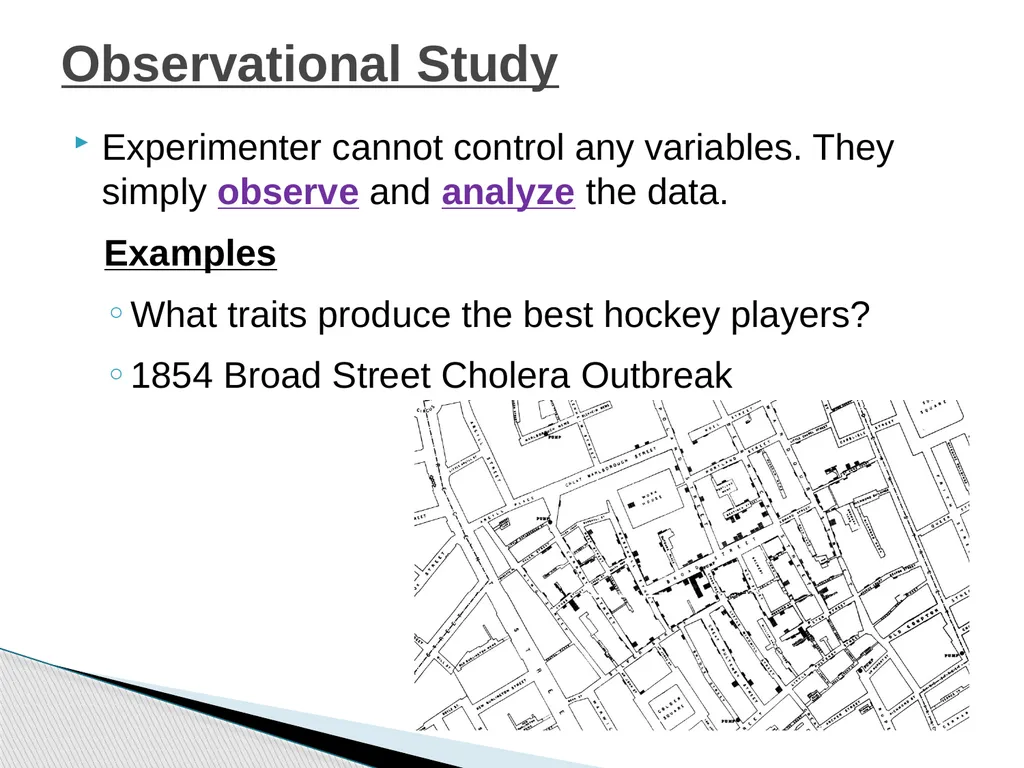
Experimenter cannot control any variables. They simply observe and analyze the data.
Examples
What traits produce the best hockey players?
1854 Broad Street Cholera Outbreak Observational Study<br>
12
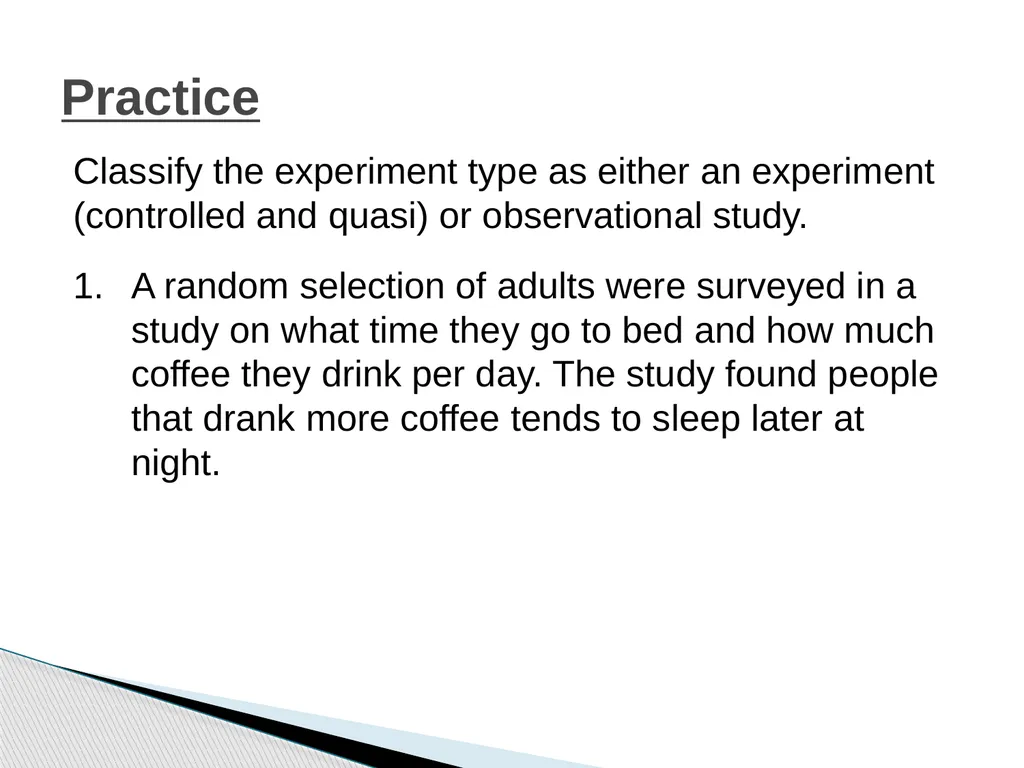
Classify the experiment type as either an experiment (controlled and quasi) or observational study.
A random selection of adults were surveyed in a study on what time they go to bed and how much coffee they drink per day. The study found people that drank more coffee tends to sleep later at night. Practice<br>
13
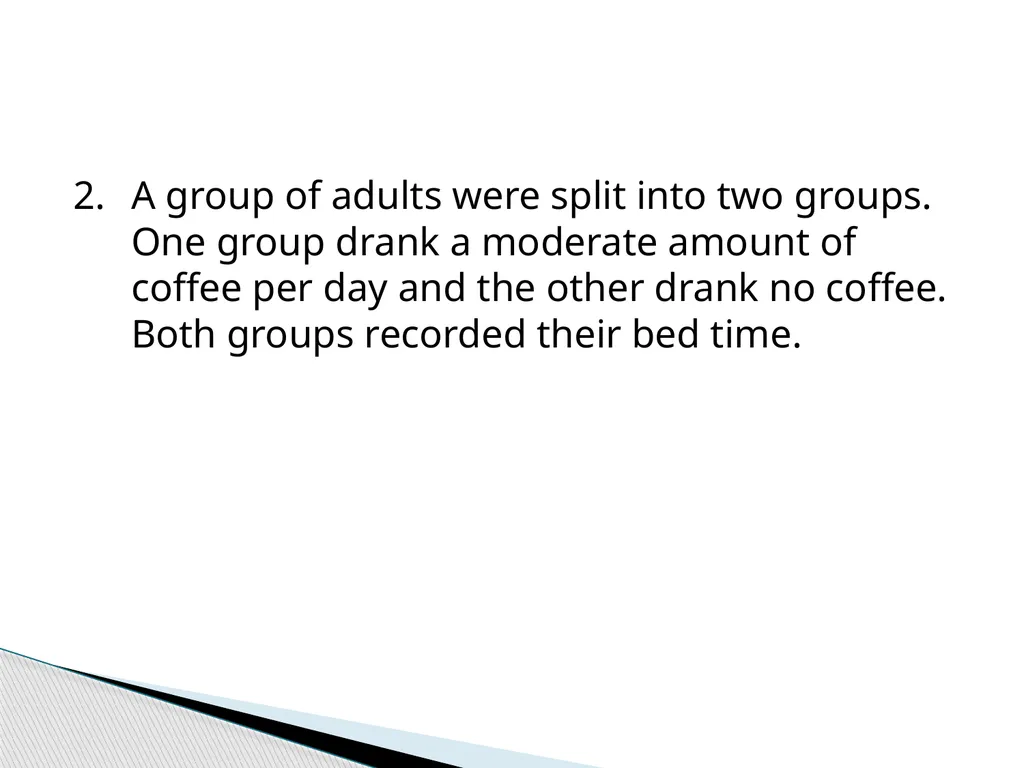
A group of adults were split into two groups. One group drank a moderate amount of coffee per day and the other drank no coffee. Both groups recorded their bed time.<br>
14
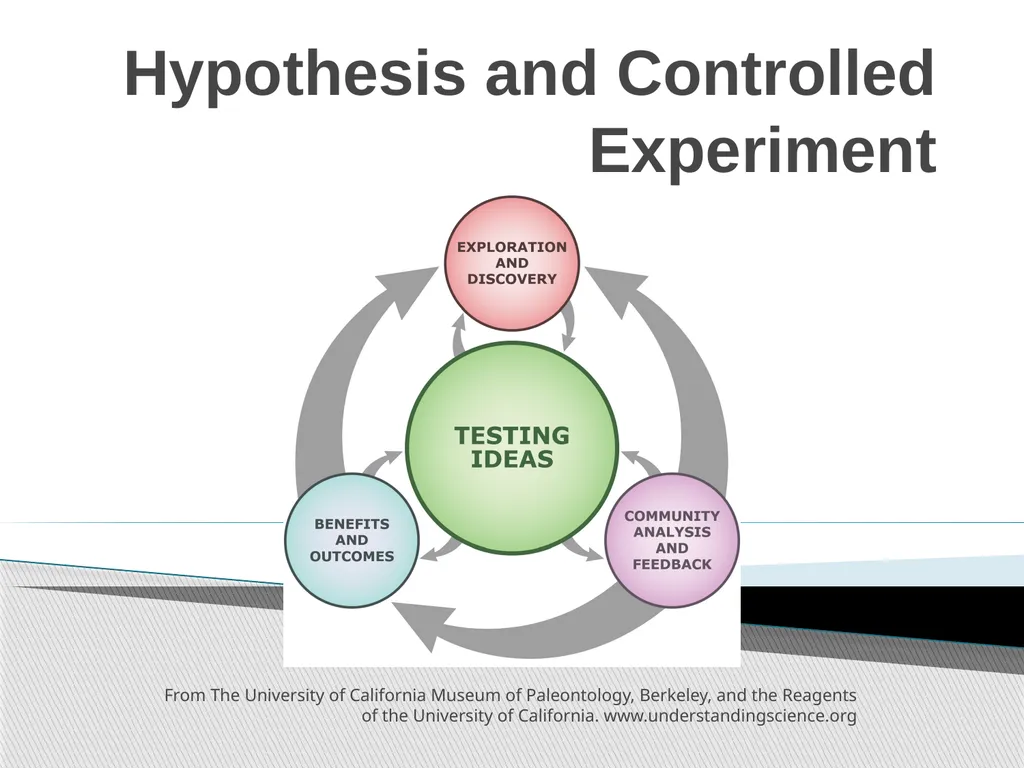
Hypothesis and Controlled Experiment From The University of California Museum of Paleontology, Berkeley, and the Reagents of the University of California. www.understandingscience.org<br>
15
Heart of Science At the heart of science is the process of testing ideas.<br>
16
Before Testing Ideas… Find a problem or something you want to figure out.
i.e., How does acid rain affect the environment?
What kind of background knowledge do you think you might need? (exploring literature, discussion with colleagues)
Identify something specific you want to test and come up with a hypothesis.<br>
17
Narrowing Down The Initial Question What is the effect of acid rain on plants?
What background knowledge might you have to research before tackling this question?
Acidity and acid rain
How plants grow
Types of plants?<br>
18
Try to be more specific in your question:
What is the effect of acid rain on the growth rate of sunflower plants?<br>
19
Hypothesis… Is a possible explanation or a prediction based on limited evidence.
Is the starting point for further investigation.
Is developed from the original question in the inquiry/investigation
Is based on prior knowledge
Oftentimes an “if… then… because” statement.<br>
20
Controlled Experiments For certain questions, you may be able to conduct a controlled experiment.
The factors that might influence the data are called variables.
In controlled experiments, all the variables are under control of the experimenter.<br>
21
Types of Variables The variable that the investigator changes is called the independent variable.
The variable that changes due to the change in the independent variable is called the dependent variable.
All other variables that are kept the same are called controlled variables.<br>
22
A controlled experiment should be repeated multiple times (“trials”)
It is important to have a controlled trial in this type of experiment.
A controlled trial mimics normal conditions.<br>
23
Example: What is the effect of acid rain on the growth rate of sunflower plants?<br>
24
Question: How does temperature (heat energy) affect the rate at which water boils?
Hypothesis: If more heat energy is added to water, then the water will come to a boil faster because the water particles will be moving faster. Example #1<br>
25
Question: How does the amount of time a student spends studying affect their grades?
Hypothesis: If a student studies more, then their marks will improve because they have a better understanding of the material. Example #2<br>
26
Try #1: How does acid rain affect the growth of sunflowers?
What could our hypothesis be?
How could we conduct the experiment?<br>
27
What would be our independent and dependent variables?
What are some controlled variables?
What is our controlled trial?<br>
28
Try#2: We want to know whether seeds germinate faster if fertilizer is applied.
What could our hypothesis be?
How would we conduct the experiment?<br>
29
What would be our independent and dependent variables?
What are some controlled variables?
What is our controlled trial?<br>
31
ADD NOTES HERE FOR GRAPHS<br>