
The Scope for an Independent Monetary Policy on
GB
Published · 19 slides · 0 views

1 / 1




Description
The Scope for an Independent Monetary Policy on the Path to EU Accession Erald Themeli Head of the Monetary Policy Department Presentation on Conference co-organized by the Bank of Albania and the Albanian Association of Banks The Role of
Related Topics
Share
Embed code
Download this presentation From Below
"The Scope for an Independent Monetary Policy on" is the property of its rightful owner. Permission is granted to download and print the materials on this website for personal, non-commercial use only, and to display it on your personal computer provided you do not modify the materials and that you retain all copyright notices contained in the materials. By downloading content from our website, you accept the terms of this agreement.
Presentation Transcript
01
The Scope for
an Independent Monetary Policy
on the Path to EU Accession Erald Themeli
Head of the Monetary Policy Department
Presentation on
Conference co-organized by the Bank of Albania and the Albanian Association of Banks
The Role of Central Banks and Banking Systems on the Path to EU<br>
Head of the Monetary Policy Department
Presentation on
Conference co-organized by the Bank of Albania and the Albanian Association of Banks
The Role of Central Banks and Banking Systems on the Path to EU<br>
02
Motivation EU accession means an irrevocable commitment to an eventual adoption of Euro and access to the Eurozone
However, new member states can choose to forego the immediate adoption of the Euro at the moment of access, if such an option is deemed sub-optimal
Drawing a balance on the pros & cons of euro adoption / loss of monetary policy independence, is a complex exercise
This presentation aims to present a preliminary assessment of the desirability of an early euro adoption for Albania 2<br>
However, new member states can choose to forego the immediate adoption of the Euro at the moment of access, if such an option is deemed sub-optimal
Drawing a balance on the pros & cons of euro adoption / loss of monetary policy independence, is a complex exercise
This presentation aims to present a preliminary assessment of the desirability of an early euro adoption for Albania 2<br>
03
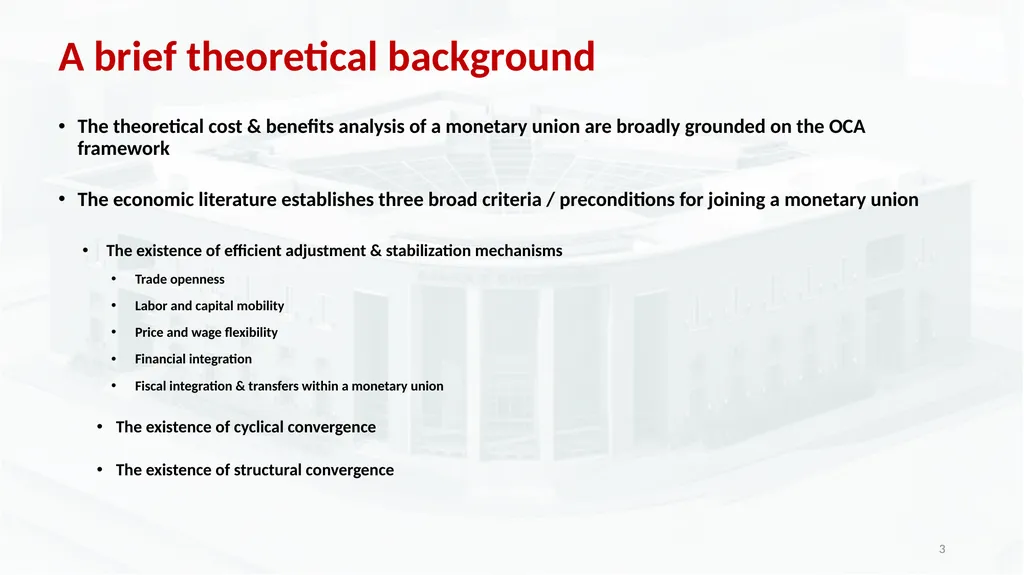
A brief theoretical background 3 The theoretical cost & benefits analysis of a monetary union are broadly grounded on the OCA framework
The economic literature establishes three broad criteria / preconditions for joining a monetary union
The existence of efficient adjustment & stabilization mechanisms
Trade openness
Labor and capital mobility
Price and wage flexibility
Financial integration
Fiscal integration & transfers within a monetary union
The existence of cyclical convergence
The existence of structural convergence<br>
The economic literature establishes three broad criteria / preconditions for joining a monetary union
The existence of efficient adjustment & stabilization mechanisms
Trade openness
Labor and capital mobility
Price and wage flexibility
Financial integration
Fiscal integration & transfers within a monetary union
The existence of cyclical convergence
The existence of structural convergence<br>
04
Content 4 Cyclical convergence between Albania and Euroarea
Structural convergence between Albania and Euroarea
A case study on the benefits of independent monetary policy for Albania
Conclusions<br>
Structural convergence between Albania and Euroarea
A case study on the benefits of independent monetary policy for Albania
Conclusions<br>
05
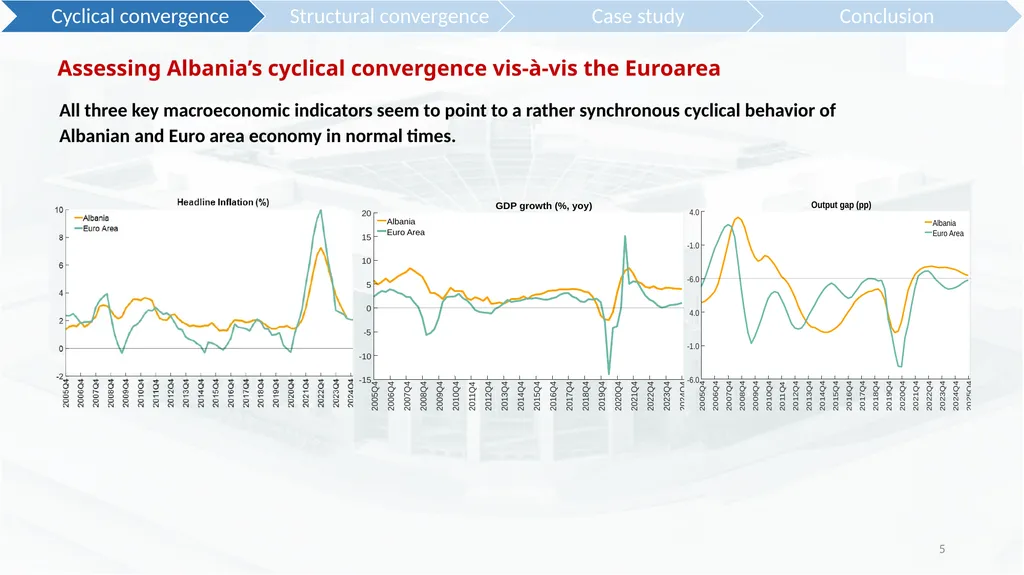
Source: MPD projections 5 All three key macroeconomic indicators seem to point to a rather synchronous cyclical behavior of Albanian and Euro area economy in normal times. Assessing Albania’s cyclical convergence vis-à-vis the Euroarea<br>
06
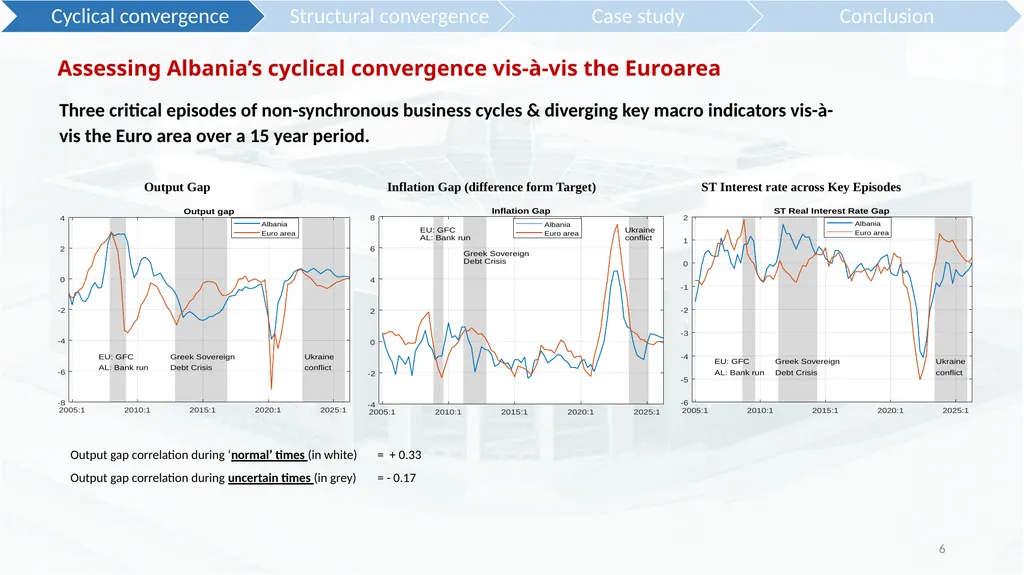
Source: MPD projections 6 Output Gap Inflation Gap (difference form Target) ST Interest rate across Key Episodes Output gap correlation during ‘normal’ times (in white) = + 0.33
Output gap correlation during uncertain times (in grey) = - 0.17 Three critical episodes of non-synchronous business cycles & diverging key macro indicators vis-à-vis the Euro area over a 15 year period. Assessing Albania’s cyclical convergence vis-à-vis the Euroarea<br>
Output gap correlation during uncertain times (in grey) = - 0.17 Three critical episodes of non-synchronous business cycles & diverging key macro indicators vis-à-vis the Euro area over a 15 year period. Assessing Albania’s cyclical convergence vis-à-vis the Euroarea<br>
07
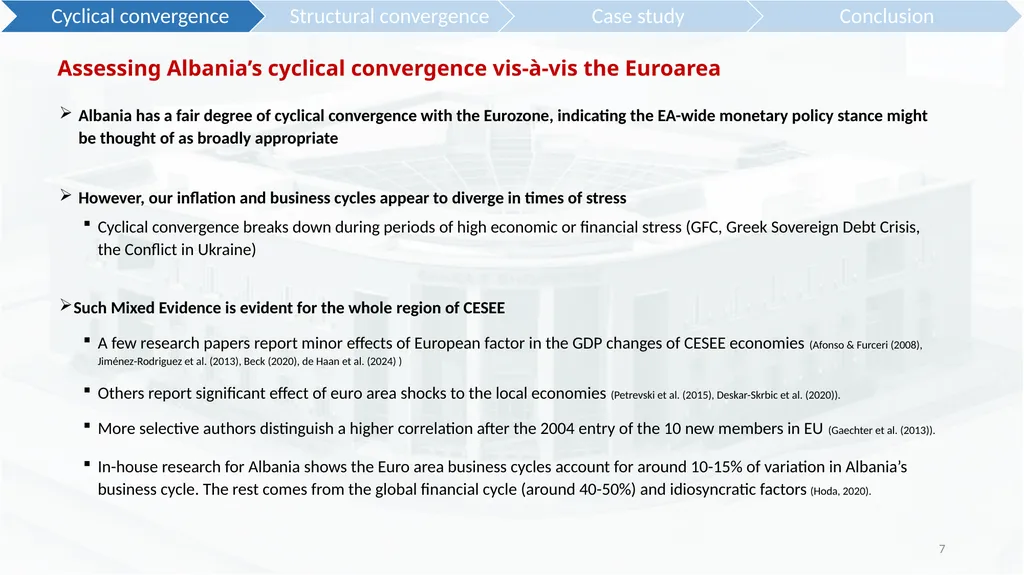
Source: MPD projections 7 Albania has a fair degree of cyclical convergence with the Eurozone, indicating the EA-wide monetary policy stance might be thought of as broadly appropriate
However, our inflation and business cycles appear to diverge in times of stress
Cyclical convergence breaks down during periods of high economic or financial stress (GFC, Greek Sovereign Debt Crisis, the Conflict in Ukraine)
Such Mixed Evidence is evident for the whole region of CESEE
A few research papers report minor effects of European factor in the GDP changes of CESEE economies (Afonso & Furceri (2008), Jiménez-Rodriguez et al. (2013), Beck (2020), de Haan et al. (2024) )
Others report significant effect of euro area shocks to the local economies (Petrevski et al. (2015), Deskar-Skrbic et al. (2020)).
More selective authors distinguish a higher correlation after the 2004 entry of the 10 new members in EU (Gaechter et al. (2013)).
In-house research for Albania shows the Euro area business cycles account for around 10-15% of variation in Albania’s business cycle. The rest comes from the global financial cycle (around 40-50%) and idiosyncratic factors (Hoda, 2020). Assessing Albania’s cyclical convergence vis-à-vis the Euroarea<br>
However, our inflation and business cycles appear to diverge in times of stress
Cyclical convergence breaks down during periods of high economic or financial stress (GFC, Greek Sovereign Debt Crisis, the Conflict in Ukraine)
Such Mixed Evidence is evident for the whole region of CESEE
A few research papers report minor effects of European factor in the GDP changes of CESEE economies (Afonso & Furceri (2008), Jiménez-Rodriguez et al. (2013), Beck (2020), de Haan et al. (2024) )
Others report significant effect of euro area shocks to the local economies (Petrevski et al. (2015), Deskar-Skrbic et al. (2020)).
More selective authors distinguish a higher correlation after the 2004 entry of the 10 new members in EU (Gaechter et al. (2013)).
In-house research for Albania shows the Euro area business cycles account for around 10-15% of variation in Albania’s business cycle. The rest comes from the global financial cycle (around 40-50%) and idiosyncratic factors (Hoda, 2020). Assessing Albania’s cyclical convergence vis-à-vis the Euroarea<br>
08
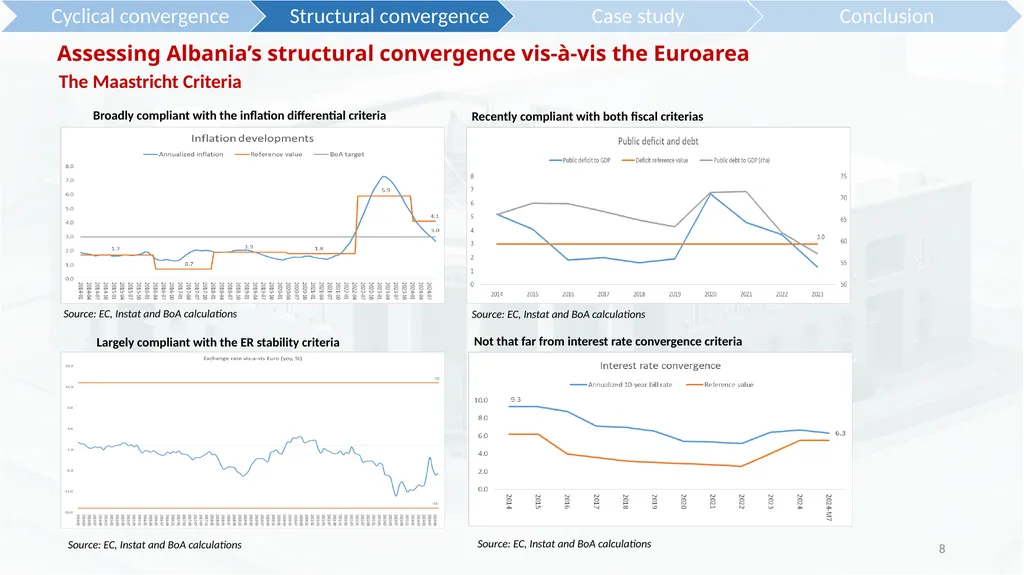
Assessing Albania’s structural convergence vis-à-vis the Euroarea Broadly compliant with the inflation differential criteria Largely compliant with the ER stability criteria Source: EC, Instat and BoA calculations Source: EC, Instat and BoA calculations Recently compliant with both fiscal criterias Source: EC, Instat and BoA calculations Not that far from interest rate convergence criteria Source: EC, Instat and BoA calculations The Maastricht Criteria 8<br>
09
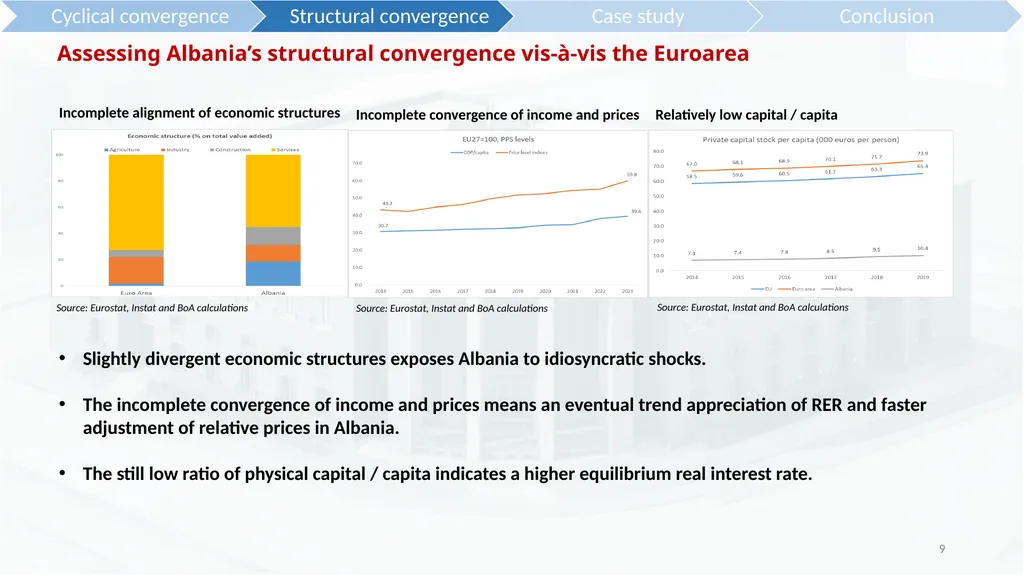
Incomplete convergence of income and prices Source: Eurostat, Instat and BoA calculations Incomplete alignment of economic structures Relatively low capital / capita Source: Eurostat, Instat and BoA calculations Source: Eurostat, Instat and BoA calculations Slightly divergent economic structures exposes Albania to idiosyncratic shocks.
The incomplete convergence of income and prices means an eventual trend appreciation of RER and faster adjustment of relative prices in Albania.
The still low ratio of physical capital / capita indicates a higher equilibrium real interest rate. 9 Assessing Albania’s structural convergence vis-à-vis the Euroarea<br>
The incomplete convergence of income and prices means an eventual trend appreciation of RER and faster adjustment of relative prices in Albania.
The still low ratio of physical capital / capita indicates a higher equilibrium real interest rate. 9 Assessing Albania’s structural convergence vis-à-vis the Euroarea<br>
10
1. The Albanian economy at the beginning of the ER appreciation episode 10 The external supply shock raised CPI inflation… … slowed down GDP growth… … and required a tighter MP stance. However, the Lek ER started appreciating by late-2022<br>
11
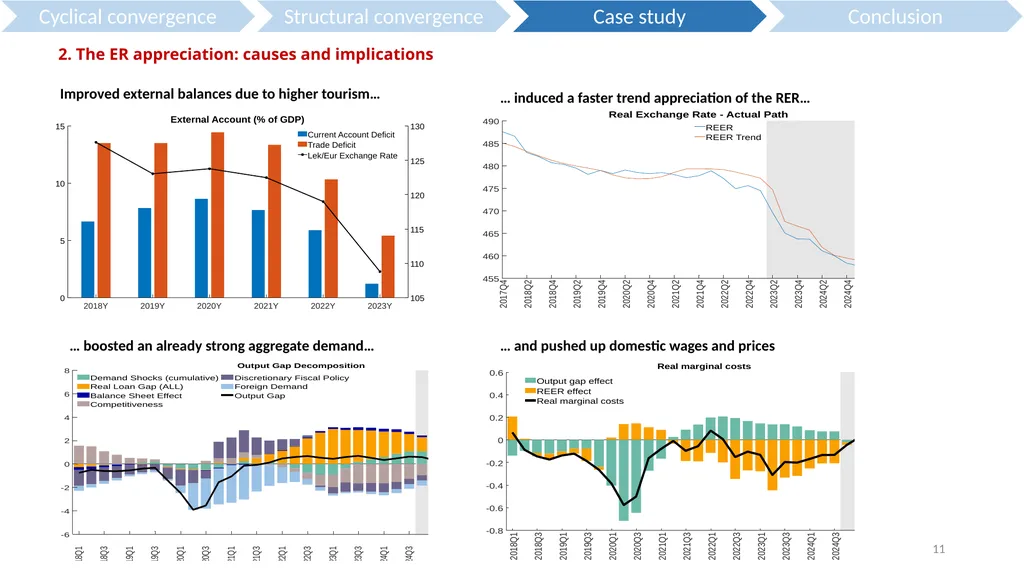
2. The ER appreciation: causes and implications 11 Improved external balances due to higher tourism… … induced a faster trend appreciation of the RER… … boosted an already strong aggregate demand… … and pushed up domestic wages and prices<br>
12
3. Policy reaction and results under a flexible ER regime 12 The BoA allowed the ER to appreciate…. … slowed down the pace of MP normalization… … thus, maintaining control of inflation… … without inducing a strong loss in output.<br>
13
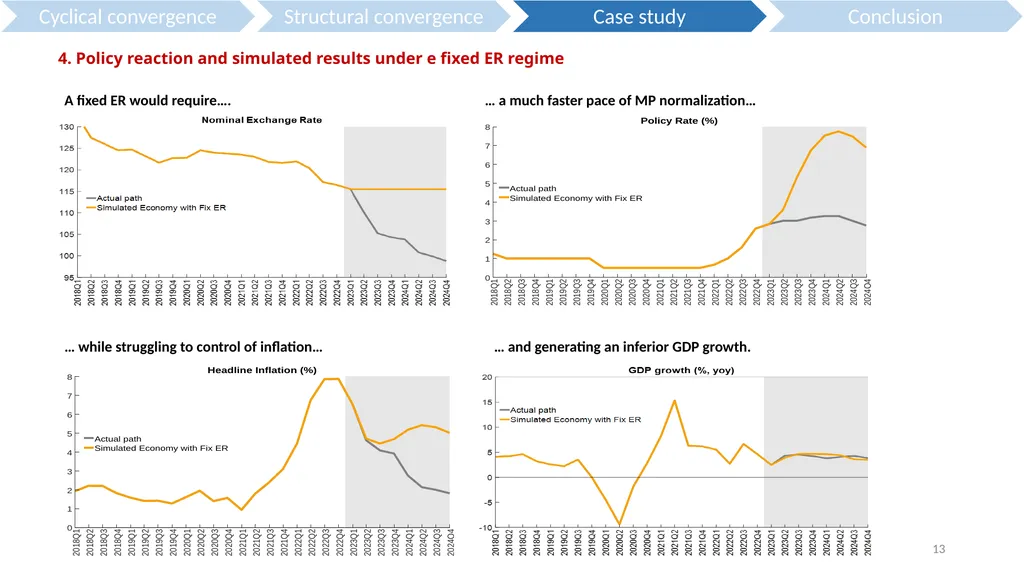
13 A fixed ER would require…. … a much faster pace of MP normalization… … while struggling to control of inflation… … and generating an inferior GDP growth. 4. Policy reaction and simulated results under e fixed ER regime<br>
14
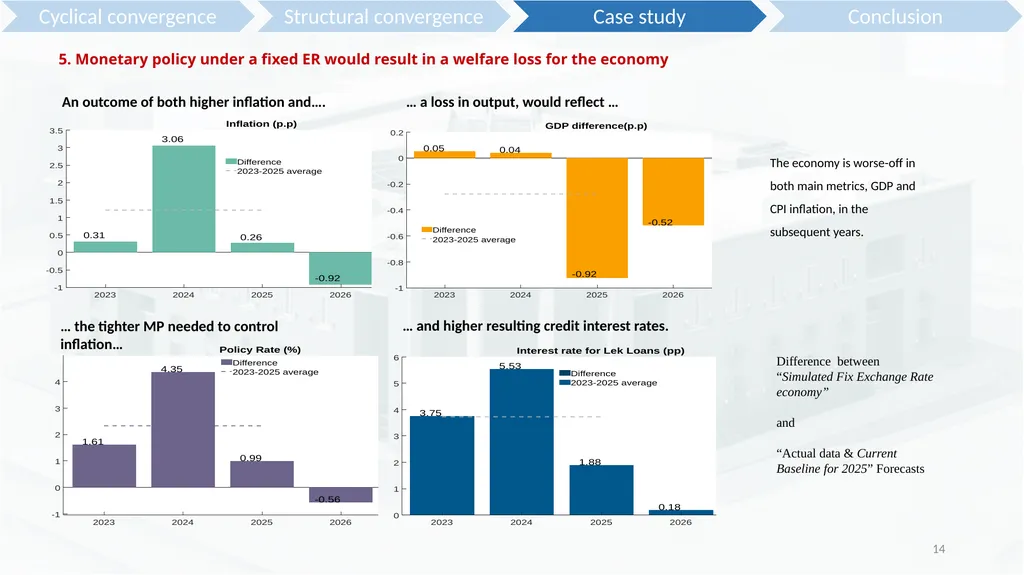
5. Monetary policy under a fixed ER would result in a welfare loss for the economy The economy is worse-off in both main metrics, GDP and CPI inflation, in the subsequent years. Difference between “Simulated Fix Exchange Rate economy”
and
“Actual data & Current Baseline for 2025” Forecasts 14 An outcome of both higher inflation and…. … a loss in output, would reflect … … the tighter MP needed to control inflation… … and higher resulting credit interest rates.<br>
and
“Actual data & Current Baseline for 2025” Forecasts 14 An outcome of both higher inflation and…. … a loss in output, would reflect … … the tighter MP needed to control inflation… … and higher resulting credit interest rates.<br>
15
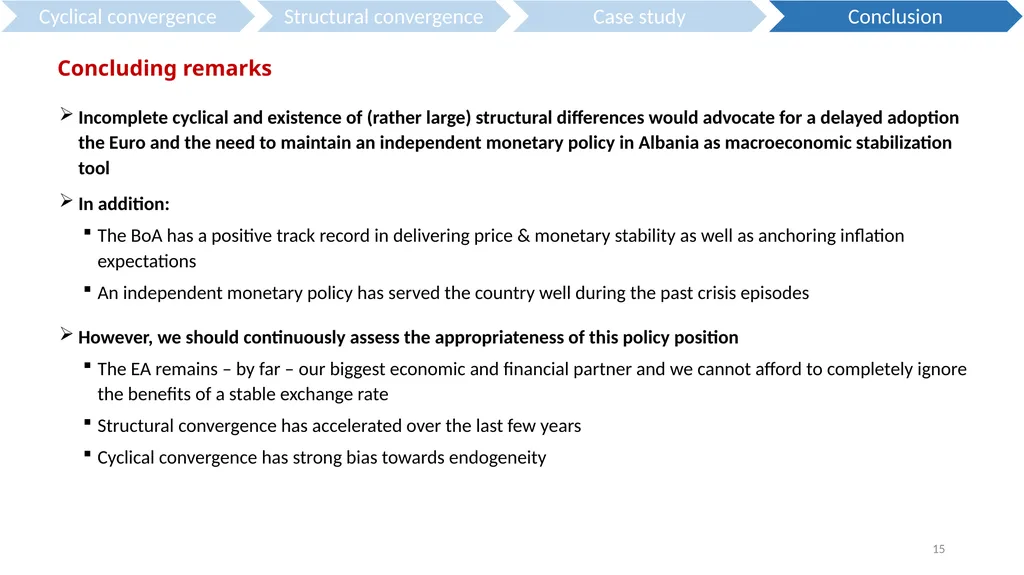
Source: MPD projections 15 Incomplete cyclical and existence of (rather large) structural differences would advocate for a delayed adoption the Euro and the need to maintain an independent monetary policy in Albania as macroeconomic stabilization tool
In addition:
The BoA has a positive track record in delivering price & monetary stability as well as anchoring inflation expectations
An independent monetary policy has served the country well during the past crisis episodes
However, we should continuously assess the appropriateness of this policy position
The EA remains – by far – our biggest economic and financial partner and we cannot afford to completely ignore the benefits of a stable exchange rate
Structural convergence has accelerated over the last few years
Cyclical convergence has strong bias towards endogeneity Concluding remarks<br>
In addition:
The BoA has a positive track record in delivering price & monetary stability as well as anchoring inflation expectations
An independent monetary policy has served the country well during the past crisis episodes
However, we should continuously assess the appropriateness of this policy position
The EA remains – by far – our biggest economic and financial partner and we cannot afford to completely ignore the benefits of a stable exchange rate
Structural convergence has accelerated over the last few years
Cyclical convergence has strong bias towards endogeneity Concluding remarks<br>
16
Thank You!<br>
17
Source: MPD projections 17 References. Afonso, A., Furceri, D., 2008. EMU enlargement, stabilizations costs and insurance mechanisms. Journal of International Money and Finance. 27, 169–187
Artis, M., Marcellino, M., Proietti, T., 2005. Business cycles in the new EU member countries and their conformity with the euro area. Journal of Business Cycle Measurement and Analysis. 2, 7–41.
Beck, K. (2020) Decoupling after the crisis: western and eastern business cycles in the European Union, Eastern European Economics. No. 58 (2020), pp. 68-82
Deskar-S̃krbic, M., Kotarac, K., Kunovac, D. (2020) The third round of euro area enlargement: are the candidates ready? Journal of International Money and Finance, No. 107 (2020).
Gaechter, M., Riedl, A., Ritzberger-Gruenwald, D., 2013. Business cycle convergence or decoupling? In: Nowotny, E., Mooslechner, P., Ritzberger-Gruenewald, D. (Eds.), A New Model for Balanced Growth and Convergence. Achieving Economic Sustainability in CESEE Countries. Edward Elgar Publishing, Cheltenham Glos, UK, pp. 147–169.
Hoda, B. (2020) The Global Credit and euro area Financial shocks: How Important Are They for Albania, Bank of Albania Working Paper 44 (83) 2020.
Jiménez-Rodriguez, R., Morales-Zumaquero, A., Égert, B. (2013) Business cycle synchronization between euro area and Central and Eastern European countries, Review of Development Economics No. 17 (2013), pp. 379-395.<br>
Artis, M., Marcellino, M., Proietti, T., 2005. Business cycles in the new EU member countries and their conformity with the euro area. Journal of Business Cycle Measurement and Analysis. 2, 7–41.
Beck, K. (2020) Decoupling after the crisis: western and eastern business cycles in the European Union, Eastern European Economics. No. 58 (2020), pp. 68-82
Deskar-S̃krbic, M., Kotarac, K., Kunovac, D. (2020) The third round of euro area enlargement: are the candidates ready? Journal of International Money and Finance, No. 107 (2020).
Gaechter, M., Riedl, A., Ritzberger-Gruenwald, D., 2013. Business cycle convergence or decoupling? In: Nowotny, E., Mooslechner, P., Ritzberger-Gruenewald, D. (Eds.), A New Model for Balanced Growth and Convergence. Achieving Economic Sustainability in CESEE Countries. Edward Elgar Publishing, Cheltenham Glos, UK, pp. 147–169.
Hoda, B. (2020) The Global Credit and euro area Financial shocks: How Important Are They for Albania, Bank of Albania Working Paper 44 (83) 2020.
Jiménez-Rodriguez, R., Morales-Zumaquero, A., Égert, B. (2013) Business cycle synchronization between euro area and Central and Eastern European countries, Review of Development Economics No. 17 (2013), pp. 379-395.<br>
18
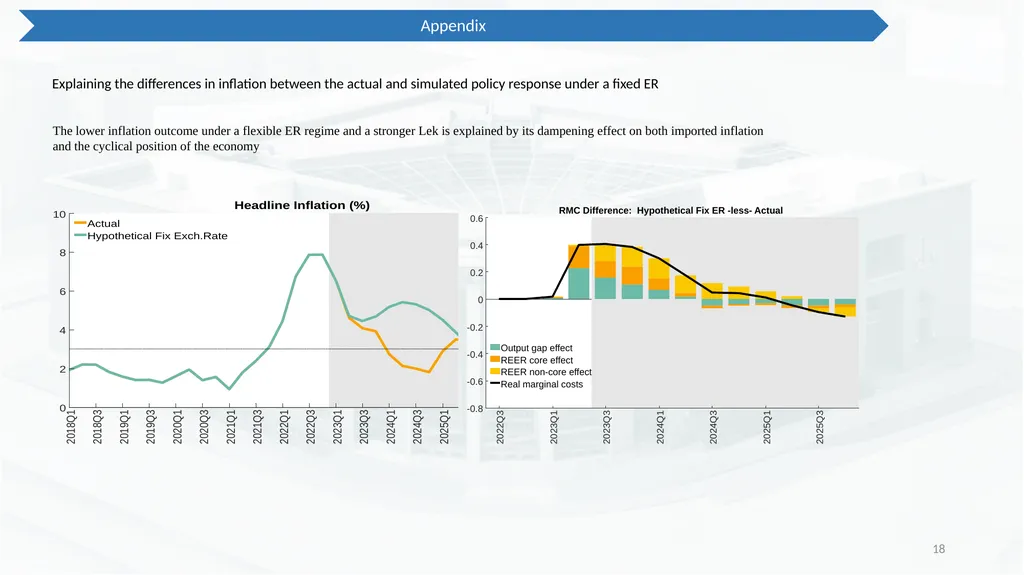
Source: MPD projections 18 Explaining the differences in inflation between the actual and simulated policy response under a fixed ER The lower inflation outcome under a flexible ER regime and a stronger Lek is explained by its dampening effect on both imported inflation and the cyclical position of the economy<br>
19
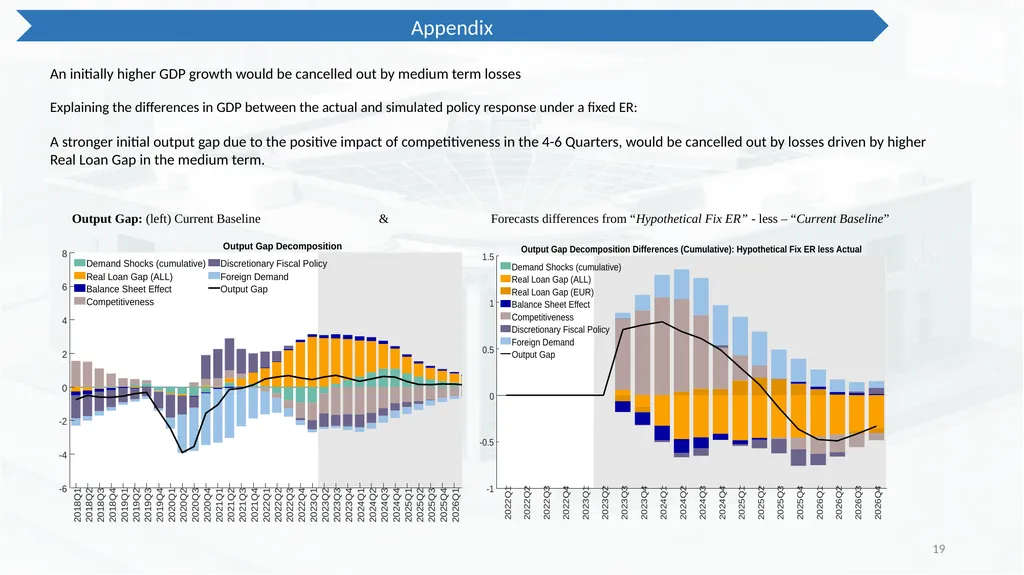
Source: MPD projections 19 Explaining the differences in GDP between the actual and simulated policy response under a fixed ER:
A stronger initial output gap due to the positive impact of competitiveness in the 4-6 Quarters, would be cancelled out by losses driven by higher Real Loan Gap in the medium term. Output Gap: (left) Current Baseline & Forecasts differences from “Hypothetical Fix ER” - less – “Current Baseline” An initially higher GDP growth would be cancelled out by medium term losses<br>
A stronger initial output gap due to the positive impact of competitiveness in the 4-6 Quarters, would be cancelled out by losses driven by higher Real Loan Gap in the medium term. Output Gap: (left) Current Baseline & Forecasts differences from “Hypothetical Fix ER” - less – “Current Baseline” An initially higher GDP growth would be cancelled out by medium term losses<br>