
The Seventeen “Real” Processes A New Process


Description: The Seventeen Real Processes A New Process Reference Model October 21st, 2016 Noon CT President, KC ITSM LIG, greg.roweusda.gov Greg Rowe Why this topic? ITIL describes 26 processes. Seventeen of them have process diagrams. Several
Related Topics
Download Presentation
"The Seventeen “Real” Processes A New Process" is the property of its rightful owner. Permission is granted to download and print the materials on this website for personal, non-commercial use only, and to display it on your personal computer provided you do not modify the materials and that you retain all copyright notices contained in the materials. By downloading content from our website, you accept the terms of this agreement.
Presentation Transcript
slide1. The Seventeen “Real” Processes
A New Process Reference Model October 21st, 2016 – Noon CT President, KC ITSM LIG, greg.rowe@usda.gov Greg Rowe<br>
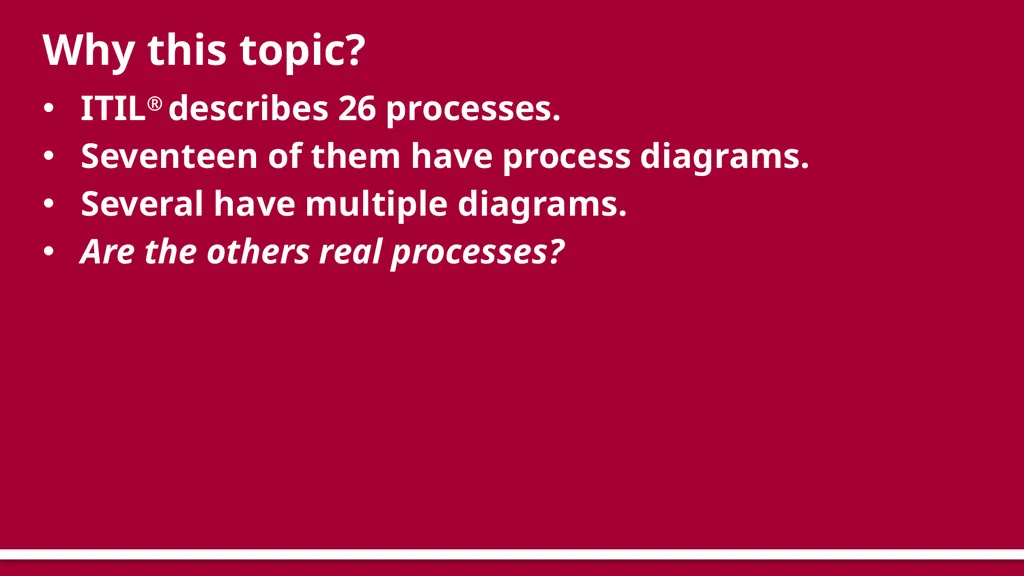
slide2. Why this topic? ITIL® describes 26 processes.
Seventeen of them have process diagrams.
Several have multiple diagrams.
Are the others real processes?<br>
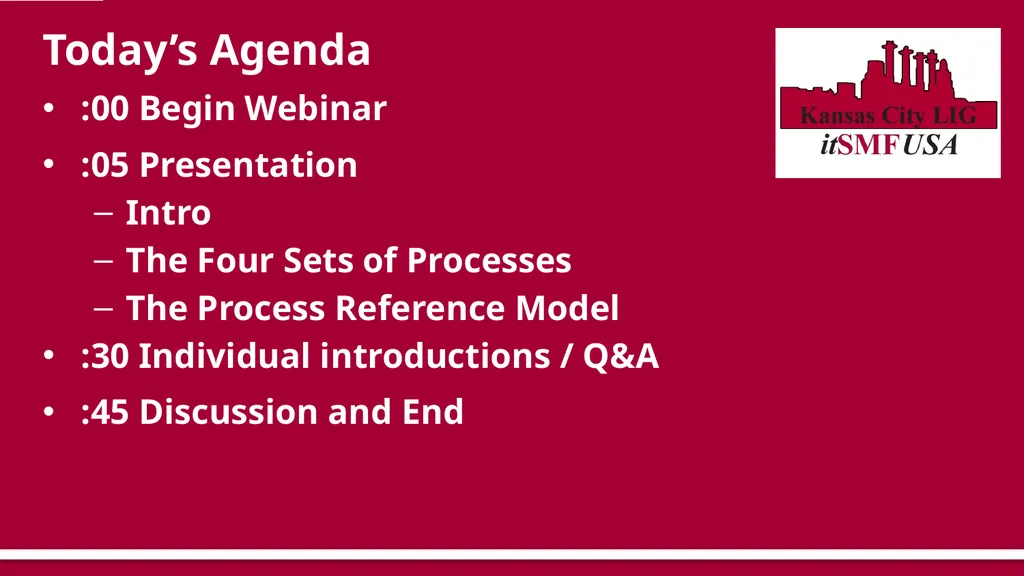
slide3. Today’s Agenda :00 Begin Webinar
:05 Presentation
Intro
The Four Sets of Processes
The Process Reference Model
:30 Individual introductions / Q&A
:45 Discussion and End<br>
slide4. KC LIG Events via Webinar 2016 March 11 – Transition Planning with Projects and Ops
October 21 – The 17: Process Reference Model
November – The Three Most Missing Processes
December 16 – Too Much: Doing ITIL® Wrong
December 30 – Member Appreciation itSMF LIG site
http://www.itsmfusa.org/members/group.aspx?id=87654<br>
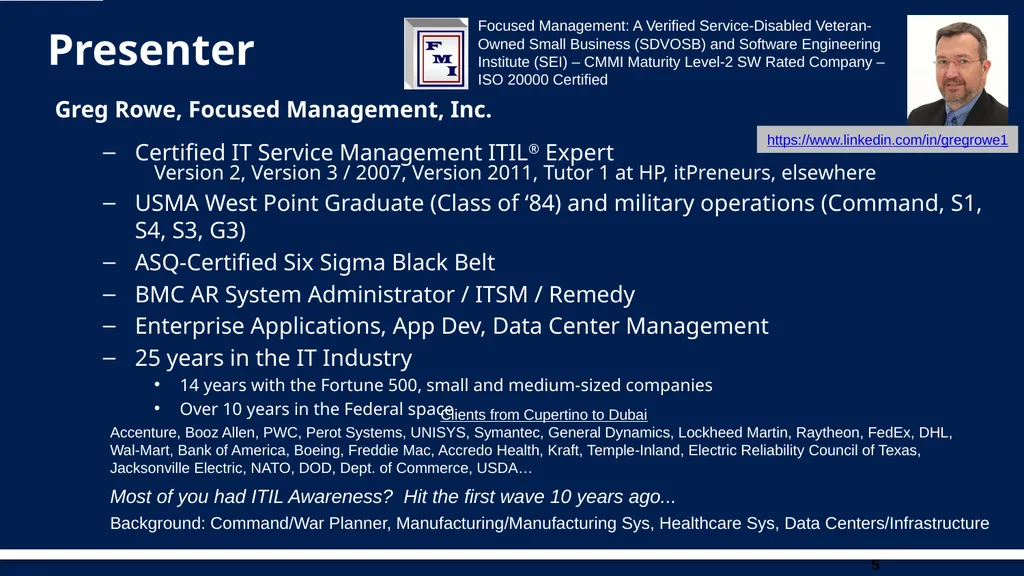
slide5. Presenter Greg Rowe, Focused Management, Inc.
Certified IT Service Management ITIL® Expert
Version 2, Version 3 / 2007, Version 2011, Tutor 1 at HP, itPreneurs, elsewhere
USMA West Point Graduate (Class of ‘84) and military operations (Command, S1, S4, S3, G3)
ASQ-Certified Six Sigma Black Belt
BMC AR System Administrator / ITSM / Remedy
Enterprise Applications, App Dev, Data Center Management
25 years in the IT Industry
14 years with the Fortune 500, small and medium-sized companies
Over 10 years in the Federal space Focused Management: A Verified Service-Disabled Veteran-Owned Small Business (SDVOSB) and Software Engineering Institute (SEI) – CMMI Maturity Level-2 SW Rated Company – ISO 20000 Certified Clients from Cupertino to Dubai
Accenture, Booz Allen, PWC, Perot Systems, UNISYS, Symantec, General Dynamics, Lockheed Martin, Raytheon, FedEx, DHL, Wal-Mart, Bank of America, Boeing, Freddie Mac, Accredo Health, Kraft, Temple-Inland, Electric Reliability Council of Texas, Jacksonville Electric, NATO, DOD, Dept. of Commerce, USDA… Background: Command/War Planner, Manufacturing/Manufacturing Sys, Healthcare Sys, Data Centers/Infrastructure Most of you had ITIL Awareness? Hit the first wave 10 years ago... 5 https://www.linkedin.com/in/gregrowe1<br>
slide6. Our Forum Forum Purpose
IT Management
Service Management
Management Systems
Professional Advice
Success at Work Purpose Introduction 6 of 30<br>
slide7. The Seventeen “Real” Processes A New Process Reference Model Greg Rowe President, KC ITSM Forum greg.rowe@usda.gov<br>
slide8. Outline Intro
The Four Sets of Processes
The Process Reference Model<br>
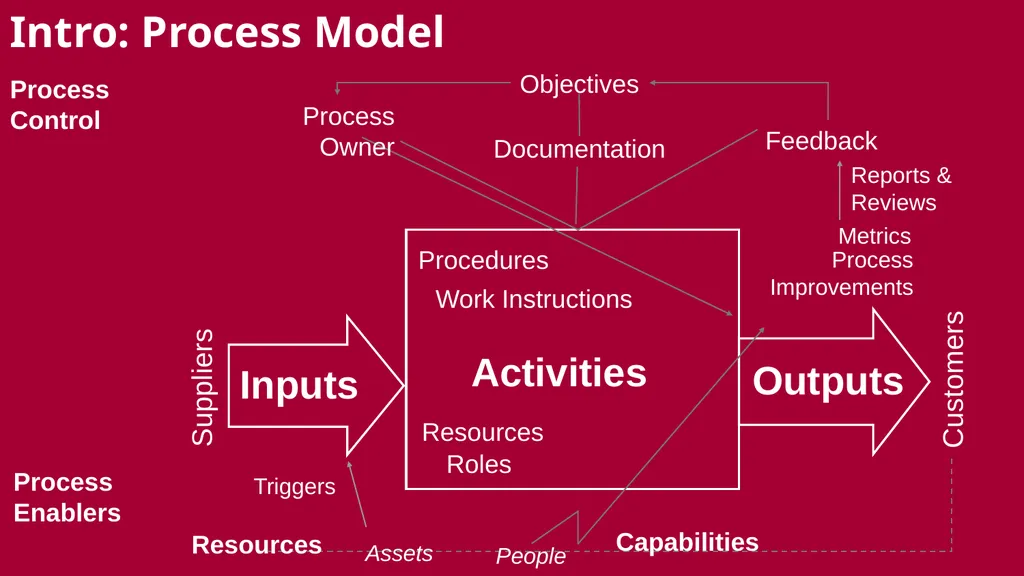
slide9. Customers Suppliers Intro: Process Model Outputs Process
Control Process
Enablers Resources Inputs Triggers Reports & Reviews Procedures Work Instructions Roles Metrics Activities Process Improvements People Assets Process Owner Documentation Feedback Objectives Capabilities Resources<br>
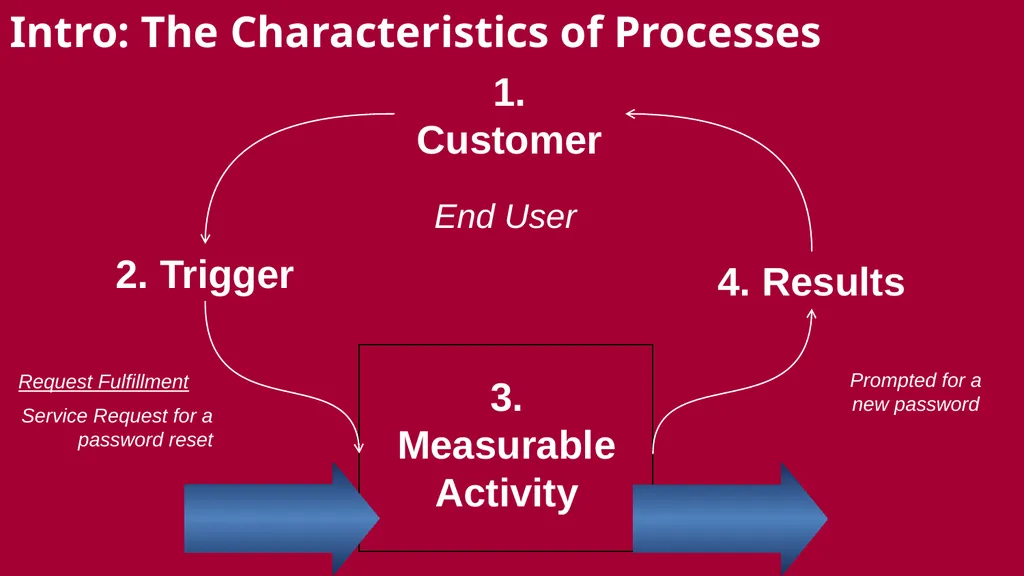
slide10. Intro: The Characteristics of Processes End User Request Fulfillment 1. Customer 2. Trigger 4. Results Service Request for a password reset Prompted for a new password<br>
slide11. The Twenty-Six with Seventeen of Thirteen<br>
slide12. The Four Sets Logical Groups of Processes<br>
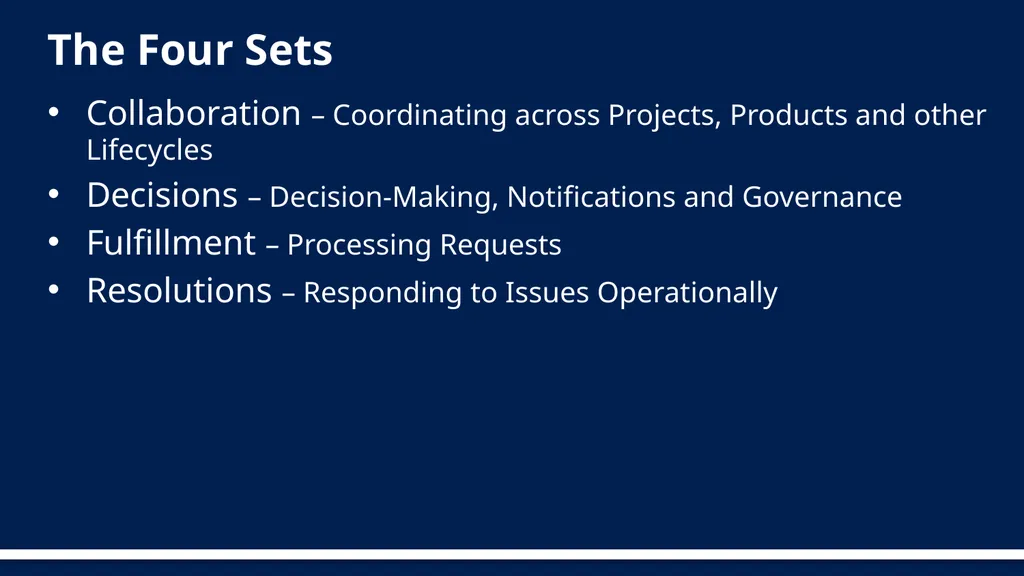
slide13. The Four Sets Collaboration – Coordinating across Projects, Products and other Lifecycles
Decisions – Decision-Making, Notifications and Governance
Fulfillment – Processing Requests
Resolutions – Responding to Issues Operationally<br>
slide14. Build/Test J1 J1 J1 F Incidents, Problems Program & Project Management 5a 3 4 7 8 6 3 4 5 6 7 8 7a V1 2 3a 4 3b 3c 5 1 A2 System
Event Projects &
Support 3 2 1 Transition
Planning &
Support Design SDP Design Coord. Transition Planning 4 Dev C2 Numbered steps are short-hand to fit on the page. See each process for full activity names. Portfolio Management
Process 2 3 4 1 1 2 3 4 5 IV III II Identify or receive an incident, problem or request Create a request for change Project funding is involved in design auth., often after project planning Normal Changes Standard Operational Changes Standard Deployments M2 Requests & Standard Changes X1 R2 SLA OLA Cata. SLR Catalog Mgmt,
SLM Deploy 1 Change
Proposal 1 Incidents 2 Auth. Design Auth. Build Auth. Deploy 2a 4a K Testing Auth. Dev. << Back Strategy Management PM or BA, Auth.
Project
Charter I Plan Identify Control Report Audit and update Base-line M1 Major Incident Procedure Events, Incidents
& Problems Events 5 Strategic Coordination of the Portfolio, Designs and Transitions Evaluation Plan Sched. Consolidated
Change
Schedule Evaluations Release & Deployment Planning 14 Evaluation Changes “Changes should be delivered in releases, except for standard changes and some emergency changes.” ITIL® ST 3.1.1.2 ©Gregory Paul Rowe greg@rowe.services 4b: ChM authorizes a Transition and to plan a release 4b Releases* Four Frameworks in Three Groups of Two Sets 1 2 A B C D<br>
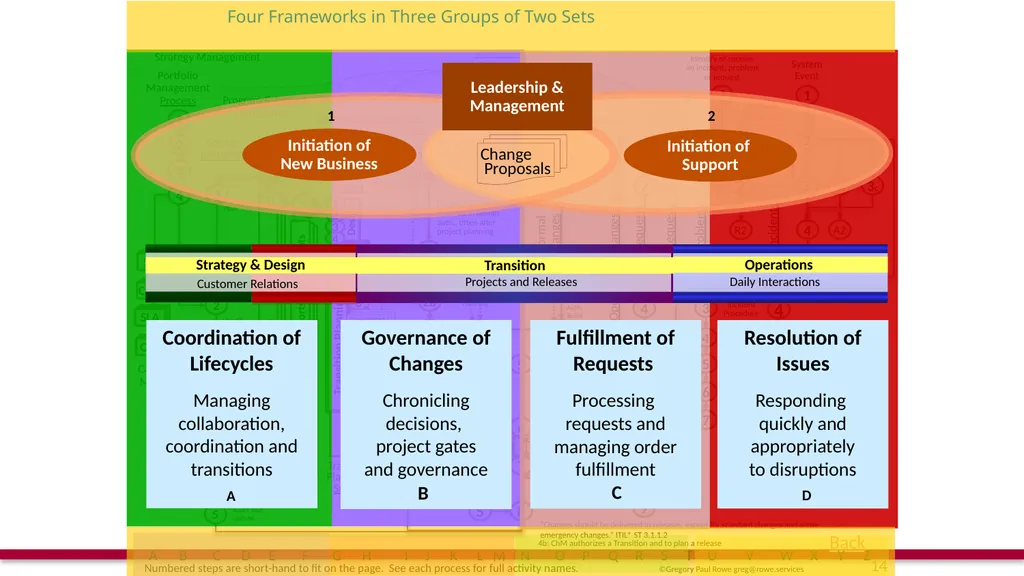
slide15. Four Frameworks in Three Groups of Two Sets Build/Test J1 J1 J1 F Incidents, Problems Program & Project Management 5a 3 4 7 8 6 3 4 5 6 7 8 7a Transition Operation V1 2 3a 4 3b 3c 5 1 A2 System
Event Projects &
Support 3 2 1 Transition
Planning &
Support Design SDP Design Coord. Transition Planning 4 Dev C2 Initiation
of Support Numbered steps are short-hand to fit on the page. See each process for full activity names. Portfolio Management
Process 2 3 4 1 Strategy & Design 1 2 3 4 5 IV III II Identify or receive an incident, problem or request Create a request for change Project funding is involved in design auth., often after project planning Normal Changes Standard Operational Changes Standard Deployments M2 Requests & Standard Changes X1 R2 SLA OLA Cata. SLR Catalog Mgmt,
SLM Deploy 1 Change
Proposal 1 Incidents 2 Auth. Design Auth. Build Auth. Deploy 2a 4a K Testing Auth. Dev. << Back Strategy Management PM or BA, Auth.
Project
Charter I Plan Identify Control Report Audit and update Base-line M1 Major Incident Procedure Events, Incidents
& Problems Events 5 << Back Strategic Coordination of the Portfolio, Designs and Transitions Evaluation Plan Sched. Consolidated
Change
Schedule Evaluations Release & Deployment Planning << Main End >> 15 Evaluation Changes “Changes should be delivered in releases, except for standard changes and some emergency changes.” ITIL® ST 3.1.1.2 ©Gregory Paul Rowe greg@rowe.services Initiation of Strategic
or Design Changes
including New Business, a New Service, Reorganization, etc. 4b: ChM authorizes a Transition and to plan a release 4b Releases* Configurations Projects Transition Planning & Support Design Coord. Normal Changes Standard Operational Changes Standard Deployments Incidents Problems Access Requests Service Requests Testing Events Evaluations Releases* Portfolio Management Process Requests & Standard Changes Events, Incidents
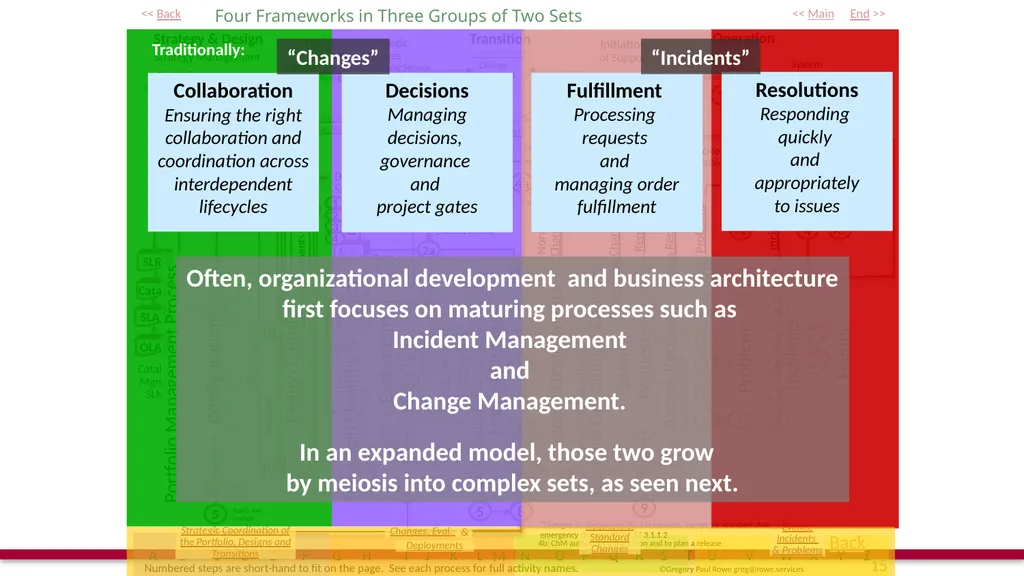
& Problems Strategic Coordination of the Portfolio, Designs and Transitions “Changes” “Incidents” Often, organizational development and business architecture
first focuses on maturing processes such as
Incident Management
and
Change Management.
In an expanded model, those two grow
by meiosis into complex sets, as seen next. Traditionally:<br>
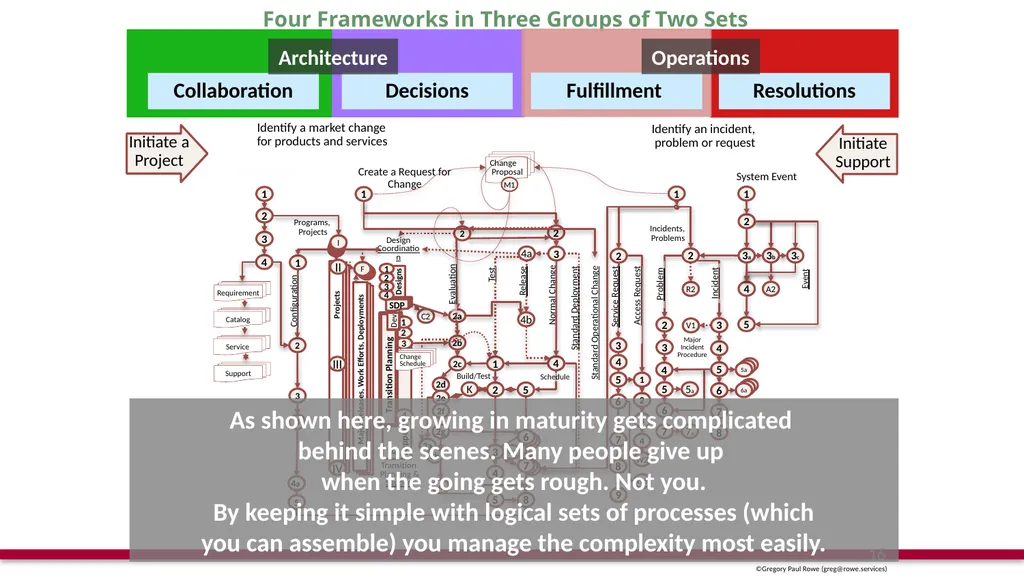
slide16. ©Gregory Paul Rowe (greg@rowe.services) Four Frameworks in Three Groups of Two Sets 16 As shown here, growing in maturity gets complicated
behind the scenes. Many people give up
when the going gets rough. Not you.
By keeping it simple with logical sets of processes (which
you can assemble) you manage the complexity most easily.<br>
slide17. The Reference Model Drill-down to each process from the books.<br>
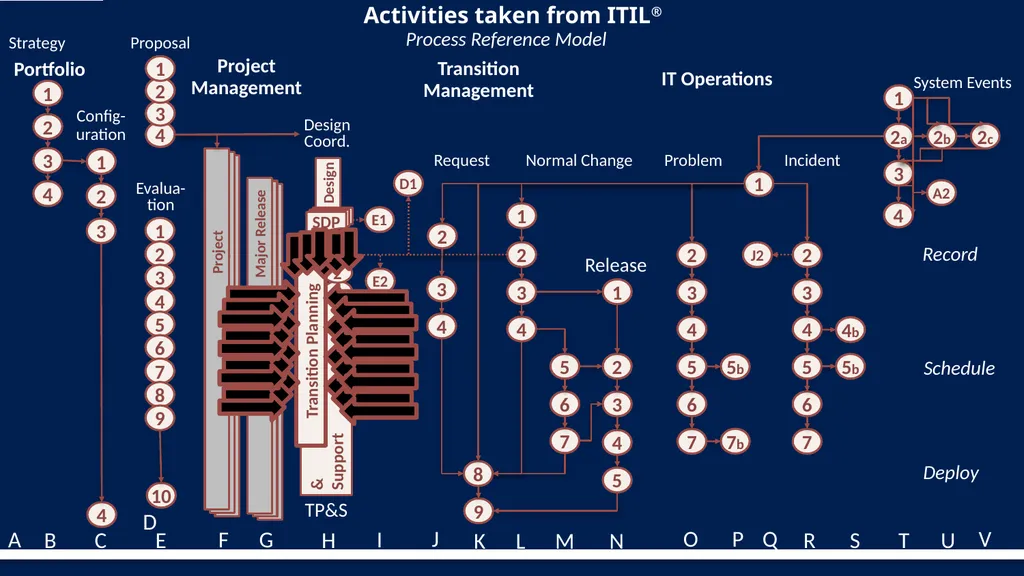
slide18. Activities taken from ITIL® System Events Incident Project Management Normal Change Problem Request 2 3 4 5b 5 6 7 1 2 3 4 5 6 7 8 9 7b Transition Management IT Operations 1 2 3 4 5 2 3 4 1 H J2 Deploy J K L M N O P Q R S T U Release Evalua-
tion 4 Schedule Record E2 B C D E F G I A D1 V E1 Strategy Process Reference Model<br>
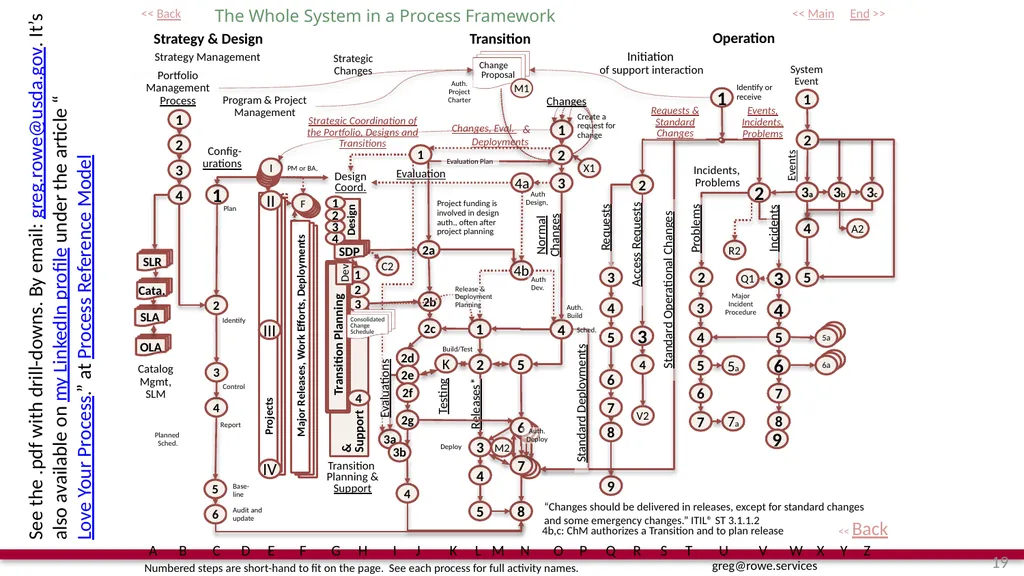
slide19. The Whole System in a Process Framework Build/Test J1 J1 J1 F Incidents, Problems Program & Project Management 2 3 4 5a 5 6 7 3 4 7 8 6 3 4 5 6 7 8 5a 6a 7a Transition Operation H Q1 J K N O P Q R S T U V W 2 3a 4 3b 3c 5 1 A2 System
Event &
Support 3 2 1 Transition
Planning &
Support Design SDP Design Coord. Transition Planning 4 Dev C D E F G I X C2 Initiation
of support interaction Numbered steps are short-hand to fit on the page. See each process for full activity names. Portfolio Management
Process 2 3 4 1 Strategy & Design 1 2 3 4 5 B A Y Z L M IV III II Identify or receive Create a request for change 2 Project funding is involved in design auth., often after project planning 4b,c: ChM authorizes a Transition and to plan release 4b Normal Changes Standard Operational Changes Releases* Standard Deployments M2 Requests & Standard Changes X1 R2 SLA OLA Cata. SLR Catalog Mgmt,
SLM Deploy 1 Change
Proposal 1 Incidents Problems 2 Auth Design, Auth. Build Auth. Deploy 2a 4a K Testing Auth Dev. << Back Strategy Management PM or BA, Auth.
Project
Charter I Strategic Changes Plan Identify Control Report Audit and update Base-line M1 Major Incident Procedure Events, Incidents, Problems Events 5 << Back Strategic Coordination of the Portfolio, Designs and Transitions & Changes, Eval. Evaluation Plan Sched. Planned
Sched. Consolidated
Change
Schedule Evaluations Release & Deployment Planning << Main End >> 19 Evaluation Changes “Changes should be delivered in releases, except for standard changes and some emergency changes.” ITIL® ST 3.1.1.2 9 greg@rowe.services Deployments See the .pdf. For details: greg.rowe@usda.gov See the .pdf with drill-downs. By email: greg.rowe@usda.gov. It’s also available on my LinkedIn profile under the article “Love Your Process.” at Process Reference Model<br>
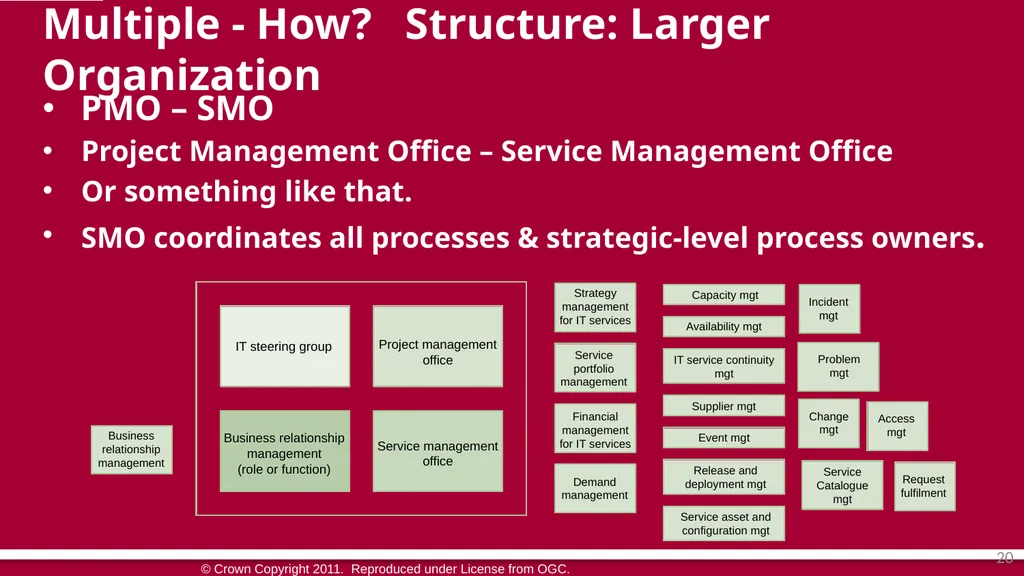
slide20. Multiple - How? Structure: Larger Organization PMO – SMO
Project Management Office – Service Management Office
Or something like that.
SMO coordinates all processes & strategic-level process owners. 20 Strategy
management
for IT services Service
portfolio
management Financial
management
for IT services Demand
management IT steering group Project management
office Business relationship
management
(role or function) Service management
office Business
relationship
management Capacity mgt Availability mgt IT service continuity
mgt Supplier mgt Event mgt Release and
deployment mgt Service asset and
configuration mgt Incident
mgt Problem
mgt Change
mgt Access
mgt Service
Catalogue
mgt Request
fulfilment © Crown Copyright 2011. Reproduced under License from OGC.<br>
slide21. Summary Not all process activities are easily measurable.
Most organizations can’t afford twenty-six process owners but four is doable.
It all comes together in a process reference model.
How does this apply for you?<br>
slide22. Applying it where you work How many process champions/owners does your organization have?
Is it merely an assumed role for those with functional oversight?
Does the model apply as presented here?<br>
slide23. Conclusion Every organization is different - but process is the same.
ISO 20000 has 13 process areas, yet even that can seem like too much, especially in smaller organizations.
Groups of processes apply.
Personality and skillsets of leaders also apply.
Organizations have unique constellations of responsibility.
The minimum is two centers of constellation.
Change Management
Incident Management (next slide)<br>
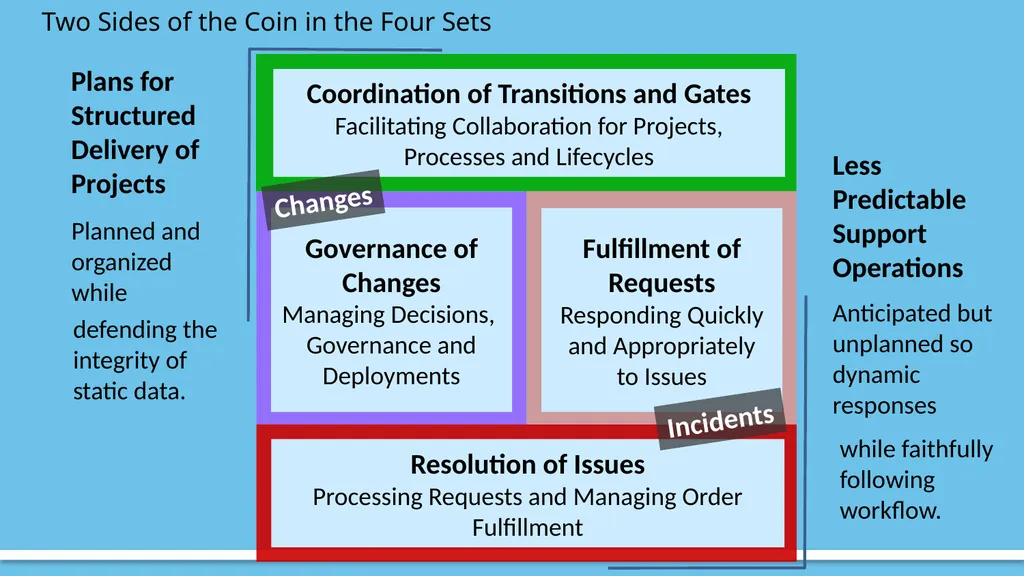
slide24. Governance of Changes
Managing Decisions, Governance and Deployments Coordination of Transitions and Gates
Facilitating Collaboration for Projects, Processes and Lifecycles Resolution of Issues
Processing Requests and Managing Order Fulfillment Fulfillment of Requests
Responding Quickly and Appropriately
to Issues Planned and organized while Anticipated but unplanned so dynamic responses defending the integrity of static data. while faithfully following workflow. Plans for
Structured Delivery of Projects Less Predictable Support Operations Changes Incidents Two Sides of the Coin in the Four Sets<br>
slide25. Conclusion Seventeen and Four<br>
slide26. Announcements itSMF USA site
Board positons
Next national events<br>
slide27. End Supplemental Slides Follow<br>
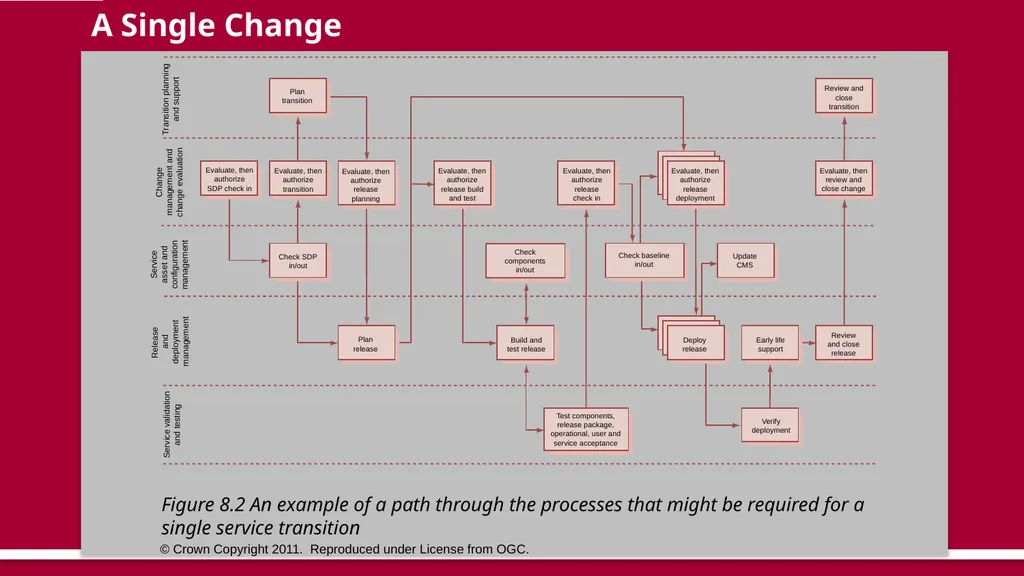
slide28. A Single Change © Crown Copyright 2011. Reproduced under License from OGC.<br>
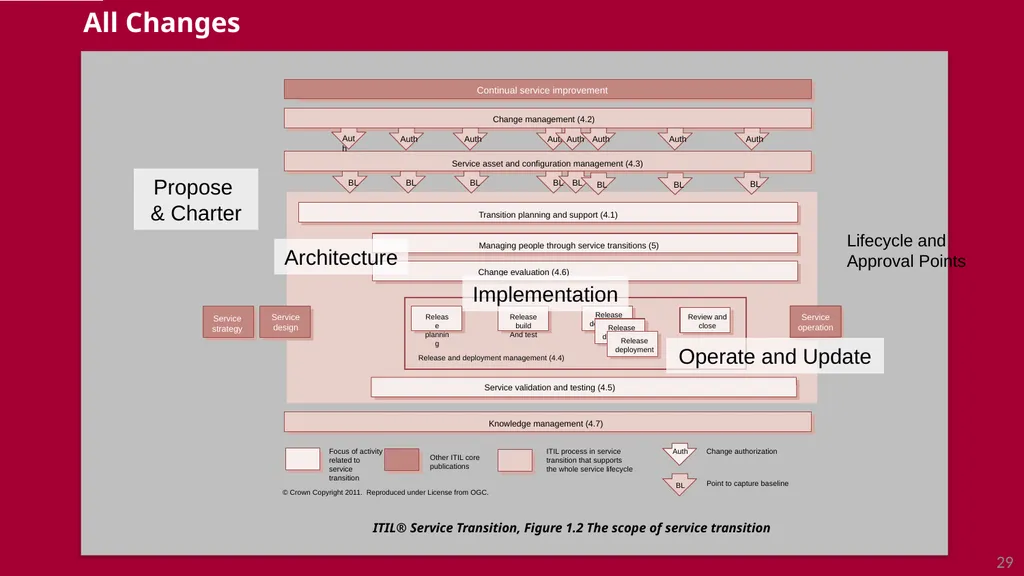
slide29. Release
deployment Continual service improvement Change management (4.2) Auth Auth Auth Auth Auth Auth Auth Auth Service asset and configuration management (4.3) Transition planning and support (4.1) Managing people through service transitions (5) Change evaluation (4.6) BL BL BL BL BL BL BL BL Service
strategy Service
design Release
planning Release build
And test Release
deployment Release
deployment Review and
close Service
operation Release and deployment management (4.4) Service validation and testing (4.5) Knowledge management (4.7) Focus of activity
related to
service
transition Other ITIL core
publications ITIL process in service
transition that supports
the whole service lifecycle Auth BL Change authorization Point to capture baseline Propose
& Charter Architecture Implementation Operate and Update Lifecycle and Approval Points All Changes 29 ITIL® Service Transition, Figure 1.2 The scope of service transition © Crown Copyright 2011. Reproduced under License from OGC.<br>
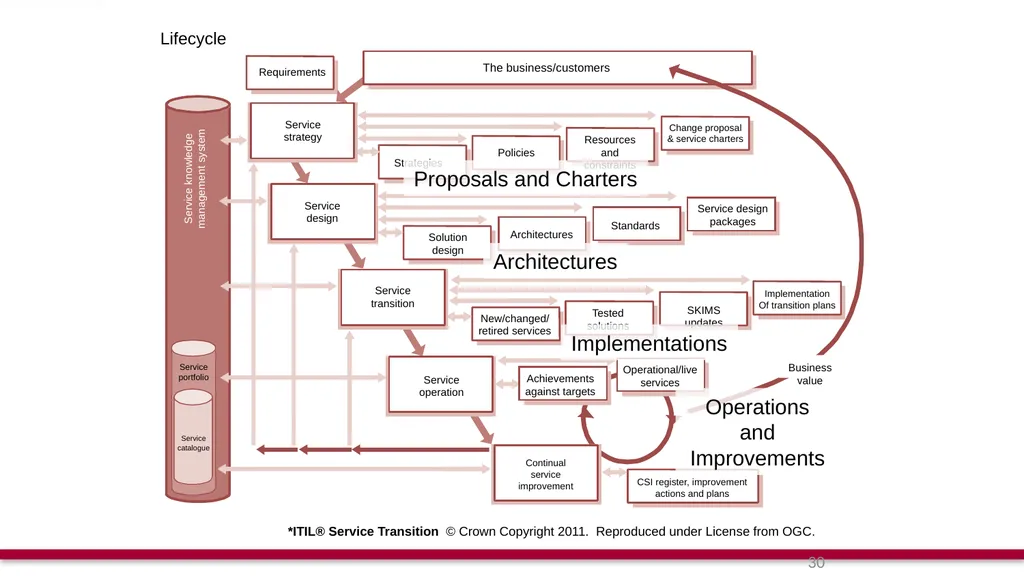
slide30. Service
portfolio Service
catalogue The business/customers Requirements Change proposal
& service charters Service
strategy Strategies Policies Resources and
constraints Service
design Service
transition Service
operation Continual
service
improvement CSI register, improvement
actions and plans Achievements
against targets Operational/live
services Business
value Solution
design Architectures Standards Service design packages New/changed/
retired services Tested
solutions SKIMS updates Implementation
Of transition plans Service knowledge
management system Proposals and Charters Architectures Implementations Operations and Improvements Lifecycle 30 *ITIL® Service Transition © Crown Copyright 2011. Reproduced under License from OGC.<br>
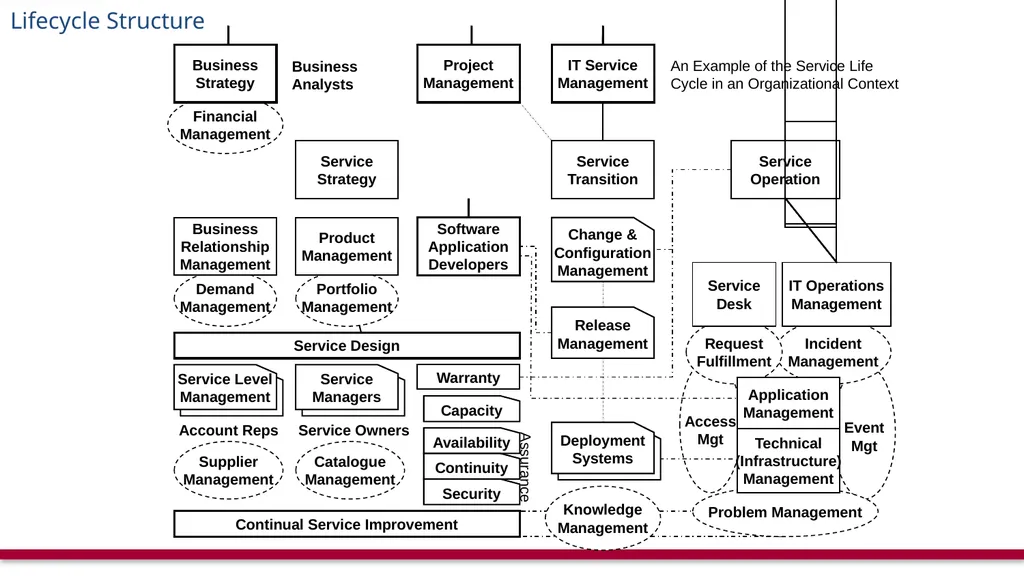
slide31. An Example of the Service Life Cycle in an Organizational Context Service
Transition Service
Operation Service
Strategy Lifecycle Structure<br>
slide32. Sales/Business
Relationship
Management Finance &
Accounting Design for Value Innovation,
Integration &
Transition gregory.rowe@gdit.com Procurement
& Supplier
Management Configuration
Management Chief of
Staff Business
Units
(w/ Sales-Svc) Shared &
Regional
Functions Asset
Management HR, Legal, IT, etc. Operations,
IT &
Infrastructure Strategy &
Business
Management Operations
Management
& Tech Mgmt Head Transition
Management
(BA & Projects) Engineering,
Research &
Development Product
Management QA &
Performance
Improvement Security
Management
& Ethics Customer
Service
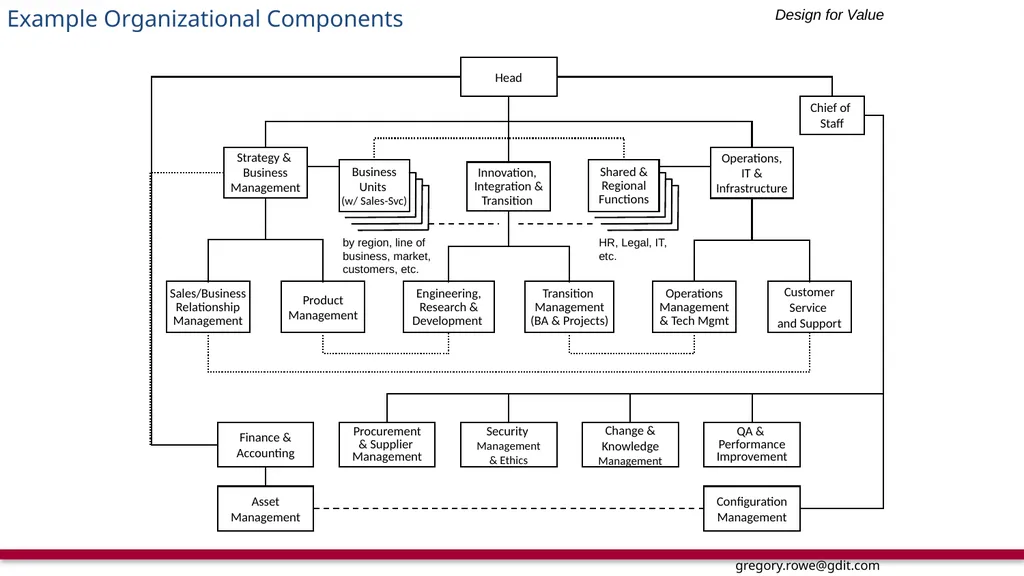
and Support Example Organizational Components Change &
Knowledge
Management by region, line of business, market, customers, etc.<br>
slide2. Why this topic? ITIL® describes 26 processes.
Seventeen of them have process diagrams.
Several have multiple diagrams.
Are the others real processes?<br>
slide3. Today’s Agenda :00 Begin Webinar
:05 Presentation
Intro
The Four Sets of Processes
The Process Reference Model
:30 Individual introductions / Q&A
:45 Discussion and End<br>
slide4. KC LIG Events via Webinar 2016 March 11 – Transition Planning with Projects and Ops
October 21 – The 17: Process Reference Model
November – The Three Most Missing Processes
December 16 – Too Much: Doing ITIL® Wrong
December 30 – Member Appreciation itSMF LIG site
http://www.itsmfusa.org/members/group.aspx?id=87654<br>
slide5. Presenter Greg Rowe, Focused Management, Inc.
Certified IT Service Management ITIL® Expert
Version 2, Version 3 / 2007, Version 2011, Tutor 1 at HP, itPreneurs, elsewhere
USMA West Point Graduate (Class of ‘84) and military operations (Command, S1, S4, S3, G3)
ASQ-Certified Six Sigma Black Belt
BMC AR System Administrator / ITSM / Remedy
Enterprise Applications, App Dev, Data Center Management
25 years in the IT Industry
14 years with the Fortune 500, small and medium-sized companies
Over 10 years in the Federal space Focused Management: A Verified Service-Disabled Veteran-Owned Small Business (SDVOSB) and Software Engineering Institute (SEI) – CMMI Maturity Level-2 SW Rated Company – ISO 20000 Certified Clients from Cupertino to Dubai
Accenture, Booz Allen, PWC, Perot Systems, UNISYS, Symantec, General Dynamics, Lockheed Martin, Raytheon, FedEx, DHL, Wal-Mart, Bank of America, Boeing, Freddie Mac, Accredo Health, Kraft, Temple-Inland, Electric Reliability Council of Texas, Jacksonville Electric, NATO, DOD, Dept. of Commerce, USDA… Background: Command/War Planner, Manufacturing/Manufacturing Sys, Healthcare Sys, Data Centers/Infrastructure Most of you had ITIL Awareness? Hit the first wave 10 years ago... 5 https://www.linkedin.com/in/gregrowe1<br>
slide6. Our Forum Forum Purpose
IT Management
Service Management
Management Systems
Professional Advice
Success at Work Purpose Introduction 6 of 30<br>
slide7. The Seventeen “Real” Processes A New Process Reference Model Greg Rowe President, KC ITSM Forum greg.rowe@usda.gov<br>
slide8. Outline Intro
The Four Sets of Processes
The Process Reference Model<br>
slide9. Customers Suppliers Intro: Process Model Outputs Process
Control Process
Enablers Resources Inputs Triggers Reports & Reviews Procedures Work Instructions Roles Metrics Activities Process Improvements People Assets Process Owner Documentation Feedback Objectives Capabilities Resources<br>
slide10. Intro: The Characteristics of Processes End User Request Fulfillment 1. Customer 2. Trigger 4. Results Service Request for a password reset Prompted for a new password<br>
slide11. The Twenty-Six with Seventeen of Thirteen<br>
slide12. The Four Sets Logical Groups of Processes<br>
slide13. The Four Sets Collaboration – Coordinating across Projects, Products and other Lifecycles
Decisions – Decision-Making, Notifications and Governance
Fulfillment – Processing Requests
Resolutions – Responding to Issues Operationally<br>
slide14. Build/Test J1 J1 J1 F Incidents, Problems Program & Project Management 5a 3 4 7 8 6 3 4 5 6 7 8 7a V1 2 3a 4 3b 3c 5 1 A2 System
Event Projects &
Support 3 2 1 Transition
Planning &
Support Design SDP Design Coord. Transition Planning 4 Dev C2 Numbered steps are short-hand to fit on the page. See each process for full activity names. Portfolio Management
Process 2 3 4 1 1 2 3 4 5 IV III II Identify or receive an incident, problem or request Create a request for change Project funding is involved in design auth., often after project planning Normal Changes Standard Operational Changes Standard Deployments M2 Requests & Standard Changes X1 R2 SLA OLA Cata. SLR Catalog Mgmt,
SLM Deploy 1 Change
Proposal 1 Incidents 2 Auth. Design Auth. Build Auth. Deploy 2a 4a K Testing Auth. Dev. << Back Strategy Management PM or BA, Auth.
Project
Charter I Plan Identify Control Report Audit and update Base-line M1 Major Incident Procedure Events, Incidents
& Problems Events 5 Strategic Coordination of the Portfolio, Designs and Transitions Evaluation Plan Sched. Consolidated
Change
Schedule Evaluations Release & Deployment Planning 14 Evaluation Changes “Changes should be delivered in releases, except for standard changes and some emergency changes.” ITIL® ST 3.1.1.2 ©Gregory Paul Rowe greg@rowe.services 4b: ChM authorizes a Transition and to plan a release 4b Releases* Four Frameworks in Three Groups of Two Sets 1 2 A B C D<br>
slide15. Four Frameworks in Three Groups of Two Sets Build/Test J1 J1 J1 F Incidents, Problems Program & Project Management 5a 3 4 7 8 6 3 4 5 6 7 8 7a Transition Operation V1 2 3a 4 3b 3c 5 1 A2 System
Event Projects &
Support 3 2 1 Transition
Planning &
Support Design SDP Design Coord. Transition Planning 4 Dev C2 Initiation
of Support Numbered steps are short-hand to fit on the page. See each process for full activity names. Portfolio Management
Process 2 3 4 1 Strategy & Design 1 2 3 4 5 IV III II Identify or receive an incident, problem or request Create a request for change Project funding is involved in design auth., often after project planning Normal Changes Standard Operational Changes Standard Deployments M2 Requests & Standard Changes X1 R2 SLA OLA Cata. SLR Catalog Mgmt,
SLM Deploy 1 Change
Proposal 1 Incidents 2 Auth. Design Auth. Build Auth. Deploy 2a 4a K Testing Auth. Dev. << Back Strategy Management PM or BA, Auth.
Project
Charter I Plan Identify Control Report Audit and update Base-line M1 Major Incident Procedure Events, Incidents
& Problems Events 5 << Back Strategic Coordination of the Portfolio, Designs and Transitions Evaluation Plan Sched. Consolidated
Change
Schedule Evaluations Release & Deployment Planning << Main End >> 15 Evaluation Changes “Changes should be delivered in releases, except for standard changes and some emergency changes.” ITIL® ST 3.1.1.2 ©Gregory Paul Rowe greg@rowe.services Initiation of Strategic
or Design Changes
including New Business, a New Service, Reorganization, etc. 4b: ChM authorizes a Transition and to plan a release 4b Releases* Configurations Projects Transition Planning & Support Design Coord. Normal Changes Standard Operational Changes Standard Deployments Incidents Problems Access Requests Service Requests Testing Events Evaluations Releases* Portfolio Management Process Requests & Standard Changes Events, Incidents
& Problems Strategic Coordination of the Portfolio, Designs and Transitions “Changes” “Incidents” Often, organizational development and business architecture
first focuses on maturing processes such as
Incident Management
and
Change Management.
In an expanded model, those two grow
by meiosis into complex sets, as seen next. Traditionally:<br>
slide16. ©Gregory Paul Rowe (greg@rowe.services) Four Frameworks in Three Groups of Two Sets 16 As shown here, growing in maturity gets complicated
behind the scenes. Many people give up
when the going gets rough. Not you.
By keeping it simple with logical sets of processes (which
you can assemble) you manage the complexity most easily.<br>
slide17. The Reference Model Drill-down to each process from the books.<br>
slide18. Activities taken from ITIL® System Events Incident Project Management Normal Change Problem Request 2 3 4 5b 5 6 7 1 2 3 4 5 6 7 8 9 7b Transition Management IT Operations 1 2 3 4 5 2 3 4 1 H J2 Deploy J K L M N O P Q R S T U Release Evalua-
tion 4 Schedule Record E2 B C D E F G I A D1 V E1 Strategy Process Reference Model<br>
slide19. The Whole System in a Process Framework Build/Test J1 J1 J1 F Incidents, Problems Program & Project Management 2 3 4 5a 5 6 7 3 4 7 8 6 3 4 5 6 7 8 5a 6a 7a Transition Operation H Q1 J K N O P Q R S T U V W 2 3a 4 3b 3c 5 1 A2 System
Event &
Support 3 2 1 Transition
Planning &
Support Design SDP Design Coord. Transition Planning 4 Dev C D E F G I X C2 Initiation
of support interaction Numbered steps are short-hand to fit on the page. See each process for full activity names. Portfolio Management
Process 2 3 4 1 Strategy & Design 1 2 3 4 5 B A Y Z L M IV III II Identify or receive Create a request for change 2 Project funding is involved in design auth., often after project planning 4b,c: ChM authorizes a Transition and to plan release 4b Normal Changes Standard Operational Changes Releases* Standard Deployments M2 Requests & Standard Changes X1 R2 SLA OLA Cata. SLR Catalog Mgmt,
SLM Deploy 1 Change
Proposal 1 Incidents Problems 2 Auth Design, Auth. Build Auth. Deploy 2a 4a K Testing Auth Dev. << Back Strategy Management PM or BA, Auth.
Project
Charter I Strategic Changes Plan Identify Control Report Audit and update Base-line M1 Major Incident Procedure Events, Incidents, Problems Events 5 << Back Strategic Coordination of the Portfolio, Designs and Transitions & Changes, Eval. Evaluation Plan Sched. Planned
Sched. Consolidated
Change
Schedule Evaluations Release & Deployment Planning << Main End >> 19 Evaluation Changes “Changes should be delivered in releases, except for standard changes and some emergency changes.” ITIL® ST 3.1.1.2 9 greg@rowe.services Deployments See the .pdf. For details: greg.rowe@usda.gov See the .pdf with drill-downs. By email: greg.rowe@usda.gov. It’s also available on my LinkedIn profile under the article “Love Your Process.” at Process Reference Model<br>
slide20. Multiple - How? Structure: Larger Organization PMO – SMO
Project Management Office – Service Management Office
Or something like that.
SMO coordinates all processes & strategic-level process owners. 20 Strategy
management
for IT services Service
portfolio
management Financial
management
for IT services Demand
management IT steering group Project management
office Business relationship
management
(role or function) Service management
office Business
relationship
management Capacity mgt Availability mgt IT service continuity
mgt Supplier mgt Event mgt Release and
deployment mgt Service asset and
configuration mgt Incident
mgt Problem
mgt Change
mgt Access
mgt Service
Catalogue
mgt Request
fulfilment © Crown Copyright 2011. Reproduced under License from OGC.<br>
slide21. Summary Not all process activities are easily measurable.
Most organizations can’t afford twenty-six process owners but four is doable.
It all comes together in a process reference model.
How does this apply for you?<br>
slide22. Applying it where you work How many process champions/owners does your organization have?
Is it merely an assumed role for those with functional oversight?
Does the model apply as presented here?<br>
slide23. Conclusion Every organization is different - but process is the same.
ISO 20000 has 13 process areas, yet even that can seem like too much, especially in smaller organizations.
Groups of processes apply.
Personality and skillsets of leaders also apply.
Organizations have unique constellations of responsibility.
The minimum is two centers of constellation.
Change Management
Incident Management (next slide)<br>
slide24. Governance of Changes
Managing Decisions, Governance and Deployments Coordination of Transitions and Gates
Facilitating Collaboration for Projects, Processes and Lifecycles Resolution of Issues
Processing Requests and Managing Order Fulfillment Fulfillment of Requests
Responding Quickly and Appropriately
to Issues Planned and organized while Anticipated but unplanned so dynamic responses defending the integrity of static data. while faithfully following workflow. Plans for
Structured Delivery of Projects Less Predictable Support Operations Changes Incidents Two Sides of the Coin in the Four Sets<br>
slide25. Conclusion Seventeen and Four<br>
slide26. Announcements itSMF USA site
Board positons
Next national events<br>
slide27. End Supplemental Slides Follow<br>
slide28. A Single Change © Crown Copyright 2011. Reproduced under License from OGC.<br>
slide29. Release
deployment Continual service improvement Change management (4.2) Auth Auth Auth Auth Auth Auth Auth Auth Service asset and configuration management (4.3) Transition planning and support (4.1) Managing people through service transitions (5) Change evaluation (4.6) BL BL BL BL BL BL BL BL Service
strategy Service
design Release
planning Release build
And test Release
deployment Release
deployment Review and
close Service
operation Release and deployment management (4.4) Service validation and testing (4.5) Knowledge management (4.7) Focus of activity
related to
service
transition Other ITIL core
publications ITIL process in service
transition that supports
the whole service lifecycle Auth BL Change authorization Point to capture baseline Propose
& Charter Architecture Implementation Operate and Update Lifecycle and Approval Points All Changes 29 ITIL® Service Transition, Figure 1.2 The scope of service transition © Crown Copyright 2011. Reproduced under License from OGC.<br>
slide30. Service
portfolio Service
catalogue The business/customers Requirements Change proposal
& service charters Service
strategy Strategies Policies Resources and
constraints Service
design Service
transition Service
operation Continual
service
improvement CSI register, improvement
actions and plans Achievements
against targets Operational/live
services Business
value Solution
design Architectures Standards Service design packages New/changed/
retired services Tested
solutions SKIMS updates Implementation
Of transition plans Service knowledge
management system Proposals and Charters Architectures Implementations Operations and Improvements Lifecycle 30 *ITIL® Service Transition © Crown Copyright 2011. Reproduced under License from OGC.<br>
slide31. An Example of the Service Life Cycle in an Organizational Context Service
Transition Service
Operation Service
Strategy Lifecycle Structure<br>
slide32. Sales/Business
Relationship
Management Finance &
Accounting Design for Value Innovation,
Integration &
Transition gregory.rowe@gdit.com Procurement
& Supplier
Management Configuration
Management Chief of
Staff Business
Units
(w/ Sales-Svc) Shared &
Regional
Functions Asset
Management HR, Legal, IT, etc. Operations,
IT &
Infrastructure Strategy &
Business
Management Operations
Management
& Tech Mgmt Head Transition
Management
(BA & Projects) Engineering,
Research &
Development Product
Management QA &
Performance
Improvement Security
Management
& Ethics Customer
Service
and Support Example Organizational Components Change &
Knowledge
Management by region, line of business, market, customers, etc.<br>