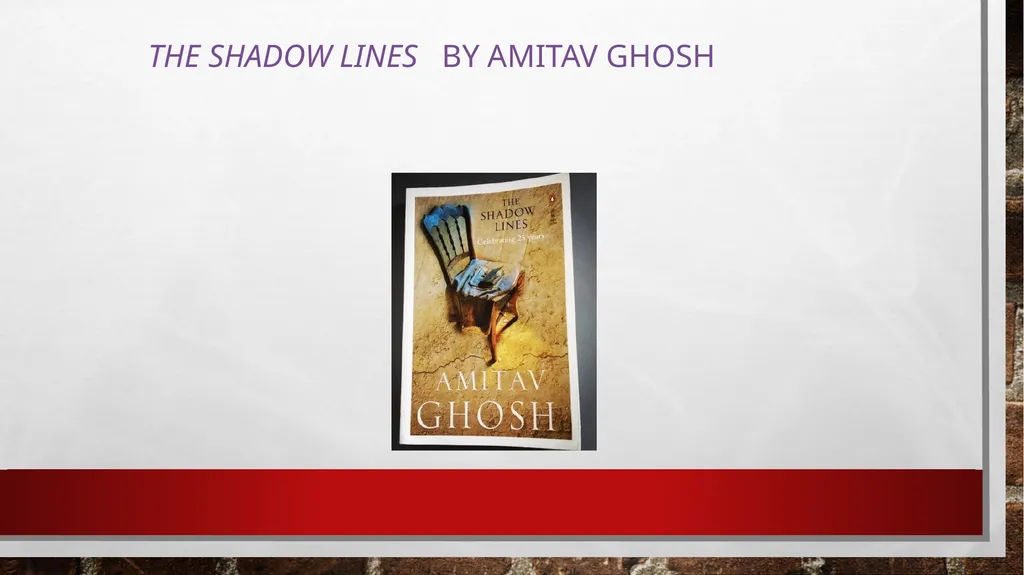
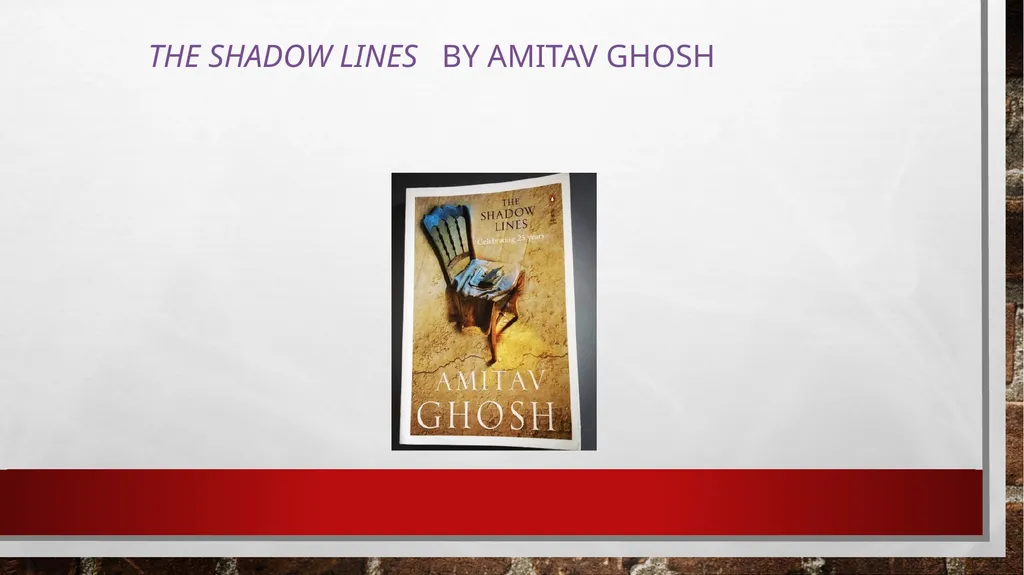
THE SHADOW LINES BY AMITAV GHOSH The Shadow Lines (1988) is a sahitya Academy award winning novel by Amitav Ghosh. It is a book that captures perspective of time and events, of lines that bring people together and hold them apart; lines
Related Topics
Share
Embed code
Download this presentation From Below
"THE SHADOW LINES BY AMITAV GHOSH The Shadow Lines" is the property of its rightful owner. Permission is granted to
download and print the materials on this website for personal, non-commercial use only, and to display it
on your personal computer provided you do not modify the materials and that you retain all copyright
notices contained in the materials. By downloading content from our website, you accept the terms of this
agreement.
Presentation Transcript
01
THE SHADOW LINES BY AMITAV GHOSH<br>
02
The Shadow Lines (1988) is a sahitya Academy award winning novel by Amitav Ghosh. It is a book that captures perspective of time and events, of lines that bring people together and hold them apart; lines that are clearly visible from one perspective and non-existent from another; lines that exist in the memory of one, and therefore in another's imagination.<br>
03
narrative built out of an intricate, constantly crisscrossing web of memories of many people, it never pretends to tell a story. Instead, it invites the reader to invent one, out of the memories of those involved, memories that hold mirrors of differing shades to the same experience.<br>
04
The Shadow Lines does not pretend to have a concrete plot. Rather, it is a series of stream-of-consciousness memories delivered to the reader by an unnamed character known as the narrator. Jumping back and forth between 1939 and the mid 1970s, the Narrator reminisces about various family members and friends, and how their lives intersected with a series of fatal riots in Calcutta and Pakistan in 1963 and 1964.<br>
05
The novel is set against the backdrop of many historical events like
the swadeshi movement,
Second world war,
Partition of India
and communal riots in Dhaka and Calcutta in the year
1963-1964.
The novel earned Ghosh the 1990 Sahitya Akademi Award for English,<br>
06
Split into two parts
'Going Away’
and 'Coming Home’<br>
07
Setting
India, England and East Pakistan
PoV: First Person
Type: Historical Fiction<br>
08
The novel follows the life of a young boy growing up in Calcutta, who is educated in Delhi and then follows with the experiences he has in London.<br>
09
Ghosh‟s The Shadow Lines is a historical narrative which deals mainly with the national borders and geographical boundaries that separate people. The novel also records to violence that followed the riots of Calcutta and Dhaka in 1964. The title, “The shadow lines” has many connotations; it does not only refer to borders between countries. Ghosh chooses his title to suggest that the borders which separate people are mere “shadow”, and nothing more than artificial lines created by politicians. Building upon this, Ghosh stresses the arbitrariness of such cartographic demarcations. He illustrates this point through Thamma‟a, the narrator‟s grandmother. When she travels to Calcutta with her family in the plane, she naively asks “whether she would be able to see the border between India and East Pakistan from the plane” Thamma‟a does not imagine any line in between the borders; she is actually looking for visible indication of demarcation.<br>
10
The Shadow Lines received great acclaim, despite its challenging style. It is not a book that can be read quickly or haphazardly, given the Narrator’s tendency to switch cities, years, and sometimes even decades, all in the same paragraph. But read carefully, as a whole, the novel is an ingenious, occasionally frustrating nesting structure, much like memory itself.<br>
11
Characters The narrator
We do not know too much about the narrator. He is a young boy born and raised in Calcutta (Kolkata) in West Bengal, India. He has his education in Delhi, India and later lives in London, England. He adores his uncle, Tridib. Despite his love for certain people—Tridib, Tha’mma his grandmother, and Ila—he is extremely passive. After Ila rejects him, his role becomes that of an observer. He rarely inserts himself into the action; he simply tells the reader what has happened. The Narrator is often a frustrating character, because his style of story-telling works in much the same way as memory itself. His delivery takes place largely in the form of Stream of consciousness.<br>
12
TRIDIB Tridib is the narrator’s uncle. He's about twenty years older and is a very skilled storyteller. He often tells the narrator stories about the year he lived in London with the Prices. Tridib's sense of place in his stories is so exact, the narrator can find his way around London as an adult years later going off of what Tridib told him. Tridib has an atlas that he uses to show the narrator where in the world the places he talks about in his stories are.<br>
13
Tha'mma (the narrator's grandmother) – She was the headmistress of a girls' school in Calcutta. She is a very strict, disciplined, hard-working, mentally strong and patient lady. She is the one who wants to bring her uncle, Jethamoshai, to India to live with her, eventually leading to his and Tridib's deaths by a mob in Dhaka.She is a strict disciplinarian head of the family. She plays a foil to the younger generation and also a critic of those whom she thinks have deviated from Indian mores like old persons she has faith in old accepted values of life and looks down upon those who do not fall in line with her.<br>
14
Ila
Ila is actually the young boy's, the narrator's, cousin, even though she also is his love interest. The young boy is sexually attracted to Ila, but dares not to tell her. There is one incident in the book where the young boy unwillingly lets Ila know about his feelings and interests. Ila ends up marrying Nick, the Price family's son. Ila lives in Stockwell in London, England.<br>
15
May – She is the Price family's daughter. She is in love with Tridib and blames herself for his death.
Nick – He is the Price family's son, distinguishable by his long blond hair. He wants to work in the 'futures industry'. He marries Ila during the course of the novel, but it is later found that he is allegedly having an affair. He worked in Kuwait for a brief period of time but quit his job (it is implied that he may have been fired for embezzlement).
Mayadebi – She is the narrator's grandmother's younger sister and Tridib's mother.<br>