The suns effect on climate LeSson 4b Why Is It Warmer in the Summer than in the Winter? Lesson Focus Question Why is it warmer in the summer than in the winter? What ideas have you come up with so far to answer this question? Make sure to
"The sun’s effect on climate LeSson 4b Why Is It" is the property of its rightful owner. Permission is granted to
download and print the materials on this website for personal, non-commercial use only, and to display it
on your personal computer provided you do not modify the materials and that you retain all copyright
notices contained in the materials. By downloading content from our website, you accept the terms of this
agreement.
Presentation Transcript
01
The sun’s effect on climate LeSson 4b Why Is It Warmer in the Summer than in the Winter?<br>
02
Lesson Focus Question Why is it warmer in the summer than in the winter?
What ideas have you come up with so far to answer this question?
Make sure to support your ideas with evidence!<br>
03
Lesson Focus Question Why is it warmer in the summer than in the winter?
To figure out the best answer to this question, we need to make sense of the data we collected last time about the Sun’s incoming energy at different latitudes in Earth’s orbit.<br>
04
Today’s Activity For this activity, you’ll work in the same small groups from our last lesson.
You’ll need the following materials:
Your science notebooks
Your completed data tables from last time (handout 4.4)
Handouts 4.2 and 4.3 from yesterday (The Sun’s Incoming Energy with Tilt for positions 1 and 3)
Handout 2.3 (The Sun’s Incoming Energy) from lesson 2b<br>
05
Discussion Questions Look at the discussion questions on page 3 of handout 4.1 (The Angle of Sunlight and Seasons on Earth).
Work together as a group to answer each question. Make sure to use the data from your data table (handout 4.4) and lesson 2b (handout 2.3, The Sun’s Incoming Energy).
Record your group’s answers to these questions in your science notebook.<br>
06
Class Data Chart Record your group’s data from the data table (handout 4.4) on our class chart. Then we’ll compare our results.<br>
07
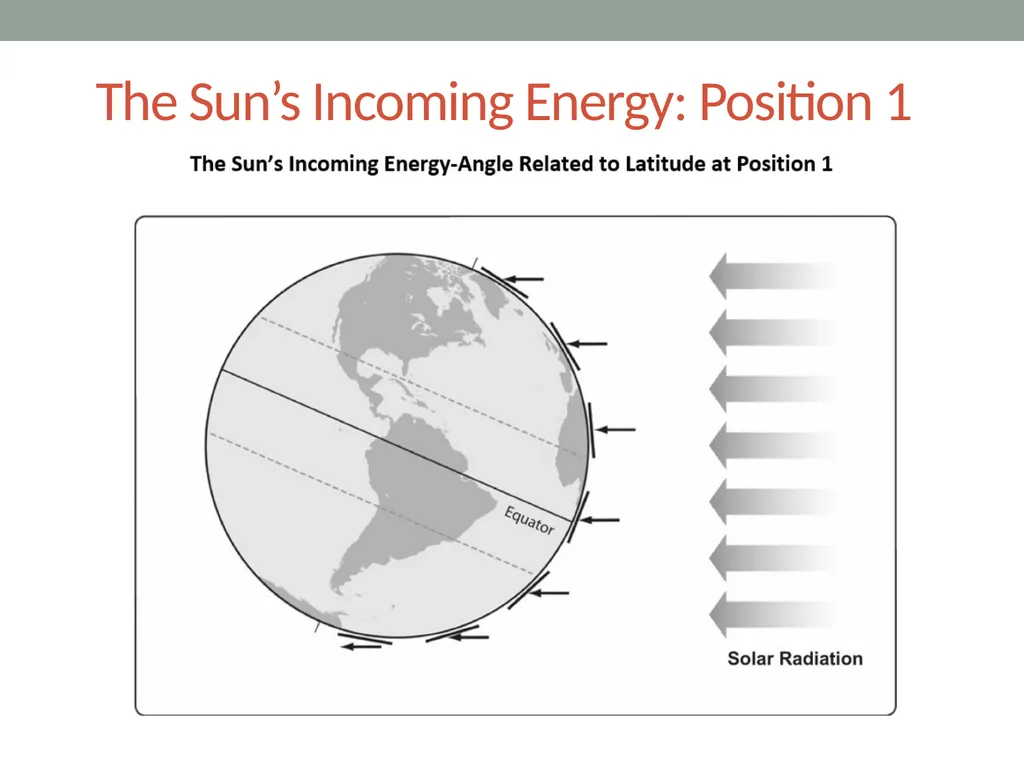
What Do You Observe? Is there any difference between the number of lines you counted near the equator and closer to the poles?
Where is the Sun’s light energy (solar radiation) more direct (concentrated) in position 1?
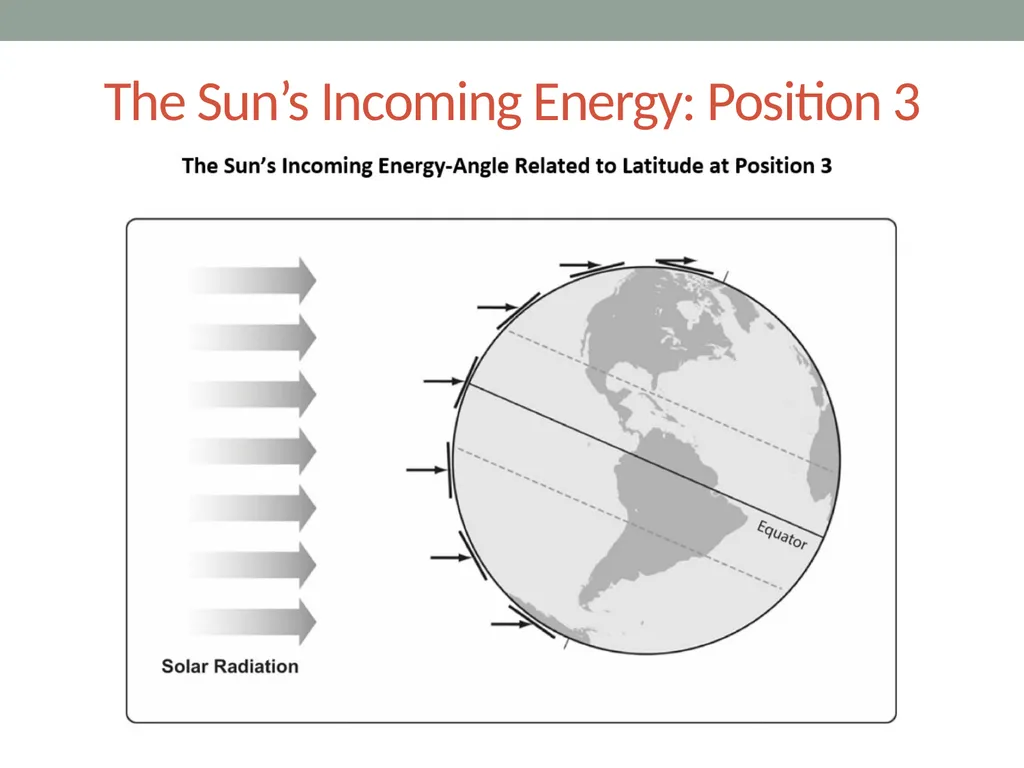
Where is the solar radiation more direct (concentrated) in position 3?
Did the distance between the Sun and Earth change from position 1 to position 3?<br>
08
What Causes Seasons on Earth? So if the distance between Earth and the Sun doesn’t cause different seasons on Earth, what does?
What do you think makes temperatures warmer or cooler around the world at different times of the year?<br>
09
Let’s Compare Our Data Compare the data from our data table in handout 4.4 (Earth with a tilt) with the data from handout 2.3 in lesson 2 (Earth without a tilt).
Is the number of lines of solar radiation the same at these latitudes when Earth is tilted and when it isn’t? What do the data tell you?
0–15° N latitude
0–15° S latitude
45–60° N latitude
45–60° S latitude<br>
10
The Sun’s Incoming Energy: Position 1<br>
11
The Sun’s Incoming Energy: Position 3<br>
12
Key Science Ideas from Lesson 2 When sunlight strikes Earth at a more direct angle, the light energy (solar radiation) is more concentrated (intense), and Earth’s surface gets warmer.
When sunlight strikes Earth at a less direct angle, the light energy (solar radiation) is less concentrated (intense), and Earth’s surface doesn’t warm up as much.<br>
13
Today’s Focus Question Why is it warmer in the summer than in the winter?
Based on today’s activity, how can the science ideas from lesson 2 help you answer this question?
Write a new answer to this question in your notebook. Make sure to support your answer with evidence from the data table in handout 4.4.<br>
14
Key Science Ideas from Today’s Lesson The Northern Hemisphere experiences summer in June, July, and August because Earth’s tilt toward the Sun causes more direct (intense) light energy to hit Earth’s surface at northern latitudes during these months.
The Southern Hemisphere experiences summer in December, January, and February because Earth’s tilt toward the Sun causes more direct (intense) light energy to hit Earth’s surface at southern latitudes during these months.
The angle of sunlight related to Earth’s tilt is one key factor in determining seasons and temperatures around the globe.<br>
15
Next Time So far we’ve explored these factors that affect seasons and temperatures on Earth:
Latitude
The angle of sunlight
The consistent tilt of Earth’s axis
Earth’s orbit around the Sun
What other factors might affect temperatures on Earth?
We’ll talk about your ideas next time!<br>