THE TECHNIQUES OF NEWS AND FEATURE WRITING A
Description: THE TECHNIQUES OF NEWS AND FEATURE WRITING A PRESENTATION BY MOHAMMED ASHIRU BABA, fsi, FCIA, MNIM, ANIPR DIRECTOR PUBLIC ENLIGHTENMENT AND EDUCATION, ICPC AT A 2-DAY REFRESHER WORKSHOP FOR REPORTERS COVERING THE ACTIVITIES OF INDEPENDENT
Related Topics
Download Presentation
"THE TECHNIQUES OF NEWS AND FEATURE WRITING A" is the property of its rightful owner. Permission is granted to download and print the materials on this website for personal, non-commercial use only, and to display it on your personal computer provided you do not modify the materials and that you retain all copyright notices contained in the materials. By downloading content from our website, you accept the terms of this agreement.
Presentation Transcript
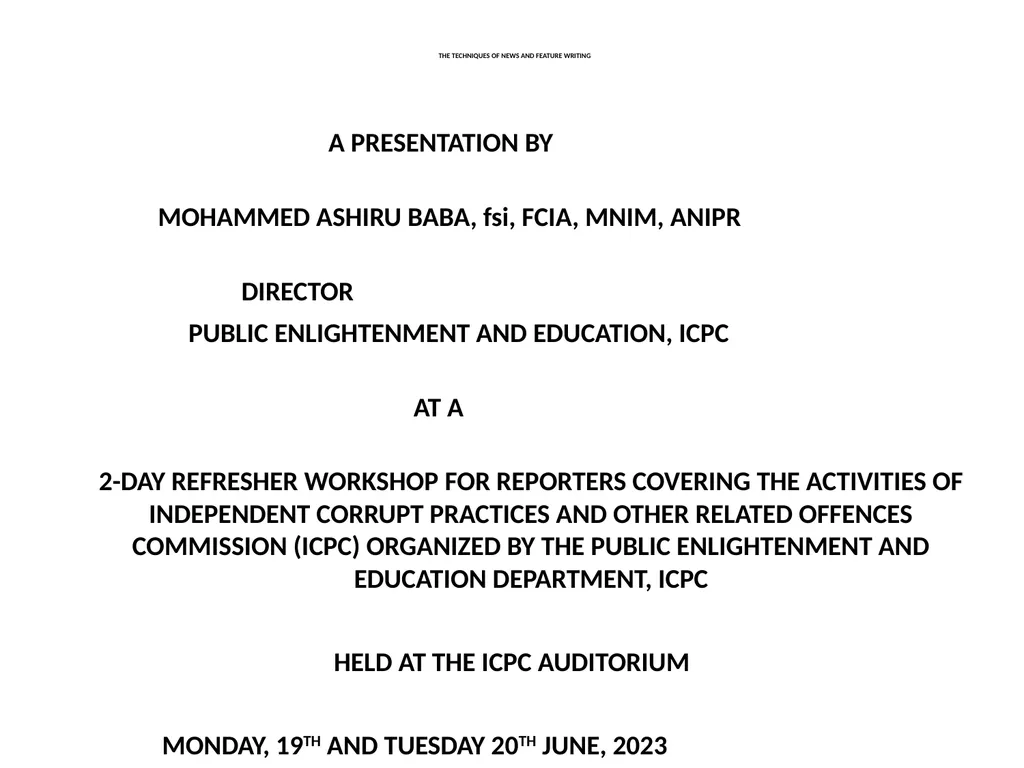
slide1. THE TECHNIQUES OF NEWS AND FEATURE WRITING A PRESENTATION BY
MOHAMMED ASHIRU BABA, fsi, FCIA, MNIM, ANIPR
DIRECTOR
PUBLIC ENLIGHTENMENT AND EDUCATION, ICPC
AT A
2-DAY REFRESHER WORKSHOP FOR REPORTERS COVERING THE ACTIVITIES OF INDEPENDENT CORRUPT PRACTICES AND OTHER RELATED OFFENCES COMMISSION (ICPC) ORGANIZED BY THE PUBLIC ENLIGHTENMENT AND EDUCATION DEPARTMENT, ICPC
HELD AT THE ICPC AUDITORIUM
MONDAY, 19TH AND TUESDAY 20TH JUNE, 2023<br>
slide2. OBJECTIVES OF THE PRESENTATION: The presentation seeks to achieve the following
objectives:
To refresh the minds of reporters on the art of news and feature writing;
2. To share opinions with reporters on how best to report anti-corruption activities with utmost sense of professionalism through news and feature writing;
3. To guide reporters on contemporary styles and ethics of news and feature writing.<br>
slide3. INTRODUCTION: Journalism is one aspect of mass communication which entails informing, educating, entertaining and setting agenda for the society. Some of its basic tools of communication are news and feature writing and reporting.
Language is the major tool of news writing and news reporting and the same way language is dynamic, the art of news writing and news reporting is equally dynamic.<br>
slide4. INTRODUCTION: In the past three decades the art of news and feature writing had experienced alarming transformation globally, especially with the emergence of digital and social media. The process of information dissemination through the art of news writing and news reporting had assumed unimaginable speed compared to the information dissemination processes of the 60s up to 90s.
Apart from the speed, the public outreach is also alarming. There is tremendous improvement in visuals while public engagements and feedback are almost instant. These are some of positive consequences of the evolution of the digital media.<br>
slide5. INTRODUCTION Those who trained and practiced journalism in the 60s down to the 90s in Nigeria would however discover the disturbing fact that what is practiced today is more or less cash and carry journalism. Very few Nigerian reporters engage in investigative journalism just as journalists pitch tents with political gladiators and worship the whimps and caprices of their owners.
In fact many a journalist nowadays are accidental journalists – they neither possess the requisite skill nor have the quantum of experience necessary to practice on the field. Some of them write without knowing what or how news should look like. Their qualification is simply an iphone.<br>
slide6. INTRODUCTION The ethics of the noble journalism profession has become the major casualty over the years as truth, fairness, objectivity, and depth, basic characteristics of professional journalism have given way to mediocrity and subjectivity.
The glaring war of wit between conventional and social media aggravates the situation beyond redemption. A situation where virtually everybody is now a journalist makes our highly respected profession an all-comer profession. This poses a big challenge to seasoned journalists and media regulators.<br>
slide7. SCOPE This presentation is on the techniques of news and feature writing. It therefore focuses on the practical aspect of news and feature writing.
The presentation is not in any way an encyclopaedia of news and feature writing. The techniques it teaches are not exhaustive but only a guide to the practicing journalist. There is therefore the need for participants to consult references provided at the end of this presentation for further research.<br>
slide8. WHAT IS NEWS?<br>
slide9. WHAT IS NEWS?<br>
slide10. WHAT IS NEWS?<br>
slide11. WHAT IS NEWS? There are as many definitions of News as there are newsmen. But they all end up saying the same thing. Here are a few of some popular definitions proffered by scholar and media practitioners:
According to Croteau and Hovnes, 2014, ‘’News is a form of communication that informs the public of current events, issues, and trends in the society.”
“News is a cultural production that transforms events and issues into symbols and narratives that reflect and shape social meaning.” (Fishman, 1980)
“News is a product of a news organization, conveying information to an audience about recent events, developments, and issues.” (Galtung & Ruge, 1965)<br>
slide12. WHAT IS NEWS? News is information that is published in newspapers and broadcast on radio and television about recent events in a particular area of activity.
NEWS is Notable Events, Weather and Sport
NEWS is North, East, West and South
News is new information about something that has happened recently
‘’News is a cultural production that transforms events and issues into symbols and narratives that reflect and shape social meaning.” (Fishman, 1980)24 Apr 2023<br>
slide13. WHAT IS NEWS? “News is a social construction that provides a mediated reality of events and issues that are selected, framed, and presented by news media professionals.” (McQuail, 2010)
“News is a means of communication that provides citizens with information and knowledge necessary for their democratic participation and decision-making.” (Lippmann, 1922)
“News is a mode of public communication that represents a specific, observable form of discourse about the world.” (Schudson, 2011)<br>
slide14. WHAT IS NEWS? “News is a process of selecting, processing, and disseminating information about events, issues, and people that are considered newsworthy by journalists.” (Zelizer, 1993)
“News is a medium through which individuals and societies create, maintain, and share a sense of public knowledge and common understanding.” (Zelizer & Allan, 2011)
“News is an account of current events presented in a medium to a public audience.” (Bell, 1991)<br>
slide15. ORIGIN OF NEWS The origin of news can be traced back to ancient civilizations, where individuals disseminated information through oral communication or written records.
Over time, the emergence of technologies such as printing presses, telegraphs, radios, televisions, and the internet has revolutionized the way news is gathered, produced, and distributed from hand mails packaging and delivery to digital broadcast and transmission .<br>
slide18. NEWS WRTING TECHNIQUES In news or feature writing there are some rules the writer must adhere to for clarity, cohesion brevity. Some of the rules are as follows:
1. Abbreviations - Acceptable if part of formal name e.g Ashiru Baba & Co. Avoid in running text e.g Professor Baba, not Prof. Baba.
2. Acronyms - Use on second and subsequent references if given after a first spelled-out use e.g Code of Conduct Bureau, subsequently CCB
3. Apostrophes – Do not use to form plurals e.g 1940s, not 1940’s
4. Bias – free language - Use first-year students instead of freshmen (unless it appears in a quoation). International students is preferred over foreign students. Juniors and seniors is preferred over upperclass students.<br>
slide19. NEWS WRTING TECHNIQUES 5. Numbers from 10 should appear in words not digits e.g. Ten not 10 etc
6. Capitalize first letters in official names and geographical areas etc . E.g Department of Public Enlightenment and Education; Central Area, not central area
7. Lowercase job titles e.g the chief executive officer Not Chief Executive Officer
8. Use captions to identify images. Use from left to properly identify images in photos<br>
slide20. 9. After a first reference, subsequent references generally use only a person’s last name, except in obituaries. E.g Mr. Baba; Professor Owasanoye etc, not Mr. Mohammed Ashiru Baba or Professor Bolaji Owasanoye.
10. Dates - If the day of the month appears, use a comma before the year e.g by the January 15, 2013 deadline). Do not use a comma between the month and the year without a date e.g by the January 2013 deadline.
11. Lists - Do not use a colon after a verb or a preposition introducing a list (including Ben, Julie, and Pete instead of including: Ben, Julie, and Pete) unless the introductory phrase contains some variation of the following: or as follows:<br>
slide23. 5 Ws & H<br>
slide24. INVERTED PYRAMID STYLE<br>
slide25. WHAT IS A FEATURE STORY? A feature story is any piece of writing that falls between the cut-and-dried news story on the one hand, and the wholly fictionalized story or opinionated essay on the other hand. It is the product of factual reporting and reporting to which are added story elements of imaginative writing and interpretation.
A feature story is a creative, sometimes subjective article designed primarily to entertain and to inform readers about an event, a situation or an aspect of life.<br>
slide26. WHAT IS A FEATURE STORY? 1. Feature stories can be (elongated) news stories usually called news analysis
2. Features can be investigative.
3. Features can be in-depth studies – outcome of a research.
4. Features can be for fun. The subject can be anything: places such as a community, a farm etc. It can be on a business, education, science, economy, religion, philosophy; events-parades, programmes, concerts; people (personality profile), can be on animals-unusual or ordinary; objects-art or product. In Other words,
5. Features can be about anything, you want to write about, but the writing must interesting and captivating.<br>
slide27. WHAT IS A FEATURE STORY? The feature article is similar to news story in that it gives the readers facts in an interesting form. But it goes beyond those facts by multiplying them with study, research, and interviews to instruct, guide and entertain the readers who know about the subject as well as those who do not know.
Once you are creative and you have the penchant for writing, you can produce a good feature article<br>
slide28. CHARACTERISTICS OF A FEATURE STORY 1. It may inform, instruct , entertain and advise. It is usually read after the news and in leisure moments;
2. It is factual and it requires reporting;
3. It may or may not be timely. If it is timely and related to a current news event, it is likely to appeal more to readers;
4. It may be written in any form and style. The only criterion is that the form and style be appropriate to the contents and purpose of the story;
5. It permits the reporter to use his/her knowledge and ingenuity to write a story original in ideas and treatment.<br>
slide29. CHARACTERISTICS OF A FEATURE STORY 6. It rarely has news leads. Instead, it more often has novelty leads;
7. It usually strikes the keynote in the opening sentences, which permits the readers to come into quick contact with the story and become interested;
8. It usually is not cut in make-up. Thus, the reporter may use any devices of the fiction writer: suspense, dialogue, description, narration, climax, and the like. The inverted pyramid does not usually fit the purpose of a feature story, but can be adopted;
9. It requires the writer to apply his/her imaginations to the facts.<br>
slide30. CHARACTERISTICS OF A FEATURE STORY 10. Apply all the principles of effective writing - unity, coherence, and emphasis;
11. It can be improved by rewriting to eliminate all writing faults. For example, stodginess, verbosity, abstractness, monotony and absence of rhythm, etc;
12: It brings readers as close as possible to the experience or idea of the story. The reader feels himself as a part of the story.<br>
slide31. FEATURE WRITING TECHNIQUES<br>
slide32. FEATURE WRITING TECHNIQUES<br>
slide33. FEATURE WRITING TECHNIQUES Structure
A feature is seldom written in the traditional Inverted pyramid pattern. Feature may be written in a narrative fashion, much like a good joke or anecdote.
The good feature requires as much organization as the straight news story, for the feature has to flow smoothly and parts of a feature story must be kept intact if it is to succeed. In the well-planned story, every paragraph, every sentence, should add to the total effect.<br>
slide34. FEATURE WRITING TECHNIQUES Lead
The lead must attract immediate attention and pull the reader into the story. Leads can vary in style and content. You can use description, narration, dialogue, question, unusual statement, call to action, comparison-contr.ast etc.
Transition
No matter how good the lead is, you need a solid transition into the body of the feature. If you think of the lead as a lure to attract the audience, then the transition sets the hook. It makes the reader wants to continue. And it promises some kind of satisfaction or reward. The reward can be entertainment, information or self- awareness but has to be something of value to the reader.<br>
slide35. FEATURE WRITING TECHNIQUES Body
Sound knowledge of the subject, coupled with good writing skills, will let you take the reader through a variety of experiences. You should use the standard writing devices of crisp dialogue, documentable but vivid fact and detail, careful observation, suspense and if appropriate, plot.
Length
If a reporter asks how long a feature story should be the editor may reply, “as long as you keep it interesting.” Feature stories vary in length from seven paragraphs to 15 or 20 triple-spaced sheets of copy. In other words the maximum length of a news story can be the minimum length of a feature article. Reader’s interest is the main yardstick by which feature articles are judged. Editors are paid to accurately assess, reader’s interest.<br>
slide36. FEATURE WRITING TECHNIQUES Conclusion:
The conclusion should give the reader a sense of satisfaction. You need to tie the conclusion to the lead so that the story has unity. Often you can do this through a short, tight summary. Occasionally, you can conclude with an anecdote or a quote that sums up the substance of the story. With a narrative approach, you build toward a climax.<br>
slide37. WRITING FOR THE WEB<br>
slide38. WRITING FOR THE WEB<br>
slide39. WRITING FOR THE WEB Users want to find what they are looking for as quickly and easily as possible. Web-oriented writing and editing are essential for optimal content delivery.
Key Concepts
Omit non-essential words. Users don't read -- they scan.
Use "inverted pyramid" writing style: start with the point, then support it, using links for more in-depth details.
One idea only per paragraph.
Keep the most important elements "above the fold," that is, visible upon initial page view without scrolling.<br>
slide40. WRITING FOR THE WEB Categorize according to users' needs, not by departmental organization or hierarchy.
Do:
Facilitate scanning with subheads, bullet points, lists, and captions.
Provide links to related and additional detail.
Use an active voice e.g "The company published the book."
Use lists or tables and infographics as much as possible.<br>
slide41. WRITING FOR THE WEB Don't:
Expect your visitors to read everything.
Put everything on one page.
Use a passive voice e.g "The book was published by the company."
List items in a paragraph to save room.
Consistency of Style:
The only web constant is change. Stylistic debates continue ("Is it E-mail, e-mail, or email?"). Style manuals will help, but the most important style and usage point that cannot be emphasized enough, is consistency. You must adhere to the style you choose.<br>
slide42. WRITING FOR THE WEB<br>
slide43. CHALLENGES OF NEWS AND FEATURE WRITING TECHNIQUES Non adherence to ethics – facts, objectivity, balance and fairness
Disregard or inconsistency in styles
Cash and carry journalism – sold to highest bidder – exclusive story, exclusive ‘wahala’
Lack of skills and experience
Prevalence of fake news
Casualisation
Lack of skills, initiative, pro-activity and creativity<br>
slide44. FAKE NEWS<br>
slide45. FACT-CHECK Fact – check is the major solution to fake news.
- Source ?
- Does it make sense?
- Is the source verifiable?
- Is it true?
- Is it possible
- How reasonable / sensible?
- what are the interests involved?<br>
slide46. SOURCES OF NEWS News sources vary widely, ranging from politicians, public and private organizations and institutions, traditional media outlets like newspapers, radio, and television to modern digital platforms such as websites, social media, podcasts, and mobile applications.
It is part of the ethics of the journalism profession for the writer to credit his sources of information. Doing so would give the story added credibility. Not crediting a source may amount to plagiarism, especially in feature articles, but in news writing, the source may opt for anonimity as a matter of right .<br>
slide47. CONCLUSION The credibility and reliability of news are of utmost importance. Journalism ethics and standards guide news organizations and journalists in maintaining accuracy, fairness, and impartiality.
Finally, to ensure quality reporting, journalists must adhere to principles like verifying information from multiple sources, attributing sources, fact-checking, and separating news from opinion or commentary.
Thank you and God Bless You<br>
slide48. REFERENCES 1. Bell, A. (1991). The Language of News Media. Oxford: Blackwell.
2. Croteau, D., & Hoynes, W. (2014). Media/Society: Industries, Images, and Audiences (5th ed.). Thousand Oaks, CA: Sage Publications.
3. Fishman, M. (1980). Manufacturing the News. Austin: the University of Texas Press.
4. Galtung, J., & Ruge, M. H. (1965). The Structure of Foreign News. Journal of Peace Research, 2(1), 64-91.
5. McQuail, D. (2010). McQuail’s Mass Communication Theory (6th ed.). Los Angeles: Sage Publications.
6. Lippmann, W. (1922). Public Opinion. New York: Harcourt, Brace and Company.<br>
slide49. REFERENCES 7. Schudson, M. (2011). The Sociology of News (2nd ed.). New York: W.W. Norton & Company.
8. Tuchman, G. (1978). Making News: A Study in the Construction of Reality. New York: The Free Press.
9. Zelizer, B., & Allan, S. (2011). Journalism After September 11. New York: Routledge.
10. Zelizer, B. (1993). Journalists as Interpretive Communities. Critical Studies in Mass Communication, 10(2), 219-237.<br>
slide50. Contact ICPC: E-mail: info@icpc.gov.ng
Website: www.icpc.gov.ng
Toll-free lines (MTN and GLO): 0800-CALL-ICPC (0800-2255-4272)
08031230280, 08031230281, 08031230282,
07056990190, 07056990191
@ICPCNIGERIA 50<br>
MOHAMMED ASHIRU BABA, fsi, FCIA, MNIM, ANIPR
DIRECTOR
PUBLIC ENLIGHTENMENT AND EDUCATION, ICPC
AT A
2-DAY REFRESHER WORKSHOP FOR REPORTERS COVERING THE ACTIVITIES OF INDEPENDENT CORRUPT PRACTICES AND OTHER RELATED OFFENCES COMMISSION (ICPC) ORGANIZED BY THE PUBLIC ENLIGHTENMENT AND EDUCATION DEPARTMENT, ICPC
HELD AT THE ICPC AUDITORIUM
MONDAY, 19TH AND TUESDAY 20TH JUNE, 2023<br>
slide2. OBJECTIVES OF THE PRESENTATION: The presentation seeks to achieve the following
objectives:
To refresh the minds of reporters on the art of news and feature writing;
2. To share opinions with reporters on how best to report anti-corruption activities with utmost sense of professionalism through news and feature writing;
3. To guide reporters on contemporary styles and ethics of news and feature writing.<br>
slide3. INTRODUCTION: Journalism is one aspect of mass communication which entails informing, educating, entertaining and setting agenda for the society. Some of its basic tools of communication are news and feature writing and reporting.
Language is the major tool of news writing and news reporting and the same way language is dynamic, the art of news writing and news reporting is equally dynamic.<br>
slide4. INTRODUCTION: In the past three decades the art of news and feature writing had experienced alarming transformation globally, especially with the emergence of digital and social media. The process of information dissemination through the art of news writing and news reporting had assumed unimaginable speed compared to the information dissemination processes of the 60s up to 90s.
Apart from the speed, the public outreach is also alarming. There is tremendous improvement in visuals while public engagements and feedback are almost instant. These are some of positive consequences of the evolution of the digital media.<br>
slide5. INTRODUCTION Those who trained and practiced journalism in the 60s down to the 90s in Nigeria would however discover the disturbing fact that what is practiced today is more or less cash and carry journalism. Very few Nigerian reporters engage in investigative journalism just as journalists pitch tents with political gladiators and worship the whimps and caprices of their owners.
In fact many a journalist nowadays are accidental journalists – they neither possess the requisite skill nor have the quantum of experience necessary to practice on the field. Some of them write without knowing what or how news should look like. Their qualification is simply an iphone.<br>
slide6. INTRODUCTION The ethics of the noble journalism profession has become the major casualty over the years as truth, fairness, objectivity, and depth, basic characteristics of professional journalism have given way to mediocrity and subjectivity.
The glaring war of wit between conventional and social media aggravates the situation beyond redemption. A situation where virtually everybody is now a journalist makes our highly respected profession an all-comer profession. This poses a big challenge to seasoned journalists and media regulators.<br>
slide7. SCOPE This presentation is on the techniques of news and feature writing. It therefore focuses on the practical aspect of news and feature writing.
The presentation is not in any way an encyclopaedia of news and feature writing. The techniques it teaches are not exhaustive but only a guide to the practicing journalist. There is therefore the need for participants to consult references provided at the end of this presentation for further research.<br>
slide8. WHAT IS NEWS?<br>
slide9. WHAT IS NEWS?<br>
slide10. WHAT IS NEWS?<br>
slide11. WHAT IS NEWS? There are as many definitions of News as there are newsmen. But they all end up saying the same thing. Here are a few of some popular definitions proffered by scholar and media practitioners:
According to Croteau and Hovnes, 2014, ‘’News is a form of communication that informs the public of current events, issues, and trends in the society.”
“News is a cultural production that transforms events and issues into symbols and narratives that reflect and shape social meaning.” (Fishman, 1980)
“News is a product of a news organization, conveying information to an audience about recent events, developments, and issues.” (Galtung & Ruge, 1965)<br>
slide12. WHAT IS NEWS? News is information that is published in newspapers and broadcast on radio and television about recent events in a particular area of activity.
NEWS is Notable Events, Weather and Sport
NEWS is North, East, West and South
News is new information about something that has happened recently
‘’News is a cultural production that transforms events and issues into symbols and narratives that reflect and shape social meaning.” (Fishman, 1980)24 Apr 2023<br>
slide13. WHAT IS NEWS? “News is a social construction that provides a mediated reality of events and issues that are selected, framed, and presented by news media professionals.” (McQuail, 2010)
“News is a means of communication that provides citizens with information and knowledge necessary for their democratic participation and decision-making.” (Lippmann, 1922)
“News is a mode of public communication that represents a specific, observable form of discourse about the world.” (Schudson, 2011)<br>
slide14. WHAT IS NEWS? “News is a process of selecting, processing, and disseminating information about events, issues, and people that are considered newsworthy by journalists.” (Zelizer, 1993)
“News is a medium through which individuals and societies create, maintain, and share a sense of public knowledge and common understanding.” (Zelizer & Allan, 2011)
“News is an account of current events presented in a medium to a public audience.” (Bell, 1991)<br>
slide15. ORIGIN OF NEWS The origin of news can be traced back to ancient civilizations, where individuals disseminated information through oral communication or written records.
Over time, the emergence of technologies such as printing presses, telegraphs, radios, televisions, and the internet has revolutionized the way news is gathered, produced, and distributed from hand mails packaging and delivery to digital broadcast and transmission .<br>
slide18. NEWS WRTING TECHNIQUES In news or feature writing there are some rules the writer must adhere to for clarity, cohesion brevity. Some of the rules are as follows:
1. Abbreviations - Acceptable if part of formal name e.g Ashiru Baba & Co. Avoid in running text e.g Professor Baba, not Prof. Baba.
2. Acronyms - Use on second and subsequent references if given after a first spelled-out use e.g Code of Conduct Bureau, subsequently CCB
3. Apostrophes – Do not use to form plurals e.g 1940s, not 1940’s
4. Bias – free language - Use first-year students instead of freshmen (unless it appears in a quoation). International students is preferred over foreign students. Juniors and seniors is preferred over upperclass students.<br>
slide19. NEWS WRTING TECHNIQUES 5. Numbers from 10 should appear in words not digits e.g. Ten not 10 etc
6. Capitalize first letters in official names and geographical areas etc . E.g Department of Public Enlightenment and Education; Central Area, not central area
7. Lowercase job titles e.g the chief executive officer Not Chief Executive Officer
8. Use captions to identify images. Use from left to properly identify images in photos<br>
slide20. 9. After a first reference, subsequent references generally use only a person’s last name, except in obituaries. E.g Mr. Baba; Professor Owasanoye etc, not Mr. Mohammed Ashiru Baba or Professor Bolaji Owasanoye.
10. Dates - If the day of the month appears, use a comma before the year e.g by the January 15, 2013 deadline). Do not use a comma between the month and the year without a date e.g by the January 2013 deadline.
11. Lists - Do not use a colon after a verb or a preposition introducing a list (including Ben, Julie, and Pete instead of including: Ben, Julie, and Pete) unless the introductory phrase contains some variation of the following: or as follows:<br>
slide23. 5 Ws & H<br>
slide24. INVERTED PYRAMID STYLE<br>
slide25. WHAT IS A FEATURE STORY? A feature story is any piece of writing that falls between the cut-and-dried news story on the one hand, and the wholly fictionalized story or opinionated essay on the other hand. It is the product of factual reporting and reporting to which are added story elements of imaginative writing and interpretation.
A feature story is a creative, sometimes subjective article designed primarily to entertain and to inform readers about an event, a situation or an aspect of life.<br>
slide26. WHAT IS A FEATURE STORY? 1. Feature stories can be (elongated) news stories usually called news analysis
2. Features can be investigative.
3. Features can be in-depth studies – outcome of a research.
4. Features can be for fun. The subject can be anything: places such as a community, a farm etc. It can be on a business, education, science, economy, religion, philosophy; events-parades, programmes, concerts; people (personality profile), can be on animals-unusual or ordinary; objects-art or product. In Other words,
5. Features can be about anything, you want to write about, but the writing must interesting and captivating.<br>
slide27. WHAT IS A FEATURE STORY? The feature article is similar to news story in that it gives the readers facts in an interesting form. But it goes beyond those facts by multiplying them with study, research, and interviews to instruct, guide and entertain the readers who know about the subject as well as those who do not know.
Once you are creative and you have the penchant for writing, you can produce a good feature article<br>
slide28. CHARACTERISTICS OF A FEATURE STORY 1. It may inform, instruct , entertain and advise. It is usually read after the news and in leisure moments;
2. It is factual and it requires reporting;
3. It may or may not be timely. If it is timely and related to a current news event, it is likely to appeal more to readers;
4. It may be written in any form and style. The only criterion is that the form and style be appropriate to the contents and purpose of the story;
5. It permits the reporter to use his/her knowledge and ingenuity to write a story original in ideas and treatment.<br>
slide29. CHARACTERISTICS OF A FEATURE STORY 6. It rarely has news leads. Instead, it more often has novelty leads;
7. It usually strikes the keynote in the opening sentences, which permits the readers to come into quick contact with the story and become interested;
8. It usually is not cut in make-up. Thus, the reporter may use any devices of the fiction writer: suspense, dialogue, description, narration, climax, and the like. The inverted pyramid does not usually fit the purpose of a feature story, but can be adopted;
9. It requires the writer to apply his/her imaginations to the facts.<br>
slide30. CHARACTERISTICS OF A FEATURE STORY 10. Apply all the principles of effective writing - unity, coherence, and emphasis;
11. It can be improved by rewriting to eliminate all writing faults. For example, stodginess, verbosity, abstractness, monotony and absence of rhythm, etc;
12: It brings readers as close as possible to the experience or idea of the story. The reader feels himself as a part of the story.<br>
slide31. FEATURE WRITING TECHNIQUES<br>
slide32. FEATURE WRITING TECHNIQUES<br>
slide33. FEATURE WRITING TECHNIQUES Structure
A feature is seldom written in the traditional Inverted pyramid pattern. Feature may be written in a narrative fashion, much like a good joke or anecdote.
The good feature requires as much organization as the straight news story, for the feature has to flow smoothly and parts of a feature story must be kept intact if it is to succeed. In the well-planned story, every paragraph, every sentence, should add to the total effect.<br>
slide34. FEATURE WRITING TECHNIQUES Lead
The lead must attract immediate attention and pull the reader into the story. Leads can vary in style and content. You can use description, narration, dialogue, question, unusual statement, call to action, comparison-contr.ast etc.
Transition
No matter how good the lead is, you need a solid transition into the body of the feature. If you think of the lead as a lure to attract the audience, then the transition sets the hook. It makes the reader wants to continue. And it promises some kind of satisfaction or reward. The reward can be entertainment, information or self- awareness but has to be something of value to the reader.<br>
slide35. FEATURE WRITING TECHNIQUES Body
Sound knowledge of the subject, coupled with good writing skills, will let you take the reader through a variety of experiences. You should use the standard writing devices of crisp dialogue, documentable but vivid fact and detail, careful observation, suspense and if appropriate, plot.
Length
If a reporter asks how long a feature story should be the editor may reply, “as long as you keep it interesting.” Feature stories vary in length from seven paragraphs to 15 or 20 triple-spaced sheets of copy. In other words the maximum length of a news story can be the minimum length of a feature article. Reader’s interest is the main yardstick by which feature articles are judged. Editors are paid to accurately assess, reader’s interest.<br>
slide36. FEATURE WRITING TECHNIQUES Conclusion:
The conclusion should give the reader a sense of satisfaction. You need to tie the conclusion to the lead so that the story has unity. Often you can do this through a short, tight summary. Occasionally, you can conclude with an anecdote or a quote that sums up the substance of the story. With a narrative approach, you build toward a climax.<br>
slide37. WRITING FOR THE WEB<br>
slide38. WRITING FOR THE WEB<br>
slide39. WRITING FOR THE WEB Users want to find what they are looking for as quickly and easily as possible. Web-oriented writing and editing are essential for optimal content delivery.
Key Concepts
Omit non-essential words. Users don't read -- they scan.
Use "inverted pyramid" writing style: start with the point, then support it, using links for more in-depth details.
One idea only per paragraph.
Keep the most important elements "above the fold," that is, visible upon initial page view without scrolling.<br>
slide40. WRITING FOR THE WEB Categorize according to users' needs, not by departmental organization or hierarchy.
Do:
Facilitate scanning with subheads, bullet points, lists, and captions.
Provide links to related and additional detail.
Use an active voice e.g "The company published the book."
Use lists or tables and infographics as much as possible.<br>
slide41. WRITING FOR THE WEB Don't:
Expect your visitors to read everything.
Put everything on one page.
Use a passive voice e.g "The book was published by the company."
List items in a paragraph to save room.
Consistency of Style:
The only web constant is change. Stylistic debates continue ("Is it E-mail, e-mail, or email?"). Style manuals will help, but the most important style and usage point that cannot be emphasized enough, is consistency. You must adhere to the style you choose.<br>
slide42. WRITING FOR THE WEB<br>
slide43. CHALLENGES OF NEWS AND FEATURE WRITING TECHNIQUES Non adherence to ethics – facts, objectivity, balance and fairness
Disregard or inconsistency in styles
Cash and carry journalism – sold to highest bidder – exclusive story, exclusive ‘wahala’
Lack of skills and experience
Prevalence of fake news
Casualisation
Lack of skills, initiative, pro-activity and creativity<br>
slide44. FAKE NEWS<br>
slide45. FACT-CHECK Fact – check is the major solution to fake news.
- Source ?
- Does it make sense?
- Is the source verifiable?
- Is it true?
- Is it possible
- How reasonable / sensible?
- what are the interests involved?<br>
slide46. SOURCES OF NEWS News sources vary widely, ranging from politicians, public and private organizations and institutions, traditional media outlets like newspapers, radio, and television to modern digital platforms such as websites, social media, podcasts, and mobile applications.
It is part of the ethics of the journalism profession for the writer to credit his sources of information. Doing so would give the story added credibility. Not crediting a source may amount to plagiarism, especially in feature articles, but in news writing, the source may opt for anonimity as a matter of right .<br>
slide47. CONCLUSION The credibility and reliability of news are of utmost importance. Journalism ethics and standards guide news organizations and journalists in maintaining accuracy, fairness, and impartiality.
Finally, to ensure quality reporting, journalists must adhere to principles like verifying information from multiple sources, attributing sources, fact-checking, and separating news from opinion or commentary.
Thank you and God Bless You<br>
slide48. REFERENCES 1. Bell, A. (1991). The Language of News Media. Oxford: Blackwell.
2. Croteau, D., & Hoynes, W. (2014). Media/Society: Industries, Images, and Audiences (5th ed.). Thousand Oaks, CA: Sage Publications.
3. Fishman, M. (1980). Manufacturing the News. Austin: the University of Texas Press.
4. Galtung, J., & Ruge, M. H. (1965). The Structure of Foreign News. Journal of Peace Research, 2(1), 64-91.
5. McQuail, D. (2010). McQuail’s Mass Communication Theory (6th ed.). Los Angeles: Sage Publications.
6. Lippmann, W. (1922). Public Opinion. New York: Harcourt, Brace and Company.<br>
slide49. REFERENCES 7. Schudson, M. (2011). The Sociology of News (2nd ed.). New York: W.W. Norton & Company.
8. Tuchman, G. (1978). Making News: A Study in the Construction of Reality. New York: The Free Press.
9. Zelizer, B., & Allan, S. (2011). Journalism After September 11. New York: Routledge.
10. Zelizer, B. (1993). Journalists as Interpretive Communities. Critical Studies in Mass Communication, 10(2), 219-237.<br>
slide50. Contact ICPC: E-mail: info@icpc.gov.ng
Website: www.icpc.gov.ng
Toll-free lines (MTN and GLO): 0800-CALL-ICPC (0800-2255-4272)
08031230280, 08031230281, 08031230282,
07056990190, 07056990191
@ICPCNIGERIA 50<br>