
The UN National Quality Assurance Framework for
CB
Published · 21 slides · 0 views

1 / 1


Description
The UN National Quality Assurance Framework for Official Statistics Matthias Reister, reisterun.org Chief, Development Data Section Statistics Division, Development Data and Outreach Branch United Nations Department of Economic and Social
Related Topics
Share
Embed code
Download this presentation From Below
"The UN National Quality Assurance Framework for" is the property of its rightful owner. Permission is granted to download and print the materials on this website for personal, non-commercial use only, and to display it on your personal computer provided you do not modify the materials and that you retain all copyright notices contained in the materials. By downloading content from our website, you accept the terms of this agreement.
Presentation Transcript
01
The UN National Quality Assurance Framework for Official Statistics
Matthias Reister, reister@un.org
Chief, Development Data Section
Statistics Division, Development Data and Outreach Branch
United Nations Department of Economic and Social Affairs Strengthening Capacity and Resources for Disaster-Related Statistics
30 October 2024<br>
30 October 2024<br>
02
What is quality in Statistics (Definition) Quality is the degree to which a set of inherent characteristics of an object fulfils requirements (see International Standards Organization, ISO 9000:2015).
In the context of statistical organizations, the object is the statistical output or product, the process, the institutional environment or the whole statistical system
A simple definition of quality is "fit for use" or “fit for purpose”. 2<br>
In the context of statistical organizations, the object is the statistical output or product, the process, the institutional environment or the whole statistical system
A simple definition of quality is "fit for use" or “fit for purpose”. 2<br>
03
What is quality in Statistics (Definition) Notes:
It is the users' needs that define the quality.
It is multi-dimensional. The dimensions of quality are interrelated and, there are trade-offs between some of them.
Quality is crucial for the confidence in a statistical institution and its products.
Quality is the responsibility of all! 3<br>
It is the users' needs that define the quality.
It is multi-dimensional. The dimensions of quality are interrelated and, there are trade-offs between some of them.
Quality is crucial for the confidence in a statistical institution and its products.
Quality is the responsibility of all! 3<br>
04
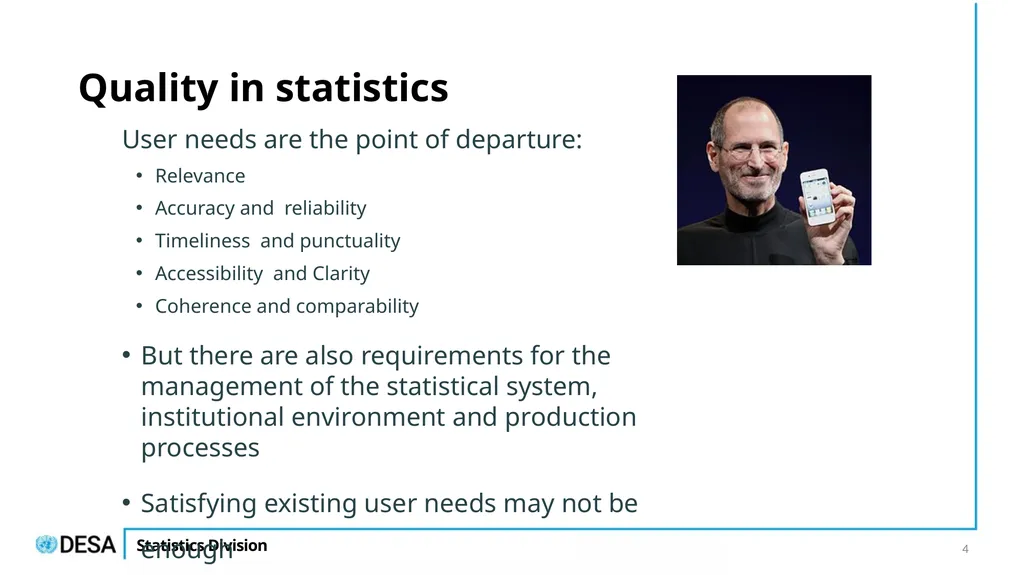
4 User needs are the point of departure:
Relevance
Accuracy and reliability
Timeliness and punctuality
Accessibility and Clarity
Coherence and comparability
But there are also requirements for the management of the statistical system, institutional environment and production processes
Satisfying existing user needs may not be enough Quality in statistics<br>
Relevance
Accuracy and reliability
Timeliness and punctuality
Accessibility and Clarity
Coherence and comparability
But there are also requirements for the management of the statistical system, institutional environment and production processes
Satisfying existing user needs may not be enough Quality in statistics<br>
05
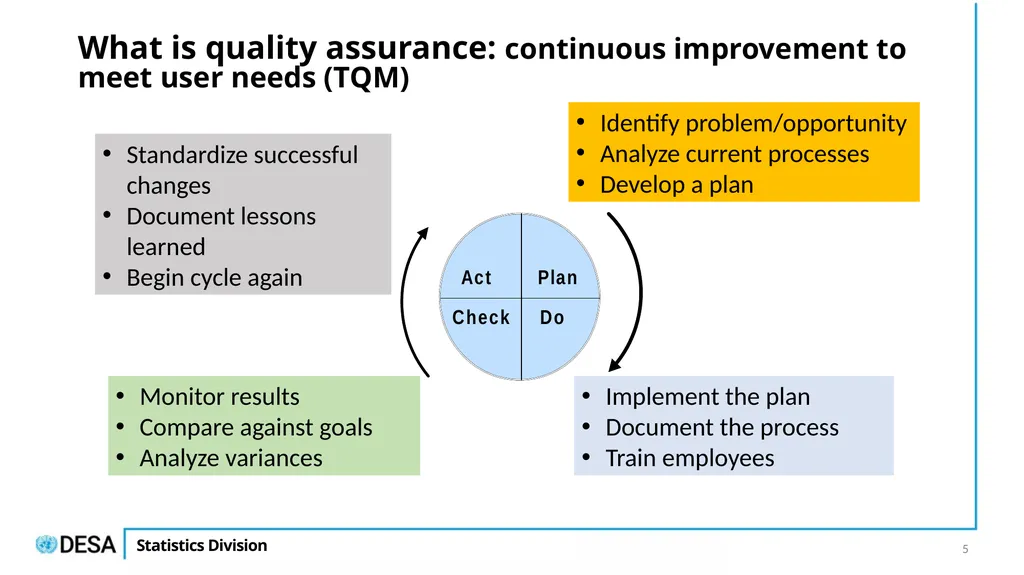
What is quality assurance: continuous improvement to meet user needs (TQM) 5 Monitor results
Compare against goals
Analyze variances Identify problem/opportunity
Analyze current processes
Develop a plan Implement the plan
Document the process
Train employees Standardize successful changes
Document lessons learned
Begin cycle again<br>
Compare against goals
Analyze variances Identify problem/opportunity
Analyze current processes
Develop a plan Implement the plan
Document the process
Train employees Standardize successful changes
Document lessons learned
Begin cycle again<br>
06
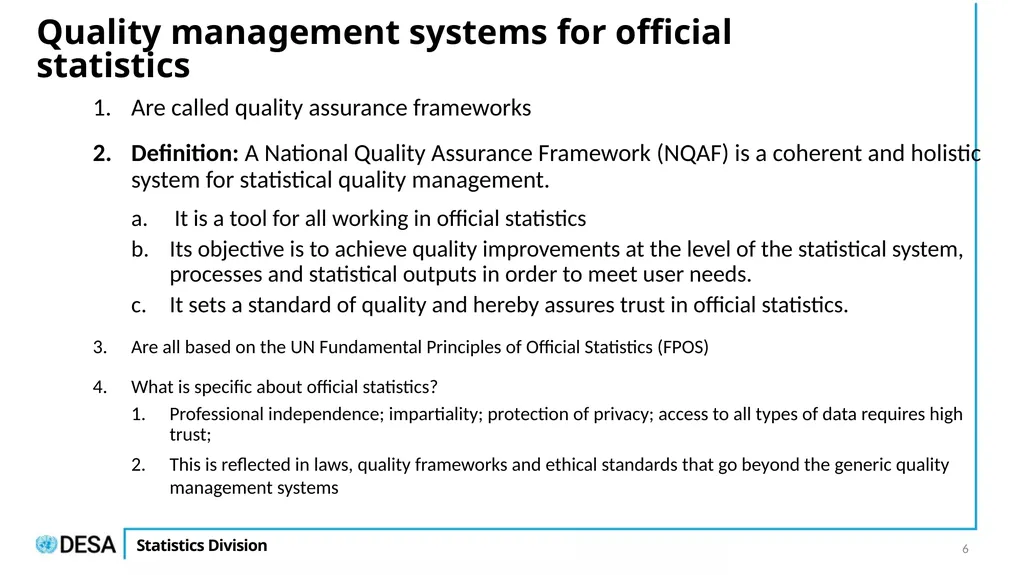
Quality management systems for official statistics Are called quality assurance frameworks
Definition: A National Quality Assurance Framework (NQAF) is a coherent and holistic system for statistical quality management.
It is a tool for all working in official statistics
Its objective is to achieve quality improvements at the level of the statistical system, processes and statistical outputs in order to meet user needs.
It sets a standard of quality and hereby assures trust in official statistics.
Are all based on the UN Fundamental Principles of Official Statistics (FPOS)
What is specific about official statistics?
Professional independence; impartiality; protection of privacy; access to all types of data requires high trust;
This is reflected in laws, quality frameworks and ethical standards that go beyond the generic quality management systems 6<br>
Definition: A National Quality Assurance Framework (NQAF) is a coherent and holistic system for statistical quality management.
It is a tool for all working in official statistics
Its objective is to achieve quality improvements at the level of the statistical system, processes and statistical outputs in order to meet user needs.
It sets a standard of quality and hereby assures trust in official statistics.
Are all based on the UN Fundamental Principles of Official Statistics (FPOS)
What is specific about official statistics?
Professional independence; impartiality; protection of privacy; access to all types of data requires high trust;
This is reflected in laws, quality frameworks and ethical standards that go beyond the generic quality management systems 6<br>
07
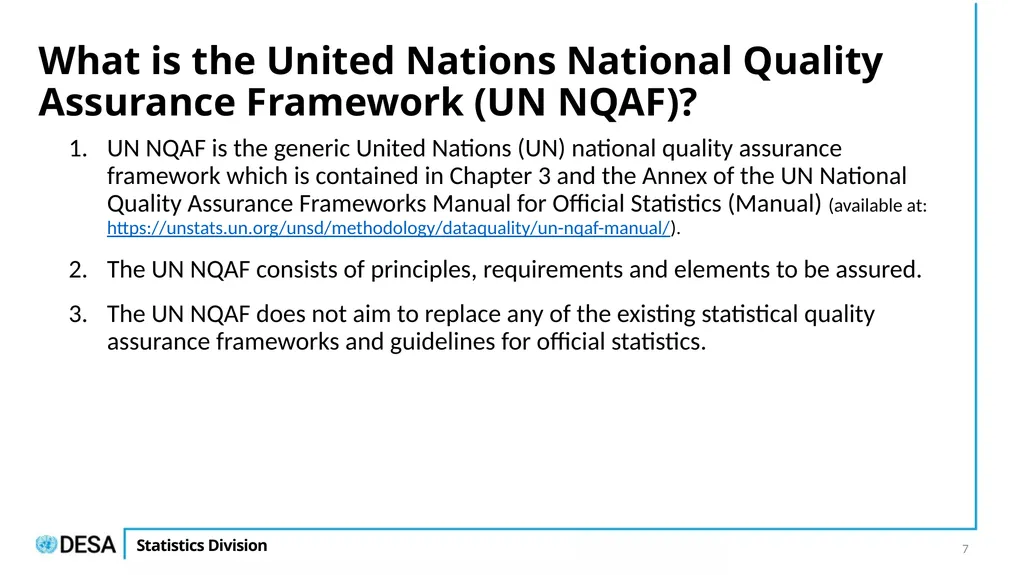
What is the United Nations National Quality Assurance Framework (UN NQAF)? UN NQAF is the generic United Nations (UN) national quality assurance framework which is contained in Chapter 3 and the Annex of the UN National Quality Assurance Frameworks Manual for Official Statistics (Manual) (available at: https://unstats.un.org/unsd/methodology/dataquality/un-nqaf-manual/).
The UN NQAF consists of principles, requirements and elements to be assured.
The UN NQAF does not aim to replace any of the existing statistical quality assurance frameworks and guidelines for official statistics. 7<br>
The UN NQAF consists of principles, requirements and elements to be assured.
The UN NQAF does not aim to replace any of the existing statistical quality assurance frameworks and guidelines for official statistics. 7<br>
08
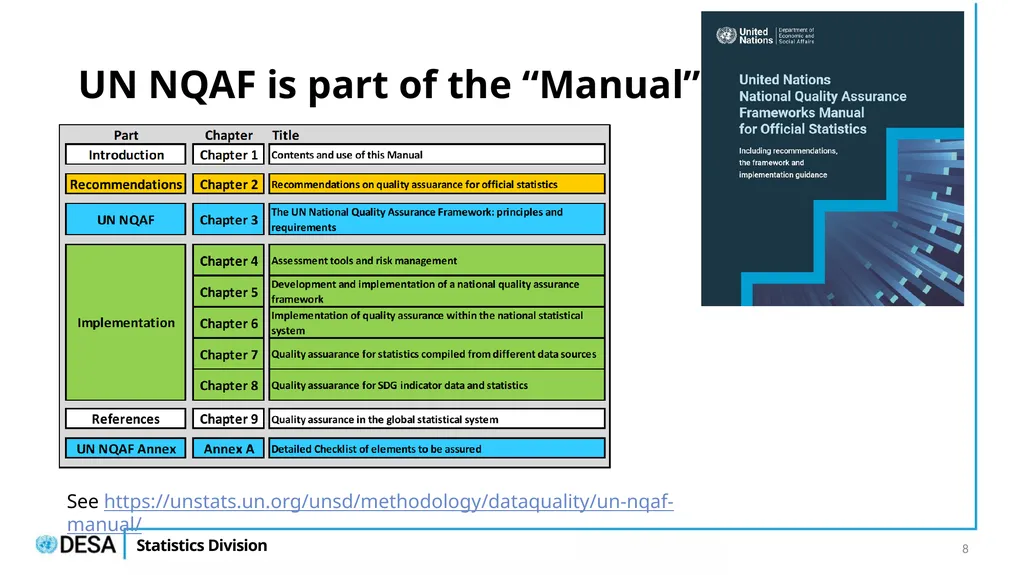
UN NQAF is part of the “Manual” 8 See https://unstats.un.org/unsd/methodology/dataquality/un-nqaf-manual/<br>
09
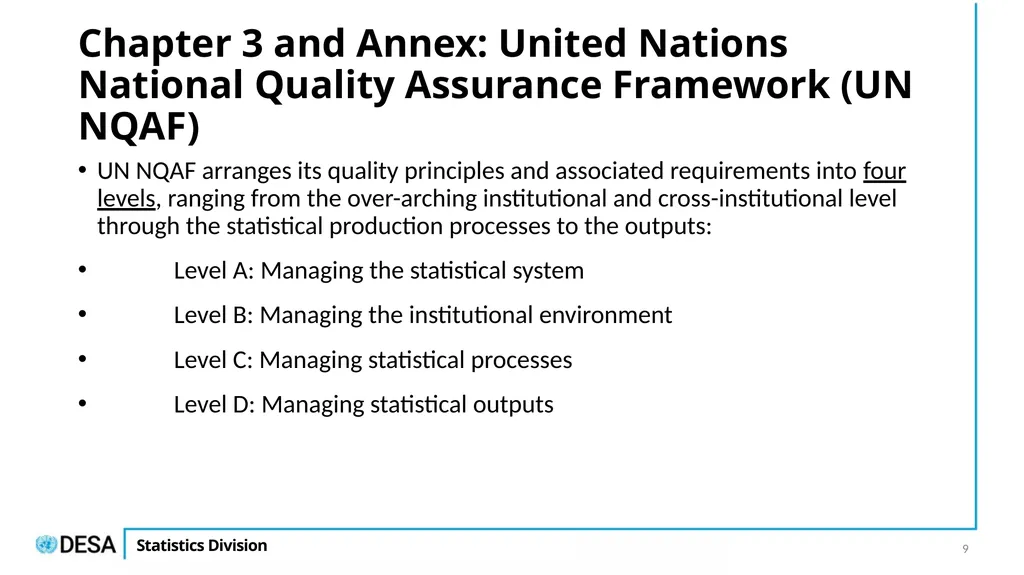
Chapter 3 and Annex: United Nations National Quality Assurance Framework (UN NQAF) UN NQAF arranges its quality principles and associated requirements into four levels, ranging from the over-arching institutional and cross-institutional level through the statistical production processes to the outputs:
Level A: Managing the statistical system
Level B: Managing the institutional environment
Level C: Managing statistical processes
Level D: Managing statistical outputs 9<br>
Level A: Managing the statistical system
Level B: Managing the institutional environment
Level C: Managing statistical processes
Level D: Managing statistical outputs 9<br>
10
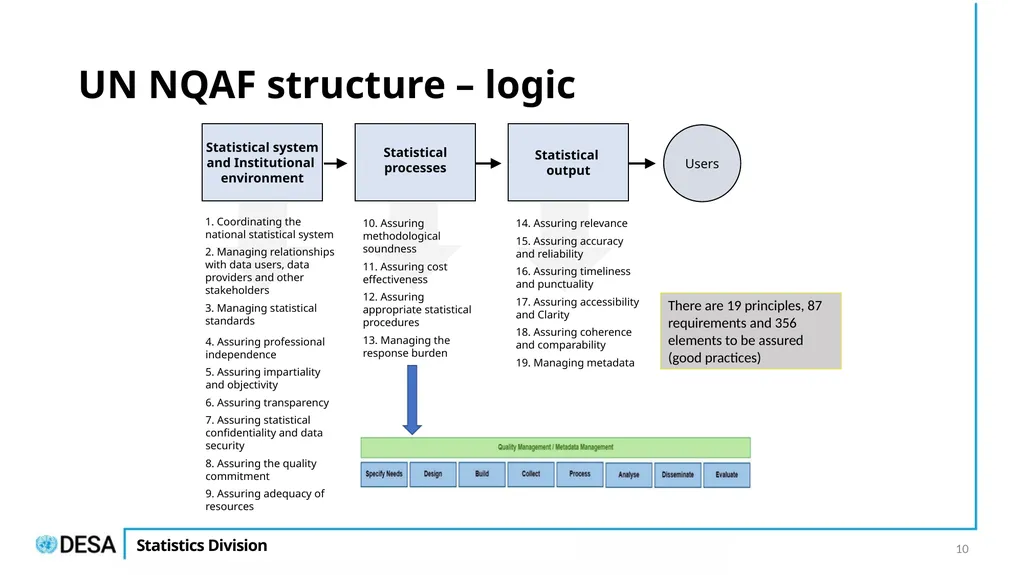
UN NQAF structure – logic 10 Statistical system
and Institutional
environment Statistical
processes Statistical
output Users 1. Coordinating the national statistical system
2. Managing relationships with data users, data providers and other stakeholders
3. Managing statistical standards 4. Assuring professional independence
5. Assuring impartiality and objectivity
6. Assuring transparency
7. Assuring statistical confidentiality and data security
8. Assuring the quality commitment
9. Assuring adequacy of resources 10. Assuring methodological soundness
11. Assuring cost effectiveness
12. Assuring appropriate statistical procedures
13. Managing the response burden 14. Assuring relevance
15. Assuring accuracy and reliability
16. Assuring timeliness and punctuality
17. Assuring accessibility and Clarity
18. Assuring coherence and comparability
19. Managing metadata There are 19 principles, 87 requirements and 356 elements to be assured (good practices)<br>
and Institutional
environment Statistical
processes Statistical
output Users 1. Coordinating the national statistical system
2. Managing relationships with data users, data providers and other stakeholders
3. Managing statistical standards 4. Assuring professional independence
5. Assuring impartiality and objectivity
6. Assuring transparency
7. Assuring statistical confidentiality and data security
8. Assuring the quality commitment
9. Assuring adequacy of resources 10. Assuring methodological soundness
11. Assuring cost effectiveness
12. Assuring appropriate statistical procedures
13. Managing the response burden 14. Assuring relevance
15. Assuring accuracy and reliability
16. Assuring timeliness and punctuality
17. Assuring accessibility and Clarity
18. Assuring coherence and comparability
19. Managing metadata There are 19 principles, 87 requirements and 356 elements to be assured (good practices)<br>
11
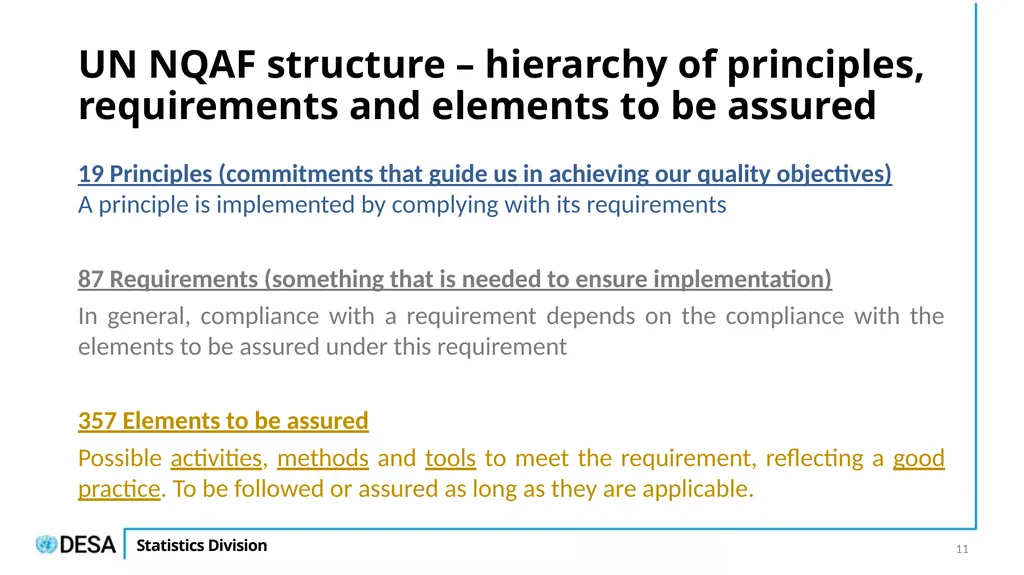
UN NQAF structure – hierarchy of principles, requirements and elements to be assured 19 Principles (commitments that guide us in achieving our quality objectives)
A principle is implemented by complying with its requirements
87 Requirements (something that is needed to ensure implementation)
In general, compliance with a requirement depends on the compliance with the elements to be assured under this requirement
357 Elements to be assured
Possible activities, methods and tools to meet the requirement, reflecting a good practice. To be followed or assured as long as they are applicable. 11<br>
A principle is implemented by complying with its requirements
87 Requirements (something that is needed to ensure implementation)
In general, compliance with a requirement depends on the compliance with the elements to be assured under this requirement
357 Elements to be assured
Possible activities, methods and tools to meet the requirement, reflecting a good practice. To be followed or assured as long as they are applicable. 11<br>
12
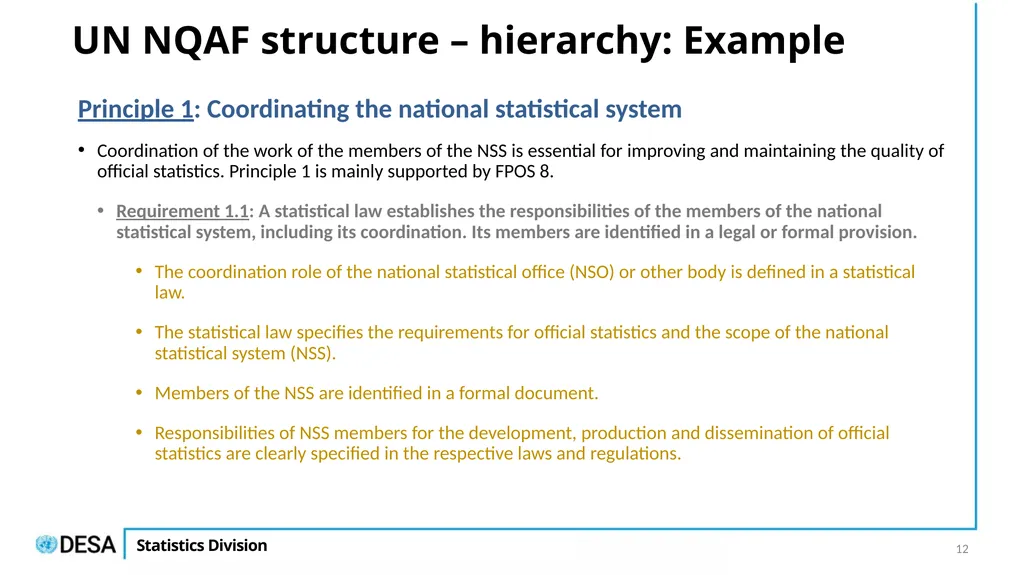
UN NQAF structure – hierarchy: Example Principle 1: Coordinating the national statistical system
Coordination of the work of the members of the NSS is essential for improving and maintaining the quality of official statistics. Principle 1 is mainly supported by FPOS 8.
Requirement 1.1: A statistical law establishes the responsibilities of the members of the national statistical system, including its coordination. Its members are identified in a legal or formal provision.
The coordination role of the national statistical office (NSO) or other body is defined in a statistical law.
The statistical law specifies the requirements for official statistics and the scope of the national statistical system (NSS).
Members of the NSS are identified in a formal document.
Responsibilities of NSS members for the development, production and dissemination of official statistics are clearly specified in the respective laws and regulations. 12<br>
Coordination of the work of the members of the NSS is essential for improving and maintaining the quality of official statistics. Principle 1 is mainly supported by FPOS 8.
Requirement 1.1: A statistical law establishes the responsibilities of the members of the national statistical system, including its coordination. Its members are identified in a legal or formal provision.
The coordination role of the national statistical office (NSO) or other body is defined in a statistical law.
The statistical law specifies the requirements for official statistics and the scope of the national statistical system (NSS).
Members of the NSS are identified in a formal document.
Responsibilities of NSS members for the development, production and dissemination of official statistics are clearly specified in the respective laws and regulations. 12<br>
13
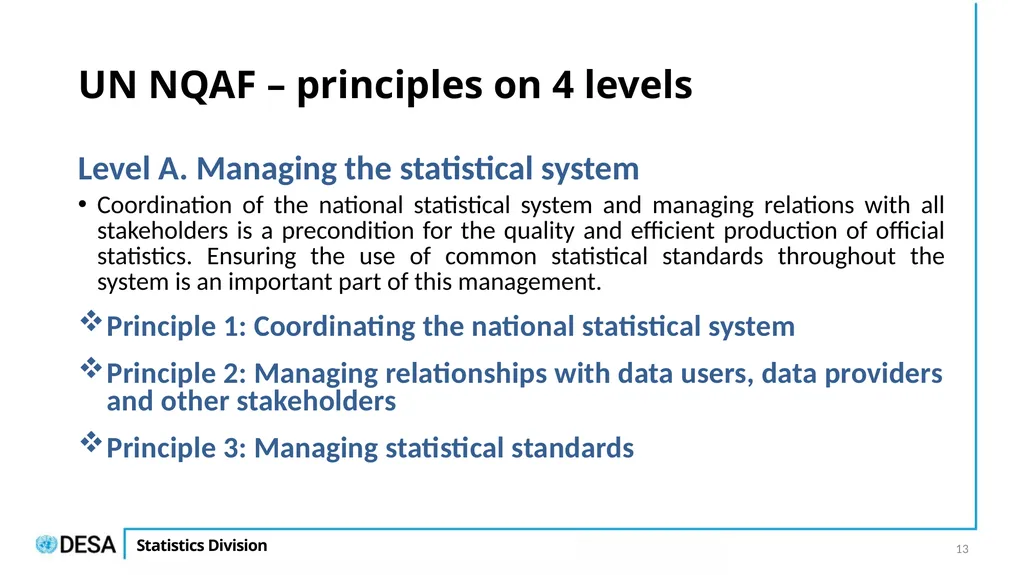
UN NQAF – principles on 4 levels Level A. Managing the statistical system
Coordination of the national statistical system and managing relations with all stakeholders is a precondition for the quality and efficient production of official statistics. Ensuring the use of common statistical standards throughout the system is an important part of this management.
Principle 1: Coordinating the national statistical system
Principle 2: Managing relationships with data users, data providers and other stakeholders
Principle 3: Managing statistical standards 13<br>
Coordination of the national statistical system and managing relations with all stakeholders is a precondition for the quality and efficient production of official statistics. Ensuring the use of common statistical standards throughout the system is an important part of this management.
Principle 1: Coordinating the national statistical system
Principle 2: Managing relationships with data users, data providers and other stakeholders
Principle 3: Managing statistical standards 13<br>
14
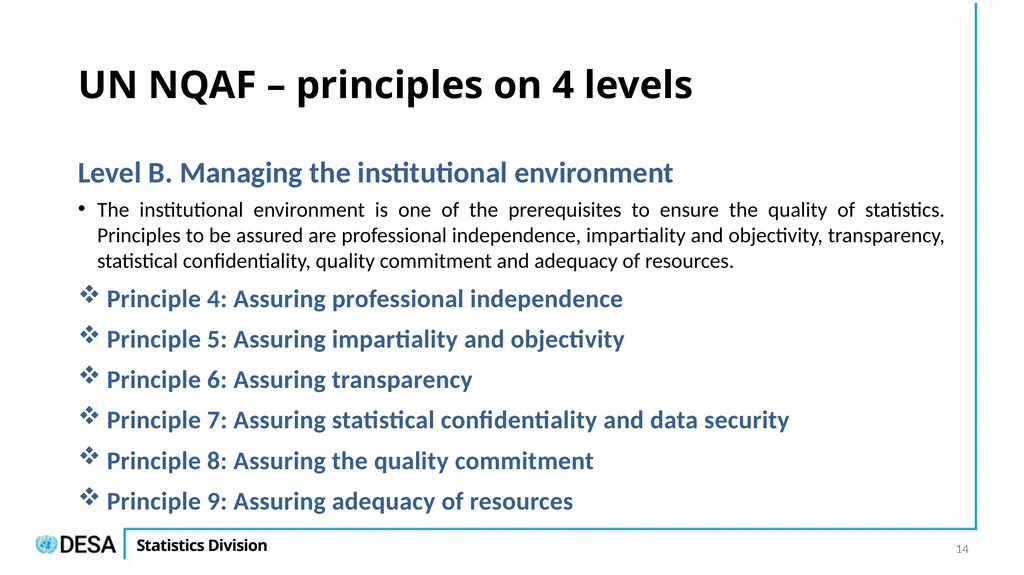
UN NQAF – principles on 4 levels Level B. Managing the institutional environment
The institutional environment is one of the prerequisites to ensure the quality of statistics. Principles to be assured are professional independence, impartiality and objectivity, transparency, statistical confidentiality, quality commitment and adequacy of resources.
Principle 4: Assuring professional independence
Principle 5: Assuring impartiality and objectivity
Principle 6: Assuring transparency
Principle 7: Assuring statistical confidentiality and data security
Principle 8: Assuring the quality commitment
Principle 9: Assuring adequacy of resources 14<br>
The institutional environment is one of the prerequisites to ensure the quality of statistics. Principles to be assured are professional independence, impartiality and objectivity, transparency, statistical confidentiality, quality commitment and adequacy of resources.
Principle 4: Assuring professional independence
Principle 5: Assuring impartiality and objectivity
Principle 6: Assuring transparency
Principle 7: Assuring statistical confidentiality and data security
Principle 8: Assuring the quality commitment
Principle 9: Assuring adequacy of resources 14<br>
15
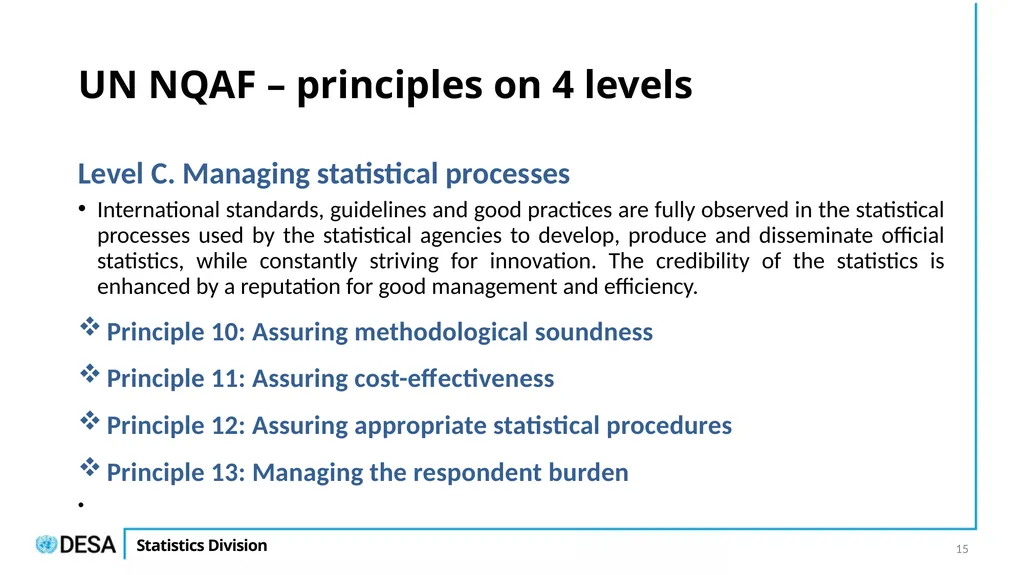
UN NQAF – principles on 4 levels Level C. Managing statistical processes
International standards, guidelines and good practices are fully observed in the statistical processes used by the statistical agencies to develop, produce and disseminate official statistics, while constantly striving for innovation. The credibility of the statistics is enhanced by a reputation for good management and efficiency.
Principle 10: Assuring methodological soundness
Principle 11: Assuring cost-effectiveness
Principle 12: Assuring appropriate statistical procedures
Principle 13: Managing the respondent burden 15<br>
International standards, guidelines and good practices are fully observed in the statistical processes used by the statistical agencies to develop, produce and disseminate official statistics, while constantly striving for innovation. The credibility of the statistics is enhanced by a reputation for good management and efficiency.
Principle 10: Assuring methodological soundness
Principle 11: Assuring cost-effectiveness
Principle 12: Assuring appropriate statistical procedures
Principle 13: Managing the respondent burden 15<br>
16
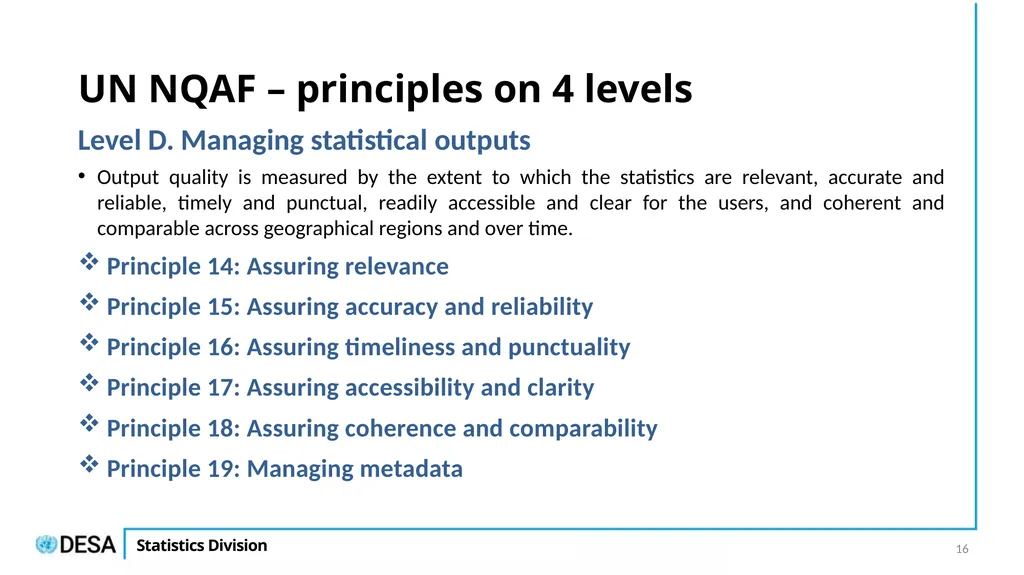
UN NQAF – principles on 4 levels Level D. Managing statistical outputs
Output quality is measured by the extent to which the statistics are relevant, accurate and reliable, timely and punctual, readily accessible and clear for the users, and coherent and comparable across geographical regions and over time.
Principle 14: Assuring relevance
Principle 15: Assuring accuracy and reliability
Principle 16: Assuring timeliness and punctuality
Principle 17: Assuring accessibility and clarity
Principle 18: Assuring coherence and comparability
Principle 19: Managing metadata 16<br>
Output quality is measured by the extent to which the statistics are relevant, accurate and reliable, timely and punctual, readily accessible and clear for the users, and coherent and comparable across geographical regions and over time.
Principle 14: Assuring relevance
Principle 15: Assuring accuracy and reliability
Principle 16: Assuring timeliness and punctuality
Principle 17: Assuring accessibility and clarity
Principle 18: Assuring coherence and comparability
Principle 19: Managing metadata 16<br>
17
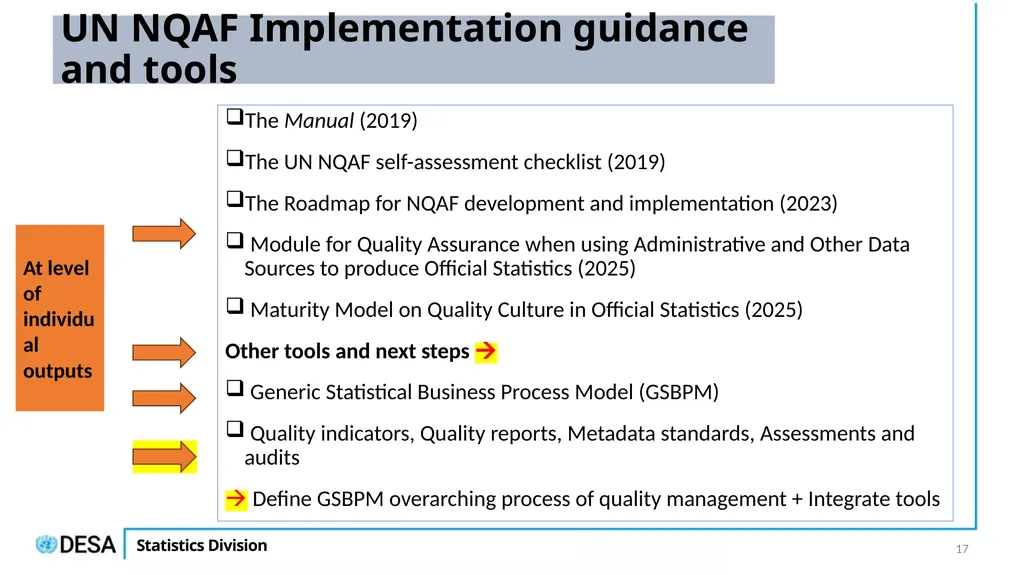
UN NQAF Implementation guidance and tools The Manual (2019)
The UN NQAF self-assessment checklist (2019)
The Roadmap for NQAF development and implementation (2023)
Module for Quality Assurance when using Administrative and Other Data Sources to produce Official Statistics (2025)
Maturity Model on Quality Culture in Official Statistics (2025)
Other tools and next steps
Generic Statistical Business Process Model (GSBPM)
Quality indicators, Quality reports, Metadata standards, Assessments and audits
Define GSBPM overarching process of quality management + Integrate tools 17 At level of individual outputs<br>
The UN NQAF self-assessment checklist (2019)
The Roadmap for NQAF development and implementation (2023)
Module for Quality Assurance when using Administrative and Other Data Sources to produce Official Statistics (2025)
Maturity Model on Quality Culture in Official Statistics (2025)
Other tools and next steps
Generic Statistical Business Process Model (GSBPM)
Quality indicators, Quality reports, Metadata standards, Assessments and audits
Define GSBPM overarching process of quality management + Integrate tools 17 At level of individual outputs<br>
18
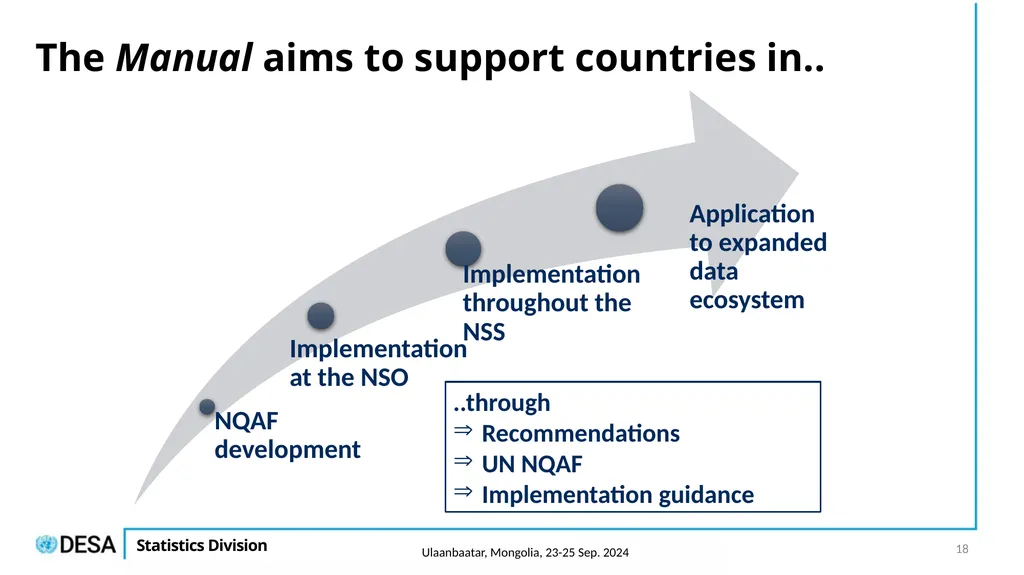
The Manual aims to support countries in.. 18 ..through
Recommendations
UN NQAF
Implementation guidance Ulaanbaatar, Mongolia, 23-25 Sep. 2024<br>
Recommendations
UN NQAF
Implementation guidance Ulaanbaatar, Mongolia, 23-25 Sep. 2024<br>
19
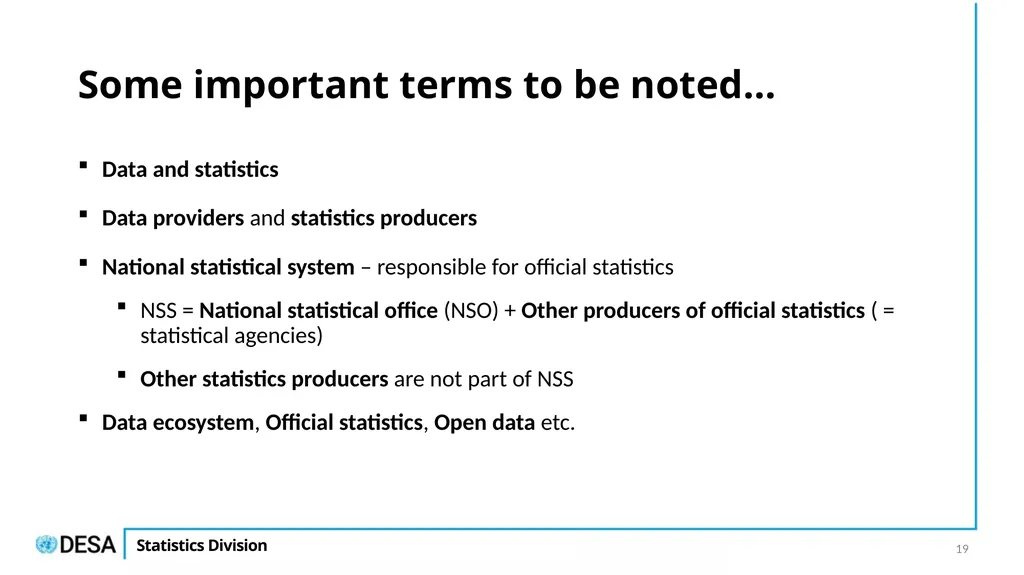
Some important terms to be noted… Data and statistics
Data providers and statistics producers
National statistical system – responsible for official statistics
NSS = National statistical office (NSO) + Other producers of official statistics ( = statistical agencies)
Other statistics producers are not part of NSS
Data ecosystem, Official statistics, Open data etc. 19<br>
Data providers and statistics producers
National statistical system – responsible for official statistics
NSS = National statistical office (NSO) + Other producers of official statistics ( = statistical agencies)
Other statistics producers are not part of NSS
Data ecosystem, Official statistics, Open data etc. 19<br>
20
Thank you. 20<br>
21
UN NQAF covers factors contributing to the quality of produced statistics, including practices on handling source or input data UN National Quality Assurance Framework (NQAF) Statistical system
and Institutional
environment Statistical
processes Statistical
output User needs Quality of statistics Quality of source data
Statistical
Administrative
Other Coordinating the national
statistical system
Managing relationships with data users, data providers and other stakeholders
Managing statistical standards
Assuring professional independence
Assuring impartiality and objectivity
Assuring transparency
Assuring statistical confidentiality and data security
Assuring the quality
commitment
Assuring adequacy of resources Assuring methodological soundness
Assuring cost effectiveness
Assuring appropriate statistical procedures
Managing the
response burden Assuring relevance
Assuring accuracy and reliability
Assuring timeliness and punctuality
Assuring accessibility and Clarity
Assuring coherence
and comparability
Managing metadata 21<br>
and Institutional
environment Statistical
processes Statistical
output User needs Quality of statistics Quality of source data
Statistical
Administrative
Other Coordinating the national
statistical system
Managing relationships with data users, data providers and other stakeholders
Managing statistical standards
Assuring professional independence
Assuring impartiality and objectivity
Assuring transparency
Assuring statistical confidentiality and data security
Assuring the quality
commitment
Assuring adequacy of resources Assuring methodological soundness
Assuring cost effectiveness
Assuring appropriate statistical procedures
Managing the
response burden Assuring relevance
Assuring accuracy and reliability
Assuring timeliness and punctuality
Assuring accessibility and Clarity
Assuring coherence
and comparability
Managing metadata 21<br>
22
UN NQAF was developed by the United Nations Expert Group on National Assurance Quality Frameworks and adopted by the Statistical Commission in 2019
Members (after its re-establishment in 2017):
21 Countries: Botswana, Cameroon, Canada, Chile, China, Colombia, Egypt, Indonesia, Iran, Italy, Jamaica, Japan, Mexico, Niger, Norway, Philippines (co-Chair), Russian Federation, South Africa, United Kingdom (co-Chair), Ukraine, Viet Nam
8 international and regional organizations: the Food and Agriculture Organization of the United Nations (FAO), the International Monetary Fund (IMF), the Organisation for Economic Co-operation and Development (OECD), the World Bank, the Economic Commission for Africa (ECA), the Economic Commission for Europe (ECE), the Economic Commission for Latin America and the Caribbean (ECLAC) and the Economic and Social Commission for Asia and the Pacific (ESCAP), Statistical Office of the European Community (Eurostat) 22 Who developed UN NQAF?<br>
Members (after its re-establishment in 2017):
21 Countries: Botswana, Cameroon, Canada, Chile, China, Colombia, Egypt, Indonesia, Iran, Italy, Jamaica, Japan, Mexico, Niger, Norway, Philippines (co-Chair), Russian Federation, South Africa, United Kingdom (co-Chair), Ukraine, Viet Nam
8 international and regional organizations: the Food and Agriculture Organization of the United Nations (FAO), the International Monetary Fund (IMF), the Organisation for Economic Co-operation and Development (OECD), the World Bank, the Economic Commission for Africa (ECA), the Economic Commission for Europe (ECE), the Economic Commission for Latin America and the Caribbean (ECLAC) and the Economic and Social Commission for Asia and the Pacific (ESCAP), Statistical Office of the European Community (Eurostat) 22 Who developed UN NQAF?<br>
23
Please note:
The United Nations National Quality Assurance Framework (UN NQAF) of Chapter 3 is descriptive.
However, the link to the Fundamental Principles of Official Statistics (FPOS) and the associated recommendations of Chapter 2 support specific principles and give them an obligatory character. 23<br>
The United Nations National Quality Assurance Framework (UN NQAF) of Chapter 3 is descriptive.
However, the link to the Fundamental Principles of Official Statistics (FPOS) and the associated recommendations of Chapter 2 support specific principles and give them an obligatory character. 23<br>
24
Quality Management: Coordinated activities to direct and control an organization with regard to quality (ISO)
Establishing quality policies and objectives
Establishing processes to achieve these objectives (planning, quality assurance, control and improvement)
Quality management system: Provides a coherent and holistic system as a basis for quality management 24<br>
Establishing quality policies and objectives
Establishing processes to achieve these objectives (planning, quality assurance, control and improvement)
Quality management system: Provides a coherent and holistic system as a basis for quality management 24<br>
25
Quality Management Systems There are various general quality management frameworks applicable to any organization, such as Total Quality Management (TQM), International Organization for Standardization (ISO) , Six Sigma, European Foundation for Quality Management (EFQM), Balanced Scorecard, Lean and Lean Six Sigma. These frameworks are largely based on common definitions and principles, but their main focus and formalization vary.
For example, ISO emphasizes certification and standardization of “processes”, while Six Sigma focuses on quality control of the “products/outputs” using statistical methods. Lean emphasizes improvement in efficiency by reducing waste.
In many ways, TQM, which was developed in the last century, is the foundation of all general quality frameworks. TQM is “a set of systematic activities carried out by the entire organization to effectively and efficiently achieve company objectives so as to provide products and services with a level of quality that satisfies customers, at the appropriate time and price”.
The strategic core of all major TQM models is continuous improvement, often illustrated with reference to the Plan-Do-Check-Act cycle (PDCA) made popular by Deming. This cycle is a four-step process which guides all changes for continuous improvement. 25<br>
For example, ISO emphasizes certification and standardization of “processes”, while Six Sigma focuses on quality control of the “products/outputs” using statistical methods. Lean emphasizes improvement in efficiency by reducing waste.
In many ways, TQM, which was developed in the last century, is the foundation of all general quality frameworks. TQM is “a set of systematic activities carried out by the entire organization to effectively and efficiently achieve company objectives so as to provide products and services with a level of quality that satisfies customers, at the appropriate time and price”.
The strategic core of all major TQM models is continuous improvement, often illustrated with reference to the Plan-Do-Check-Act cycle (PDCA) made popular by Deming. This cycle is a four-step process which guides all changes for continuous improvement. 25<br>
26
User orientation: Quality is a multidimensional concept, beyond accuracy
Process orientation: Facts as the basis for improvements
Participation by all
Management and continuity W. Edwards Deming Quality Management Systems - Heritage from TQM<br>
Process orientation: Facts as the basis for improvements
Participation by all
Management and continuity W. Edwards Deming Quality Management Systems - Heritage from TQM<br>
27
Level D. Managing statistical outputs 27 Principle 14: Assuring relevance
Statistical information shall meet the current and/or emerging needs or requirements of its users. Without relevance, there is no quality. However, relevance is subjective and depends upon the varying needs of users. The statistical agency’s challenge is to weight and balance the conflicting needs of current and potential users to produce statistics that satisfy the most important and highest priority needs within the given resource constraints. Principle 14 is mainly supported by FPOS 1.
Requirement 14.1: Procedures are in place to identify users and their needs and to consult them about the content of the statistical work program.
Requirement 14.2: Users’ needs and requirements are balanced, prioritized and reflected in the work program.
Requirement 14.3: Statistics based on new and existing data sources are being developed in response to society’s emerging information needs.
Requirement 14.4: User satisfaction is regularly measured and systematically followed up.<br>
Statistical information shall meet the current and/or emerging needs or requirements of its users. Without relevance, there is no quality. However, relevance is subjective and depends upon the varying needs of users. The statistical agency’s challenge is to weight and balance the conflicting needs of current and potential users to produce statistics that satisfy the most important and highest priority needs within the given resource constraints. Principle 14 is mainly supported by FPOS 1.
Requirement 14.1: Procedures are in place to identify users and their needs and to consult them about the content of the statistical work program.
Requirement 14.2: Users’ needs and requirements are balanced, prioritized and reflected in the work program.
Requirement 14.3: Statistics based on new and existing data sources are being developed in response to society’s emerging information needs.
Requirement 14.4: User satisfaction is regularly measured and systematically followed up.<br>
28
Level D. Managing statistical outputs 28 Principle 15: Assuring accuracy and reliability
Statistical agencies should develop, produce and disseminate statistics that accurately and reliably portray reality. The accuracy of statistical information reflects the degree to which the information correctly describes the phenomena it was designed to measure, i.e. the degree of closeness of estimates to true values. Principle 15 is mainly supported by FPOS 1.
Requirement 15.1: Source data, integrated data, intermediate results and statistical outputs are regularly assessed and validated.
Requirement 15.2: Sampling errors are measured, evaluated and documented. Non-sampling errors are described and, when possible, estimated.
Requirement 15.3: Studies and analyses of revisions are carried out and used to improve data sources, statistical processes and outputs.<br>
Statistical agencies should develop, produce and disseminate statistics that accurately and reliably portray reality. The accuracy of statistical information reflects the degree to which the information correctly describes the phenomena it was designed to measure, i.e. the degree of closeness of estimates to true values. Principle 15 is mainly supported by FPOS 1.
Requirement 15.1: Source data, integrated data, intermediate results and statistical outputs are regularly assessed and validated.
Requirement 15.2: Sampling errors are measured, evaluated and documented. Non-sampling errors are described and, when possible, estimated.
Requirement 15.3: Studies and analyses of revisions are carried out and used to improve data sources, statistical processes and outputs.<br>
29
Level D. Managing statistical outputs 29 Principle 16: Assuring timeliness and punctuality
Statistical agencies should minimize the delays in making statistics available. Timeliness refers to how fast – after the reference date or the end of the reference period – the data and statistics are made available to users. Punctuality refers to whether data and statistics are delivered on the promised, advertised or announced dates. Principle 16 is mainly supported by FPOS 1.
Requirement 16.1: Timeliness of the statistical agency’s statistics comply with international standards or other relevant timeliness targets.
Requirement 16.2: The relationship with data providers is managed with respect to timeliness and punctuality needs.
Requirement 16.3: Preliminary results can be released when their accuracy and reliability is acceptable.
Requirement 16.4: Punctuality is measured and monitored according to planned release dates, such as those set in a release calendar.<br>
Statistical agencies should minimize the delays in making statistics available. Timeliness refers to how fast – after the reference date or the end of the reference period – the data and statistics are made available to users. Punctuality refers to whether data and statistics are delivered on the promised, advertised or announced dates. Principle 16 is mainly supported by FPOS 1.
Requirement 16.1: Timeliness of the statistical agency’s statistics comply with international standards or other relevant timeliness targets.
Requirement 16.2: The relationship with data providers is managed with respect to timeliness and punctuality needs.
Requirement 16.3: Preliminary results can be released when their accuracy and reliability is acceptable.
Requirement 16.4: Punctuality is measured and monitored according to planned release dates, such as those set in a release calendar.<br>
30
Level D. Managing statistical outputs 30 Principle 17: Assuring accessibility and clarity
Statistical agencies should ensure that the statistics they develop, produce and disseminate can be found and obtained without difficulty, are presented clearly and in such a way that they can be understood, and are available and accessible to all users on an impartial and equal basis in various convenient formats in line with open data standards. Provision should be made for allowing access to microdata for research purposes, in accordance with an established policy which ensures statistical confidentiality. Principle 17 is mainly supported by FPOS 1.
Requirement 17.1: Statistics are presented in a form that facilitates proper interpretation and meaningful comparisons.
Requirement 17.2: A data dissemination strategy and policy exist and is made public.
Requirement 17.3: Modern information and communication technology is used for facilitating easy access to statistics.
Requirement 17.4: Access to microdata is allowed for research purposes, subject to specific rules and protocols on statistical confidentiality that are posted on the statistical agency’s website.
Requirement 17.5: Mechanisms are in place to promote statistical literacy.
Requirement 17.6: The statistical agencies have a dedicated focal point that provides support and responds to inquiries from users in a timely manner.
Requirement 17.7: Users are kept informed about the quality of statistical outputs.<br>
Statistical agencies should ensure that the statistics they develop, produce and disseminate can be found and obtained without difficulty, are presented clearly and in such a way that they can be understood, and are available and accessible to all users on an impartial and equal basis in various convenient formats in line with open data standards. Provision should be made for allowing access to microdata for research purposes, in accordance with an established policy which ensures statistical confidentiality. Principle 17 is mainly supported by FPOS 1.
Requirement 17.1: Statistics are presented in a form that facilitates proper interpretation and meaningful comparisons.
Requirement 17.2: A data dissemination strategy and policy exist and is made public.
Requirement 17.3: Modern information and communication technology is used for facilitating easy access to statistics.
Requirement 17.4: Access to microdata is allowed for research purposes, subject to specific rules and protocols on statistical confidentiality that are posted on the statistical agency’s website.
Requirement 17.5: Mechanisms are in place to promote statistical literacy.
Requirement 17.6: The statistical agencies have a dedicated focal point that provides support and responds to inquiries from users in a timely manner.
Requirement 17.7: Users are kept informed about the quality of statistical outputs.<br>
31
Level D. Managing statistical outputs 31 Principle 18: Assuring coherence and comparability
Statistical agencies should develop, produce and disseminate statistics that are consistent, meaning it should be possible to combine and make joint use of related data including data from different sources. Furthermore, statistics should be comparable over time and between areas. Principle 18 is mainly supported by FPOS 1.
Requirement 18.1: International, regional and national standards are used with regard to definitions, units, variables and classifications.
Requirement 18.2: Procedures or guidelines are in place to ensure and monitor internal, intra-sectoral and cross-sectoral coherence and consistency.
Requirement 18.3: Statistics are kept comparable over a reasonable period of time and between geographical areas.<br>
Statistical agencies should develop, produce and disseminate statistics that are consistent, meaning it should be possible to combine and make joint use of related data including data from different sources. Furthermore, statistics should be comparable over time and between areas. Principle 18 is mainly supported by FPOS 1.
Requirement 18.1: International, regional and national standards are used with regard to definitions, units, variables and classifications.
Requirement 18.2: Procedures or guidelines are in place to ensure and monitor internal, intra-sectoral and cross-sectoral coherence and consistency.
Requirement 18.3: Statistics are kept comparable over a reasonable period of time and between geographical areas.<br>