The United Nations as an Intergovernmental Organisation (IGO) IB Global Politics Power, Sovereignty and International Relations www.glopoib.wordpress.com Unit 1: Power, Sovereignty and International Relations Lesson 13, 14 and 15: The
"The United Nations as an Intergovernmental" is the property of its rightful owner. Permission is granted to
download and print the materials on this website for personal, non-commercial use only, and to display it
on your personal computer provided you do not modify the materials and that you retain all copyright
notices contained in the materials. By downloading content from our website, you accept the terms of this
agreement.
Presentation Transcript
01
The United Nations as an Intergovernmental Organisation (IGO) IB Global Politics
Power, Sovereignty and International Relations<br>
02
www.glopoib.wordpress.com Unit 1: Power, Sovereignty and International Relations
Lesson 13, 14 and 15: The United Nations as an Intergovernmental Organisation<br>
03
States do not operate in isolation in the international system This assumption underpins the next few lessons.
What evidence is there for this claim?<br>
04
Guiding Question To what extent can state actors affect greater change in the international system when operating multilaterally?<br>
05
What do we know already?<br>
06
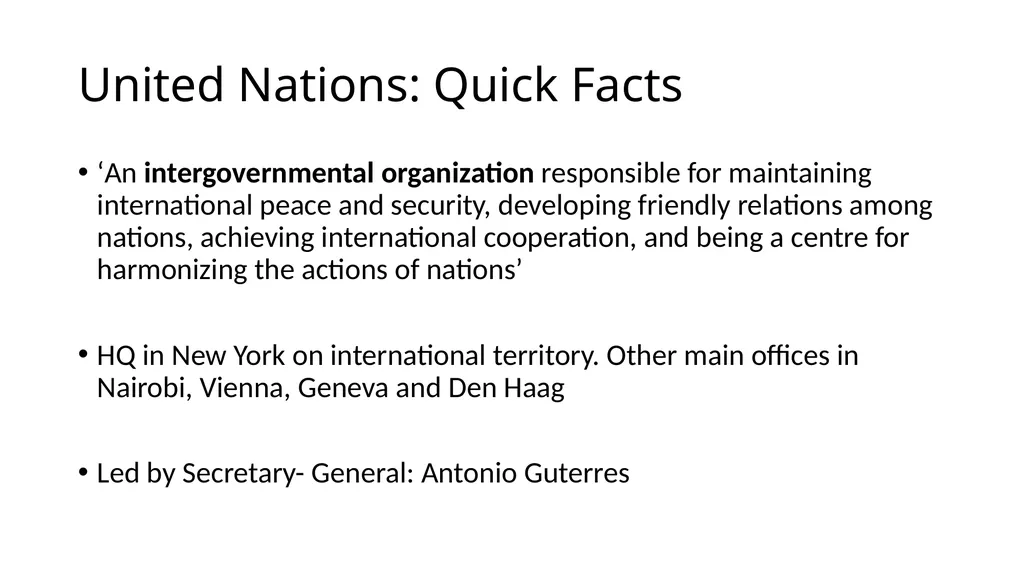
United Nations: Quick Facts ‘An intergovernmental organization responsible for maintaining international peace and security, developing friendly relations among nations, achieving international cooperation, and being a centre for harmonizing the actions of nations’
HQ in New York on international territory. Other main offices in Nairobi, Vienna, Geneva and Den Haag
Led by Secretary- General: Antonio Guterres<br>
07
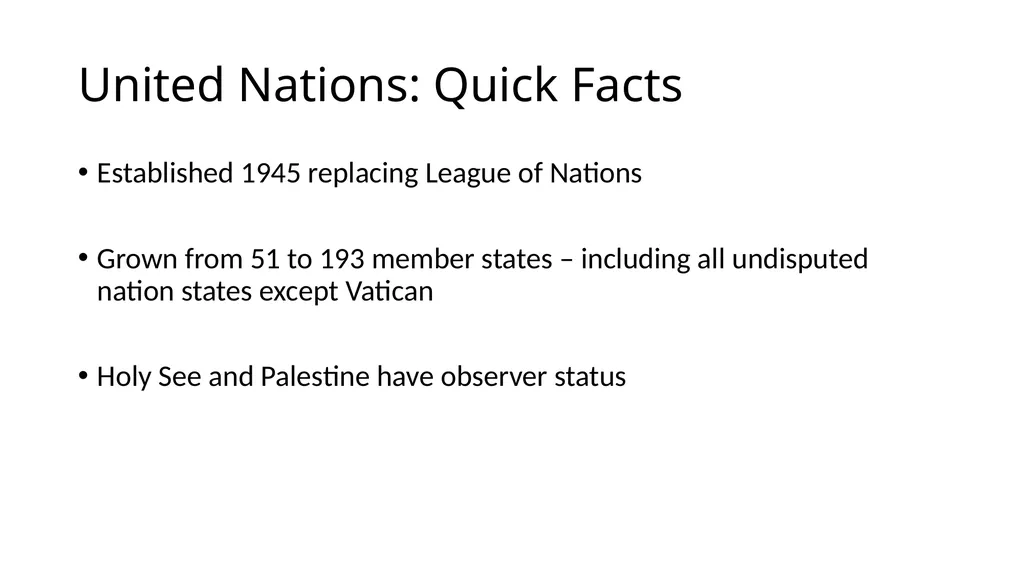
United Nations: Quick Facts Established 1945 replacing League of Nations
Grown from 51 to 193 member states – including all undisputed nation states except Vatican
Holy See and Palestine have observer status<br>
08
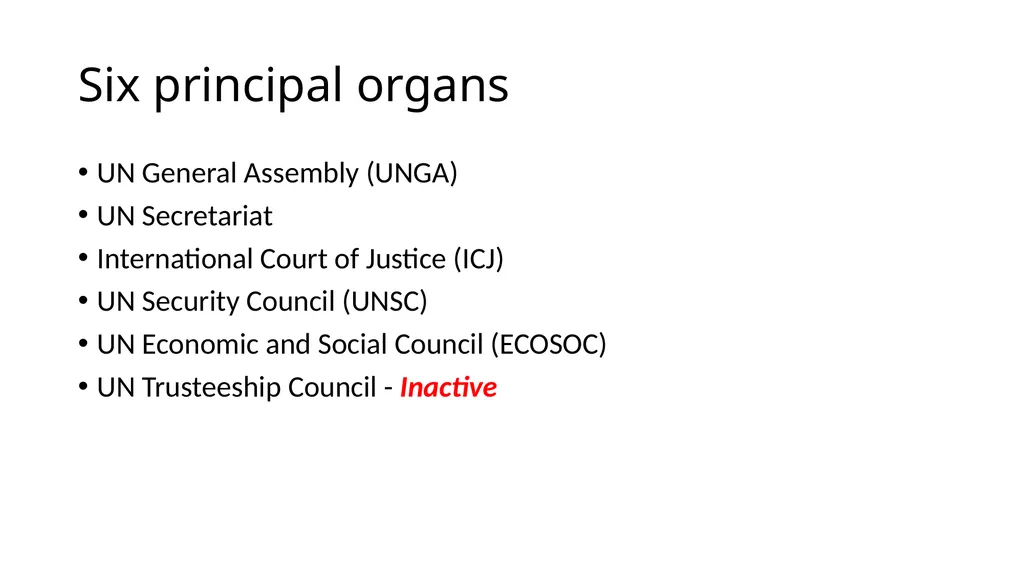
Six principal organs UN General Assembly (UNGA)
UN Secretariat
International Court of Justice (ICJ)
UN Security Council (UNSC)
UN Economic and Social Council (ECOSOC)
UN Trusteeship Council - Inactive<br>
09
UN General Assembly Deliberative assembly of all UN member states
May resolve non-compulsory recommendations to states or suggestions to the Security Council (UNSC)
Decides on the admission of new members
Adopts the budget
Elects the non-permanent members of the UNSC; all members of ECOSOC; the UN Secretary General (following his/her proposal by the UNSC); and the fifteen judges of the International Court of Justice (ICJ). Each country has one vote.<br>
10
UN Secretariat Administrative organ of the UN
Supports the other UN bodies administratively (for example, in the organization of conferences, the writing of reports and studies and the preparation of the budget);
Its chairperson – the UN Secretary General – is elected by the General Assembly for a five-year mandate and is the UN's foremost representative.<br>
11
International Court of Justice Universal court for international law
Decides disputes between states that recognize its jurisdiction;
Issues legal opinions;
Renders judgment by relative majority. Its fifteen judges are elected by the UN General Assembly for nine-year terms.<br>
12
UN Security Council For international security issues
Responsible for the maintenance of international peace and security;
May adopt compulsory resolutions;
Has fifteen members: five permanent members with veto power and ten elected members<br>
13
UN Economic and Social Council For global economic and social affairs
Responsible for co-operation between states as regards economic and social matters;
Co-ordinates co-operation between the UN's numerous specialized agencies;
Has 54 members, elected by the General Assembly to serve staggered three-year mandates.<br>
14
Guiding Question To what extent can state actors affect greater change in the international system when operating multilaterally?<br>