
Thematic Analysis © Virginia Braun, Victoria
TG
Published · 57 slides · 0 views

1 / 1


















Description
Thematic Analysis Virginia Braun, Victoria Clarke Activities for teaching reflexive thematic analysis - bonus companion website only activities - Activities list(1 of 2) Semantic or latent code? (relates to content in Chapter Three) Code
Related Topics
Share
Embed code
Download this presentation From Below
"Thematic Analysis © Virginia Braun, Victoria" is the property of its rightful owner. Permission is granted to download and print the materials on this website for personal, non-commercial use only, and to display it on your personal computer provided you do not modify the materials and that you retain all copyright notices contained in the materials. By downloading content from our website, you accept the terms of this agreement.
Presentation Transcript
01
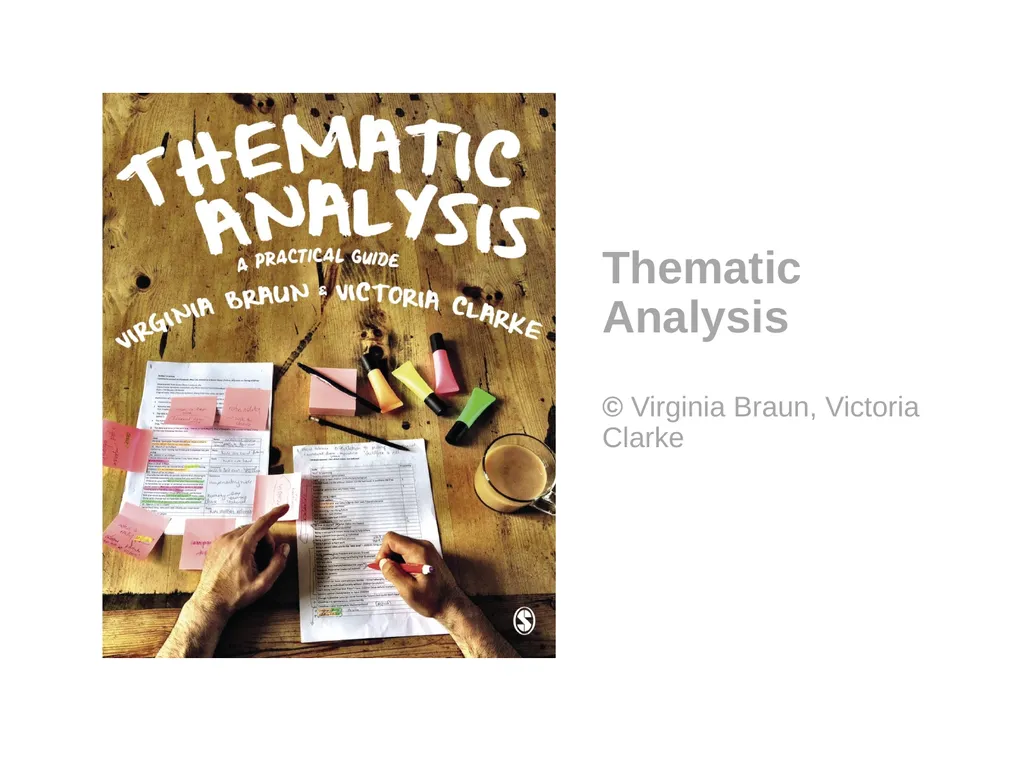
Thematic Analysis
© Virginia Braun, Victoria Clarke<br>
02
Activities for teaching reflexive thematic analysis
- bonus companion website only activities -<br>
- bonus companion website only activities -<br>
03
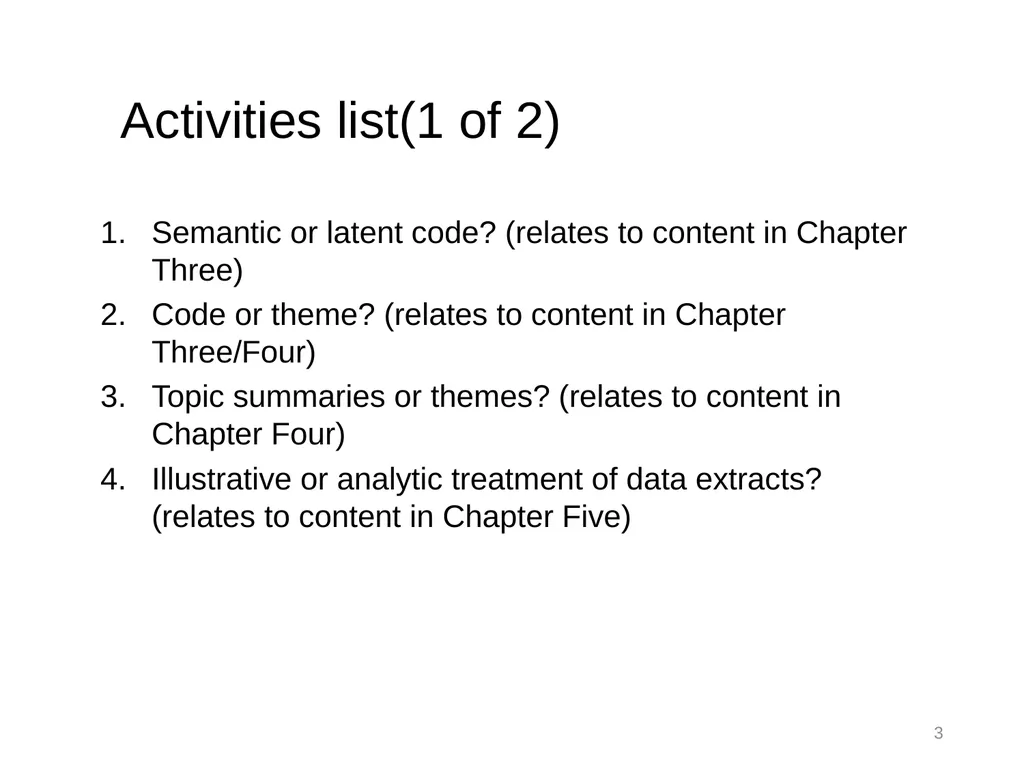
Activities list(1 of 2) Semantic or latent code? (relates to content in Chapter Three)
Code or theme? (relates to content in Chapter Three/Four)
Topic summaries or themes? (relates to content in Chapter Four)
Illustrative or analytic treatment of data extracts? (relates to content in Chapter Five) 3<br>
Code or theme? (relates to content in Chapter Three/Four)
Topic summaries or themes? (relates to content in Chapter Four)
Illustrative or analytic treatment of data extracts? (relates to content in Chapter Five) 3<br>
04
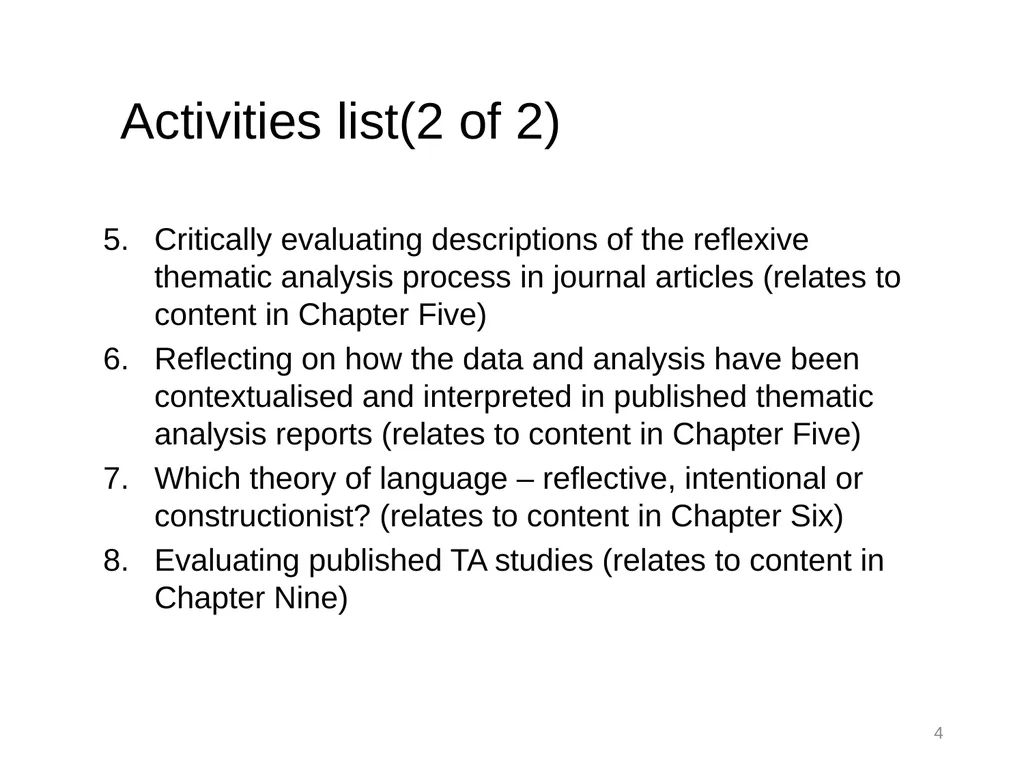
Activities list(2 of 2) Critically evaluating descriptions of the reflexive thematic analysis process in journal articles (relates to content in Chapter Five)
Reflecting on how the data and analysis have been contextualised and interpreted in published thematic analysis reports (relates to content in Chapter Five)
Which theory of language – reflective, intentional or constructionist? (relates to content in Chapter Six)
Evaluating published TA studies (relates to content in Chapter Nine) 4<br>
Reflecting on how the data and analysis have been contextualised and interpreted in published thematic analysis reports (relates to content in Chapter Five)
Which theory of language – reflective, intentional or constructionist? (relates to content in Chapter Six)
Evaluating published TA studies (relates to content in Chapter Nine) 4<br>
05
1. Semantic or latent codes exercise Semantic or latent codes? You decide!
Remember, these are not distinct and more like ends of a continuum
Read the excerpts from the data set and the associated coding labels - the introduction to the dataset provide some valuable context - and reflect on whether each code is (more or less) semantic or (more or less) latent.
Keep in mind that there isn’t an absolute distinction between semantic and latent codes - it’s better to think of them as two ends of the spectrum, with the potential for some blurring and overlap in the centre of the spectrum.
Reflect on why you have decided a code is more semantic or latent.
What aspects of the coding label or the data influenced your judgement? 5<br>
Remember, these are not distinct and more like ends of a continuum
Read the excerpts from the data set and the associated coding labels - the introduction to the dataset provide some valuable context - and reflect on whether each code is (more or less) semantic or (more or less) latent.
Keep in mind that there isn’t an absolute distinction between semantic and latent codes - it’s better to think of them as two ends of the spectrum, with the potential for some blurring and overlap in the centre of the spectrum.
Reflect on why you have decided a code is more semantic or latent.
What aspects of the coding label or the data influenced your judgement? 5<br>
06
Introducing the dataset(1 of 2) The New Zealand Herald is one of the main daily newspapers in New Zealand. The data come from reader comments in response to the following question on The New Zealand Herald’s website, in 2009:
Where should the Undie five-hundred go to next? South Island mayors have been quick to say “no thanks” to the prospect of the Undie five-hundred student rally moving to their neck of the woods. Canterbury University and student organisations yesterday decided to axe the annual pilgrimage to Dunedin after last weekend's rioting. It was the fourth consecutive year the celebrations following the arrival of the rally, official or unofficial, had descended into chaos. Where should the Undie five-hundred go to next? 6<br>
Where should the Undie five-hundred go to next? South Island mayors have been quick to say “no thanks” to the prospect of the Undie five-hundred student rally moving to their neck of the woods. Canterbury University and student organisations yesterday decided to axe the annual pilgrimage to Dunedin after last weekend's rioting. It was the fourth consecutive year the celebrations following the arrival of the rally, official or unofficial, had descended into chaos. Where should the Undie five-hundred go to next? 6<br>
07
Introducing the dataset(2 of 2) The city of Dunedin in the South Island of Aotearoa New Zealand is famed for a ‘rowdy’ student culture at Otago University, and for being the endpoint of the ‘Undie five-hundred’, an annual event organised by Canterbury University (in Christchurch) engineering students. It involves a pub crawl from Christchurch to Dunedin (about a four-and-a-half hour drive), in cars worth under $500 (£250). Previous news coverage had highlighted ‘mobs’, ‘rioting’ and ‘arrests’ in the city, for days after the arrival of the Undie five-hundred – which led to it being axed.
Research question: How are university students and the events surrounding the Undie five-hundred depicted in reader commentaries? 7<br>
Research question: How are university students and the events surrounding the Undie five-hundred depicted in reader commentaries? 7<br>
08
Semantic or latent codes? All is revealed! 8<br>
09
Reference: Terry, G., & Braun, V. (2016). "I think gorilla-like back effusions of hair are rather a turn-off": ‘Excessive hair’ and male body hair (removal) discourse. Body Image, 17, 14-24. 2. Code or theme exercise(1 of 2) Read the data excerpts and the associated code labels/theme names. These come from Ginny and Gareth Terry’s research exploring views on male body hair in New Zealand (Terry & Braun, 2016)
The data for this study were collected via an online survey and the broad, initial research question that guided the coding was: What are New Zealand men and women’s views of men’s body hair? 9<br>
The data for this study were collected via an online survey and the broad, initial research question that guided the coding was: What are New Zealand men and women’s views of men’s body hair? 9<br>
10
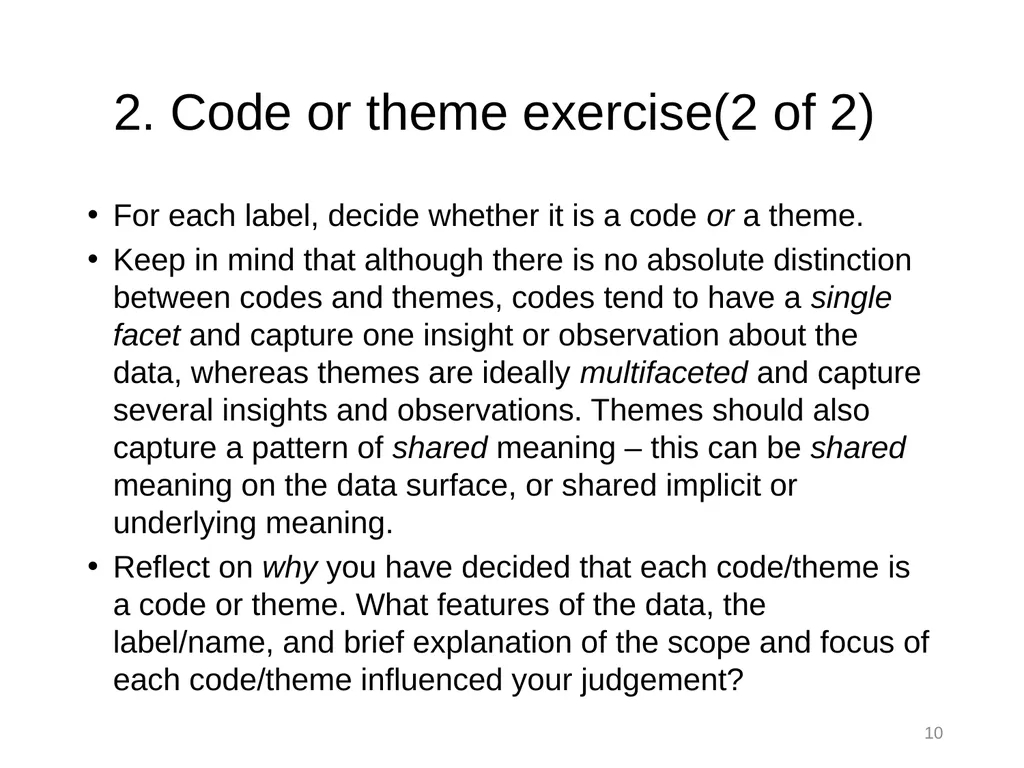
For each label, decide whether it is a code or a theme.
Keep in mind that although there is no absolute distinction between codes and themes, codes tend to have a single facet and capture one insight or observation about the data, whereas themes are ideally multifaceted and capture several insights and observations. Themes should also capture a pattern of shared meaning – this can be shared meaning on the data surface, or shared implicit or underlying meaning.
Reflect on why you have decided that each code/theme is a code or theme. What features of the data, the label/name, and brief explanation of the scope and focus of each code/theme influenced your judgement? 10 2. Code or theme exercise(2 of 2)<br>
Keep in mind that although there is no absolute distinction between codes and themes, codes tend to have a single facet and capture one insight or observation about the data, whereas themes are ideally multifaceted and capture several insights and observations. Themes should also capture a pattern of shared meaning – this can be shared meaning on the data surface, or shared implicit or underlying meaning.
Reflect on why you have decided that each code/theme is a code or theme. What features of the data, the label/name, and brief explanation of the scope and focus of each code/theme influenced your judgement? 10 2. Code or theme exercise(2 of 2)<br>
11
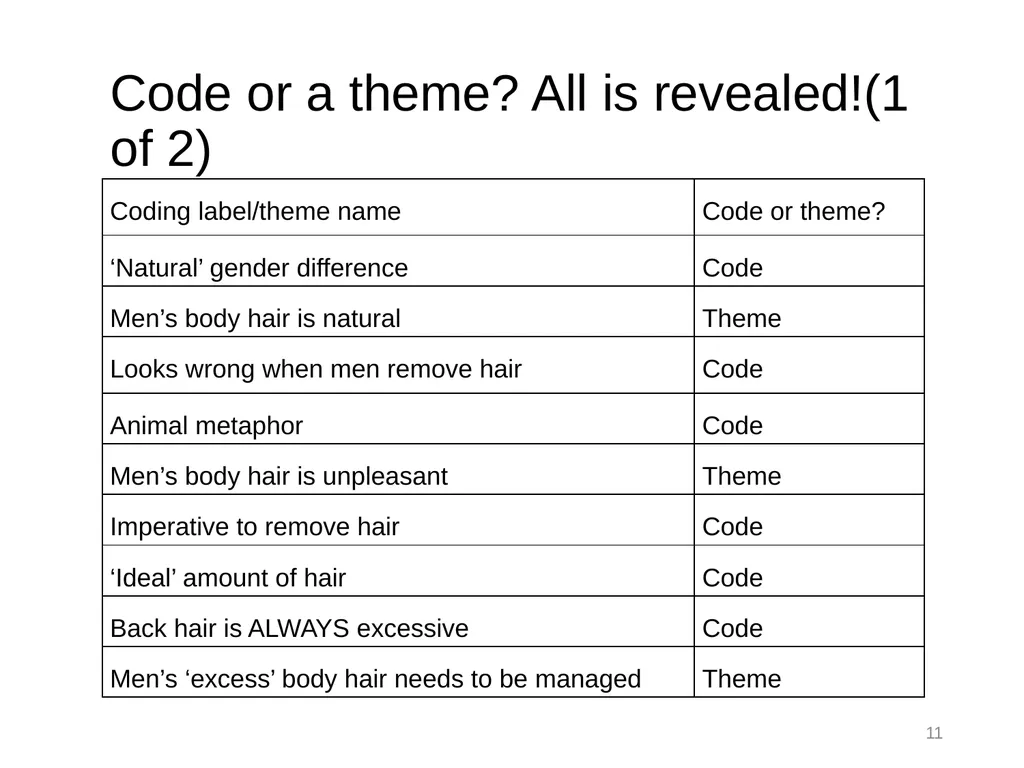
Code or a theme? All is revealed!(1 of 2) 11<br>
12
Three themes were presented in the analysis: "Two themes capture contradictory ideas: that men’s body hair is natural, and that men’s body hair is unpleasant. A third theme introduces the concept of ‘excess’ hair, which allowed sense-making of this contradiction, mandating men’s grooming of ‘excessive’ hair." (Terry & Braun, 2016, page 14) 12 Code or a theme? All is revealed!(2 of 2)<br>
13
3. Topic summaries or themes exercise(1 of 2) Read the ‘theme’ titles and summaries based on five published thematic analysis papers and determine whether the ‘themes’ reported are topic summaries or fully realised, shared meaning-based themes.
As a brief recap, topic summaries typically summarise and overview participants’ responses in relation to a particular topic area/data collection question - there is a shared topic, but not shared meaning. 13<br>
As a brief recap, topic summaries typically summarise and overview participants’ responses in relation to a particular topic area/data collection question - there is a shared topic, but not shared meaning. 13<br>
14
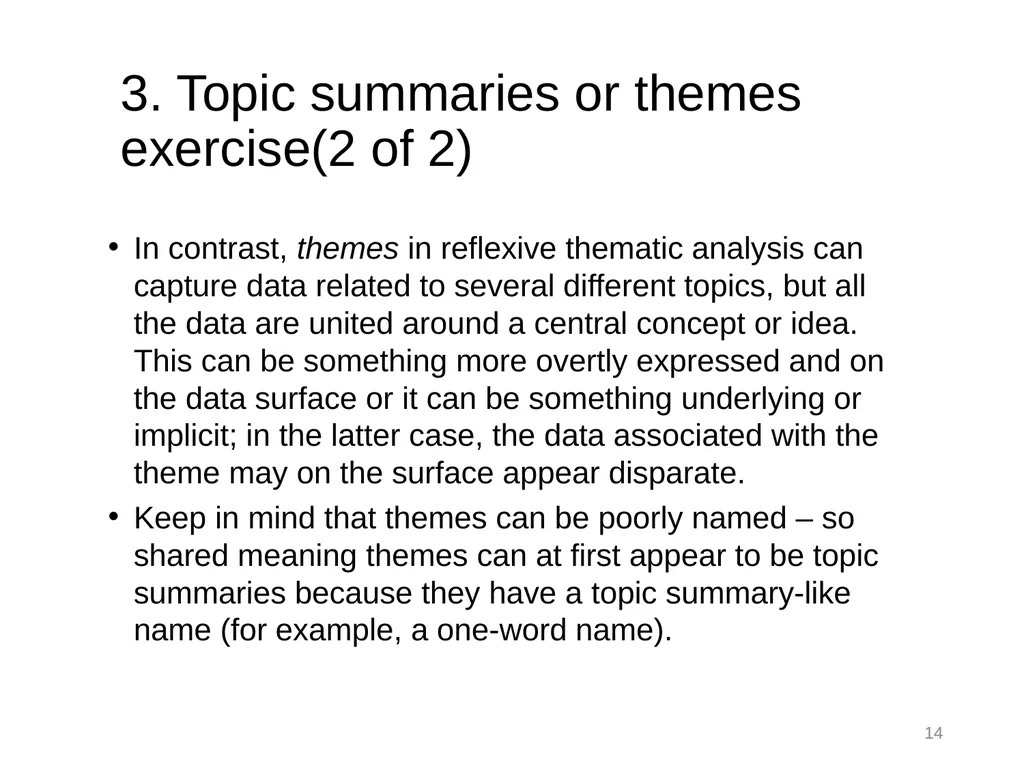
In contrast, themes in reflexive thematic analysis can capture data related to several different topics, but all the data are united around a central concept or idea. This can be something more overtly expressed and on the data surface or it can be something underlying or implicit; in the latter case, the data associated with the theme may on the surface appear disparate.
Keep in mind that themes can be poorly named – so shared meaning themes can at first appear to be topic summaries because they have a topic summary-like name (for example, a one-word name). 14 3. Topic summaries or themes exercise(2 of 2)<br>
Keep in mind that themes can be poorly named – so shared meaning themes can at first appear to be topic summaries because they have a topic summary-like name (for example, a one-word name). 14 3. Topic summaries or themes exercise(2 of 2)<br>
15
Topic summaries or themes? All is revealed!(1 of 2) 15<br>
16
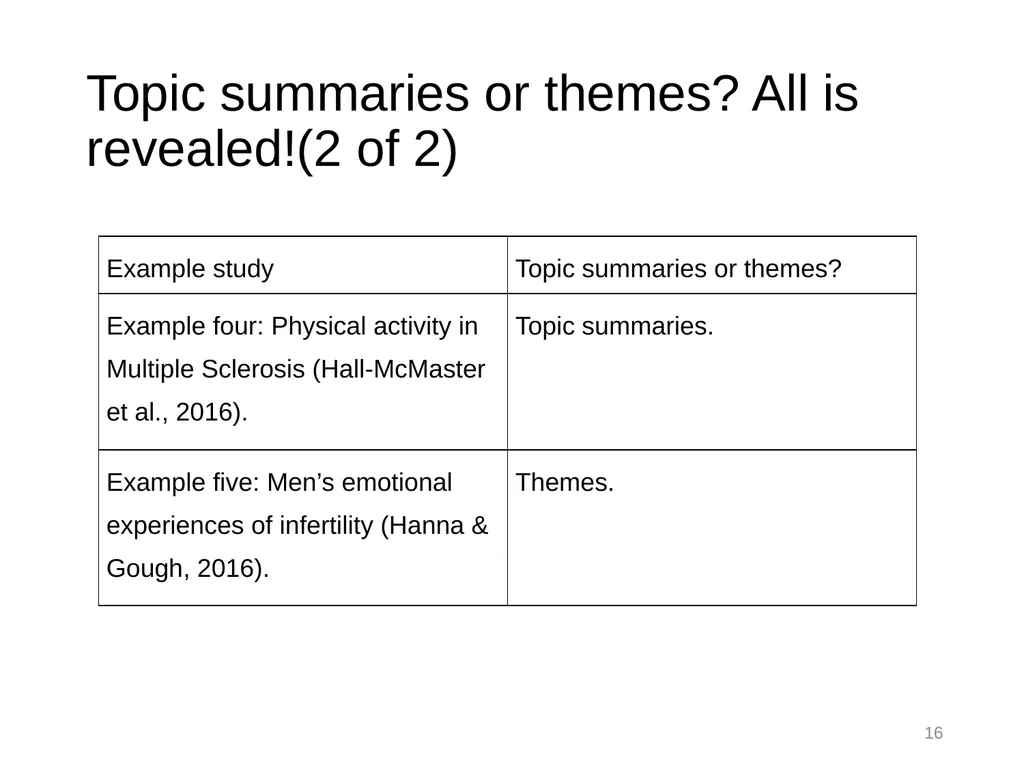
16 Topic summaries or themes? All is revealed!(2 of 2)<br>
17
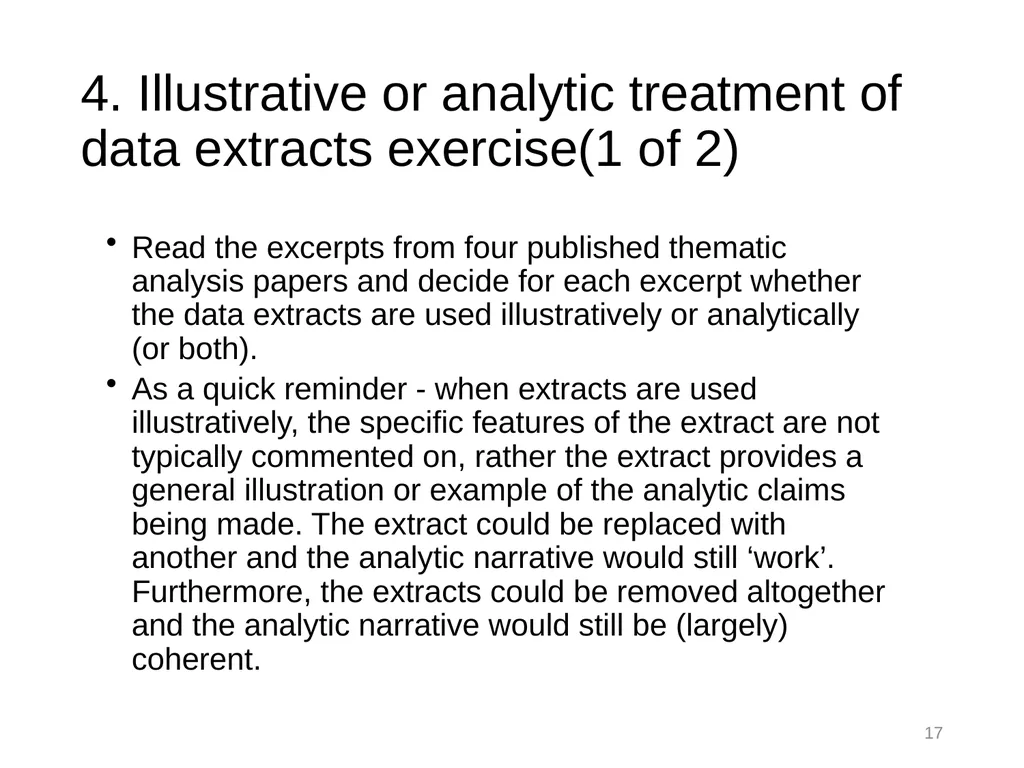
4. Illustrative or analytic treatment of data extracts exercise(1 of 2) Read the excerpts from four published thematic analysis papers and decide for each excerpt whether the data extracts are used illustratively or analytically (or both).
As a quick reminder - when extracts are used illustratively, the specific features of the extract are not typically commented on, rather the extract provides a general illustration or example of the analytic claims being made. The extract could be replaced with another and the analytic narrative would still ‘work’. Furthermore, the extracts could be removed altogether and the analytic narrative would still be (largely) coherent. 17<br>
As a quick reminder - when extracts are used illustratively, the specific features of the extract are not typically commented on, rather the extract provides a general illustration or example of the analytic claims being made. The extract could be replaced with another and the analytic narrative would still ‘work’. Furthermore, the extracts could be removed altogether and the analytic narrative would still be (largely) coherent. 17<br>
18
With illustrative use, the specific features of an extract are commented on and the analysis is developed through the specific extracts selected for presentation in the report.
Reflect on why you think the extracts in a particular excerpt are used illustratively or analytically (or both).
What details in the excerpt can you point to as evidence of this? 18 4. Illustrative or analytic treatment of data extracts exercise(2 of 2)<br>
Reflect on why you think the extracts in a particular excerpt are used illustratively or analytically (or both).
What details in the excerpt can you point to as evidence of this? 18 4. Illustrative or analytic treatment of data extracts exercise(2 of 2)<br>
19
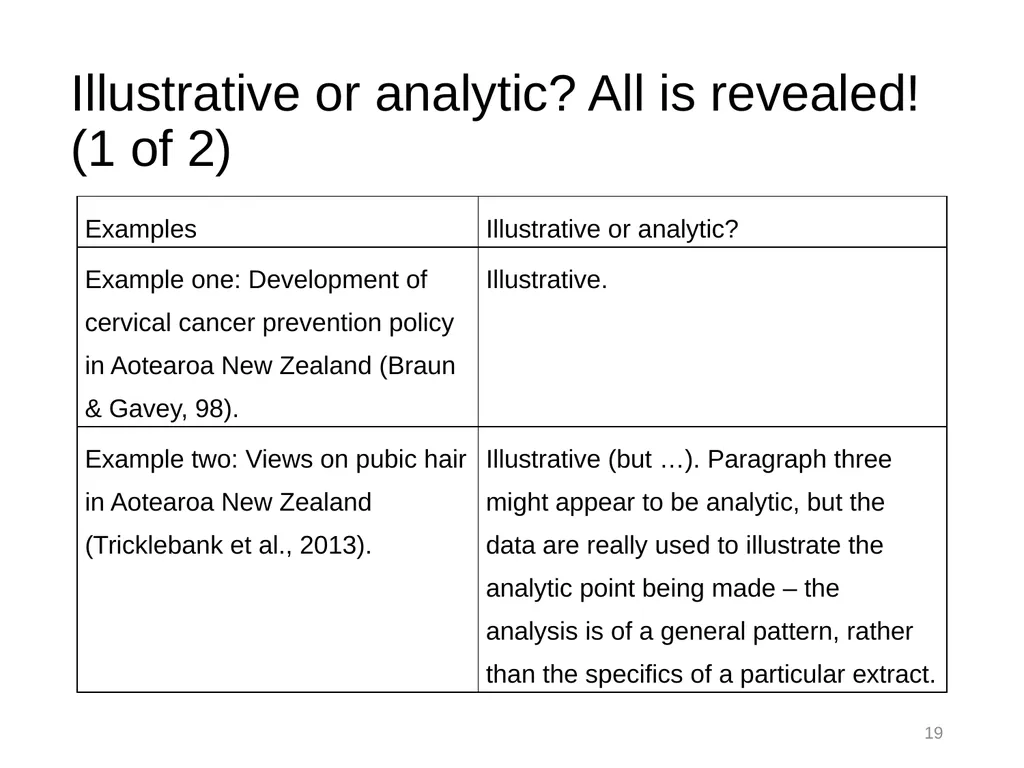
Illustrative or analytic? All is revealed!(1 of 2) 19<br>
20
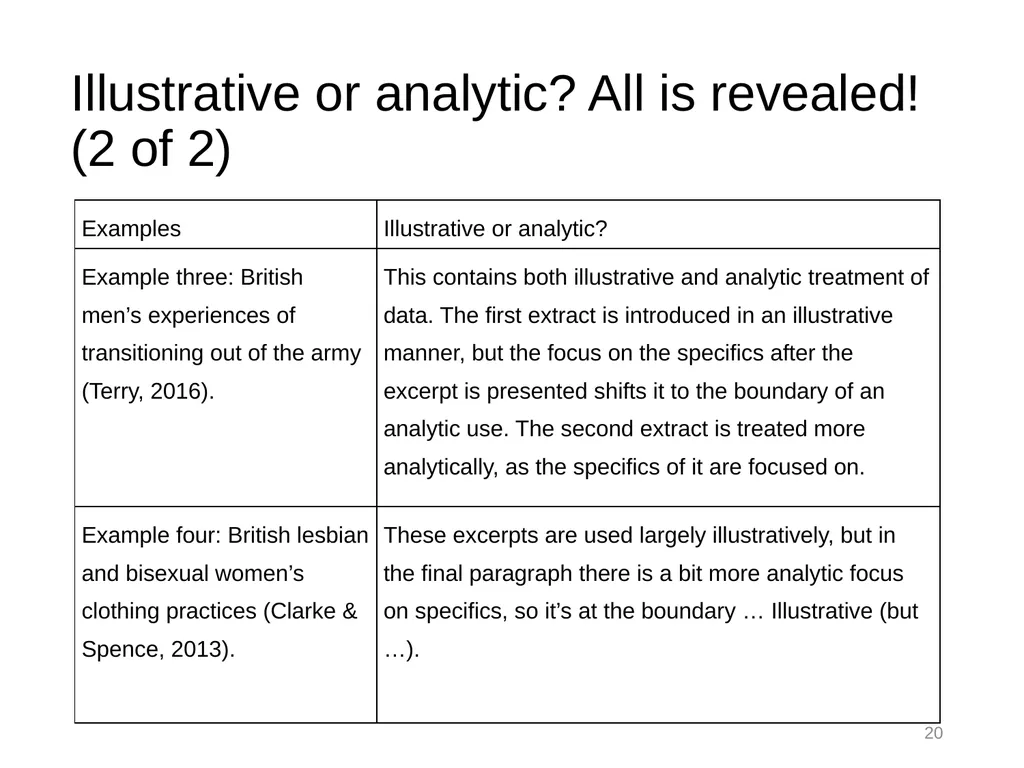
20 Illustrative or analytic? All is revealed!(2 of 2)<br>
21
5. Critically evaluating descriptions of the reflexive thematic analysis process in journal articles Read the extracts from four published papers in which the authors describe their (reflexive) thematic analysis analytic process; note that some of these papers were written before we first designated our approach as reflexive thematic analysis.
Note that Virginia Braun is a co-author on two of these papers – but don’t assume these examples are necessarily excellent or there is no scope for improvement! All authors are subject to constraints when publishing that can distort best practice.<br>
Note that Virginia Braun is a co-author on two of these papers – but don’t assume these examples are necessarily excellent or there is no scope for improvement! All authors are subject to constraints when publishing that can distort best practice.<br>
22
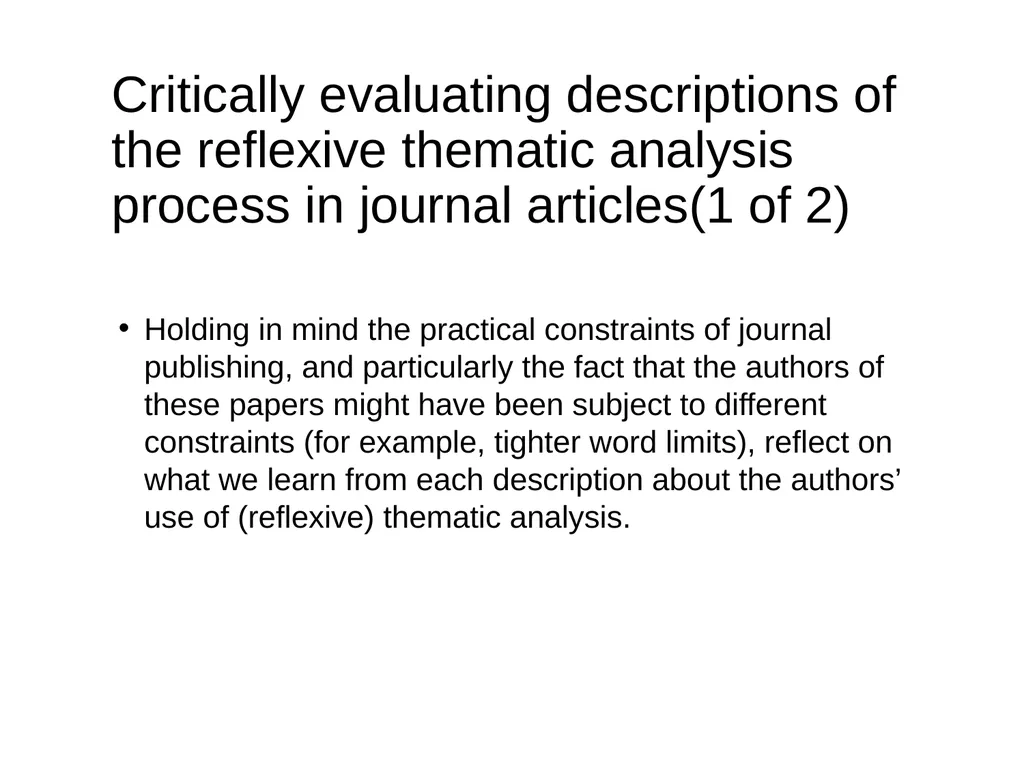
Critically evaluating descriptions of the reflexive thematic analysis process in journal articles(1 of 2) Holding in mind the practical constraints of journal publishing, and particularly the fact that the authors of these papers might have been subject to different constraints (for example, tighter word limits), reflect on what we learn from each description about the authors’ use of (reflexive) thematic analysis.<br>
23
Critically evaluating descriptions of the reflexive thematic analysis process in journal articles(2 of 2) Is there scope for improvement in any of these descriptions?
What exactly can be improved and why?
Do you think any of these examples are stronger or weaker?
What informed this judgement?
What are some of the strengths of the stronger examples?<br>
What exactly can be improved and why?
Do you think any of these examples are stronger or weaker?
What informed this judgement?
What are some of the strengths of the stronger examples?<br>
24
Critically evaluating example one: Being single (Pickens & Braun, 2018)(1 of 2) Things we noted:
Critical realism discussed and the authors’ particular ‘take’ on this is specified including what it means for how they treat and interpret their data.
Each author’s role in the analysis is specified and the authors’ analytic process is clearly described, including examples of codes and coding.<br>
Critical realism discussed and the authors’ particular ‘take’ on this is specified including what it means for how they treat and interpret their data.
Each author’s role in the analysis is specified and the authors’ analytic process is clearly described, including examples of codes and coding.<br>
25
The orientation to thematic analysis is discussed (experiential, semantic and latent coding, latent themes), except for inductive-deductive.
The authors discuss how they conceptualise their themes.
The analysis is clearly located in the wider socio-cultural context. Critically evaluating example one: Being single (Pickens & Braun, 2018)(2 of 2)<br>
The authors discuss how they conceptualise their themes.
The analysis is clearly located in the wider socio-cultural context. Critically evaluating example one: Being single (Pickens & Braun, 2018)(2 of 2)<br>
26
Critically evaluating example two: Running barefoot (Walton & French, 2016)(1 of 2) Things we noted:
Implicit realist/positivist assumptions evident in the notion of ‘accurate’ transcription (from a Big Q perspective, a transcript is always an interpretation) and analysis.
Emerging themes!
Departure from reflexive thematic analysis procedures – more like IPA with themes developed for each case – but there is an explanation for this.<br>
Implicit realist/positivist assumptions evident in the notion of ‘accurate’ transcription (from a Big Q perspective, a transcript is always an interpretation) and analysis.
Emerging themes!
Departure from reflexive thematic analysis procedures – more like IPA with themes developed for each case – but there is an explanation for this.<br>
27
No indication of orientation (for example, inductive-deductive, semantic-latent meaning) and guiding theoretical assumptions (other than implicit realism) in the discussion of TA, but elsewhere described as latent and seeking to "go beyond the purely descriptive reporting of patterns in data and instead attempted to theorize the meanings and implications of these patterns" (Walton & French, 2016, page 453).
Clear account of the authors’ analytic process but unclear who conducted the analysis but reference to ‘the researcher’ singular – the first author? The analysis was supervised and reviewed by a psychologist – the second author? Critically evaluating example two: Running barefoot (Walton & French, 2016)(2 of 2)<br>
Clear account of the authors’ analytic process but unclear who conducted the analysis but reference to ‘the researcher’ singular – the first author? The analysis was supervised and reviewed by a psychologist – the second author? Critically evaluating example two: Running barefoot (Walton & French, 2016)(2 of 2)<br>
28
Critically evaluating example three: Body hair (Terry et al., 2018) Things we noted:
Critical realist ontology noted and explained.
Focus on semantic and latent meaning and an inductive orientation specified.
The authors’ analytic process is clearly described including examples of codes.
Which authors conducted the analysis is made clear – along with the precise contribution of each of these authors.
The authors specify how they conceptualise themes.<br>
Critical realist ontology noted and explained.
Focus on semantic and latent meaning and an inductive orientation specified.
The authors’ analytic process is clearly described including examples of codes.
Which authors conducted the analysis is made clear – along with the precise contribution of each of these authors.
The authors specify how they conceptualise themes.<br>
29
Critically evaluating example four: Venous thromboembolism (Hunter et al., 2016)(1 of 2) Things we noted:
Inductive orientation specified.
Rationale given for use of thematic analysis but rather generic.
Another reference to ‘accurate’ transcription.
Themes emerged!<br>
Inductive orientation specified.
Rationale given for use of thematic analysis but rather generic.
Another reference to ‘accurate’ transcription.
Themes emerged!<br>
30
Authors’ analytic process clearly described but unclear who conducted the analysis (one author appeared to take a validating role).
No discussion of theoretical grounding (but implicit realist/positivist assumptions around ‘accuracy’ and clearly oriented to experiential qualitative).
No discussion of focus on semantic-latent meaning. Critically evaluating example four: Venous thromboembolism (Hunter et al., 2016)(2 of 2)<br>
No discussion of theoretical grounding (but implicit realist/positivist assumptions around ‘accuracy’ and clearly oriented to experiential qualitative).
No discussion of focus on semantic-latent meaning. Critically evaluating example four: Venous thromboembolism (Hunter et al., 2016)(2 of 2)<br>
31
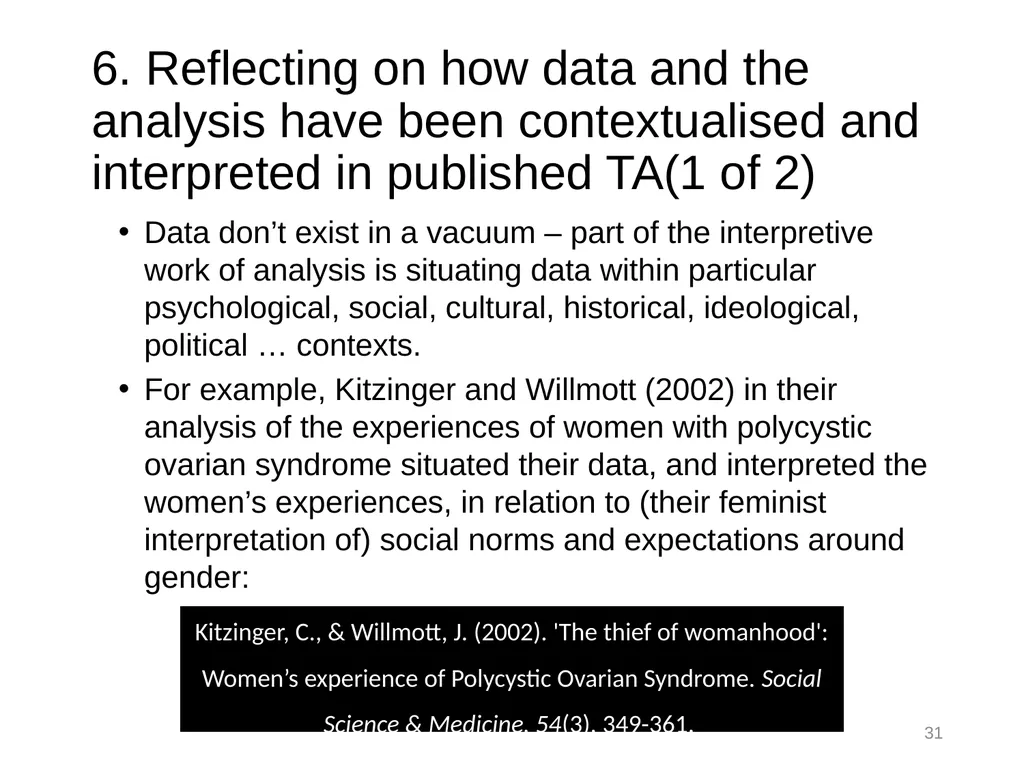
Kitzinger, C., & Willmott, J. (2002). 'The thief of womanhood': Women’s experience of Polycystic Ovarian Syndrome. Social Science & Medicine, 54(3), 349-361. 6. Reflecting on how data and the analysis have been contextualised and interpreted in published TA(1 of 2) Data don’t exist in a vacuum – part of the interpretive work of analysis is situating data within particular psychological, social, cultural, historical, ideological, political … contexts.
For example, Kitzinger and Willmott (2002) in their analysis of the experiences of women with polycystic ovarian syndrome situated their data, and interpreted the women’s experiences, in relation to (their feminist interpretation of) social norms and expectations around gender: 31<br>
For example, Kitzinger and Willmott (2002) in their analysis of the experiences of women with polycystic ovarian syndrome situated their data, and interpreted the women’s experiences, in relation to (their feminist interpretation of) social norms and expectations around gender: 31<br>
32
Kitzinger, C., & Willmott, J. (2002). 'The thief of womanhood': Women’s experience of Polycystic Ovarian Syndrome. Social Science & Medicine, 54(3), 349-361. “It is not surprising that women with PCOS seek to fit the cultural conventions of beauty in this way. Meeting societal standards of beauty has become a moral obligation, and a woman who falls short of the prescribed requirements is a seen as a failure […]” (pages 354-355). 32 6. Reflecting on how data and the analysis have been contextualised and interpreted in published TA(2 of 2)<br>
33
Reflecting on how data and the analysis have been contextualised … the exercise Read the excerpts from four published thematic analysis papers and reflect on the ways in which the authors’ interpret their data and contextualise their analysis.
What do they assume their data access – participants’ psychology, meaning frameworks within the wider social context or something else?
In what other ways could the authors have located and interpreted their data? 33<br>
What do they assume their data access – participants’ psychology, meaning frameworks within the wider social context or something else?
In what other ways could the authors have located and interpreted their data? 33<br>
34
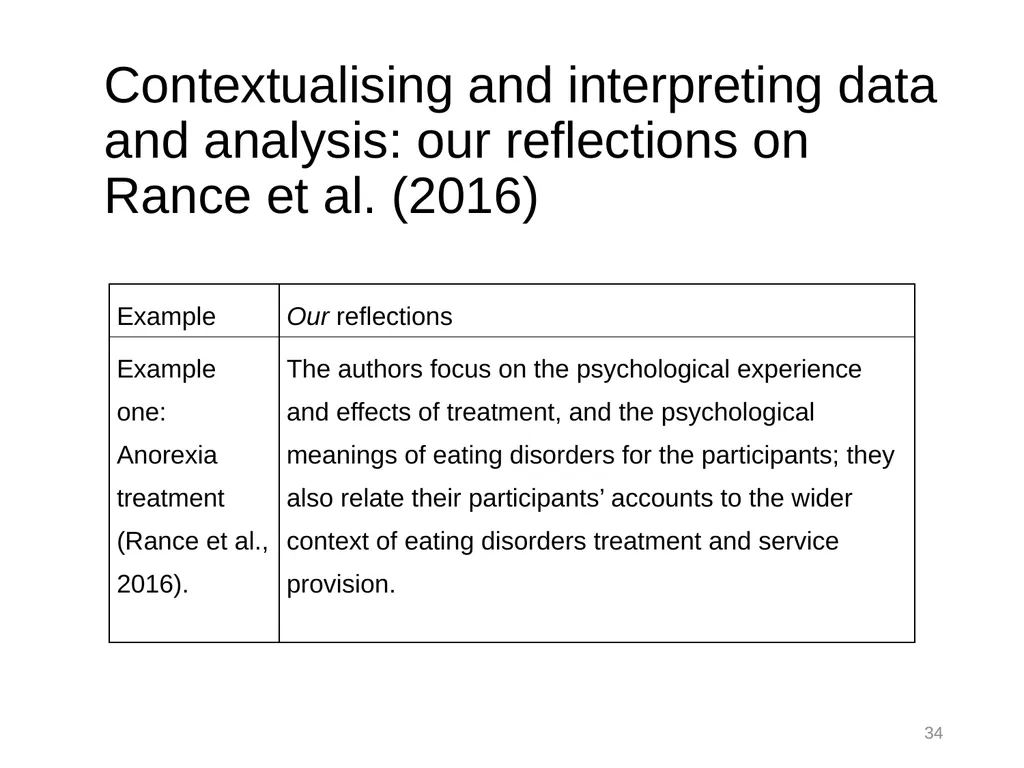
Contextualising and interpreting data and analysis: our reflections on Rance et al. (2016) 34<br>
35
Contextualising and interpreting data and analysis: our reflections on Moulding (2016) 35<br>
36
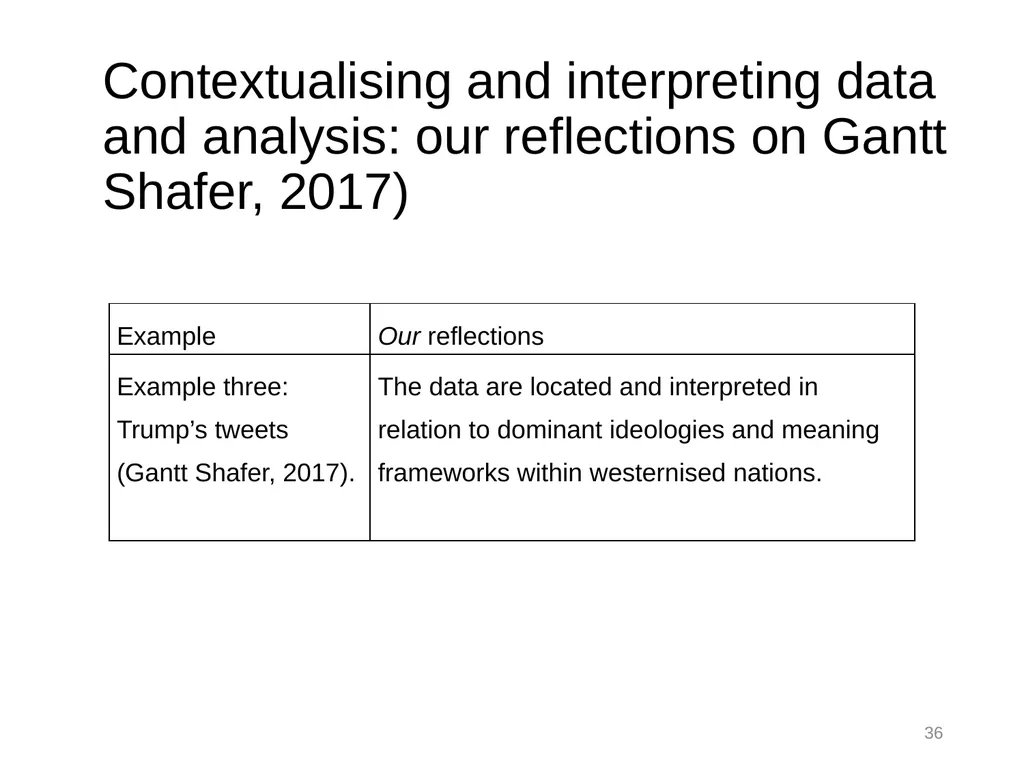
Contextualising and interpreting data and analysis: our reflections on Gantt Shafer, 2017) 36<br>
37
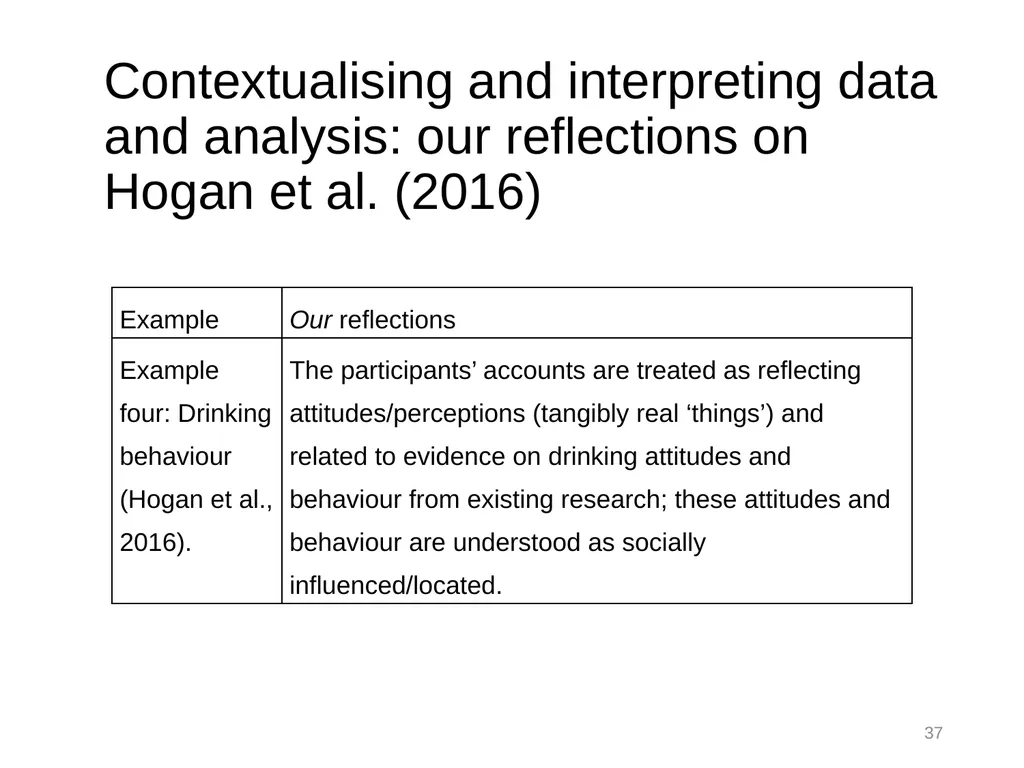
Contextualising and interpreting data and analysis: our reflections on Hogan et al. (2016) 37<br>
38
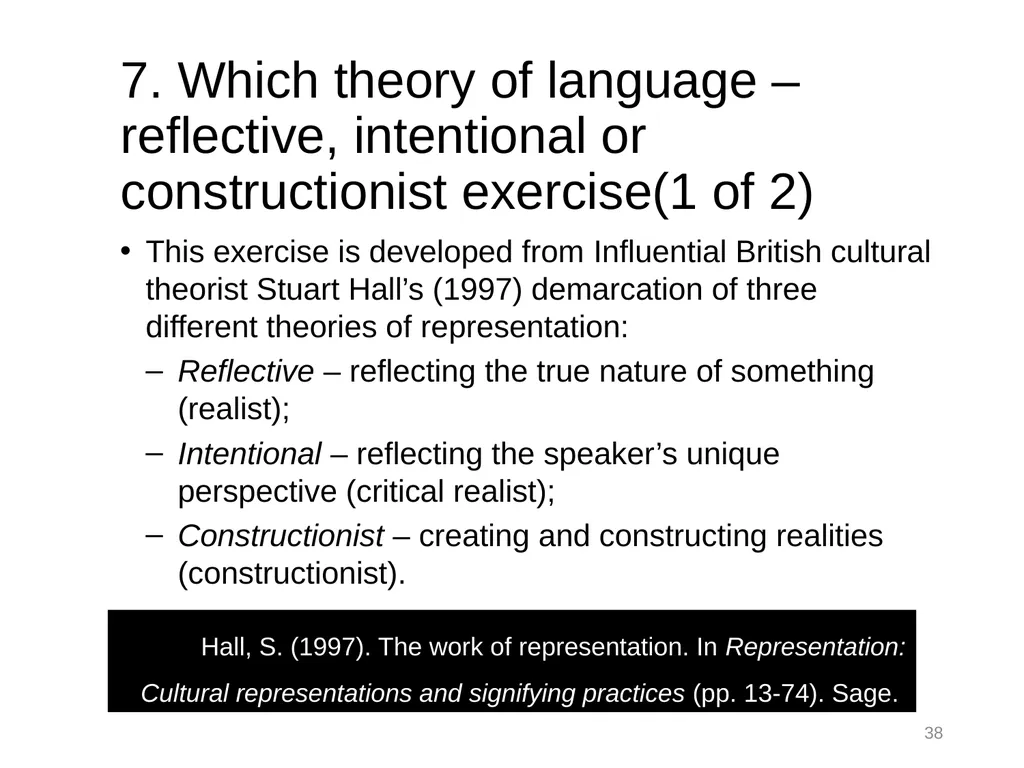
Hall, S. (1997). The work of representation. In Representation: Cultural representations and signifying practices (pp. 13-74). Sage. 7. Which theory of language – reflective, intentional or constructionist exercise(1 of 2) This exercise is developed from Influential British cultural theorist Stuart Hall’s (1997) demarcation of three different theories of representation:
Reflective – reflecting the true nature of something (realist);
Intentional – reflecting the speaker’s unique perspective (critical realist);
Constructionist – creating and constructing realities (constructionist). 38<br>
Reflective – reflecting the true nature of something (realist);
Intentional – reflecting the speaker’s unique perspective (critical realist);
Constructionist – creating and constructing realities (constructionist). 38<br>
39
Read the excerpts from eight* published thematic analysis papers and identify which broad theory of language (reflective, intentional, constructionist) best captures how the authors of each paper treat and make sense of their data.
*Actually, seven thematic analysis papers and one wild card – not a thematic analysis study but a study that nonetheless reports themes in qualitative data. 39 7. Which theory of language – reflective, intentional or constructionist exercise(2 of 2)<br>
*Actually, seven thematic analysis papers and one wild card – not a thematic analysis study but a study that nonetheless reports themes in qualitative data. 39 7. Which theory of language – reflective, intentional or constructionist exercise(2 of 2)<br>
40
Which theory of language – reflective, intentional or constructionist exercise… questions How did you make that judgement?
What features of the excerpts influenced your judgement? 40<br>
What features of the excerpts influenced your judgement? 40<br>
41
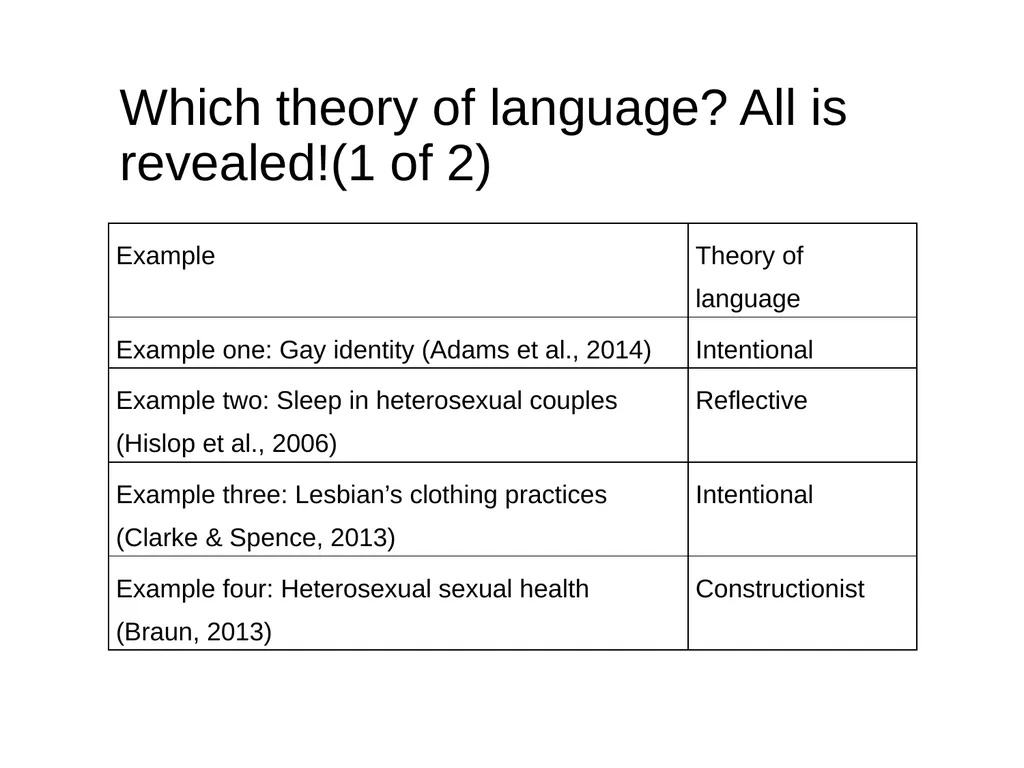
Which theory of language? All is revealed!(1 of 2)<br>
42
Which theory of language? All is revealed!(2 of 2)<br>
43
8. Evaluating published thematic analysis studies Select a published TA article to evaluate.
To help you assess the "methodological integrity" (Levitt et al., 2017) of the research you have chosen to evaluate, start your evaluation by determining the broad contours of the research – how can we categorise this piece of research?
For example, is it small q or Big Q (or confused q)? Experiential or critical? Realist, critical realist or relativist? (Post)positivist, contextualist or constructionist? What theory of language underpins the treatment of data? 43<br>
To help you assess the "methodological integrity" (Levitt et al., 2017) of the research you have chosen to evaluate, start your evaluation by determining the broad contours of the research – how can we categorise this piece of research?
For example, is it small q or Big Q (or confused q)? Experiential or critical? Realist, critical realist or relativist? (Post)positivist, contextualist or constructionist? What theory of language underpins the treatment of data? 43<br>
44
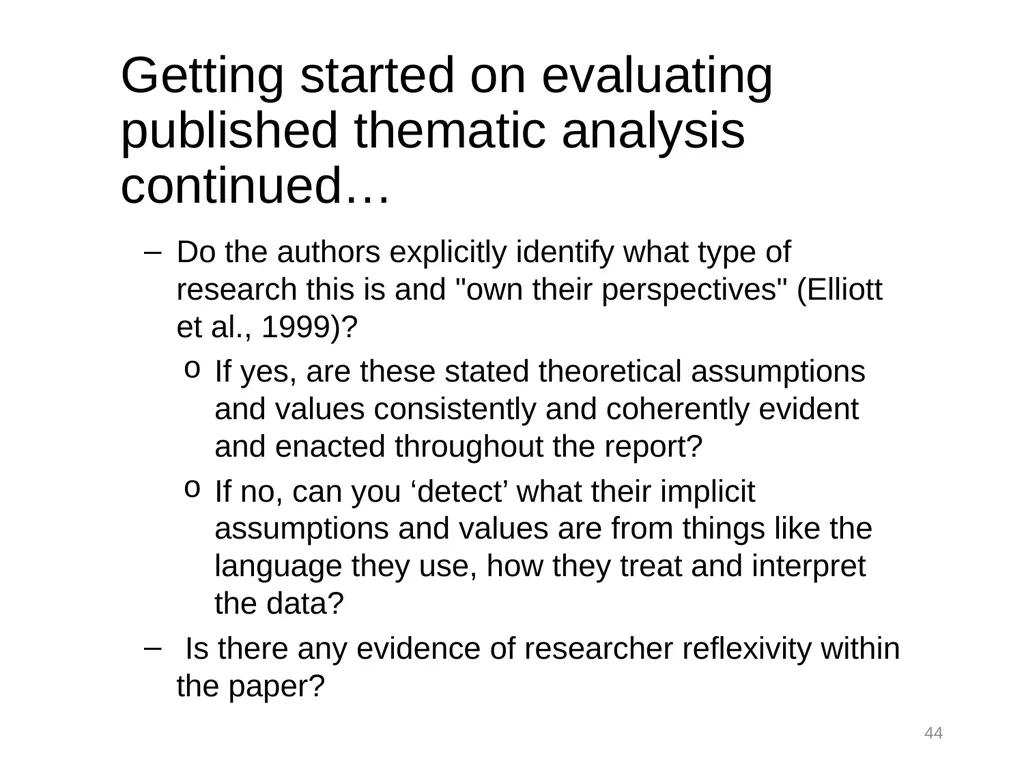
Getting started on evaluating published thematic analysis continued… Do the authors explicitly identify what type of research this is and "own their perspectives" (Elliott et al., 1999)?
If yes, are these stated theoretical assumptions and values consistently and coherently evident and enacted throughout the report?
If no, can you ‘detect’ what their implicit assumptions and values are from things like the language they use, how they treat and interpret the data?
Is there any evidence of researcher reflexivity within the paper? 44<br>
If yes, are these stated theoretical assumptions and values consistently and coherently evident and enacted throughout the report?
If no, can you ‘detect’ what their implicit assumptions and values are from things like the language they use, how they treat and interpret the data?
Is there any evidence of researcher reflexivity within the paper? 44<br>
45
Be mindful of the constraints of academic journal publishing continued… Limited word counts, the expectations and expertise of the editors and reviewers, the style and conventions of the journal all shape and constrain how research is reported.
Do a quick Google search for the journal – on the journal home page, is there a word/page count for qualitative research reports? (tight <[less-than] six-thousand words; generous >[greater-than] ten-thousand words) Any guidelines for reporting qualitative research? Any guidelines for reviewers assessing qualitative research? 45<br>
Do a quick Google search for the journal – on the journal home page, is there a word/page count for qualitative research reports? (tight <[less-than] six-thousand words; generous >[greater-than] ten-thousand words) Any guidelines for reporting qualitative research? Any guidelines for reviewers assessing qualitative research? 45<br>
46
Be mindful of the constraints of academic journal publishing continued… Search within the journal contents for "thematic analysis" – does this generate lots of hits?
Indicators of a potentially positive qualitative publishing context include: generous/higher word counts for qualitative research; qualitative experts on the editorial board; reporting/reviewer guidelines that reflect a sound understanding of qualitative research values; and lots of reflexive thematic analysis published in the journal. 46<br>
Indicators of a potentially positive qualitative publishing context include: generous/higher word counts for qualitative research; qualitative experts on the editorial board; reporting/reviewer guidelines that reflect a sound understanding of qualitative research values; and lots of reflexive thematic analysis published in the journal. 46<br>
47
Evaluating the authors’ use of thematic analysis(1 of 3) What sources on reflexive thematic analysis do the authors draw on? If multiple authors/sources on thematic analysis – are these complimentary or contradictory? Is the use of reflexive thematic analysis knowing?
Do the authors describe a particular orientation to thematic analysis? (for example, inductive or deductive or a mix, semantic or latent coding/theme development or a mix?) Is this consistently evident and enacted in the analysis? 47<br>
Do the authors describe a particular orientation to thematic analysis? (for example, inductive or deductive or a mix, semantic or latent coding/theme development or a mix?) Is this consistently evident and enacted in the analysis? 47<br>
48
Do the authors explicitly or implicitly elide the diversity within the thematic analysis family of methods, treating thematic analysis as a singular approach with a standardised set of procedures? Are there evidence of unknowing ‘mash-ups’ of different approaches (for example, reflexive thematic analysis with a codebook and consensus coding)?
Do the authors make problematic assumptions about thematic analysis (for example, it’s atheoretical, only realist/essentialist, descriptive, summative, inductive)? 48 Evaluating the authors’ use of thematic analysis(2 of 3)<br>
Do the authors make problematic assumptions about thematic analysis (for example, it’s atheoretical, only realist/essentialist, descriptive, summative, inductive)? 48 Evaluating the authors’ use of thematic analysis(2 of 3)<br>
49
Do the authors make assumptions and articulate values and concepts not consistent with reflexive thematic analysis (for example, concern for the truth and accuracy of the analysis)? 49 Evaluating the authors’ use of thematic analysis(3 of 3)<br>
50
Evaluating the authors’ rationale for thematic analysis and their account of the analytic process(1 of 2) Do the authors provide a compelling rationale for their use of/particular approach and orientation to thematic analysis? Are their reasons for using thematic analysis centred on generic features of thematic analysis (for example, flexible, accessible)? If so, are these explicitly related to the goals and purpose of the research?
Is there a good ‘fit’ between the authors’ stated (or implicit) theoretical assumptions and values, the research question and the use of thematic analysis? 50<br>
Is there a good ‘fit’ between the authors’ stated (or implicit) theoretical assumptions and values, the research question and the use of thematic analysis? 50<br>
51
Does the authors’ account of their analytic process provide a lively sense of how specifically they engaged with thematic analysis (which goes beyond listing the six phases)?
In multi-authored papers, do the authors discuss how each contributed to the analysis?
Do the authors describe any quality practices (for example, keeping a reflexive journal)? 51 Evaluating the authors’ rationale for thematic analysis and their account of the analytic process(2 of 2)<br>
In multi-authored papers, do the authors discuss how each contributed to the analysis?
Do the authors describe any quality practices (for example, keeping a reflexive journal)? 51 Evaluating the authors’ rationale for thematic analysis and their account of the analytic process(2 of 2)<br>
52
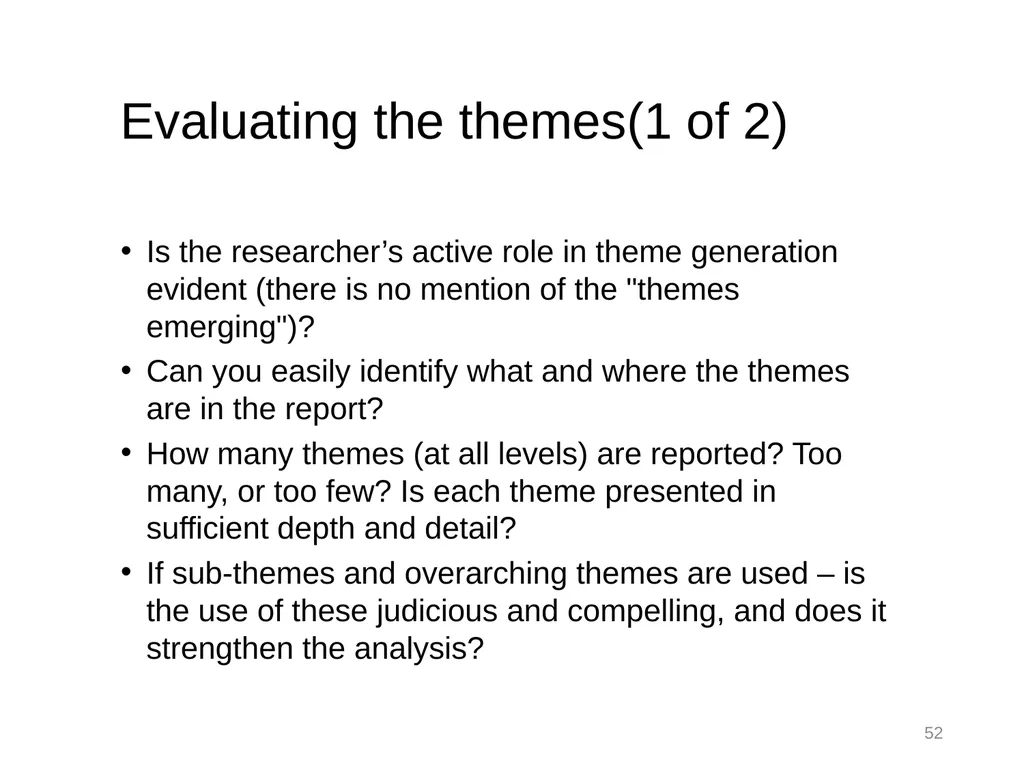
Evaluating the themes(1 of 2) Is the researcher’s active role in theme generation evident (there is no mention of the "themes emerging")?
Can you easily identify what and where the themes are in the report?
How many themes (at all levels) are reported? Too many, or too few? Is each theme presented in sufficient depth and detail?
If sub-themes and overarching themes are used – is the use of these judicious and compelling, and does it strengthen the analysis? 52<br>
Can you easily identify what and where the themes are in the report?
How many themes (at all levels) are reported? Too many, or too few? Is each theme presented in sufficient depth and detail?
If sub-themes and overarching themes are used – is the use of these judicious and compelling, and does it strengthen the analysis? 52<br>
53
Evaluating the themes(2 of 2) How do the authors (implicitly) conceptualise themes? (Topic summaries or shared meaning? Entities that reside in data fully formed prior to analysis or the outputs of a subjective coding process?) Have the authors confused single faceted codes with multi-faceted themes? Consider both the theme names and content.
Do the theme names capture the ‘essence’ or ‘story’ of each theme?
Are the scope and boundaries of each theme clear? Does each theme stand alone but contribute to an overall story about the data? Is there any undesirable overlap between the themes? 53<br>
Do the theme names capture the ‘essence’ or ‘story’ of each theme?
Are the scope and boundaries of each theme clear? Does each theme stand alone but contribute to an overall story about the data? Is there any undesirable overlap between the themes? 53<br>
54
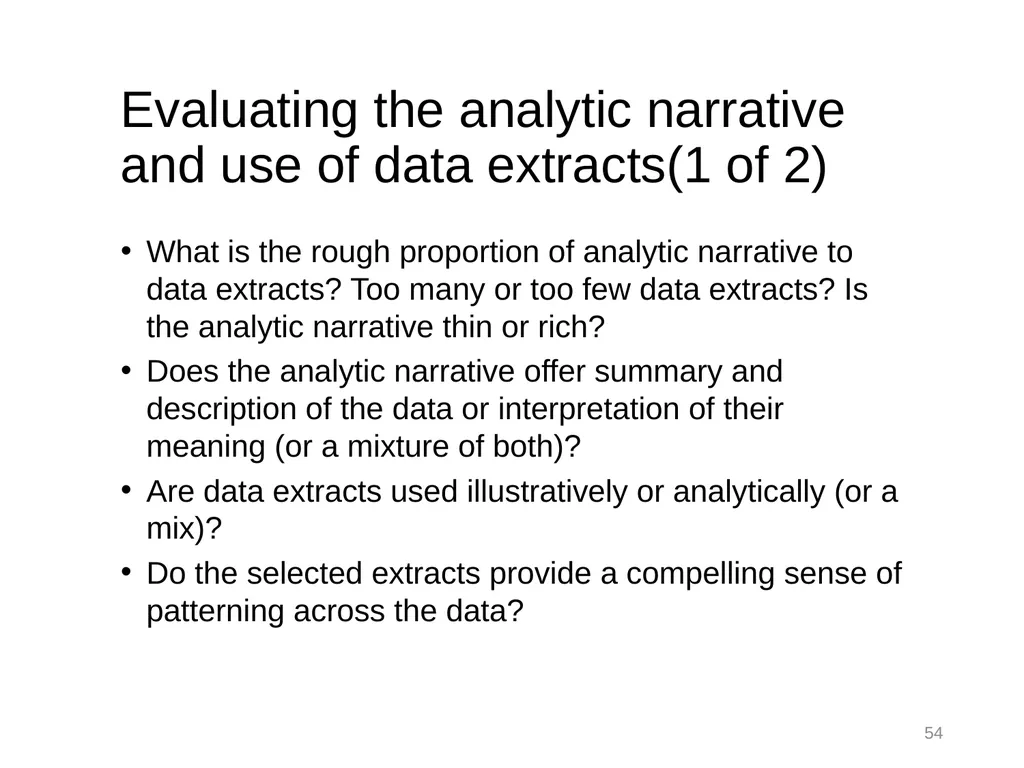
Evaluating the analytic narrative and use of data extracts(1 of 2) What is the rough proportion of analytic narrative to data extracts? Too many or too few data extracts? Is the analytic narrative thin or rich?
Does the analytic narrative offer summary and description of the data or interpretation of their meaning (or a mixture of both)?
Are data extracts used illustratively or analytically (or a mix)?
Do the selected extracts provide a compelling sense of patterning across the data? 54<br>
Does the analytic narrative offer summary and description of the data or interpretation of their meaning (or a mixture of both)?
Are data extracts used illustratively or analytically (or a mix)?
Do the selected extracts provide a compelling sense of patterning across the data? 54<br>
55
Evaluating the analytic narrative and use of data extracts(2 of 2) Are the chosen extracts vivid and engaging?
Is the interpretation of the data, and selected extracts, plausible?
Can you identify the authors’ overall conclusions? Are you convinced by these?
Either in the analysis or the discussion, do the authors contextualise their data and interpretation of it in relation to the existing literature and (where relevant) wider contexts? 55<br>
Is the interpretation of the data, and selected extracts, plausible?
Can you identify the authors’ overall conclusions? Are you convinced by these?
Either in the analysis or the discussion, do the authors contextualise their data and interpretation of it in relation to the existing literature and (where relevant) wider contexts? 55<br>
56
What’s your overall assessment of the report? Is the research useful and insightful?
Does the report evidence a sound and knowing use of reflexive thematic analysis?
Are there flaws/areas for improvement?
Would the research have benefitted from different reporting conventions (for example, more oriented to qualitative values; a longer word count)? 56<br>
Does the report evidence a sound and knowing use of reflexive thematic analysis?
Are there flaws/areas for improvement?
Would the research have benefitted from different reporting conventions (for example, more oriented to qualitative values; a longer word count)? 56<br>
57
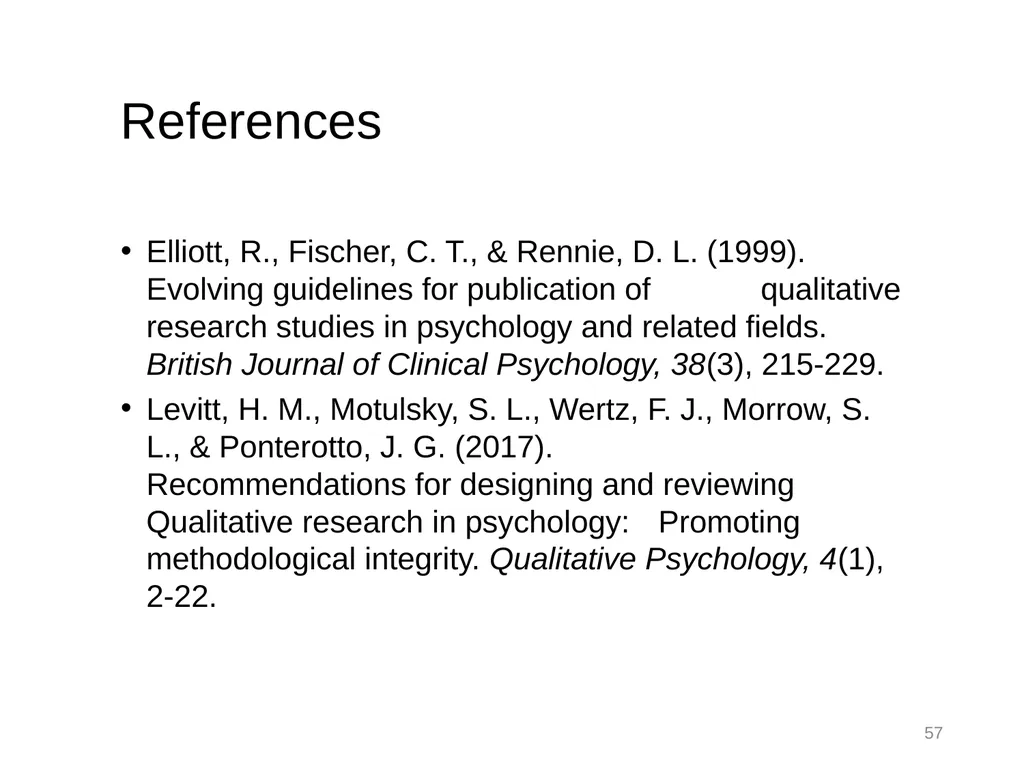
References Elliott, R., Fischer, C. T., & Rennie, D. L. (1999). Evolving guidelines for publication of qualitative research studies in psychology and related fields. British Journal of Clinical Psychology, 38(3), 215-229.
Levitt, H. M., Motulsky, S. L., Wertz, F. J., Morrow, S. L., & Ponterotto, J. G. (2017). Recommendations for designing and reviewing Qualitative research in psychology: Promoting methodological integrity. Qualitative Psychology, 4(1), 2-22. 57<br>
Levitt, H. M., Motulsky, S. L., Wertz, F. J., Morrow, S. L., & Ponterotto, J. G. (2017). Recommendations for designing and reviewing Qualitative research in psychology: Promoting methodological integrity. Qualitative Psychology, 4(1), 2-22. 57<br>