
Thematic Peer Group C on Quality Assurance
EM
Published · 26 slides · 0 views

1 / 1

Description
Thematic Peer Group C on Quality Assurance Kick-OFF meeting, online, 30 June 2021 Initial Questionnaire - Results TPG Composition and answers 47 members 40 countries EC 20 HE authorities 17 QA agencies 3 both 6 stakeholders 29 answers 23
Related Topics
Share
Embed code
Download this presentation From Below
"Thematic Peer Group C on Quality Assurance" is the property of its rightful owner. Permission is granted to download and print the materials on this website for personal, non-commercial use only, and to display it on your personal computer provided you do not modify the materials and that you retain all copyright notices contained in the materials. By downloading content from our website, you accept the terms of this agreement.
Presentation Transcript
01
Thematic Peer Group C on Quality Assurance
Kick-OFF meeting, online, 30 June 2021 Initial Questionnaire - Results<br>
Kick-OFF meeting, online, 30 June 2021 Initial Questionnaire - Results<br>
02
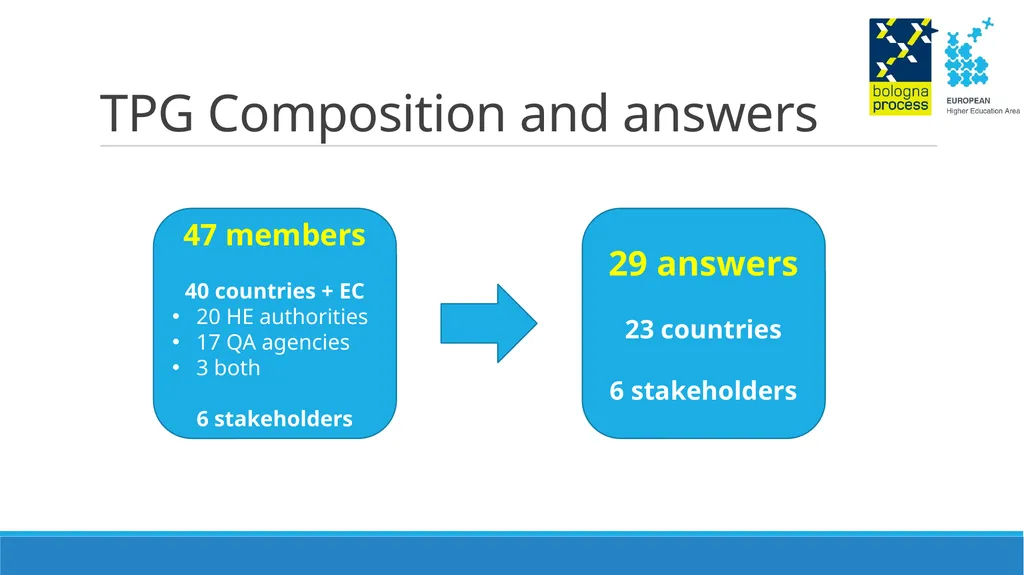
TPG Composition and answers 47 members
40 countries + EC
20 HE authorities
17 QA agencies
3 both
6 stakeholders 29 answers
23 countries
6 stakeholders<br>
40 countries + EC
20 HE authorities
17 QA agencies
3 both
6 stakeholders 29 answers
23 countries
6 stakeholders<br>
03
Rome Communiqué We acknowledge the progress made in the development of quality assurance systems aligned with the ESG, and we commit to removing the remaining obstacles, including those related to the cross-border operation of EQAR registered agencies and the application of the European Approach for Quality Assurance of Joint Programmes. We commit to ensuring that our external quality assurance arrangements cover transnational higher education in the EHEA with equal standards as for domestic provision. In view of the need for increased flexibility and openness of learning paths, smaller units of learning and greater synergies among higher education institutions, we encourage an enhancement-oriented use of the ESG to support innovation in higher education and its quality assurance.<br>
04
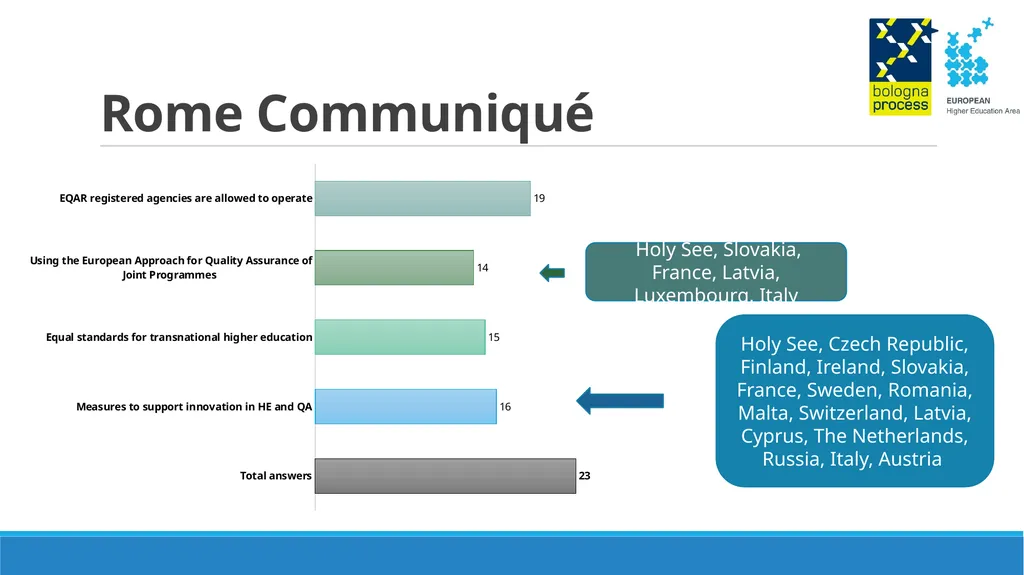
Rome Communiqué Holy See, Slovakia, France, Latvia, Luxembourg, Italy Holy See, Czech Republic, Finland, Ireland, Slovakia, France, Sweden, Romania, Malta, Switzerland, Latvia, Cyprus, The Netherlands, Russia, Italy, Austria<br>
05
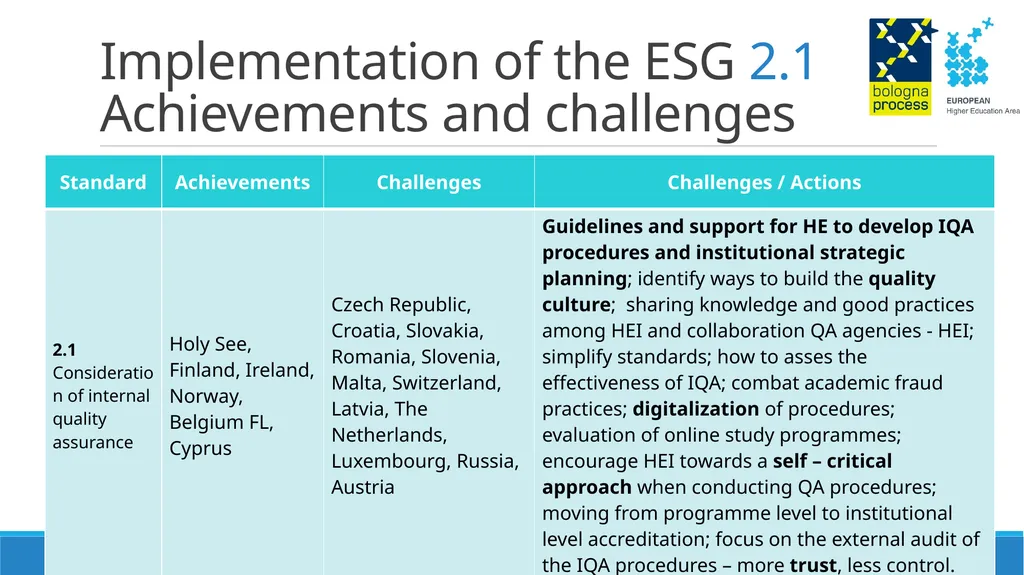
Implementation of the ESG 2.1 Achievements and challenges<br>
06
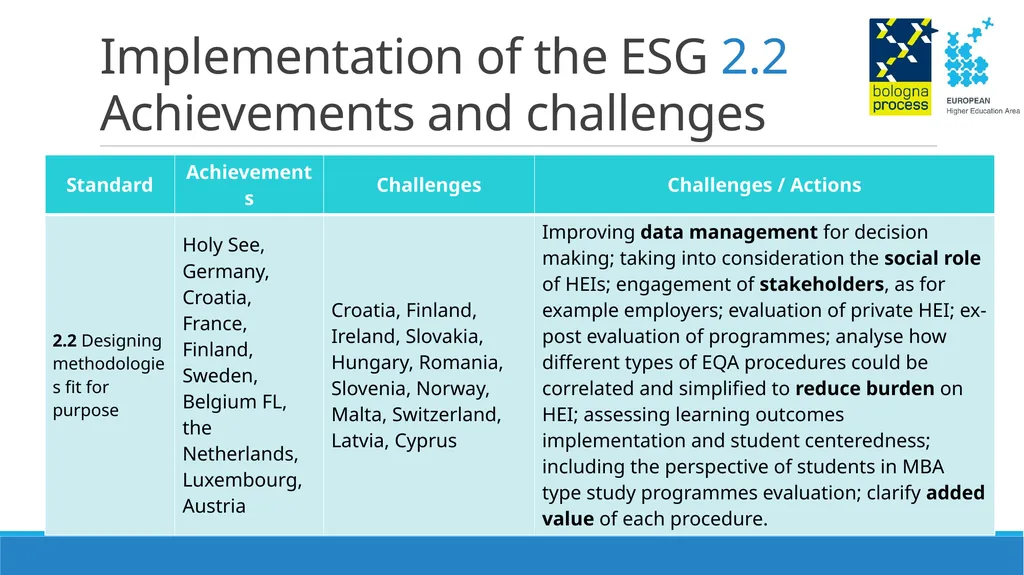
Implementation of the ESG 2.2 Achievements and challenges<br>
07
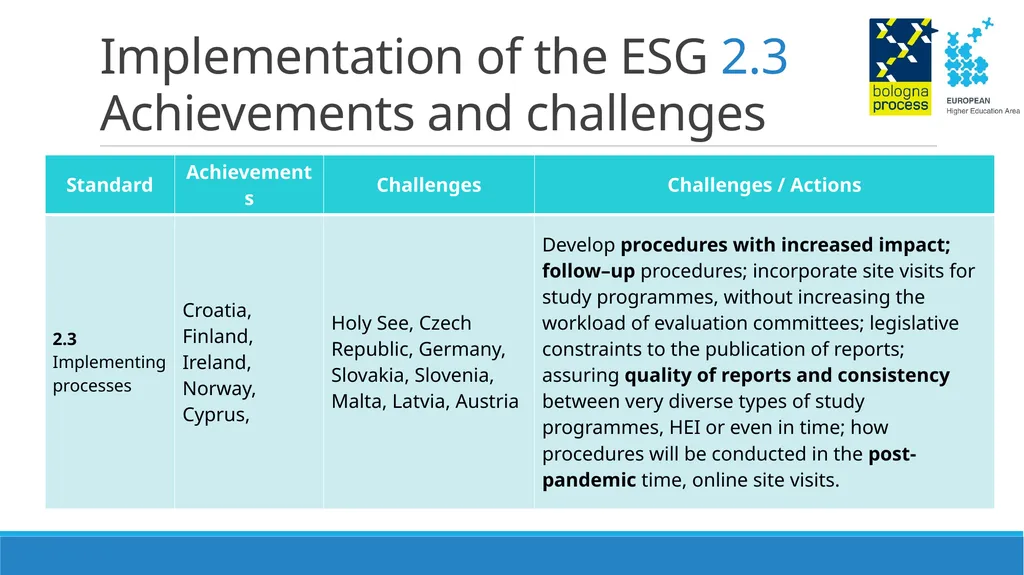
Implementation of the ESG 2.3 Achievements and challenges<br>
08
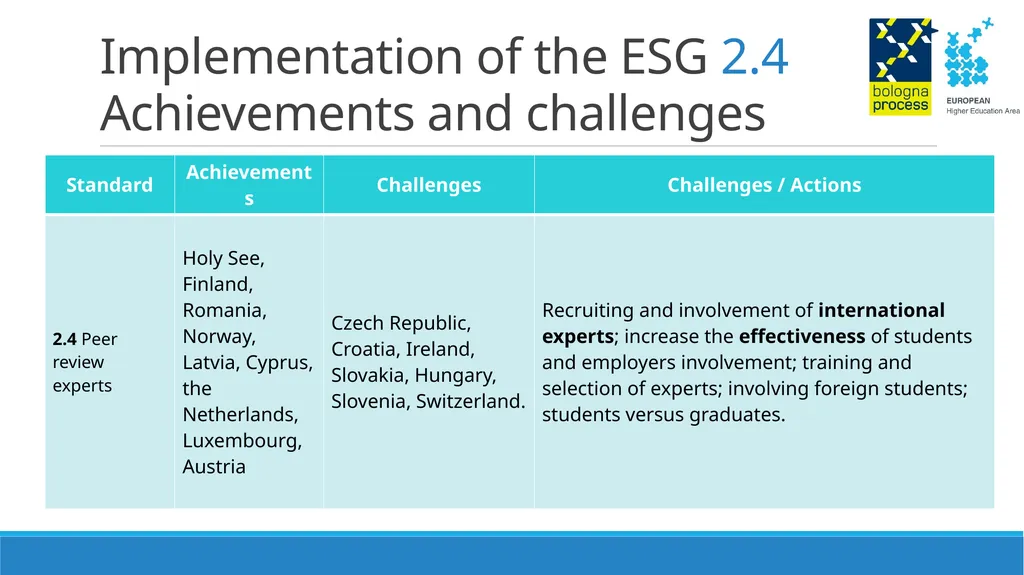
Implementation of the ESG 2.4 Achievements and challenges<br>
09
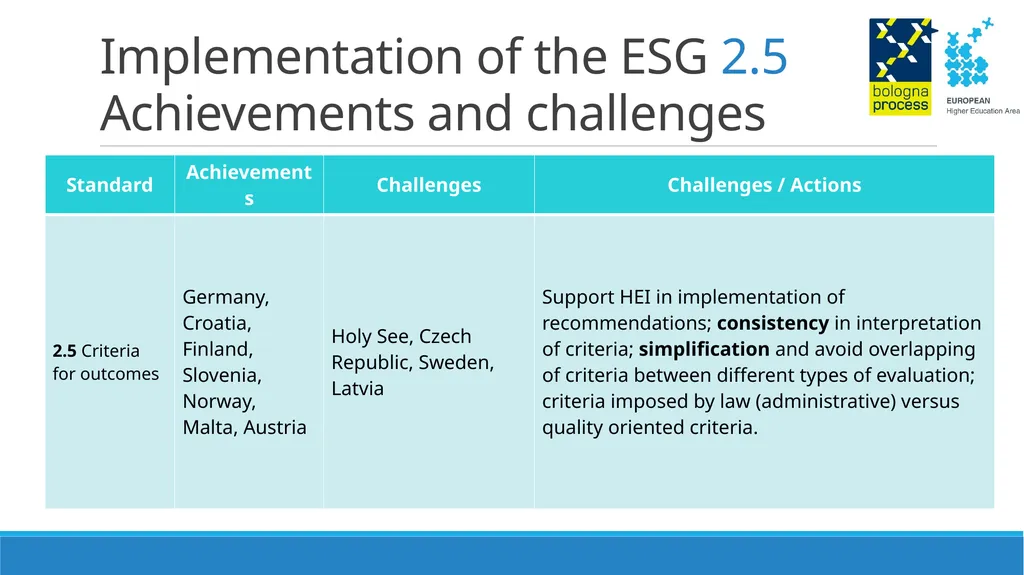
Implementation of the ESG 2.5 Achievements and challenges<br>
10
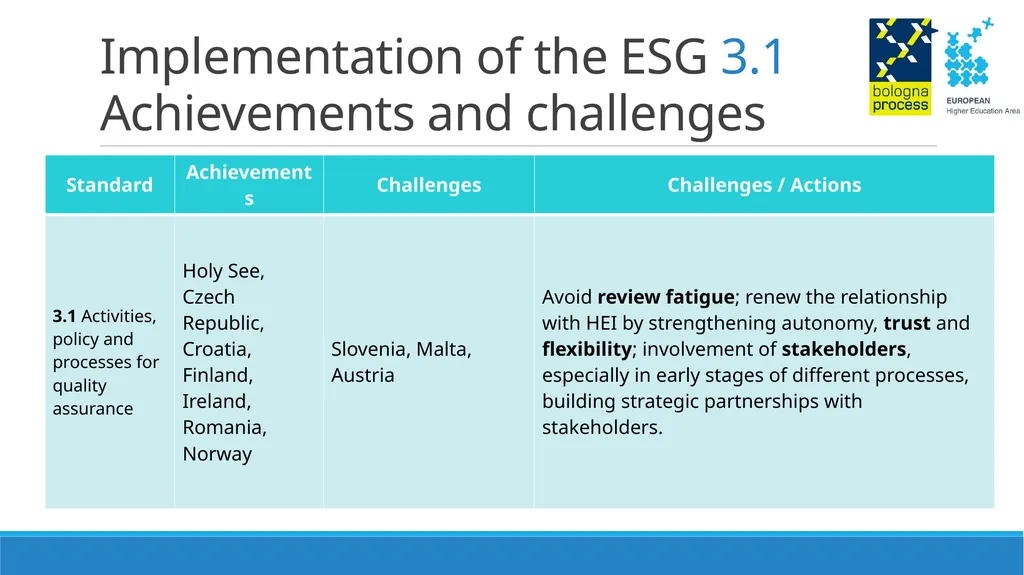
Implementation of the ESG 3.1 Achievements and challenges<br>
11
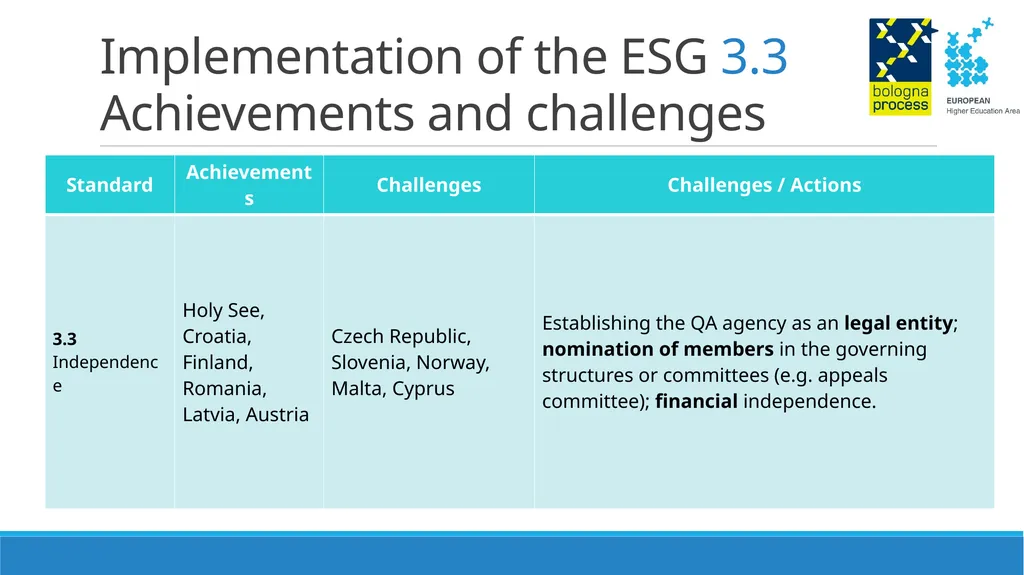
Implementation of the ESG 3.3 Achievements and challenges<br>
12
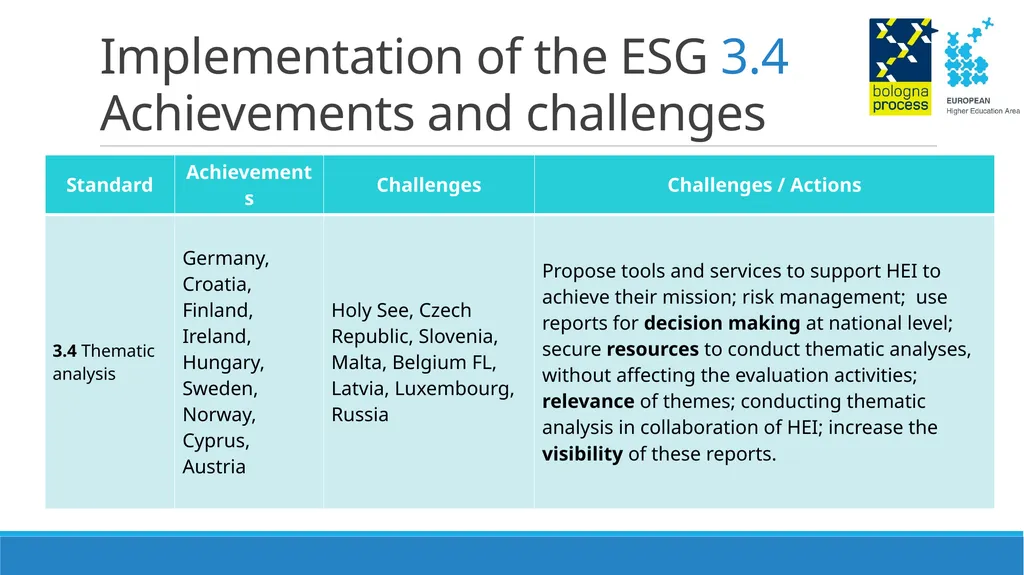
Implementation of the ESG 3.4 Achievements and challenges<br>
13
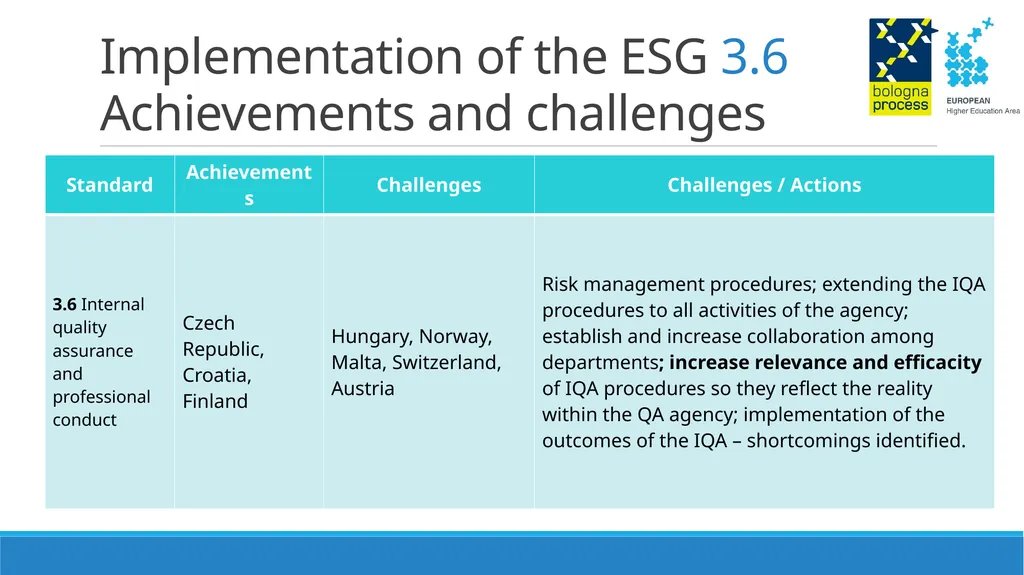
Implementation of the ESG 3.6 Achievements and challenges<br>
14
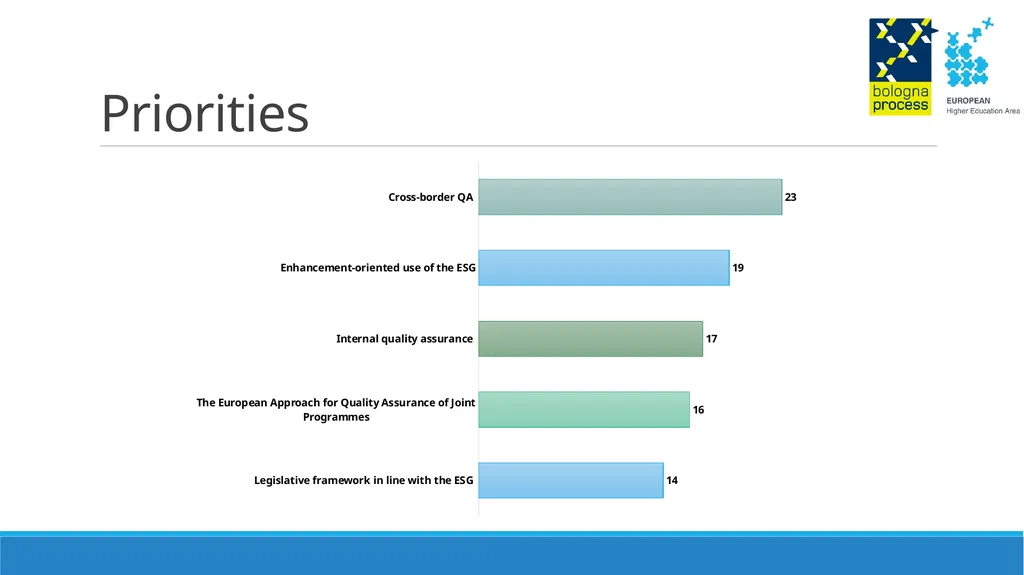
Priorities<br>
15
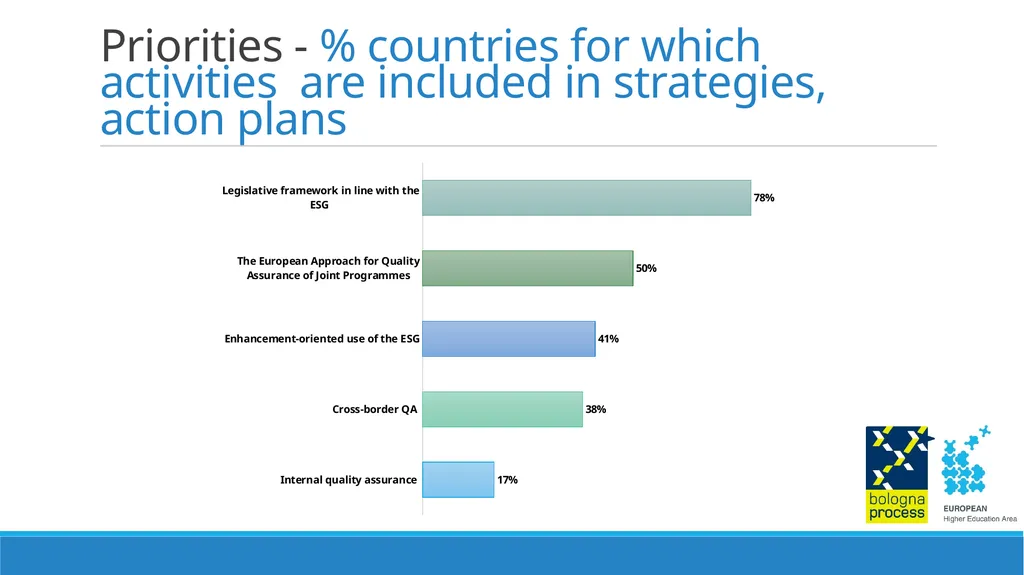
Priorities - % countries for which activities are included in strategies, action plans<br>
16
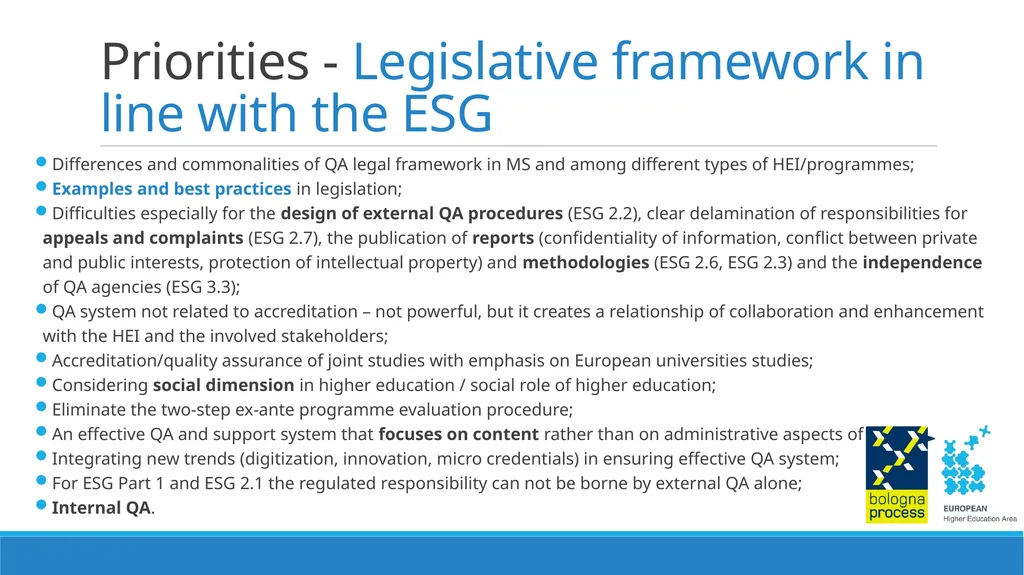
Priorities - Legislative framework in line with the ESG Differences and commonalities of QA legal framework in MS and among different types of HEI/programmes;
Examples and best practices in legislation;
Difficulties especially for the design of external QA procedures (ESG 2.2), clear delamination of responsibilities for appeals and complaints (ESG 2.7), the publication of reports (confidentiality of information, conflict between private and public interests, protection of intellectual property) and methodologies (ESG 2.6, ESG 2.3) and the independence of QA agencies (ESG 3.3);
QA system not related to accreditation – not powerful, but it creates a relationship of collaboration and enhancement with the HEI and the involved stakeholders;
Accreditation/quality assurance of joint studies with emphasis on European universities studies;
Considering social dimension in higher education / social role of higher education;
Eliminate the two-step ex-ante programme evaluation procedure;
An effective QA and support system that focuses on content rather than on administrative aspects of quality;
Integrating new trends (digitization, innovation, micro credentials) in ensuring effective QA system;
For ESG Part 1 and ESG 2.1 the regulated responsibility can not be borne by external QA alone;
Internal QA.<br>
Examples and best practices in legislation;
Difficulties especially for the design of external QA procedures (ESG 2.2), clear delamination of responsibilities for appeals and complaints (ESG 2.7), the publication of reports (confidentiality of information, conflict between private and public interests, protection of intellectual property) and methodologies (ESG 2.6, ESG 2.3) and the independence of QA agencies (ESG 3.3);
QA system not related to accreditation – not powerful, but it creates a relationship of collaboration and enhancement with the HEI and the involved stakeholders;
Accreditation/quality assurance of joint studies with emphasis on European universities studies;
Considering social dimension in higher education / social role of higher education;
Eliminate the two-step ex-ante programme evaluation procedure;
An effective QA and support system that focuses on content rather than on administrative aspects of quality;
Integrating new trends (digitization, innovation, micro credentials) in ensuring effective QA system;
For ESG Part 1 and ESG 2.1 the regulated responsibility can not be borne by external QA alone;
Internal QA.<br>
17
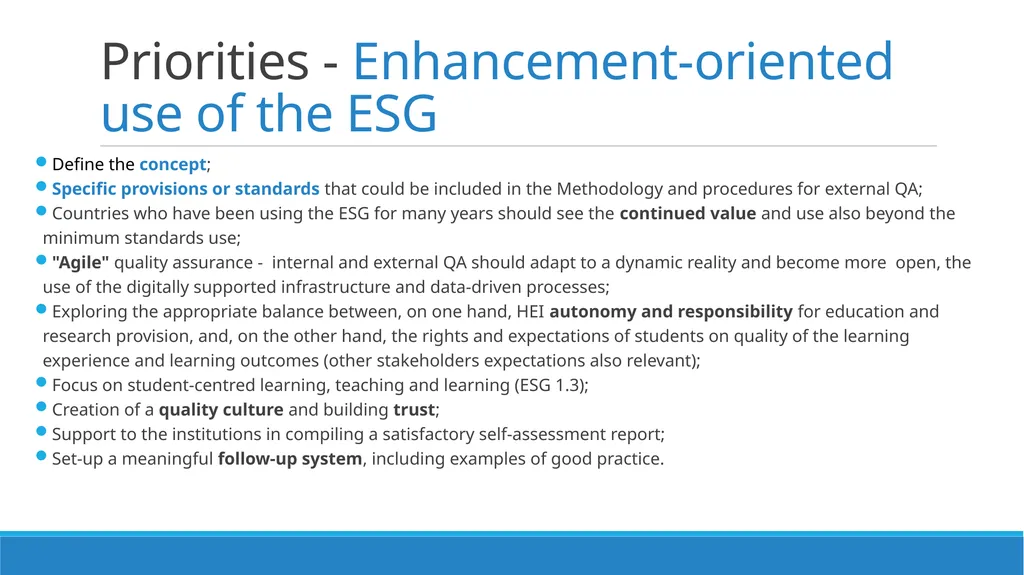
Priorities - Enhancement-oriented use of the ESG Define the concept;
Specific provisions or standards that could be included in the Methodology and procedures for external QA;
Countries who have been using the ESG for many years should see the continued value and use also beyond the minimum standards use;
"Agile" quality assurance - internal and external QA should adapt to a dynamic reality and become more open, the use of the digitally supported infrastructure and data-driven processes;
Exploring the appropriate balance between, on one hand, HEI autonomy and responsibility for education and research provision, and, on the other hand, the rights and expectations of students on quality of the learning experience and learning outcomes (other stakeholders expectations also relevant);
Focus on student-centred learning, teaching and learning (ESG 1.3);
Creation of a quality culture and building trust;
Support to the institutions in compiling a satisfactory self-assessment report;
Set-up a meaningful follow-up system, including examples of good practice.<br>
Specific provisions or standards that could be included in the Methodology and procedures for external QA;
Countries who have been using the ESG for many years should see the continued value and use also beyond the minimum standards use;
"Agile" quality assurance - internal and external QA should adapt to a dynamic reality and become more open, the use of the digitally supported infrastructure and data-driven processes;
Exploring the appropriate balance between, on one hand, HEI autonomy and responsibility for education and research provision, and, on the other hand, the rights and expectations of students on quality of the learning experience and learning outcomes (other stakeholders expectations also relevant);
Focus on student-centred learning, teaching and learning (ESG 1.3);
Creation of a quality culture and building trust;
Support to the institutions in compiling a satisfactory self-assessment report;
Set-up a meaningful follow-up system, including examples of good practice.<br>
18
Priorities - Enhancement-oriented use of the ESG Adjustments in a new version of the ESG;
Possible rethinking of the role of QA agencies, and of the modalities of the dialogue between all parties involved in QA;
The enhancement use of ESG in correlation with the registration process in EQAR, that shall be designed in order to fit for the purpose;
To be used for the QA of European Universities / micro-credentials;
To consider the third mission activities;
Support academic integrity.<br>
Possible rethinking of the role of QA agencies, and of the modalities of the dialogue between all parties involved in QA;
The enhancement use of ESG in correlation with the registration process in EQAR, that shall be designed in order to fit for the purpose;
To be used for the QA of European Universities / micro-credentials;
To consider the third mission activities;
Support academic integrity.<br>
19
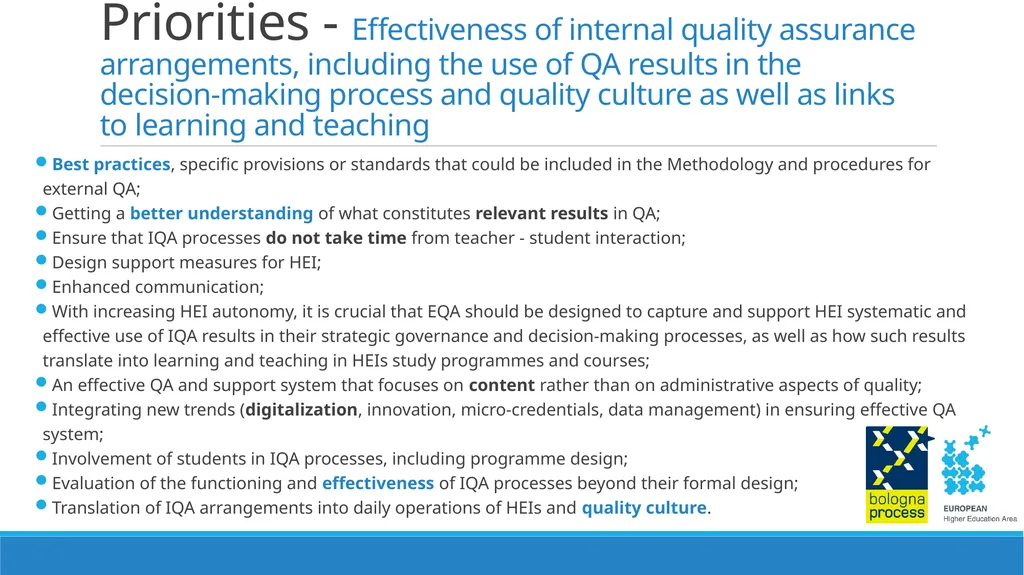
Priorities - Effectiveness of internal quality assurance arrangements, including the use of QA results in the decision-making process and quality culture as well as links to learning and teaching Best practices, specific provisions or standards that could be included in the Methodology and procedures for external QA;
Getting a better understanding of what constitutes relevant results in QA;
Ensure that IQA processes do not take time from teacher - student interaction;
Design support measures for HEI;
Enhanced communication;
With increasing HEI autonomy, it is crucial that EQA should be designed to capture and support HEI systematic and effective use of IQA results in their strategic governance and decision-making processes, as well as how such results translate into learning and teaching in HEIs study programmes and courses;
An effective QA and support system that focuses on content rather than on administrative aspects of quality;
Integrating new trends (digitalization, innovation, micro-credentials, data management) in ensuring effective QA system;
Involvement of students in IQA processes, including programme design;
Evaluation of the functioning and effectiveness of IQA processes beyond their formal design;
Translation of IQA arrangements into daily operations of HEIs and quality culture.<br>
Getting a better understanding of what constitutes relevant results in QA;
Ensure that IQA processes do not take time from teacher - student interaction;
Design support measures for HEI;
Enhanced communication;
With increasing HEI autonomy, it is crucial that EQA should be designed to capture and support HEI systematic and effective use of IQA results in their strategic governance and decision-making processes, as well as how such results translate into learning and teaching in HEIs study programmes and courses;
An effective QA and support system that focuses on content rather than on administrative aspects of quality;
Integrating new trends (digitalization, innovation, micro-credentials, data management) in ensuring effective QA system;
Involvement of students in IQA processes, including programme design;
Evaluation of the functioning and effectiveness of IQA processes beyond their formal design;
Translation of IQA arrangements into daily operations of HEIs and quality culture.<br>
20
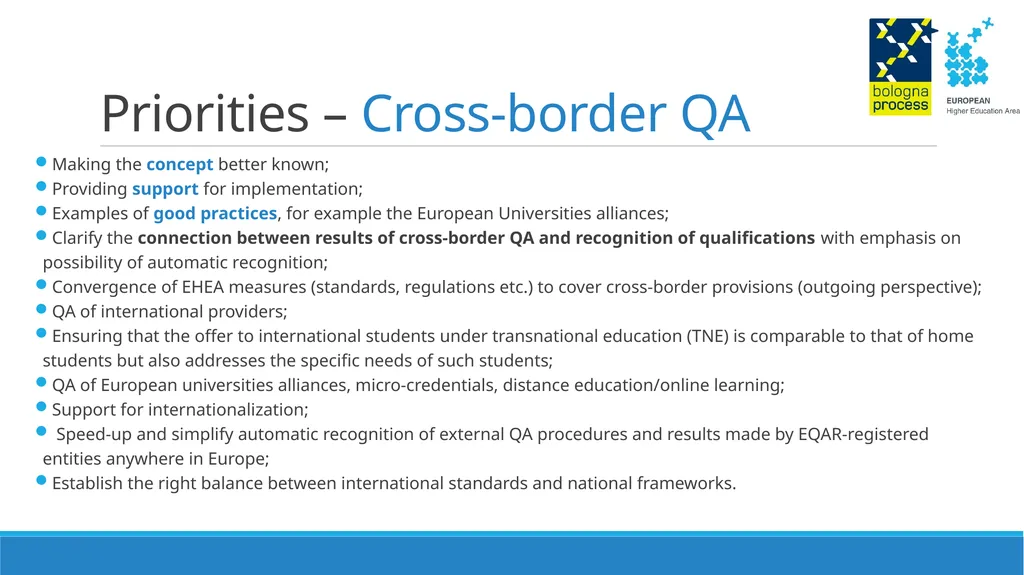
Priorities – Cross-border QA Making the concept better known;
Providing support for implementation;
Examples of good practices, for example the European Universities alliances;
Clarify the connection between results of cross-border QA and recognition of qualifications with emphasis on possibility of automatic recognition;
Convergence of EHEA measures (standards, regulations etc.) to cover cross-border provisions (outgoing perspective);
QA of international providers;
Ensuring that the offer to international students under transnational education (TNE) is comparable to that of home students but also addresses the specific needs of such students;
QA of European universities alliances, micro-credentials, distance education/online learning;
Support for internationalization;
Speed-up and simplify automatic recognition of external QA procedures and results made by EQAR-registered entities anywhere in Europe;
Establish the right balance between international standards and national frameworks.<br>
Providing support for implementation;
Examples of good practices, for example the European Universities alliances;
Clarify the connection between results of cross-border QA and recognition of qualifications with emphasis on possibility of automatic recognition;
Convergence of EHEA measures (standards, regulations etc.) to cover cross-border provisions (outgoing perspective);
QA of international providers;
Ensuring that the offer to international students under transnational education (TNE) is comparable to that of home students but also addresses the specific needs of such students;
QA of European universities alliances, micro-credentials, distance education/online learning;
Support for internationalization;
Speed-up and simplify automatic recognition of external QA procedures and results made by EQAR-registered entities anywhere in Europe;
Establish the right balance between international standards and national frameworks.<br>
21
Priorities – The European Approach for Quality Assurance of Joint Programmes Making the concept better known;
Providing support for implementation;
Examples of good practices, for example the European Universities alliances;
The exclusive use of the European Approach guidelines during an EQA procedure without any added criteria regarding national regulations and issues related to calendar mismatch with national priorities;
Support for internationalization;
Extend the analysis to the possibility to establish joint programmes taking into consideration the national context.<br>
Providing support for implementation;
Examples of good practices, for example the European Universities alliances;
The exclusive use of the European Approach guidelines during an EQA procedure without any added criteria regarding national regulations and issues related to calendar mismatch with national priorities;
Support for internationalization;
Extend the analysis to the possibility to establish joint programmes taking into consideration the national context.<br>
22
Priorities – Other topics Thematic analyses;
Adaptation of QA tools to micro-credentials, European Universities Alliances, LLL;
QA of research/PhD programmes;
Use of experts reports: reports addressed exclusively to the assessed HEI with potential and impact is maximized, whereas a shorter "user friendly" version shall be published, still guaranteeing transparency on the outcomes and recommendations for quality enhancement;
Emphasizing the importance of developing/improving the social role of HEIs and the social role of QA agencies;
The connection between good working conditions for academic staff, including more permanent positions, and creating a quality culture;
The importance of a strong link between teaching and research for quality education.<br>
Adaptation of QA tools to micro-credentials, European Universities Alliances, LLL;
QA of research/PhD programmes;
Use of experts reports: reports addressed exclusively to the assessed HEI with potential and impact is maximized, whereas a shorter "user friendly" version shall be published, still guaranteeing transparency on the outcomes and recommendations for quality enhancement;
Emphasizing the importance of developing/improving the social role of HEIs and the social role of QA agencies;
The connection between good working conditions for academic staff, including more permanent positions, and creating a quality culture;
The importance of a strong link between teaching and research for quality education.<br>
23
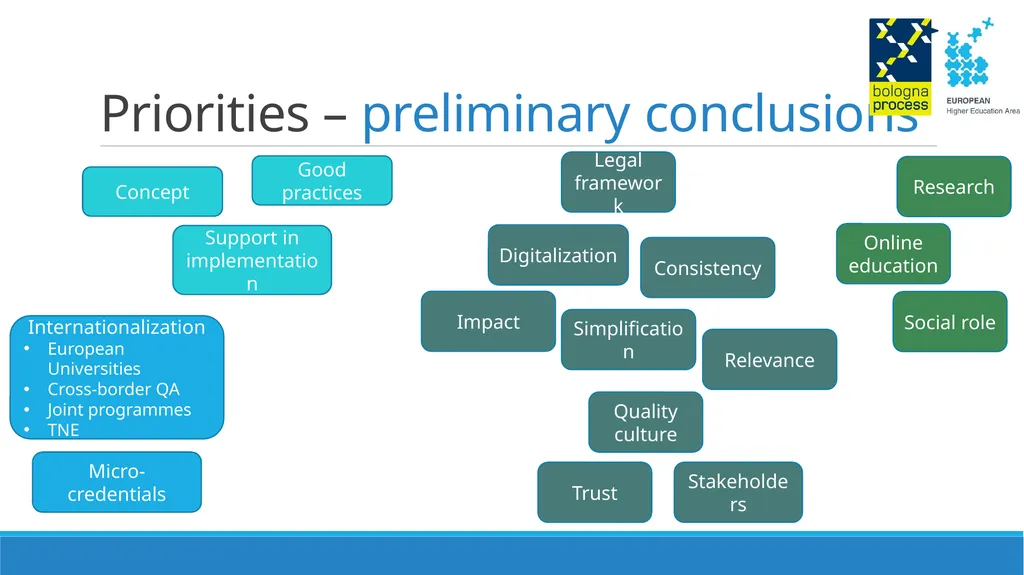
Priorities – preliminary conclusions Concept Support in implementation Good practices Social role Quality culture Digitalization Micro-credentials Internationalization
European Universities
Cross-border QA
Joint programmes
TNE Research Legal framework Simplification Relevance Impact Online education Trust Stakeholders Consistency<br>
European Universities
Cross-border QA
Joint programmes
TNE Research Legal framework Simplification Relevance Impact Online education Trust Stakeholders Consistency<br>
24
Priorities – Planned projects Support the work of TPG C - organization of approx. 2 international meetings/year; PLA; staff mobilities; activities on subgroups, who will target activities and tools related to specific topics, e.g. European Universities and micro-credentials (Flanders (co chair), Romania (co chair) , EQAR, ENQA (TBC))
Use of the ESG and the future of quality assurance in Europe ( E4+)
Project for countries where the ESG have not yet been implemented for external QA (ENQA+ QA agencies, governments)
Bologna With Stakeholder Eyes - continuation. Gathering student perspectives on the developments on Bologna process (also on the QA as a sub activities and sub chapter) (ESU+)
Work based learning, recognition of prior learning and micro-credentials, short cycle (EURASHE)<br>
Use of the ESG and the future of quality assurance in Europe ( E4+)
Project for countries where the ESG have not yet been implemented for external QA (ENQA+ QA agencies, governments)
Bologna With Stakeholder Eyes - continuation. Gathering student perspectives on the developments on Bologna process (also on the QA as a sub activities and sub chapter) (ESU+)
Work based learning, recognition of prior learning and micro-credentials, short cycle (EURASHE)<br>
25
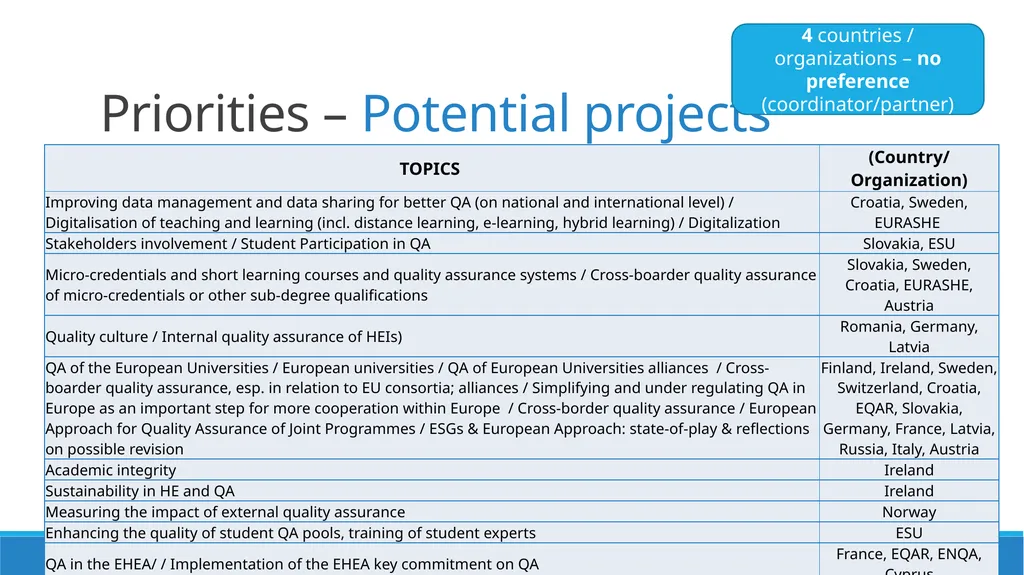
Priorities – Potential projects 4 countries / organizations – no preference (coordinator/partner)<br>