
These Slides are Provided for Educational Purposes
CP
Published · 27 slides · 0 views

1 / 1

Description
These Slides are Provided for Educational Purposes as of February 2026. Note: These slides are made available to any appropriately requesting individual, regardless of the manner in which they cover, recommend, or participate in the
Related Topics
Share
Embed code
Download this presentation From Below
"These Slides are Provided for Educational Purposes" is the property of its rightful owner. Permission is granted to download and print the materials on this website for personal, non-commercial use only, and to display it on your personal computer provided you do not modify the materials and that you retain all copyright notices contained in the materials. By downloading content from our website, you accept the terms of this agreement.
Presentation Transcript
01
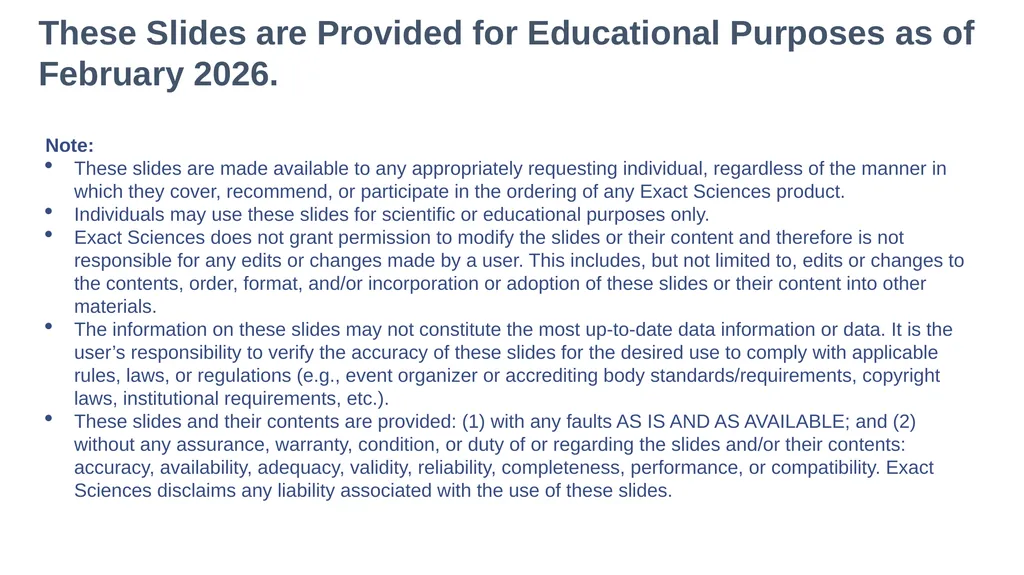
These Slides are Provided for Educational Purposes as of February 2026. Note:
These slides are made available to any appropriately requesting individual, regardless of the manner in which they cover, recommend, or participate in the ordering of any Exact Sciences product.
Individuals may use these slides for scientific or educational purposes only.
Exact Sciences does not grant permission to modify the slides or their content and therefore is not responsible for any edits or changes made by a user. This includes, but not limited to, edits or changes to the contents, order, format, and/or incorporation or adoption of these slides or their content into other materials.
The information on these slides may not constitute the most up-to-date data information or data. It is the user’s responsibility to verify the accuracy of these slides for the desired use to comply with applicable rules, laws, or regulations (e.g., event organizer or accrediting body standards/requirements, copyright laws, institutional requirements, etc.).
These slides and their contents are provided: (1) with any faults AS IS AND AS AVAILABLE; and (2) without any assurance, warranty, condition, or duty of or regarding the slides and/or their contents: accuracy, availability, adequacy, validity, reliability, completeness, performance, or compatibility. Exact Sciences disclaims any liability associated with the use of these slides.<br>
These slides are made available to any appropriately requesting individual, regardless of the manner in which they cover, recommend, or participate in the ordering of any Exact Sciences product.
Individuals may use these slides for scientific or educational purposes only.
Exact Sciences does not grant permission to modify the slides or their content and therefore is not responsible for any edits or changes made by a user. This includes, but not limited to, edits or changes to the contents, order, format, and/or incorporation or adoption of these slides or their content into other materials.
The information on these slides may not constitute the most up-to-date data information or data. It is the user’s responsibility to verify the accuracy of these slides for the desired use to comply with applicable rules, laws, or regulations (e.g., event organizer or accrediting body standards/requirements, copyright laws, institutional requirements, etc.).
These slides and their contents are provided: (1) with any faults AS IS AND AS AVAILABLE; and (2) without any assurance, warranty, condition, or duty of or regarding the slides and/or their contents: accuracy, availability, adequacy, validity, reliability, completeness, performance, or compatibility. Exact Sciences disclaims any liability associated with the use of these slides.<br>
02
February 2026 / MED-CG2400071 (v5.0) Cologuard Plus® Test Performance
BLUE-C Study Cologuard Plus is a registered trademark of Exact Sciences Corporation. All other trademarks are properties of their respective owners.
© 2026 Exact Sciences Corporation. All rights reserved.<br>
© 2026 Exact Sciences Corporation. All rights reserved.<br>
03
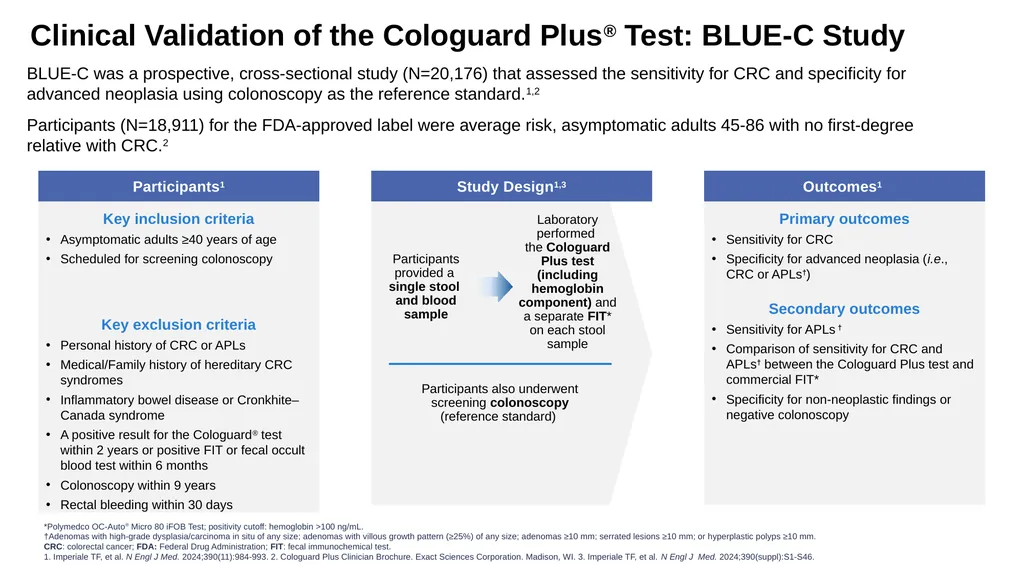
BLUE-C was a prospective, cross-sectional study (N=20,176) that assessed the sensitivity for CRC and specificity for advanced neoplasia using colonoscopy as the reference standard.1,2
Participants (N=18,911) for the FDA-approved label were average risk, asymptomatic adults 45-86 with no first-degree relative with CRC.2 Clinical Validation of the Cologuard Plus® Test: BLUE-C Study Participants also underwent screening colonoscopy (reference standard) Key inclusion criteria
Asymptomatic adults ≥40 years of age
Scheduled for screening colonoscopy
Key exclusion criteria
Personal history of CRC or APLs
Medical/Family history of hereditary CRC syndromes
Inflammatory bowel disease or Cronkhite–Canada syndrome
A positive result for the Cologuard® test within 2 years or positive FIT or fecal occult blood test within 6 months
Colonoscopy within 9 years
Rectal bleeding within 30 days Participants1 Primary outcomes
Sensitivity for CRC
Specificity for advanced neoplasia (i.e., CRC or APLs†)
Secondary outcomes
Sensitivity for APLs †
Comparison of sensitivity for CRC and APLs† between the Cologuard Plus test and commercial FIT*
Specificity for non-neoplastic findings or negative colonoscopy Outcomes1 Study Design1,3 *Polymedco OC-Auto® Micro 80 iFOB Test; positivity cutoff: hemoglobin >100 ng/mL.
†Adenomas with high-grade dysplasia/carcinoma in situ of any size; adenomas with villous growth pattern (≥25%) of any size; adenomas ≥10 mm; serrated lesions ≥10 mm; or hyperplastic polyps ≥10 mm.
CRC: colorectal cancer; FDA: Federal Drug Administration; FIT: fecal immunochemical test.
1. Imperiale TF, et al. N Engl J Med. 2024;390(11):984-993. 2. Cologuard Plus Clinician Brochure. Exact Sciences Corporation. Madison, WI. 3. Imperiale TF, et al. N Engl J Med. 2024;390(suppl):S1-S46.<br>
Participants (N=18,911) for the FDA-approved label were average risk, asymptomatic adults 45-86 with no first-degree relative with CRC.2 Clinical Validation of the Cologuard Plus® Test: BLUE-C Study Participants also underwent screening colonoscopy (reference standard) Key inclusion criteria
Asymptomatic adults ≥40 years of age
Scheduled for screening colonoscopy
Key exclusion criteria
Personal history of CRC or APLs
Medical/Family history of hereditary CRC syndromes
Inflammatory bowel disease or Cronkhite–Canada syndrome
A positive result for the Cologuard® test within 2 years or positive FIT or fecal occult blood test within 6 months
Colonoscopy within 9 years
Rectal bleeding within 30 days Participants1 Primary outcomes
Sensitivity for CRC
Specificity for advanced neoplasia (i.e., CRC or APLs†)
Secondary outcomes
Sensitivity for APLs †
Comparison of sensitivity for CRC and APLs† between the Cologuard Plus test and commercial FIT*
Specificity for non-neoplastic findings or negative colonoscopy Outcomes1 Study Design1,3 *Polymedco OC-Auto® Micro 80 iFOB Test; positivity cutoff: hemoglobin >100 ng/mL.
†Adenomas with high-grade dysplasia/carcinoma in situ of any size; adenomas with villous growth pattern (≥25%) of any size; adenomas ≥10 mm; serrated lesions ≥10 mm; or hyperplastic polyps ≥10 mm.
CRC: colorectal cancer; FDA: Federal Drug Administration; FIT: fecal immunochemical test.
1. Imperiale TF, et al. N Engl J Med. 2024;390(11):984-993. 2. Cologuard Plus Clinician Brochure. Exact Sciences Corporation. Madison, WI. 3. Imperiale TF, et al. N Engl J Med. 2024;390(suppl):S1-S46.<br>
04
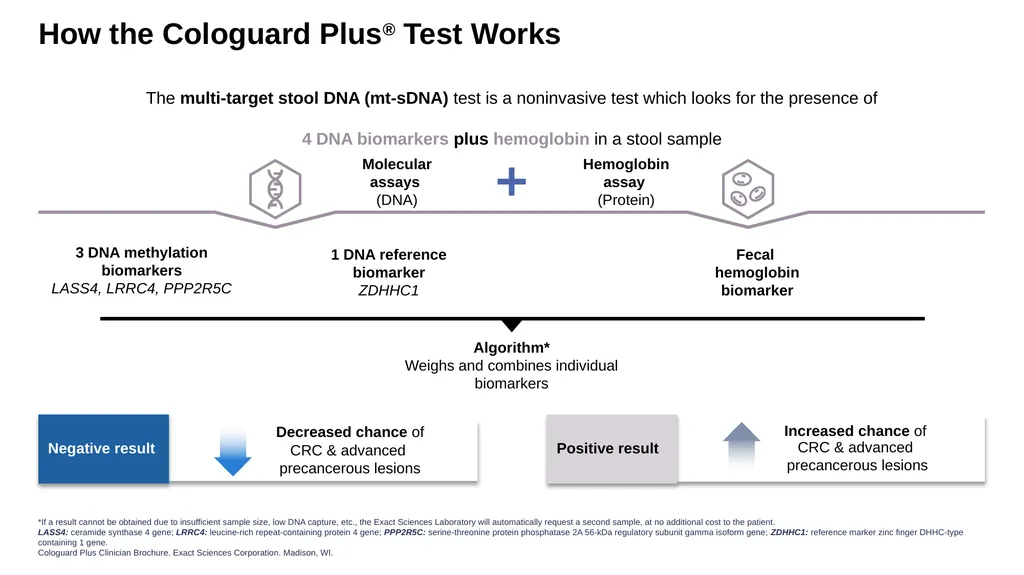
How the Cologuard Plus® Test Works The multi-target stool DNA (mt-sDNA) test is a noninvasive test which looks for the presence of
4 DNA biomarkers plus hemoglobin in a stool sample Algorithm*
Weighs and combines individual biomarkers Hemoglobin assay
(Protein) Molecular assays
(DNA) 3 DNA methylation biomarkers
LASS4, LRRC4, PPP2R5C 1 DNA reference biomarker ZDHHC1 Fecal hemoglobin biomarker *If a result cannot be obtained due to insufficient sample size, low DNA capture, etc., the Exact Sciences Laboratory will automatically request a second sample, at no additional cost to the patient.
LASS4: ceramide synthase 4 gene; LRRC4: leucine-rich repeat-containing protein 4 gene; PPP2R5C: serine-threonine protein phosphatase 2A 56-kDa regulatory subunit gamma isoform gene; ZDHHC1: reference marker zinc finger DHHC-type containing 1 gene.
Cologuard Plus Clinician Brochure. Exact Sciences Corporation. Madison, WI. Increased chance of CRC & advanced
precancerous lesions Positive result Decreased chance of
CRC & advanced
precancerous lesions Negative result<br>
LASS4, LRRC4, PPP2R5C 1 DNA reference biomarker ZDHHC1 Fecal hemoglobin biomarker *If a result cannot be obtained due to insufficient sample size, low DNA capture, etc., the Exact Sciences Laboratory will automatically request a second sample, at no additional cost to the patient.
LASS4: ceramide synthase 4 gene; LRRC4: leucine-rich repeat-containing protein 4 gene; PPP2R5C: serine-threonine protein phosphatase 2A 56-kDa regulatory subunit gamma isoform gene; ZDHHC1: reference marker zinc finger DHHC-type containing 1 gene.
Cologuard Plus Clinician Brochure. Exact Sciences Corporation. Madison, WI. Increased chance of CRC & advanced
precancerous lesions Positive result Decreased chance of
CRC & advanced
precancerous lesions Negative result<br>
05
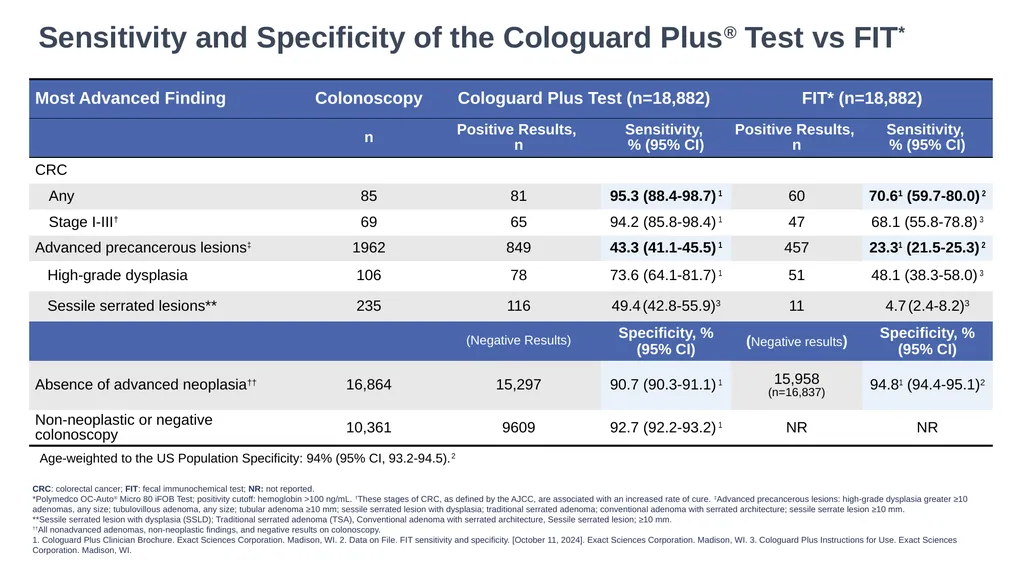
Sensitivity and Specificity of the Cologuard Plus® Test vs FIT* Age-weighted to the US Population Specificity: 94% (95% CI, 93.2-94.5).2 CRC: colorectal cancer; FIT: fecal immunochemical test; NR: not reported.
*Polymedco OC-Auto® Micro 80 iFOB Test; positivity cutoff: hemoglobin >100 ng/mL. †These stages of CRC, as defined by the AJCC, are associated with an increased rate of cure. ‡Advanced precancerous lesions: high-grade dysplasia greater ≥10 adenomas, any size; tubulovillous adenoma, any size; tubular adenoma ≥10 mm; sessile serrated lesion with dysplasia; traditional serrated adenoma; conventional adenoma with serrated architecture; sessile serrate lesion ≥10 mm.
**Sessile serrated lesion with dysplasia (SSLD); Traditional serrated adenoma (TSA), Conventional adenoma with serrated architecture, Sessile serrated lesion; ≥10 mm.
††All nonadvanced adenomas, non-neoplastic findings, and negative results on colonoscopy.
1. Cologuard Plus Clinician Brochure. Exact Sciences Corporation. Madison, WI. 2. Data on File. FIT sensitivity and specificity. [October 11, 2024]. Exact Sciences Corporation. Madison, WI. 3. Cologuard Plus Instructions for Use. Exact Sciences Corporation. Madison, WI.<br>
*Polymedco OC-Auto® Micro 80 iFOB Test; positivity cutoff: hemoglobin >100 ng/mL. †These stages of CRC, as defined by the AJCC, are associated with an increased rate of cure. ‡Advanced precancerous lesions: high-grade dysplasia greater ≥10 adenomas, any size; tubulovillous adenoma, any size; tubular adenoma ≥10 mm; sessile serrated lesion with dysplasia; traditional serrated adenoma; conventional adenoma with serrated architecture; sessile serrate lesion ≥10 mm.
**Sessile serrated lesion with dysplasia (SSLD); Traditional serrated adenoma (TSA), Conventional adenoma with serrated architecture, Sessile serrated lesion; ≥10 mm.
††All nonadvanced adenomas, non-neoplastic findings, and negative results on colonoscopy.
1. Cologuard Plus Clinician Brochure. Exact Sciences Corporation. Madison, WI. 2. Data on File. FIT sensitivity and specificity. [October 11, 2024]. Exact Sciences Corporation. Madison, WI. 3. Cologuard Plus Instructions for Use. Exact Sciences Corporation. Madison, WI.<br>
06
*Polymedco OC-Auto® Micro 80 iFOB Test; positivity cutoff: hemoglobin >100 ng/mL.
APL: advanced precancerous lesion; CRC: colorectal cancer; FIT: fecal immunochemical test; US: United States.
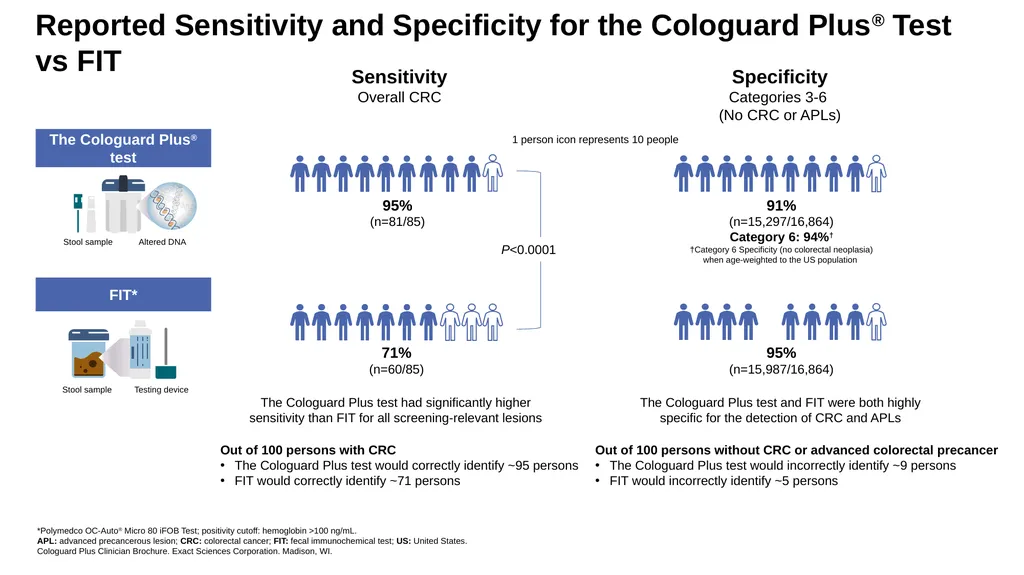
Cologuard Plus Clinician Brochure. Exact Sciences Corporation. Madison, WI. Reported Sensitivity and Specificity for the Cologuard Plus® Test vs FIT Sensitivity
Overall CRC 71%
(n=60/85) 95%
(n=81/85) Specificity
Categories 3-6
(No CRC or APLs) 91%
(n=15,297/16,864)
Category 6: 94%†
†Category 6 Specificity (no colorectal neoplasia) when age-weighted to the US population 95%
(n=15,987/16,864) P<0.0001 The Cologuard Plus test had significantly higher sensitivity than FIT for all screening-relevant lesions The Cologuard Plus test and FIT were both highly specific for the detection of CRC and APLs 1 person icon represents 10 people Out of 100 persons with CRC
The Cologuard Plus test would correctly identify ~95 persons
FIT would correctly identify ~71 persons Out of 100 persons without CRC or advanced colorectal precancer
The Cologuard Plus test would incorrectly identify ~9 persons
FIT would incorrectly identify ~5 persons<br>
APL: advanced precancerous lesion; CRC: colorectal cancer; FIT: fecal immunochemical test; US: United States.
Cologuard Plus Clinician Brochure. Exact Sciences Corporation. Madison, WI. Reported Sensitivity and Specificity for the Cologuard Plus® Test vs FIT Sensitivity
Overall CRC 71%
(n=60/85) 95%
(n=81/85) Specificity
Categories 3-6
(No CRC or APLs) 91%
(n=15,297/16,864)
Category 6: 94%†
†Category 6 Specificity (no colorectal neoplasia) when age-weighted to the US population 95%
(n=15,987/16,864) P<0.0001 The Cologuard Plus test had significantly higher sensitivity than FIT for all screening-relevant lesions The Cologuard Plus test and FIT were both highly specific for the detection of CRC and APLs 1 person icon represents 10 people Out of 100 persons with CRC
The Cologuard Plus test would correctly identify ~95 persons
FIT would correctly identify ~71 persons Out of 100 persons without CRC or advanced colorectal precancer
The Cologuard Plus test would incorrectly identify ~9 persons
FIT would incorrectly identify ~5 persons<br>
07
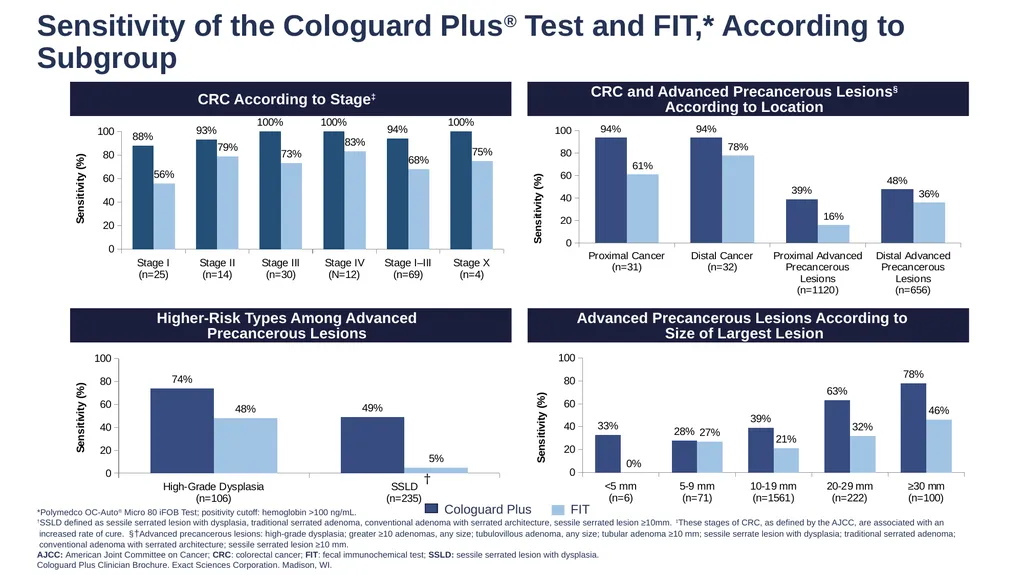
Sensitivity of the Cologuard Plus® Test and FIT,* According to Subgroup *Polymedco OC-Auto® Micro 80 iFOB Test; positivity cutoff: hemoglobin >100 ng/mL.
†SSLD defined as sessile serrated lesion with dysplasia, traditional serrated adenoma, conventional adenoma with serrated architecture, sessile serrated lesion ≥10mm. ‡These stages of CRC, as defined by the AJCC, are associated with an
increased rate of cure. §†Advanced precancerous lesions: high-grade dysplasia; greater ≥10 adenomas, any size; tubulovillous adenoma, any size; tubular adenoma ≥10 mm; sessile serrate lesion with dysplasia; traditional serrated adenoma;
conventional adenoma with serrated architecture; sessile serrated lesion ≥10 mm.
AJCC: American Joint Committee on Cancer; CRC: colorectal cancer; FIT: fecal immunochemical test; SSLD: sessile serrated lesion with dysplasia.
Cologuard Plus Clinician Brochure. Exact Sciences Corporation. Madison, WI. Cologuard Plus FIT<br>
†SSLD defined as sessile serrated lesion with dysplasia, traditional serrated adenoma, conventional adenoma with serrated architecture, sessile serrated lesion ≥10mm. ‡These stages of CRC, as defined by the AJCC, are associated with an
increased rate of cure. §†Advanced precancerous lesions: high-grade dysplasia; greater ≥10 adenomas, any size; tubulovillous adenoma, any size; tubular adenoma ≥10 mm; sessile serrate lesion with dysplasia; traditional serrated adenoma;
conventional adenoma with serrated architecture; sessile serrated lesion ≥10 mm.
AJCC: American Joint Committee on Cancer; CRC: colorectal cancer; FIT: fecal immunochemical test; SSLD: sessile serrated lesion with dysplasia.
Cologuard Plus Clinician Brochure. Exact Sciences Corporation. Madison, WI. Cologuard Plus FIT<br>
08
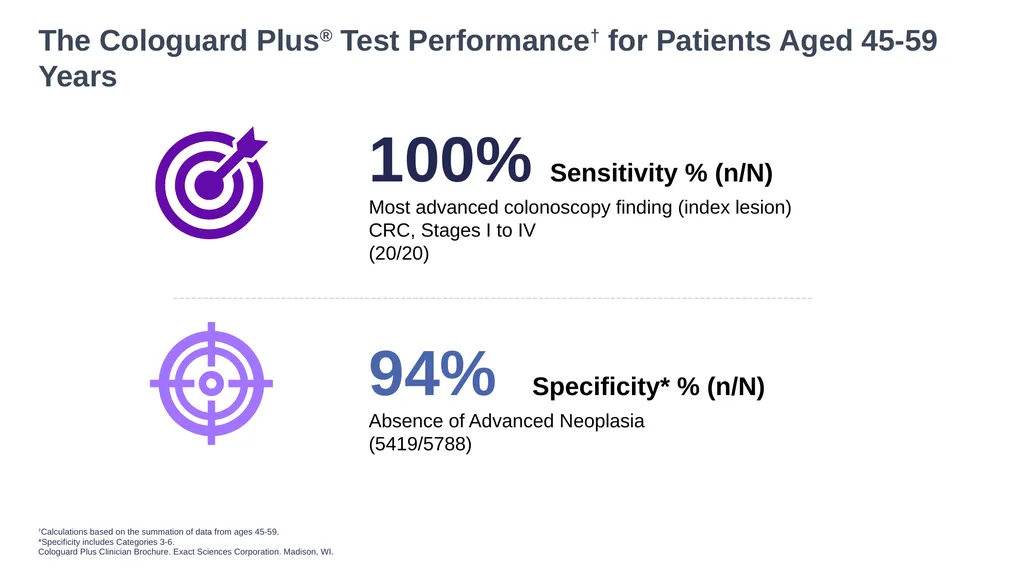
The Cologuard Plus® Test Performance† for Patients Aged 45-59 Years 100% Sensitivity % (n/N)
Most advanced colonoscopy finding (index lesion)
CRC, Stages I to IV
(20/20) 94% Specificity* % (n/N)
Absence of Advanced Neoplasia
(5419/5788) †Calculations based on the summation of data from ages 45-59.
*Specificity includes Categories 3-6.
Cologuard Plus Clinician Brochure. Exact Sciences Corporation. Madison, WI.<br>
Most advanced colonoscopy finding (index lesion)
CRC, Stages I to IV
(20/20) 94% Specificity* % (n/N)
Absence of Advanced Neoplasia
(5419/5788) †Calculations based on the summation of data from ages 45-59.
*Specificity includes Categories 3-6.
Cologuard Plus Clinician Brochure. Exact Sciences Corporation. Madison, WI.<br>
09
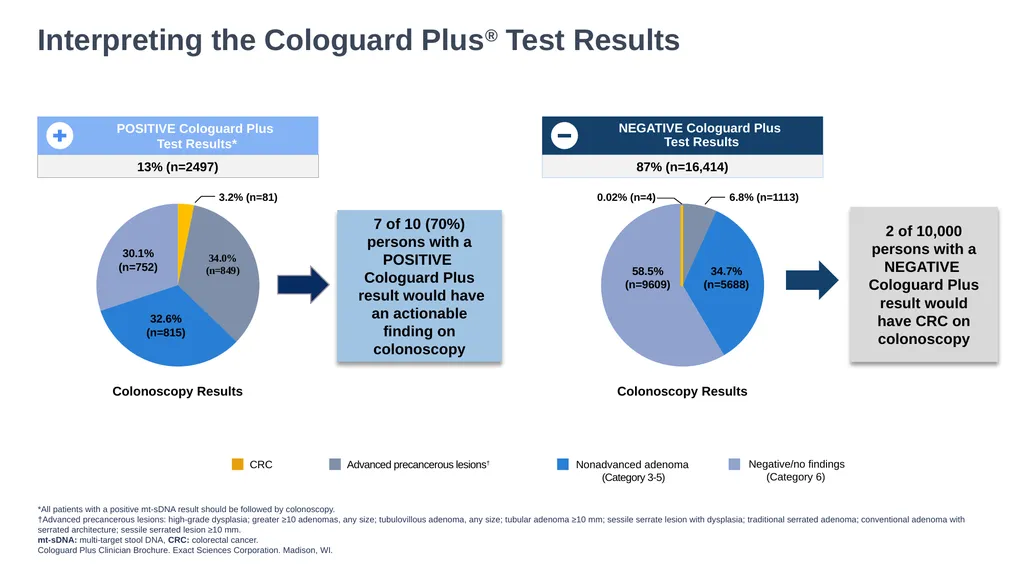
*All patients with a positive mt-sDNA result should be followed by colonoscopy.
†Advanced precancerous lesions: high-grade dysplasia; greater ≥10 adenomas, any size; tubulovillous adenoma, any size; tubular adenoma ≥10 mm; sessile serrate lesion with dysplasia; traditional serrated adenoma; conventional adenoma with serrated architecture; sessile serrated lesion ≥10 mm.
mt-sDNA: multi-target stool DNA, CRC: colorectal cancer.
Cologuard Plus Clinician Brochure. Exact Sciences Corporation. Madison, WI. Interpreting the Cologuard Plus® Test Results 2 of 10,000 persons with a NEGATIVE
Cologuard Plus result would have CRC on colonoscopy 7 of 10 (70%) persons with a POSITIVE
Cologuard Plus
result would have an actionable finding on colonoscopy<br>
†Advanced precancerous lesions: high-grade dysplasia; greater ≥10 adenomas, any size; tubulovillous adenoma, any size; tubular adenoma ≥10 mm; sessile serrate lesion with dysplasia; traditional serrated adenoma; conventional adenoma with serrated architecture; sessile serrated lesion ≥10 mm.
mt-sDNA: multi-target stool DNA, CRC: colorectal cancer.
Cologuard Plus Clinician Brochure. Exact Sciences Corporation. Madison, WI. Interpreting the Cologuard Plus® Test Results 2 of 10,000 persons with a NEGATIVE
Cologuard Plus result would have CRC on colonoscopy 7 of 10 (70%) persons with a POSITIVE
Cologuard Plus
result would have an actionable finding on colonoscopy<br>
10
Validation of the
Next-Generation mt-sDNA Test<br>
11
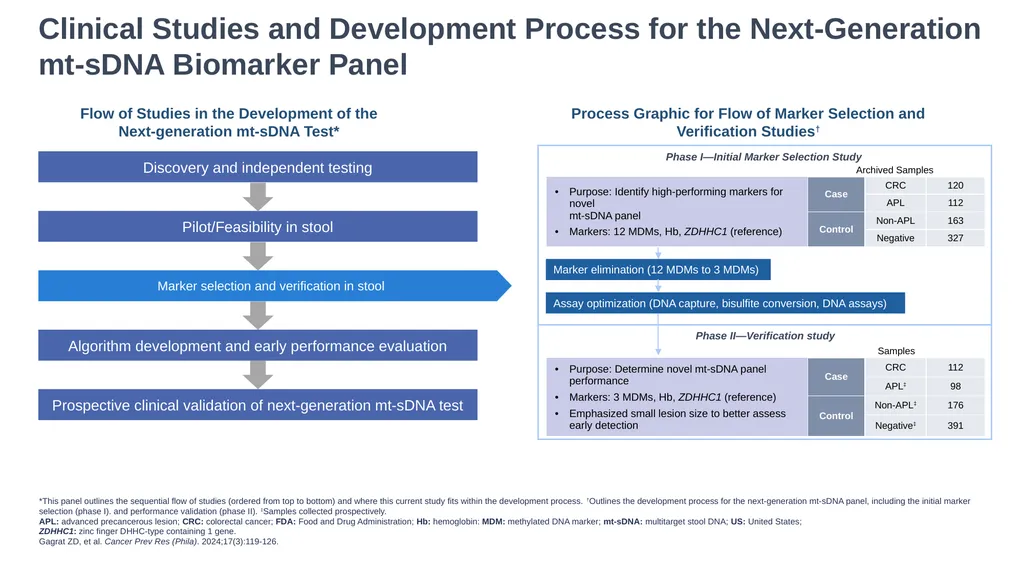
Clinical Studies and Development Process for the Next-Generation mt-sDNA Biomarker Panel *This panel outlines the sequential flow of studies (ordered from top to bottom) and where this current study fits within the development process. †Outlines the development process for the next-generation mt-sDNA panel, including the initial marker selection (phase I). and performance validation (phase II). ‡Samples collected prospectively.
APL: advanced precancerous lesion; CRC: colorectal cancer; FDA: Food and Drug Administration; Hb: hemoglobin: MDM: methylated DNA marker; mt-sDNA: multitarget stool DNA; US: United States; ZDHHC1: zinc finger DHHC-type containing 1 gene.
Gagrat ZD, et al. Cancer Prev Res (Phila). 2024;17(3):119-126. Discovery and independent testing Pilot/Feasibility in stool Algorithm development and early performance evaluation Prospective clinical validation of next-generation mt-sDNA test Flow of Studies in the Development of the Next-generation mt-sDNA Test* Marker selection and verification in stool Process Graphic for Flow of Marker Selection and
Verification Studies† Marker elimination (12 MDMs to 3 MDMs) Assay optimization (DNA capture, bisulfite conversion, DNA assays)<br>
APL: advanced precancerous lesion; CRC: colorectal cancer; FDA: Food and Drug Administration; Hb: hemoglobin: MDM: methylated DNA marker; mt-sDNA: multitarget stool DNA; US: United States; ZDHHC1: zinc finger DHHC-type containing 1 gene.
Gagrat ZD, et al. Cancer Prev Res (Phila). 2024;17(3):119-126. Discovery and independent testing Pilot/Feasibility in stool Algorithm development and early performance evaluation Prospective clinical validation of next-generation mt-sDNA test Flow of Studies in the Development of the Next-generation mt-sDNA Test* Marker selection and verification in stool Process Graphic for Flow of Marker Selection and
Verification Studies† Marker elimination (12 MDMs to 3 MDMs) Assay optimization (DNA capture, bisulfite conversion, DNA assays)<br>
12
Algorithm development Performance evaluation/
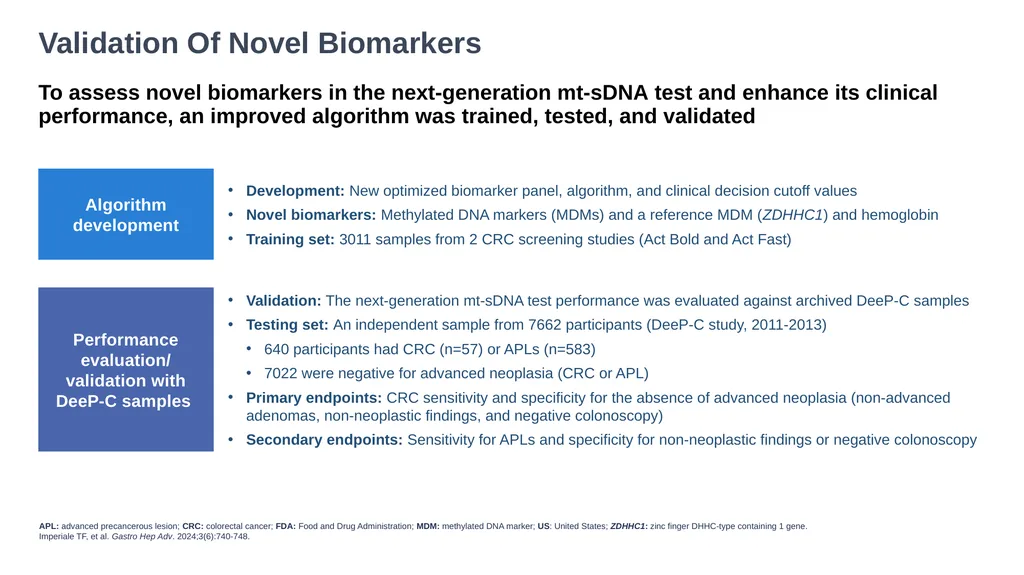
validation with DeeP-C samples Development: New optimized biomarker panel, algorithm, and clinical decision cutoff values
Novel biomarkers: Methylated DNA markers (MDMs) and a reference MDM (ZDHHC1) and hemoglobin
Training set: 3011 samples from 2 CRC screening studies (Act Bold and Act Fast) Validation: The next-generation mt-sDNA test performance was evaluated against archived DeeP-C samples
Testing set: An independent sample from 7662 participants (DeeP-C study, 2011-2013)
640 participants had CRC (n=57) or APLs (n=583)
7022 were negative for advanced neoplasia (CRC or APL)
Primary endpoints: CRC sensitivity and specificity for the absence of advanced neoplasia (non-advanced adenomas, non-neoplastic findings, and negative colonoscopy)
Secondary endpoints: Sensitivity for APLs and specificity for non-neoplastic findings or negative colonoscopy Validation Of Novel Biomarkers To assess novel biomarkers in the next-generation mt-sDNA test and enhance its clinical performance, an improved algorithm was trained, tested, and validated APL: advanced precancerous lesion; CRC: colorectal cancer; FDA: Food and Drug Administration; MDM: methylated DNA marker; US: United States; ZDHHC1: zinc finger DHHC-type containing 1 gene.
Imperiale TF, et al. Gastro Hep Adv. 2024;3(6):740-748.<br>
Novel biomarkers: Methylated DNA markers (MDMs) and a reference MDM (ZDHHC1) and hemoglobin
Training set: 3011 samples from 2 CRC screening studies (Act Bold and Act Fast) Validation: The next-generation mt-sDNA test performance was evaluated against archived DeeP-C samples
Testing set: An independent sample from 7662 participants (DeeP-C study, 2011-2013)
640 participants had CRC (n=57) or APLs (n=583)
7022 were negative for advanced neoplasia (CRC or APL)
Primary endpoints: CRC sensitivity and specificity for the absence of advanced neoplasia (non-advanced adenomas, non-neoplastic findings, and negative colonoscopy)
Secondary endpoints: Sensitivity for APLs and specificity for non-neoplastic findings or negative colonoscopy Validation Of Novel Biomarkers To assess novel biomarkers in the next-generation mt-sDNA test and enhance its clinical performance, an improved algorithm was trained, tested, and validated APL: advanced precancerous lesion; CRC: colorectal cancer; FDA: Food and Drug Administration; MDM: methylated DNA marker; US: United States; ZDHHC1: zinc finger DHHC-type containing 1 gene.
Imperiale TF, et al. Gastro Hep Adv. 2024;3(6):740-748.<br>
13
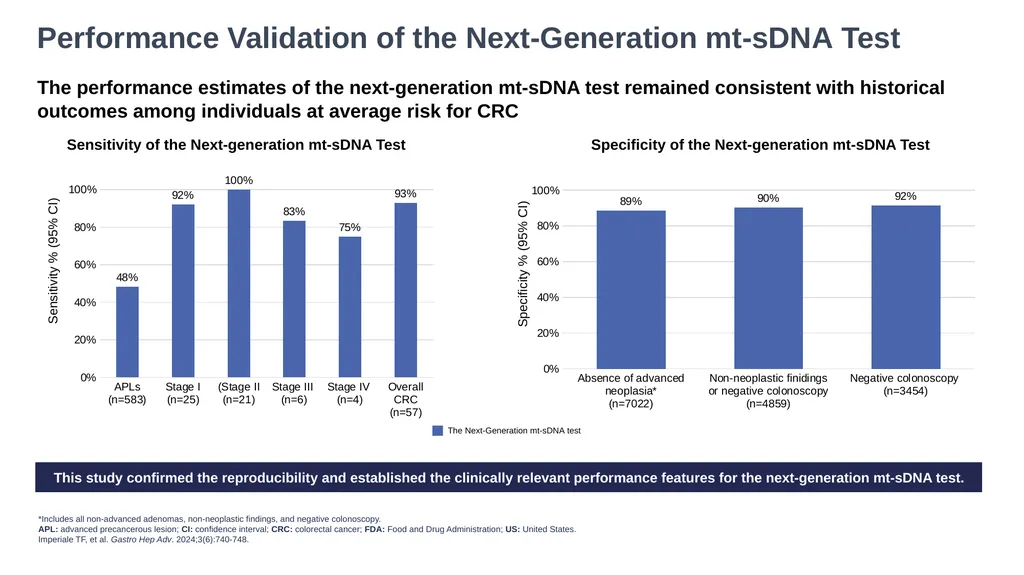
Performance Validation of the Next-Generation mt-sDNA Test The performance estimates of the next-generation mt-sDNA test remained consistent with historical outcomes among individuals at average risk for CRC *Includes all non-advanced adenomas, non-neoplastic findings, and negative colonoscopy.
APL: advanced precancerous lesion; CI: confidence interval; CRC: colorectal cancer; FDA: Food and Drug Administration; US: United States.
Imperiale TF, et al. Gastro Hep Adv. 2024;3(6):740-748. This study confirmed the reproducibility and established the clinically relevant performance features for the next-generation mt-sDNA test. Sensitivity of the Next-generation mt-sDNA Test Specificity of the Next-generation mt-sDNA Test Sensitivity % (95% CI) Specificity % (95% CI)<br>
Imperiale TF, et al. Gastro Hep Adv. 2024;3(6):740-748. This study confirmed the reproducibility and established the clinically relevant performance features for the next-generation mt-sDNA test. Sensitivity of the Next-generation mt-sDNA Test Specificity of the Next-generation mt-sDNA Test Sensitivity % (95% CI) Specificity % (95% CI)<br>
14
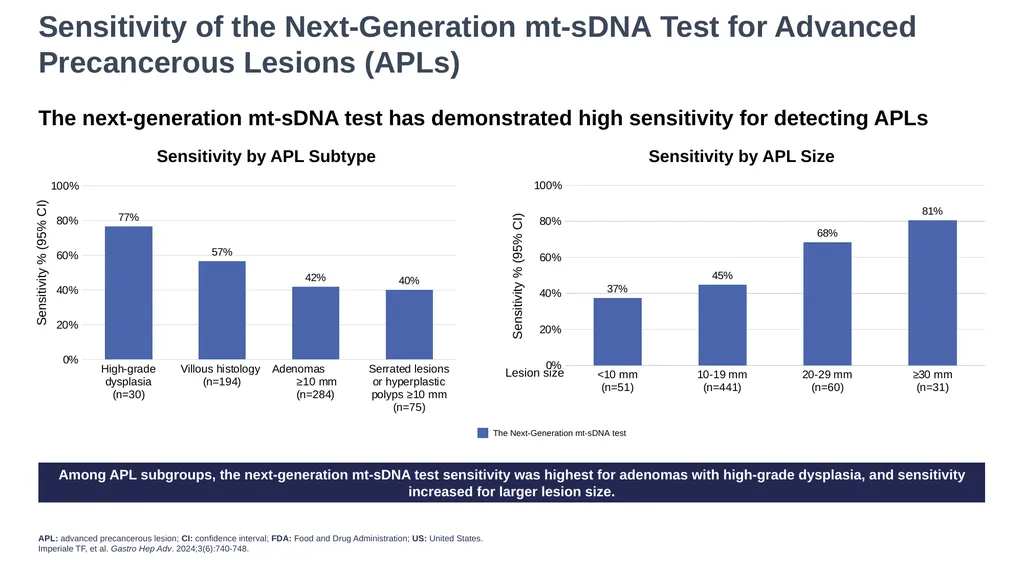
Sensitivity of the Next-Generation mt-sDNA Test for Advanced Precancerous Lesions (APLs) The next-generation mt-sDNA test has demonstrated high sensitivity for detecting APLs Among APL subgroups, the next-generation mt-sDNA test sensitivity was highest for adenomas with high-grade dysplasia, and sensitivity increased for larger lesion size. APL: advanced precancerous lesion; CI: confidence interval; FDA: Food and Drug Administration; US: United States.
Imperiale TF, et al. Gastro Hep Adv. 2024;3(6):740-748. Lesion size Sensitivity % (95% CI) Sensitivity by APL Subtype Sensitivity by APL Size Sensitivity % (95% CI)<br>
15
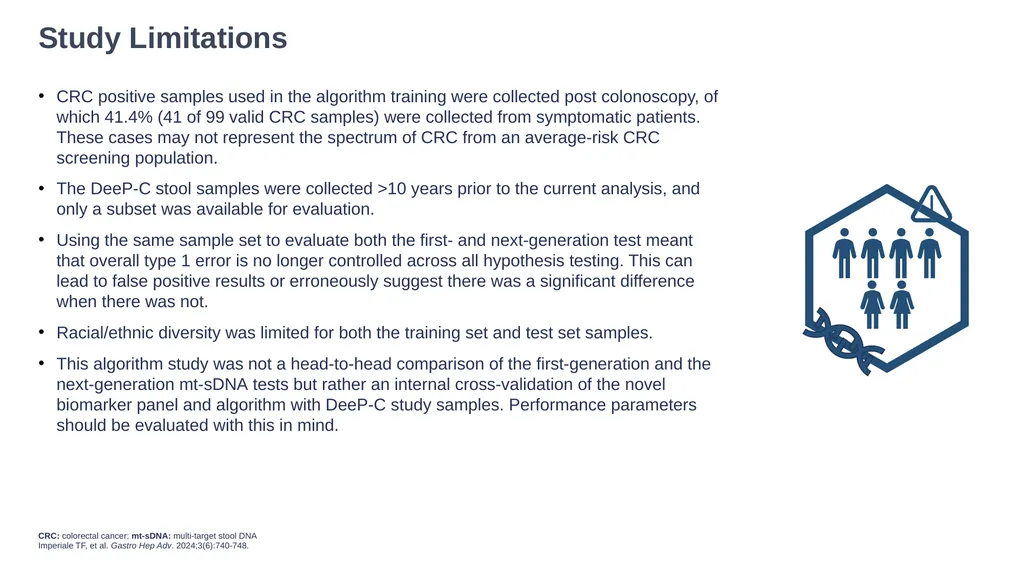
CRC positive samples used in the algorithm training were collected post colonoscopy, of which 41.4% (41 of 99 valid CRC samples) were collected from symptomatic patients. These cases may not represent the spectrum of CRC from an average-risk CRC screening population.
The DeeP-C stool samples were collected >10 years prior to the current analysis, and only a subset was available for evaluation.
Using the same sample set to evaluate both the first- and next-generation test meant that overall type 1 error is no longer controlled across all hypothesis testing. This can lead to false positive results or erroneously suggest there was a significant difference when there was not.
Racial/ethnic diversity was limited for both the training set and test set samples.
This algorithm study was not a head-to-head comparison of the first-generation and the next-generation mt-sDNA tests but rather an internal cross-validation of the novel biomarker panel and algorithm with DeeP-C study samples. Performance parameters should be evaluated with this in mind. Study Limitations CRC: colorectal cancer; mt-sDNA: multi-target stool DNA
Imperiale TF, et al. Gastro Hep Adv. 2024;3(6):740-748.<br>
The DeeP-C stool samples were collected >10 years prior to the current analysis, and only a subset was available for evaluation.
Using the same sample set to evaluate both the first- and next-generation test meant that overall type 1 error is no longer controlled across all hypothesis testing. This can lead to false positive results or erroneously suggest there was a significant difference when there was not.
Racial/ethnic diversity was limited for both the training set and test set samples.
This algorithm study was not a head-to-head comparison of the first-generation and the next-generation mt-sDNA tests but rather an internal cross-validation of the novel biomarker panel and algorithm with DeeP-C study samples. Performance parameters should be evaluated with this in mind. Study Limitations CRC: colorectal cancer; mt-sDNA: multi-target stool DNA
Imperiale TF, et al. Gastro Hep Adv. 2024;3(6):740-748.<br>
16
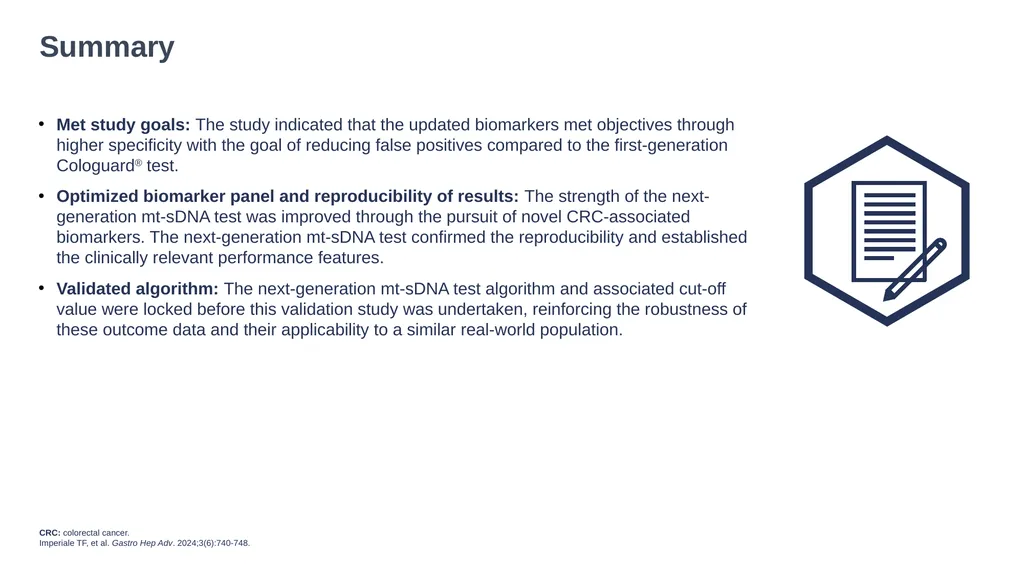
Summary Met study goals: The study indicated that the updated biomarkers met objectives through higher specificity with the goal of reducing false positives compared to the first-generation Cologuard® test.
Optimized biomarker panel and reproducibility of results: The strength of the next-generation mt-sDNA test was improved through the pursuit of novel CRC-associated biomarkers. The next-generation mt-sDNA test confirmed the reproducibility and established the clinically relevant performance features.
Validated algorithm: The next-generation mt-sDNA test algorithm and associated cut-off value were locked before this validation study was undertaken, reinforcing the robustness of these outcome data and their applicability to a similar real-world population. CRC: colorectal cancer. Imperiale TF, et al. Gastro Hep Adv. 2024;3(6):740-748.<br>
Optimized biomarker panel and reproducibility of results: The strength of the next-generation mt-sDNA test was improved through the pursuit of novel CRC-associated biomarkers. The next-generation mt-sDNA test confirmed the reproducibility and established the clinically relevant performance features.
Validated algorithm: The next-generation mt-sDNA test algorithm and associated cut-off value were locked before this validation study was undertaken, reinforcing the robustness of these outcome data and their applicability to a similar real-world population. CRC: colorectal cancer. Imperiale TF, et al. Gastro Hep Adv. 2024;3(6):740-748.<br>
17
Next-Generation Multitarget Stool DNA Test
for Colorectal Cancer Screening (BLUE-C Study) Imperiale TF, et al. Next-generation multitarget stool DNA test for colorectal cancer screening. N Engl J Med. 2024;390(11):984-993.<br>
18
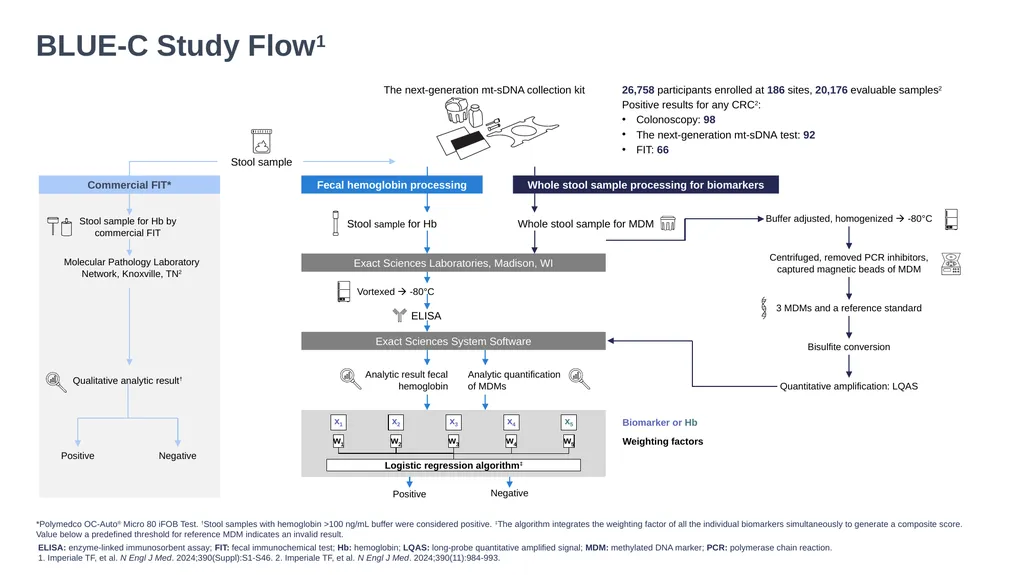
BLUE-C Study Flow1 *Polymedco OC-Auto® Micro 80 iFOB Test. †Stool samples with hemoglobin >100 ng/mL buffer were considered positive. ‡The algorithm integrates the weighting factor of all the individual biomarkers simultaneously to generate a composite score. Value below a predefined threshold for reference MDM indicates an invalid result. ELISA: enzyme-linked immunosorbent assay; FIT: fecal immunochemical test; Hb: hemoglobin; LQAS: long-probe quantitative amplified signal; MDM: methylated DNA marker; PCR: polymerase chain reaction.
1. Imperiale TF, et al. N Engl J Med. 2024;390(Suppl):S1-S46. 2. Imperiale TF, et al. N Engl J Med. 2024;390(11):984-993. Whole stool sample for MDM Exact Sciences Laboratories, Madison, WI Buffer adjusted, homogenized -80°C Centrifuged, removed PCR inhibitors, captured magnetic beads of MDM 3 MDMs and a reference standard Bisulfite conversion Quantitative amplification: LQAS 26,758 participants enrolled at 186 sites, 20,176 evaluable samples2
Positive results for any CRC2:
Colonoscopy: 98
The next-generation mt-sDNA test: 92
FIT: 66 Stool sample for Hb Fecal hemoglobin processing Whole stool sample processing for biomarkers The next-generation mt-sDNA collection kit Biomarker or Hb Weighting factors x1 x2 x3 x4 x5 w1 w2 w3 w4 w5 Logistic regression algorithm‡ Stool sample for Hb by commercial FIT Molecular Pathology Laboratory Network, Knoxville, TN2 Qualitative analytic result† Commercial FIT* Exact Sciences System Software<br>
1. Imperiale TF, et al. N Engl J Med. 2024;390(Suppl):S1-S46. 2. Imperiale TF, et al. N Engl J Med. 2024;390(11):984-993. Whole stool sample for MDM Exact Sciences Laboratories, Madison, WI Buffer adjusted, homogenized -80°C Centrifuged, removed PCR inhibitors, captured magnetic beads of MDM 3 MDMs and a reference standard Bisulfite conversion Quantitative amplification: LQAS 26,758 participants enrolled at 186 sites, 20,176 evaluable samples2
Positive results for any CRC2:
Colonoscopy: 98
The next-generation mt-sDNA test: 92
FIT: 66 Stool sample for Hb Fecal hemoglobin processing Whole stool sample processing for biomarkers The next-generation mt-sDNA collection kit Biomarker or Hb Weighting factors x1 x2 x3 x4 x5 w1 w2 w3 w4 w5 Logistic regression algorithm‡ Stool sample for Hb by commercial FIT Molecular Pathology Laboratory Network, Knoxville, TN2 Qualitative analytic result† Commercial FIT* Exact Sciences System Software<br>
19
*Data are missing for race/ethnicity for 12 participants.
APL: advanced precancerous lesion; CRC: colorectal cancer; SD: standard deviation; US: United States.
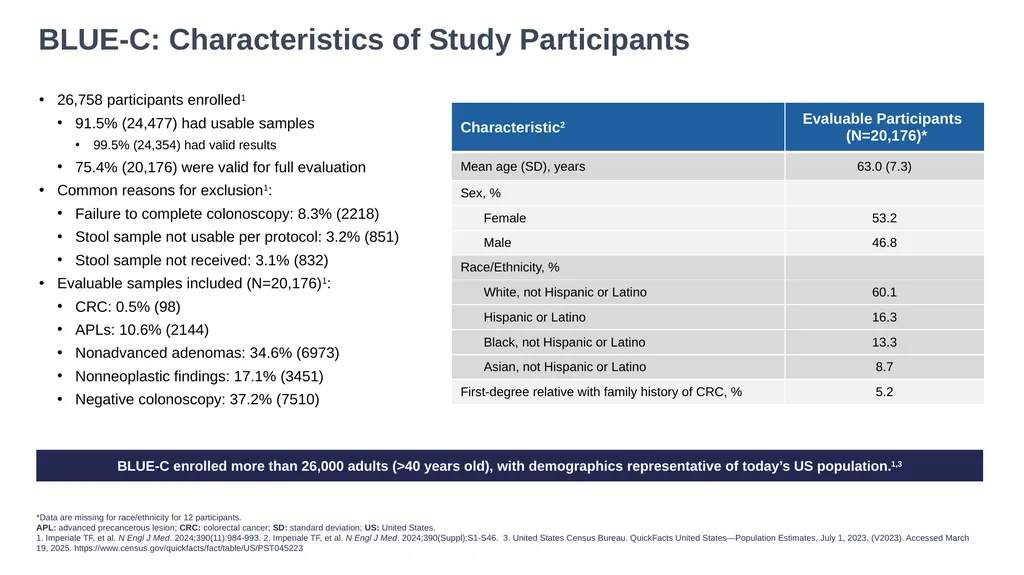
1. Imperiale TF, et al. N Engl J Med. 2024;390(11):984-993. 2. Imperiale TF, et al. N Engl J Med. 2024;390(Suppl):S1-S46. 3. United States Census Bureau. QuickFacts United States—Population Estimates, July 1, 2023, (V2023). Accessed March 19, 2025. https://www.census.gov/quickfacts/fact/table/US/PST045223 26,758 participants enrolled1
91.5% (24,477) had usable samples
99.5% (24,354) had valid results
75.4% (20,176) were valid for full evaluation
Common reasons for exclusion1:
Failure to complete colonoscopy: 8.3% (2218)
Stool sample not usable per protocol: 3.2% (851)
Stool sample not received: 3.1% (832)
Evaluable samples included (N=20,176)1:
CRC: 0.5% (98)
APLs: 10.6% (2144)
Nonadvanced adenomas: 34.6% (6973)
Nonneoplastic findings: 17.1% (3451)
Negative colonoscopy: 37.2% (7510) BLUE-C: Characteristics of Study Participants BLUE-C enrolled more than 26,000 adults (>40 years old), with demographics representative of today’s US population.1,3<br>
APL: advanced precancerous lesion; CRC: colorectal cancer; SD: standard deviation; US: United States.
1. Imperiale TF, et al. N Engl J Med. 2024;390(11):984-993. 2. Imperiale TF, et al. N Engl J Med. 2024;390(Suppl):S1-S46. 3. United States Census Bureau. QuickFacts United States—Population Estimates, July 1, 2023, (V2023). Accessed March 19, 2025. https://www.census.gov/quickfacts/fact/table/US/PST045223 26,758 participants enrolled1
91.5% (24,477) had usable samples
99.5% (24,354) had valid results
75.4% (20,176) were valid for full evaluation
Common reasons for exclusion1:
Failure to complete colonoscopy: 8.3% (2218)
Stool sample not usable per protocol: 3.2% (851)
Stool sample not received: 3.1% (832)
Evaluable samples included (N=20,176)1:
CRC: 0.5% (98)
APLs: 10.6% (2144)
Nonadvanced adenomas: 34.6% (6973)
Nonneoplastic findings: 17.1% (3451)
Negative colonoscopy: 37.2% (7510) BLUE-C: Characteristics of Study Participants BLUE-C enrolled more than 26,000 adults (>40 years old), with demographics representative of today’s US population.1,3<br>
20
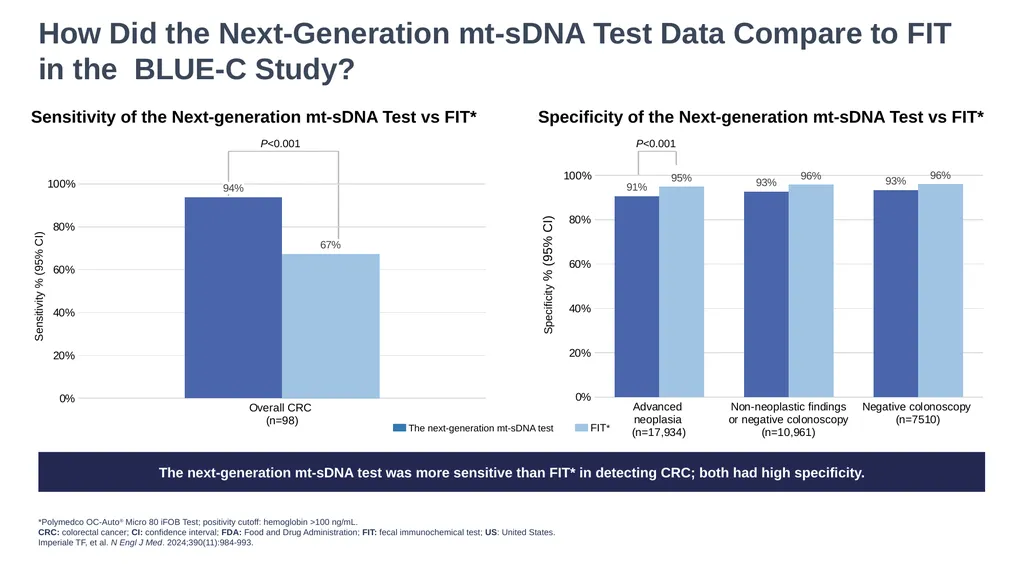
How Did the Next-Generation mt-sDNA Test Data Compare to FIT in the BLUE-C Study? The next-generation mt-sDNA test was more sensitive than FIT* in detecting CRC; both had high specificity. *Polymedco OC-Auto® Micro 80 iFOB Test; positivity cutoff: hemoglobin >100 ng/mL.
CRC: colorectal cancer; CI: confidence interval; FDA: Food and Drug Administration; FIT: fecal immunochemical test; US: United States.
Imperiale TF, et al. N Engl J Med. 2024;390(11):984-993. P<0.001 P<0.001 Specificity of the Next-generation mt-sDNA Test vs FIT* Sensitivity of the Next-generation mt-sDNA Test vs FIT* Sensitivity % (95% CI) Specificity % (95% CI)<br>
Imperiale TF, et al. N Engl J Med. 2024;390(11):984-993. P<0.001 P<0.001 Specificity of the Next-generation mt-sDNA Test vs FIT* Sensitivity of the Next-generation mt-sDNA Test vs FIT* Sensitivity % (95% CI) Specificity % (95% CI)<br>
21
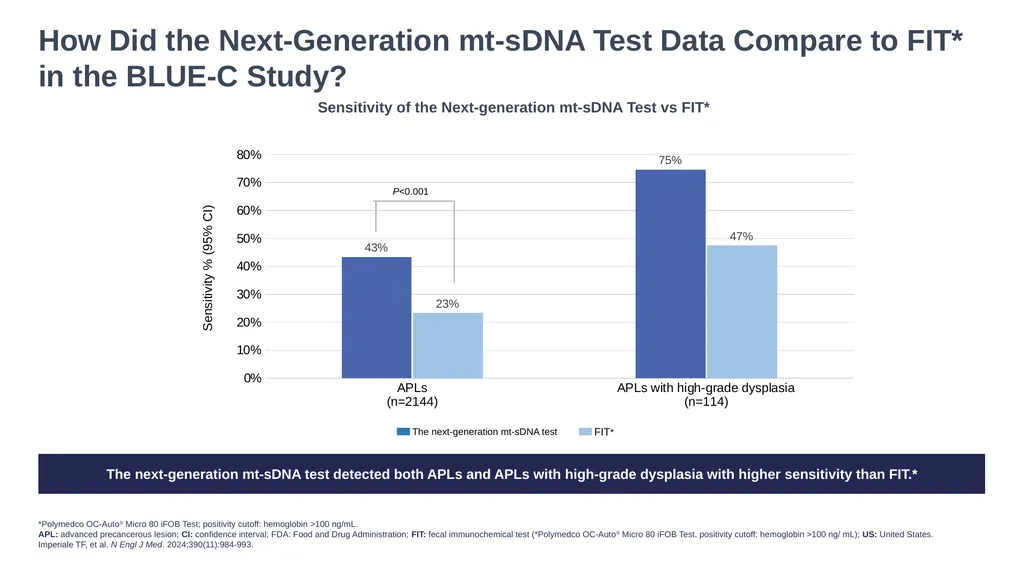
How Did the Next-Generation mt-sDNA Test Data Compare to FIT* in the BLUE-C Study? Sensitivity of the Next-generation mt-sDNA Test vs FIT* The next-generation mt-sDNA test detected both APLs and APLs with high-grade dysplasia with higher sensitivity than FIT.* *Polymedco OC-Auto® Micro 80 iFOB Test; positivity cutoff: hemoglobin >100 ng/mL.
APL: advanced precancerous lesion; CI: confidence interval; FDA: Food and Drug Administration; FIT: fecal immunochemical test (*Polymedco OC-Auto® Micro 80 iFOB Test, positivity cutoff: hemoglobin >100 ng/ mL); US: United States.
Imperiale TF, et al. N Engl J Med. 2024;390(11):984-993. P<0.001 Sensitivity % (95% CI)<br>
Imperiale TF, et al. N Engl J Med. 2024;390(11):984-993. P<0.001 Sensitivity % (95% CI)<br>
22
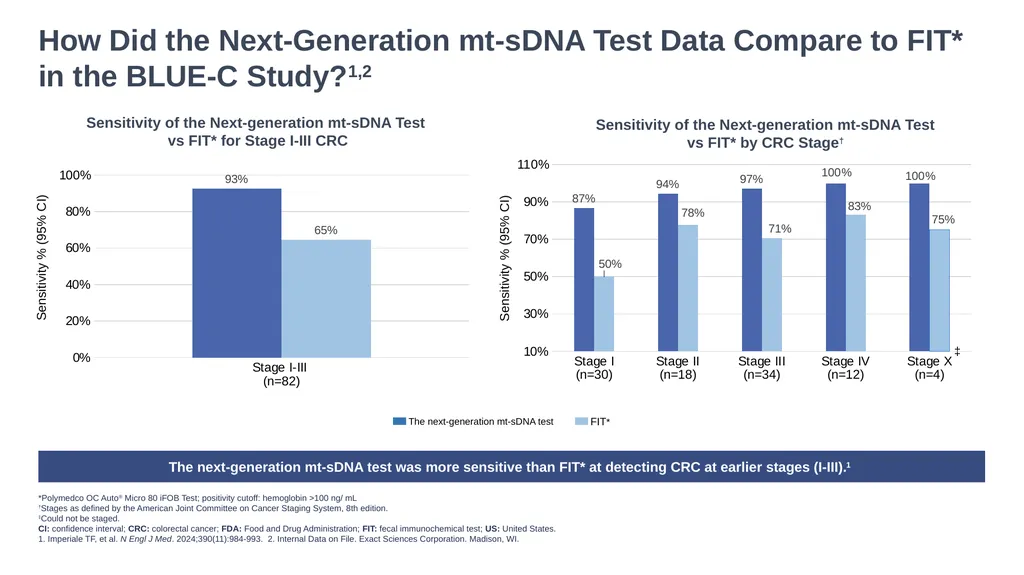
How Did the Next-Generation mt-sDNA Test Data Compare to FIT* in the BLUE-C Study?1,2 The next-generation mt-sDNA test was more sensitive than FIT* at detecting CRC at earlier stages (I-III).1 *Polymedco OC Auto® Micro 80 iFOB Test; positivity cutoff: hemoglobin >100 ng/ mL
†Stages as defined by the American Joint Committee on Cancer Staging System, 8th edition.
‡Could not be staged.
CI: confidence interval; CRC: colorectal cancer; FDA: Food and Drug Administration; FIT: fecal immunochemical test; US: United States.
1. Imperiale TF, et al. N Engl J Med. 2024;390(11):984-993. 2. Internal Data on File. Exact Sciences Corporation. Madison, WI. Sensitivity of the Next-generation mt-sDNA Test vs FIT* by CRC Stage† Sensitivity of the Next-generation mt-sDNA Test vs FIT* for Stage I-III CRC Sensitivity % (95% CI) Sensitivity % (95% CI)<br>
†Stages as defined by the American Joint Committee on Cancer Staging System, 8th edition.
‡Could not be staged.
CI: confidence interval; CRC: colorectal cancer; FDA: Food and Drug Administration; FIT: fecal immunochemical test; US: United States.
1. Imperiale TF, et al. N Engl J Med. 2024;390(11):984-993. 2. Internal Data on File. Exact Sciences Corporation. Madison, WI. Sensitivity of the Next-generation mt-sDNA Test vs FIT* by CRC Stage† Sensitivity of the Next-generation mt-sDNA Test vs FIT* for Stage I-III CRC Sensitivity % (95% CI) Sensitivity % (95% CI)<br>
23
BLUE-C: Key Takeaways Summary
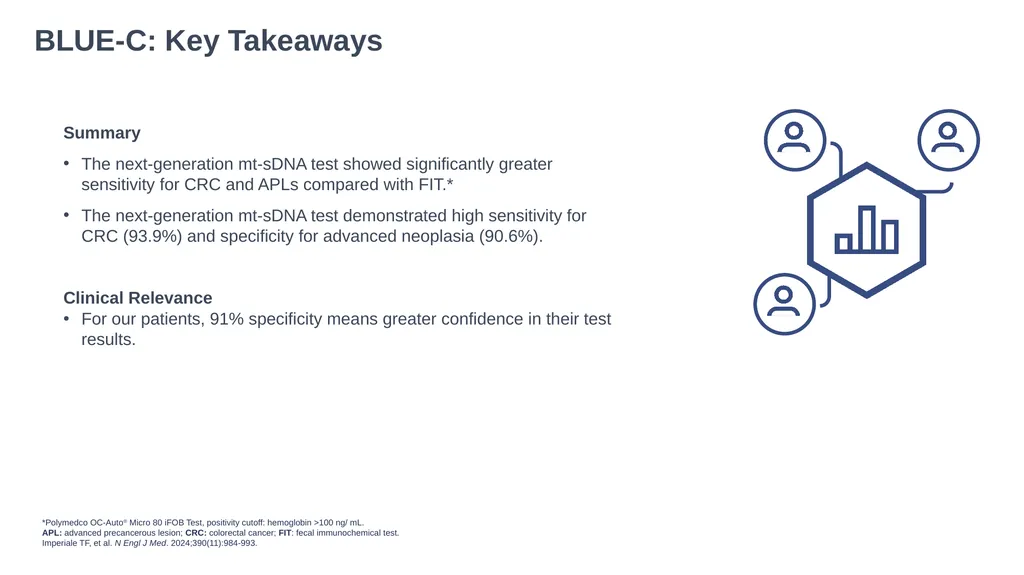
The next-generation mt-sDNA test showed significantly greater sensitivity for CRC and APLs compared with FIT.*
The next-generation mt-sDNA test demonstrated high sensitivity for CRC (93.9%) and specificity for advanced neoplasia (90.6%).
Clinical Relevance
For our patients, 91% specificity means greater confidence in their test results. *Polymedco OC-Auto® Micro 80 iFOB Test, positivity cutoff: hemoglobin >100 ng/ mL.
APL: advanced precancerous lesion; CRC: colorectal cancer; FIT: fecal immunochemical test.
Imperiale TF, et al. N Engl J Med. 2024;390(11):984-993.<br>
The next-generation mt-sDNA test showed significantly greater sensitivity for CRC and APLs compared with FIT.*
The next-generation mt-sDNA test demonstrated high sensitivity for CRC (93.9%) and specificity for advanced neoplasia (90.6%).
Clinical Relevance
For our patients, 91% specificity means greater confidence in their test results. *Polymedco OC-Auto® Micro 80 iFOB Test, positivity cutoff: hemoglobin >100 ng/ mL.
APL: advanced precancerous lesion; CRC: colorectal cancer; FIT: fecal immunochemical test.
Imperiale TF, et al. N Engl J Med. 2024;390(11):984-993.<br>
24
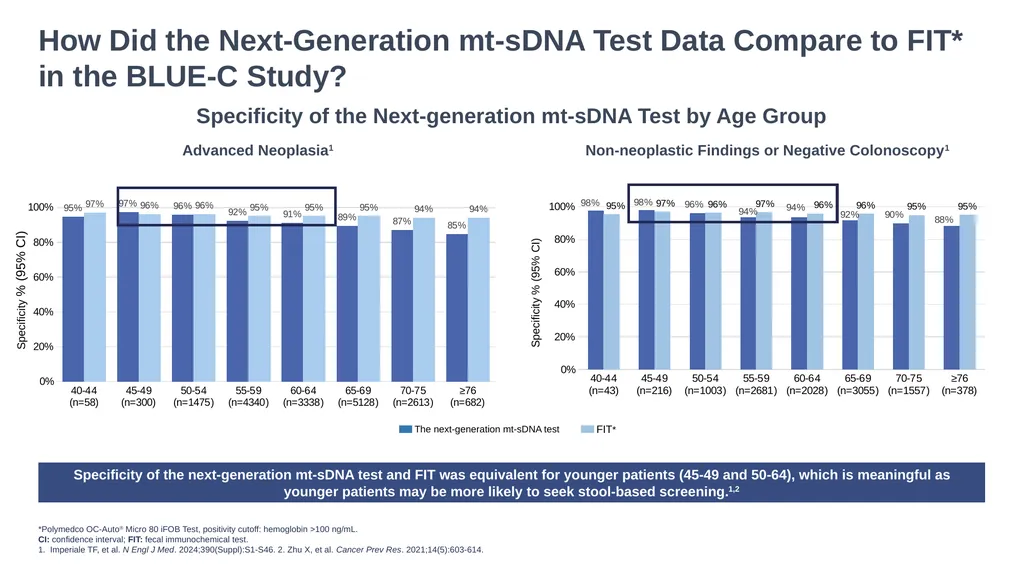
How Did the Next-Generation mt-sDNA Test Data Compare to FIT* in the BLUE-C Study? Specificity of the Next-generation mt-sDNA Test by Age Group Specificity of the next-generation mt-sDNA test and FIT was equivalent for younger patients (45-49 and 50-64), which is meaningful as younger patients may be more likely to seek stool-based screening.1,2 *Polymedco OC-Auto® Micro 80 iFOB Test, positivity cutoff: hemoglobin >100 ng/mL.
CI: confidence interval; FIT: fecal immunochemical test.
1. Imperiale TF, et al. N Engl J Med. 2024;390(Suppl):S1-S46. 2. Zhu X, et al. Cancer Prev Res. 2021;14(5):603-614. Advanced Neoplasia1 Non-neoplastic Findings or Negative Colonoscopy1 Specificity % (95% CI) Specificity % (95% CI)<br>
CI: confidence interval; FIT: fecal immunochemical test.
1. Imperiale TF, et al. N Engl J Med. 2024;390(Suppl):S1-S46. 2. Zhu X, et al. Cancer Prev Res. 2021;14(5):603-614. Advanced Neoplasia1 Non-neoplastic Findings or Negative Colonoscopy1 Specificity % (95% CI) Specificity % (95% CI)<br>
25
BLUE-C: Limitations A relatively high proportion of individuals consented and enrolled but were not evaluable per protocol. The COVID-19 pandemic was a likely contributor, affecting both enrollment and access to colonoscopy.
The results from this study should not be directly compared with published findings for the on-market Cologuard® test; valid comparisons require assessment of both tests on the same individuals and specimens concurrently in the screening setting. COVID-19: Coronavirus disease 2019.
Imperiale TF, et al. N Engl J Med. 2024;390(11):984-993.<br>
The results from this study should not be directly compared with published findings for the on-market Cologuard® test; valid comparisons require assessment of both tests on the same individuals and specimens concurrently in the screening setting. COVID-19: Coronavirus disease 2019.
Imperiale TF, et al. N Engl J Med. 2024;390(11):984-993.<br>
26
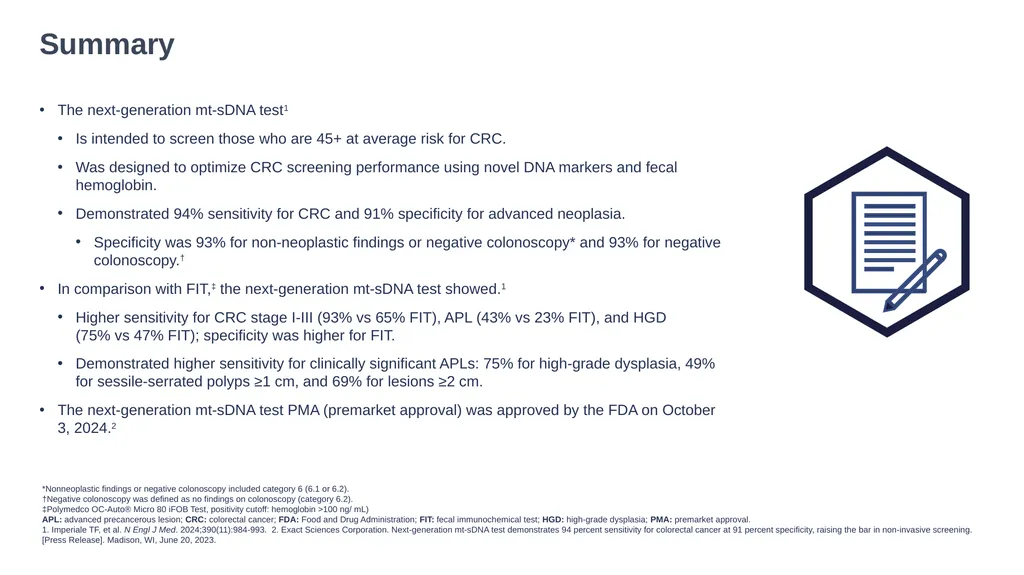
Summary The next-generation mt-sDNA test1
Is intended to screen those who are 45+ at average risk for CRC.
Was designed to optimize CRC screening performance using novel DNA markers and fecal hemoglobin.
Demonstrated 94% sensitivity for CRC and 91% specificity for advanced neoplasia.
Specificity was 93% for non-neoplastic findings or negative colonoscopy* and 93% for negative colonoscopy.†
In comparison with FIT,‡ the next-generation mt-sDNA test showed.1
Higher sensitivity for CRC stage I-III (93% vs 65% FIT), APL (43% vs 23% FIT), and HGD (75% vs 47% FIT); specificity was higher for FIT.
Demonstrated higher sensitivity for clinically significant APLs: 75% for high-grade dysplasia, 49% for sessile-serrated polyps ≥1 cm, and 69% for lesions ≥2 cm.
The next-generation mt-sDNA test PMA (premarket approval) was approved by the FDA on October 3, 2024.2 *Nonneoplastic findings or negative colonoscopy included category 6 (6.1 or 6.2).
†Negative colonoscopy was defined as no findings on colonoscopy (category 6.2).
‡Polymedco OC-Auto® Micro 80 iFOB Test, positivity cutoff: hemoglobin >100 ng/ mL)
APL: advanced precancerous lesion; CRC: colorectal cancer; FDA: Food and Drug Administration; FIT: fecal immunochemical test; HGD: high-grade dysplasia; PMA: premarket approval.
1. Imperiale TF, et al. N Engl J Med. 2024;390(11):984-993. 2. Exact Sciences Corporation. Next-generation mt-sDNA test demonstrates 94 percent sensitivity for colorectal cancer at 91 percent specificity, raising the bar in non-invasive screening. [Press Release]. Madison, WI, June 20, 2023.<br>
Is intended to screen those who are 45+ at average risk for CRC.
Was designed to optimize CRC screening performance using novel DNA markers and fecal hemoglobin.
Demonstrated 94% sensitivity for CRC and 91% specificity for advanced neoplasia.
Specificity was 93% for non-neoplastic findings or negative colonoscopy* and 93% for negative colonoscopy.†
In comparison with FIT,‡ the next-generation mt-sDNA test showed.1
Higher sensitivity for CRC stage I-III (93% vs 65% FIT), APL (43% vs 23% FIT), and HGD (75% vs 47% FIT); specificity was higher for FIT.
Demonstrated higher sensitivity for clinically significant APLs: 75% for high-grade dysplasia, 49% for sessile-serrated polyps ≥1 cm, and 69% for lesions ≥2 cm.
The next-generation mt-sDNA test PMA (premarket approval) was approved by the FDA on October 3, 2024.2 *Nonneoplastic findings or negative colonoscopy included category 6 (6.1 or 6.2).
†Negative colonoscopy was defined as no findings on colonoscopy (category 6.2).
‡Polymedco OC-Auto® Micro 80 iFOB Test, positivity cutoff: hemoglobin >100 ng/ mL)
APL: advanced precancerous lesion; CRC: colorectal cancer; FDA: Food and Drug Administration; FIT: fecal immunochemical test; HGD: high-grade dysplasia; PMA: premarket approval.
1. Imperiale TF, et al. N Engl J Med. 2024;390(11):984-993. 2. Exact Sciences Corporation. Next-generation mt-sDNA test demonstrates 94 percent sensitivity for colorectal cancer at 91 percent specificity, raising the bar in non-invasive screening. [Press Release]. Madison, WI, June 20, 2023.<br>
27
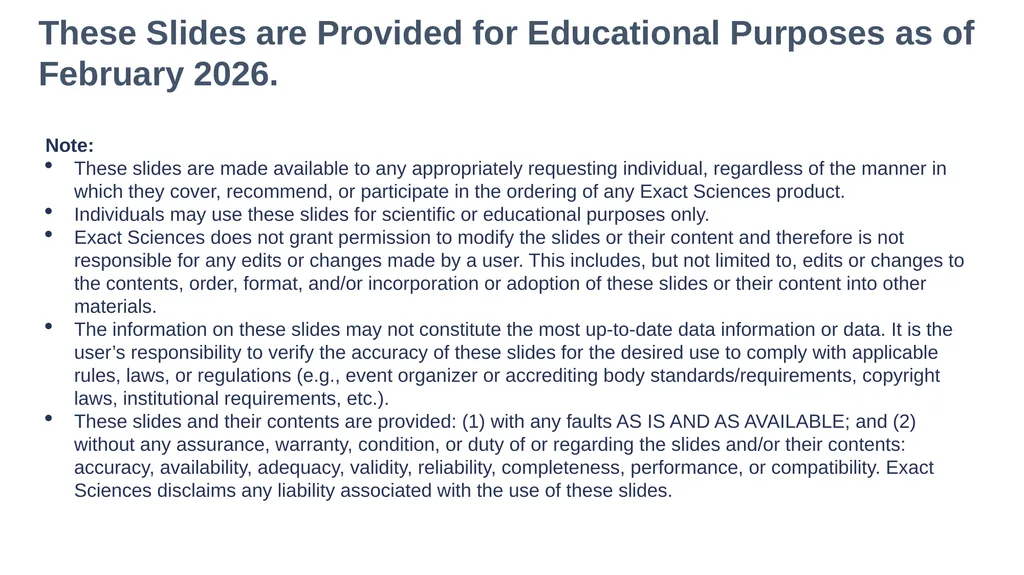
These Slides are Provided for Educational Purposes as of February 2026. Note:
These slides are made available to any appropriately requesting individual, regardless of the manner in which they cover, recommend, or participate in the ordering of any Exact Sciences product.
Individuals may use these slides for scientific or educational purposes only.
Exact Sciences does not grant permission to modify the slides or their content and therefore is not responsible for any edits or changes made by a user. This includes, but not limited to, edits or changes to the contents, order, format, and/or incorporation or adoption of these slides or their content into other materials.
The information on these slides may not constitute the most up-to-date data information or data. It is the user’s responsibility to verify the accuracy of these slides for the desired use to comply with applicable rules, laws, or regulations (e.g., event organizer or accrediting body standards/requirements, copyright laws, institutional requirements, etc.).
These slides and their contents are provided: (1) with any faults AS IS AND AS AVAILABLE; and (2) without any assurance, warranty, condition, or duty of or regarding the slides and/or their contents: accuracy, availability, adequacy, validity, reliability, completeness, performance, or compatibility. Exact Sciences disclaims any liability associated with the use of these slides.<br>
These slides are made available to any appropriately requesting individual, regardless of the manner in which they cover, recommend, or participate in the ordering of any Exact Sciences product.
Individuals may use these slides for scientific or educational purposes only.
Exact Sciences does not grant permission to modify the slides or their content and therefore is not responsible for any edits or changes made by a user. This includes, but not limited to, edits or changes to the contents, order, format, and/or incorporation or adoption of these slides or their content into other materials.
The information on these slides may not constitute the most up-to-date data information or data. It is the user’s responsibility to verify the accuracy of these slides for the desired use to comply with applicable rules, laws, or regulations (e.g., event organizer or accrediting body standards/requirements, copyright laws, institutional requirements, etc.).
These slides and their contents are provided: (1) with any faults AS IS AND AS AVAILABLE; and (2) without any assurance, warranty, condition, or duty of or regarding the slides and/or their contents: accuracy, availability, adequacy, validity, reliability, completeness, performance, or compatibility. Exact Sciences disclaims any liability associated with the use of these slides.<br>