
These slides contain animations, when the
LS
Published · 22 slides · 0 views
1 / 1



Description
These slides contain animations, when the PowerPoint file is played The content gradually appears with clicks Questions appear before their answers Carbon Dioxide Its not all bad Carbon dioxide results from the combustion of carbon
Related Topics
Share
Embed code
Download this presentation From Below
"These slides contain animations, when the" is the property of its rightful owner. Permission is granted to download and print the materials on this website for personal, non-commercial use only, and to display it on your personal computer provided you do not modify the materials and that you retain all copyright notices contained in the materials. By downloading content from our website, you accept the terms of this agreement.
Presentation Transcript
01
These slides contain animations, when the PowerPoint file is played
The content gradually appears with clicks
Questions appear before their answers<br>
The content gradually appears with clicks
Questions appear before their answers<br>
02
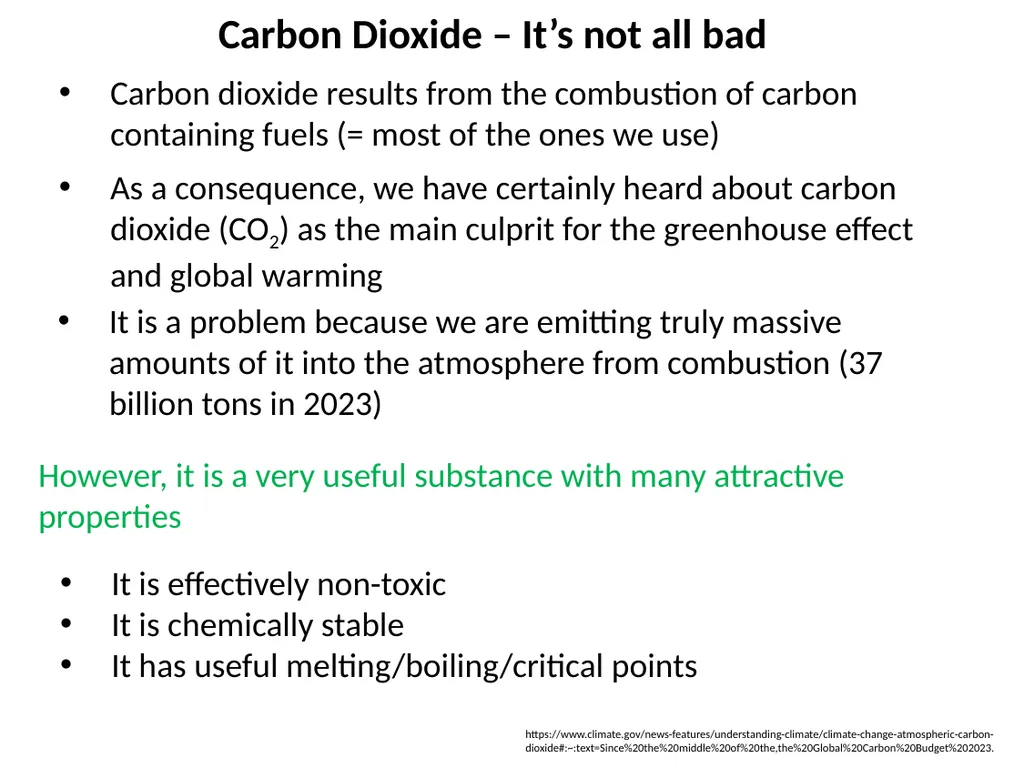
Carbon Dioxide – It’s not all bad Carbon dioxide results from the combustion of carbon containing fuels (= most of the ones we use) However, it is a very useful substance with many attractive properties As a consequence, we have certainly heard about carbon dioxide (CO2) as the main culprit for the greenhouse effect and global warming It is a problem because we are emitting truly massive amounts of it into the atmosphere from combustion (37 billion tons in 2023) https://www.climate.gov/news-features/understanding-climate/climate-change-atmospheric-carbon-dioxide#:~:text=Since%20the%20middle%20of%20the,the%20Global%20Carbon%20Budget%202023. It is effectively non-toxic
It is chemically stable
It has useful melting/boiling/critical points<br>
It is chemically stable
It has useful melting/boiling/critical points<br>
03
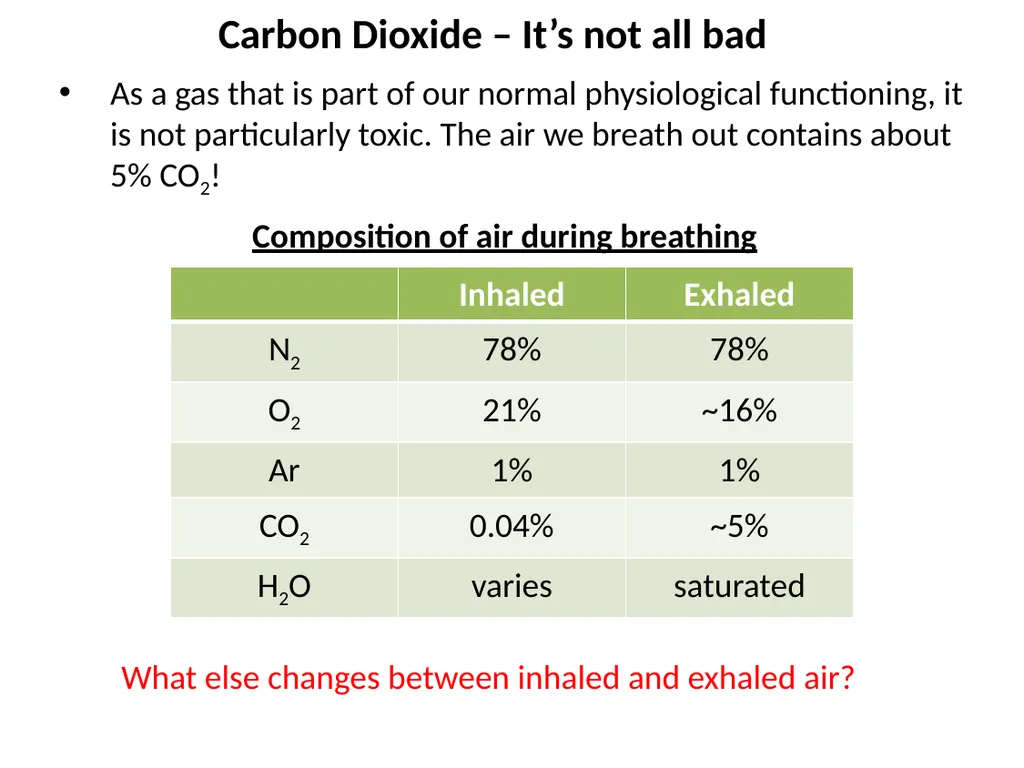
Carbon Dioxide – It’s not all bad As a gas that is part of our normal physiological functioning, it is not particularly toxic. The air we breath out contains about 5% CO2! Composition of air during breathing What else changes between inhaled and exhaled air?<br>
04
Carbon Dioxide – It’s not all bad Name some familiar uses of CO2: CO2 is a very useful substance with many attractive properties Drink carbonation
Fire extinguishing
Refrigerant – dry ice
Leavening (raising) bread
CO2 lasers
As a “green” solvent<br>
Fire extinguishing
Refrigerant – dry ice
Leavening (raising) bread
CO2 lasers
As a “green” solvent<br>
05
Carbon Dioxide – Drink Carbonation Sodas and other sparkling drinks get their bubbles from carbon dioxide Why not use some other gas to make drinks bubbly? Solubility - the gases from air (N2, O2, Ar) meet the criteria of low toxicity, no odor, and low cost. However, they have very poor solubility in water. Some reasons: Toxicity – clearly a problem! (e.g. NH3, SO2, H2S, CO, NO2) Odor – 4/5 of the examples above (NH3, SO2, H2S, NO2 also have unpleasant odors) Cost – CO2 is quite cheap and readily available<br>
06
Carbon Dioxide – Drink Carbonation Why not use some other gas to make drinks bubbly? Solubility – CO2 has good solubility in water. We see this when opening a soda bottle, the pressure over the liquid reduces and so the CO2 solubility reduces, leading to gas coming out of solution in the form of bubbles Henry’s Law tells us that the amount of gas that can dissolve in a liquid is proportional to the pressure of the gas above the liquid. Also, a small amount of CO2 reacts with water: CO2 + H2O ⇄ H2CO3 H2CO3 is an acid, making the water more acidic (pH 3-4). This contributes to the flavor of carbonated drinks and water.<br>
07
Carbon Dioxide – Drink Carbonation Some drinks, like soda, are pressurized with CO2 e.g. from a gas cylinder
A typical soda can or bottle is pressurized to about 30-50 psi at room temperature. That’s around 2-3 times atmospheric pressure How does the CO2 get in the drinks? Soda bottle Car Tire Narrow Bike Tire Propane tank Nitrogen
cylinder ~2 atm ~3 atm 6-8 atm 10-13 atm ~145 atm Inflating a balloon - ~ 0.1 atm<br>
A typical soda can or bottle is pressurized to about 30-50 psi at room temperature. That’s around 2-3 times atmospheric pressure How does the CO2 get in the drinks? Soda bottle Car Tire Narrow Bike Tire Propane tank Nitrogen
cylinder ~2 atm ~3 atm 6-8 atm 10-13 atm ~145 atm Inflating a balloon - ~ 0.1 atm<br>
08
Carbon Dioxide – Drink Carbonation Other drinks, like beer and champagne, get their CO2 from the fermentation process that produced their alcohol: How does the CO2 get in the drinks? C6H12O6 2 C2H5OH + 2 CO2 sugar ethanol https://physicsworld.com/a/six-secrets-of-champagne/ https://images.app.goo.gl/WxYZdZrS7jr1okNCA<br>
09
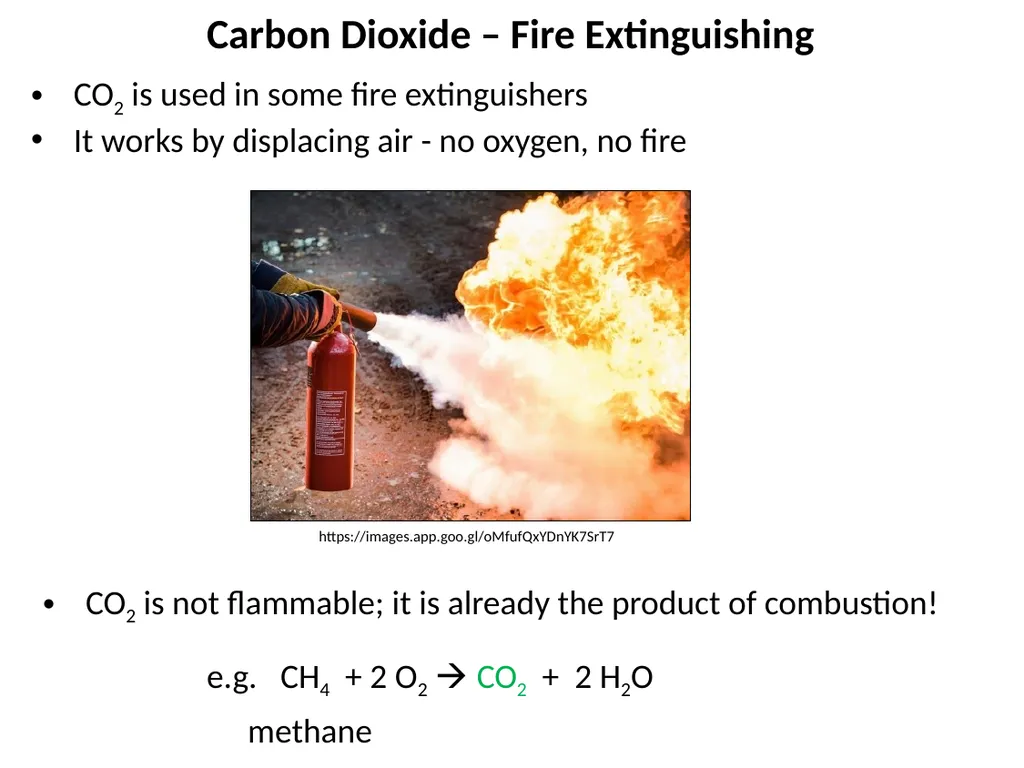
Carbon Dioxide – Fire Extinguishing CO2 is used in some fire extinguishers
It works by displacing air - no oxygen, no fire https://images.app.goo.gl/oMfufQxYDnYK7SrT7 e.g. CH4 + 2 O2 CO2 + 2 H2O methane CO2 is not flammable; it is already the product of combustion!<br>
It works by displacing air - no oxygen, no fire https://images.app.goo.gl/oMfufQxYDnYK7SrT7 e.g. CH4 + 2 O2 CO2 + 2 H2O methane CO2 is not flammable; it is already the product of combustion!<br>
10
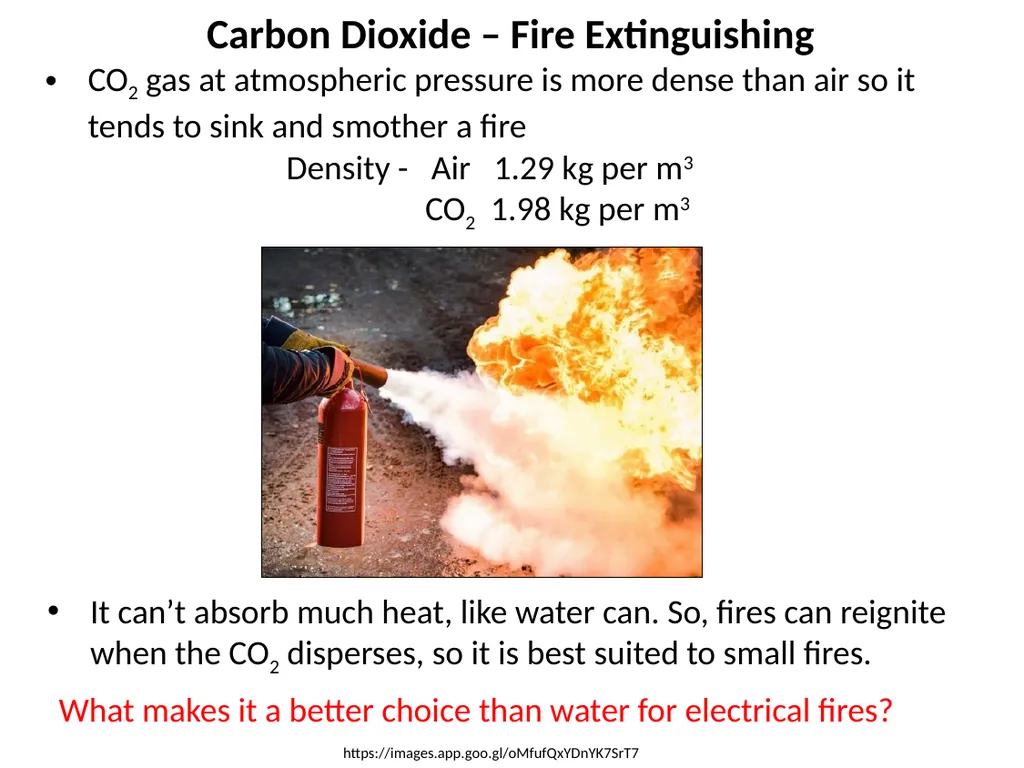
Carbon Dioxide – Fire Extinguishing What makes it a better choice than water for electrical fires? CO2 gas at atmospheric pressure is more dense than air so it tends to sink and smother a fire Density - Air 1.29 kg per m3
CO2 1.98 kg per m3 It can’t absorb much heat, like water can. So, fires can reignite when the CO2 disperses, so it is best suited to small fires. https://images.app.goo.gl/oMfufQxYDnYK7SrT7<br>
CO2 1.98 kg per m3 It can’t absorb much heat, like water can. So, fires can reignite when the CO2 disperses, so it is best suited to small fires. https://images.app.goo.gl/oMfufQxYDnYK7SrT7<br>
11
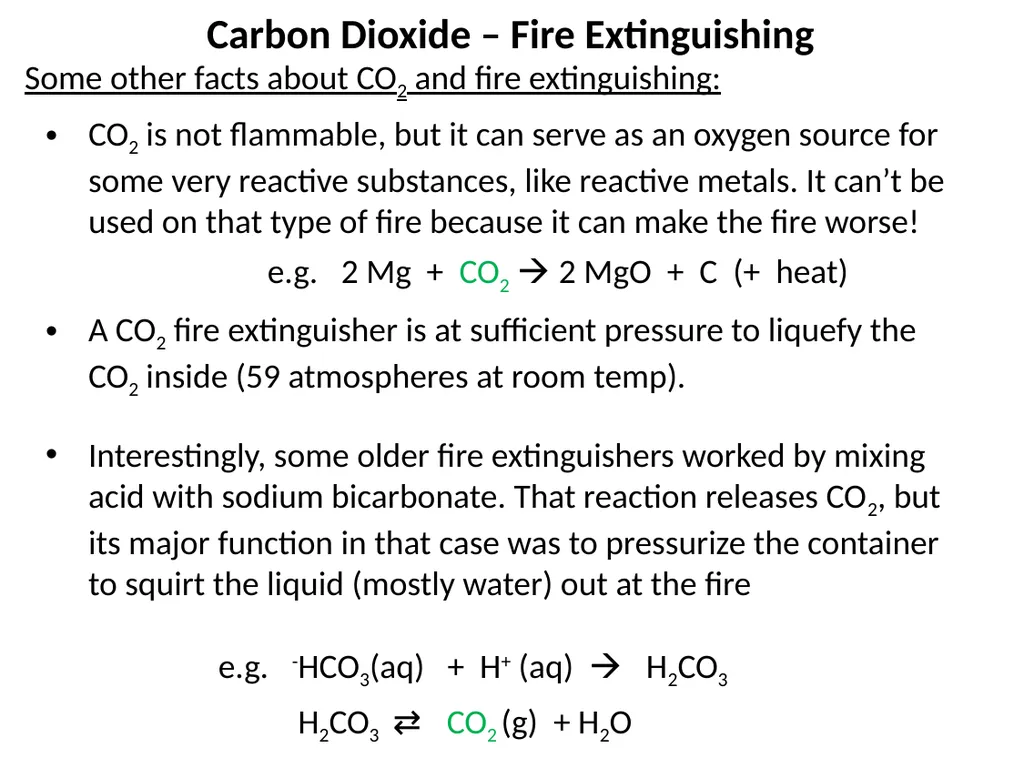
Carbon Dioxide – Fire Extinguishing e.g. 2 Mg + CO2 2 MgO + C (+ heat) CO2 is not flammable, but it can serve as an oxygen source for some very reactive substances, like reactive metals. It can’t be used on that type of fire because it can make the fire worse! A CO2 fire extinguisher is at sufficient pressure to liquefy the CO2 inside (59 atmospheres at room temp). Interestingly, some older fire extinguishers worked by mixing acid with sodium bicarbonate. That reaction releases CO2, but its major function in that case was to pressurize the container to squirt the liquid (mostly water) out at the fire e.g. -HCO3(aq) + H+ (aq) H2CO3 H2CO3 ⇄ CO2 (g) + H2O Some other facts about CO2 and fire extinguishing:<br>
12
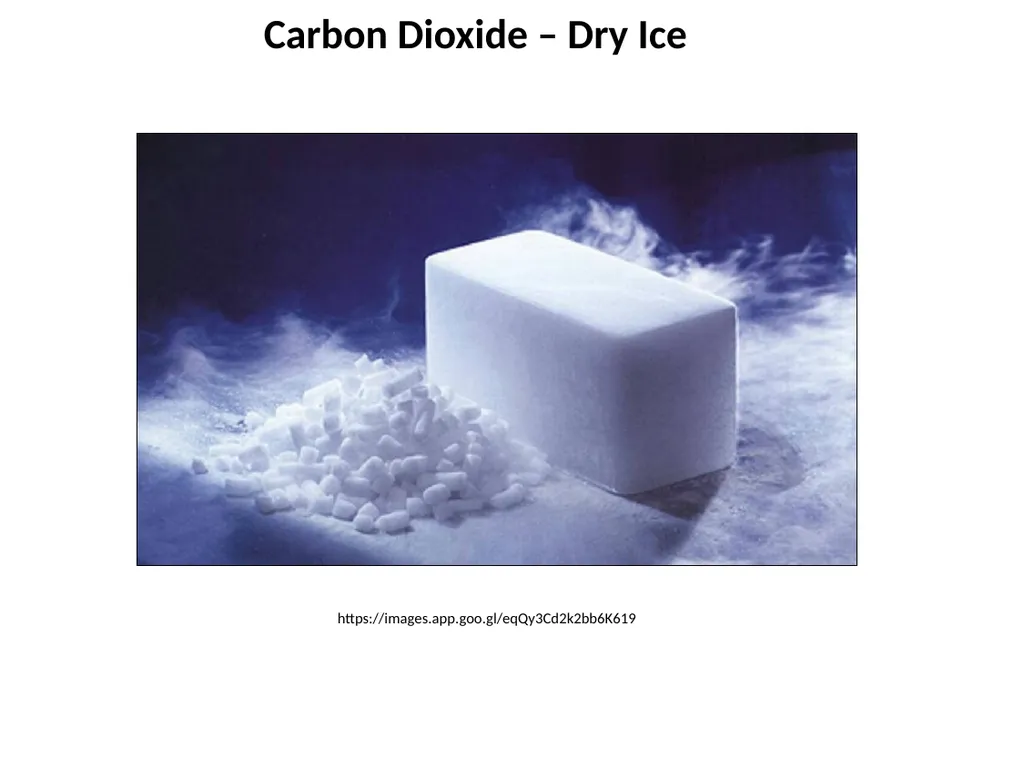
Carbon Dioxide – Dry Ice https://images.app.goo.gl/eqQy3Cd2k2bb6K619<br>
13
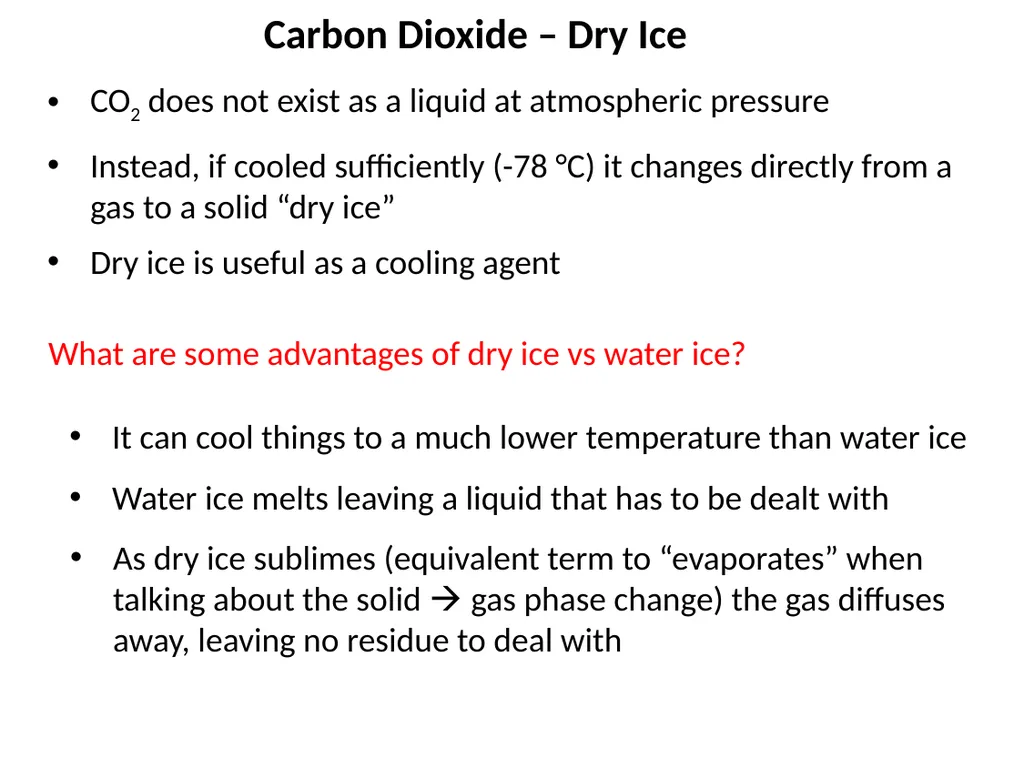
Carbon Dioxide – Dry Ice What are some advantages of dry ice vs water ice? CO2 does not exist as a liquid at atmospheric pressure Instead, if cooled sufficiently (-78 °C) it changes directly from a gas to a solid “dry ice” Dry ice is useful as a cooling agent It can cool things to a much lower temperature than water ice Water ice melts leaving a liquid that has to be dealt with As dry ice sublimes (equivalent term to “evaporates” when talking about the solid gas phase change) the gas diffuses away, leaving no residue to deal with<br>
14
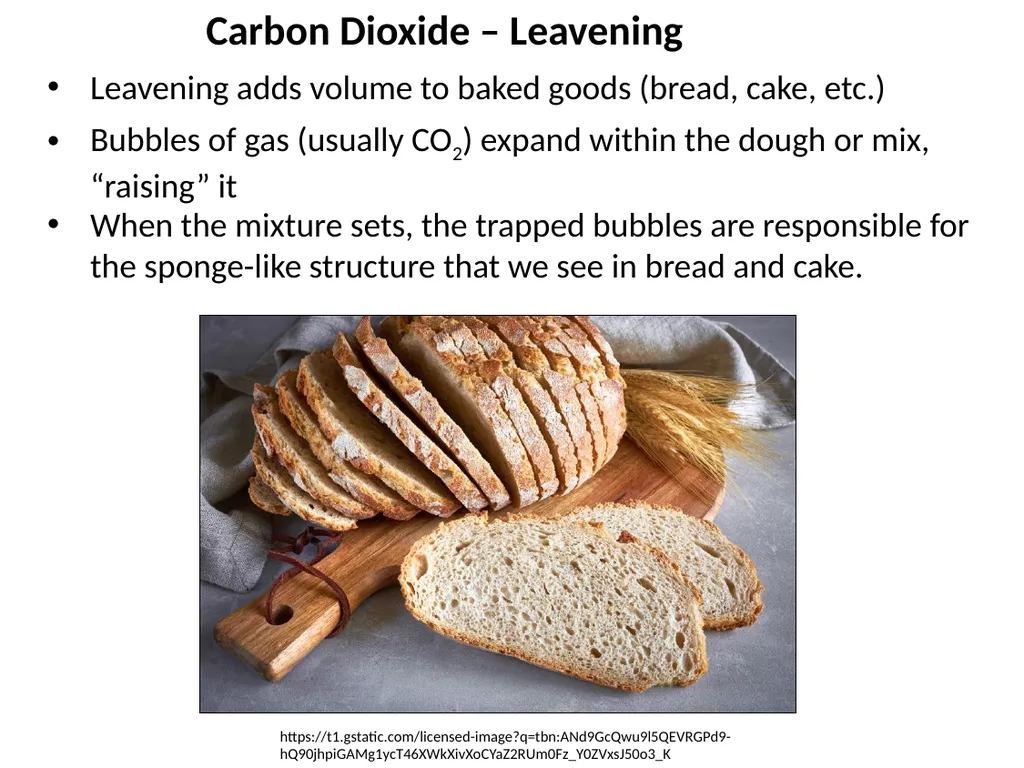
Carbon Dioxide – Leavening Leavening adds volume to baked goods (bread, cake, etc.) When the mixture sets, the trapped bubbles are responsible for the sponge-like structure that we see in bread and cake. https://t1.gstatic.com/licensed-image?q=tbn:ANd9GcQwu9l5QEVRGPd9-hQ90jhpiGAMg1ycT46XWkXivXoCYaZ2RUm0Fz_Y0ZVxsJ50o3_K Bubbles of gas (usually CO2) expand within the dough or mix, “raising” it<br>
15
Carbon Dioxide – Leavening There are two common ways that the CO2 gas is produced: 1. “Biological” – Baker’s yeast
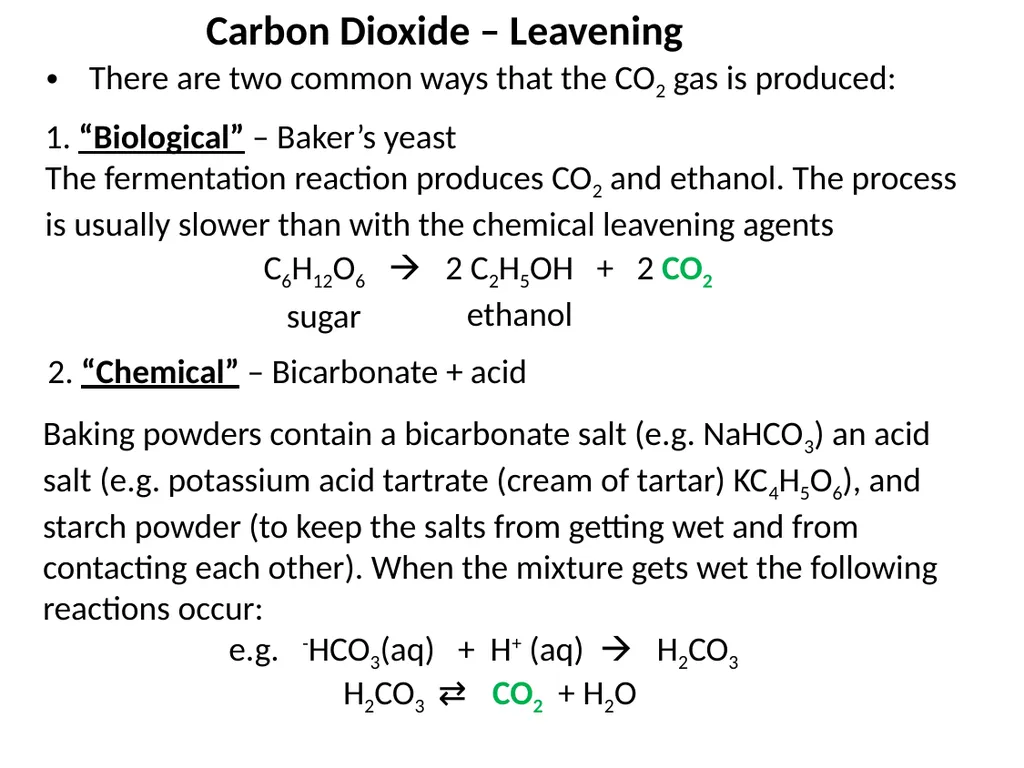
The fermentation reaction produces CO2 and ethanol. The process is usually slower than with the chemical leavening agents C6H12O6 2 C2H5OH + 2 CO2 sugar ethanol 2. “Chemical” – Bicarbonate + acid e.g. -HCO3(aq) + H+ (aq) H2CO3 H2CO3 ⇄ CO2 + H2O Baking powders contain a bicarbonate salt (e.g. NaHCO3) an acid salt (e.g. potassium acid tartrate (cream of tartar) KC4H5O6), and starch powder (to keep the salts from getting wet and from contacting each other). When the mixture gets wet the following reactions occur:<br>
The fermentation reaction produces CO2 and ethanol. The process is usually slower than with the chemical leavening agents C6H12O6 2 C2H5OH + 2 CO2 sugar ethanol 2. “Chemical” – Bicarbonate + acid e.g. -HCO3(aq) + H+ (aq) H2CO3 H2CO3 ⇄ CO2 + H2O Baking powders contain a bicarbonate salt (e.g. NaHCO3) an acid salt (e.g. potassium acid tartrate (cream of tartar) KC4H5O6), and starch powder (to keep the salts from getting wet and from contacting each other). When the mixture gets wet the following reactions occur:<br>
16
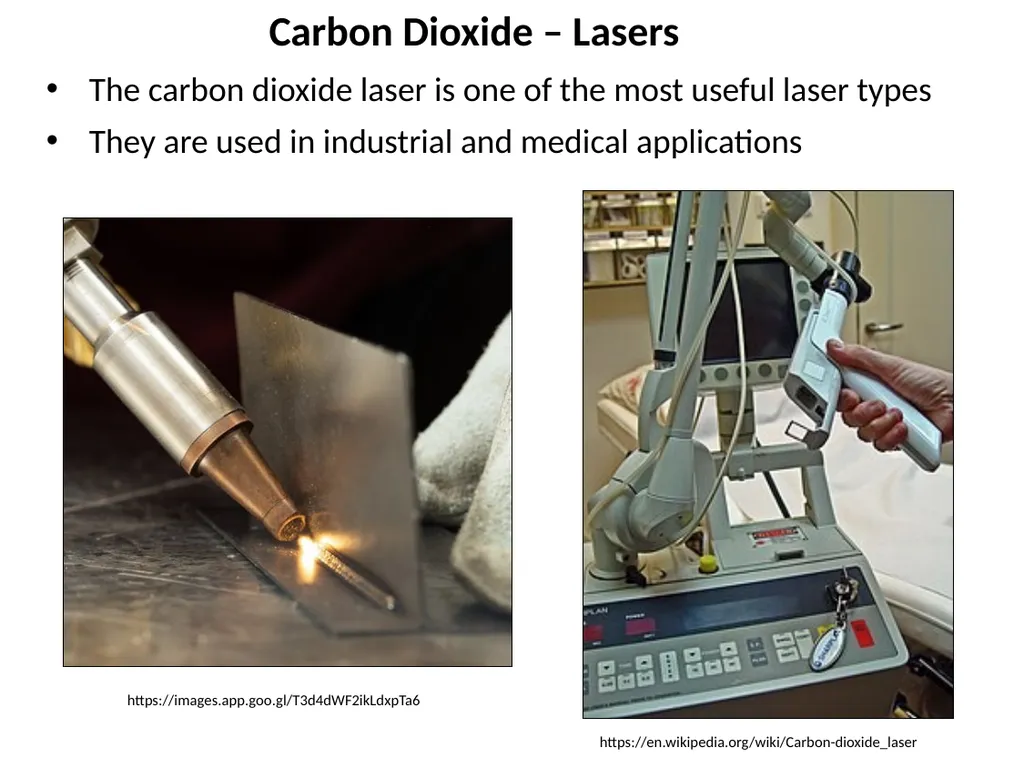
Carbon Dioxide – Lasers The carbon dioxide laser is one of the most useful laser types They are used in industrial and medical applications https://images.app.goo.gl/T3d4dWF2ikLdxpTa6 https://en.wikipedia.org/wiki/Carbon-dioxide_laser<br>
17
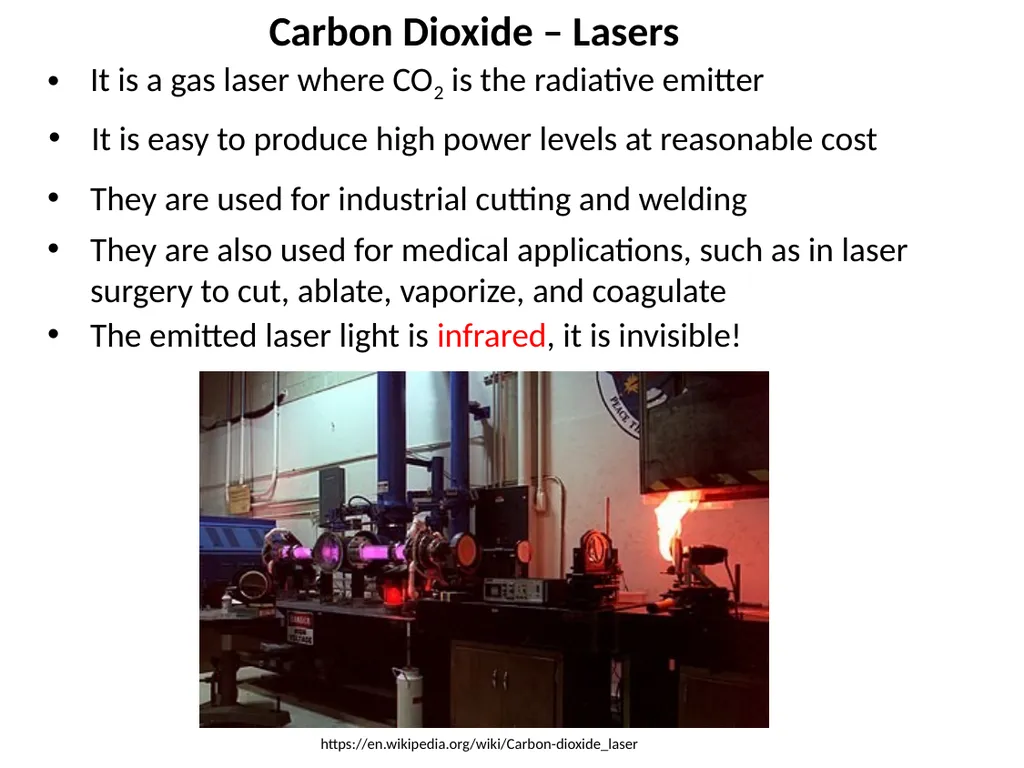
Carbon Dioxide – Lasers It is a gas laser where CO2 is the radiative emitter It is easy to produce high power levels at reasonable cost They are used for industrial cutting and welding They are also used for medical applications, such as in laser surgery to cut, ablate, vaporize, and coagulate The emitted laser light is infrared, it is invisible! https://en.wikipedia.org/wiki/Carbon-dioxide_laser<br>
18
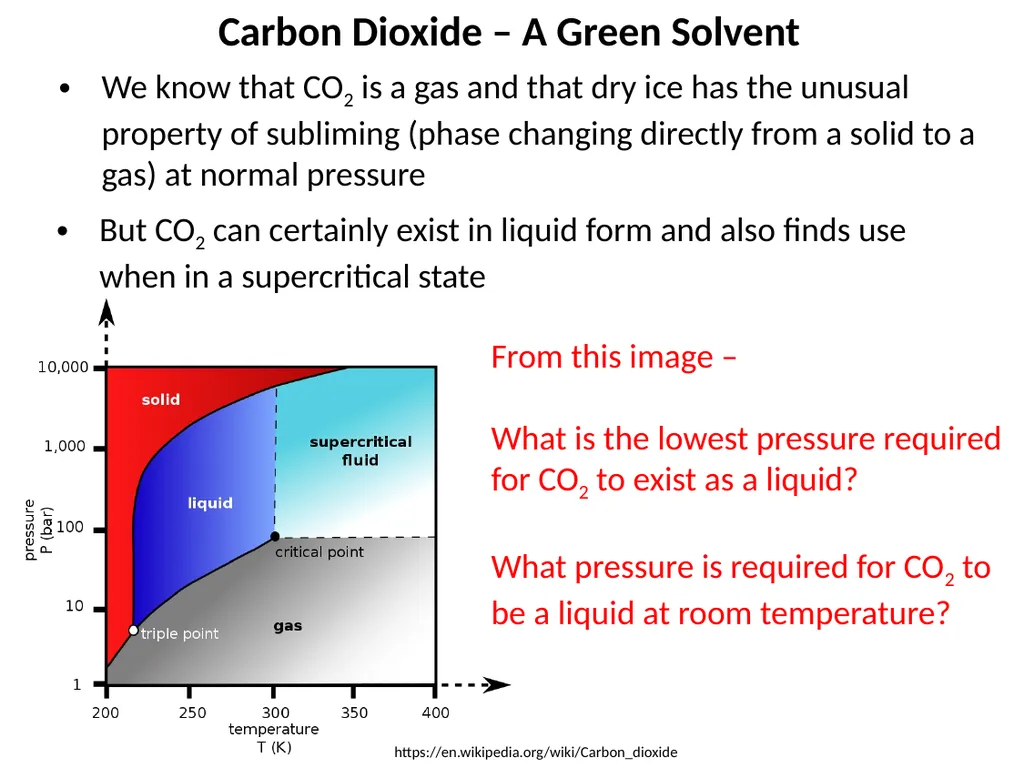
Carbon Dioxide – A Green Solvent We know that CO2 is a gas and that dry ice has the unusual property of subliming (phase changing directly from a solid to a gas) at normal pressure But CO2 can certainly exist in liquid form and also finds use when in a supercritical state https://en.wikipedia.org/wiki/Carbon_dioxide From this image –
What is the lowest pressure required for CO2 to exist as a liquid?
What pressure is required for CO2 to be a liquid at room temperature?<br>
What is the lowest pressure required for CO2 to exist as a liquid?
What pressure is required for CO2 to be a liquid at room temperature?<br>
19
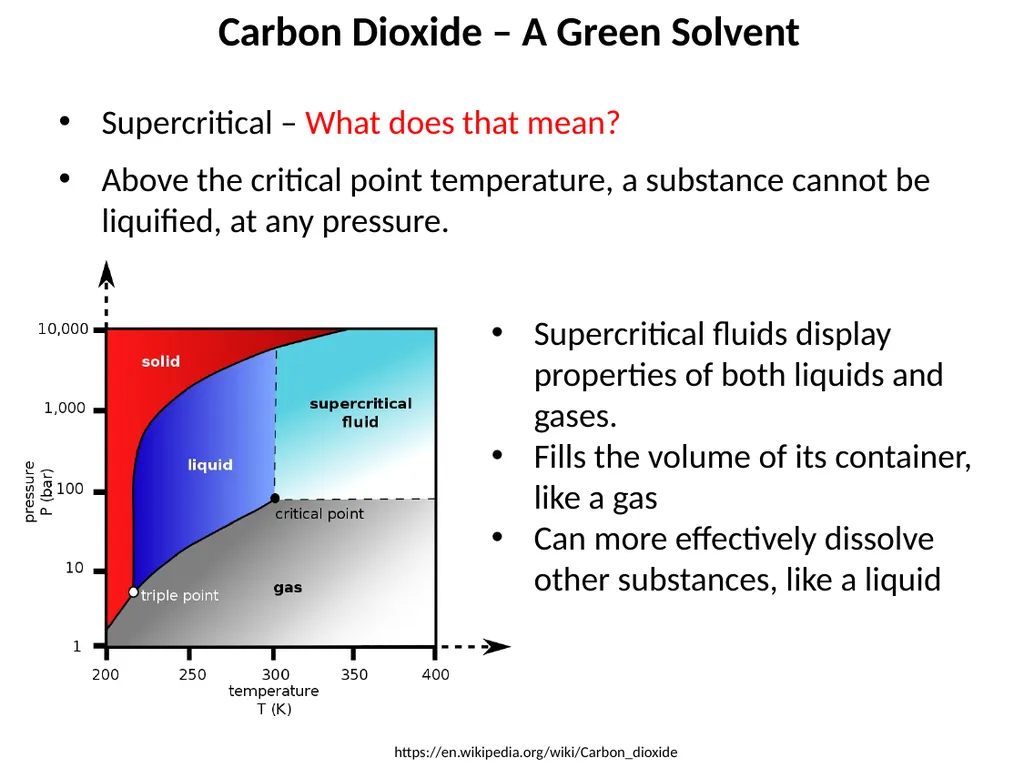
Carbon Dioxide – A Green Solvent Supercritical – What does that mean? Above the critical point temperature, a substance cannot be liquified, at any pressure. https://en.wikipedia.org/wiki/Carbon_dioxide Supercritical fluids display properties of both liquids and gases.
Fills the volume of its container, like a gas
Can more effectively dissolve other substances, like a liquid<br>
Fills the volume of its container, like a gas
Can more effectively dissolve other substances, like a liquid<br>
20
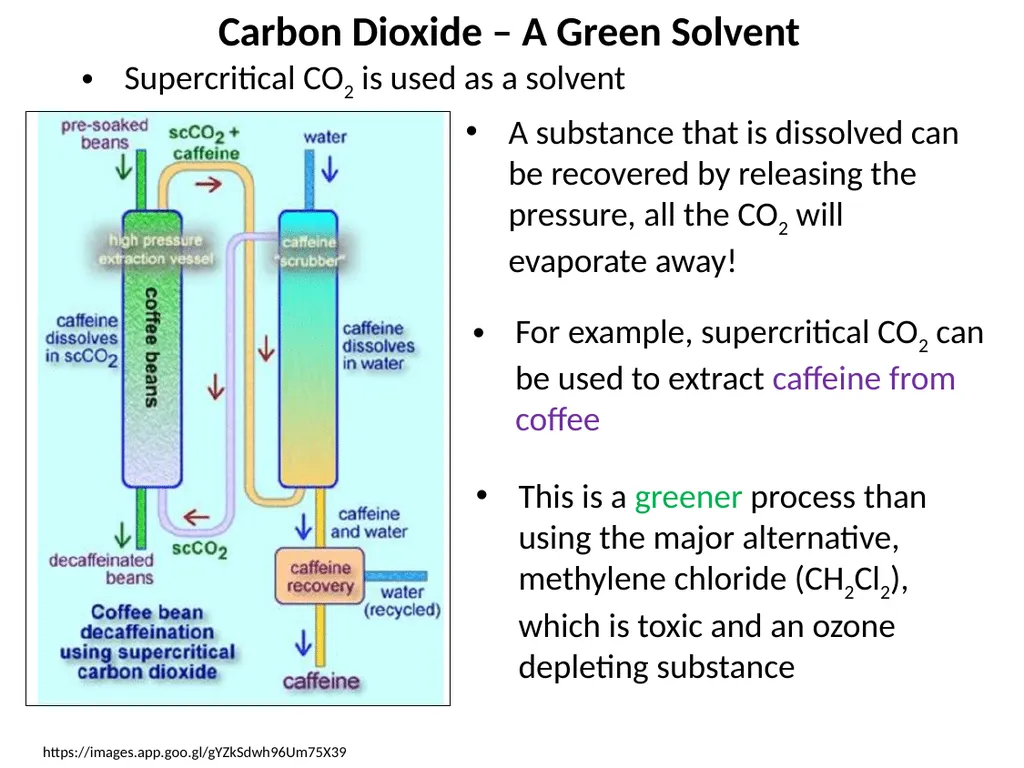
Carbon Dioxide – A Green Solvent Supercritical CO2 is used as a solvent A substance that is dissolved can be recovered by releasing the pressure, all the CO2 will evaporate away! This is a greener process than using the major alternative, methylene chloride (CH2Cl2), which is toxic and an ozone depleting substance For example, supercritical CO2 can be used to extract caffeine from coffee https://images.app.goo.gl/gYZkSdwh96Um75X39<br>
21
Carbon Dioxide – A Green Solvent Another example involves using supercritical CO2 for “dry cleaning” This is also a greener alternative to the standard solvent, perchloroethylene https://images.app.goo.gl/6jTmj8smmpxgzTxT7<br>
22
Carbon Dioxide – A Green Solvent How can using CO2 as a solvent be green? The reasoning is simple,
CO2 is obtained from the environment
If it is then, released back into the environment, there is no overall change to the amount in the environment This is very different to burning fossil fuels, which releases CO2 into the air that was not there before Most importantly, it is safe and effectively non-toxic<br>
CO2 is obtained from the environment
If it is then, released back into the environment, there is no overall change to the amount in the environment This is very different to burning fossil fuels, which releases CO2 into the air that was not there before Most importantly, it is safe and effectively non-toxic<br>