
This course constitutes a series of five training
TF
Published · 18 slides · 0 views

1 / 1



Description
This course constitutes a series of five training units which have been designed to support staff in the energy networks industry with the management of work-related fatigue. The aim of this training is to improve health and safety by
Related Topics
Share
Embed code
Download this presentation From Below
"This course constitutes a series of five training" is the property of its rightful owner. Permission is granted to download and print the materials on this website for personal, non-commercial use only, and to display it on your personal computer provided you do not modify the materials and that you retain all copyright notices contained in the materials. By downloading content from our website, you accept the terms of this agreement.
Presentation Transcript
01
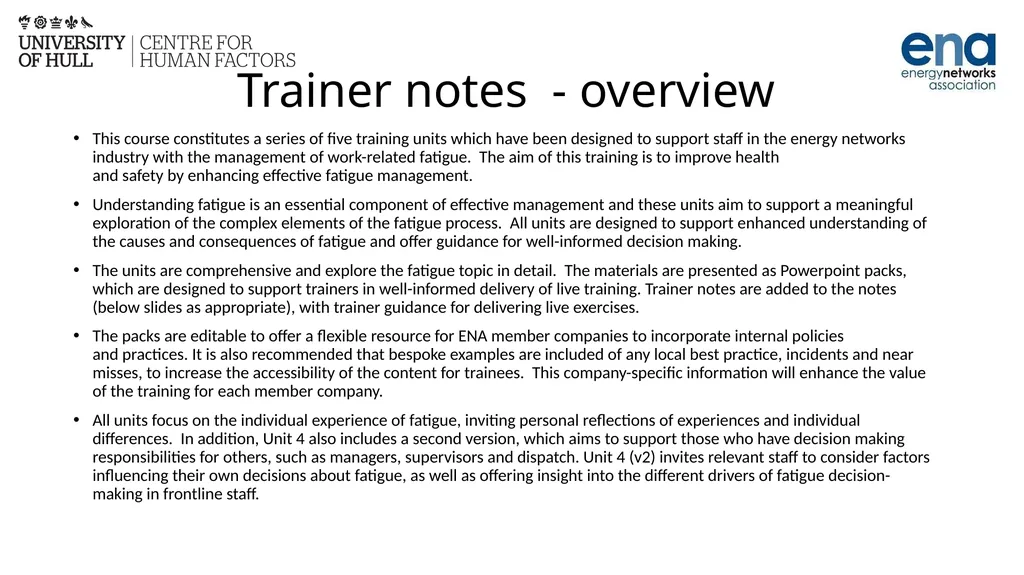
This course constitutes a series of five training units which have been designed to support staff in the energy networks industry with the management of work-related fatigue. The aim of this training is to improve health and safety by enhancing effective fatigue management.
Understanding fatigue is an essential component of effective management and these units aim to support a meaningful exploration of the complex elements of the fatigue process. All units are designed to support enhanced understanding of the causes and consequences of fatigue and offer guidance for well-informed decision making.
The units are comprehensive and explore the fatigue topic in detail. The materials are presented as Powerpoint packs, which are designed to support trainers in well-informed delivery of live training. Trainer notes are added to the notes (below slides as appropriate), with trainer guidance for delivering live exercises.
The packs are editable to offer a flexible resource for ENA member companies to incorporate internal policies and practices. It is also recommended that bespoke examples are included of any local best practice, incidents and near misses, to increase the accessibility of the content for trainees. This company-specific information will enhance the value of the training for each member company.
All units focus on the individual experience of fatigue, inviting personal reflections of experiences and individual differences. In addition, Unit 4 also includes a second version, which aims to support those who have decision making responsibilities for others, such as managers, supervisors and dispatch. Unit 4 (v2) invites relevant staff to consider factors influencing their own decisions about fatigue, as well as offering insight into the different drivers of fatigue decision-making in frontline staff. Trainer notes - overview<br>
Understanding fatigue is an essential component of effective management and these units aim to support a meaningful exploration of the complex elements of the fatigue process. All units are designed to support enhanced understanding of the causes and consequences of fatigue and offer guidance for well-informed decision making.
The units are comprehensive and explore the fatigue topic in detail. The materials are presented as Powerpoint packs, which are designed to support trainers in well-informed delivery of live training. Trainer notes are added to the notes (below slides as appropriate), with trainer guidance for delivering live exercises.
The packs are editable to offer a flexible resource for ENA member companies to incorporate internal policies and practices. It is also recommended that bespoke examples are included of any local best practice, incidents and near misses, to increase the accessibility of the content for trainees. This company-specific information will enhance the value of the training for each member company.
All units focus on the individual experience of fatigue, inviting personal reflections of experiences and individual differences. In addition, Unit 4 also includes a second version, which aims to support those who have decision making responsibilities for others, such as managers, supervisors and dispatch. Unit 4 (v2) invites relevant staff to consider factors influencing their own decisions about fatigue, as well as offering insight into the different drivers of fatigue decision-making in frontline staff. Trainer notes - overview<br>
02
Introduction to Work-Related Fatigue
Unit 1: Fatigue as a complex challenge Prepared by:
Centre for Human Factors, University of Hull
Commissioned and supported by:
Energy Networks Association
Copyright © 2024 Centre for Human Factors. All rights reserved<br>
Unit 1: Fatigue as a complex challenge Prepared by:
Centre for Human Factors, University of Hull
Commissioned and supported by:
Energy Networks Association
Copyright © 2024 Centre for Human Factors. All rights reserved<br>
03
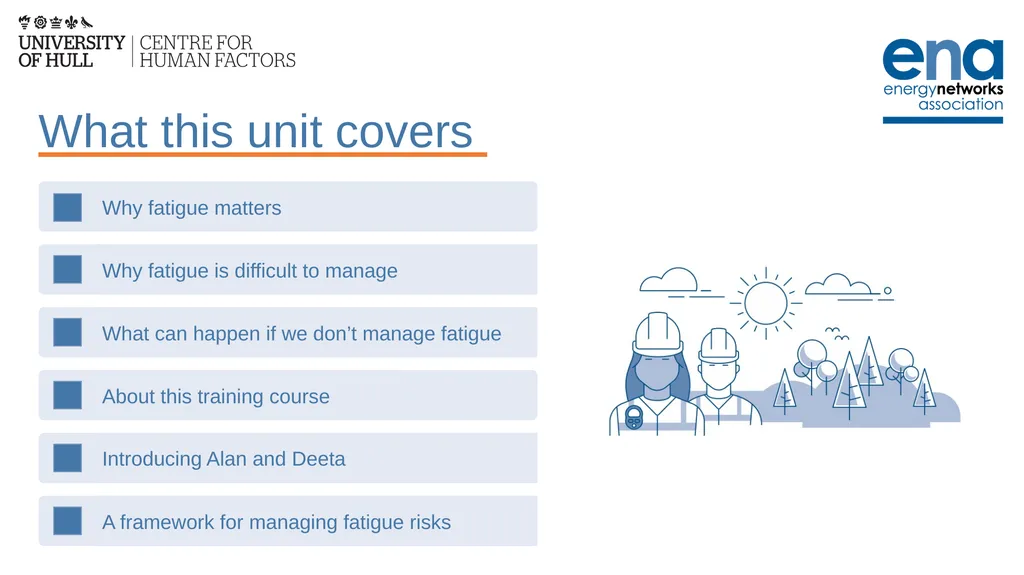
What this unit covers<br>
04
There are legal and ethical compliance requirements: Employers have a legal duty to manage risks from fatigue
Effective management of fatigue is a consideration in any work context, but most important where:
Consequently, fatigue management is a core concern in the energy networks industry
But addressing these risks is far from straightforward… Why does fatigue matter?<br>
Effective management of fatigue is a consideration in any work context, but most important where:
Consequently, fatigue management is a core concern in the energy networks industry
But addressing these risks is far from straightforward… Why does fatigue matter?<br>
05
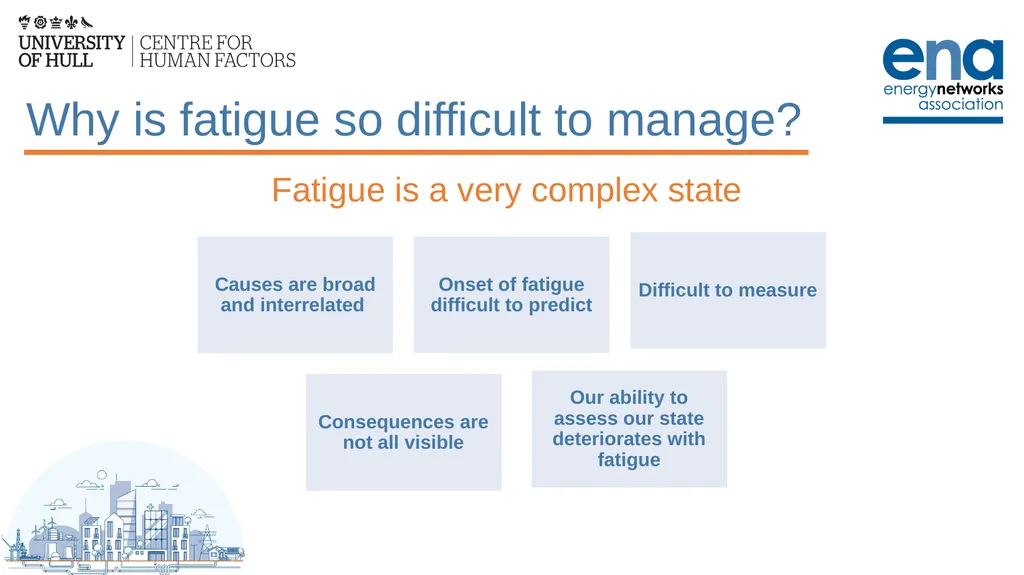
Why is fatigue so difficult to manage? Fatigue is a very complex state<br>
06
What can happen if we don’t manage fatigue? Network Rail motorway crash, June 2014 , Reading, UK
Network rail crew members driving home from shift - crashed into the back of a lorry, killing 3 members
The Role of Fatigue: Employees working into early hours, decided not to use hotel and travel fatigued
Ship's Bosun accident, February 2019, USA
The ship was instructed to secure a lifeboat on sea, when carrying out work, lifeboat descended throwing bosun overboard - fatal incident
The Role of Fatigue: In the 24hrs leading to the incident, the bosun had only 4 hours off duty, so alertness and reactions would be affected due to fatigue
Metro-rail Derailment December 2013, Rye, New York, USA
Train crashed on a bend travelling at 82 mph, 3 x the speed limit; 4 passengers killed and 75 injured.
The Role of Fatigue: The controller with an Obstructive Sleep Apnoea had just started 5am shifts, affecting his sleep pattern. The governing body provides advice on sleep disorders and fatigue but not on OSA.<br>
Network rail crew members driving home from shift - crashed into the back of a lorry, killing 3 members
The Role of Fatigue: Employees working into early hours, decided not to use hotel and travel fatigued
Ship's Bosun accident, February 2019, USA
The ship was instructed to secure a lifeboat on sea, when carrying out work, lifeboat descended throwing bosun overboard - fatal incident
The Role of Fatigue: In the 24hrs leading to the incident, the bosun had only 4 hours off duty, so alertness and reactions would be affected due to fatigue
Metro-rail Derailment December 2013, Rye, New York, USA
Train crashed on a bend travelling at 82 mph, 3 x the speed limit; 4 passengers killed and 75 injured.
The Role of Fatigue: The controller with an Obstructive Sleep Apnoea had just started 5am shifts, affecting his sleep pattern. The governing body provides advice on sleep disorders and fatigue but not on OSA.<br>
07
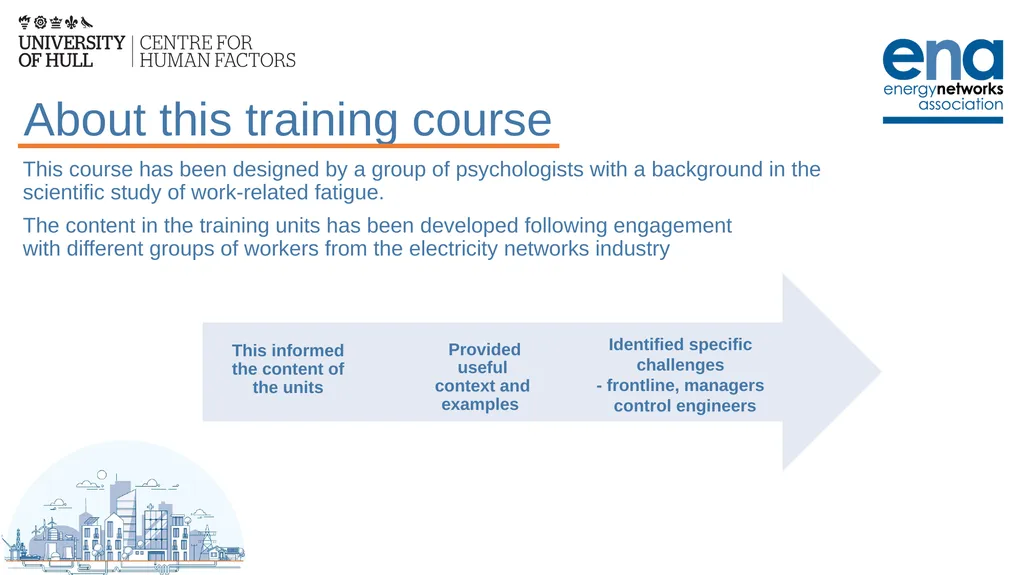
About this training course This course has been designed by a group of psychologists with a background in the scientific study of work-related fatigue.
The content in the training units has been developed following engagement with different groups of workers from the electricity networks industry<br>
The content in the training units has been developed following engagement with different groups of workers from the electricity networks industry<br>
08
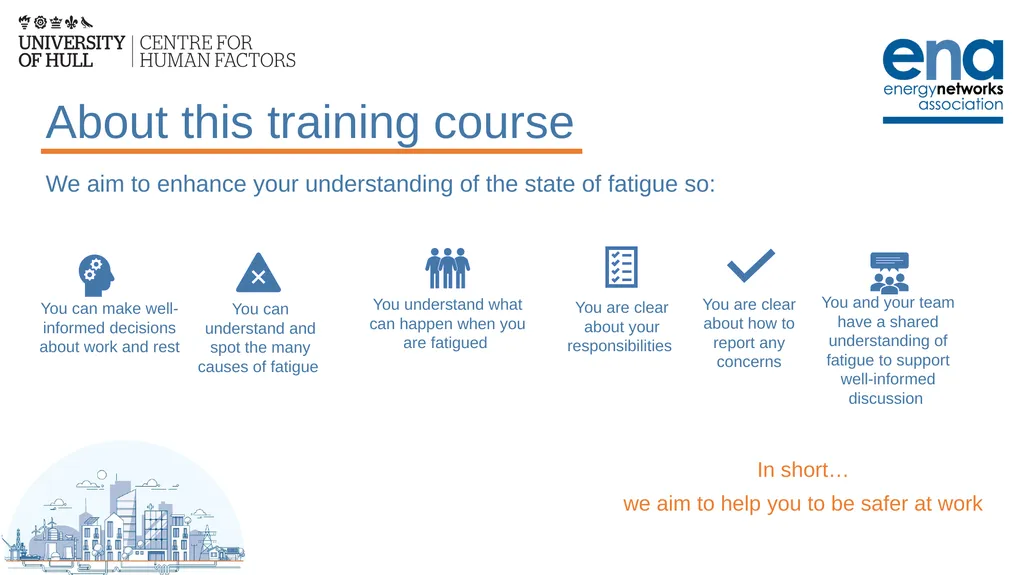
About this training course We aim to enhance your understanding of the state of fatigue so: In short…
we aim to help you to be safer at work<br>
we aim to help you to be safer at work<br>
09
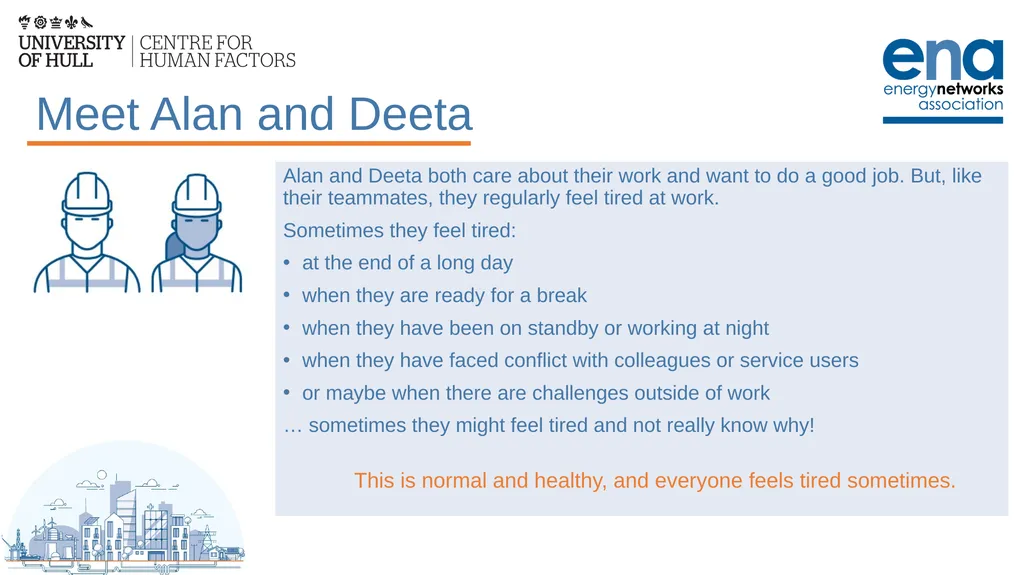
Meet Alan and Deeta Alan and Deeta both care about their work and want to do a good job. But, like their teammates, they regularly feel tired at work.
Sometimes they feel tired:
at the end of a long day
when they are ready for a break
when they have been on standby or working at night
when they have faced conflict with colleagues or service users
or maybe when there are challenges outside of work
… sometimes they might feel tired and not really know why!
This is normal and healthy, and everyone feels tired sometimes.<br>
Sometimes they feel tired:
at the end of a long day
when they are ready for a break
when they have been on standby or working at night
when they have faced conflict with colleagues or service users
or maybe when there are challenges outside of work
… sometimes they might feel tired and not really know why!
This is normal and healthy, and everyone feels tired sometimes.<br>
10
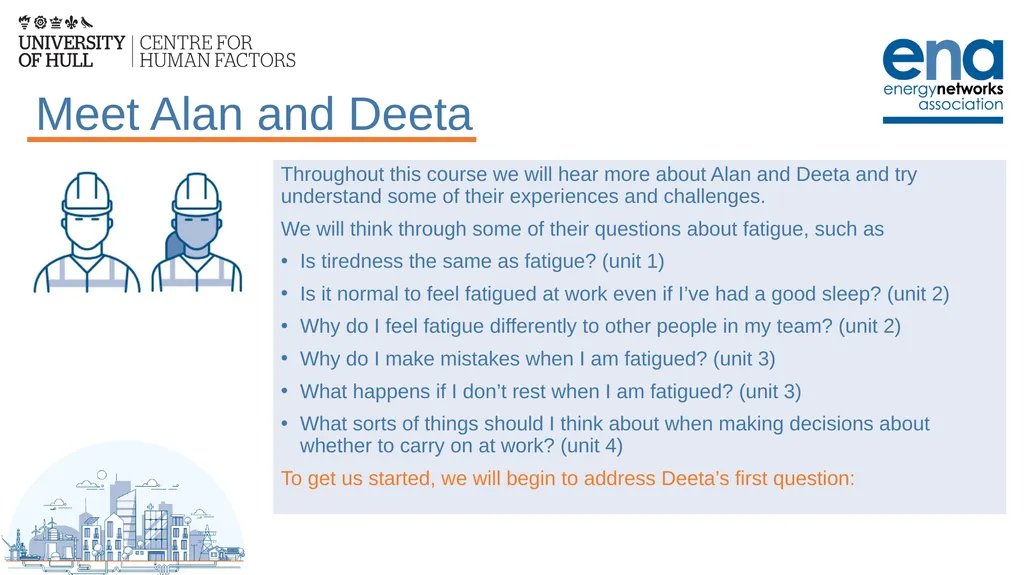
Meet Alan and Deeta Throughout this course we will hear more about Alan and Deeta and try understand some of their experiences and challenges.
We will think through some of their questions about fatigue, such as
Is tiredness the same as fatigue? (unit 1)
Is it normal to feel fatigued at work even if I’ve had a good sleep? (unit 2)
Why do I feel fatigue differently to other people in my team? (unit 2)
Why do I make mistakes when I am fatigued? (unit 3)
What happens if I don’t rest when I am fatigued? (unit 3)
What sorts of things should I think about when making decisions about whether to carry on at work? (unit 4)
To get us started, we will begin to address Deeta’s first question:<br>
We will think through some of their questions about fatigue, such as
Is tiredness the same as fatigue? (unit 1)
Is it normal to feel fatigued at work even if I’ve had a good sleep? (unit 2)
Why do I feel fatigue differently to other people in my team? (unit 2)
Why do I make mistakes when I am fatigued? (unit 3)
What happens if I don’t rest when I am fatigued? (unit 3)
What sorts of things should I think about when making decisions about whether to carry on at work? (unit 4)
To get us started, we will begin to address Deeta’s first question:<br>
11
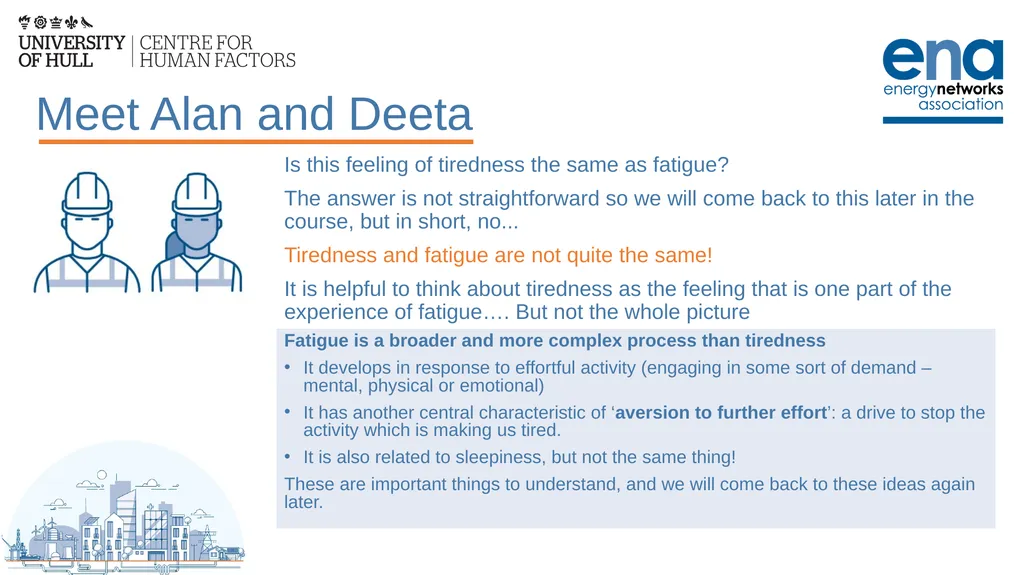
Meet Alan and Deeta Is this feeling of tiredness the same as fatigue?
The answer is not straightforward so we will come back to this later in the course, but in short, no...
Tiredness and fatigue are not quite the same!
It is helpful to think about tiredness as the feeling that is one part of the experience of fatigue…. But not the whole picture Fatigue is a broader and more complex process than tiredness
It develops in response to effortful activity (engaging in some sort of demand – mental, physical or emotional)
It has another central characteristic of ‘aversion to further effort’: a drive to stop the activity which is making us tired.
It is also related to sleepiness, but not the same thing!
These are important things to understand, and we will come back to these ideas again later.<br>
The answer is not straightforward so we will come back to this later in the course, but in short, no...
Tiredness and fatigue are not quite the same!
It is helpful to think about tiredness as the feeling that is one part of the experience of fatigue…. But not the whole picture Fatigue is a broader and more complex process than tiredness
It develops in response to effortful activity (engaging in some sort of demand – mental, physical or emotional)
It has another central characteristic of ‘aversion to further effort’: a drive to stop the activity which is making us tired.
It is also related to sleepiness, but not the same thing!
These are important things to understand, and we will come back to these ideas again later.<br>
12
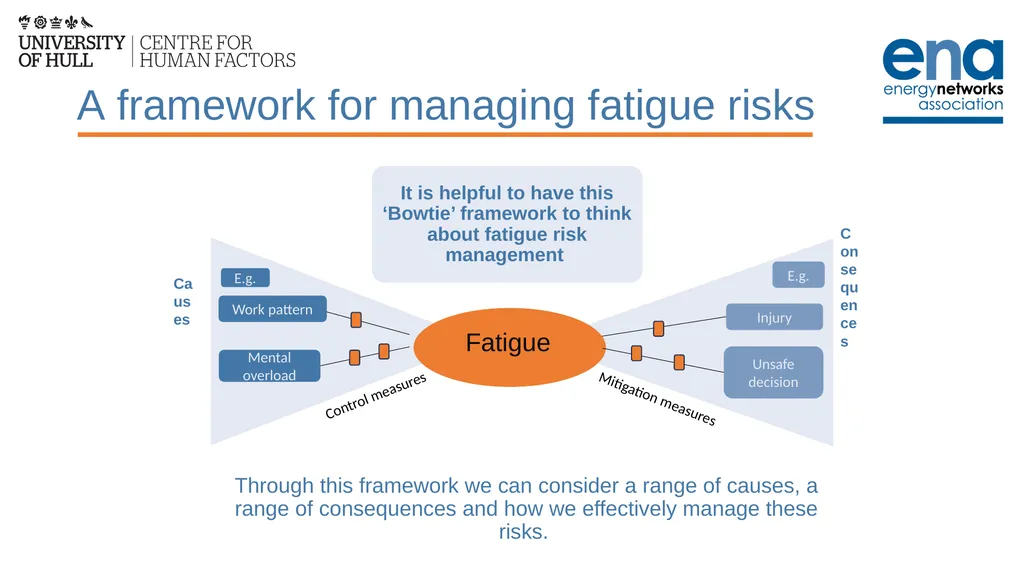
A framework for managing fatigue risks Causes Consequences Fatigue Mental overload Injury Unsafe decision Control measures E.g. E.g. Mitigation measures Through this framework we can consider a range of causes, a range of consequences and how we effectively manage these risks. Work pattern<br>
13
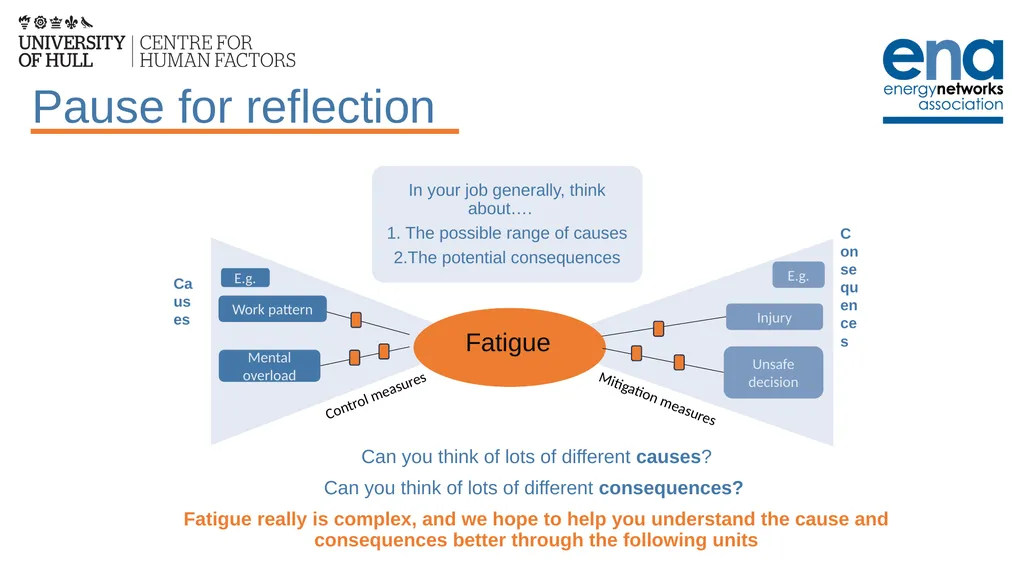
Pause for reflection Causes Consequences Fatigue Mental overload Injury Unsafe decision Control measures E.g. E.g. Mitigation measures Can you think of lots of different causes?
Can you think of lots of different consequences?
Fatigue really is complex, and we hope to help you understand the cause and consequences better through the following units Work pattern<br>
Can you think of lots of different consequences?
Fatigue really is complex, and we hope to help you understand the cause and consequences better through the following units Work pattern<br>
14
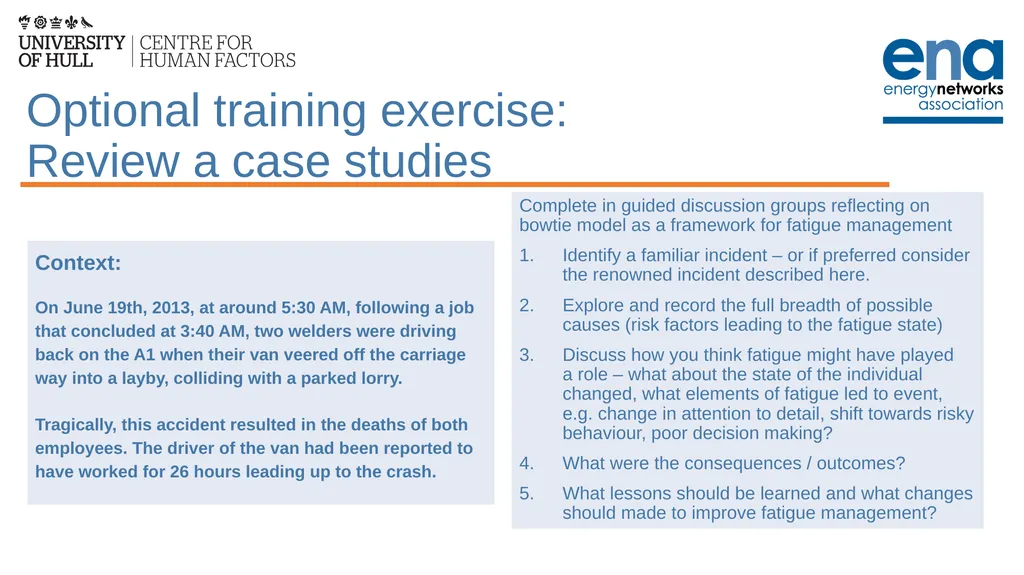
Complete in guided discussion groups reflecting on bowtie model as a framework for fatigue management
Identify a familiar incident – or if preferred consider the renowned incident described here.
Explore and record the full breadth of possible causes (risk factors leading to the fatigue state)
Discuss how you think fatigue might have played a role – what about the state of the individual changed, what elements of fatigue led to event, e.g. change in attention to detail, shift towards risky behaviour, poor decision making?
What were the consequences / outcomes?
What lessons should be learned and what changes should made to improve fatigue management? Optional training exercise: Review a case studies Context:
On June 19th, 2013, at around 5:30 AM, following a job that concluded at 3:40 AM, two welders were driving back on the A1 when their van veered off the carriage way into a layby, colliding with a parked lorry. Tragically, this accident resulted in the deaths of both employees. The driver of the van had been reported to have worked for 26 hours leading up to the crash.<br>
Identify a familiar incident – or if preferred consider the renowned incident described here.
Explore and record the full breadth of possible causes (risk factors leading to the fatigue state)
Discuss how you think fatigue might have played a role – what about the state of the individual changed, what elements of fatigue led to event, e.g. change in attention to detail, shift towards risky behaviour, poor decision making?
What were the consequences / outcomes?
What lessons should be learned and what changes should made to improve fatigue management? Optional training exercise: Review a case studies Context:
On June 19th, 2013, at around 5:30 AM, following a job that concluded at 3:40 AM, two welders were driving back on the A1 when their van veered off the carriage way into a layby, colliding with a parked lorry. Tragically, this accident resulted in the deaths of both employees. The driver of the van had been reported to have worked for 26 hours leading up to the crash.<br>
15
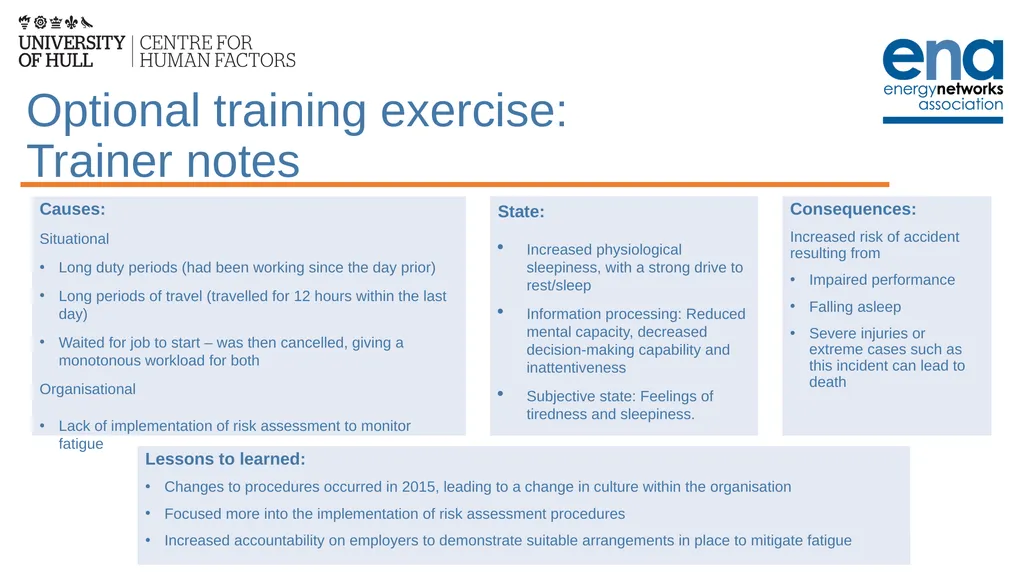
Causes:
Situational
Long duty periods (had been working since the day prior)
Long periods of travel (travelled for 12 hours within the last day)
Waited for job to start – was then cancelled, giving a monotonous workload for both
Organisational
Lack of implementation of risk assessment to monitor fatigue Optional training exercise: Trainer notes State:
Increased physiological sleepiness, with a strong drive to rest/sleep
Information processing: Reduced mental capacity, decreased decision-making capability and inattentiveness
Subjective state: Feelings of tiredness and sleepiness. Consequences:
Increased risk of accident resulting from
Impaired performance
Falling asleep
Severe injuries or extreme cases such as this incident can lead to death Lessons to learned:
Changes to procedures occurred in 2015, leading to a change in culture within the organisation
Focused more into the implementation of risk assessment procedures
Increased accountability on employers to demonstrate suitable arrangements in place to mitigate fatigue<br>
Situational
Long duty periods (had been working since the day prior)
Long periods of travel (travelled for 12 hours within the last day)
Waited for job to start – was then cancelled, giving a monotonous workload for both
Organisational
Lack of implementation of risk assessment to monitor fatigue Optional training exercise: Trainer notes State:
Increased physiological sleepiness, with a strong drive to rest/sleep
Information processing: Reduced mental capacity, decreased decision-making capability and inattentiveness
Subjective state: Feelings of tiredness and sleepiness. Consequences:
Increased risk of accident resulting from
Impaired performance
Falling asleep
Severe injuries or extreme cases such as this incident can lead to death Lessons to learned:
Changes to procedures occurred in 2015, leading to a change in culture within the organisation
Focused more into the implementation of risk assessment procedures
Increased accountability on employers to demonstrate suitable arrangements in place to mitigate fatigue<br>
16
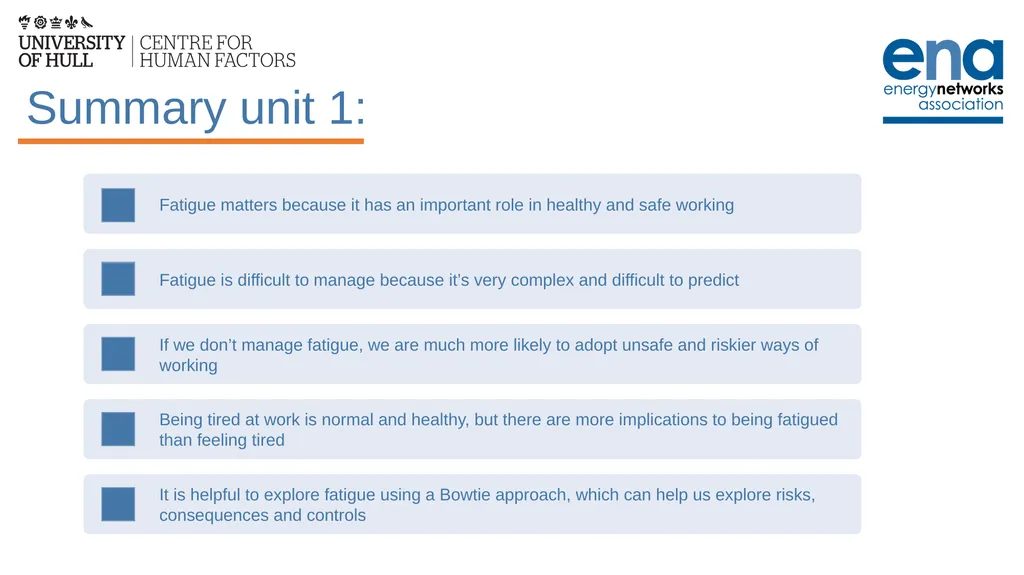
Summary unit 1:<br>
17
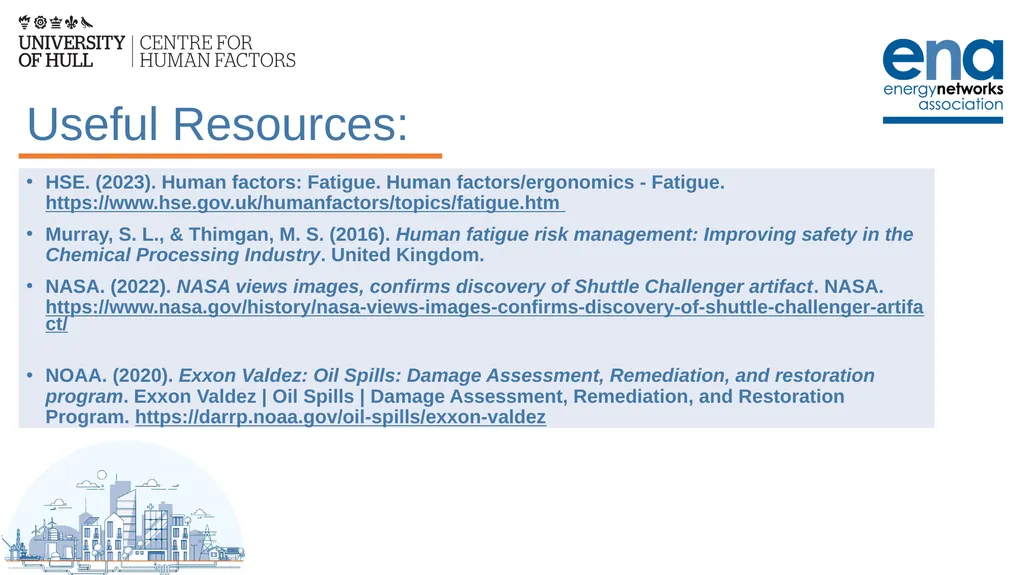
Useful Resources: HSE. (2023). Human factors: Fatigue. Human factors/ergonomics - Fatigue. https://www.hse.gov.uk/humanfactors/topics/fatigue.htm
Murray, S. L., & Thimgan, M. S. (2016). Human fatigue risk management: Improving safety in the Chemical Processing Industry. United Kingdom.
NASA. (2022). NASA views images, confirms discovery of Shuttle Challenger artifact. NASA. https://www.nasa.gov/history/nasa-views-images-confirms-discovery-of-shuttle-challenger-artifact/
NOAA. (2020). Exxon Valdez: Oil Spills: Damage Assessment, Remediation, and restoration program. Exxon Valdez | Oil Spills | Damage Assessment, Remediation, and Restoration Program. https://darrp.noaa.gov/oil-spills/exxon-valdez<br>
Murray, S. L., & Thimgan, M. S. (2016). Human fatigue risk management: Improving safety in the Chemical Processing Industry. United Kingdom.
NASA. (2022). NASA views images, confirms discovery of Shuttle Challenger artifact. NASA. https://www.nasa.gov/history/nasa-views-images-confirms-discovery-of-shuttle-challenger-artifact/
NOAA. (2020). Exxon Valdez: Oil Spills: Damage Assessment, Remediation, and restoration program. Exxon Valdez | Oil Spills | Damage Assessment, Remediation, and Restoration Program. https://darrp.noaa.gov/oil-spills/exxon-valdez<br>
18
Prepared by:
Centre for Human Factors, University of Hull
Please email humanfactors@hull.ac.uk if you have any questions about our work in fatigue
Copyright © 2024 Centre for Human Factors. All rights reserved<br>
Centre for Human Factors, University of Hull
Please email humanfactors@hull.ac.uk if you have any questions about our work in fatigue
Copyright © 2024 Centre for Human Factors. All rights reserved<br>