This document has been prepared for general guidance on matters of interest only, and does not constitute professional advice. You should not act upon the information contained in this document without obtaining specific professional
"This document has been prepared for general" is the property of its rightful owner. Permission is granted to
download and print the materials on this website for personal, non-commercial use only, and to display it
on your personal computer provided you do not modify the materials and that you retain all copyright
notices contained in the materials. By downloading content from our website, you accept the terms of this
agreement.
Presentation Transcript
01
This document has been prepared for general guidance on matters of interest only, and does not constitute professional advice. You should not act upon the information contained in this document without obtaining specific professional advice. No representation or warranty (express or implied) is given as to the accuracy or completeness of the information contained in this document, and, to the extent permitted by law, PwC, IIRC or their licensors do not accept or assume any liability, responsibility or duty of care for any consequences of you or anyone else acting, or refraining to act, in reliance on the information contained in this document or for any decision based on it.
Copyright 2014. All rights reserved. Permission is granted to make copies of these slides, provided that all logos, disclaimers, copyright notices and acknowledgements on the slides are retained, and each copy bears the following credit line: "Copyright 2014. All rights reserved. Used with permission of the IIRC and PwC." In this document, PwC refers to the PwC network and/or one or more of its member firms, each of which is a separate legal entity. Please see www.pwc.com/structure for further details. IIRC refers to the International Integrated Reporting Council.
Acknowledgements of third party source materials are contained on the relevant slides.<br>
02
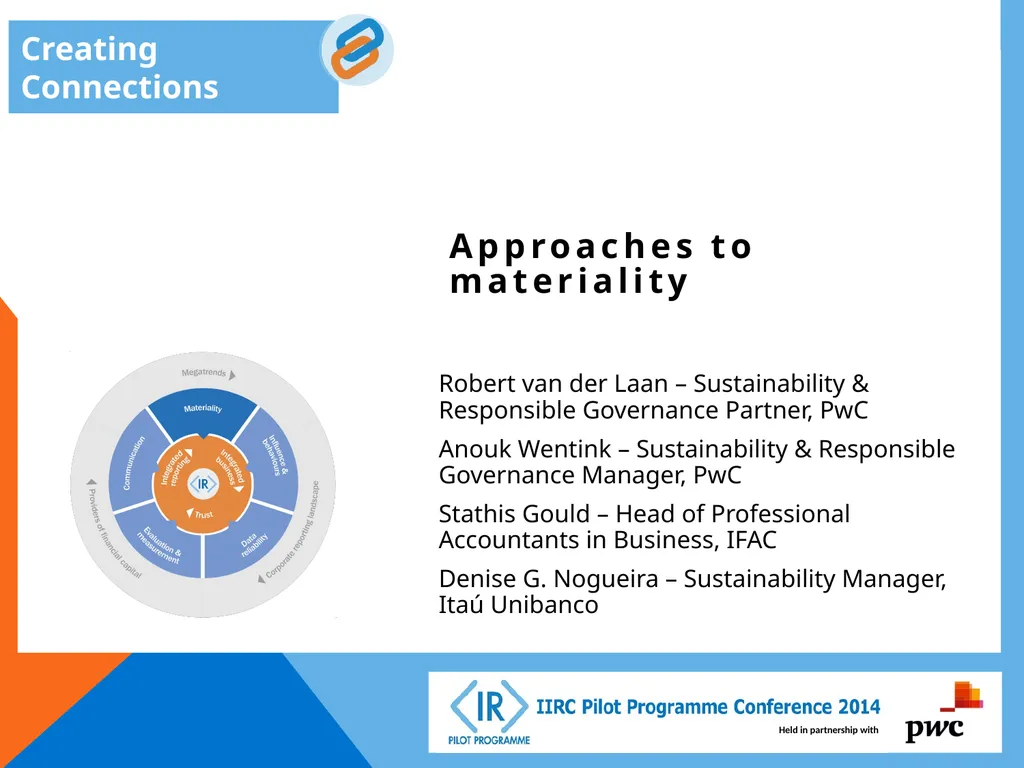
Approaches to materiality Robert van der Laan – Sustainability & Responsible Governance Partner, PwC
Anouk Wentink – Sustainability & Responsible Governance Manager, PwC
Stathis Gould – Head of Professional Accountants in Business, IFAC
Denise G. Nogueira – Sustainability Manager, Itaú Unibanco<br>
03
Overview Introduction
Methodologies
Real life case
Determining materiality for your own organization
Recap and conclusion<br>
04
Introduction<br>
05
Key objectives Understand approaches to determining materiality in the context of <IR>
Experience how to use the materiality concept
Opportunity to share your experiences and learn from others about the benefits and to tackle difficulties and challenges facing materiality
Be equipped with insight into the next steps to embed the analysis into decision-making and reporting
Be able to demonstrate materiality in an integrated report
Be familiar with the IIRC technical project<br>
06
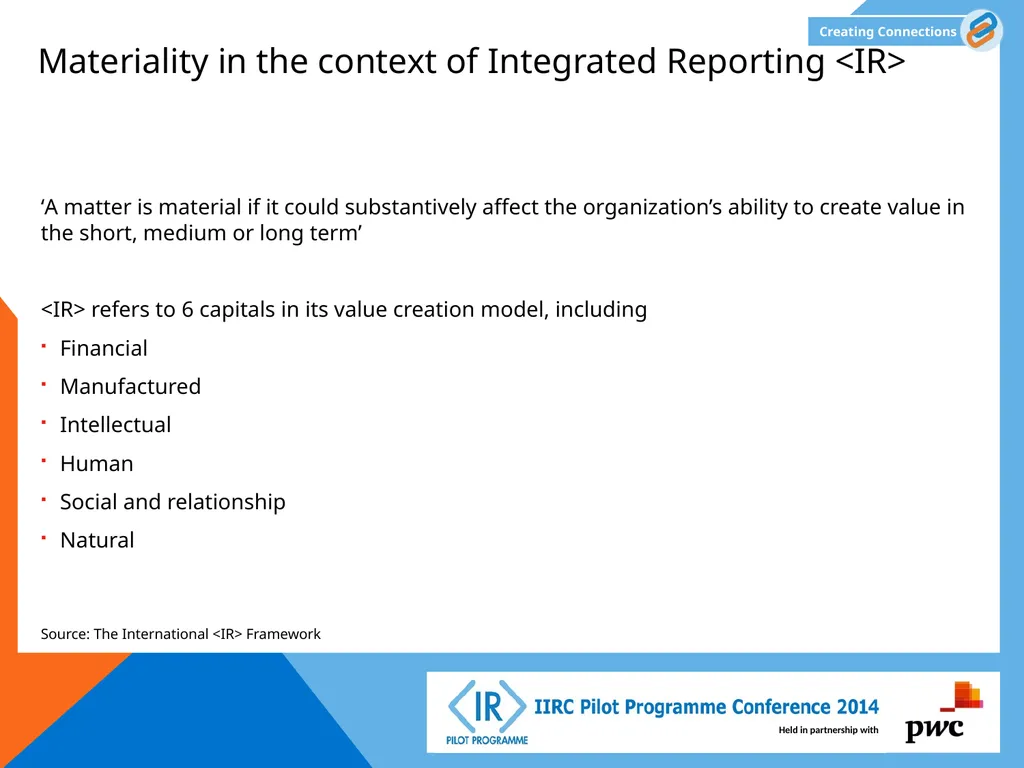
Materiality in the context of Integrated Reporting <IR> ‘A matter is material if it could substantively affect the organization’s ability to create value in the short, medium or long term’
<IR> refers to 6 capitals in its value creation model, including
Financial
Manufactured
Intellectual
Human
Social and relationship
Natural
Source: The International <IR> Framework<br>
07
Poll question 1 The most important benefit of knowing your material matters:
Answer 1 – Clarifies emerging matters
Answer 2 – Clarifies relevant information
Answer 3 – Clarifies stakeholder needs
Answer 4 – Foundation for <IR>
Answer 5 – Other<br>
08
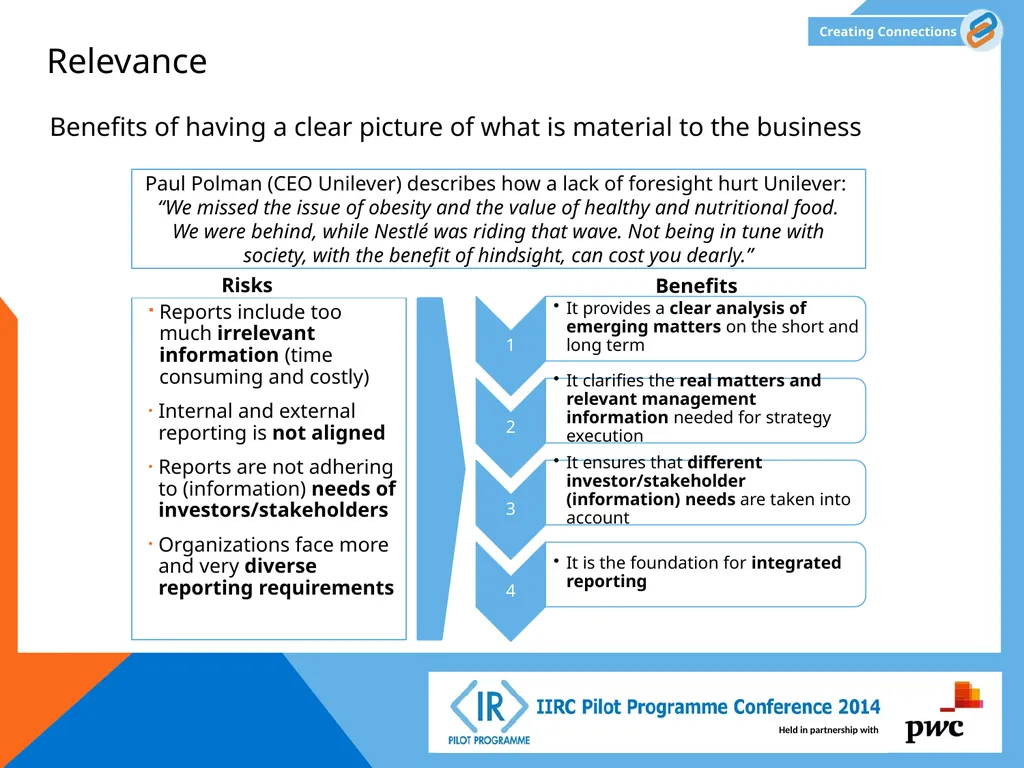
Relevance Benefits of having a clear picture of what is material to the business Reports include too much irrelevant information (time consuming and costly)
Internal and external reporting is not aligned
Reports are not adhering to (information) needs of investors/stakeholders
Organizations face more and very diverse reporting requirements Paul Polman (CEO Unilever) describes how a lack of foresight hurt Unilever: “We missed the issue of obesity and the value of healthy and nutritional food. We were behind, while Nestlé was riding that wave. Not being in tune with society, with the benefit of hindsight, can cost you dearly.” Risks Benefits<br>
09
Methodologies<br>
10
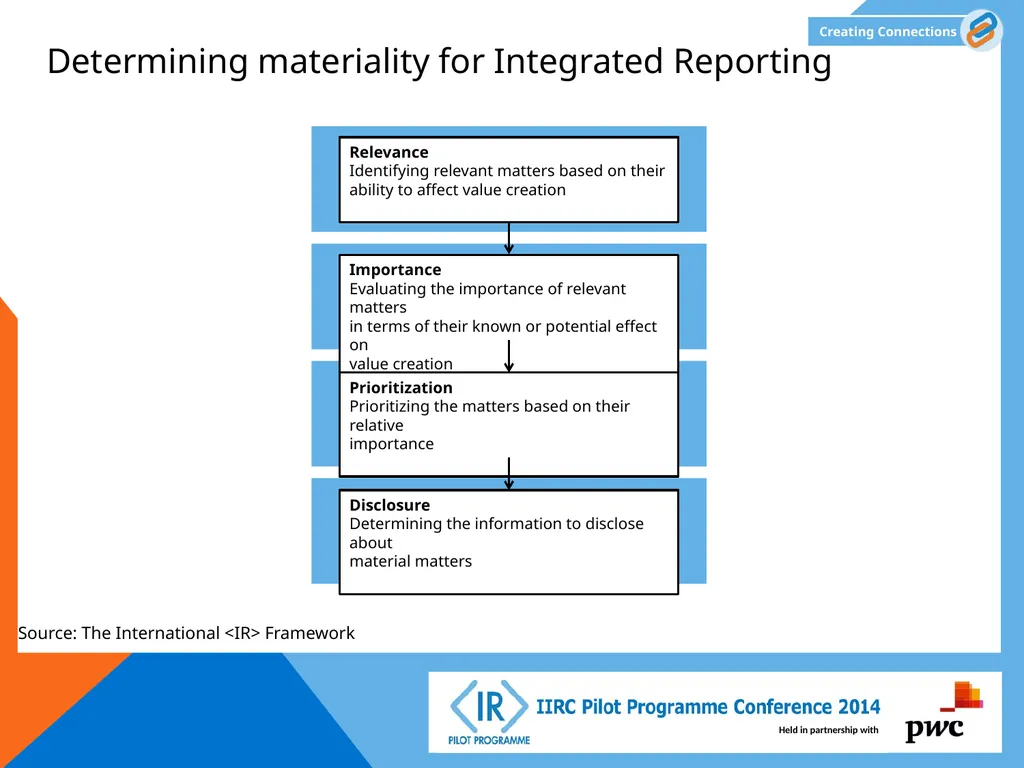
Determining materiality for Integrated Reporting Relevance
Identifying relevant matters based on their
ability to affect value creation Importance
Evaluating the importance of relevant matters
in terms of their known or potential effect on
value creation Prioritization
Prioritizing the matters based on their relative
importance Disclosure
Determining the information to disclose about
material matters Source: The International <IR> Framework<br>
11
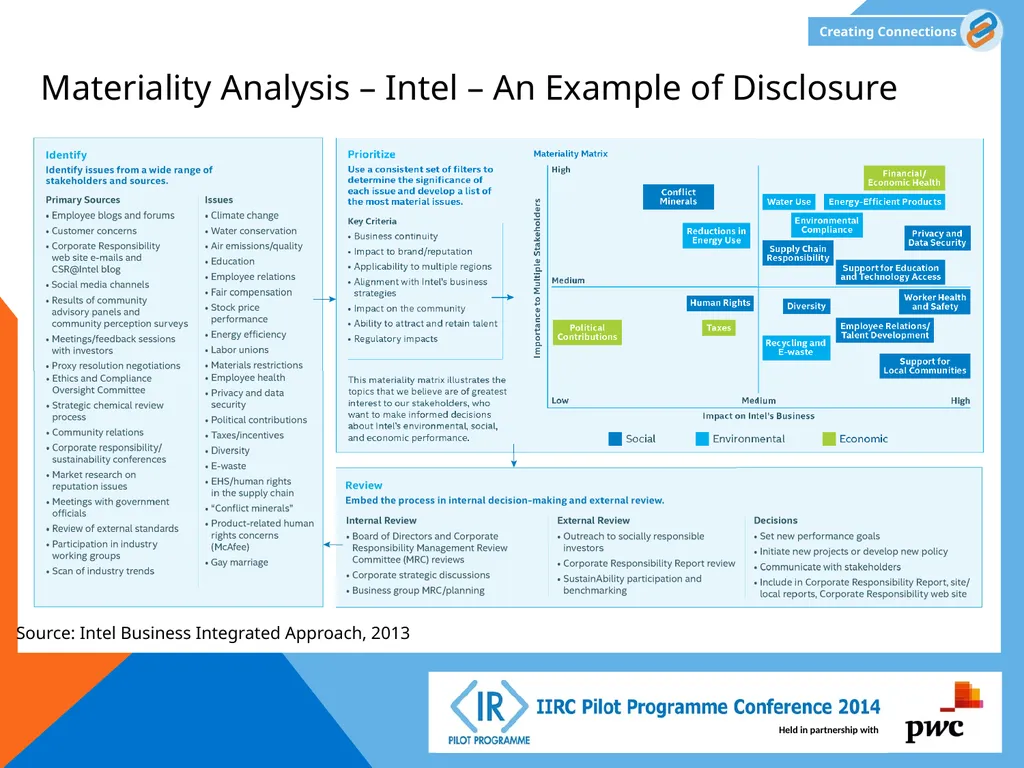
Materiality Analysis – Intel – An Example of Disclosure Source: Intel Business Integrated Approach, 2013<br>
12
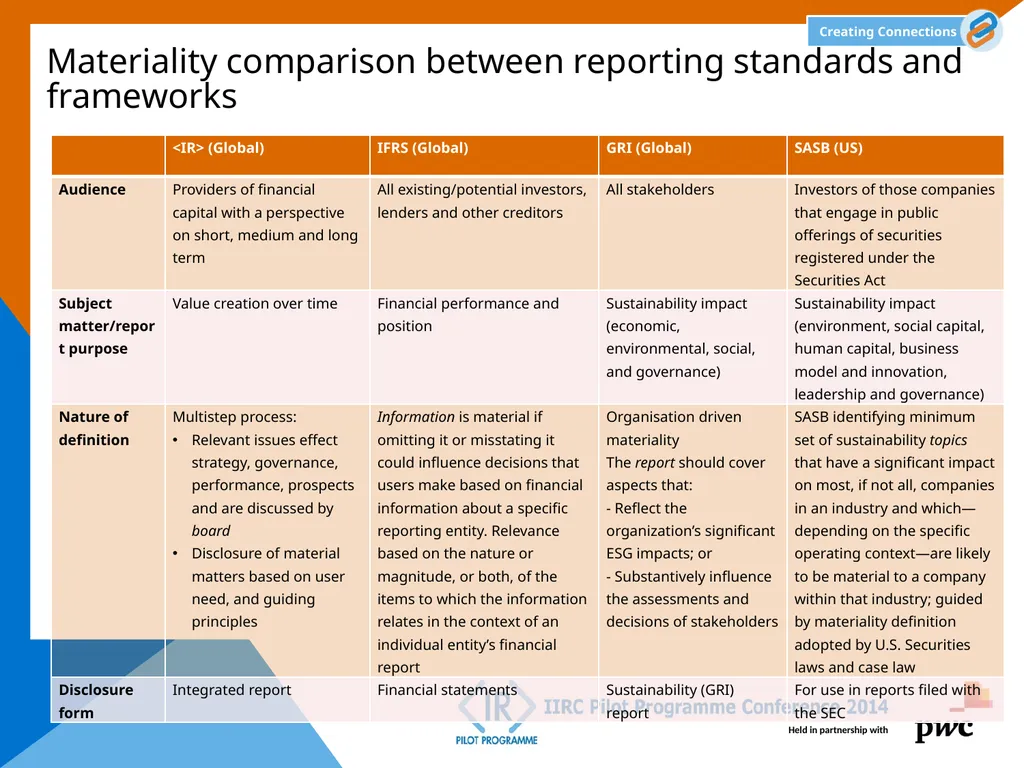
Materiality comparison between reporting standards and frameworks<br>
13
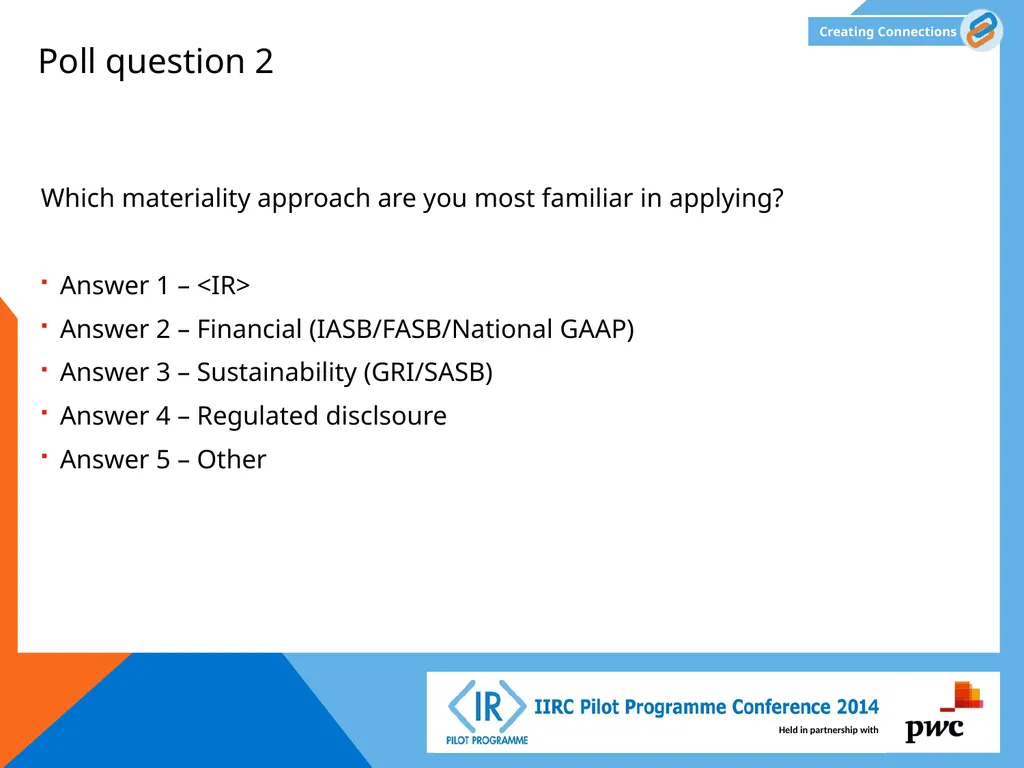
Poll question 2 Which materiality approach are you most familiar in applying?
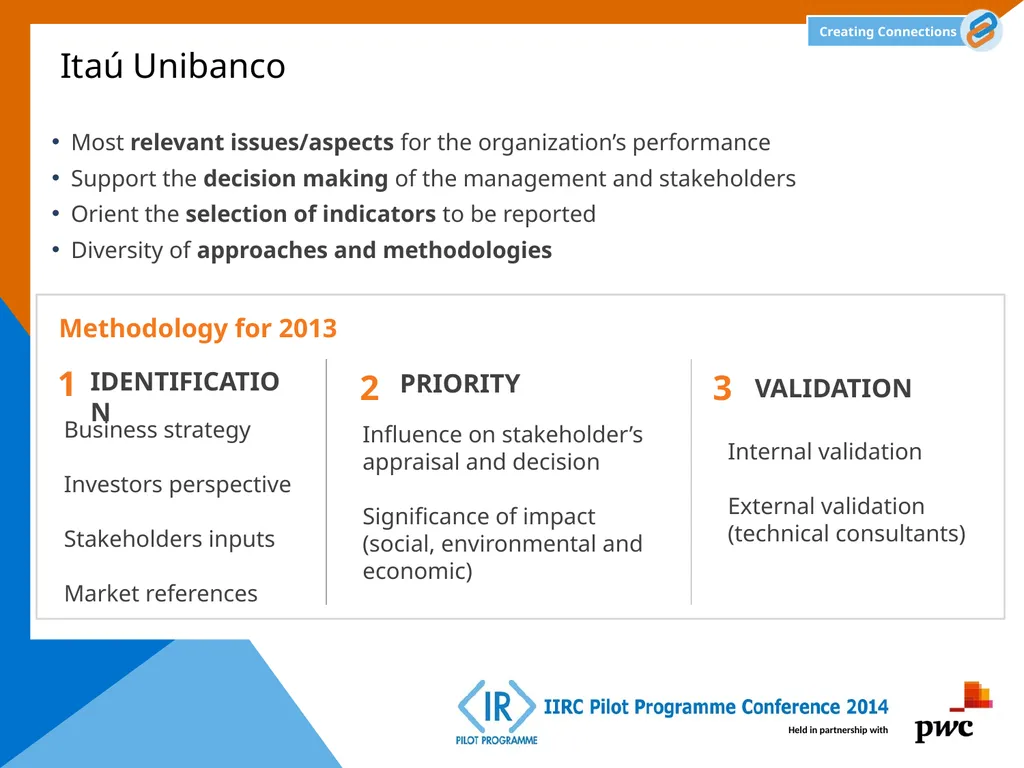
Most relevant issues/aspects for the organization’s performance
Support the decision making of the management and stakeholders
Orient the selection of indicators to be reported
Diversity of approaches and methodologies Itaú Unibanco Methodology for 2013 Business strategy
Investors perspective
Stakeholders inputs
Market references IDENTIFICATION 1 2 3 PRIORITY VALIDATION Influence on stakeholder’s appraisal and decision
Significance of impact (social, environmental and economic) Internal validation
External validation (technical consultants)<br>
16
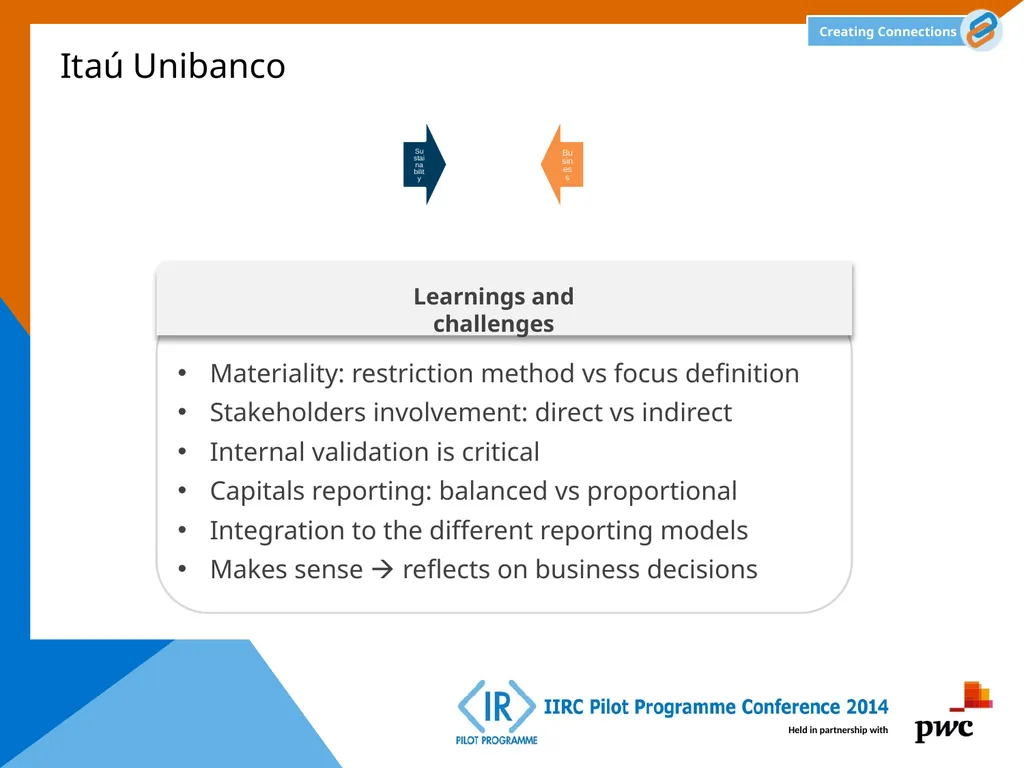
Itaú Unibanco Learnings and challenges Materiality: restriction method vs focus definition
Stakeholders involvement: direct vs indirect
Internal validation is critical
Capitals reporting: balanced vs proportional
Integration to the different reporting models
Makes sense reflects on business decisions<br>
17
Materiality for your own organization<br>
18
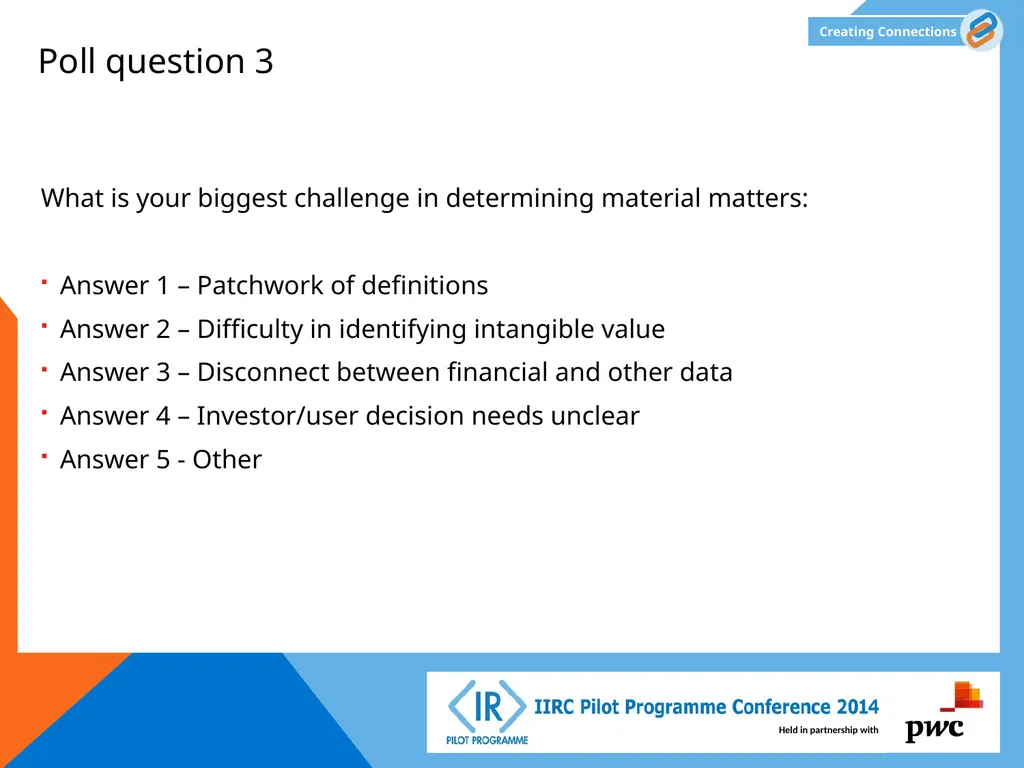
Poll question 3 What is your biggest challenge in determining material matters:
Answer 1 – Patchwork of definitions
Answer 2 – Difficulty in identifying intangible value
Answer 3 – Disconnect between financial and other data
Answer 4 – Investor/user decision needs unclear
Answer 5 - Other<br>
19
Benefits and challenges of materiality What are the benefits and challenges of determining material matters (concept and process)? Challenges Benefits<br>
20
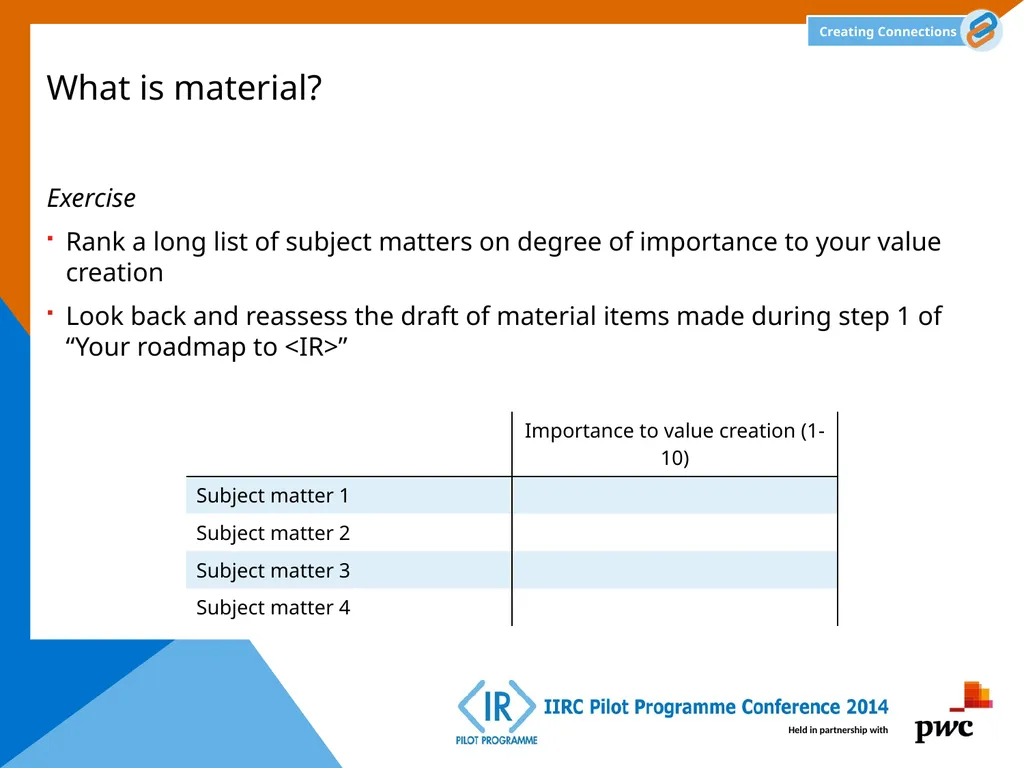
What is material? Exercise
Rank a long list of subject matters on degree of importance to your value creation
Look back and reassess the draft of material items made during step 1 of “Your roadmap to <IR>”<br>
21
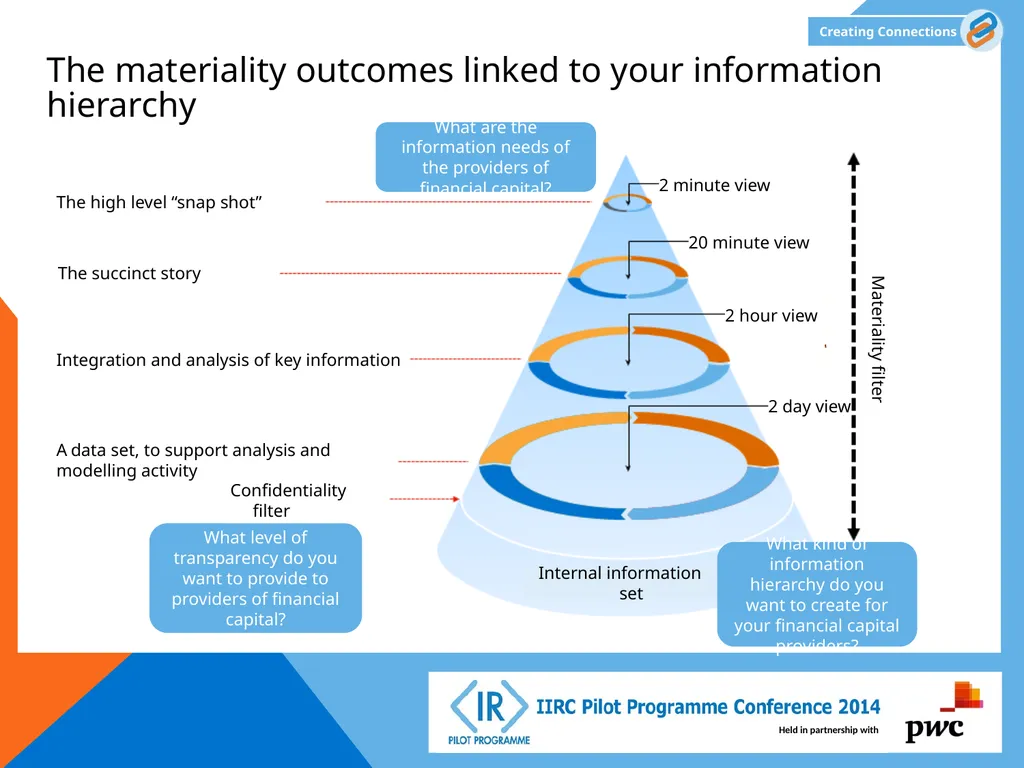
The materiality outcomes linked to your information hierarchy What are the information needs of the providers of financial capital? What kind of information hierarchy do you want to create for your financial capital providers? What level of transparency do you want to provide to providers of financial capital? The high level “snap shot” The succinct story Integration and analysis of key information A data set, to support analysis and modelling activity Confidentiality filter 2 minute view 20 minute view 2 hour view 2 day view Materiality filter Internal information set<br>
22
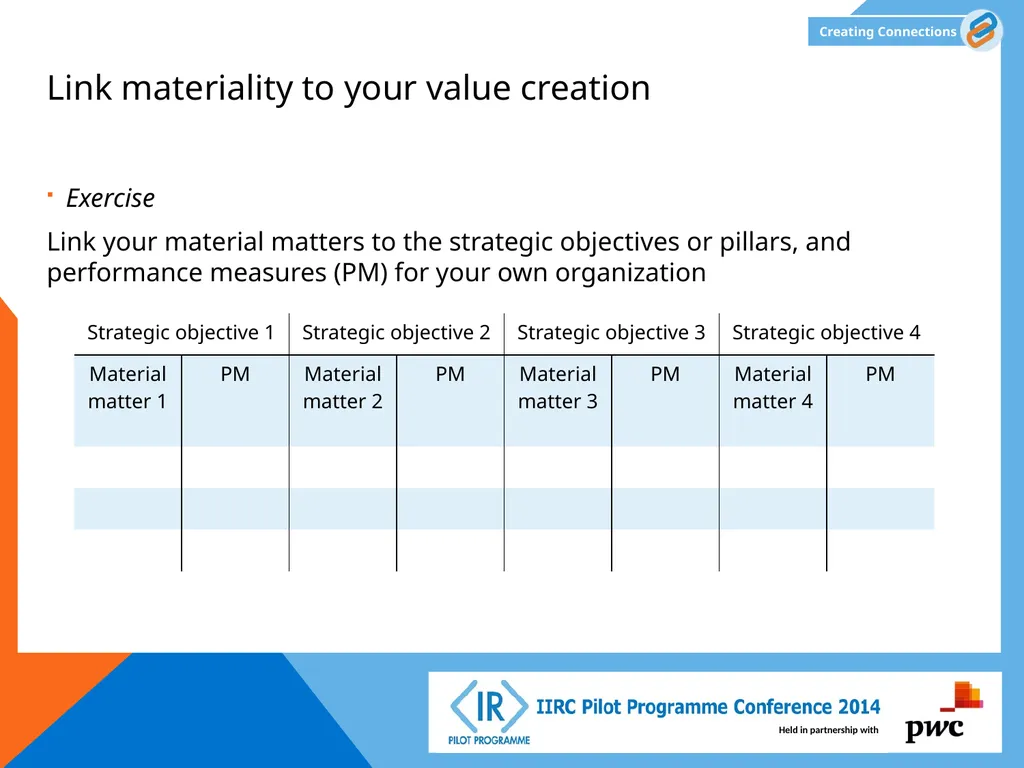
Link materiality to your value creation Exercise
Link your material matters to the strategic objectives or pillars, and performance measures (PM) for your own organization<br>
23
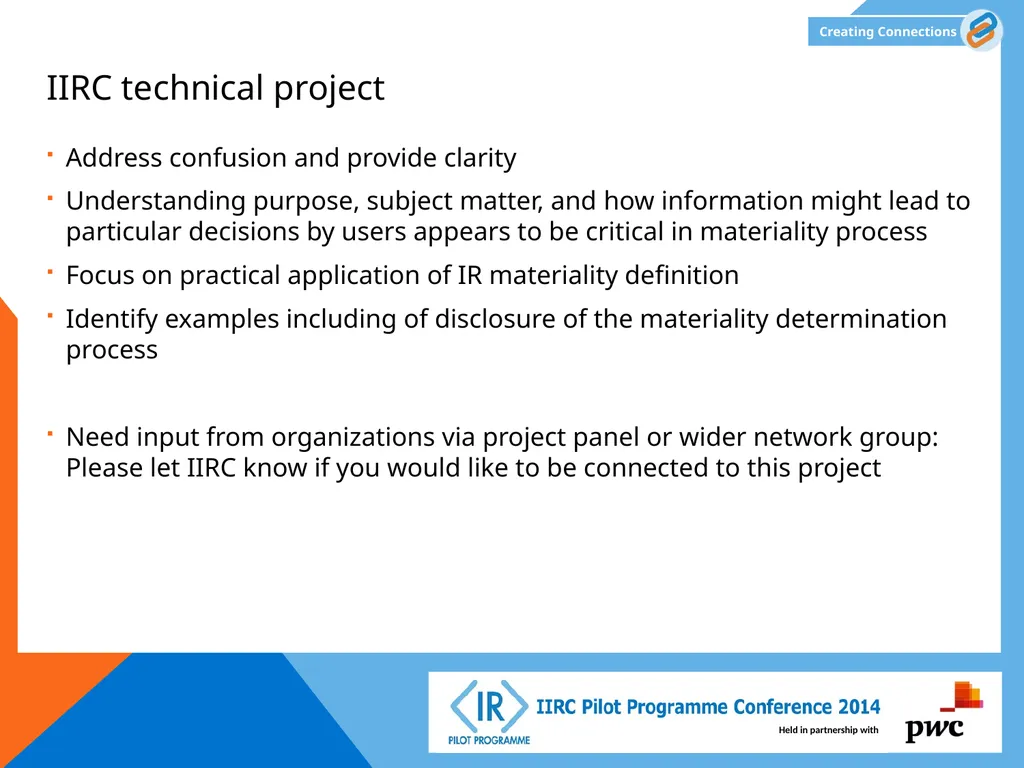
IIRC technical project Address confusion and provide clarity
Understanding purpose, subject matter, and how information might lead to particular decisions by users appears to be critical in materiality process
Focus on practical application of IR materiality definition
Identify examples including of disclosure of the materiality determination process
Need input from organizations via project panel or wider network group: Please let IIRC know if you would like to be connected to this project<br>
24
Recap and conclusion<br>
25
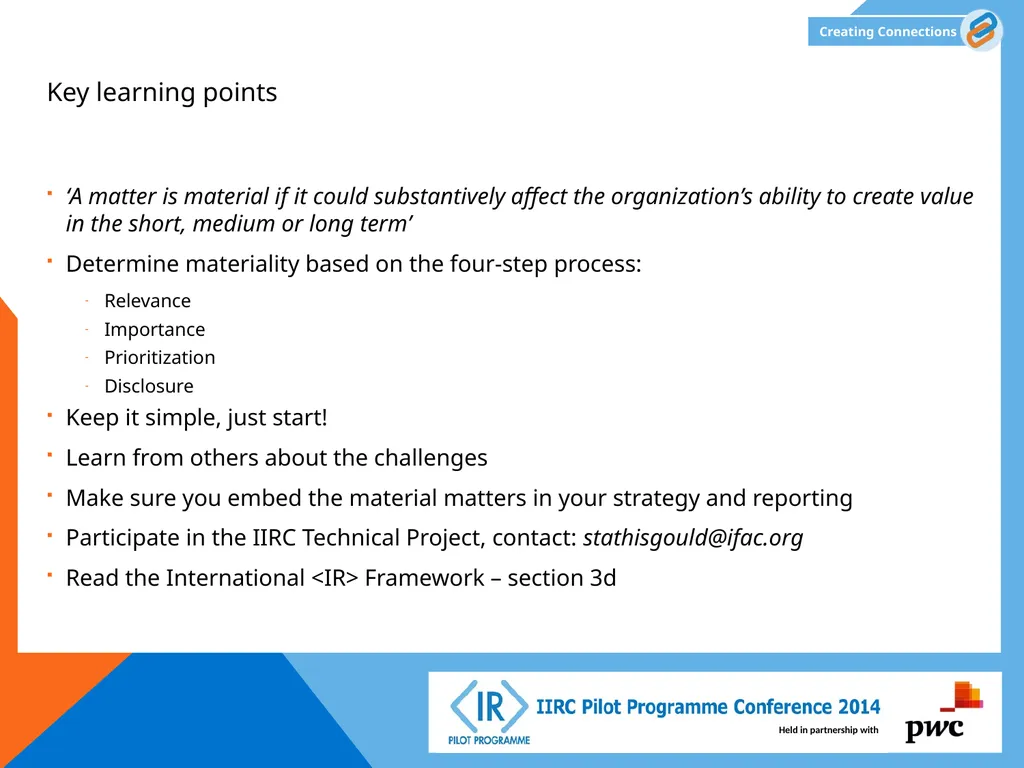
Key learning points ‘A matter is material if it could substantively affect the organization’s ability to create value in the short, medium or long term’
Determine materiality based on the four-step process:
Relevance
Importance
Prioritization
Disclosure
Keep it simple, just start!
Learn from others about the challenges
Make sure you embed the material matters in your strategy and reporting
Participate in the IIRC Technical Project, contact: stathisgould@ifac.org
Read the International <IR> Framework – section 3d<br>
26
Thank you for your participation Materiality Is Important in Preparing an Integrated Report<br>