This half term, we will be learning about the Ancient Greeks. Year 4 - History Where is Greece? Have you ever been to Greece? What do you already know about Greece? Where is Greece? Greece is a small country in south east Europe. It is a
"This half term, we will be learning about the" is the property of its rightful owner. Permission is granted to
download and print the materials on this website for personal, non-commercial use only, and to display it
on your personal computer provided you do not modify the materials and that you retain all copyright
notices contained in the materials. By downloading content from our website, you accept the terms of this
agreement.
Presentation Transcript
01
This half term, we will be learning about the Ancient Greeks. Year 4 - History<br>
02
Where is Greece? Have you ever been to Greece? What do you already know about Greece?<br>
03
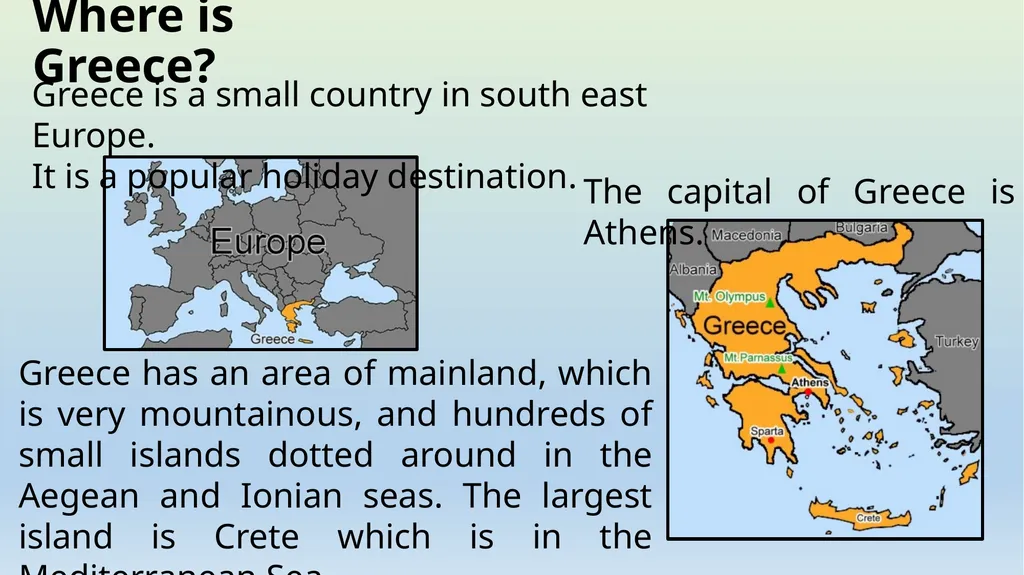
Where is Greece? Greece is a small country in south east Europe.
It is a popular holiday destination. Greece has an area of mainland, which is very mountainous, and hundreds of small islands dotted around in the Aegean and Ionian seas. The largest island is Crete which is in the Mediterranean Sea. The capital of Greece is Athens.<br>
04
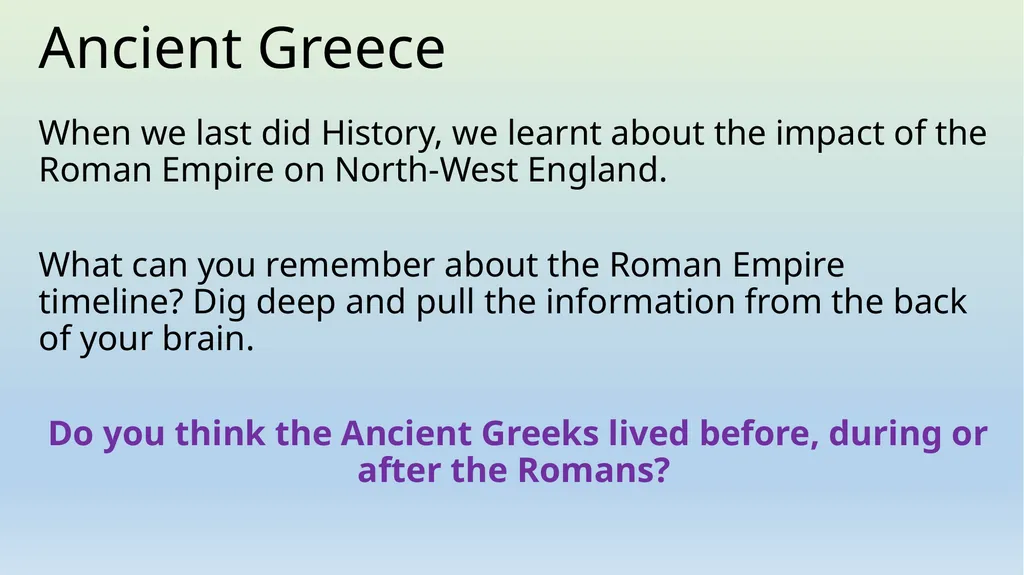
Ancient Greece When we last did History, we learnt about the impact of the Roman Empire on North-West England.
What can you remember about the Roman Empire timeline? Dig deep and pull the information from the back of your brain.
Do you think the Ancient Greeks lived before, during or after the Romans?<br>
05
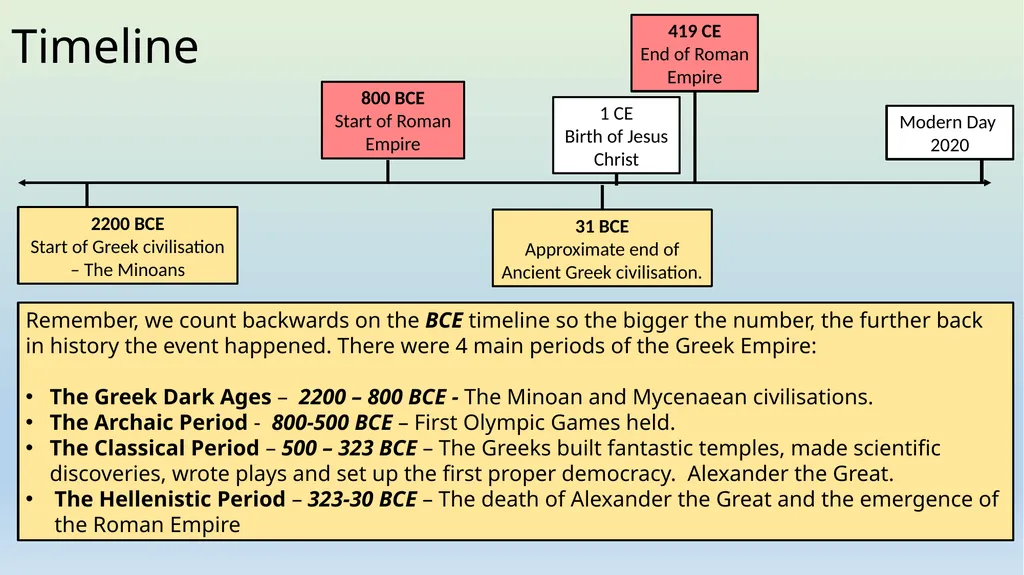
Timeline Modern Day
2020 800 BCE
Start of Roman Empire 419 CE
End of Roman Empire 2200 BCE
Start of Greek civilisation – The Minoans 31 BCE
Approximate end of Ancient Greek civilisation. Remember, we count backwards on the BCE timeline so the bigger the number, the further back in history the event happened. There were 4 main periods of the Greek Empire:
The Greek Dark Ages – 2200 – 800 BCE - The Minoan and Mycenaean civilisations.
The Archaic Period - 800-500 BCE – First Olympic Games held.
The Classical Period – 500 – 323 BCE – The Greeks built fantastic temples, made scientific discoveries, wrote plays and set up the first proper democracy. Alexander the Great.
The Hellenistic Period – 323-30 BCE – The death of Alexander the Great and the emergence of the Roman Empire<br>
06
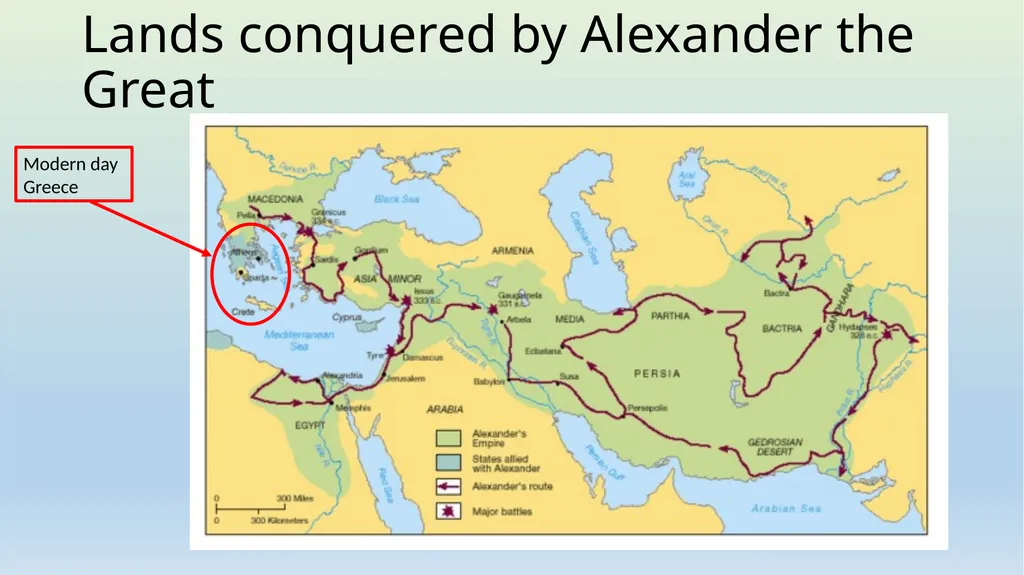
Lands conquered by Alexander the Great Modern day Greece<br>
07
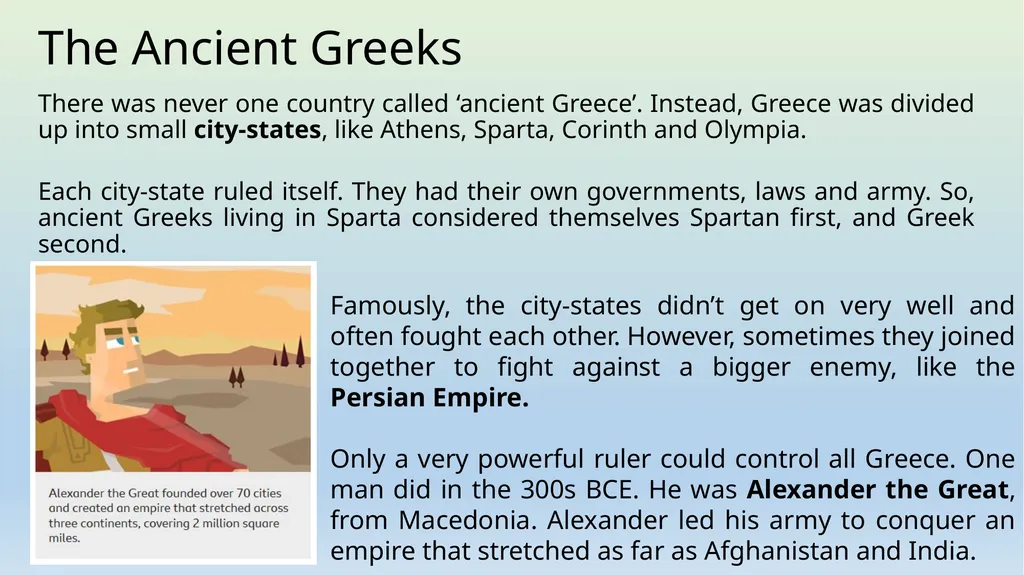
The Ancient Greeks There was never one country called ‘ancient Greece’. Instead, Greece was divided up into small city-states, like Athens, Sparta, Corinth and Olympia.
Each city-state ruled itself. They had their own governments, laws and army. So, ancient Greeks living in Sparta considered themselves Spartan first, and Greek second. Famously, the city-states didn’t get on very well and often fought each other. However, sometimes they joined together to fight against a bigger enemy, like the Persian Empire.
Only a very powerful ruler could control all Greece. One man did in the 300s BCE. He was Alexander the Great, from Macedonia. Alexander led his army to conquer an empire that stretched as far as Afghanistan and India.<br>
08
There is an enormous amount of information available about the ancient Greeks. Here are some websites you might like to look at to find out more: https://www.bbc.co.uk/bitesize/topics/z87tn39/articles/zxytpv4
https://www.dkfindout.com/uk/history/ancient-greece/ Activity: Read a bit more about the ancient Greeks. Create a fact file or an informative poster showing what you have found out about the ancient Greeks.<br>
09
I hope you enjoyed finding out about the ancient Greeks.
In the next lesson, we will be looking at how the ancient Greeks have impacted our lives today.<br>