This material was produced under grant number SH-22316-SH-1 from the Occupational Safety and Health Administration, U.S. Department of Labor. It does not necessarily reflect the views or policies of the U.S. Department of Labor, nor does
"This material was produced under grant number" is the property of its rightful owner. Permission is granted to
download and print the materials on this website for personal, non-commercial use only, and to display it
on your personal computer provided you do not modify the materials and that you retain all copyright
notices contained in the materials. By downloading content from our website, you accept the terms of this
agreement.
Presentation Transcript
01
This material was produced under grant number SH-22316-SH-1 from the Occupational Safety and Health Administration, U.S. Department of Labor. It does not necessarily reflect the views or policies of the U.S. Department of Labor, nor does mention of trade names, commercial products, or organizations imply endorsement by the U.S. Government. Mistake Proofing (Poke Yoke) Presented By The University of Texas-School of Public Health<br>
02
By the end of this module participants should be able to:
Identify the concept and importance of mistake proofing (poke yoke)
Apply Poke Yoke methods as a control on identified key Xs to reduce or eliminate process errors and defects from occurring
Select the appropriate strategies and methods for mistake proofing based on DMAIC Implementation road map Learning Objectives<br>
03
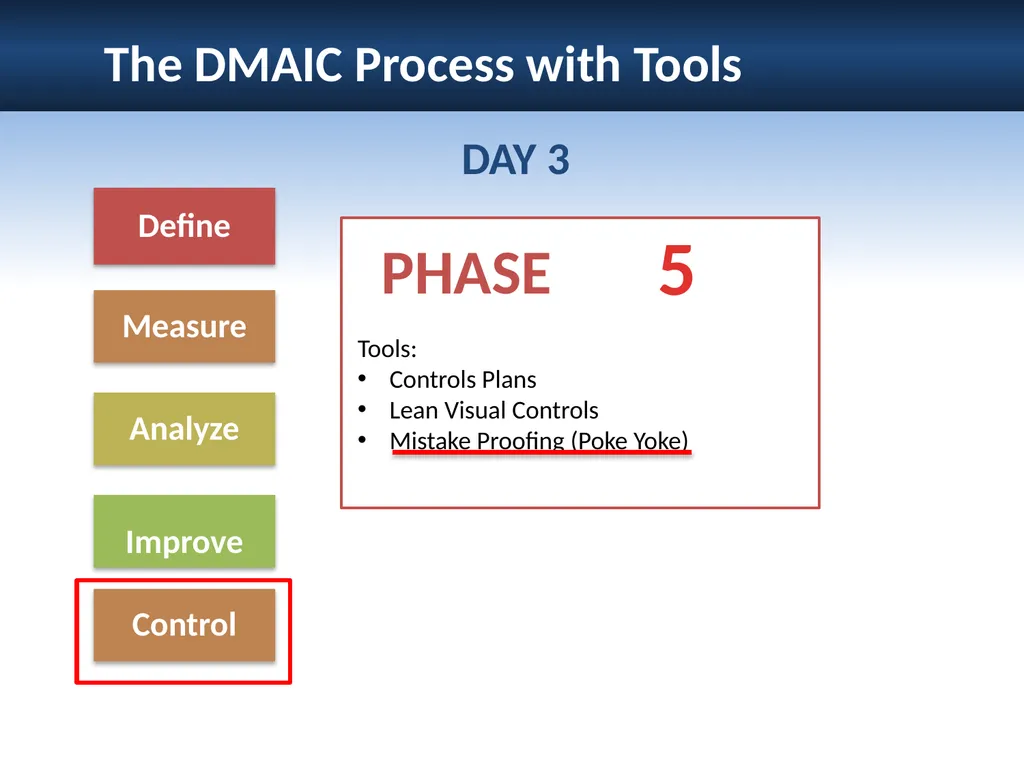
Define Measure Analyze Improve Control The DMAIC Process with Tools DAY 3<br>
04
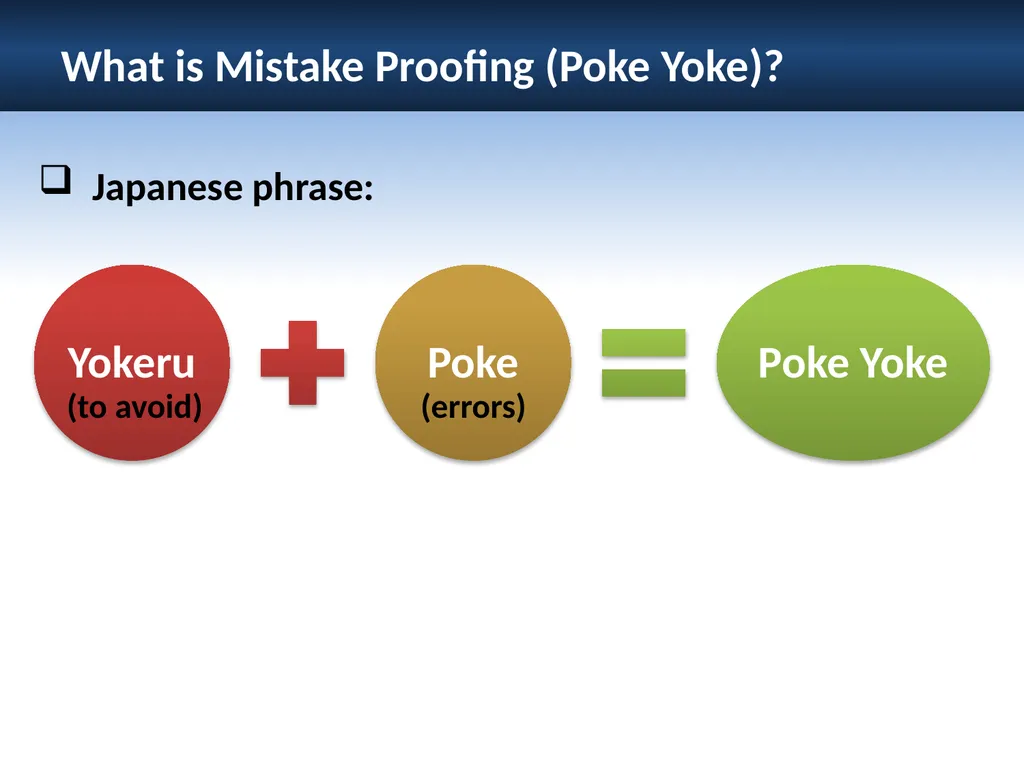
What is Mistake Proofing (Poke Yoke)? Japanese phrase: Yokeru Poke Poke Yoke (to avoid) (errors)<br>
05
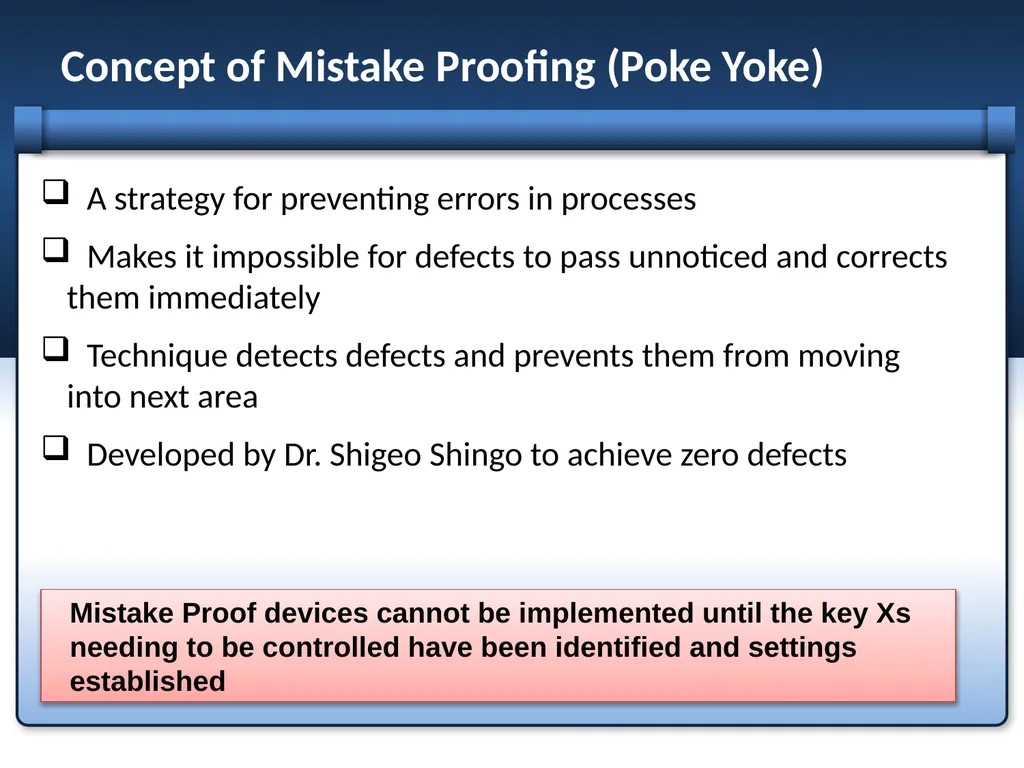
Concept of Mistake Proofing (Poke Yoke) A strategy for preventing errors in processes
Makes it impossible for defects to pass unnoticed and corrects them immediately
Technique detects defects and prevents them from moving into next area
Developed by Dr. Shigeo Shingo to achieve zero defects Mistake Proof devices cannot be implemented until the key Xs
needing to be controlled have been identified and settings
established<br>
06
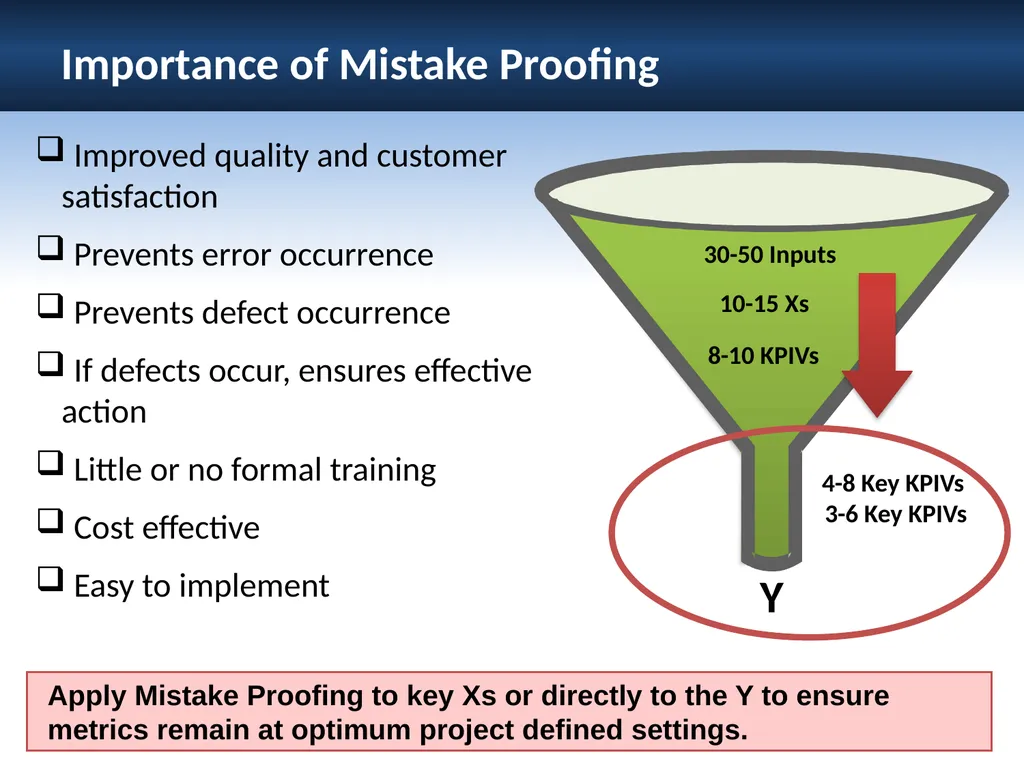
Importance of Mistake Proofing Improved quality and customer satisfaction
Prevents error occurrence
Prevents defect occurrence
If defects occur, ensures effective action
Little or no formal training
Cost effective
Easy to implement Apply Mistake Proofing to key Xs or directly to the Y to ensure
metrics remain at optimum project defined settings.<br>
07
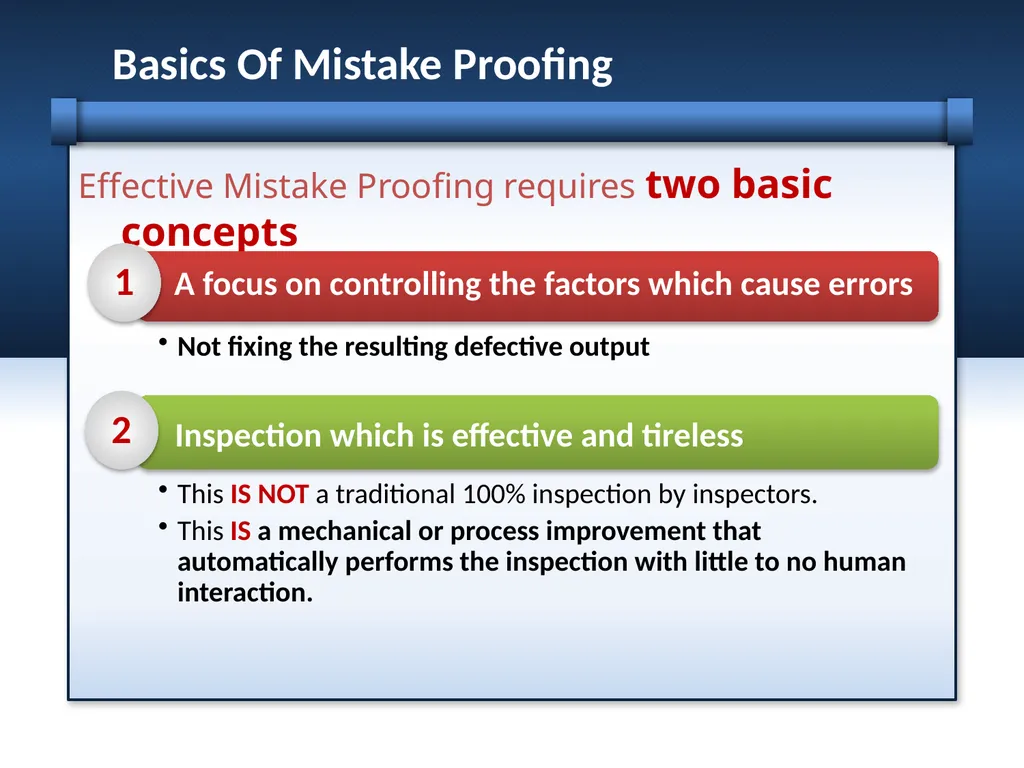
Basics Of Mistake Proofing Effective Mistake Proofing requires two basic concepts Not fixing the resulting defective output This IS NOT a traditional 100% inspection by inspectors.
This IS a mechanical or process improvement that automatically performs the inspection with little to no human interaction. A focus on controlling the factors which cause errors Inspection which is effective and tireless<br>
08
Basics Of Mistake Proofing Anybody can and should practice poke yoke in the workplace.
It’s not rocket science!
Sometimes it just needs common sense and the appropriate poke yoke device.
Poke yoke devices should have the following characteristics:
Useable by all workers
Simple to install
Does not require continuous attention from the operator (ideally, it should work even if the operator is not aware of it)
Low-cost
Provides instantaneous feedback, prevention, or correction. A lot of Shingo's poke yoke devices cost less than $50!<br>
09
Common Examples Of Mistake Proofing Home
auto shut off on iron
Auto
car won’t start unless transmission is in park/neutral
Sport/Recreation
dead man’s lanyard on personal watercraft
Amusement Parks
sensors on roller coaster tracks
Work/Commerce
pull down menus on forms<br>
10
Mistake Proofing Business Processes Mistake Proofing is the primary means of control for many business processes. Spell check
Checklists
Color coding (boxes, work areas, products, components)
Pull down menus
Required fields<br>
11
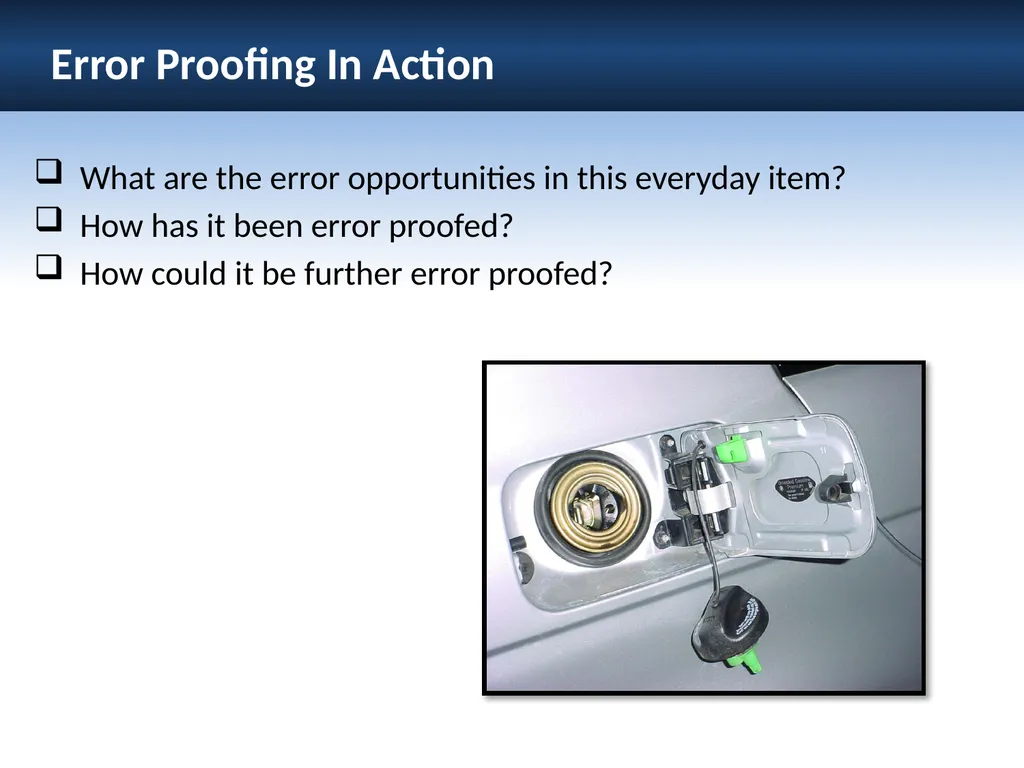
Error Proofing In Action What are the error opportunities in this everyday item?
How has it been error proofed?
How could it be further error proofed?<br>
12
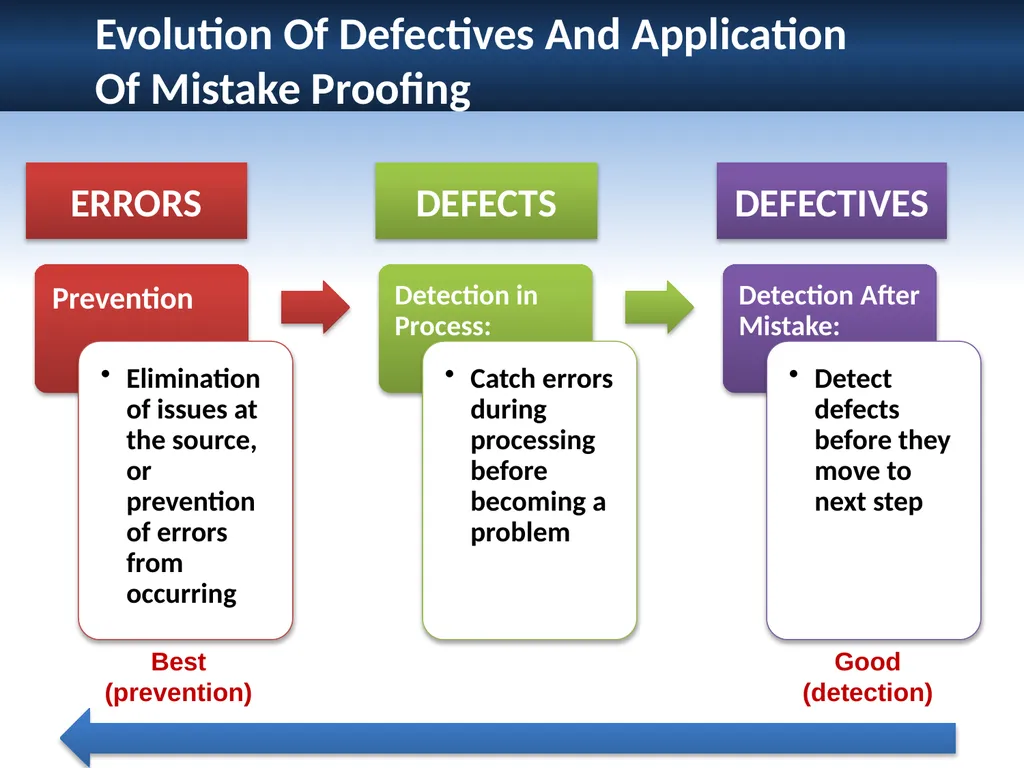
Evolution Of Defectives And Application Of Mistake Proofing Prevention Elimination of issues at the source, or prevention of errors from occurring Detection in Process: Catch errors during processing before becoming a problem Detection After Mistake: Detect defects before they move to next step Good
(detection) Best
(prevention) ERRORS DEFECTS DEFECTIVES<br>
13
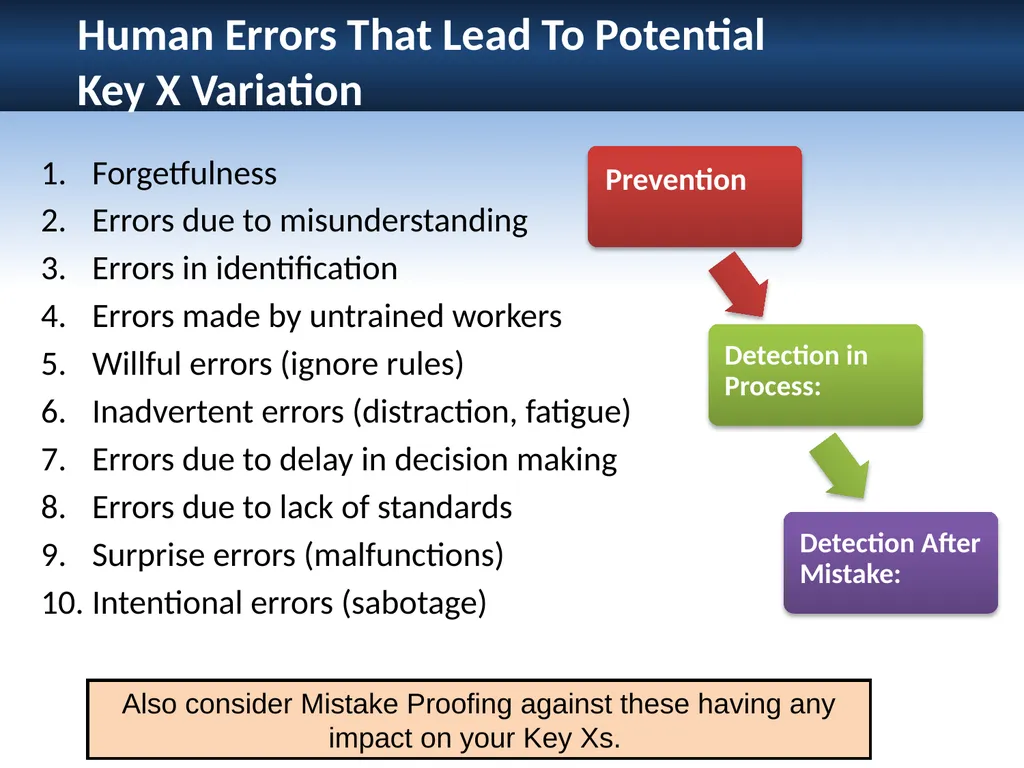
Human Errors That Lead To Potential Key X Variation Forgetfulness
Errors due to misunderstanding
Errors in identification
Errors made by untrained workers
Willful errors (ignore rules)
Inadvertent errors (distraction, fatigue)
Errors due to delay in decision making
Errors due to lack of standards
Surprise errors (malfunctions)
Intentional errors (sabotage) Also consider Mistake Proofing against these having any impact on your Key Xs. Prevention Detection in Process: Detection After Mistake:<br>
14
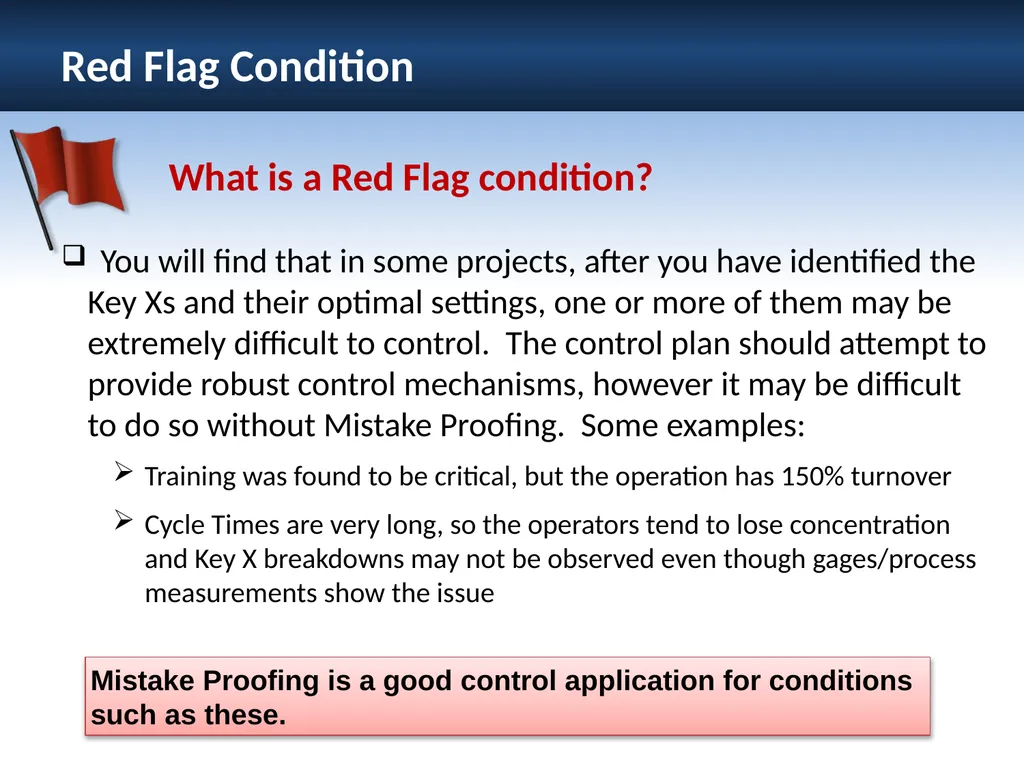
Red Flag Condition What is a Red Flag condition? Mistake Proofing is a good control application for conditions such as these. You will find that in some projects, after you have identified the Key Xs and their optimal settings, one or more of them may be extremely difficult to control. The control plan should attempt to provide robust control mechanisms, however it may be difficult to do so without Mistake Proofing. Some examples:
Training was found to be critical, but the operation has 150% turnover
Cycle Times are very long, so the operators tend to lose concentration and Key X breakdowns may not be observed even though gages/process measurements show the issue<br>
15
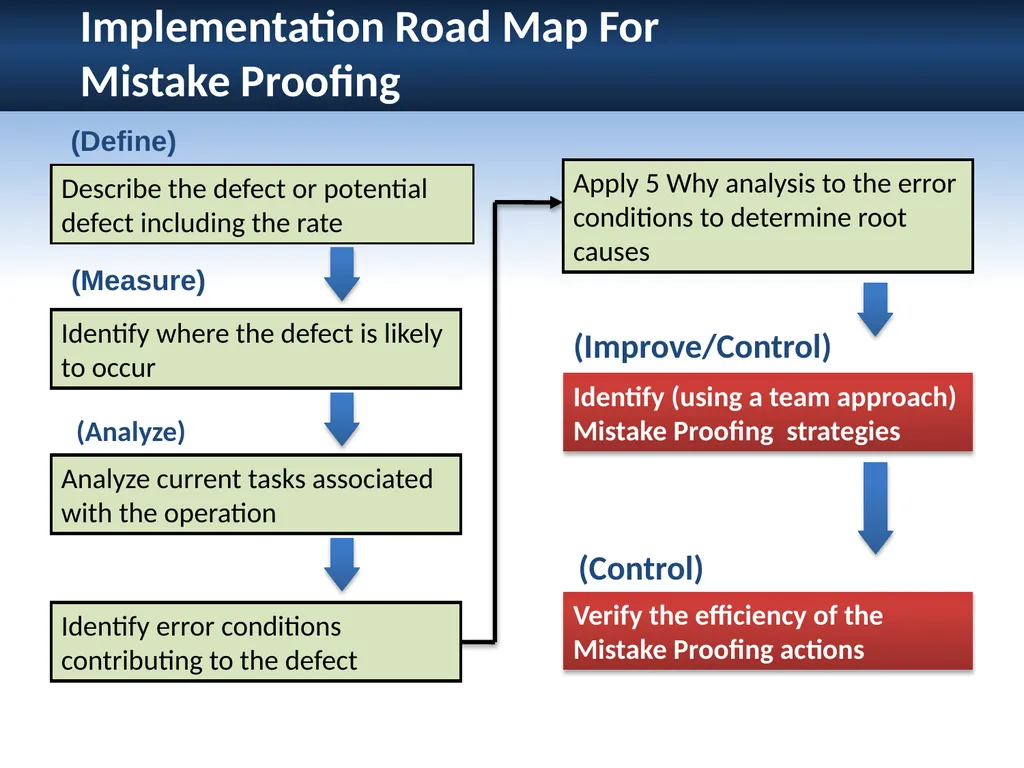
Implementation Road Map For Mistake Proofing Describe the defect or potential defect including the rate Identify where the defect is likely to occur Analyze current tasks associated with the operation Identify error conditions contributing to the defect Apply 5 Why analysis to the error conditions to determine root causes Identify (using a team approach) Mistake Proofing strategies Verify the efficiency of the Mistake Proofing actions (Define) (Measure) (Analyze) (Improve/Control) (Control)<br>
16
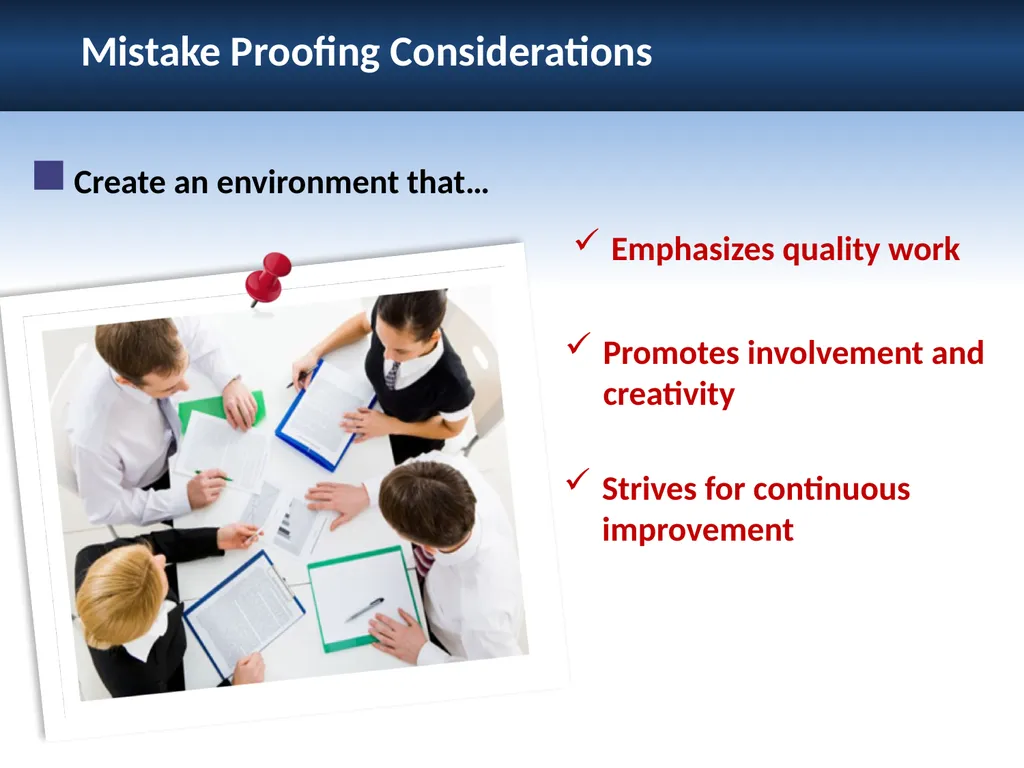
Mistake Proofing Considerations Create an environment that… Emphasizes quality work Promotes involvement and creativity Strives for continuous improvement<br>
17
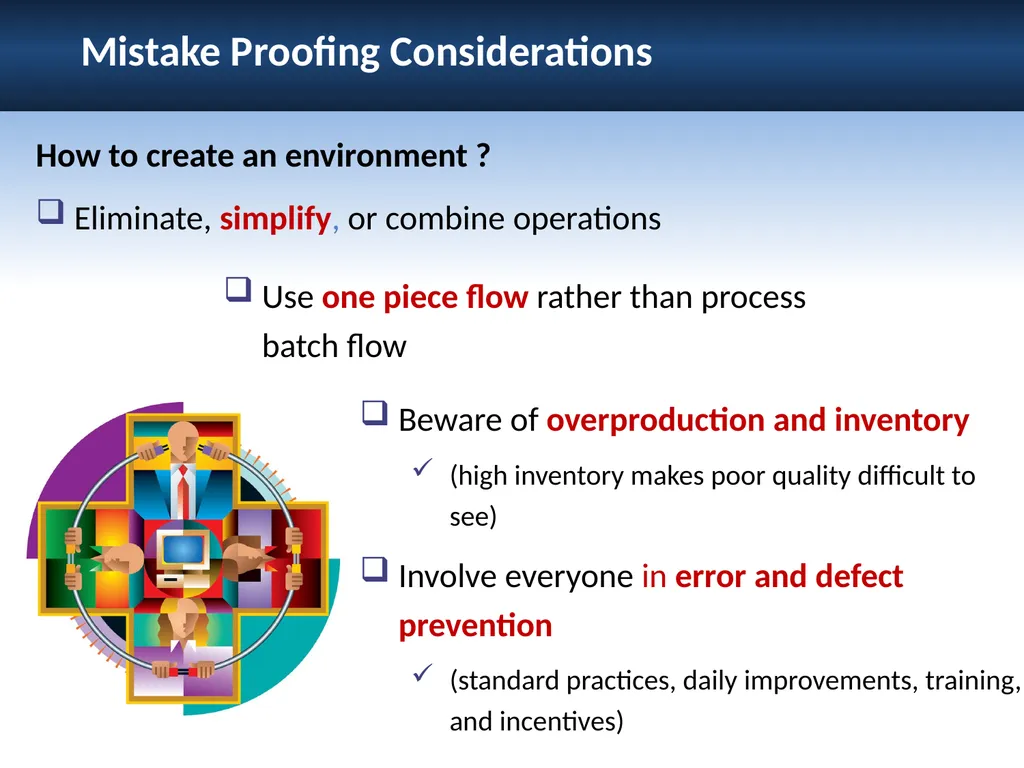
Mistake Proofing Considerations How to create an environment ?
Eliminate, simplify, or combine operations Beware of overproduction and inventory
(high inventory makes poor quality difficult to see)
Involve everyone in error and defect prevention
(standard practices, daily improvements, training, and incentives) Use one piece flow rather than process batch flow<br>
18
Exercise # 1: Going around the class, name a Mistake Proofing idea from one of the following:
Home, e.g., auto shut off on flat iron
Auto, e.g., car won’t start unless transmission is in park/neutral
Sport/Recreation, e.g., dead man’s lanyard on personal watercraft
Amusement Parks, e.g., sensors on roller coaster tracks
Work/Commerce, e.g., pull down menus on forms
Etc.
Break into your groups and pick one project per group.
Identify a common, recurring issue within the project and list the defects contributing to it. Then, determine the errors that cause the defect and brainstorm for potential mistake-proofing on all levels.
Are you Preventing, Detecting During the Process, or Detecting After the Process?<br>
19
Summary Mistake Proofing (Poke Yoke) is a strategy for preventing errors in processes.
Effective Mistake Proofing requires two basic concepts:
1. A focus on controlling the factors which cause errors
2. Inspection which is effective and tireless<br>