
This slide set is restricted for academic and
DJ
Published · 39 slides · 0 views
1 / 1


Description
This slide set is restricted for academic and educational purposes only. No additions or changes may be made to slides. Use of the slide set or of individual slides for commercial or promotional purposes requires approval from GINA. GINA
Related Topics
Share
Embed code
Download this presentation From Below
"This slide set is restricted for academic and" is the property of its rightful owner. Permission is granted to download and print the materials on this website for personal, non-commercial use only, and to display it on your personal computer provided you do not modify the materials and that you retain all copyright notices contained in the materials. By downloading content from our website, you accept the terms of this agreement.
Presentation Transcript
01
This slide set is restricted for academic and educational purposes only.
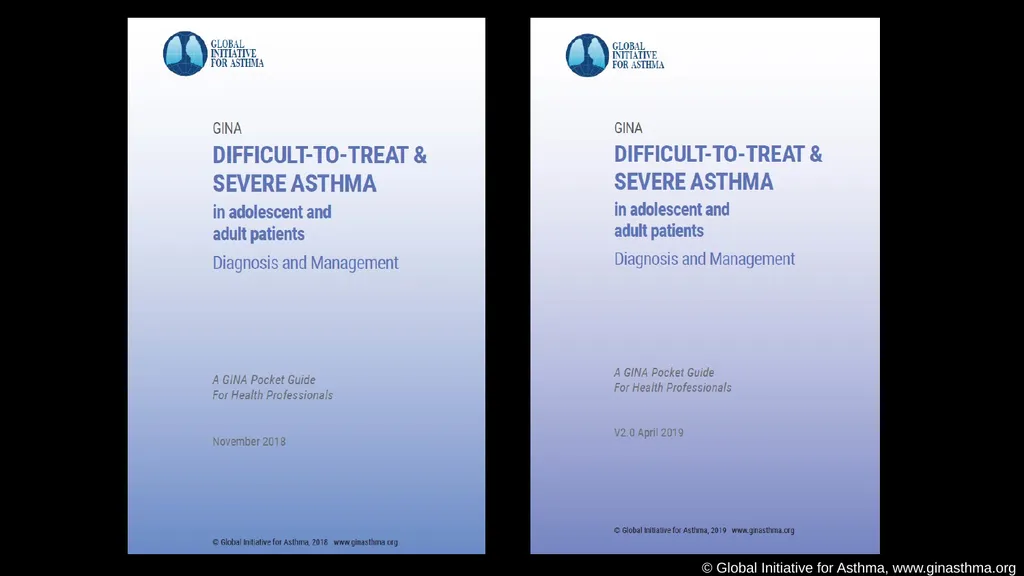
No additions or changes may be made to slides. Use of the slide set or of individual slides for commercial or promotional purposes requires approval from GINA. GINA Pocket Guide
Difficult to treat and severe asthma
in adults and adolescents V2.0 April 2019<br>
02
[PLEASE ADD YOUR DECLARATION OF INTEREST HERE]
The work of GINA is supported only by the sale and licensing of GINA resources Declaration of interest<br>
The work of GINA is supported only by the sale and licensing of GINA resources Declaration of interest<br>
03
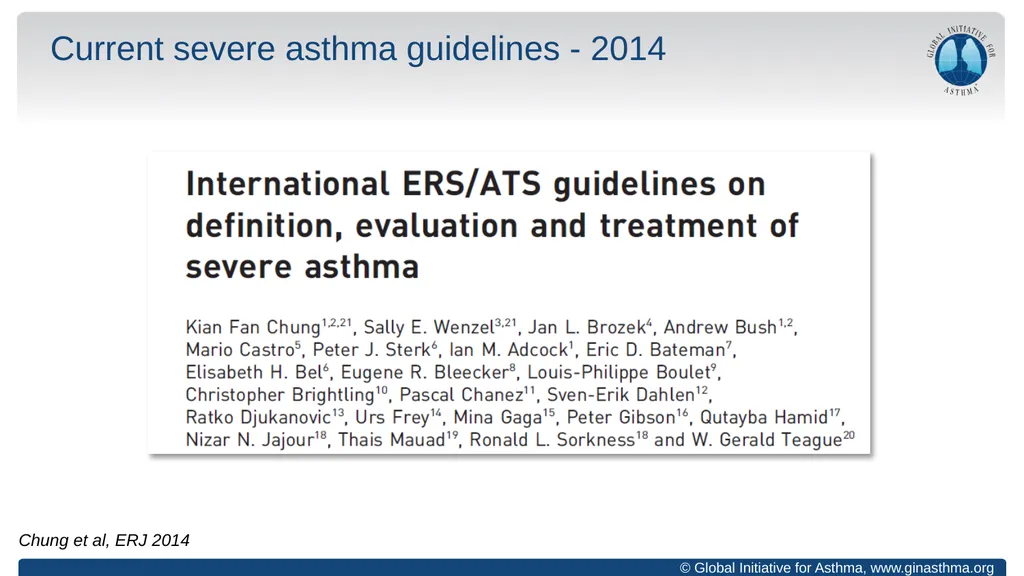
Current severe asthma guidelines - 2014 Chung et al, ERJ 2014<br>
04
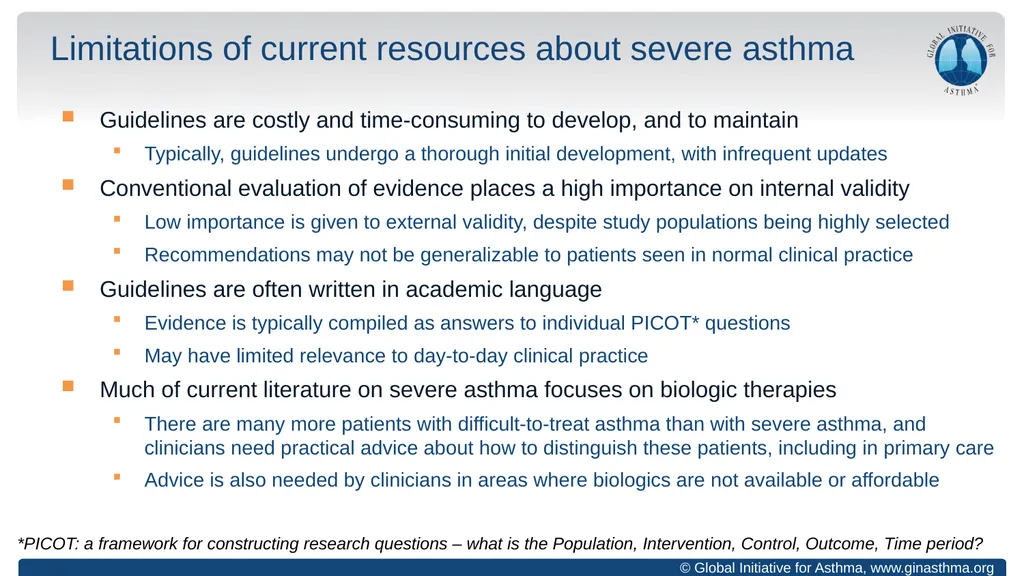
Guidelines are costly and time-consuming to develop, and to maintain
Typically, guidelines undergo a thorough initial development, with infrequent updates
Conventional evaluation of evidence places a high importance on internal validity
Low importance is given to external validity, despite study populations being highly selected
Recommendations may not be generalizable to patients seen in normal clinical practice
Guidelines are often written in academic language
Evidence is typically compiled as answers to individual PICOT* questions
May have limited relevance to day-to-day clinical practice
Much of current literature on severe asthma focuses on biologic therapies
There are many more patients with difficult-to-treat asthma than with severe asthma, and clinicians need practical advice about how to distinguish these patients, including in primary care
Advice is also needed by clinicians in areas where biologics are not available or affordable Limitations of current resources about severe asthma *PICOT: a framework for constructing research questions – what is the Population, Intervention, Control, Outcome, Time period? © Global Initiative for Asthma, www.ginasthma.org<br>
Typically, guidelines undergo a thorough initial development, with infrequent updates
Conventional evaluation of evidence places a high importance on internal validity
Low importance is given to external validity, despite study populations being highly selected
Recommendations may not be generalizable to patients seen in normal clinical practice
Guidelines are often written in academic language
Evidence is typically compiled as answers to individual PICOT* questions
May have limited relevance to day-to-day clinical practice
Much of current literature on severe asthma focuses on biologic therapies
There are many more patients with difficult-to-treat asthma than with severe asthma, and clinicians need practical advice about how to distinguish these patients, including in primary care
Advice is also needed by clinicians in areas where biologics are not available or affordable Limitations of current resources about severe asthma *PICOT: a framework for constructing research questions – what is the Population, Intervention, Control, Outcome, Time period? © Global Initiative for Asthma, www.ginasthma.org<br>
05
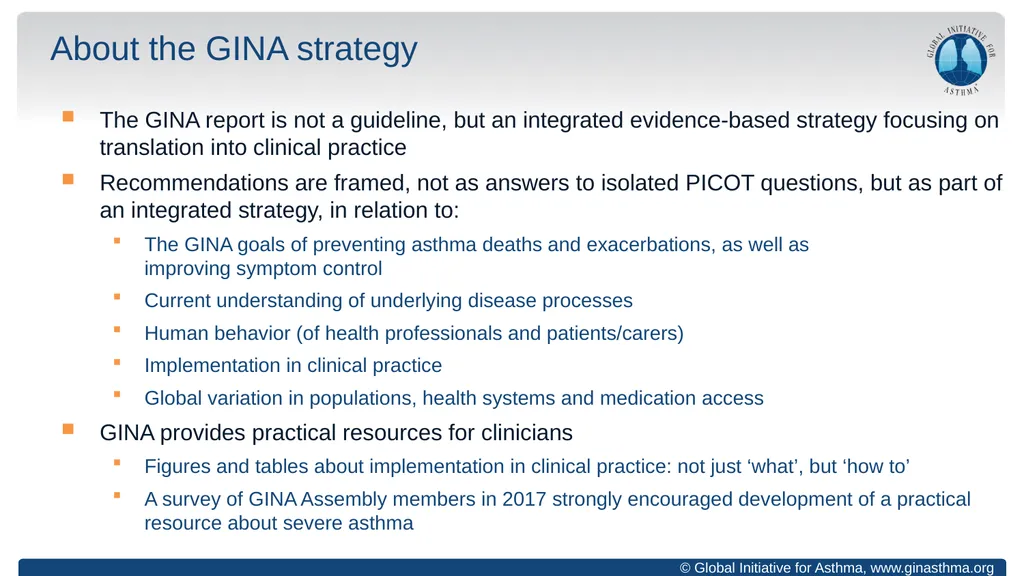
The GINA report is not a guideline, but an integrated evidence-based strategy focusing on translation into clinical practice
Recommendations are framed, not as answers to isolated PICOT questions, but as part of an integrated strategy, in relation to:
The GINA goals of preventing asthma deaths and exacerbations, as well as improving symptom control
Current understanding of underlying disease processes
Human behavior (of health professionals and patients/carers)
Implementation in clinical practice
Global variation in populations, health systems and medication access
GINA provides practical resources for clinicians
Figures and tables about implementation in clinical practice: not just ‘what’, but ‘how to’
A survey of GINA Assembly members in 2017 strongly encouraged development of a practical resource about severe asthma About the GINA strategy © Global Initiative for Asthma, www.ginasthma.org<br>
Recommendations are framed, not as answers to isolated PICOT questions, but as part of an integrated strategy, in relation to:
The GINA goals of preventing asthma deaths and exacerbations, as well as improving symptom control
Current understanding of underlying disease processes
Human behavior (of health professionals and patients/carers)
Implementation in clinical practice
Global variation in populations, health systems and medication access
GINA provides practical resources for clinicians
Figures and tables about implementation in clinical practice: not just ‘what’, but ‘how to’
A survey of GINA Assembly members in 2017 strongly encouraged development of a practical resource about severe asthma About the GINA strategy © Global Initiative for Asthma, www.ginasthma.org<br>
06
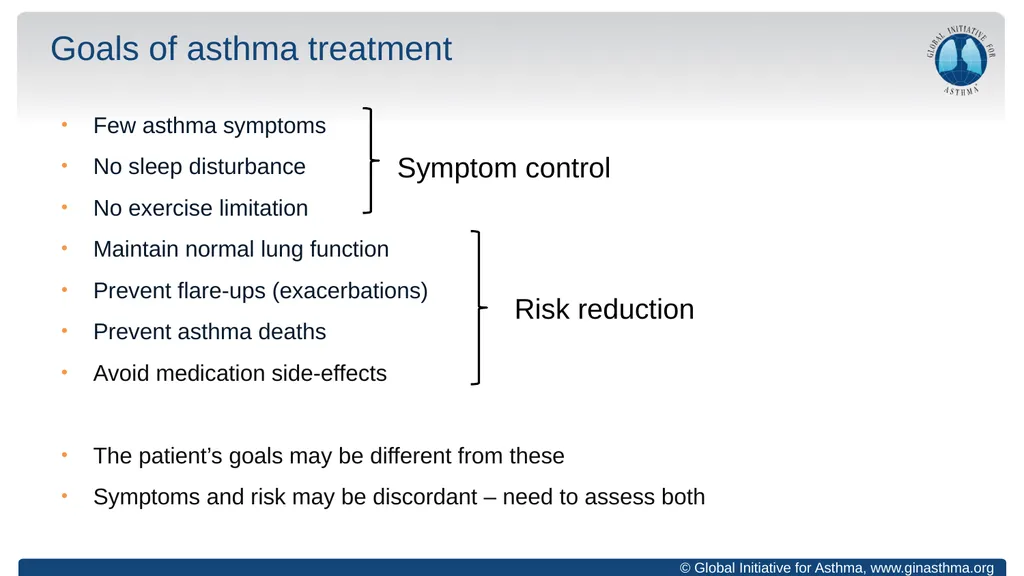
Goals of asthma treatment Few asthma symptoms
No sleep disturbance
No exercise limitation
Maintain normal lung function
Prevent flare-ups (exacerbations)
Prevent asthma deaths
Avoid medication side-effects
The patient’s goals may be different from these
Symptoms and risk may be discordant – need to assess both Symptom control Risk reduction © Global Initiative for Asthma, www.ginasthma.org<br>
No sleep disturbance
No exercise limitation
Maintain normal lung function
Prevent flare-ups (exacerbations)
Prevent asthma deaths
Avoid medication side-effects
The patient’s goals may be different from these
Symptoms and risk may be discordant – need to assess both Symptom control Risk reduction © Global Initiative for Asthma, www.ginasthma.org<br>
07
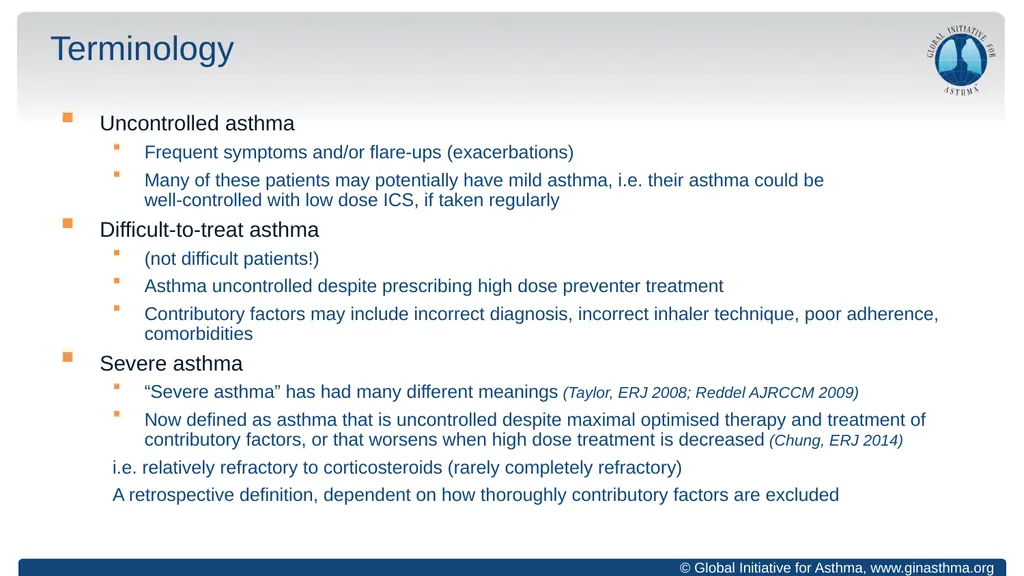
Terminology Uncontrolled asthma
Frequent symptoms and/or flare-ups (exacerbations)
Many of these patients may potentially have mild asthma, i.e. their asthma could be well-controlled with low dose ICS, if taken regularly
Difficult-to-treat asthma
(not difficult patients!)
Asthma uncontrolled despite prescribing high dose preventer treatment
Contributory factors may include incorrect diagnosis, incorrect inhaler technique, poor adherence, comorbidities
Severe asthma
“Severe asthma” has had many different meanings (Taylor, ERJ 2008; Reddel AJRCCM 2009)
Now defined as asthma that is uncontrolled despite maximal optimised therapy and treatment of contributory factors, or that worsens when high dose treatment is decreased (Chung, ERJ 2014)
i.e. relatively refractory to corticosteroids (rarely completely refractory)
A retrospective definition, dependent on how thoroughly contributory factors are excluded © Global Initiative for Asthma, www.ginasthma.org<br>
Frequent symptoms and/or flare-ups (exacerbations)
Many of these patients may potentially have mild asthma, i.e. their asthma could be well-controlled with low dose ICS, if taken regularly
Difficult-to-treat asthma
(not difficult patients!)
Asthma uncontrolled despite prescribing high dose preventer treatment
Contributory factors may include incorrect diagnosis, incorrect inhaler technique, poor adherence, comorbidities
Severe asthma
“Severe asthma” has had many different meanings (Taylor, ERJ 2008; Reddel AJRCCM 2009)
Now defined as asthma that is uncontrolled despite maximal optimised therapy and treatment of contributory factors, or that worsens when high dose treatment is decreased (Chung, ERJ 2014)
i.e. relatively refractory to corticosteroids (rarely completely refractory)
A retrospective definition, dependent on how thoroughly contributory factors are excluded © Global Initiative for Asthma, www.ginasthma.org<br>
08
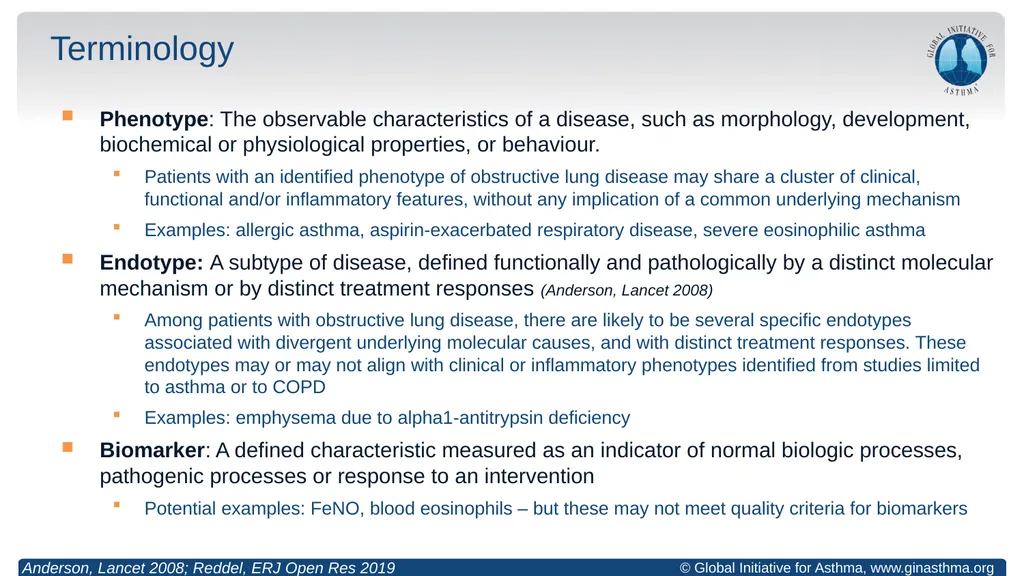
Phenotype: The observable characteristics of a disease, such as morphology, development, biochemical or physiological properties, or behaviour.
Patients with an identified phenotype of obstructive lung disease may share a cluster of clinical, functional and/or inflammatory features, without any implication of a common underlying mechanism
Examples: allergic asthma, aspirin-exacerbated respiratory disease, severe eosinophilic asthma
Endotype: A subtype of disease, defined functionally and pathologically by a distinct molecular mechanism or by distinct treatment responses (Anderson, Lancet 2008)
Among patients with obstructive lung disease, there are likely to be several specific endotypes associated with divergent underlying molecular causes, and with distinct treatment responses. These endotypes may or may not align with clinical or inflammatory phenotypes identified from studies limited to asthma or to COPD
Examples: emphysema due to alpha1-antitrypsin deficiency
Biomarker: A defined characteristic measured as an indicator of normal biologic processes, pathogenic processes or response to an intervention
Potential examples: FeNO, blood eosinophils – but these may not meet quality criteria for biomarkers Terminology Anderson, Lancet 2008; Reddel, ERJ Open Res 2019 © Global Initiative for Asthma, www.ginasthma.org<br>
Patients with an identified phenotype of obstructive lung disease may share a cluster of clinical, functional and/or inflammatory features, without any implication of a common underlying mechanism
Examples: allergic asthma, aspirin-exacerbated respiratory disease, severe eosinophilic asthma
Endotype: A subtype of disease, defined functionally and pathologically by a distinct molecular mechanism or by distinct treatment responses (Anderson, Lancet 2008)
Among patients with obstructive lung disease, there are likely to be several specific endotypes associated with divergent underlying molecular causes, and with distinct treatment responses. These endotypes may or may not align with clinical or inflammatory phenotypes identified from studies limited to asthma or to COPD
Examples: emphysema due to alpha1-antitrypsin deficiency
Biomarker: A defined characteristic measured as an indicator of normal biologic processes, pathogenic processes or response to an intervention
Potential examples: FeNO, blood eosinophils – but these may not meet quality criteria for biomarkers Terminology Anderson, Lancet 2008; Reddel, ERJ Open Res 2019 © Global Initiative for Asthma, www.ginasthma.org<br>
09
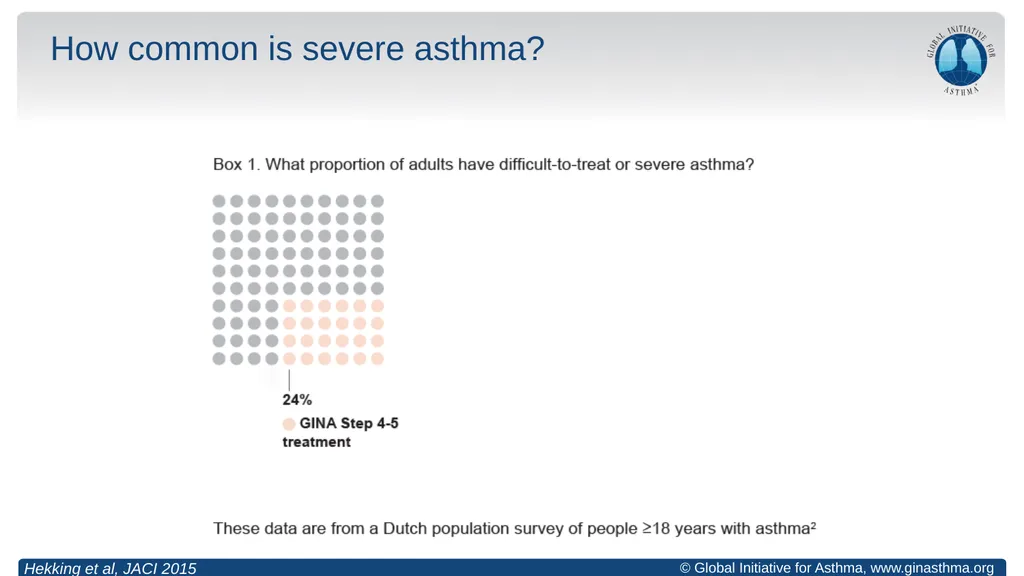
How common is severe asthma? Hekking et al, JACI 2015<br>
10
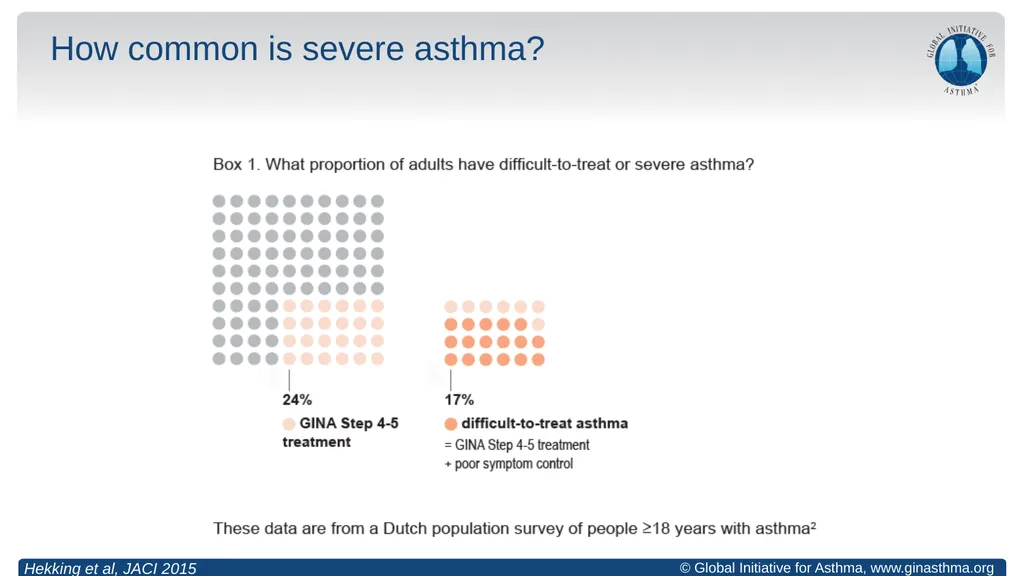
How common is severe asthma? Hekking et al, JACI 2015<br>
11
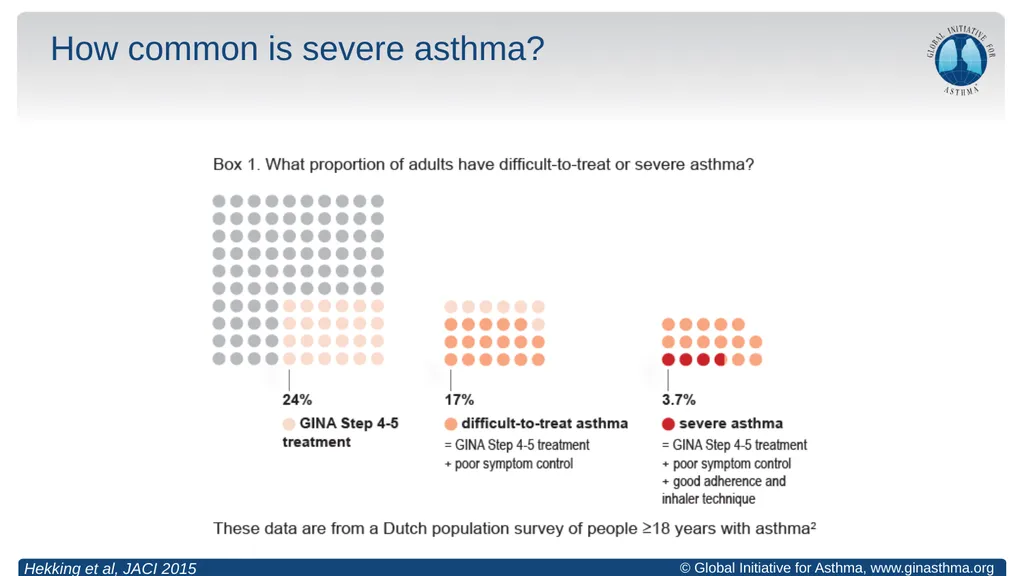
How common is severe asthma? Hekking et al, JACI 2015<br>
12
© Global Initiative for Asthma, www.ginasthma.org<br>
13
Tomoko Ichikawa, Clinical Professor of Design, Information Designer, University of Illinois
Hugh Musick, Associate Director, Program for Healthcare Delivery Design, University of Illinois
Helen Reddel, Chair of GINA Science committee
Members of the GINA Science Committee Team who developed pocket guide © Global Initiative for Asthma, www.ginasthma.org<br>
Hugh Musick, Associate Director, Program for Healthcare Delivery Design, University of Illinois
Helen Reddel, Chair of GINA Science committee
Members of the GINA Science Committee Team who developed pocket guide © Global Initiative for Asthma, www.ginasthma.org<br>
14
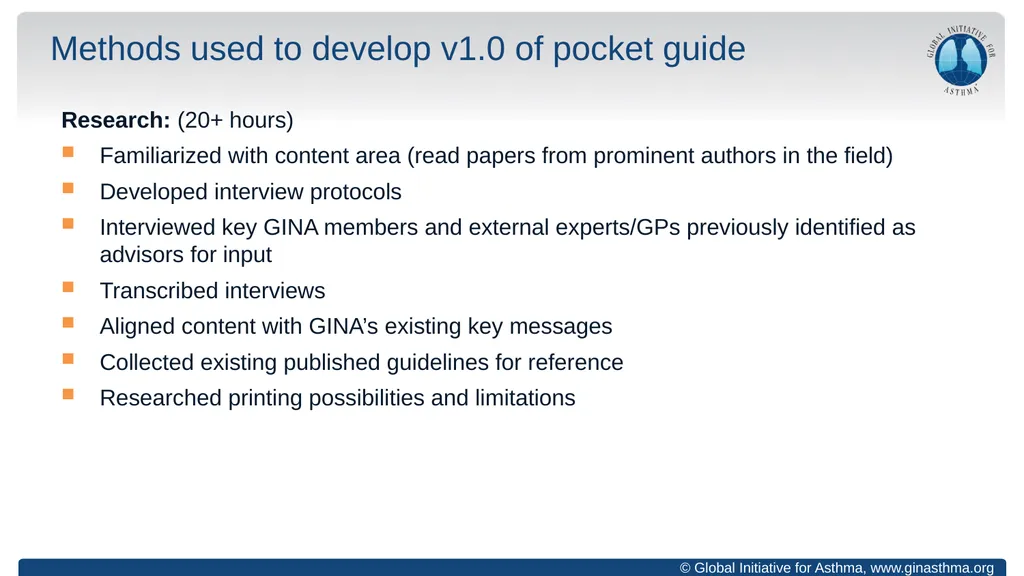
Research: (20+ hours)
Familiarized with content area (read papers from prominent authors in the field)
Developed interview protocols
Interviewed key GINA members and external experts/GPs previously identified as advisors for input
Transcribed interviews
Aligned content with GINA’s existing key messages
Collected existing published guidelines for reference
Researched printing possibilities and limitations Methods used to develop v1.0 of pocket guide © Global Initiative for Asthma, www.ginasthma.org<br>
Familiarized with content area (read papers from prominent authors in the field)
Developed interview protocols
Interviewed key GINA members and external experts/GPs previously identified as advisors for input
Transcribed interviews
Aligned content with GINA’s existing key messages
Collected existing published guidelines for reference
Researched printing possibilities and limitations Methods used to develop v1.0 of pocket guide © Global Initiative for Asthma, www.ginasthma.org<br>
15
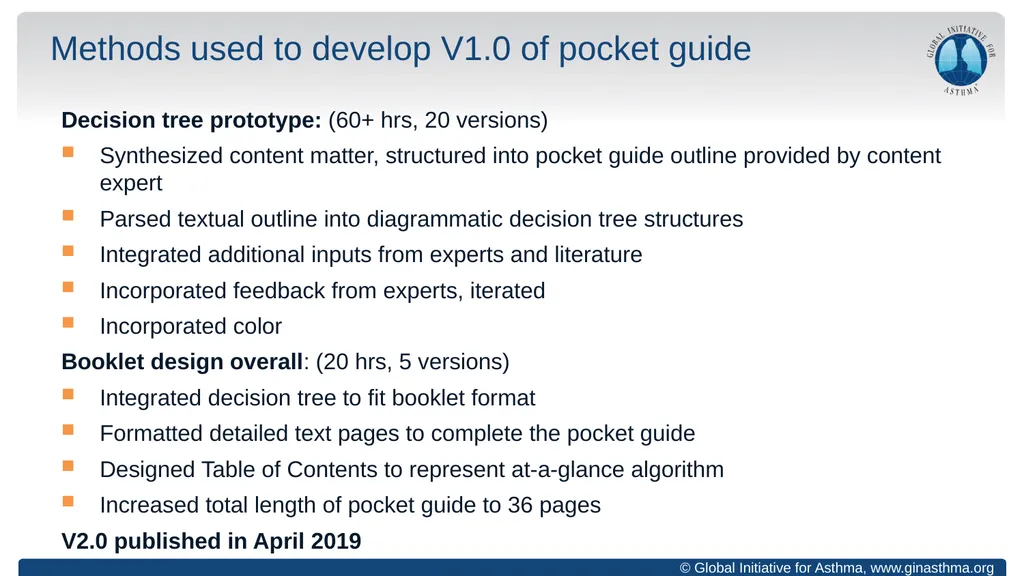
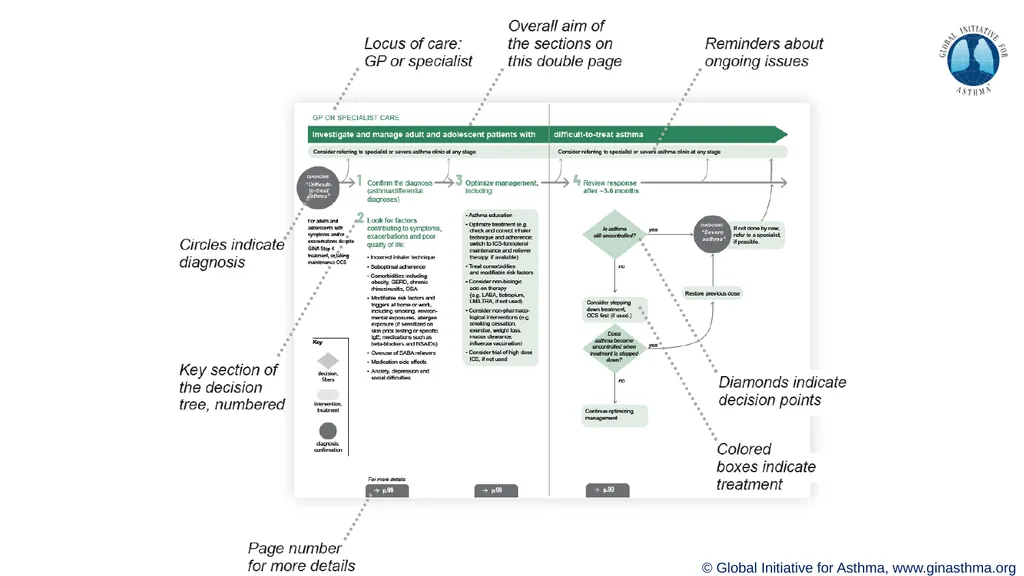
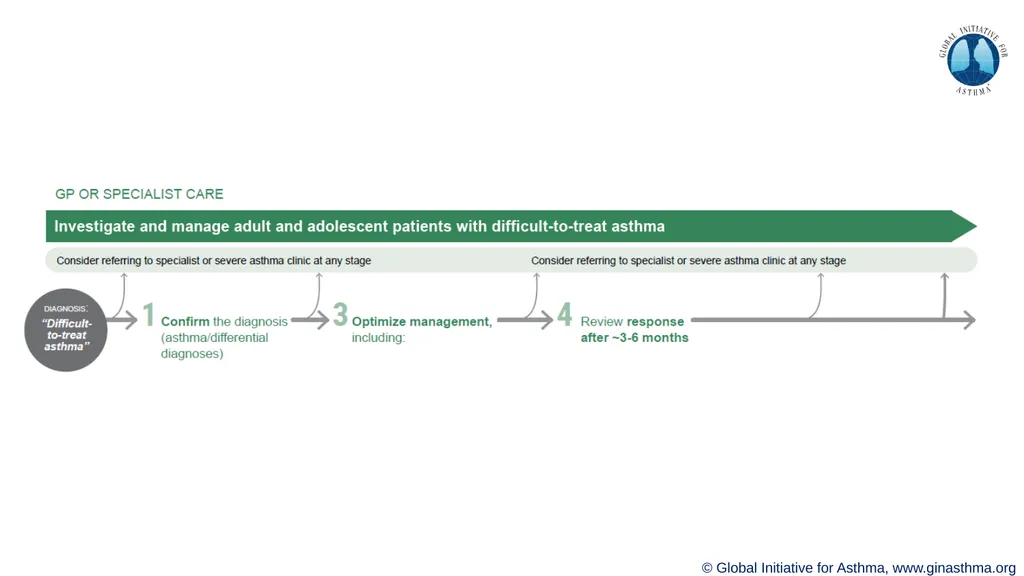
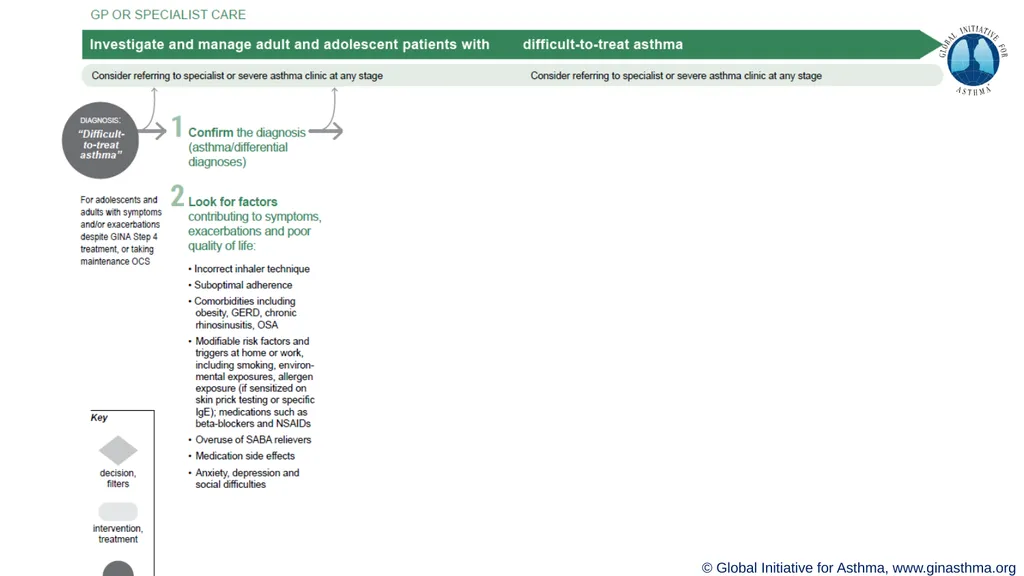
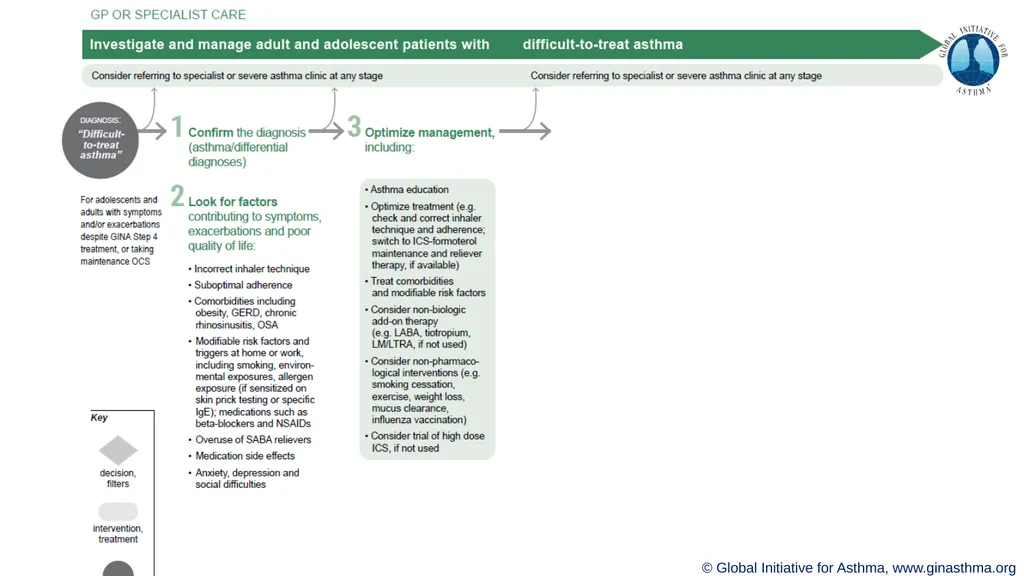
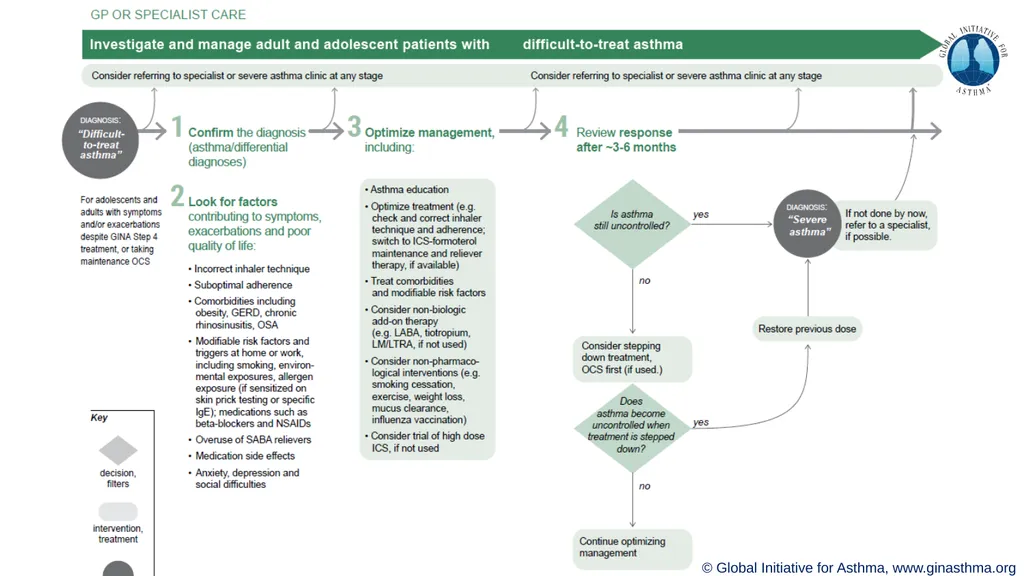
Decision tree prototype: (60+ hrs, 20 versions)
Synthesized content matter, structured into pocket guide outline provided by content expert
Parsed textual outline into diagrammatic decision tree structures
Integrated additional inputs from experts and literature
Incorporated feedback from experts, iterated
Incorporated color
Booklet design overall: (20 hrs, 5 versions)
Integrated decision tree to fit booklet format
Formatted detailed text pages to complete the pocket guide
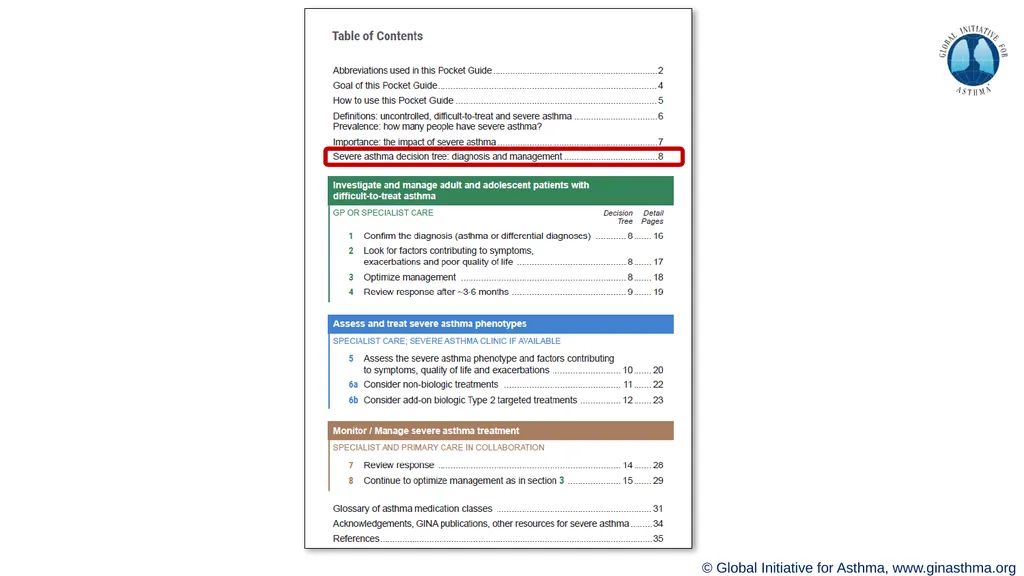
Designed Table of Contents to represent at-a-glance algorithm
Increased total length of pocket guide to 36 pages
V2.0 published in April 2019 Methods used to develop V1.0 of pocket guide © Global Initiative for Asthma, www.ginasthma.org<br>
Synthesized content matter, structured into pocket guide outline provided by content expert
Parsed textual outline into diagrammatic decision tree structures
Integrated additional inputs from experts and literature
Incorporated feedback from experts, iterated
Incorporated color
Booklet design overall: (20 hrs, 5 versions)
Integrated decision tree to fit booklet format
Formatted detailed text pages to complete the pocket guide
Designed Table of Contents to represent at-a-glance algorithm
Increased total length of pocket guide to 36 pages
V2.0 published in April 2019 Methods used to develop V1.0 of pocket guide © Global Initiative for Asthma, www.ginasthma.org<br>
16
© Global Initiative for Asthma, www.ginasthma.org<br>
17
© Global Initiative for Asthma, www.ginasthma.org<br>
18
© Global Initiative for Asthma, www.ginasthma.org<br>
19
© Global Initiative for Asthma, www.ginasthma.org<br>
20
© Global Initiative for Asthma, www.ginasthma.org<br>
21
© Global Initiative for Asthma, www.ginasthma.org<br>
22
© Global Initiative for Asthma, www.ginasthma.org<br>
23
© Global Initiative for Asthma, www.ginasthma.org<br>
24
© Global Initiative for Asthma, www.ginasthma.org<br>
25
© Global Initiative for Asthma, www.ginasthma.org<br>
26
© Global Initiative for Asthma, www.ginasthma.org<br>
27
© Global Initiative for Asthma, www.ginasthma.org<br>
28
© Global Initiative for Asthma, www.ginasthma.org<br>
29
© Global Initiative for Asthma, www.ginasthma.org<br>
30
© Global Initiative for Asthma, www.ginasthma.org<br>
31
© Global Initiative for Asthma, www.ginasthma.org<br>
32
© Global Initiative for Asthma, www.ginasthma.org<br>
33
© Global Initiative for Asthma, www.ginasthma.org<br>
34
© Global Initiative for Asthma, www.ginasthma.org<br>
35
© Global Initiative for Asthma, www.ginasthma.org<br>
36
© Global Initiative for Asthma, www.ginasthma.org<br>
37
© Global Initiative for Asthma, www.ginasthma.org<br>
38
© Global Initiative for Asthma, www.ginasthma.org<br>
39
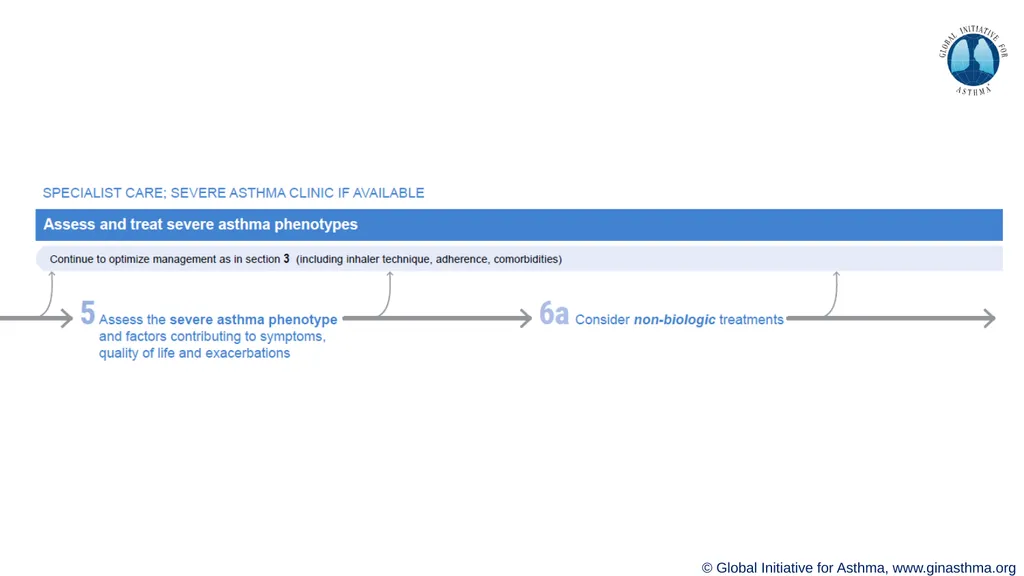
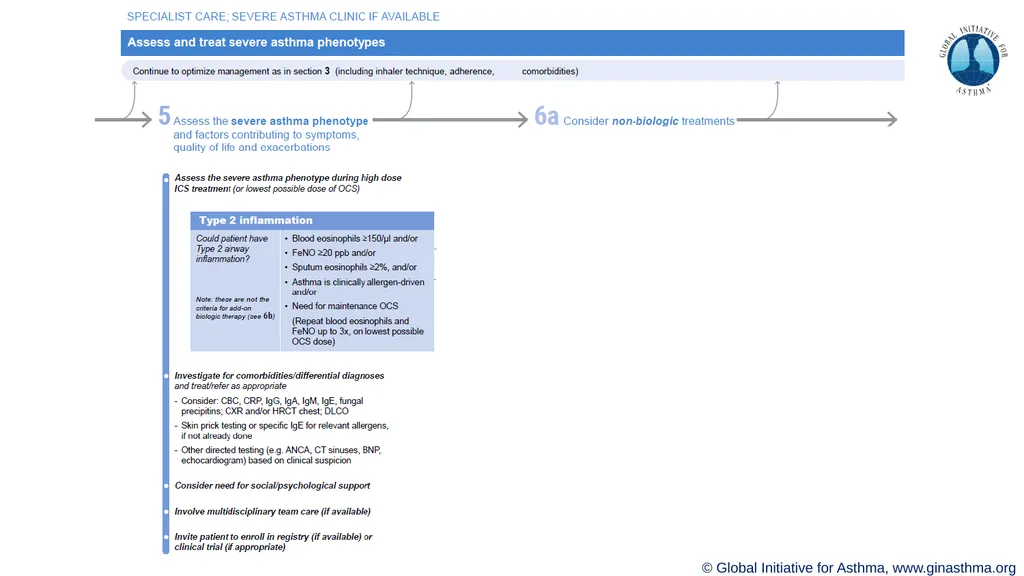
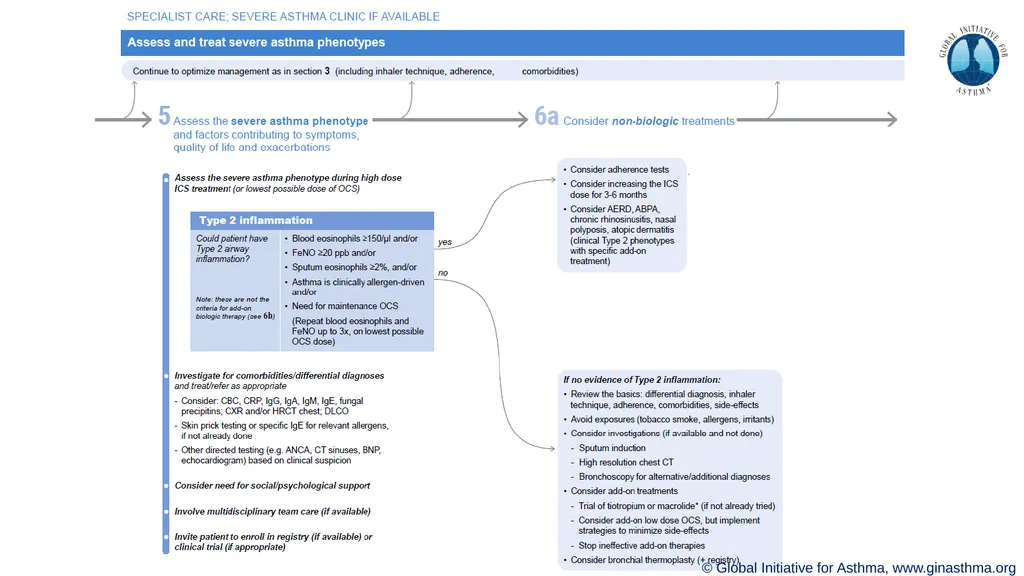
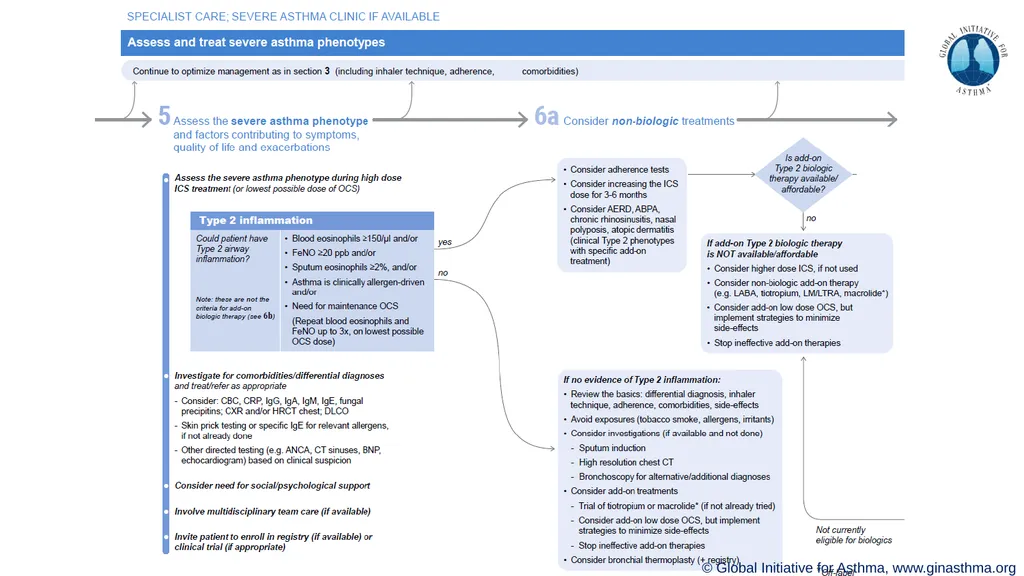
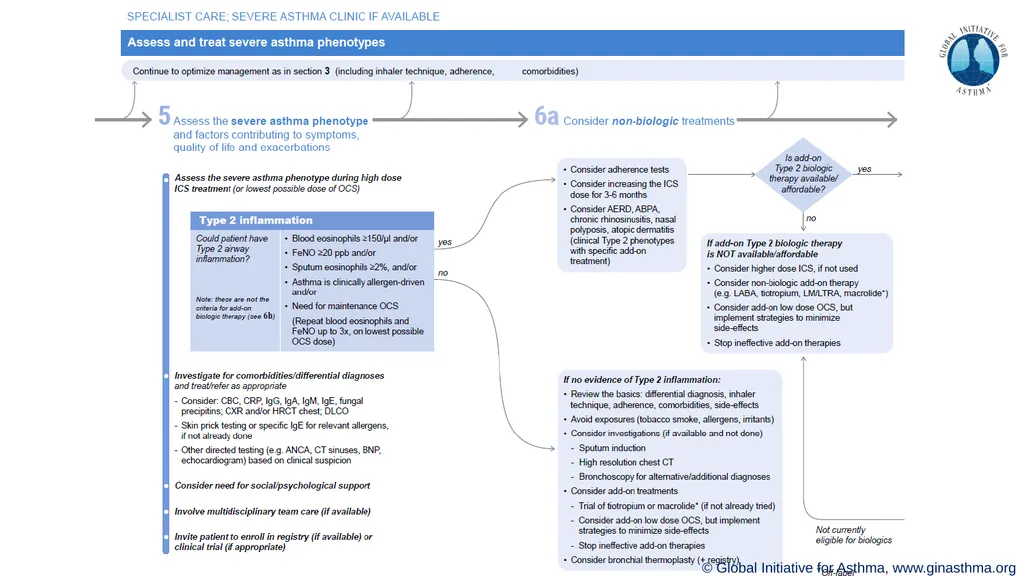
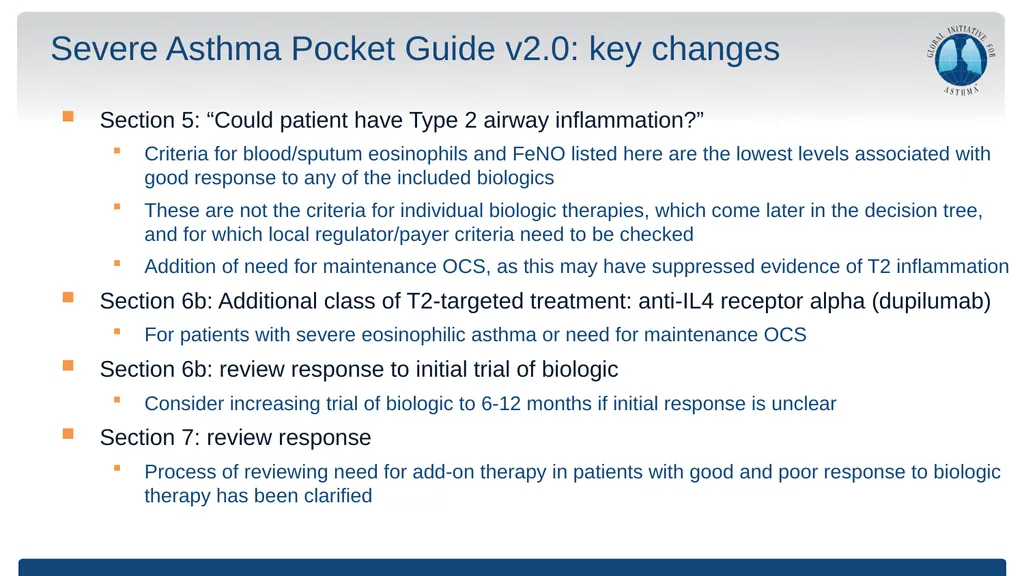
Section 5: “Could patient have Type 2 airway inflammation?”
Criteria for blood/sputum eosinophils and FeNO listed here are the lowest levels associated with good response to any of the included biologics
These are not the criteria for individual biologic therapies, which come later in the decision tree, and for which local regulator/payer criteria need to be checked
Addition of need for maintenance OCS, as this may have suppressed evidence of T2 inflammation
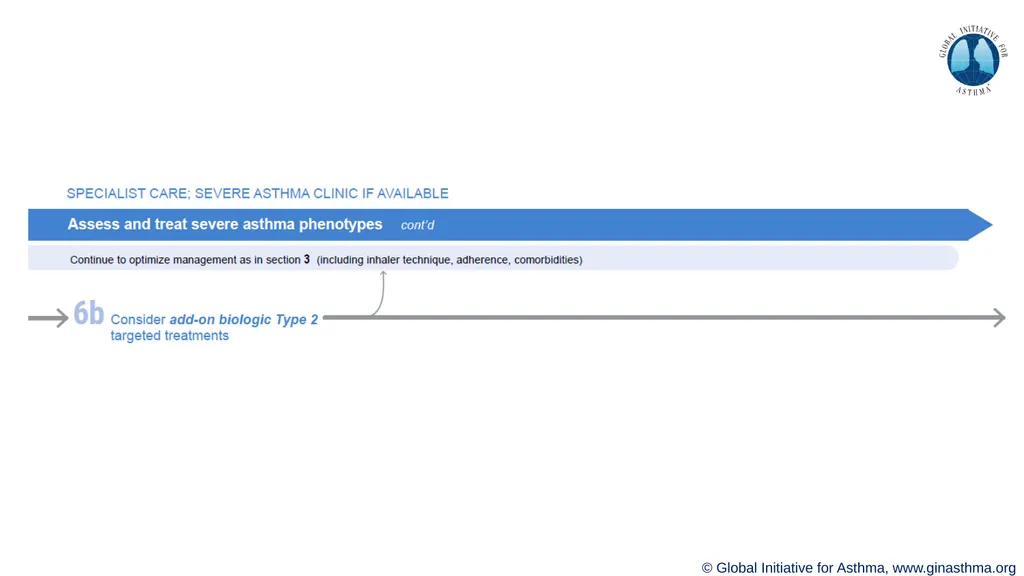
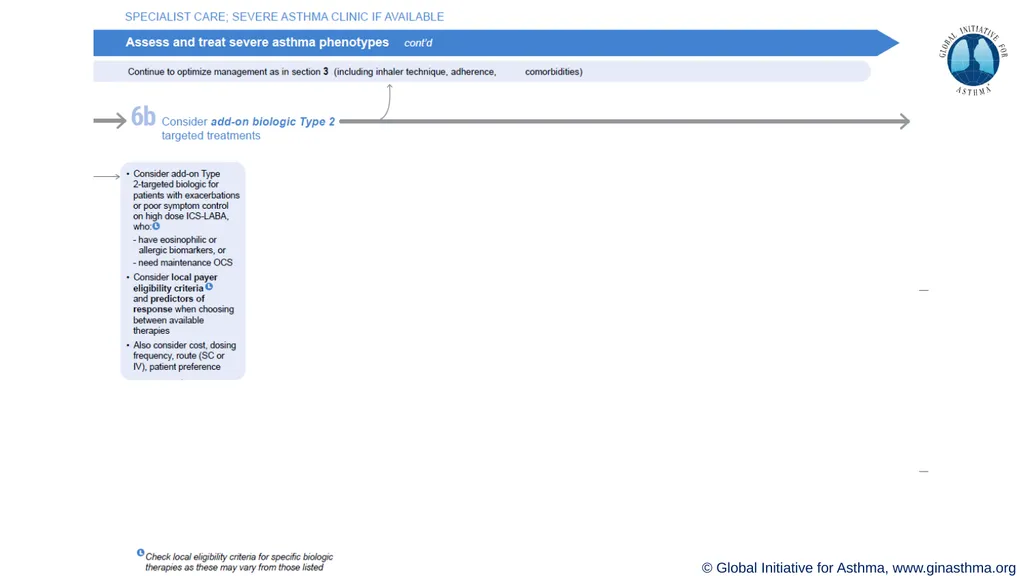
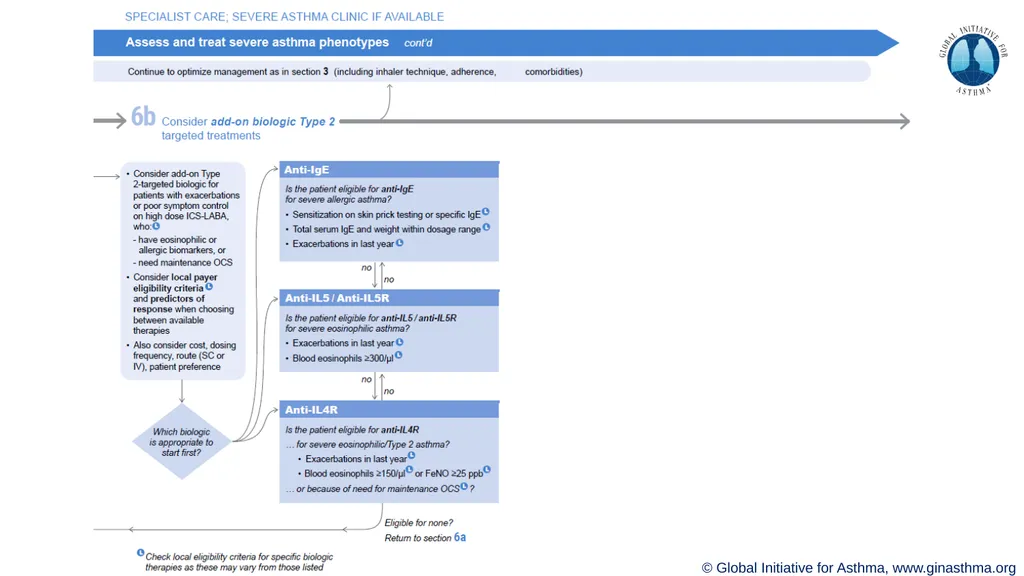
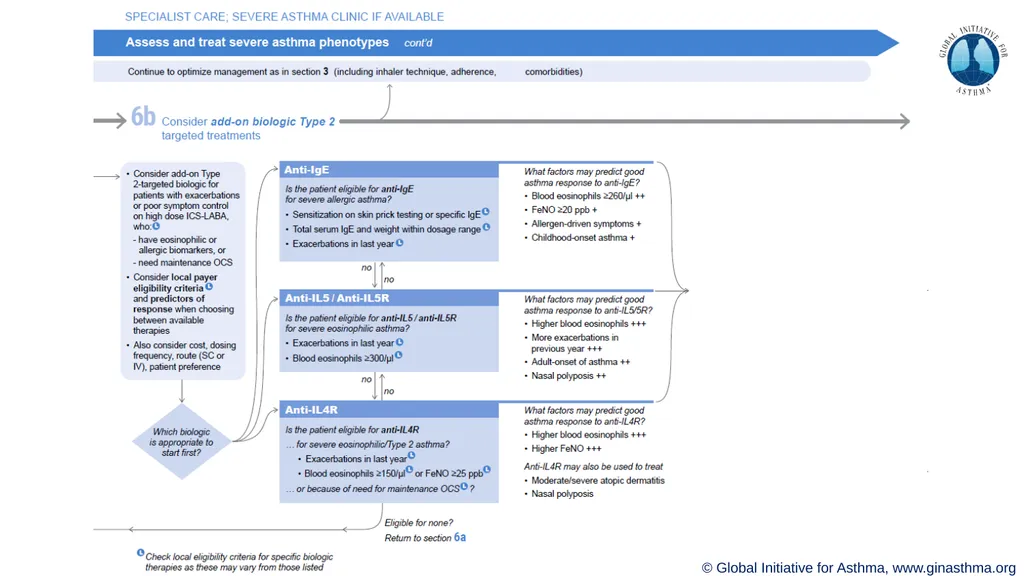
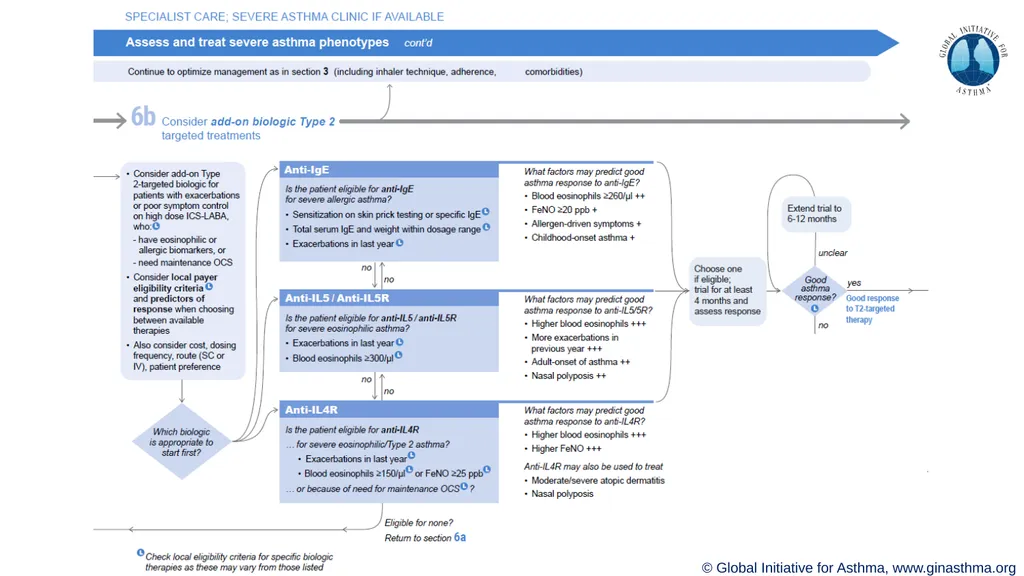
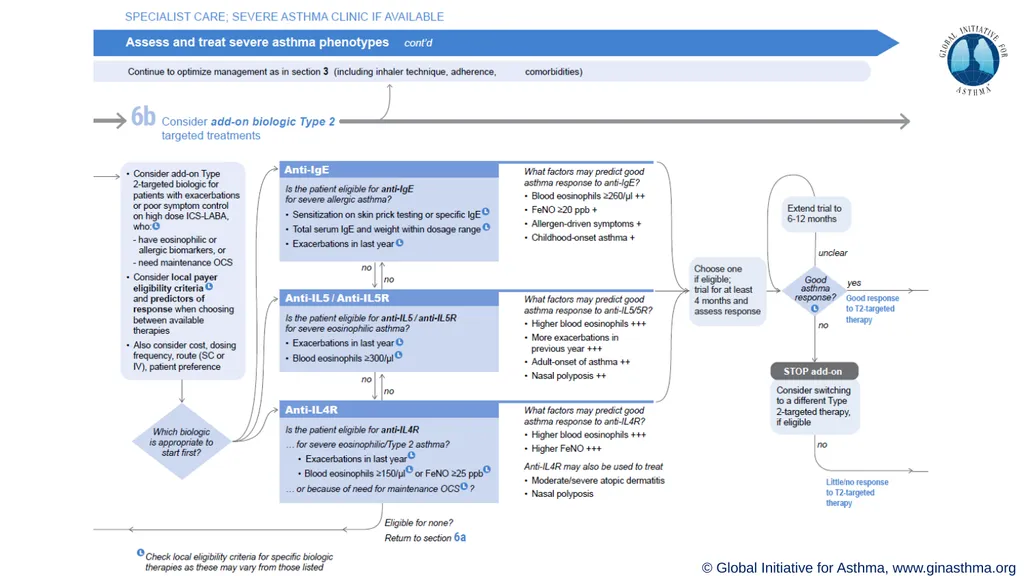
Section 6b: Additional class of T2-targeted treatment: anti-IL4 receptor alpha (dupilumab)
For patients with severe eosinophilic asthma or need for maintenance OCS
Section 6b: review response to initial trial of biologic
Consider increasing trial of biologic to 6-12 months if initial response is unclear
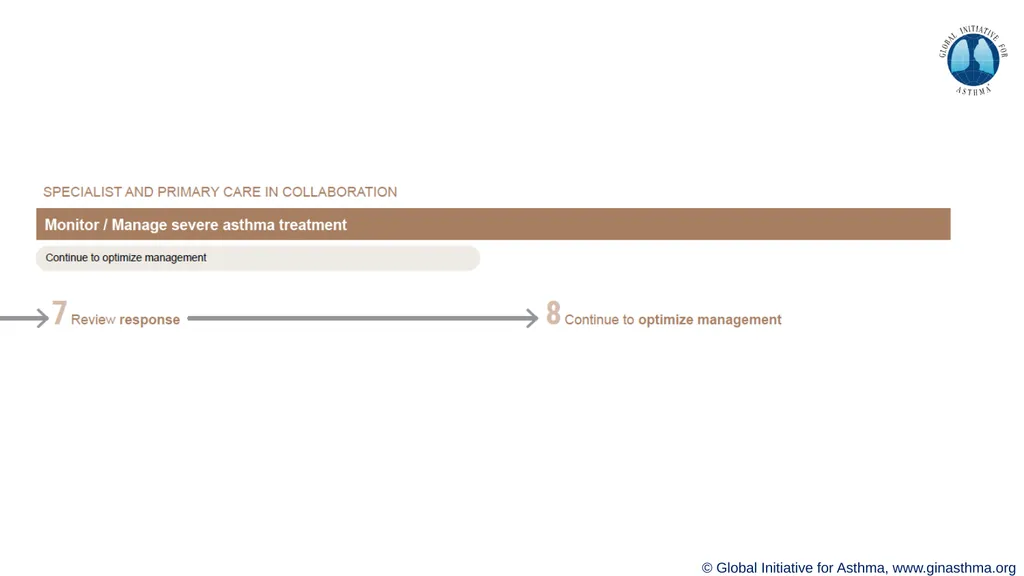
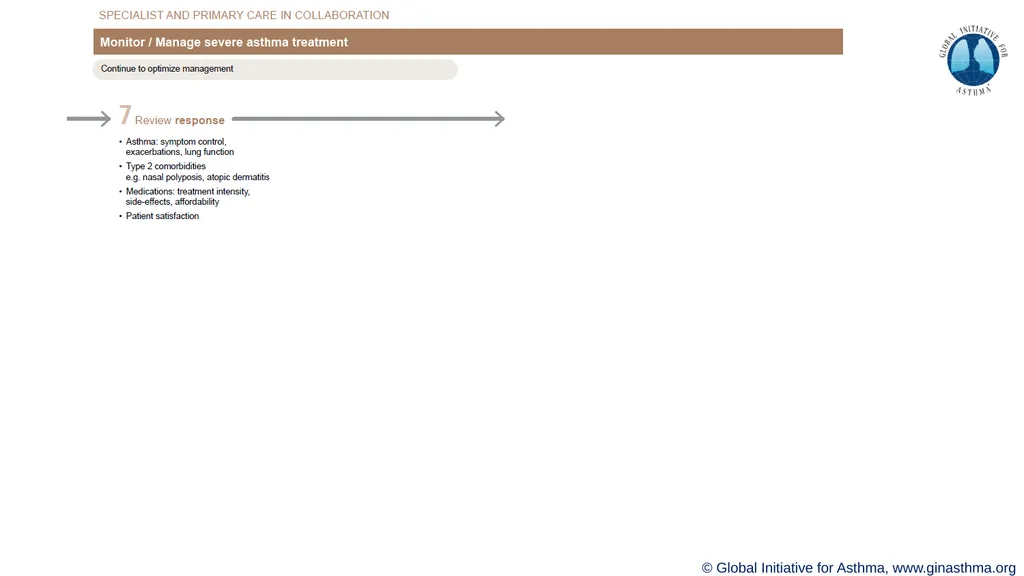
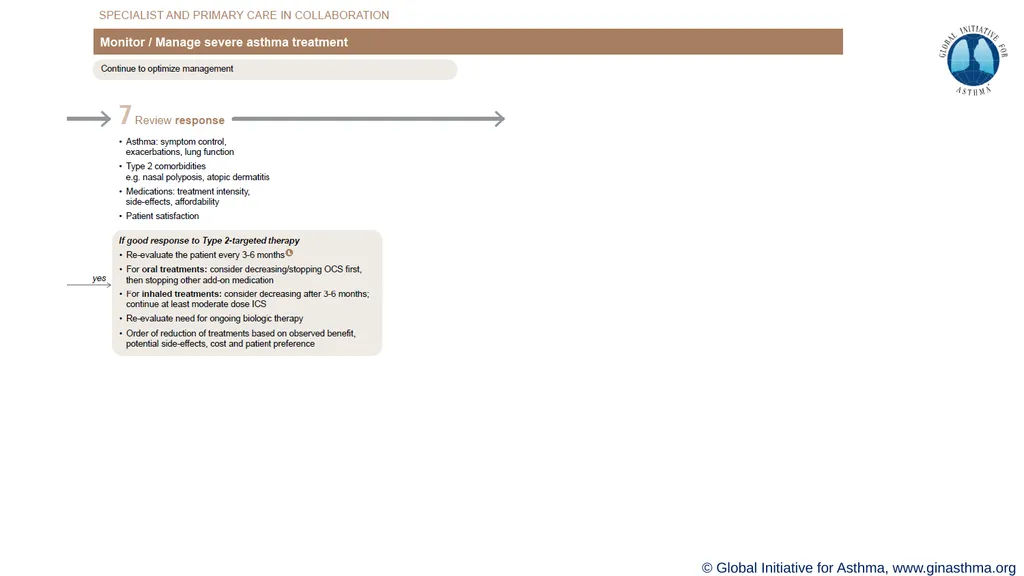
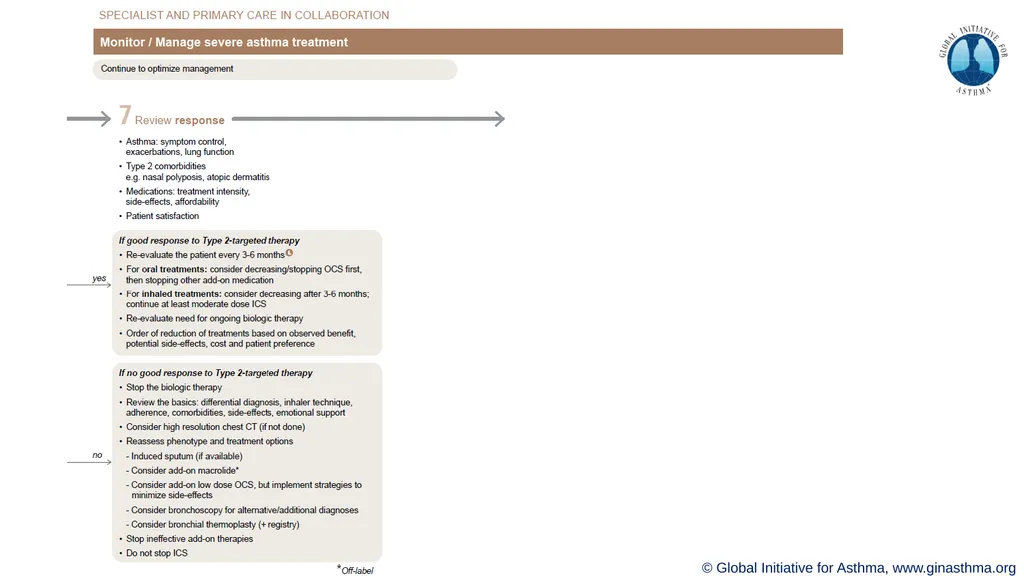
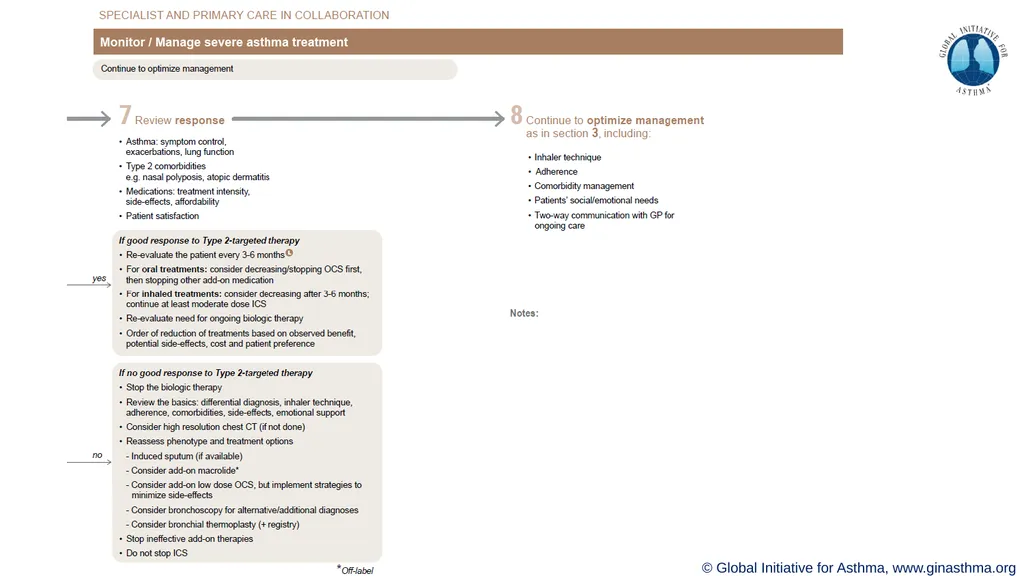
Section 7: review response
Process of reviewing need for add-on therapy in patients with good and poor response to biologic therapy has been clarified Severe Asthma Pocket Guide v2.0: key changes<br>
Criteria for blood/sputum eosinophils and FeNO listed here are the lowest levels associated with good response to any of the included biologics
These are not the criteria for individual biologic therapies, which come later in the decision tree, and for which local regulator/payer criteria need to be checked
Addition of need for maintenance OCS, as this may have suppressed evidence of T2 inflammation
Section 6b: Additional class of T2-targeted treatment: anti-IL4 receptor alpha (dupilumab)
For patients with severe eosinophilic asthma or need for maintenance OCS
Section 6b: review response to initial trial of biologic
Consider increasing trial of biologic to 6-12 months if initial response is unclear
Section 7: review response
Process of reviewing need for add-on therapy in patients with good and poor response to biologic therapy has been clarified Severe Asthma Pocket Guide v2.0: key changes<br>