
Thrive Discipleship & Apologetics Proverbs 11 28
MY
Published · 18 slides · 0 views
1 / 1



Description
Thrive Discipleship Apologetics Proverbs 11 28 Those who trust in their riches will fall, but the righteous will thrive like a green leaf. Jude 3 Beloved, while I was very diligent to write to you concerning our common salvation, I found
Related Topics
Share
Embed code
Download this presentation From Below
"Thrive Discipleship & Apologetics Proverbs 11 28" is the property of its rightful owner. Permission is granted to download and print the materials on this website for personal, non-commercial use only, and to display it on your personal computer provided you do not modify the materials and that you retain all copyright notices contained in the materials. By downloading content from our website, you accept the terms of this agreement.
Presentation Transcript
01
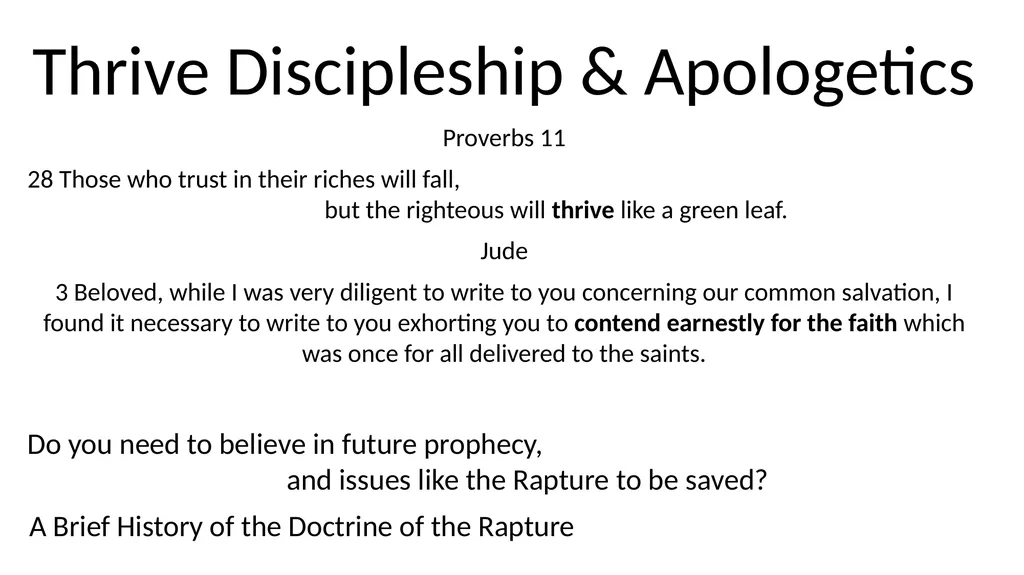
Thrive Discipleship & Apologetics
Proverbs 11
28 Those who trust in their riches will fall, but the righteous will thrive like a green leaf.
Jude
3 Beloved, while I was very diligent to write to you concerning our common salvation, I found it necessary to write to you exhorting you to contend earnestly for the faith which was once for all delivered to the saints.
Do you need to believe in future prophecy, and issues like the Rapture to be saved?
A Brief History of the Doctrine of the Rapture<br>
Proverbs 11
28 Those who trust in their riches will fall, but the righteous will thrive like a green leaf.
Jude
3 Beloved, while I was very diligent to write to you concerning our common salvation, I found it necessary to write to you exhorting you to contend earnestly for the faith which was once for all delivered to the saints.
Do you need to believe in future prophecy, and issues like the Rapture to be saved?
A Brief History of the Doctrine of the Rapture<br>
02
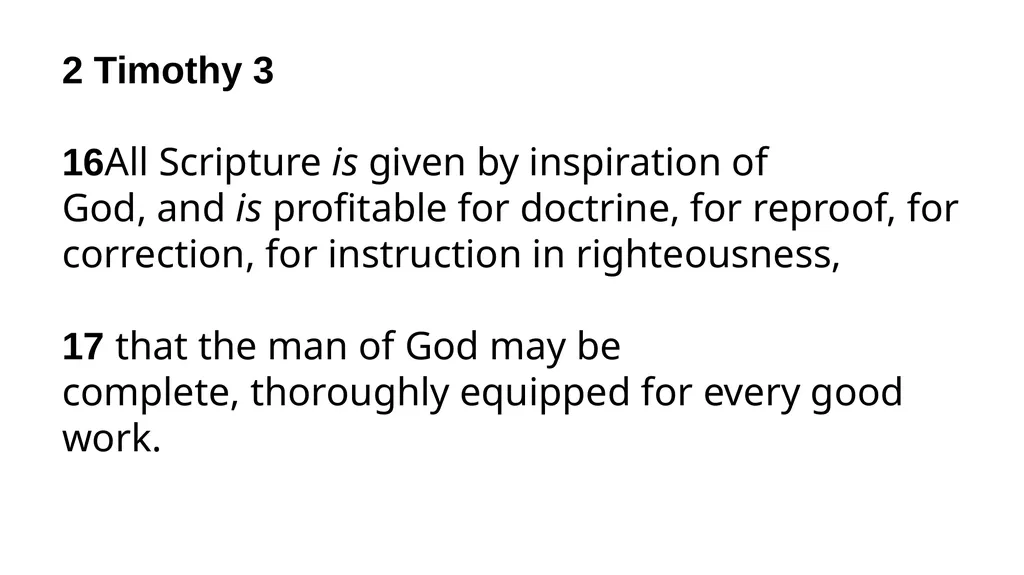
2 Timothy 3
16All Scripture is given by inspiration of God, and is profitable for doctrine, for reproof, for correction, for instruction in righteousness,
17 that the man of God may be complete, thoroughly equipped for every good work.<br>
16All Scripture is given by inspiration of God, and is profitable for doctrine, for reproof, for correction, for instruction in righteousness,
17 that the man of God may be complete, thoroughly equipped for every good work.<br>
03
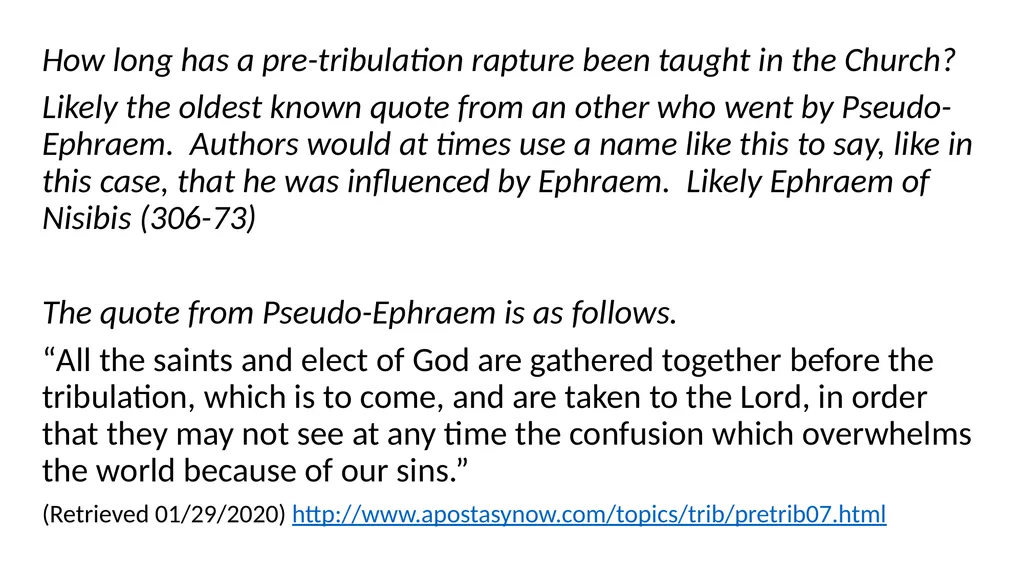
How long has a pre-tribulation rapture been taught in the Church?
Likely the oldest known quote from an other who went by Pseudo-Ephraem. Authors would at times use a name like this to say, like in this case, that he was influenced by Ephraem. Likely Ephraem of Nisibis (306-73)
The quote from Pseudo-Ephraem is as follows.
“All the saints and elect of God are gathered together before the tribulation, which is to come, and are taken to the Lord, in order that they may not see at any time the confusion which overwhelms the world because of our sins.”
(Retrieved 01/29/2020) http://www.apostasynow.com/topics/trib/pretrib07.html<br>
Likely the oldest known quote from an other who went by Pseudo-Ephraem. Authors would at times use a name like this to say, like in this case, that he was influenced by Ephraem. Likely Ephraem of Nisibis (306-73)
The quote from Pseudo-Ephraem is as follows.
“All the saints and elect of God are gathered together before the tribulation, which is to come, and are taken to the Lord, in order that they may not see at any time the confusion which overwhelms the world because of our sins.”
(Retrieved 01/29/2020) http://www.apostasynow.com/topics/trib/pretrib07.html<br>
04
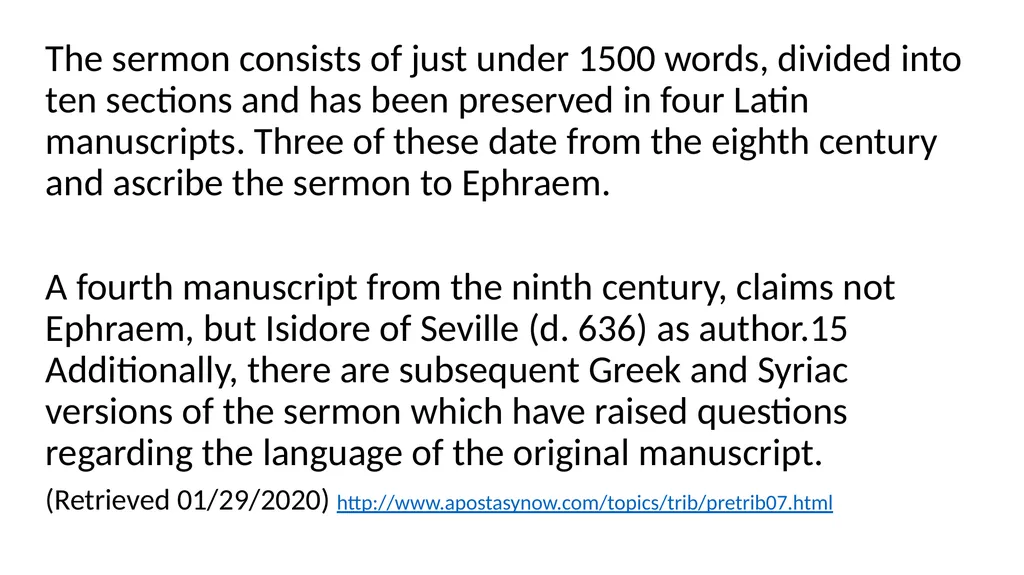
The sermon consists of just under 1500 words, divided into ten sections and has been preserved in four Latin manuscripts. Three of these date from the eighth century and ascribe the sermon to Ephraem.
A fourth manuscript from the ninth century, claims not Ephraem, but Isidore of Seville (d. 636) as author.15 Additionally, there are subsequent Greek and Syriac versions of the sermon which have raised questions regarding the language of the original manuscript.
(Retrieved 01/29/2020) http://www.apostasynow.com/topics/trib/pretrib07.html<br>
A fourth manuscript from the ninth century, claims not Ephraem, but Isidore of Seville (d. 636) as author.15 Additionally, there are subsequent Greek and Syriac versions of the sermon which have raised questions regarding the language of the original manuscript.
(Retrieved 01/29/2020) http://www.apostasynow.com/topics/trib/pretrib07.html<br>
05
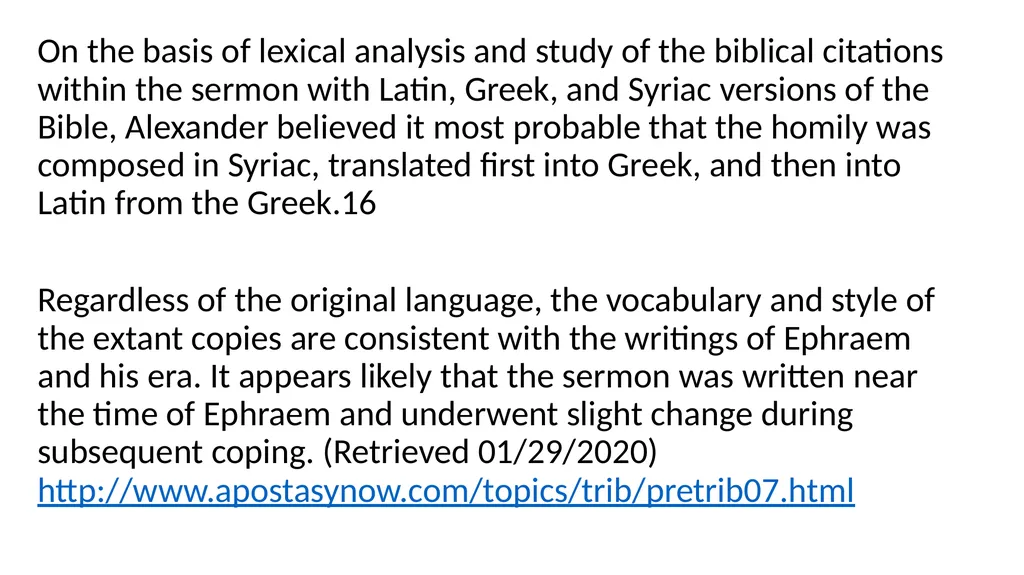
On the basis of lexical analysis and study of the biblical citations within the sermon with Latin, Greek, and Syriac versions of the Bible, Alexander believed it most probable that the homily was composed in Syriac, translated first into Greek, and then into Latin from the Greek.16
Regardless of the original language, the vocabulary and style of the extant copies are consistent with the writings of Ephraem and his era. It appears likely that the sermon was written near the time of Ephraem and underwent slight change during subsequent coping. (Retrieved 01/29/2020) http://www.apostasynow.com/topics/trib/pretrib07.html<br>
Regardless of the original language, the vocabulary and style of the extant copies are consistent with the writings of Ephraem and his era. It appears likely that the sermon was written near the time of Ephraem and underwent slight change during subsequent coping. (Retrieved 01/29/2020) http://www.apostasynow.com/topics/trib/pretrib07.html<br>
06
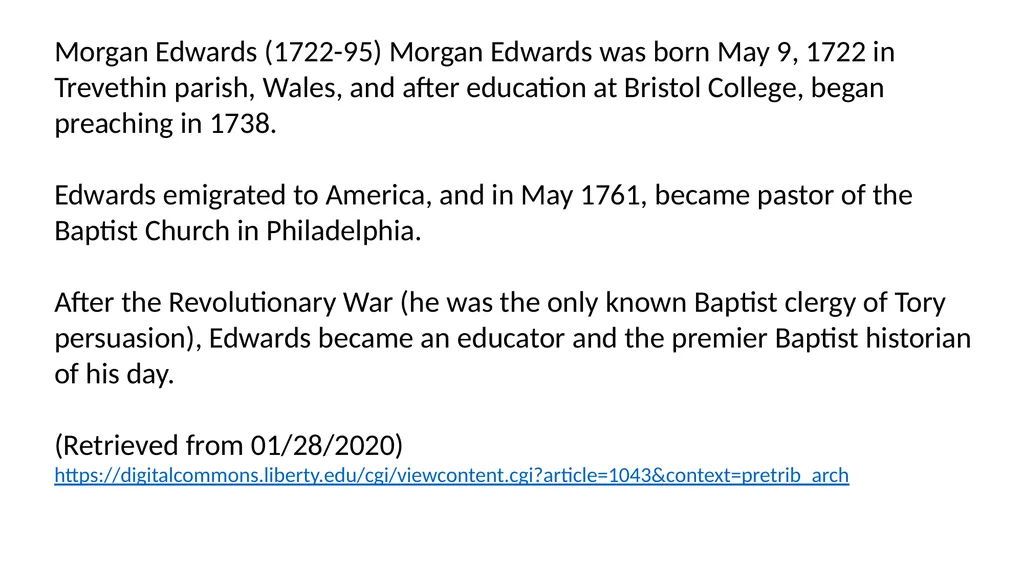
Morgan Edwards (1722-95) Morgan Edwards was born May 9, 1722 in Trevethin parish, Wales, and after education at Bristol College, began preaching in 1738.
Edwards emigrated to America, and in May 1761, became pastor of the Baptist Church in Philadelphia.
After the Revolutionary War (he was the only known Baptist clergy of Tory persuasion), Edwards became an educator and the premier Baptist historian of his day.
(Retrieved from 01/28/2020) https://digitalcommons.liberty.edu/cgi/viewcontent.cgi?article=1043&context=pretrib_arch<br>
Edwards emigrated to America, and in May 1761, became pastor of the Baptist Church in Philadelphia.
After the Revolutionary War (he was the only known Baptist clergy of Tory persuasion), Edwards became an educator and the premier Baptist historian of his day.
(Retrieved from 01/28/2020) https://digitalcommons.liberty.edu/cgi/viewcontent.cgi?article=1043&context=pretrib_arch<br>
07
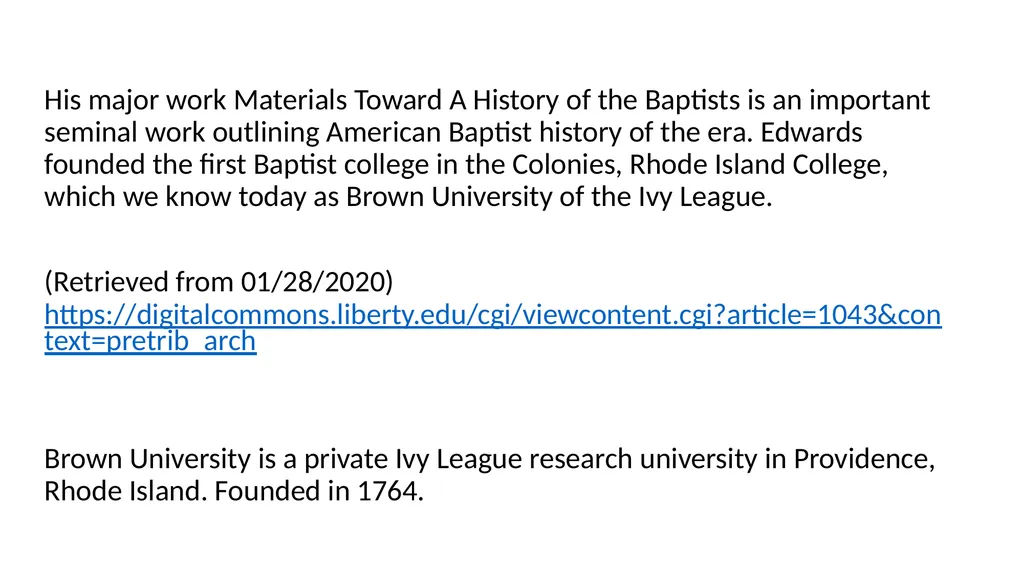
His major work Materials Toward A History of the Baptists is an important seminal work outlining American Baptist history of the era. Edwards founded the first Baptist college in the Colonies, Rhode Island College, which we know today as Brown University of the Ivy League.
(Retrieved from 01/28/2020) https://digitalcommons.liberty.edu/cgi/viewcontent.cgi?article=1043&context=pretrib_arch
Brown University is a private Ivy League research university in Providence, Rhode Island. Founded in 1764.<br>
(Retrieved from 01/28/2020) https://digitalcommons.liberty.edu/cgi/viewcontent.cgi?article=1043&context=pretrib_arch
Brown University is a private Ivy League research university in Providence, Rhode Island. Founded in 1764.<br>
08
Edwards essay on the Rapture while in college contains the following”
“I say, somewhat more —; because the dead saints will be raised, and the living changed at Christ’s “appearing in the air” (I Thes. iv. 17); and this will be about three years and a half before the millennium, as we shall see hereafter: but will he and they abide in the air all that time? No: they will ascend to paradise, or to some one of those many “mansions in the father’s house”
1 Thessalonians 4:17 Then we who are alive and remain shall be caught up together with them in the clouds to meet the Lord in the air. And thus we shall always be with the Lord.<br>
“I say, somewhat more —; because the dead saints will be raised, and the living changed at Christ’s “appearing in the air” (I Thes. iv. 17); and this will be about three years and a half before the millennium, as we shall see hereafter: but will he and they abide in the air all that time? No: they will ascend to paradise, or to some one of those many “mansions in the father’s house”
1 Thessalonians 4:17 Then we who are alive and remain shall be caught up together with them in the clouds to meet the Lord in the air. And thus we shall always be with the Lord.<br>
09
“(John xiv. 2), and so disappear during the foresaid period of time. The design of this retreat and disappearing will be to judge the risen and changed saints; for “now the time is come that judgment must begin,” and that will be “at the house of God” (I Pet. iv. 17)... (p. 7; the spelling of all Edwards quotes have been modernized)”
John 14:2 In My Father’s house are many mansions; if it were not so, I would have told you. I go to prepare a place for you.
1 Peter 4:17 For the time has come for judgment to begin at the house of God; and if it begins with us first, what will be the end of those who do not obey the gospel of God?”
(Retrieved from 01/28/2020) https://digitalcommons.liberty.edu/cgi/viewcontent.cgi?article=1043&context=pretrib_arch<br>
John 14:2 In My Father’s house are many mansions; if it were not so, I would have told you. I go to prepare a place for you.
1 Peter 4:17 For the time has come for judgment to begin at the house of God; and if it begins with us first, what will be the end of those who do not obey the gospel of God?”
(Retrieved from 01/28/2020) https://digitalcommons.liberty.edu/cgi/viewcontent.cgi?article=1043&context=pretrib_arch<br>
10
“The bringing to light of Morgan Edwards' views of the rapture do demonstrate (again) that a consistently literal approach to Bible interpretation leads many to distinguish between Christ's coming in the air for His bride www.pre-trib.org and His return to earth with His saints.”
2 Timothy 3
16All Scripture is given by inspiration of God, and is profitable for doctrine, for reproof, for correction, for instruction in righteousness,
17 that the man of God may be complete, thoroughly equipped for every good work.<br>
2 Timothy 3
16All Scripture is given by inspiration of God, and is profitable for doctrine, for reproof, for correction, for instruction in righteousness,
17 that the man of God may be complete, thoroughly equipped for every good work.<br>
11
Revelation 6
7 “And to the angel of the church in Philadelphia write, ‘These things says He who is holy, He who is true, “He who has the key of David, He who opens and no one shuts, and shuts and no one opens”:
8 “I know your works. See, I have set before you an open door, and no one can shut it; for you have a little strength, have kept My word, and have not denied My name.
9 Indeed I will make those of the synagogue of Satan, who say they are Jews and are not, but lie—indeed I will make them come and worship before your feet, and to know that I have loved you.<br>
7 “And to the angel of the church in Philadelphia write, ‘These things says He who is holy, He who is true, “He who has the key of David, He who opens and no one shuts, and shuts and no one opens”:
8 “I know your works. See, I have set before you an open door, and no one can shut it; for you have a little strength, have kept My word, and have not denied My name.
9 Indeed I will make those of the synagogue of Satan, who say they are Jews and are not, but lie—indeed I will make them come and worship before your feet, and to know that I have loved you.<br>
12
Revelation 6 (Promise for the rapture)
10 Because you have kept My command to persevere, I also will keep you from the hour of trial which shall come upon the whole world, to test those who dwell on the earth.
(Second coming)
11 Behold, I am coming quickly! Hold fast what you have, that no one may take your crown.
12 He who overcomes, I will make him a pillar in the temple of My God, and he shall go out no more. I will write on him the name of My God and the name of the city of My God, the New Jerusalem, which comes down out of heaven from My God. And I will write on him My new name.
13 “He who has an ear, let him hear what the Spirit says to the churches.”<br>
10 Because you have kept My command to persevere, I also will keep you from the hour of trial which shall come upon the whole world, to test those who dwell on the earth.
(Second coming)
11 Behold, I am coming quickly! Hold fast what you have, that no one may take your crown.
12 He who overcomes, I will make him a pillar in the temple of My God, and he shall go out no more. I will write on him the name of My God and the name of the city of My God, the New Jerusalem, which comes down out of heaven from My God. And I will write on him My new name.
13 “He who has an ear, let him hear what the Spirit says to the churches.”<br>
13
DARBY, JOHN NELSON - The most prominent among the founders of the Plymouth Brethren; born in London on Nov. 18, 1800; died in Bournemouth on Apr. 29, 1882.
He graduated Trinity College, Dublin, in 1819 and was called to the Irish bar about 1825; but soon gave up law practice, took orders, and served a curacy in Wicklow until, in 1827, doubts as to the Scriptural authority for church establishments led him to leave the institutional church altogether and meet with a company of like-minded persons in Dublin. https://www.swordsearcher.com/christian-authors/john-nelson-darby.html<br>
He graduated Trinity College, Dublin, in 1819 and was called to the Irish bar about 1825; but soon gave up law practice, took orders, and served a curacy in Wicklow until, in 1827, doubts as to the Scriptural authority for church establishments led him to leave the institutional church altogether and meet with a company of like-minded persons in Dublin. https://www.swordsearcher.com/christian-authors/john-nelson-darby.html<br>
14
Between 1838 and 1840 Darby worked in Switzerland. In the autumn of 1839 an influential member of the congregation at Lausanne invited him there to oppose Methodism. In March, 1840, he came and obtained a hearing by discourses and a tract, De la doctrine des Wesleyens a l'egard de la perfection.
His lectures on prophecy made a great impression, and he soon gathered young men round him at Lausanne, with whom he studied the Scriptures. The fruit of these conferences was his etudes sur la Parole, a work which appeared in English as Synopsis of the Books of the Bible (5 vols., London, 1857-67). Many congregations were formed in Cantons Vaud, Geneva, and Bern. Certain of his followers started a periodical, Le Temoignage des disciples de la Parole.
https://www.swordsearcher.com/christian-authors/john-nelson-darby.html<br>
His lectures on prophecy made a great impression, and he soon gathered young men round him at Lausanne, with whom he studied the Scriptures. The fruit of these conferences was his etudes sur la Parole, a work which appeared in English as Synopsis of the Books of the Bible (5 vols., London, 1857-67). Many congregations were formed in Cantons Vaud, Geneva, and Bern. Certain of his followers started a periodical, Le Temoignage des disciples de la Parole.
https://www.swordsearcher.com/christian-authors/john-nelson-darby.html<br>
15
In 1830 he visited Paris, Cambridge, and Oxford, and then went to Plymouth, where an assembly of Brethren was shortly formed, and the town soon lent its name to the movement. James L. Harris, perpetual curate of Plymstock, resigned to unite with them and, in 1834, started the Christian Witness, their first periodical.
Darby became an assiduous writer, and published his Parochial Arrangement Destructive of Order in the Church in the first volume of the Witness, and his Apostasy of the Successive Dispensations (afterward published in French as Apostasie de l'economie actuelle) in the same paper in 1836. Dissensions among the Brethren had already begun, and Darby was accused of departing from their original principles.
https://www.swordsearcher.com/christian-authors/john-nelson-darby.html<br>
Darby became an assiduous writer, and published his Parochial Arrangement Destructive of Order in the Church in the first volume of the Witness, and his Apostasy of the Successive Dispensations (afterward published in French as Apostasie de l'economie actuelle) in the same paper in 1836. Dissensions among the Brethren had already begun, and Darby was accused of departing from their original principles.
https://www.swordsearcher.com/christian-authors/john-nelson-darby.html<br>
16
Darby, on the other hand, developed a new premillennialism, which he called "dispensationalism" after the division of history into eras or dispensations. Though later dispensationalists quibbled over the number and names of these periods, most agreed with Darby that there were seven, like the seven days of creation. Darby listed the ages as: Paradise, Noah, Abraham, Israel, Gentiles, the Spirit, and the Millennium.
Darby saw history as a "progressive revelation," and his system sought to explain the stages in God's redemptive plan for the universe. There was nothing especially radical about dividing history into periods.
What separated Darby's dispensationalism was his novel method of biblical interpretation, which consisted of a strict literalism, the absolute separation of Israel and the church into two distinct peoples of God, and the separation of the rapture (the "catching away" of the church) from Christ's Second Coming. At the rapture, he said, Christ will come for his saints; and at the Second Coming, he will come with his saints. (Retrieved on 01/29/2019) from : https://www.christianitytoday.com/history/people/pastorsandpreachers/john-nelson-darby.html<br>
Darby saw history as a "progressive revelation," and his system sought to explain the stages in God's redemptive plan for the universe. There was nothing especially radical about dividing history into periods.
What separated Darby's dispensationalism was his novel method of biblical interpretation, which consisted of a strict literalism, the absolute separation of Israel and the church into two distinct peoples of God, and the separation of the rapture (the "catching away" of the church) from Christ's Second Coming. At the rapture, he said, Christ will come for his saints; and at the Second Coming, he will come with his saints. (Retrieved on 01/29/2019) from : https://www.christianitytoday.com/history/people/pastorsandpreachers/john-nelson-darby.html<br>
17
Though Darby's teachings became increasingly popular (and became more popular still after his death when C.I. Scofield published Darby's ideas in the annotated Scofield Reference Bible in 1909)<br>
18
2 Timothy 3
16All Scripture is given by inspiration of God, and is profitable for doctrine, for reproof, for correction, for instruction in righteousness,
17 that the man of God may be complete, thoroughly equipped for every good work.<br>
16All Scripture is given by inspiration of God, and is profitable for doctrine, for reproof, for correction, for instruction in righteousness,
17 that the man of God may be complete, thoroughly equipped for every good work.<br>