
TIMBERS Tools and Equipment Tenon saw Bench hook
SB
Published · 5 slides · 0 views

1 / 1
Description
TIMBERS Tools and Equipment Tenon saw Bench hook Steel ruler Tri-square Vice Belt sander Safety goggles Pillar drill Examples of Manufactured Boards Block board- This is built up with a core of softwood strips bonded together with adhesive
Related Topics
Share
Embed code
Download this presentation From Below
"TIMBERS Tools and Equipment Tenon saw Bench hook" is the property of its rightful owner. Permission is granted to download and print the materials on this website for personal, non-commercial use only, and to display it on your personal computer provided you do not modify the materials and that you retain all copyright notices contained in the materials. By downloading content from our website, you accept the terms of this agreement.
Presentation Transcript
01
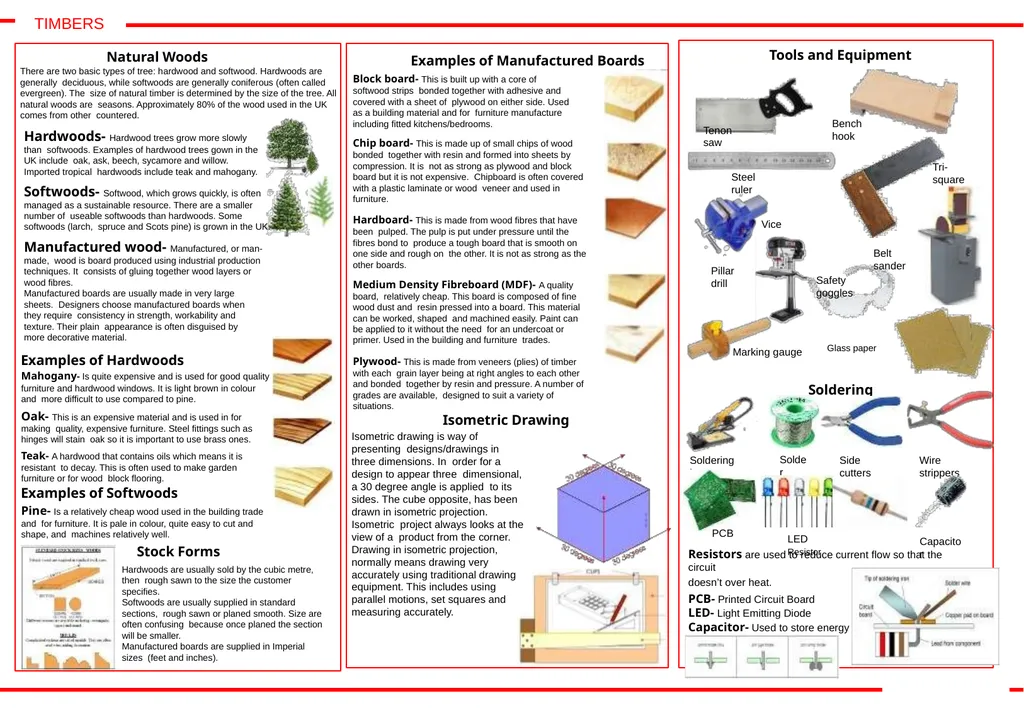
TIMBERS Tools and Equipment Tenon saw Bench hook Steel ruler Tri-square Vice Belt sander Safety goggles Pillar drill Examples of Manufactured Boards
Block board- This is built up with a core of softwood strips bonded together with adhesive and covered with a sheet of plywood on either side. Used as a building material and for furniture manufacture including fitted kitchens/bedrooms.
Chip board- This is made up of small chips of wood bonded together with resin and formed into sheets by compression. It is not as strong as plywood and block board but it is not expensive. Chipboard is often covered with a plastic laminate or wood veneer and used in furniture.
Hardboard- This is made from wood fibres that have been pulped. The pulp is put under pressure until the fibres bond to produce a tough board that is smooth on one side and rough on the other. It is not as strong as the other boards.
Medium Density Fibreboard (MDF)- A quality board, relatively cheap. This board is composed of fine wood dust and resin pressed into a board. This material can be worked, shaped and machined easily. Paint can be applied to it without the need for an undercoat or primer. Used in the building and furniture trades.
Plywood- This is made from veneers (plies) of timber with each grain layer being at right angles to each other and bonded together by resin and pressure. A number of grades are available, designed to suit a variety of situations.
Isometric Drawing
Isometric drawing is way of presenting designs/drawings in three dimensions. In order for a design to appear three dimensional, a 30 degree angle is applied to its sides. The cube opposite, has been drawn in isometric projection. Isometric project always looks at the view of a product from the corner. Drawing in isometric projection, normally means drawing very accurately using traditional drawing equipment. This includes using parallel motions, set squares and measuring accurately. Natural Woods
There are two basic types of tree: hardwood and softwood. Hardwoods are generally deciduous, while softwoods are generally coniferous (often called evergreen). The size of natural timber is determined by the size of the tree. All natural woods are seasons. Approximately 80% of the wood used in the UK comes from other countered.
Hardwoods- Hardwood trees grow more slowly than softwoods. Examples of hardwood trees gown in the UK include oak, ask, beech, sycamore and willow. Imported tropical hardwoods include teak and mahogany.
Softwoods- Softwood, which grows quickly, is often managed as a sustainable resource. There are a smaller number of useable softwoods than hardwoods. Some softwoods (larch, spruce and Scots pine) is grown in the UK.
Manufactured wood- Manufactured, or man-made, wood is board produced using industrial production techniques. It consists of gluing together wood layers or wood fibres.
Manufactured boards are usually made in very large sheets. Designers choose manufactured boards when they require consistency in strength, workability and texture. Their plain appearance is often disguised by more decorative material.
Examples of Hardwoods
Mahogany- Is quite expensive and is used for good quality
furniture and hardwood windows. It is light brown in colour and more difficult to use compared to pine.
Oak- This is an expensive material and is used in for making quality, expensive furniture. Steel fittings such as hinges will stain oak so it is important to use brass ones.
Teak- A hardwood that contains oils which means it is resistant to decay. This is often used to make garden furniture or for wood block flooring.
Examples of Softwoods
Pine- Is a relatively cheap wood used in the building trade and for furniture. It is pale in colour, quite easy to cut and shape, and machines relatively well.
Stock Forms
Hardwoods are usually sold by the cubic metre, then rough sawn to the size the customer specifies.
Softwoods are usually supplied in standard sections, rough sawn or planed smooth. Size are often confusing because once planed the section will be smaller.
Manufactured boards are supplied in Imperial sizes (feet and inches). Marking gauge Glass paper
Soldering Soldering iron Solder Side cutters Wire strippers PCB LED Resistor Resistors are used to reduce current flow so that the circuit
doesn’t over heat.
PCB- Printed Circuit Board
LED- Light Emitting Diode
Capacitor- Used to store energy Capacitor<br>
Block board- This is built up with a core of softwood strips bonded together with adhesive and covered with a sheet of plywood on either side. Used as a building material and for furniture manufacture including fitted kitchens/bedrooms.
Chip board- This is made up of small chips of wood bonded together with resin and formed into sheets by compression. It is not as strong as plywood and block board but it is not expensive. Chipboard is often covered with a plastic laminate or wood veneer and used in furniture.
Hardboard- This is made from wood fibres that have been pulped. The pulp is put under pressure until the fibres bond to produce a tough board that is smooth on one side and rough on the other. It is not as strong as the other boards.
Medium Density Fibreboard (MDF)- A quality board, relatively cheap. This board is composed of fine wood dust and resin pressed into a board. This material can be worked, shaped and machined easily. Paint can be applied to it without the need for an undercoat or primer. Used in the building and furniture trades.
Plywood- This is made from veneers (plies) of timber with each grain layer being at right angles to each other and bonded together by resin and pressure. A number of grades are available, designed to suit a variety of situations.
Isometric Drawing
Isometric drawing is way of presenting designs/drawings in three dimensions. In order for a design to appear three dimensional, a 30 degree angle is applied to its sides. The cube opposite, has been drawn in isometric projection. Isometric project always looks at the view of a product from the corner. Drawing in isometric projection, normally means drawing very accurately using traditional drawing equipment. This includes using parallel motions, set squares and measuring accurately. Natural Woods
There are two basic types of tree: hardwood and softwood. Hardwoods are generally deciduous, while softwoods are generally coniferous (often called evergreen). The size of natural timber is determined by the size of the tree. All natural woods are seasons. Approximately 80% of the wood used in the UK comes from other countered.
Hardwoods- Hardwood trees grow more slowly than softwoods. Examples of hardwood trees gown in the UK include oak, ask, beech, sycamore and willow. Imported tropical hardwoods include teak and mahogany.
Softwoods- Softwood, which grows quickly, is often managed as a sustainable resource. There are a smaller number of useable softwoods than hardwoods. Some softwoods (larch, spruce and Scots pine) is grown in the UK.
Manufactured wood- Manufactured, or man-made, wood is board produced using industrial production techniques. It consists of gluing together wood layers or wood fibres.
Manufactured boards are usually made in very large sheets. Designers choose manufactured boards when they require consistency in strength, workability and texture. Their plain appearance is often disguised by more decorative material.
Examples of Hardwoods
Mahogany- Is quite expensive and is used for good quality
furniture and hardwood windows. It is light brown in colour and more difficult to use compared to pine.
Oak- This is an expensive material and is used in for making quality, expensive furniture. Steel fittings such as hinges will stain oak so it is important to use brass ones.
Teak- A hardwood that contains oils which means it is resistant to decay. This is often used to make garden furniture or for wood block flooring.
Examples of Softwoods
Pine- Is a relatively cheap wood used in the building trade and for furniture. It is pale in colour, quite easy to cut and shape, and machines relatively well.
Stock Forms
Hardwoods are usually sold by the cubic metre, then rough sawn to the size the customer specifies.
Softwoods are usually supplied in standard sections, rough sawn or planed smooth. Size are often confusing because once planed the section will be smaller.
Manufactured boards are supplied in Imperial sizes (feet and inches). Marking gauge Glass paper
Soldering Soldering iron Solder Side cutters Wire strippers PCB LED Resistor Resistors are used to reduce current flow so that the circuit
doesn’t over heat.
PCB- Printed Circuit Board
LED- Light Emitting Diode
Capacitor- Used to store energy Capacitor<br>
02
POLYMERS CAD/CAM
CAD- Computer Aided Design
CAM- Computer Aided Manufacture
CNC- Computer Numerical Control Important tools for 2D Design
Select tool- Select any part of your design by clicking or dragging over it until it turns purple.
Vectorise- Adapting images from the internet to the be suitable for the laser cutter.
Contour- Create an identical replica of the shape you have to a specified size.
Boundary fill- Add colour to your work if the boundary of lines is closed.
Delete- There are a number of ways to delete parts or all of your design. Click and hold until you can see all options.
Shapes- Draw a number of different shapes. To access the different shapes you must click and hold the rectangular tool
Manufacturing Plastics
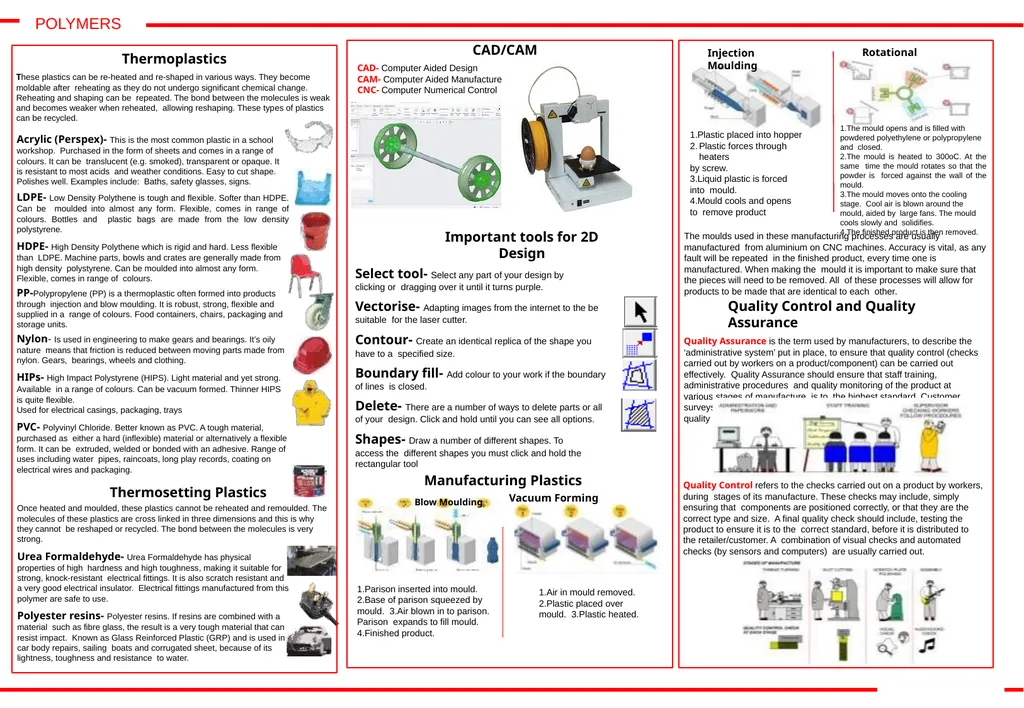
Blow Moulding Vacuum Forming Injection Moulding Parison inserted into mould.
Base of parison squeezed by mould. 3.Air blown in to parison. Parison expands to fill mould.
4.Finished product. 1.Air in mould removed. 2.Plastic placed over mould. 3.Plastic heated. Plastic placed into hopper
Plastic forces through heaters
by screw.
Liquid plastic is forced into mould.
Mould cools and opens to remove product Thermoplastics
These plastics can be re-heated and re-shaped in various ways. They become moldable after reheating as they do not undergo significant chemical change. Reheating and shaping can be repeated. The bond between the molecules is weak and becomes weaker when reheated, allowing reshaping. These types of plastics can be recycled.
Acrylic (Perspex)- This is the most common plastic in a school workshop. Purchased in the form of sheets and comes in a range of colours. It can be translucent (e.g. smoked), transparent or opaque. It is resistant to most acids and weather conditions. Easy to cut shape. Polishes well. Examples include: Baths, safety glasses, signs.
LDPE- Low Density Polythene is tough and flexible. Softer than HDPE. Can be moulded into almost any form. Flexible, comes in range of colours. Bottles and plastic bags are made from the low density polystyrene.
HDPE- High Density Polythene which is rigid and hard. Less flexible than LDPE. Machine parts, bowls and crates are generally made from high density polystyrene. Can be moulded into almost any form. Flexible, comes in range of colours.
PP-Polypropylene (PP) is a thermoplastic often formed into products through injection and blow moulding. It is robust, strong, flexible and supplied in a range of colours. Food containers, chairs, packaging and storage units.
Nylon- Is used in engineering to make gears and bearings. It’s oily nature means that friction is reduced between moving parts made from nylon. Gears, bearings, wheels and clothing.
HIPs- High Impact Polystyrene (HIPS). Light material and yet strong. Available in a range of colours. Can be vacuum formed. Thinner HIPS is quite flexible.
Used for electrical casings, packaging, trays
PVC- Polyvinyl Chloride. Better known as PVC. A tough material, purchased as either a hard (inflexible) material or alternatively a flexible form. It can be extruded, welded or bonded with an adhesive. Range of uses including water pipes, raincoats, long play records, coating on electrical wires and packaging.
Thermosetting Plastics
Once heated and moulded, these plastics cannot be reheated and remoulded. The molecules of these plastics are cross linked in three dimensions and this is why they cannot be reshaped or recycled. The bond between the molecules is very strong.
Urea Formaldehyde- Urea Formaldehyde has physical properties of high hardness and high toughness, making it suitable for strong, knock-resistant electrical fittings. It is also scratch resistant and a very good electrical insulator. Electrical fittings manufactured from this polymer are safe to use.
Polyester resins- Polyester resins. If resins are combined with a material such as fibre glass, the result is a very tough material that can resist impact. Known as Glass Reinforced Plastic (GRP) and is used in car body repairs, sailing boats and corrugated sheet, because of its lightness, toughness and resistance to water. Rotational Moulding The mould opens and is filled with powdered polyethylene or polypropylene and closed.
The mould is heated to 300oC. At the same time the mould rotates so that the powder is forced against the wall of the mould.
The mould moves onto the cooling stage. Cool air is blown around the mould, aided by large fans. The mould cools slowly and solidifies.
The finished product is then removed. The moulds used in these manufacturing processes are usually manufactured from aluminium on CNC machines. Accuracy is vital, as any fault will be repeated in the finished product, every time one is manufactured. When making the mould it is important to make sure that the pieces will need to be removed. All of these processes will allow for products to be made that are identical to each other.
Quality Control and Quality Assurance
Quality Assurance is the term used by manufacturers, to describe the ‘administrative system’ put in place, to ensure that quality control (checks carried out by workers on a product/component) can be carried out effectively. Quality Assurance should ensure that staff training, administrative procedures and quality monitoring of the product at various stages of manufacture, is to the highest standard. Customer surveys will be carried out to ensure customer satisfaction, all part of quality assurance. Quality Control refers to the checks carried out on a product by workers, during stages of its manufacture. These checks may include, simply ensuring that components are positioned correctly, or that they are the correct type and size. A final quality check should include, testing the product to ensure it is to the correct standard, before it is distributed to the retailer/customer. A combination of visual checks and automated checks (by sensors and computers) are usually carried out.<br>
CAD- Computer Aided Design
CAM- Computer Aided Manufacture
CNC- Computer Numerical Control Important tools for 2D Design
Select tool- Select any part of your design by clicking or dragging over it until it turns purple.
Vectorise- Adapting images from the internet to the be suitable for the laser cutter.
Contour- Create an identical replica of the shape you have to a specified size.
Boundary fill- Add colour to your work if the boundary of lines is closed.
Delete- There are a number of ways to delete parts or all of your design. Click and hold until you can see all options.
Shapes- Draw a number of different shapes. To access the different shapes you must click and hold the rectangular tool
Manufacturing Plastics
Blow Moulding Vacuum Forming Injection Moulding Parison inserted into mould.
Base of parison squeezed by mould. 3.Air blown in to parison. Parison expands to fill mould.
4.Finished product. 1.Air in mould removed. 2.Plastic placed over mould. 3.Plastic heated. Plastic placed into hopper
Plastic forces through heaters
by screw.
Liquid plastic is forced into mould.
Mould cools and opens to remove product Thermoplastics
These plastics can be re-heated and re-shaped in various ways. They become moldable after reheating as they do not undergo significant chemical change. Reheating and shaping can be repeated. The bond between the molecules is weak and becomes weaker when reheated, allowing reshaping. These types of plastics can be recycled.
Acrylic (Perspex)- This is the most common plastic in a school workshop. Purchased in the form of sheets and comes in a range of colours. It can be translucent (e.g. smoked), transparent or opaque. It is resistant to most acids and weather conditions. Easy to cut shape. Polishes well. Examples include: Baths, safety glasses, signs.
LDPE- Low Density Polythene is tough and flexible. Softer than HDPE. Can be moulded into almost any form. Flexible, comes in range of colours. Bottles and plastic bags are made from the low density polystyrene.
HDPE- High Density Polythene which is rigid and hard. Less flexible than LDPE. Machine parts, bowls and crates are generally made from high density polystyrene. Can be moulded into almost any form. Flexible, comes in range of colours.
PP-Polypropylene (PP) is a thermoplastic often formed into products through injection and blow moulding. It is robust, strong, flexible and supplied in a range of colours. Food containers, chairs, packaging and storage units.
Nylon- Is used in engineering to make gears and bearings. It’s oily nature means that friction is reduced between moving parts made from nylon. Gears, bearings, wheels and clothing.
HIPs- High Impact Polystyrene (HIPS). Light material and yet strong. Available in a range of colours. Can be vacuum formed. Thinner HIPS is quite flexible.
Used for electrical casings, packaging, trays
PVC- Polyvinyl Chloride. Better known as PVC. A tough material, purchased as either a hard (inflexible) material or alternatively a flexible form. It can be extruded, welded or bonded with an adhesive. Range of uses including water pipes, raincoats, long play records, coating on electrical wires and packaging.
Thermosetting Plastics
Once heated and moulded, these plastics cannot be reheated and remoulded. The molecules of these plastics are cross linked in three dimensions and this is why they cannot be reshaped or recycled. The bond between the molecules is very strong.
Urea Formaldehyde- Urea Formaldehyde has physical properties of high hardness and high toughness, making it suitable for strong, knock-resistant electrical fittings. It is also scratch resistant and a very good electrical insulator. Electrical fittings manufactured from this polymer are safe to use.
Polyester resins- Polyester resins. If resins are combined with a material such as fibre glass, the result is a very tough material that can resist impact. Known as Glass Reinforced Plastic (GRP) and is used in car body repairs, sailing boats and corrugated sheet, because of its lightness, toughness and resistance to water. Rotational Moulding The mould opens and is filled with powdered polyethylene or polypropylene and closed.
The mould is heated to 300oC. At the same time the mould rotates so that the powder is forced against the wall of the mould.
The mould moves onto the cooling stage. Cool air is blown around the mould, aided by large fans. The mould cools slowly and solidifies.
The finished product is then removed. The moulds used in these manufacturing processes are usually manufactured from aluminium on CNC machines. Accuracy is vital, as any fault will be repeated in the finished product, every time one is manufactured. When making the mould it is important to make sure that the pieces will need to be removed. All of these processes will allow for products to be made that are identical to each other.
Quality Control and Quality Assurance
Quality Assurance is the term used by manufacturers, to describe the ‘administrative system’ put in place, to ensure that quality control (checks carried out by workers on a product/component) can be carried out effectively. Quality Assurance should ensure that staff training, administrative procedures and quality monitoring of the product at various stages of manufacture, is to the highest standard. Customer surveys will be carried out to ensure customer satisfaction, all part of quality assurance. Quality Control refers to the checks carried out on a product by workers, during stages of its manufacture. These checks may include, simply ensuring that components are positioned correctly, or that they are the correct type and size. A final quality check should include, testing the product to ensure it is to the correct standard, before it is distributed to the retailer/customer. A combination of visual checks and automated checks (by sensors and computers) are usually carried out.<br>
03
PAPER, CARD and BRANDING s Analysis- ACCESS FM Aesthetics- What does it look like. Colour/shape/texture Cost- How must will it cost to make and buy?
Consumer- Who will buy the product? Environment- How will this product impact on the environment?
Safety- How has this product been made so that it is safe to use?
Size- What are the dimensions of this product?
Function- What does the product do? How does it work? Materials and manufacture- what is this product made from and how is it made? Functions of Packaging: I PICT PD
Protect- Make sure product is safe, undamaged and unopened Inform- Information about the product: Calorie Content, Barcode, Ingredients, Recycling Info, Allergy Advice, Contact
Contain- To keep product in, prevent leakages, be shaped to fit Transport- Should be easy to transport (in bulk), must remain intact Preserve- Make sure temperature and freshness is maintained over time
Display- Advertise product to make it look good. Window to see product (made of acetate)
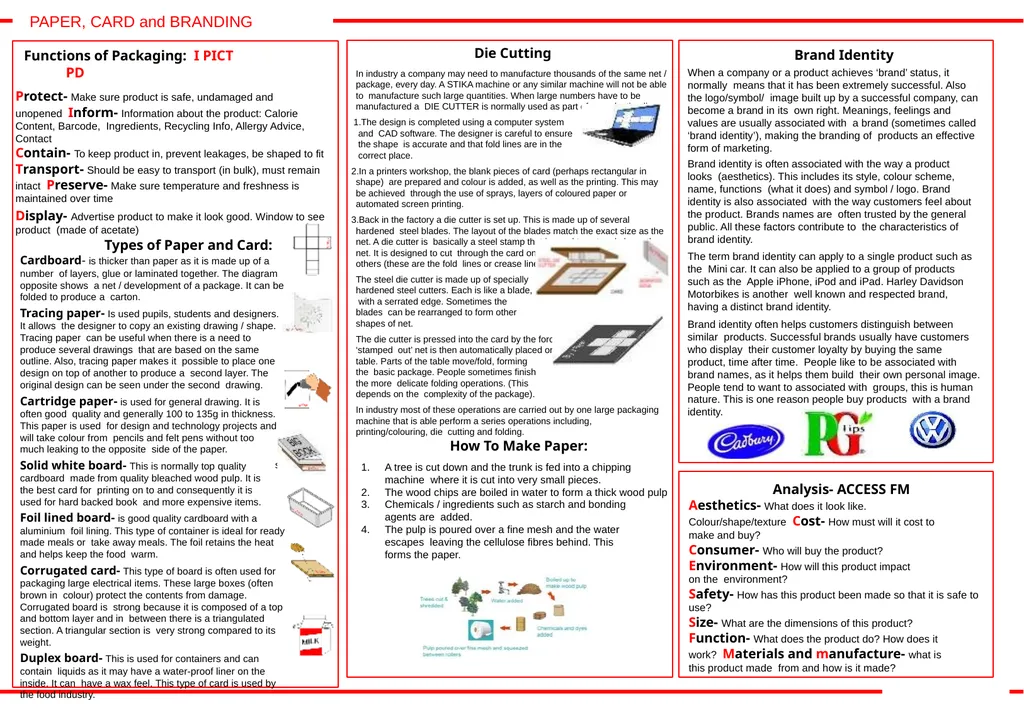
Types of Paper and Card: Cardboard- is thicker than paper as it is made up of a number of layers, glue or laminated together. The diagram opposite shows a net / development of a package. It can be folded to produce a carton.
Tracing paper- Is used pupils, students and designers. It allows the designer to copy an existing drawing / shape. Tracing paper can be useful when there is a need to produce several drawings that are based on the same outline. Also, tracing paper makes it possible to place one design on top of another to produce a second layer. The original design can be seen under the second drawing.
Cartridge paper- is used for general drawing. It is often good quality and generally 100 to 135g in thickness. This paper is used for design and technology projects and will take colour from pencils and felt pens without too much leaking to the opposite side of the paper.
Solid white board- This is normally top quality cardboard made from quality bleached wood pulp. It is the best card for printing on to and consequently it is used for hard backed book and more expensive items.
Foil lined board- is good quality cardboard with a aluminium foil lining. This type of container is ideal for ready made meals or take away meals. The foil retains the heat and helps keep the food warm.
Corrugated card- This type of board is often used for packaging large electrical items. These large boxes (often brown in colour) protect the contents from damage. Corrugated board is strong because it is composed of a top and bottom layer and in between there is a triangulated section. A triangular section is very strong compared to its weight.
Duplex board- This is used for containers and can contain liquids as it may have a water-proof liner on the inside. It can have a wax feel. This type of card is used by the food industry. Die Cutting
In industry a company may need to manufacture thousands of the same net / package, every day. A STIKA machine or any similar machine will not be able to manufacture such large quantities. When large numbers have to be manufactured a DIE CUTTER is normally used as part of a production line.
The design is completed using a computer system and CAD software. The designer is careful to ensure the shape is accurate and that fold lines are in the correct place.
In a printers workshop, the blank pieces of card (perhaps rectangular in shape) are prepared and colour is added, as well as the printing. This may be achieved through the use of sprays, layers of coloured paper or automated screen printing.
Back in the factory a die cutter is set up. This is made up of several hardened steel blades. The layout of the blades match the exact size as the net. A die cutter is basically a steel stamp that is used to cut and shape the net. It is designed to cut through the card on some lines whilst slightly cutting others (these are the fold lines or crease lines).
The steel die cutter is made up of specially hardened steel cutters. Each is like a blade, with a serrated edge. Sometimes the blades can be rearranged to form other shapes of net.
The die cutter is pressed into the card by the force of the machine. The ‘stamped out’ net is then automatically placed on a folding
table. Parts of the table move/fold, forming the basic package. People sometimes finish the more delicate folding operations. (This depends on the complexity of the package).
In industry most of these operations are carried out by one large packaging machine that is able perform a series operations including, printing/colouring, die cutting and folding.
How To Make Paper:
A tree is cut down and the trunk is fed into a chipping machine where it is cut into very small pieces.
The wood chips are boiled in water to form a thick wood pulp
Chemicals / ingredients such as starch and bonding agents are added.
The pulp is poured over a fine mesh and the water escapes leaving the cellulose fibres behind. This forms the paper. Brand Identity
When a company or a product achieves ‘brand’ status, it normally means that it has been extremely successful. Also the logo/symbol/ image built up by a successful company, can become a brand in its own right. Meanings, feelings and values are usually associated with a brand (sometimes called ‘brand identity’), making the branding of products an effective form of marketing.
Brand identity is often associated with the way a product looks (aesthetics). This includes its style, colour scheme, name, functions (what it does) and symbol / logo. Brand identity is also associated with the way customers feel about the product. Brands names are often trusted by the general public. All these factors contribute to the characteristics of brand identity.
The term brand identity can apply to a single product such as the Mini car. It can also be applied to a group of products such as the Apple iPhone, iPod and iPad. Harley Davidson Motorbikes is another well known and respected brand, having a distinct brand identity.
Brand identity often helps customers distinguish between similar products. Successful brands usually have customers who display their customer loyalty by buying the same product, time after time. People like to be associated with brand names, as it helps them build their own personal image. People tend to want to associated with groups, this is human nature. This is one reason people buy products with a brand identity.<br>
Consumer- Who will buy the product? Environment- How will this product impact on the environment?
Safety- How has this product been made so that it is safe to use?
Size- What are the dimensions of this product?
Function- What does the product do? How does it work? Materials and manufacture- what is this product made from and how is it made? Functions of Packaging: I PICT PD
Protect- Make sure product is safe, undamaged and unopened Inform- Information about the product: Calorie Content, Barcode, Ingredients, Recycling Info, Allergy Advice, Contact
Contain- To keep product in, prevent leakages, be shaped to fit Transport- Should be easy to transport (in bulk), must remain intact Preserve- Make sure temperature and freshness is maintained over time
Display- Advertise product to make it look good. Window to see product (made of acetate)
Types of Paper and Card: Cardboard- is thicker than paper as it is made up of a number of layers, glue or laminated together. The diagram opposite shows a net / development of a package. It can be folded to produce a carton.
Tracing paper- Is used pupils, students and designers. It allows the designer to copy an existing drawing / shape. Tracing paper can be useful when there is a need to produce several drawings that are based on the same outline. Also, tracing paper makes it possible to place one design on top of another to produce a second layer. The original design can be seen under the second drawing.
Cartridge paper- is used for general drawing. It is often good quality and generally 100 to 135g in thickness. This paper is used for design and technology projects and will take colour from pencils and felt pens without too much leaking to the opposite side of the paper.
Solid white board- This is normally top quality cardboard made from quality bleached wood pulp. It is the best card for printing on to and consequently it is used for hard backed book and more expensive items.
Foil lined board- is good quality cardboard with a aluminium foil lining. This type of container is ideal for ready made meals or take away meals. The foil retains the heat and helps keep the food warm.
Corrugated card- This type of board is often used for packaging large electrical items. These large boxes (often brown in colour) protect the contents from damage. Corrugated board is strong because it is composed of a top and bottom layer and in between there is a triangulated section. A triangular section is very strong compared to its weight.
Duplex board- This is used for containers and can contain liquids as it may have a water-proof liner on the inside. It can have a wax feel. This type of card is used by the food industry. Die Cutting
In industry a company may need to manufacture thousands of the same net / package, every day. A STIKA machine or any similar machine will not be able to manufacture such large quantities. When large numbers have to be manufactured a DIE CUTTER is normally used as part of a production line.
The design is completed using a computer system and CAD software. The designer is careful to ensure the shape is accurate and that fold lines are in the correct place.
In a printers workshop, the blank pieces of card (perhaps rectangular in shape) are prepared and colour is added, as well as the printing. This may be achieved through the use of sprays, layers of coloured paper or automated screen printing.
Back in the factory a die cutter is set up. This is made up of several hardened steel blades. The layout of the blades match the exact size as the net. A die cutter is basically a steel stamp that is used to cut and shape the net. It is designed to cut through the card on some lines whilst slightly cutting others (these are the fold lines or crease lines).
The steel die cutter is made up of specially hardened steel cutters. Each is like a blade, with a serrated edge. Sometimes the blades can be rearranged to form other shapes of net.
The die cutter is pressed into the card by the force of the machine. The ‘stamped out’ net is then automatically placed on a folding
table. Parts of the table move/fold, forming the basic package. People sometimes finish the more delicate folding operations. (This depends on the complexity of the package).
In industry most of these operations are carried out by one large packaging machine that is able perform a series operations including, printing/colouring, die cutting and folding.
How To Make Paper:
A tree is cut down and the trunk is fed into a chipping machine where it is cut into very small pieces.
The wood chips are boiled in water to form a thick wood pulp
Chemicals / ingredients such as starch and bonding agents are added.
The pulp is poured over a fine mesh and the water escapes leaving the cellulose fibres behind. This forms the paper. Brand Identity
When a company or a product achieves ‘brand’ status, it normally means that it has been extremely successful. Also the logo/symbol/ image built up by a successful company, can become a brand in its own right. Meanings, feelings and values are usually associated with a brand (sometimes called ‘brand identity’), making the branding of products an effective form of marketing.
Brand identity is often associated with the way a product looks (aesthetics). This includes its style, colour scheme, name, functions (what it does) and symbol / logo. Brand identity is also associated with the way customers feel about the product. Brands names are often trusted by the general public. All these factors contribute to the characteristics of brand identity.
The term brand identity can apply to a single product such as the Mini car. It can also be applied to a group of products such as the Apple iPhone, iPod and iPad. Harley Davidson Motorbikes is another well known and respected brand, having a distinct brand identity.
Brand identity often helps customers distinguish between similar products. Successful brands usually have customers who display their customer loyalty by buying the same product, time after time. People like to be associated with brand names, as it helps them build their own personal image. People tend to want to associated with groups, this is human nature. This is one reason people buy products with a brand identity.<br>
04
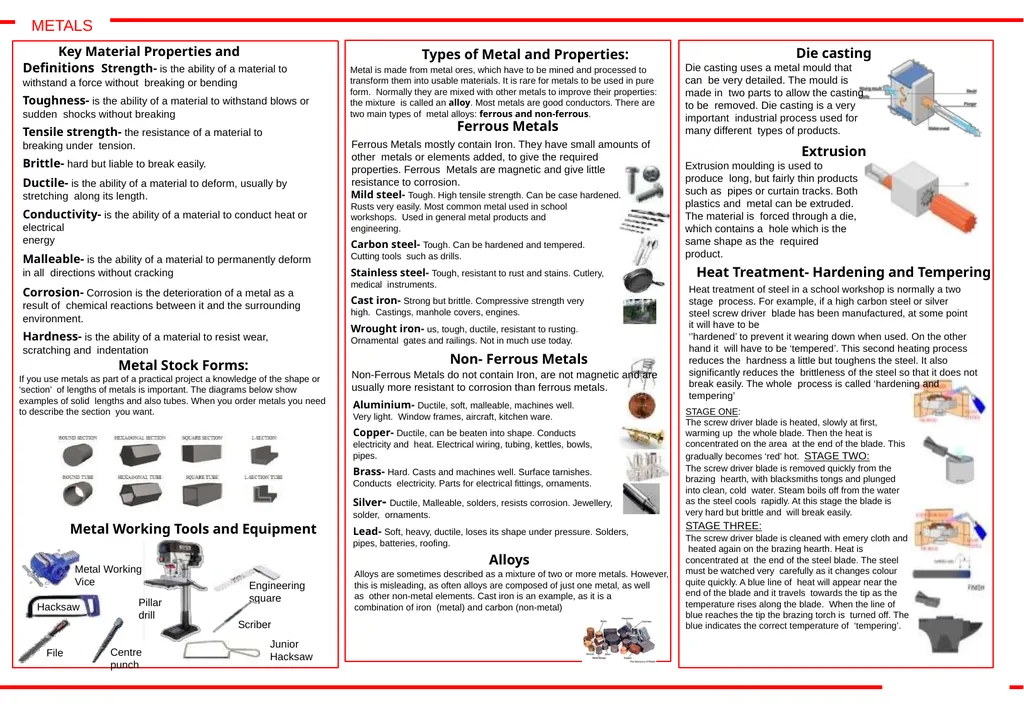
METALS Metal Working Vice Pillar drill Engineering square Hacksaw Junior Hacksaw Metal Working Tools and Equipment Key Material Properties and Definitions Strength- is the ability of a material to withstand a force without breaking or bending
Toughness- is the ability of a material to withstand blows or sudden shocks without breaking
Tensile strength- the resistance of a material to breaking under tension.
Brittle- hard but liable to break easily.
Ductile- is the ability of a material to deform, usually by stretching along its length.
Conductivity- is the ability of a material to conduct heat or electrical
energy
Malleable- is the ability of a material to permanently deform in all directions without cracking
Corrosion- Corrosion is the deterioration of a metal as a result of chemical reactions between it and the surrounding environment.
Hardness- is the ability of a material to resist wear, scratching and indentation
Metal Stock Forms:
If you use metals as part of a practical project a knowledge of the shape or ‘section’ of lengths of metals is important. The diagrams below show examples of solid lengths and also tubes. When you order metals you need to describe the section you want. File Centre punch Scriber Die casting
Die casting uses a metal mould that can be very detailed. The mould is made in two parts to allow the casting to be removed. Die casting is a very important industrial process used for many different types of products.
Extrusion
Extrusion moulding is used to produce long, but fairly thin products such as pipes or curtain tracks. Both plastics and metal can be extruded. The material is forced through a die, which contains a hole which is the same shape as the required product.
Heat Treatment- Hardening and Tempering
Heat treatment of steel in a school workshop is normally a two stage process. For example, if a high carbon steel or silver steel screw driver blade has been manufactured, at some point it will have to be
‘’hardened’ to prevent it wearing down when used. On the other hand it will have to be ‘tempered’. This second heating process reduces the hardness a little but toughens the steel. It also significantly reduces the brittleness of the steel so that it does not break easily. The whole process is called ‘hardening and tempering’
STAGE ONE:
The screw driver blade is heated, slowly at first, warming up the whole blade. Then the heat is concentrated on the area at the end of the blade. This gradually becomes ‘red’ hot. STAGE TWO:
The screw driver blade is removed quickly from the brazing hearth, with blacksmiths tongs and plunged into clean, cold water. Steam boils off from the water as the steel cools rapidly. At this stage the blade is very hard but brittle and will break easily.
STAGE THREE:
The screw driver blade is cleaned with emery cloth and heated again on the brazing hearth. Heat is concentrated at the end of the steel blade. The steel must be watched very carefully as it changes colour quite quickly. A blue line of heat will appear near the end of the blade and it travels towards the tip as the temperature rises along the blade. When the line of blue reaches the tip the brazing torch is turned off. The blue indicates the correct temperature of ‘tempering’. Types of Metal and Properties:
Metal is made from metal ores, which have to be mined and processed to
transform them into usable materials. It is rare for metals to be used in pure form. Normally they are mixed with other metals to improve their properties: the mixture is called an alloy. Most metals are good conductors. There are two main types of metal alloys: ferrous and non-ferrous.
Ferrous Metals
Ferrous Metals mostly contain Iron. They have small amounts of other metals or elements added, to give the required properties. Ferrous Metals are magnetic and give little resistance to corrosion.
Mild steel- Tough. High tensile strength. Can be case hardened.
Rusts very easily. Most common metal used in school workshops. Used in general metal products and engineering.
Carbon steel- Tough. Can be hardened and tempered. Cutting tools such as drills.
Stainless steel- Tough, resistant to rust and stains. Cutlery, medical instruments.
Cast iron- Strong but brittle. Compressive strength very high. Castings, manhole covers, engines.
Wrought iron- us, tough, ductile, resistant to rusting. Ornamental gates and railings. Not in much use today.
Non- Ferrous Metals
Non-Ferrous Metals do not contain Iron, are not magnetic and are
usually more resistant to corrosion than ferrous metals.
Aluminium- Ductile, soft, malleable, machines well. Very light. Window frames, aircraft, kitchen ware.
Copper- Ductile, can be beaten into shape. Conducts electricity and heat. Electrical wiring, tubing, kettles, bowls, pipes.
Brass- Hard. Casts and machines well. Surface tarnishes. Conducts electricity. Parts for electrical fittings, ornaments.
Silver- Ductile, Malleable, solders, resists corrosion. Jewellery, solder, ornaments.
Lead- Soft, heavy, ductile, loses its shape under pressure. Solders,
pipes, batteries, roofing.
Alloys
Alloys are sometimes described as a mixture of two or more metals. However,
this is misleading, as often alloys are composed of just one metal, as well as other non-metal elements. Cast iron is an example, as it is a combination of iron (metal) and carbon (non-metal)<br>
Toughness- is the ability of a material to withstand blows or sudden shocks without breaking
Tensile strength- the resistance of a material to breaking under tension.
Brittle- hard but liable to break easily.
Ductile- is the ability of a material to deform, usually by stretching along its length.
Conductivity- is the ability of a material to conduct heat or electrical
energy
Malleable- is the ability of a material to permanently deform in all directions without cracking
Corrosion- Corrosion is the deterioration of a metal as a result of chemical reactions between it and the surrounding environment.
Hardness- is the ability of a material to resist wear, scratching and indentation
Metal Stock Forms:
If you use metals as part of a practical project a knowledge of the shape or ‘section’ of lengths of metals is important. The diagrams below show examples of solid lengths and also tubes. When you order metals you need to describe the section you want. File Centre punch Scriber Die casting
Die casting uses a metal mould that can be very detailed. The mould is made in two parts to allow the casting to be removed. Die casting is a very important industrial process used for many different types of products.
Extrusion
Extrusion moulding is used to produce long, but fairly thin products such as pipes or curtain tracks. Both plastics and metal can be extruded. The material is forced through a die, which contains a hole which is the same shape as the required product.
Heat Treatment- Hardening and Tempering
Heat treatment of steel in a school workshop is normally a two stage process. For example, if a high carbon steel or silver steel screw driver blade has been manufactured, at some point it will have to be
‘’hardened’ to prevent it wearing down when used. On the other hand it will have to be ‘tempered’. This second heating process reduces the hardness a little but toughens the steel. It also significantly reduces the brittleness of the steel so that it does not break easily. The whole process is called ‘hardening and tempering’
STAGE ONE:
The screw driver blade is heated, slowly at first, warming up the whole blade. Then the heat is concentrated on the area at the end of the blade. This gradually becomes ‘red’ hot. STAGE TWO:
The screw driver blade is removed quickly from the brazing hearth, with blacksmiths tongs and plunged into clean, cold water. Steam boils off from the water as the steel cools rapidly. At this stage the blade is very hard but brittle and will break easily.
STAGE THREE:
The screw driver blade is cleaned with emery cloth and heated again on the brazing hearth. Heat is concentrated at the end of the steel blade. The steel must be watched very carefully as it changes colour quite quickly. A blue line of heat will appear near the end of the blade and it travels towards the tip as the temperature rises along the blade. When the line of blue reaches the tip the brazing torch is turned off. The blue indicates the correct temperature of ‘tempering’. Types of Metal and Properties:
Metal is made from metal ores, which have to be mined and processed to
transform them into usable materials. It is rare for metals to be used in pure form. Normally they are mixed with other metals to improve their properties: the mixture is called an alloy. Most metals are good conductors. There are two main types of metal alloys: ferrous and non-ferrous.
Ferrous Metals
Ferrous Metals mostly contain Iron. They have small amounts of other metals or elements added, to give the required properties. Ferrous Metals are magnetic and give little resistance to corrosion.
Mild steel- Tough. High tensile strength. Can be case hardened.
Rusts very easily. Most common metal used in school workshops. Used in general metal products and engineering.
Carbon steel- Tough. Can be hardened and tempered. Cutting tools such as drills.
Stainless steel- Tough, resistant to rust and stains. Cutlery, medical instruments.
Cast iron- Strong but brittle. Compressive strength very high. Castings, manhole covers, engines.
Wrought iron- us, tough, ductile, resistant to rusting. Ornamental gates and railings. Not in much use today.
Non- Ferrous Metals
Non-Ferrous Metals do not contain Iron, are not magnetic and are
usually more resistant to corrosion than ferrous metals.
Aluminium- Ductile, soft, malleable, machines well. Very light. Window frames, aircraft, kitchen ware.
Copper- Ductile, can be beaten into shape. Conducts electricity and heat. Electrical wiring, tubing, kettles, bowls, pipes.
Brass- Hard. Casts and machines well. Surface tarnishes. Conducts electricity. Parts for electrical fittings, ornaments.
Silver- Ductile, Malleable, solders, resists corrosion. Jewellery, solder, ornaments.
Lead- Soft, heavy, ductile, loses its shape under pressure. Solders,
pipes, batteries, roofing.
Alloys
Alloys are sometimes described as a mixture of two or more metals. However,
this is misleading, as often alloys are composed of just one metal, as well as other non-metal elements. Cast iron is an example, as it is a combination of iron (metal) and carbon (non-metal)<br>
05
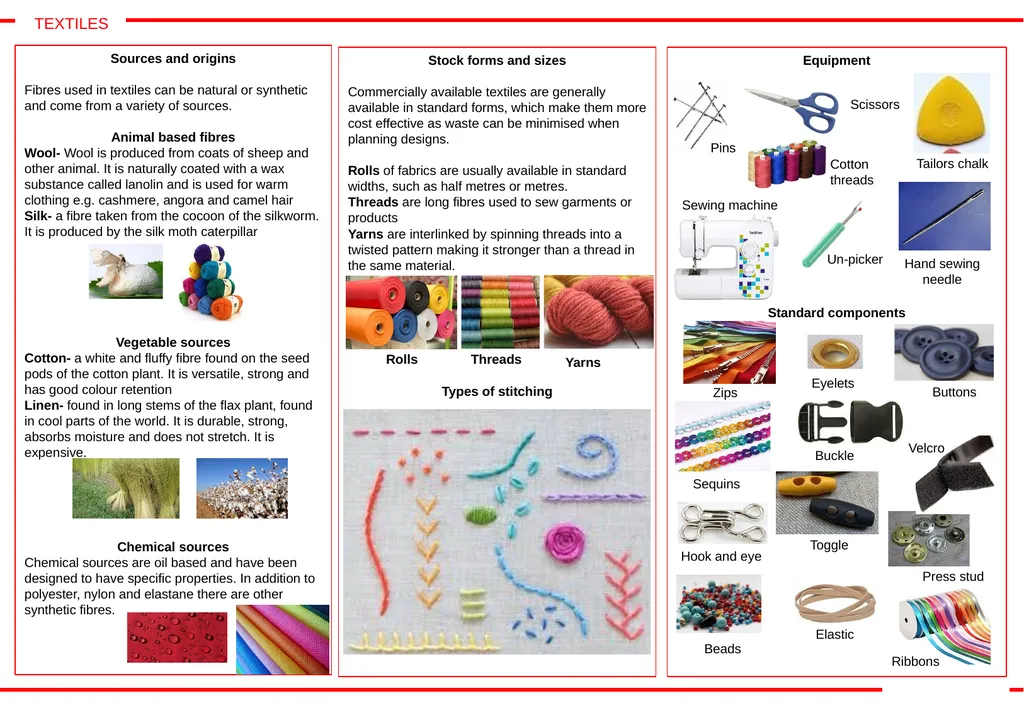
TEXTILES Sources and origins
Fibres used in textiles can be natural or synthetic and come from a variety of sources.
Animal based fibres
Wool- Wool is produced from coats of sheep and other animal. It is naturally coated with a wax substance called lanolin and is used for warm clothing e.g. cashmere, angora and camel hair
Silk- a fibre taken from the cocoon of the silkworm. It is produced by the silk moth caterpillar
Vegetable sources
Cotton- a white and fluffy fibre found on the seed pods of the cotton plant. It is versatile, strong and has good colour retention
Linen- found in long stems of the flax plant, found in cool parts of the world. It is durable, strong, absorbs moisture and does not stretch. It is expensive.
Chemical sources
Chemical sources are oil based and have been designed to have specific properties. In addition to polyester, nylon and elastane there are other synthetic fibres. Stock forms and sizes
Commercially available textiles are generally available in standard forms, which make them more cost effective as waste can be minimised when planning designs.
Rolls of fabrics are usually available in standard widths, such as half metres or metres.
Threads are long fibres used to sew garments or products
Yarns are interlinked by spinning threads into a twisted pattern making it stronger than a thread in the same material.
Types of stitching Equipment
Standard components Zips Eyelets Buttons Sequins Buckle Velcro Hook and eye Toggle Press stud Beads Elastic Ribbons Hand sewing needle Un-picker Sewing machine Pins Cotton threads Scissors Tailors chalk Rolls Threads Yarns<br>
Fibres used in textiles can be natural or synthetic and come from a variety of sources.
Animal based fibres
Wool- Wool is produced from coats of sheep and other animal. It is naturally coated with a wax substance called lanolin and is used for warm clothing e.g. cashmere, angora and camel hair
Silk- a fibre taken from the cocoon of the silkworm. It is produced by the silk moth caterpillar
Vegetable sources
Cotton- a white and fluffy fibre found on the seed pods of the cotton plant. It is versatile, strong and has good colour retention
Linen- found in long stems of the flax plant, found in cool parts of the world. It is durable, strong, absorbs moisture and does not stretch. It is expensive.
Chemical sources
Chemical sources are oil based and have been designed to have specific properties. In addition to polyester, nylon and elastane there are other synthetic fibres. Stock forms and sizes
Commercially available textiles are generally available in standard forms, which make them more cost effective as waste can be minimised when planning designs.
Rolls of fabrics are usually available in standard widths, such as half metres or metres.
Threads are long fibres used to sew garments or products
Yarns are interlinked by spinning threads into a twisted pattern making it stronger than a thread in the same material.
Types of stitching Equipment
Standard components Zips Eyelets Buttons Sequins Buckle Velcro Hook and eye Toggle Press stud Beads Elastic Ribbons Hand sewing needle Un-picker Sewing machine Pins Cotton threads Scissors Tailors chalk Rolls Threads Yarns<br>