
Tips for Engaging and Exciting Residents (and
SN
Published · 25 slides · 0 views

1 / 1



Description
Tips for Engaging and Exciting Residents (and faculty) in Scholarship and Research, Part 2: Creative QI Scholarship Activity Curricula Ryan Gilles, MD, Kootenai Clinic Family Medicine Residency of Coeur dAlene Elizabeth Paddock, MD,
Related Topics
Share
Embed code
Download this presentation From Below
"Tips for Engaging and Exciting Residents (and" is the property of its rightful owner. Permission is granted to download and print the materials on this website for personal, non-commercial use only, and to display it on your personal computer provided you do not modify the materials and that you retain all copyright notices contained in the materials. By downloading content from our website, you accept the terms of this agreement.
Presentation Transcript
01
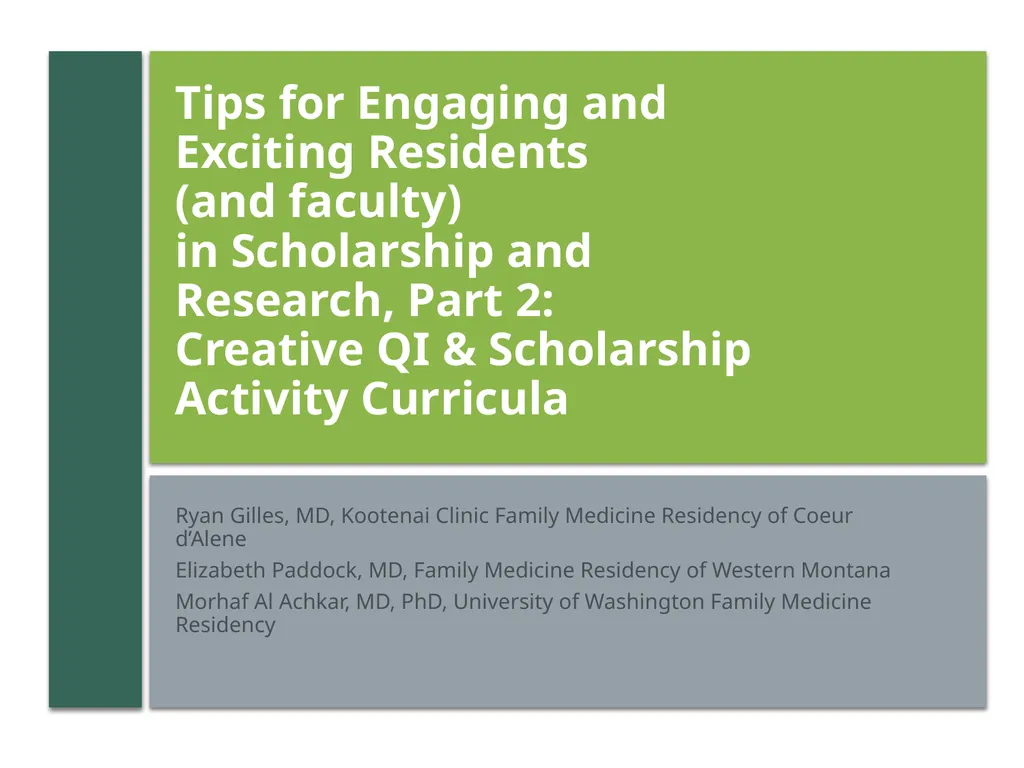
Tips for Engaging and Exciting Residents
(and faculty)
in Scholarship and Research, Part 2:
Creative QI & Scholarship Activity Curricula Ryan Gilles, MD, Kootenai Clinic Family Medicine Residency of Coeur d’Alene
Elizabeth Paddock, MD, Family Medicine Residency of Western Montana
Morhaf Al Achkar, MD, PhD, University of Washington Family Medicine Residency<br>
Elizabeth Paddock, MD, Family Medicine Residency of Western Montana
Morhaf Al Achkar, MD, PhD, University of Washington Family Medicine Residency<br>
02
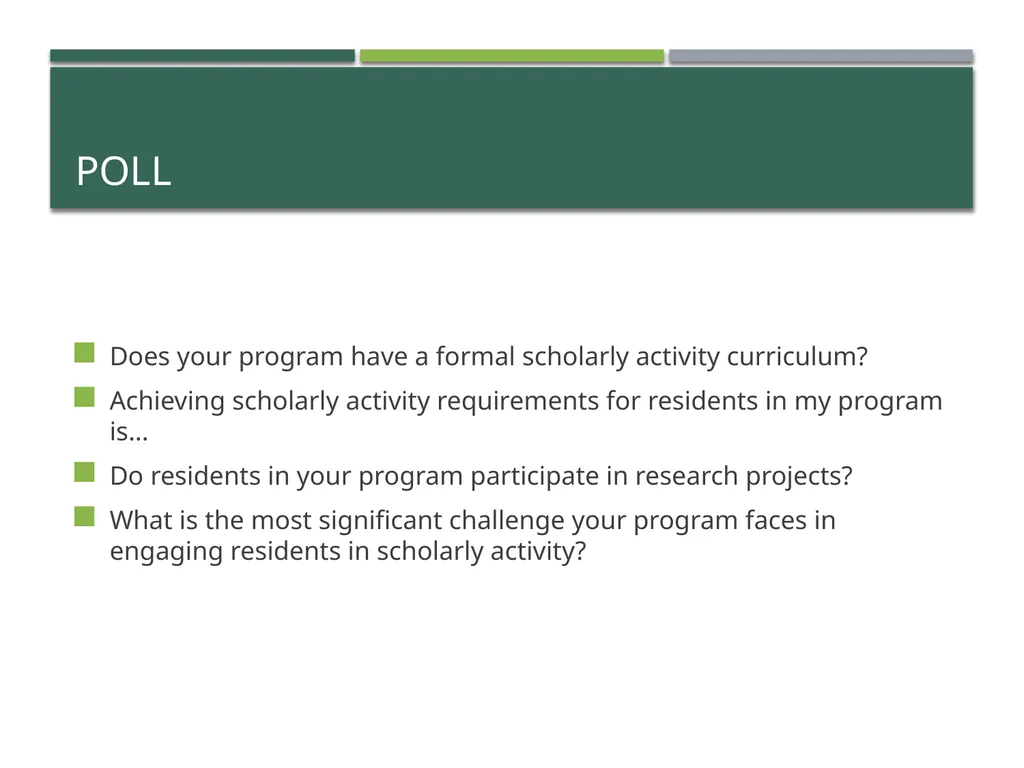
Poll Does your program have a formal scholarly activity curriculum?
Achieving scholarly activity requirements for residents in my program is…
Do residents in your program participate in research projects?
What is the most significant challenge your program faces in engaging residents in scholarly activity?<br>
Achieving scholarly activity requirements for residents in my program is…
Do residents in your program participate in research projects?
What is the most significant challenge your program faces in engaging residents in scholarly activity?<br>
03
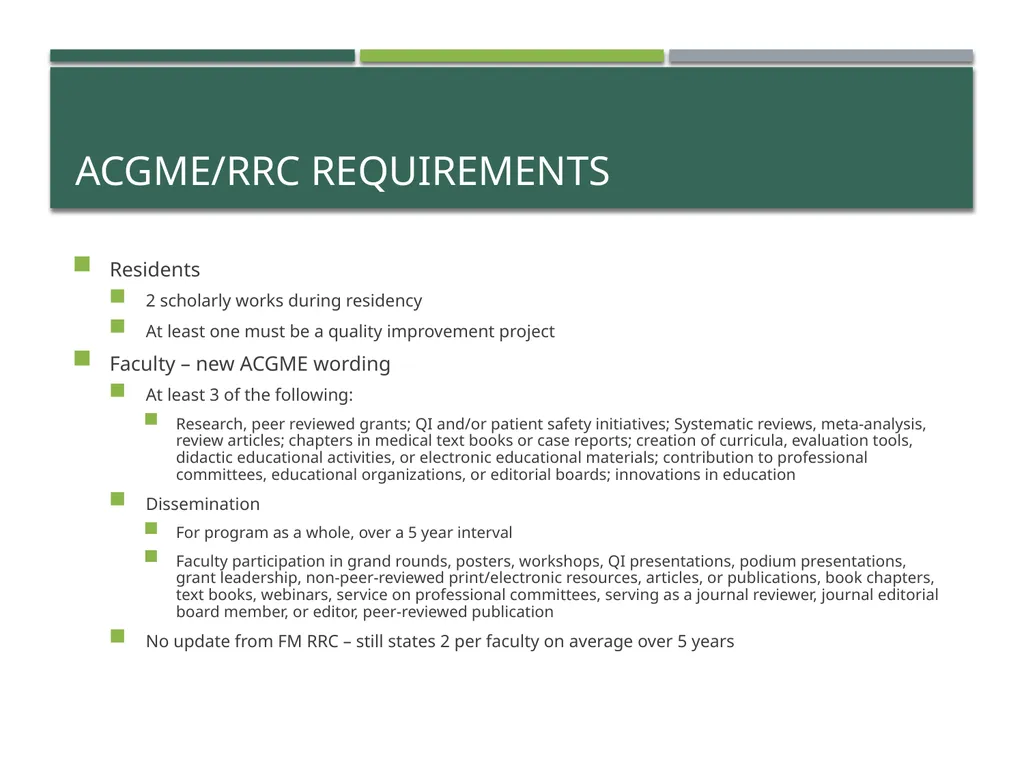
ACGME/RRC Requirements Residents
2 scholarly works during residency
At least one must be a quality improvement project
Faculty – new ACGME wording
At least 3 of the following:
Research, peer reviewed grants; QI and/or patient safety initiatives; Systematic reviews, meta-analysis, review articles; chapters in medical text books or case reports; creation of curricula, evaluation tools, didactic educational activities, or electronic educational materials; contribution to professional committees, educational organizations, or editorial boards; innovations in education
Dissemination
For program as a whole, over a 5 year interval
Faculty participation in grand rounds, posters, workshops, QI presentations, podium presentations, grant leadership, non-peer-reviewed print/electronic resources, articles, or publications, book chapters, text books, webinars, service on professional committees, serving as a journal reviewer, journal editorial board member, or editor, peer-reviewed publication
No update from FM RRC – still states 2 per faculty on average over 5 years<br>
2 scholarly works during residency
At least one must be a quality improvement project
Faculty – new ACGME wording
At least 3 of the following:
Research, peer reviewed grants; QI and/or patient safety initiatives; Systematic reviews, meta-analysis, review articles; chapters in medical text books or case reports; creation of curricula, evaluation tools, didactic educational activities, or electronic educational materials; contribution to professional committees, educational organizations, or editorial boards; innovations in education
Dissemination
For program as a whole, over a 5 year interval
Faculty participation in grand rounds, posters, workshops, QI presentations, podium presentations, grant leadership, non-peer-reviewed print/electronic resources, articles, or publications, book chapters, text books, webinars, service on professional committees, serving as a journal reviewer, journal editorial board member, or editor, peer-reviewed publication
No update from FM RRC – still states 2 per faculty on average over 5 years<br>
04
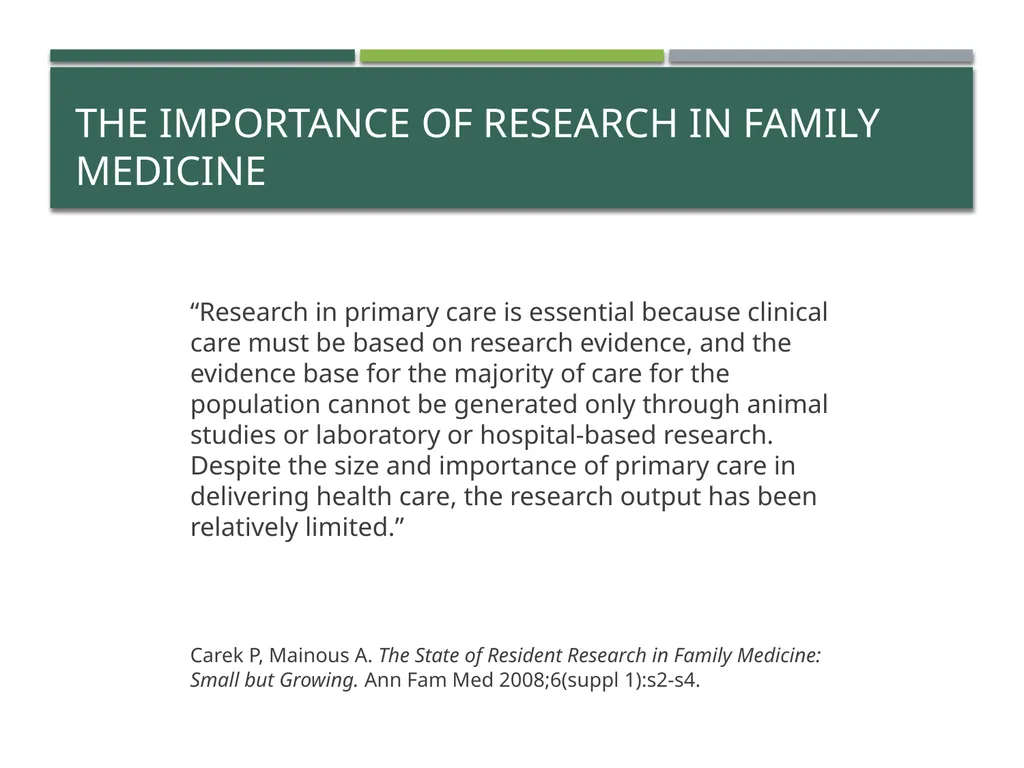
The importance of research in family medicine “Research in primary care is essential because clinical care must be based on research evidence, and the evidence base for the majority of care for the population cannot be generated only through animal studies or laboratory or hospital-based research. Despite the size and importance of primary care in delivering health care, the research output has been relatively limited.”
Carek P, Mainous A. The State of Resident Research in Family Medicine: Small but Growing. Ann Fam Med 2008;6(suppl 1):s2-s4.<br>
Carek P, Mainous A. The State of Resident Research in Family Medicine: Small but Growing. Ann Fam Med 2008;6(suppl 1):s2-s4.<br>
05
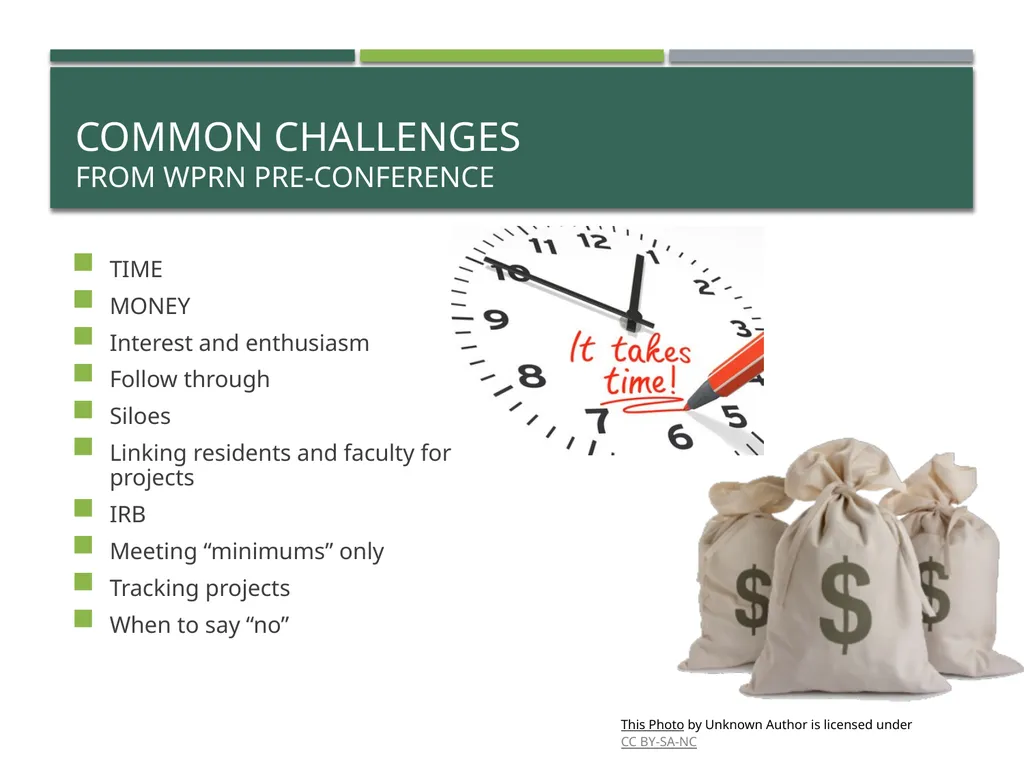
Common challenges
From WPRN Pre-conference TIME
MONEY
Interest and enthusiasm
Follow through
Siloes
Linking residents and faculty for projects
IRB
Meeting “minimums” only
Tracking projects
When to say “no” This Photo by Unknown Author is licensed under CC BY-SA-NC<br>
MONEY
Interest and enthusiasm
Follow through
Siloes
Linking residents and faculty for projects
IRB
Meeting “minimums” only
Tracking projects
When to say “no” This Photo by Unknown Author is licensed under CC BY-SA-NC<br>
06
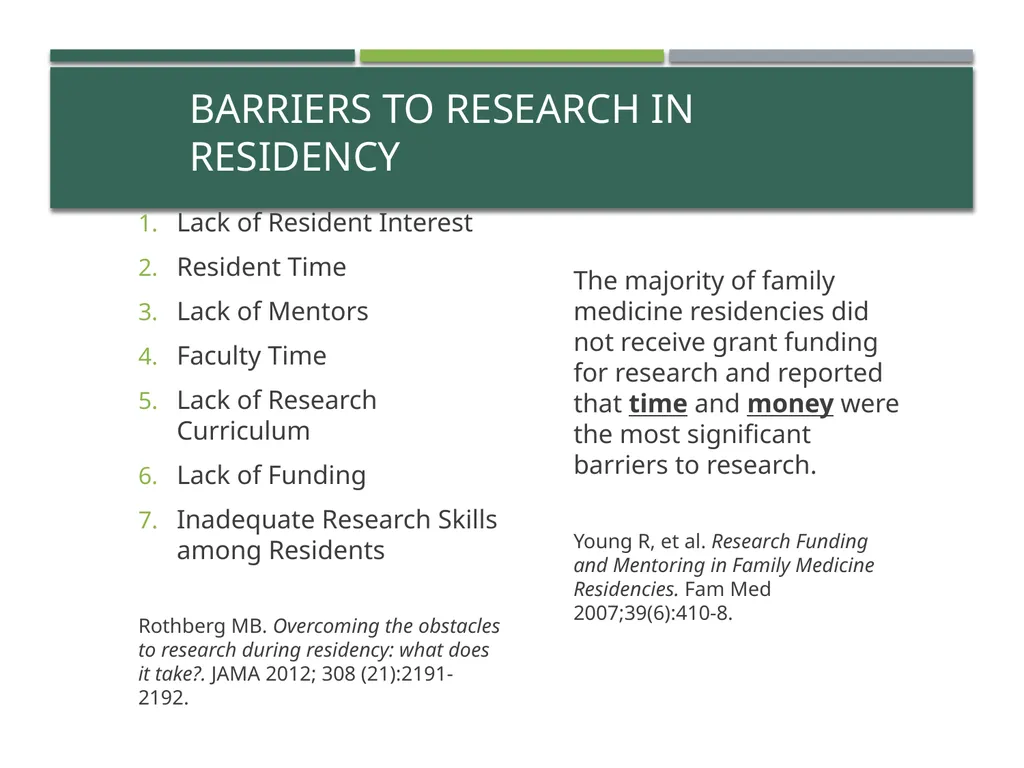
Barriers to Research in residency Lack of Resident Interest
Resident Time
Lack of Mentors
Faculty Time
Lack of Research Curriculum
Lack of Funding
Inadequate Research Skills among Residents
Rothberg MB. Overcoming the obstacles to research during residency: what does it take?. JAMA 2012; 308 (21):2191-2192. The majority of family medicine residencies did not receive grant funding for research and reported that time and money were the most significant barriers to research.
Young R, et al. Research Funding and Mentoring in Family Medicine Residencies. Fam Med 2007;39(6):410-8.<br>
Resident Time
Lack of Mentors
Faculty Time
Lack of Research Curriculum
Lack of Funding
Inadequate Research Skills among Residents
Rothberg MB. Overcoming the obstacles to research during residency: what does it take?. JAMA 2012; 308 (21):2191-2192. The majority of family medicine residencies did not receive grant funding for research and reported that time and money were the most significant barriers to research.
Young R, et al. Research Funding and Mentoring in Family Medicine Residencies. Fam Med 2007;39(6):410-8.<br>
07
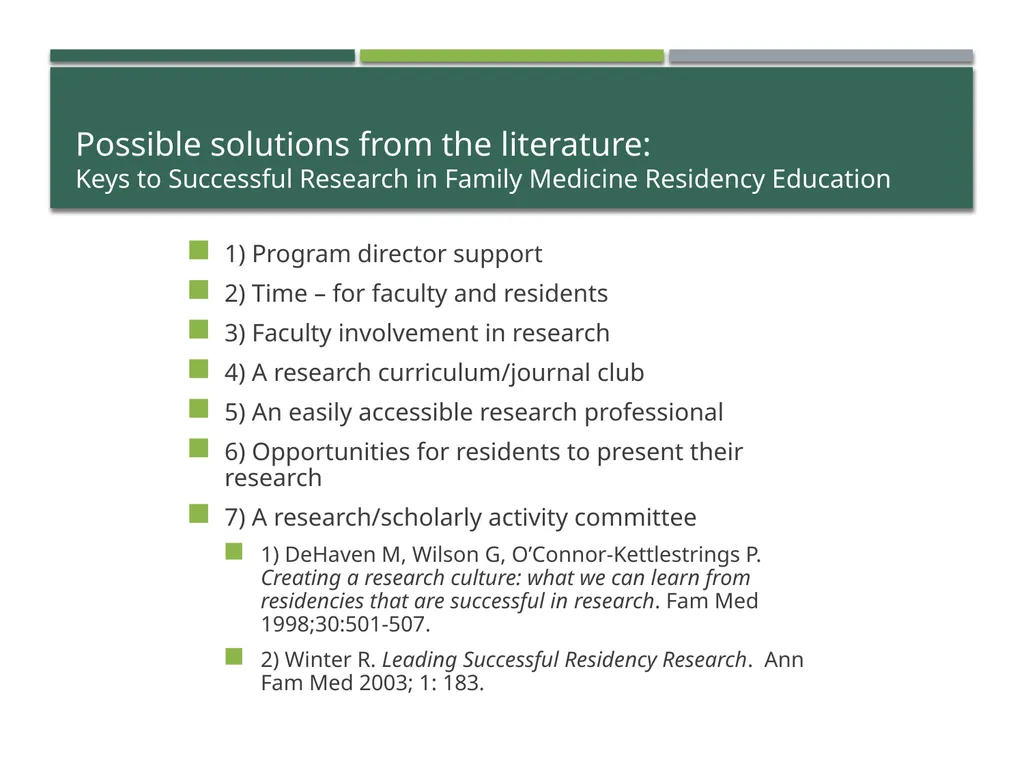
Possible solutions from the literature:
Keys to Successful Research in Family Medicine Residency Education 1) Program director support
2) Time – for faculty and residents
3) Faculty involvement in research
4) A research curriculum/journal club
5) An easily accessible research professional
6) Opportunities for residents to present their research
7) A research/scholarly activity committee
1) DeHaven M, Wilson G, O’Connor-Kettlestrings P. Creating a research culture: what we can learn from residencies that are successful in research. Fam Med 1998;30:501-507.
2) Winter R. Leading Successful Residency Research. Ann Fam Med 2003; 1: 183.<br>
2) Time – for faculty and residents
3) Faculty involvement in research
4) A research curriculum/journal club
5) An easily accessible research professional
6) Opportunities for residents to present their research
7) A research/scholarly activity committee
1) DeHaven M, Wilson G, O’Connor-Kettlestrings P. Creating a research culture: what we can learn from residencies that are successful in research. Fam Med 1998;30:501-507.
2) Winter R. Leading Successful Residency Research. Ann Fam Med 2003; 1: 183.<br>
08
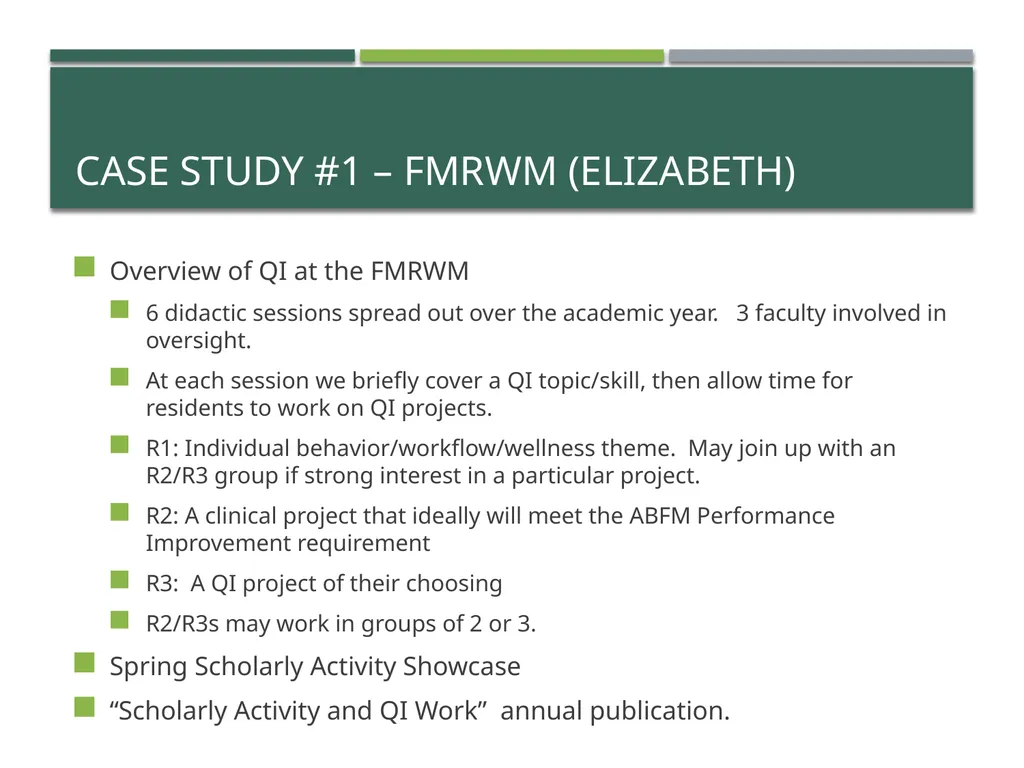
Case study #1 – FMRWM (Elizabeth) Overview of QI at the FMRWM
6 didactic sessions spread out over the academic year. 3 faculty involved in oversight.
At each session we briefly cover a QI topic/skill, then allow time for residents to work on QI projects.
R1: Individual behavior/workflow/wellness theme. May join up with an R2/R3 group if strong interest in a particular project.
R2: A clinical project that ideally will meet the ABFM Performance Improvement requirement
R3: A QI project of their choosing
R2/R3s may work in groups of 2 or 3.
Spring Scholarly Activity Showcase
“Scholarly Activity and QI Work” annual publication.<br>
6 didactic sessions spread out over the academic year. 3 faculty involved in oversight.
At each session we briefly cover a QI topic/skill, then allow time for residents to work on QI projects.
R1: Individual behavior/workflow/wellness theme. May join up with an R2/R3 group if strong interest in a particular project.
R2: A clinical project that ideally will meet the ABFM Performance Improvement requirement
R3: A QI project of their choosing
R2/R3s may work in groups of 2 or 3.
Spring Scholarly Activity Showcase
“Scholarly Activity and QI Work” annual publication.<br>
09
QI at FMRWM-
GOALS OF THE qi cURRICULUM Our aim is not necessarily success but rather exposure to the QI process.
Residents choose their topics. Huge variability in what is addressed.
We do not want this to feel like extra work.
Because of limited time we aim to make these really tiny projects.
Majority of our teaching is spent on SMART aim statements. Some on measures.
1:1 guidance and suggestions on projects available during protected QI time.
We have tried to partner with QI interests/growth areas at Partnership Health Center (PHC) our clinical training site.<br>
Residents choose their topics. Huge variability in what is addressed.
We do not want this to feel like extra work.
Because of limited time we aim to make these really tiny projects.
Majority of our teaching is spent on SMART aim statements. Some on measures.
1:1 guidance and suggestions on projects available during protected QI time.
We have tried to partner with QI interests/growth areas at Partnership Health Center (PHC) our clinical training site.<br>
10
FMWRM
Details of the Annual Publication of QI and Scholarly activity work. Final product: For R1/R2/R3 QI Write up using QI abstract template
In addition R3s also provide a write up of scholarly activity work completed over the past 3 years.<br>
In addition R3s also provide a write up of scholarly activity work completed over the past 3 years.<br>
11
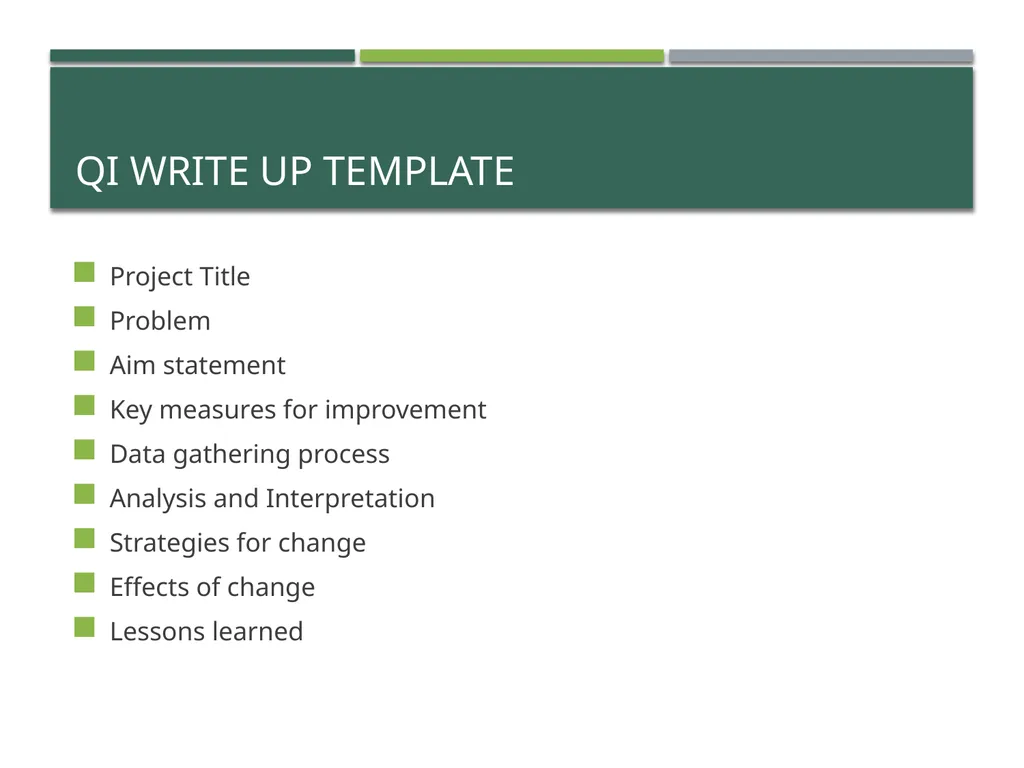
QI Write up template Project Title
Problem
Aim statement
Key measures for improvement
Data gathering process
Analysis and Interpretation
Strategies for change
Effects of change
Lessons learned<br>
Problem
Aim statement
Key measures for improvement
Data gathering process
Analysis and Interpretation
Strategies for change
Effects of change
Lessons learned<br>
12
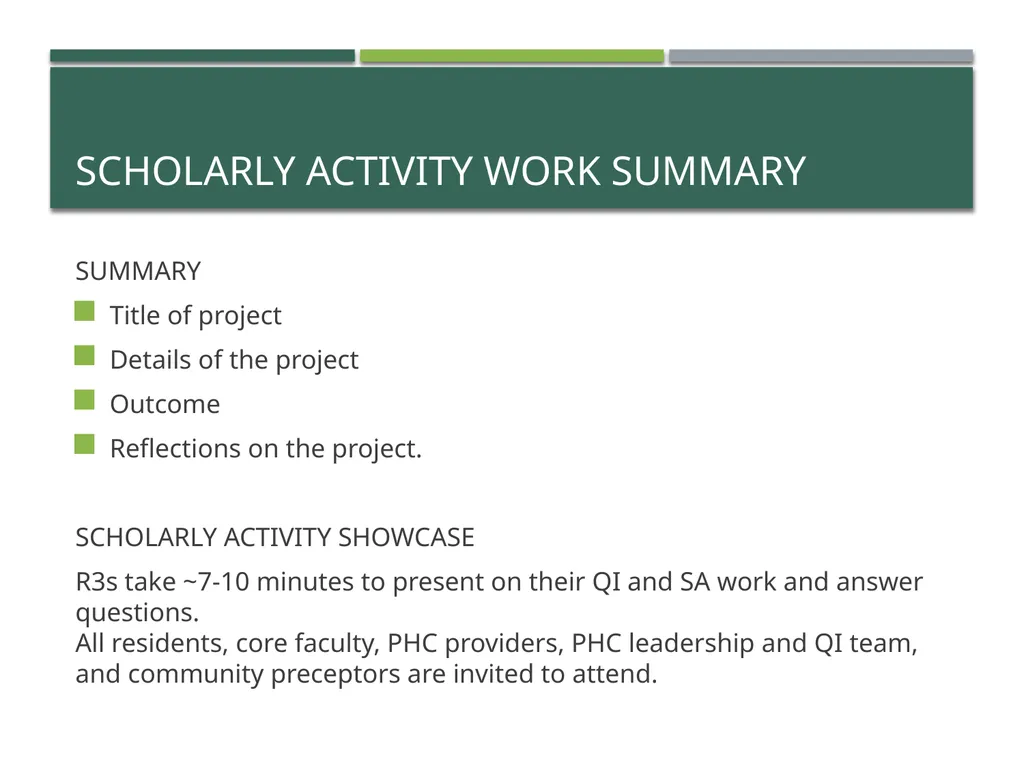
Scholarly Activity work summary SUMMARY
Title of project
Details of the project
Outcome
Reflections on the project.
SCHOLARLY ACTIVITY SHOWCASE
R3s take ~7-10 minutes to present on their QI and SA work and answer questions. All residents, core faculty, PHC providers, PHC leadership and QI team, and community preceptors are invited to attend.<br>
Title of project
Details of the project
Outcome
Reflections on the project.
SCHOLARLY ACTIVITY SHOWCASE
R3s take ~7-10 minutes to present on their QI and SA work and answer questions. All residents, core faculty, PHC providers, PHC leadership and QI team, and community preceptors are invited to attend.<br>
13
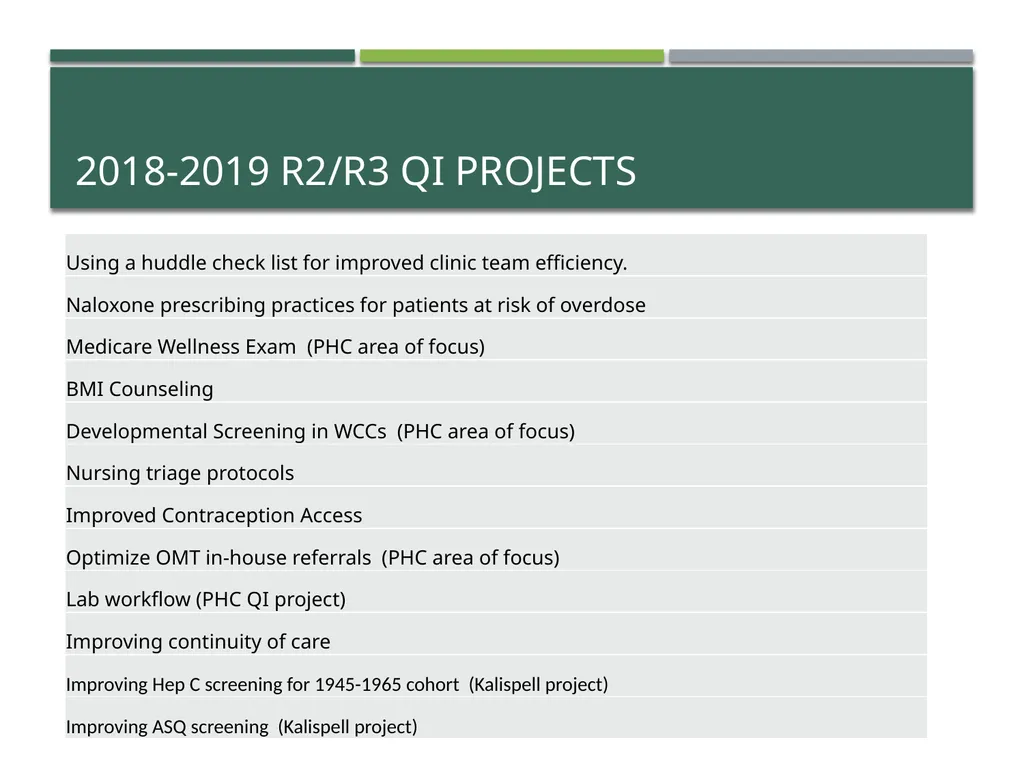
2018-2019 R2/R3 QI projects<br>
14
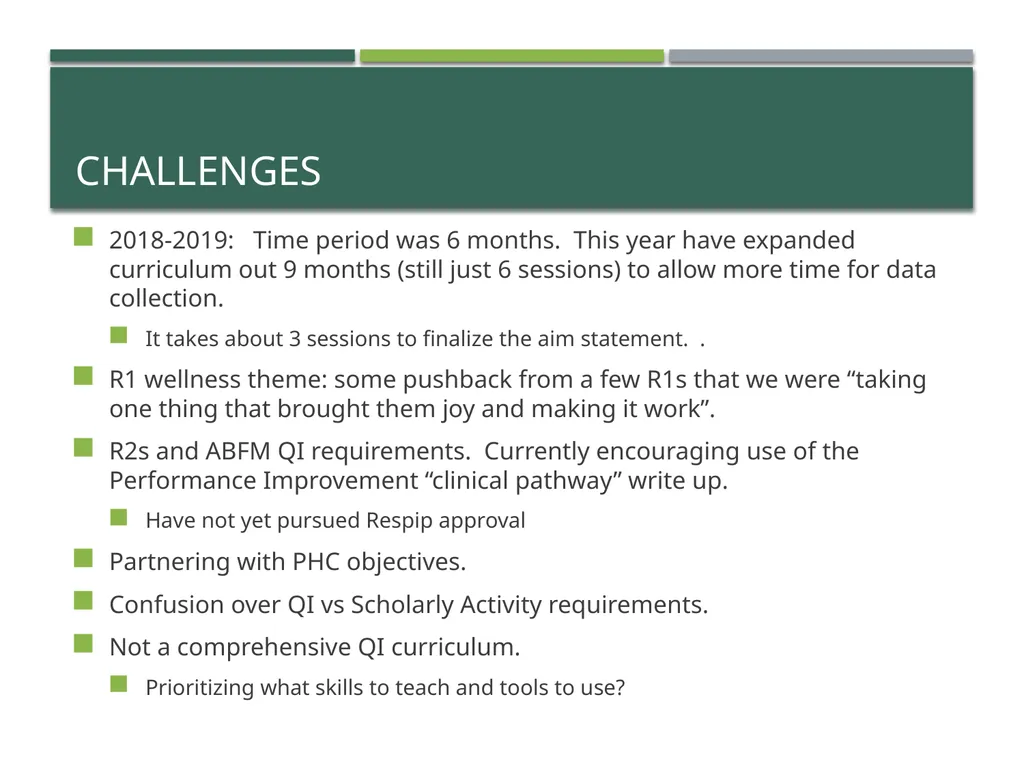
Challenges 2018-2019: Time period was 6 months. This year have expanded curriculum out 9 months (still just 6 sessions) to allow more time for data collection.
It takes about 3 sessions to finalize the aim statement. .
R1 wellness theme: some pushback from a few R1s that we were “taking one thing that brought them joy and making it work”.
R2s and ABFM QI requirements. Currently encouraging use of the Performance Improvement “clinical pathway” write up.
Have not yet pursued Respip approval
Partnering with PHC objectives.
Confusion over QI vs Scholarly Activity requirements.
Not a comprehensive QI curriculum.
Prioritizing what skills to teach and tools to use?<br>
It takes about 3 sessions to finalize the aim statement. .
R1 wellness theme: some pushback from a few R1s that we were “taking one thing that brought them joy and making it work”.
R2s and ABFM QI requirements. Currently encouraging use of the Performance Improvement “clinical pathway” write up.
Have not yet pursued Respip approval
Partnering with PHC objectives.
Confusion over QI vs Scholarly Activity requirements.
Not a comprehensive QI curriculum.
Prioritizing what skills to teach and tools to use?<br>
15
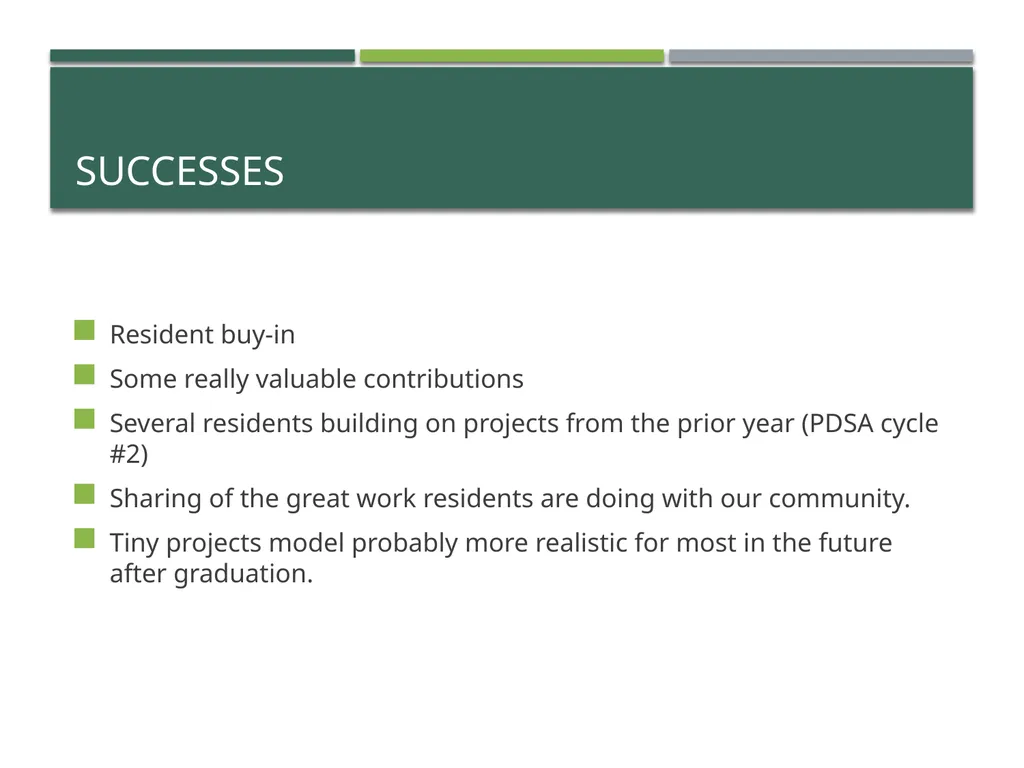
Successes Resident buy-in
Some really valuable contributions
Several residents building on projects from the prior year (PDSA cycle #2)
Sharing of the great work residents are doing with our community.
Tiny projects model probably more realistic for most in the future after graduation.<br>
Some really valuable contributions
Several residents building on projects from the prior year (PDSA cycle #2)
Sharing of the great work residents are doing with our community.
Tiny projects model probably more realistic for most in the future after graduation.<br>
16
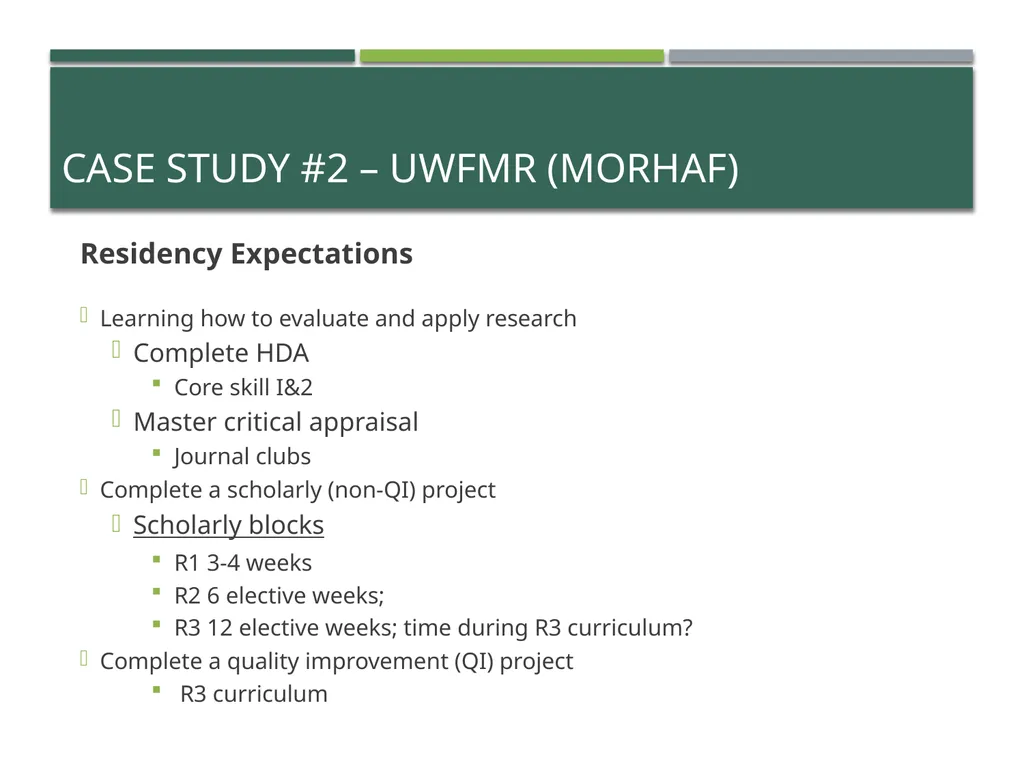
Case study #2 – UWFMR (Morhaf) Residency Expectations
Learning how to evaluate and apply research
Complete HDA
Core skill I&2
Master critical appraisal
Journal clubs
Complete a scholarly (non-QI) project
Scholarly blocks
R1 3-4 weeks
R2 6 elective weeks;
R3 12 elective weeks; time during R3 curriculum?
Complete a quality improvement (QI) project
R3 curriculum<br>
Learning how to evaluate and apply research
Complete HDA
Core skill I&2
Master critical appraisal
Journal clubs
Complete a scholarly (non-QI) project
Scholarly blocks
R1 3-4 weeks
R2 6 elective weeks;
R3 12 elective weeks; time during R3 curriculum?
Complete a quality improvement (QI) project
R3 curriculum<br>
17
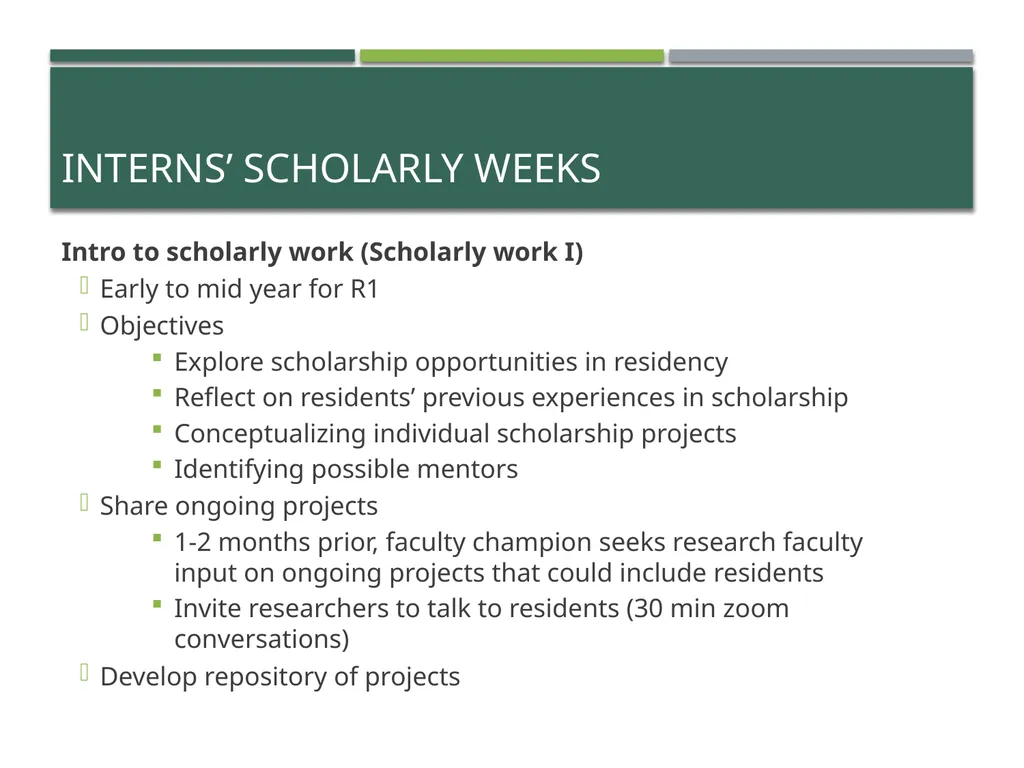
Interns’ Scholarly Weeks Intro to scholarly work (Scholarly work I)
Early to mid year for R1
Objectives
Explore scholarship opportunities in residency
Reflect on residents’ previous experiences in scholarship
Conceptualizing individual scholarship projects
Identifying possible mentors
Share ongoing projects
1-2 months prior, faculty champion seeks research faculty input on ongoing projects that could include residents
Invite researchers to talk to residents (30 min zoom conversations)
Develop repository of projects<br>
Early to mid year for R1
Objectives
Explore scholarship opportunities in residency
Reflect on residents’ previous experiences in scholarship
Conceptualizing individual scholarship projects
Identifying possible mentors
Share ongoing projects
1-2 months prior, faculty champion seeks research faculty input on ongoing projects that could include residents
Invite researchers to talk to residents (30 min zoom conversations)
Develop repository of projects<br>
18
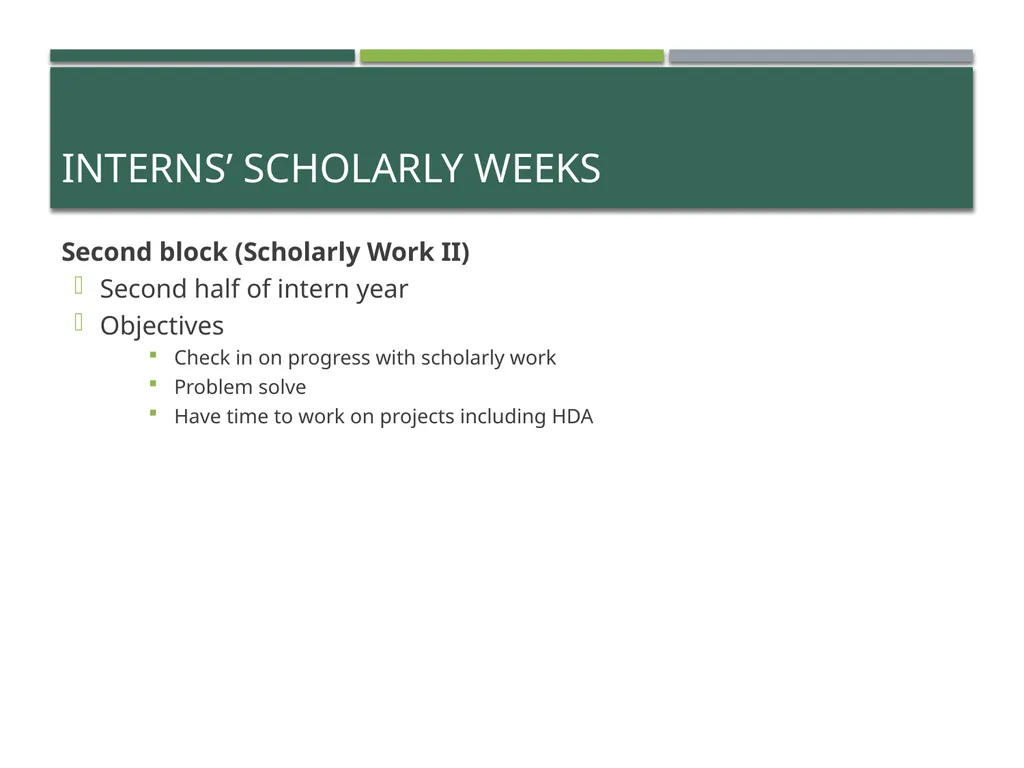
Interns’ Scholarly Weeks Second block (Scholarly Work II)
Second half of intern year
Objectives
Check in on progress with scholarly work
Problem solve
Have time to work on projects including HDA<br>
Second half of intern year
Objectives
Check in on progress with scholarly work
Problem solve
Have time to work on projects including HDA<br>
19
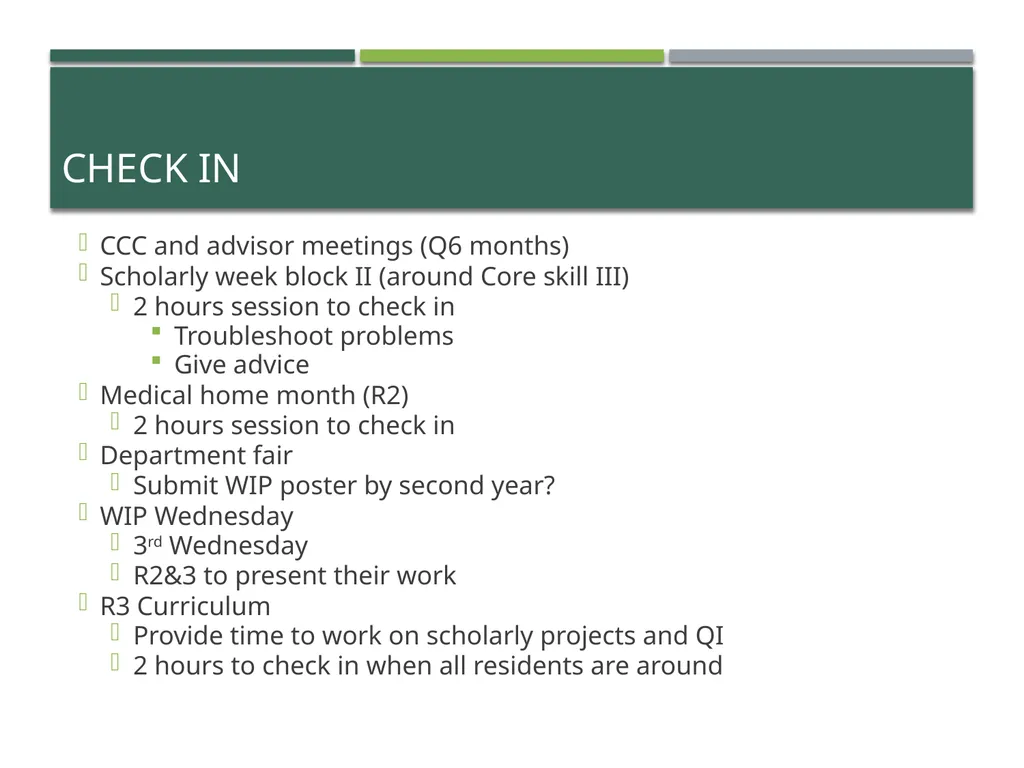
Check in CCC and advisor meetings (Q6 months)
Scholarly week block II (around Core skill III)
2 hours session to check in
Troubleshoot problems
Give advice
Medical home month (R2)
2 hours session to check in
Department fair
Submit WIP poster by second year?
WIP Wednesday
3rd Wednesday
R2&3 to present their work
R3 Curriculum
Provide time to work on scholarly projects and QI
2 hours to check in when all residents are around<br>
Scholarly week block II (around Core skill III)
2 hours session to check in
Troubleshoot problems
Give advice
Medical home month (R2)
2 hours session to check in
Department fair
Submit WIP poster by second year?
WIP Wednesday
3rd Wednesday
R2&3 to present their work
R3 Curriculum
Provide time to work on scholarly projects and QI
2 hours to check in when all residents are around<br>
20
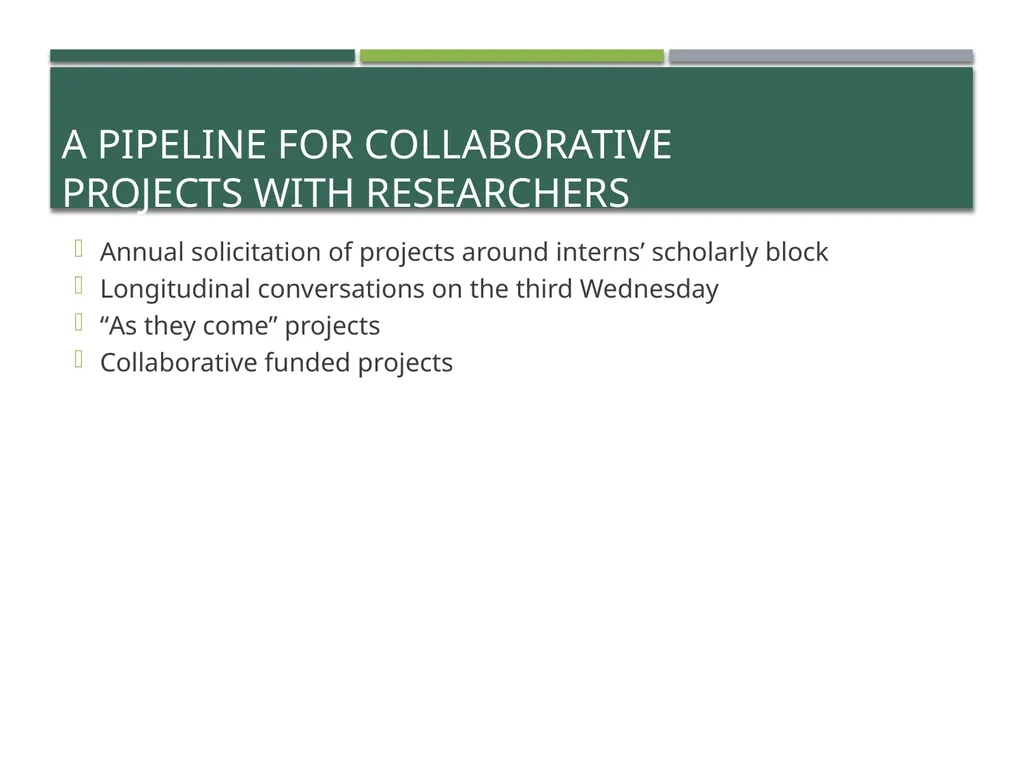
A Pipeline For Collaborative Projects with Researchers Annual solicitation of projects around interns’ scholarly block
Longitudinal conversations on the third Wednesday
“As they come” projects
Collaborative funded projects<br>
Longitudinal conversations on the third Wednesday
“As they come” projects
Collaborative funded projects<br>
21
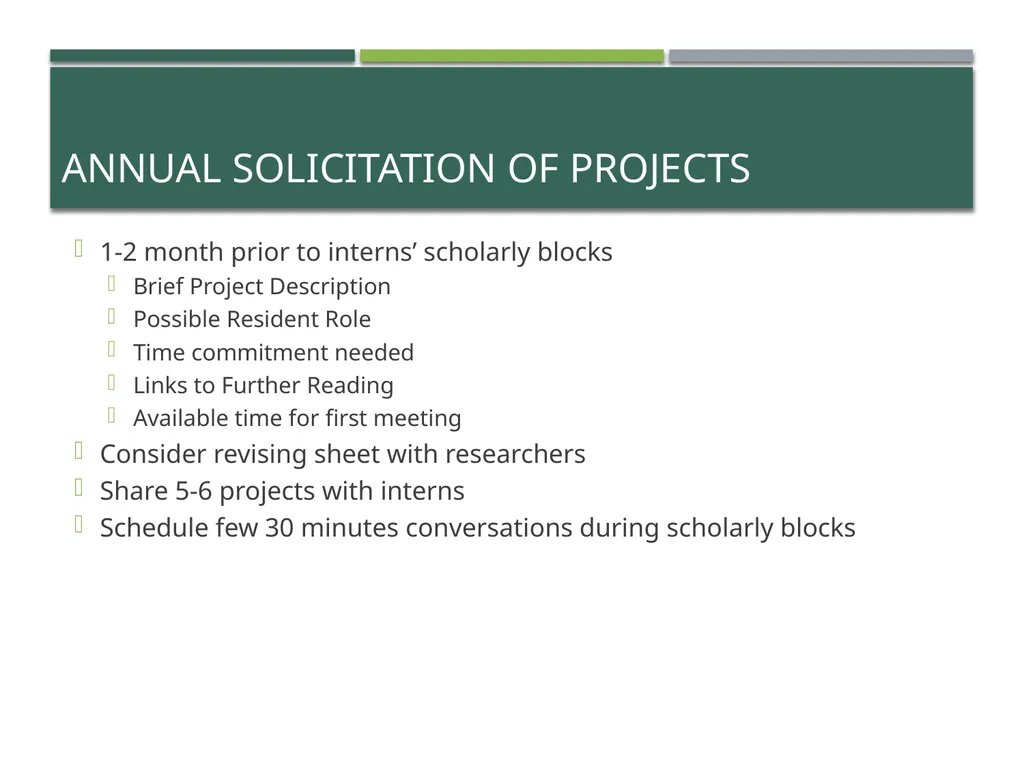
Annual solicitation of projects 1-2 month prior to interns’ scholarly blocks
Brief Project Description
Possible Resident Role
Time commitment needed
Links to Further Reading
Available time for first meeting
Consider revising sheet with researchers
Share 5-6 projects with interns
Schedule few 30 minutes conversations during scholarly blocks<br>
Brief Project Description
Possible Resident Role
Time commitment needed
Links to Further Reading
Available time for first meeting
Consider revising sheet with researchers
Share 5-6 projects with interns
Schedule few 30 minutes conversations during scholarly blocks<br>
22
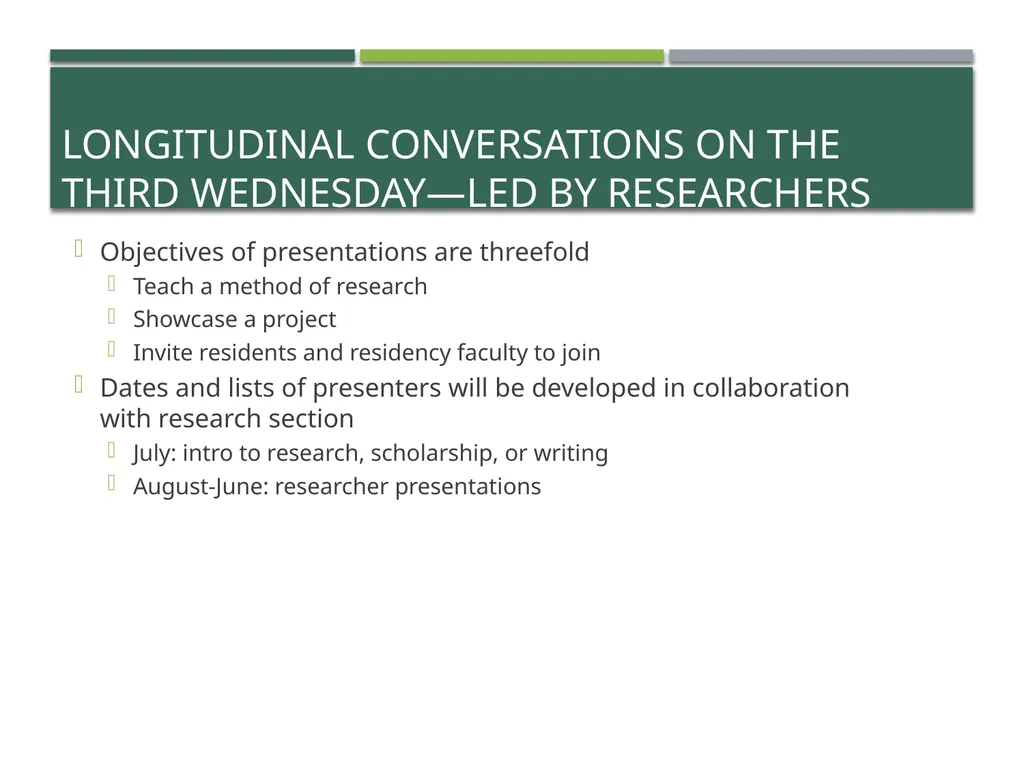
Longitudinal Conversations on the Third Wednesday—led by researchers Objectives of presentations are threefold
Teach a method of research
Showcase a project
Invite residents and residency faculty to join
Dates and lists of presenters will be developed in collaboration with research section
July: intro to research, scholarship, or writing
August-June: researcher presentations<br>
Teach a method of research
Showcase a project
Invite residents and residency faculty to join
Dates and lists of presenters will be developed in collaboration with research section
July: intro to research, scholarship, or writing
August-June: researcher presentations<br>
23
“As they come” projects WPRN projects
Champion to share with faculty in next faculty meeting as announcement
Champion to share with residents in next Wednesday as 5 minutes announcement
Email goes out to both group<br>
Champion to share with faculty in next faculty meeting as announcement
Champion to share with residents in next Wednesday as 5 minutes announcement
Email goes out to both group<br>
24
Learning Critical Appraisal (EBM) Either Online modules (Preferred)
YouTube videos on critical appraisal (4)
4 articles and 4 working sheets
Scholarly work II
Expectations are to complete 2
Or 1-2 sessions during 3rd Wednesday
Therapy (RCT)
Diagnosis
Prognosis
Etiology
Or combination of both
Practicing by running journal club (JC)
Develop a structure for leading JC discussions
Validity, importance of results, applicability<br>
YouTube videos on critical appraisal (4)
4 articles and 4 working sheets
Scholarly work II
Expectations are to complete 2
Or 1-2 sessions during 3rd Wednesday
Therapy (RCT)
Diagnosis
Prognosis
Etiology
Or combination of both
Practicing by running journal club (JC)
Develop a structure for leading JC discussions
Validity, importance of results, applicability<br>
25
QUESTIONS? DISCUSSION?<br>