Title: The Amazon Rainforest Date: Tuesday, 12 May 2020 BELL WORK The Living World: Name the 4 layers of the rainforest Give a fact about each layer Why is annual rainfall so high in the rainforest? Where is the Amazon located? Define the
Related Topics
Share
Embed code
Download this presentation From Below
"Title: The Amazon Rainforest Date: Tuesday, 12 May" is the property of its rightful owner. Permission is granted to
download and print the materials on this website for personal, non-commercial use only, and to display it
on your personal computer provided you do not modify the materials and that you retain all copyright
notices contained in the materials. By downloading content from our website, you accept the terms of this
agreement.
Presentation Transcript
01
Title: The Amazon Rainforest Date: Tuesday, 12 May 2020 BELL WORK The Living World:
Name the 4 layers of the rainforest
Give a fact about each layer
Why is annual rainfall so high in the rainforest?
Where is the Amazon located?
Define the term biomass
Define the term biodiversity
Explain why the rainforest has high levels of biodiversity
How can we control deforestation on a local scale?
How can we control deforestation on a global/international scale?<br>
02
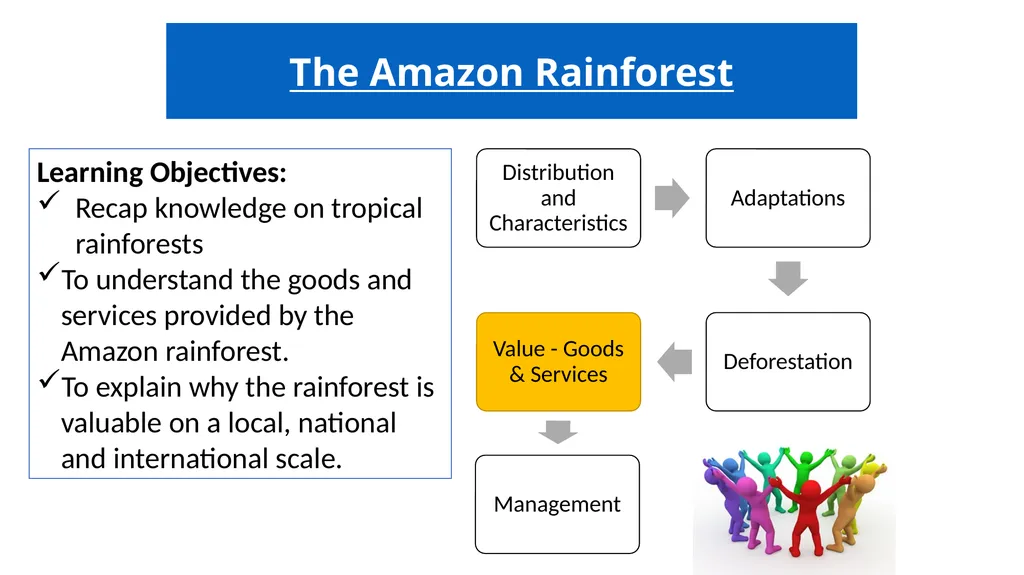
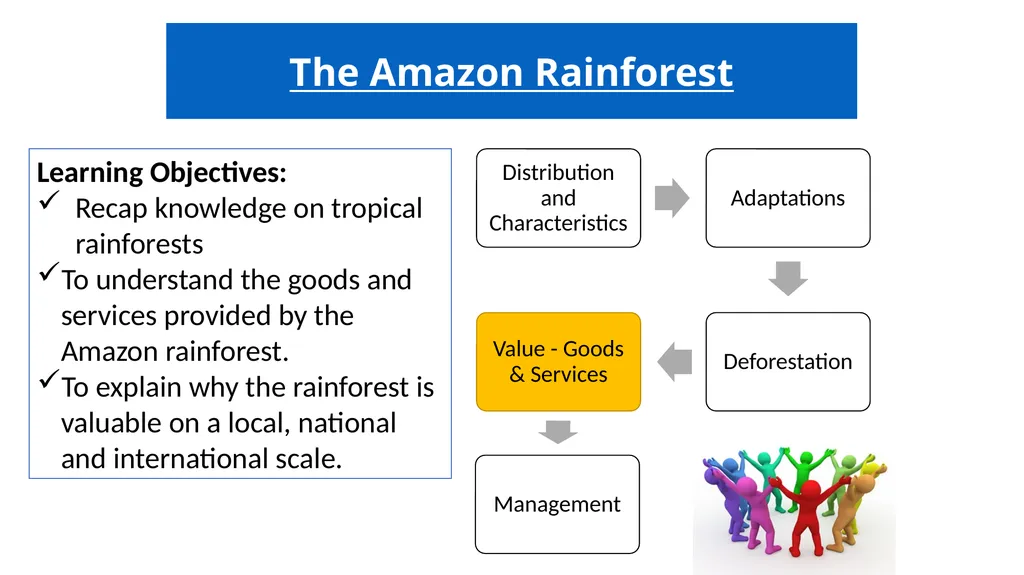
The Amazon Rainforest Learning Objectives:
Recap knowledge on tropical rainforests
To understand the goods and services provided by the Amazon rainforest.
To explain why the rainforest is valuable on a local, national and international scale.<br>
03
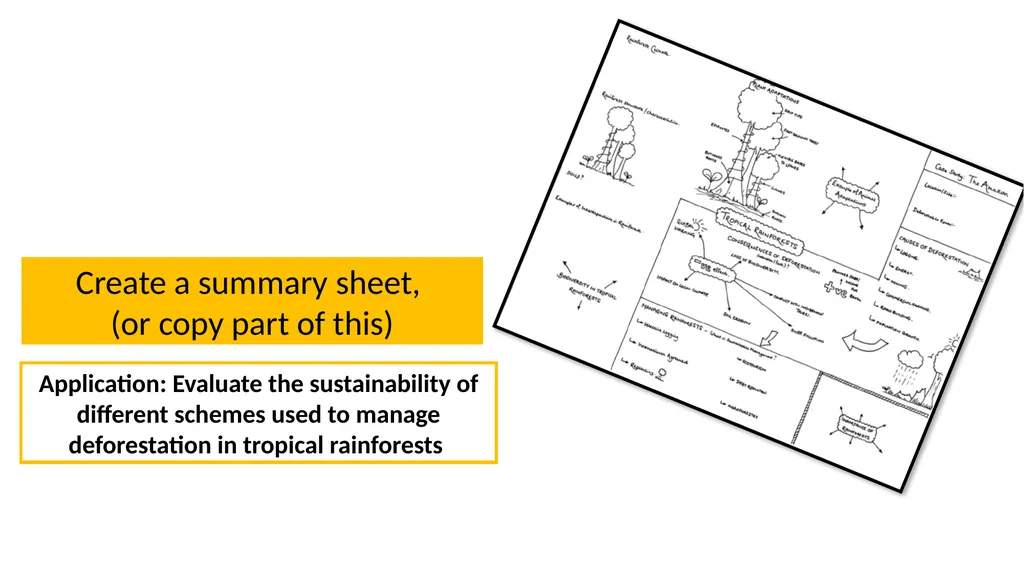
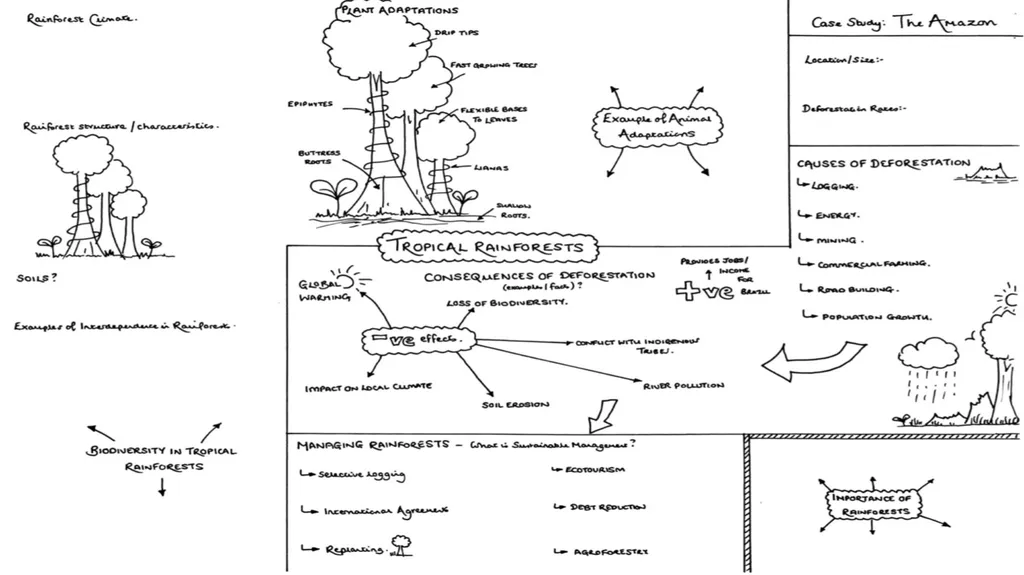
Create a summary sheet,
(or copy part of this) Application: Evaluate the sustainability of different schemes used to manage deforestation in tropical rainforests<br>
04
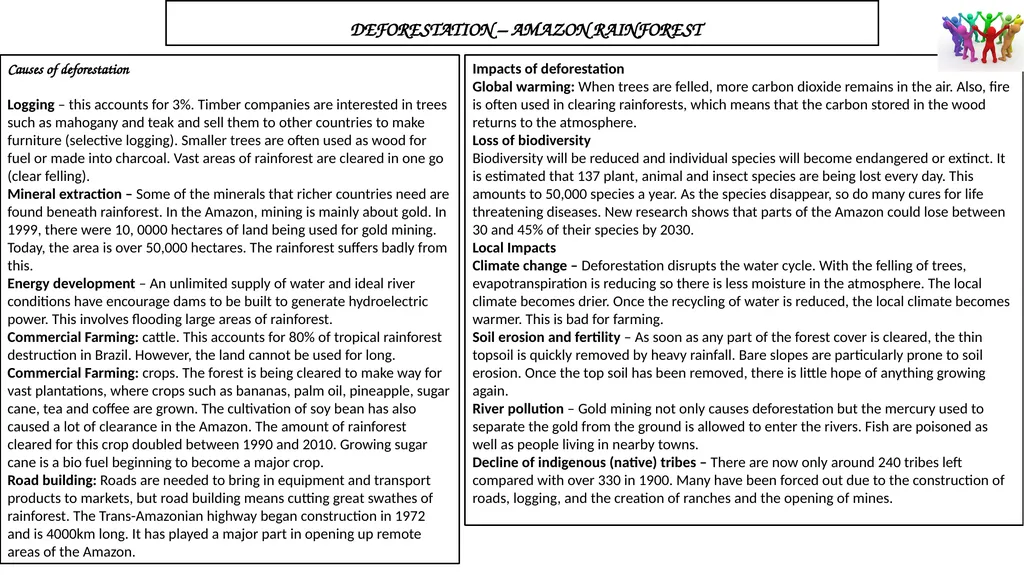
DEFORESTATION – AMAZON RAINFOREST Causes of deforestation
Logging – this accounts for 3%. Timber companies are interested in trees such as mahogany and teak and sell them to other countries to make furniture (selective logging). Smaller trees are often used as wood for fuel or made into charcoal. Vast areas of rainforest are cleared in one go (clear felling).
Mineral extraction – Some of the minerals that richer countries need are found beneath rainforest. In the Amazon, mining is mainly about gold. In 1999, there were 10, 0000 hectares of land being used for gold mining. Today, the area is over 50,000 hectares. The rainforest suffers badly from this.
Energy development – An unlimited supply of water and ideal river conditions have encourage dams to be built to generate hydroelectric power. This involves flooding large areas of rainforest.
Commercial Farming: cattle. This accounts for 80% of tropical rainforest destruction in Brazil. However, the land cannot be used for long.
Commercial Farming: crops. The forest is being cleared to make way for vast plantations, where crops such as bananas, palm oil, pineapple, sugar cane, tea and coffee are grown. The cultivation of soy bean has also caused a lot of clearance in the Amazon. The amount of rainforest cleared for this crop doubled between 1990 and 2010. Growing sugar cane is a bio fuel beginning to become a major crop.
Road building: Roads are needed to bring in equipment and transport products to markets, but road building means cutting great swathes of rainforest. The Trans-Amazonian highway began construction in 1972 and is 4000km long. It has played a major part in opening up remote areas of the Amazon. Impacts of deforestation
Global warming: When trees are felled, more carbon dioxide remains in the air. Also, fire is often used in clearing rainforests, which means that the carbon stored in the wood returns to the atmosphere.
Loss of biodiversity
Biodiversity will be reduced and individual species will become endangered or extinct. It is estimated that 137 plant, animal and insect species are being lost every day. This amounts to 50,000 species a year. As the species disappear, so do many cures for life threatening diseases. New research shows that parts of the Amazon could lose between 30 and 45% of their species by 2030.
Local Impacts
Climate change – Deforestation disrupts the water cycle. With the felling of trees, evapotranspiration is reducing so there is less moisture in the atmosphere. The local climate becomes drier. Once the recycling of water is reduced, the local climate becomes warmer. This is bad for farming.
Soil erosion and fertility – As soon as any part of the forest cover is cleared, the thin topsoil is quickly removed by heavy rainfall. Bare slopes are particularly prone to soil erosion. Once the top soil has been removed, there is little hope of anything growing again.
River pollution – Gold mining not only causes deforestation but the mercury used to separate the gold from the ground is allowed to enter the rivers. Fish are poisoned as well as people living in nearby towns.
Decline of indigenous (native) tribes – There are now only around 240 tribes left compared with over 330 in 1900. Many have been forced out due to the construction of roads, logging, and the creation of ranches and the opening of mines.<br>
05
The Amazon Rainforest Learning Objectives:
Recap knowledge on tropical rainforests
To understand the goods and services provided by the Amazon rainforest.
To explain why the rainforest is valuable on a local, national and international scale.<br>
06
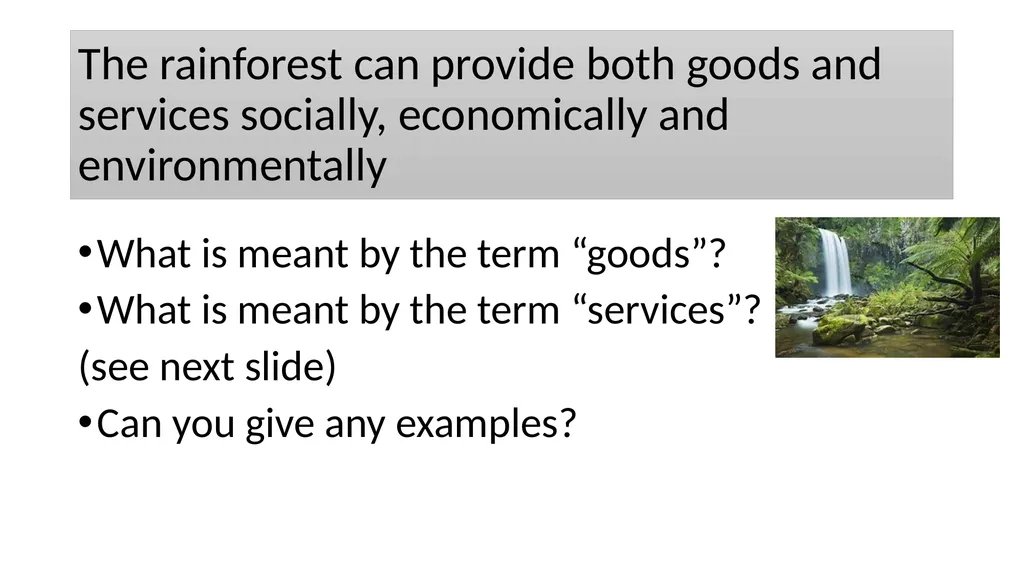
The rainforest can provide both goods and services socially, economically and environmentally What is meant by the term “goods”?
What is meant by the term “services”?
(see next slide)
Can you give any examples?<br>
07
Goods – Something that can be obtained directly from the rainforest
Services – Benefits that the rainforest can provide to both people and the environment<br>
08
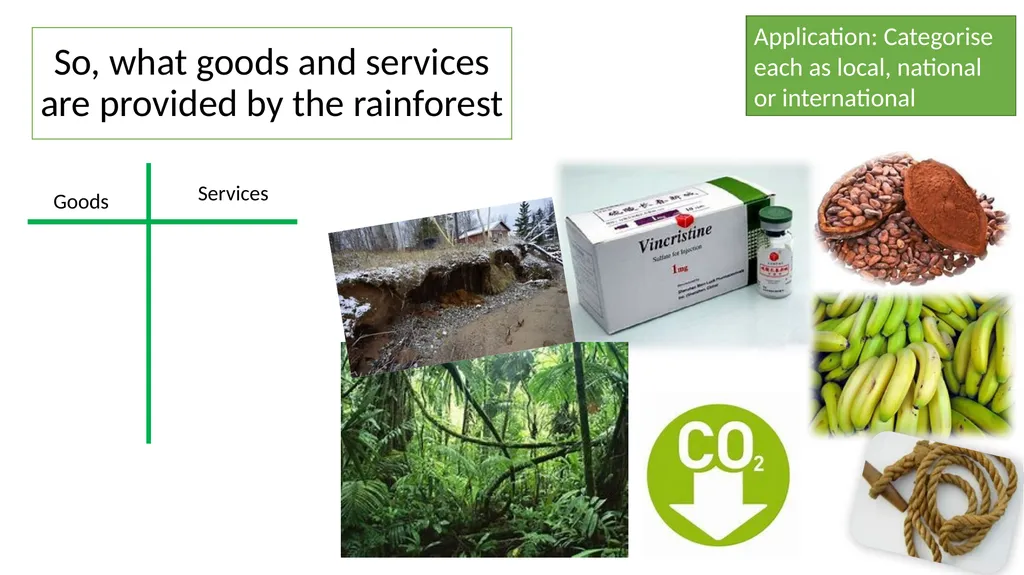
So, what goods and services are provided by the rainforest Goods Services Application: Categorise each as local, national or international<br>
09
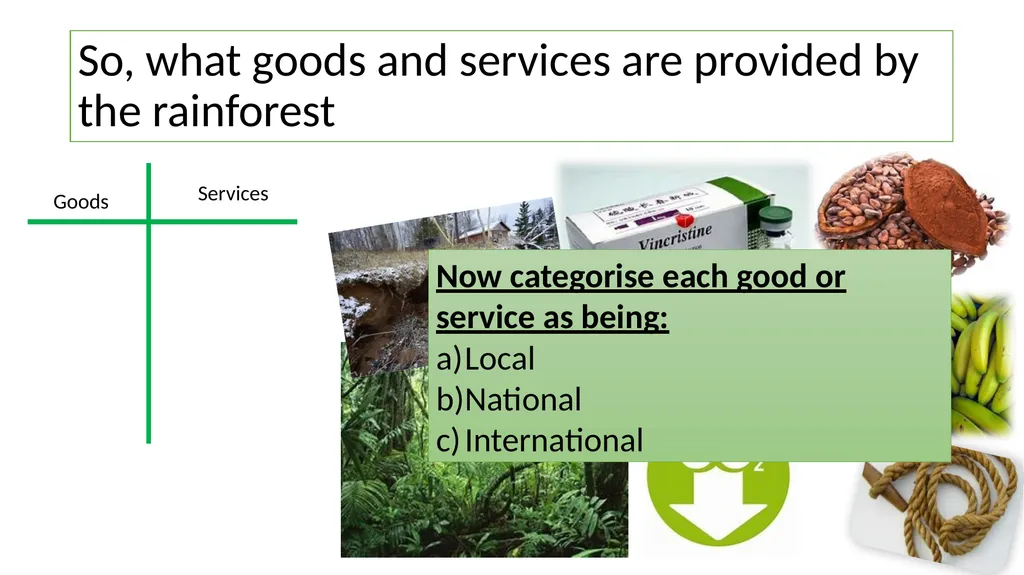
So, what goods and services are provided by the rainforest Goods Services Now categorise each good or service as being:
Local
National
International<br>
10
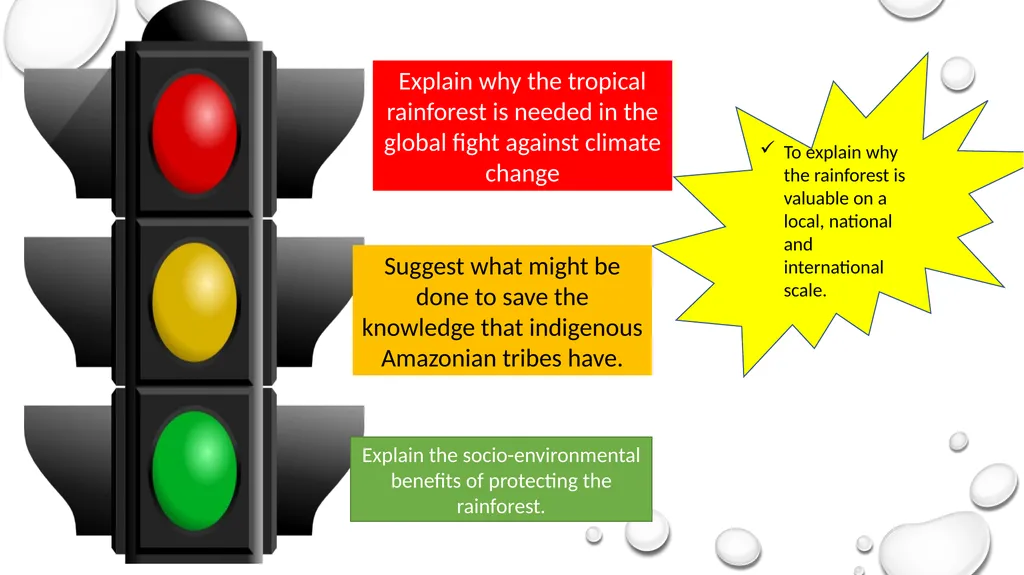
To explain why the rainforest is valuable on a local, national and international scale. Suggest what might be done to save the knowledge that indigenous Amazonian tribes have. Explain why the tropical rainforest is needed in the global fight against climate change Explain the socio-environmental benefits of protecting the rainforest.<br>
11
Value of the rainforest Lesson Objectives:
To understand the goods and services provided by the Amazon rainforest.
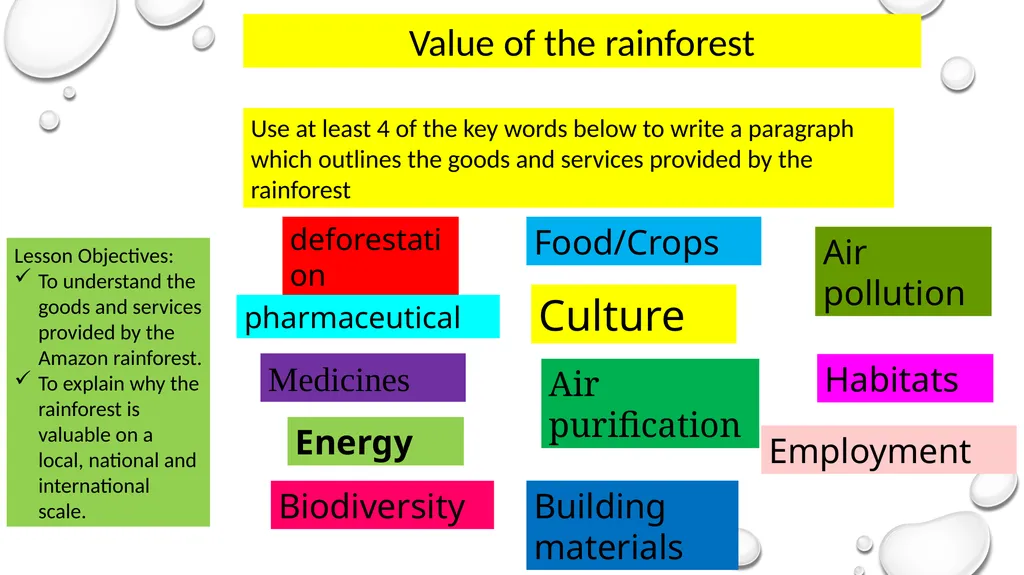
To explain why the rainforest is valuable on a local, national and international scale. Use at least 4 of the key words below to write a paragraph which outlines the goods and services provided by the rainforest deforestation Medicines Building materials Food/Crops Air purification Energy Culture pharmaceutical Habitats Biodiversity Employment Air pollution<br>