Topic : LOGIC-INTRODUCTION LOGIC LAWS Subject Code : bma18008 Subject Name : DISCRETE mathematics Delivered by : Dr. p. sona Mathematical Logic- Intro In this chapter we shall study mathematical logic, which is concerned with all kinds of
"Topic : LOGIC-INTRODUCTION & LOGIC LAWS Subject" is the property of its rightful owner. Permission is granted to
download and print the materials on this website for personal, non-commercial use only, and to display it
on your personal computer provided you do not modify the materials and that you retain all copyright
notices contained in the materials. By downloading content from our website, you accept the terms of this
agreement.
Presentation Transcript
01
Topic : LOGIC-INTRODUCTION & LOGIC LAWS Subject Code : bma18008 Subject Name : DISCRETE mathematics Delivered by : Dr. p. sona<br>
02
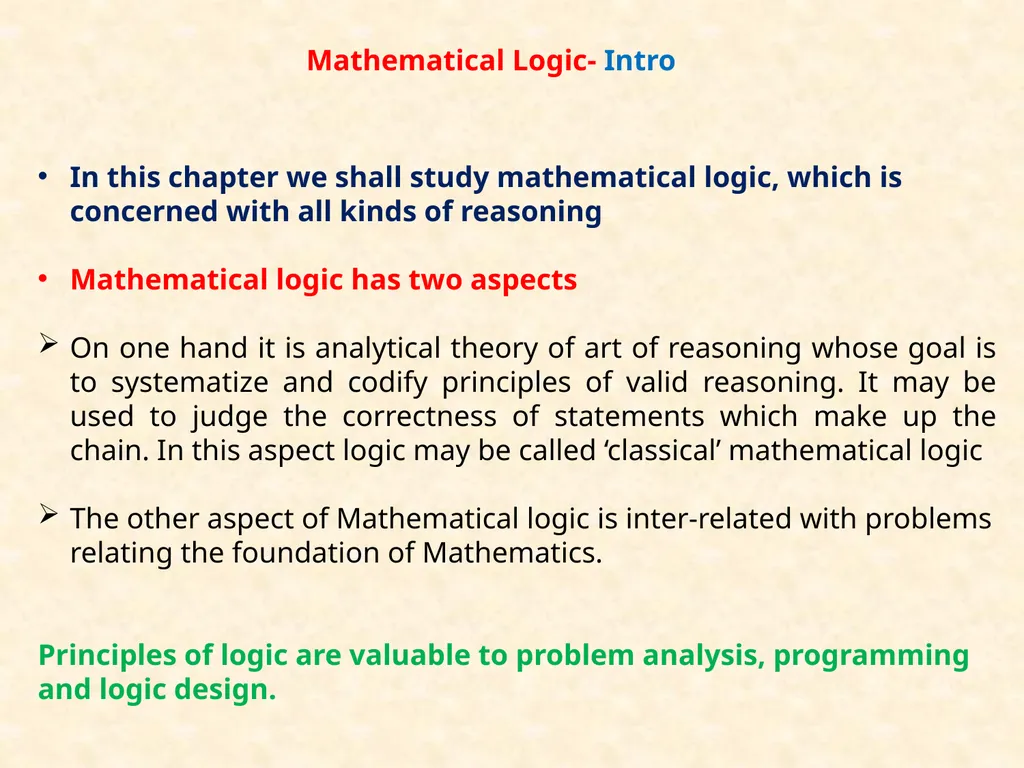
Mathematical Logic- Intro In this chapter we shall study mathematical logic, which is concerned with all kinds of reasoning
Mathematical logic has two aspects
On one hand it is analytical theory of art of reasoning whose goal is to systematize and codify principles of valid reasoning. It may be used to judge the correctness of statements which make up the chain. In this aspect logic may be called ‘classical’ mathematical logic
The other aspect of Mathematical logic is inter-related with problems relating the foundation of Mathematics.
Principles of logic are valuable to problem analysis, programming and logic design.<br>
03
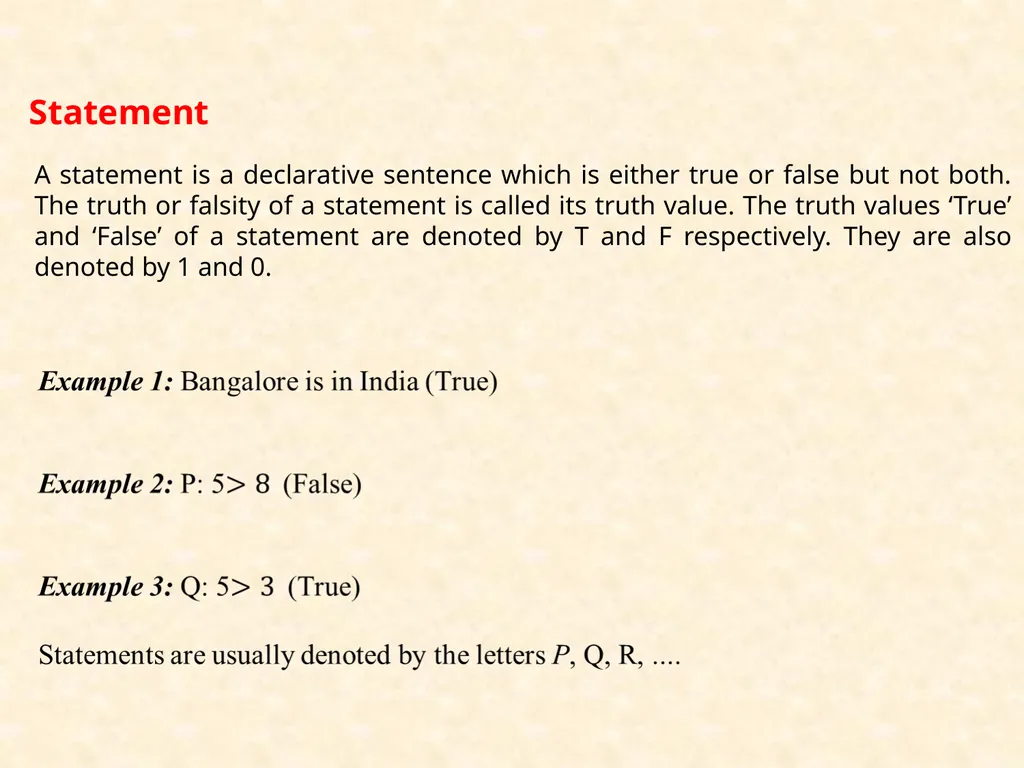
Statement A statement is a declarative sentence which is either true or false but not both. The truth or falsity of a statement is called its truth value. The truth values ‘True’ and ‘False’ of a statement are denoted by T and F respectively. They are also denoted by 1 and 0.<br>
04
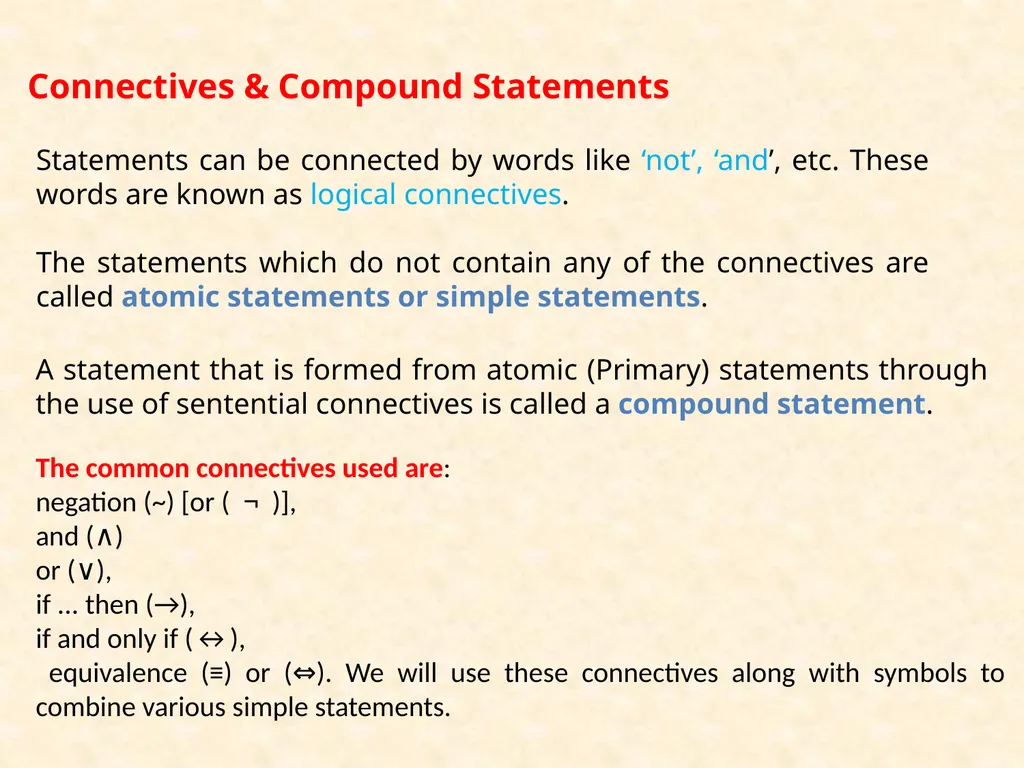
Connectives & Compound Statements Statements can be connected by words like ‘not’, ‘and’, etc. These words are known as logical connectives.
The statements which do not contain any of the connectives are called atomic statements or simple statements. A statement that is formed from atomic (Primary) statements through the use of sentential connectives is called a compound statement. The common connectives used are:
negation (~) [or (¬)],
and (∧)
or (∨),
if ... then (→),
if and only if (↔),
equivalence (≡) or (⇔). We will use these connectives along with symbols to combine various simple statements.<br>
05
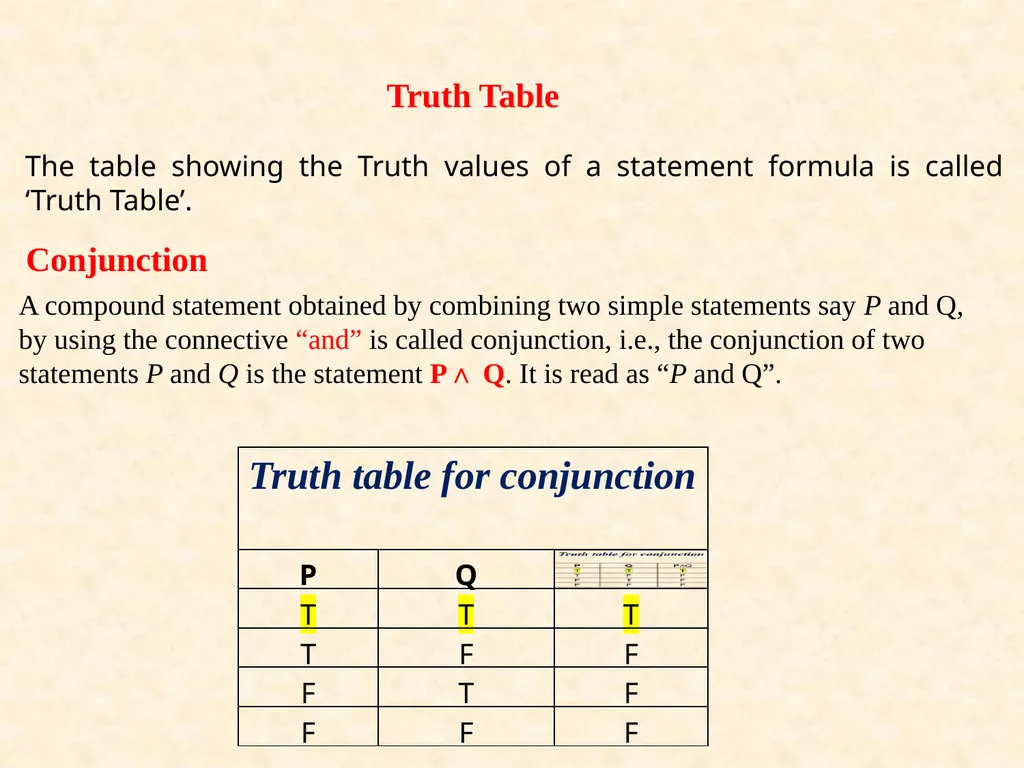
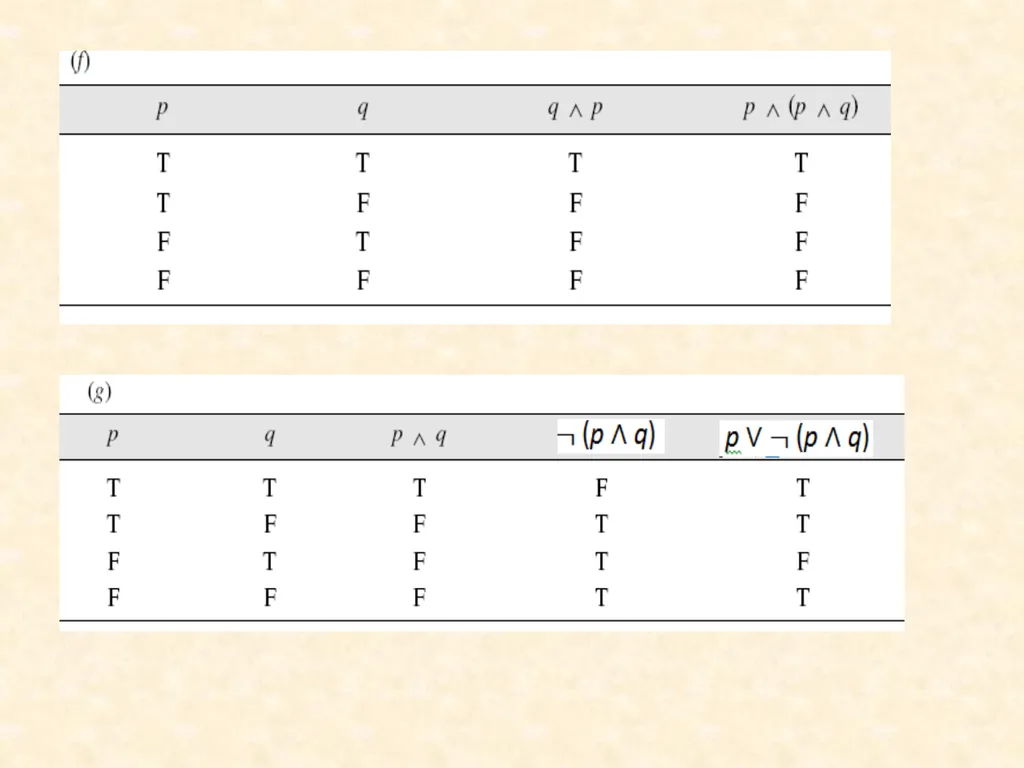
Truth Table The table showing the Truth values of a statement formula is called ‘Truth Table’. A compound statement obtained by combining two simple statements say P and Q, by using the connective “and” is called conjunction, i.e., the conjunction of two statements P and Q is the statement P∧ Q. It is read as “P and Q”. Conjunction<br>
06
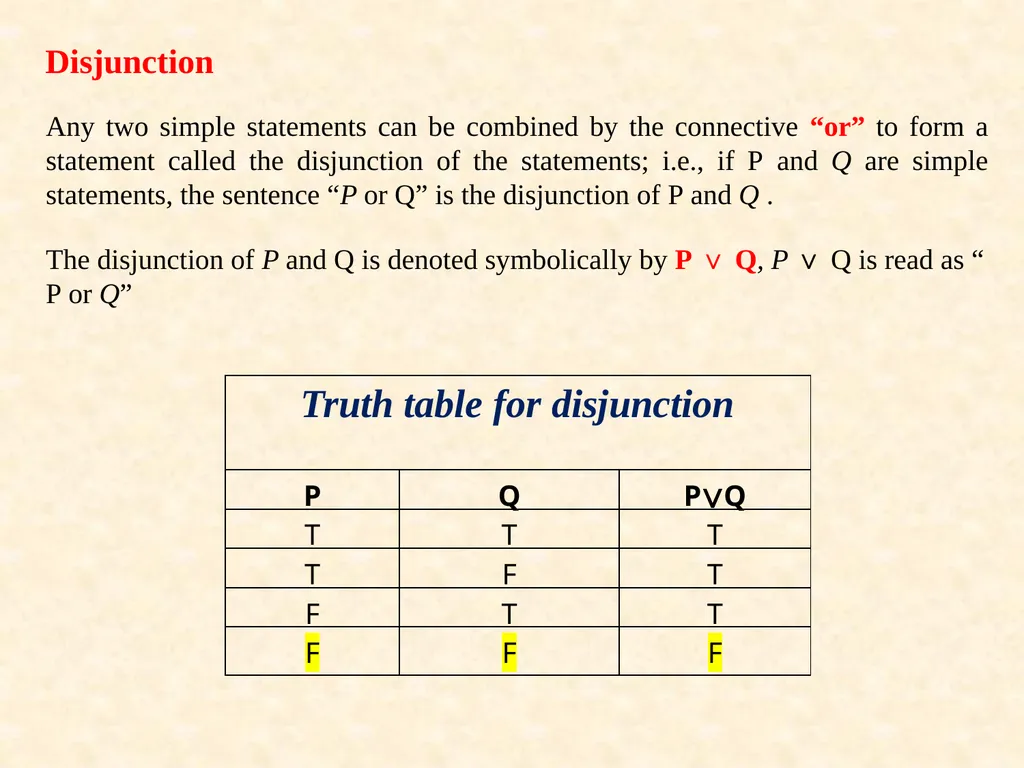
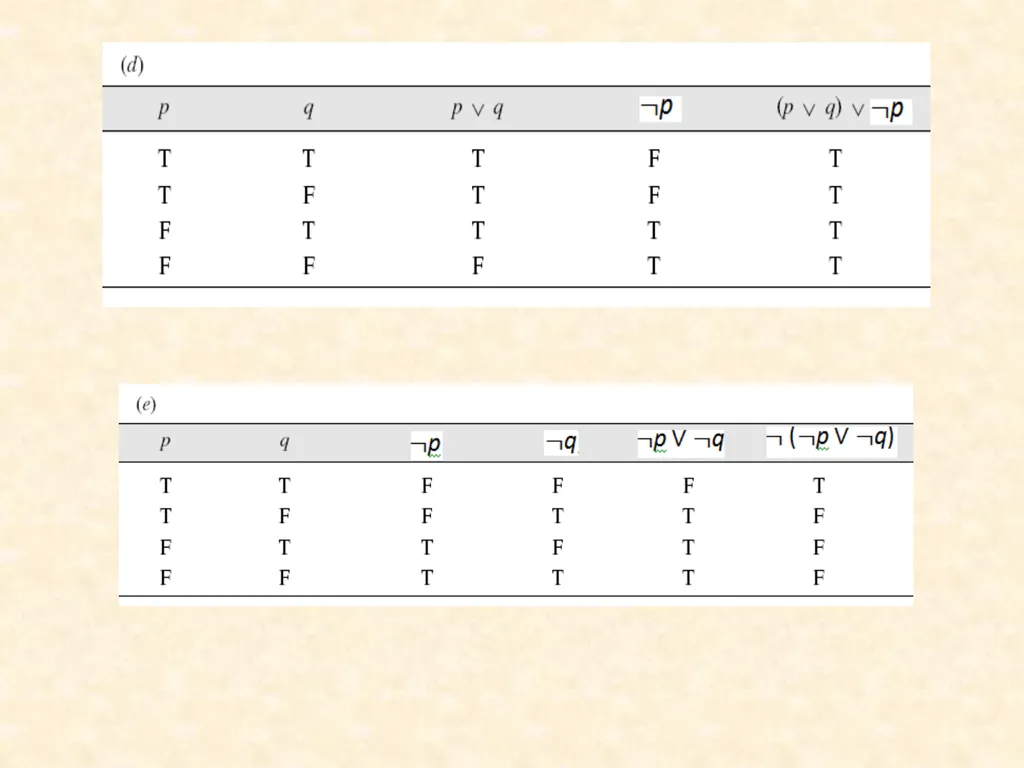
Disjunction Any two simple statements can be combined by the connective “or” to form a statement called the disjunction of the statements; i.e., if P and Q are simple statements, the sentence “P or Q” is the disjunction of P and Q .
The disjunction of P and Q is denoted symbolically by P ∨ Q, P ∨ Q is read as “ P or Q”<br>
07
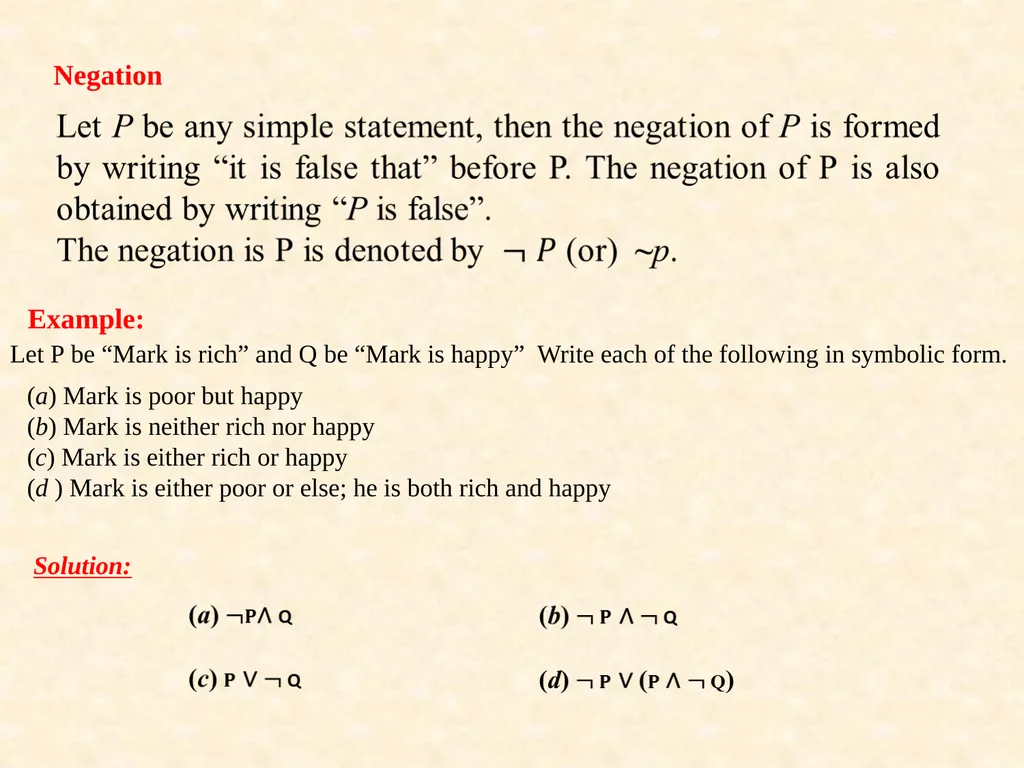
Negation Example: Let P be “Mark is rich” and Q be “Mark is happy” Write each of the following in symbolic form. (a) Mark is poor but happy
(b) Mark is neither rich nor happy
(c) Mark is either rich or happy
(d ) Mark is either poor or else; he is both rich and happy Solution:<br>
08
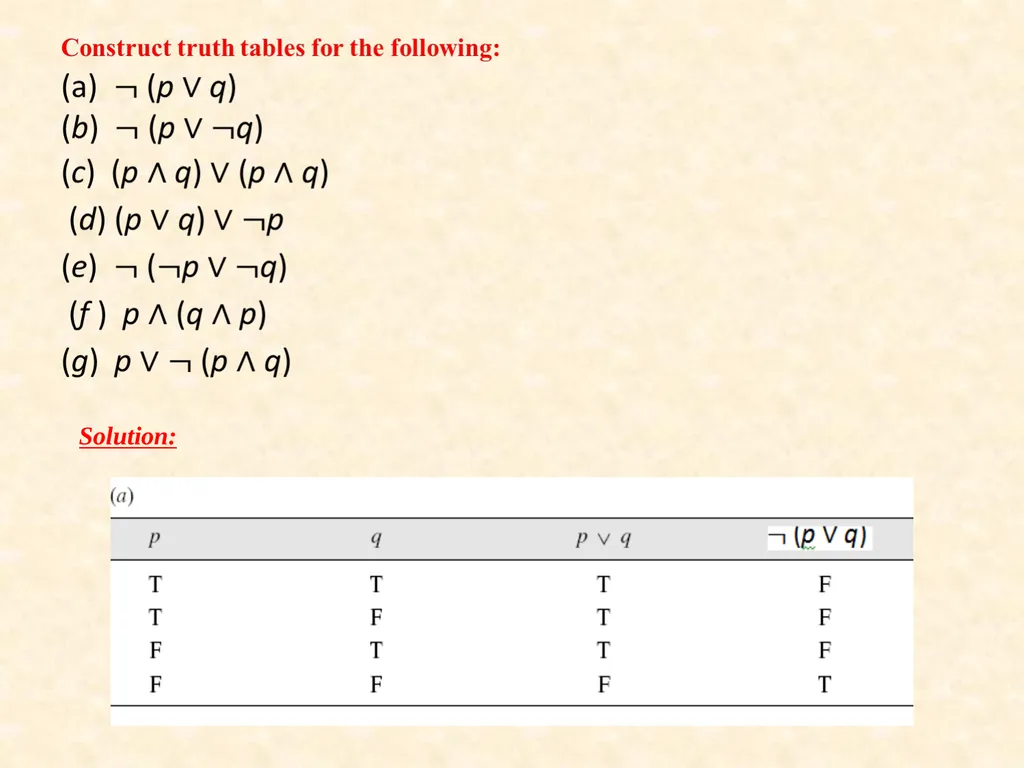
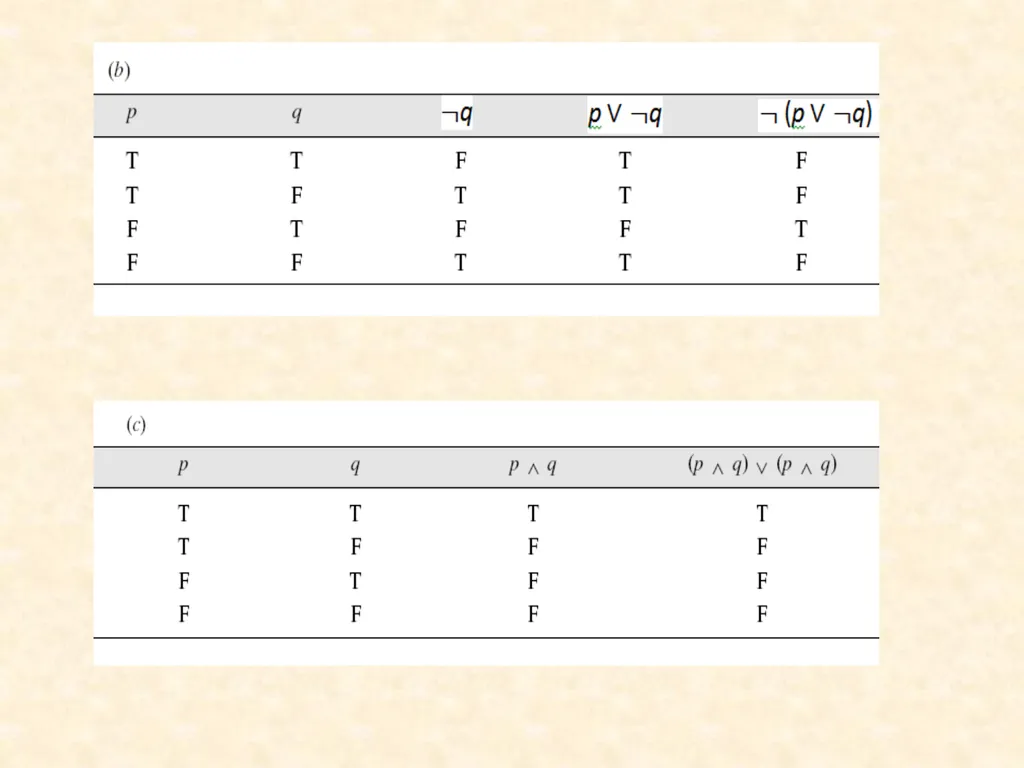
Solution:<br>
09
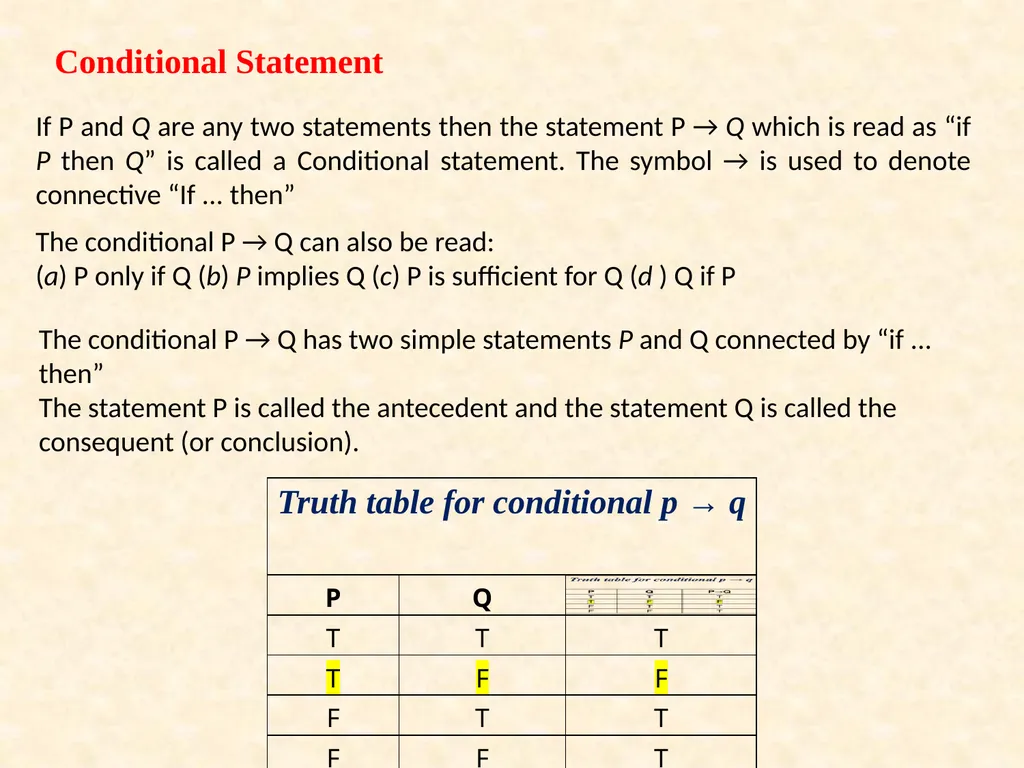
Conditional Statement If P and Q are any two statements then the statement P → Q which is read as “if P then Q” is called a Conditional statement. The symbol → is used to denote connective “If ... then” The conditional P → Q can also be read:
(a) P only if Q (b) P implies Q (c) P is sufficient for Q (d ) Q if P The conditional P → Q has two simple statements P and Q connected by “if ... then”
The statement P is called the antecedent and the statement Q is called the consequent (or conclusion).<br>
10
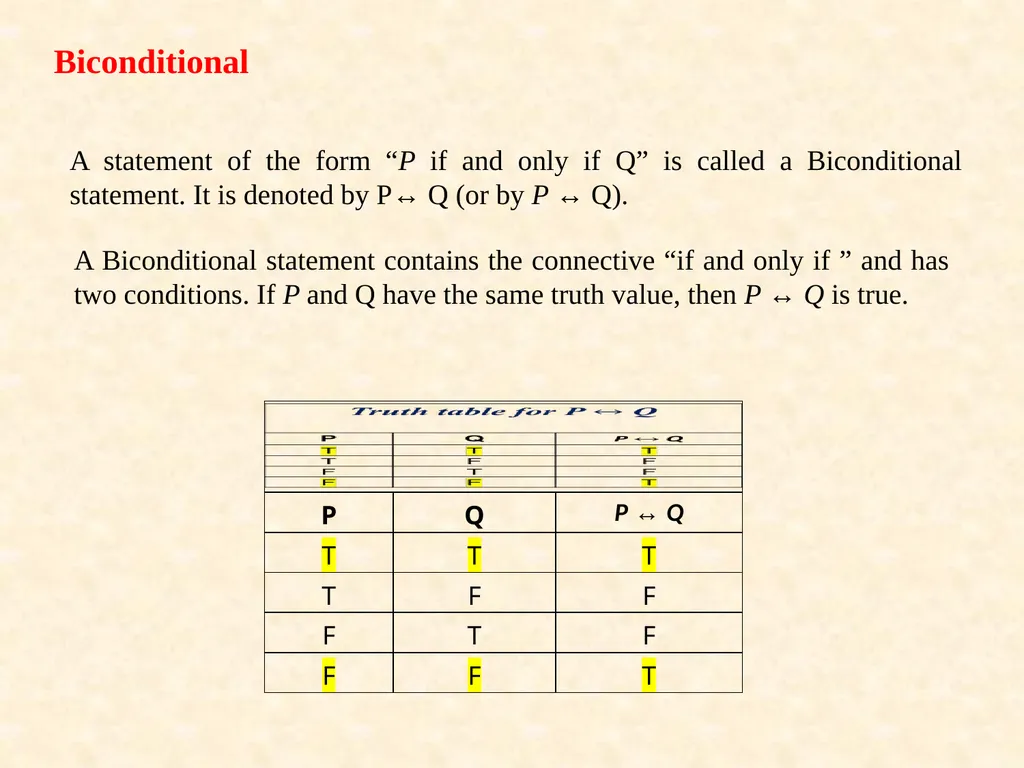
A statement of the form “P if and only if Q” is called a Biconditional statement. It is denoted by P↔ Q (or by P ↔ Q). A Biconditional statement contains the connective “if and only if ” and has two conditions. If P and Q have the same truth value, then P ↔ Q is true. Biconditional<br>
11
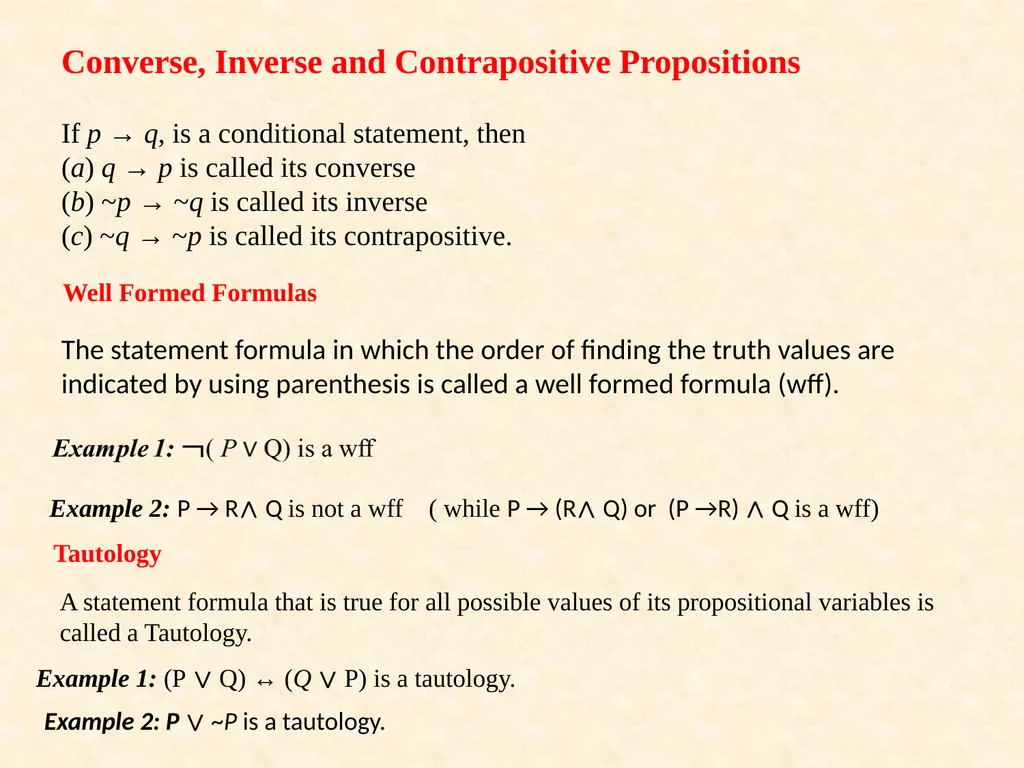
Converse, Inverse and Contrapositive Propositions
If p → q, is a conditional statement, then
(a) q → p is called its converse
(b) ~p → ~q is called its inverse
(c) ~q → ~p is called its contrapositive. Well Formed Formulas The statement formula in which the order of finding the truth values are indicated by using parenthesis is called a well formed formula (wff). Example 2: P → R∧ Q is not a wff ( while P → (R∧ Q) or (P →R) ∧ Q is a wff) Tautology A statement formula that is true for all possible values of its propositional variables is called a Tautology. Example 1: (P ∨ Q) ↔ (Q ∨ P) is a tautology. Example 2: P ∨ ~P is a tautology.<br>
12
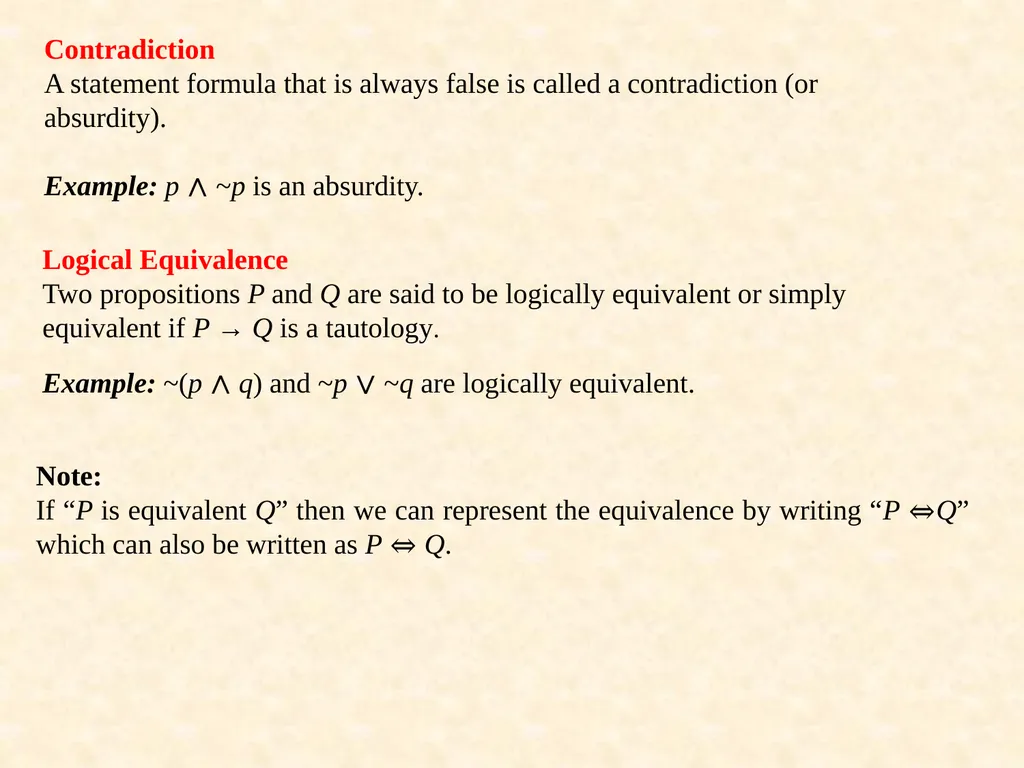
Contradiction
A statement formula that is always false is called a contradiction (or absurdity).
Example: p ∧ ~p is an absurdity. Logical Equivalence
Two propositions P and Q are said to be logically equivalent or simply equivalent if P → Q is a tautology. Example: ~(p ∧ q) and ~p ∨ ~q are logically equivalent. Note:
If “P is equivalent Q” then we can represent the equivalence by writing “P ⇔Q” which can also be written as P ⇔ Q.<br>
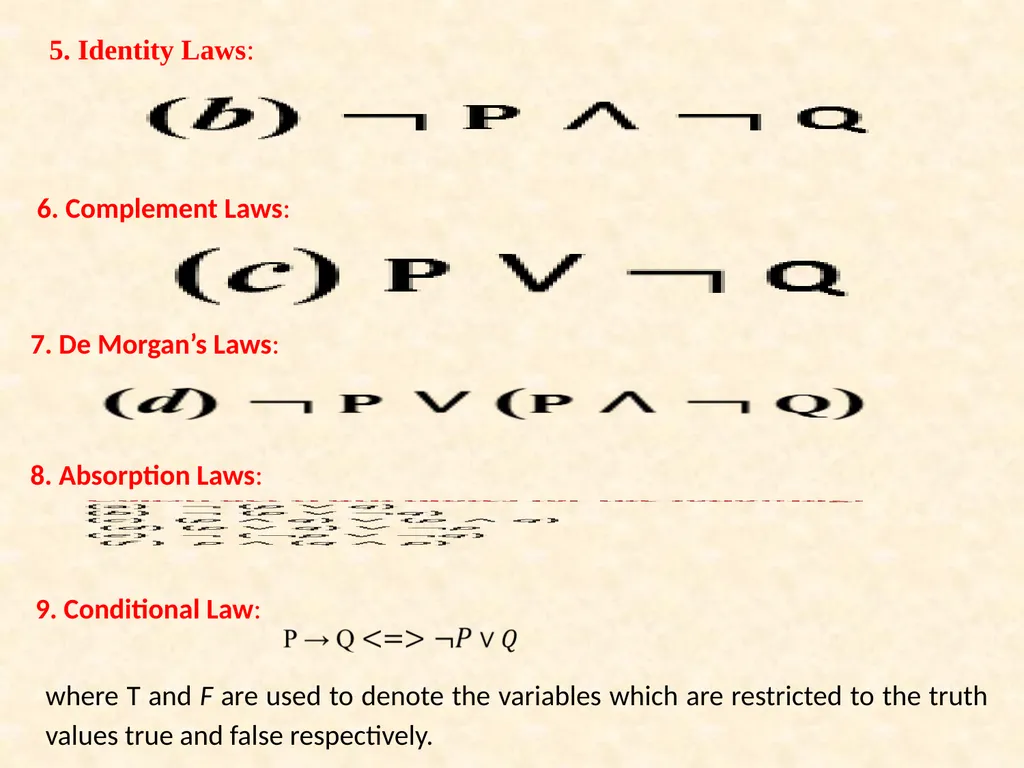
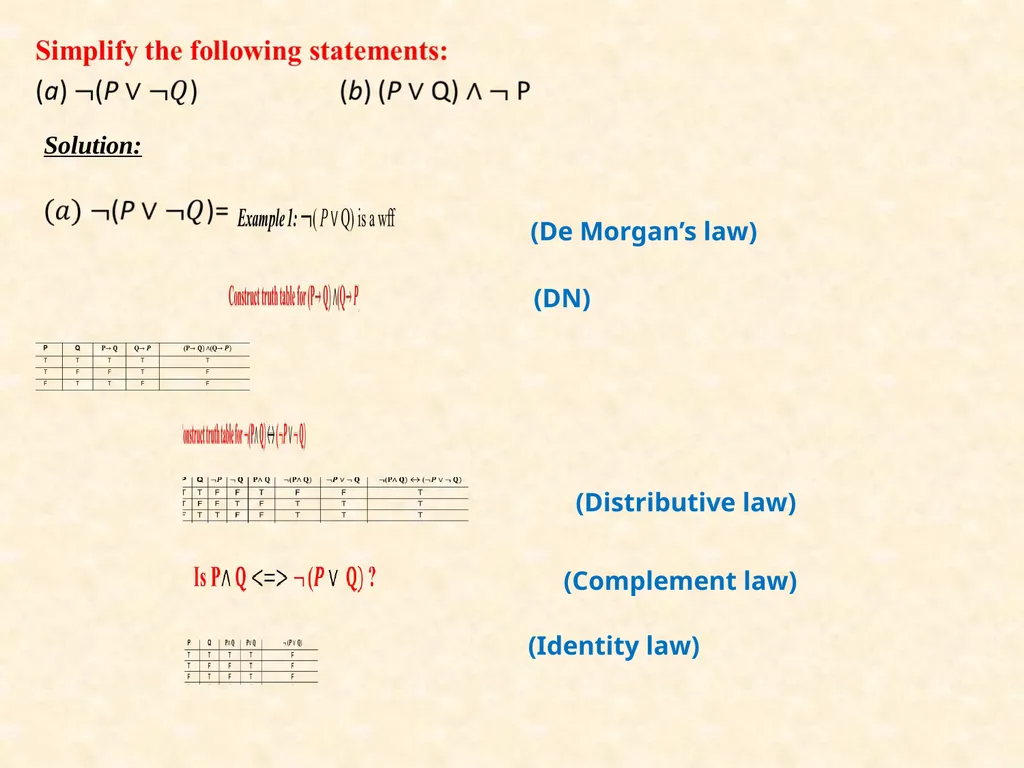
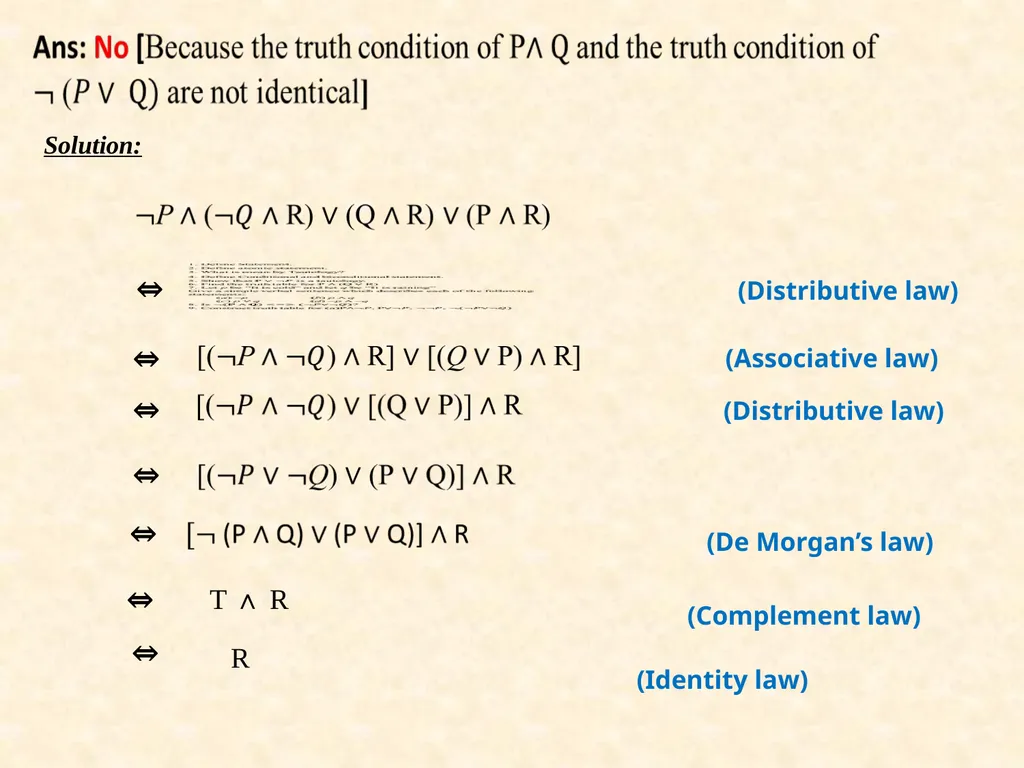
5. Identity Laws: 6. Complement Laws: 7. De Morgan’s Laws: 8. Absorption Laws: 9. Conditional Law: where T and F are used to denote the variables which are restricted to the truth values true and false respectively.<br>
17
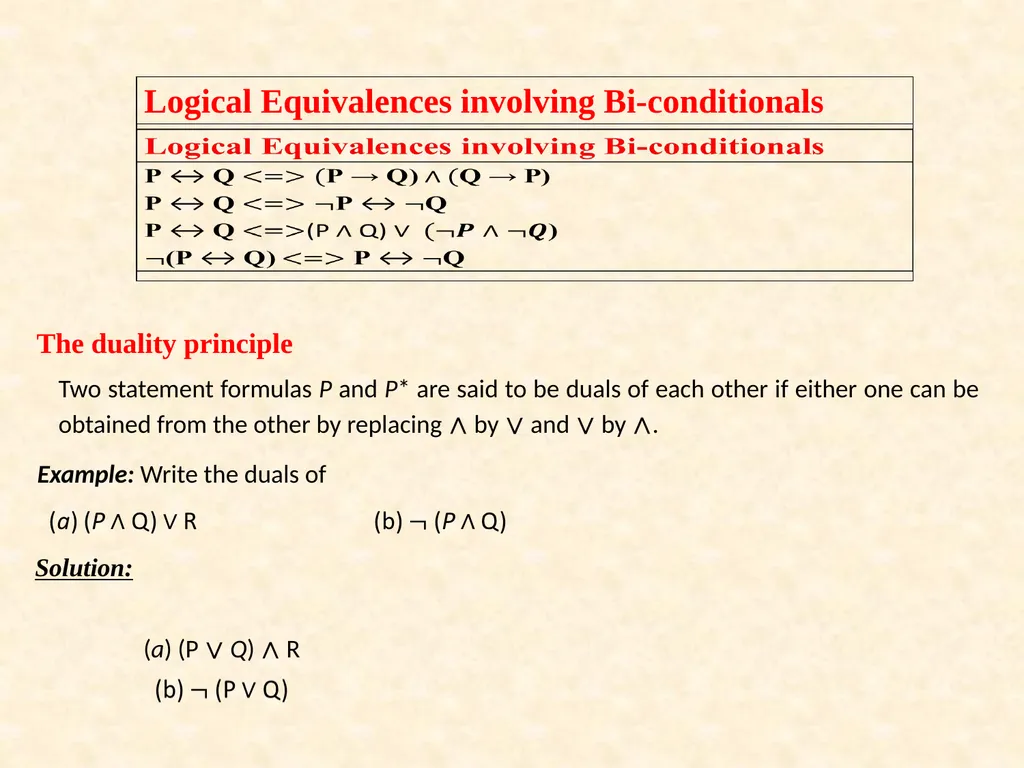
The duality principle Two statement formulas P and P* are said to be duals of each other if either one can be obtained from the other by replacing ∧ by ∨ and ∨ by ∧. Example: Write the duals of Solution: (a) (P ∨ Q) ∧ R<br>