05
Experimental Results�Dataset and Preprocessing Dataset contains 3,664 articles from Web of Science (WoS) Core Collection in Social Science research area (25 categories) from 1999 to 2019
Articles contain phrase social network* for the purpose of narrowing of the monitored set of data
Every article is represented by its text in the title, abstract and keywords
The collection is preprocessed by removing English stopwords and numbers, and removing high frequently words: social, network, study, analysis, model and datum
It is performed a lemmatisation
It is created term-document matrix using tf-idf weighting scheme
The collection is represented by a bag of words model using terms that appear in at least 2 documents from the corpus (3,663 documents)
The final number of index terms – 9,096 5 Collect Data Prepare Data 25th Young Statisticians Meeting<br>
09
Conclusion The main goal: compare latent topics with categories from WoS
The research was conducted on the sample of papers from 1999 to 2019 with the phrase social network* for the purpose of narrowing of the monitored set of data
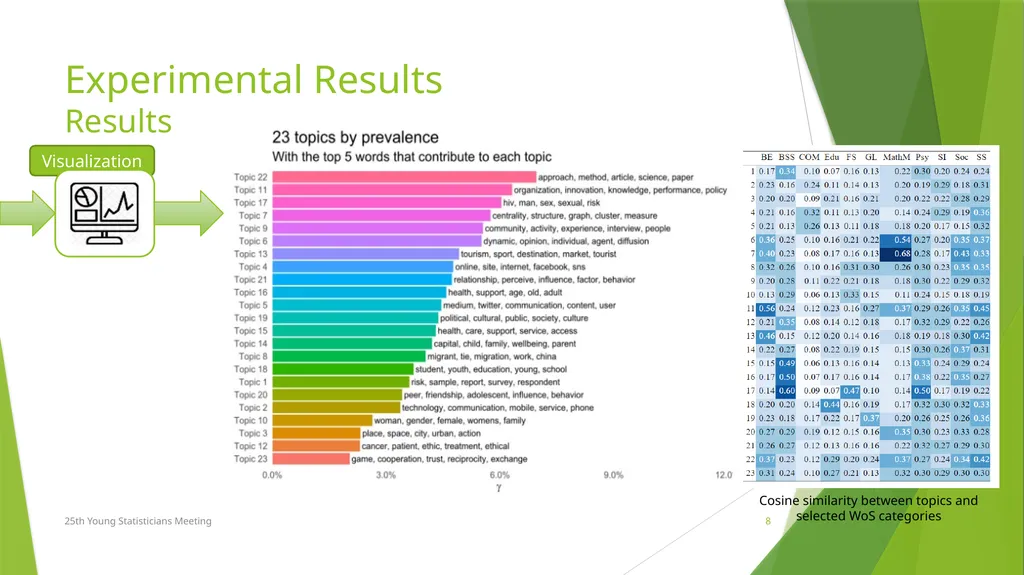
Social networks are mainly applied in disciplines of Business and Economics (BE), Biomedical Social Sciences (BSS), Mathematical Methods in Social Sciences (MathM) and Psychology (Psy)
Based on cosine similarities, we could identify interdisciplinarity between disciplines of BE and MathM, BSS and MathM, BSS and Psy, BSS, FS, and Psy
We plan to extend our research to all papers in WoS in the field of Social Sciences to identify interdisciplinary fields
In future research, we intend to investigate the interdisciplinarity between science disciplines which are hidden or masked and reconsider the existing taxonomy of research areas in Social Sciences and its temporal changes 9 Future Work 25th Young Statisticians Meeting<br>
10
References Bischof, J., Airoldi, E. (2012). Summarizing Topical Content with Word Frequency and Exclusivity. Proceedings of the 29th International Conference on Machine Learning, ICML ’12 (pp. 201–208). New York: J. Langford, J. Pineau (eds.).
Blei, D. M., Ng, A. Y., Jordan, M. I. (2003). Latent Dirichlet Allocation. Journal of Machine Learning Research 3, pp. 993-1022.
Chuang, J., Ramage, D., Manning, C., Heer, J. (2012). Interpretation and trust: designing model-driven visualizations for text analysis. SIGCHI Conference on Human Factors in Computing Systems, (pp. 443-452). Austin, Texas, USA.
Dietz, L., Bickel, S., Scheffer, T. (2007). Unsupervised prediction of citation influences. 24th international conference on Machine learning (pp. 233-240). Corvalis, Oregon, USA: Association for Computing Machinery, New York, United States.
Gerrish, S., Blei, D. (2010). A Language-based Approach to Measuring Scholarly Impact. 27th International Conference on Machine Learning, (pp. 375-382). Haifa, Israel.
Griffiths, T., Steyvers, M. (2004). Finding scientific topics. Proceedings of the National Academy of Sciences, 101, pp. 5228-5235.
Hall, D., Jurafsky, D., Manning, C. D. (2008). Studying the History of Ideas Using Topic Models. Conference on Empirical Methods in Natural Language Processing, (pp. 363–371).
Mimno, D., Wallach, H. M., Talley, E., Leenders, M., McCallum, A. (2011). Optimizing semantic coherence in topic models. Conference on Empirical Methods in Natural Language Processing (EMNLP ’11) (pp. 262-272). USA: Association for Computational Linguistics.
Nanni, F., Dietz, L., Ponzetto, S. P. (2018). Toward a computational history of universities: Evaluating text mining methods for interdisciplinarity detection from PhD dissertation abstracts. Digital Scholarship in the Humanities, Volume 33, Issue 3, pp. 612–620.
Nichols, L. G. (2014). A topic model approach to measuring interdisciplinarity at the National Science Foundation. Scientometrics 100(3), pp. 741-754.
Ramage D., Manning C. D., Dumais S. (2011). Partially labelled topic models for interpretable text mining. 17th ACM SIGKDD international conference on Knowledge discovery and data mining (pp. 457-465). San Diego California USA: Association for Computing Machinery New York NY United States.
Repko, A. F. (2008). Interdisciplinary Research: Process and Theory. California: Sage: Thousand Oaks.
Roberts, M. E., Stewart, B. M., Tingley, D. (August 2020). stm: R Package for Structural Topic Models. Retrieved from The Comprehensive R Archive Network: http://www.structuraltopicmodel.com/
Silge, J., Robinson, D. (August 2020). Text Mining with R. Retrieved from https://www.tidytextmining.com/topicmodeling.html
Taddy, M. A. (2012). On Estimation and Selection for Topic Models. The 15th International Conference on Artificial Intelligence and Statistics., (pp. 1184-1193). 10 25th Young Statisticians Meeting<br>