
Topic: Scientific Principles of Management For




Description: Topic: Scientific Principles of Management For B.Ed Ist Semester Students (Punjabi University) By Ms. Sarita Gulati Librarian Shivalik Institute of Education and Research, Mohali Dr. F.W Taylor, is called as Father of Scientific
Related Topics
Download Presentation
"Topic: Scientific Principles of Management For" is the property of its rightful owner. Permission is granted to download and print the materials on this website for personal, non-commercial use only, and to display it on your personal computer provided you do not modify the materials and that you retain all copyright notices contained in the materials. By downloading content from our website, you accept the terms of this agreement.
Presentation Transcript
slide1. Topic: Scientific Principles of Management
For B.Ed Ist Semester Students
(Punjabi University)
By
Ms. Sarita Gulati
Librarian
Shivalik Institute of Education and Research, Mohali<br>
slide2. Dr. F.W Taylor, is called as “Father of Scientific Management’. He popularized scientific management movement and made it universally acceptable. He worked almost at every position before becoming the chief engineer. So, he was practically associated with various problems faced by the workers at different positions. He noticed that the industrial resources were not being properly used.<br>
slide3. Business enterprises were being managed by the rule of thumb. No systematic effort had ever been made to find the exact nature of the work to be done or the best way of doing it. There was no proper division of responsibilities between management and workers.
He carried out many experiments for finding out ways and means to reduce wastage and inefficiency of every kind in the production processes. This ultimately led to the emergence of the concept of ‘Scientific Management’.<br>
slide4. Scientific management implies the art of knowing exactly what is to be done and how it is to be done. Under this approach, scientific techniques are applied in the recruitment, selection and training of workers and are also used in tackling various industrial problems.
“Scientific management means knowing exactly what you want men to do and seeing that they do it in the best and the cheapest way”.
— F.W. Taylor Meaning and Definition of Scientific Management<br>
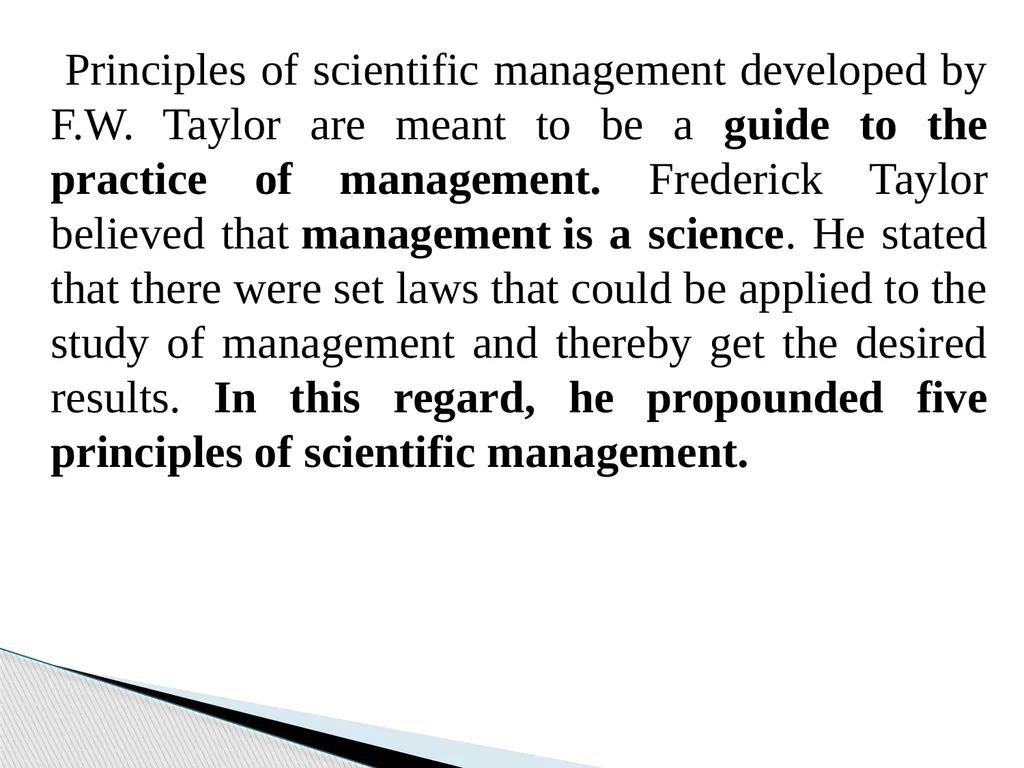
slide5. Principles of scientific management developed by F.W. Taylor are meant to be a guide to the practice of management. Frederick Taylor believed that management is a science. He stated that there were set laws that could be applied to the study of management and thereby get the desired results. In this regard, he propounded five principles of scientific management.<br>
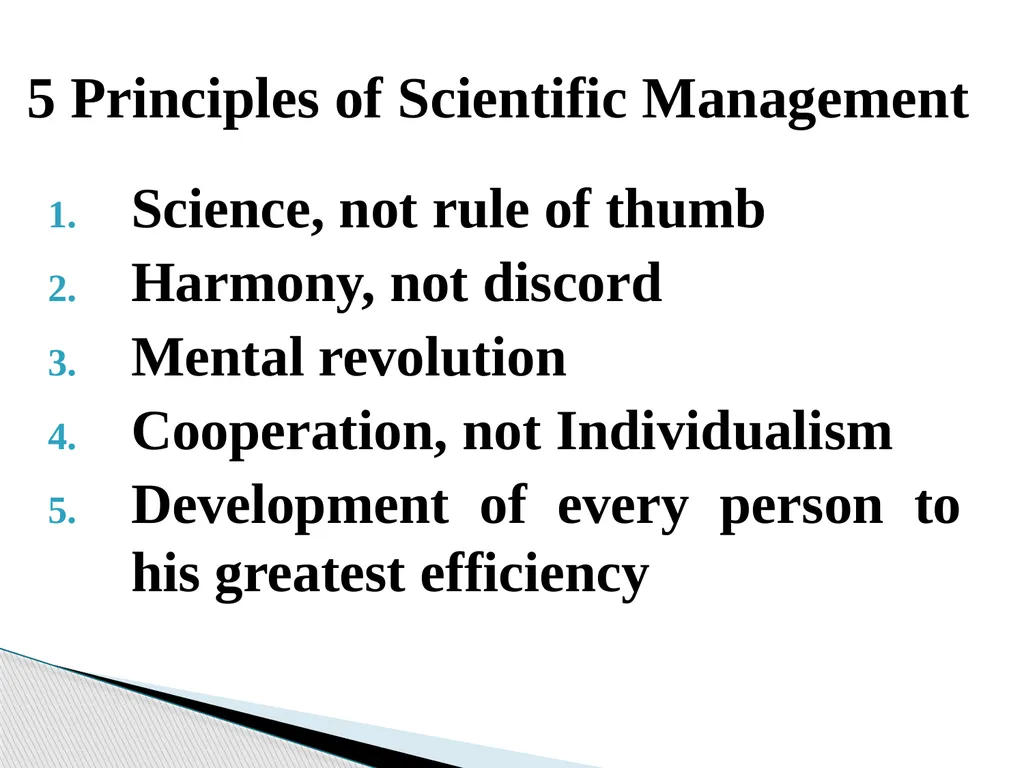
slide6. Science, not rule of thumb
Harmony, not discord
Mental revolution
Cooperation, not Individualism
Development of every person to his greatest efficiency 5 Principles of Scientific Management<br>
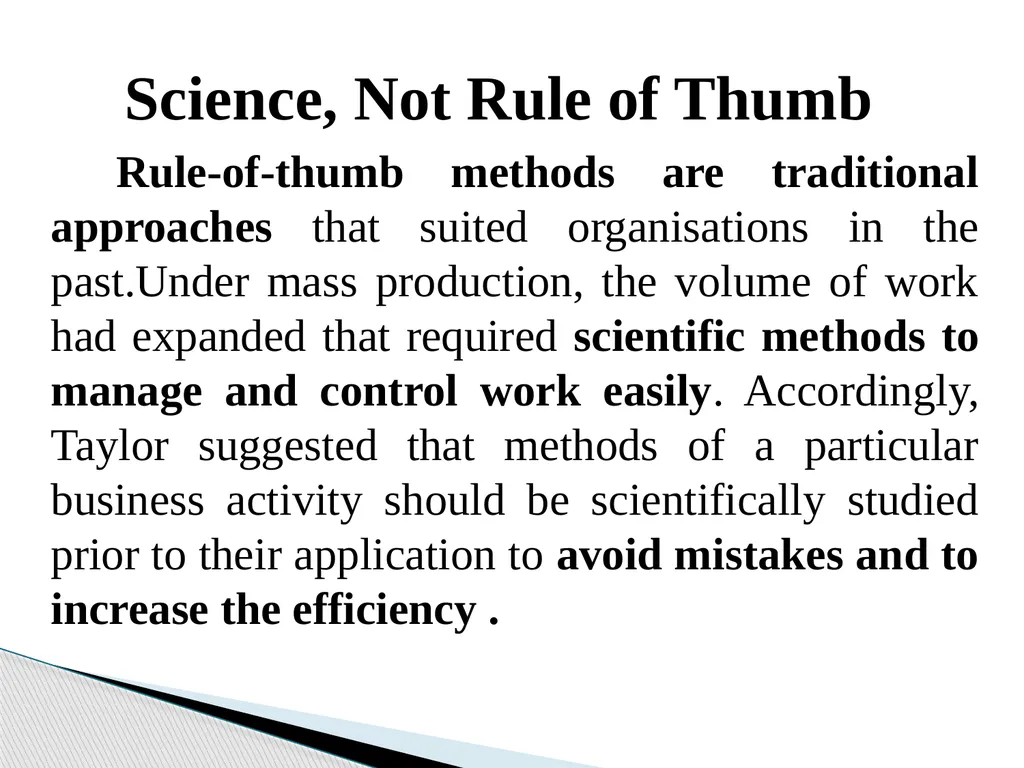
slide7. Rule-of-thumb methods are traditional approaches that suited organisations in the past.Under mass production, the volume of work had expanded that required scientific methods to manage and control work easily. Accordingly, Taylor suggested that methods of a particular business activity should be scientifically studied prior to their application to avoid mistakes and to increase the efficiency . Science, Not Rule of Thumb<br>
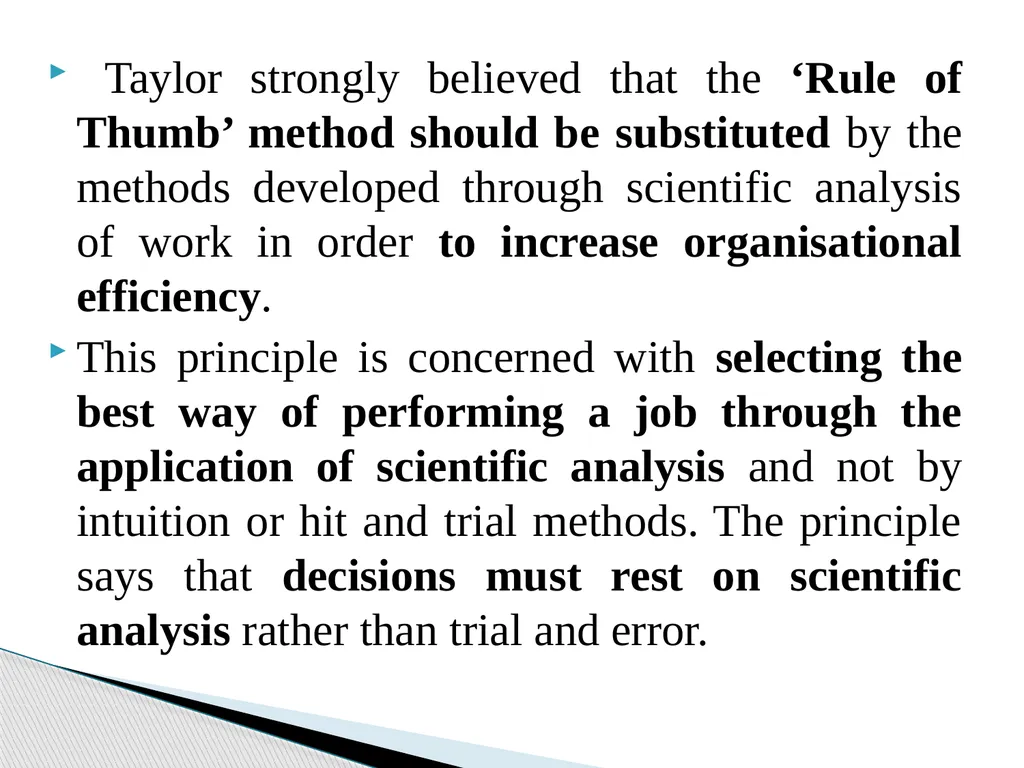
slide8. Taylor strongly believed that the ‘Rule of Thumb’ method should be substituted by the methods developed through scientific analysis of work in order to increase organisational efficiency.
This principle is concerned with selecting the best way of performing a job through the application of scientific analysis and not by intuition or hit and trial methods. The principle says that decisions must rest on scientific analysis rather than trial and error.<br>
slide9. For keeping books in library proper classification schemes like DDC,UDC etc. should be used rather than any hit and trial method. That will help users to easily locate books and other library materials. Example<br>
slide10. Under this principle, employees and management should work in harmony with mutual cooperation and coordination. In case there are any conflicts between the management and the employees, the organization will not be able to run smoothly. Workers should not be overburdened with work, while should not feel dissatisfied with their investment of time and money in an organisation.
According to Taylor an organisation can achieve maximum prosperity if employees and management work with each other leading to development of a cordial relationship with each other and team spirit, and organisational goals can be achieved easily. Harmony, Not Discord (conflict/disagreement)<br>
slide11. If there are any disputes between the library staff then it should be dissolve with proper justice to maintain harmony in the organisation and for smooth working. Example<br>
slide12. This technique involves a shift/change of attitude of management and workers towards each other. Both should understand the value of each other and work with full participation and cooperation. The aim of both should be to improve and boost the profits of the organisation. Mental Revolution demands a complete change in the outlook of both the workers and management; both should have a sense of togetherness. Mental Revolution<br>
slide13. It requires that management should create suitable working condition and solve all problems scientifically. Similarly workers should attend their jobs with utmost attention, devotion and carefulness. They should not waste the resources of an organisation. Handsome remuneration should be provided to employees to boost up their moral. It will create a sense of belongingness among employees . They will be disciplined, loyal and sincere in fulfilling the task assigned to them.<br>
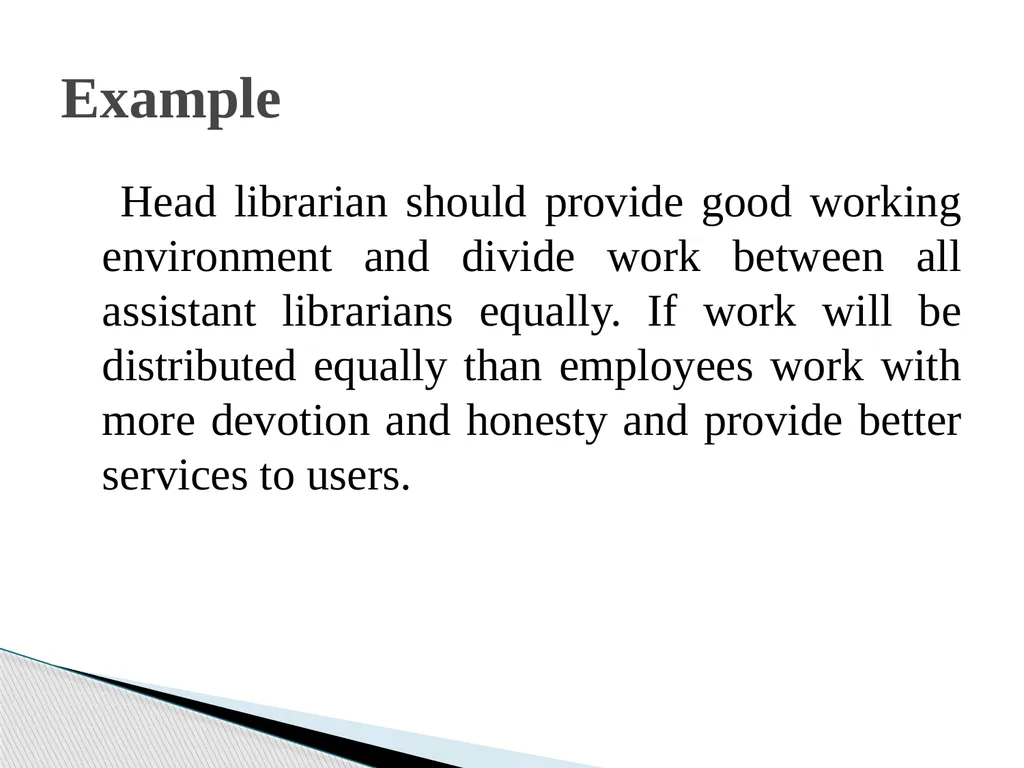
slide14. Head librarian should provide good working environment and divide work between all assistant librarians equally. If work will be distributed equally than employees work with more devotion and honesty and provide better services to users. Example<br>
slide15. This is an extension of the harmony principle. While the former emphasizes the need for harmony between the two, this principle takes it further and talk’s mutual cooperation. Cooperation is an action of working together and Taylor states employees and management should cooperate with each other that could lead to high morale and team spirit. A sense of individualism in terms of an organization can lead to diversion from the unified goals, ultimately affecting the growth of the entire organization. Cooperation, Not Individualism<br>
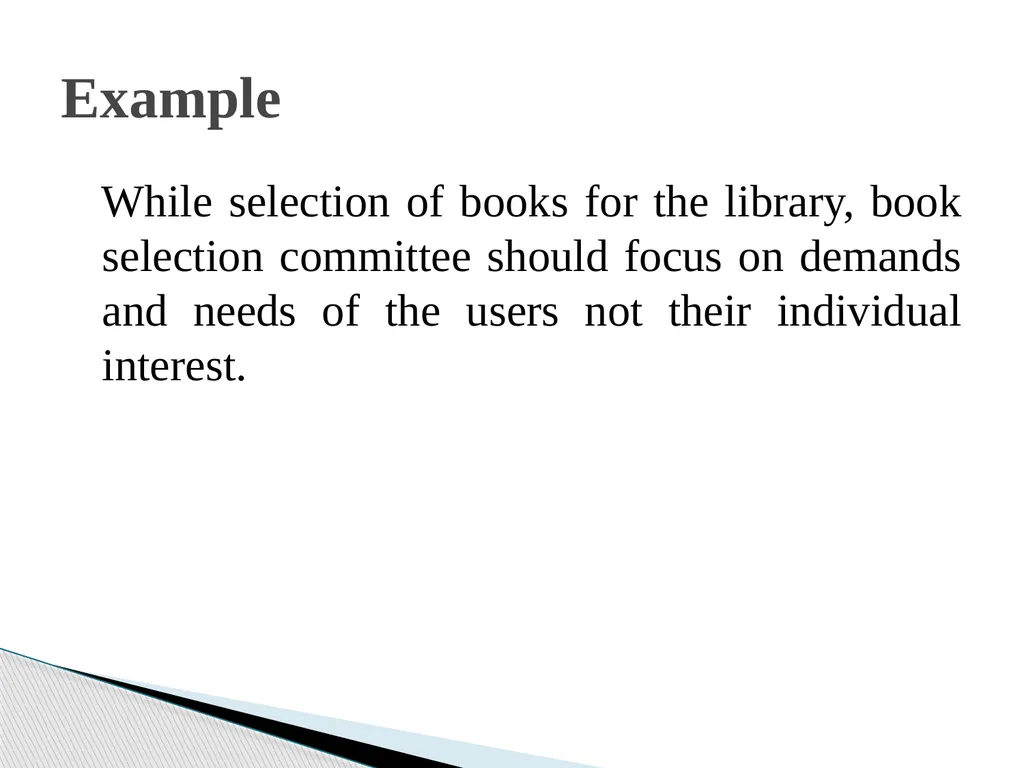
slide16. While selection of books for the library, book selection committee should focus on demands and needs of the users not their individual interest. Example<br>
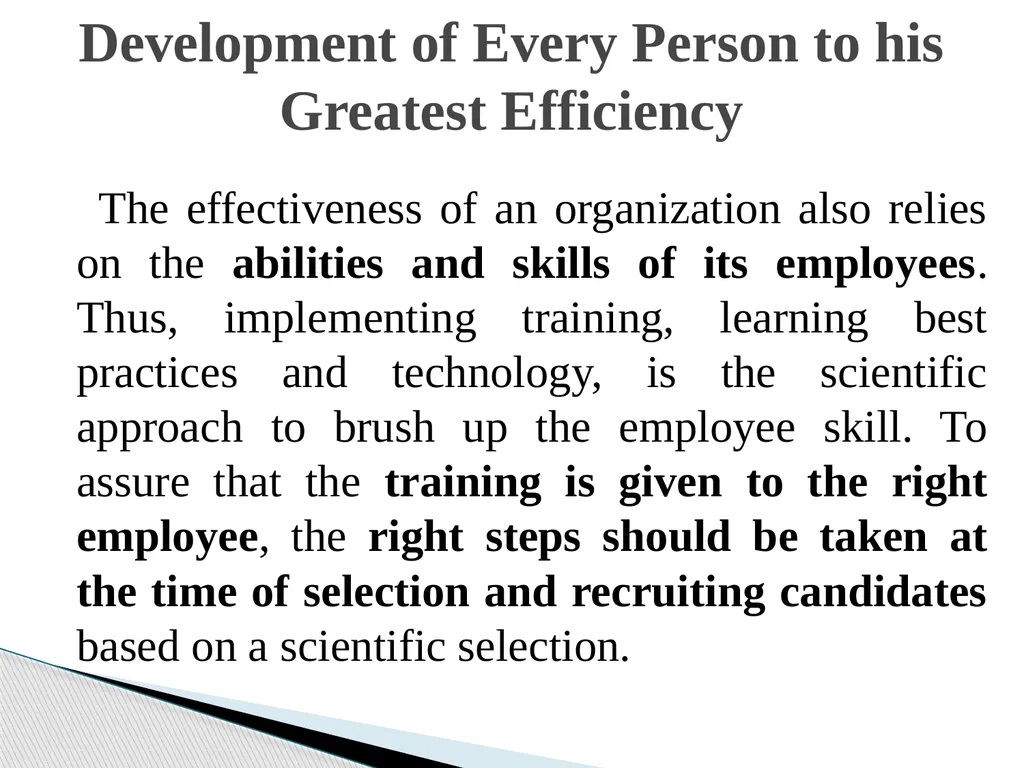
slide17. The effectiveness of an organization also relies on the abilities and skills of its employees. Thus, implementing training, learning best practices and technology, is the scientific approach to brush up the employee skill. To assure that the training is given to the right employee, the right steps should be taken at the time of selection and recruiting candidates based on a scientific selection. Development of Every Person to his Greatest Efficiency<br>
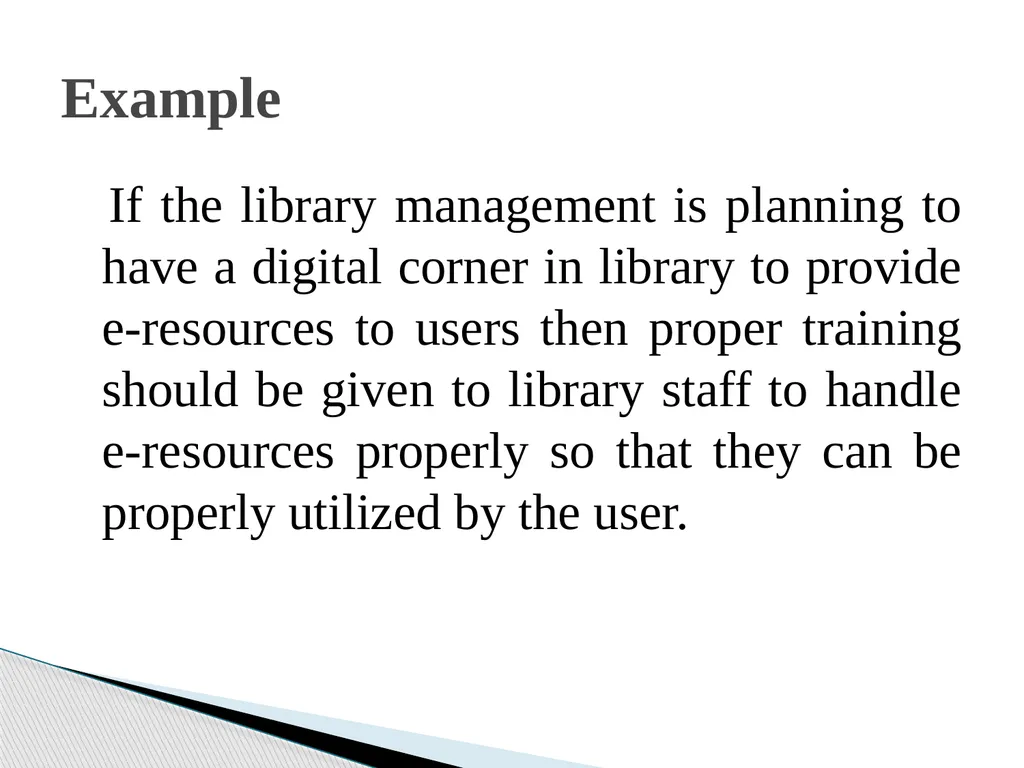
slide18. If the library management is planning to have a digital corner in library to provide e-resources to users then proper training should be given to library staff to handle e-resources properly so that they can be properly utilized by the user. Example<br>
slide19. Better services: The scientific management theory is responsible for enhanced services to users as it concentrates on steady improvements in library operations. There is fruitful cooperation between head librarian and librarian assistants and hence enhanced teamwork achieved. The harmonious relationship between the management and staff assists in better services to users. ADVANTAGES OF SCIENTIFIC MANAGEMENT<br>
slide20. Benefits of Division of work: The principle of specialization adopted under scientific management ensures the benefits derived from the division of work. The work is simplified and is carried out in most economical and efficient manner.
Avoidance of Disputes between staff and Management: Scientific management is instrumental in developing healthy cooperation between the management and the staff thereby encouraging cordial and harmonious relations between the two. This leads to reduction in disputes and provides peaceful atmosphere. The concept of ‘Mental Revolution’ has been evolved by F.W. Taylor for developing close understanding, mutual trust and confidence between the staff and management.<br>
slide21. Proper Methods of Selection and Training of staff: One of the main principles of scientific management is that it undertakes scientific selection, placement and training of its staff. In this manner, right type of man is selected for the right type of job.
Good working conditions: A proper atmosphere for working are developed with scientific management theory. Proper working schedules follow with ventilation; adequate lighting, proper safety, and other facilities provided to users.<br>
slide22. Decreases inaccuracy: Inaccuracy decreased as the theory based on experiment and observation for finding solutions is followed. With better planning and improved decision making, the accuracy achieved.
Decreased autocracy: The theory stimulates the management to adopt a positive relationship with leadership. Cooperation amongst employees and management enhances democracy in the workplace. Hence there decreased autocracy by following scientific management theory.
Quick decision making: Planning ahead of time and prompt decisions making are few good aspects of scientific management theory.<br>
slide23. Efficiency Increased: They follow early working methods and control where a management methodology developed for training, selecting and supervising them in a close manner. Since scientific selection and training methods follow, it leads to a workforce that is best and enhances efficiency.
Best use of resources and development: With the scientific techniques followed, there is better utilization of resources this, in turn, leads to increased productivity. Wastage and inefficiency of all means eradicated with the theory. Also with the help of scientific investigation, it leads to technological development.<br>
slide24. THANK YOU<br>
slide2. Dr. F.W Taylor, is called as “Father of Scientific Management’. He popularized scientific management movement and made it universally acceptable. He worked almost at every position before becoming the chief engineer. So, he was practically associated with various problems faced by the workers at different positions. He noticed that the industrial resources were not being properly used.<br>
slide3. Business enterprises were being managed by the rule of thumb. No systematic effort had ever been made to find the exact nature of the work to be done or the best way of doing it. There was no proper division of responsibilities between management and workers.
He carried out many experiments for finding out ways and means to reduce wastage and inefficiency of every kind in the production processes. This ultimately led to the emergence of the concept of ‘Scientific Management’.<br>
slide4. Scientific management implies the art of knowing exactly what is to be done and how it is to be done. Under this approach, scientific techniques are applied in the recruitment, selection and training of workers and are also used in tackling various industrial problems.
“Scientific management means knowing exactly what you want men to do and seeing that they do it in the best and the cheapest way”.
— F.W. Taylor Meaning and Definition of Scientific Management<br>
slide5. Principles of scientific management developed by F.W. Taylor are meant to be a guide to the practice of management. Frederick Taylor believed that management is a science. He stated that there were set laws that could be applied to the study of management and thereby get the desired results. In this regard, he propounded five principles of scientific management.<br>
slide6. Science, not rule of thumb
Harmony, not discord
Mental revolution
Cooperation, not Individualism
Development of every person to his greatest efficiency 5 Principles of Scientific Management<br>
slide7. Rule-of-thumb methods are traditional approaches that suited organisations in the past.Under mass production, the volume of work had expanded that required scientific methods to manage and control work easily. Accordingly, Taylor suggested that methods of a particular business activity should be scientifically studied prior to their application to avoid mistakes and to increase the efficiency . Science, Not Rule of Thumb<br>
slide8. Taylor strongly believed that the ‘Rule of Thumb’ method should be substituted by the methods developed through scientific analysis of work in order to increase organisational efficiency.
This principle is concerned with selecting the best way of performing a job through the application of scientific analysis and not by intuition or hit and trial methods. The principle says that decisions must rest on scientific analysis rather than trial and error.<br>
slide9. For keeping books in library proper classification schemes like DDC,UDC etc. should be used rather than any hit and trial method. That will help users to easily locate books and other library materials. Example<br>
slide10. Under this principle, employees and management should work in harmony with mutual cooperation and coordination. In case there are any conflicts between the management and the employees, the organization will not be able to run smoothly. Workers should not be overburdened with work, while should not feel dissatisfied with their investment of time and money in an organisation.
According to Taylor an organisation can achieve maximum prosperity if employees and management work with each other leading to development of a cordial relationship with each other and team spirit, and organisational goals can be achieved easily. Harmony, Not Discord (conflict/disagreement)<br>
slide11. If there are any disputes between the library staff then it should be dissolve with proper justice to maintain harmony in the organisation and for smooth working. Example<br>
slide12. This technique involves a shift/change of attitude of management and workers towards each other. Both should understand the value of each other and work with full participation and cooperation. The aim of both should be to improve and boost the profits of the organisation. Mental Revolution demands a complete change in the outlook of both the workers and management; both should have a sense of togetherness. Mental Revolution<br>
slide13. It requires that management should create suitable working condition and solve all problems scientifically. Similarly workers should attend their jobs with utmost attention, devotion and carefulness. They should not waste the resources of an organisation. Handsome remuneration should be provided to employees to boost up their moral. It will create a sense of belongingness among employees . They will be disciplined, loyal and sincere in fulfilling the task assigned to them.<br>
slide14. Head librarian should provide good working environment and divide work between all assistant librarians equally. If work will be distributed equally than employees work with more devotion and honesty and provide better services to users. Example<br>
slide15. This is an extension of the harmony principle. While the former emphasizes the need for harmony between the two, this principle takes it further and talk’s mutual cooperation. Cooperation is an action of working together and Taylor states employees and management should cooperate with each other that could lead to high morale and team spirit. A sense of individualism in terms of an organization can lead to diversion from the unified goals, ultimately affecting the growth of the entire organization. Cooperation, Not Individualism<br>
slide16. While selection of books for the library, book selection committee should focus on demands and needs of the users not their individual interest. Example<br>
slide17. The effectiveness of an organization also relies on the abilities and skills of its employees. Thus, implementing training, learning best practices and technology, is the scientific approach to brush up the employee skill. To assure that the training is given to the right employee, the right steps should be taken at the time of selection and recruiting candidates based on a scientific selection. Development of Every Person to his Greatest Efficiency<br>
slide18. If the library management is planning to have a digital corner in library to provide e-resources to users then proper training should be given to library staff to handle e-resources properly so that they can be properly utilized by the user. Example<br>
slide19. Better services: The scientific management theory is responsible for enhanced services to users as it concentrates on steady improvements in library operations. There is fruitful cooperation between head librarian and librarian assistants and hence enhanced teamwork achieved. The harmonious relationship between the management and staff assists in better services to users. ADVANTAGES OF SCIENTIFIC MANAGEMENT<br>
slide20. Benefits of Division of work: The principle of specialization adopted under scientific management ensures the benefits derived from the division of work. The work is simplified and is carried out in most economical and efficient manner.
Avoidance of Disputes between staff and Management: Scientific management is instrumental in developing healthy cooperation between the management and the staff thereby encouraging cordial and harmonious relations between the two. This leads to reduction in disputes and provides peaceful atmosphere. The concept of ‘Mental Revolution’ has been evolved by F.W. Taylor for developing close understanding, mutual trust and confidence between the staff and management.<br>
slide21. Proper Methods of Selection and Training of staff: One of the main principles of scientific management is that it undertakes scientific selection, placement and training of its staff. In this manner, right type of man is selected for the right type of job.
Good working conditions: A proper atmosphere for working are developed with scientific management theory. Proper working schedules follow with ventilation; adequate lighting, proper safety, and other facilities provided to users.<br>
slide22. Decreases inaccuracy: Inaccuracy decreased as the theory based on experiment and observation for finding solutions is followed. With better planning and improved decision making, the accuracy achieved.
Decreased autocracy: The theory stimulates the management to adopt a positive relationship with leadership. Cooperation amongst employees and management enhances democracy in the workplace. Hence there decreased autocracy by following scientific management theory.
Quick decision making: Planning ahead of time and prompt decisions making are few good aspects of scientific management theory.<br>
slide23. Efficiency Increased: They follow early working methods and control where a management methodology developed for training, selecting and supervising them in a close manner. Since scientific selection and training methods follow, it leads to a workforce that is best and enhances efficiency.
Best use of resources and development: With the scientific techniques followed, there is better utilization of resources this, in turn, leads to increased productivity. Wastage and inefficiency of all means eradicated with the theory. Also with the help of scientific investigation, it leads to technological development.<br>
slide24. THANK YOU<br>