
TOPS/FSN Network Food Security Conference
KB
Published · 22 slides · 0 views

1 / 1


Description
TOPSFSN Network Food Security Conference September 19-23, 2011 Maputo, Mozambique an integrated information management system Slide 2 Content Slide 3 1.1 Introduction McAID is a software database system. The title is the short form of
Related Topics
Share
Embed code
Download this presentation From Below
"TOPS/FSN Network Food Security Conference" is the property of its rightful owner. Permission is granted to download and print the materials on this website for personal, non-commercial use only, and to display it on your personal computer provided you do not modify the materials and that you retain all copyright notices contained in the materials. By downloading content from our website, you accept the terms of this agreement.
Presentation Transcript
01
TOPS/FSN Network Food Security Conference September 19-23, 2011
Maputo, Mozambique an integrated information management system<br>
Maputo, Mozambique an integrated information management system<br>
02
Slide 2 Content<br>
03
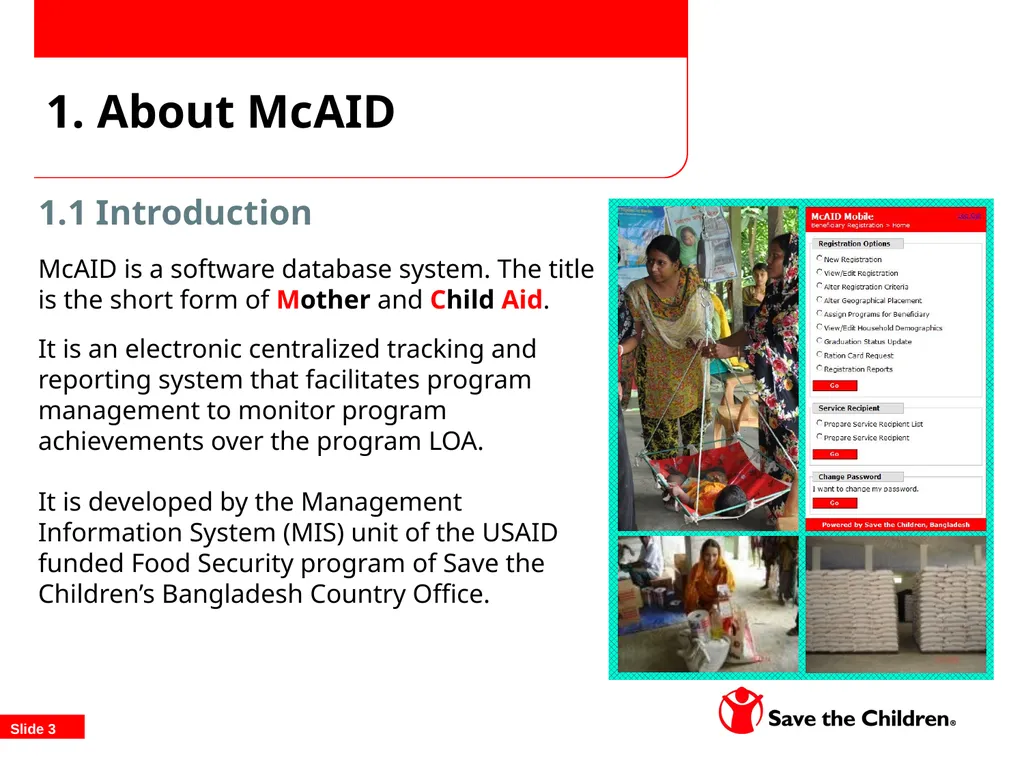
Slide 3 1.1 Introduction McAID is a software database system. The title is the short form of Mother and Child Aid. It is developed by the Management Information System (MIS) unit of the USAID funded Food Security program of Save the Children’s Bangladesh Country Office. It is an electronic centralized tracking and reporting system that facilitates program management to monitor program achievements over the program LOA. 1. About McAID<br>
04
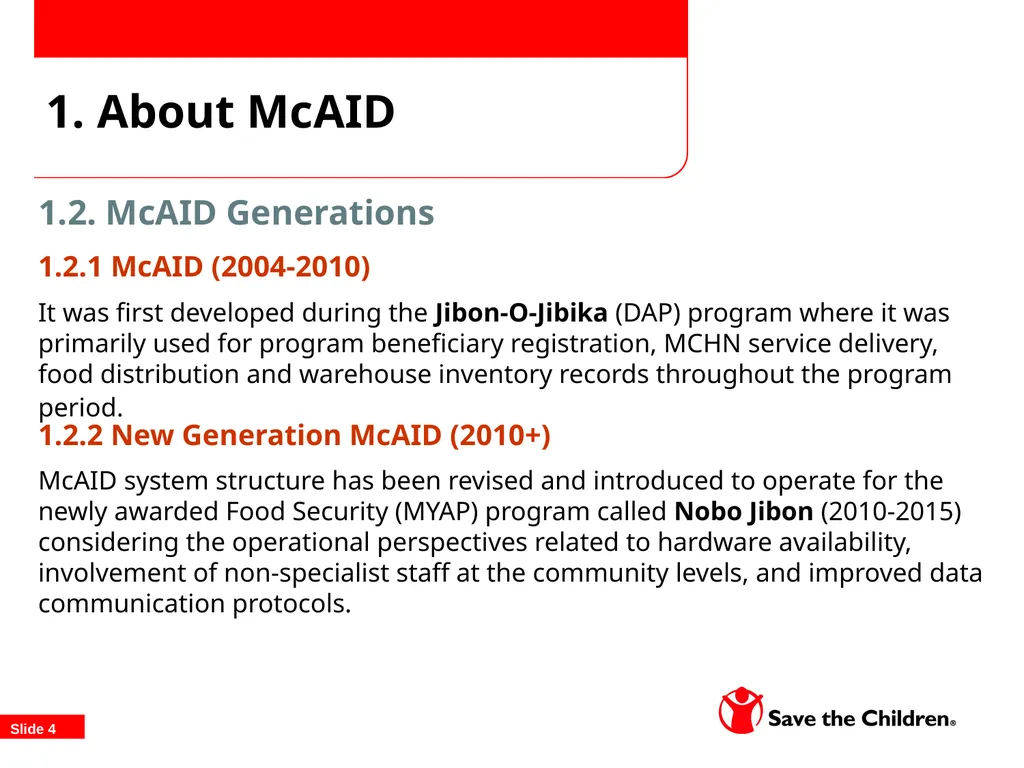
Slide 4 1. About McAID 1.2. McAID Generations 1.2.1 McAID (2004-2010)
It was first developed during the Jibon-O-Jibika (DAP) program where it was primarily used for program beneficiary registration, MCHN service delivery, food distribution and warehouse inventory records throughout the program period. 1.2.2 New Generation McAID (2010+)
McAID system structure has been revised and introduced to operate for the newly awarded Food Security (MYAP) program called Nobo Jibon (2010-2015) considering the operational perspectives related to hardware availability, involvement of non-specialist staff at the community levels, and improved data communication protocols.<br>
It was first developed during the Jibon-O-Jibika (DAP) program where it was primarily used for program beneficiary registration, MCHN service delivery, food distribution and warehouse inventory records throughout the program period. 1.2.2 New Generation McAID (2010+)
McAID system structure has been revised and introduced to operate for the newly awarded Food Security (MYAP) program called Nobo Jibon (2010-2015) considering the operational perspectives related to hardware availability, involvement of non-specialist staff at the community levels, and improved data communication protocols.<br>
05
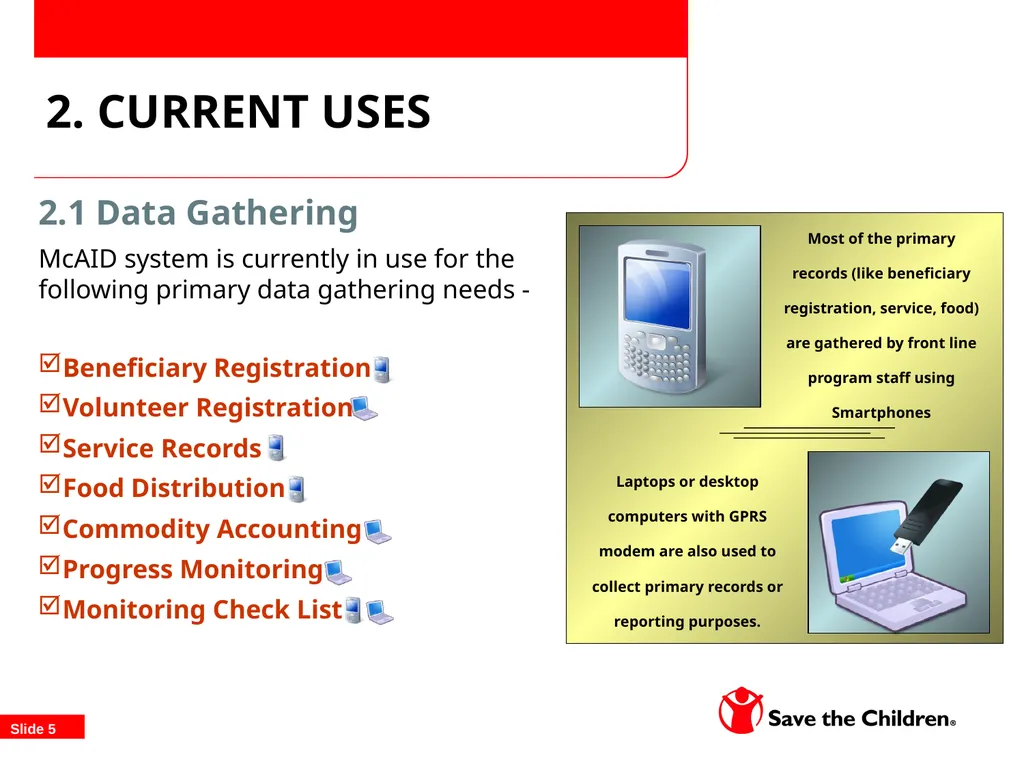
Slide 5 2. CURRENT USES 2.1 Data Gathering Beneficiary Registration Volunteer Registration Service Records Food Distribution Commodity Accounting Progress Monitoring Monitoring Check List McAID system is currently in use for the following primary data gathering needs -<br>
06
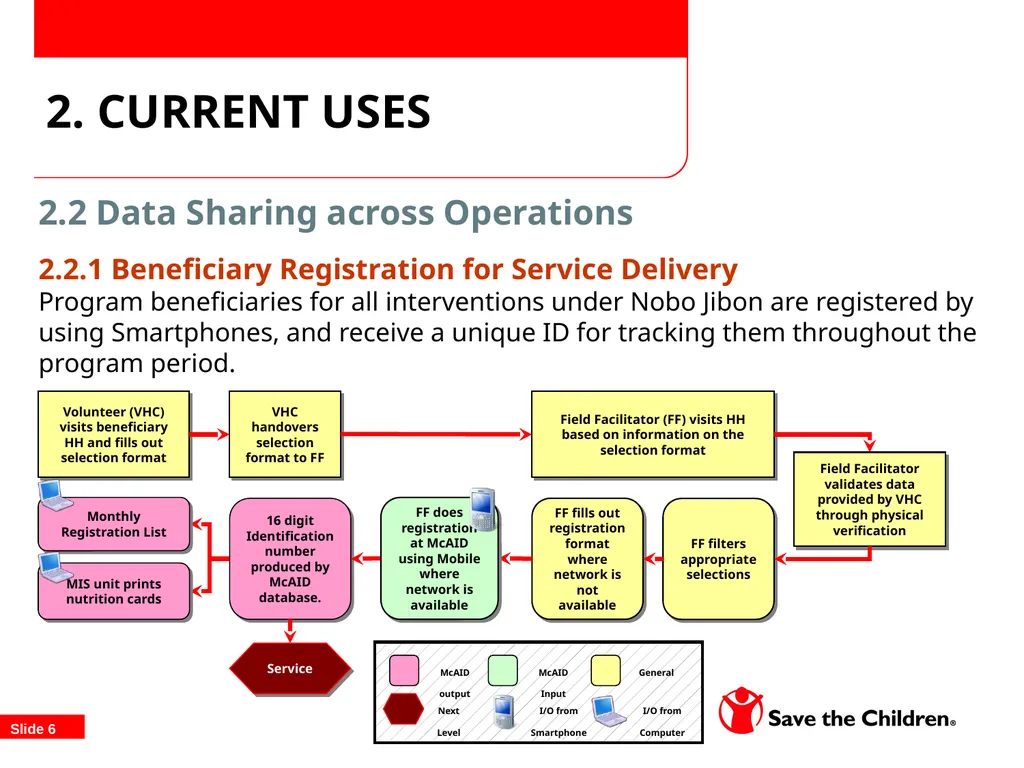
Slide 6 2. CURRENT USES 2.2 Data Sharing across Operations 2.2.1 Beneficiary Registration for Service Delivery
Program beneficiaries for all interventions under Nobo Jibon are registered by using Smartphones, and receive a unique ID for tracking them throughout the program period. Volunteer (VHC) visits beneficiary HH and fills out selection format FF fills out registration format where network is not available FF filters appropriate selections VHC handovers selection format to FF Field Facilitator (FF) visits HH based on information on the selection format Field Facilitator validates data provided by VHC through physical verification 16 digit Identification number produced by McAID database. Service<br>
Program beneficiaries for all interventions under Nobo Jibon are registered by using Smartphones, and receive a unique ID for tracking them throughout the program period. Volunteer (VHC) visits beneficiary HH and fills out selection format FF fills out registration format where network is not available FF filters appropriate selections VHC handovers selection format to FF Field Facilitator (FF) visits HH based on information on the selection format Field Facilitator validates data provided by VHC through physical verification 16 digit Identification number produced by McAID database. Service<br>
07
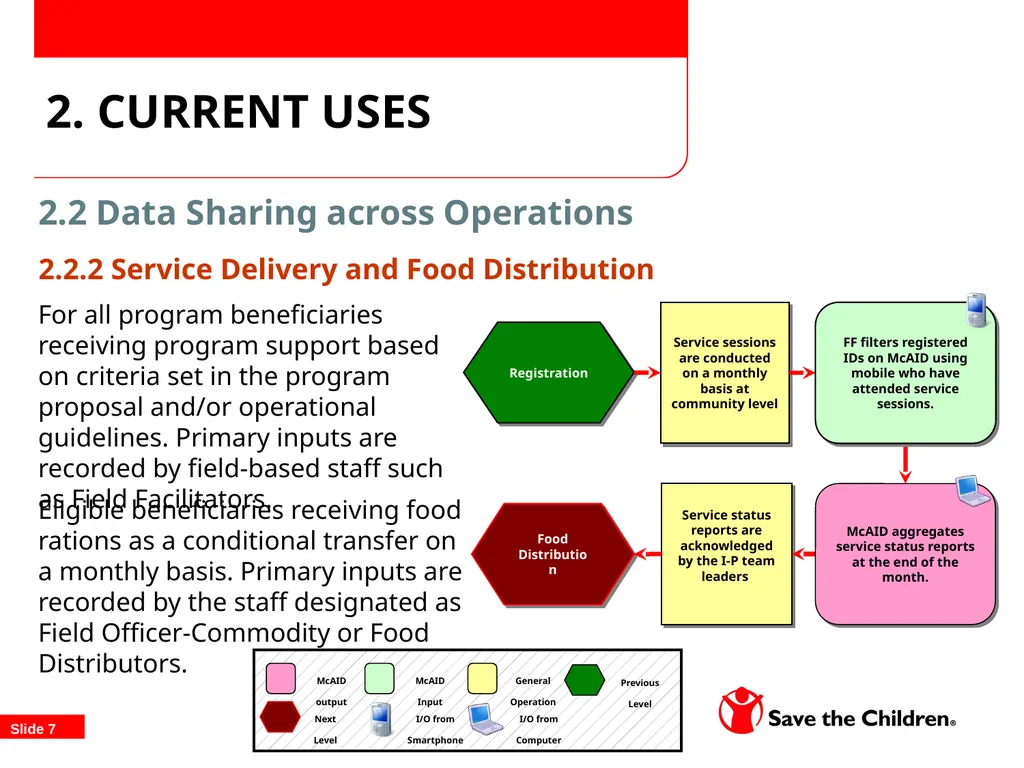
Slide 7 2. CURRENT USES 2.2 Data Sharing across Operations 2.2.2 Service Delivery and Food Distribution For all program beneficiaries receiving program support based on criteria set in the program proposal and/or operational guidelines. Primary inputs are recorded by field-based staff such as Field Facilitators. Eligible beneficiaries receiving food rations as a conditional transfer on a monthly basis. Primary inputs are recorded by the staff designated as Field Officer-Commodity or Food Distributors. Service sessions are conducted on a monthly basis at community level Service status reports are acknowledged by the I-P team leaders Registration Food Distribution<br>
08
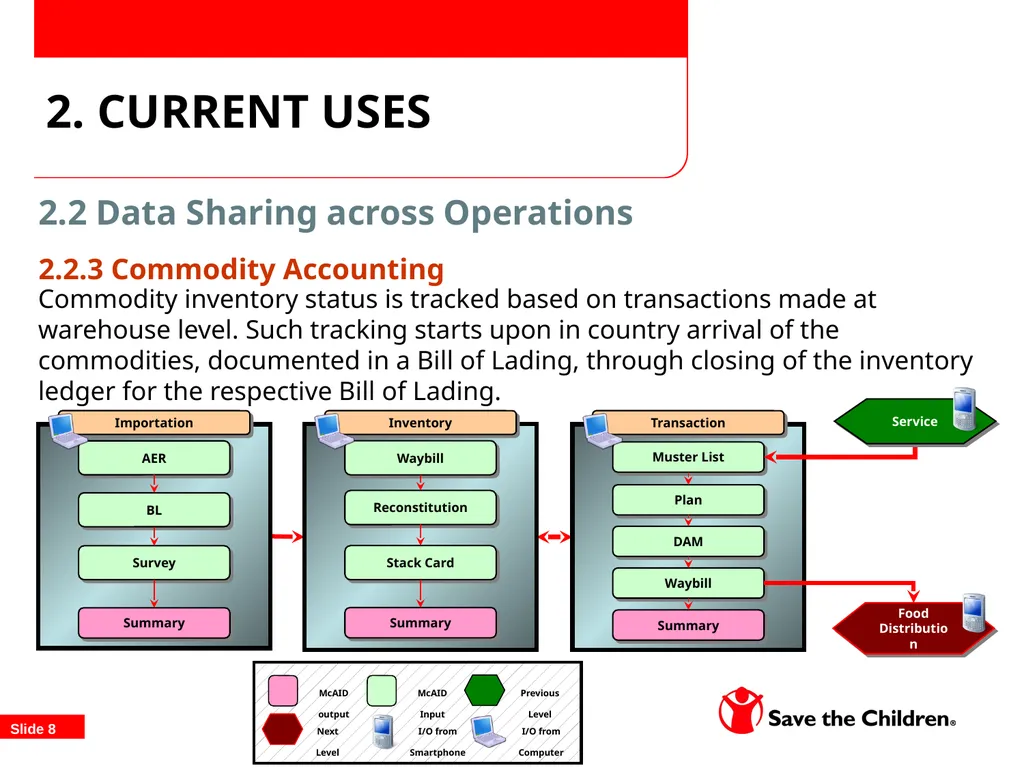
Slide 8 2. CURRENT USES 2.2 Data Sharing across Operations 2.2.3 Commodity Accounting Commodity inventory status is tracked based on transactions made at warehouse level. Such tracking starts upon in country arrival of the commodities, documented in a Bill of Lading, through closing of the inventory ledger for the respective Bill of Lading.<br>
09
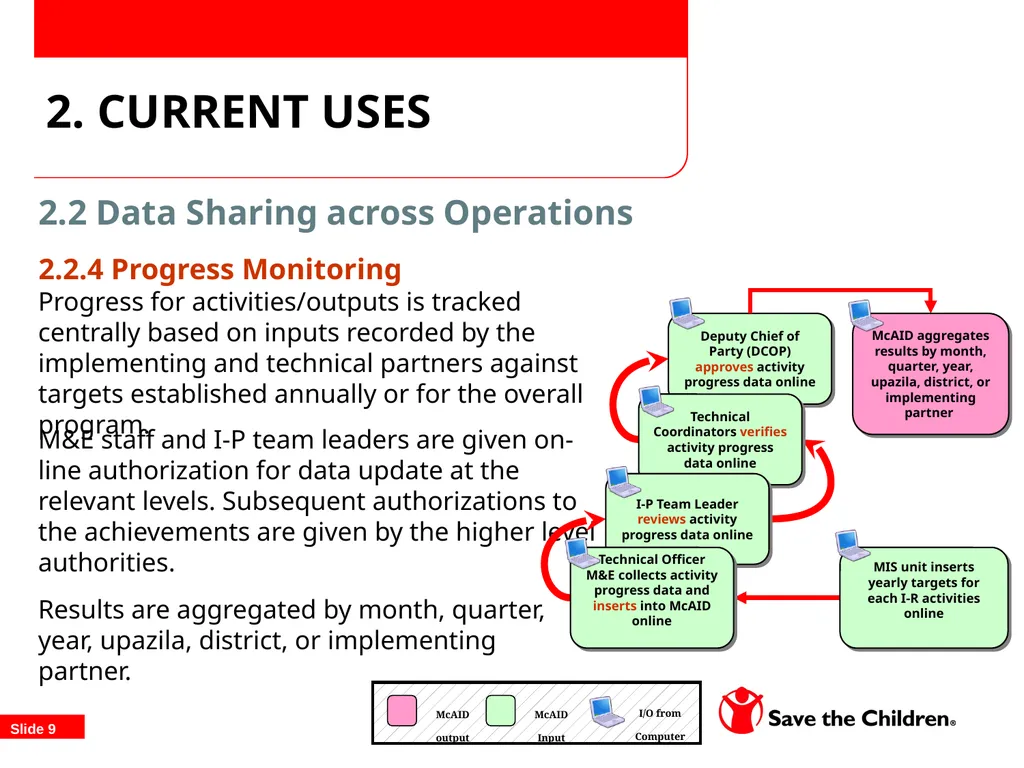
Slide 9 2. CURRENT USES 2.2 Data Sharing across Operations 2.2.4 Progress Monitoring Progress for activities/outputs is tracked centrally based on inputs recorded by the implementing and technical partners against targets established annually or for the overall program. M&E staff and I-P team leaders are given on-line authorization for data update at the relevant levels. Subsequent authorizations to the achievements are given by the higher level authorities. Results are aggregated by month, quarter, year, upazila, district, or implementing partner.<br>
10
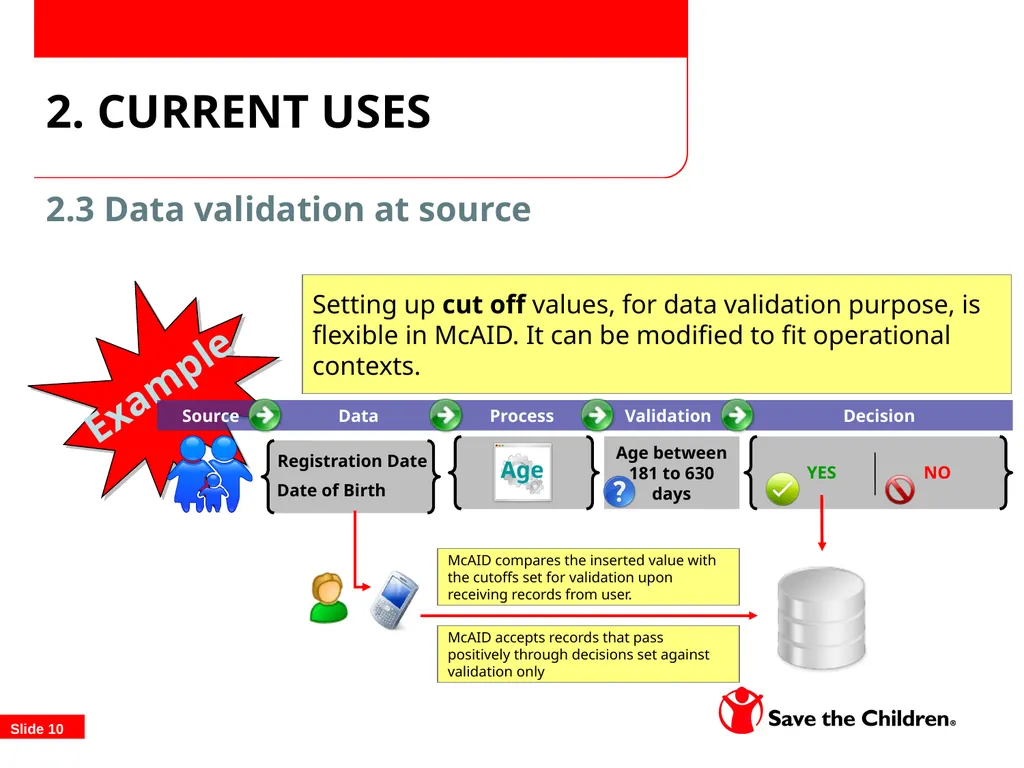
Slide 10 2. CURRENT USES Example Validation Process Decision 2.3 Data validation at source Data Setting up cut off values, for data validation purpose, is flexible in McAID. It can be modified to fit operational contexts. McAID compares the inserted value with the cutoffs set for validation upon receiving records from user. McAID accepts records that pass positively through decisions set against validation only<br>
11
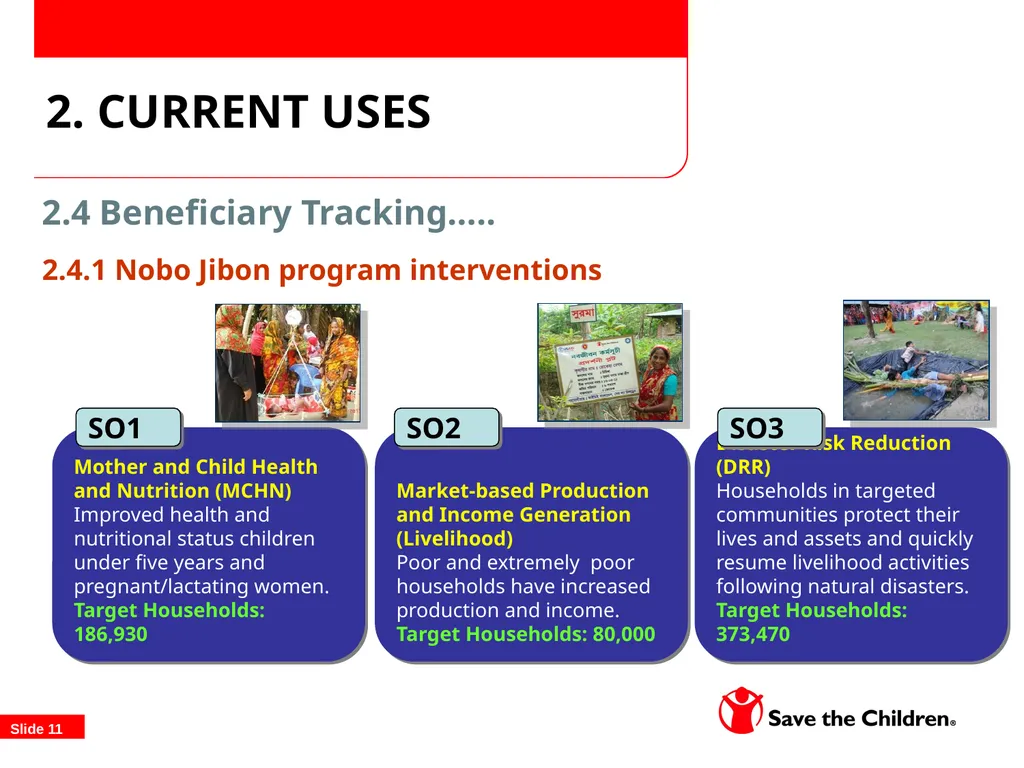
Slide 11 2. CURRENT USES 2.4 Beneficiary Tracking….. 2.4.1 Nobo Jibon program interventions<br>
12
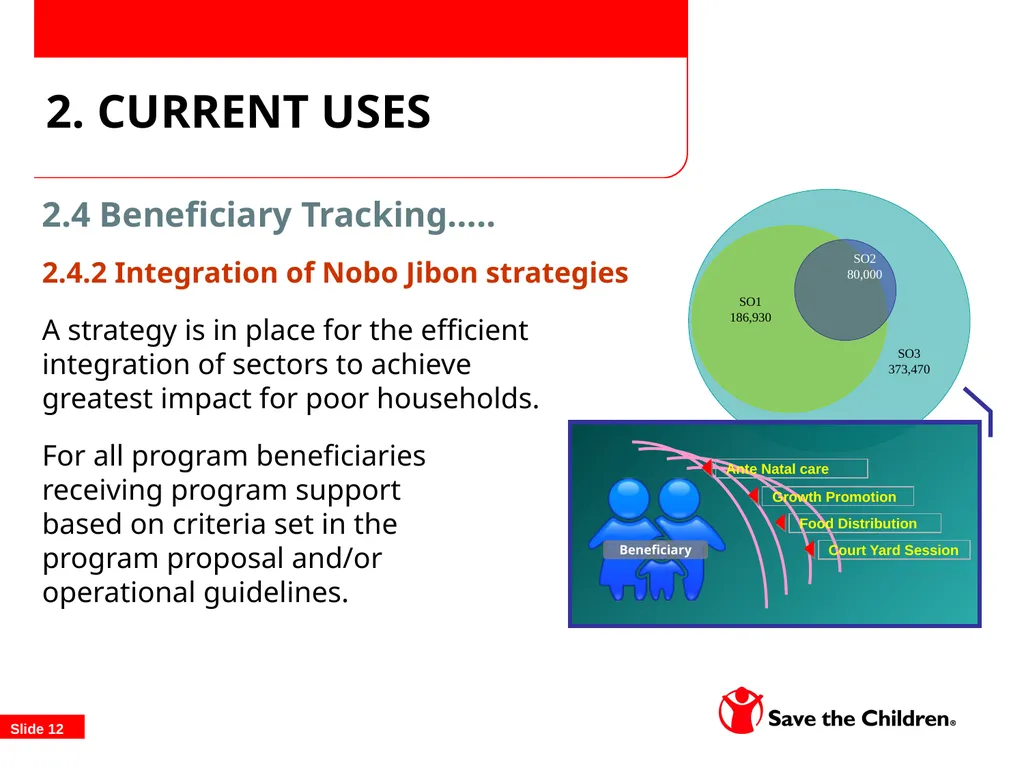
Slide 12 2. CURRENT USES 2.4 Beneficiary Tracking….. 2.4.2 Integration of Nobo Jibon strategies A strategy is in place for the efficient integration of sectors to achieve greatest impact for poor households. For all program beneficiaries receiving program support based on criteria set in the program proposal and/or operational guidelines.<br>
13
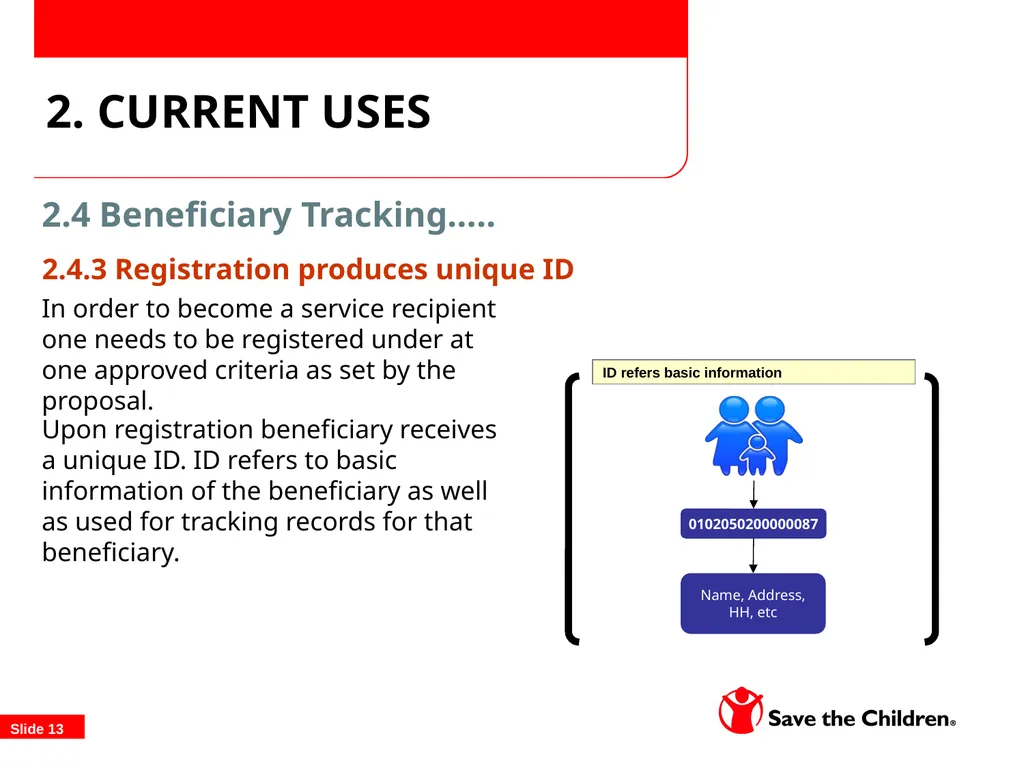
Slide 13 2. CURRENT USES 2.4 Beneficiary Tracking….. 2.4.3 Registration produces unique ID In order to become a service recipient one needs to be registered under at one approved criteria as set by the proposal. Upon registration beneficiary receives a unique ID. ID refers to basic information of the beneficiary as well as used for tracking records for that beneficiary.<br>
14
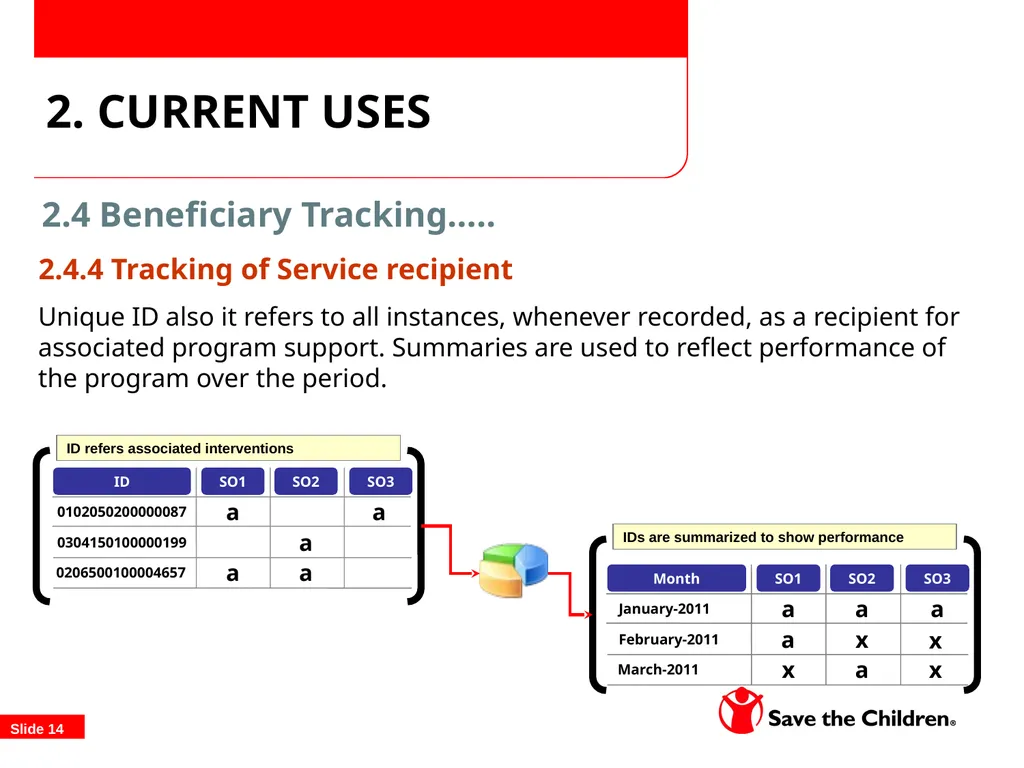
Slide 14 2. CURRENT USES 2.4 Beneficiary Tracking….. 2.4.4 Tracking of Service recipient Unique ID also it refers to all instances, whenever recorded, as a recipient for associated program support. Summaries are used to reflect performance of the program over the period.<br>
15
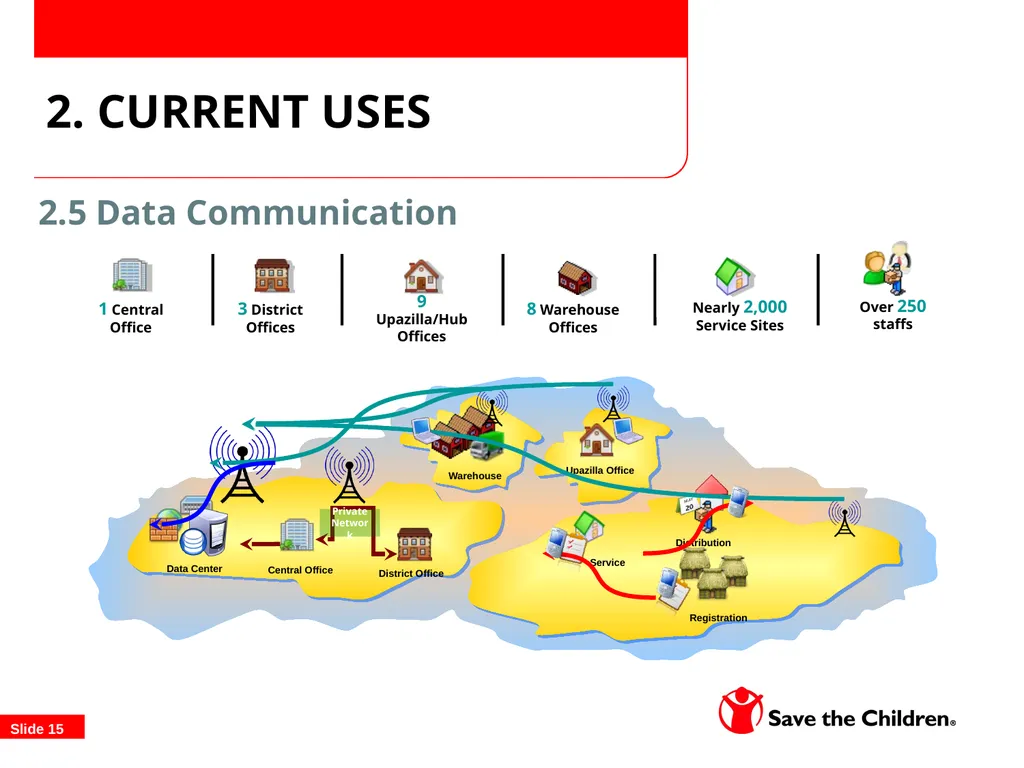
Slide 15 2. CURRENT USES 2.5 Data Communication<br>
16
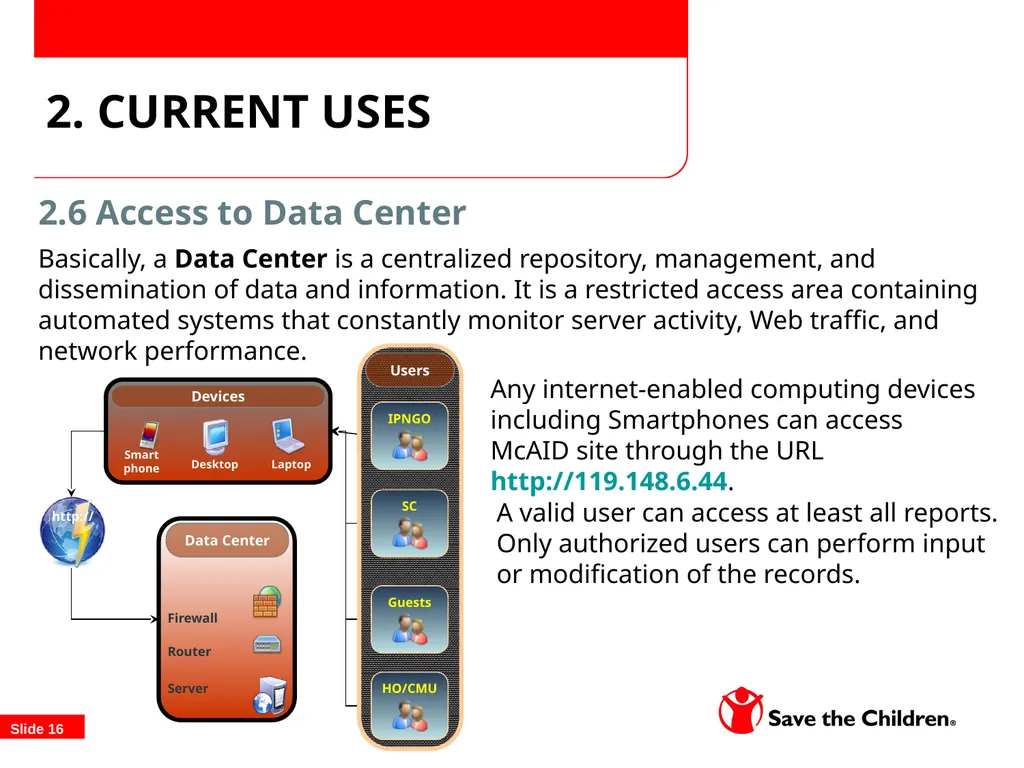
Slide 16 2. CURRENT USES 2.6 Access to Data Center A valid user can access at least all reports. Only authorized users can perform input or modification of the records. Any internet-enabled computing devices including Smartphones can access McAID site through the URL http://119.148.6.44. Basically, a Data Center is a centralized repository, management, and dissemination of data and information. It is a restricted access area containing automated systems that constantly monitor server activity, Web traffic, and network performance.<br>
17
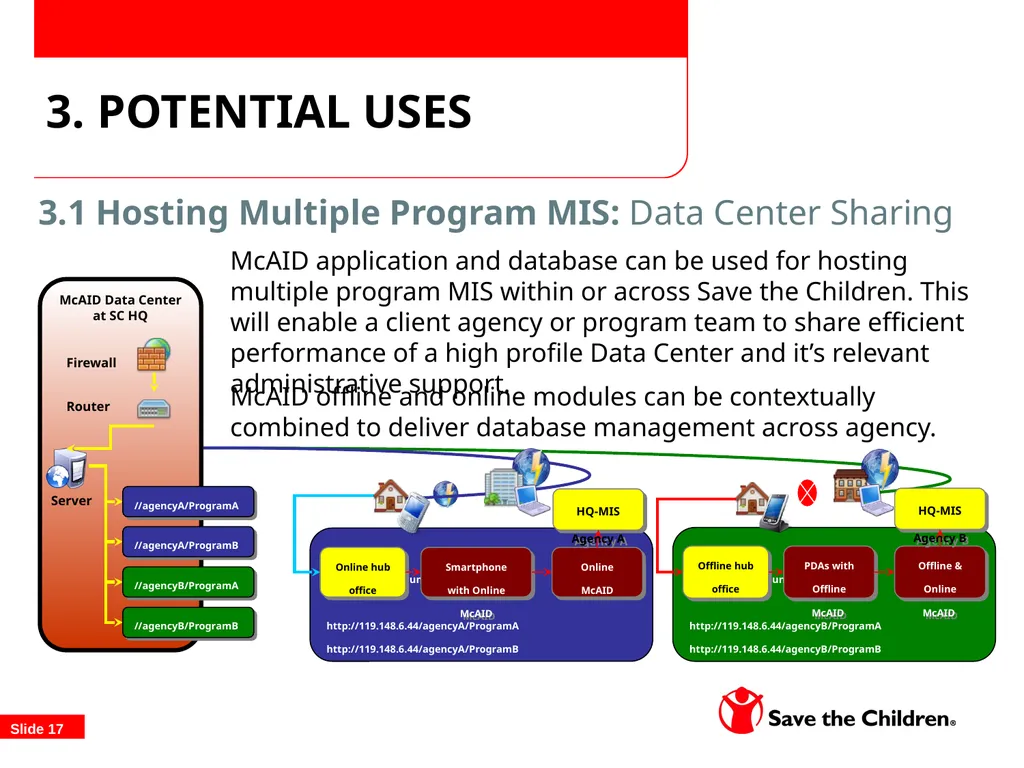
Slide 17 3. POTENTIAL USES 3.1 Hosting Multiple Program MIS: Data Center Sharing McAID application and database can be used for hosting multiple program MIS within or across Save the Children. This will enable a client agency or program team to share efficient performance of a high profile Data Center and it’s relevant administrative support. McAID offline and online modules can be contextually combined to deliver database management across agency. Agency A: Communication Protocol
http://119.148.6.44/agencyA/ProgramA
http://119.148.6.44/agencyA/ProgramB Online hub office Smartphone with Online McAID Online McAID HQ-MIS Agency A Agency B: Communication Protocol
http://119.148.6.44/agencyB/ProgramA
http://119.148.6.44/agencyB/ProgramB Offline hub office PDAs with Offline McAID Offline & Online McAID HQ-MIS Agency B<br>
http://119.148.6.44/agencyA/ProgramA
http://119.148.6.44/agencyA/ProgramB Online hub office Smartphone with Online McAID Online McAID HQ-MIS Agency A Agency B: Communication Protocol
http://119.148.6.44/agencyB/ProgramA
http://119.148.6.44/agencyB/ProgramB Offline hub office PDAs with Offline McAID Offline & Online McAID HQ-MIS Agency B<br>
18
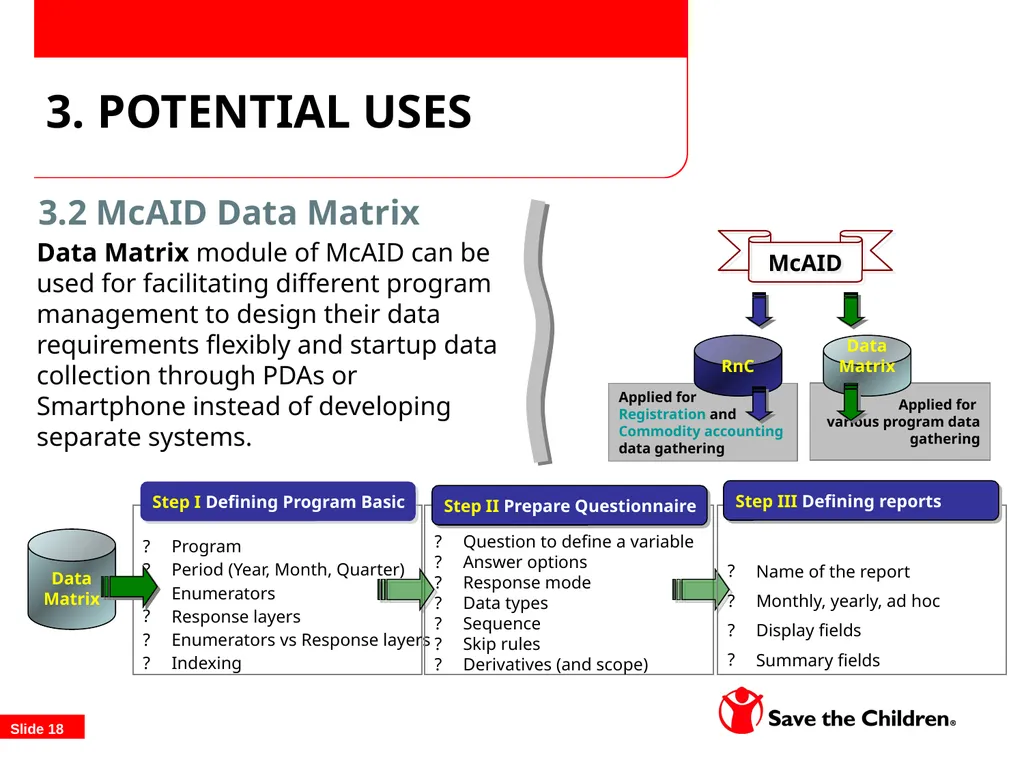
Slide 18 3. POTENTIAL USES 3.2 McAID Data Matrix Data Matrix module of McAID can be used for facilitating different program management to design their data requirements flexibly and startup data collection through PDAs or Smartphone instead of developing separate systems. Data Matrix<br>
19
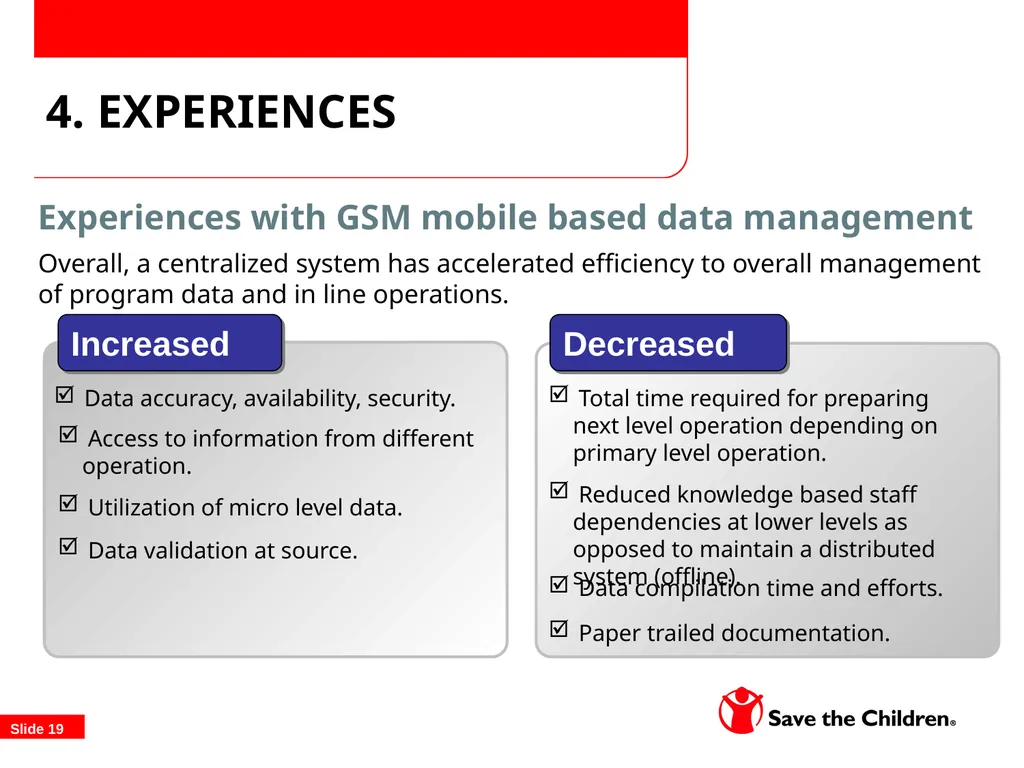
Slide 19 4. EXPERIENCES Experiences with GSM mobile based data management Data accuracy, availability, security. Access to information from different operation. Utilization of micro level data. Data validation at source. Overall, a centralized system has accelerated efficiency to overall management of program data and in line operations. Total time required for preparing next level operation depending on primary level operation. Data compilation time and efforts. Paper trailed documentation. Reduced knowledge based staff dependencies at lower levels as opposed to maintain a distributed system (offline).<br>
20
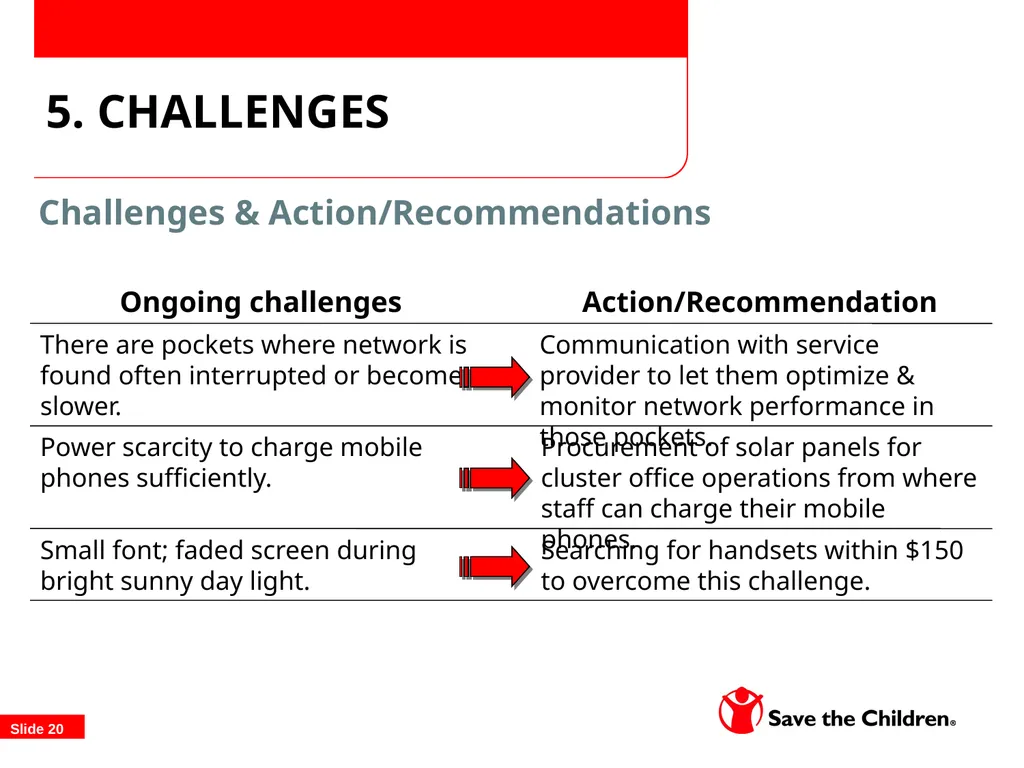
Slide 20 5. CHALLENGES Challenges & Action/Recommendations There are pockets where network is found often interrupted or become slower. Communication with service provider to let them optimize & monitor network performance in those pockets. Ongoing challenges Action/Recommendation Power scarcity to charge mobile phones sufficiently. Procurement of solar panels for cluster office operations from where staff can charge their mobile phones. Small font; faded screen during bright sunny day light. Searching for handsets within $150 to overcome this challenge.<br>
21
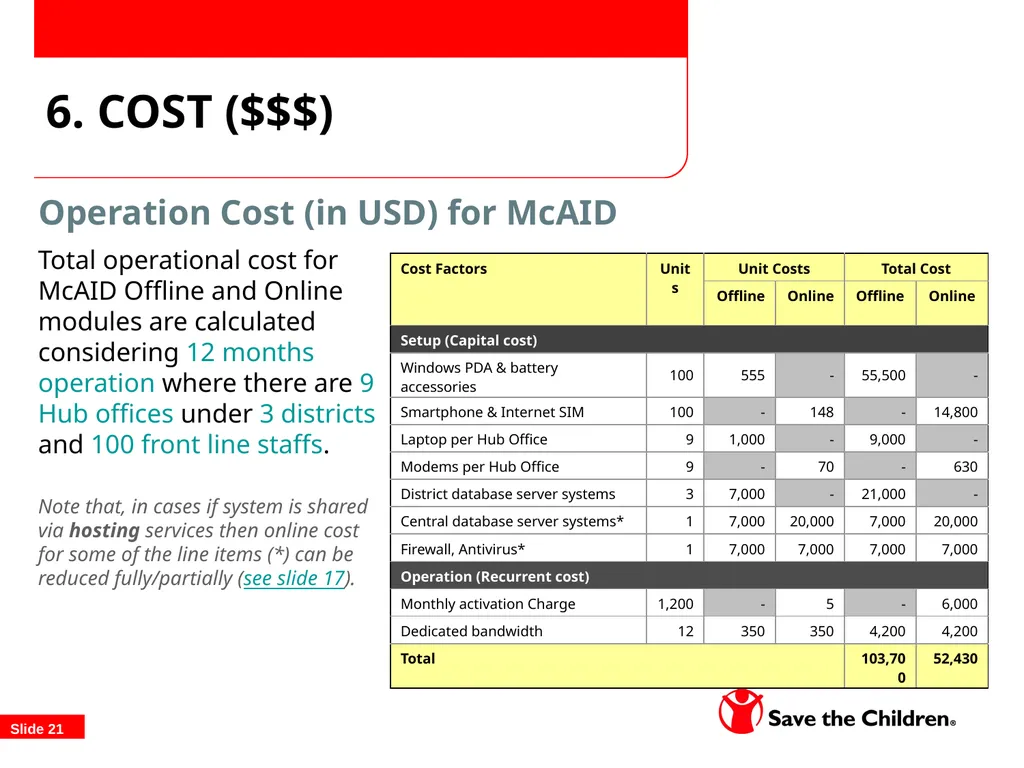
Slide 21 6. COST ($$$) Operation Cost (in USD) for McAID Total operational cost for McAID Offline and Online modules are calculated considering 12 months operation where there are 9 Hub offices under 3 districts and 100 front line staffs. Note that, in cases if system is shared via hosting services then online cost for some of the line items (*) can be reduced fully/partially (see slide 17).<br>
22
Slide 22 THANK YOU……<br>