
Towards a measurement framework for data 1 Erich

Description: Towards a measurement framework for data 1 Erich H. Strassner James Tebrake digitalization has led statistical agencies to underestimate investment, particularly in intangibles. A consequence is that central banks are working with
Related Topics
Download Presentation
"Towards a measurement framework for data 1 Erich" is the property of its rightful owner. Permission is granted to download and print the materials on this website for personal, non-commercial use only, and to display it on your personal computer provided you do not modify the materials and that you retain all copyright notices contained in the materials. By downloading content from our website, you accept the terms of this agreement.
Presentation Transcript
slide1. Towards a measurement framework for data 1 Erich H. Strassner
James Tebrake<br>
slide2. “digitalization has led statistical agencies to underestimate investment, particularly in intangibles. A consequence is that central banks are working with estimates of potential output today that may be revised up in the future. The recent historical revisions to US GDP data, which improved the measurement of investment in intangibles such as software, indicate that this could be important. A similar exercise in Canada has delivered a large upward revision in investment, and, hence, potential output, beginning in 2014. This makes one wonder about what revisions may be forthcoming for 2015, 2016 and, of course, today.” A worrisome quote from the Governor of the Bank of Canada 2 Stephen Poloz – The Fourth Industrial Revolution and Central Banking
Jackson Hole, Wyoming.<br>
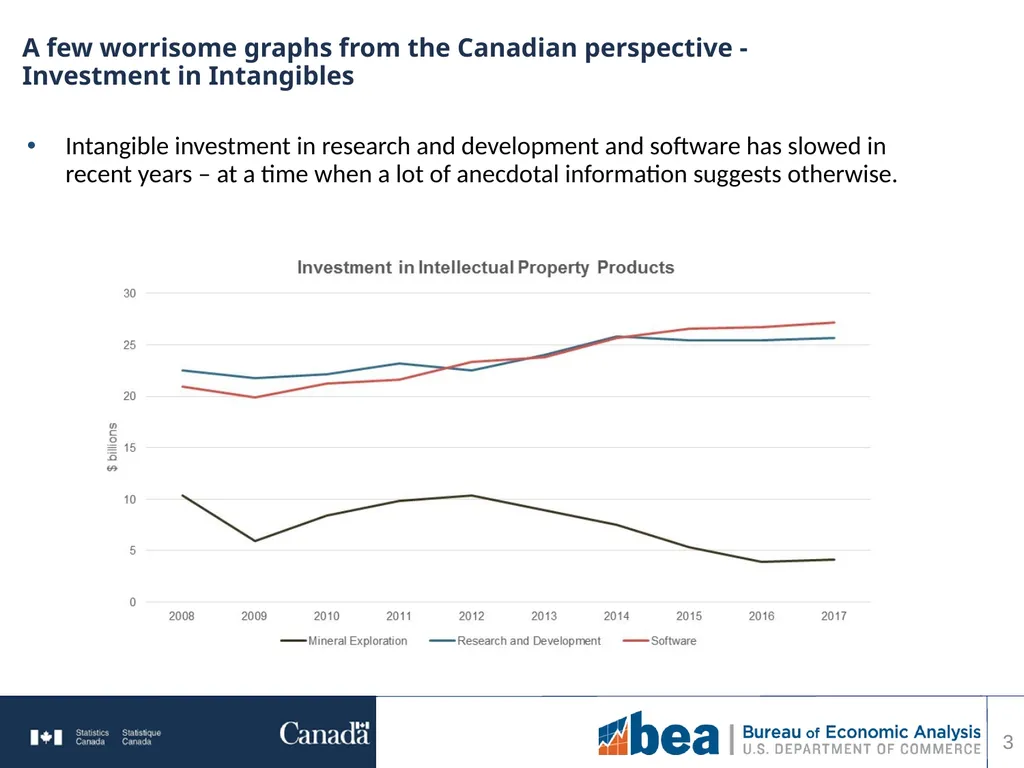
slide3. Intangible investment in research and development and software has slowed in recent years – at a time when a lot of anecdotal information suggests otherwise. A few worrisome graphs from the Canadian perspective - Investment in Intangibles 3<br>
slide4. The growth in investment in software has been significantly outpaced by the growth in data in recent years. A few worrisome graphs from the Canadian perspective - Investment in Intangibles 4<br>
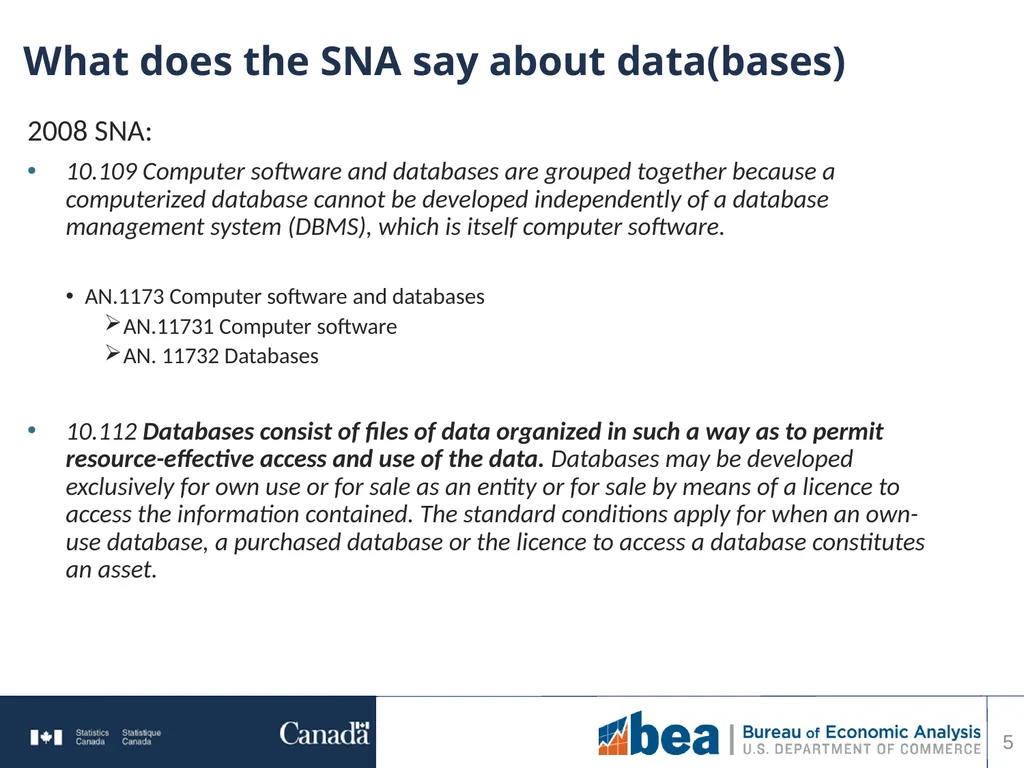
slide5. 2008 SNA:
10.109 Computer software and databases are grouped together because a computerized database cannot be developed independently of a database management system (DBMS), which is itself computer software.
AN.1173 Computer software and databases
AN.11731 Computer software
AN. 11732 Databases
10.112 Databases consist of files of data organized in such a way as to permit resource-effective access and use of the data. Databases may be developed exclusively for own use or for sale as an entity or for sale by means of a licence to access the information contained. The standard conditions apply for when an own-use database, a purchased database or the licence to access a database constitutes an asset. What does the SNA say about data(bases) 5<br>
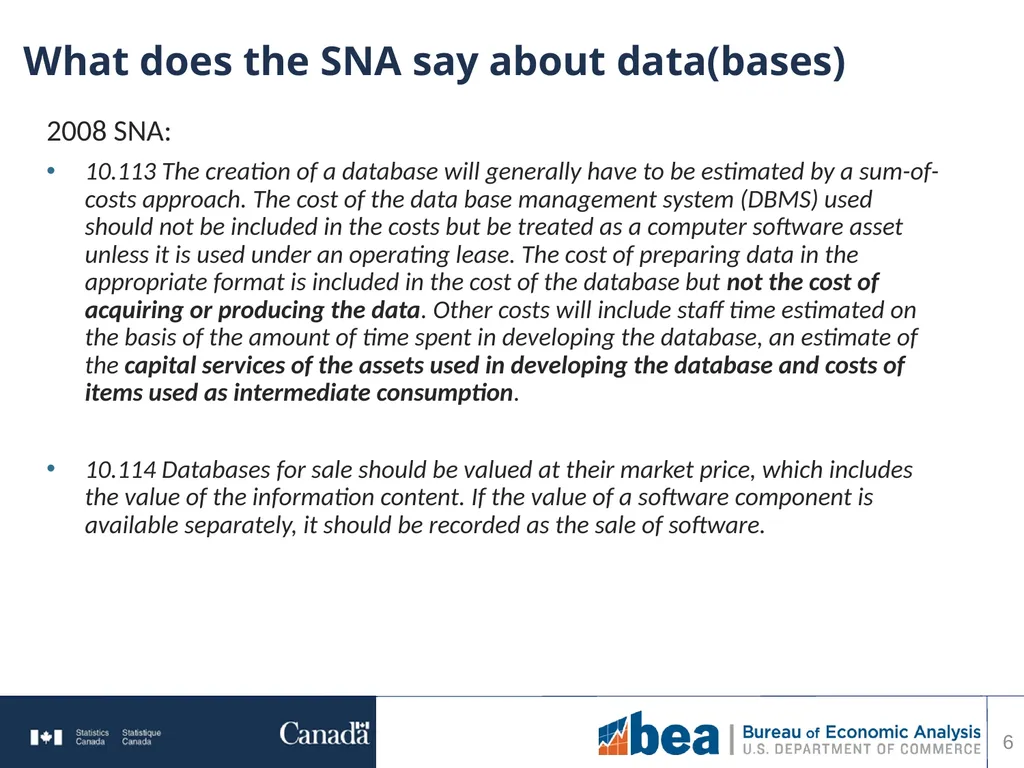
slide6. 2008 SNA:
10.113 The creation of a database will generally have to be estimated by a sum-of-costs approach. The cost of the data base management system (DBMS) used should not be included in the costs but be treated as a computer software asset unless it is used under an operating lease. The cost of preparing data in the appropriate format is included in the cost of the database but not the cost of acquiring or producing the data. Other costs will include staff time estimated on the basis of the amount of time spent in developing the database, an estimate of the capital services of the assets used in developing the database and costs of items used as intermediate consumption.
10.114 Databases for sale should be valued at their market price, which includes the value of the information content. If the value of a software component is available separately, it should be recorded as the sale of software. What does the SNA say about data(bases) 6<br>
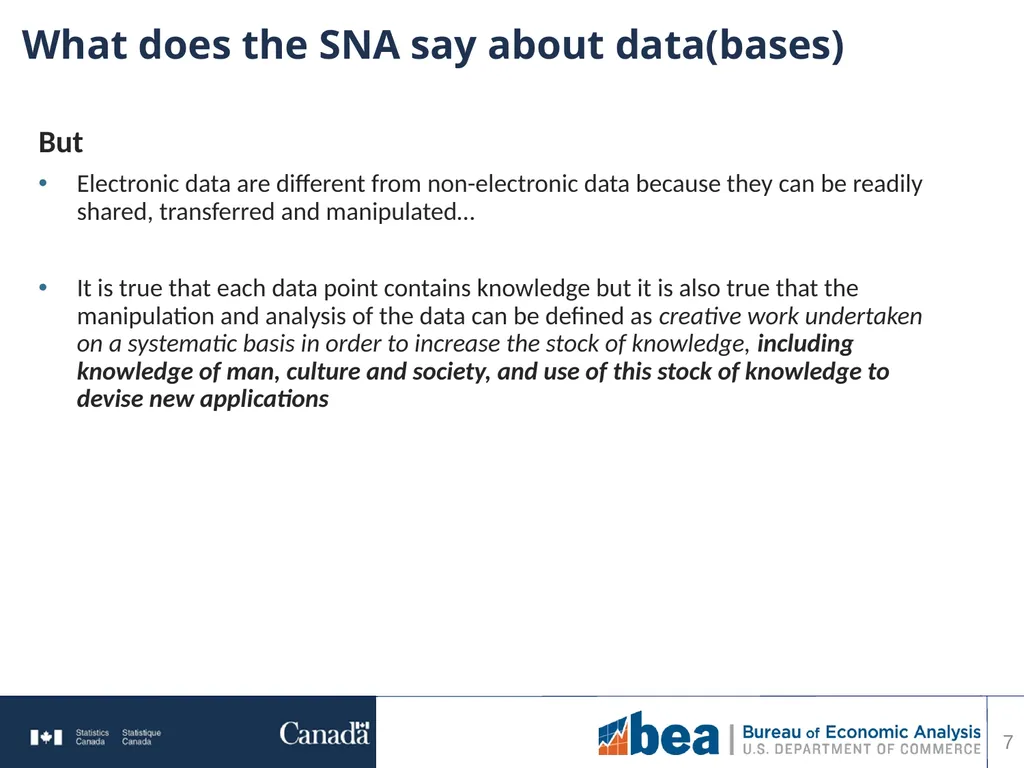
slide7. But
Electronic data are different from non-electronic data because they can be readily shared, transferred and manipulated…
It is true that each data point contains knowledge but it is also true that the manipulation and analysis of the data can be defined as creative work undertaken on a systematic basis in order to increase the stock of knowledge, including knowledge of man, culture and society, and use of this stock of knowledge to devise new applications What does the SNA say about data(bases) 7<br>
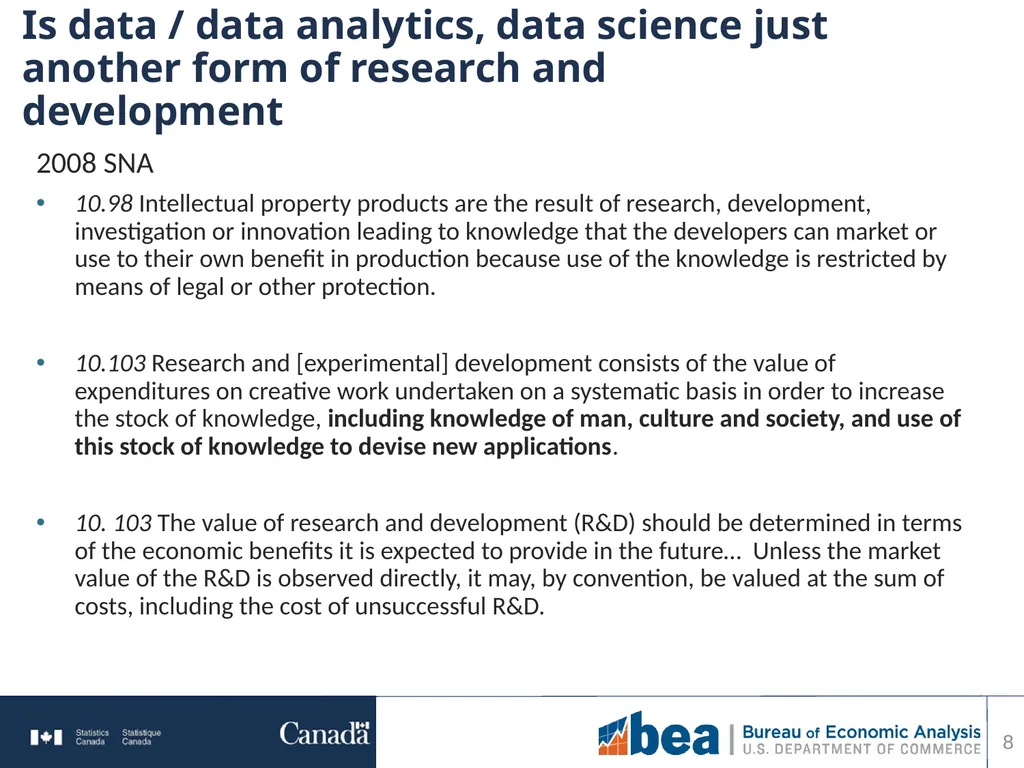
slide8. 2008 SNA
10.98 Intellectual property products are the result of research, development, investigation or innovation leading to knowledge that the developers can market or use to their own benefit in production because use of the knowledge is restricted by means of legal or other protection.
10.103 Research and [experimental] development consists of the value of expenditures on creative work undertaken on a systematic basis in order to increase the stock of knowledge, including knowledge of man, culture and society, and use of this stock of knowledge to devise new applications.
10. 103 The value of research and development (R&D) should be determined in terms of the economic benefits it is expected to provide in the future… Unless the market value of the R&D is observed directly, it may, by convention, be valued at the sum of costs, including the cost of unsuccessful R&D. Is data / data analytics, data science just another form of research and development 8<br>
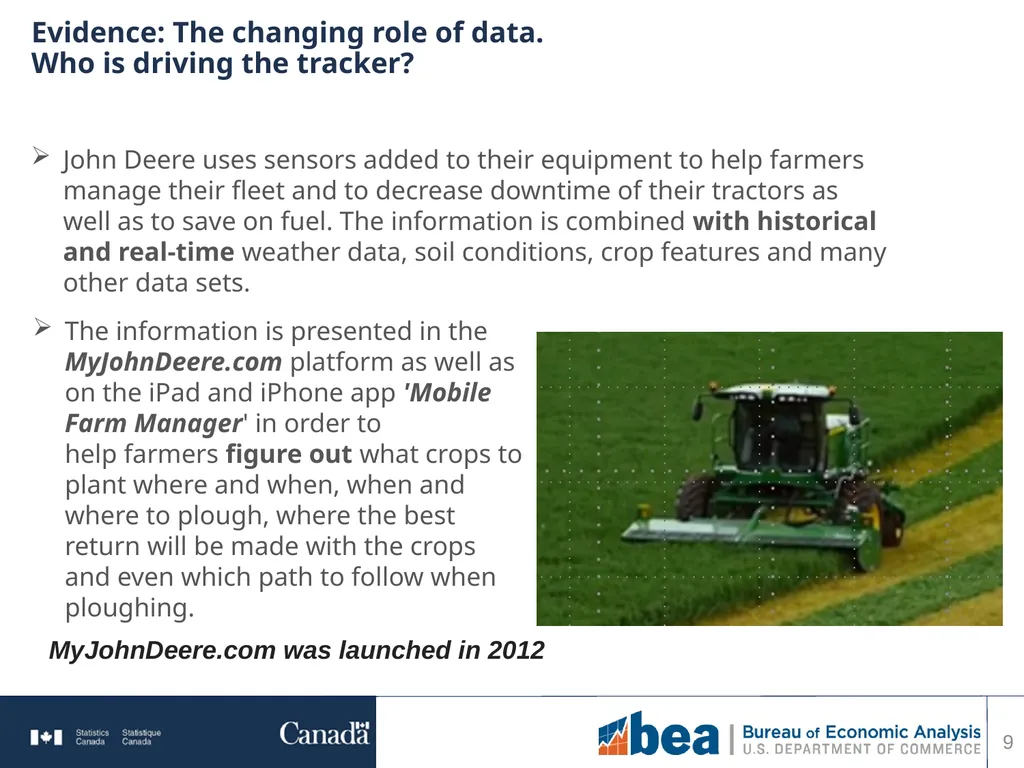
slide9. Evidence: The changing role of data. Who is driving the tracker? John Deere uses sensors added to their equipment to help farmers manage their fleet and to decrease downtime of their tractors as well as to save on fuel. The information is combined with historical and real-time weather data, soil conditions, crop features and many other data sets. The information is presented in the MyJohnDeere.com platform as well as on the iPad and iPhone app 'Mobile Farm Manager' in order to help farmers figure out what crops to plant where and when, when and where to plough, where the best return will be made with the crops and even which path to follow when ploughing. MyJohnDeere.com was launched in 2012 9<br>
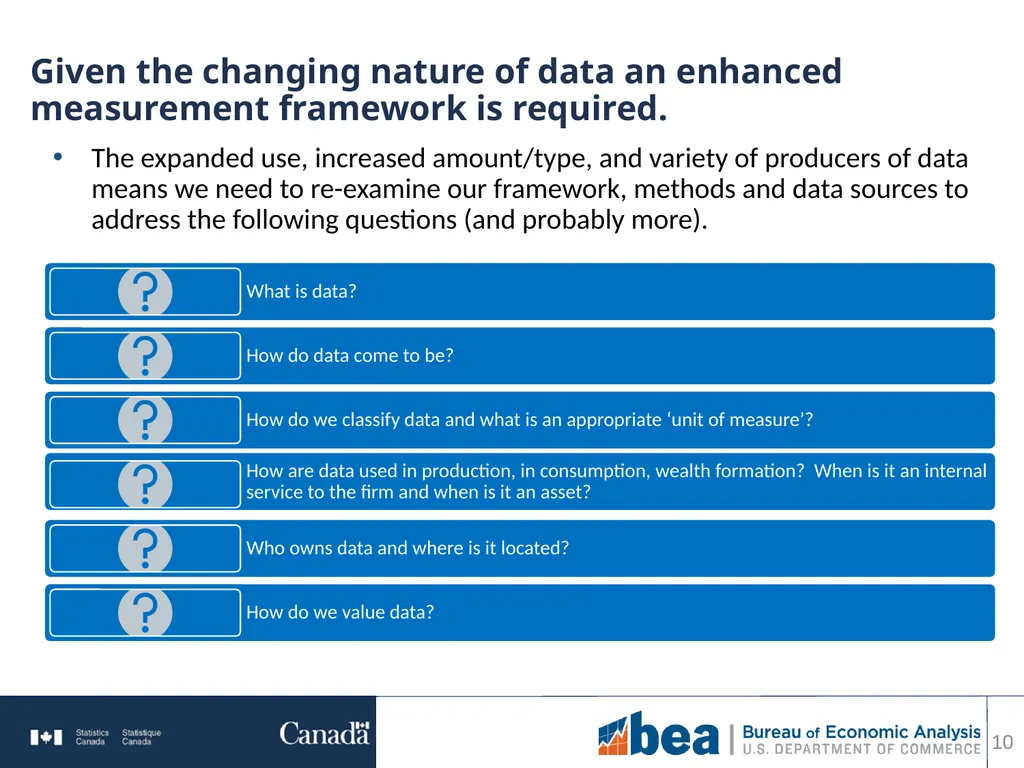
slide10. The expanded use, increased amount/type, and variety of producers of data means we need to re-examine our framework, methods and data sources to address the following questions (and probably more). Given the changing nature of data an enhanced measurement framework is required. 10<br>
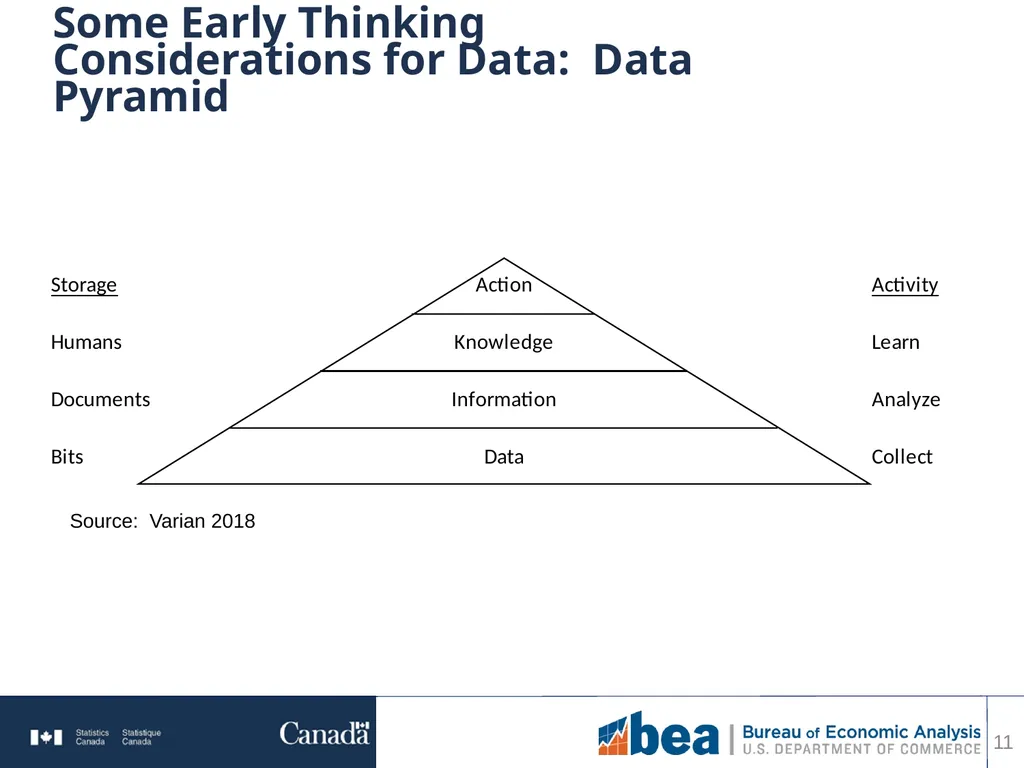
slide11. 11 Some Early Thinking Considerations for Data: Data Pyramid Source: Varian 2018<br>
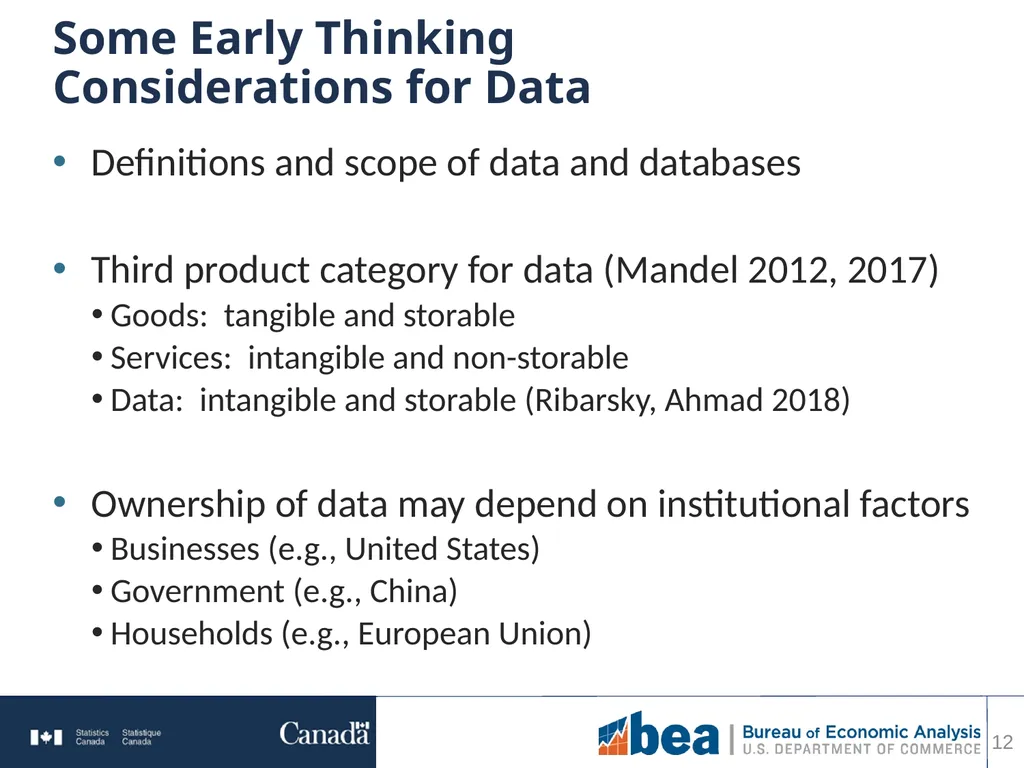
slide12. 12 Some Early Thinking Considerations for Data Definitions and scope of data and databases
Third product category for data (Mandel 2012, 2017)
Goods: tangible and storable
Services: intangible and non-storable
Data: intangible and storable (Ribarsky, Ahmad 2018)
Ownership of data may depend on institutional factors
Businesses (e.g., United States)
Government (e.g., China)
Households (e.g., European Union)<br>
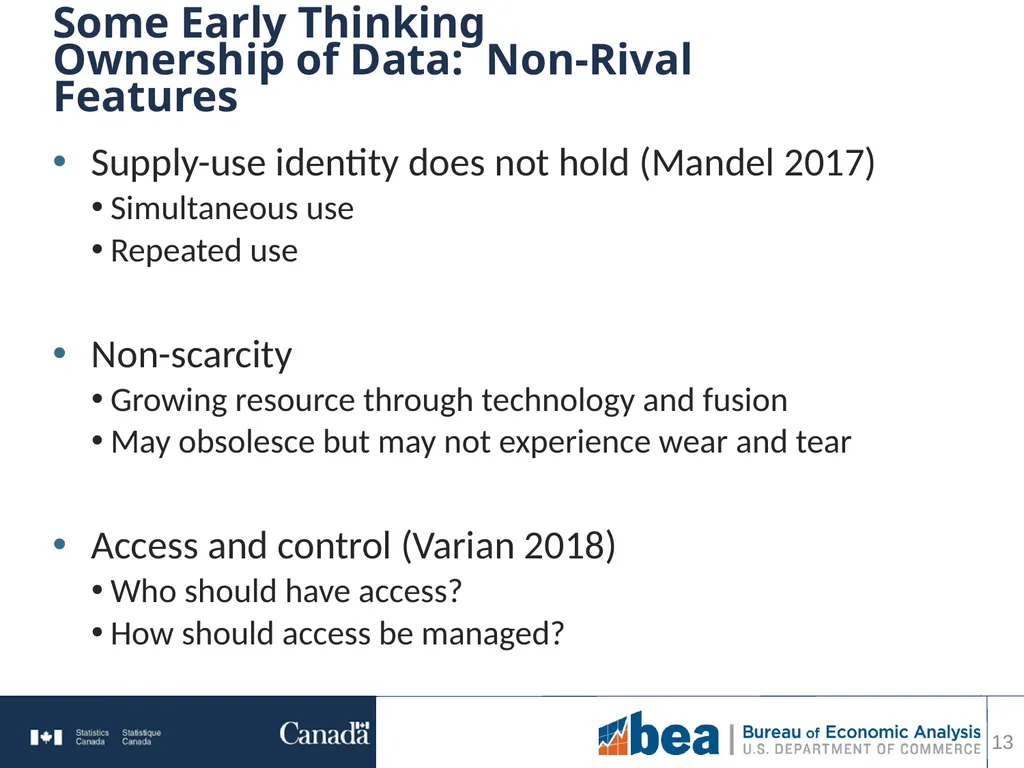
slide13. 13 Some Early Thinking Ownership of Data: Non-Rival Features Supply-use identity does not hold (Mandel 2017)
Simultaneous use
Repeated use
Non-scarcity
Growing resource through technology and fusion
May obsolesce but may not experience wear and tear
Access and control (Varian 2018)
Who should have access?
How should access be managed?<br>
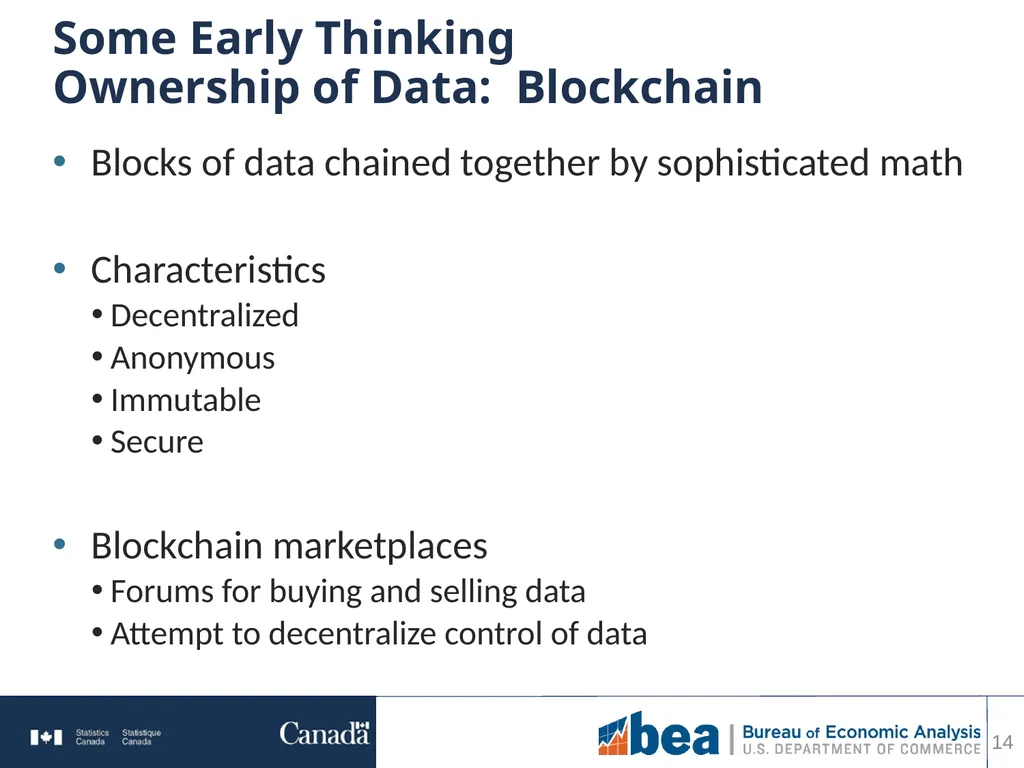
slide14. 14 Some Early Thinking Ownership of Data: Blockchain Blocks of data chained together by sophisticated math
Characteristics
Decentralized
Anonymous
Immutable
Secure
Blockchain marketplaces
Forums for buying and selling data
Attempt to decentralize control of data<br>
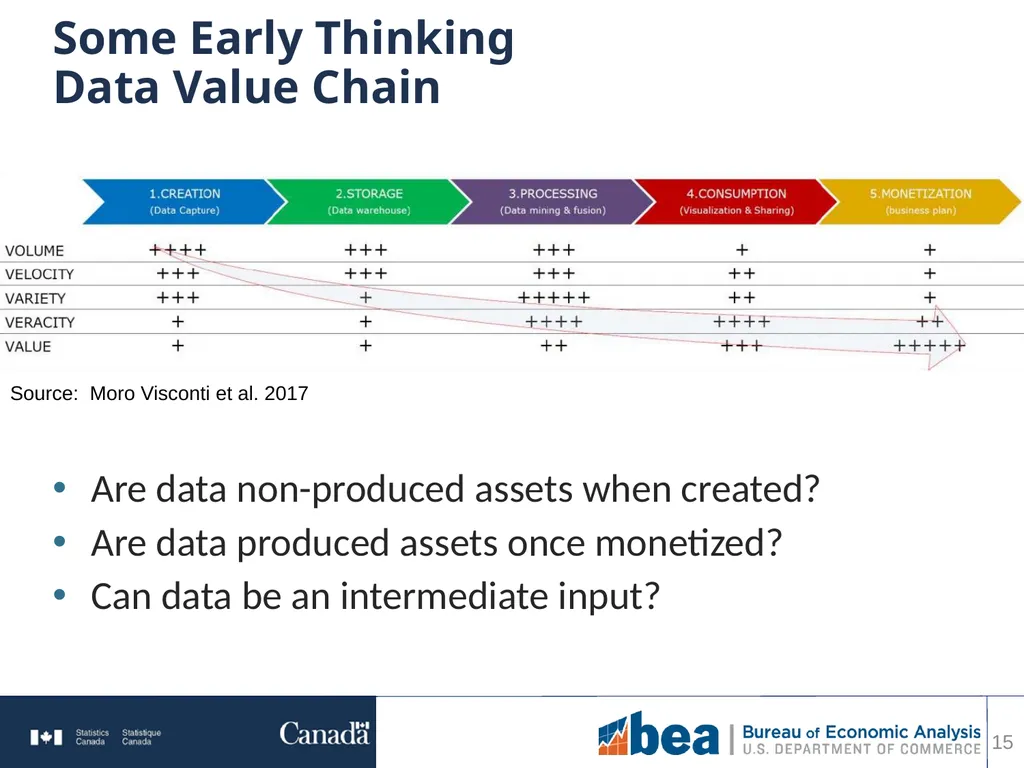
slide15. 15 Some Early Thinking Data Value Chain Are data non-produced assets when created?
Are data produced assets once monetized?
Can data be an intermediate input? Source: Moro Visconti et al. 2017<br>
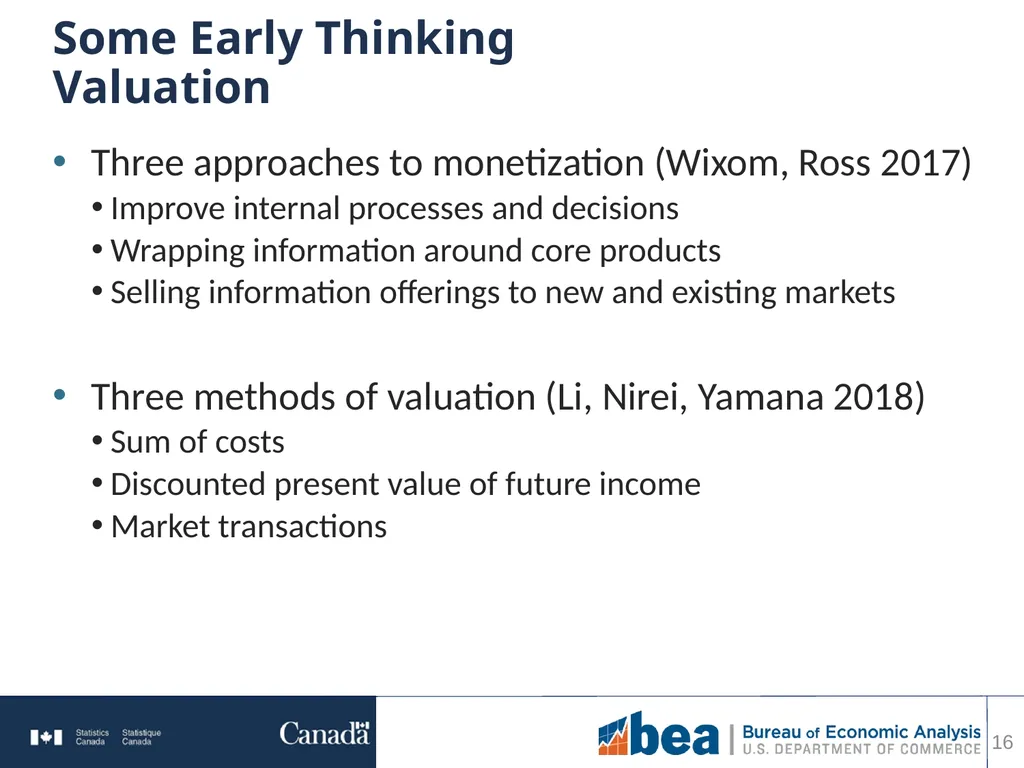
slide16. 16 Some Early Thinking Valuation Three approaches to monetization (Wixom, Ross 2017)
Improve internal processes and decisions
Wrapping information around core products
Selling information offerings to new and existing markets
Three methods of valuation (Li, Nirei, Yamana 2018)
Sum of costs
Discounted present value of future income
Market transactions<br>
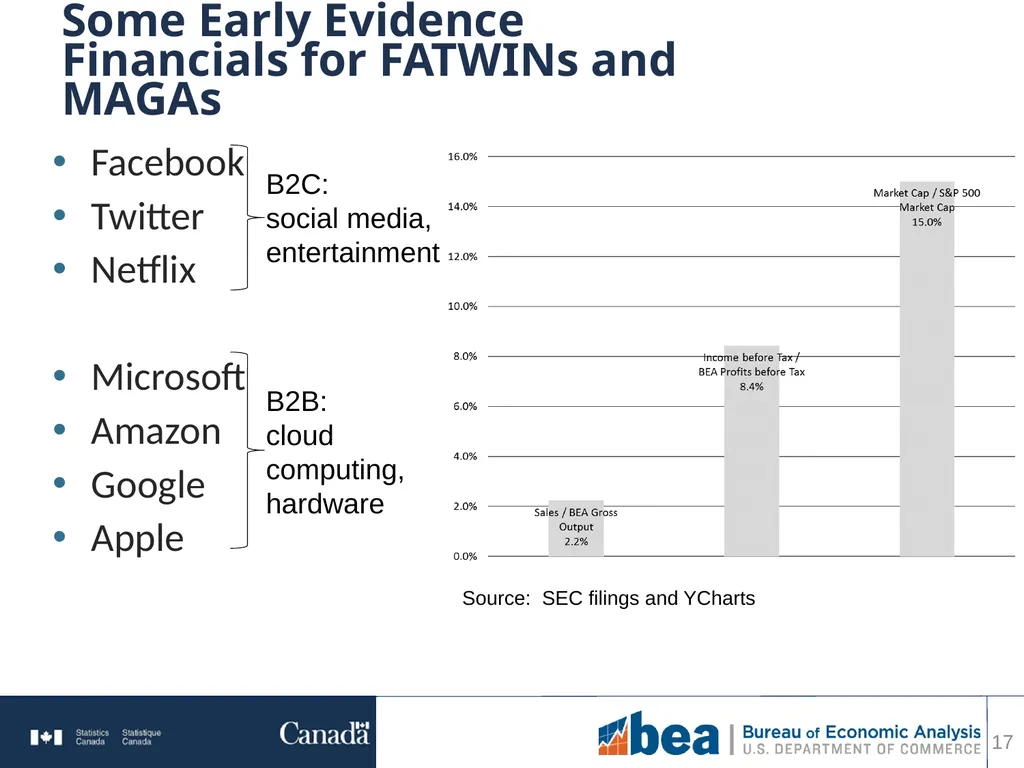
slide17. 17 Some Early Evidence Financials for FATWINs and MAGAs Facebook
Twitter
Netflix
Microsoft
Amazon
Google
Apple Source: SEC filings and YCharts B2C:
social media,
entertainment B2B:
cloud computing,
hardware<br>
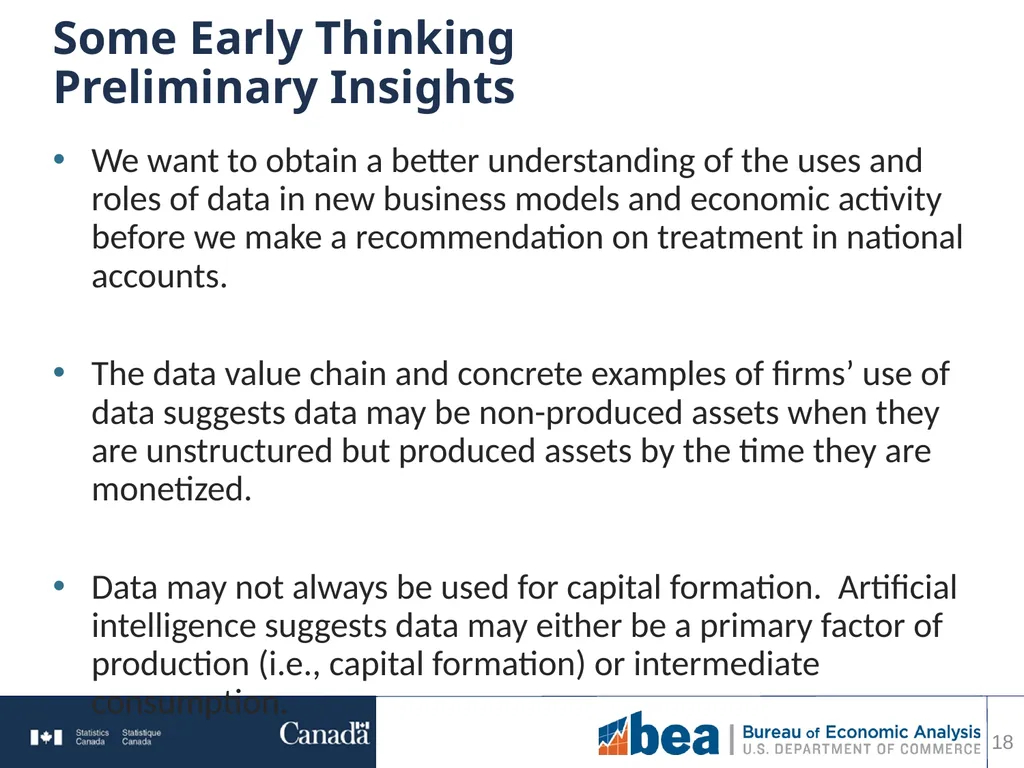
slide18. 18 Some Early Thinking Preliminary Insights We want to obtain a better understanding of the uses and roles of data in new business models and economic activity before we make a recommendation on treatment in national accounts.
The data value chain and concrete examples of firms’ use of data suggests data may be non-produced assets when they are unstructured but produced assets by the time they are monetized.
Data may not always be used for capital formation. Artificial intelligence suggests data may either be a primary factor of production (i.e., capital formation) or intermediate consumption.<br>
slide19. 19 THANK YOU! For more information, please visit
www.statcan.gc.ca
www.bea.gov
#StatCan100<br>
slide20. 20 References Ahmad, Nadim. 2004. “The Measurement of Databases in the National Accounts.” Issue paper prepared for the December 2004 Meeting of the Advisory Expert Group on National Accounts.
Ahmad, Nadim. 2005. “Follow-Up to the Measurement of Databases in the National Accounts.” Issue paper prepared for the July 2005 SNA Update Issue 12.
Ahmad, Nadim and Paul Schreyer. 2016. “Measuring GDP in a Digitalized Economy.” OECD Statistics Working Paper 2016/07.
Li, Wendy, Makoto Nirei, and Kazufumi Yamana. 2018. “Value of Data: There is no such thing as a free lunch in the digital economy.” Paper prepared for the 2018 IP Statistics for Decision Makers Conference.
Mandel, Michael. 2012. “Beyond Goods and Services: The (Unmeasured) Rise of the Data-Driven Economy.” Policy Memo of the Progressive Policy Institute.
Mandel, Michael. 2017. “The Economic Impact of Data: Why Data is not Like Oil.” Paper of the Progressive Policy Institute.
Moro Visconti, Roberto, Alberto Larocca, and Michele Marconi. 2017. “Big Data-Driven Value Chains and Digital Platforms: From value co-creation to monetization,” in Big Data Analytics, Arun K. Somani and Ganesh Chandra Deka, eds., Chapter 16.
Nijmeijer, Henk. 2018. “Issue Paper on Databases.” Paper prepared for the Joint Eurostat-OECD Task Force on Land and Other Non-Financial Assets.
Ribarsky, Jennifer and Nadim Ahmad. “Towards a Framework for Measuring the Digital Economy.” Paper prepared for the 35th IARIW General Conference.
Varian, Hal. 2018. “Artificial Intelligence, Economics, and Industrial Organization.” National Bureau of Economic Research Working Paper 24839.
Wixom, Barbara H. and Jeanne W. Ross. 2017. “How to Monetize Your Data.” MITSloan Management Review, Spring Issue.<br>
James Tebrake<br>
slide2. “digitalization has led statistical agencies to underestimate investment, particularly in intangibles. A consequence is that central banks are working with estimates of potential output today that may be revised up in the future. The recent historical revisions to US GDP data, which improved the measurement of investment in intangibles such as software, indicate that this could be important. A similar exercise in Canada has delivered a large upward revision in investment, and, hence, potential output, beginning in 2014. This makes one wonder about what revisions may be forthcoming for 2015, 2016 and, of course, today.” A worrisome quote from the Governor of the Bank of Canada 2 Stephen Poloz – The Fourth Industrial Revolution and Central Banking
Jackson Hole, Wyoming.<br>
slide3. Intangible investment in research and development and software has slowed in recent years – at a time when a lot of anecdotal information suggests otherwise. A few worrisome graphs from the Canadian perspective - Investment in Intangibles 3<br>
slide4. The growth in investment in software has been significantly outpaced by the growth in data in recent years. A few worrisome graphs from the Canadian perspective - Investment in Intangibles 4<br>
slide5. 2008 SNA:
10.109 Computer software and databases are grouped together because a computerized database cannot be developed independently of a database management system (DBMS), which is itself computer software.
AN.1173 Computer software and databases
AN.11731 Computer software
AN. 11732 Databases
10.112 Databases consist of files of data organized in such a way as to permit resource-effective access and use of the data. Databases may be developed exclusively for own use or for sale as an entity or for sale by means of a licence to access the information contained. The standard conditions apply for when an own-use database, a purchased database or the licence to access a database constitutes an asset. What does the SNA say about data(bases) 5<br>
slide6. 2008 SNA:
10.113 The creation of a database will generally have to be estimated by a sum-of-costs approach. The cost of the data base management system (DBMS) used should not be included in the costs but be treated as a computer software asset unless it is used under an operating lease. The cost of preparing data in the appropriate format is included in the cost of the database but not the cost of acquiring or producing the data. Other costs will include staff time estimated on the basis of the amount of time spent in developing the database, an estimate of the capital services of the assets used in developing the database and costs of items used as intermediate consumption.
10.114 Databases for sale should be valued at their market price, which includes the value of the information content. If the value of a software component is available separately, it should be recorded as the sale of software. What does the SNA say about data(bases) 6<br>
slide7. But
Electronic data are different from non-electronic data because they can be readily shared, transferred and manipulated…
It is true that each data point contains knowledge but it is also true that the manipulation and analysis of the data can be defined as creative work undertaken on a systematic basis in order to increase the stock of knowledge, including knowledge of man, culture and society, and use of this stock of knowledge to devise new applications What does the SNA say about data(bases) 7<br>
slide8. 2008 SNA
10.98 Intellectual property products are the result of research, development, investigation or innovation leading to knowledge that the developers can market or use to their own benefit in production because use of the knowledge is restricted by means of legal or other protection.
10.103 Research and [experimental] development consists of the value of expenditures on creative work undertaken on a systematic basis in order to increase the stock of knowledge, including knowledge of man, culture and society, and use of this stock of knowledge to devise new applications.
10. 103 The value of research and development (R&D) should be determined in terms of the economic benefits it is expected to provide in the future… Unless the market value of the R&D is observed directly, it may, by convention, be valued at the sum of costs, including the cost of unsuccessful R&D. Is data / data analytics, data science just another form of research and development 8<br>
slide9. Evidence: The changing role of data. Who is driving the tracker? John Deere uses sensors added to their equipment to help farmers manage their fleet and to decrease downtime of their tractors as well as to save on fuel. The information is combined with historical and real-time weather data, soil conditions, crop features and many other data sets. The information is presented in the MyJohnDeere.com platform as well as on the iPad and iPhone app 'Mobile Farm Manager' in order to help farmers figure out what crops to plant where and when, when and where to plough, where the best return will be made with the crops and even which path to follow when ploughing. MyJohnDeere.com was launched in 2012 9<br>
slide10. The expanded use, increased amount/type, and variety of producers of data means we need to re-examine our framework, methods and data sources to address the following questions (and probably more). Given the changing nature of data an enhanced measurement framework is required. 10<br>
slide11. 11 Some Early Thinking Considerations for Data: Data Pyramid Source: Varian 2018<br>
slide12. 12 Some Early Thinking Considerations for Data Definitions and scope of data and databases
Third product category for data (Mandel 2012, 2017)
Goods: tangible and storable
Services: intangible and non-storable
Data: intangible and storable (Ribarsky, Ahmad 2018)
Ownership of data may depend on institutional factors
Businesses (e.g., United States)
Government (e.g., China)
Households (e.g., European Union)<br>
slide13. 13 Some Early Thinking Ownership of Data: Non-Rival Features Supply-use identity does not hold (Mandel 2017)
Simultaneous use
Repeated use
Non-scarcity
Growing resource through technology and fusion
May obsolesce but may not experience wear and tear
Access and control (Varian 2018)
Who should have access?
How should access be managed?<br>
slide14. 14 Some Early Thinking Ownership of Data: Blockchain Blocks of data chained together by sophisticated math
Characteristics
Decentralized
Anonymous
Immutable
Secure
Blockchain marketplaces
Forums for buying and selling data
Attempt to decentralize control of data<br>
slide15. 15 Some Early Thinking Data Value Chain Are data non-produced assets when created?
Are data produced assets once monetized?
Can data be an intermediate input? Source: Moro Visconti et al. 2017<br>
slide16. 16 Some Early Thinking Valuation Three approaches to monetization (Wixom, Ross 2017)
Improve internal processes and decisions
Wrapping information around core products
Selling information offerings to new and existing markets
Three methods of valuation (Li, Nirei, Yamana 2018)
Sum of costs
Discounted present value of future income
Market transactions<br>
slide17. 17 Some Early Evidence Financials for FATWINs and MAGAs Facebook
Netflix
Microsoft
Amazon
Apple Source: SEC filings and YCharts B2C:
social media,
entertainment B2B:
cloud computing,
hardware<br>
slide18. 18 Some Early Thinking Preliminary Insights We want to obtain a better understanding of the uses and roles of data in new business models and economic activity before we make a recommendation on treatment in national accounts.
The data value chain and concrete examples of firms’ use of data suggests data may be non-produced assets when they are unstructured but produced assets by the time they are monetized.
Data may not always be used for capital formation. Artificial intelligence suggests data may either be a primary factor of production (i.e., capital formation) or intermediate consumption.<br>
slide19. 19 THANK YOU! For more information, please visit
www.statcan.gc.ca
www.bea.gov
#StatCan100<br>
slide20. 20 References Ahmad, Nadim. 2004. “The Measurement of Databases in the National Accounts.” Issue paper prepared for the December 2004 Meeting of the Advisory Expert Group on National Accounts.
Ahmad, Nadim. 2005. “Follow-Up to the Measurement of Databases in the National Accounts.” Issue paper prepared for the July 2005 SNA Update Issue 12.
Ahmad, Nadim and Paul Schreyer. 2016. “Measuring GDP in a Digitalized Economy.” OECD Statistics Working Paper 2016/07.
Li, Wendy, Makoto Nirei, and Kazufumi Yamana. 2018. “Value of Data: There is no such thing as a free lunch in the digital economy.” Paper prepared for the 2018 IP Statistics for Decision Makers Conference.
Mandel, Michael. 2012. “Beyond Goods and Services: The (Unmeasured) Rise of the Data-Driven Economy.” Policy Memo of the Progressive Policy Institute.
Mandel, Michael. 2017. “The Economic Impact of Data: Why Data is not Like Oil.” Paper of the Progressive Policy Institute.
Moro Visconti, Roberto, Alberto Larocca, and Michele Marconi. 2017. “Big Data-Driven Value Chains and Digital Platforms: From value co-creation to monetization,” in Big Data Analytics, Arun K. Somani and Ganesh Chandra Deka, eds., Chapter 16.
Nijmeijer, Henk. 2018. “Issue Paper on Databases.” Paper prepared for the Joint Eurostat-OECD Task Force on Land and Other Non-Financial Assets.
Ribarsky, Jennifer and Nadim Ahmad. “Towards a Framework for Measuring the Digital Economy.” Paper prepared for the 35th IARIW General Conference.
Varian, Hal. 2018. “Artificial Intelligence, Economics, and Industrial Organization.” National Bureau of Economic Research Working Paper 24839.
Wixom, Barbara H. and Jeanne W. Ross. 2017. “How to Monetize Your Data.” MITSloan Management Review, Spring Issue.<br>