
Tower Hamlets Plan (2018-2023) Annual Review,
MY
Published · 18 slides · 0 views
1 / 1

Description
Tower Hamlets Plan (2018-2023) Annual Review, 2022-23 July 2023 Tower Hamlets Plan Annual Review April 2022 March 2023 Contents Introduction 3-4 Partnership Executive Group 5 A better deal for children and young people 6 Good jobs and
Related Topics
Share
Embed code
Download this presentation From Below
"Tower Hamlets Plan (2018-2023) Annual Review," is the property of its rightful owner. Permission is granted to download and print the materials on this website for personal, non-commercial use only, and to display it on your personal computer provided you do not modify the materials and that you retain all copyright notices contained in the materials. By downloading content from our website, you accept the terms of this agreement.
Presentation Transcript
01
Tower Hamlets Plan (2018-2023)
Annual Review, 2022-23 July 2023<br>
02
Tower Hamlets Plan – Annual Review
April 2022 – March 2023 Contents Introduction 3-4
Partnership Executive Group 5
A better deal for children and young people 6
Good jobs and employment 7
Strong, resilient and safe communities 8-11
Better health and wellbeing 12-13
Tower Hamlets Plan data 14-17
Find out more 18 2<br>
Partnership Executive Group 5
A better deal for children and young people 6
Good jobs and employment 7
Strong, resilient and safe communities 8-11
Better health and wellbeing 12-13
Tower Hamlets Plan data 14-17
Find out more 18 2<br>
03
Tower Hamlets Plan Annual Review
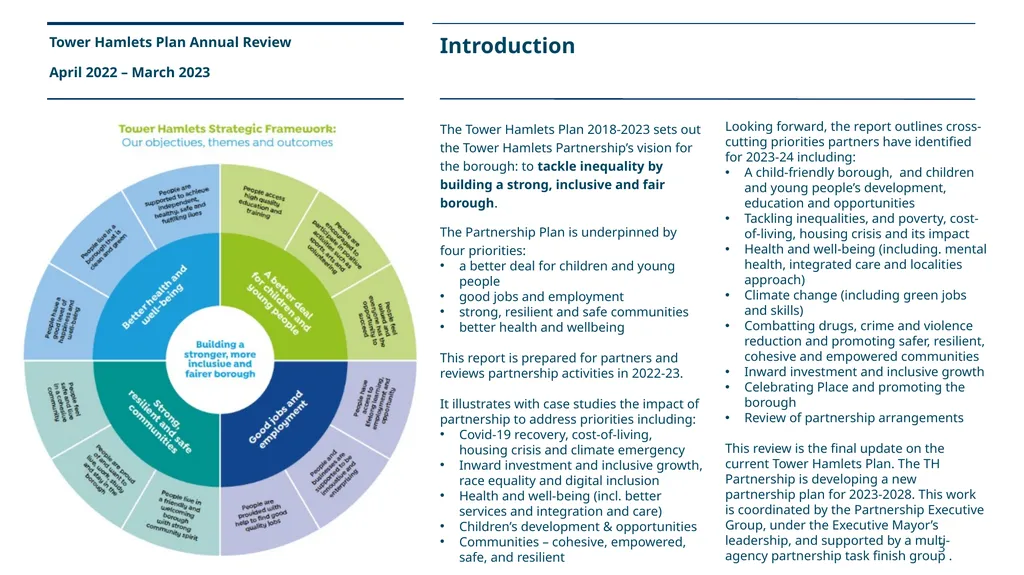
April 2022 – March 2023 Introduction The Tower Hamlets Plan 2018-2023 sets out the Tower Hamlets Partnership’s vision for the borough: to tackle inequality by building a strong, inclusive and fair borough.
The Partnership Plan is underpinned by four priorities:
a better deal for children and young people
good jobs and employment
strong, resilient and safe communities
better health and wellbeing
This report is prepared for partners and reviews partnership activities in 2022-23.
It illustrates with case studies the impact of partnership to address priorities including:
Covid-19 recovery, cost-of-living, housing crisis and climate emergency
Inward investment and inclusive growth, race equality and digital inclusion
Health and well-being (incl. better services and integration and care)
Children’s development & opportunities
Communities – cohesive, empowered, safe, and resilient
Looking forward, the report outlines cross-cutting priorities partners have identified for 2023-24 including:
A child-friendly borough, and children and young people’s development, education and opportunities
Tackling inequalities, and poverty, cost-of-living, housing crisis and its impact
Health and well-being (including. mental health, integrated care and localities approach)
Climate change (including green jobs and skills)
Combatting drugs, crime and violence reduction and promoting safer, resilient, cohesive and empowered communities
Inward investment and inclusive growth
Celebrating Place and promoting the borough
Review of partnership arrangements
This review is the final update on the current Tower Hamlets Plan. The TH Partnership is developing a new partnership plan for 2023-2028. This work is coordinated by the Partnership Executive Group, under the Executive Mayor’s leadership, and supported by a multi-agency partnership task finish group . 3<br>
04
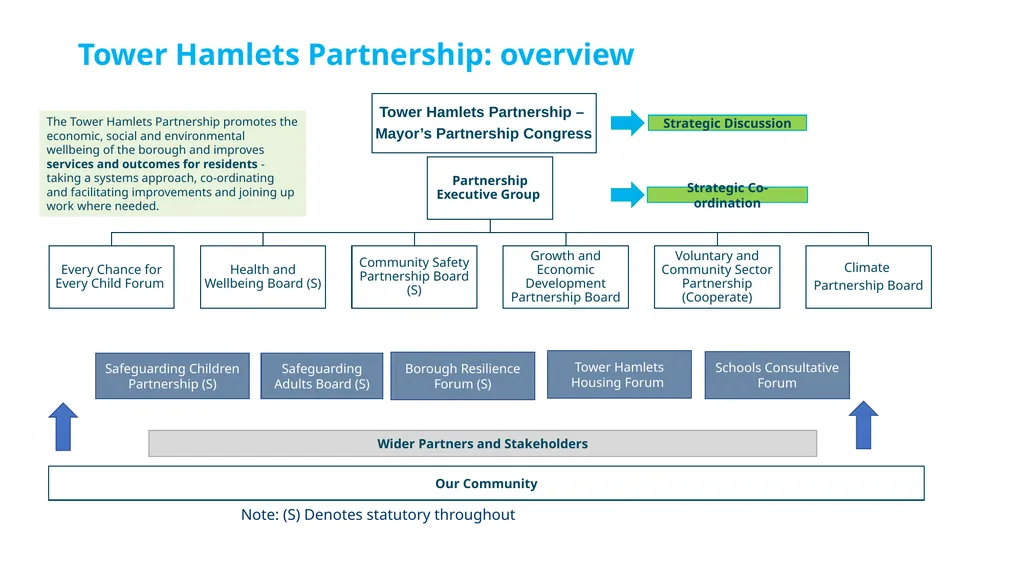
Tower Hamlets Partnership: overview The Tower Hamlets Partnership promotes the economic, social and environmental wellbeing of the borough and improves services and outcomes for residents - taking a systems approach, co-ordinating and facilitating improvements and joining up work where needed. Safeguarding Children Partnership (S) Safeguarding Adults Board (S) Borough Resilience Forum (S) Tower Hamlets Housing Forum Schools Consultative Forum Wider Partners and Stakeholders Our Community Note: (S) Denotes statutory throughout Strategic Discussion Strategic Co-ordination<br>
05
Our strategy and Partnership Boards Partnership Executive Group Priorities for 2023-24:
A child-friendly borough
Improving homes, neighbourhoods and health
Tackling poverty, cost of living and improving incomes
Improving Mental health and emotional wellbeing
Developing a new Tower Hamlets Partnership Plan 2023-2028
Two Partnership Congresses: Community Safety; Children and Young People
Tackling inequalities
Celebrating place and promoting the borough Introduction:
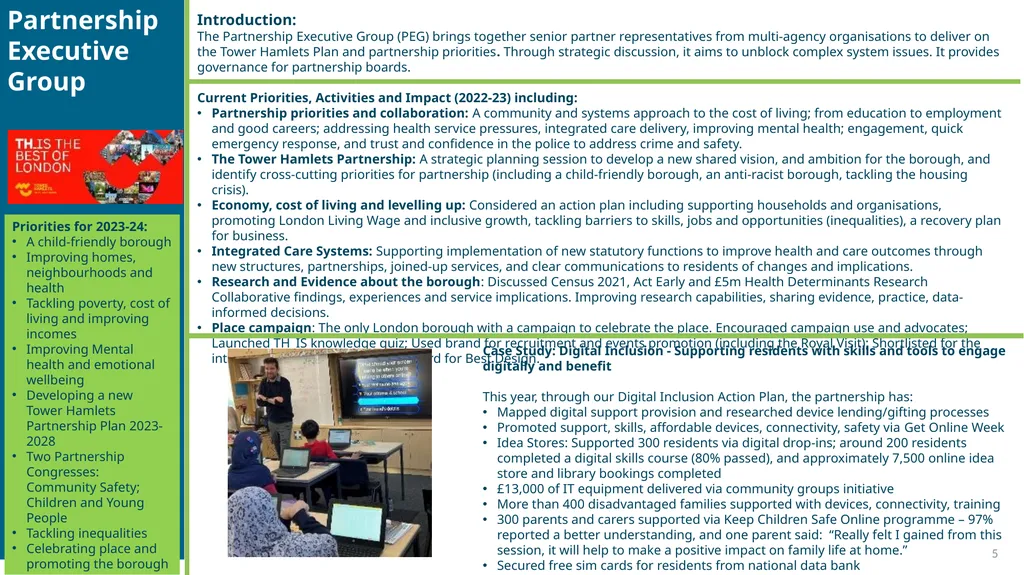
The Partnership Executive Group (PEG) brings together senior partner representatives from multi-agency organisations to deliver on the Tower Hamlets Plan and partnership priorities. Through strategic discussion, it aims to unblock complex system issues. It provides governance for partnership boards.
Current Priorities, Activities and Impact (2022-23) including:
Partnership priorities and collaboration: A community and systems approach to the cost of living; from education to employment and good careers; addressing health service pressures, integrated care delivery, improving mental health; engagement, quick emergency response, and trust and confidence in the police to address crime and safety.
The Tower Hamlets Partnership: A strategic planning session to develop a new shared vision, and ambition for the borough, and identify cross-cutting priorities for partnership (including a child-friendly borough, an anti-racist borough, tackling the housing crisis).
Economy, cost of living and levelling up: Considered an action plan including supporting households and organisations, promoting London Living Wage and inclusive growth, tackling barriers to skills, jobs and opportunities (inequalities), a recovery plan for business.
Integrated Care Systems: Supporting implementation of new statutory functions to improve health and care outcomes through new structures, partnerships, joined-up services, and clear communications to residents of changes and implications.
Research and Evidence about the borough: Discussed Census 2021, Act Early and £5m Health Determinants Research Collaborative findings, experiences and service implications. Improving research capabilities, sharing evidence, practice, data-informed decisions.
Place campaign: The only London borough with a campaign to celebrate the place. Encouraged campaign use and advocates; Launched TH_IS knowledge quiz; Used brand for recruitment and events promotion (including the Royal Visit); Shortlisted for the international City, Nation, Place Award for Best Design. Case Study: Digital Inclusion - Supporting residents with skills and tools to engage digitally and benefit
This year, through our Digital Inclusion Action Plan, the partnership has:
Mapped digital support provision and researched device lending/gifting processes
Promoted support, skills, affordable devices, connectivity, safety via Get Online Week
Idea Stores: Supported 300 residents via digital drop-ins; around 200 residents completed a digital skills course (80% passed), and approximately 7,500 online idea store and library bookings completed
£13,000 of IT equipment delivered via community groups initiative
More than 400 disadvantaged families supported with devices, connectivity, training
300 parents and carers supported via Keep Children Safe Online programme – 97% reported a better understanding, and one parent said: “Really felt I gained from this session, it will help to make a positive impact on family life at home.”
Secured free sim cards for residents from national data bank 5<br>
06
Our strategy continued 1 - The Children and Families Executive A better deal for children and young people Priorities for 2023-24:
Integrated working to improve outcomes, with a focus on early years (including health and development outcomes, referral pathways, support and transition, communications and service access.
Mitigating poverty and economic hardship for children, young people and their families (including financial support, and resilience, meals and experiences during school holidays) The Children and Families Executive
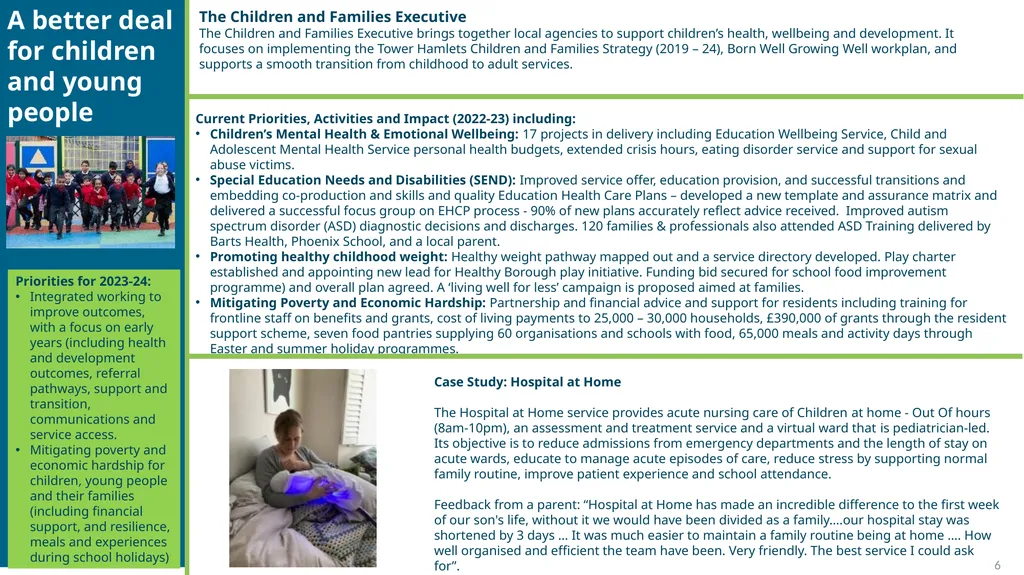
The Children and Families Executive brings together local agencies to support children’s health, wellbeing and development. It focuses on implementing the Tower Hamlets Children and Families Strategy (2019 – 24), Born Well Growing Well workplan, and supports a smooth transition from childhood to adult services. Current Priorities, Activities and Impact (2022-23) including:
Children’s Mental Health & Emotional Wellbeing: 17 projects in delivery including Education Wellbeing Service, Child and Adolescent Mental Health Service personal health budgets, extended crisis hours, eating disorder service and support for sexual abuse victims.
Special Education Needs and Disabilities (SEND): Improved service offer, education provision, and successful transitions and embedding co-production and skills and quality Education Health Care Plans – developed a new template and assurance matrix and delivered a successful focus group on EHCP process - 90% of new plans accurately reflect advice received. Improved autism spectrum disorder (ASD) diagnostic decisions and discharges. 120 families & professionals also attended ASD Training delivered by Barts Health, Phoenix School, and a local parent.
Promoting healthy childhood weight: Healthy weight pathway mapped out and a service directory developed. Play charter established and appointing new lead for Healthy Borough play initiative. Funding bid secured for school food improvement programme) and overall plan agreed. A ‘living well for less’ campaign is proposed aimed at families.
Mitigating Poverty and Economic Hardship: Partnership and financial advice and support for residents including training for frontline staff on benefits and grants, cost of living payments to 25,000 – 30,000 households, £390,000 of grants through the resident support scheme, seven food pantries supplying 60 organisations and schools with food, 65,000 meals and activity days through Easter and summer holiday programmes. Case Study: Hospital at Home
The Hospital at Home service provides acute nursing care of Children at home - Out Of hours (8am-10pm), an assessment and treatment service and a virtual ward that is pediatrician-led. Its objective is to reduce admissions from emergency departments and the length of stay on acute wards, educate to manage acute episodes of care, reduce stress by supporting normal family routine, improve patient experience and school attendance.
Feedback from a parent: “Hospital at Home has made an incredible difference to the first week of our son's life, without it we would have been divided as a family….our hospital stay was shortened by 3 days … It was much easier to maintain a family routine being at home …. How well organised and efficient the team have been. Very friendly. The best service I could ask for”. 6<br>
07
Our strategy continued 2 - The Growth and Economic Development Partnership Board Good jobs and employment Priorities for 2023-24:
Keeping under review the cost of living, impact and support
Local rollout of the UK Shared Prosperity Fund, business grants schemes
Green jobs and skills agenda The Growth and Economic Development Partnership Board
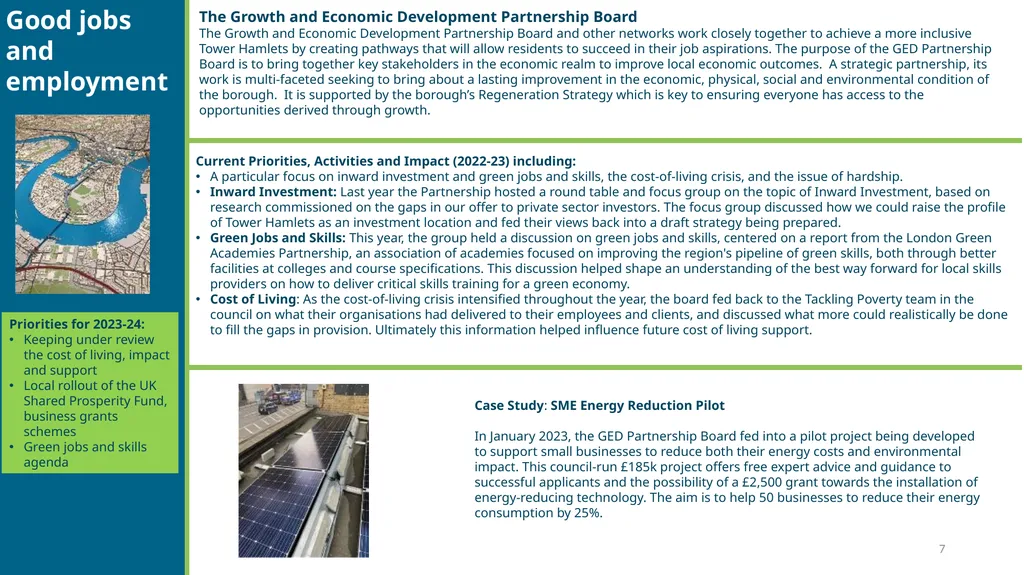
The Growth and Economic Development Partnership Board and other networks work closely together to achieve a more inclusive Tower Hamlets by creating pathways that will allow residents to succeed in their job aspirations. The purpose of the GED Partnership Board is to bring together key stakeholders in the economic realm to improve local economic outcomes. A strategic partnership, its work is multi-faceted seeking to bring about a lasting improvement in the economic, physical, social and environmental condition of the borough. It is supported by the borough’s Regeneration Strategy which is key to ensuring everyone has access to the opportunities derived through growth. Current Priorities, Activities and Impact (2022-23) including:
A particular focus on inward investment and green jobs and skills, the cost-of-living crisis, and the issue of hardship.
Inward Investment: Last year the Partnership hosted a round table and focus group on the topic of Inward Investment, based on research commissioned on the gaps in our offer to private sector investors. The focus group discussed how we could raise the profile of Tower Hamlets as an investment location and fed their views back into a draft strategy being prepared.
Green Jobs and Skills: This year, the group held a discussion on green jobs and skills, centered on a report from the London Green Academies Partnership, an association of academies focused on improving the region's pipeline of green skills, both through better facilities at colleges and course specifications. This discussion helped shape an understanding of the best way forward for local skills providers on how to deliver critical skills training for a green economy.
Cost of Living: As the cost-of-living crisis intensified throughout the year, the board fed back to the Tackling Poverty team in the council on what their organisations had delivered to their employees and clients, and discussed what more could realistically be done to fill the gaps in provision. Ultimately this information helped influence future cost of living support. Case Study: SME Energy Reduction Pilot
In January 2023, the GED Partnership Board fed into a pilot project being developed to support small businesses to reduce both their energy costs and environmental impact. This council-run £185k project offers free expert advice and guidance to successful applicants and the possibility of a £2,500 grant towards the installation of energy-reducing technology. The aim is to help 50 businesses to reduce their energy consumption by 25%. 7<br>
08
Our strategy continued 3 - The Community Safety Partnership Strong, resilient and safe communities Priorities for 2023-24 including a focus on:
Sexual offenses, serious violence, ‘hidden harm’ crimes, under 18 repeat victimisation and revenge attacks
Oversee delivery of key strategies (Combatting Drugs, Serious Violence, and Violence Against Women & Girls)
Improving trust and public confidence in line with Casey Review recommendations
Reducing Nitrous Oxide use by young people The Community Safety Partnership
The Community Safety Partnership (CSP) is a statutory requirement of the Crime and Disorder Act 1998. It is a strategic group that works in partnership to address local issues including crime, disorder, antisocial behaviour (ASB), substance misuse, and re-offending. It directs the work of its partnership boards in order to create a safer borough for people to live, work, study and visit. Current Priorities, Activities and Impact (2022-23) including:
Tackling Neighbourhood Crime and ASB – The Neighbourhood Crime and ASB Board a subgroup of the CSP continues to coordinate partnership activity. We have seen a 27.5% (-4683 reports) reduction in ASB through strong partnership work.
Tackling Hate Crime, Community Tensions, Extremism and Building Trust and Confidence – Delivered training, outreach, and communications on our One Tower Hamlets vision and No Place for Hate campaign. 21 partnership activities delivered during National Hate Crime Awareness Week 2022. 47 ‘Workshop to Raise Awareness of Prevent’ training sessions delivered with 1855 attendees. Prevent team welcomed delegates from Kosovo for a 2-day training and received a high-performance rating from Home Office.
Tackling Drugs, Re-offending and the Drivers of Crime - Established a combatting drugs partnership (including health partners) to implement the national ‘From Harm to Hope strategy’ to combat illegal drugs and drug-related harm and improve care including through project ADDER (Addiction, Diversion, Disruption, Enforcement and Recovery). Since 2021 ADDER has seen a rise from 14% to 31% in residents engaging in community treatment after leaving prison.
Reducing violence - Installed four knife bins and life-saving bleed control cabinets, and distributed control kits at key locations. Carried out multi-agency weapon sweeps in high-risk areas of serious violence. Tower Hamlets Island Community Network (THICN), funded by the Mayor of London’s My Ends programme, has been delivering interventions for young people to prevent and reduce violence on the Isle of Dogs. THICN has engaged 1533 young people across several interventions delivered through the programme. Case Study: Safety Surgeries and Walkabouts
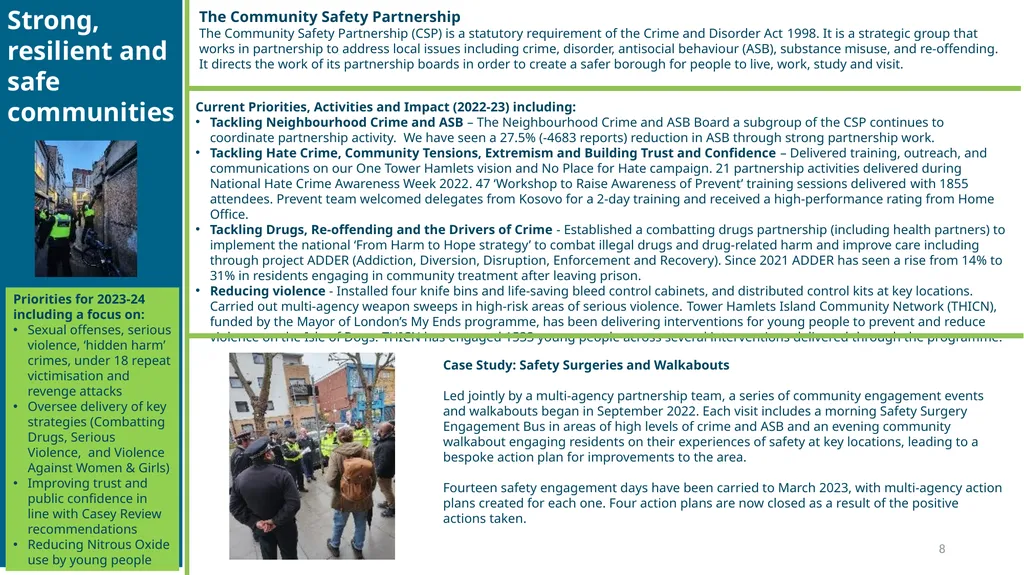
Led jointly by a multi-agency partnership team, a series of community engagement events and walkabouts began in September 2022. Each visit includes a morning Safety Surgery Engagement Bus in areas of high levels of crime and ASB and an evening community walkabout engaging residents on their experiences of safety at key locations, leading to a bespoke action plan for improvements to the area.
Fourteen safety engagement days have been carried to March 2023, with multi-agency action plans created for each one. Four action plans are now closed as a result of the positive actions taken. 8<br>
09
Our strategy continued 4 – Race Equality Partnership Network Strong, resilient and safe communities Priorities for 2023-2024, including:
‘I can be campaign’
Anti-racist borough: pledge, training, inclusive recruitment, career progression and leadership, health inclusion and equity
Community leadership
Young people: Mentoring, employment and development and progression Tackling Race Inequality
An open and accountable Partnership that provides strategic leadership and influence across the borough to tackle race inequality to improve outcomes for residents from Black, Asian and Multi-Ethnic communities. Working across the Tower Hamlets Partnership to help set, deliver and monitor targeted action plans that work with communities to address issues, develop impactful interventions that meet diverse needs and promote Tower Hamlets as an Anti Racist Borough. Current Priorities, Activities and Impact (2022-23) including:
Implementation of the partnership action plan: Mentoring for 400 young people over two years; targeted interventions for 800 young people not in Education, Employment and Training; 5 targeted careers fairs; Engaged 18 Schools in Anti Racist Curriculum; Engaged 9500 students in Anti Racist Curriculum; 50 teachers engaged into leadership programme; 150 women attended partnership leadership event; 22 Women engaged in accredited leadership course; 18 residents supported to be trustee of VCS organisations; 50 Faith settings engaged to promote COVID-19 vaccine; 1400 elderly and clinically vulnerable Bangladeshi residents engaged in vaccines; £460k of NHS England Inequalities funding secured.
Pan-London coordination: The Council is also collaborating at a Pan-London level for coordinated action on racial equality. Case Study: Mentoring
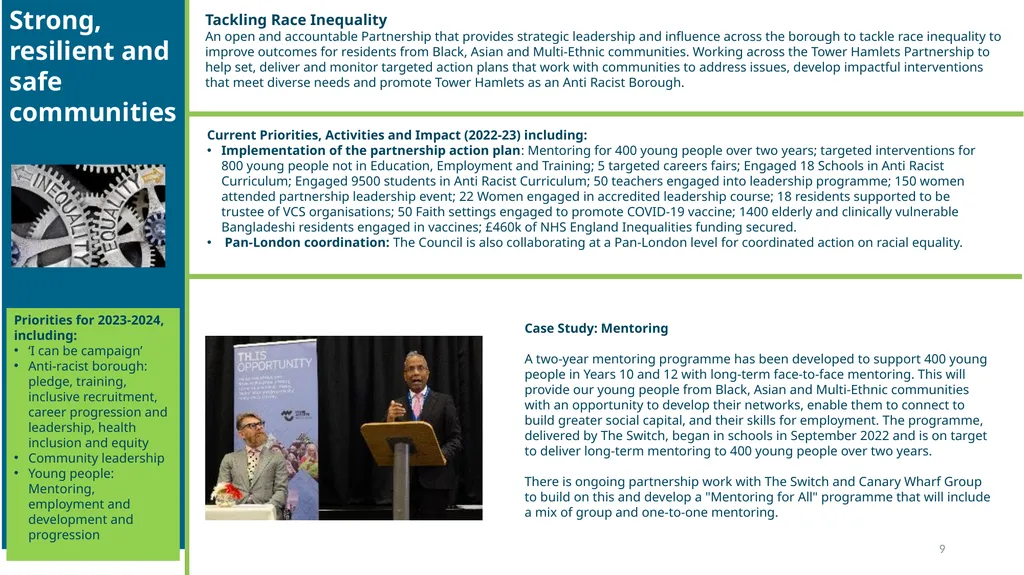
A two-year mentoring programme has been developed to support 400 young people in Years 10 and 12 with long-term face-to-face mentoring. This will provide our young people from Black, Asian and Multi-Ethnic communities with an opportunity to develop their networks, enable them to connect to build greater social capital, and their skills for employment. The programme, delivered by The Switch, began in schools in September 2022 and is on target to deliver long-term mentoring to 400 young people over two years.
There is ongoing partnership work with The Switch and Canary Wharf Group to build on this and develop a "Mentoring for All" programme that will include a mix of group and one-to-one mentoring. 9<br>
10
Our strategy continued 5 - cooperate Strong, resilient and safe communities Priorities for 2023-2024:
Implementation and monitoring of Mayor’s Community Grants Programme
VCS workforce issues and opportunities for greater joint working
Co-production - exploring opportunities to get the sector and local residents more involved in the design and delivery of services. Cooperate
Cooperate is a voluntary, community and public sector partnership. It is a strategic body that engages its partners to deliver the Tower Hamlets Voluntary and Community Sector (VCS) Strategy. Cooperate provides an opportunity to come together to consider resilience, recovery, and renewal, tackle challenges, and harness opportunities bringing in new thinking and new ways of working. Current Priorities, Activities and Impact (2022-23) including:
Understanding the impact of the Cost of Living crisis on local voluntary and community sector organisations and response to this by the sector and opportunities for further joint work
The council commenced an engagement process with the VCS and local residents to:
Develop a new Grants Policy & Outcomes Framework agreed by Cabinet in March 2023
Launched the Mayor’s Community Grants Programme in April 2023, which will commence in November 2023
Support the development of the new Small Grants Programme, also scheduled to commence in December 2023
Delivery of the partnership Voluntary and Community Sector Strategy 2020-24 through task and finish groups focusing on volunteering, digital inclusion, external funding, service mapping, strengthening partnership working,
A Tower Hamlets Council for Voluntary Service-led partnership has secured £450,000 of Cornerstone funding over two years to foster co-production and secure input from beneficiaries of local services to change culture and behaviour within VCS services and organisations in the borough, either for single issues or policy areas. Case Study: Mayor’s Community Grants Programme and Small Grants Programme
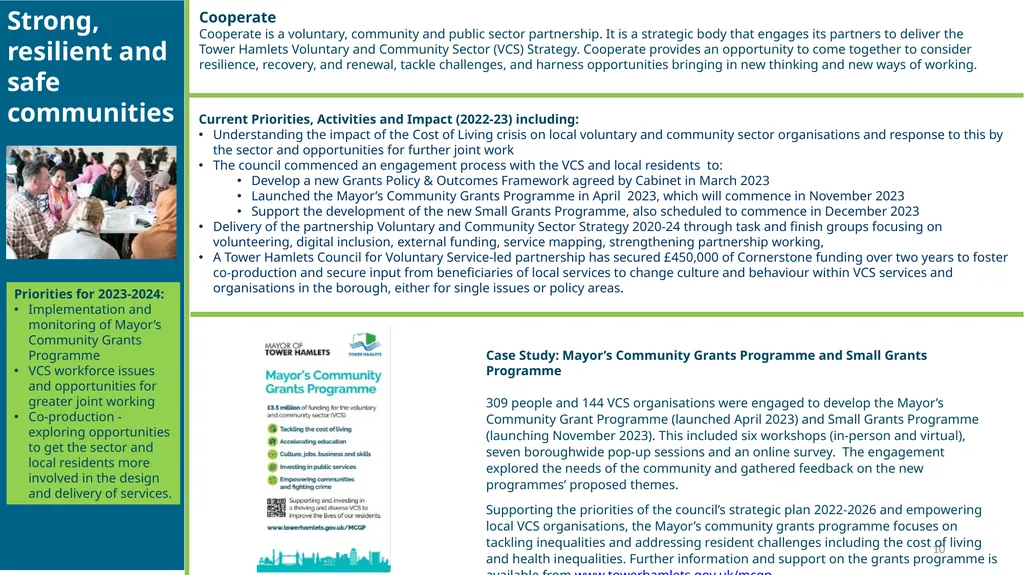
309 people and 144 VCS organisations were engaged to develop the Mayor’s Community Grant Programme (launched April 2023) and Small Grants Programme (launching November 2023). This included six workshops (in-person and virtual), seven boroughwide pop-up sessions and an online survey. The engagement explored the needs of the community and gathered feedback on the new programmes’ proposed themes.
Supporting the priorities of the council’s strategic plan 2022-2026 and empowering local VCS organisations, the Mayor’s community grants programme focuses on tackling inequalities and addressing resident challenges including the cost of living and health inequalities. Further information and support on the grants programme is available from www.towerhamlets.gov.uk/mcgp 10<br>
11
Our strategy continued 6 – Tower Hamlets Housing Forum Strong, resilient and safe communities Priorities for 2023-24:
under development Tower Hamlets Housing Forum
Tower Hamlets Housing Forum (THHF) brings together the council and local housing associations, so residents benefit from effectively developed, managed and safe homes and estates; and a vibrant cohesive community. Its aims are to Challenge discrimination and stigma; Develop and share best practice; Improve resident experience; Promote the sector’s reputation; Support Tower Hamlets Council to deliver its strategic housing and community plans. Current Priorities, Activities and Impact (2022-23) including:
Adopt a proactive approach to tackling damp, mould, and condensation: Shared best practice in understanding the causes of, and eradicating, damp, mould, and condensation from tenants’ homes. This includes friendly communications, recording every report and one-working-day triage visit to prioritise reports, using data and risk assessments to identify high-risk homes, and installing of smart technology for a proactive approach.
Reduce tenant overcrowding: 21,890 applications on the Housing List and 48% are from overcrowded households. This year Council and THHF Partners rehoused 645 overcrowded households, 62% of lets (excluding statutory homeless); 59 under-occupying households rehoused, 6% of lets (excluding statutory homeless). Developing a project to use machine learning to increase moves to under-occupied and overcrowded households by matching tenants for mutual exchanges based on bidding history. This is due to pilot in 2023-2024.
Provide Cost of Living support / Focus on food, warmth, health, and financial support - THHF Members have worked closely with the Council to promote advice, support and signpost people to services including reducing rent arrears, debt advice, and maximising benefit take-up, employment and training, energy switching. This also included sourcing laptops and tablets for young people and healthy eating and exercise, food banks and food pantries, and social prescribing. Case Study: Summer of Wellbeing festivals 2022
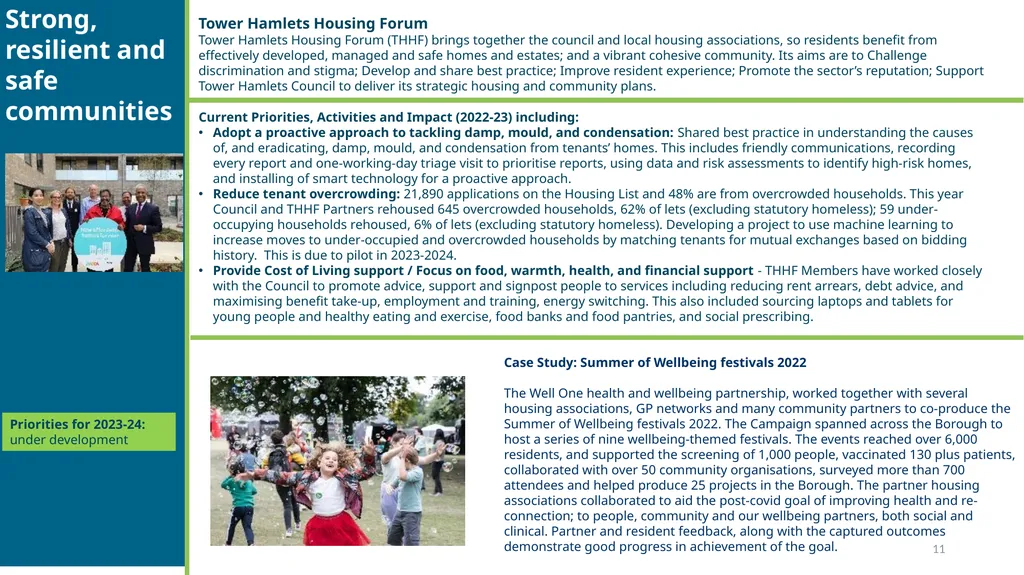
The Well One health and wellbeing partnership, worked together with several housing associations, GP networks and many community partners to co-produce the Summer of Wellbeing festivals 2022. The Campaign spanned across the Borough to host a series of nine wellbeing-themed festivals. The events reached over 6,000 residents, and supported the screening of 1,000 people, vaccinated 130 plus patients, collaborated with over 50 community organisations, surveyed more than 700 attendees and helped produce 25 projects in the Borough. The partner housing associations collaborated to aid the post-covid goal of improving health and re-connection; to people, community and our wellbeing partners, both social and clinical. Partner and resident feedback, along with the captured outcomes demonstrate good progress in achievement of the goal. 11<br>
12
Our strategy continued 7 - Health and Wellbeing Board and Tower Hamlets Together Better health and wellbeing Priorities 2022-23 including:
Reviewing the function of the HWBB to enhance its community focus and delivery of requirements.
Combatting Drugs Strategy: enforcement, treatment and demand reduction.
Healthy adults: Living Well
Access to services for disabled residents
System-wide health intelligence for localities and neighbourhoods
Complex adults: Promoting Independence
Improving personalisation care offer
Reviewing & refreshing the model & approach for Community Health Services model and approach Health and Wellbeing Board and Tower Hamlets Together
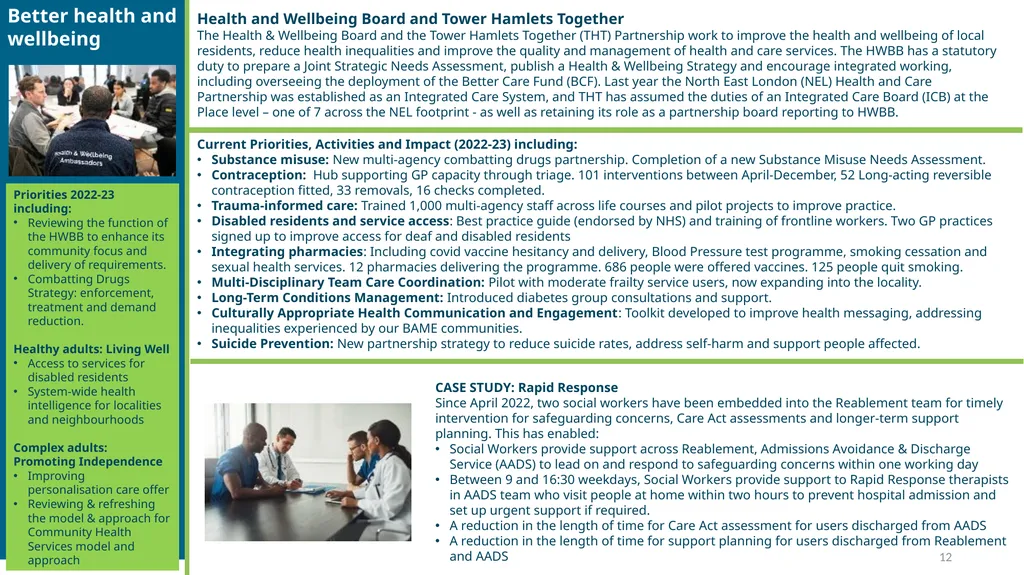
The Health & Wellbeing Board and the Tower Hamlets Together (THT) Partnership work to improve the health and wellbeing of local residents, reduce health inequalities and improve the quality and management of health and care services. The HWBB has a statutory duty to prepare a Joint Strategic Needs Assessment, publish a Health & Wellbeing Strategy and encourage integrated working, including overseeing the deployment of the Better Care Fund (BCF). Last year the North East London (NEL) Health and Care Partnership was established as an Integrated Care System, and THT has assumed the duties of an Integrated Care Board (ICB) at the Place level – one of 7 across the NEL footprint - as well as retaining its role as a partnership board reporting to HWBB. Current Priorities, Activities and Impact (2022-23) including:
Substance misuse: New multi-agency combatting drugs partnership. Completion of a new Substance Misuse Needs Assessment.
Contraception: Hub supporting GP capacity through triage. 101 interventions between April-December, 52 Long-acting reversible contraception fitted, 33 removals, 16 checks completed.
Trauma-informed care: Trained 1,000 multi-agency staff across life courses and pilot projects to improve practice.
Disabled residents and service access: Best practice guide (endorsed by NHS) and training of frontline workers. Two GP practices signed up to improve access for deaf and disabled residents
Integrating pharmacies: Including covid vaccine hesitancy and delivery, Blood Pressure test programme, smoking cessation and sexual health services. 12 pharmacies delivering the programme. 686 people were offered vaccines. 125 people quit smoking.
Multi-Disciplinary Team Care Coordination: Pilot with moderate frailty service users, now expanding into the locality.
Long-Term Conditions Management: Introduced diabetes group consultations and support.
Culturally Appropriate Health Communication and Engagement: Toolkit developed to improve health messaging, addressing inequalities experienced by our BAME communities.
Suicide Prevention: New partnership strategy to reduce suicide rates, address self-harm and support people affected. CASE STUDY: Rapid Response
Since April 2022, two social workers have been embedded into the Reablement team for timely intervention for safeguarding concerns, Care Act assessments and longer-term support planning. This has enabled:
Social Workers provide support across Reablement, Admissions Avoidance & Discharge Service (AADS) to lead on and respond to safeguarding concerns within one working day
Between 9 and 16:30 weekdays, Social Workers provide support to Rapid Response therapists in AADS team who visit people at home within two hours to prevent hospital admission and set up urgent support if required.
A reduction in the length of time for Care Act assessment for users discharged from AADS
A reduction in the length of time for support planning for users discharged from Reablement and AADS 12<br>
13
Our strategy continued 8 – climate partnership Better Health and Wellbeing Priorities for 2023-24:
Restart the Climate Partnership to refresh and deliver the climate action plan under its seven themes
Standardise carbon emissions measurement and reporting by organisations
Delivery of the Local Biodiversity Action Plan
Delivery of biodiverse roofs and renewable energy generating technologies Climate Partnership
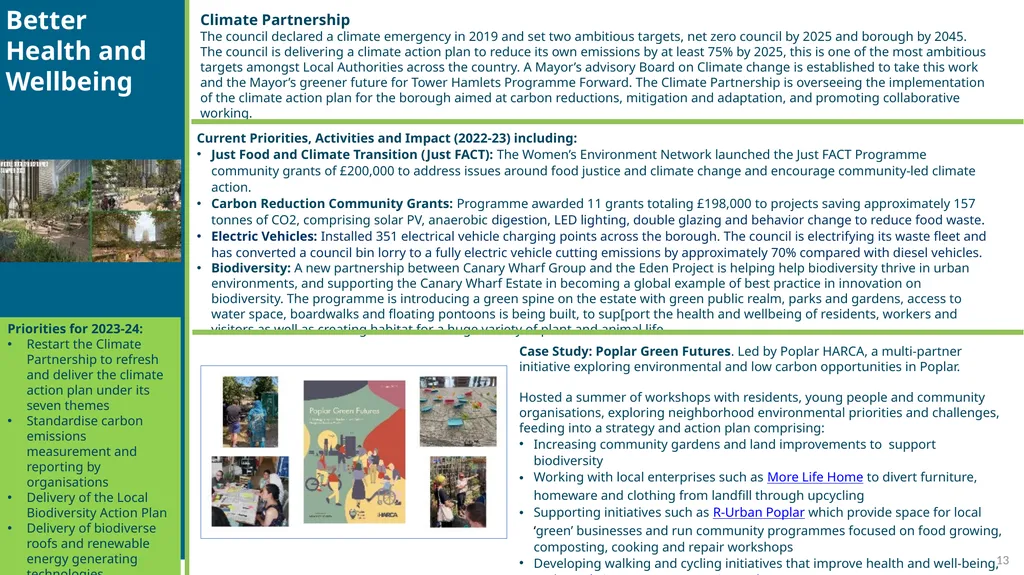
The council declared a climate emergency in 2019 and set two ambitious targets, net zero council by 2025 and borough by 2045. The council is delivering a climate action plan to reduce its own emissions by at least 75% by 2025, this is one of the most ambitious targets amongst Local Authorities across the country. A Mayor’s advisory Board on Climate change is established to take this work and the Mayor’s greener future for Tower Hamlets Programme Forward. The Climate Partnership is overseeing the implementation of the climate action plan for the borough aimed at carbon reductions, mitigation and adaptation, and promoting collaborative working. Current Priorities, Activities and Impact (2022-23) including:
Just Food and Climate Transition (Just FACT): The Women’s Environment Network launched the Just FACT Programme community grants of £200,000 to address issues around food justice and climate change and encourage community-led climate action.
Carbon Reduction Community Grants: Programme awarded 11 grants totaling £198,000 to projects saving approximately 157 tonnes of CO2, comprising solar PV, anaerobic digestion, LED lighting, double glazing and behavior change to reduce food waste.
Electric Vehicles: Installed 351 electrical vehicle charging points across the borough. The council is electrifying its waste fleet and has converted a council bin lorry to a fully electric vehicle cutting emissions by approximately 70% compared with diesel vehicles.
Biodiversity: A new partnership between Canary Wharf Group and the Eden Project is helping help biodiversity thrive in urban environments, and supporting the Canary Wharf Estate in becoming a global example of best practice in innovation on biodiversity. The programme is introducing a green spine on the estate with green public realm, parks and gardens, access to water space, boardwalks and floating pontoons is being built, to sup[port the health and wellbeing of residents, workers and visitors as well as creating habitat for a huge variety of plant and animal life. Case Study: Poplar Green Futures. Led by Poplar HARCA, a multi-partner initiative exploring environmental and low carbon opportunities in Poplar.
Hosted a summer of workshops with residents, young people and community organisations, exploring neighborhood environmental priorities and challenges, feeding into a strategy and action plan comprising:
Increasing community gardens and land improvements to support biodiversity
Working with local enterprises such as More Life Home to divert furniture, homeware and clothing from landfill through upcycling
Supporting initiatives such as R-Urban Poplar which provide space for local ‘green’ businesses and run community programmes focused on food growing, composting, cooking and repair workshops
Developing walking and cycling initiatives that improve health and well-being, such as Chrisp Street Community Cycles 13<br>
14
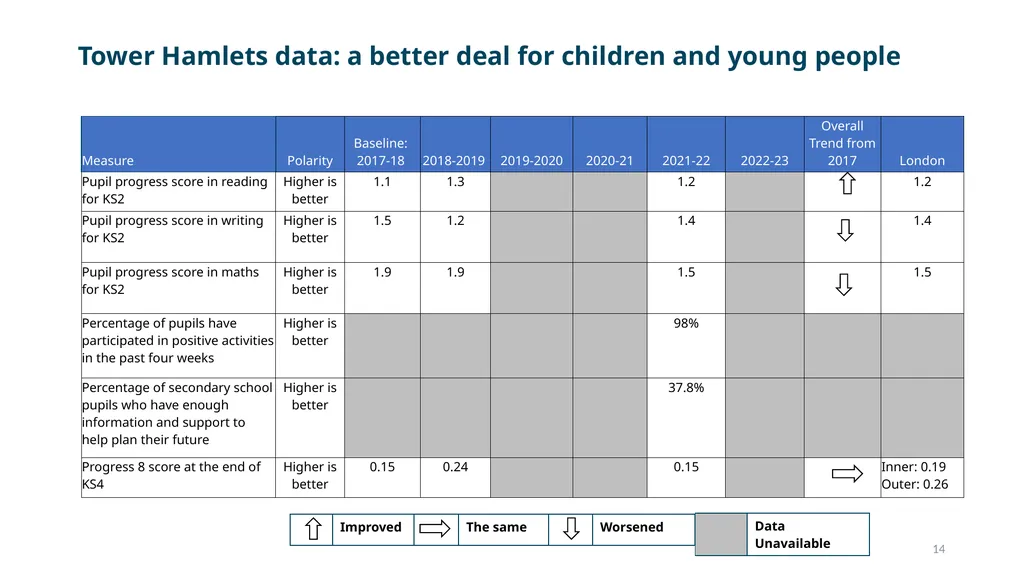
Tower Hamlets data: a better deal for children and young people 14<br>
15
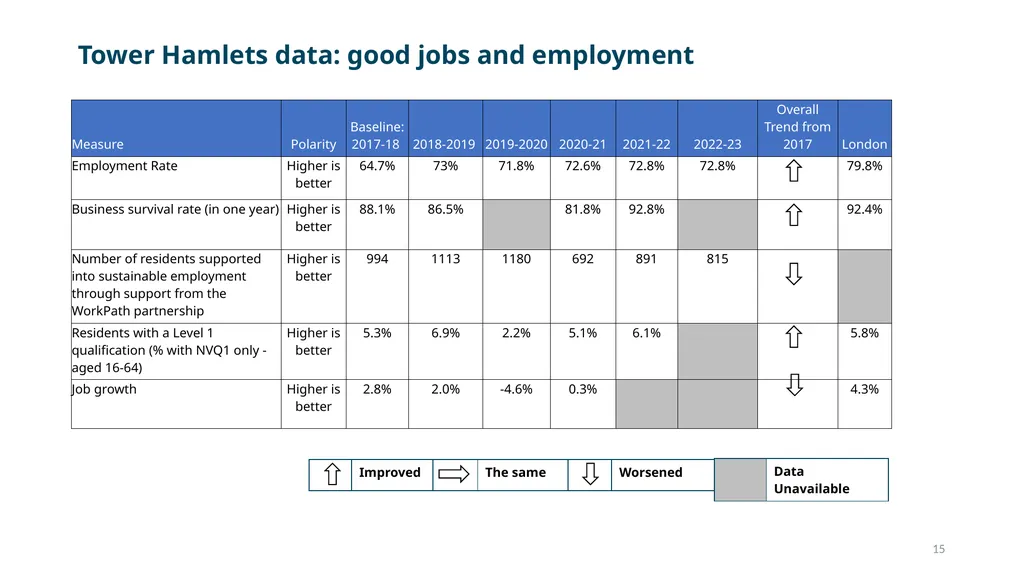
Tower Hamlets data: good jobs and employment 15<br>
16
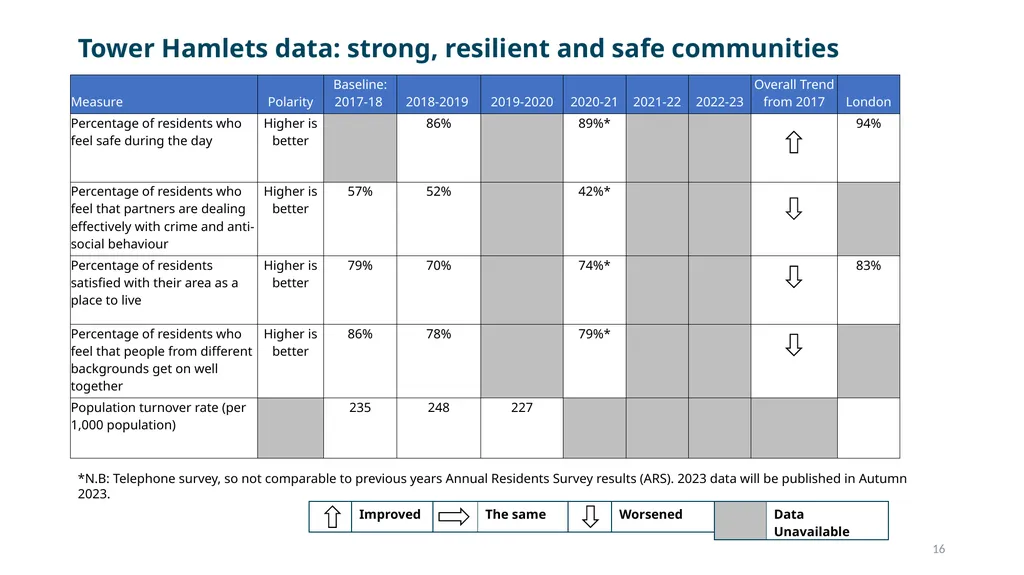
Tower Hamlets data: strong, resilient and safe communities *N.B: Telephone survey, so not comparable to previous years Annual Residents Survey results (ARS). 2023 data will be published in Autumn 2023. 16<br>
17
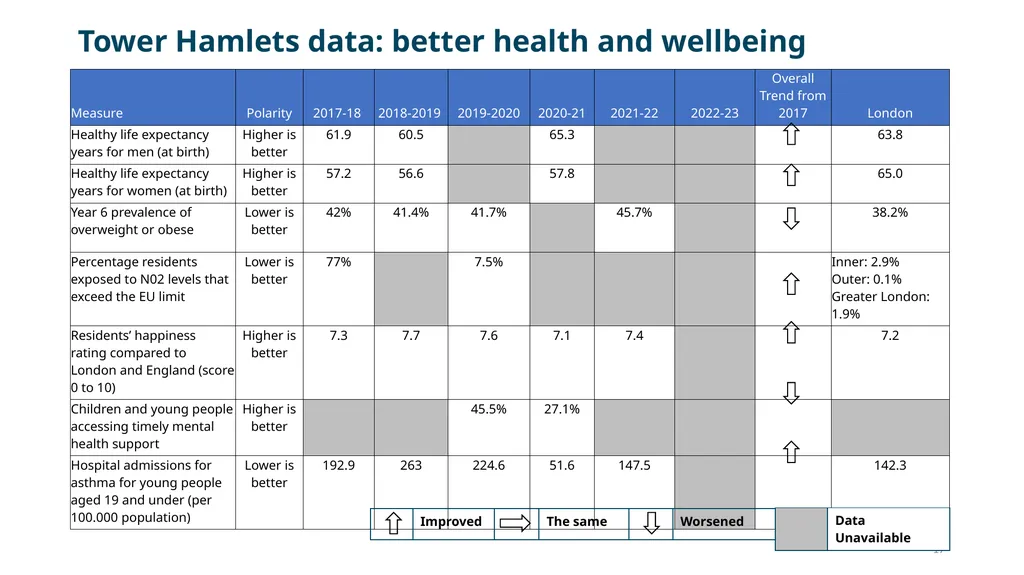
Tower Hamlets data: better health and wellbeing 17<br>
18
If you have any questions about the annual review or would like to find out more, please do not hesitate to contact us: Abidah Kamali: LBTH Senior Strategy and Policy Officer
TowerHamletsPartnership@towerhamlets.gov.uk
https://www.towerhamlets.gov.uk/lgnl/community_and_living/community_plan/tower_hamlets_partnership.aspx Tower Hamlets Full headteacher consultative 18<br>
TowerHamletsPartnership@towerhamlets.gov.uk
https://www.towerhamlets.gov.uk/lgnl/community_and_living/community_plan/tower_hamlets_partnership.aspx Tower Hamlets Full headteacher consultative 18<br>