Trade and the SDGs Alison, SDD for IMTS Workshop, Nadi 2022 Trades role in sustainable development Historically, trade has proven to be an engine for development and poverty reduction by improving growth in developing countries. Open trade
Related Topics
Share
Embed code
Download this presentation From Below
"Trade and the SDGs Alison, SDD for IMTS Workshop," is the property of its rightful owner. Permission is granted to
download and print the materials on this website for personal, non-commercial use only, and to display it
on your personal computer provided you do not modify the materials and that you retain all copyright
notices contained in the materials. By downloading content from our website, you accept the terms of this
agreement.
Presentation Transcript
01
Trade and the SDGs Alison, SDD
for IMTS Workshop, Nadi 2022<br>
02
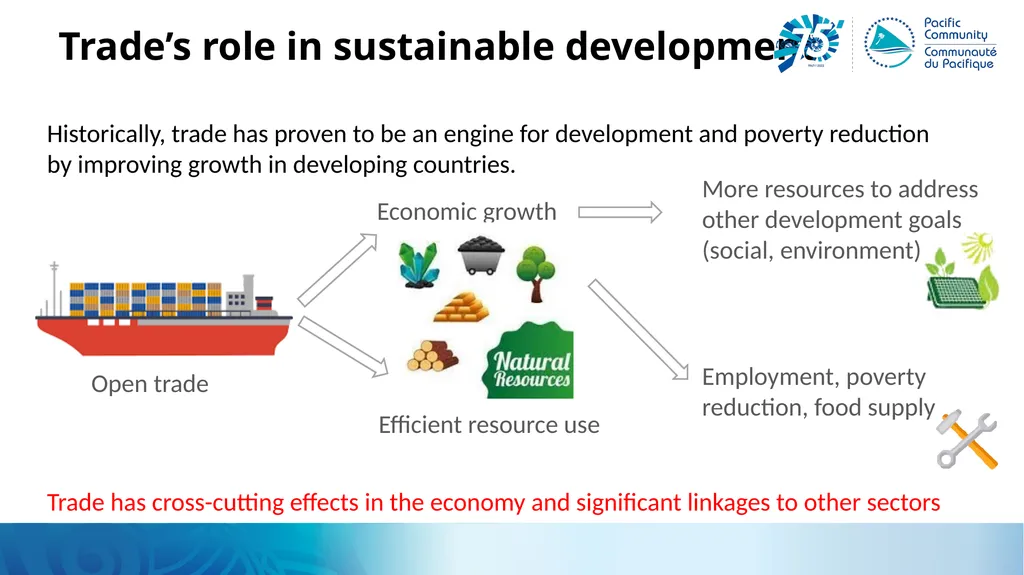
Trade’s role in sustainable development Historically, trade has proven to be an engine for development and poverty reduction by improving growth in developing countries. Open trade Economic growth Efficient resource use More resources to address other development goals (social, environment) Employment, poverty reduction, food supply Trade has cross-cutting effects in the economy and significant linkages to other sectors<br>
03
Some ways trade can accelerate SDGs Build supply-side capacity and trade related infrastructure in SIDS
Focus on export diversification and value addition.
Enhance the services sector.
Flexible rules of origin to increase utilization of preference schemes.
Ensure that non-tariff measures do not become barriers to trade.
Make e-commerce a force for inclusion (including gender)
Support micro, small and medium sized enterprises to engage in international trade.
WTO<br>
04
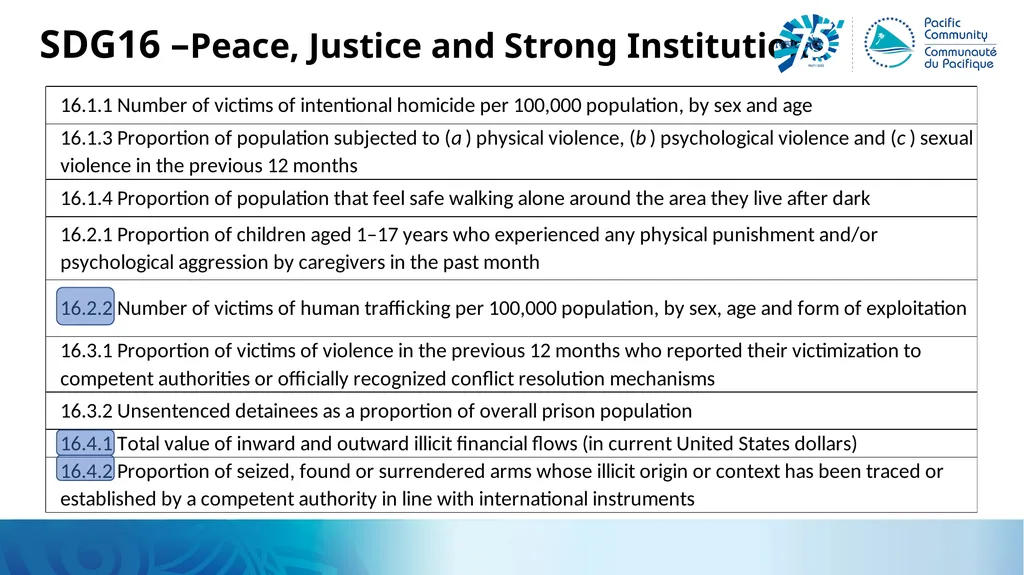
SDG16 –Peace, Justice and Strong Institutions<br>
05
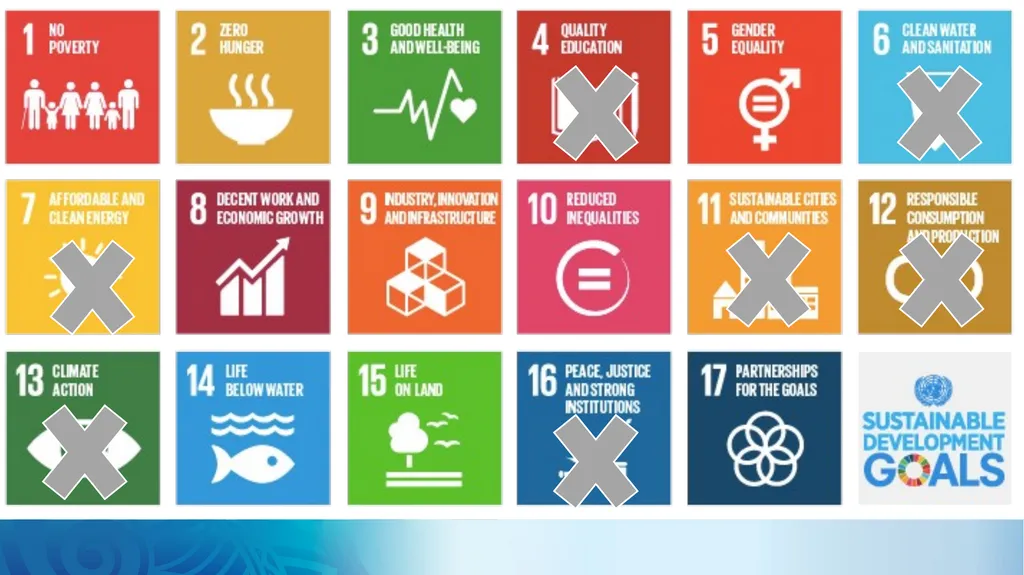
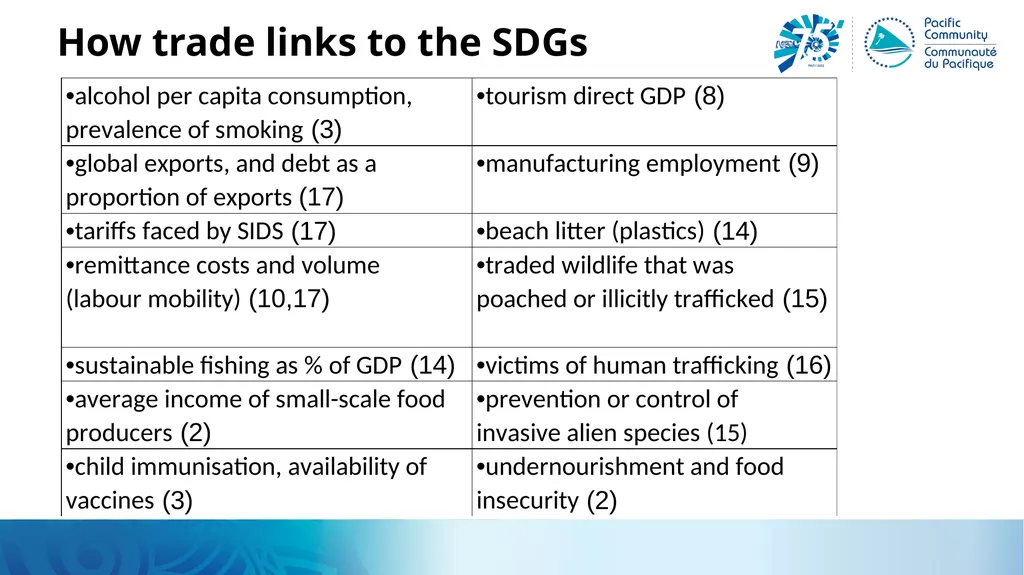
How trade links to the SDGs<br>
06
COVID19, SDGs and trade Some measures taken to fight COVID-19, are likely to increase the risk of NCDs in the long term.
Trade and movement restrictions within and between countries, reduced availability and accessibility to healthier foods, and increased reliance on unhealthy processed foods.
In addition, we saw increased abuse of tobacco and alcohol while being isolated at home and an increase in domestic violence.
Fish supply, consumption and trade revenues declined due to the impact of containment restrictions on demand, logistics, prices, labour and business planning.<br>
07
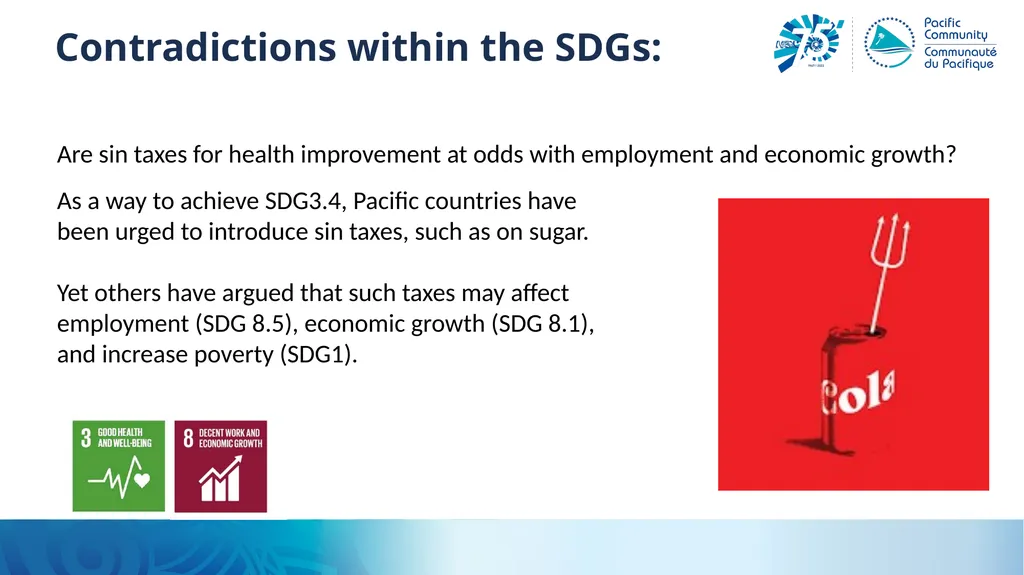
Contradictions within the SDGs: As a way to achieve SDG3.4, Pacific countries have been urged to introduce sin taxes, such as on sugar.
Yet others have argued that such taxes may affect employment (SDG 8.5), economic growth (SDG 8.1), and increase poverty (SDG1). Are sin taxes for health improvement at odds with employment and economic growth?<br>
08
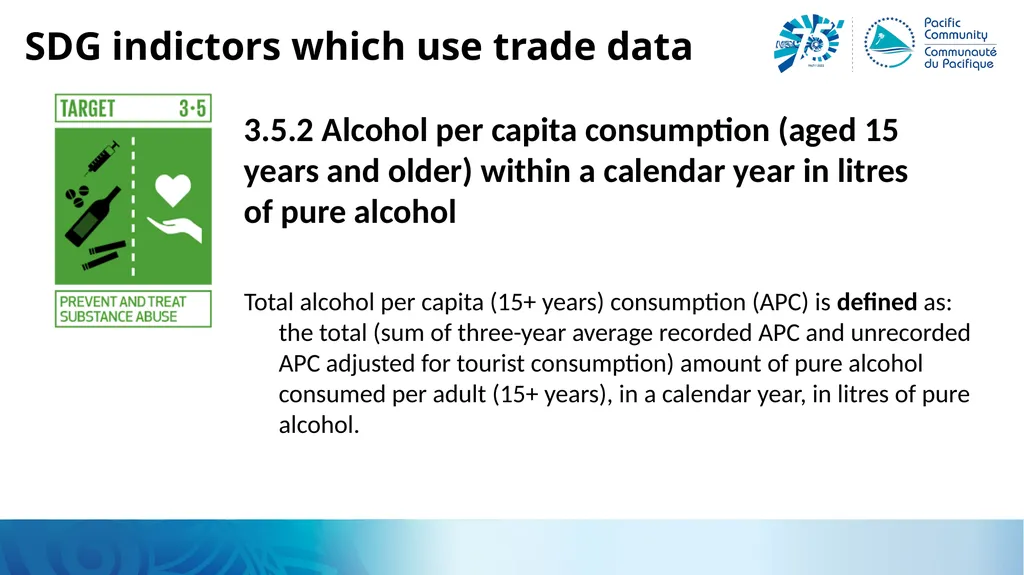
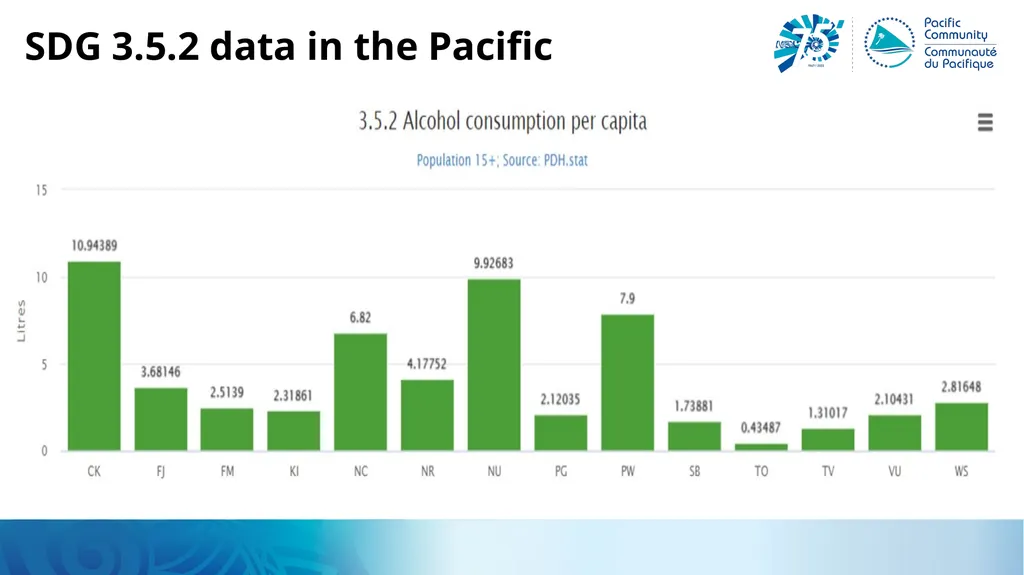
SDG indictors which use trade data 3.5.2 Alcohol per capita consumption (aged 15 years and older) within a calendar year in litres of pure alcohol Total alcohol per capita (15+ years) consumption (APC) is defined as:
the total (sum of three-year average recorded APC and unrecorded
APC adjusted for tourist consumption) amount of pure alcohol
consumed per adult (15+ years), in a calendar year, in litres of pure
alcohol.<br>
09
SDG 3.5.2 continued Recorded alcohol consumption refers to official statistics at country level (production, import, export, and sales or taxation data), while the unrecorded alcohol consumption refers to alcohol which is not taxed and is outside the usual system of governmental control, such as home or informally produced alcohol (legal or illegal), smuggled alcohol, surrogate alcohol (which is alcohol not intended for human consumption), or alcohol obtained through cross-border shopping (which is recorded in a different jurisdiction).
Tourist consumption takes into account tourists visiting the country and inhabitants visiting other countries. Tourist consumption is based on UN statistics (assumes people consume the same amount overseas as they do at home)<br>
10
SDG 3.5.2 continued Why we want this indicator–
Per capita alcohol consumption is seen as the best possible indicator of alcohol exposure in populations and the key indicator for estimating alcohol-attributable disease burden and deaths.
Alcohol consumption has been identified as a component cause for more than 200 diseases, injuries and other health conditions.<br>
11
SDG 3.5.2 data in the Pacific<br>
12
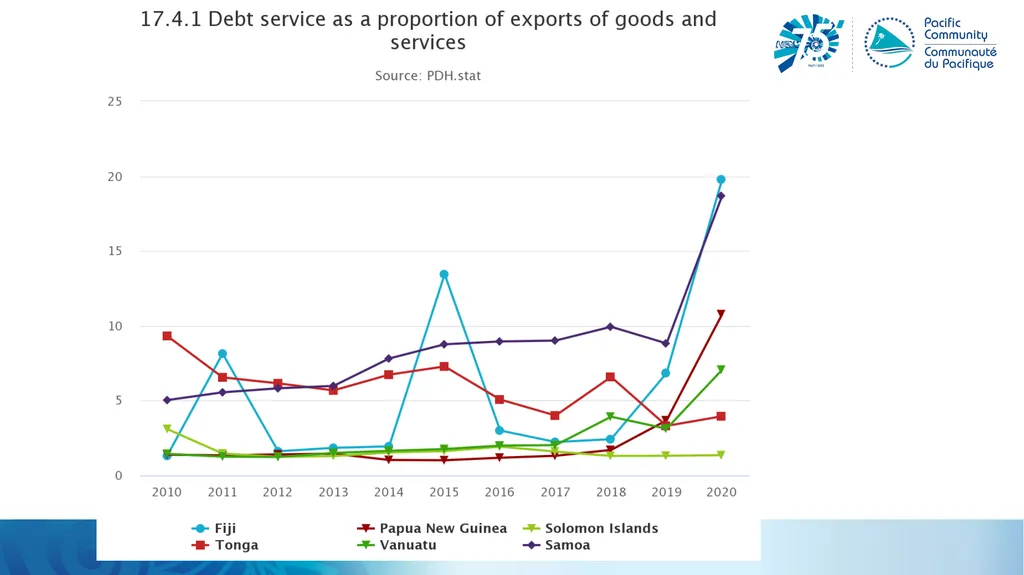
17.4.1 Debt service as a proportion of exports of goods and services “Exports of goods and services” data are sourced from IMF’s Balance of Payments Statistics database and then gap-filled with World Bank staff estimates in accordance with the sixth edition of the Balance of Payments and International Investment Position Manual (BPM6)
Exports data are not reported directly to the World Bank from the national data provider. They are reported to the International Monetary Fund (IMF), which is the institution in charge of overseeing balance of payment stability as part of its institutional mandate.<br>
13
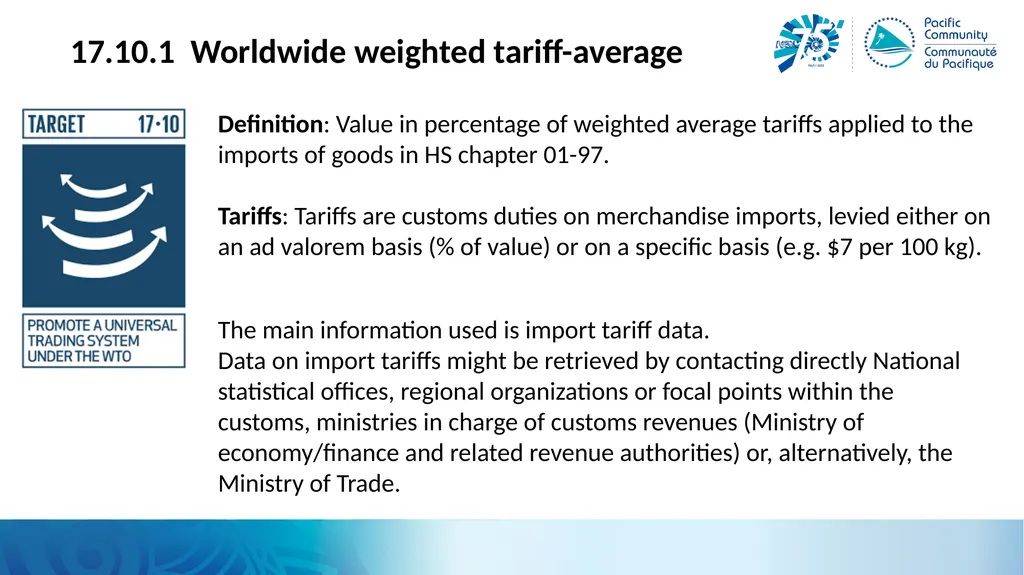
17.10.1 Worldwide weighted tariff-average Definition: Value in percentage of weighted average tariffs applied to the imports of goods in HS chapter 01-97.
Tariffs: Tariffs are customs duties on merchandise imports, levied either on an ad valorem basis (% of value) or on a specific basis (e.g. $7 per 100 kg). The main information used is import tariff data.
Data on import tariffs might be retrieved by contacting directly National statistical offices, regional organizations or focal points within the customs, ministries in charge of customs revenues (Ministry of economy/finance and related revenue authorities) or, alternatively, the Ministry of Trade.<br>
14
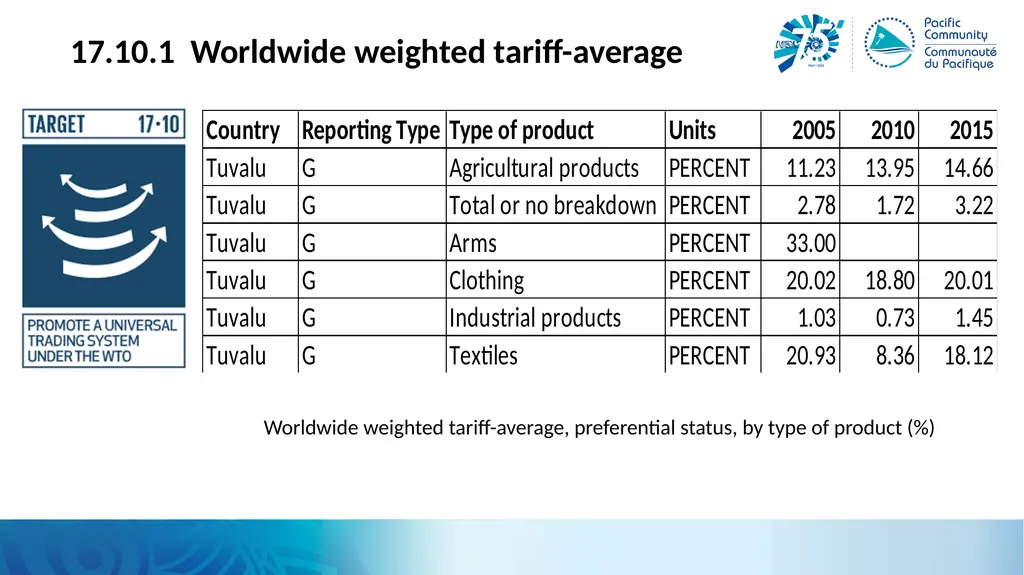
17.10.1 Worldwide weighted tariff-average Worldwide weighted tariff-average, preferential status, by type of product (%)<br>
15
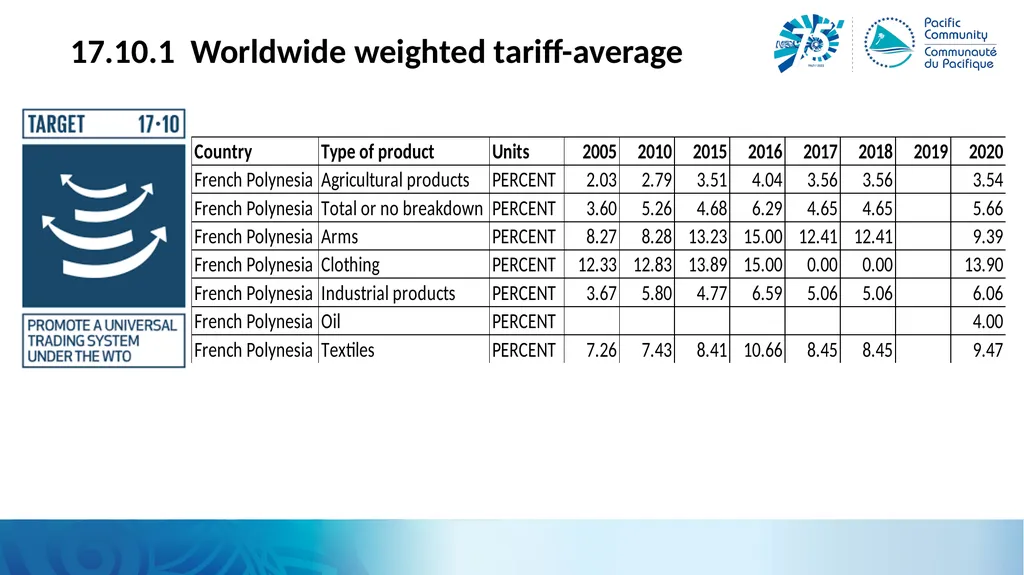
17.10.1 Worldwide weighted tariff-average<br>
16
17.11.1 Developing countries’ and least developed countries’ share of global exports Definition: Exports by developing countries and LDCs as a share of global exports of goods and services Trade in goods data are collected by contacting directly focal points in national agencies or regional organizations (in the case of custom unions or regional economic communities). Trade in goods data included in the WTO (IDB) database are sourced from official notifications of WTO members. Trade in goods data are complemented, when needed using the UN COMTRADE database. Trade in services data are sourced from a joint ITC/UNCTAD/WTO database, based on balance of payments accounts data maintained by the IMF, OECD and EUROSTAT. In some cases WTO jointly with UNCTAD collects information from national sources. Trade in services data can be retrieved by domestic banks and/or national statistic offices.<br>
17
17.12.1 Weighted average tariffs faced by developing countries, least developed countries and small island developing States Definition: Average import tariffs (in per cent) faced by products exported from developing countries and least developed countries.<br>
18
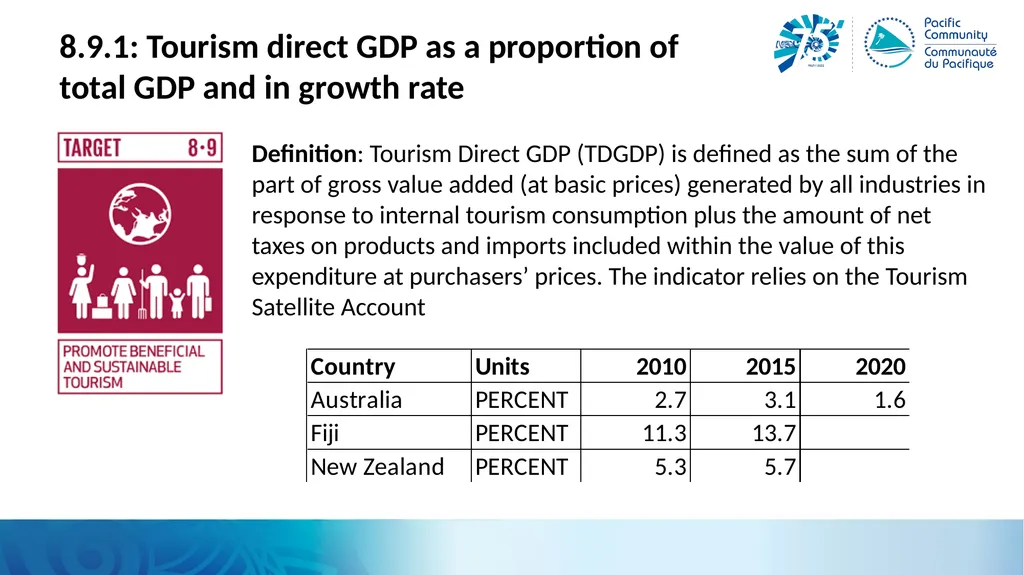
8.9.1: Tourism direct GDP as a proportion of total GDP and in growth rate Definition: Tourism Direct GDP (TDGDP) is defined as the sum of the part of gross value added (at basic prices) generated by all industries in response to internal tourism consumption plus the amount of net taxes on products and imports included within the value of this expenditure at purchasers’ prices. The indicator relies on the Tourism Satellite Account<br>
19
SDG indictors –which could use trade data Indicator 3.b.3: Proportion of health facilities that have a core set of relevant essential medicines available and affordable on a sustainable basis
A medicine is affordable when no extra daily wages (EDW) are needed for the lowest paid unskilled government sector worker (LPGW wage) to purchase a monthly dose treatment of this medicine after fulfilling basic needs represented by the national poverty line (NPL).<br>
20
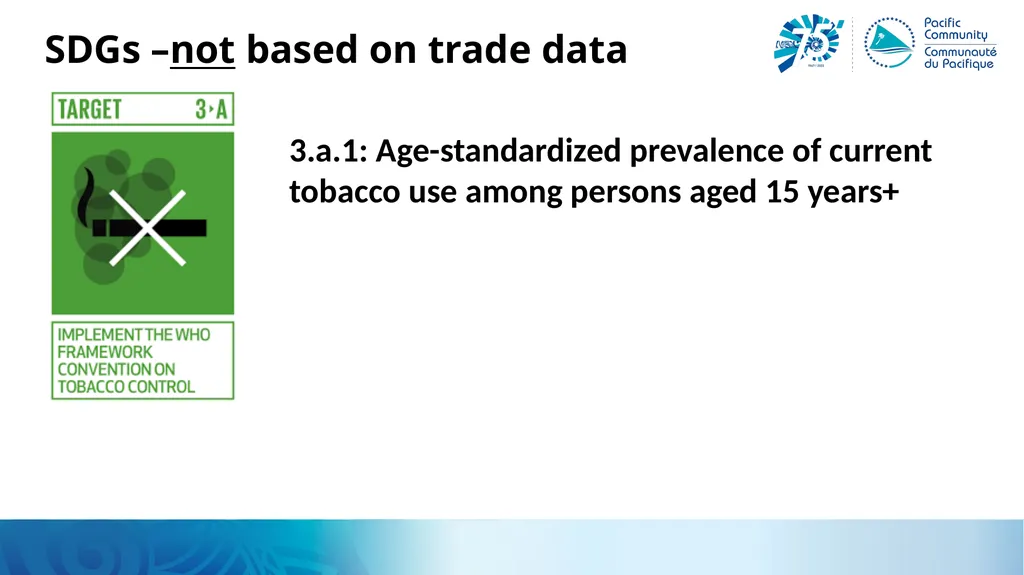
SDGs –not based on trade data 3.a.1: Age-standardized prevalence of current tobacco use among persons aged 15 years+<br>
21
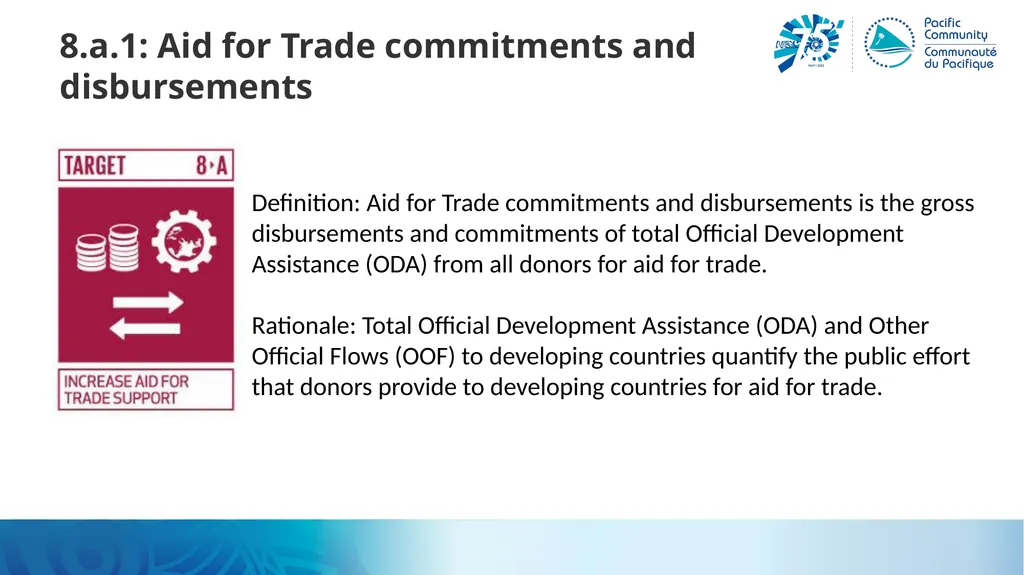
8.a.1: Aid for Trade commitments and disbursements Definition: Aid for Trade commitments and disbursements is the gross disbursements and commitments of total Official Development Assistance (ODA) from all donors for aid for trade.
Rationale: Total Official Development Assistance (ODA) and Other Official Flows (OOF) to developing countries quantify the public effort that donors provide to developing countries for aid for trade.<br>