04
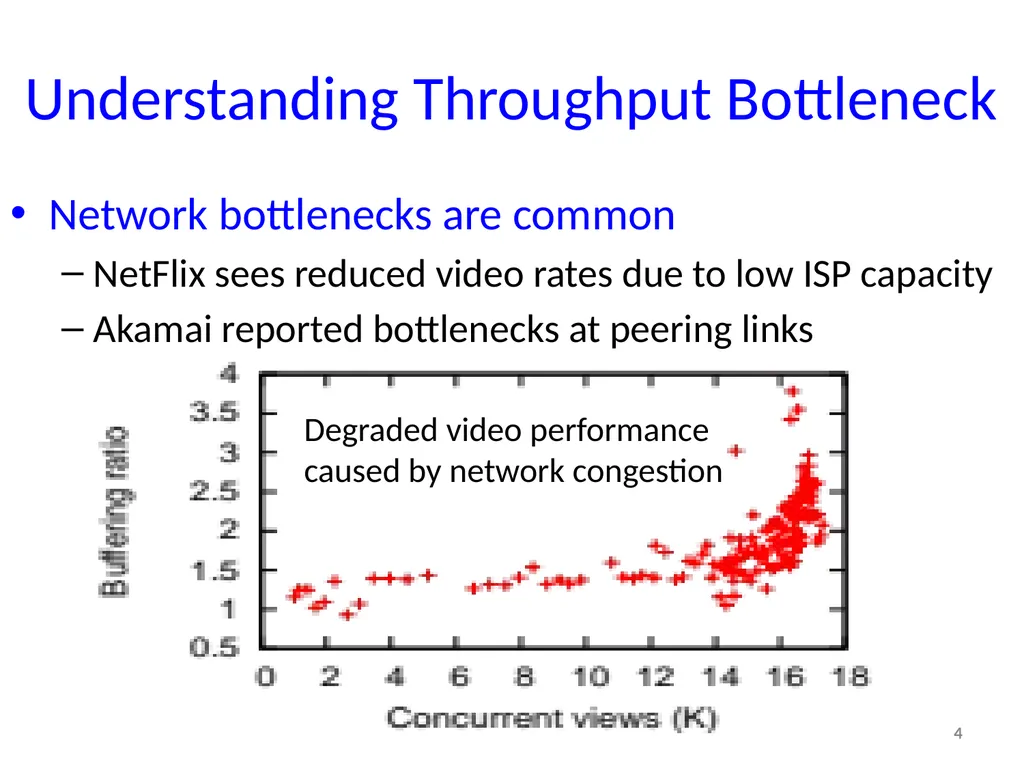
Understanding Throughput Bottleneck Network bottlenecks are common
NetFlix sees reduced video rates due to low ISP capacity
Akamai reported bottlenecks at peering links 4 Degraded video performance caused by network congestion<br>
05
Nature of Bottleneck is Changing More throughput-oriented applications
Video traffic lasts longer and has higher volume
More elephants step on each other in the future
Decreases the benefits of statistical multiplexing
Introduces more challenges in bandwidth provisioning 5<br>
06
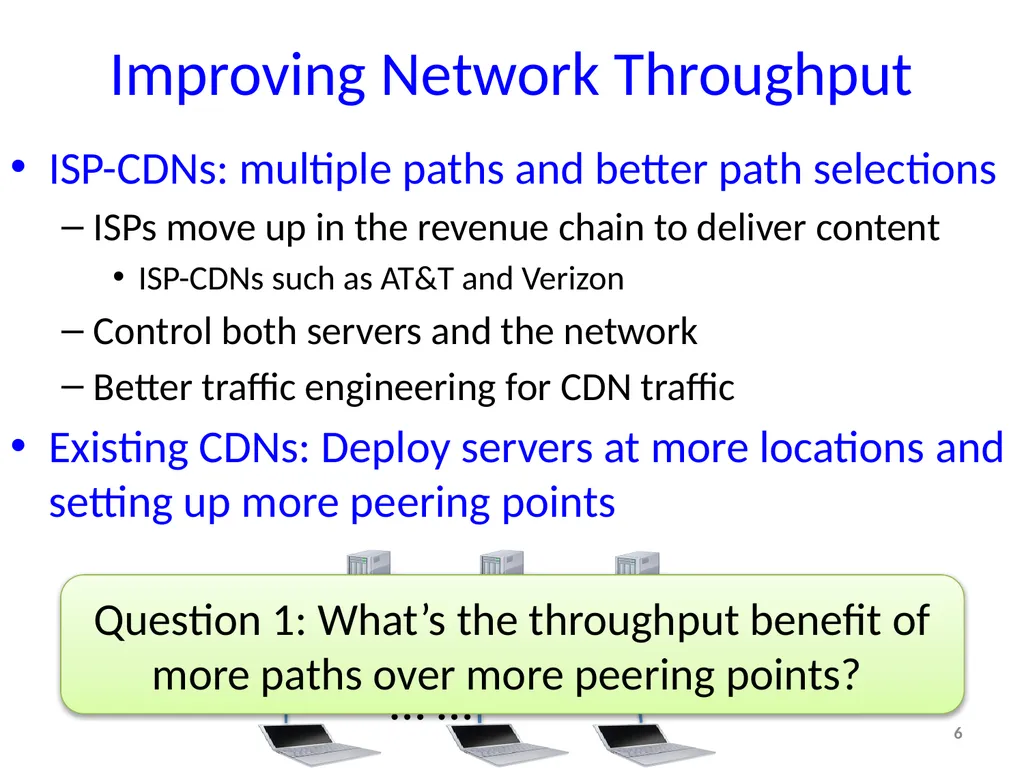
Improving Network Throughput ISP-CDNs: multiple paths and better path selections
ISPs move up in the revenue chain to deliver content
ISP-CDNs such as AT&T and Verizon
Control both servers and the network
Better traffic engineering for CDN traffic
Existing CDNs: Deploy servers at more locations and setting up more peering points 6 Peering points Question 1: What’s the throughput benefit of more paths over more peering points?<br>
07
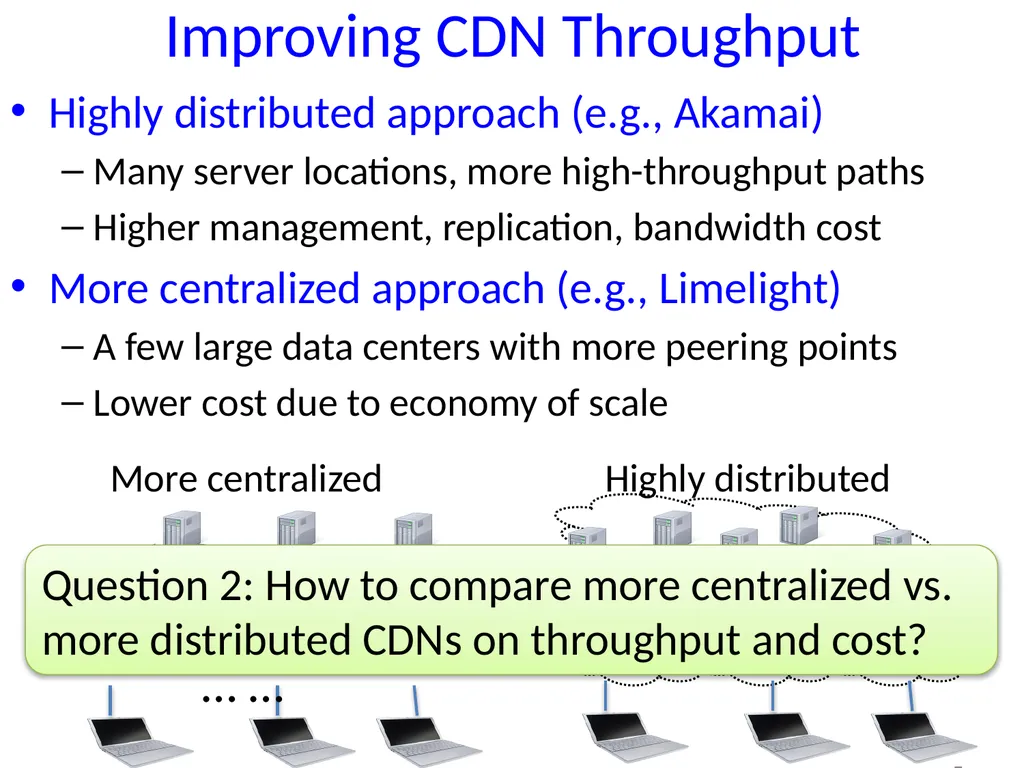
Improving CDN Throughput Highly distributed approach (e.g., Akamai)
Many server locations, more high-throughput paths
Higher management, replication, bandwidth cost
More centralized approach (e.g., Limelight)
A few large data centers with more peering points
Lower cost due to economy of scale 7 More centralized Highly distributed Question 2: How to compare more centralized vs. more distributed CDNs on throughput and cost?<br>
08
Modeling CDN Design Choices CDNs: Increase peering points at the edge
ISPs: Improve path selection at the core 8<br>
09
Increase Peering Points Modeling peering points (PPs)
Increase #PPs to study throughput effect
Pick PP locations from synthetic and real topologies
Peering point selection
Maximize aggregate throughput
By assigning client locations to PPs
… and splitting traffic to different PPs 9<br>
10
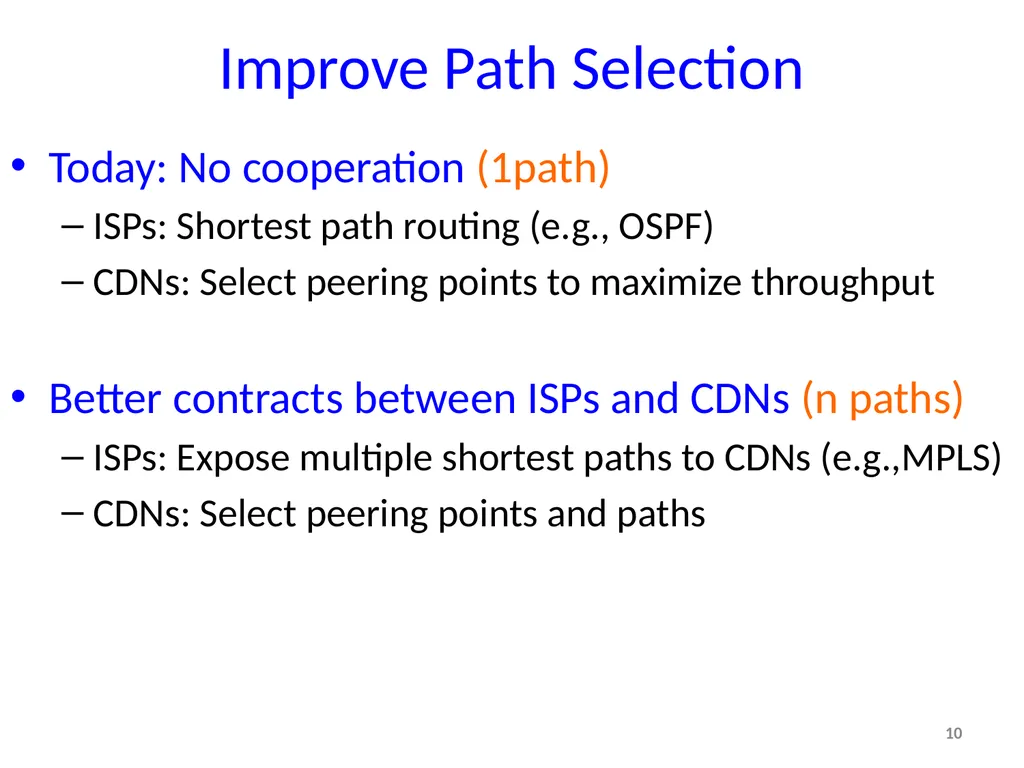
Improve Path Selection Today: No cooperation (1path)
ISPs: Shortest path routing (e.g., OSPF)
CDNs: Select peering points to maximize throughput
Better contracts between ISPs and CDNs (n paths)
ISPs: Expose multiple shortest paths to CDNs (e.g.,MPLS)
CDNs: Select peering points and paths 10<br>
11
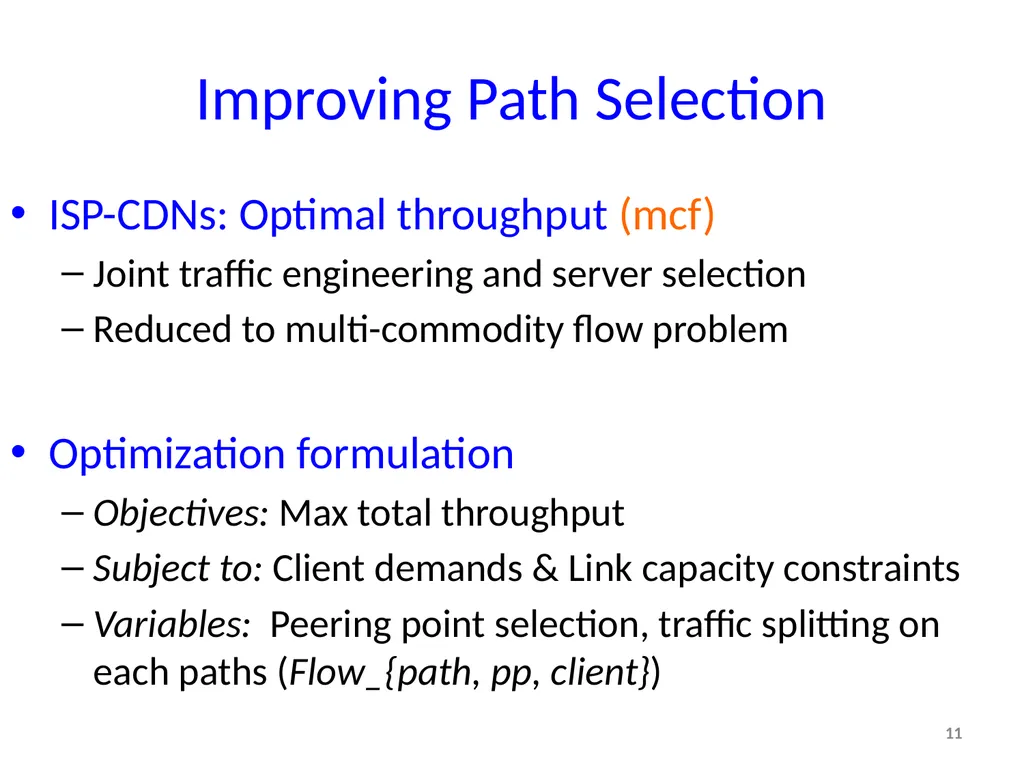
Improving Path Selection ISP-CDNs: Optimal throughput (mcf)
Joint traffic engineering and server selection
Reduced to multi-commodity flow problem
Optimization formulation
Objectives: Max total throughput
Subject to: Client demands & Link capacity constraints
Variables: Peering point selection, traffic splitting on each paths (Flow_{path, pp, client}) 11<br>
12
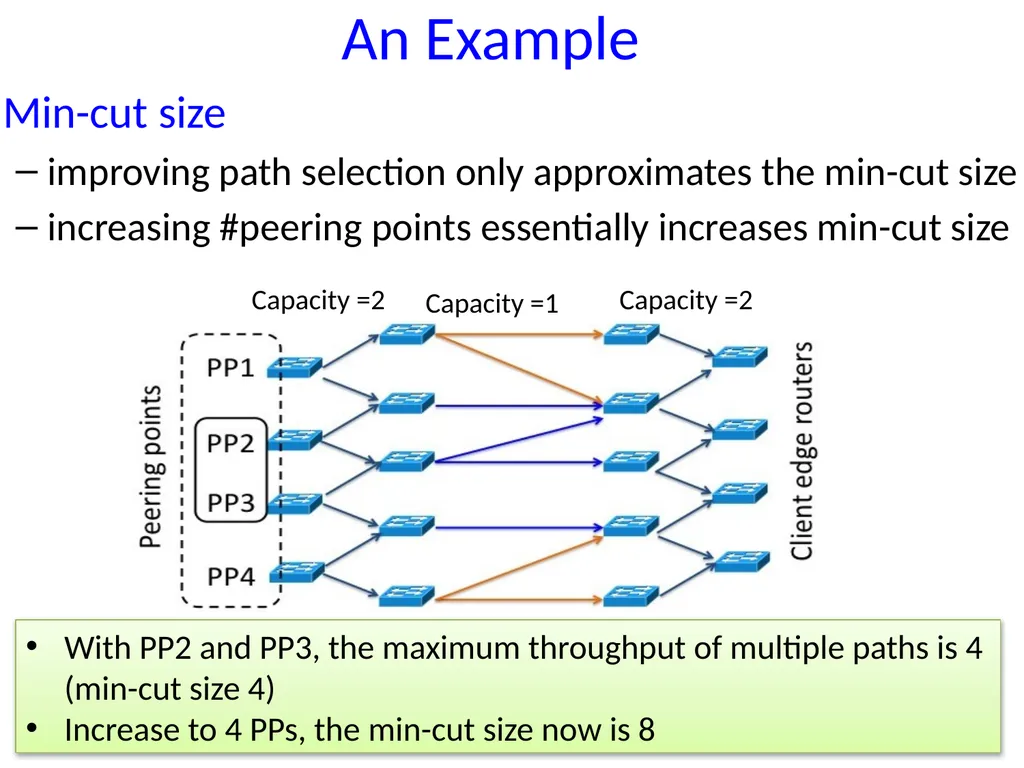
An Example 12 Capacity =2 Capacity =2 Capacity =1 With PP2 and PP3, the maximum throughput of multiple paths is 4 (min-cut size 4)
Increase to 4 PPs, the min-cut size now is 8 Min-cut size
improving path selection only approximates the min-cut size
increasing #peering points essentially increases min-cut size<br>
13
Question 1:�What’s the benefit of path selection �over peering point selection? 13<br>
14
Quantify the Benefits under Various Scenarios Network
Topologies: power-law, random, hierarchy, different link density, router-level ISP topo, AS-level Internet topo
Link capacity distribution: uniform, exp., pareto, higher inter-AS bandwidth
CDN peering points
Map Akamai and Limelight server IP addresses to ASes (collected from PlanetLab measurement at Nov. 2010)
Randomly pick peering points for synthetic topologies
Client demands
Session-level traces from Conviva collected between Dec. 2011 and April. 2012 14<br>
15
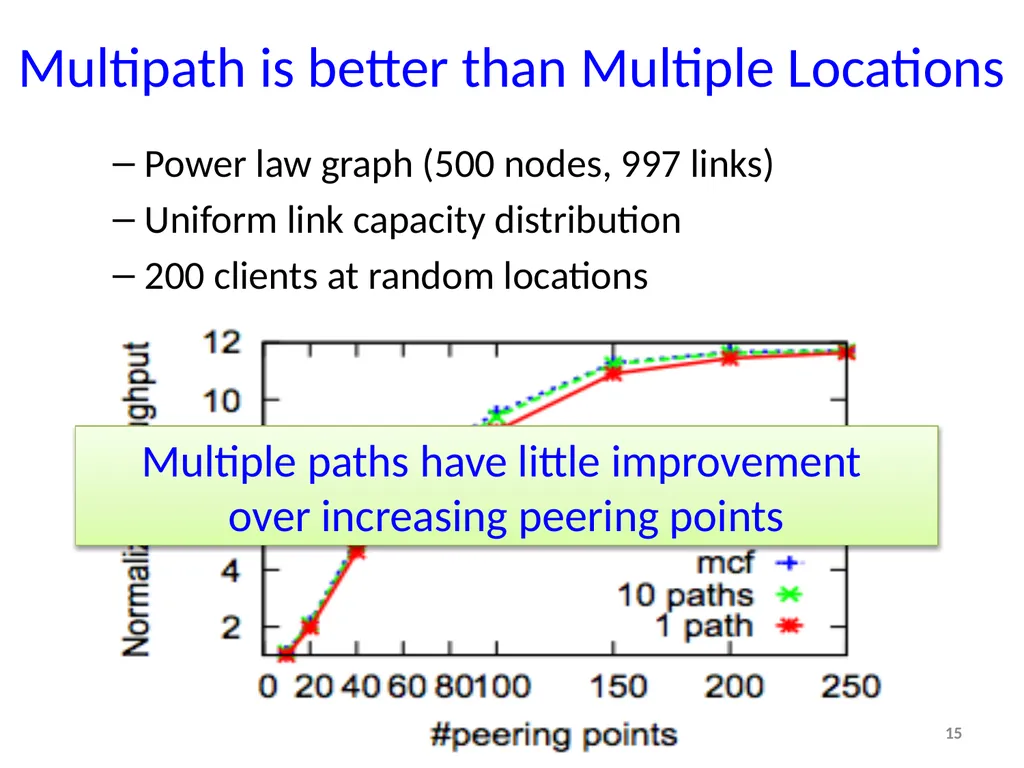
Multipath is better than Multiple Locations Power law graph (500 nodes, 997 links)
Uniform link capacity distribution
200 clients at random locations 15 Multiple paths have little improvement
over increasing peering points<br>
16
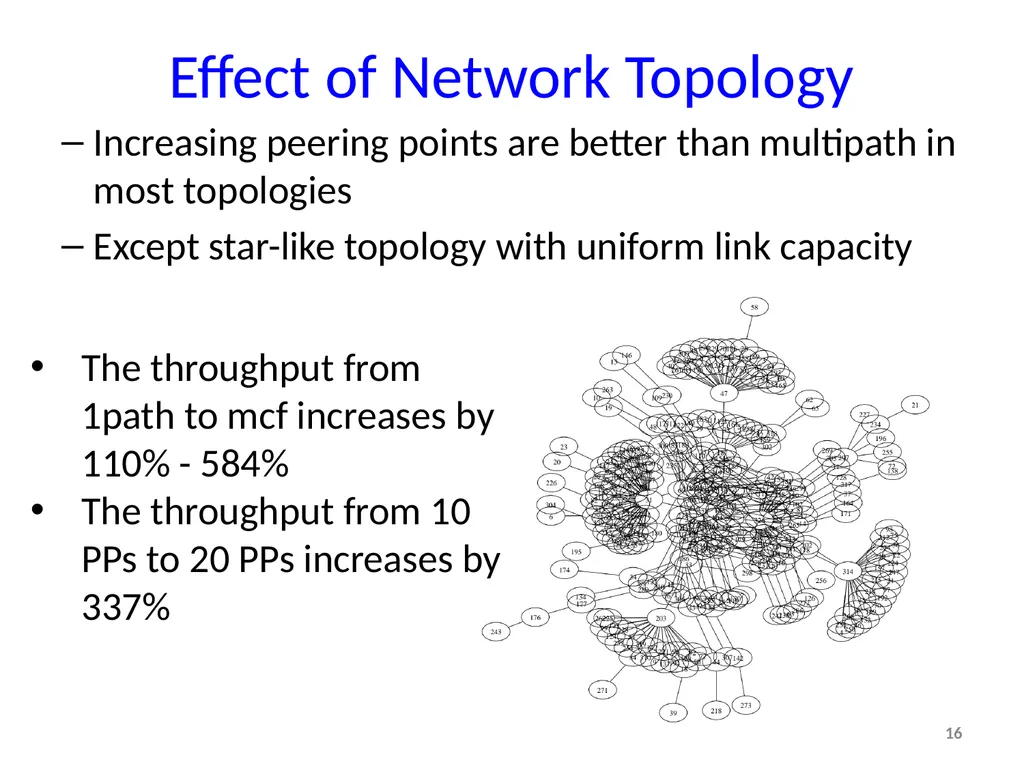
Effect of Network Topology Increasing peering points are better than multipath in most topologies
Except star-like topology with uniform link capacity 16 The throughput from 1path to mcf increases by 110% - 584%
The throughput from 10 PPs to 20 PPs increases by 337%<br>
17
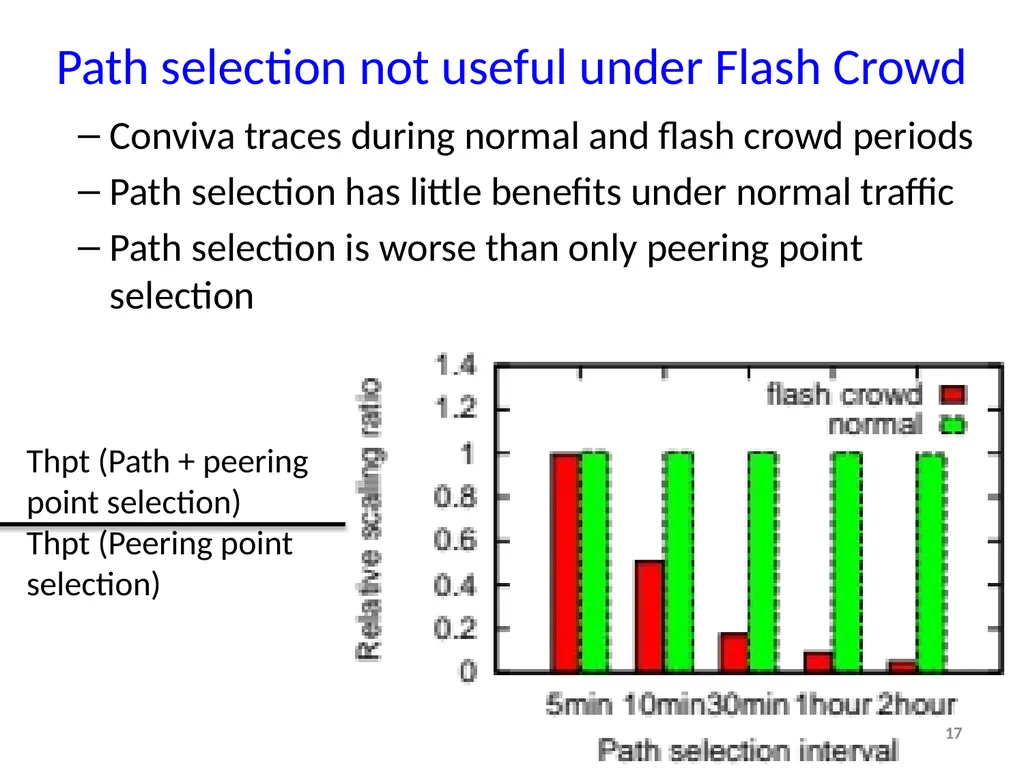
Path selection not useful under Flash Crowd 17 Conviva traces during normal and flash crowd periods
Path selection has little benefits under normal traffic
Path selection is worse than only peering point selection Thpt (Path + peering point selection)
Thpt (Peering point selection)<br>
18
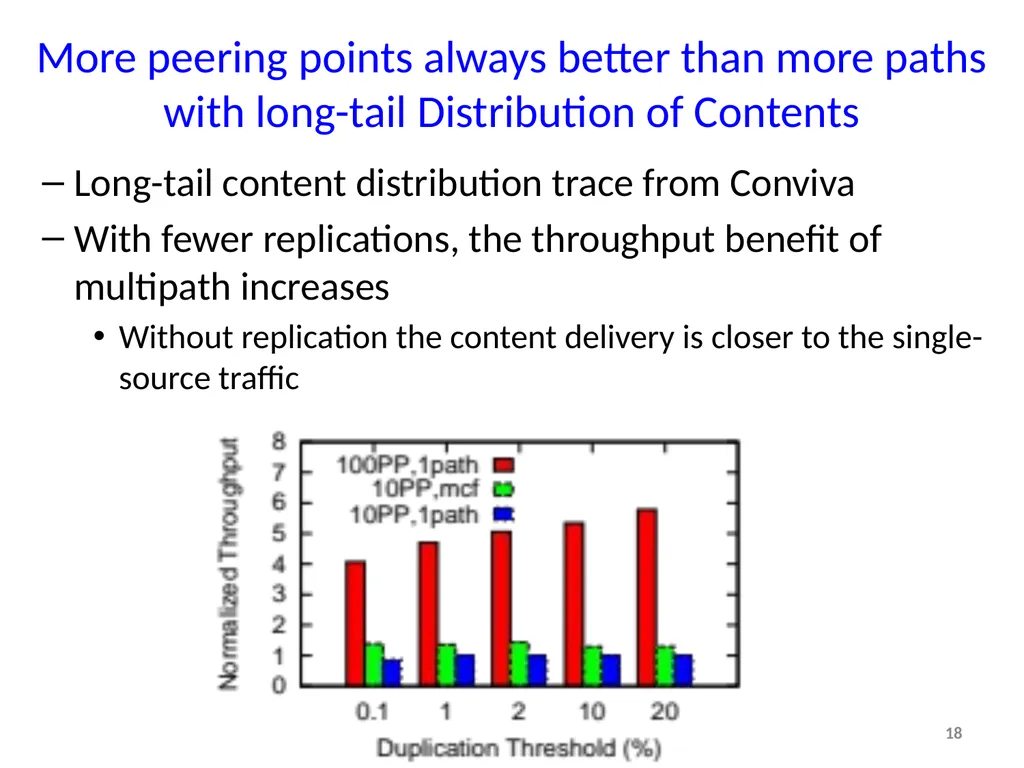
More peering points always better than more paths�with long-tail Distribution of Contents 18 Long-tail content distribution trace from Conviva
With fewer replications, the throughput benefit of multipath increases
Without replication the content delivery is closer to the single-source traffic<br>
19
Takeaway 1:��CDNs only need to control the edge of the Internet to improve the throughput.��ISP-CDNs don’t get significant benefits from controlling the network over CDNs 19<br>
20
Question 2:�How to compare throughput and cost between�more centralized vs more dist. CDNs? 20<br>
21
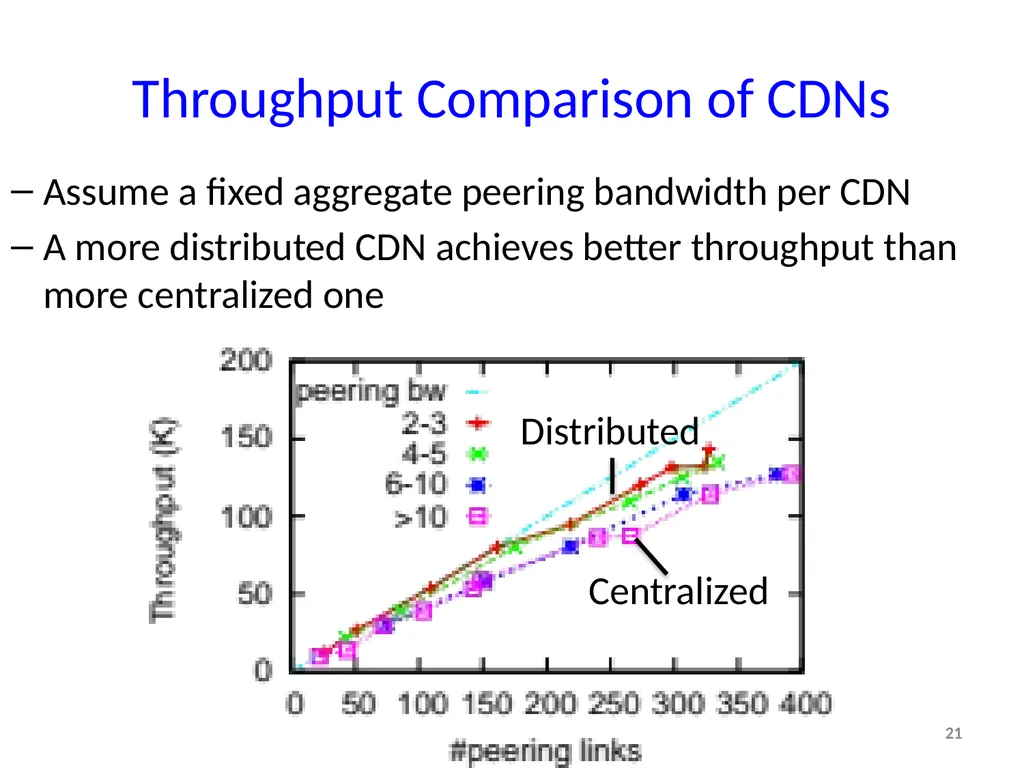
Throughput Comparison of CDNs 21 Assume a fixed aggregate peering bandwidth per CDN
A more distributed CDN achieves better throughput than more centralized one<br>
22
CDN Operation Cost Management cost
At each location: electricity, cooling, equip maintenance, and human resources
Content replication cost
Storage cost to replicate popular content
Bandwidth cost to redirect traffic for rare content
Bandwidth cost
CDNs often pay ISPs for the bandwidth they use at the peering points based on mutually-agreed billing model 22<br>
23
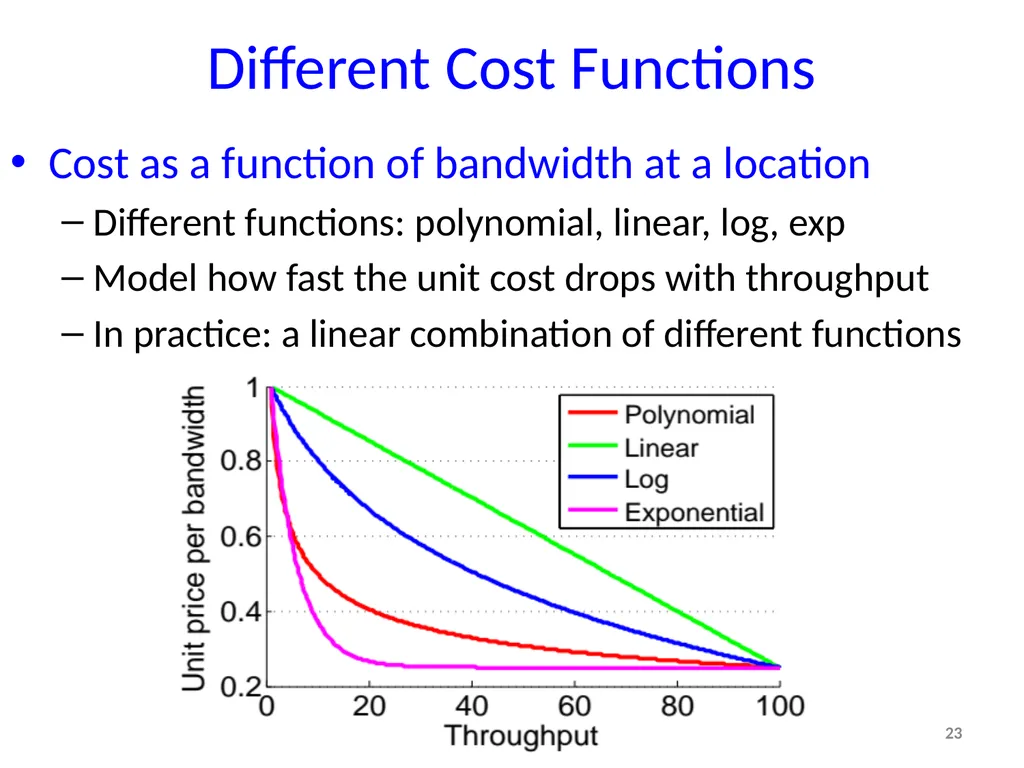
Different Cost Functions 23 Cost as a function of bandwidth at a location
Different functions: polynomial, linear, log, exp
Model how fast the unit cost drops with throughput
In practice: a linear combination of different functions<br>
24
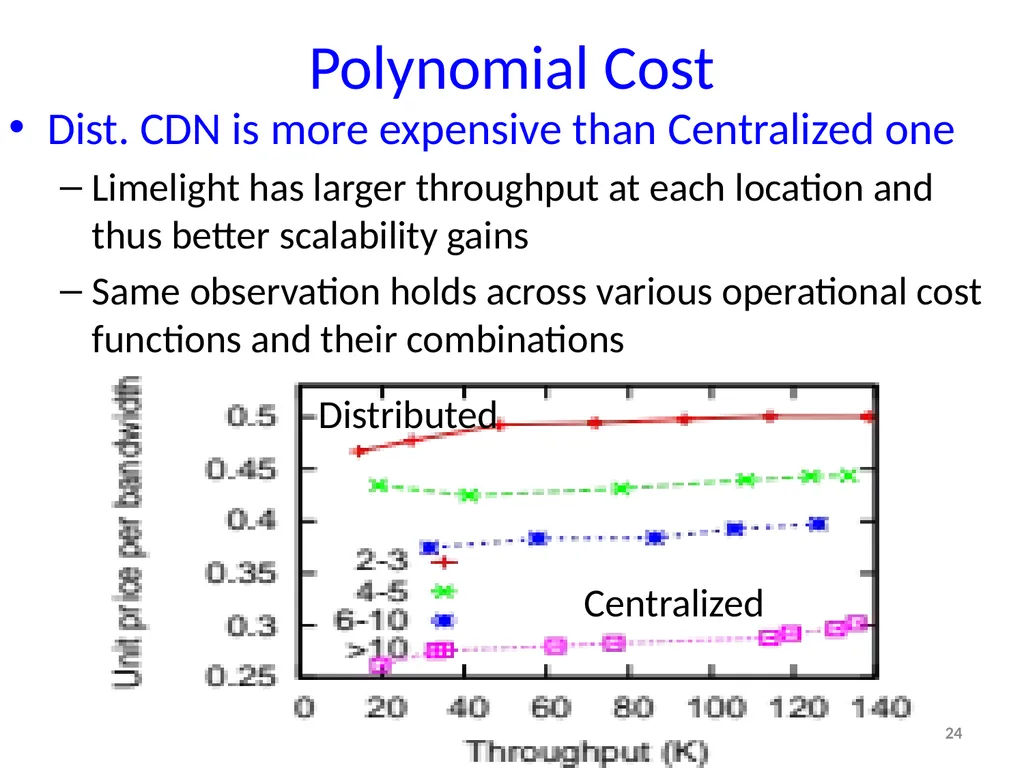
Polynomial Cost 24 Dist. CDN is more expensive than Centralized one
Limelight has larger throughput at each location and thus better scalability gains
Same observation holds across various operational cost functions and their combinations<br>
25
Takeaway 2:��More distributed CDNs achieve higher throughput than more centralized CDNs, but…��… are more expensive for same throughput 25<br>
26
Conclusion A simple model to quantify CDN design choices
Increasing the number of peering points
Improving path selection
More distributed vs more centralized design
Optimizations at the edge is enough for CDNs
Multipath has little benefit over increasing # locations and choosing different peering links
There’s a tradeoff of throughput and cost among CDNs 26<br>
27
Thanks!���Questions? 27<br>