
Training Human Service Providers to Address the
TF
Published · 30 slides · 0 views

1 / 1

Description
Training Human Service Providers to Address the Complex Financial Concerns of Clients Evaluation of the Financial Stability Pathway Provider Project Council on Social Work Education October 25 , 2014 Baltimore City One in four individuals
Related Topics
Share
Embed code
Download this presentation From Below
"Training Human Service Providers to Address the" is the property of its rightful owner. Permission is granted to download and print the materials on this website for personal, non-commercial use only, and to display it on your personal computer provided you do not modify the materials and that you retain all copyright notices contained in the materials. By downloading content from our website, you accept the terms of this agreement.
Presentation Transcript
01
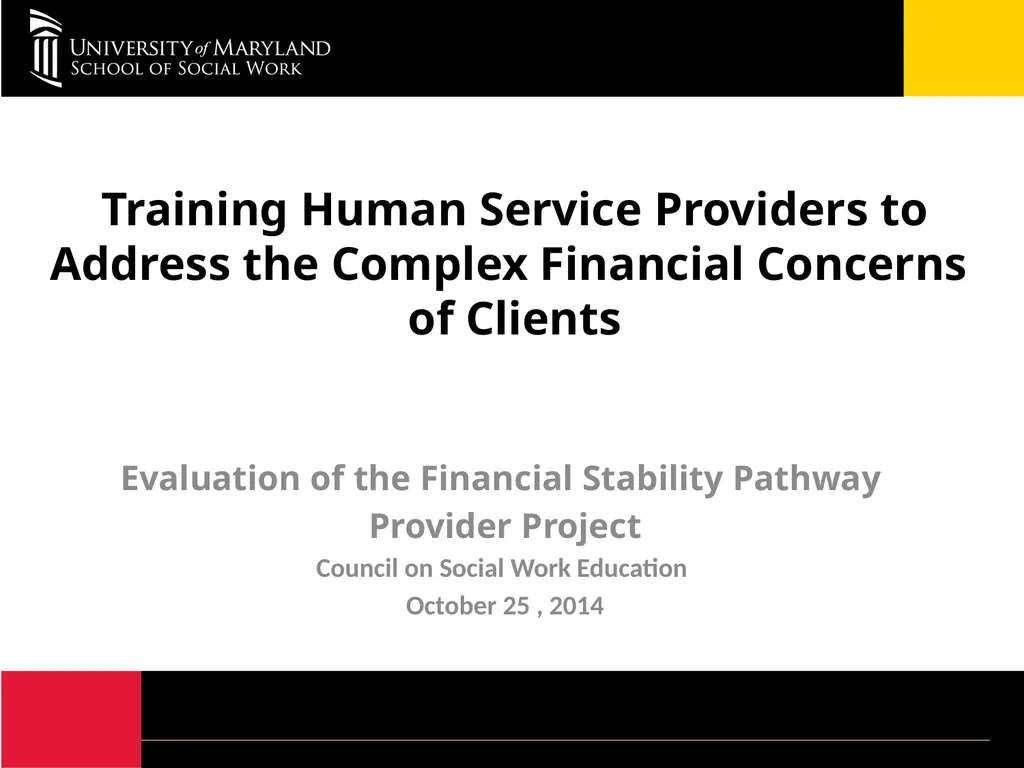
Training Human Service Providers to Address the Complex Financial Concerns
of Clients Evaluation of the Financial Stability Pathway
Provider Project
Council on Social Work Education
October 25 , 2014<br>
Provider Project
Council on Social Work Education
October 25 , 2014<br>
02
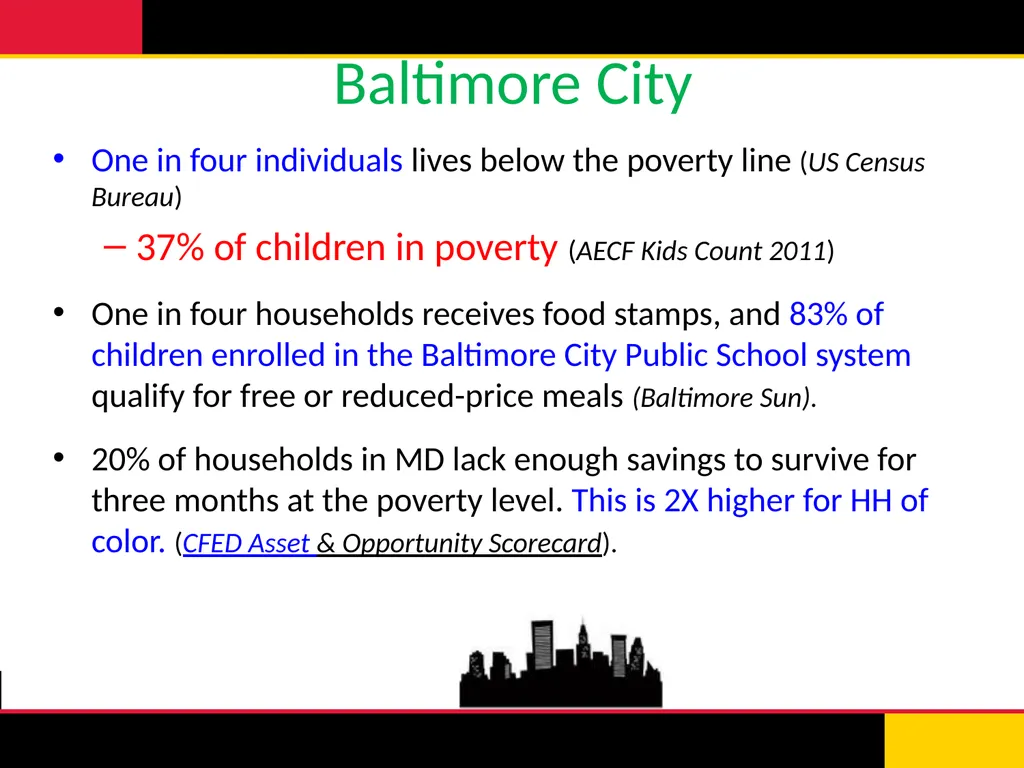
Baltimore City One in four individuals lives below the poverty line (US Census Bureau)
37% of children in poverty (AECF Kids Count 2011)
One in four households receives food stamps, and 83% of children enrolled in the Baltimore City Public School system qualify for free or reduced-price meals (Baltimore Sun).
20% of households in MD lack enough savings to survive for three months at the poverty level. This is 2X higher for HH of color. (CFED Asset & Opportunity Scorecard).<br>
37% of children in poverty (AECF Kids Count 2011)
One in four households receives food stamps, and 83% of children enrolled in the Baltimore City Public School system qualify for free or reduced-price meals (Baltimore Sun).
20% of households in MD lack enough savings to survive for three months at the poverty level. This is 2X higher for HH of color. (CFED Asset & Opportunity Scorecard).<br>
03
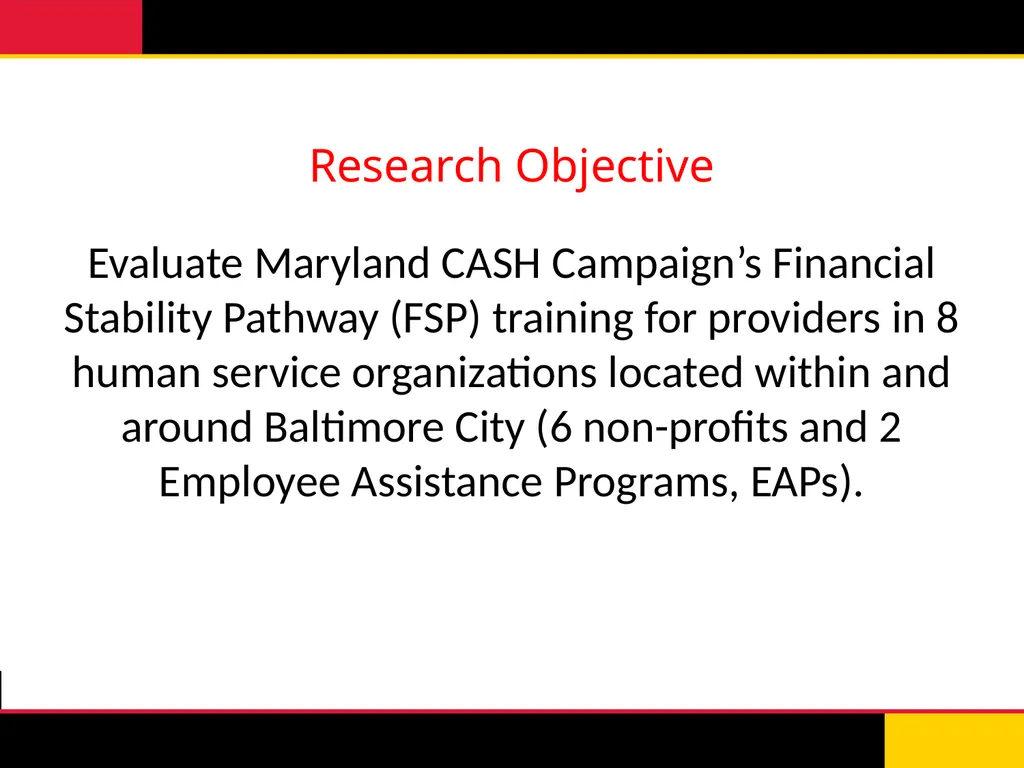
Research Objective Evaluate Maryland CASH Campaign’s Financial Stability Pathway (FSP) training for providers in 8 human service organizations located within and around Baltimore City (6 non-profits and 2 Employee Assistance Programs, EAPs).<br>
04
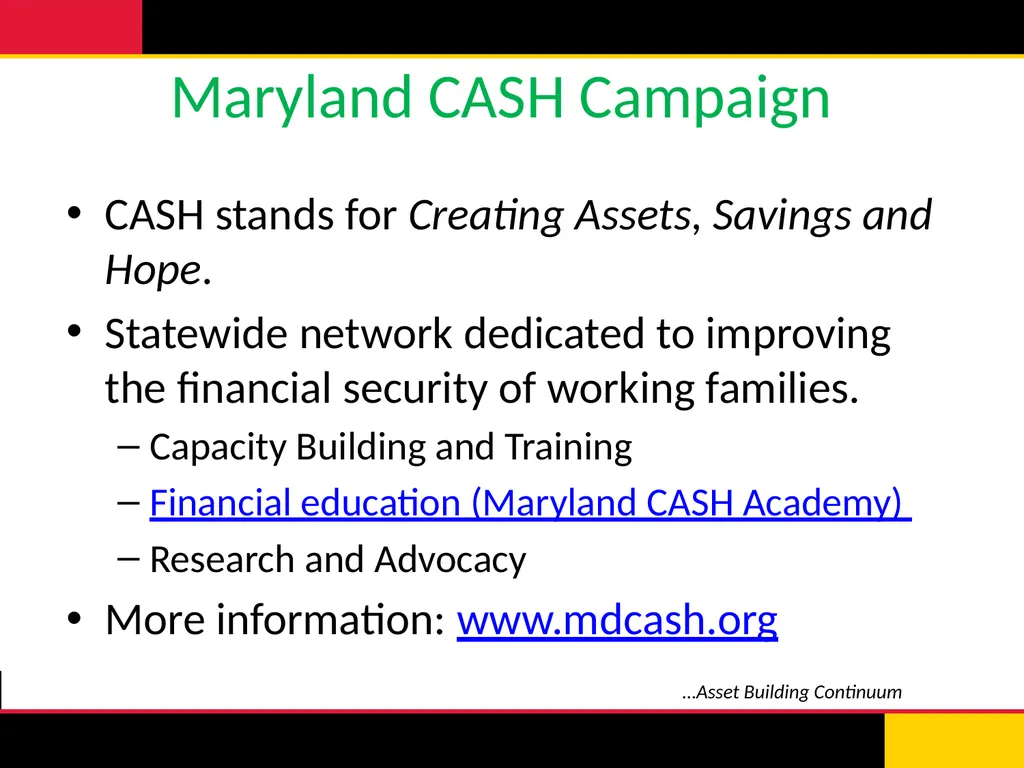
Maryland CASH Campaign CASH stands for Creating Assets, Savings and Hope.
Statewide network dedicated to improving the financial security of working families.
Capacity Building and Training
Financial education (Maryland CASH Academy)
Research and Advocacy
More information: www.mdcash.org …Asset Building Continuum<br>
Statewide network dedicated to improving the financial security of working families.
Capacity Building and Training
Financial education (Maryland CASH Academy)
Research and Advocacy
More information: www.mdcash.org …Asset Building Continuum<br>
05
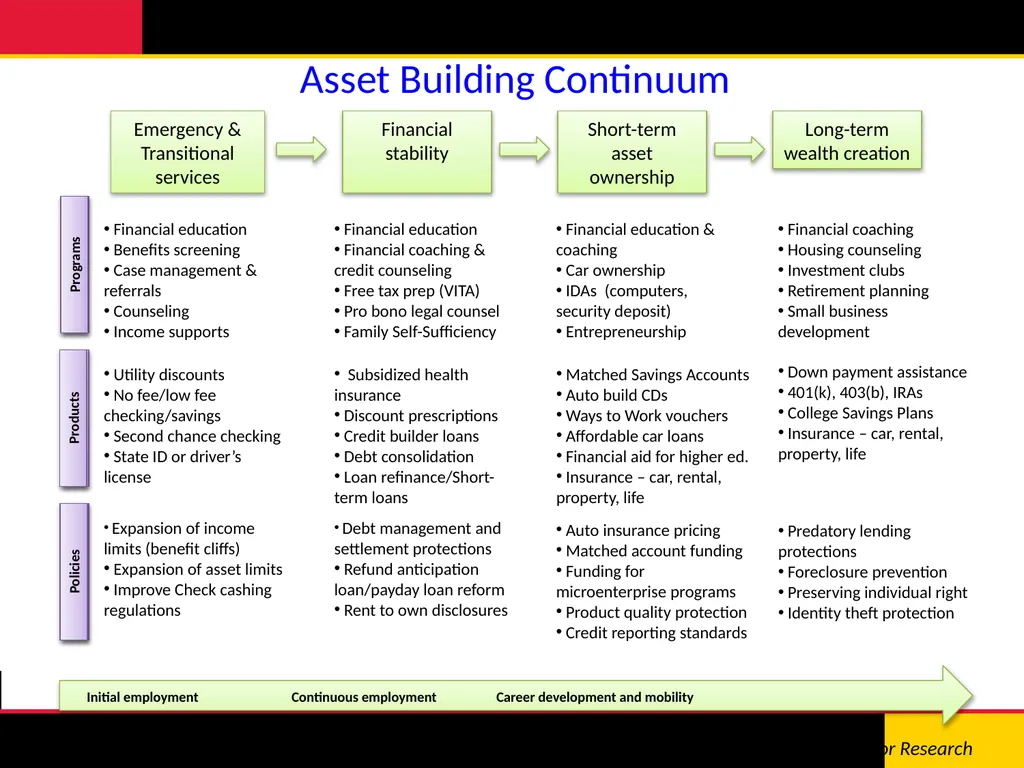
Asset Building Continuum Copyright Job Opportunities Task Force (Maryland CASH Campaign) 2008 …Need for Research<br>
06
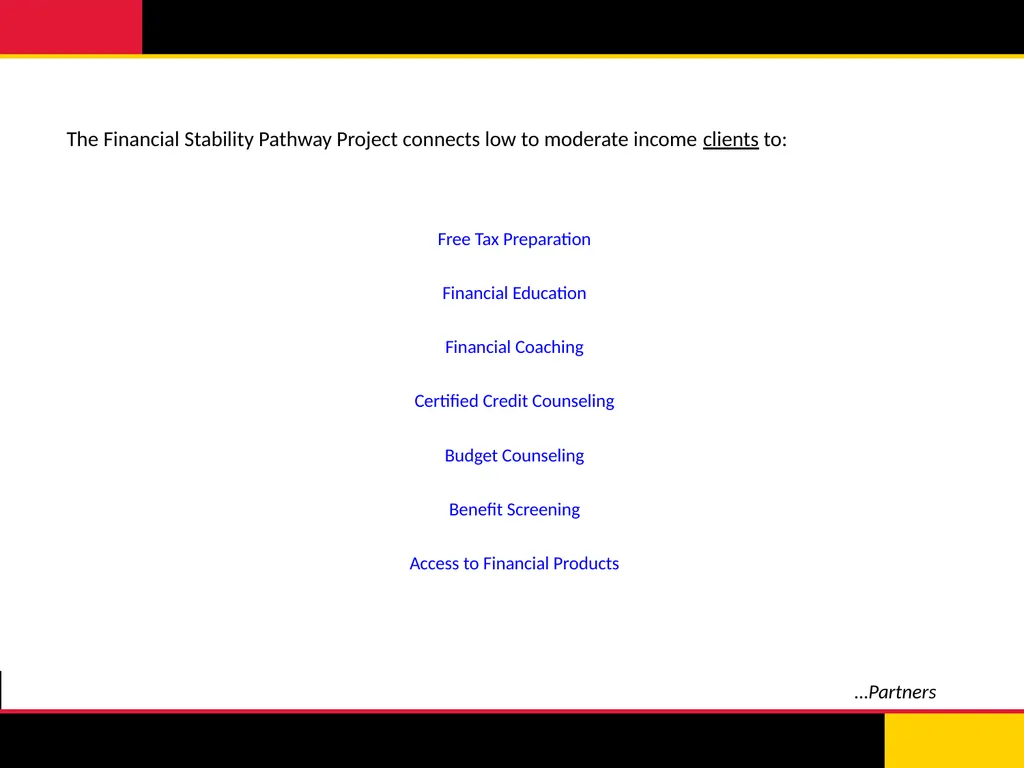
The Financial Stability Pathway Project connects low to moderate income clients to:
Free Tax Preparation
Financial Education
Financial Coaching
Certified Credit Counseling
Budget Counseling
Benefit Screening
Access to Financial Products …Partners<br>
Free Tax Preparation
Financial Education
Financial Coaching
Certified Credit Counseling
Budget Counseling
Benefit Screening
Access to Financial Products …Partners<br>
07
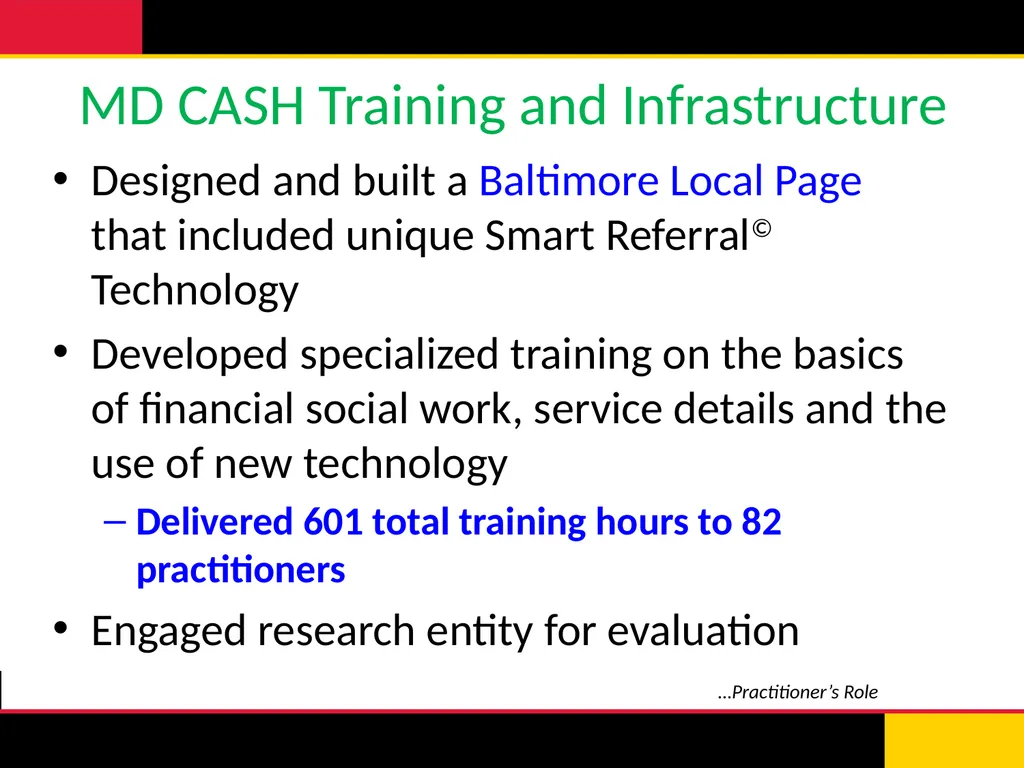
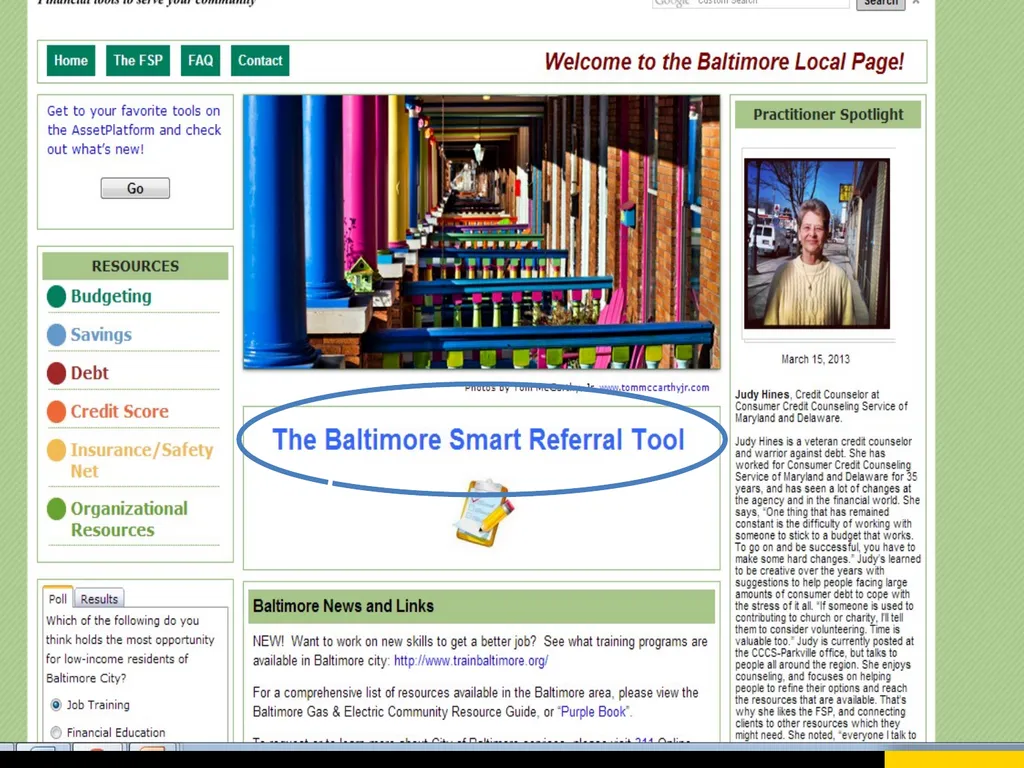
MD CASH Training and Infrastructure Designed and built a Baltimore Local Page that included unique Smart Referral© Technology
Developed specialized training on the basics of financial social work, service details and the use of new technology
Delivered 601 total training hours to 82 practitioners
Engaged research entity for evaluation …Practitioner’s Role<br>
Developed specialized training on the basics of financial social work, service details and the use of new technology
Delivered 601 total training hours to 82 practitioners
Engaged research entity for evaluation …Practitioner’s Role<br>
08
FSP<br>
09
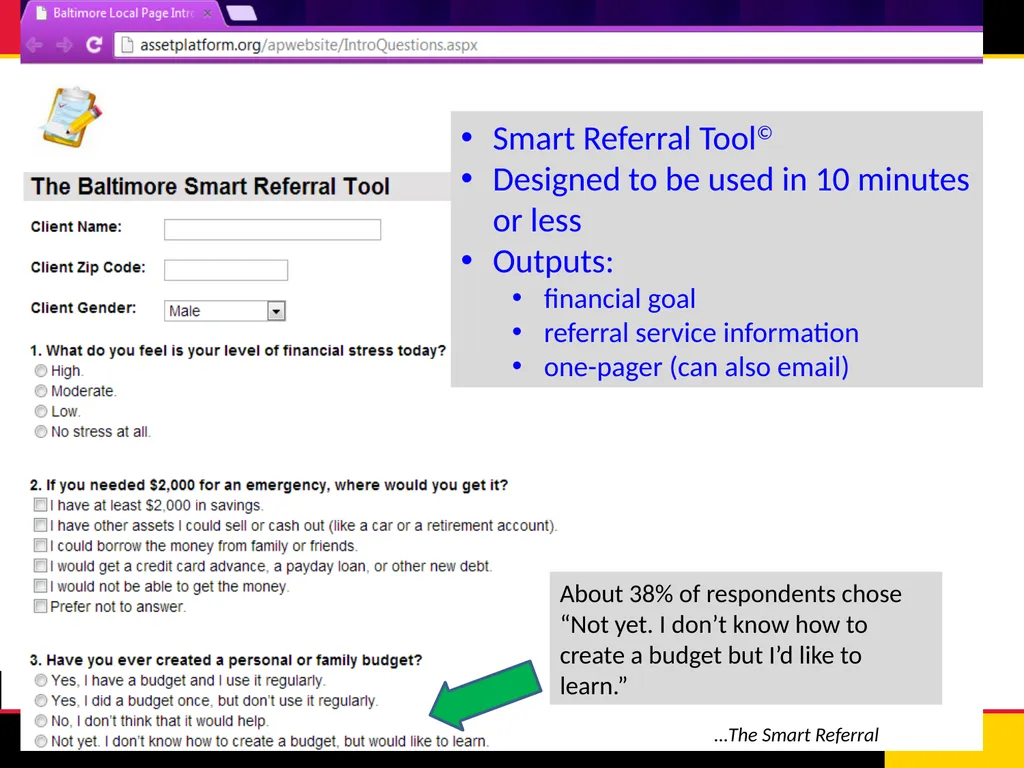
Smart Referral Tool©
Designed to be used in 10 minutes or less
Outputs:
financial goal
referral service information
one-pager (can also email) About 38% of respondents chose “Not yet. I don’t know how to create a budget but I’d like to learn.” …The Smart Referral<br>
Designed to be used in 10 minutes or less
Outputs:
financial goal
referral service information
one-pager (can also email) About 38% of respondents chose “Not yet. I don’t know how to create a budget but I’d like to learn.” …The Smart Referral<br>
10
Practitioner’s Role Practitioners should not give financial advice, investment tips, or provide referrals to brokers. In short, not financial planners.
Practitioners currently help clients create budgets, manage benefits, and sometimes manage their finances (representative payees).
Practitioners can help clients work through the psychosocial side of financial management.<br>
Practitioners currently help clients create budgets, manage benefits, and sometimes manage their finances (representative payees).
Practitioners can help clients work through the psychosocial side of financial management.<br>
11
Psychosocial Side of Financial Management Reflecting on own biases
Asking questions without judgment
Money is emotional, staying with the client where they are
Use tools to help ask directive questions
Need to be familiar with types of financial assistance programs and resources within the community<br>
Asking questions without judgment
Money is emotional, staying with the client where they are
Use tools to help ask directive questions
Need to be familiar with types of financial assistance programs and resources within the community<br>
12
Financial Stability Pathway Training for Providers: Overview Financial stability
Use of Maryland CASH Smart Referral Tool on the Baltimore City Local Page of the Asset Platform (Aspen Institute)
Assessment of financial problems
Help individuals and families manage: 1) current financial situations; 2) improve future financial outlook; 3) address emotional concerns & problems related to finances
Monthly consultation and meetings with researchers and Maryland CASH staff<br>
Use of Maryland CASH Smart Referral Tool on the Baltimore City Local Page of the Asset Platform (Aspen Institute)
Assessment of financial problems
Help individuals and families manage: 1) current financial situations; 2) improve future financial outlook; 3) address emotional concerns & problems related to finances
Monthly consultation and meetings with researchers and Maryland CASH staff<br>
13
Methods Provider Study:
One group, longitudinal research design
Pre-test, post-test (immediately after training), and follow-up (9 months) online surveys
Outcomes: providers’ knowledge, self-efficacy and practice behaviors<br>
One group, longitudinal research design
Pre-test, post-test (immediately after training), and follow-up (9 months) online surveys
Outcomes: providers’ knowledge, self-efficacy and practice behaviors<br>
14
Measures: Provider Survey Pretest: 7 sections to survey + open-ended questions
Baseline understanding of providers’ financial knowledge,
Confidence to work with clients on financial problems,
Practice behaviors
Own financial behaviors
Post-Test -- immediately following training
Follow-Up -- 9 months after training<br>
Baseline understanding of providers’ financial knowledge,
Confidence to work with clients on financial problems,
Practice behaviors
Own financial behaviors
Post-Test -- immediately following training
Follow-Up -- 9 months after training<br>
15
Measures for Providers (continued) Section I: demographics and professional experience
Section II: prior education on financial capability
Section III: work setting and client practice behaviors
Section IV: perceived preparedness to deliver financial services to clients within work setting
Section V: financial well-being assessed using the Personal Financial Wellness Scale (PFW; Prawitz et al, 2006).<br>
Section II: prior education on financial capability
Section III: work setting and client practice behaviors
Section IV: perceived preparedness to deliver financial services to clients within work setting
Section V: financial well-being assessed using the Personal Financial Wellness Scale (PFW; Prawitz et al, 2006).<br>
16
Measures for Providers (continued) Section VI: personal financial knowledge
assessed using 3 indices (credit, savings, and other financial topics)
from the University of Michigan’s quiz, “What’s Your Financial IQ,” part of the broader national study, Survey of Consumers (Hilgert et al., 2003)
Section VII: financial behaviors assessed using the Financial Management Behavior Scale-Revised (FMBS; Dew & Xiao, 2011)<br>
assessed using 3 indices (credit, savings, and other financial topics)
from the University of Michigan’s quiz, “What’s Your Financial IQ,” part of the broader national study, Survey of Consumers (Hilgert et al., 2003)
Section VII: financial behaviors assessed using the Financial Management Behavior Scale-Revised (FMBS; Dew & Xiao, 2011)<br>
17
Results
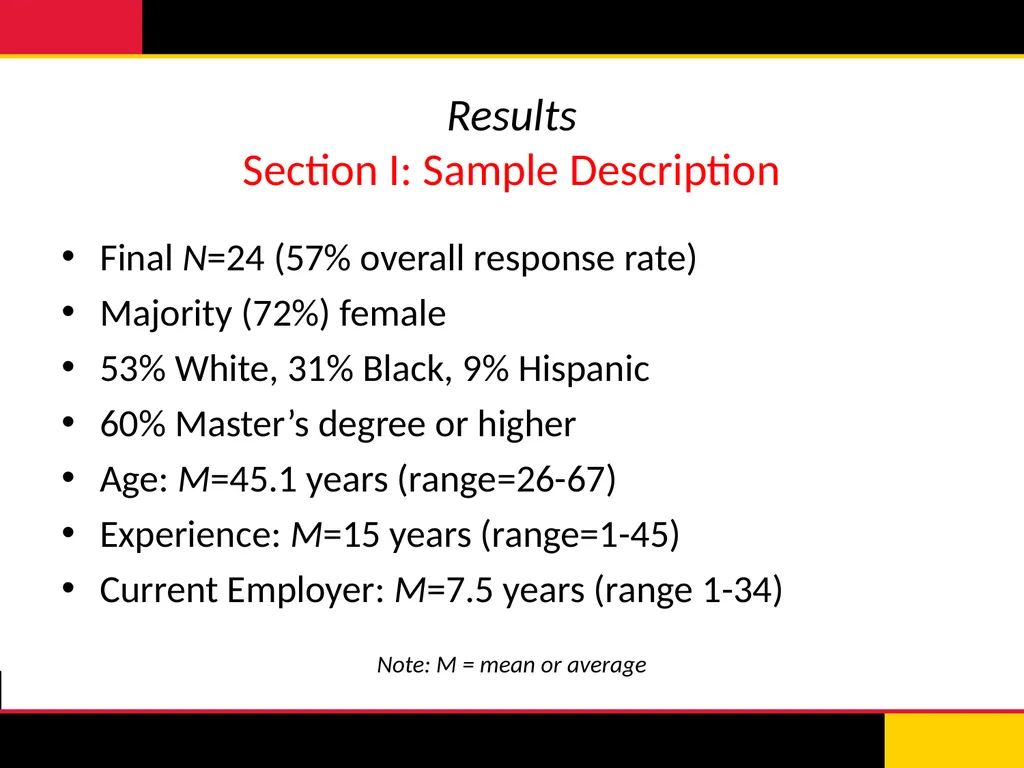
Section I: Sample Description Final N=24 (57% overall response rate)
Majority (72%) female
53% White, 31% Black, 9% Hispanic
60% Master’s degree or higher
Age: M=45.1 years (range=26-67)
Experience: M=15 years (range=1-45)
Current Employer: M=7.5 years (range 1-34)
Note: M = mean or average<br>
Majority (72%) female
53% White, 31% Black, 9% Hispanic
60% Master’s degree or higher
Age: M=45.1 years (range=26-67)
Experience: M=15 years (range=1-45)
Current Employer: M=7.5 years (range 1-34)
Note: M = mean or average<br>
18
Results
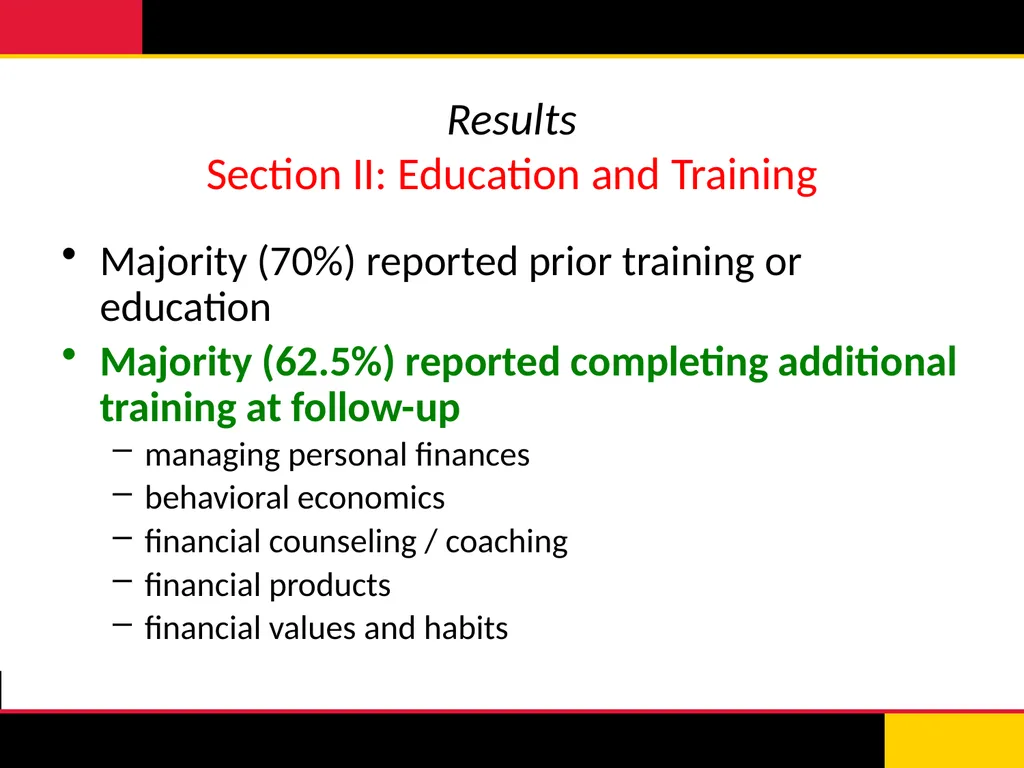
Section II: Education and Training Majority (70%) reported prior training or education
Majority (62.5%) reported completing additional training at follow-up
managing personal finances
behavioral economics
financial counseling / coaching
financial products
financial values and habits<br>
Majority (62.5%) reported completing additional training at follow-up
managing personal finances
behavioral economics
financial counseling / coaching
financial products
financial values and habits<br>
19
Results
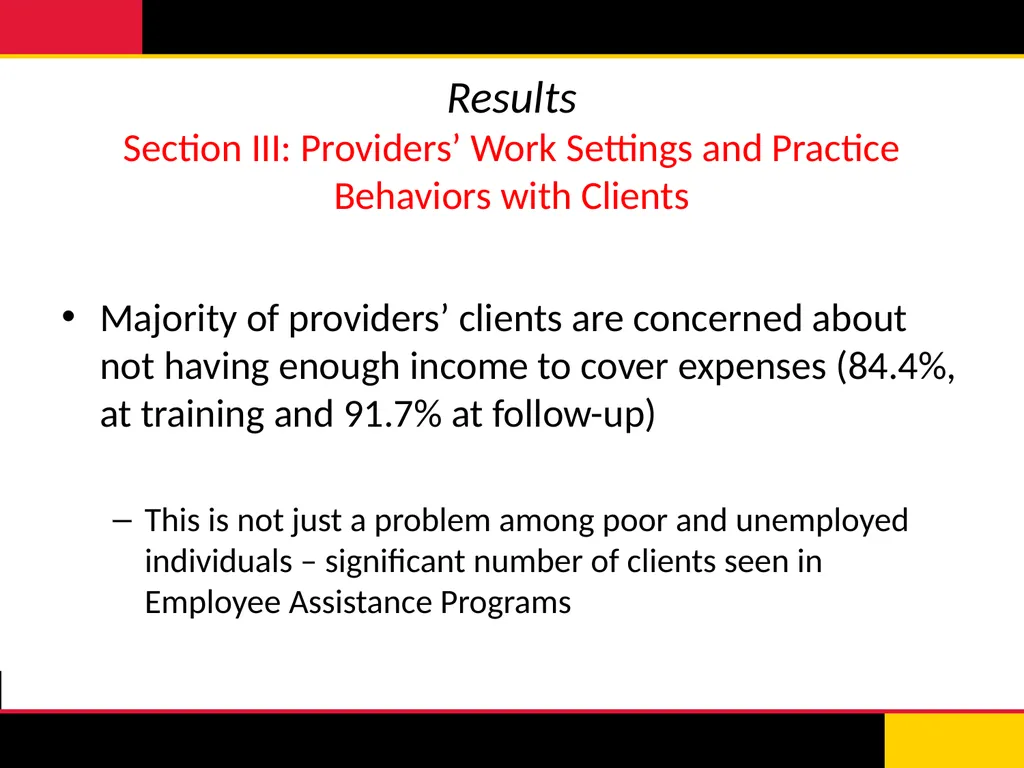
Section III: Providers’ Work Settings and Practice Behaviors with Clients Majority of providers’ clients are concerned about not having enough income to cover expenses (84.4%, at training and 91.7% at follow-up)
This is not just a problem among poor and unemployed individuals – significant number of clients seen in Employee Assistance Programs<br>
This is not just a problem among poor and unemployed individuals – significant number of clients seen in Employee Assistance Programs<br>
20
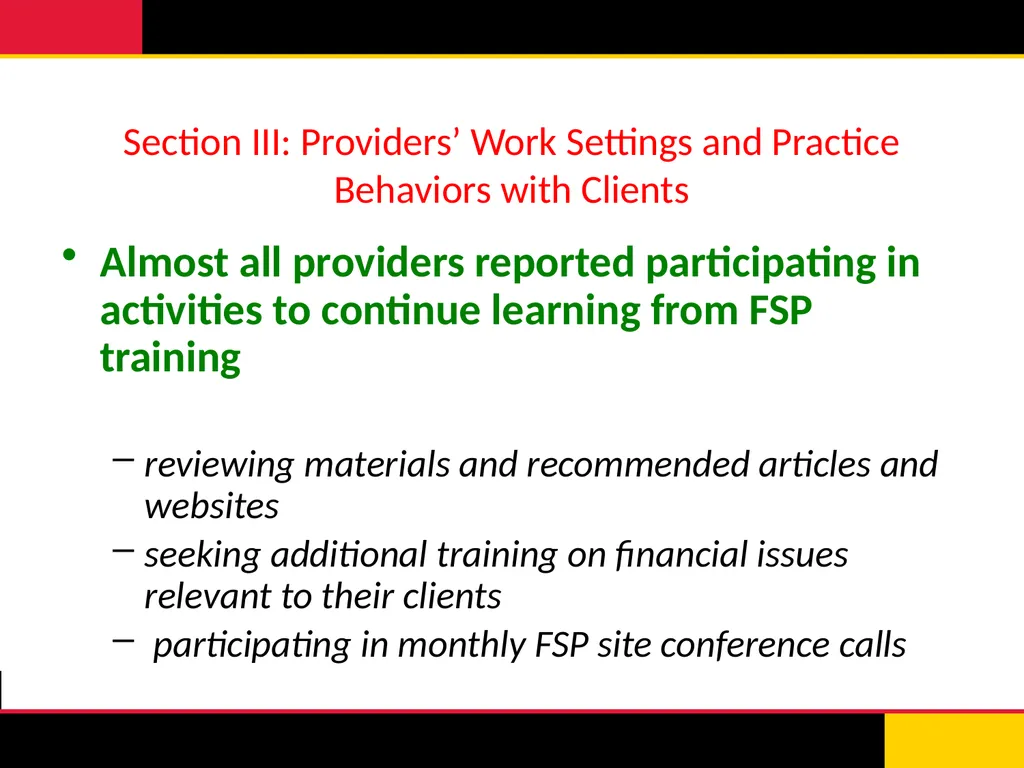
Section III: Providers’ Work Settings and Practice Behaviors with Clients Almost all providers reported participating in activities to continue learning from FSP training
reviewing materials and recommended articles and websites
seeking additional training on financial issues relevant to their clients
participating in monthly FSP site conference calls<br>
reviewing materials and recommended articles and websites
seeking additional training on financial issues relevant to their clients
participating in monthly FSP site conference calls<br>
21
Results
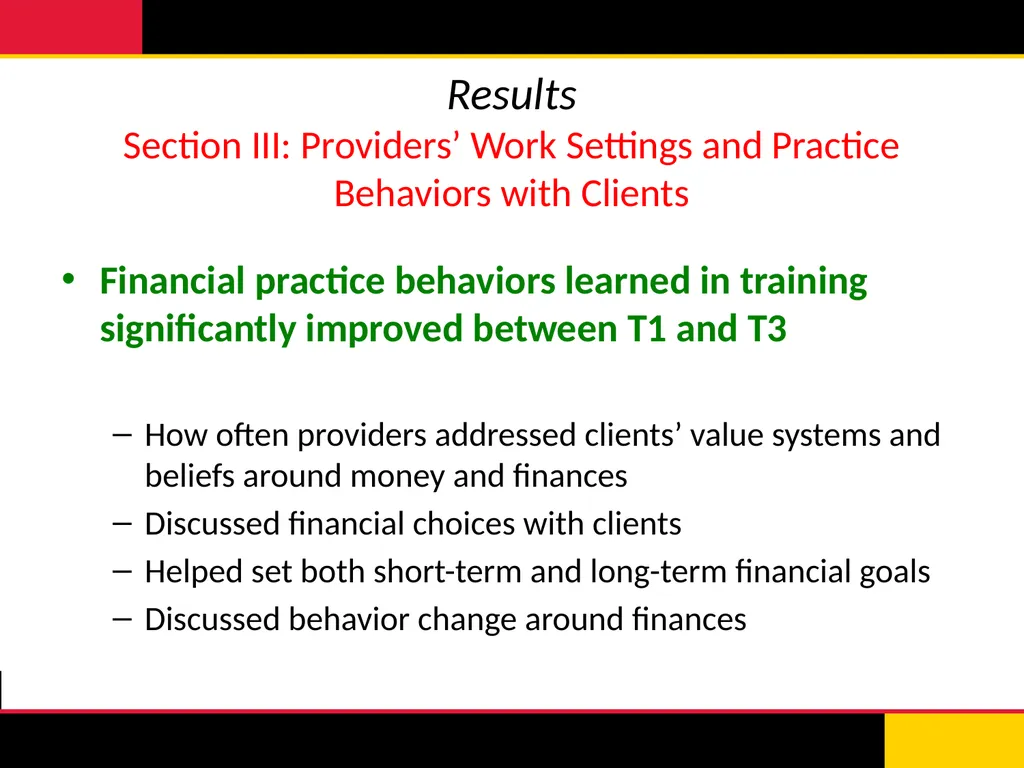
Section III: Providers’ Work Settings and Practice Behaviors with Clients Financial practice behaviors learned in training significantly improved between T1 and T3
How often providers addressed clients’ value systems and beliefs around money and finances
Discussed financial choices with clients
Helped set both short-term and long-term financial goals
Discussed behavior change around finances<br>
How often providers addressed clients’ value systems and beliefs around money and finances
Discussed financial choices with clients
Helped set both short-term and long-term financial goals
Discussed behavior change around finances<br>
22
Results
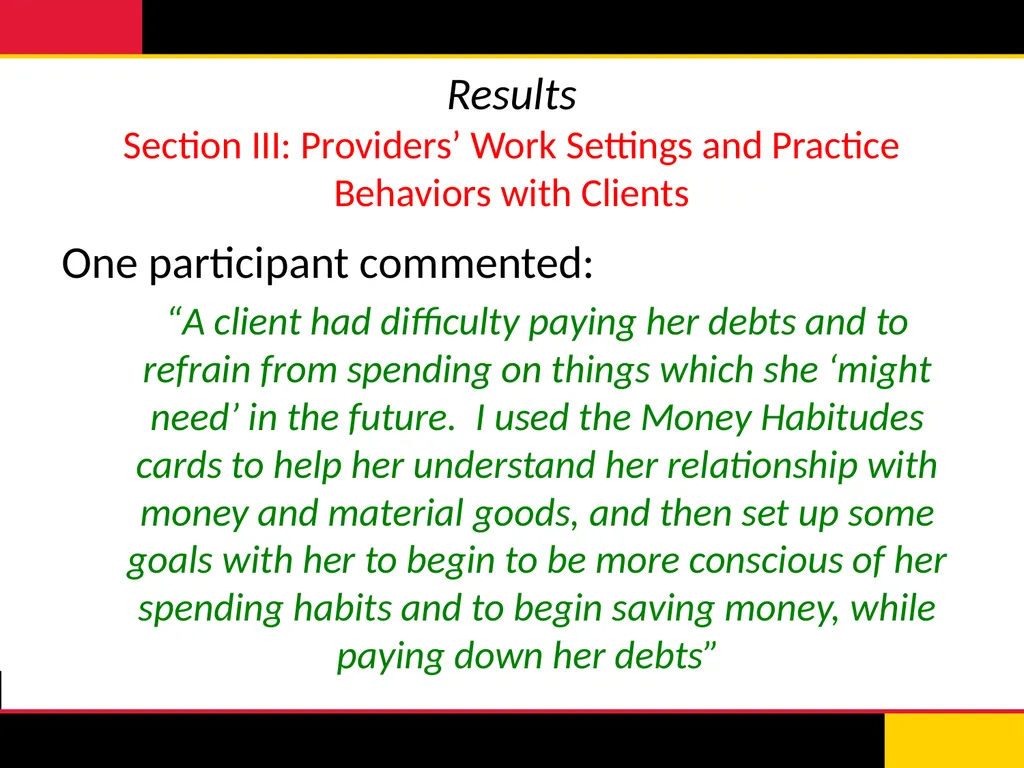
Section III: Providers’ Work Settings and Practice Behaviors with Clients One participant commented:
“A client had difficulty paying her debts and to refrain from spending on things which she ‘might need’ in the future. I used the Money Habitudes cards to help her understand her relationship with money and material goods, and then set up some goals with her to begin to be more conscious of her spending habits and to begin saving money, while paying down her debts”<br>
“A client had difficulty paying her debts and to refrain from spending on things which she ‘might need’ in the future. I used the Money Habitudes cards to help her understand her relationship with money and material goods, and then set up some goals with her to begin to be more conscious of her spending habits and to begin saving money, while paying down her debts”<br>
23
Results
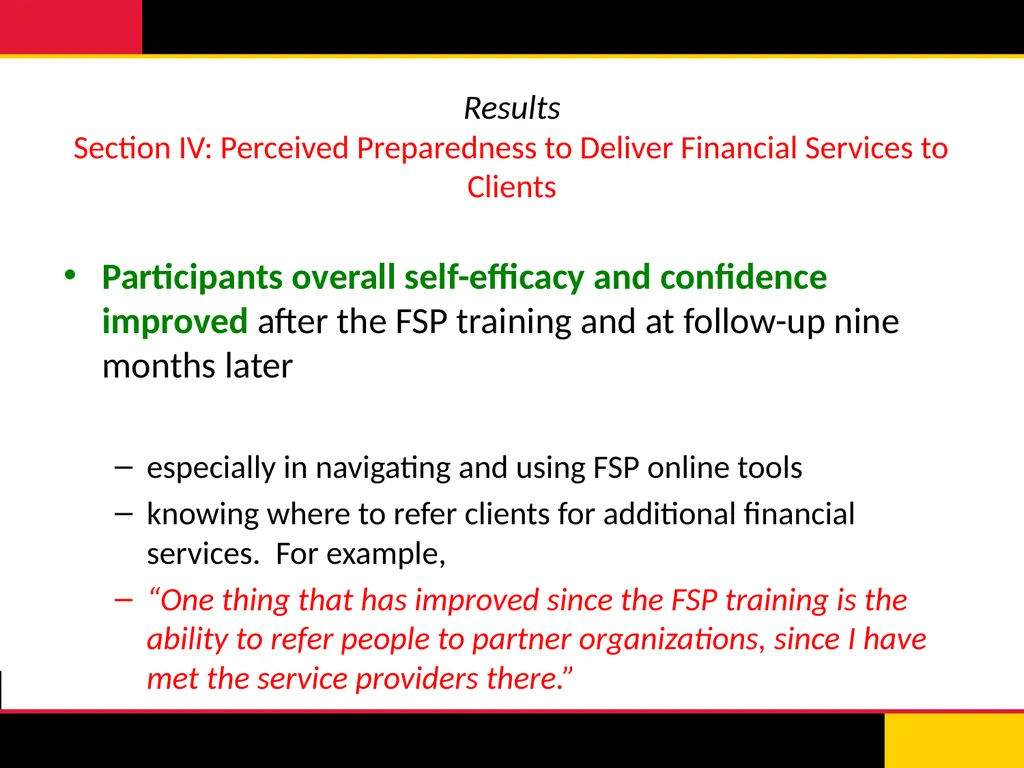
Section IV: Perceived Preparedness to Deliver Financial Services to Clients Participants overall self-efficacy and confidence improved after the FSP training and at follow-up nine months later
especially in navigating and using FSP online tools
knowing where to refer clients for additional financial services. For example,
“One thing that has improved since the FSP training is the ability to refer people to partner organizations, since I have met the service providers there.”<br>
especially in navigating and using FSP online tools
knowing where to refer clients for additional financial services. For example,
“One thing that has improved since the FSP training is the ability to refer people to partner organizations, since I have met the service providers there.”<br>
24
Results
Sections V & VI: Personal Well-Being and
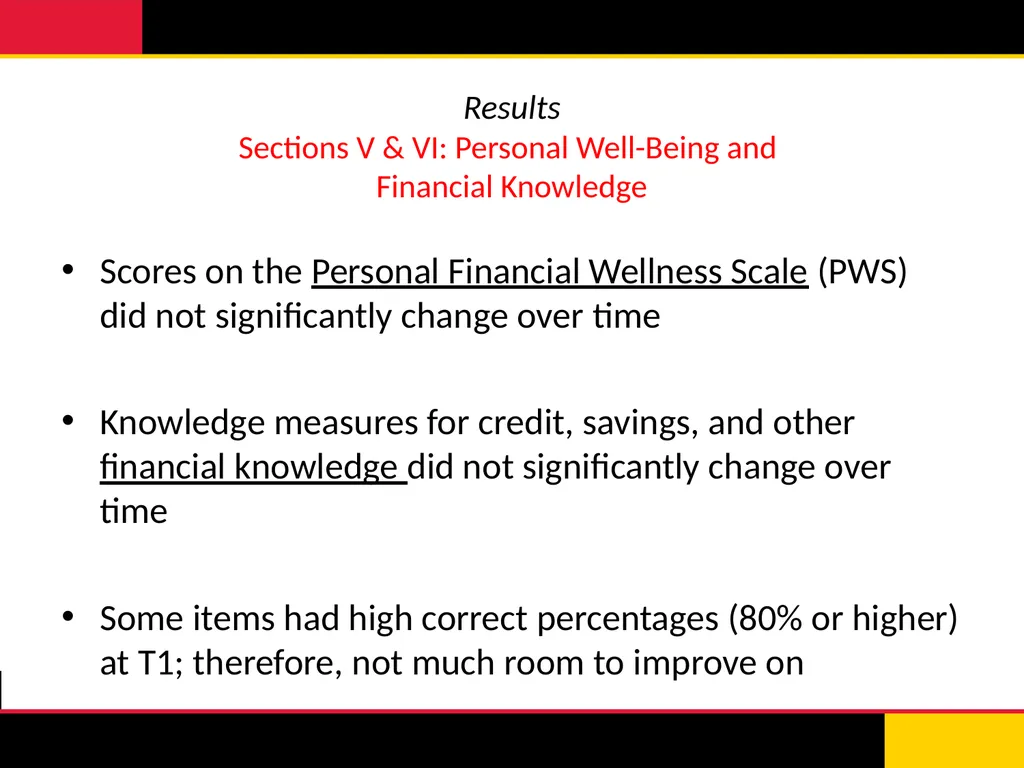
Financial Knowledge Scores on the Personal Financial Wellness Scale (PWS) did not significantly change over time
Knowledge measures for credit, savings, and other financial knowledge did not significantly change over time
Some items had high correct percentages (80% or higher) at T1; therefore, not much room to improve on<br>
Knowledge measures for credit, savings, and other financial knowledge did not significantly change over time
Some items had high correct percentages (80% or higher) at T1; therefore, not much room to improve on<br>
25
Results
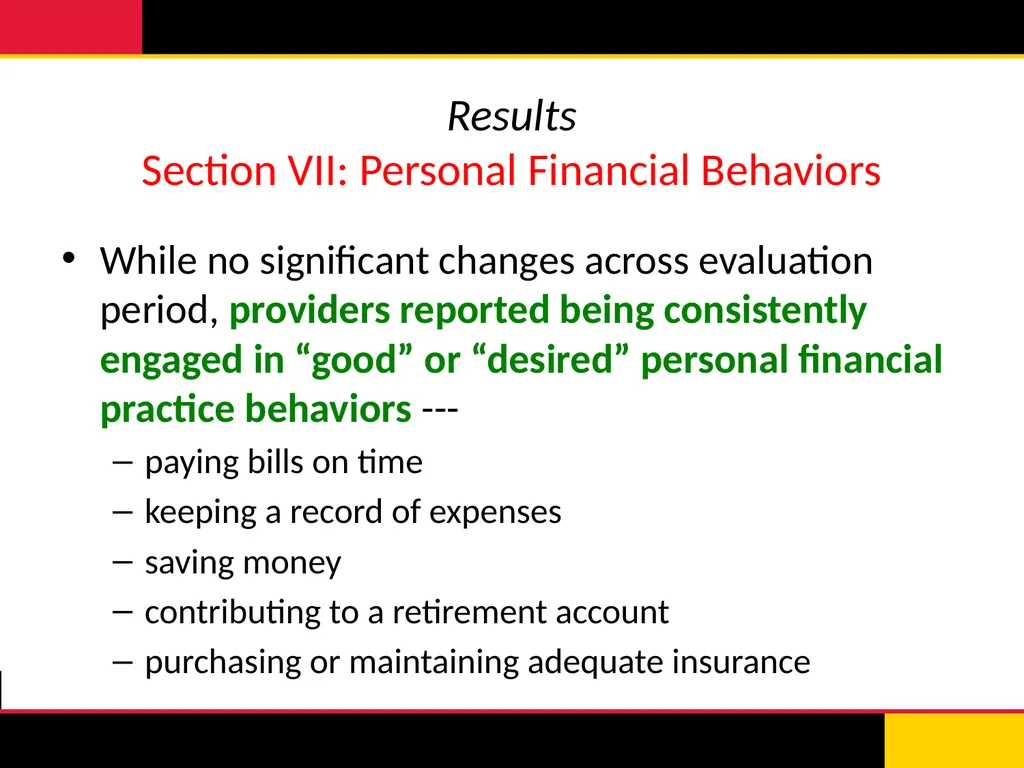
Section VII: Personal Financial Behaviors While no significant changes across evaluation period, providers reported being consistently engaged in “good” or “desired” personal financial practice behaviors ---
paying bills on time
keeping a record of expenses
saving money
contributing to a retirement account
purchasing or maintaining adequate insurance<br>
paying bills on time
keeping a record of expenses
saving money
contributing to a retirement account
purchasing or maintaining adequate insurance<br>
26
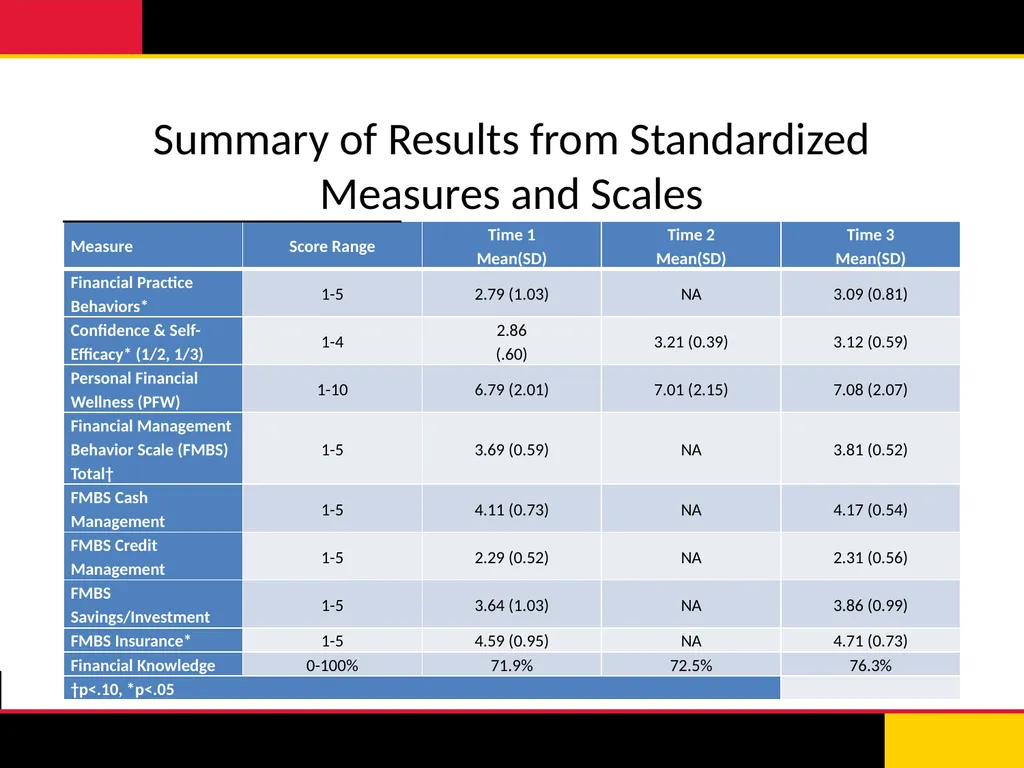
Summary of Results from Standardized Measures and Scales<br>
27
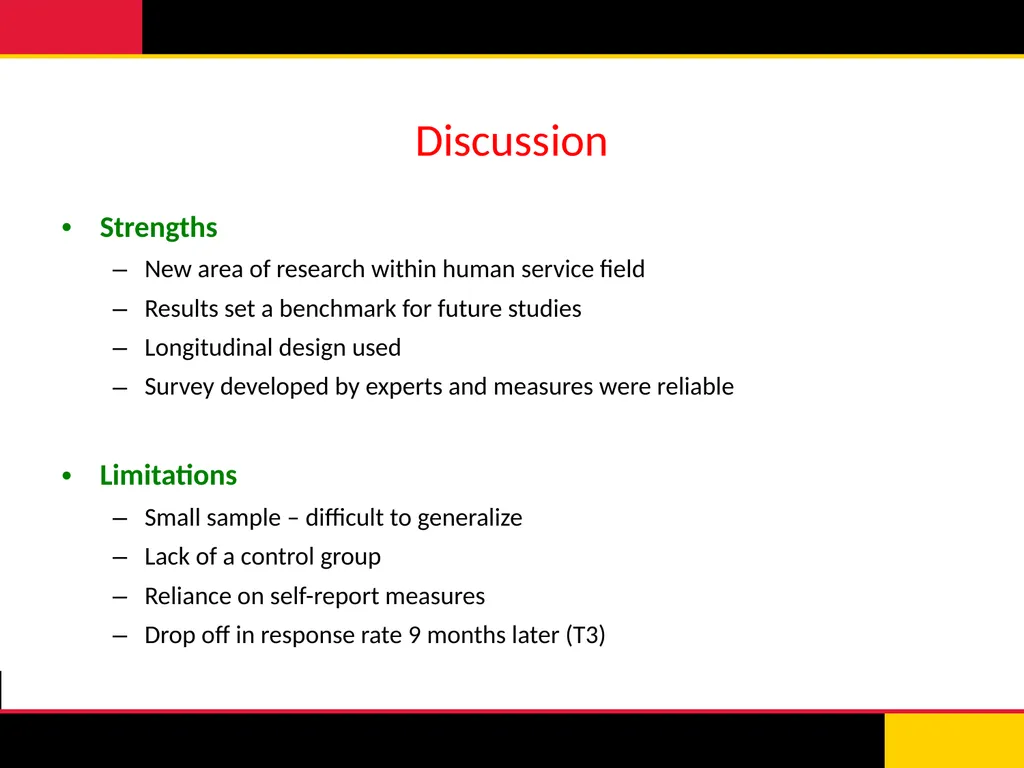
Discussion Strengths
New area of research within human service field
Results set a benchmark for future studies
Longitudinal design used
Survey developed by experts and measures were reliable
Limitations
Small sample – difficult to generalize
Lack of a control group
Reliance on self-report measures
Drop off in response rate 9 months later (T3)<br>
New area of research within human service field
Results set a benchmark for future studies
Longitudinal design used
Survey developed by experts and measures were reliable
Limitations
Small sample – difficult to generalize
Lack of a control group
Reliance on self-report measures
Drop off in response rate 9 months later (T3)<br>
28
Thank you!
Thank you!
Karen Hopkins, PhD
khopkins@ssw.umaryland.edu
Philip Osteen, PhD
posteen@fsu.edu
Christine Callahan, PhD
ccallahan@ssw.umaryland.edu<br>
29
Acknowledgements and Research Team This study was funded by the Maryland CASH Campaign, c/o the Job Opportunities Task Force, working in collaboration with the Aspen Institute and the University of Wisconsin Center for Financial Security
Research Team Members:
Jodi Jacobson Frey, PhD: Principal Investigator
Karen Hopkins, PhD: Co-Principal Investigator
Philip Osteen, PhD: Co-Principal Investigator
Lara Henneman, MA: Project Manager
Jungyai Ko, MSSW: Research Assistant
Lucy Bill, MSW: Research Assistant<br>
Research Team Members:
Jodi Jacobson Frey, PhD: Principal Investigator
Karen Hopkins, PhD: Co-Principal Investigator
Philip Osteen, PhD: Co-Principal Investigator
Lara Henneman, MA: Project Manager
Jungyai Ko, MSSW: Research Assistant
Lucy Bill, MSW: Research Assistant<br>
30
References Birkenmaier, J., Sherraden, M., & Curley, J. (Eds.) (2013). Financial capability and asset development: Research, Education, Policy and Practice. New York, NY: Oxford.
Dew, J., & Xiao, J. J. (2011). The Financial Management Behavior Scale: Development and Validation. Journal of Financial Counseling and Planning, 22, 43-59.
Hernandez, M. T. & Karger, H. J. (2004). The decline of the public intellectual in social work. Journal of Sociology and Social Welfare, 31(3), 51-68.
Hilgert, M. A., Hogarth, J. M., & Beverly, S. G. (2003). Household financial management: The connection between knowledge and behavior. Federal Reserve Bulletin, 89, 309-322.
Sherraden, M., Laux, S., & Kaufman, C. (2007). Financial education for social workers. Journal of Community Practice, 15(3), 9-36.
Prawitz, A. D., Garman, E. T., Sorhaindo, B., O’Neill, B., Kim, J., & Drentea, P. (2006). The InCharge Financial Distress/Financial Well-Being Scale: Development, administration, and score interpretation. Financial Counseling and Planning, 17(1), 34-50.<br>
Dew, J., & Xiao, J. J. (2011). The Financial Management Behavior Scale: Development and Validation. Journal of Financial Counseling and Planning, 22, 43-59.
Hernandez, M. T. & Karger, H. J. (2004). The decline of the public intellectual in social work. Journal of Sociology and Social Welfare, 31(3), 51-68.
Hilgert, M. A., Hogarth, J. M., & Beverly, S. G. (2003). Household financial management: The connection between knowledge and behavior. Federal Reserve Bulletin, 89, 309-322.
Sherraden, M., Laux, S., & Kaufman, C. (2007). Financial education for social workers. Journal of Community Practice, 15(3), 9-36.
Prawitz, A. D., Garman, E. T., Sorhaindo, B., O’Neill, B., Kim, J., & Drentea, P. (2006). The InCharge Financial Distress/Financial Well-Being Scale: Development, administration, and score interpretation. Financial Counseling and Planning, 17(1), 34-50.<br>