
Transaction Exposure Sections Exposures Forwards
LV
Published · 22 slides · 0 views
1 / 1
Description
Transaction Exposure Sections Exposures Forwards (and futures) hedge Money market hedge Options hedge Swaps hedge Operational hedge techniques Exposure Exposure: exposed (non-zero sensitivity) to risk. Three types of FX exposure: (1)
Related Topics
Share
Embed code
Download this presentation From Below
"Transaction Exposure Sections Exposures Forwards" is the property of its rightful owner. Permission is granted to download and print the materials on this website for personal, non-commercial use only, and to display it on your personal computer provided you do not modify the materials and that you retain all copyright notices contained in the materials. By downloading content from our website, you accept the terms of this agreement.
Presentation Transcript
01
Transaction Exposure<br>
02
Sections Exposures
Forwards (and futures) hedge
Money market hedge
Options hedge
Swaps hedge
Operational hedge techniques<br>
Forwards (and futures) hedge
Money market hedge
Options hedge
Swaps hedge
Operational hedge techniques<br>
03
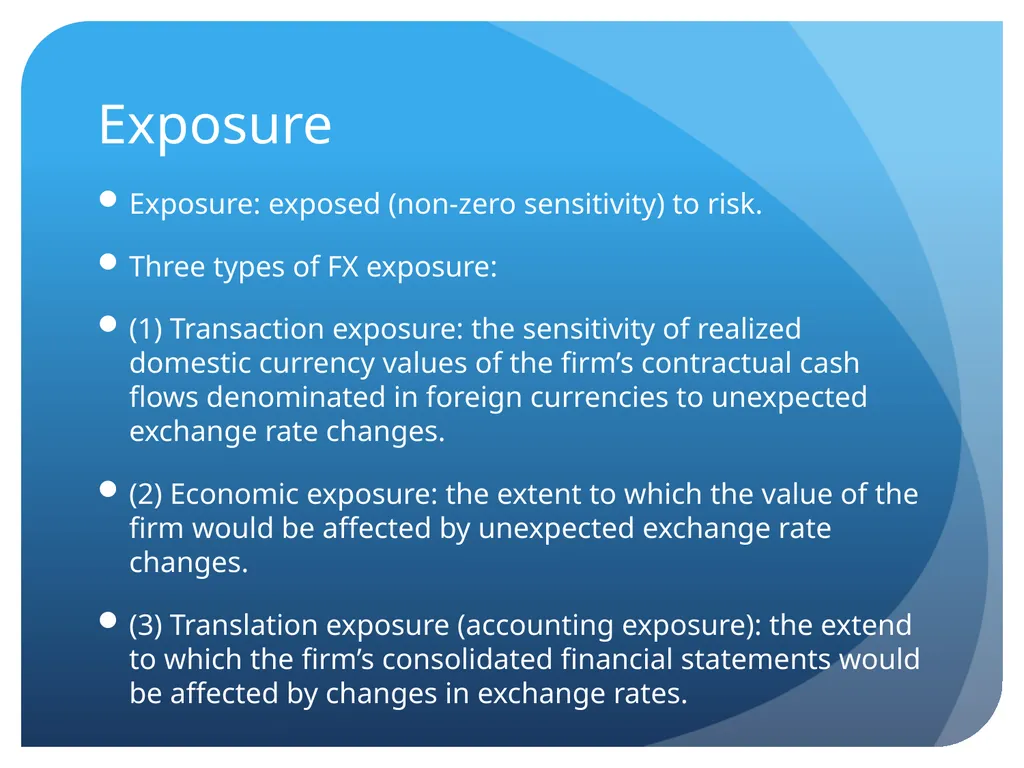
Exposure Exposure: exposed (non-zero sensitivity) to risk.
Three types of FX exposure:
(1) Transaction exposure: the sensitivity of realized domestic currency values of the firm’s contractual cash flows denominated in foreign currencies to unexpected exchange rate changes.
(2) Economic exposure: the extent to which the value of the firm would be affected by unexpected exchange rate changes.
(3) Translation exposure (accounting exposure): the extend to which the firm’s consolidated financial statements would be affected by changes in exchange rates.<br>
Three types of FX exposure:
(1) Transaction exposure: the sensitivity of realized domestic currency values of the firm’s contractual cash flows denominated in foreign currencies to unexpected exchange rate changes.
(2) Economic exposure: the extent to which the value of the firm would be affected by unexpected exchange rate changes.
(3) Translation exposure (accounting exposure): the extend to which the firm’s consolidated financial statements would be affected by changes in exchange rates.<br>
04
Transaction exposure Whenever a firm has foreign-currency-denominated receivables or payables, it is subject to transaction exposure.
The sizes of these receivables or payables defines the magnitude of transaction exposure.
Thus, when a firm has no foreign-currency-denominated receivables or payables, it has no transaction exposure.<br>
The sizes of these receivables or payables defines the magnitude of transaction exposure.
Thus, when a firm has no foreign-currency-denominated receivables or payables, it has no transaction exposure.<br>
05
Hedging via financial contracts The following financial contracts can be used to hedge transaction exposure:
(1) Forwards (and futures).
(2) Money market securities.
(3) Options.
(4) Swaps.<br>
(1) Forwards (and futures).
(2) Money market securities.
(3) Options.
(4) Swaps.<br>
06
Hedging via operational techniques The following operational techniques can also be used to hedge transaction exposure:
(1) Choice of the invoice currency.
(2) Lead/lag strategy.
(3) Exposure netting.<br>
(1) Choice of the invoice currency.
(2) Lead/lag strategy.
(3) Exposure netting.<br>
07
Scenario Suppose that Boeing exported a Boeing jet to British Airways and billed £10 million payable in 1 year.
Non-$ receivable for Boeing transaction exposure.
This is so because the $ value of £10 million receivable in 1 year is subject to the $/£ FX risk in this coming year.<br>
Non-$ receivable for Boeing transaction exposure.
This is so because the $ value of £10 million receivable in 1 year is subject to the $/£ FX risk in this coming year.<br>
08
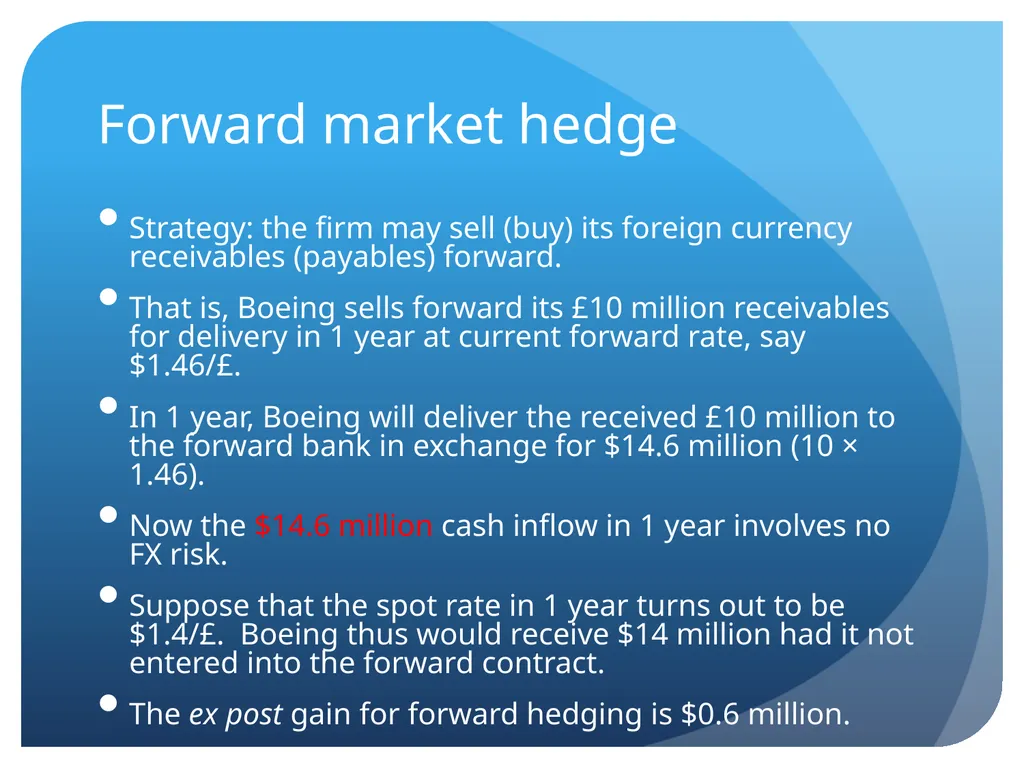
Forward market hedge Strategy: the firm may sell (buy) its foreign currency receivables (payables) forward.
That is, Boeing sells forward its £10 million receivables for delivery in 1 year at current forward rate, say $1.46/£.
In 1 year, Boeing will deliver the received £10 million to the forward bank in exchange for $14.6 million (10 × 1.46).
Now the $14.6 million cash inflow in 1 year involves no FX risk.
Suppose that the spot rate in 1 year turns out to be $1.4/£. Boeing thus would receive $14 million had it not entered into the forward contract.
The ex post gain for forward hedging is $0.6 million.<br>
That is, Boeing sells forward its £10 million receivables for delivery in 1 year at current forward rate, say $1.46/£.
In 1 year, Boeing will deliver the received £10 million to the forward bank in exchange for $14.6 million (10 × 1.46).
Now the $14.6 million cash inflow in 1 year involves no FX risk.
Suppose that the spot rate in 1 year turns out to be $1.4/£. Boeing thus would receive $14 million had it not entered into the forward contract.
The ex post gain for forward hedging is $0.6 million.<br>
09
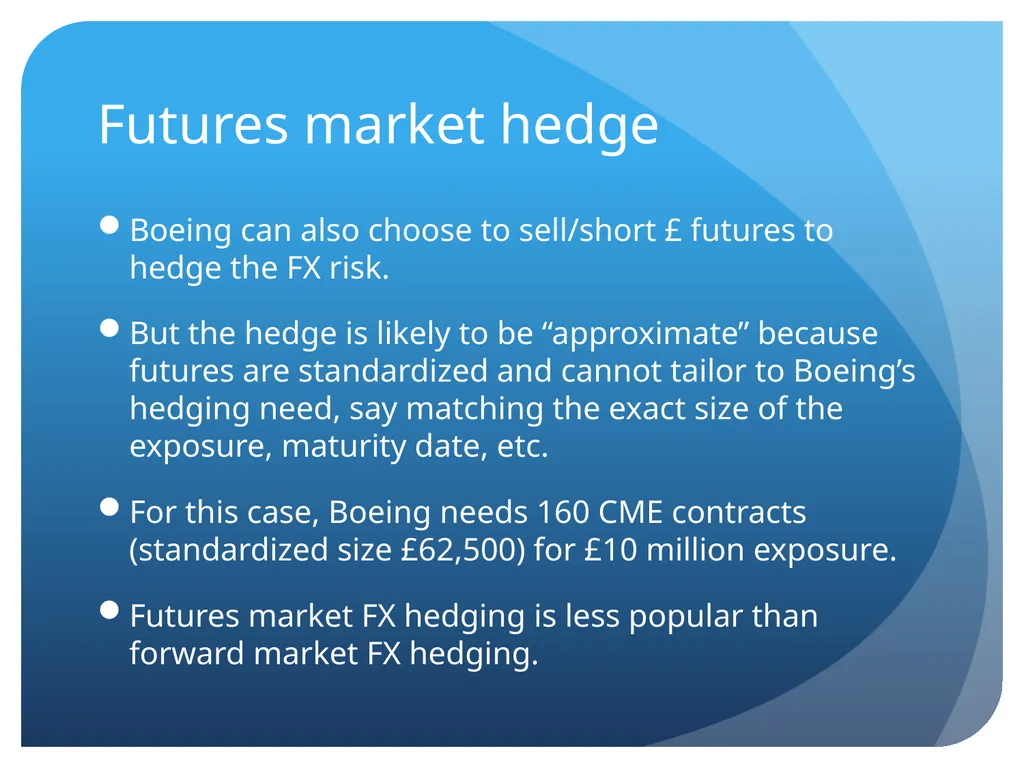
Futures market hedge Boeing can also choose to sell/short £ futures to hedge the FX risk.
But the hedge is likely to be “approximate” because futures are standardized and cannot tailor to Boeing’s hedging need, say matching the exact size of the exposure, maturity date, etc.
For this case, Boeing needs 160 CME contracts (standardized size £62,500) for £10 million exposure.
Futures market FX hedging is less popular than forward market FX hedging.<br>
But the hedge is likely to be “approximate” because futures are standardized and cannot tailor to Boeing’s hedging need, say matching the exact size of the exposure, maturity date, etc.
For this case, Boeing needs 160 CME contracts (standardized size £62,500) for £10 million exposure.
Futures market FX hedging is less popular than forward market FX hedging.<br>
10
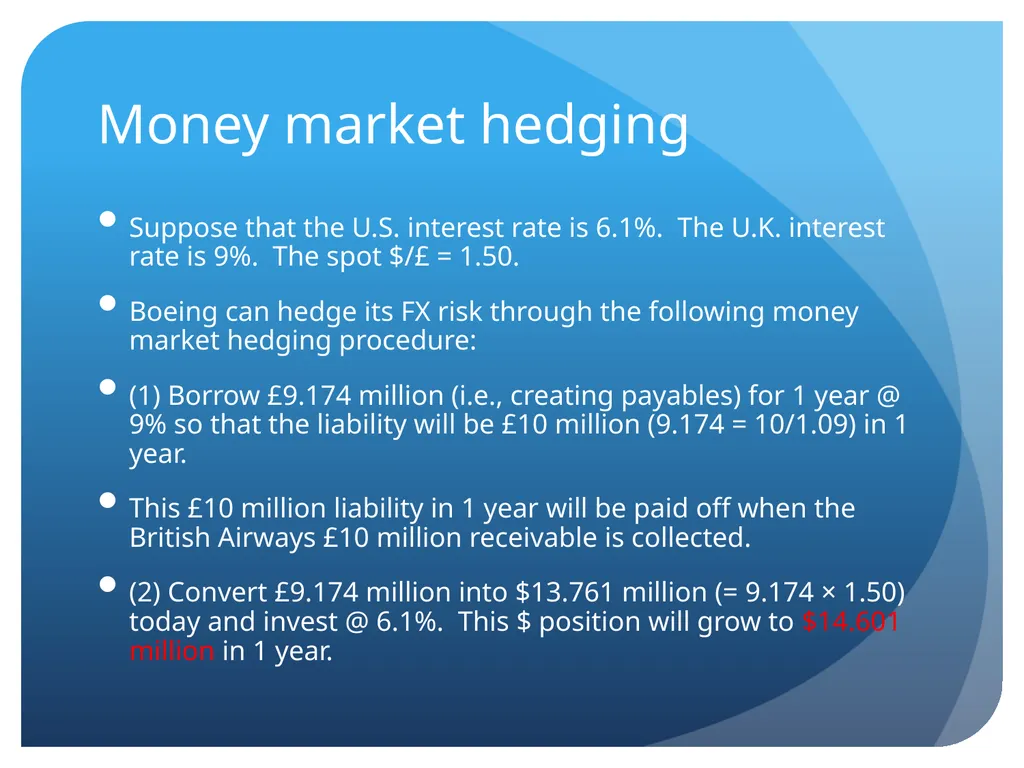
Money market hedging Suppose that the U.S. interest rate is 6.1%. The U.K. interest rate is 9%. The spot $/£ = 1.50.
Boeing can hedge its FX risk through the following money market hedging procedure:
(1) Borrow £9.174 million (i.e., creating payables) for 1 year @ 9% so that the liability will be £10 million (9.174 = 10/1.09) in 1 year.
This £10 million liability in 1 year will be paid off when the British Airways £10 million receivable is collected.
(2) Convert £9.174 million into $13.761 million (= 9.174 × 1.50) today and invest @ 6.1%. This $ position will grow to $14.601 million in 1 year.<br>
Boeing can hedge its FX risk through the following money market hedging procedure:
(1) Borrow £9.174 million (i.e., creating payables) for 1 year @ 9% so that the liability will be £10 million (9.174 = 10/1.09) in 1 year.
This £10 million liability in 1 year will be paid off when the British Airways £10 million receivable is collected.
(2) Convert £9.174 million into $13.761 million (= 9.174 × 1.50) today and invest @ 6.1%. This $ position will grow to $14.601 million in 1 year.<br>
11
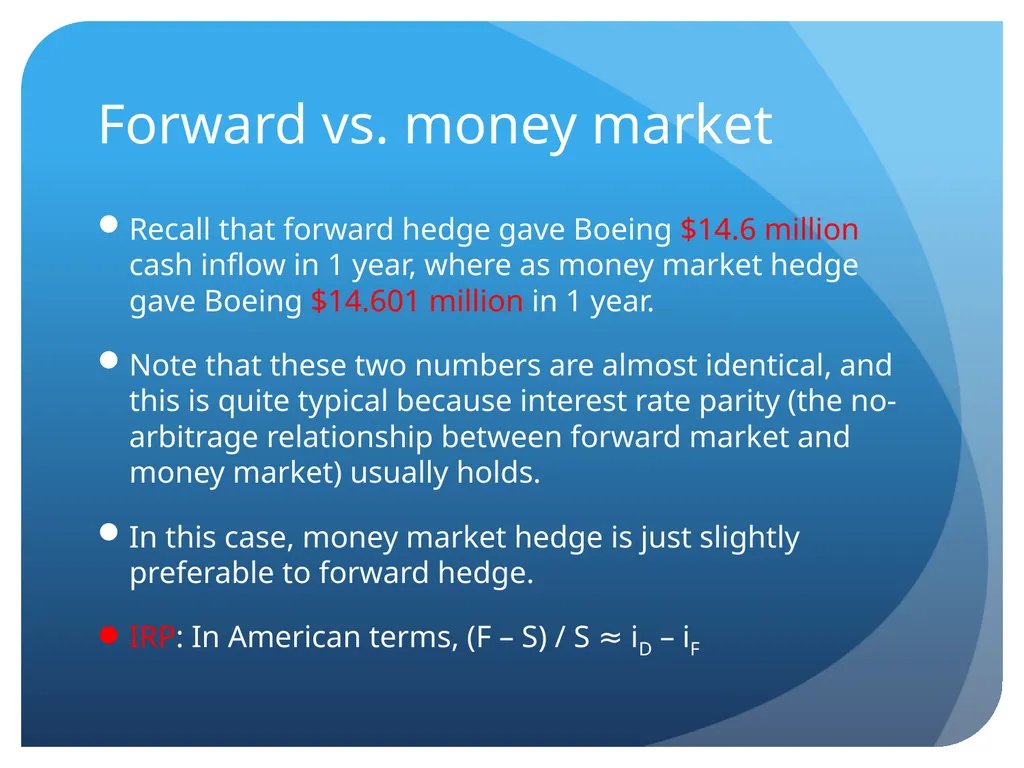
Forward vs. money market Recall that forward hedge gave Boeing $14.6 million cash inflow in 1 year, where as money market hedge gave Boeing $14.601 million in 1 year.
Note that these two numbers are almost identical, and this is quite typical because interest rate parity (the no-arbitrage relationship between forward market and money market) usually holds.
In this case, money market hedge is just slightly preferable to forward hedge.
IRP: In American terms, (F – S) / S ≈ iD – iF<br>
Note that these two numbers are almost identical, and this is quite typical because interest rate parity (the no-arbitrage relationship between forward market and money market) usually holds.
In this case, money market hedge is just slightly preferable to forward hedge.
IRP: In American terms, (F – S) / S ≈ iD – iF<br>
12
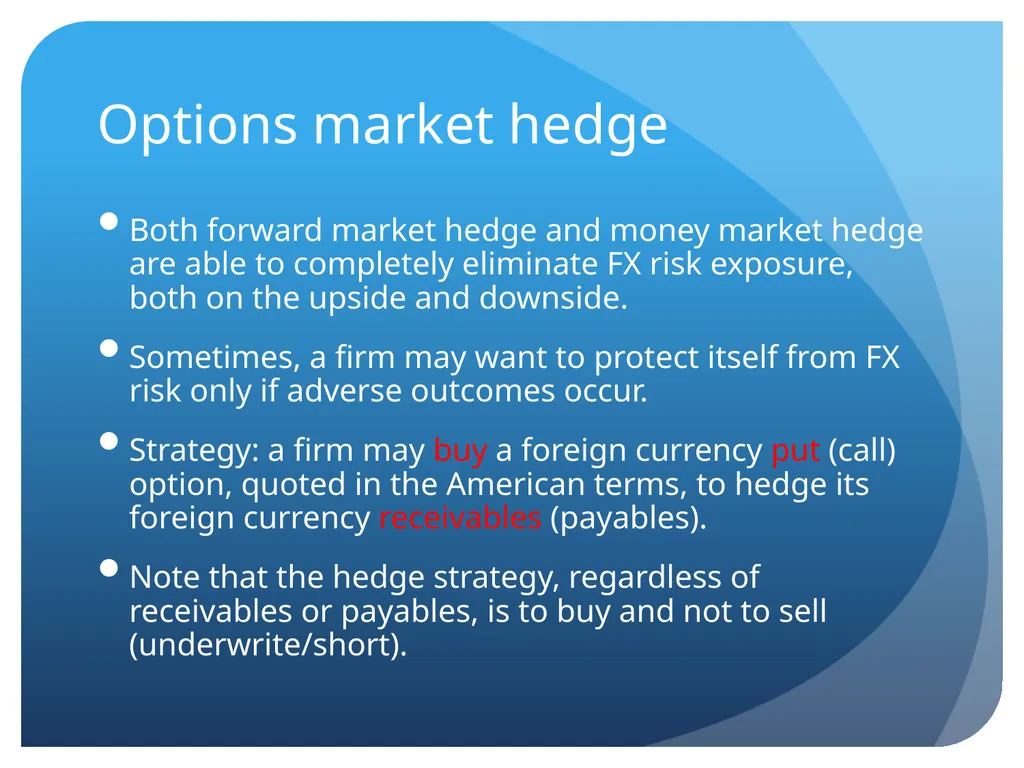
Options market hedge Both forward market hedge and money market hedge are able to completely eliminate FX risk exposure, both on the upside and downside.
Sometimes, a firm may want to protect itself from FX risk only if adverse outcomes occur.
Strategy: a firm may buy a foreign currency put (call) option, quoted in the American terms, to hedge its foreign currency receivables (payables).
Note that the hedge strategy, regardless of receivables or payables, is to buy and not to sell (underwrite/short).<br>
Sometimes, a firm may want to protect itself from FX risk only if adverse outcomes occur.
Strategy: a firm may buy a foreign currency put (call) option, quoted in the American terms, to hedge its foreign currency receivables (payables).
Note that the hedge strategy, regardless of receivables or payables, is to buy and not to sell (underwrite/short).<br>
13
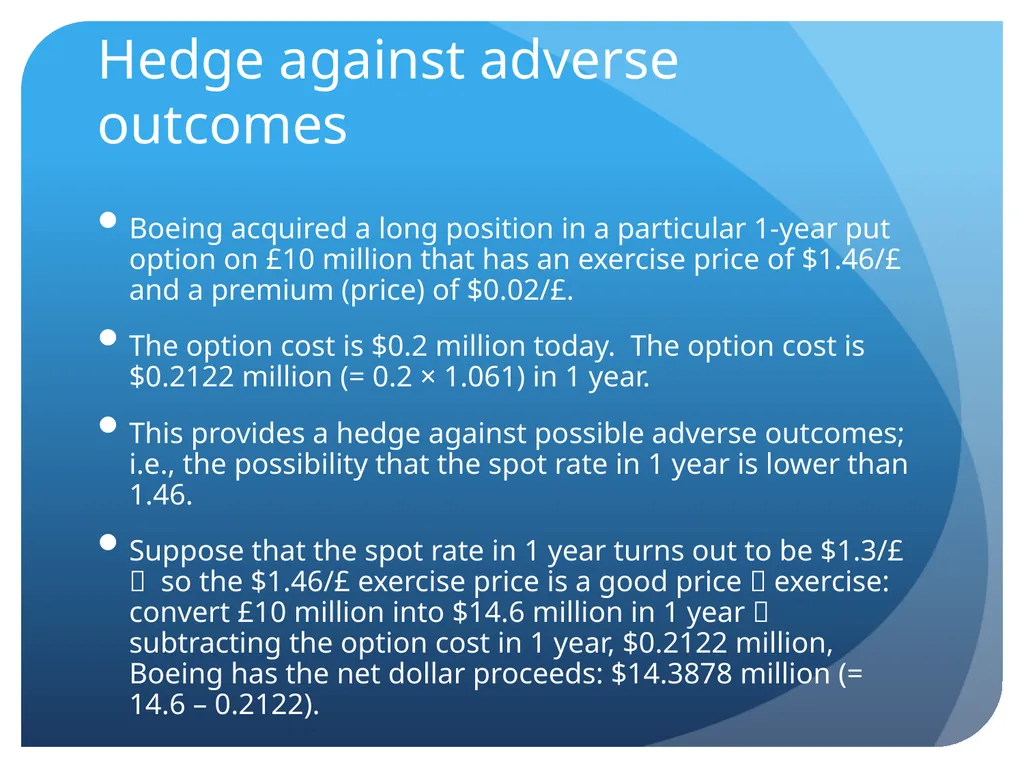
Hedge against adverse outcomes Boeing acquired a long position in a particular 1-year put option on £10 million that has an exercise price of $1.46/£ and a premium (price) of $0.02/£.
The option cost is $0.2 million today. The option cost is $0.2122 million (= 0.2 × 1.061) in 1 year.
This provides a hedge against possible adverse outcomes; i.e., the possibility that the spot rate in 1 year is lower than 1.46.
Suppose that the spot rate in 1 year turns out to be $1.3/£ so the $1.46/£ exercise price is a good price exercise: convert £10 million into $14.6 million in 1 year subtracting the option cost in 1 year, $0.2122 million, Boeing has the net dollar proceeds: $14.3878 million (= 14.6 – 0.2122).<br>
The option cost is $0.2 million today. The option cost is $0.2122 million (= 0.2 × 1.061) in 1 year.
This provides a hedge against possible adverse outcomes; i.e., the possibility that the spot rate in 1 year is lower than 1.46.
Suppose that the spot rate in 1 year turns out to be $1.3/£ so the $1.46/£ exercise price is a good price exercise: convert £10 million into $14.6 million in 1 year subtracting the option cost in 1 year, $0.2122 million, Boeing has the net dollar proceeds: $14.3878 million (= 14.6 – 0.2122).<br>
14
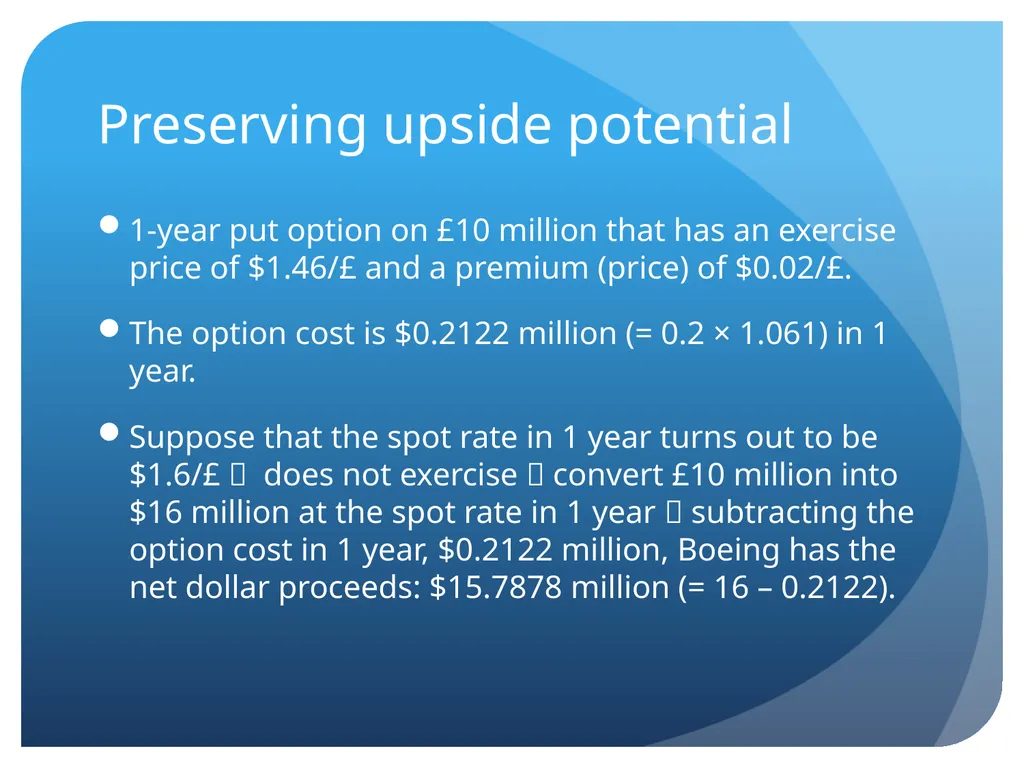
Preserving upside potential 1-year put option on £10 million that has an exercise price of $1.46/£ and a premium (price) of $0.02/£.
The option cost is $0.2122 million (= 0.2 × 1.061) in 1 year.
Suppose that the spot rate in 1 year turns out to be $1.6/£ does not exercise convert £10 million into $16 million at the spot rate in 1 year subtracting the option cost in 1 year, $0.2122 million, Boeing has the net dollar proceeds: $15.7878 million (= 16 – 0.2122).<br>
The option cost is $0.2122 million (= 0.2 × 1.061) in 1 year.
Suppose that the spot rate in 1 year turns out to be $1.6/£ does not exercise convert £10 million into $16 million at the spot rate in 1 year subtracting the option cost in 1 year, $0.2122 million, Boeing has the net dollar proceeds: $15.7878 million (= 16 – 0.2122).<br>
15
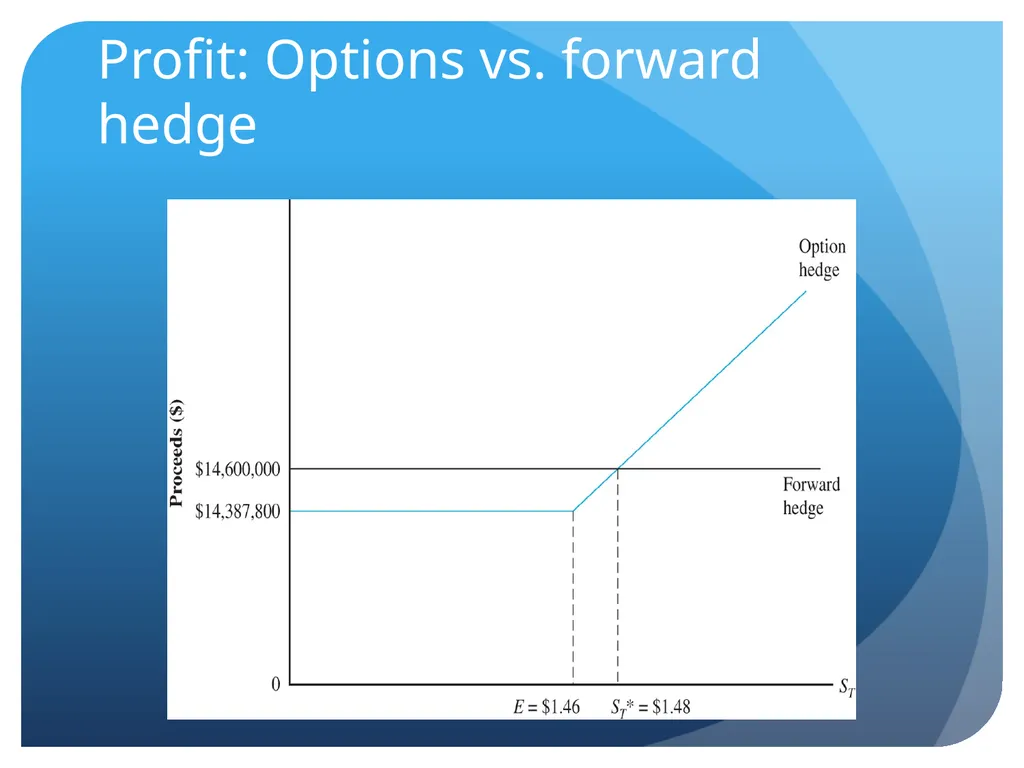
Profit: Options vs. forward hedge<br>
16
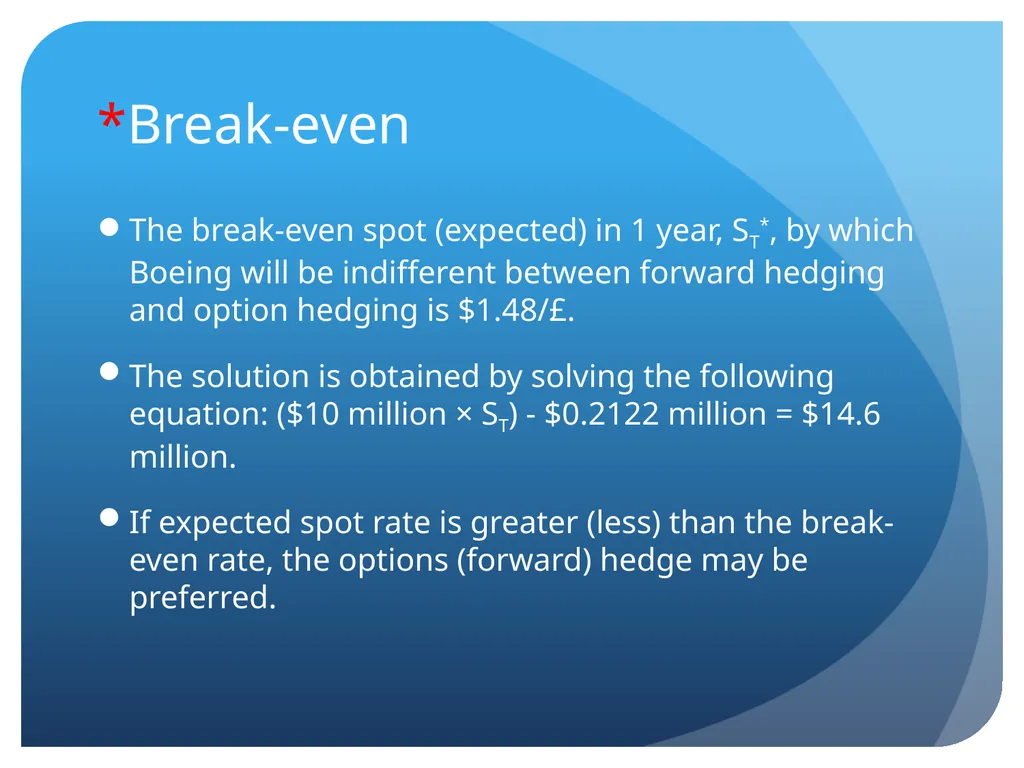
*Break-even The break-even spot (expected) in 1 year, ST*, by which Boeing will be indifferent between forward hedging and option hedging is $1.48/£.
The solution is obtained by solving the following equation: ($10 million × ST) - $0.2122 million = $14.6 million.
If expected spot rate is greater (less) than the break-even rate, the options (forward) hedge may be preferred.<br>
The solution is obtained by solving the following equation: ($10 million × ST) - $0.2122 million = $14.6 million.
If expected spot rate is greater (less) than the break-even rate, the options (forward) hedge may be preferred.<br>
17
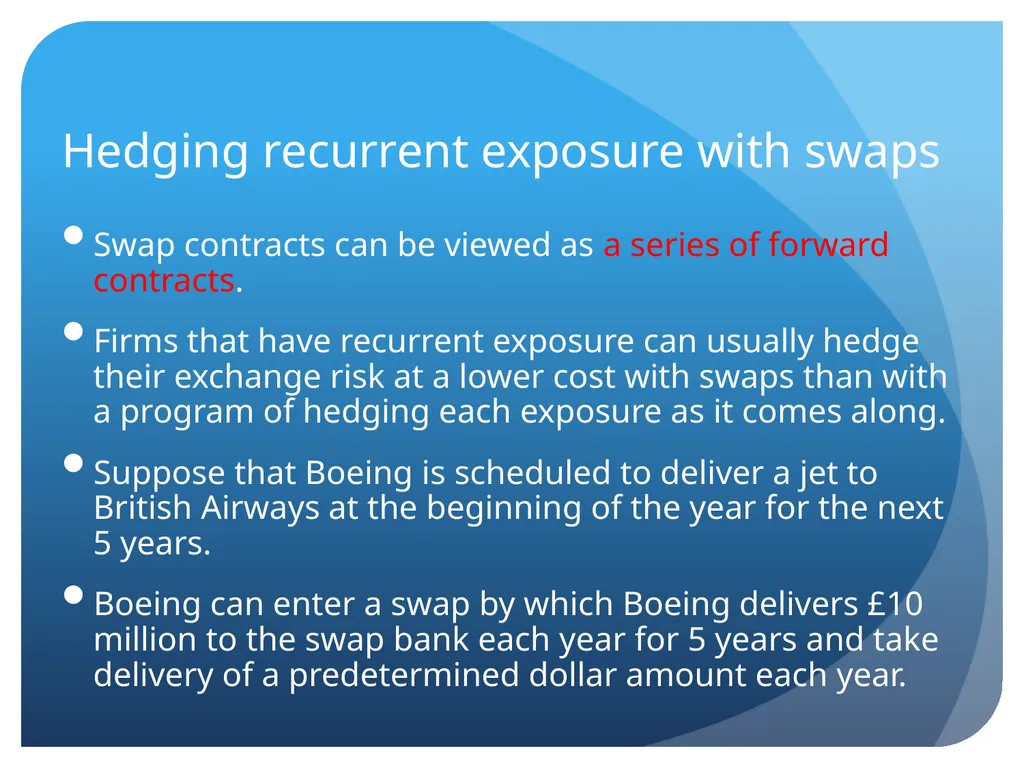
Hedging recurrent exposure with swaps Swap contracts can be viewed as a series of forward contracts.
Firms that have recurrent exposure can usually hedge their exchange risk at a lower cost with swaps than with a program of hedging each exposure as it comes along.
Suppose that Boeing is scheduled to deliver a jet to British Airways at the beginning of the year for the next 5 years.
Boeing can enter a swap by which Boeing delivers £10 million to the swap bank each year for 5 years and take delivery of a predetermined dollar amount each year.<br>
Firms that have recurrent exposure can usually hedge their exchange risk at a lower cost with swaps than with a program of hedging each exposure as it comes along.
Suppose that Boeing is scheduled to deliver a jet to British Airways at the beginning of the year for the next 5 years.
Boeing can enter a swap by which Boeing delivers £10 million to the swap bank each year for 5 years and take delivery of a predetermined dollar amount each year.<br>
18
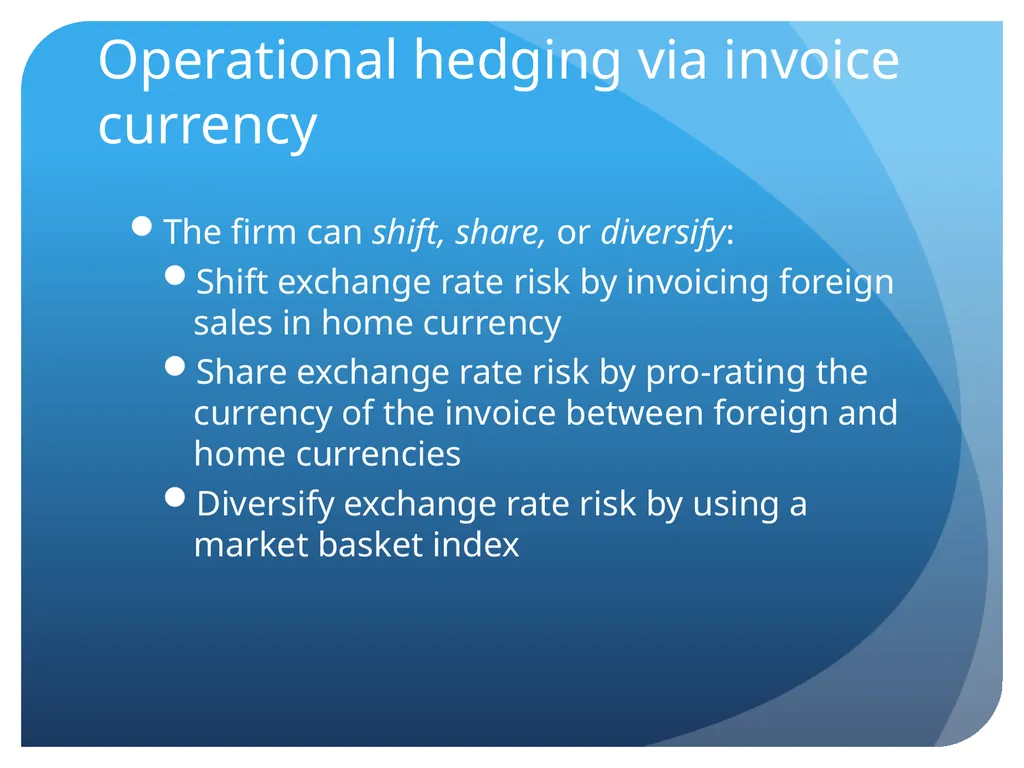
Operational hedging via invoice currency The firm can shift, share, or diversify:
Shift exchange rate risk by invoicing foreign sales in home currency
Share exchange rate risk by pro-rating the currency of the invoice between foreign and home currencies
Diversify exchange rate risk by using a market basket index<br>
Shift exchange rate risk by invoicing foreign sales in home currency
Share exchange rate risk by pro-rating the currency of the invoice between foreign and home currencies
Diversify exchange rate risk by using a market basket index<br>
19
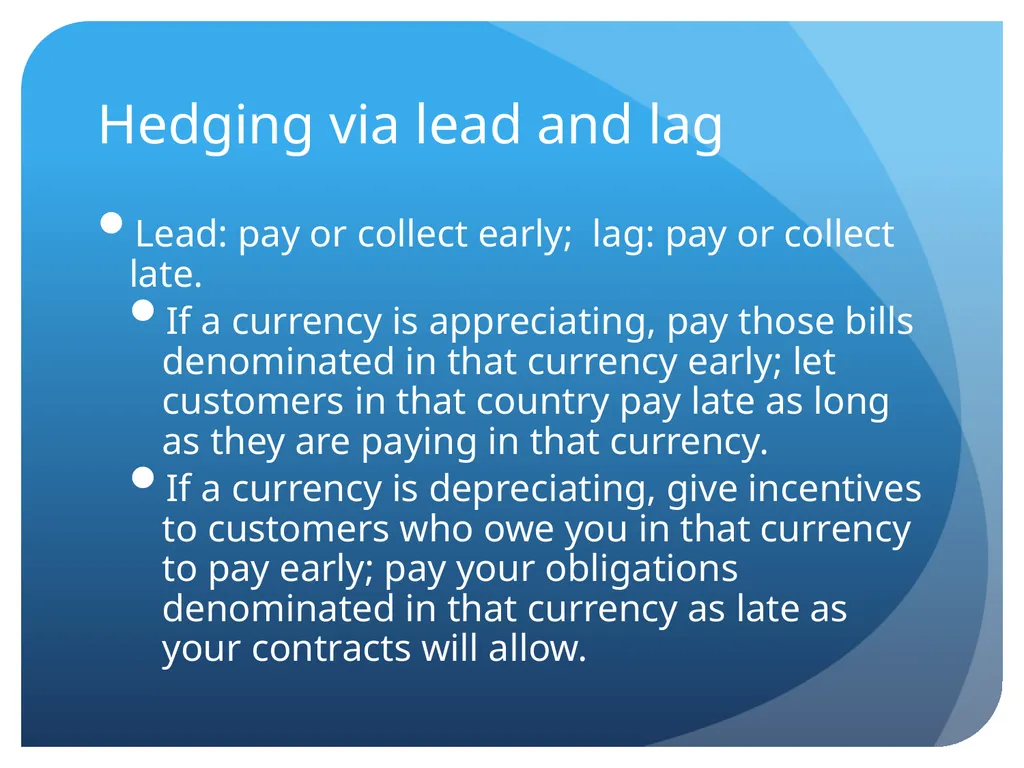
Hedging via lead and lag Lead: pay or collect early; lag: pay or collect late.
If a currency is appreciating, pay those bills denominated in that currency early; let customers in that country pay late as long as they are paying in that currency.
If a currency is depreciating, give incentives to customers who owe you in that currency to pay early; pay your obligations denominated in that currency as late as your contracts will allow.<br>
If a currency is appreciating, pay those bills denominated in that currency early; let customers in that country pay late as long as they are paying in that currency.
If a currency is depreciating, give incentives to customers who owe you in that currency to pay early; pay your obligations denominated in that currency as late as your contracts will allow.<br>
20
Exposure netting When a firm has both receivables and payables in a given foreign currency, it should consider hedging only its net exposure.
Suppose that Boeing has receivables of £10 million from British Airways, and it has payables of £5 million to Rolls-Royce. Both are due around the same time. Then the net exposure is £5 million receivables.<br>
Suppose that Boeing has receivables of £10 million from British Airways, and it has payables of £5 million to Rolls-Royce. Both are due around the same time. Then the net exposure is £5 million receivables.<br>
21
Should the firm hedge? Not everyone agrees that a firm should hedge.
Hedging by the firm may not add to shareholder wealth if the shareholders can manage exposure themselves.
Hedging may not reduce the non-diversifiable risk of the firm. Therefore, shareholders who hold a diversified portfolio are not benefitted when management hedges.
In the presence of market imperfections, the firm may hedge; e.g., (1) information asymmetry: The managers may have better information than the shareholders, (2) differential transactions costs: the firm may be able to hedge at better prices than the shareholders.<br>
Hedging by the firm may not add to shareholder wealth if the shareholders can manage exposure themselves.
Hedging may not reduce the non-diversifiable risk of the firm. Therefore, shareholders who hold a diversified portfolio are not benefitted when management hedges.
In the presence of market imperfections, the firm may hedge; e.g., (1) information asymmetry: The managers may have better information than the shareholders, (2) differential transactions costs: the firm may be able to hedge at better prices than the shareholders.<br>
22
End-of-chapter Questions: 1-7.
Problems: 1-3, 6, 7 (only a and b).<br>
Problems: 1-3, 6, 7 (only a and b).<br>