
Transfer Pricing Developments Steven
Description: Transfer Pricing Developments Steven Wrappe--Moderator Grant Thornton Laurie Dicker BDO Rocco Femia Miller and Chevalier Sayantani Ghose KPMG Ryan Lange Kroll Natalia PierottiYIN Reporter Weil, Gotshal Manges Transfer Pricing Exam Trends
Related Topics
Download Presentation
"Transfer Pricing Developments Steven" is the property of its rightful owner. Permission is granted to download and print the materials on this website for personal, non-commercial use only, and to display it on your personal computer provided you do not modify the materials and that you retain all copyright notices contained in the materials. By downloading content from our website, you accept the terms of this agreement.
Presentation Transcript
slide1. Transfer Pricing Developments Steven Wrappe--Moderator
Grant Thornton
Laurie Dicker
BDO
Rocco Femia
Miller and Chevalier
Sayantani Ghose
KPMG
Ryan Lange
Kroll
Natalia Pierotti—YIN Reporter
Weil, Gotshal & Manges<br>
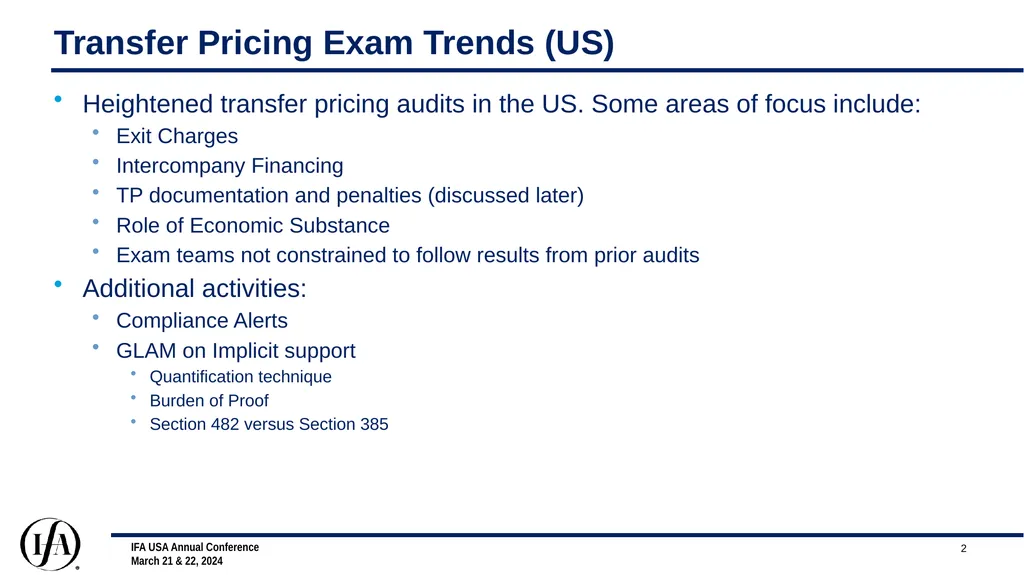
slide2. Transfer Pricing Exam Trends (US) Heightened transfer pricing audits in the US. Some areas of focus include:
Exit Charges
Intercompany Financing
TP documentation and penalties (discussed later)
Role of Economic Substance
Exam teams not constrained to follow results from prior audits
Additional activities:
Compliance Alerts
GLAM on Implicit support
Quantification technique
Burden of Proof
Section 482 versus Section 385<br>
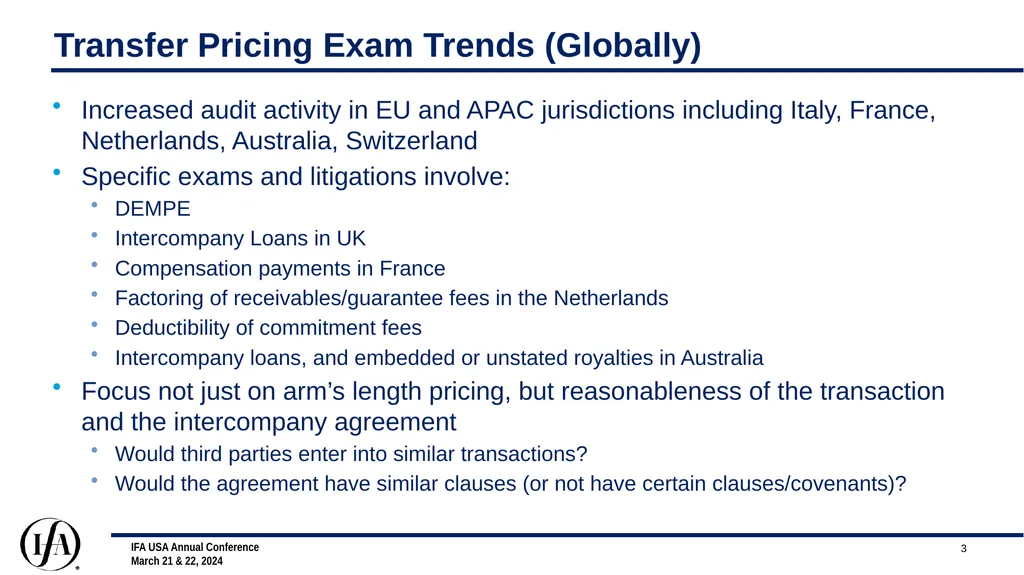
slide3. Transfer Pricing Exam Trends (Globally) Increased audit activity in EU and APAC jurisdictions including Italy, France, Netherlands, Australia, Switzerland
Specific exams and litigations involve:
DEMPE
Intercompany Loans in UK
Compensation payments in France
Factoring of receivables/guarantee fees in the Netherlands
Deductibility of commitment fees
Intercompany loans, and embedded or unstated royalties in Australia
Focus not just on arm’s length pricing, but reasonableness of the transaction and the intercompany agreement
Would third parties enter into similar transactions?
Would the agreement have similar clauses (or not have certain clauses/covenants)?<br>
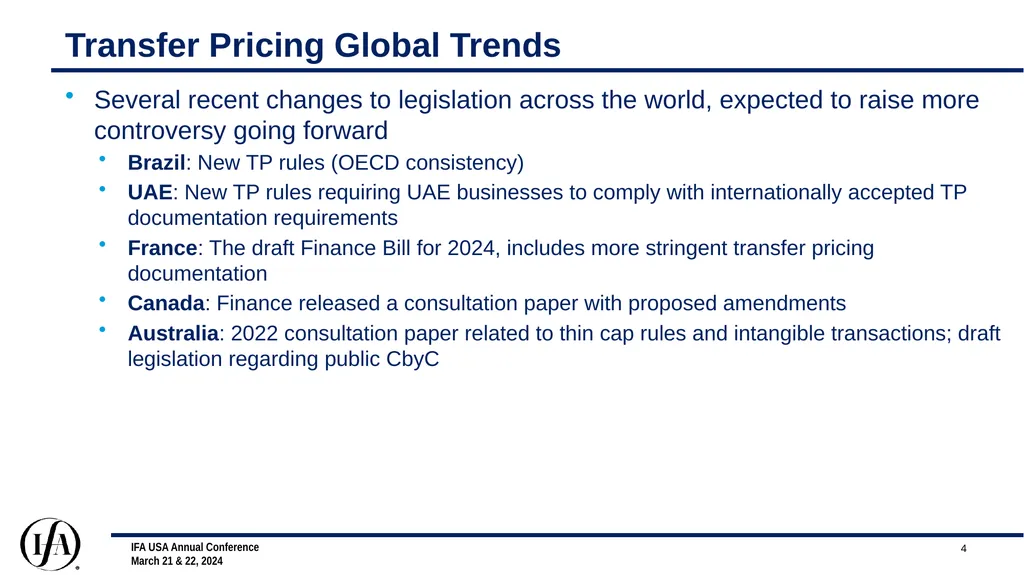
slide4. Transfer Pricing Global Trends Several recent changes to legislation across the world, expected to raise more controversy going forward
Brazil: New TP rules (OECD consistency)
UAE: New TP rules requiring UAE businesses to comply with internationally accepted TP documentation requirements
France: The draft Finance Bill for 2024, includes more stringent transfer pricing documentation
Canada: Finance released a consultation paper with proposed amendments
Australia: 2022 consultation paper related to thin cap rules and intangible transactions; draft legislation regarding public CbyC<br>
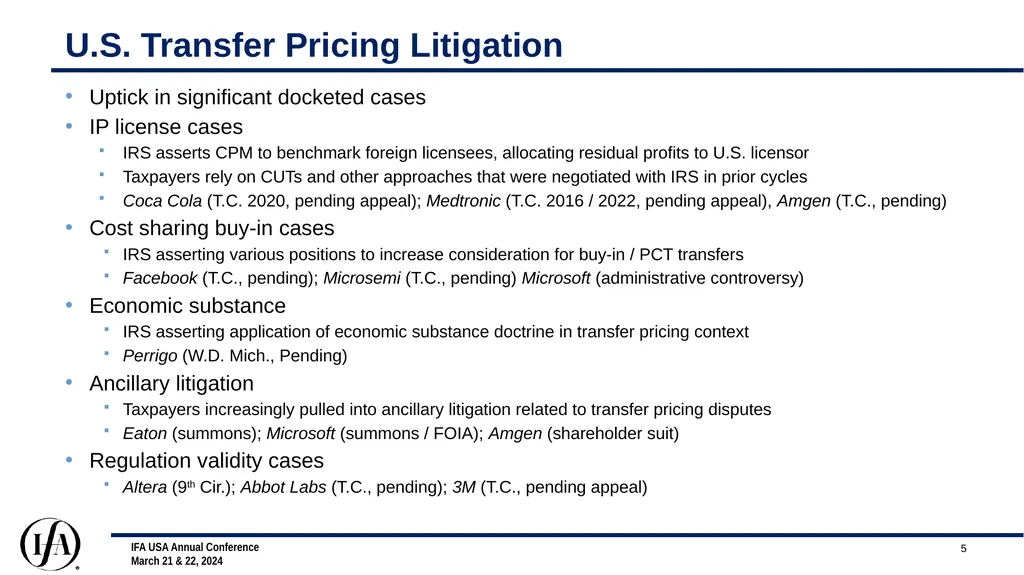
slide5. U.S. Transfer Pricing Litigation Uptick in significant docketed cases
IP license cases
IRS asserts CPM to benchmark foreign licensees, allocating residual profits to U.S. licensor
Taxpayers rely on CUTs and other approaches that were negotiated with IRS in prior cycles
Coca Cola (T.C. 2020, pending appeal); Medtronic (T.C. 2016 / 2022, pending appeal), Amgen (T.C., pending)
Cost sharing buy-in cases
IRS asserting various positions to increase consideration for buy-in / PCT transfers
Facebook (T.C., pending); Microsemi (T.C., pending) Microsoft (administrative controversy)
Economic substance
IRS asserting application of economic substance doctrine in transfer pricing context
Perrigo (W.D. Mich., Pending)
Ancillary litigation
Taxpayers increasingly pulled into ancillary litigation related to transfer pricing disputes
Eaton (summons); Microsoft (summons / FOIA); Amgen (shareholder suit)
Regulation validity cases
Altera (9th Cir.); Abbot Labs (T.C., pending); 3M (T.C., pending appeal)<br>
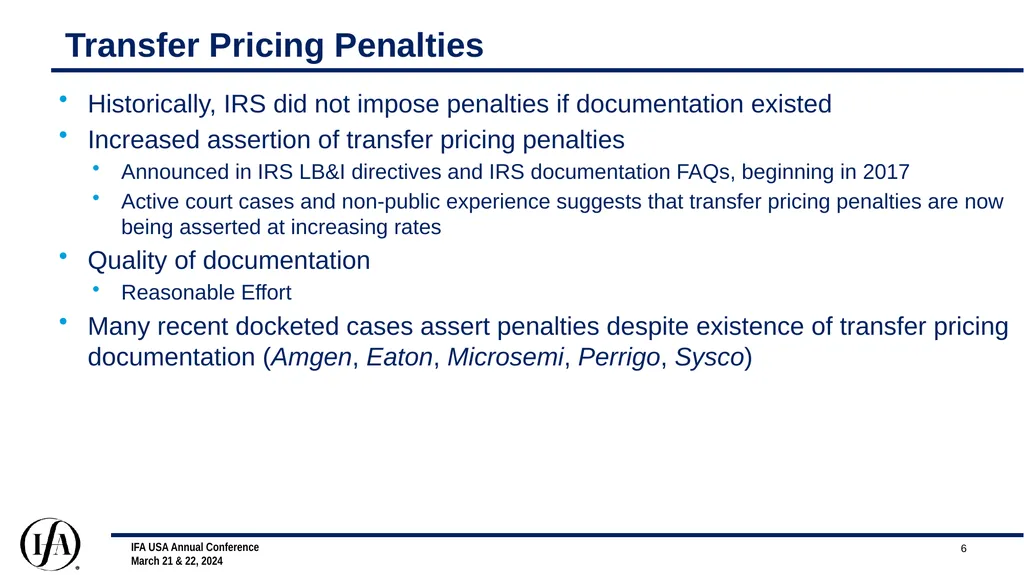
slide6. Transfer Pricing Penalties Historically, IRS did not impose penalties if documentation existed
Increased assertion of transfer pricing penalties
Announced in IRS LB&I directives and IRS documentation FAQs, beginning in 2017
Active court cases and non-public experience suggests that transfer pricing penalties are now being asserted at increasing rates
Quality of documentation
Reasonable Effort
Many recent docketed cases assert penalties despite existence of transfer pricing documentation (Amgen, Eaton, Microsemi, Perrigo, Sysco)<br>
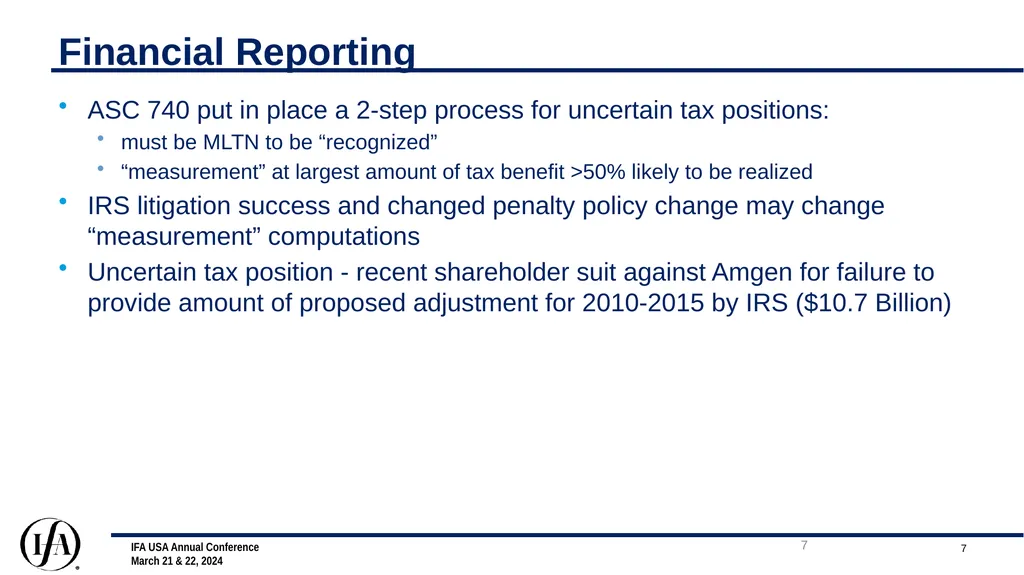
slide7. Financial Reporting ASC 740 put in place a 2-step process for uncertain tax positions:
must be MLTN to be “recognized”
“measurement” at largest amount of tax benefit >50% likely to be realized
IRS litigation success and changed penalty policy change may change “measurement” computations
Uncertain tax position - recent shareholder suit against Amgen for failure to provide amount of proposed adjustment for 2010-2015 by IRS ($10.7 Billion) 7<br>
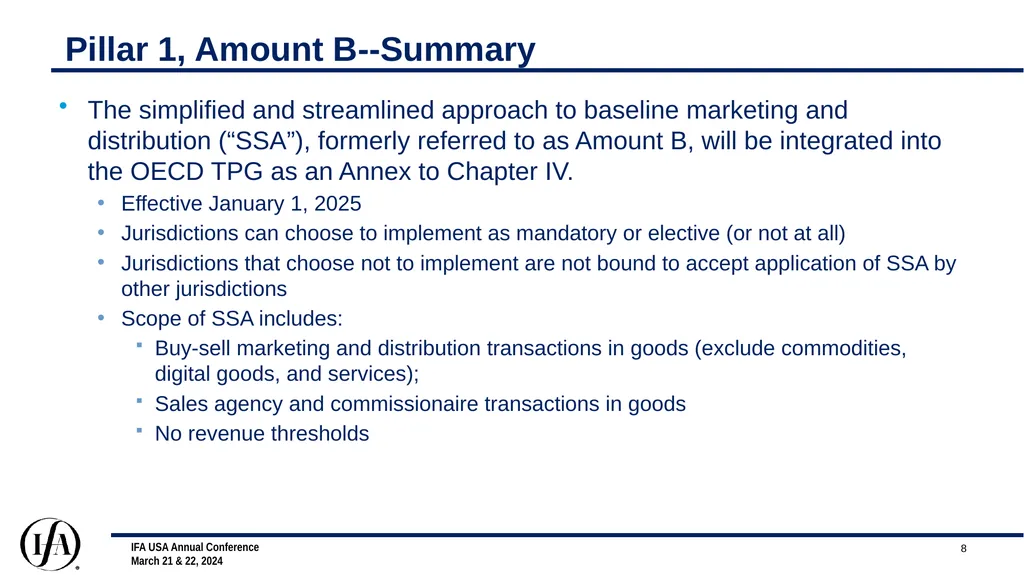
slide8. Pillar 1, Amount B--Summary The simplified and streamlined approach to baseline marketing and distribution (“SSA”), formerly referred to as Amount B, will be integrated into the OECD TPG as an Annex to Chapter IV.
Effective January 1, 2025
Jurisdictions can choose to implement as mandatory or elective (or not at all)
Jurisdictions that choose not to implement are not bound to accept application of SSA by other jurisdictions
Scope of SSA includes:
Buy-sell marketing and distribution transactions in goods (exclude commodities, digital goods, and services);
Sales agency and commissionaire transactions in goods
No revenue thresholds<br>
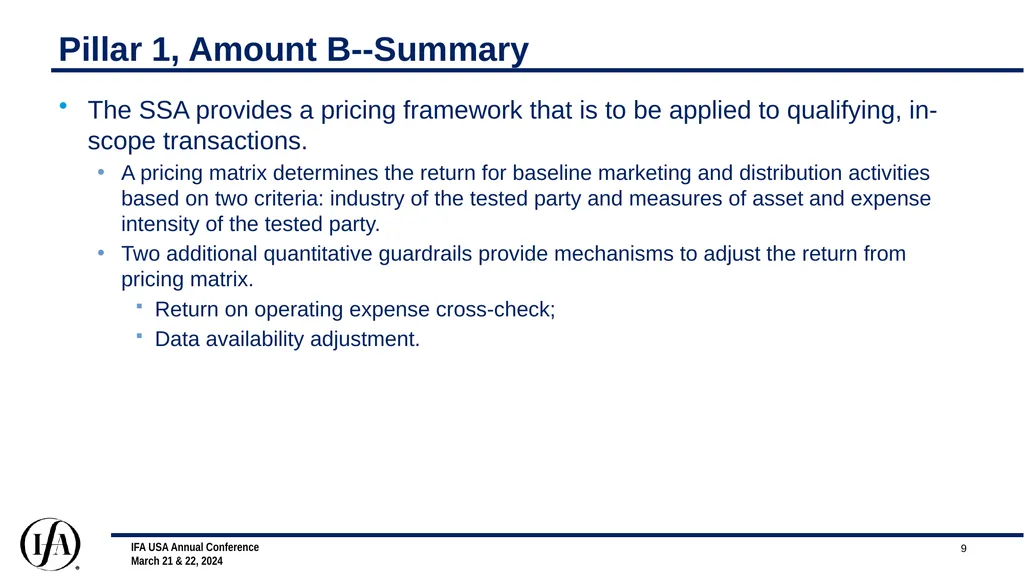
slide9. Pillar 1, Amount B--Summary The SSA provides a pricing framework that is to be applied to qualifying, in-scope transactions.
A pricing matrix determines the return for baseline marketing and distribution activities based on two criteria: industry of the tested party and measures of asset and expense intensity of the tested party.
Two additional quantitative guardrails provide mechanisms to adjust the return from pricing matrix.
Return on operating expense cross-check;
Data availability adjustment.<br>
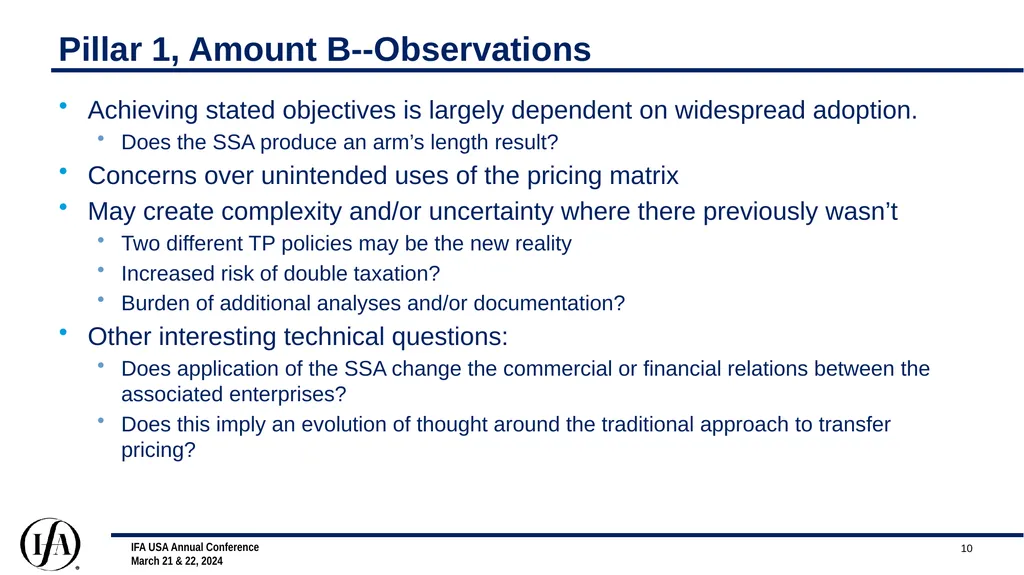
slide10. Pillar 1, Amount B--Observations Achieving stated objectives is largely dependent on widespread adoption.
Does the SSA produce an arm’s length result?
Concerns over unintended uses of the pricing matrix
May create complexity and/or uncertainty where there previously wasn’t
Two different TP policies may be the new reality
Increased risk of double taxation?
Burden of additional analyses and/or documentation?
Other interesting technical questions:
Does application of the SSA change the commercial or financial relations between the associated enterprises?
Does this imply an evolution of thought around the traditional approach to transfer pricing?<br>
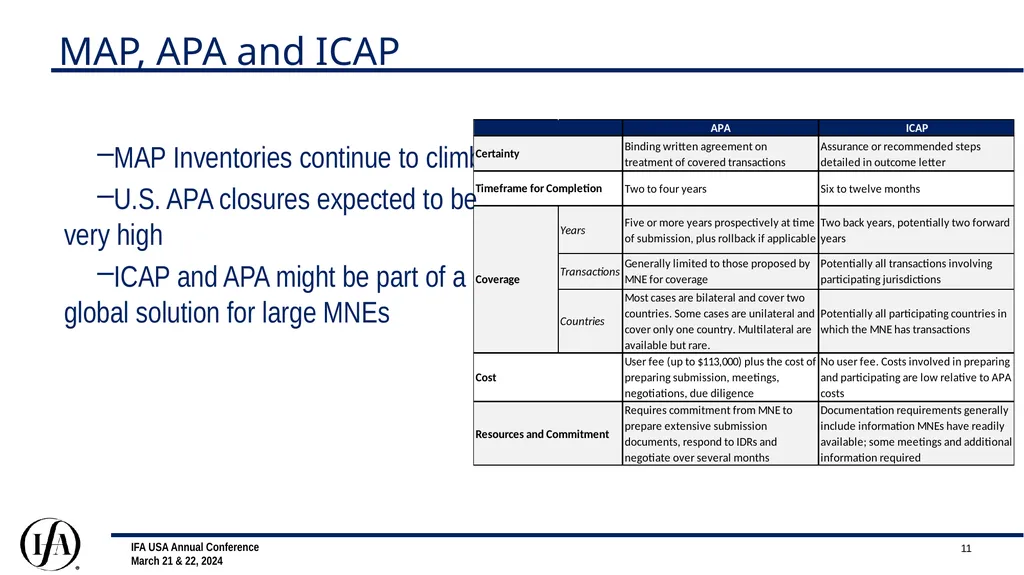
slide11. MAP, APA and ICAP MAP Inventories continue to climb
U.S. APA closures expected to be very high
ICAP and APA might be part of a global solution for large MNEs<br>
slide12. Thank you Moderator: Steven Wrappe Firm: Grant Thornton
Email: steven.wrappe@us.gt.com
Panelist: Ryan Lange Firm: Kroll, LLC
Email: ryan.lange@kroll.com
Panelist: Sayantani Ghose Firm: KPMG
Email: sghose@kpmg.com
Panelist: Rocco Femia Firm: Miller and Chevalier
Email: rfemia@milchev.com
Panelist: Laurie Dicker Firm: BDO
Email: ldicker@bdo.com<br>
Grant Thornton
Laurie Dicker
BDO
Rocco Femia
Miller and Chevalier
Sayantani Ghose
KPMG
Ryan Lange
Kroll
Natalia Pierotti—YIN Reporter
Weil, Gotshal & Manges<br>
slide2. Transfer Pricing Exam Trends (US) Heightened transfer pricing audits in the US. Some areas of focus include:
Exit Charges
Intercompany Financing
TP documentation and penalties (discussed later)
Role of Economic Substance
Exam teams not constrained to follow results from prior audits
Additional activities:
Compliance Alerts
GLAM on Implicit support
Quantification technique
Burden of Proof
Section 482 versus Section 385<br>
slide3. Transfer Pricing Exam Trends (Globally) Increased audit activity in EU and APAC jurisdictions including Italy, France, Netherlands, Australia, Switzerland
Specific exams and litigations involve:
DEMPE
Intercompany Loans in UK
Compensation payments in France
Factoring of receivables/guarantee fees in the Netherlands
Deductibility of commitment fees
Intercompany loans, and embedded or unstated royalties in Australia
Focus not just on arm’s length pricing, but reasonableness of the transaction and the intercompany agreement
Would third parties enter into similar transactions?
Would the agreement have similar clauses (or not have certain clauses/covenants)?<br>
slide4. Transfer Pricing Global Trends Several recent changes to legislation across the world, expected to raise more controversy going forward
Brazil: New TP rules (OECD consistency)
UAE: New TP rules requiring UAE businesses to comply with internationally accepted TP documentation requirements
France: The draft Finance Bill for 2024, includes more stringent transfer pricing documentation
Canada: Finance released a consultation paper with proposed amendments
Australia: 2022 consultation paper related to thin cap rules and intangible transactions; draft legislation regarding public CbyC<br>
slide5. U.S. Transfer Pricing Litigation Uptick in significant docketed cases
IP license cases
IRS asserts CPM to benchmark foreign licensees, allocating residual profits to U.S. licensor
Taxpayers rely on CUTs and other approaches that were negotiated with IRS in prior cycles
Coca Cola (T.C. 2020, pending appeal); Medtronic (T.C. 2016 / 2022, pending appeal), Amgen (T.C., pending)
Cost sharing buy-in cases
IRS asserting various positions to increase consideration for buy-in / PCT transfers
Facebook (T.C., pending); Microsemi (T.C., pending) Microsoft (administrative controversy)
Economic substance
IRS asserting application of economic substance doctrine in transfer pricing context
Perrigo (W.D. Mich., Pending)
Ancillary litigation
Taxpayers increasingly pulled into ancillary litigation related to transfer pricing disputes
Eaton (summons); Microsoft (summons / FOIA); Amgen (shareholder suit)
Regulation validity cases
Altera (9th Cir.); Abbot Labs (T.C., pending); 3M (T.C., pending appeal)<br>
slide6. Transfer Pricing Penalties Historically, IRS did not impose penalties if documentation existed
Increased assertion of transfer pricing penalties
Announced in IRS LB&I directives and IRS documentation FAQs, beginning in 2017
Active court cases and non-public experience suggests that transfer pricing penalties are now being asserted at increasing rates
Quality of documentation
Reasonable Effort
Many recent docketed cases assert penalties despite existence of transfer pricing documentation (Amgen, Eaton, Microsemi, Perrigo, Sysco)<br>
slide7. Financial Reporting ASC 740 put in place a 2-step process for uncertain tax positions:
must be MLTN to be “recognized”
“measurement” at largest amount of tax benefit >50% likely to be realized
IRS litigation success and changed penalty policy change may change “measurement” computations
Uncertain tax position - recent shareholder suit against Amgen for failure to provide amount of proposed adjustment for 2010-2015 by IRS ($10.7 Billion) 7<br>
slide8. Pillar 1, Amount B--Summary The simplified and streamlined approach to baseline marketing and distribution (“SSA”), formerly referred to as Amount B, will be integrated into the OECD TPG as an Annex to Chapter IV.
Effective January 1, 2025
Jurisdictions can choose to implement as mandatory or elective (or not at all)
Jurisdictions that choose not to implement are not bound to accept application of SSA by other jurisdictions
Scope of SSA includes:
Buy-sell marketing and distribution transactions in goods (exclude commodities, digital goods, and services);
Sales agency and commissionaire transactions in goods
No revenue thresholds<br>
slide9. Pillar 1, Amount B--Summary The SSA provides a pricing framework that is to be applied to qualifying, in-scope transactions.
A pricing matrix determines the return for baseline marketing and distribution activities based on two criteria: industry of the tested party and measures of asset and expense intensity of the tested party.
Two additional quantitative guardrails provide mechanisms to adjust the return from pricing matrix.
Return on operating expense cross-check;
Data availability adjustment.<br>
slide10. Pillar 1, Amount B--Observations Achieving stated objectives is largely dependent on widespread adoption.
Does the SSA produce an arm’s length result?
Concerns over unintended uses of the pricing matrix
May create complexity and/or uncertainty where there previously wasn’t
Two different TP policies may be the new reality
Increased risk of double taxation?
Burden of additional analyses and/or documentation?
Other interesting technical questions:
Does application of the SSA change the commercial or financial relations between the associated enterprises?
Does this imply an evolution of thought around the traditional approach to transfer pricing?<br>
slide11. MAP, APA and ICAP MAP Inventories continue to climb
U.S. APA closures expected to be very high
ICAP and APA might be part of a global solution for large MNEs<br>
slide12. Thank you Moderator: Steven Wrappe Firm: Grant Thornton
Email: steven.wrappe@us.gt.com
Panelist: Ryan Lange Firm: Kroll, LLC
Email: ryan.lange@kroll.com
Panelist: Sayantani Ghose Firm: KPMG
Email: sghose@kpmg.com
Panelist: Rocco Femia Firm: Miller and Chevalier
Email: rfemia@milchev.com
Panelist: Laurie Dicker Firm: BDO
Email: ldicker@bdo.com<br>