
Transformationof swedish welfare state: case study
LO
Published · 19 slides · 0 views

1 / 1





Description
Transformationof swedish welfare state: case study Ing. Vít Bárta, CSc. 212 2025 Liberal welfare regimes: their roots in the English nineteenth century political economy promote market solutions with the notion of less eligibility and
Related Topics
Download this presentation From Below
"Transformationof swedish welfare state: case study" is the property of its rightful owner. Permission is granted to download and print the materials on this website for personal, non-commercial use only, and to display it on your personal computer provided you do not modify the materials and that you retain all copyright notices contained in the materials. By downloading content from our website, you accept the terms of this agreement.
Share
Embed code
Presentation Transcript
01
Transformationof swedish welfare state: case study Ing. Vít Bárta, CSc. 2|12 | 2025<br>
02
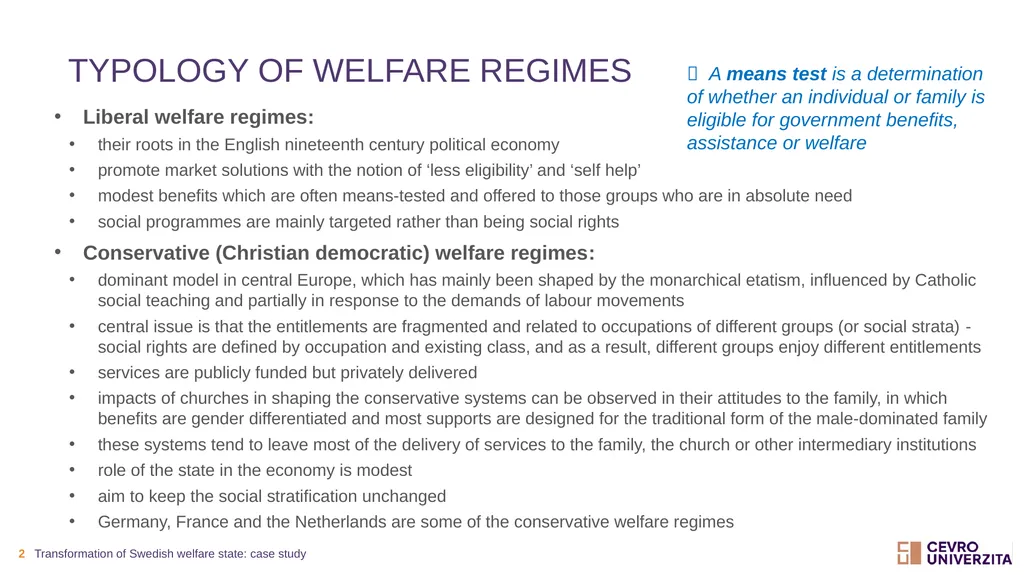
Liberal welfare regimes:
their roots in the English nineteenth century political economy
promote market solutions with the notion of ‘less eligibility’ and ‘self help’
modest benefits which are often means-tested and offered to those groups who are in absolute need
social programmes are mainly targeted rather than being social rights
Conservative (Christian democratic) welfare regimes:
dominant model in central Europe, which has mainly been shaped by the monarchical etatism, influenced by Catholic social teaching and partially in response to the demands of labour movements
central issue is that the entitlements are fragmented and related to occupations of different groups (or social strata) - social rights are defined by occupation and existing class, and as a result, different groups enjoy different entitlements
services are publicly funded but privately delivered
impacts of churches in shaping the conservative systems can be observed in their attitudes to the family, in which benefits are gender differentiated and most supports are designed for the traditional form of the male-dominated family
these systems tend to leave most of the delivery of services to the family, the church or other intermediary institutions
role of the state in the economy is modest
aim to keep the social stratification unchanged
Germany, France and the Netherlands are some of the conservative welfare regimes 2 Typology of welfare regimes Transformation of Swedish welfare state: case study A means test is a determination of whether an individual or family is eligible for government benefits, assistance or welfare<br>
their roots in the English nineteenth century political economy
promote market solutions with the notion of ‘less eligibility’ and ‘self help’
modest benefits which are often means-tested and offered to those groups who are in absolute need
social programmes are mainly targeted rather than being social rights
Conservative (Christian democratic) welfare regimes:
dominant model in central Europe, which has mainly been shaped by the monarchical etatism, influenced by Catholic social teaching and partially in response to the demands of labour movements
central issue is that the entitlements are fragmented and related to occupations of different groups (or social strata) - social rights are defined by occupation and existing class, and as a result, different groups enjoy different entitlements
services are publicly funded but privately delivered
impacts of churches in shaping the conservative systems can be observed in their attitudes to the family, in which benefits are gender differentiated and most supports are designed for the traditional form of the male-dominated family
these systems tend to leave most of the delivery of services to the family, the church or other intermediary institutions
role of the state in the economy is modest
aim to keep the social stratification unchanged
Germany, France and the Netherlands are some of the conservative welfare regimes 2 Typology of welfare regimes Transformation of Swedish welfare state: case study A means test is a determination of whether an individual or family is eligible for government benefits, assistance or welfare<br>
03
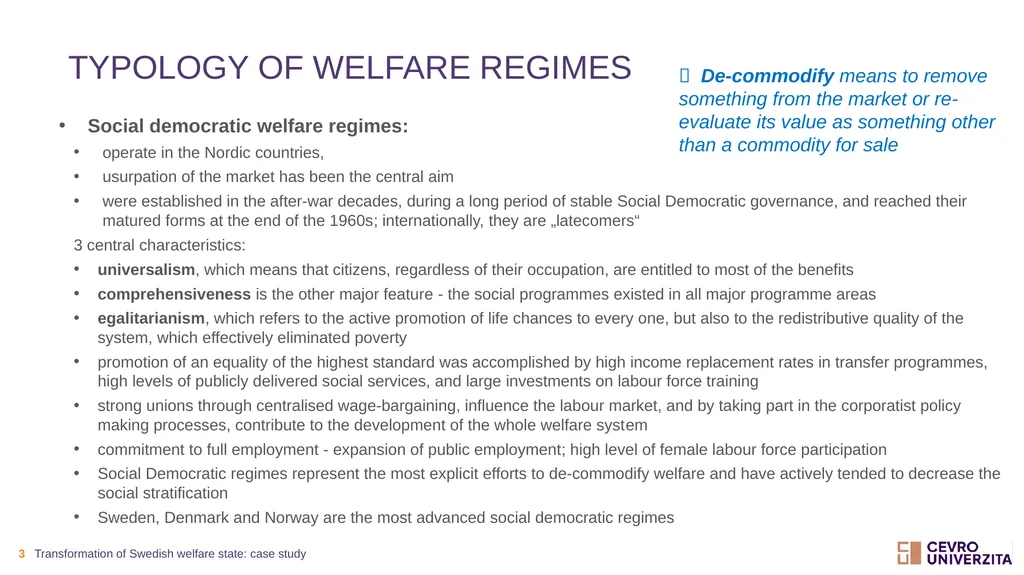
Social democratic welfare regimes:
operate in the Nordic countries,
usurpation of the market has been the central aim
were established in the after-war decades, during a long period of stable Social Democratic governance, and reached their matured forms at the end of the 1960s; internationally, they are „latecomers“
3 central characteristics:
universalism, which means that citizens, regardless of their occupation, are entitled to most of the benefits
comprehensiveness is the other major feature - the social programmes existed in all major programme areas
egalitarianism, which refers to the active promotion of life chances to every one, but also to the redistributive quality of the system, which effectively eliminated poverty
promotion of an equality of the highest standard was accomplished by high income replacement rates in transfer programmes, high levels of publicly delivered social services, and large investments on labour force training
strong unions through centralised wage-bargaining, influence the labour market, and by taking part in the corporatist policy making processes, contribute to the development of the whole welfare system
commitment to full employment - expansion of public employment; high level of female labour force participation
Social Democratic regimes represent the most explicit efforts to de-commodify welfare and have actively tended to decrease the social stratification
Sweden, Denmark and Norway are the most advanced social democratic regimes 3 Typology of welfare regimes Transformation of Swedish welfare state: case study De-commodify means to remove something from the market or re-evaluate its value as something other than a commodity for sale<br>
operate in the Nordic countries,
usurpation of the market has been the central aim
were established in the after-war decades, during a long period of stable Social Democratic governance, and reached their matured forms at the end of the 1960s; internationally, they are „latecomers“
3 central characteristics:
universalism, which means that citizens, regardless of their occupation, are entitled to most of the benefits
comprehensiveness is the other major feature - the social programmes existed in all major programme areas
egalitarianism, which refers to the active promotion of life chances to every one, but also to the redistributive quality of the system, which effectively eliminated poverty
promotion of an equality of the highest standard was accomplished by high income replacement rates in transfer programmes, high levels of publicly delivered social services, and large investments on labour force training
strong unions through centralised wage-bargaining, influence the labour market, and by taking part in the corporatist policy making processes, contribute to the development of the whole welfare system
commitment to full employment - expansion of public employment; high level of female labour force participation
Social Democratic regimes represent the most explicit efforts to de-commodify welfare and have actively tended to decrease the social stratification
Sweden, Denmark and Norway are the most advanced social democratic regimes 3 Typology of welfare regimes Transformation of Swedish welfare state: case study De-commodify means to remove something from the market or re-evaluate its value as something other than a commodity for sale<br>
04
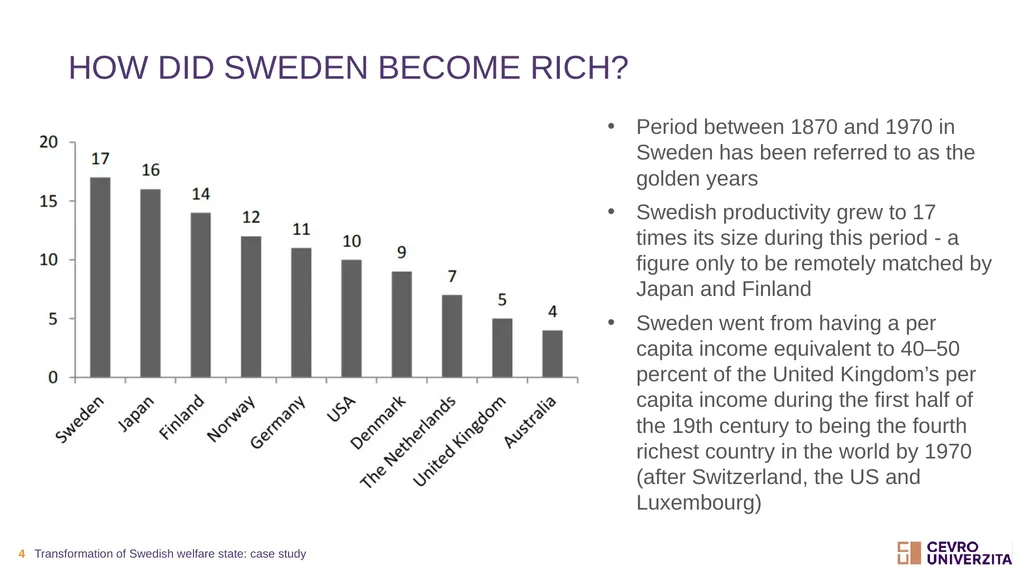
Period between 1870 and 1970 in Sweden has been referred to as the golden years
Swedish productivity grew to 17 times its size during this period - a figure only to be remotely matched by Japan and Finland
Sweden went from having a per capita income equivalent to 40–50 percent of the United Kingdom’s per capita income during the first half of the 19th century to being the fourth richest country in the world by 1970 (after Switzerland, the US and Luxembourg) 4 How did sweden become rich? Transformation of Swedish welfare state: case study<br>
Swedish productivity grew to 17 times its size during this period - a figure only to be remotely matched by Japan and Finland
Sweden went from having a per capita income equivalent to 40–50 percent of the United Kingdom’s per capita income during the first half of the 19th century to being the fourth richest country in the world by 1970 (after Switzerland, the US and Luxembourg) 4 How did sweden become rich? Transformation of Swedish welfare state: case study<br>
05
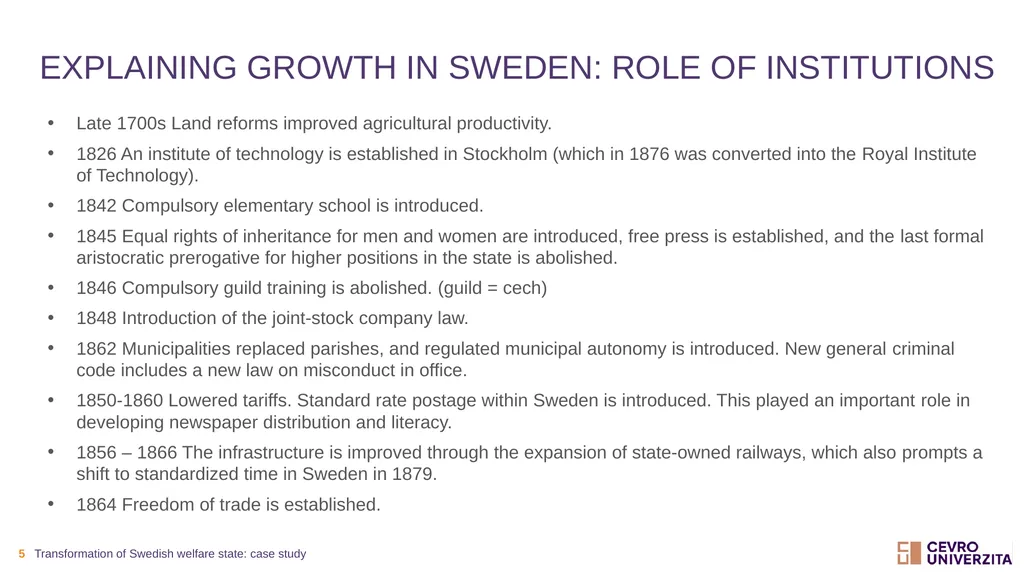
Late 1700s Land reforms improved agricultural productivity.
1826 An institute of technology is established in Stockholm (which in 1876 was converted into the Royal Institute of Technology).
1842 Compulsory elementary school is introduced.
1845 Equal rights of inheritance for men and women are introduced, free press is established, and the last formal aristocratic prerogative for higher positions in the state is abolished.
1846 Compulsory guild training is abolished. (guild = cech)
1848 Introduction of the joint-stock company law.
1862 Municipalities replaced parishes, and regulated municipal autonomy is introduced. New general criminal code includes a new law on misconduct in office.
1850-1860 Lowered tariffs. Standard rate postage within Sweden is introduced. This played an important role in developing newspaper distribution and literacy.
1856 – 1866 The infrastructure is improved through the expansion of state-owned railways, which also prompts a shift to standardized time in Sweden in 1879.
1864 Freedom of trade is established. 5 Explaining growth in sweden: role of institutions Transformation of Swedish welfare state: case study<br>
1826 An institute of technology is established in Stockholm (which in 1876 was converted into the Royal Institute of Technology).
1842 Compulsory elementary school is introduced.
1845 Equal rights of inheritance for men and women are introduced, free press is established, and the last formal aristocratic prerogative for higher positions in the state is abolished.
1846 Compulsory guild training is abolished. (guild = cech)
1848 Introduction of the joint-stock company law.
1862 Municipalities replaced parishes, and regulated municipal autonomy is introduced. New general criminal code includes a new law on misconduct in office.
1850-1860 Lowered tariffs. Standard rate postage within Sweden is introduced. This played an important role in developing newspaper distribution and literacy.
1856 – 1866 The infrastructure is improved through the expansion of state-owned railways, which also prompts a shift to standardized time in Sweden in 1879.
1864 Freedom of trade is established. 5 Explaining growth in sweden: role of institutions Transformation of Swedish welfare state: case study<br>
06
1866 The four-estate system is abolished, establishing a modern bicameral Parliament.
1840-1862 Several new public boards and agencies are established for infrastructure investments, creating a need for meritocratic recruitment of civil servants.
1860s Interest rate control is removed and banks set up as limited companies are allowed.
1873 The Swedish currency Krona is introduced. Being tied to the gold standard, this provided a stability that made overseas trading easier.
1895 The Companies Act modernized legislation, and responsibility is transferred to the newly established Patent and Registration Office.
1868 Direct payments for services to individual civil servants is abolished. From now on, the fee/money should no longer belong to the individual civil servant but be state property.
1869 Parliament decides that taxes must be paid in money instead of in goods.
1855 – 1875 Weberian-style bureaucracy is introduced through a series of reforms that transformed being a civil servant into a fixed wage, and full-time jobs are available only through open meritocratic competition. 6 role of institutions Transformation of Swedish welfare state: case study Meritocracy is the notion of a political system in which economic goods or political power are vested in individual people based on ability and talent, rather than wealth or social class. Advancement in such a system is based on performance, as measured through examination or demonstrated achievement.<br>
1840-1862 Several new public boards and agencies are established for infrastructure investments, creating a need for meritocratic recruitment of civil servants.
1860s Interest rate control is removed and banks set up as limited companies are allowed.
1873 The Swedish currency Krona is introduced. Being tied to the gold standard, this provided a stability that made overseas trading easier.
1895 The Companies Act modernized legislation, and responsibility is transferred to the newly established Patent and Registration Office.
1868 Direct payments for services to individual civil servants is abolished. From now on, the fee/money should no longer belong to the individual civil servant but be state property.
1869 Parliament decides that taxes must be paid in money instead of in goods.
1855 – 1875 Weberian-style bureaucracy is introduced through a series of reforms that transformed being a civil servant into a fixed wage, and full-time jobs are available only through open meritocratic competition. 6 role of institutions Transformation of Swedish welfare state: case study Meritocracy is the notion of a political system in which economic goods or political power are vested in individual people based on ability and talent, rather than wealth or social class. Advancement in such a system is based on performance, as measured through examination or demonstrated achievement.<br>
07
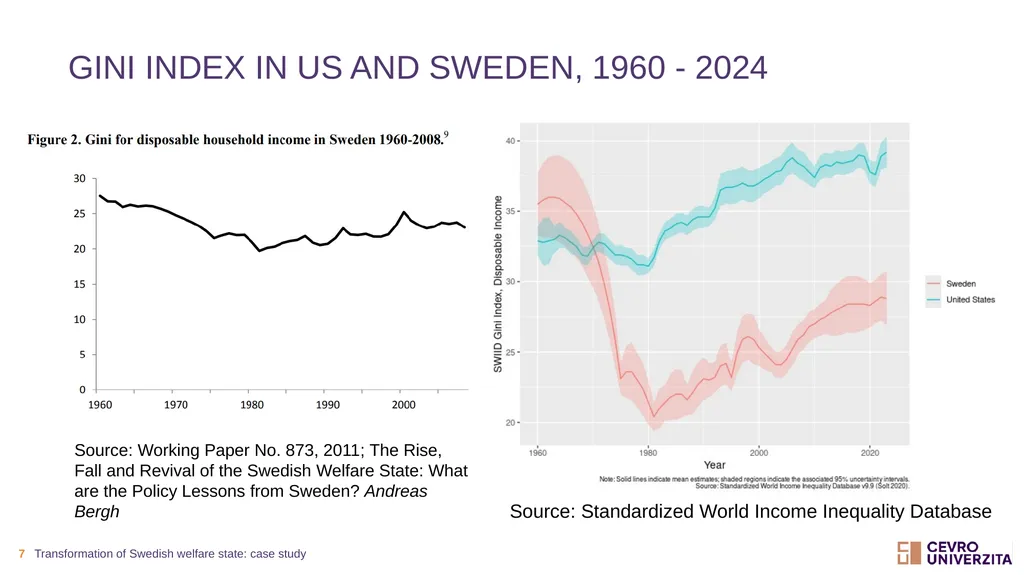
7 Gini index in US and sweden, 1960 - 2024 Transformation of Swedish welfare state: case study Source: Working Paper No. 873, 2011; The Rise, Fall and Revival of the Swedish Welfare State: What are the Policy Lessons from Sweden? Andreas Bergh Source: Standardized World Income Inequality Database<br>
08
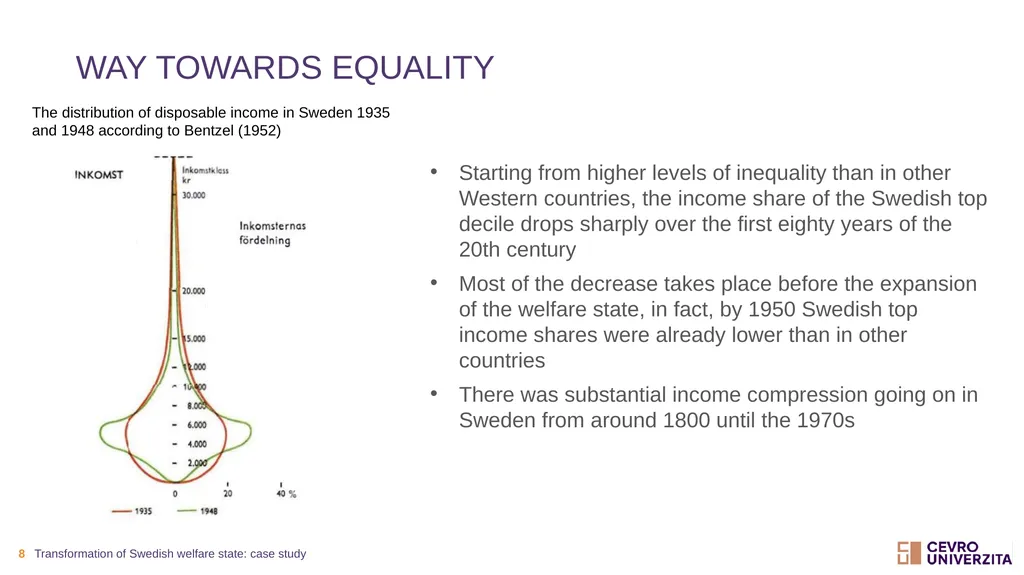
Starting from higher levels of inequality than in other Western countries, the income share of the Swedish top decile drops sharply over the first eighty years of the 20th century
Most of the decrease takes place before the expansion of the welfare state, in fact, by 1950 Swedish top income shares were already lower than in other countries
There was substantial income compression going on in Sweden from around 1800 until the 1970s 8 Way towards equality Transformation of Swedish welfare state: case study The distribution of disposable income in Sweden 1935 and 1948 according to Bentzel (1952)<br>
Most of the decrease takes place before the expansion of the welfare state, in fact, by 1950 Swedish top income shares were already lower than in other countries
There was substantial income compression going on in Sweden from around 1800 until the 1970s 8 Way towards equality Transformation of Swedish welfare state: case study The distribution of disposable income in Sweden 1935 and 1948 according to Bentzel (1952)<br>
09
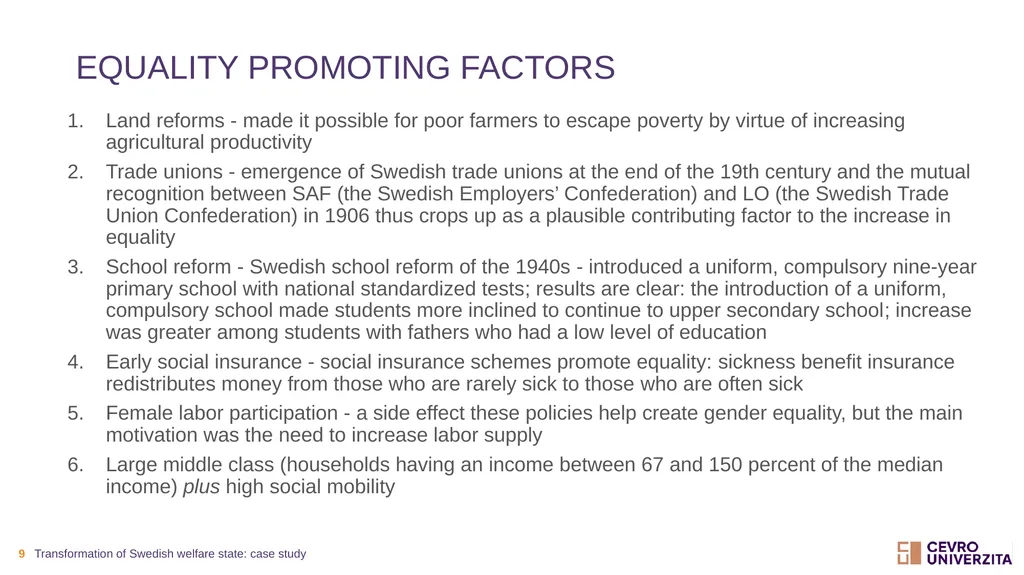
Land reforms - made it possible for poor farmers to escape poverty by virtue of increasing agricultural productivity
Trade unions - emergence of Swedish trade unions at the end of the 19th century and the mutual recognition between SAF (the Swedish Employers’ Confederation) and LO (the Swedish Trade Union Confederation) in 1906 thus crops up as a plausible contributing factor to the increase in equality
School reform - Swedish school reform of the 1940s - introduced a uniform, compulsory nine-year primary school with national standardized tests; results are clear: the introduction of a uniform, compulsory school made students more inclined to continue to upper secondary school; increase was greater among students with fathers who had a low level of education
Early social insurance - social insurance schemes promote equality: sickness benefit insurance redistributes money from those who are rarely sick to those who are often sick
Female labor participation - a side effect these policies help create gender equality, but the main motivation was the need to increase labor supply
Large middle class (households having an income between 67 and 150 percent of the median income) plus high social mobility 9 Equality promoting factors Transformation of Swedish welfare state: case study<br>
Trade unions - emergence of Swedish trade unions at the end of the 19th century and the mutual recognition between SAF (the Swedish Employers’ Confederation) and LO (the Swedish Trade Union Confederation) in 1906 thus crops up as a plausible contributing factor to the increase in equality
School reform - Swedish school reform of the 1940s - introduced a uniform, compulsory nine-year primary school with national standardized tests; results are clear: the introduction of a uniform, compulsory school made students more inclined to continue to upper secondary school; increase was greater among students with fathers who had a low level of education
Early social insurance - social insurance schemes promote equality: sickness benefit insurance redistributes money from those who are rarely sick to those who are often sick
Female labor participation - a side effect these policies help create gender equality, but the main motivation was the need to increase labor supply
Large middle class (households having an income between 67 and 150 percent of the median income) plus high social mobility 9 Equality promoting factors Transformation of Swedish welfare state: case study<br>
10
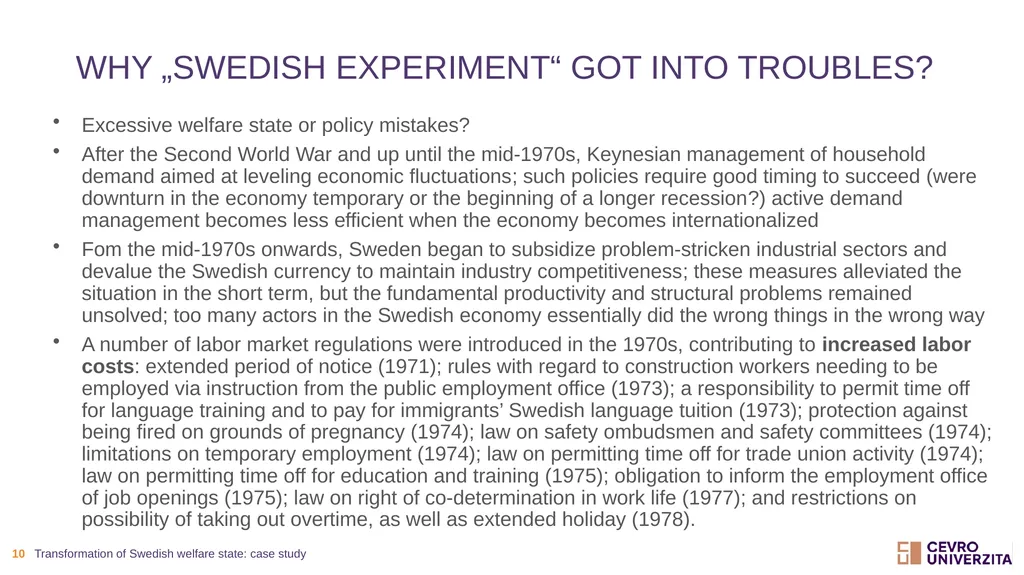
Excessive welfare state or policy mistakes?
After the Second World War and up until the mid-1970s, Keynesian management of household demand aimed at leveling economic fluctuations; such policies require good timing to succeed (were downturn in the economy temporary or the beginning of a longer recession?) active demand management becomes less efficient when the economy becomes internationalized
Fom the mid-1970s onwards, Sweden began to subsidize problem-stricken industrial sectors and devalue the Swedish currency to maintain industry competitiveness; these measures alleviated the situation in the short term, but the fundamental productivity and structural problems remained unsolved; too many actors in the Swedish economy essentially did the wrong things in the wrong way
A number of labor market regulations were introduced in the 1970s, contributing to increased labor costs: extended period of notice (1971); rules with regard to construction workers needing to be employed via instruction from the public employment office (1973); a responsibility to permit time off for language training and to pay for immigrants’ Swedish language tuition (1973); protection against being fired on grounds of pregnancy (1974); law on safety ombudsmen and safety committees (1974); limitations on temporary employment (1974); law on permitting time off for trade union activity (1974); law on permitting time off for education and training (1975); obligation to inform the employment office of job openings (1975); law on right of co-determination in work life (1977); and restrictions on possibility of taking out overtime, as well as extended holiday (1978). 10 Why „swedish experiment“ got into troubles? Transformation of Swedish welfare state: case study<br>
After the Second World War and up until the mid-1970s, Keynesian management of household demand aimed at leveling economic fluctuations; such policies require good timing to succeed (were downturn in the economy temporary or the beginning of a longer recession?) active demand management becomes less efficient when the economy becomes internationalized
Fom the mid-1970s onwards, Sweden began to subsidize problem-stricken industrial sectors and devalue the Swedish currency to maintain industry competitiveness; these measures alleviated the situation in the short term, but the fundamental productivity and structural problems remained unsolved; too many actors in the Swedish economy essentially did the wrong things in the wrong way
A number of labor market regulations were introduced in the 1970s, contributing to increased labor costs: extended period of notice (1971); rules with regard to construction workers needing to be employed via instruction from the public employment office (1973); a responsibility to permit time off for language training and to pay for immigrants’ Swedish language tuition (1973); protection against being fired on grounds of pregnancy (1974); law on safety ombudsmen and safety committees (1974); limitations on temporary employment (1974); law on permitting time off for trade union activity (1974); law on permitting time off for education and training (1975); obligation to inform the employment office of job openings (1975); law on right of co-determination in work life (1977); and restrictions on possibility of taking out overtime, as well as extended holiday (1978). 10 Why „swedish experiment“ got into troubles? Transformation of Swedish welfare state: case study<br>
11
During the 1970s, real labor costs increased much more than labor productivity increases allowed; costs increased mainly due to taxes (the payroll tax increased from 12.5 percent of a salary in 1970 to 36.7 percent in 1979, and during the same period, progressivity increased), labor market regulations (as listed above), and high nominal wage increases
High marginal taxes caused high levels of inefficiencies and tax avoidance; social democrat and economist Gunnar Myrdal (1978) famously asked whether the Swedes had turned into a people of swindlers
High marginal taxes combined with unlimited tax deductions for interest rate payments meant that loan-financed consumption became attractive for households; with marginal taxes above 80 percent, the value of tax deductions was very big; in addition, high inflation further lowered the real cost of debt financing
The aggressive devaluation in 1982, combined with the economic boom of the 1980s, made many economic indicators appear healthy for unsustainable reasons; seemingly healthy economic development made it politically difficult to pursue a sufficiently restrictive financial policy 11 Why „swedish experiment“ got into troubles? Transformation of Swedish welfare state: case study Gunnar Myrdal (1898 – 1987), Swedish economist and sociologist, in 1974, received the Nobel Memorial Prize in Economic Sciences along with Friedrich Hayek<br>
High marginal taxes caused high levels of inefficiencies and tax avoidance; social democrat and economist Gunnar Myrdal (1978) famously asked whether the Swedes had turned into a people of swindlers
High marginal taxes combined with unlimited tax deductions for interest rate payments meant that loan-financed consumption became attractive for households; with marginal taxes above 80 percent, the value of tax deductions was very big; in addition, high inflation further lowered the real cost of debt financing
The aggressive devaluation in 1982, combined with the economic boom of the 1980s, made many economic indicators appear healthy for unsustainable reasons; seemingly healthy economic development made it politically difficult to pursue a sufficiently restrictive financial policy 11 Why „swedish experiment“ got into troubles? Transformation of Swedish welfare state: case study Gunnar Myrdal (1898 – 1987), Swedish economist and sociologist, in 1974, received the Nobel Memorial Prize in Economic Sciences along with Friedrich Hayek<br>
12
Some political institutions probably also contributed:
The three-year terms of office, introduced with the election in 1970, contributed to shorttermism in politics, as each government was hampered either by being newly appointed, or by an impending election.
The joint election day for the general, county council and local government elections led the latter two to being overshadowed by the general election. This reduced incentives for local politicians to do well in local politics.
Another miscalculation concerning the reform of 1970 was the allocation of 350 seats to parliament. Remarkably, in the 1973 election, the two opposing blocs won 175 seats each, leading to a number of decisions being made by lot. While Swedish political decision-making generally had been characterized by predictability and rationality, this was not the case for the lottery-style parliament in place from the election in 1973 until 1976.
Macroeconomic strategy in the 1970s was to postpone dealing with the fundamental problems by way of devaluation. The strategy did not change until the effects of the aggressive devaluation of 1982 tapered off at the end of the 1980s. At that point, the underlying problems with regard to a) productivity, b) wage increases, c) household debt, and d) rigid labor market contributed to making the crisis of the early 1990s much worse in Sweden than in most other countries 12 Why „swedish experiment“ got into troubles? Transformation of Swedish welfare state: case study<br>
The three-year terms of office, introduced with the election in 1970, contributed to shorttermism in politics, as each government was hampered either by being newly appointed, or by an impending election.
The joint election day for the general, county council and local government elections led the latter two to being overshadowed by the general election. This reduced incentives for local politicians to do well in local politics.
Another miscalculation concerning the reform of 1970 was the allocation of 350 seats to parliament. Remarkably, in the 1973 election, the two opposing blocs won 175 seats each, leading to a number of decisions being made by lot. While Swedish political decision-making generally had been characterized by predictability and rationality, this was not the case for the lottery-style parliament in place from the election in 1973 until 1976.
Macroeconomic strategy in the 1970s was to postpone dealing with the fundamental problems by way of devaluation. The strategy did not change until the effects of the aggressive devaluation of 1982 tapered off at the end of the 1980s. At that point, the underlying problems with regard to a) productivity, b) wage increases, c) household debt, and d) rigid labor market contributed to making the crisis of the early 1990s much worse in Sweden than in most other countries 12 Why „swedish experiment“ got into troubles? Transformation of Swedish welfare state: case study<br>
13
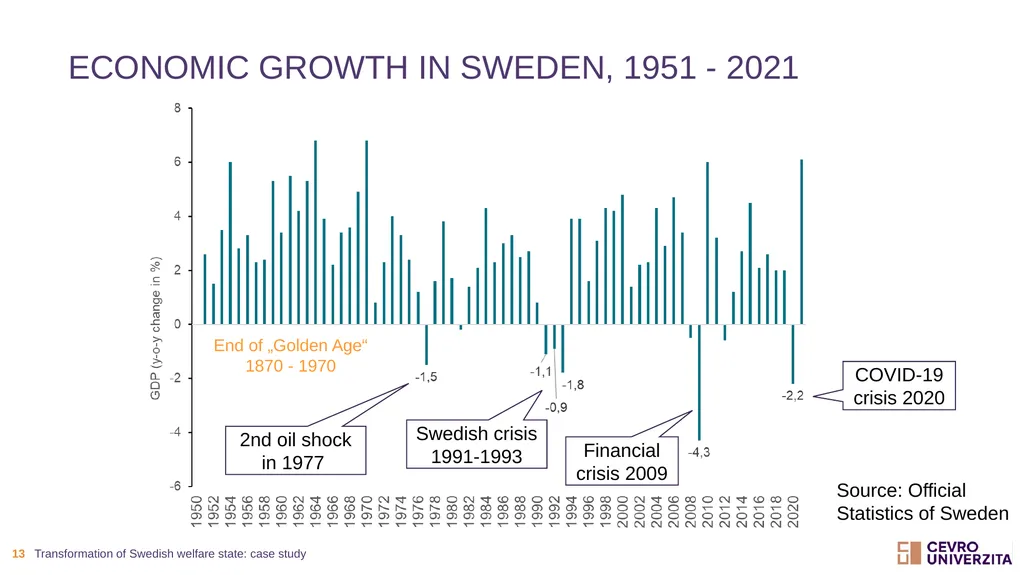
13 Economic growth in sweden, 1951 - 2021 Transformation of Swedish welfare state: case study Source: Official Statistics of Sweden 2nd oil shock
in 1977 Swedish crisis
1991-1993 Financial crisis 2009 COVID-19 crisis 2020 End of „Golden Age“
1870 - 1970<br>
in 1977 Swedish crisis
1991-1993 Financial crisis 2009 COVID-19 crisis 2020 End of „Golden Age“
1870 - 1970<br>
14
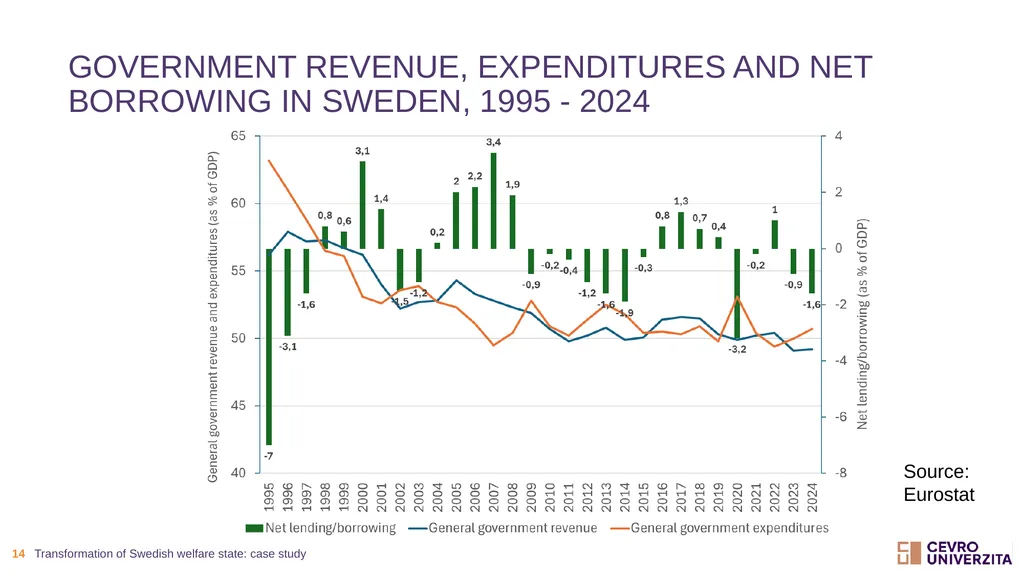
14 Government Revenue, expenditures and net borrowing in sweden, 1995 - 2024 Transformation of Swedish welfare state: case study Source: Eurostat<br>
15
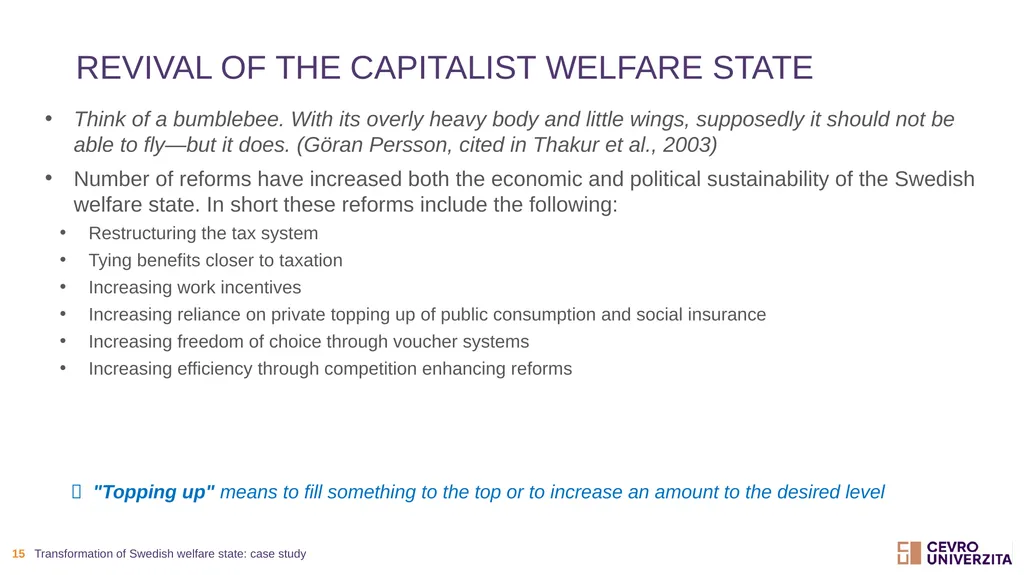
Think of a bumblebee. With its overly heavy body and little wings, supposedly it should not be able to fly—but it does. (Göran Persson, cited in Thakur et al., 2003)
Number of reforms have increased both the economic and political sustainability of the Swedish welfare state. In short these reforms include the following:
Restructuring the tax system
Tying benefits closer to taxation
Increasing work incentives
Increasing reliance on private topping up of public consumption and social insurance
Increasing freedom of choice through voucher systems
Increasing efficiency through competition enhancing reforms 15 Revival of the capitalist welfare state Transformation of Swedish welfare state: case study "Topping up" means to fill something to the top or to increase an amount to the desired level<br>
Number of reforms have increased both the economic and political sustainability of the Swedish welfare state. In short these reforms include the following:
Restructuring the tax system
Tying benefits closer to taxation
Increasing work incentives
Increasing reliance on private topping up of public consumption and social insurance
Increasing freedom of choice through voucher systems
Increasing efficiency through competition enhancing reforms 15 Revival of the capitalist welfare state Transformation of Swedish welfare state: case study "Topping up" means to fill something to the top or to increase an amount to the desired level<br>
16
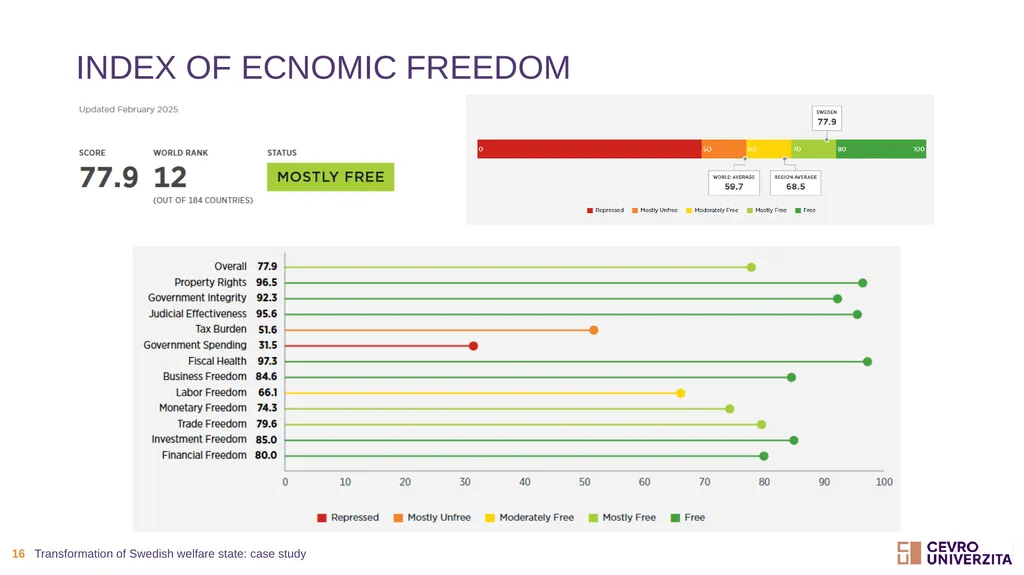
16 Index of ecnomic freedom Transformation of Swedish welfare state: case study<br>
17
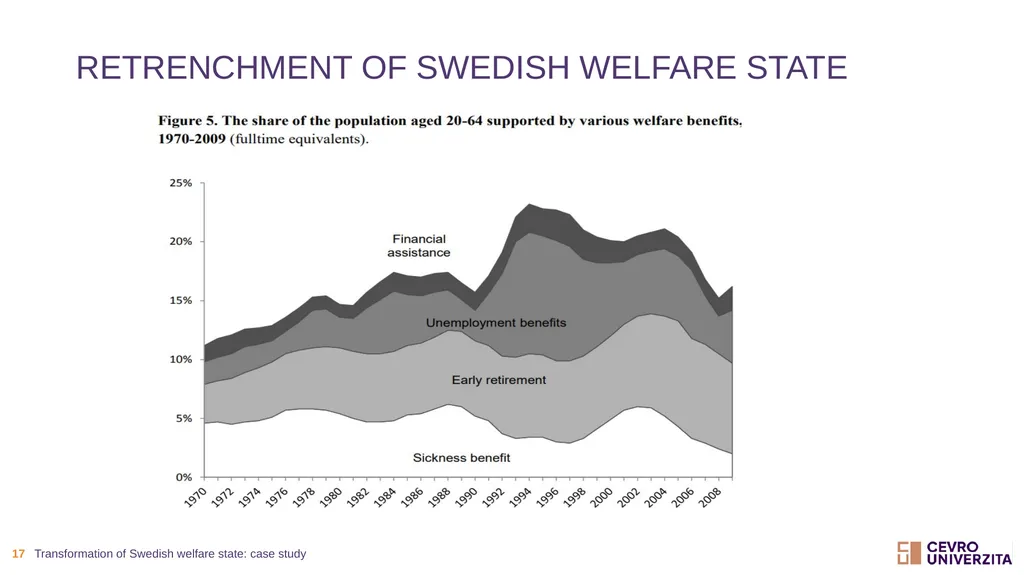
17 Retrenchment of swedish welfare state Transformation of Swedish welfare state: case study<br>
18
In many aspects, Sweden is not very different from other countries. The accelerating economic growth in Sweden around 1870 was most likely largely a result of liberalizations and well-functioning capitalist institutions. In this respect, there is no Swedish exceptionalism.
When it comes to equality, the most important conclusion is that most of the decrease in income inequality in Sweden occurred before the expansion of the welfare state. A number of seemingly unrelated reforms, such as land reforms, school reforms and the occurrence of unions and centralized wage bargaining, are likely explanations. Interestingly, at least parts of gender equality in Sweden seem to be an unintended consequence of the need to increase labor supply by using women in the workforce.
Roots of prosperity and equality: well-functioning capitalist institutions, especially property rights and a non-corrupt state sector, primary schooling, risk sharing social insurance schemes and labor unions
Combination of unsuccessful macro-economic policies and a very generous welfare state caused big problems for Sweden
Trend in Sweden from 1970 to 1995 was not sustainable economy - was much less capitalist, rules were unstable, policy unpredictable, and work incentives were weakened by the design of taxes and benefits.
Conclusion: to successfully combine a large welfare state with economic growth, macroeconomic factors are crucial; high degree of economic openness may actually foster policies that promote competitiveness and prosperity 18 Summary Transformation of Swedish welfare state: case study<br>
When it comes to equality, the most important conclusion is that most of the decrease in income inequality in Sweden occurred before the expansion of the welfare state. A number of seemingly unrelated reforms, such as land reforms, school reforms and the occurrence of unions and centralized wage bargaining, are likely explanations. Interestingly, at least parts of gender equality in Sweden seem to be an unintended consequence of the need to increase labor supply by using women in the workforce.
Roots of prosperity and equality: well-functioning capitalist institutions, especially property rights and a non-corrupt state sector, primary schooling, risk sharing social insurance schemes and labor unions
Combination of unsuccessful macro-economic policies and a very generous welfare state caused big problems for Sweden
Trend in Sweden from 1970 to 1995 was not sustainable economy - was much less capitalist, rules were unstable, policy unpredictable, and work incentives were weakened by the design of taxes and benefits.
Conclusion: to successfully combine a large welfare state with economic growth, macroeconomic factors are crucial; high degree of economic openness may actually foster policies that promote competitiveness and prosperity 18 Summary Transformation of Swedish welfare state: case study<br>
19
THANK YOU FOR
YOUR ATTENTION Jungmannova 17 | 110 00 Praha 1 | Česká republika 19 cevro.cz<br>