
Trauma-Focused Cognitive-Behavioral Therapy






















Description: Trauma-Focused Cognitive-Behavioral Therapy (TF-CBT) Basic Training Alicia Meyer, Ph.D. Adapted from: Anthony P. Mannarino, Ph.D. Judith A. Cohen, M.D. Center for Traumatic Stress in Children and Adolescents Allegheny General Hospital
Related Topics
Download Presentation
"Trauma-Focused Cognitive-Behavioral Therapy" is the property of its rightful owner. Permission is granted to download and print the materials on this website for personal, non-commercial use only, and to display it on your personal computer provided you do not modify the materials and that you retain all copyright notices contained in the materials. By downloading content from our website, you accept the terms of this agreement.
Presentation Transcript
slide1. Trauma-Focused
Cognitive-Behavioral Therapy (TF-CBT)
Basic Training Alicia Meyer, Ph.D.
Adapted from:
Anthony P. Mannarino, Ph.D.
Judith A. Cohen, M.D.
Center for Traumatic Stress in Children and Adolescents
Allegheny General Hospital
Drexel University College of Medicine<br>
slide2. Contact Information Alicia Meyer, Ph.D.
301-351-7257 (Cell)
TFCBT@AliciasPlace.org (logistics)
Alicia@AliciasPlace.org (clinical)
www.tfcbtconsulting.com
Materials
Password: TFinfo!<br>
slide3. Trainer Alicia Meyer, Ph.D.
Child Psychologist
CACs
Alicia’s Place
Started the TF Trainer role in 2015<br>
slide4. Types of Childhood Trauma Sexual abuse or assault
Physical abuse
Witness to DV
Community violence
Racial trauma
Victim or witness of school violence
Bullying
Suicide
Motor vehicle or other travel accidents Weather-related events
Terrorism
Mass disasters
Kidnapping
Fires
Medical (Cancer, burns, transplant)
Vicarious trauma
Immigration
CSEC
Traumatic Grief<br>
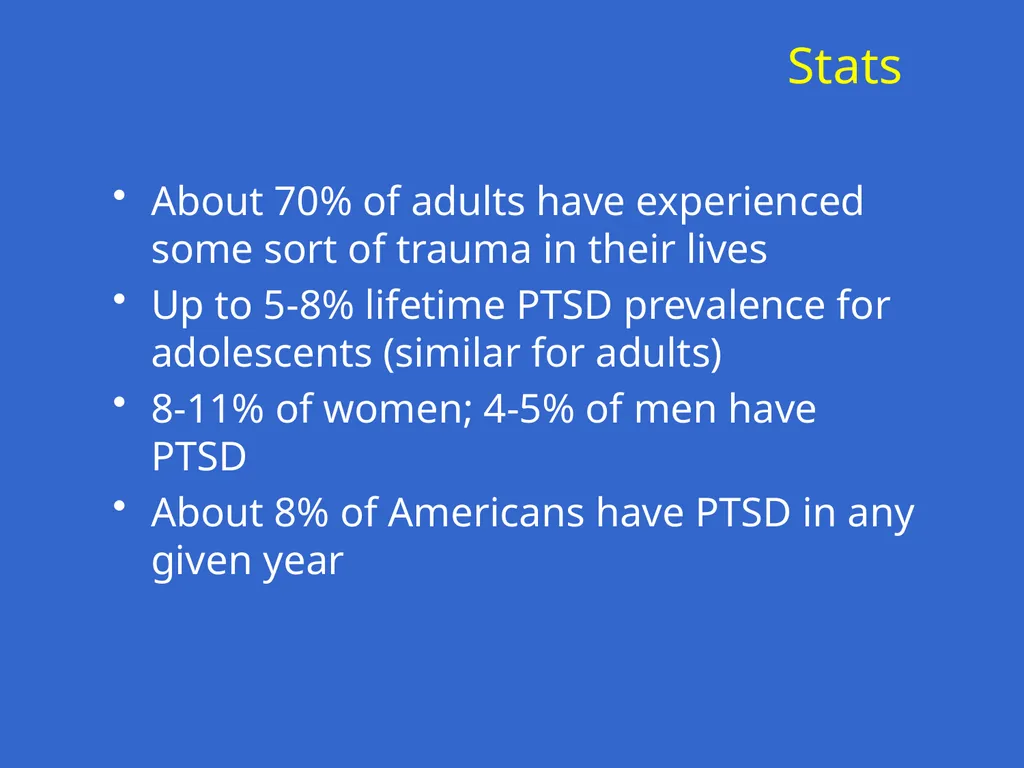
slide5. Stats About 70% of adults have experienced some sort of trauma in their lives
Up to 5-8% lifetime PTSD prevalence for adolescents (similar for adults)
8-11% of women; 4-5% of men have PTSD
About 8% of Americans have PTSD in any given year<br>
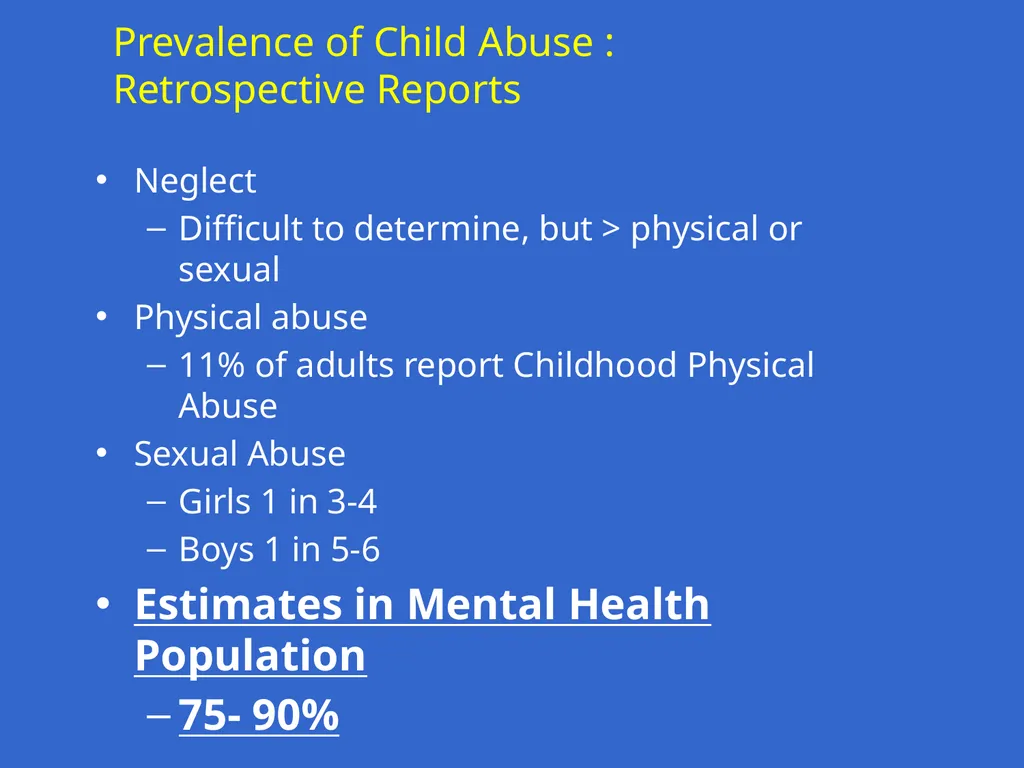
slide6. Prevalence of Child Abuse : Retrospective Reports Neglect
Difficult to determine, but > physical or sexual
Physical abuse
11% of adults report Childhood Physical Abuse
Sexual Abuse
Girls 1 in 3-4
Boys 1 in 5-6
Estimates in Mental Health Population
75- 90%<br>
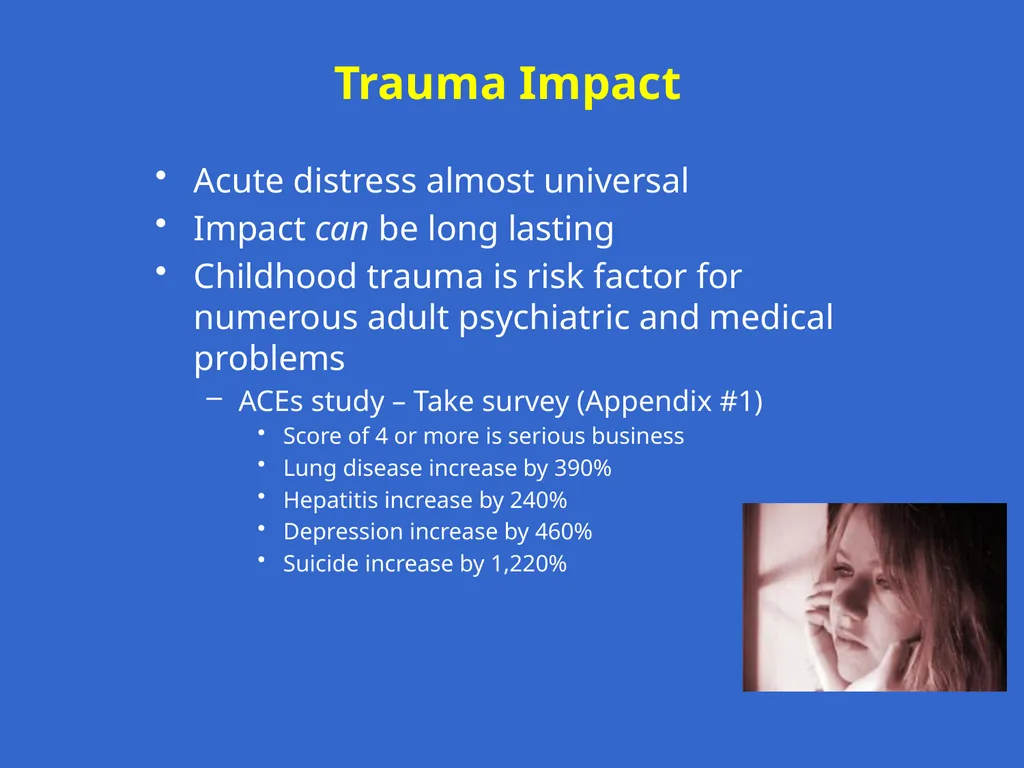
slide7. Trauma Impact Acute distress almost universal
Impact can be long lasting
Childhood trauma is risk factor for numerous adult psychiatric and medical problems
ACEs study – Take survey (Appendix #1)
Score of 4 or more is serious business
Lung disease increase by 390%
Hepatitis increase by 240%
Depression increase by 460%
Suicide increase by 1,220%<br>
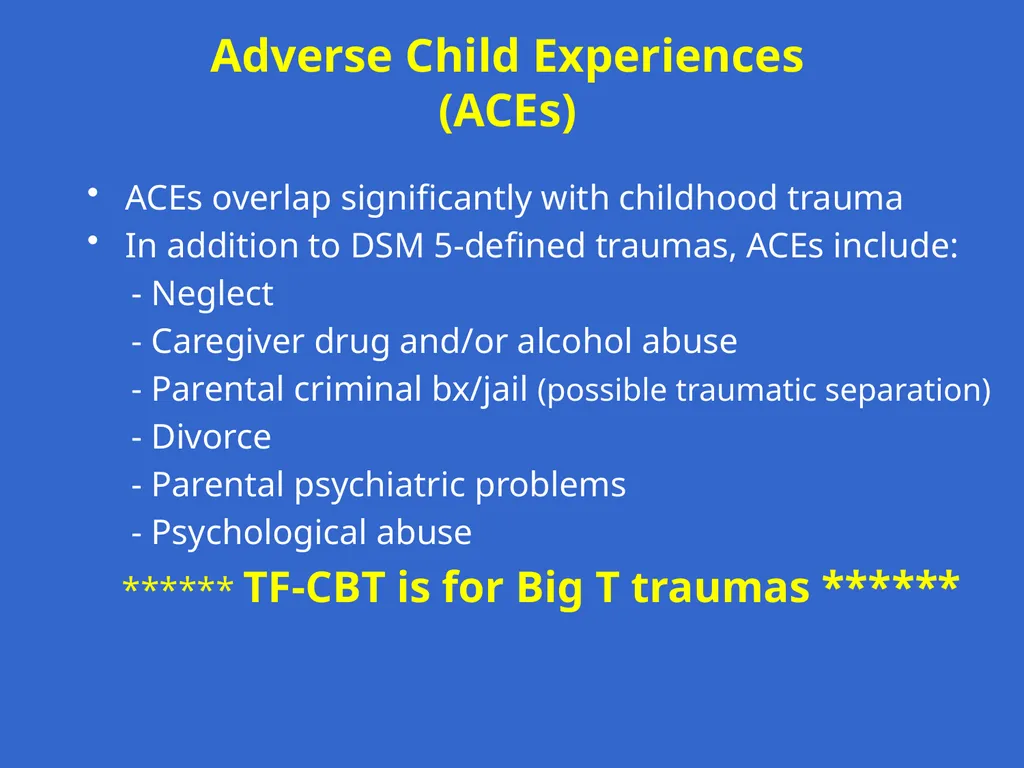
slide8. Adverse Child Experiences (ACEs) ACEs overlap significantly with childhood trauma
In addition to DSM 5-defined traumas, ACEs include:
- Neglect
- Caregiver drug and/or alcohol abuse
- Parental criminal bx/jail (possible traumatic separation)
- Divorce
- Parental psychiatric problems
- Psychological abuse
****** TF-CBT is for Big T traumas ******<br>
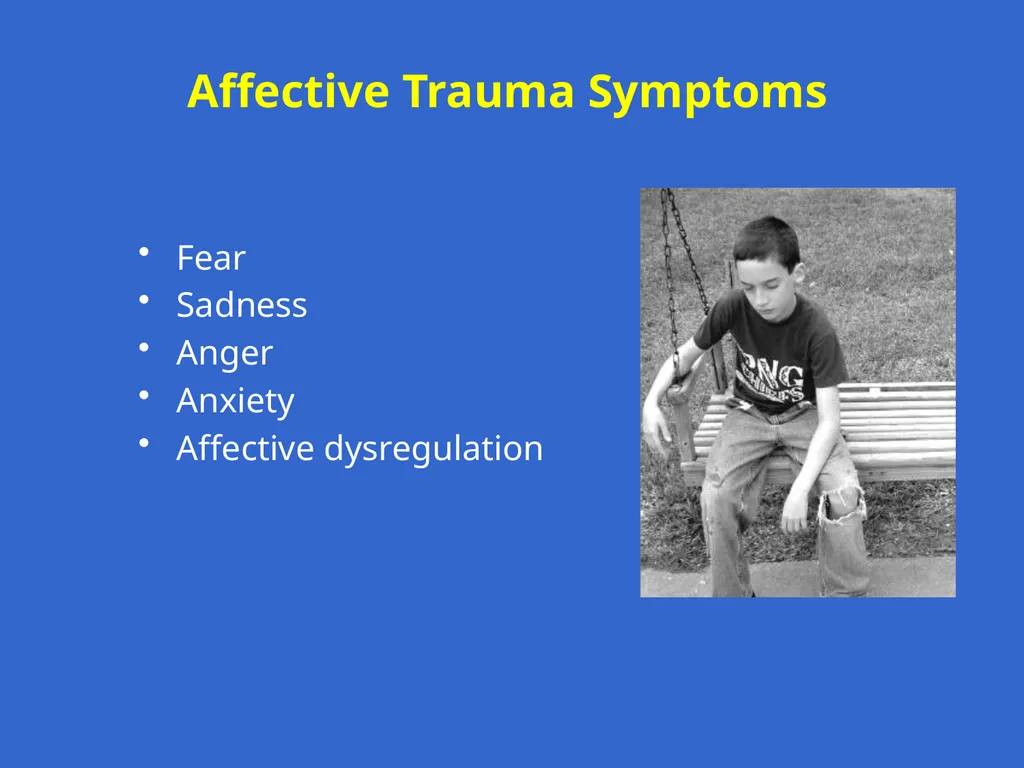
slide9. Affective Trauma Symptoms Fear
Sadness
Anger
Anxiety
Affective dysregulation<br>
slide10. Cognitive Trauma Symptoms Irrational or erroneous beliefs (e.g., “The abuse was my fault.” “I should have stopped him from drinking.”)
Reduced trust
Negative self-Image (e.g., “I am bad.” “I am damaged.”)
Potentially accurate, but unhelpful, cognitions (e.g., “Most men are dangerous.” “There will probably be another terrorist attack today.”)<br>
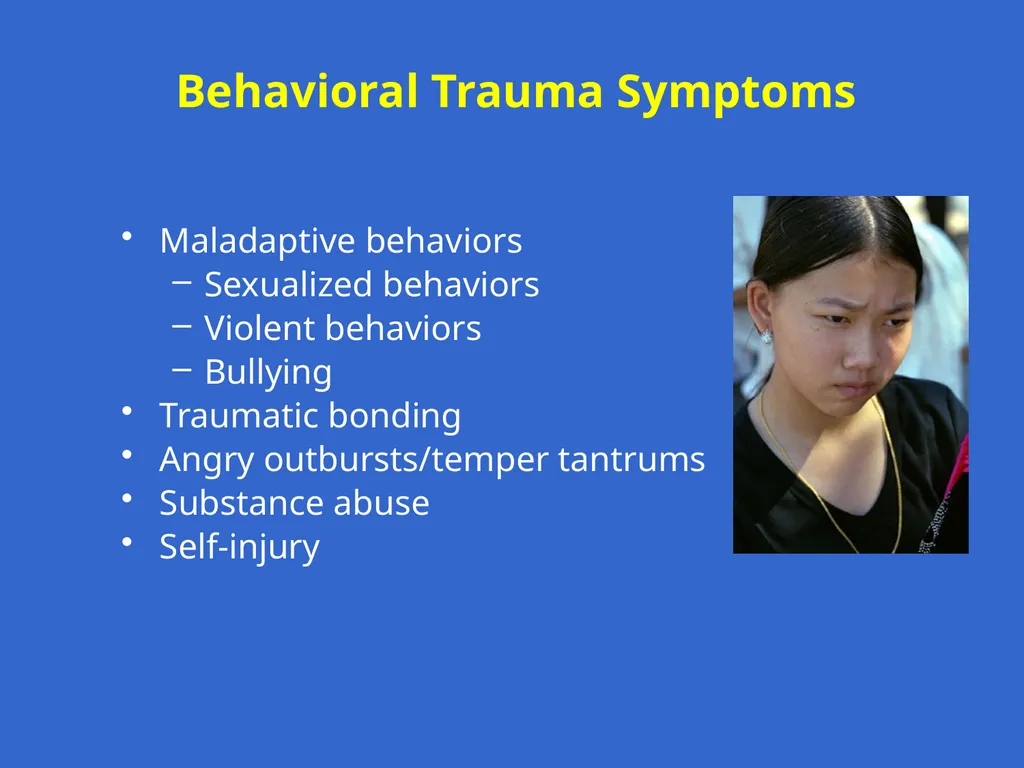
slide11. Behavioral Trauma Symptoms Maladaptive behaviors
Sexualized behaviors
Violent behaviors
Bullying
Traumatic bonding
Angry outbursts/temper tantrums
Substance abuse
Self-injury<br>
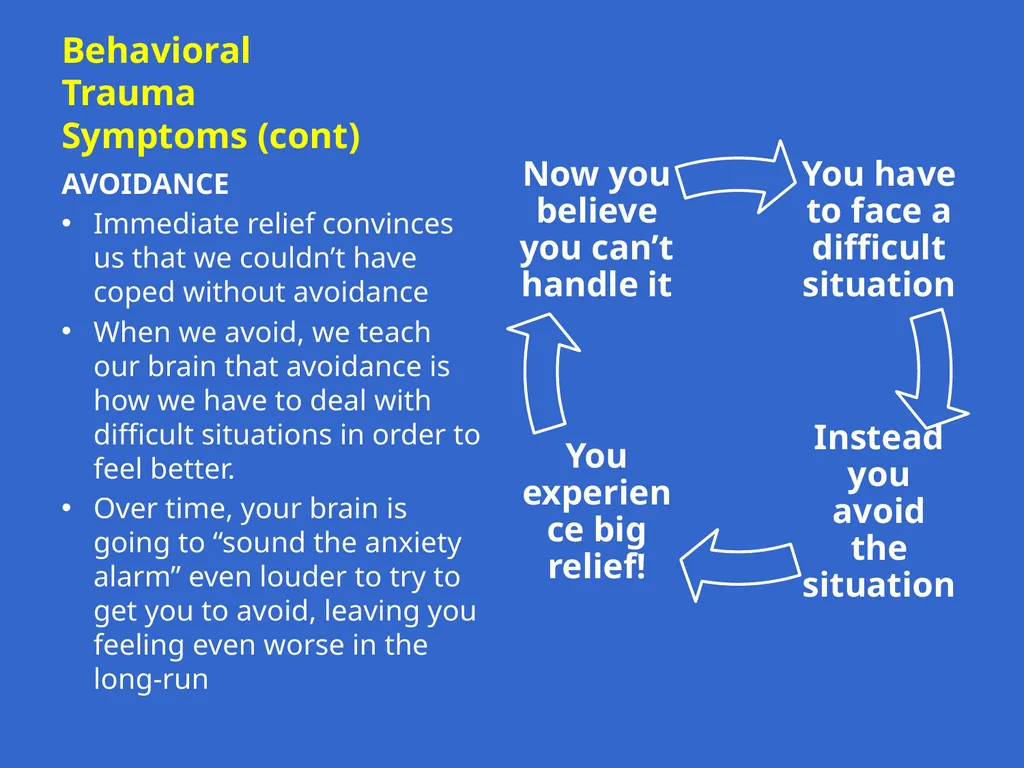
slide12. Behavioral Trauma Symptoms (cont) AVOIDANCE
Immediate relief convinces us that we couldn’t have coped without avoidance
When we avoid, we teach our brain that avoidance is how we have to deal with difficult situations in order to feel better.
Over time, your brain is going to “sound the anxiety alarm” even louder to try to get you to avoid, leaving you feeling even worse in the long-run<br>
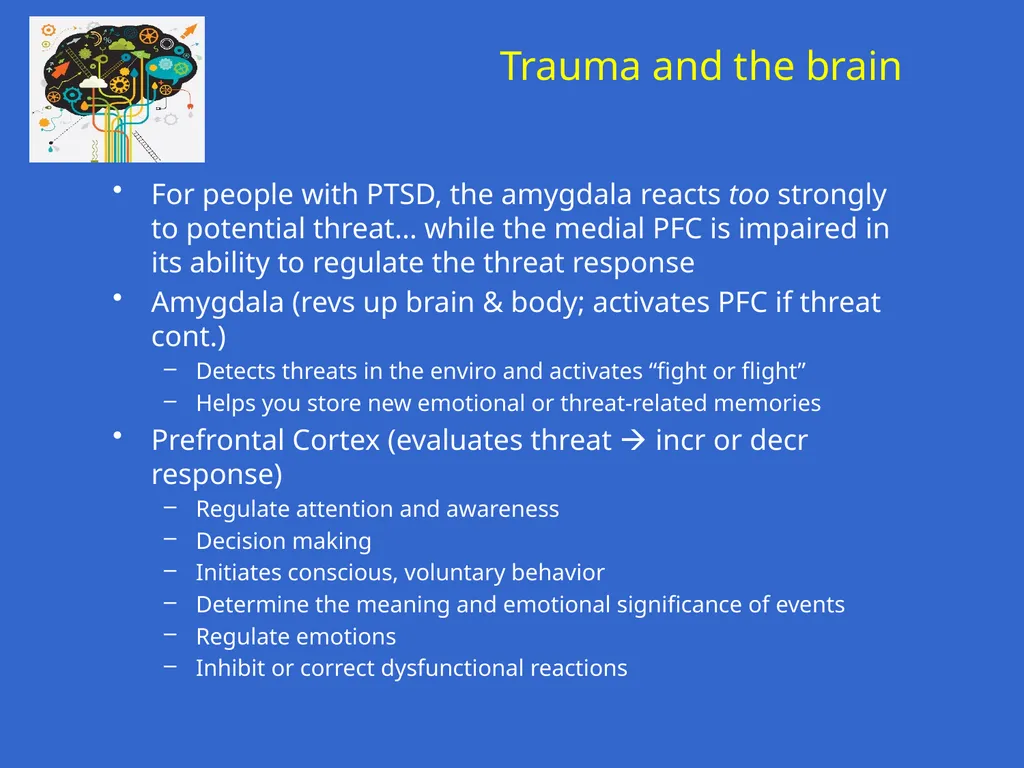
slide13. Trauma and the brain For people with PTSD, the amygdala reacts too strongly to potential threat… while the medial PFC is impaired in its ability to regulate the threat response
Amygdala (revs up brain & body; activates PFC if threat cont.)
Detects threats in the enviro and activates “fight or flight”
Helps you store new emotional or threat-related memories
Prefrontal Cortex (evaluates threat incr or decr response)
Regulate attention and awareness
Decision making
Initiates conscious, voluntary behavior
Determine the meaning and emotional significance of events
Regulate emotions
Inhibit or correct dysfunctional reactions<br>
slide14. Consequences of Brain Dysfunction Hyperarousal
Because the amygdala is overactive, more norepinephrine is released in response to threat and its release is not well-regulated by the PFC
Results in hypervigilance
Increased wakefulness & sleep disruption
Get emotionally triggered
Keyed up/on edge
Reactive Anger & Impulsivity
A reactive amygdala keeps people with PTSD on the alert and ready for quick action when they face a threat, leading them to be more impulsivity
With a less activated PFC, people with PTSD have less control over reactive anger and impulsive behaviors when they are emotionally triggered This Photo by Unknown Author is licensed under CC BY-NC-ND This Photo by Unknown Author is licensed under CC BY-SA-NC<br>
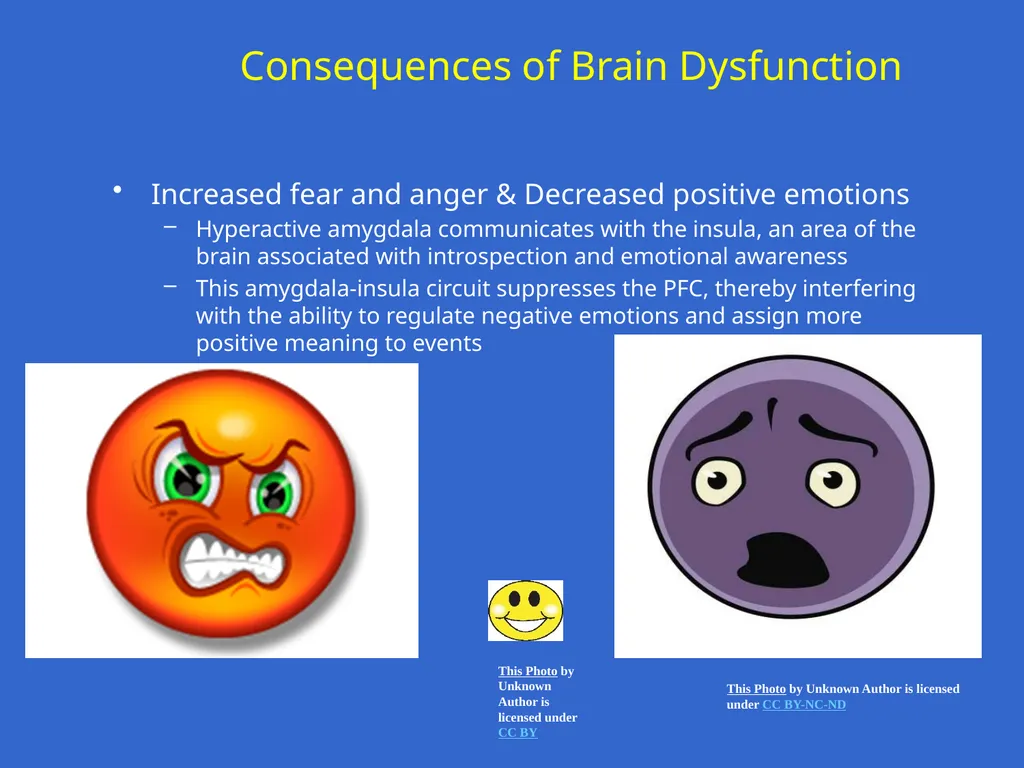
slide15. Consequences of Brain Dysfunction Increased fear and anger & Decreased positive emotions
Hyperactive amygdala communicates with the insula, an area of the brain associated with introspection and emotional awareness
This amygdala-insula circuit suppresses the PFC, thereby interfering with the ability to regulate negative emotions and assign more positive meaning to events This Photo by Unknown Author is licensed under CC BY-NC-ND This Photo by Unknown Author is licensed under CC BY<br>
slide16. Brain Dysfunction and Trauma Treatment Exposure therapy
Enhances the ability of the PFC to assign less threatening/more positive meaning to trauma events
(Antidepressants have a similar effect, too)
Mindfulness
Decreases amygdala volume
Increases the connectivity between the amygdala and PFC
Relaxation
Shuts down the release of stress chemicals<br>
slide17. Common Diagnoses PTSD
What are the symptoms?
DSM-V criteria: See handout #2
Criteria for children age six and under
See handout #3<br>
slide18. Common Diagnoses Depressive disorders
Other anxiety disorders
Comorbidity is common
ADHD
Oppositional Defiant Disorder
Substance Use Disorder
Bipolar Disorder
Psychotic disorders- up to 20% of traumatized children have psychotic symptoms<br>
slide19. Chronic Trauma Exposure (Complex Trauma) CPTSD (Per ICD-11) includes PTSD plus three additional clusters that reflect ‘disturbances in self-organization’ (DSO):
(1) affective dysregulation (AD), Heightened emotional reactivity, violent outbursts, impulsive or reckless behaviors and dissociation
(2) negative self-concept (NSC), marked by feeling diminished, defeated and worthless, feelings of shame, guilt, or despair
(3) disturbances in relationships (DR). marked by difficulties in feeling close to others, having little interest in relationships or social engagement more generally. There may be occasional relationships but the person has difficulty sustaining them<br>
slide20. Complex PTSD continued These disturbances are proposed to be typically associated with sustained, repeated, or multiple forms of traumatic exposure (e.g. genocide campaigns, childhood sexual abuse, child soldiering, severe domestic violence, torture, or slavery), reflecting loss of emotional, psychological, and social resources under conditions of prolonged adversity
For more on Complex Trauma, see handout #4
https://www.ncbi.nlm.nih.gov/pmc/articles/PMC5774423/<br>
slide21. Trauma Assessment POLL
Assessment is frequently viewed as not important
BUT:
How will you know whether a child needs trauma treatment?
Has there been trauma exposure?
Are there any trauma symptoms?
What type of trauma treatment is most appropriate?<br>
slide22. Trauma Assessment (cont’d) Clinical interview with child and caretakers
Handouts #2 and #3 as guides
Get trauma history, like with a trauma history Questionnaire (THQ)
Structured instruments (sample): See Handout #5
Child PTSD Symptom Scale
UCLA PTSD Reaction Index (RI)- child, adolescent, and parent versions
Trauma Symptom Checklist for Children
“Test narrative” or “baseline narrative”<br>
slide23. Trauma Assessment (cont’d) Is a full PTSD diagnosis necessary? No
Symptoms + functional impairment
There will likely be other diagnoses in addition
to PTSD
New DSM 5 criteria for children age six and under<br>
slide24. Pathway to Trauma Treatment What is the clinical presentation?
- Presence of trauma symptoms
What is the connection between the trauma exposure and current symptoms?
What is “driving the train”?
Start with different treatment and sequence to TF-CBT?
Therapist needs to be convinced of the need for trauma treatment if the family is going to get on board<br>
slide25. Getting “Buy-in” for TF-CBT Review trauma assessment
- Connection between exposure and current clinical
symptoms
Explain what TF-CBT is: for trauma symptoms and
trauma-related behavioral problems
Obtain consent from caregiver and child (if youth is
old enough to provide consent)
If you don’t get “buy-in”, DO NOT go forward with
TF-CBT
- Will need to do different trauma treatment or treat
a different set of problems<br>
slide26. What Are Evidence Based Treatments for Traumatized Children? What They Are Not:
Rigid
Lockstep
Inflexible…<br>
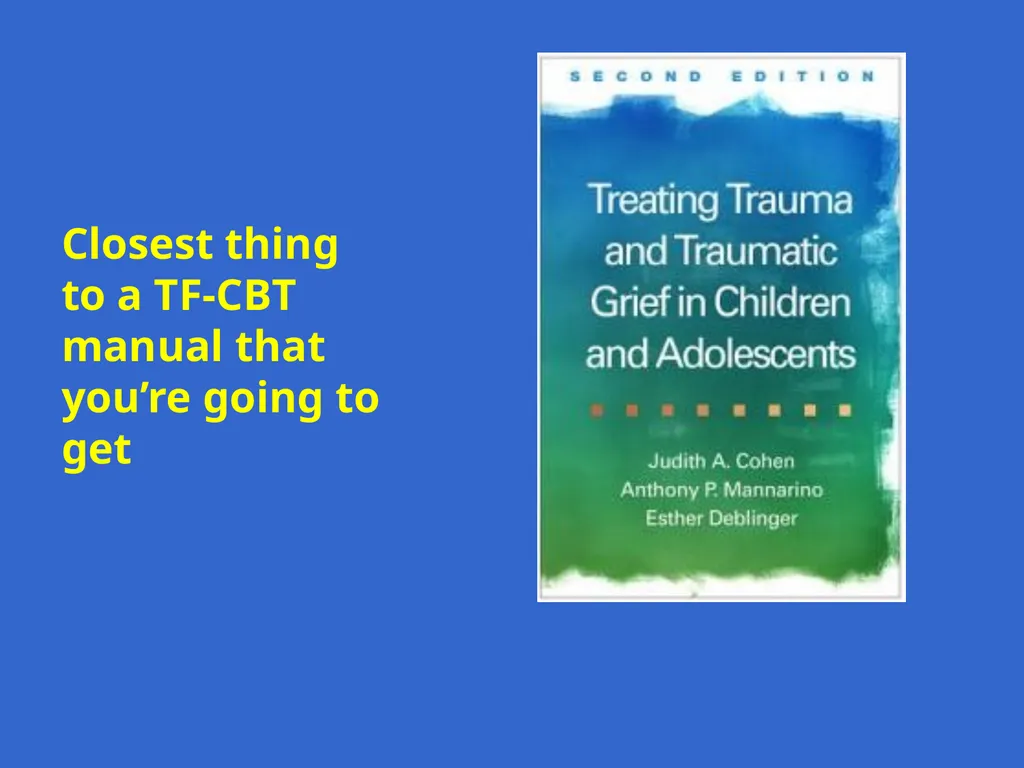
slide27. Closest thing to a TF-CBT manual that you’re going to get<br>
slide28. What is TF-CBT? A hybrid treatment model that integrates:
Trauma sensitive interventions
Cognitive-behavioral principles
Attachment theory
Developmental Neurobiology
Family Therapy
Empowerment Therapy
Humanistic Therapy<br>
slide29. For Whom IS TF-CBT Appropriate? Children with known trauma history
Single or multiple, any type
Children with prominent trauma symptoms (PTSD, depression, anxiety, with or w/o behavioral problems)
Children with severe behavior problems may need additional or alternative interventions
Parental/caretaker involvement is optimal
- However, PTSD improves even in the absence of caretaker involvement<br>
slide30. For Whom is TF-CBT Appropriate (cont’d) Treatment settings: clinic, school, residential, home, inpatient
TF-CBT is appropriate for the following groups:
- Children in foster care
- Children with exposure to chronic trauma
- Children with PTSD or other trauma symptoms
- Children ages 3-18 (a few studies say college age, too)
- Children on the spectrum who function at higher level
- Children of different cultural groups including Latino,
African-American, and Native-American<br>
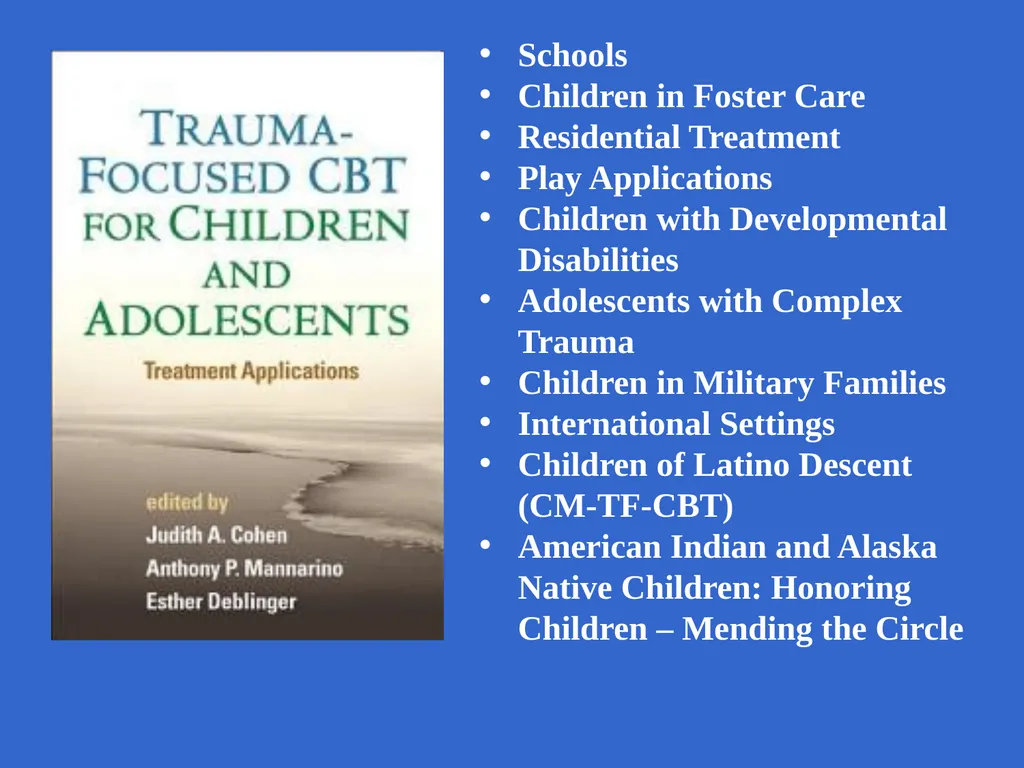
slide31. Schools
Children in Foster Care
Residential Treatment
Play Applications
Children with Developmental Disabilities
Adolescents with Complex Trauma
Children in Military Families
International Settings
Children of Latino Descent (CM-TF-CBT)
American Indian and Alaska Native Children: Honoring Children – Mending the Circle<br>
slide32. Implementation Manuals TF-CBT workbook for teens
TF-CBT workbook for children
LGBTQ Implementation manual
IDD Guide / IDD Supplemental Resource Guide
Racial Socialization (Focused on Black/AA families)
Workbook for Traumatic Grief
TF-CBT for Youth with Parental Substance Abuse (2025)<br>
slide33. Major Barriers to Trauma Treatment Fear of retraumatizing the child
“Clear encouragement” to discuss trauma is not the same as forcing children to discuss trauma!
Vicarious traumatization
“Our clients are different”<br>
slide34. Laura Murray’s Project in Cambodia Sex trafficked girls (with extensive trauma histories)
Initial response from local counselors: “Our population is different so TF-CBT won’t work”; “These girls aren’t ready to tell their stories”.
Post TF training comment from counselor: “I have worked with this client for two years already and never had a story like this. I did not know her real story. I think TF-CBT has helped me so much”.<br>
slide35. TF-CBT Treatment Research: Randomized Clinical Trials Over 25 RCTs
9 RCTs have been completed by the Cohen, Deblinger, and Mannarino team
Several international studies
https://tfcbt.org/category/research-public/<br>
slide36. Why TF-CBT Highest rating In the 0111: Guidelines Report
Highest rating by the California Evidence-Based Clearinghouse for Child Welfare
Named a "Best Practice" for cases of child abuse in the Kauffman Best Practices Report
Strong clinical anecdotal reports of effectiveness
Study in Tanzania – 100% of kids who completed TF said they would recommend TF to other kids
Impact generalizes to a wide variety of problems
Teaches basic skills necessary in many ESTs.<br>
slide37. Identified as Best Practices for Child Abuse Treatments (2011) Trauma-Focused Cognitive Behavioral Therapy
Judith Cohen, Esther Deblinger, and Tony Mannarino
Alternatives for Families: A Cognitive Behavioral Therapy (AF-CBT)
David Kolko, Elissa Brown, Meghan Shaver, Amy Hershell, and Barbara Baumann
Parent Child Interaction Therapy (PC IT)
Sheila Eyberg; Mark Chaffin; Anthony Urquiza<br>
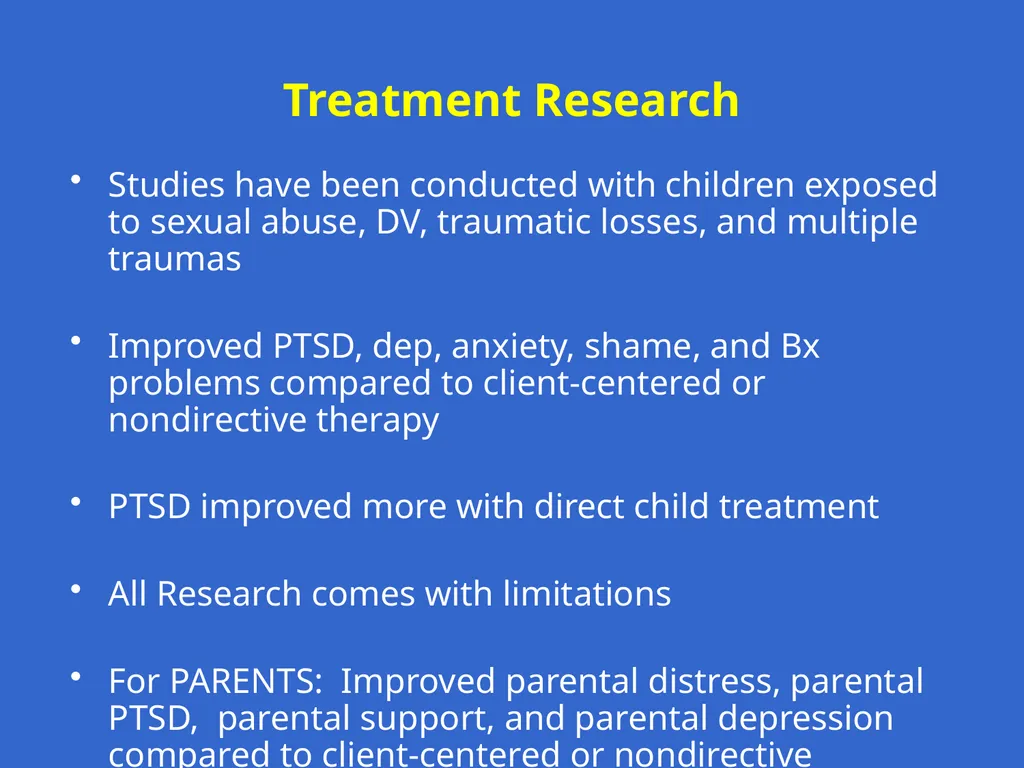
slide38. Treatment Research Studies have been conducted with children exposed to sexual abuse, DV, traumatic losses, and multiple traumas
Improved PTSD, dep, anxiety, shame, and Bx problems compared to client-centered or nondirective therapy
PTSD improved more with direct child treatment
All Research comes with limitations
For PARENTS: Improved parental distress, parental PTSD, parental support, and parental depression compared to client-centered or nondirective treatment<br>
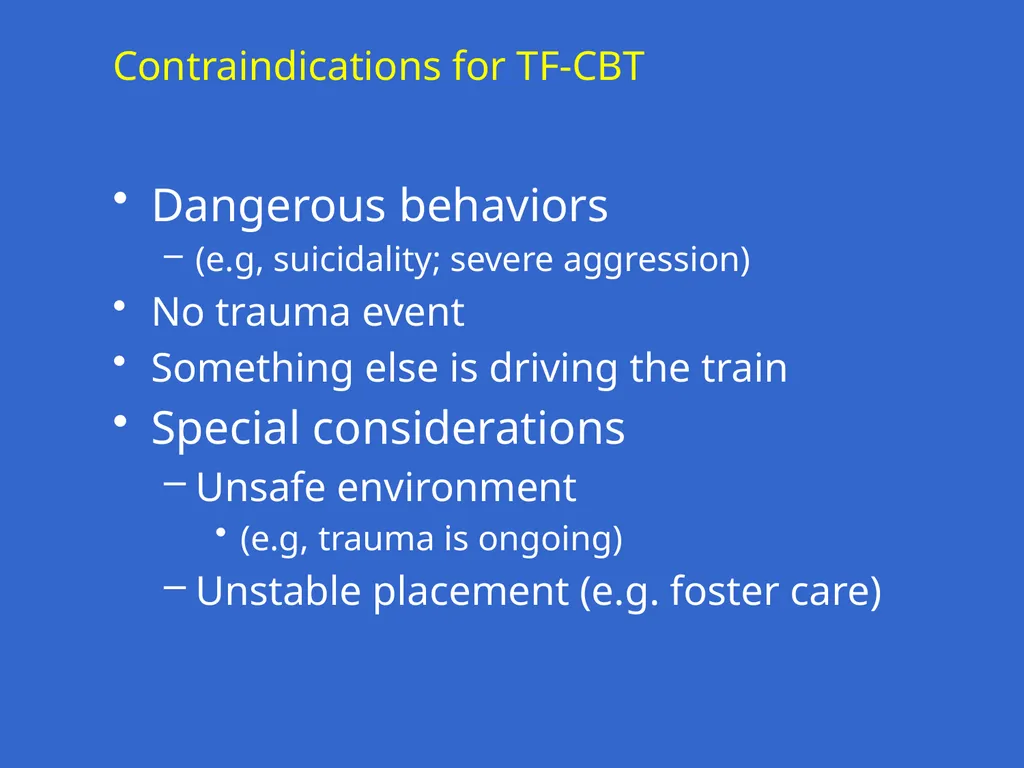
slide39. Contraindications for TF-CBT Dangerous behaviors
(e.g, suicidality; severe aggression)
No trauma event
Something else is driving the train
Special considerations
Unsafe environment
(e.g, trauma is ongoing)
Unstable placement (e.g. foster care)<br>
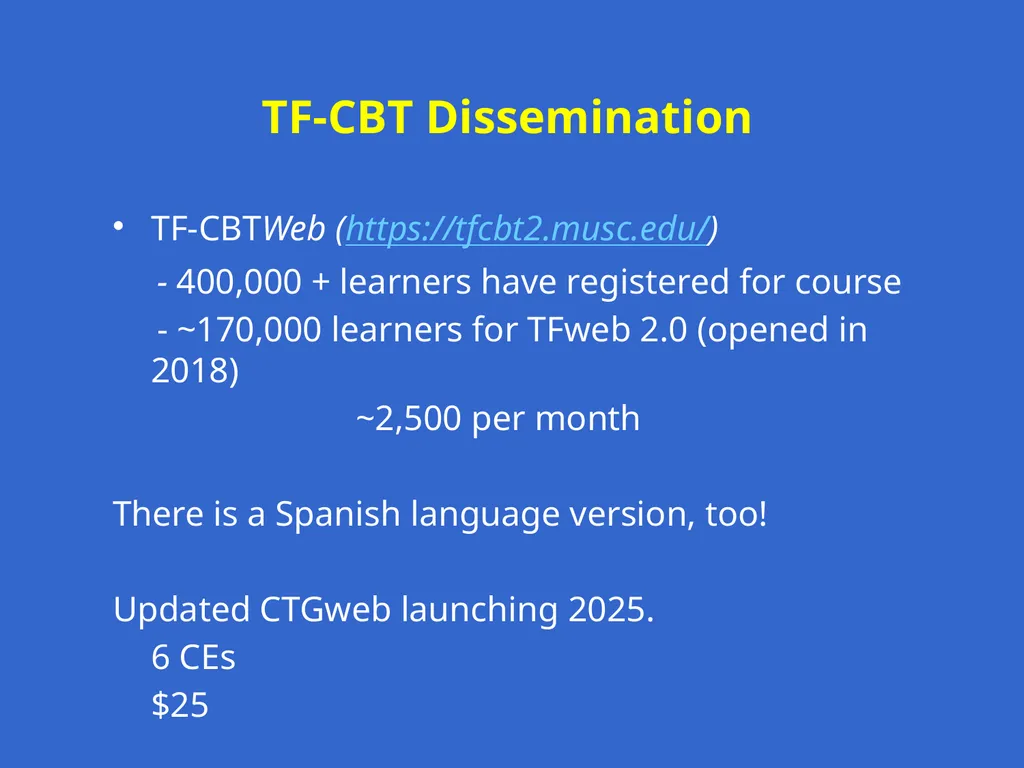
slide40. TF-CBT Dissemination TF-CBTWeb (https://tfcbt2.musc.edu/)
- 400,000 + learners have registered for course
- ~170,000 learners for TFweb 2.0 (opened in 2018)
~2,500 per month
There is a Spanish language version, too!
Updated CTGweb launching 2025.
6 CEs
$25<br>
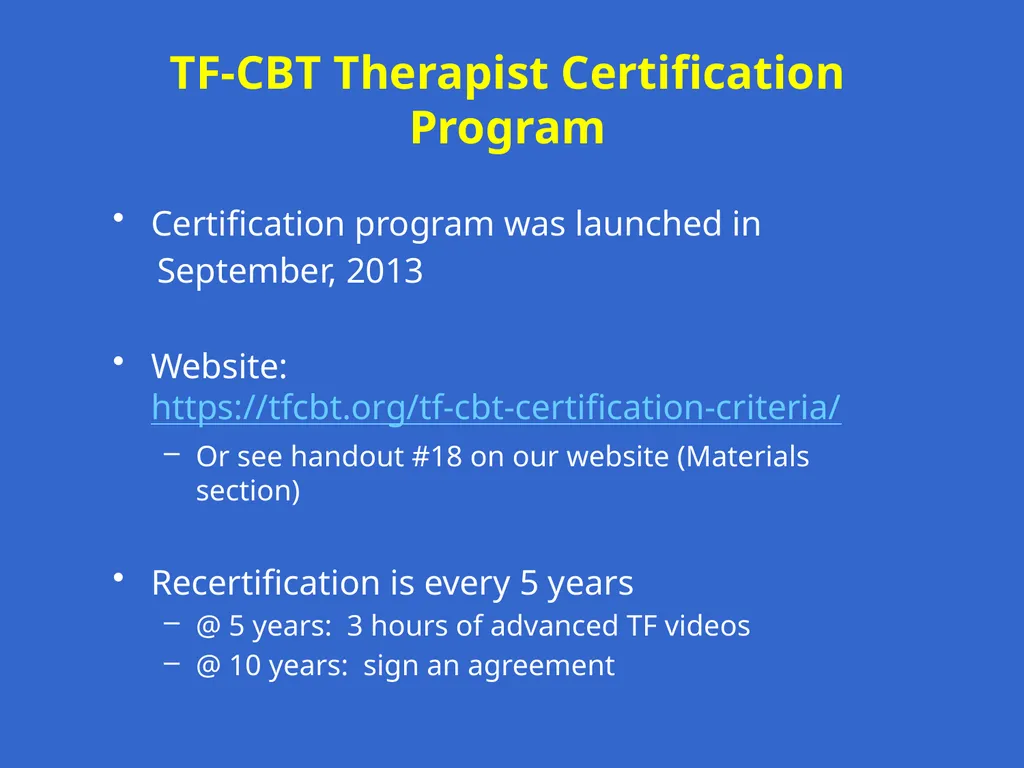
slide41. TF-CBT Therapist Certification Program Certification program was launched in
September, 2013
Website: https://tfcbt.org/tf-cbt-certification-criteria/
Or see handout #18 on our website (Materials section)
Recertification is every 5 years
@ 5 years: 3 hours of advanced TF videos
@ 10 years: sign an agreement<br>
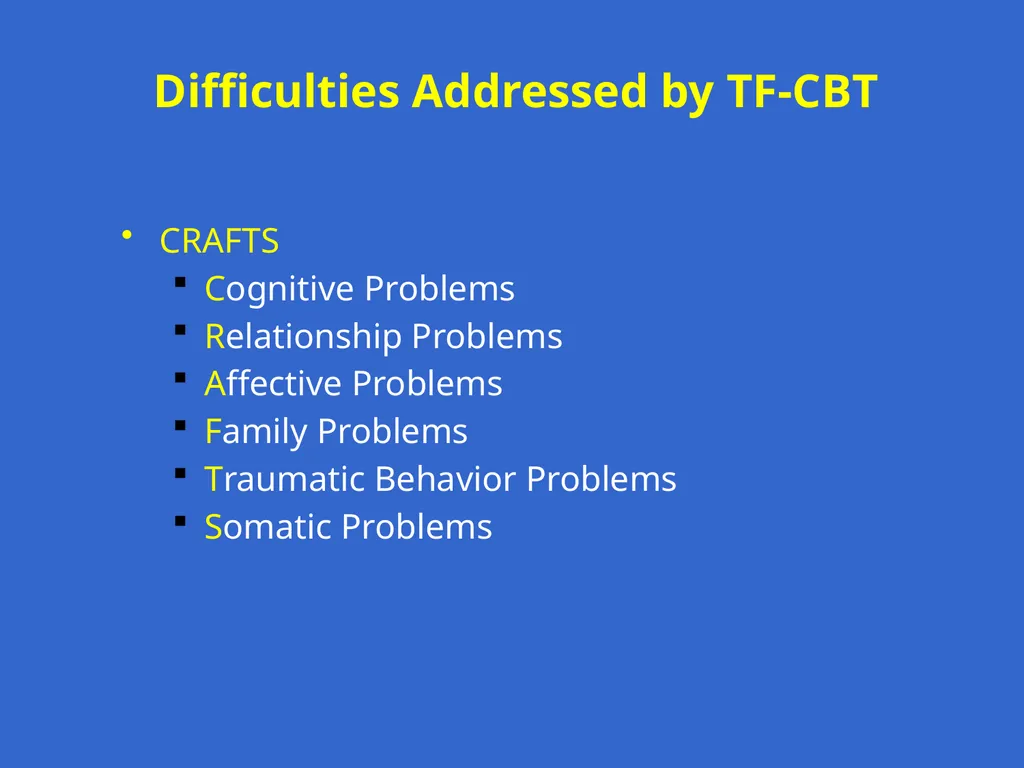
slide42. Difficulties Addressed by TF-CBT CRAFTS
Cognitive Problems
Relationship Problems
Affective Problems
Family Problems
Traumatic Behavior Problems
Somatic Problems<br>
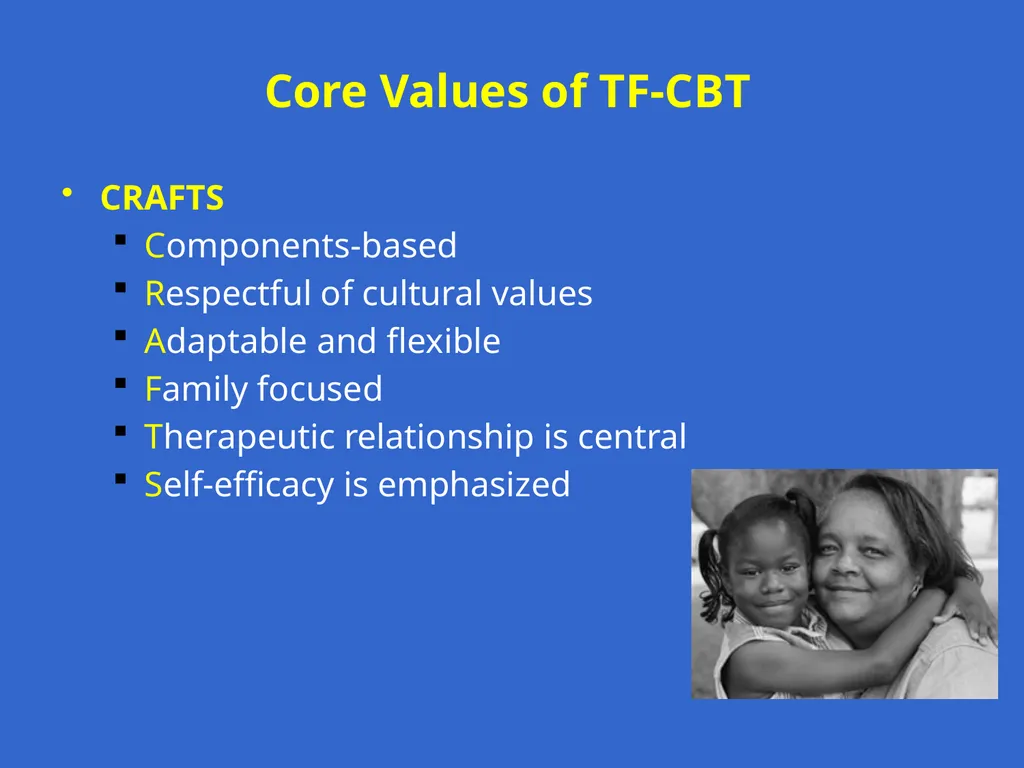
slide43. Core Values of TF-CBT CRAFTS
Components-based
Respectful of cultural values
Adaptable and flexible
Family focused
Therapeutic relationship is central
Self-efficacy is emphasized<br>
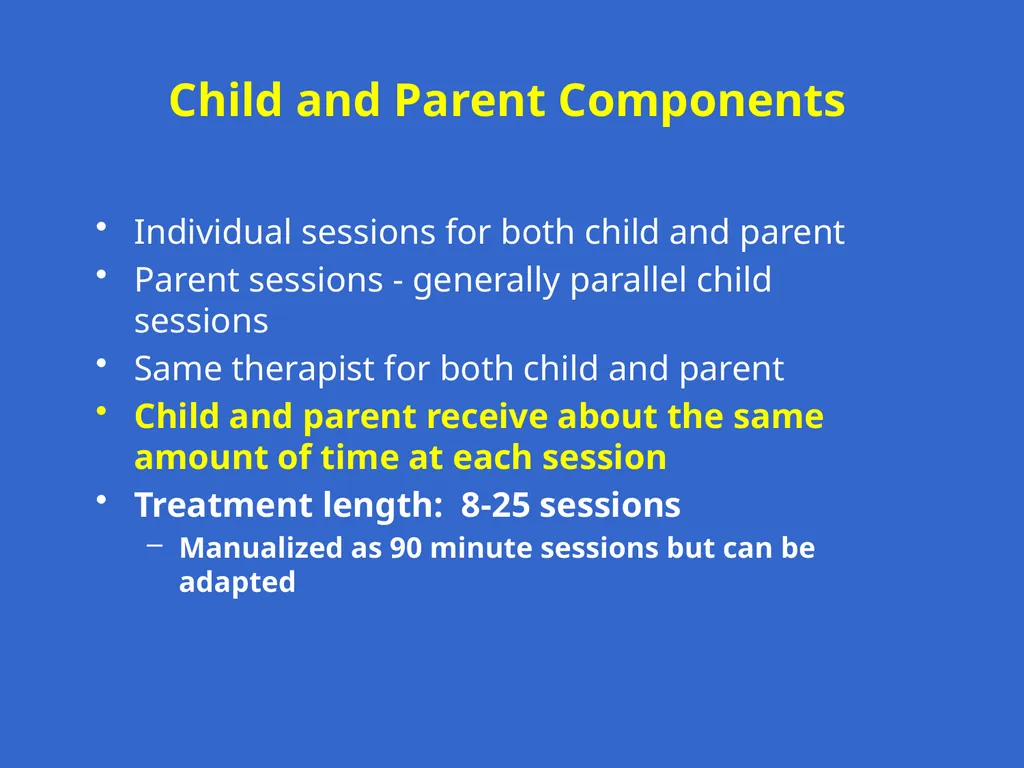
slide44. Child and Parent Components Individual sessions for both child and parent
Parent sessions - generally parallel child sessions
Same therapist for both child and parent
Child and parent receive about the same amount of time at each session
Treatment length: 8-25 sessions
Manualized as 90 minute sessions but can be adapted<br>
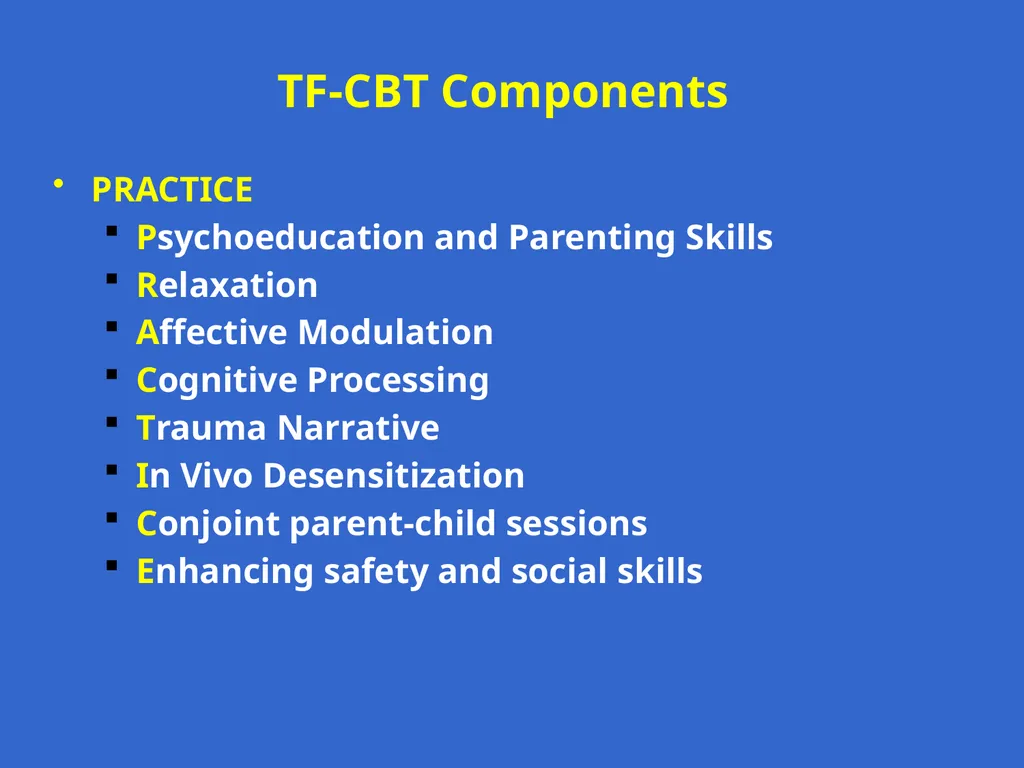
slide45. TF-CBT Components PRACTICE
Psychoeducation and Parenting Skills
Relaxation
Affective Modulation
Cognitive Processing
Trauma Narrative
In Vivo Desensitization
Conjoint parent-child sessions
Enhancing safety and social skills<br>
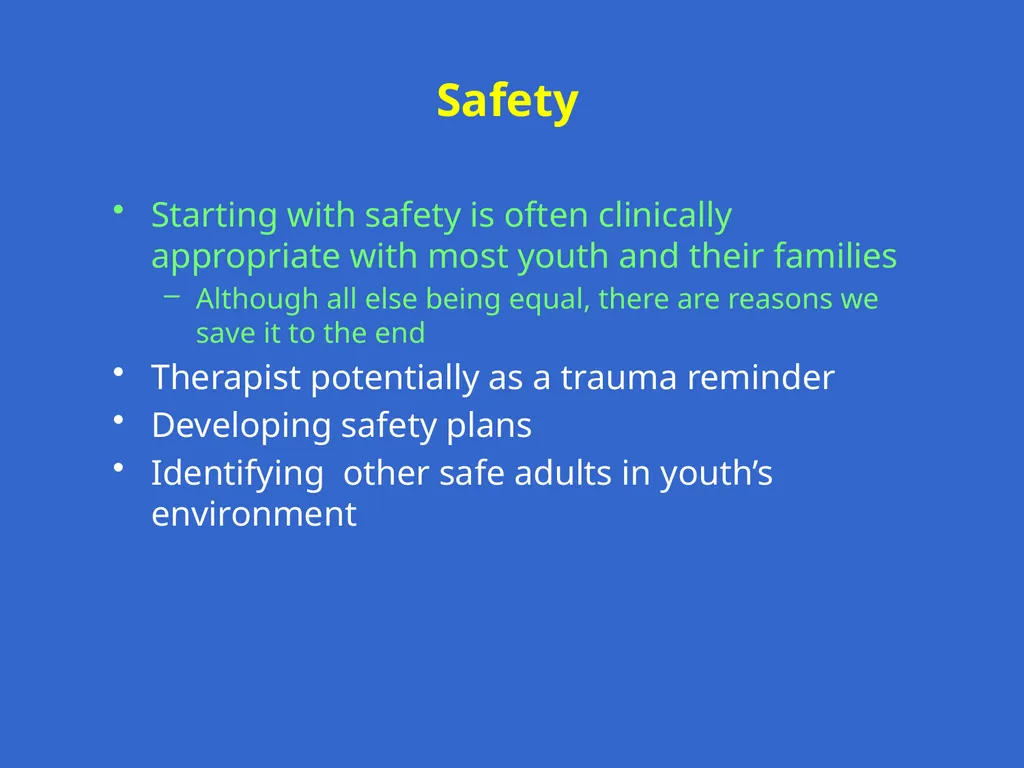
slide46. Safety Starting with safety is often clinically appropriate with most youth and their families
Although all else being equal, there are reasons we save it to the end
Therapist potentially as a trauma reminder
Developing safety plans
Identifying other safe adults in youth’s environment<br>
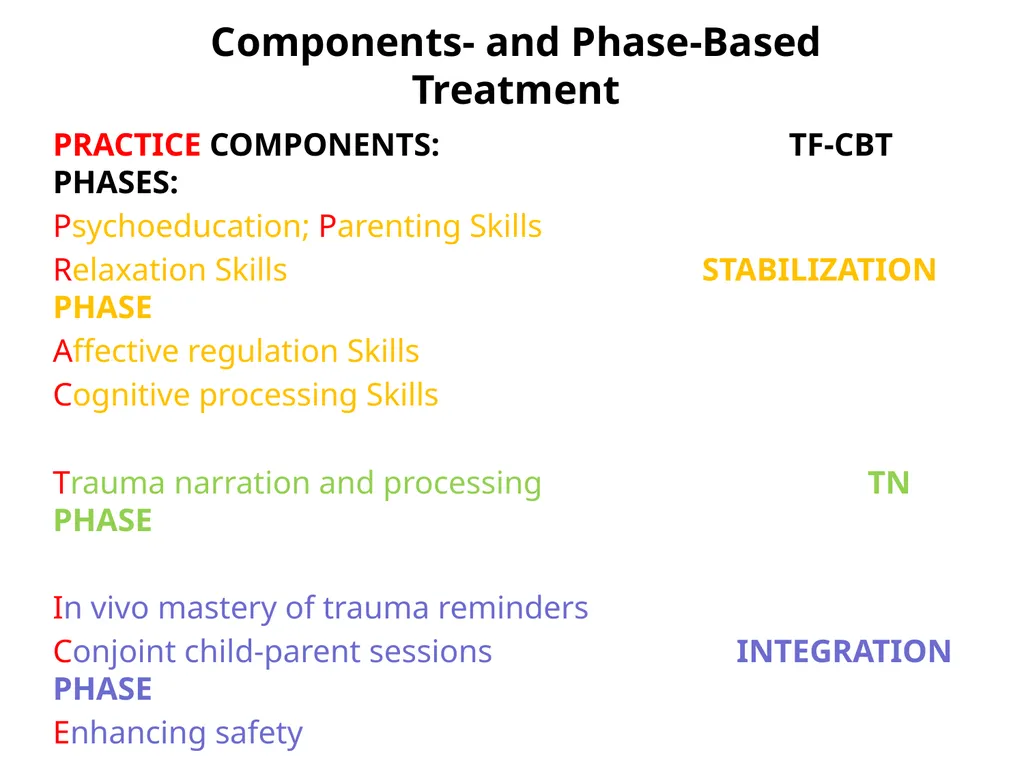
slide47. Components- and Phase-Based Treatment PRACTICE COMPONENTS: TF-CBT PHASES:
Psychoeducation; Parenting Skills
Relaxation Skills STABILIZATION PHASE
Affective regulation Skills
Cognitive processing Skills
Trauma narration and processing TN PHASE
In vivo mastery of trauma reminders
Conjoint child-parent sessions INTEGRATION PHASE
Enhancing safety<br>
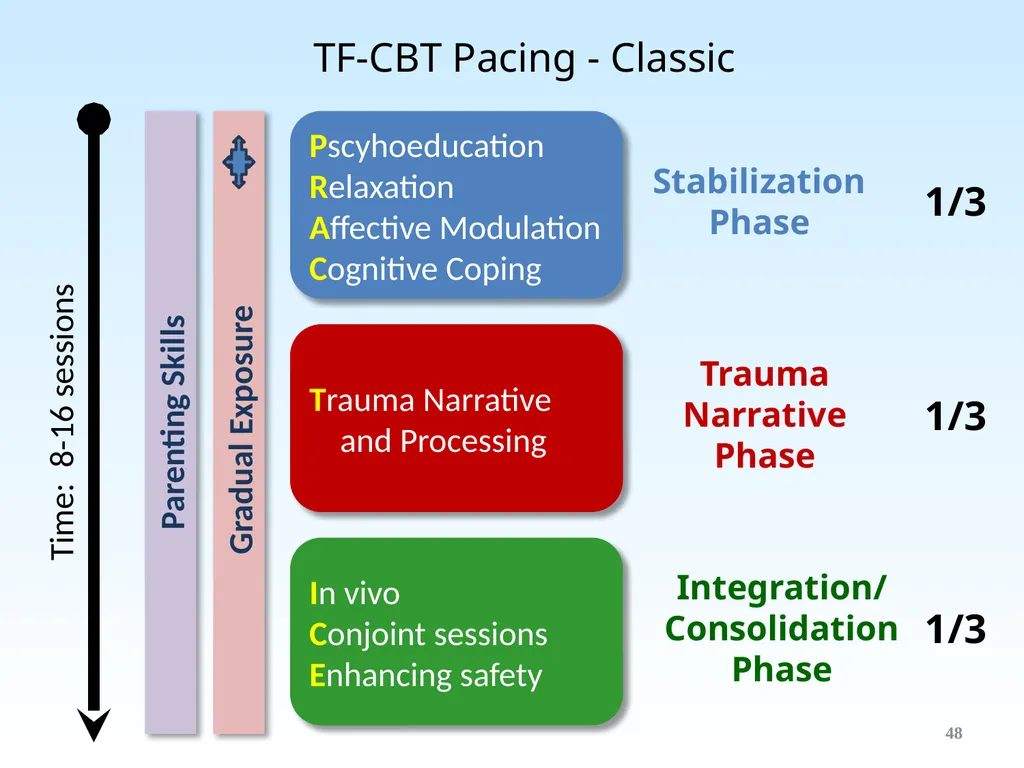
slide48. Pscyhoeducation
Relaxation
Affective Modulation
Cognitive Coping Trauma Narrative
and Processing In vivo
Conjoint sessions
Enhancing safety Trauma Narrative
Phase Integration/ Consolidation
Phase Stabilization
Phase Parenting Skills Gradual Exposure Time: 8-16 sessions 1/3 1/3 1/3 TF-CBT Pacing - Classic 48<br>
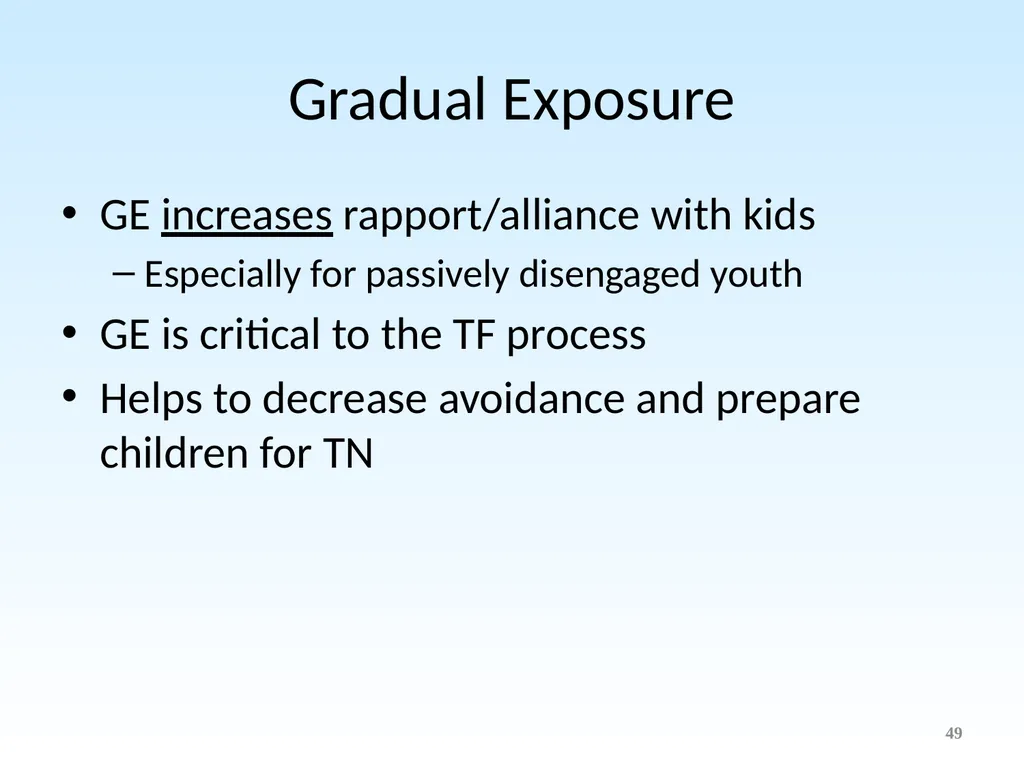
slide49. Gradual Exposure GE increases rapport/alliance with kids
Especially for passively disengaged youth
GE is critical to the TF process
Helps to decrease avoidance and prepare children for TN 49<br>
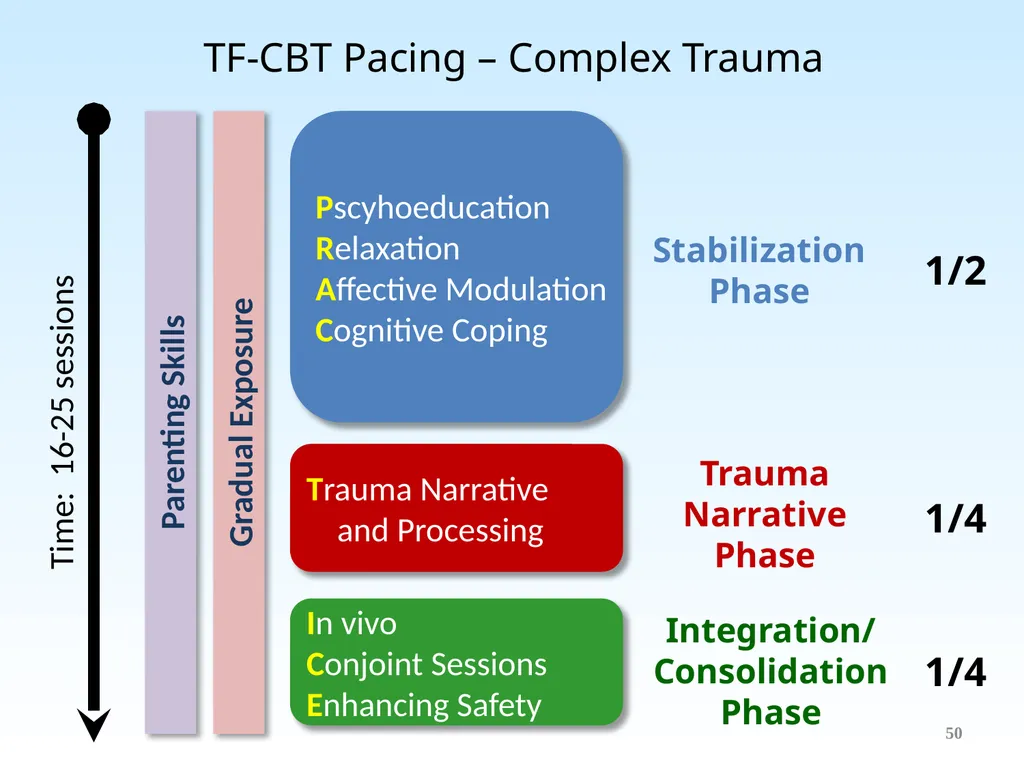
slide50. Pscyhoeducation
Relaxation
Affective Modulation
Cognitive Coping Trauma Narrative
and Processing In vivo
Conjoint Sessions
Enhancing Safety Trauma Narrative
Phase Integration/ Consolidation
Phase Stabilization
Phase Parenting Skills Gradual Exposure Time: 16-25 sessions 1/2 1/4 1/4 TF-CBT Pacing – Complex Trauma 50<br>
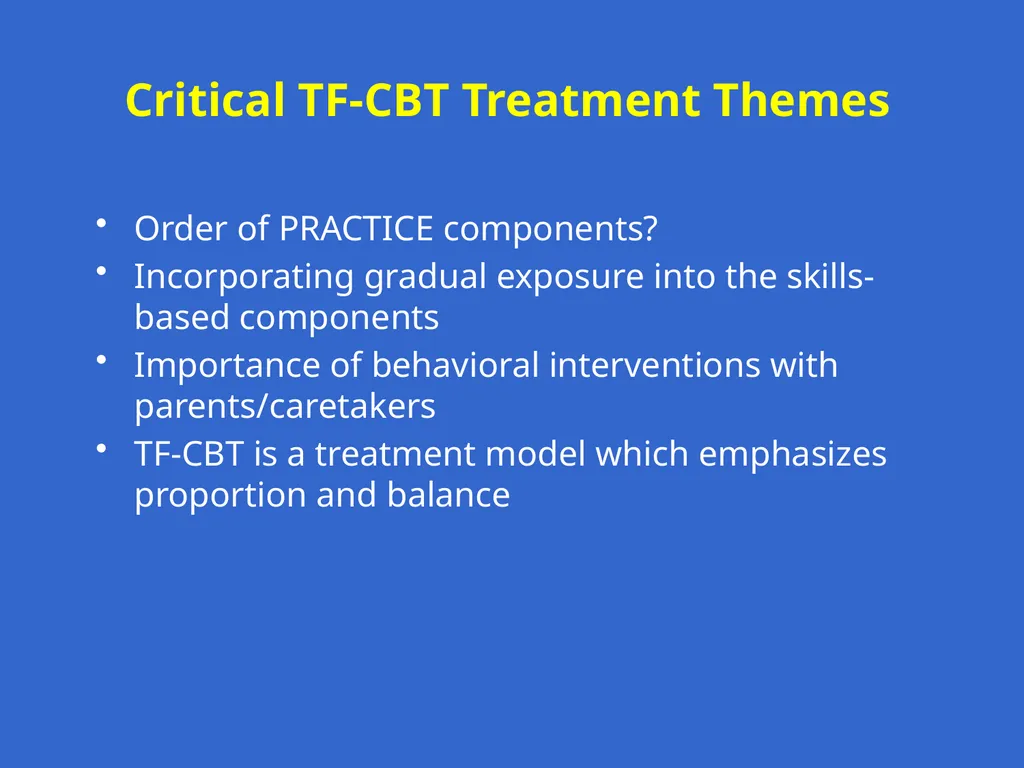
slide51. Critical TF-CBT Treatment Themes Order of PRACTICE components?
Incorporating gradual exposure into the skills-based components
Importance of behavioral interventions with parents/caretakers
TF-CBT is a treatment model which emphasizes proportion and balance<br>
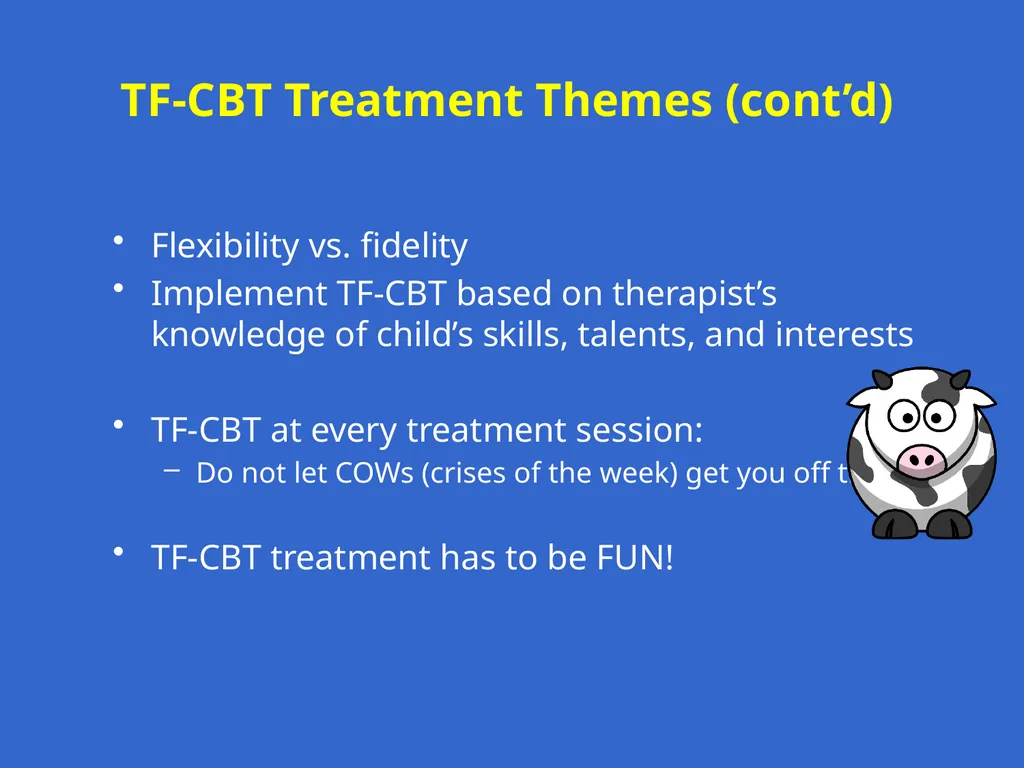
slide52. TF-CBT Treatment Themes (cont’d) Flexibility vs. fidelity
Implement TF-CBT based on therapist’s knowledge of child’s skills, talents, and interests
TF-CBT at every treatment session:
Do not let COWs (crises of the week) get you off track
TF-CBT treatment has to be FUN!<br>
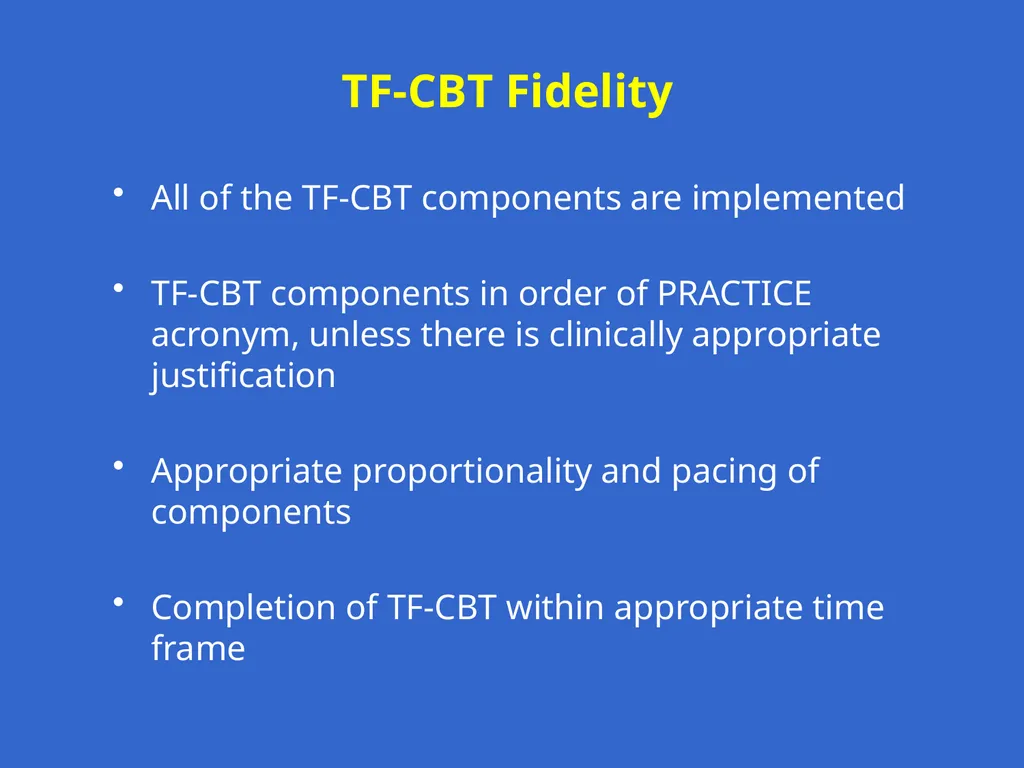
slide53. TF-CBT Fidelity All of the TF-CBT components are implemented
TF-CBT components in order of PRACTICE acronym, unless there is clinically appropriate justification
Appropriate proportionality and pacing of components
Completion of TF-CBT within appropriate time frame<br>
slide54. Why is it critical to involve parents in TF-CBT? Most children do not present at mental health settings because of trauma exposure
Children have behavior problems
Parent/caretaker involvement is essential to address behavioral difficulties<br>
slide55. Engaging Families in Treatment Establish common ground/form an alliance
Be flexible about scheduling
Recognize concrete barriers to participating in treatment
Emphasize importance/primacy of parental role
Focus on what parents need and want from therapy
Provide education about psychotherapy (what to expect: it occurs over time, not all at once, etc.)
Address such issues as stigma, cultural concerns, and previous experiences with therapists
Resistance or failure of engagement?<br>
slide56. Engaging Families in Treatment (cont’d) Child’s impression of the therapeutic alliance is a big indicator of future reductions in PTSD symptoms
NO SHAME AND NO BLAME
Praise and reinforce parents/caretakers for bringing child for treatment<br>
slide57. ENGAGEMENT EXERCISE Handout #6<br>
slide58. P R A C T I C E<br>
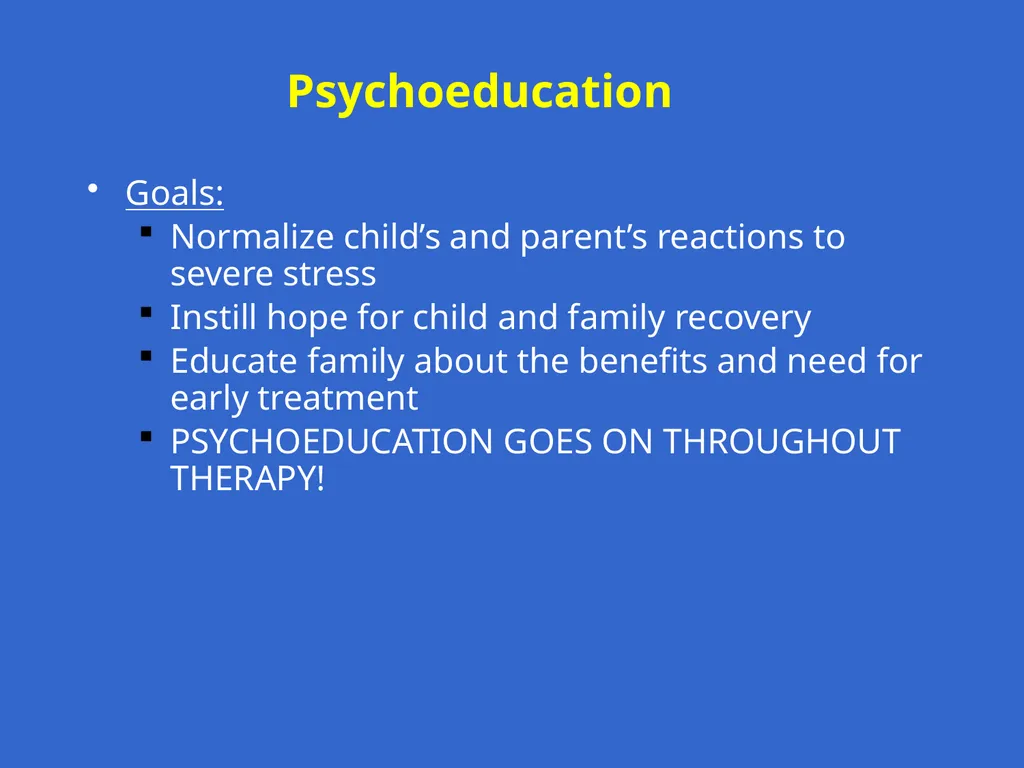
slide59. Psychoeducation Goals:
Normalize child’s and parent’s reactions to severe stress
Instill hope for child and family recovery
Educate family about the benefits and need for early treatment
PSYCHOEDUCATION GOES ON THROUGHOUT THERAPY!<br>
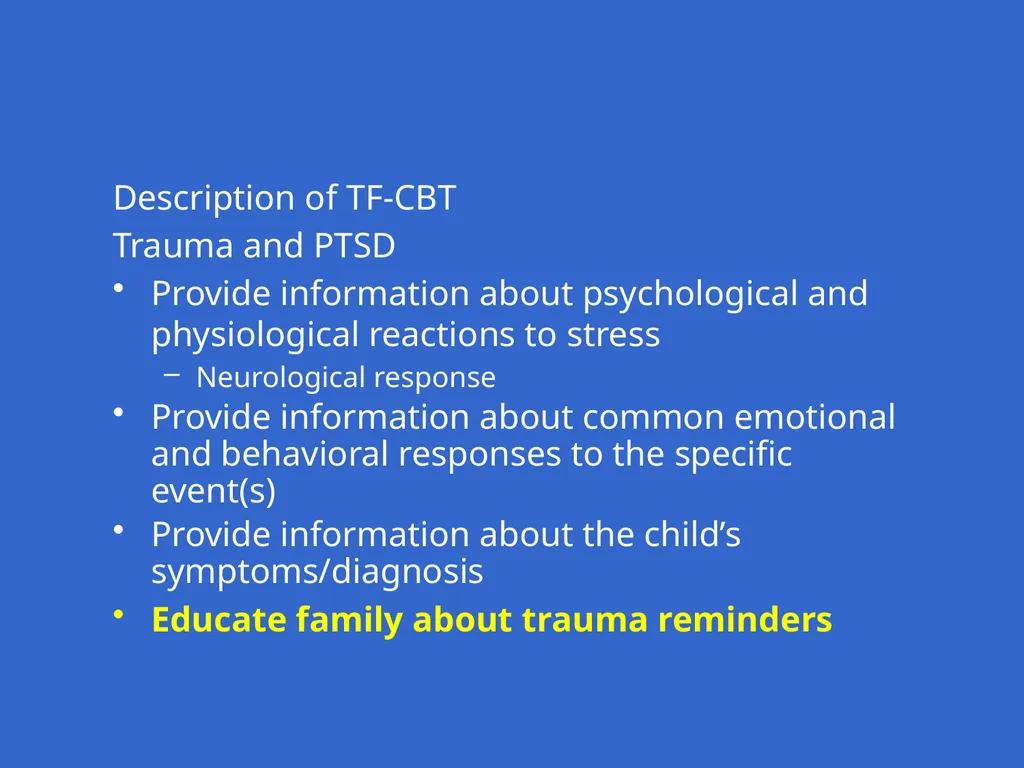
slide60. Description of TF-CBT
Trauma and PTSD
Provide information about psychological and physiological reactions to stress
Neurological response
Provide information about common emotional and behavioral responses to the specific event(s)
Provide information about the child’s symptoms/diagnosis
Educate family about trauma reminders<br>
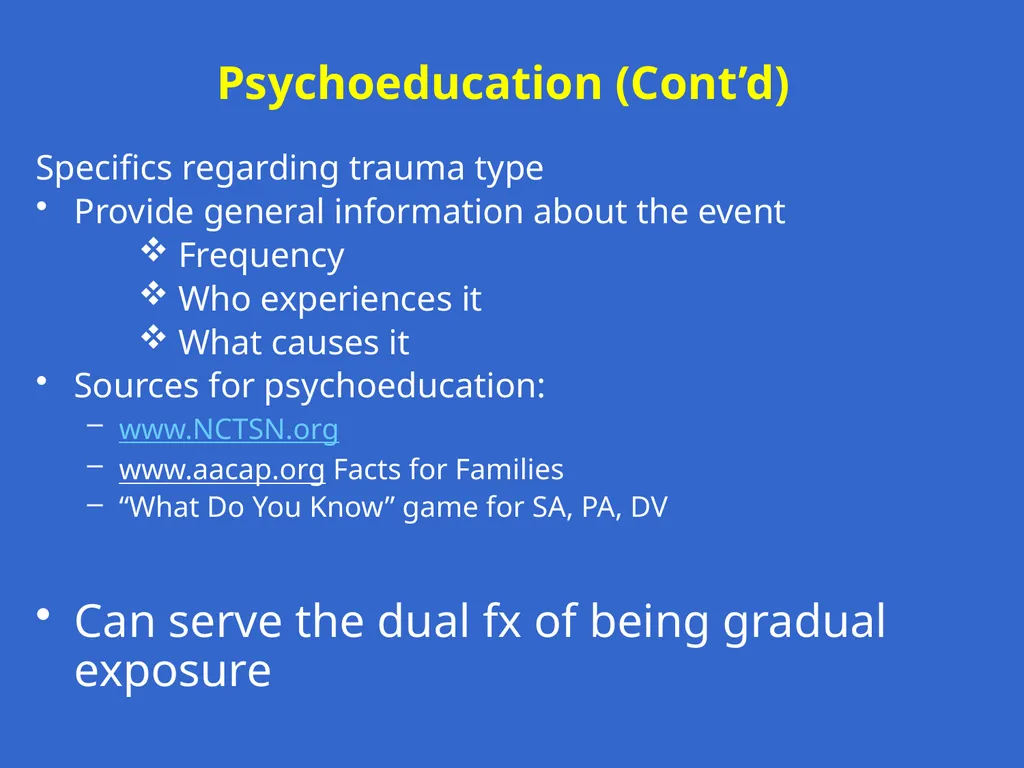
slide61. Psychoeducation (Cont’d) Specifics regarding trauma type
Provide general information about the event
Frequency
Who experiences it
What causes it
Sources for psychoeducation:
www.NCTSN.org
www.aacap.org Facts for Families
“What Do You Know” game for SA, PA, DV
Can serve the dual fx of being gradual exposure<br>
slide62. Psychoed video<br>
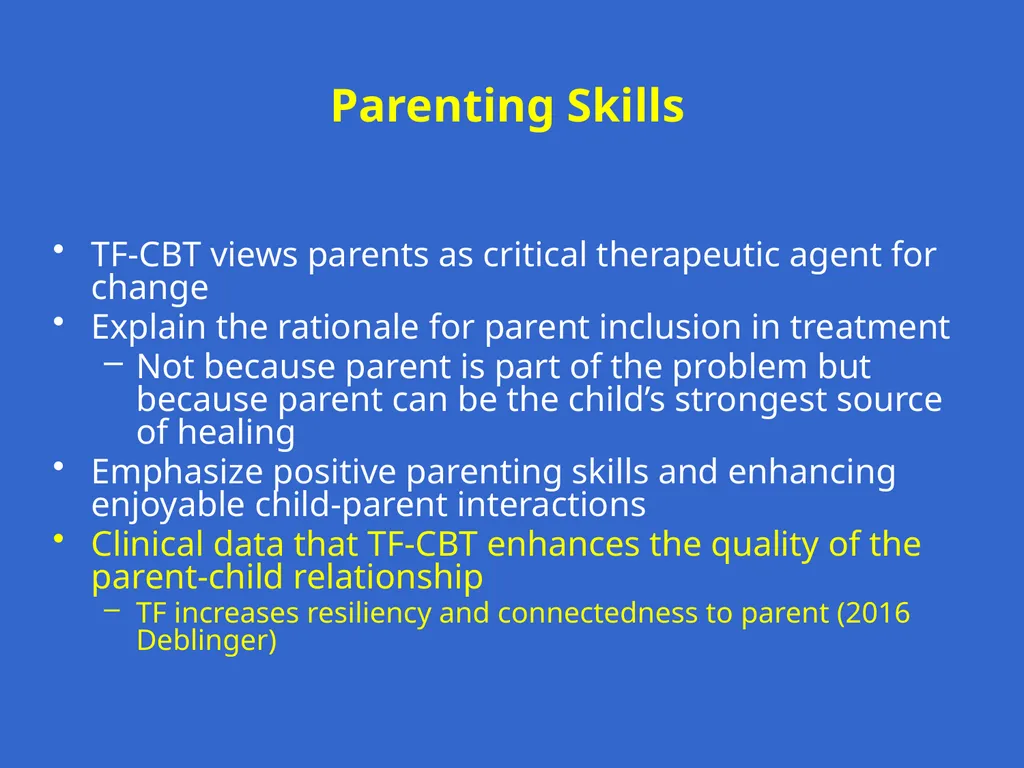
slide63. Parenting Skills TF-CBT views parents as critical therapeutic agent for change
Explain the rationale for parent inclusion in treatment
Not because parent is part of the problem but because parent can be the child’s strongest source of healing
Emphasize positive parenting skills and enhancing enjoyable child-parent interactions
Clinical data that TF-CBT enhances the quality of the parent-child relationship
TF increases resiliency and connectedness to parent (2016 Deblinger)<br>
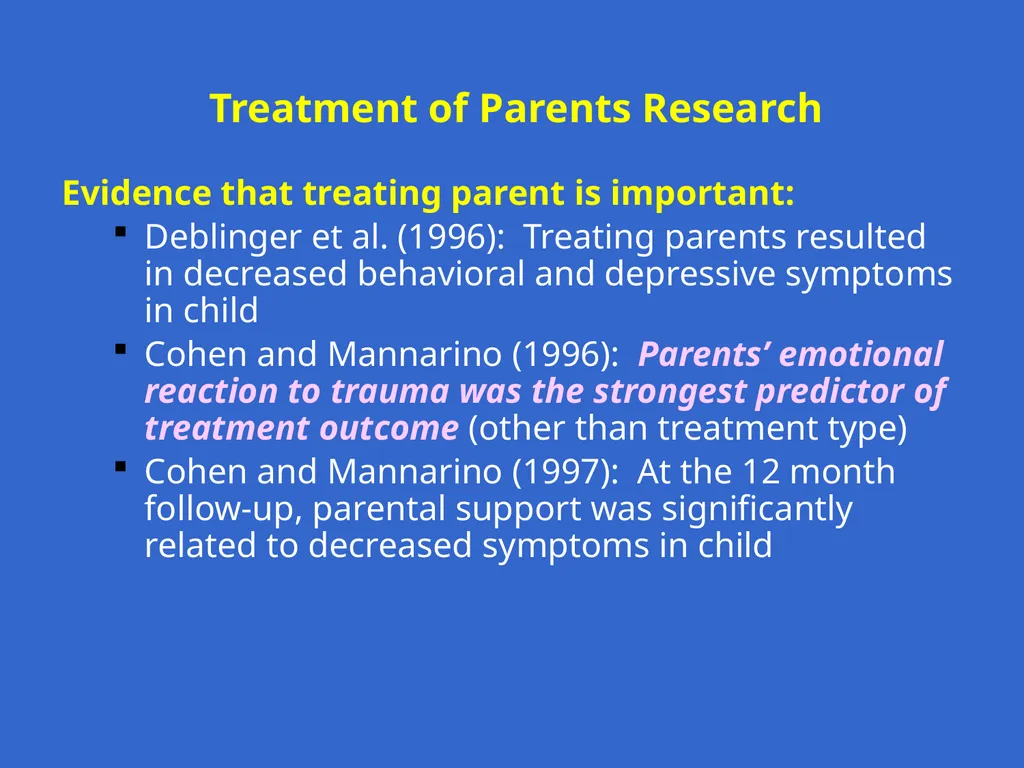
slide64. Treatment of Parents Research Evidence that treating parent is important:
Deblinger et al. (1996): Treating parents resulted in decreased behavioral and depressive symptoms in child
Cohen and Mannarino (1996): Parents’ emotional reaction to trauma was the strongest predictor of treatment outcome (other than treatment type)
Cohen and Mannarino (1997): At the 12 month follow-up, parental support was significantly related to decreased symptoms in child<br>
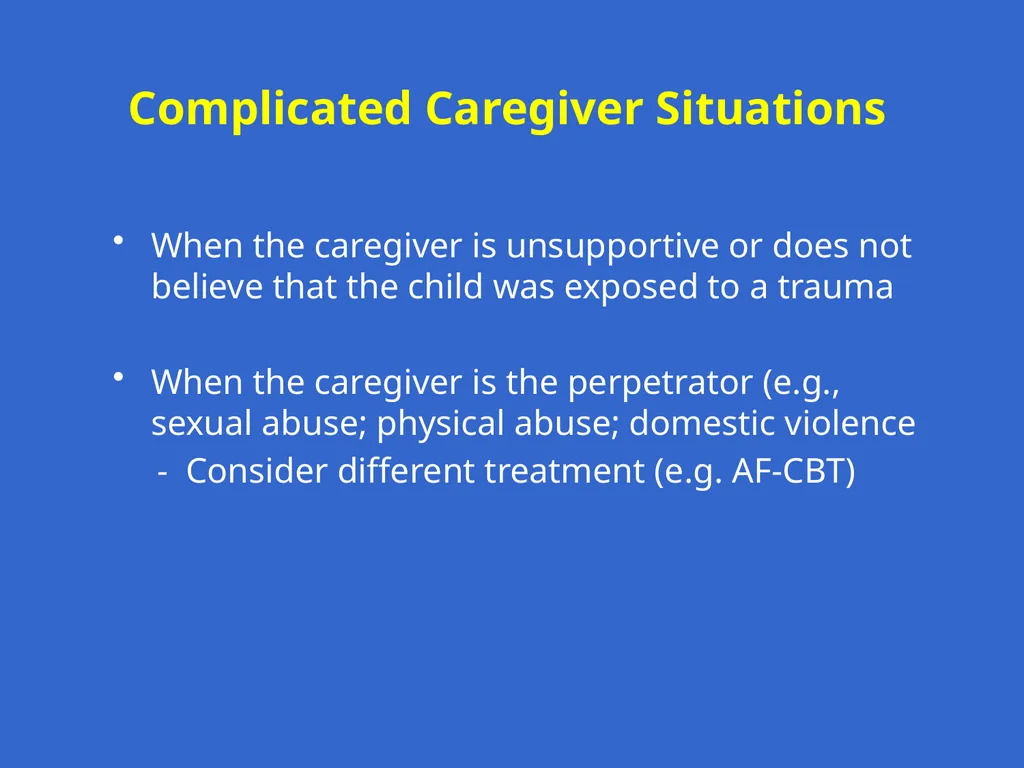
slide65. Complicated Caregiver Situations When the caregiver is unsupportive or does not believe that the child was exposed to a trauma
When the caregiver is the perpetrator (e.g., sexual abuse; physical abuse; domestic violence
- Consider different treatment (e.g. AF-CBT)<br>
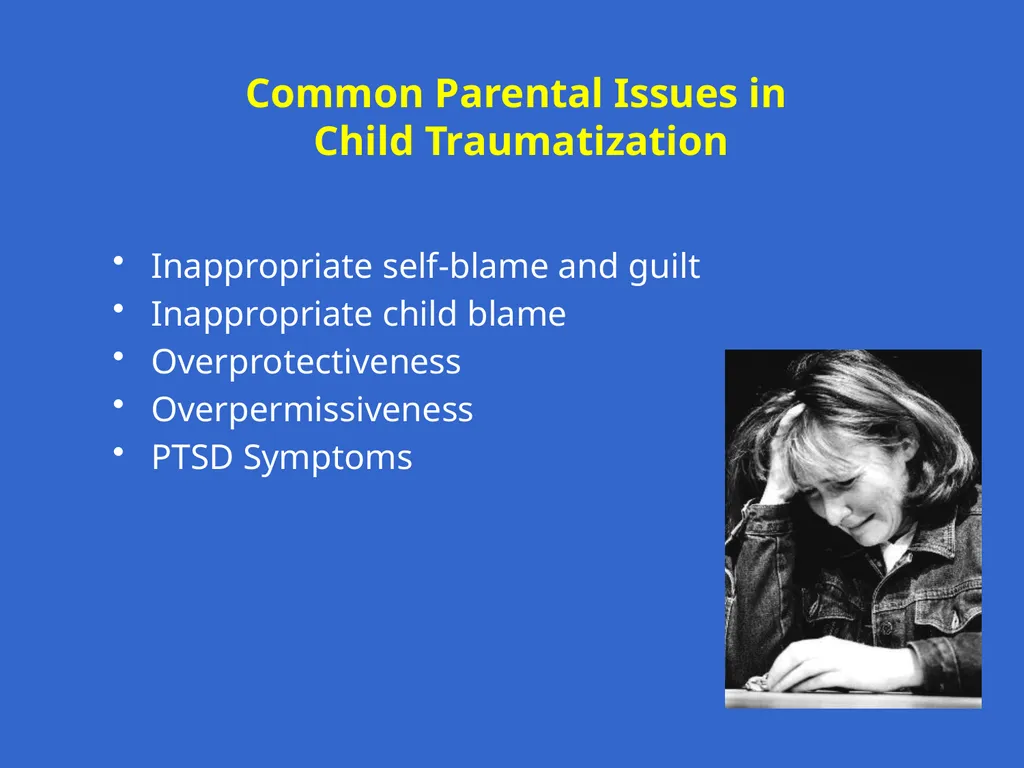
slide66. Common Parental Issues in Child Traumatization Inappropriate self-blame and guilt
Inappropriate child blame
Overprotectiveness
Overpermissiveness
PTSD Symptoms<br>
slide67. PARENTING CONCEPTS VIDEO<br>
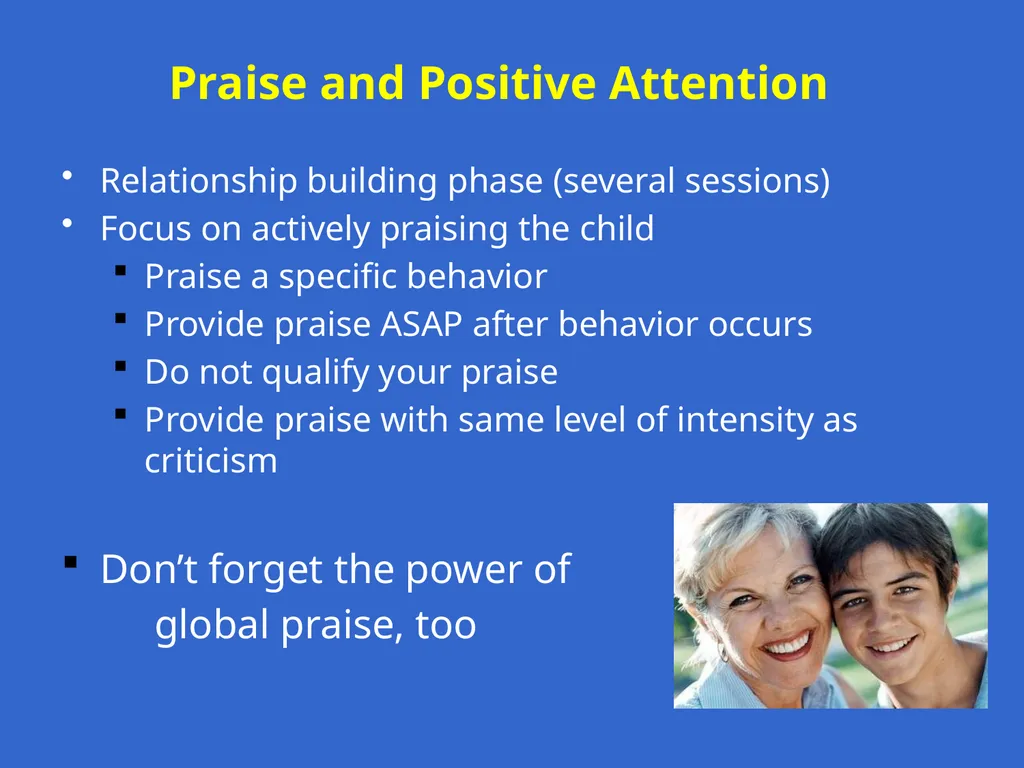
slide68. Praise and Positive Attention Relationship building phase (several sessions)
Focus on actively praising the child
Praise a specific behavior
Provide praise ASAP after behavior occurs
Do not qualify your praise
Provide praise with same level of intensity as criticism
Don’t forget the power of
global praise, too<br>
slide69. Selective Attention Active ignoring: NO reaction to certain negative behaviors
Defiant or angry verbalizations to parent
Nasty faces, rolling eyes, smirking
Mocking, mimicking
Walk away, busy oneself with an activity
Remain calm, dispassionate<br>
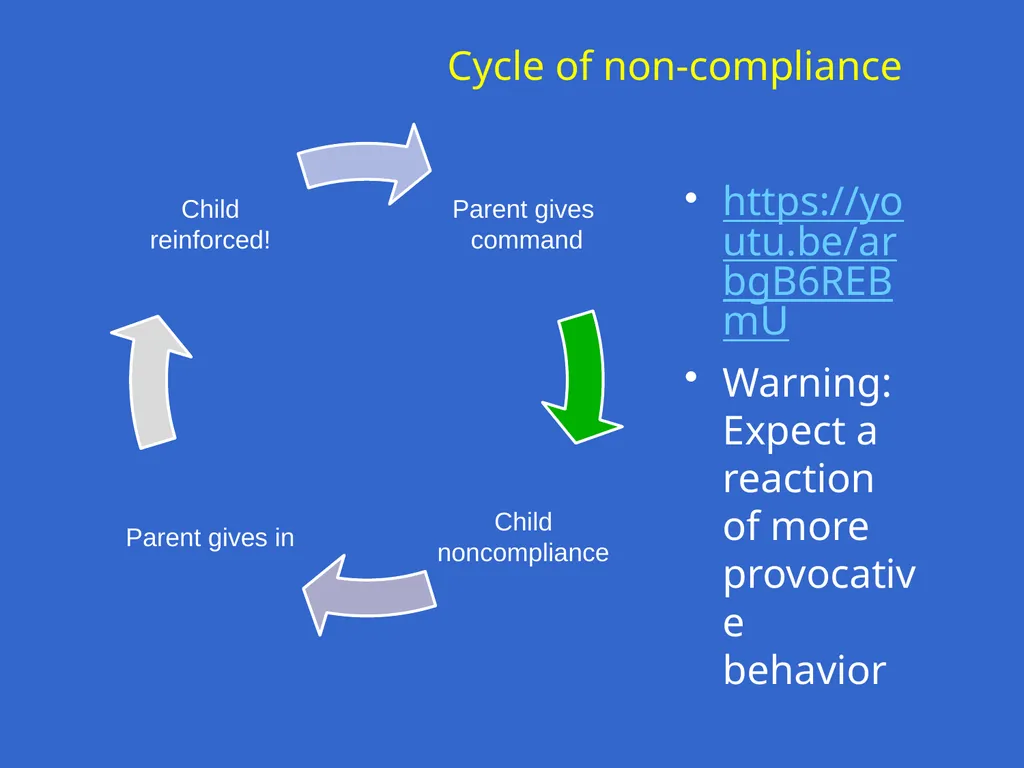
slide70. Cycle of non-compliance https://youtu.be/arbgB6REBmU
Warning: Expect a reaction of more provocative behavior<br>
slide71. Parent Activity #1<br>
slide72. Discipline<br>
slide73. Giving Clear Commands Get child's attention (e.g., make eye contact)
Commands should be specific.
E.g. Put the block in the box
(Not: “Be careful”)
Command should be developmentally appropriate.
E.g., Put the blue car in the box
(Not: put the azure vehicular object in the opaque containment unit)<br>
slide74. Effective Commands (Cont’d) Commands should be positively stated.
Tell kids what to do
Avoid these words: Don’t, stop, quit, no
Commands should be given one at a time.
Lots of commands subject to recency effect
Give commands only if you can follow through.<br>
slide75. Commands If… then…
Gives predictability and controllability
Therapeutic for traumatized children<br>
slide76. Parenting Activity #2<br>
slide77. Time Out For younger kids (Less than 7 years old, per PCIT lit)
Purpose: Interrupt child’s negative behaviors and allow him/her to regain control
Explain to child
Location: quiet, low stimulation
Duration: 3 min + 5 sec quiet
Once in time out, parent should refrain from comments, and maintain calm demeanor. (Active ignoring).
Must follow through with original command
See handout #7 for PCIT International’s statement on timeout with traumatized children<br>
slide78. Moving beyond Time Out Natural consequences
Punishment follows from the misbehavior
Logical consequences
When natural consequences don't exist or are inappropriate
Grounding- “The time fits the crime”
Create table of:
Reward-able behaviors
Ignorable behaviors
Punishable behaviors
Most important goal is commitment and consistency<br>
slide79. Contingency Reinforcement Programs Purpose: Decrease unwanted behaviors and increase desired behaviors
Select only one behavior to target
Explain process to child
Involve child in decisions about rewards
Add stars and give rewards at appropriate intervals.<br>
slide80. Behavior Management Reasonable developmental expectations
Limit-setting
Behavioral interventions for:
Anxieties
Sleep problems
Aggressive behaviors
Sexually inappropriate behaviors<br>
slide81. P R A C T I C E<br>
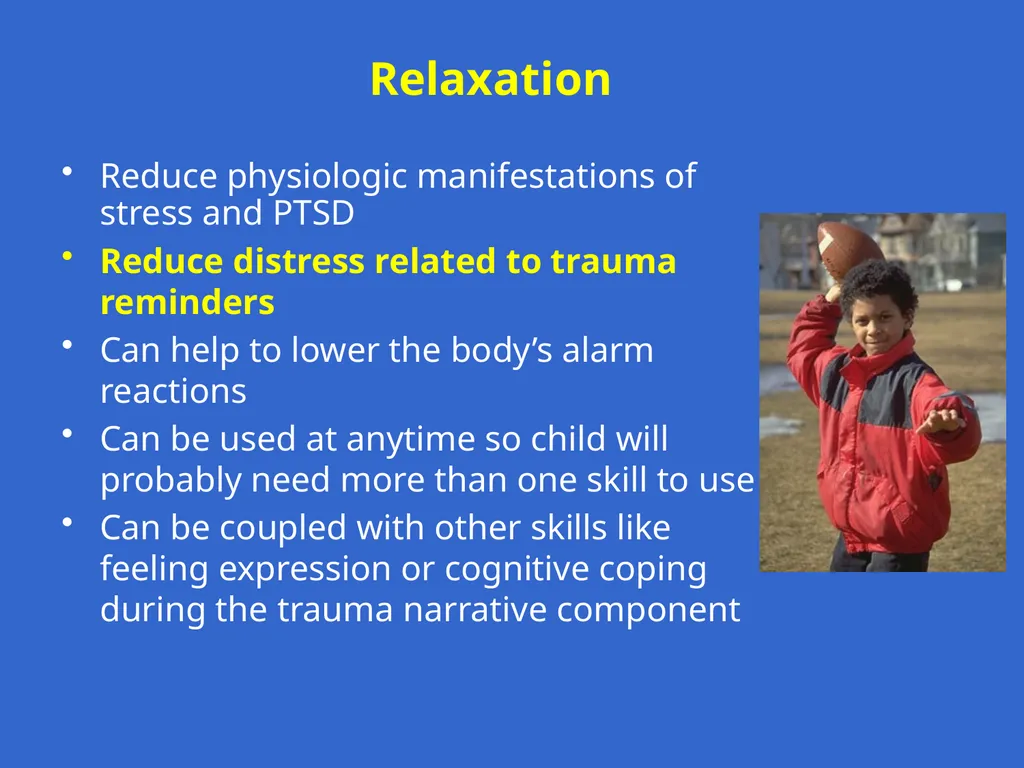
slide82. Relaxation Reduce physiologic manifestations of stress and PTSD
Reduce distress related to trauma reminders
Can help to lower the body’s alarm reactions
Can be used at anytime so child will probably need more than one skill to use
Can be coupled with other skills like feeling expression or cognitive coping during the trauma narrative component<br>
slide83. Relaxation Reduce physiologic manifestations of stress and PTSD
Respiration increases/Shallow Breath
Pupils enlarge
Heart rate speeds up
Stomach and intestines shut down
Adrenaline is pumped into bloodstream<br>
slide84. Relaxation (cont’d) Develop individualized relaxation strategies for manifestations of stress (headache, stomach ache, dizzy, racing heart, etc.)
Focused breathing/mindfulness/meditation
Progressive muscle relaxation
Physical Activity
Yoga, singing, dance, blowing bubbles
“If it’s not fun, you’re not doing it right”
Relaxation strategies for trauma reminders<br>
slide85. Relaxation: Belly Breathing Provide rationale
Imbalance in O2/C02
Teach 'correct' way to breathe to decrease distress, skills to manage fear and anxiety
Focus on 'belly' rather than chest breathing
Focus on slow rather than rapid breaths
Other options:
Smell the flowers; blow the bubbles
Cookie breaths
Balloon in, balloon out<br>
slide86. Muscle Relaxation Rationale
Flight or fight response
Relaxation Activity
Tense/Relax
Progressive muscle relaxation
Turtle technique
Rag doll/Wet noodle versus Tin soldier
See handout #8 for PMR guide young children
https://www.youtube.com/watch?v=aaTDNYjk-Gw<br>
slide87. Grounding techniques 5 senses
Key chain with sensory stimuli
Mindfulness<br>
slide88. Other Relaxation Techniques Imagery
Exercise
Yoga, Baby yoga
Consider cultural differences (music, prayer)
Not just one technique- "get" the goal
Include their own strategies
Different tools for different jobs and settings
Caregiver involvement may be key<br>
slide89. P R A C T I C E<br>
slide90. Affective Modulation Traumatized children may have inappropriate
(e.g., excessive anger) and/or restricted affect
Activities to help children identify and express a range of
different feelings
- Board games
-Emotional Bingo, Jenga/Totika, T.F.D game
- Feeling brainstorm (1 minute competition)
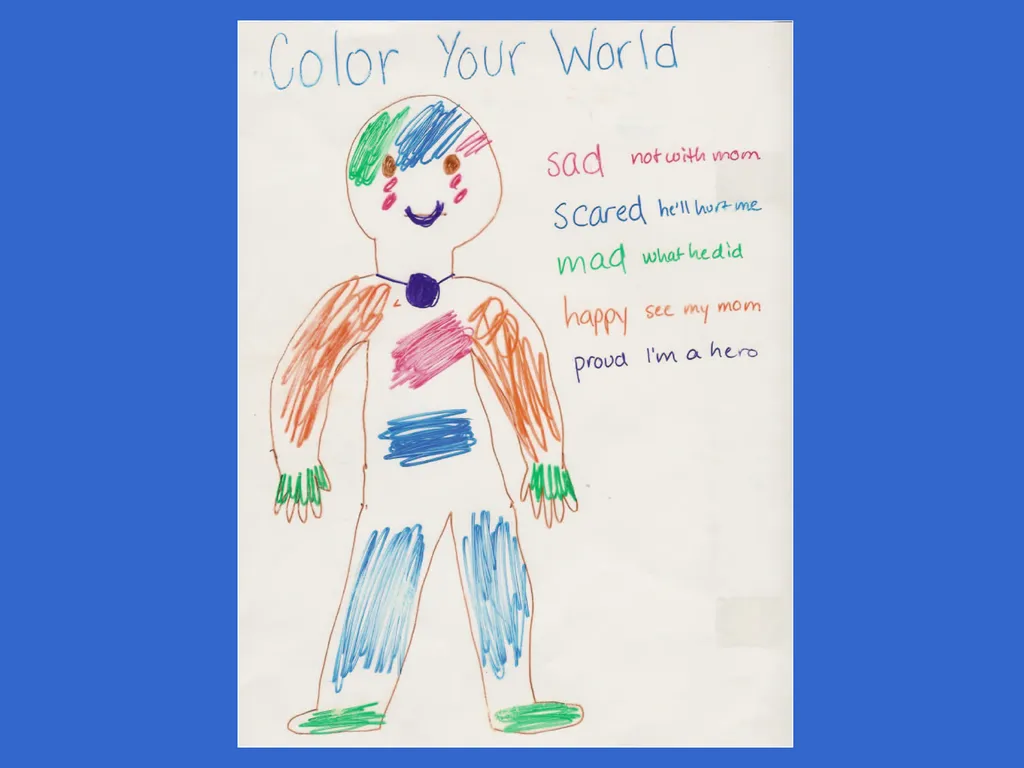
- Color Your World or person
- Emotions Color Wheel
Importance of feeling identification and expression when there are trauma reminders<br>
slide92. Affective Regulation (cont’d) Positive Self-Talk: focus on strengths
Improving social skills: interpreting other’s affective expressions accurately
Develop a safety plan<br>
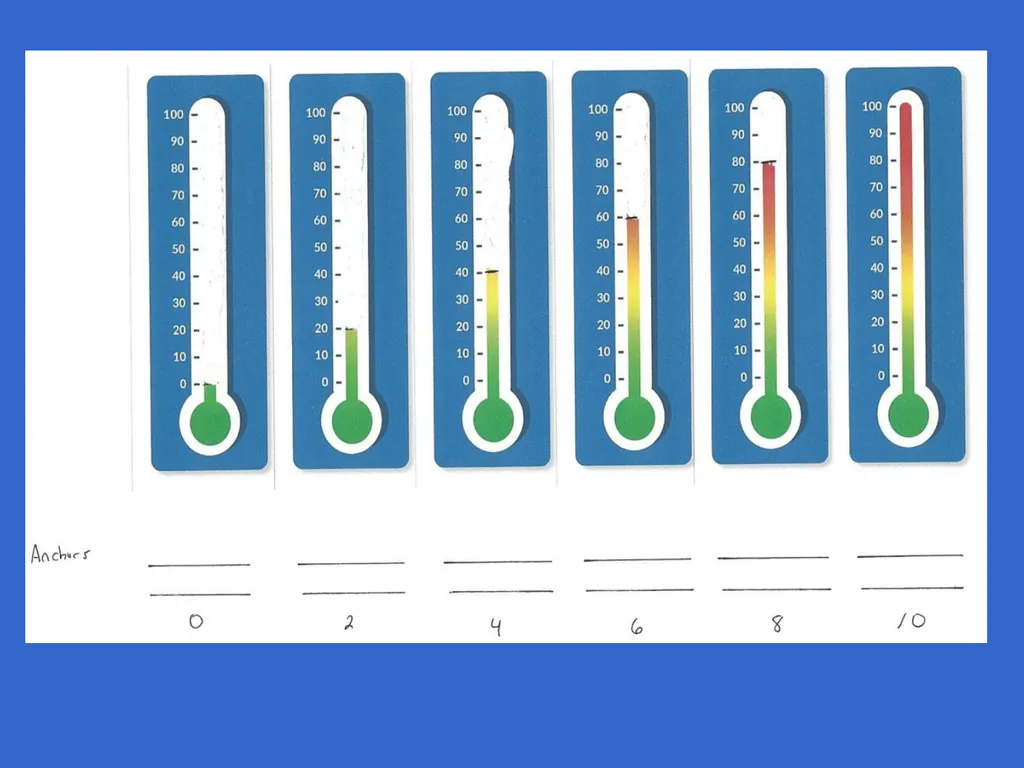
slide93. SUDS Subjective Units of Distress Scale
See handouts #10A and #10B
10B next slide<br>
slide95. P R A C T I C E<br>
slide96. GE: Cognitive Coping and Processing This is one exception to GE in PRAC components
- Children are not asked about their trauma-related
cognitions until the trauma narration and processing
component
Why? Dysfunctional thoughts are more likely to be expressed during the narrative than before.
Communicate to child that trauma-related cognitions will be addressed later in treatment<br>
slide97. Cognitive Processing Help children distinguish between thoughts, feelings, and behaviors
Help children and parents understand the cognitive triad: connections between thoughts, feelings and behaviors, as they relate to everyday events
Help children and parents view events in more accurate and helpful ways
Encourage parents to assist children in cognitive processing of upsetting situations, and to use this in their own everyday lives for affective modulation<br>
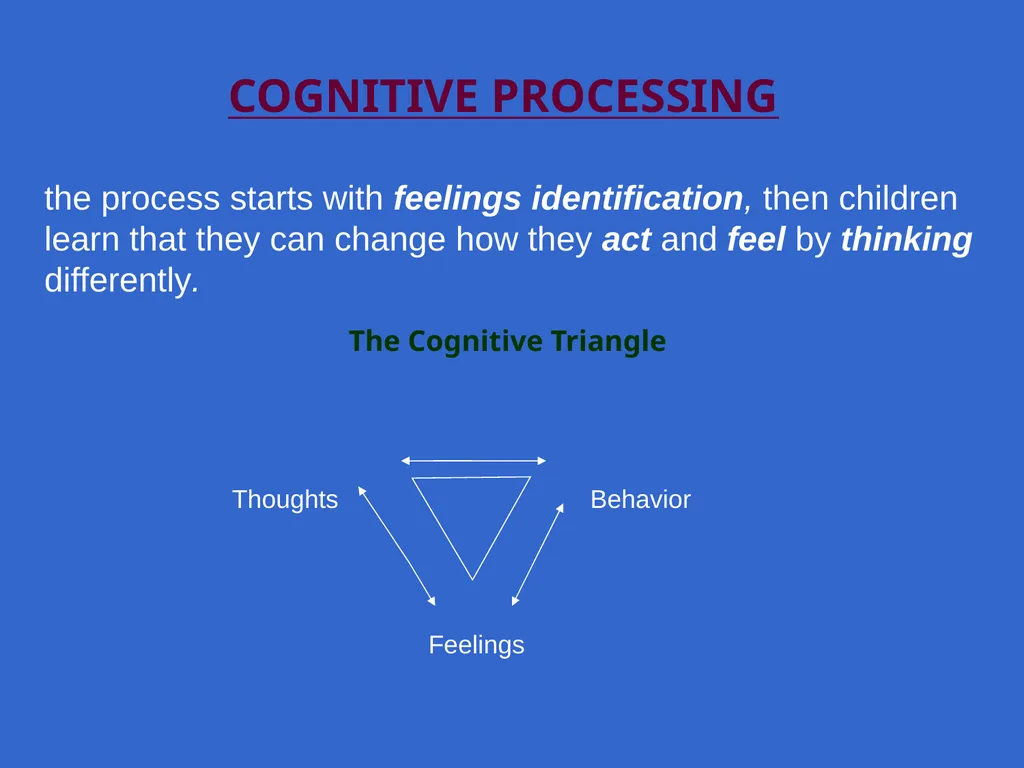
slide98. COGNITIVE PROCESSING The Cognitive Triangle Behavior Thoughts Feelings the process starts with feelings identification, then children learn that they can change how they act and feel by thinking differently.<br>
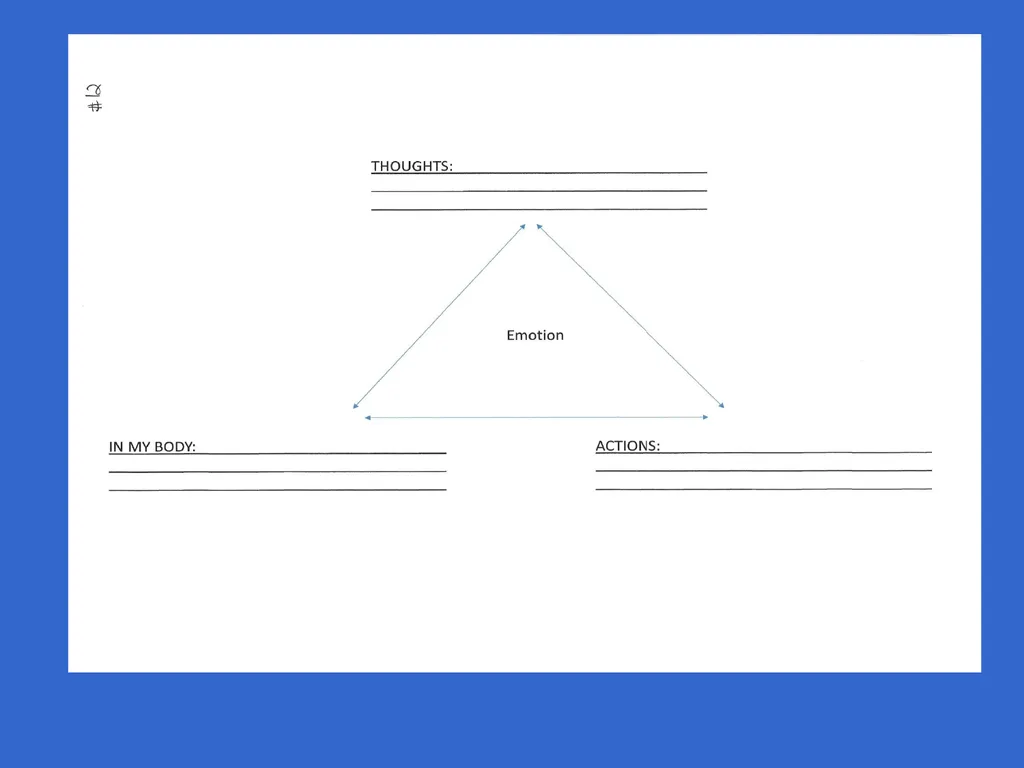
slide100. Cognitive Triangle See handout #12
Print out a million copies and use these with the kid
First do neutral events
Build to upsetting but non-trauma events
Ultimately they’ll apply the triangle to trauma thoughts, although this is not a point of focus during PRAC stage
Can also consider using the term “reconsider” your thoughts (vs “change”)<br>
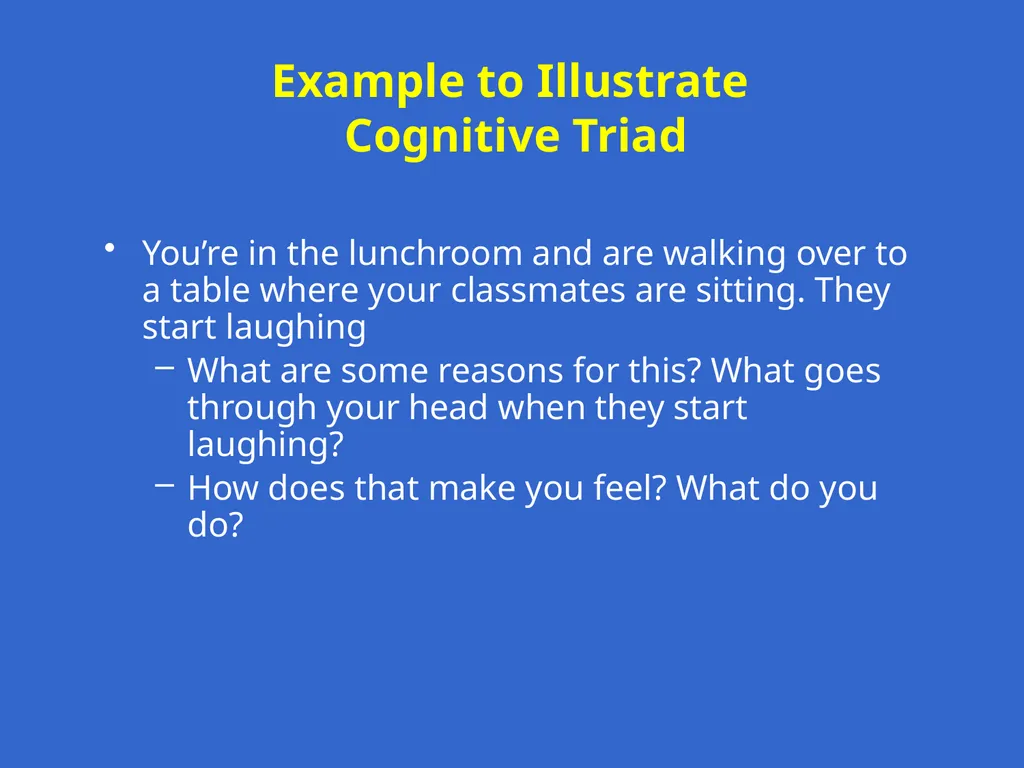
slide101. Example to Illustrate Cognitive Triad You’re in the lunchroom and are walking over to a table where your classmates are sitting. They start laughing
What are some reasons for this? What goes through your head when they start laughing?
How does that make you feel? What do you do?<br>
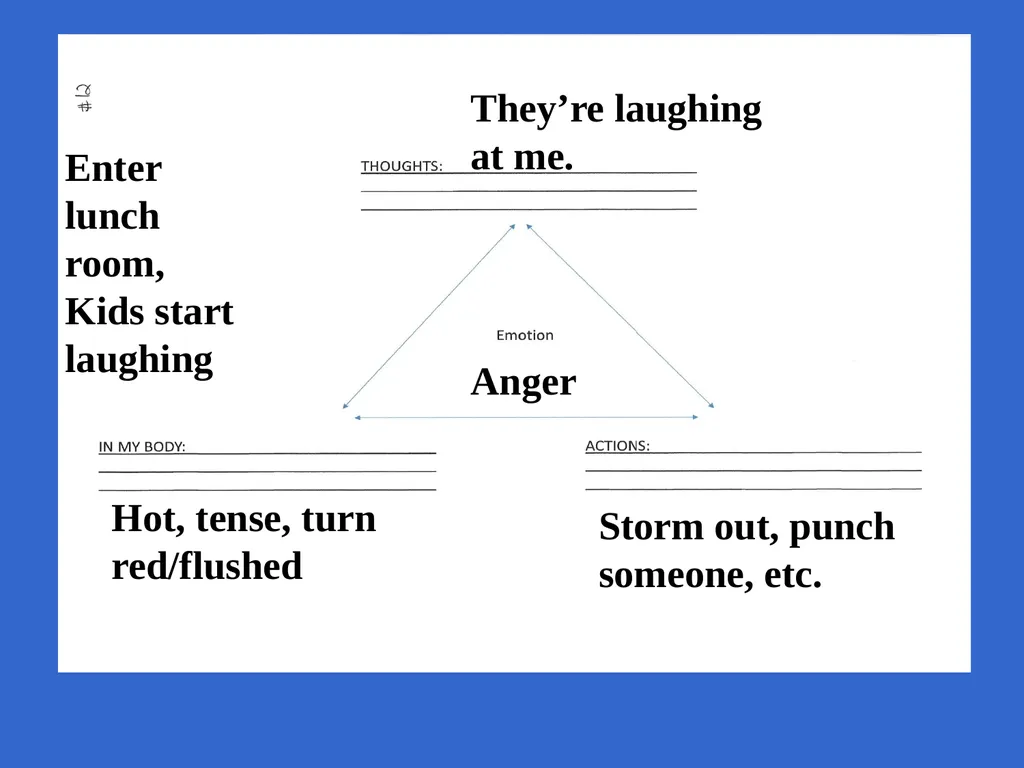
slide102. Enter lunch room, Kids start laughing They’re laughing at me. Anger Hot, tense, turn red/flushed Storm out, punch someone, etc.<br>
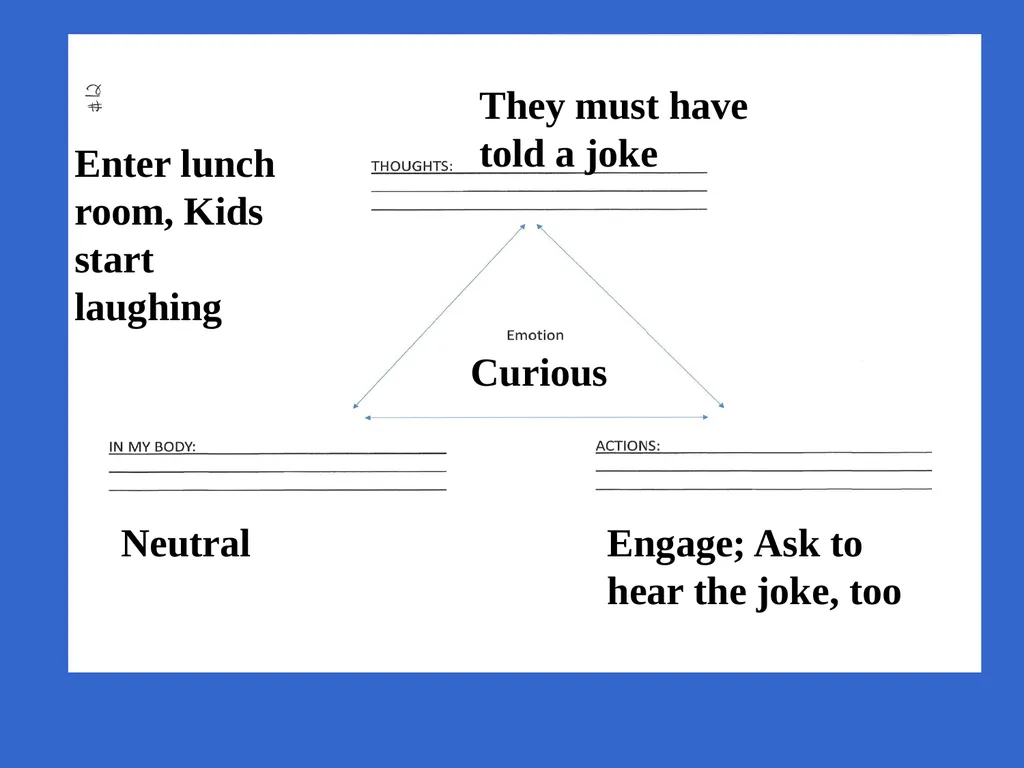
slide103. Enter lunch room, Kids start laughing They must have told a joke Curious Neutral Engage; Ask to hear the joke, too<br>
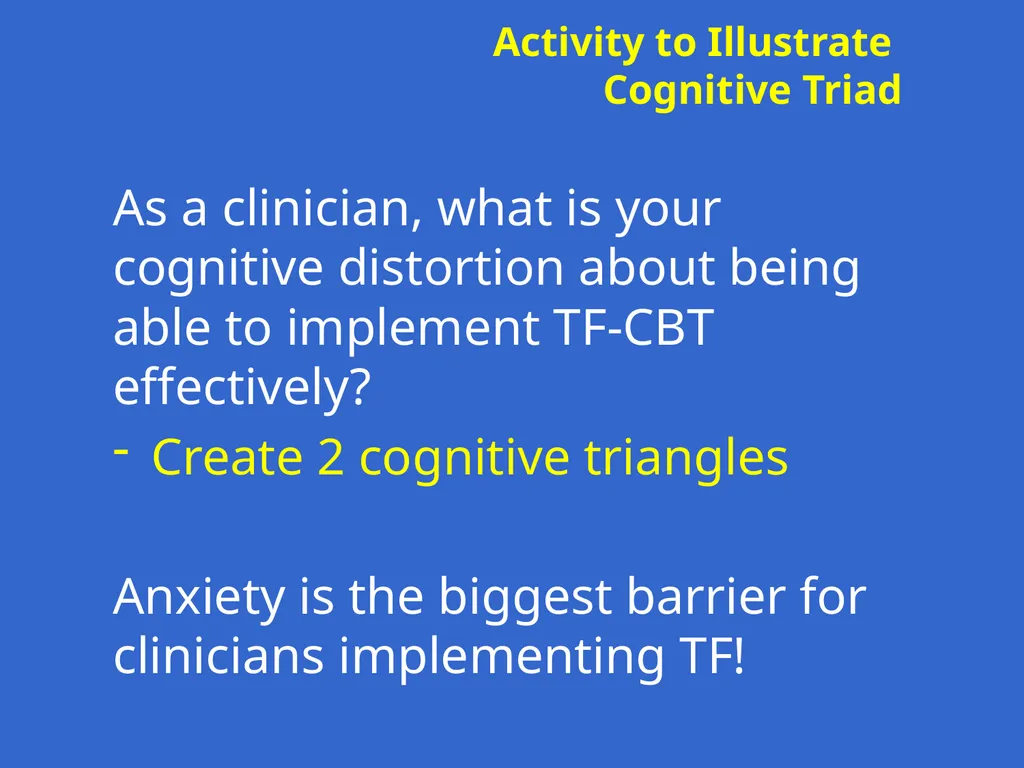
slide104. Activity to Illustrate Cognitive Triad As a clinician, what is your cognitive distortion about being able to implement TF-CBT effectively?
Create 2 cognitive triangles
Anxiety is the biggest barrier for clinicians implementing TF!<br>
slide105. Cognitive Work with Children- Identifying Thoughts HELPING CHILDREN TO TALK ABOUT THEIR THOUGHTS
Use appropriate child language
Adjust to their developmental level, BE CREATIVE!
What do you think about when you’re ______(insert feeling)?
Are there any thoughts or pictures that go through your mind?
What popped into your head? What did you say to yourself?
What went through your head?
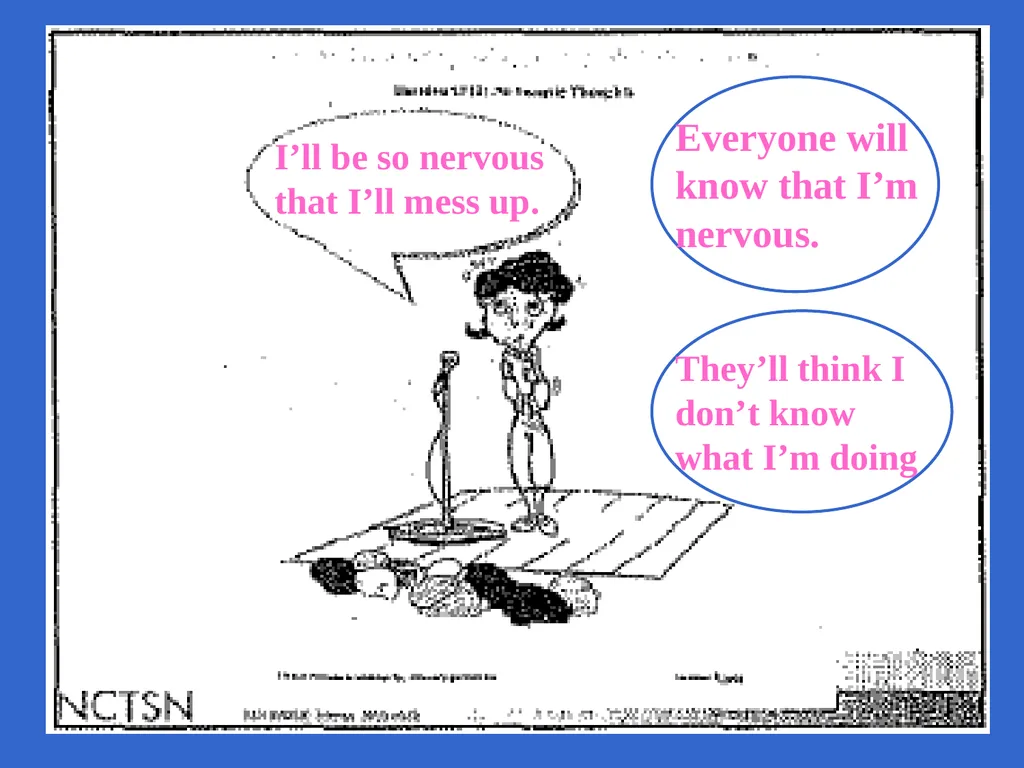
Use a cartoon bubble and fill it in<br>
slide106. Cognitive Processing in Young Children Cognitive triangle will have little utility
Young children can understand the concrete idea of “Who made that happen?”
Give them a mantra
“I can cope with that.”
“This won’t last forever.”
“I am brave.”<br>
slide107. Cognitive coping books for young children:
“The Little Engine That Could”
“Giraffes Can’t Dance”
“Tiger, Tiger is it true?” https://www.youtube.com/watch?v=gPfB4CR6fUU<br>
slide108. Cognitive Processing Video Game TF-CBT TRIANGLE OF LIFE
Currently available on the Google Play Store
Currently available on the Apple Store<br>
slide109. Cognitive Restructuring<br>
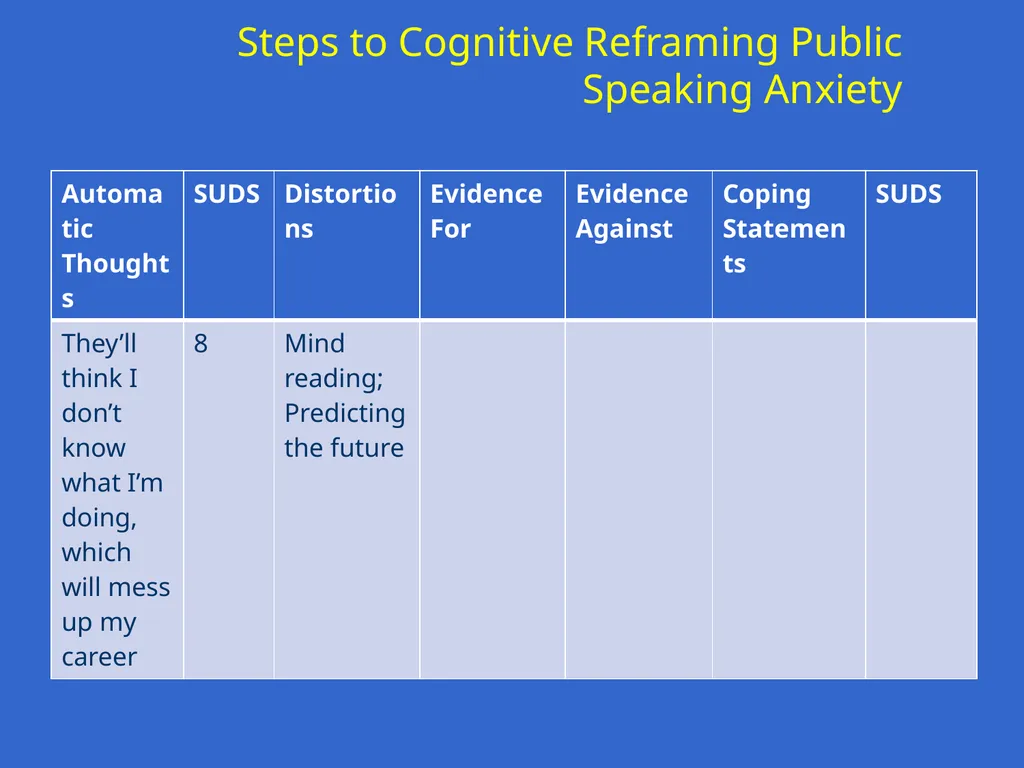
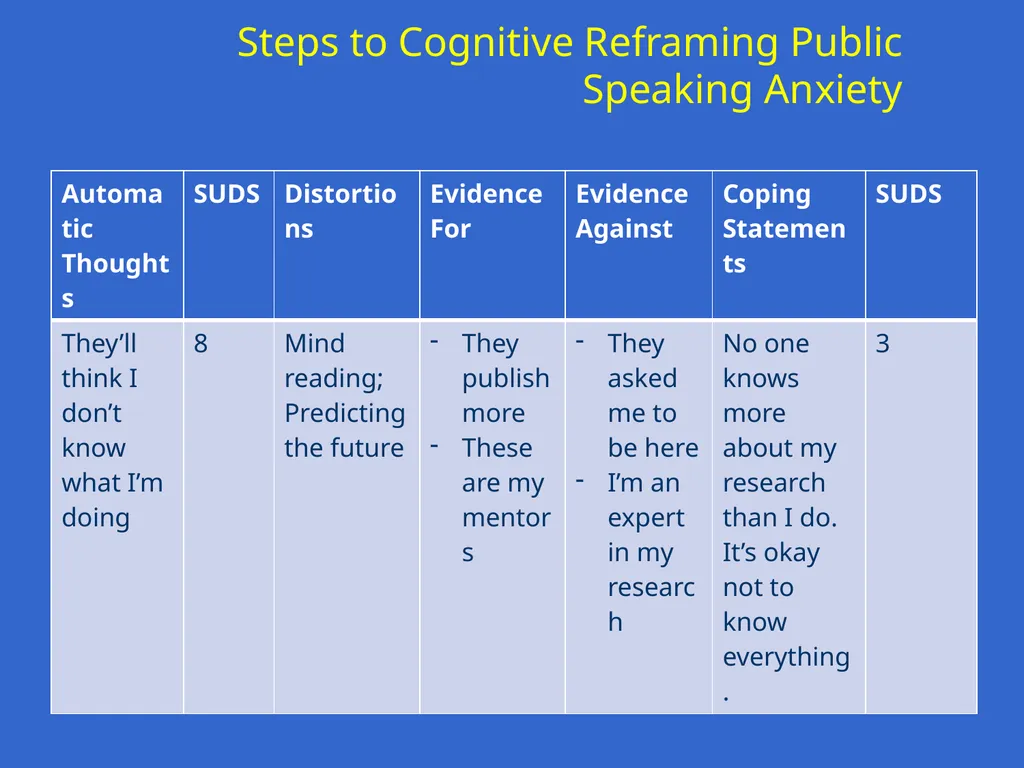
slide111. I’ll be so nervous that I’ll mess up. Everyone will know that I’m nervous. They’ll think I don’t know what I’m doing<br>
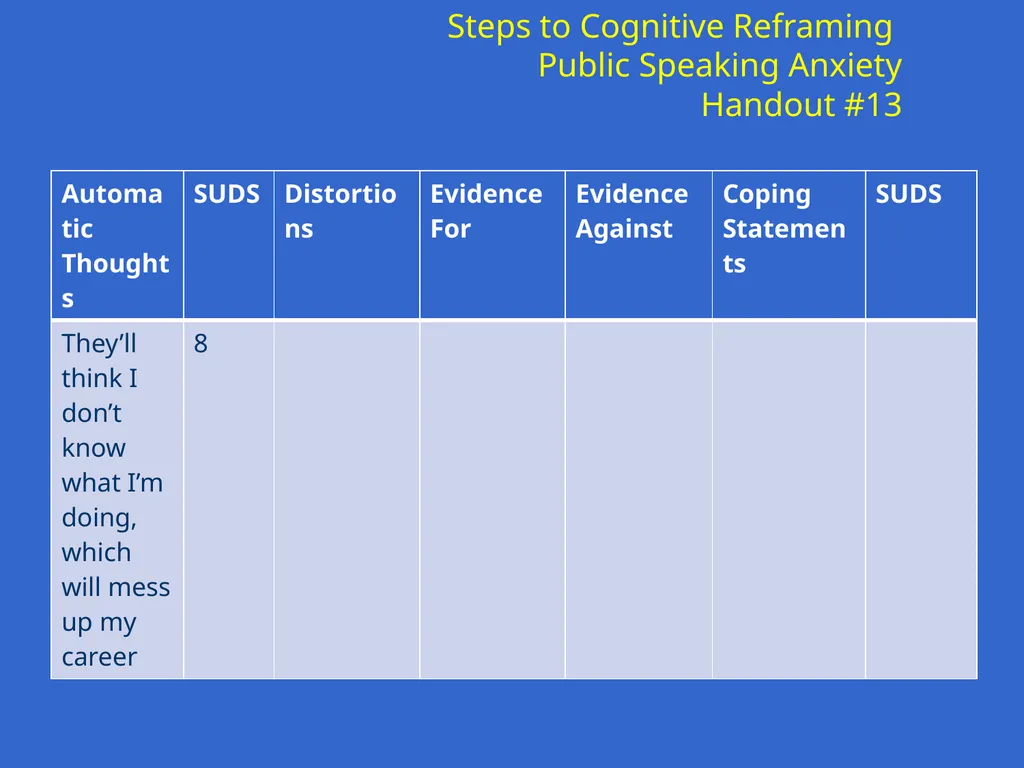
slide112. Steps to Cognitive Reframing Public Speaking Anxiety Handout #13<br>
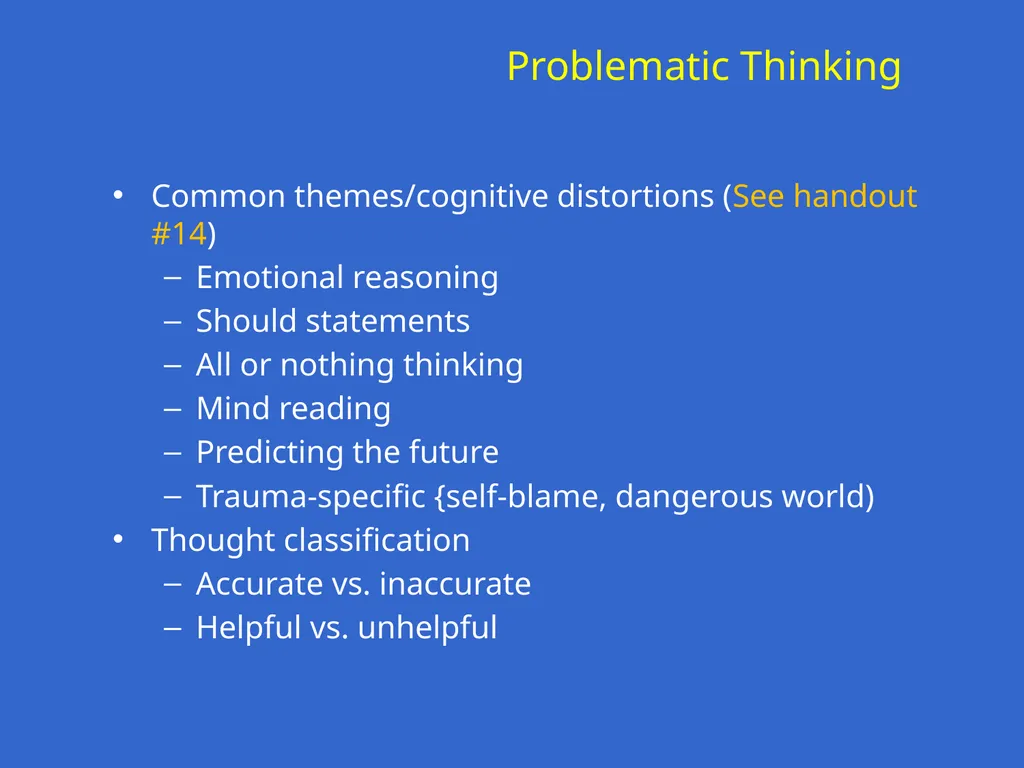
slide113. Problematic Thinking Common themes/cognitive distortions (See handout #14)
Emotional reasoning
Should statements
All or nothing thinking
Mind reading
Predicting the future
Trauma-specific {self-blame, dangerous world)
Thought classification
Accurate vs. inaccurate
Helpful vs. unhelpful<br>
slide114. Steps to Cognitive Reframing Public Speaking Anxiety<br>
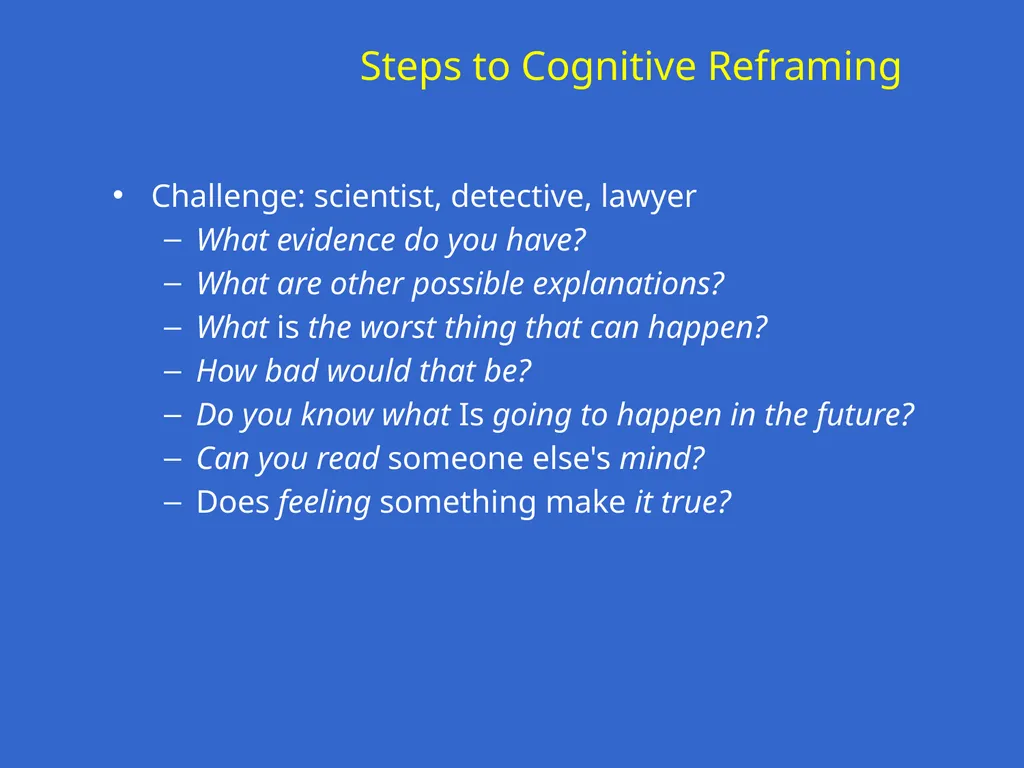
slide115. Steps to Cognitive Reframing Challenge: scientist, detective, lawyer
What evidence do you have?
What are other possible explanations?
What is the worst thing that can happen?
How bad would that be?
Do you know what Is going to happen in the future?
Can you read someone else's mind?
Does feeling something make it true?<br>
slide116. Steps to Cognitive Reframing Public Speaking Anxiety<br>
slide117. How to Help Change Negative Thoughts Role Play
Reverse roles
What would you say to your best friend/sibling?
What would you say to your child?
Use puppets or dolls
Collect data (from the internet)<br>
slide118. Problem Solving Identify the Problem
Brainstorm possible solutions
Choose a path to try
Monitor the path outcomes
If not successful, return to brainstorming list and try another solution
“What would Daniel do?”
“What would Darla do?”<br>
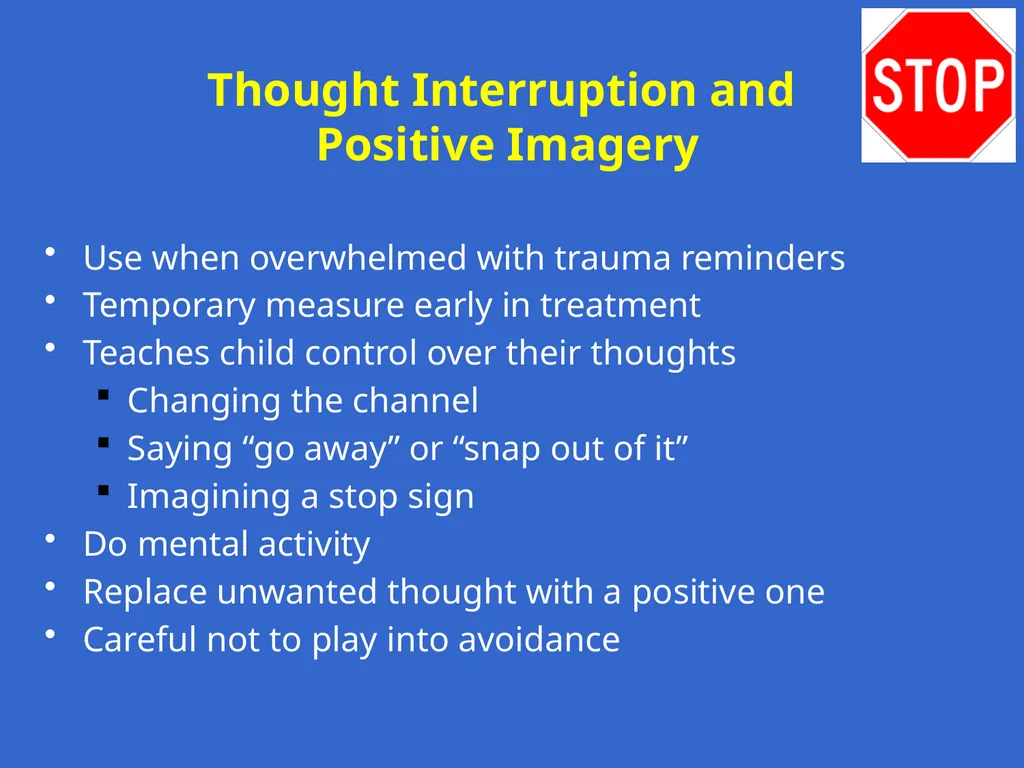
slide119. Thought Interruption and Positive Imagery Use when overwhelmed with trauma reminders
Temporary measure early in treatment
Teaches child control over their thoughts
Changing the channel
Saying “go away” or “snap out of it”
Imagining a stop sign
Do mental activity
Replace unwanted thought with a positive one
Careful not to play into avoidance<br>
slide120. Another resource:<br>
slide121. P R A C + T I C E<br>
slide122. Other Coping Skills Social Skills
Assertiveness training
Anger Management
Others???
Is there anything else this kid needs in order to be successful with TN?<br>
slide123. P R A C T I C E<br>
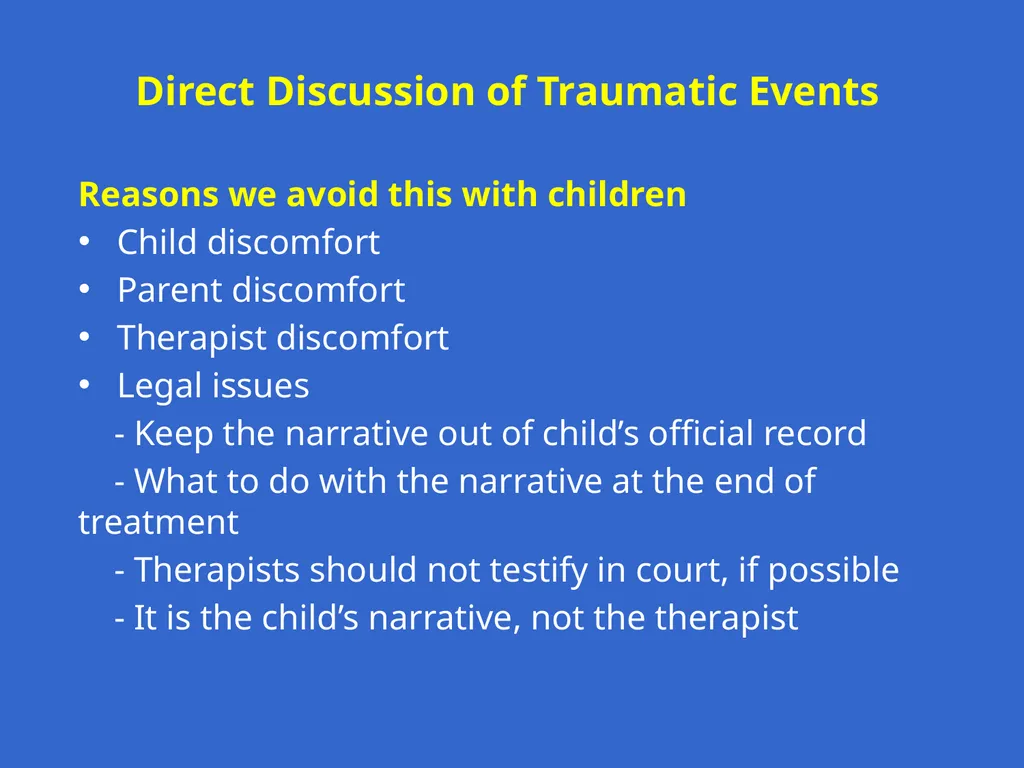
slide124. Direct Discussion of Traumatic Events Reasons we avoid this with children
Child discomfort
Parent discomfort
Therapist discomfort
Legal issues
- Keep the narrative out of child’s official record
- What to do with the narrative at the end of treatment
- Therapists should not testify in court, if possible
- It is the child’s narrative, not the therapist<br>
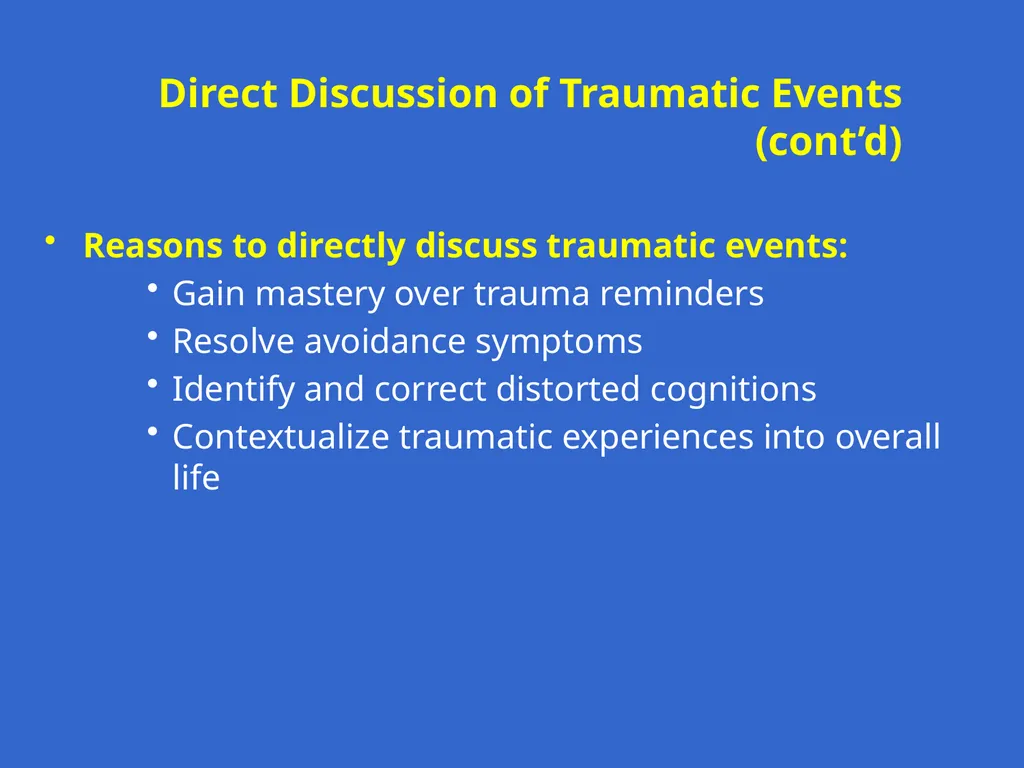
slide125. Direct Discussion of Traumatic Events (cont’d) Reasons to directly discuss traumatic events:
Gain mastery over trauma reminders
Resolve avoidance symptoms
Identify and correct distorted cognitions
Contextualize traumatic experiences into overall life<br>
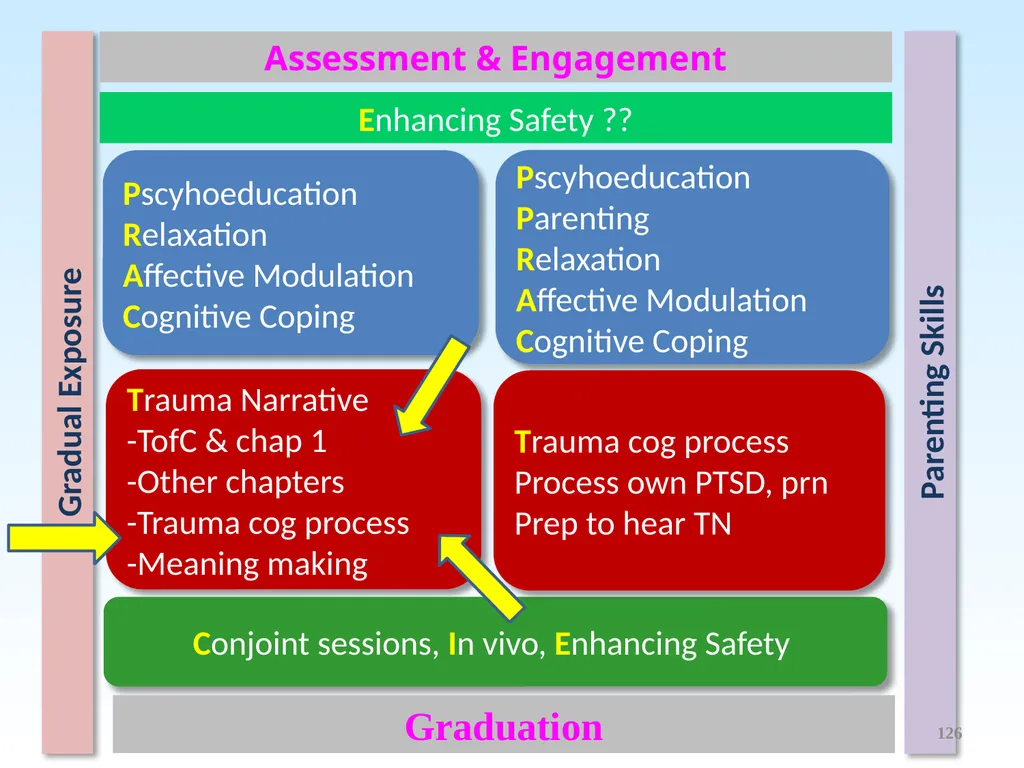
slide126. Pscyhoeducation
Relaxation
Affective Modulation
Cognitive Coping Trauma Narrative
-TofC & chap 1
-Other chapters
-Trauma cog process
-Meaning making Conjoint sessions, In vivo, Enhancing Safety Parenting Skills Gradual Exposure Assessment & Engagement Graduation Enhancing Safety ?? Pscyhoeducation
Parenting
Relaxation
Affective Modulation
Cognitive Coping Trauma cog process
Process own PTSD, prn
Prep to hear TN 126<br>
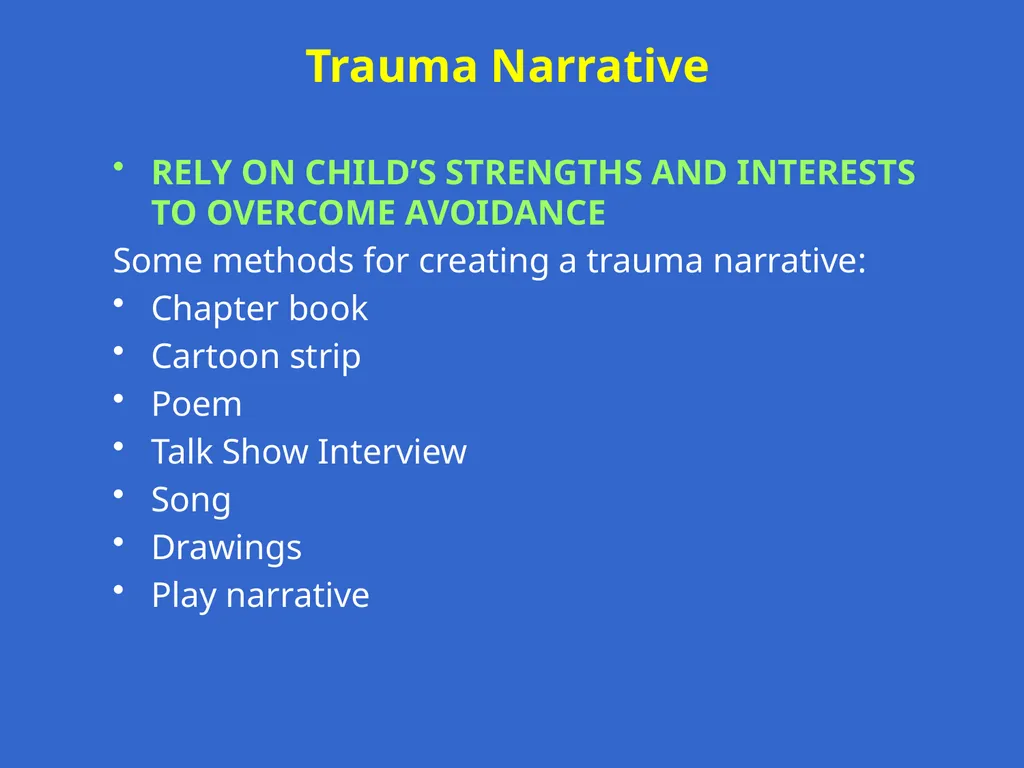
slide127. Trauma Narrative RELY ON CHILD’S STRENGTHS AND INTERESTS TO OVERCOME AVOIDANCE
Some methods for creating a trauma narrative:
Chapter book
Cartoon strip
Poem
Talk Show Interview
Song
Drawings
Play narrative<br>
slide128. Creating the Trauma Narrative First chapter : innocuous information about the child (name, age, school, hobbies, etc.)
Chapter 1 needs to come first
Child can choose what order he/she wants to do the rest of the middle chapters in
Therapist should get the child used to the questioning/prompting process<br>
slide129. Peripheral Chapter(s) - optional Peripheral chapter : Approaching the event but still peripheral information
Part of the exposure process
Only do this if the client is not yet ready to do the actual event chapter(s) yet
Example: “Before”,
for example, what the relationship was like with the person before the trauma started (if interpersonal trauma);
or what life was like before the index trauma occurred
Not appropriate for every child (like if trauma happened early in life and you don’t remember “before” the trauma)
Example: “Setting”<br>
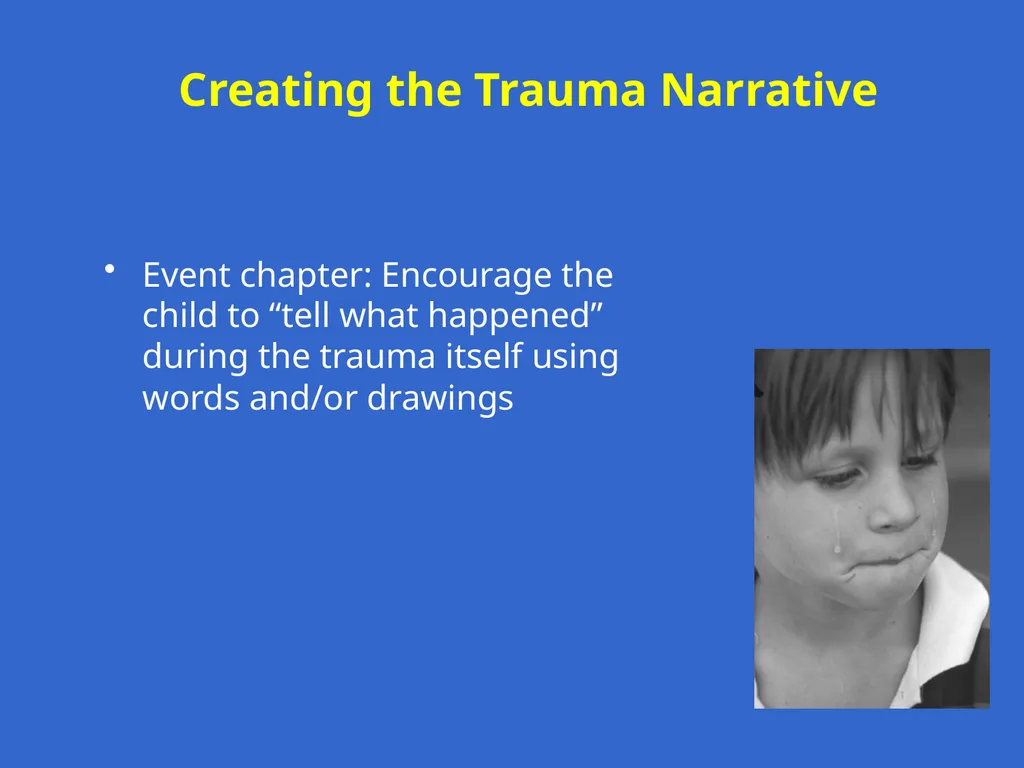
slide130. Creating the Trauma Narrative Event chapter: Encourage the child to “tell what happened” during the trauma itself using words and/or drawings<br>
slide131. For kids who are not very anxious and avoidant, trauma narrative can be a pretty organic process
Incorporate events, thoughts, feelings, body sensations all at once, in an integrated sort of way
For kids who ARE very anxious and avoidant, the organic process might not work quite as well. In that case consider the Layered Approach to trauma narrative (next slide)<br>
slide132. Layered approach Review the child’s description
First, help the child to describe more details
Flesh out details before moving on to the next stage
Next, encourage child to describe body sensations, thoughts and feelings related to the trauma
Desensitize child to talking about the event at each stage<br>
slide133. Creating the Trauma Narrative (cont’d) Identify “hot spots” or “worst moments”
Rate distress before, during, and after (SUDS thermometer for children)<br>
slide134. Creating the Trauma Narrative If multiple episodes, let the child choose one (example: first time, worst time, one best remembered)
1-3 representative samples of trauma, as needed
Limit the number of sessions for the TN so that it is not overwhelming for the child<br>
slide135. Aftermath chapter(s) - optional Optional if there is significant distress or sxs:
Include disclosure
legal procedures
medical exams
other secondary adversities
Only do aftermath chapters if there is significant distress about any of these aftermath events.
You do NOT need to do these chapters if there isn’t distress related to these events.<br>
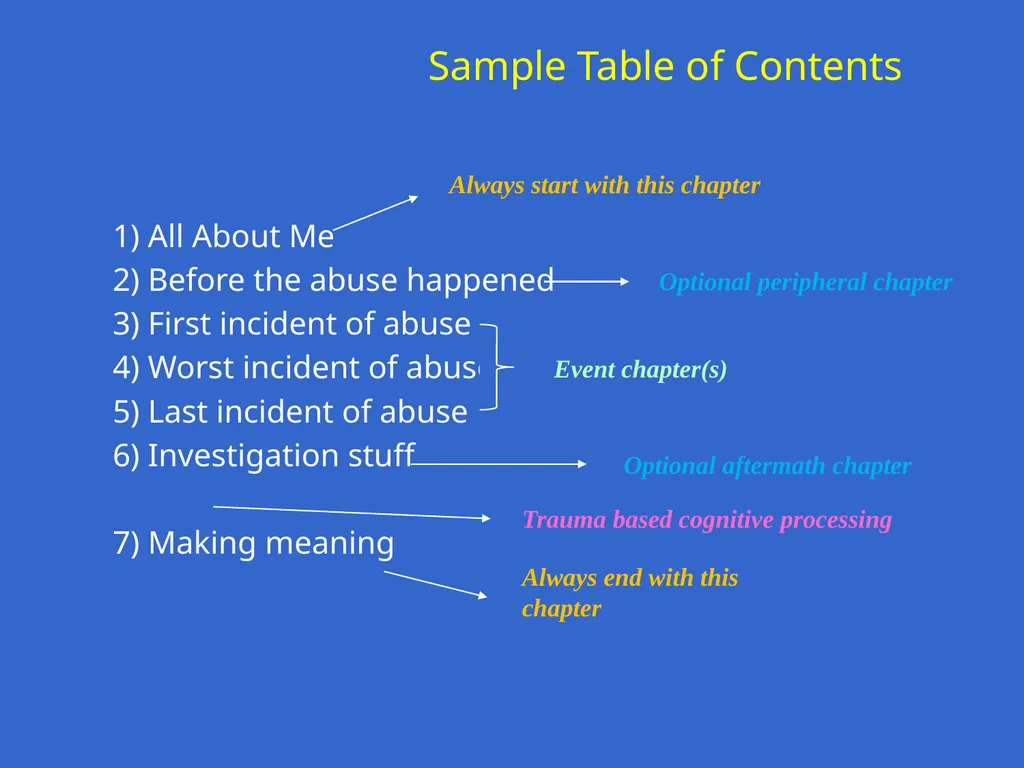
slide136. Sample Table of Contents 1) All About Me
2) Before the abuse happened
3) First incident of abuse
4) Worst incident of abuse
5) Last incident of abuse
6) Investigation stuff
7) Making meaning Always start with this chapter Optional peripheral chapter Event chapter(s) Optional aftermath chapter Always end with this chapter Trauma based cognitive processing<br>
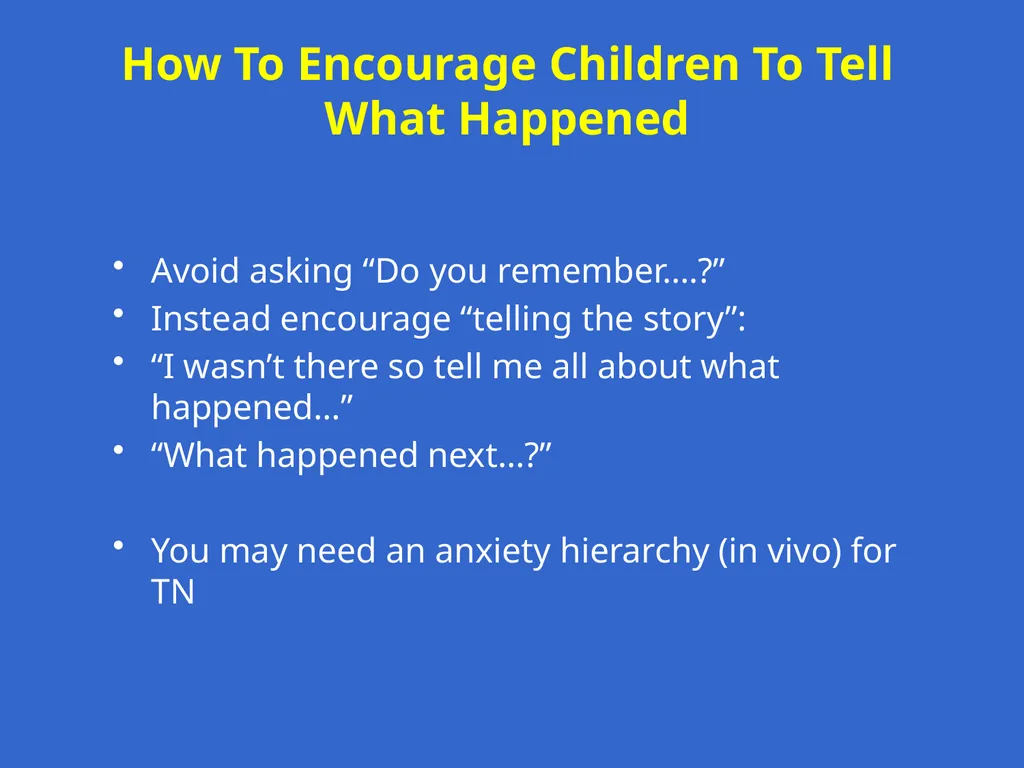
slide137. How To Encourage Children To Tell What Happened Avoid asking “Do you remember….?”
Instead encourage “telling the story”:
“I wasn’t there so tell me all about what happened…”
“What happened next…?”
You may need an anxiety hierarchy (in vivo) for TN<br>
slide138. First attempt at abuse chapter:
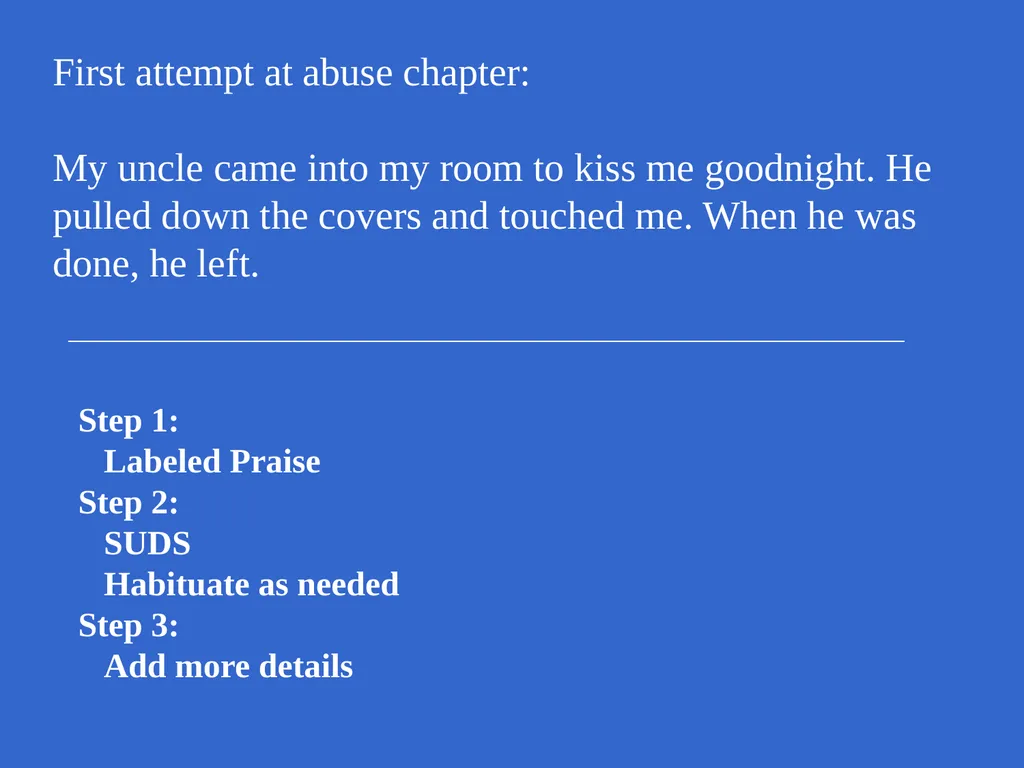
My uncle came into my room to kiss me goodnight. He pulled down the covers and touched me. When he was done, he left. Step 1:
Labeled Praise
Step 2:
SUDS
Habituate as needed
Step 3:
Add more details<br>
slide139. My uncle came into my room to kiss me goodnight.
Was this typical? At what point was this different than the norm?
How did he come into the room? What was his demeanor?
How did he approach the bed? (Sit on the bed? Pull up a chair? Stand?)
What did he say as he entered the room? As he approached the bed?
He pulled down the covers and touched me.
How did he pull down the covers?
How did he touch you?
(Which part of his body touched which part of your body?
What did he say while he was touching?
What was your response when he touched you?
When he was done, he left.
How did you know he was done?
How did he leave? Queries – Layer 1 We do not ask about thoughts, feelings, or body sensations during Level 1<br>
slide140. My uncle came into my room to kiss me goodnight. This was normal. He just came into my room and sat down on the bed. He didn’t say anything, but he sat there for longer than usual.
He pulled down the covers and touched me down there with his hand. He didn’t say anything, and I thought it was weird so I pretended I was asleep.
When he was done, he left. He stopped touching me, covered me up with the blanket, and walked out of the room. He closed the door. I just laid there, feeling really confused. 2nd draft<br>
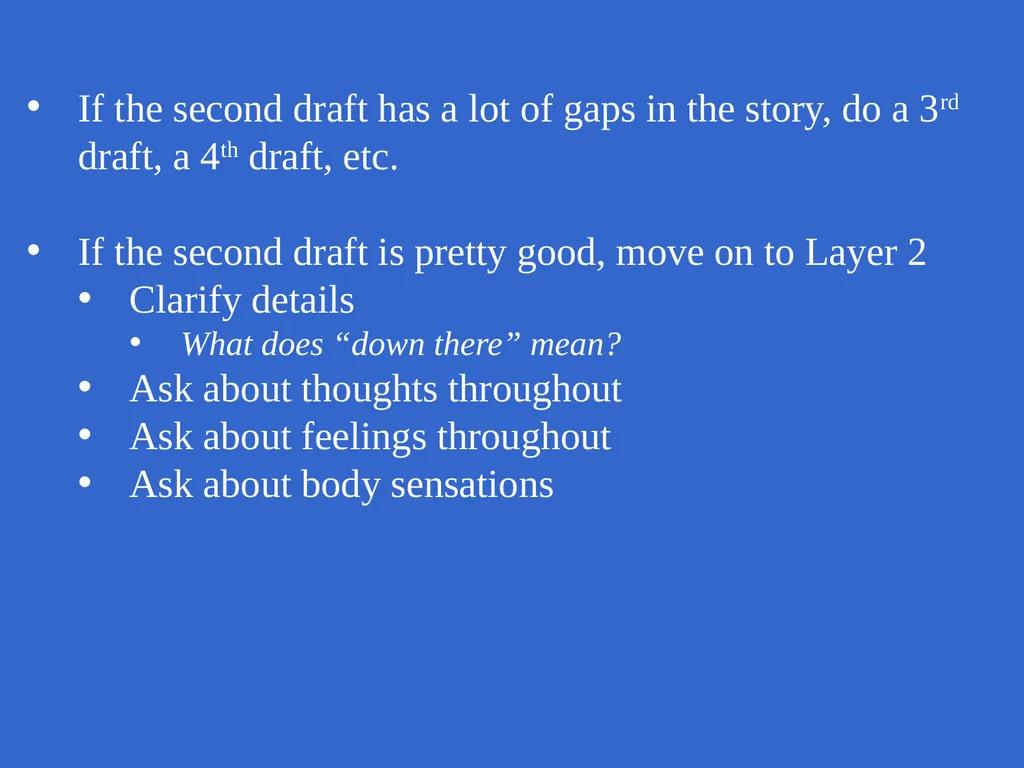
slide141. If the second draft has a lot of gaps in the story, do a 3rd draft, a 4th draft, etc.
If the second draft is pretty good, move on to Layer 2
Clarify details
What does “down there” mean?
Ask about thoughts throughout
Ask about feelings throughout
Ask about body sensations<br>
slide142. My uncle came into my room to kiss me goodnight. This was normal. He just came into my room and sat down on the bed. He usually just leaned over to give me a kiss and then left, so this was different. He didn’t say anything, but he sat there for longer than usual. I was just curious about what was going on. I didn’t really think much of it. He pulled down the covers and touched me down there on my vagina with his hand. He rubbed back and forth on the outside of my vagina. He didn’t say anything, and I thought it was weird. It didn’t hurt, but it felt weird and I didn’t like it. I felt sad and a little scared, and I didn’t know what to do. I pretended I was asleep. I thought he would stop if he thought I was asleep.<br>
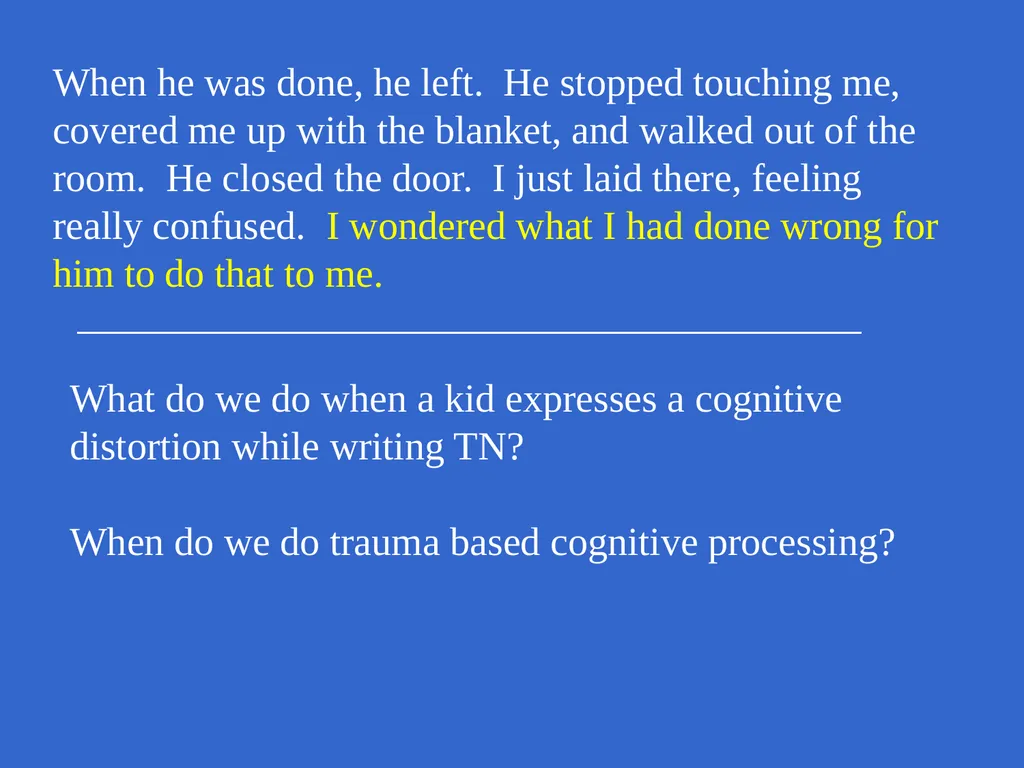
slide143. When he was done, he left. He stopped touching me, covered me up with the blanket, and walked out of the room. He closed the door. I just laid there, feeling really confused. I wondered what I had done wrong for him to do that to me. What do we do when a kid expresses a cognitive distortion while writing TN?
When do we do trauma based cognitive processing?<br>
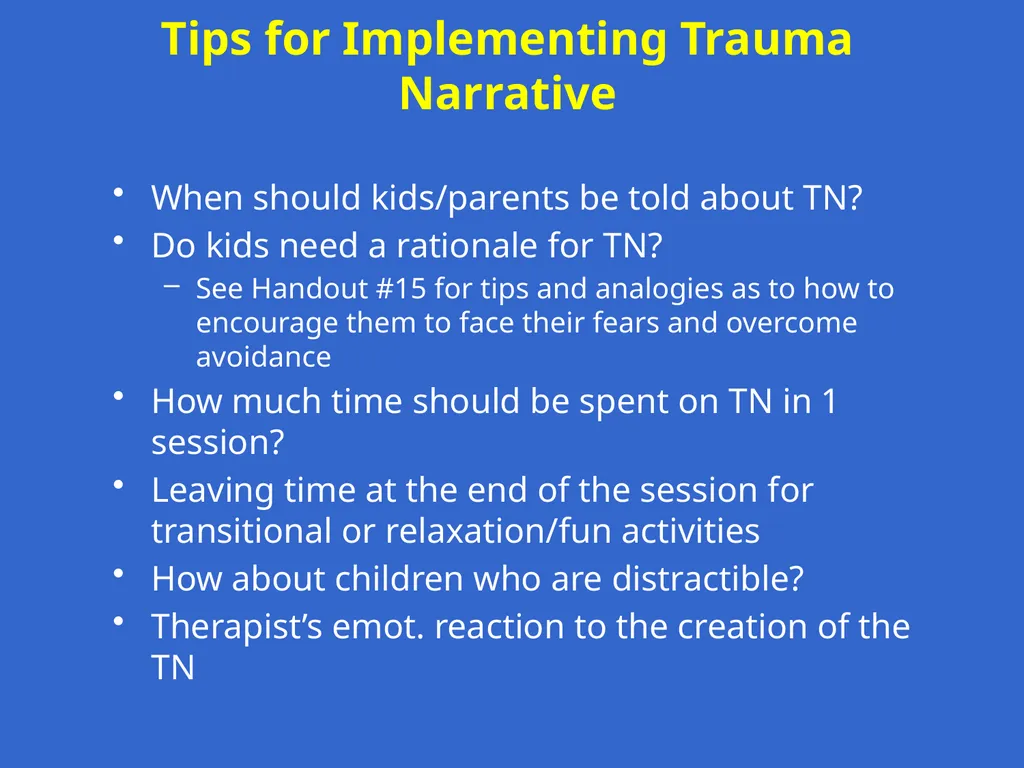
slide144. Tips for Implementing Trauma Narrative When should kids/parents be told about TN?
Do kids need a rationale for TN?
See Handout #15 for tips and analogies as to how to encourage them to face their fears and overcome avoidance
How much time should be spent on TN in 1 session?
Leaving time at the end of the session for transitional or relaxation/fun activities
How about children who are distractible?
Therapist’s emot. reaction to the creation of the TN<br>
slide145. Significant distress during TN- how should this be handled?
See VIDEO of anxiety/avoidance pattern<br>
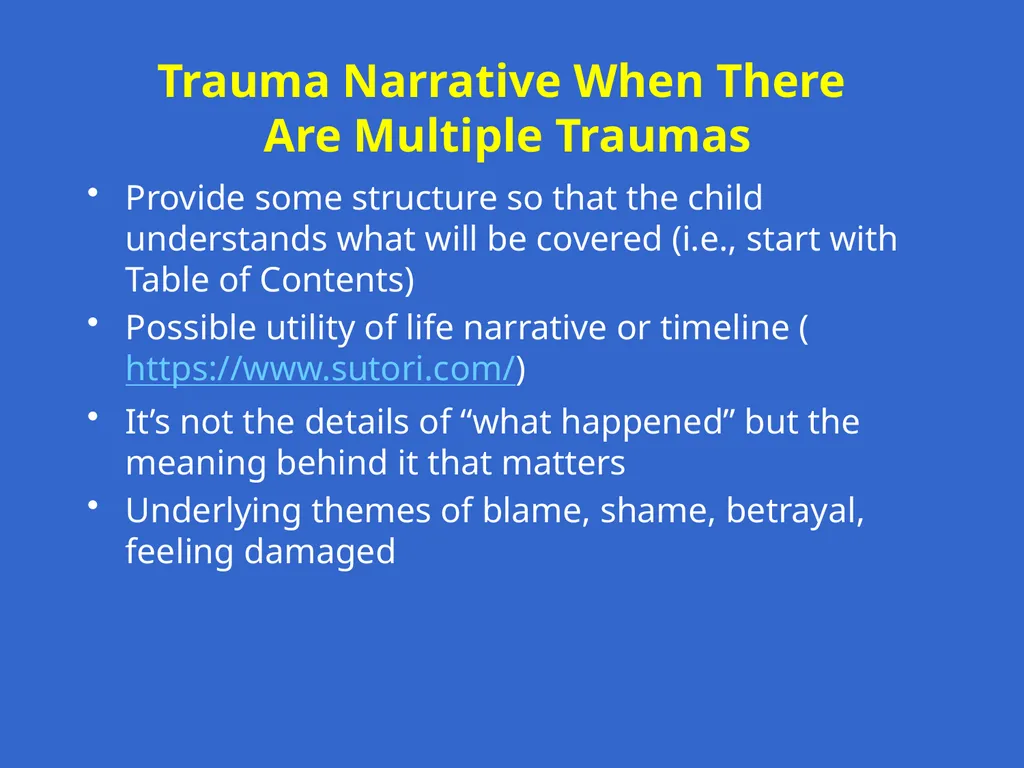
slide146. Trauma Narrative When There Are Multiple Traumas Provide some structure so that the child understands what will be covered (i.e., start with Table of Contents)
Possible utility of life narrative or timeline (https://www.sutori.com/)
It’s not the details of “what happened” but the meaning behind it that matters
Underlying themes of blame, shame, betrayal, feeling damaged<br>
slide147. Example of Child’s Trauma Narratives 8 year old with pictures<br>
slide148. Cognitive Processing of Trauma Narrative<br>
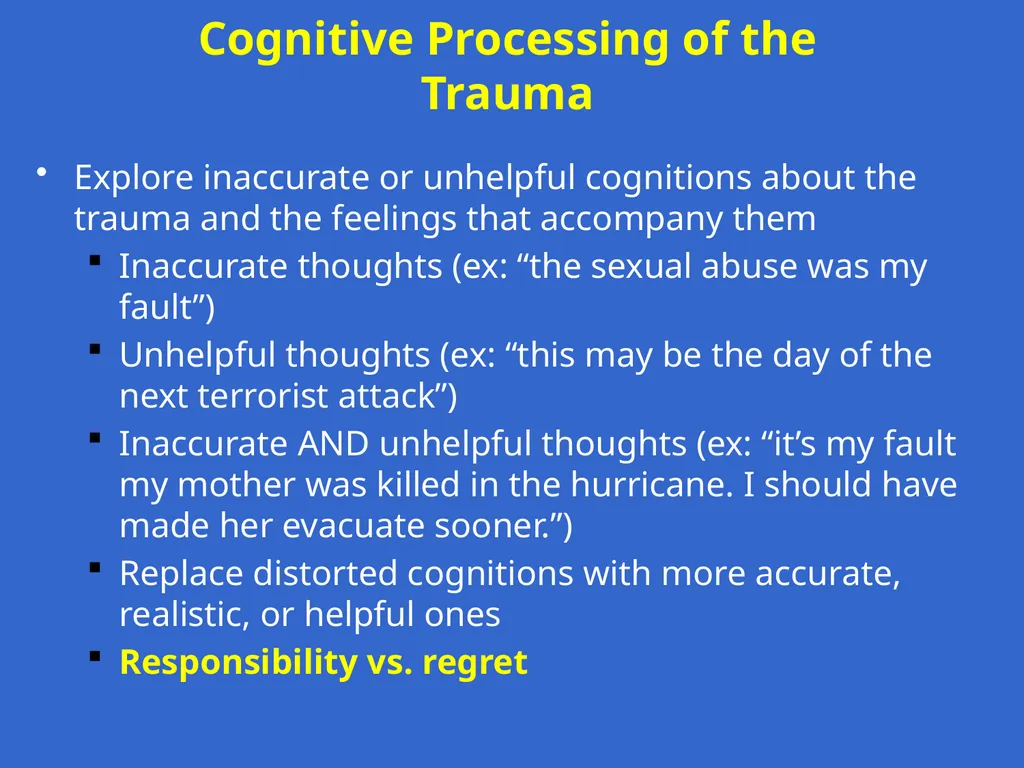
slide149. Cognitive Processing of the Trauma Explore inaccurate or unhelpful cognitions about the trauma and the feelings that accompany them
Inaccurate thoughts (ex: “the sexual abuse was my fault”)
Unhelpful thoughts (ex: “this may be the day of the next terrorist attack”)
Inaccurate AND unhelpful thoughts (ex: “it’s my fault my mother was killed in the hurricane. I should have made her evacuate sooner.”)
Replace distorted cognitions with more accurate, realistic, or helpful ones
Responsibility vs. regret<br>
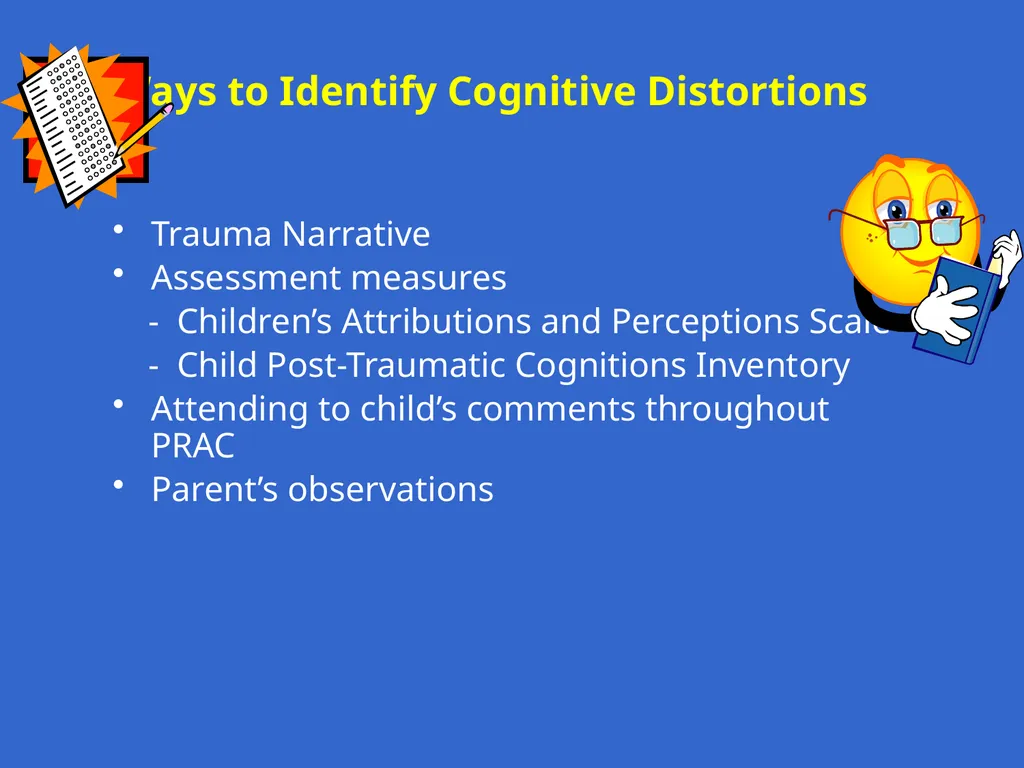
slide150. Ways to Identify Cognitive Distortions Trauma Narrative
Assessment measures
- Children’s Attributions and Perceptions Scale
- Child Post-Traumatic Cognitions Inventory
Attending to child’s comments throughout PRAC
Parent’s observations<br>
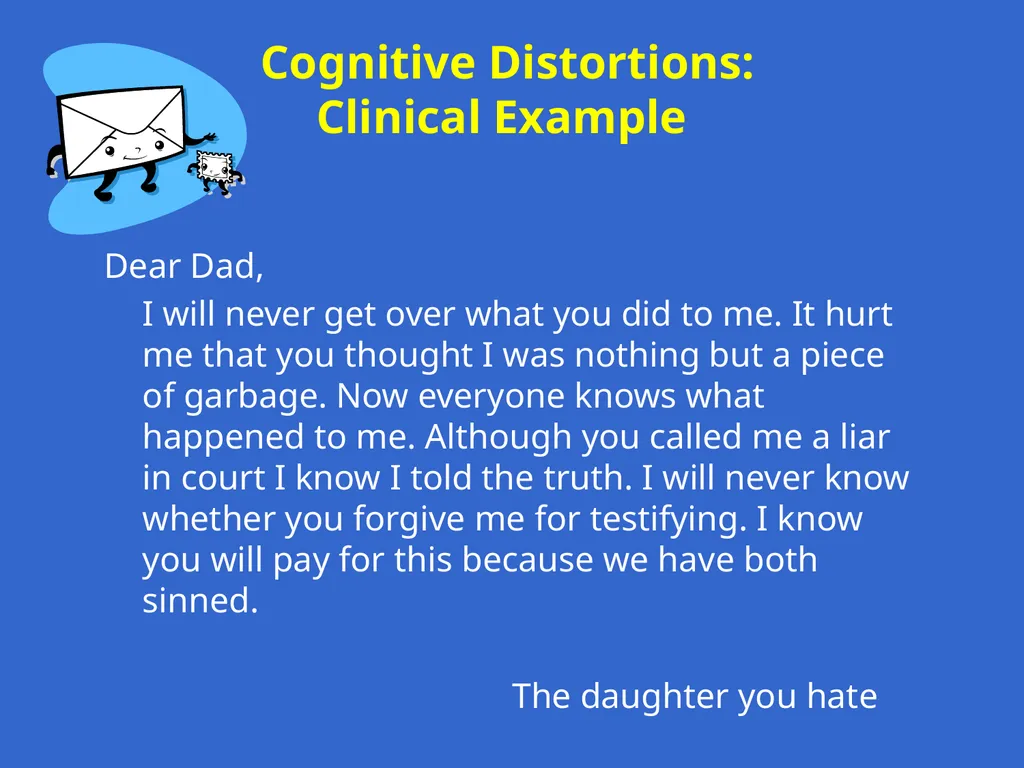
slide151. Cognitive Distortions: Clinical Example Dear Dad,
I will never get over what you did to me. It hurt me that you thought I was nothing but a piece of garbage. Now everyone knows what happened to me. Although you called me a liar in court I know I told the truth. I will never know whether you forgive me for testifying. I know you will pay for this because we have both sinned.
The daughter you hate<br>
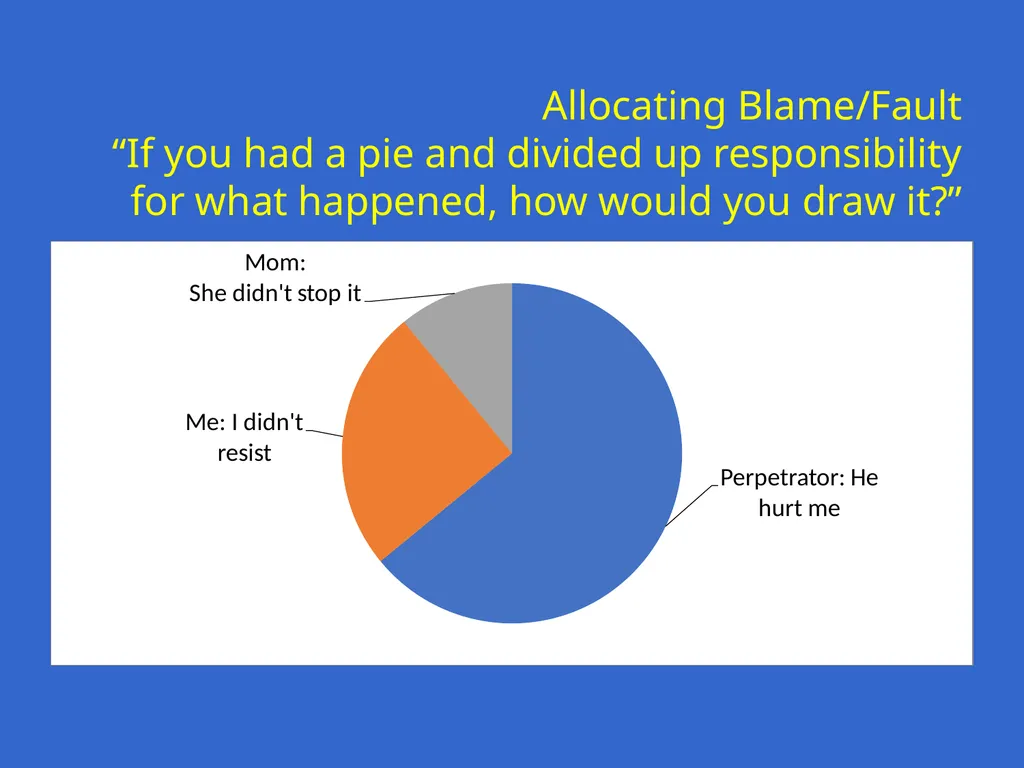
slide152. Allocating Blame/Fault “If you had a pie and divided up responsibility for what happened, how would you draw it?”<br>
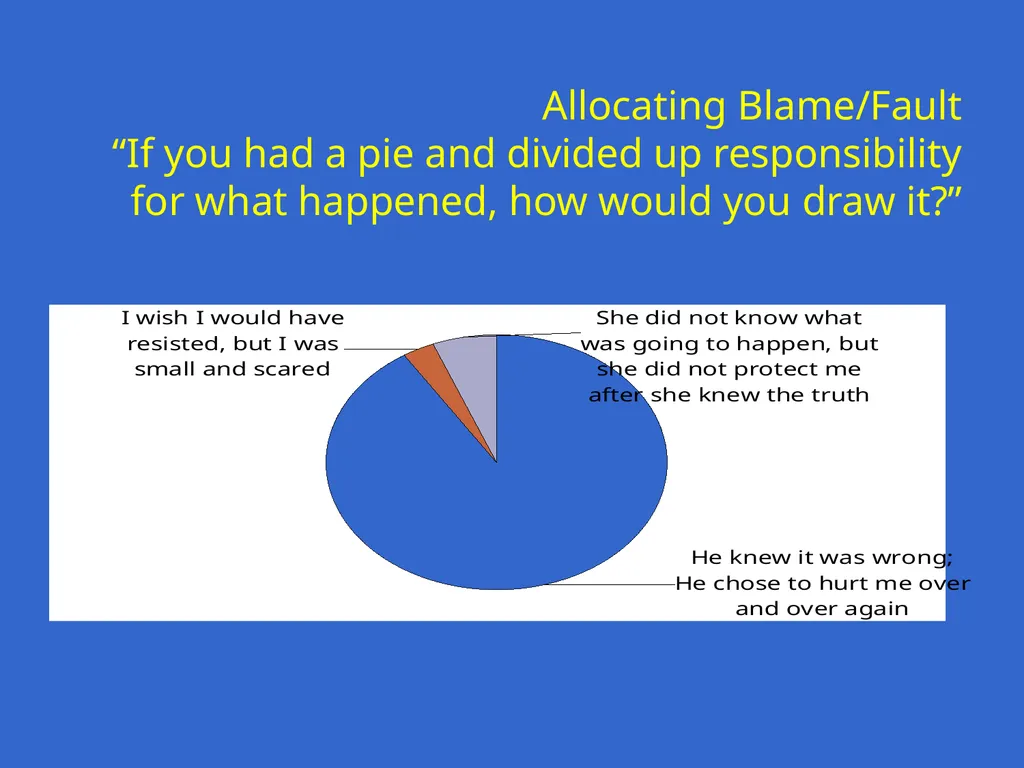
slide153. Allocating Blame/Fault “If you had a pie and divided up responsibility for what happened, how would you draw it?”<br>
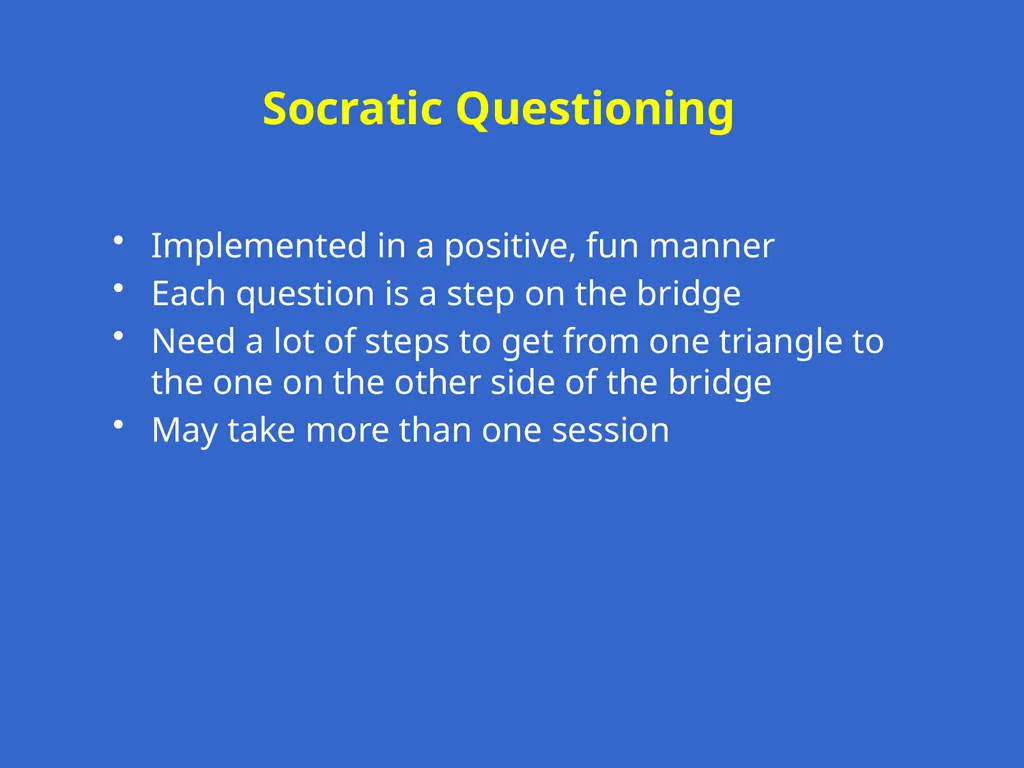
slide154. Socratic Questioning Implemented in a positive, fun manner
Each question is a step on the bridge
Need a lot of steps to get from one triangle to the one on the other side of the bridge
May take more than one session<br>
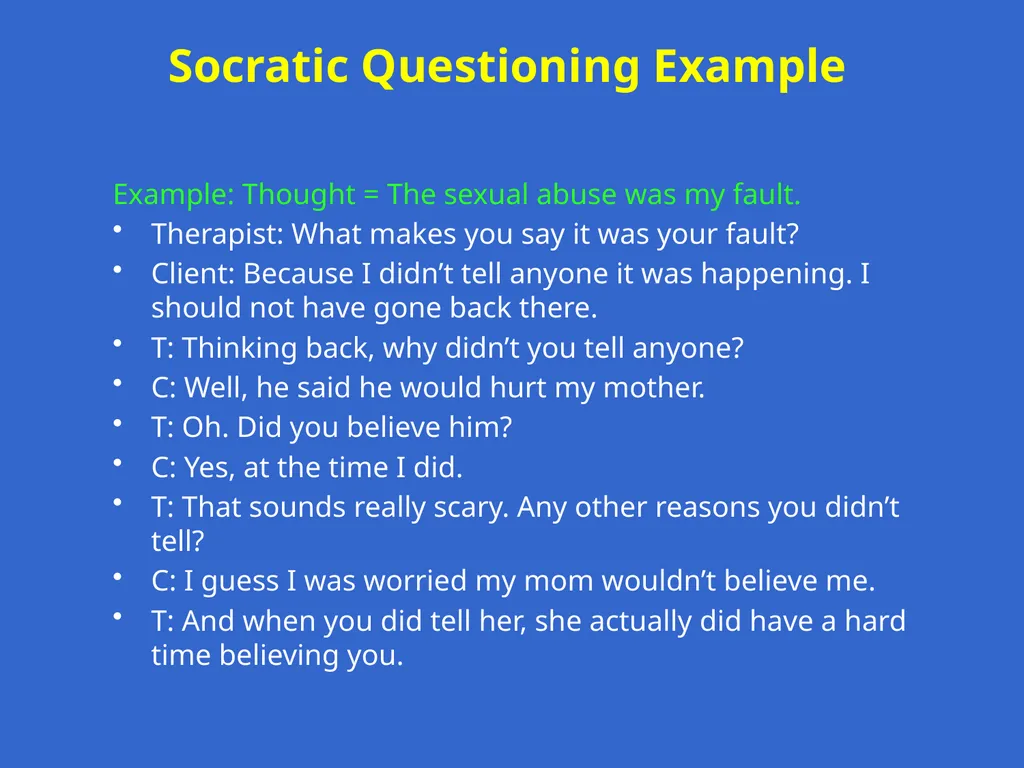
slide155. Socratic Questioning Example Example: Thought = The sexual abuse was my fault.
Therapist: What makes you say it was your fault?
Client: Because I didn’t tell anyone it was happening. I should not have gone back there.
T: Thinking back, why didn’t you tell anyone?
C: Well, he said he would hurt my mother.
T: Oh. Did you believe him?
C: Yes, at the time I did.
T: That sounds really scary. Any other reasons you didn’t tell?
C: I guess I was worried my mom wouldn’t believe me.
T: And when you did tell her, she actually did have a hard time believing you.<br>
slide156. Socratic Questioning Example (cont’d) C: Yeah.
T: So you weren’t far off on that, actually. Any other reasons you didn’t tell?
C: Well, he told me I would go to jail if the police found out.
T: Did you believe that?
C: Well, I was young. I guess I did.
T: Hmm... Sounds like you actually had some important reasons for not telling. You were worried he would hurt your mother, you were worried about your mom’s reaction, and you were convinced you could go to jail for telling. Do those seem like good reasons for a 9- year-old to keep silent?
C: Well, now that I think about it more...I guess it did make sense.<br>
slide157. AFTER the Trauma Cognitive Processing, then you go back to T.N. and do the Meaning Making Chapter<br>
slide158. Meaning Making Chapter Final Chapter: include the following:
What have you learned?
What would you tell other kids who experienced this?
How are you different now from when it happened/when you started treatment?<br>
slide159. What I Learned in Therapy I came here because I was sexually abused by my uncle. I used to feel scared and dirty. Now I know my body is OK. I don’t know why he did that, but he has a problem and it wasn’t my fault.
I didn’t know what to say or do about the sexual abuse. I felt like I didn’t do anything, but I did. I told my Mom and a wrote a book about it. That makes me feel proud.
If this ever happens to you, you could say, “No!”, get away and tell. If it’s hard to say no or get away – just tell - that is the most important thing anyway! Tell someone you trust.<br>
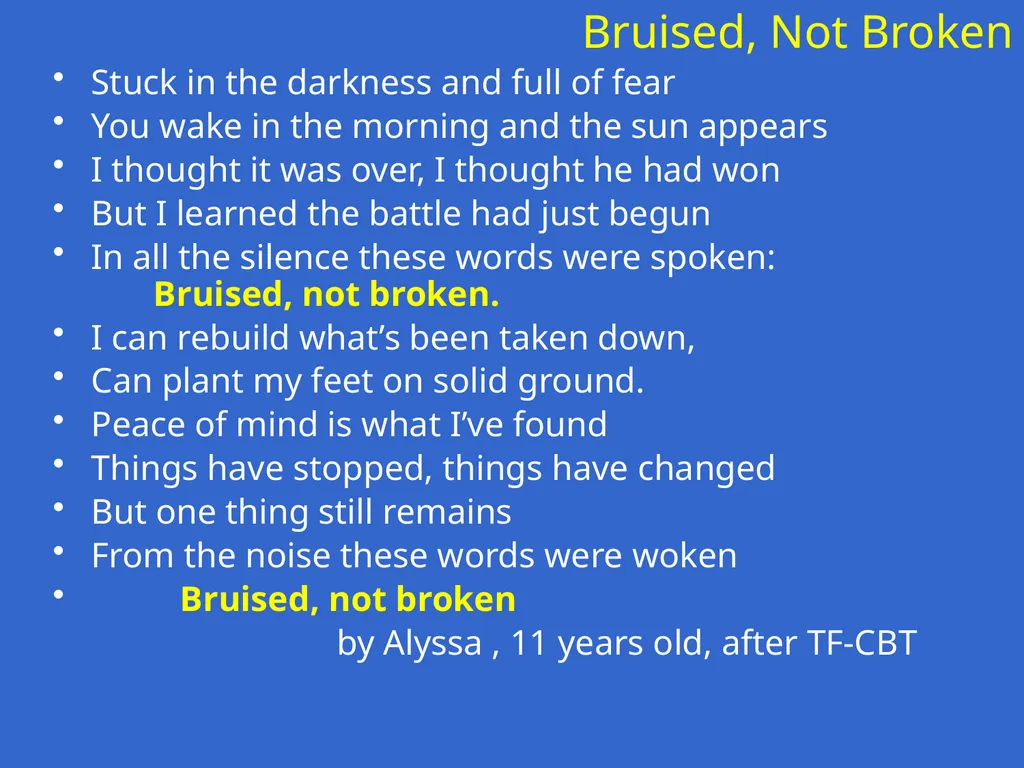
slide160. Bruised, Not Broken Stuck in the darkness and full of fear
You wake in the morning and the sun appears
I thought it was over, I thought he had won
But I learned the battle had just begun
In all the silence these words were spoken: Bruised, not broken.
I can rebuild what’s been taken down,
Can plant my feet on solid ground.
Peace of mind is what I’ve found
Things have stopped, things have changed
But one thing still remains
From the noise these words were woken
Bruised, not broken
by Alyssa , 11 years old, after TF-CBT<br>
slide161. What about the parent?<br>
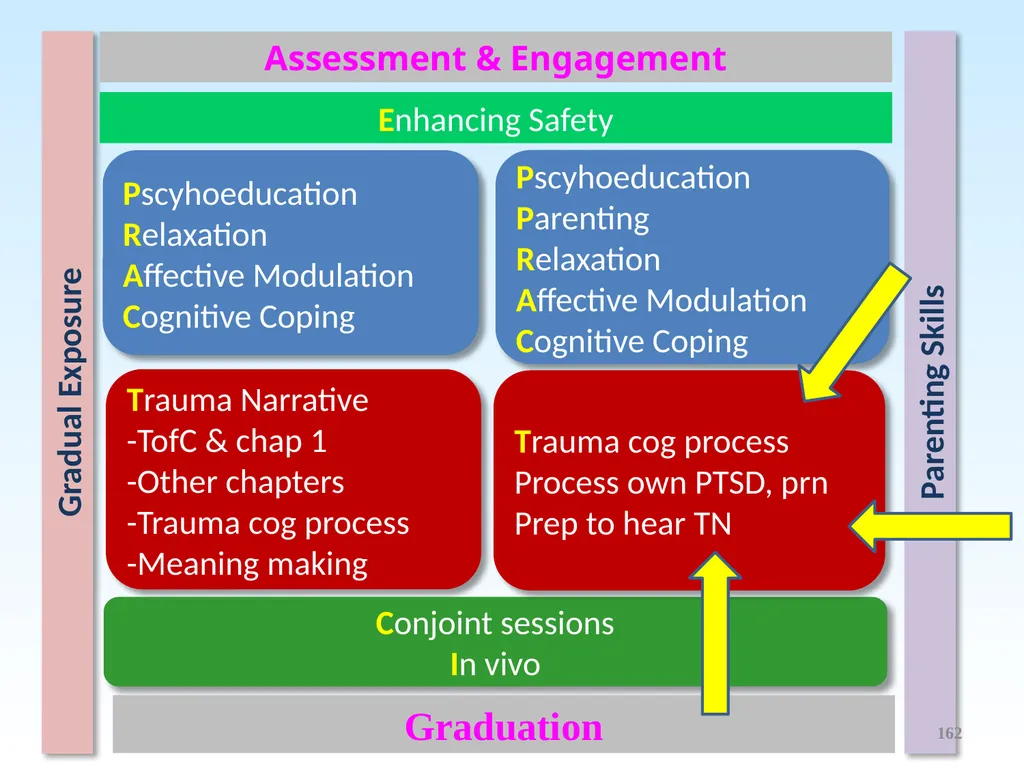
slide162. Pscyhoeducation
Relaxation
Affective Modulation
Cognitive Coping Trauma Narrative
-TofC & chap 1
-Other chapters
-Trauma cog process
-Meaning making Conjoint sessions
In vivo Parenting Skills Gradual Exposure Assessment & Engagement Graduation Enhancing Safety Pscyhoeducation
Parenting
Relaxation
Affective Modulation
Cognitive Coping Trauma cog process
Process own PTSD, prn
Prep to hear TN 162<br>
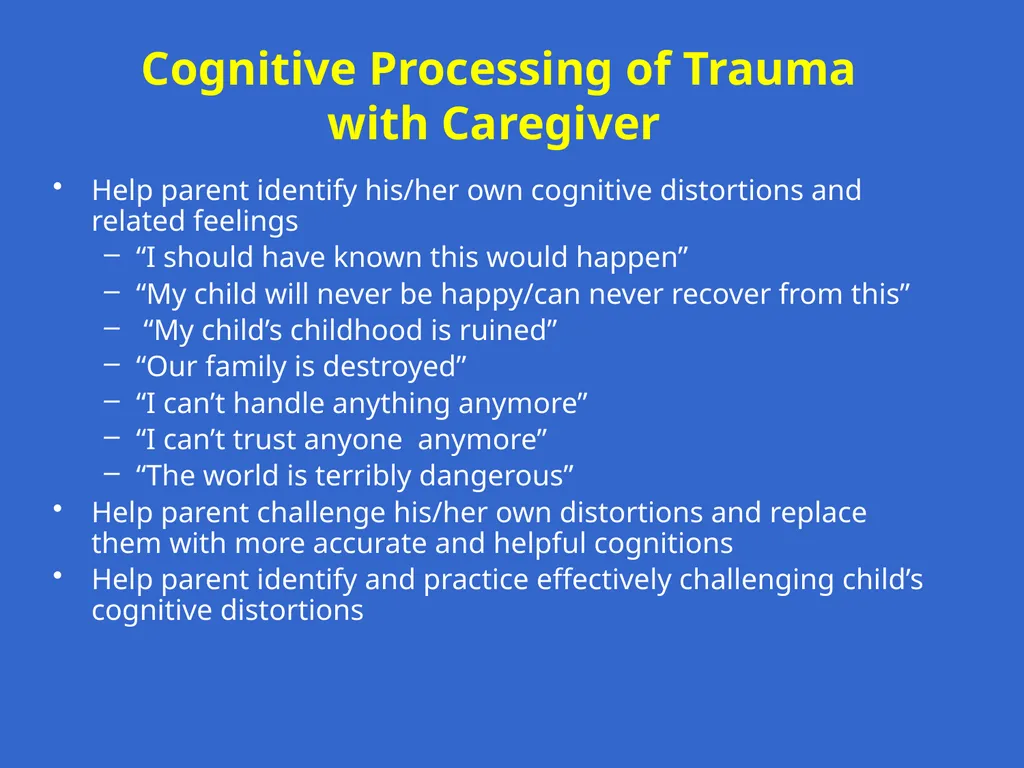
slide163. Cognitive Processing of Trauma with Caregiver Help parent identify his/her own cognitive distortions and related feelings
“I should have known this would happen”
“My child will never be happy/can never recover from this”
“My child’s childhood is ruined”
“Our family is destroyed”
“I can’t handle anything anymore”
“I can’t trust anyone anymore”
“The world is terribly dangerous”
Help parent challenge his/her own distortions and replace them with more accurate and helpful cognitions
Help parent identify and practice effectively challenging child’s cognitive distortions<br>
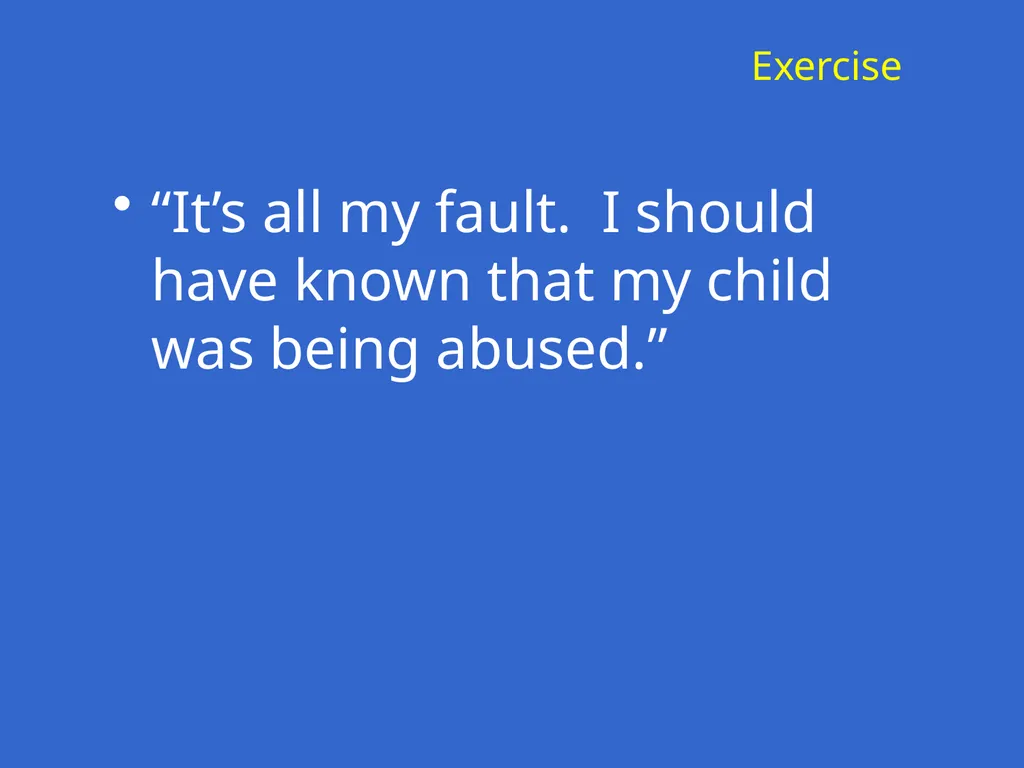
slide164. Exercise “It’s all my fault. I should have known that my child was being abused.”<br>
slide165. Parental PTSD Individual tx is good up to a point
You can work with the parent to reduce their symptoms enough to support their kiddo more effectively
However, if the parent tx is taking too much of the focus away from the kid…
Then you need a referral,
or a separate session time for parent<br>
slide166. Prepping Parent to hear TN Assess if parent is appropriate to hear the TN
Sharing TN may not be appropriate, especially in complex trauma cases when trust is a major theme
WHEN NOT TO HAVE JOINT SESSIONS:
Parent unable to provide appropriate support
Parent continues to be overly emotional in response to child’s traumatic experience
Child adamantly opposed (evaluate how realistic objections are)<br>
slide167. Prepping parent (continued) Parent may not know details of what happened
- Avoidance
- Legal issues
Explore what parent knows about the traumatic event<br>
slide168. Prepping the Parent Predictability is key, so err on the side of over preparation
Share the original copy of the TN with the parent
Role plays, pictures of kid to help with habituation process
Don’t forget to review the child’s questions of the parent<br>
slide169. Prepping the Parent Discuss what messages are important for the child to hear during this process
If necessary, have the parent write a script to read after each chapter<br>
slide170. P R A C T I C E<br>
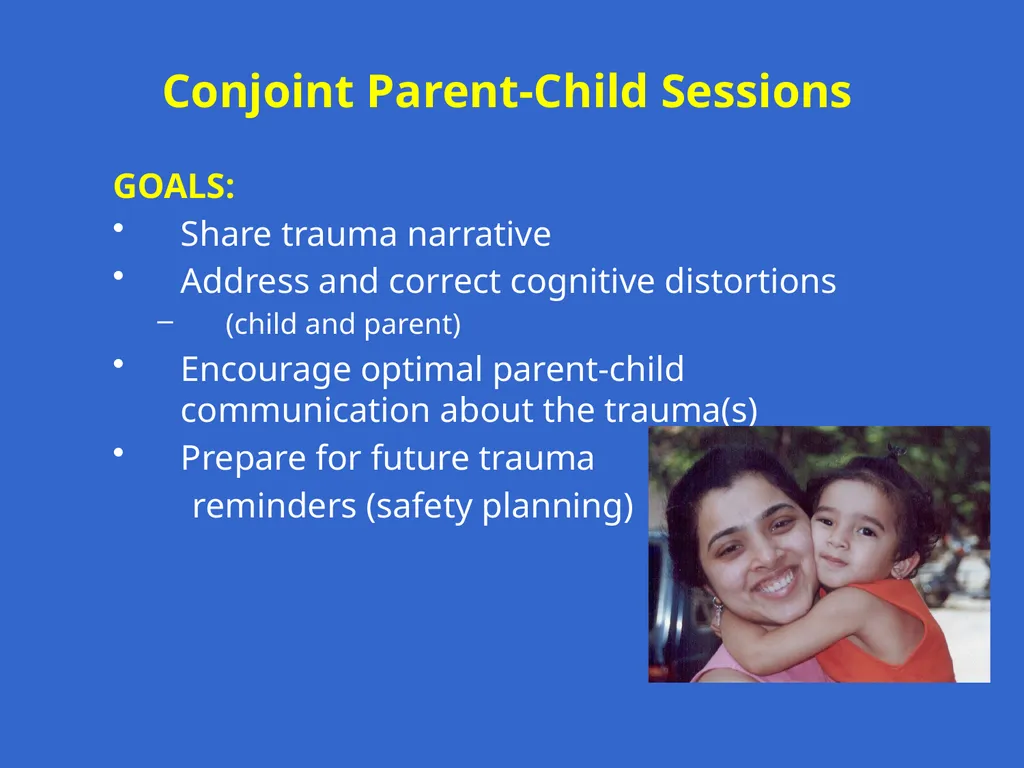
slide171. Conjoint Parent-Child Sessions GOALS:
Share trauma narrative
Address and correct cognitive distortions
(child and parent)
Encourage optimal parent-child communication about the trauma(s)
Prepare for future trauma
reminders (safety planning)<br>
slide172. Conjoint Parent-Child Sessions (cont’d) FORMAT OF SESSIONS:
Meet individually with parent and child prior to joint part of session
Meet together after child and parent prepared for session
Child reads TN, Parent responds as rehearsed<br>
slide173. Conjoint Session What about when parents go rogue??
Become emotional
Rude to or argumentative with the child
Say they don’t believe the child
Start to ask a bunch of inappropriate questions<br>
slide174. Conjoint Parent-Child Sessions (cont’d) Other Options:
Share PART of the TN
Have joint session with parent and child but do not include review of child’s TN
Instead focus on general communication, conflict resolution, praising each for what they have done successfully and for persisting with therapy<br>
slide175. Vignette #1 You have been providing home-based services to 10 year-old Susanna for the past few months. You have worked with mom and grandma to prepare for the sharing of the TN and feel confident that they are ready. When you get to their home on the day that the sharing is supposed to take place, Susanna’s uncle, aunt, and adult cousin are also present and mom tells you that they also want to be part of the session.
How would you proceed?<br>
slide176. Vignette #2 You are a school-based clinician, who has been using TF-CBT with Steve who was abused by his step-father. Steve’s guidance counselor has been a resource for you and Steve’s family. You have tried to include his grandmother (with whom he lives) in the sessions but it is really difficult for her to get to the school because of health issues and multiple doctors’ appointments.
What adaptations to the conjoint sessions could you make?<br>
slide177. P R A C T I C E<br>
slide178. In Vivo Mastery of Trauma Reminders Mastery of trauma reminders is critical for resuming normal developmental trajectory
Hierarchical exposure to innocuous reminders which have been paired with the traumatic experience
To be used only if the feared reminder is innocuous (not if it’s still dangerous)
Resolve generalized avoidant behaviors
Gradually help the child to get used to the
feared situation<br>
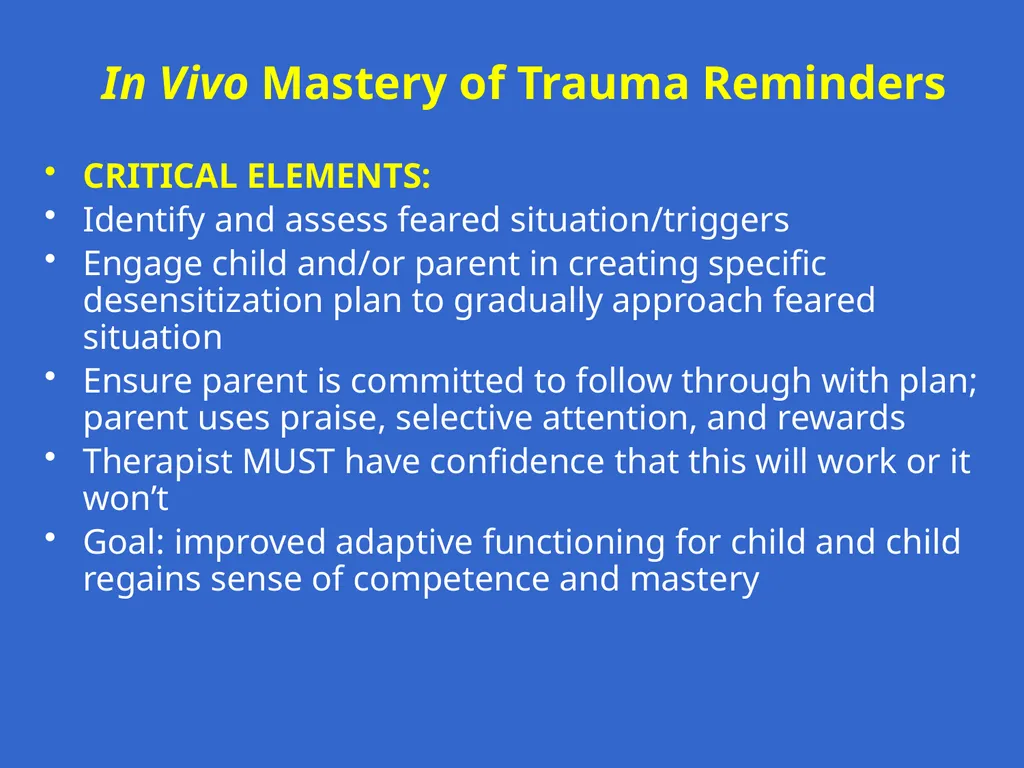
slide179. In Vivo Mastery of Trauma Reminders CRITICAL ELEMENTS:
Identify and assess feared situation/triggers
Engage child and/or parent in creating specific desensitization plan to gradually approach feared situation
Ensure parent is committed to follow through with plan; parent uses praise, selective attention, and rewards
Therapist MUST have confidence that this will work or it won’t
Goal: improved adaptive functioning for child and child regains sense of competence and mastery<br>
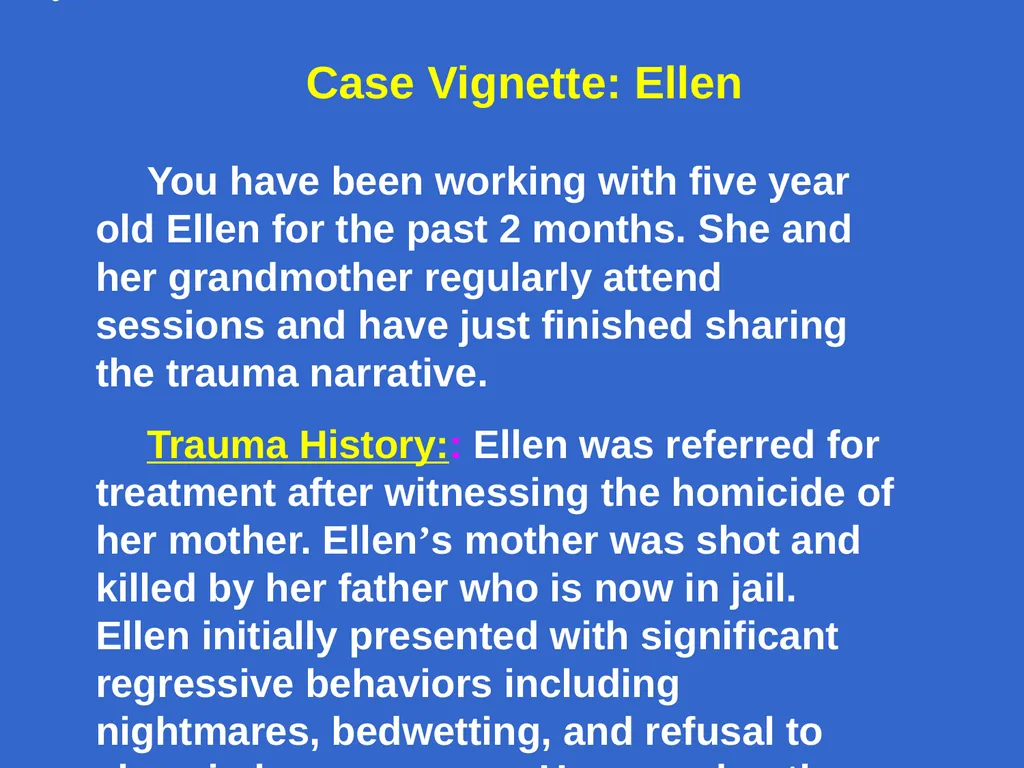
slide180. Case Vignette: Ellen
You have been working with five year old Ellen for the past 2 months. She and her grandmother regularly attend sessions and have just finished sharing the trauma narrative.
Trauma History:: Ellen was referred for treatment after witnessing the homicide of her mother. Ellen’s mother was shot and killed by her father who is now in jail. Ellen initially presented with significant regressive behaviors including nightmares, bedwetting, and refusal to sleep in her own room. Her grandmother has been supportive and they have made a great deal of progress in therapy. However, Ellen still refuses to sleep in her room and usually sleeps on the floor in her grandmother’s room (sometimes she sneaks into grandma’s bed after grandma has fallen asleep).
Develop an in vivo plan to address these problems. Case Vignette: Ellen<br>
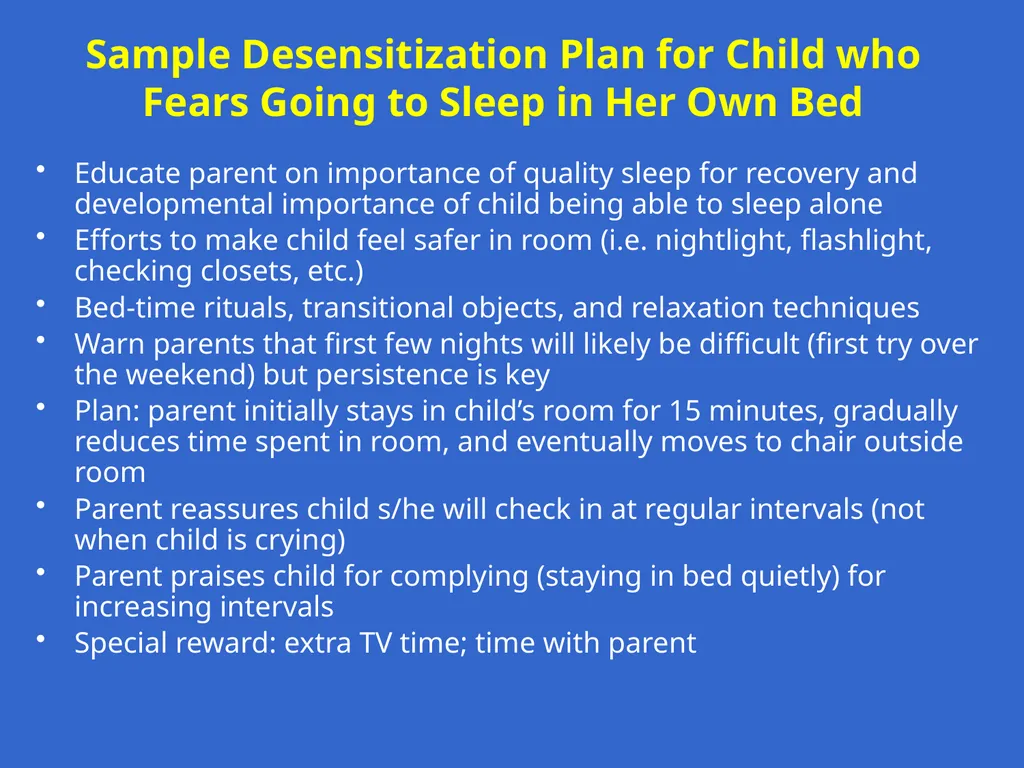
slide181. Sample Desensitization Plan for Child who Fears Going to Sleep in Her Own Bed Educate parent on importance of quality sleep for recovery and developmental importance of child being able to sleep alone
Efforts to make child feel safer in room (i.e. nightlight, flashlight, checking closets, etc.)
Bed-time rituals, transitional objects, and relaxation techniques
Warn parents that first few nights will likely be difficult (first try over the weekend) but persistence is key
Plan: parent initially stays in child’s room for 15 minutes, gradually reduces time spent in room, and eventually moves to chair outside room
Parent reassures child s/he will check in at regular intervals (not when child is crying)
Parent praises child for complying (staying in bed quietly) for increasing intervals
Special reward: extra TV time; time with parent<br>
slide182. P R A C T I C E<br>
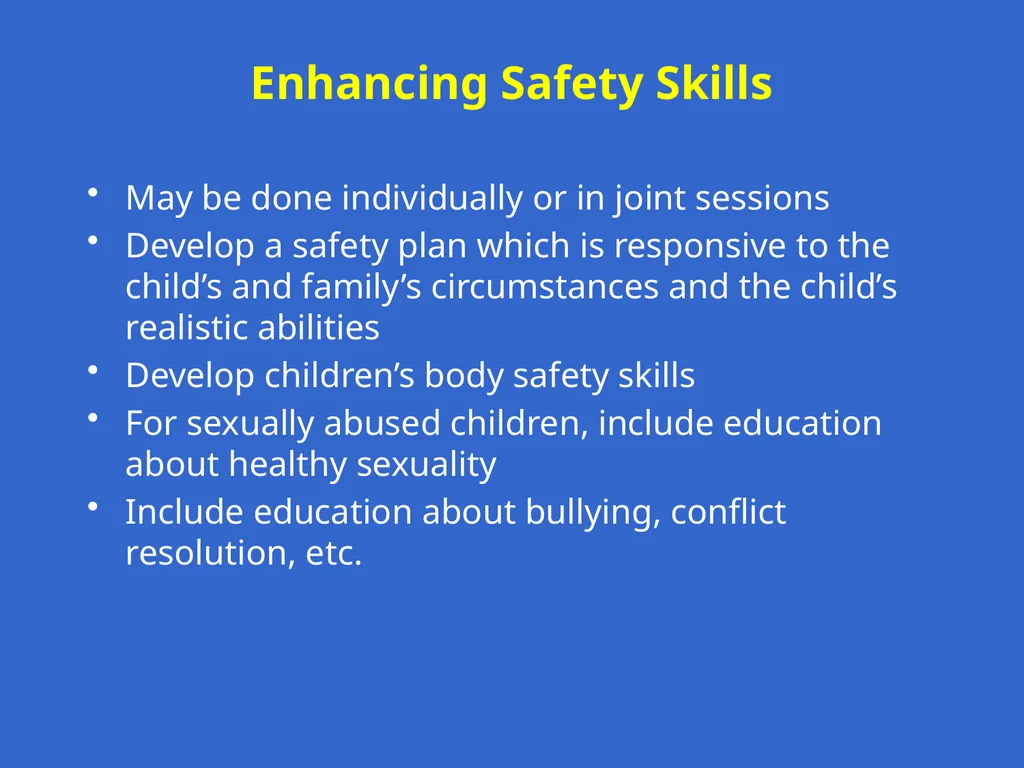
slide183. Enhancing Safety Skills May be done individually or in joint sessions
Develop a safety plan which is responsive to the child’s and family’s circumstances and the child’s realistic abilities
Develop children’s body safety skills
For sexually abused children, include education about healthy sexuality
Include education about bullying, conflict resolution, etc.<br>
slide184. Demonstration of Safety Skills Establishing a “personal safety space”
Saying “no” to invasions of personal space
Leave, escape, report (“NO, GO, TELL”)
Assuming an assertive stance<br>
slide185. Don’t Forget your post-test!<br>
slide186. GRADUATION!! Review skills
Review progress
Review safety planning<br>
slide187. Secondary Traumatic Stress This is hard work
It’s like going into a smoker’s lounge
If you’re vulnerable to STS, that’s good! You deserve to be in the field!
Assess yourself
Professional Quality of Life Scale (ProQOL)
https://www.proqol.org/uploads/ProQOL_5_English.pdf
https://www.proqol.org/uploads/ProQOL_5_English_Self-Score_3-2012.pdf<br>
slide188. Protective factors Supervisory relationship
Evidence-based practices
BEING TRAINED IN TF-CBT DECREASES BURNOUT!
Self Care<br>
slide189. Secondary Traumatic Stress Take care of yourself and your colleagues
“Sliming”
Ask for consultation
Positive self talk – motivational, meaningful
Humor
Preemptively ask others to keep an eye on you for the first few months
Have a life outside of work
PRACTICE what you preach
Get help if you need it<br>
slide190. Consultation Call Requirements See Handouts # 16 for all the details Sign up here: https://www.signupgenius.com/go/9040b4aaea828a3f58-tfcbt10
Attendance requirement:
9 out of 12 offered calls
Presentation requirement:
At least one
Strongly encourage 2 presentations!<br>
slide191. Next steps Complete a program evaluation
http://www.tfcbtconsulting.com/
“Materials” tab
Password: TFinfo!
This is how you get your completion certificate
Sign up for Calls
https://www.signupgenius.com/go/9040B4AAEA828A3F58-tfcbt10<br>
slide192. Maya Angelou: “The world is changed one child at a time”
Thank you for all you do for traumatized children!<br>
slide193. Recent Citations:
Allen B., Riden E., Shenk C.E. (2020) Trauma-Focused Cognitive Behavioral Therapy (TF-CBT). In: Friedberg R., Nakamura B. (eds) Cognitive Behavioral Therapy in Youth: Tradition and Innovation. Neuromethods, vol 156. Humana, New York, NY. https://doi.org/10.1007/978-1-0716-0700-8_5
Deblinger, E., Pollio, E., Cooper, B., & Steer, R. A. (2020). Disseminating Trauma-Focused Cognitive Behavioral Therapy with a systematic self-care approach to addressing Secondary Traumatic Stress: PRACTICE what you preach. Community Mental Health Journal, 1-13. https://doi.org/10.1007/s10597-020-00602-x
Deblinger, E., Pollio, E., Runyon, M. K., & Steer, R. A. (2017). Improvements in personal resiliency among youth who have completed Trauma-Focused Cognitive Behavioral Therapy: A preliminary examination. Child Abuse & Neglect, 65, 132-139.
Diehle, J., Opmeer, B.C., Boer, F., Mannarino, A.P. & Lindauer, R.J. (2015). Trauma-focused cognitive behavioral therapy or eye movement desensitization and reprocessing: what works in children with posttraumatic stress symptoms? A randomized controlled trial. European Child & Adolescent Psychiatry, 24, 227-236.
Dorsey, S., Pullman, M.D., Berliner, L., Koschmann, E., McKay, M., & Deblinger, E. (2014). Engaging foster parents in treatment: A randomized trial of supplementing Trauma-focused Cognitive Behavioral Therapy with evidence-based engagement strategies. Child Abuse & Neglect, 38, 1508-1520.<br>
slide194. Jensen, T.K., Holt, T., Ormhaug, S.M., Egeland, K., Granly, L., Hoaas, L.C., Hukkelberg, S.S., Indregard, T., & Stormyern, S.D. (2014). A randomized effectiveness study comparing trauma-focused cognitive behavioral therapy with therapy as usual for youth. Journal of Clinical Child & Adolescent Psychology, 43, 356-369.
Kliethermes, M. D., Drewry, K., & Wamser-Nanney, R. (2017). Trauma-focused cognitive behavioral therapy. In M. A. Landolt, M. Cloitre, & U. Schnyder (Eds.), Evidence-based treatments for trauma related disorders in children and adolescents (pp. 167–186). Springer International Publishing/Springer Nature. https://doi.org/10.1007/978-3-319-46138-0_8
Lindebø Knutsen, M., Sachser, C., Holt, T., Goldbeck, L., & Jensen, T. K. (2020). Trajectories and possible predictors of treatment outcome for youth receiving trauma-focused cognitive behavioral therapy. Psychological Trauma: Theory, Research, Practice, and Policy, 12(4), 336–346.
McMullen, J., O’Callaghan, P., Shannon, C., Black, A. & Eakin, J. (2013). Group
trauma-focused cognitive behavioral therapy with former child soldiers and other war-affected boys in the DR Congo: A randomised controlled trial. Journal of Child Psychology and Psychiatry, 54, 1231-1241.
Metzger, I. W., Anderson, R. E., Are, F., & Ritchwood, T. (2020). Healing interpersonal and racial trauma: Integrating racial socialization into trauma-focused cognitive behavioral therapy for African American youth. Child Maltreatment. DOI: 10.1177/1077559520921457<br>
slide195. Murray, L.A., Skavenski, S., Kane, J., Mayeya, J., Dorsey, S., Cohen, J.A., et al. (2015). Effectiveness of trauma-focused cognitive behavioral therapy among
trauma-affected children in Lusaka, Zambia: A randomized clinical trial. JAMA
Pediatrics, 169, 761-769
O’Callaghan, P., McMullen, J., Shannon, C., Rafferty, H. & Black, A. (2013). A randomized controlled trial of trauma-focused cognitive behavioral therapy for sexually exploited, war affected Congolese girls. Journal of the American Academy of Child & Adolescent Psychiatry, 52, 359-369.
Stewart, R. W., Orengo-Aguayo, R., Young, J., Wallace, M. M., Cohen, J. A., Mannarino, A. P., & de Arellano, M. A. (2020). Feasibility and effectiveness of a telehealth service delivery model for treating childhood posttraumatic stress: A community-based, open pilot trial of trauma-focused cognitive–behavioral therapy. Journal of Psychotherapy Integration, 30(2), 274-289.<br>
Adapted from:
Anthony P. Mannarino, Ph.D.
Judith A. Cohen, M.D.
Center for Traumatic Stress in Children and Adolescents
Allegheny General Hospital
Drexel University College of Medicine<br>
slide2. Contact Information Alicia Meyer, Ph.D.
301-351-7257 (Cell)
TFCBT@AliciasPlace.org (logistics)
Alicia@AliciasPlace.org (clinical)
www.tfcbtconsulting.com
Materials
Password: TFinfo!<br>
slide3. Trainer Alicia Meyer, Ph.D.
Child Psychologist
CACs
Alicia’s Place
Started the TF Trainer role in 2015<br>
slide4. Types of Childhood Trauma Sexual abuse or assault
Physical abuse
Witness to DV
Community violence
Racial trauma
Victim or witness of school violence
Bullying
Suicide
Motor vehicle or other travel accidents Weather-related events
Terrorism
Mass disasters
Kidnapping
Fires
Medical (Cancer, burns, transplant)
Vicarious trauma
Immigration
CSEC
Traumatic Grief<br>
slide5. Stats About 70% of adults have experienced some sort of trauma in their lives
Up to 5-8% lifetime PTSD prevalence for adolescents (similar for adults)
8-11% of women; 4-5% of men have PTSD
About 8% of Americans have PTSD in any given year<br>
slide6. Prevalence of Child Abuse : Retrospective Reports Neglect
Difficult to determine, but > physical or sexual
Physical abuse
11% of adults report Childhood Physical Abuse
Sexual Abuse
Girls 1 in 3-4
Boys 1 in 5-6
Estimates in Mental Health Population
75- 90%<br>
slide7. Trauma Impact Acute distress almost universal
Impact can be long lasting
Childhood trauma is risk factor for numerous adult psychiatric and medical problems
ACEs study – Take survey (Appendix #1)
Score of 4 or more is serious business
Lung disease increase by 390%
Hepatitis increase by 240%
Depression increase by 460%
Suicide increase by 1,220%<br>
slide8. Adverse Child Experiences (ACEs) ACEs overlap significantly with childhood trauma
In addition to DSM 5-defined traumas, ACEs include:
- Neglect
- Caregiver drug and/or alcohol abuse
- Parental criminal bx/jail (possible traumatic separation)
- Divorce
- Parental psychiatric problems
- Psychological abuse
****** TF-CBT is for Big T traumas ******<br>
slide9. Affective Trauma Symptoms Fear
Sadness
Anger
Anxiety
Affective dysregulation<br>
slide10. Cognitive Trauma Symptoms Irrational or erroneous beliefs (e.g., “The abuse was my fault.” “I should have stopped him from drinking.”)
Reduced trust
Negative self-Image (e.g., “I am bad.” “I am damaged.”)
Potentially accurate, but unhelpful, cognitions (e.g., “Most men are dangerous.” “There will probably be another terrorist attack today.”)<br>
slide11. Behavioral Trauma Symptoms Maladaptive behaviors
Sexualized behaviors
Violent behaviors
Bullying
Traumatic bonding
Angry outbursts/temper tantrums
Substance abuse
Self-injury<br>
slide12. Behavioral Trauma Symptoms (cont) AVOIDANCE
Immediate relief convinces us that we couldn’t have coped without avoidance
When we avoid, we teach our brain that avoidance is how we have to deal with difficult situations in order to feel better.
Over time, your brain is going to “sound the anxiety alarm” even louder to try to get you to avoid, leaving you feeling even worse in the long-run<br>
slide13. Trauma and the brain For people with PTSD, the amygdala reacts too strongly to potential threat… while the medial PFC is impaired in its ability to regulate the threat response
Amygdala (revs up brain & body; activates PFC if threat cont.)
Detects threats in the enviro and activates “fight or flight”
Helps you store new emotional or threat-related memories
Prefrontal Cortex (evaluates threat incr or decr response)
Regulate attention and awareness
Decision making
Initiates conscious, voluntary behavior
Determine the meaning and emotional significance of events
Regulate emotions
Inhibit or correct dysfunctional reactions<br>
slide14. Consequences of Brain Dysfunction Hyperarousal
Because the amygdala is overactive, more norepinephrine is released in response to threat and its release is not well-regulated by the PFC
Results in hypervigilance
Increased wakefulness & sleep disruption
Get emotionally triggered
Keyed up/on edge
Reactive Anger & Impulsivity
A reactive amygdala keeps people with PTSD on the alert and ready for quick action when they face a threat, leading them to be more impulsivity
With a less activated PFC, people with PTSD have less control over reactive anger and impulsive behaviors when they are emotionally triggered This Photo by Unknown Author is licensed under CC BY-NC-ND This Photo by Unknown Author is licensed under CC BY-SA-NC<br>
slide15. Consequences of Brain Dysfunction Increased fear and anger & Decreased positive emotions
Hyperactive amygdala communicates with the insula, an area of the brain associated with introspection and emotional awareness
This amygdala-insula circuit suppresses the PFC, thereby interfering with the ability to regulate negative emotions and assign more positive meaning to events This Photo by Unknown Author is licensed under CC BY-NC-ND This Photo by Unknown Author is licensed under CC BY<br>
slide16. Brain Dysfunction and Trauma Treatment Exposure therapy
Enhances the ability of the PFC to assign less threatening/more positive meaning to trauma events
(Antidepressants have a similar effect, too)
Mindfulness
Decreases amygdala volume
Increases the connectivity between the amygdala and PFC
Relaxation
Shuts down the release of stress chemicals<br>
slide17. Common Diagnoses PTSD
What are the symptoms?
DSM-V criteria: See handout #2
Criteria for children age six and under
See handout #3<br>
slide18. Common Diagnoses Depressive disorders
Other anxiety disorders
Comorbidity is common
ADHD
Oppositional Defiant Disorder
Substance Use Disorder
Bipolar Disorder
Psychotic disorders- up to 20% of traumatized children have psychotic symptoms<br>
slide19. Chronic Trauma Exposure (Complex Trauma) CPTSD (Per ICD-11) includes PTSD plus three additional clusters that reflect ‘disturbances in self-organization’ (DSO):
(1) affective dysregulation (AD), Heightened emotional reactivity, violent outbursts, impulsive or reckless behaviors and dissociation
(2) negative self-concept (NSC), marked by feeling diminished, defeated and worthless, feelings of shame, guilt, or despair
(3) disturbances in relationships (DR). marked by difficulties in feeling close to others, having little interest in relationships or social engagement more generally. There may be occasional relationships but the person has difficulty sustaining them<br>
slide20. Complex PTSD continued These disturbances are proposed to be typically associated with sustained, repeated, or multiple forms of traumatic exposure (e.g. genocide campaigns, childhood sexual abuse, child soldiering, severe domestic violence, torture, or slavery), reflecting loss of emotional, psychological, and social resources under conditions of prolonged adversity
For more on Complex Trauma, see handout #4
https://www.ncbi.nlm.nih.gov/pmc/articles/PMC5774423/<br>
slide21. Trauma Assessment POLL
Assessment is frequently viewed as not important
BUT:
How will you know whether a child needs trauma treatment?
Has there been trauma exposure?
Are there any trauma symptoms?
What type of trauma treatment is most appropriate?<br>
slide22. Trauma Assessment (cont’d) Clinical interview with child and caretakers
Handouts #2 and #3 as guides
Get trauma history, like with a trauma history Questionnaire (THQ)
Structured instruments (sample): See Handout #5
Child PTSD Symptom Scale
UCLA PTSD Reaction Index (RI)- child, adolescent, and parent versions
Trauma Symptom Checklist for Children
“Test narrative” or “baseline narrative”<br>
slide23. Trauma Assessment (cont’d) Is a full PTSD diagnosis necessary? No
Symptoms + functional impairment
There will likely be other diagnoses in addition
to PTSD
New DSM 5 criteria for children age six and under<br>
slide24. Pathway to Trauma Treatment What is the clinical presentation?
- Presence of trauma symptoms
What is the connection between the trauma exposure and current symptoms?
What is “driving the train”?
Start with different treatment and sequence to TF-CBT?
Therapist needs to be convinced of the need for trauma treatment if the family is going to get on board<br>
slide25. Getting “Buy-in” for TF-CBT Review trauma assessment
- Connection between exposure and current clinical
symptoms
Explain what TF-CBT is: for trauma symptoms and
trauma-related behavioral problems
Obtain consent from caregiver and child (if youth is
old enough to provide consent)
If you don’t get “buy-in”, DO NOT go forward with
TF-CBT
- Will need to do different trauma treatment or treat
a different set of problems<br>
slide26. What Are Evidence Based Treatments for Traumatized Children? What They Are Not:
Rigid
Lockstep
Inflexible…<br>
slide27. Closest thing to a TF-CBT manual that you’re going to get<br>
slide28. What is TF-CBT? A hybrid treatment model that integrates:
Trauma sensitive interventions
Cognitive-behavioral principles
Attachment theory
Developmental Neurobiology
Family Therapy
Empowerment Therapy
Humanistic Therapy<br>
slide29. For Whom IS TF-CBT Appropriate? Children with known trauma history
Single or multiple, any type
Children with prominent trauma symptoms (PTSD, depression, anxiety, with or w/o behavioral problems)
Children with severe behavior problems may need additional or alternative interventions
Parental/caretaker involvement is optimal
- However, PTSD improves even in the absence of caretaker involvement<br>
slide30. For Whom is TF-CBT Appropriate (cont’d) Treatment settings: clinic, school, residential, home, inpatient
TF-CBT is appropriate for the following groups:
- Children in foster care
- Children with exposure to chronic trauma
- Children with PTSD or other trauma symptoms
- Children ages 3-18 (a few studies say college age, too)
- Children on the spectrum who function at higher level
- Children of different cultural groups including Latino,
African-American, and Native-American<br>
slide31. Schools
Children in Foster Care
Residential Treatment
Play Applications
Children with Developmental Disabilities
Adolescents with Complex Trauma
Children in Military Families
International Settings
Children of Latino Descent (CM-TF-CBT)
American Indian and Alaska Native Children: Honoring Children – Mending the Circle<br>
slide32. Implementation Manuals TF-CBT workbook for teens
TF-CBT workbook for children
LGBTQ Implementation manual
IDD Guide / IDD Supplemental Resource Guide
Racial Socialization (Focused on Black/AA families)
Workbook for Traumatic Grief
TF-CBT for Youth with Parental Substance Abuse (2025)<br>
slide33. Major Barriers to Trauma Treatment Fear of retraumatizing the child
“Clear encouragement” to discuss trauma is not the same as forcing children to discuss trauma!
Vicarious traumatization
“Our clients are different”<br>
slide34. Laura Murray’s Project in Cambodia Sex trafficked girls (with extensive trauma histories)
Initial response from local counselors: “Our population is different so TF-CBT won’t work”; “These girls aren’t ready to tell their stories”.
Post TF training comment from counselor: “I have worked with this client for two years already and never had a story like this. I did not know her real story. I think TF-CBT has helped me so much”.<br>
slide35. TF-CBT Treatment Research: Randomized Clinical Trials Over 25 RCTs
9 RCTs have been completed by the Cohen, Deblinger, and Mannarino team
Several international studies
https://tfcbt.org/category/research-public/<br>
slide36. Why TF-CBT Highest rating In the 0111: Guidelines Report
Highest rating by the California Evidence-Based Clearinghouse for Child Welfare
Named a "Best Practice" for cases of child abuse in the Kauffman Best Practices Report
Strong clinical anecdotal reports of effectiveness
Study in Tanzania – 100% of kids who completed TF said they would recommend TF to other kids
Impact generalizes to a wide variety of problems
Teaches basic skills necessary in many ESTs.<br>
slide37. Identified as Best Practices for Child Abuse Treatments (2011) Trauma-Focused Cognitive Behavioral Therapy
Judith Cohen, Esther Deblinger, and Tony Mannarino
Alternatives for Families: A Cognitive Behavioral Therapy (AF-CBT)
David Kolko, Elissa Brown, Meghan Shaver, Amy Hershell, and Barbara Baumann
Parent Child Interaction Therapy (PC IT)
Sheila Eyberg; Mark Chaffin; Anthony Urquiza<br>
slide38. Treatment Research Studies have been conducted with children exposed to sexual abuse, DV, traumatic losses, and multiple traumas
Improved PTSD, dep, anxiety, shame, and Bx problems compared to client-centered or nondirective therapy
PTSD improved more with direct child treatment
All Research comes with limitations
For PARENTS: Improved parental distress, parental PTSD, parental support, and parental depression compared to client-centered or nondirective treatment<br>
slide39. Contraindications for TF-CBT Dangerous behaviors
(e.g, suicidality; severe aggression)
No trauma event
Something else is driving the train
Special considerations
Unsafe environment
(e.g, trauma is ongoing)
Unstable placement (e.g. foster care)<br>
slide40. TF-CBT Dissemination TF-CBTWeb (https://tfcbt2.musc.edu/)
- 400,000 + learners have registered for course
- ~170,000 learners for TFweb 2.0 (opened in 2018)
~2,500 per month
There is a Spanish language version, too!
Updated CTGweb launching 2025.
6 CEs
$25<br>
slide41. TF-CBT Therapist Certification Program Certification program was launched in
September, 2013
Website: https://tfcbt.org/tf-cbt-certification-criteria/
Or see handout #18 on our website (Materials section)
Recertification is every 5 years
@ 5 years: 3 hours of advanced TF videos
@ 10 years: sign an agreement<br>
slide42. Difficulties Addressed by TF-CBT CRAFTS
Cognitive Problems
Relationship Problems
Affective Problems
Family Problems
Traumatic Behavior Problems
Somatic Problems<br>
slide43. Core Values of TF-CBT CRAFTS
Components-based
Respectful of cultural values
Adaptable and flexible
Family focused
Therapeutic relationship is central
Self-efficacy is emphasized<br>
slide44. Child and Parent Components Individual sessions for both child and parent
Parent sessions - generally parallel child sessions
Same therapist for both child and parent
Child and parent receive about the same amount of time at each session
Treatment length: 8-25 sessions
Manualized as 90 minute sessions but can be adapted<br>
slide45. TF-CBT Components PRACTICE
Psychoeducation and Parenting Skills
Relaxation
Affective Modulation
Cognitive Processing
Trauma Narrative
In Vivo Desensitization
Conjoint parent-child sessions
Enhancing safety and social skills<br>
slide46. Safety Starting with safety is often clinically appropriate with most youth and their families
Although all else being equal, there are reasons we save it to the end
Therapist potentially as a trauma reminder
Developing safety plans
Identifying other safe adults in youth’s environment<br>
slide47. Components- and Phase-Based Treatment PRACTICE COMPONENTS: TF-CBT PHASES:
Psychoeducation; Parenting Skills
Relaxation Skills STABILIZATION PHASE
Affective regulation Skills
Cognitive processing Skills
Trauma narration and processing TN PHASE
In vivo mastery of trauma reminders
Conjoint child-parent sessions INTEGRATION PHASE
Enhancing safety<br>
slide48. Pscyhoeducation
Relaxation
Affective Modulation
Cognitive Coping Trauma Narrative
and Processing In vivo
Conjoint sessions
Enhancing safety Trauma Narrative
Phase Integration/ Consolidation
Phase Stabilization
Phase Parenting Skills Gradual Exposure Time: 8-16 sessions 1/3 1/3 1/3 TF-CBT Pacing - Classic 48<br>
slide49. Gradual Exposure GE increases rapport/alliance with kids
Especially for passively disengaged youth
GE is critical to the TF process
Helps to decrease avoidance and prepare children for TN 49<br>
slide50. Pscyhoeducation
Relaxation
Affective Modulation
Cognitive Coping Trauma Narrative
and Processing In vivo
Conjoint Sessions
Enhancing Safety Trauma Narrative
Phase Integration/ Consolidation
Phase Stabilization
Phase Parenting Skills Gradual Exposure Time: 16-25 sessions 1/2 1/4 1/4 TF-CBT Pacing – Complex Trauma 50<br>
slide51. Critical TF-CBT Treatment Themes Order of PRACTICE components?
Incorporating gradual exposure into the skills-based components
Importance of behavioral interventions with parents/caretakers
TF-CBT is a treatment model which emphasizes proportion and balance<br>
slide52. TF-CBT Treatment Themes (cont’d) Flexibility vs. fidelity
Implement TF-CBT based on therapist’s knowledge of child’s skills, talents, and interests
TF-CBT at every treatment session:
Do not let COWs (crises of the week) get you off track
TF-CBT treatment has to be FUN!<br>
slide53. TF-CBT Fidelity All of the TF-CBT components are implemented
TF-CBT components in order of PRACTICE acronym, unless there is clinically appropriate justification
Appropriate proportionality and pacing of components
Completion of TF-CBT within appropriate time frame<br>
slide54. Why is it critical to involve parents in TF-CBT? Most children do not present at mental health settings because of trauma exposure
Children have behavior problems
Parent/caretaker involvement is essential to address behavioral difficulties<br>
slide55. Engaging Families in Treatment Establish common ground/form an alliance
Be flexible about scheduling
Recognize concrete barriers to participating in treatment
Emphasize importance/primacy of parental role
Focus on what parents need and want from therapy
Provide education about psychotherapy (what to expect: it occurs over time, not all at once, etc.)
Address such issues as stigma, cultural concerns, and previous experiences with therapists
Resistance or failure of engagement?<br>
slide56. Engaging Families in Treatment (cont’d) Child’s impression of the therapeutic alliance is a big indicator of future reductions in PTSD symptoms
NO SHAME AND NO BLAME
Praise and reinforce parents/caretakers for bringing child for treatment<br>
slide57. ENGAGEMENT EXERCISE Handout #6<br>
slide58. P R A C T I C E<br>
slide59. Psychoeducation Goals:
Normalize child’s and parent’s reactions to severe stress
Instill hope for child and family recovery
Educate family about the benefits and need for early treatment
PSYCHOEDUCATION GOES ON THROUGHOUT THERAPY!<br>
slide60. Description of TF-CBT
Trauma and PTSD
Provide information about psychological and physiological reactions to stress
Neurological response
Provide information about common emotional and behavioral responses to the specific event(s)
Provide information about the child’s symptoms/diagnosis
Educate family about trauma reminders<br>
slide61. Psychoeducation (Cont’d) Specifics regarding trauma type
Provide general information about the event
Frequency
Who experiences it
What causes it
Sources for psychoeducation:
www.NCTSN.org
www.aacap.org Facts for Families
“What Do You Know” game for SA, PA, DV
Can serve the dual fx of being gradual exposure<br>
slide62. Psychoed video<br>
slide63. Parenting Skills TF-CBT views parents as critical therapeutic agent for change
Explain the rationale for parent inclusion in treatment
Not because parent is part of the problem but because parent can be the child’s strongest source of healing
Emphasize positive parenting skills and enhancing enjoyable child-parent interactions
Clinical data that TF-CBT enhances the quality of the parent-child relationship
TF increases resiliency and connectedness to parent (2016 Deblinger)<br>
slide64. Treatment of Parents Research Evidence that treating parent is important:
Deblinger et al. (1996): Treating parents resulted in decreased behavioral and depressive symptoms in child
Cohen and Mannarino (1996): Parents’ emotional reaction to trauma was the strongest predictor of treatment outcome (other than treatment type)
Cohen and Mannarino (1997): At the 12 month follow-up, parental support was significantly related to decreased symptoms in child<br>
slide65. Complicated Caregiver Situations When the caregiver is unsupportive or does not believe that the child was exposed to a trauma
When the caregiver is the perpetrator (e.g., sexual abuse; physical abuse; domestic violence
- Consider different treatment (e.g. AF-CBT)<br>
slide66. Common Parental Issues in Child Traumatization Inappropriate self-blame and guilt
Inappropriate child blame
Overprotectiveness
Overpermissiveness
PTSD Symptoms<br>
slide67. PARENTING CONCEPTS VIDEO<br>
slide68. Praise and Positive Attention Relationship building phase (several sessions)
Focus on actively praising the child
Praise a specific behavior
Provide praise ASAP after behavior occurs
Do not qualify your praise
Provide praise with same level of intensity as criticism
Don’t forget the power of
global praise, too<br>
slide69. Selective Attention Active ignoring: NO reaction to certain negative behaviors
Defiant or angry verbalizations to parent
Nasty faces, rolling eyes, smirking
Mocking, mimicking
Walk away, busy oneself with an activity
Remain calm, dispassionate<br>
slide70. Cycle of non-compliance https://youtu.be/arbgB6REBmU
Warning: Expect a reaction of more provocative behavior<br>
slide71. Parent Activity #1<br>
slide72. Discipline<br>
slide73. Giving Clear Commands Get child's attention (e.g., make eye contact)
Commands should be specific.
E.g. Put the block in the box
(Not: “Be careful”)
Command should be developmentally appropriate.
E.g., Put the blue car in the box
(Not: put the azure vehicular object in the opaque containment unit)<br>
slide74. Effective Commands (Cont’d) Commands should be positively stated.
Tell kids what to do
Avoid these words: Don’t, stop, quit, no
Commands should be given one at a time.
Lots of commands subject to recency effect
Give commands only if you can follow through.<br>
slide75. Commands If… then…
Gives predictability and controllability
Therapeutic for traumatized children<br>
slide76. Parenting Activity #2<br>
slide77. Time Out For younger kids (Less than 7 years old, per PCIT lit)
Purpose: Interrupt child’s negative behaviors and allow him/her to regain control
Explain to child
Location: quiet, low stimulation
Duration: 3 min + 5 sec quiet
Once in time out, parent should refrain from comments, and maintain calm demeanor. (Active ignoring).
Must follow through with original command
See handout #7 for PCIT International’s statement on timeout with traumatized children<br>
slide78. Moving beyond Time Out Natural consequences
Punishment follows from the misbehavior
Logical consequences
When natural consequences don't exist or are inappropriate
Grounding- “The time fits the crime”
Create table of:
Reward-able behaviors
Ignorable behaviors
Punishable behaviors
Most important goal is commitment and consistency<br>
slide79. Contingency Reinforcement Programs Purpose: Decrease unwanted behaviors and increase desired behaviors
Select only one behavior to target
Explain process to child
Involve child in decisions about rewards
Add stars and give rewards at appropriate intervals.<br>
slide80. Behavior Management Reasonable developmental expectations
Limit-setting
Behavioral interventions for:
Anxieties
Sleep problems
Aggressive behaviors
Sexually inappropriate behaviors<br>
slide81. P R A C T I C E<br>
slide82. Relaxation Reduce physiologic manifestations of stress and PTSD
Reduce distress related to trauma reminders
Can help to lower the body’s alarm reactions
Can be used at anytime so child will probably need more than one skill to use
Can be coupled with other skills like feeling expression or cognitive coping during the trauma narrative component<br>
slide83. Relaxation Reduce physiologic manifestations of stress and PTSD
Respiration increases/Shallow Breath
Pupils enlarge
Heart rate speeds up
Stomach and intestines shut down
Adrenaline is pumped into bloodstream<br>
slide84. Relaxation (cont’d) Develop individualized relaxation strategies for manifestations of stress (headache, stomach ache, dizzy, racing heart, etc.)
Focused breathing/mindfulness/meditation
Progressive muscle relaxation
Physical Activity
Yoga, singing, dance, blowing bubbles
“If it’s not fun, you’re not doing it right”
Relaxation strategies for trauma reminders<br>
slide85. Relaxation: Belly Breathing Provide rationale
Imbalance in O2/C02
Teach 'correct' way to breathe to decrease distress, skills to manage fear and anxiety
Focus on 'belly' rather than chest breathing
Focus on slow rather than rapid breaths
Other options:
Smell the flowers; blow the bubbles
Cookie breaths
Balloon in, balloon out<br>
slide86. Muscle Relaxation Rationale
Flight or fight response
Relaxation Activity
Tense/Relax
Progressive muscle relaxation
Turtle technique
Rag doll/Wet noodle versus Tin soldier
See handout #8 for PMR guide young children
https://www.youtube.com/watch?v=aaTDNYjk-Gw<br>
slide87. Grounding techniques 5 senses
Key chain with sensory stimuli
Mindfulness<br>
slide88. Other Relaxation Techniques Imagery
Exercise
Yoga, Baby yoga
Consider cultural differences (music, prayer)
Not just one technique- "get" the goal
Include their own strategies
Different tools for different jobs and settings
Caregiver involvement may be key<br>
slide89. P R A C T I C E<br>
slide90. Affective Modulation Traumatized children may have inappropriate
(e.g., excessive anger) and/or restricted affect
Activities to help children identify and express a range of
different feelings
- Board games
-Emotional Bingo, Jenga/Totika, T.F.D game
- Feeling brainstorm (1 minute competition)
- Color Your World or person
- Emotions Color Wheel
Importance of feeling identification and expression when there are trauma reminders<br>
slide92. Affective Regulation (cont’d) Positive Self-Talk: focus on strengths
Improving social skills: interpreting other’s affective expressions accurately
Develop a safety plan<br>
slide93. SUDS Subjective Units of Distress Scale
See handouts #10A and #10B
10B next slide<br>
slide95. P R A C T I C E<br>
slide96. GE: Cognitive Coping and Processing This is one exception to GE in PRAC components
- Children are not asked about their trauma-related
cognitions until the trauma narration and processing
component
Why? Dysfunctional thoughts are more likely to be expressed during the narrative than before.
Communicate to child that trauma-related cognitions will be addressed later in treatment<br>
slide97. Cognitive Processing Help children distinguish between thoughts, feelings, and behaviors
Help children and parents understand the cognitive triad: connections between thoughts, feelings and behaviors, as they relate to everyday events
Help children and parents view events in more accurate and helpful ways
Encourage parents to assist children in cognitive processing of upsetting situations, and to use this in their own everyday lives for affective modulation<br>
slide98. COGNITIVE PROCESSING The Cognitive Triangle Behavior Thoughts Feelings the process starts with feelings identification, then children learn that they can change how they act and feel by thinking differently.<br>
slide100. Cognitive Triangle See handout #12
Print out a million copies and use these with the kid
First do neutral events
Build to upsetting but non-trauma events
Ultimately they’ll apply the triangle to trauma thoughts, although this is not a point of focus during PRAC stage
Can also consider using the term “reconsider” your thoughts (vs “change”)<br>
slide101. Example to Illustrate Cognitive Triad You’re in the lunchroom and are walking over to a table where your classmates are sitting. They start laughing
What are some reasons for this? What goes through your head when they start laughing?
How does that make you feel? What do you do?<br>
slide102. Enter lunch room, Kids start laughing They’re laughing at me. Anger Hot, tense, turn red/flushed Storm out, punch someone, etc.<br>
slide103. Enter lunch room, Kids start laughing They must have told a joke Curious Neutral Engage; Ask to hear the joke, too<br>
slide104. Activity to Illustrate Cognitive Triad As a clinician, what is your cognitive distortion about being able to implement TF-CBT effectively?
Create 2 cognitive triangles
Anxiety is the biggest barrier for clinicians implementing TF!<br>
slide105. Cognitive Work with Children- Identifying Thoughts HELPING CHILDREN TO TALK ABOUT THEIR THOUGHTS
Use appropriate child language
Adjust to their developmental level, BE CREATIVE!
What do you think about when you’re ______(insert feeling)?
Are there any thoughts or pictures that go through your mind?
What popped into your head? What did you say to yourself?
What went through your head?
Use a cartoon bubble and fill it in<br>
slide106. Cognitive Processing in Young Children Cognitive triangle will have little utility
Young children can understand the concrete idea of “Who made that happen?”
Give them a mantra
“I can cope with that.”
“This won’t last forever.”
“I am brave.”<br>
slide107. Cognitive coping books for young children:
“The Little Engine That Could”
“Giraffes Can’t Dance”
“Tiger, Tiger is it true?” https://www.youtube.com/watch?v=gPfB4CR6fUU<br>
slide108. Cognitive Processing Video Game TF-CBT TRIANGLE OF LIFE
Currently available on the Google Play Store
Currently available on the Apple Store<br>
slide109. Cognitive Restructuring<br>
slide111. I’ll be so nervous that I’ll mess up. Everyone will know that I’m nervous. They’ll think I don’t know what I’m doing<br>
slide112. Steps to Cognitive Reframing Public Speaking Anxiety Handout #13<br>
slide113. Problematic Thinking Common themes/cognitive distortions (See handout #14)
Emotional reasoning
Should statements
All or nothing thinking
Mind reading
Predicting the future
Trauma-specific {self-blame, dangerous world)
Thought classification
Accurate vs. inaccurate
Helpful vs. unhelpful<br>
slide114. Steps to Cognitive Reframing Public Speaking Anxiety<br>
slide115. Steps to Cognitive Reframing Challenge: scientist, detective, lawyer
What evidence do you have?
What are other possible explanations?
What is the worst thing that can happen?
How bad would that be?
Do you know what Is going to happen in the future?
Can you read someone else's mind?
Does feeling something make it true?<br>
slide116. Steps to Cognitive Reframing Public Speaking Anxiety<br>
slide117. How to Help Change Negative Thoughts Role Play
Reverse roles
What would you say to your best friend/sibling?
What would you say to your child?
Use puppets or dolls
Collect data (from the internet)<br>
slide118. Problem Solving Identify the Problem
Brainstorm possible solutions
Choose a path to try
Monitor the path outcomes
If not successful, return to brainstorming list and try another solution
“What would Daniel do?”
“What would Darla do?”<br>
slide119. Thought Interruption and Positive Imagery Use when overwhelmed with trauma reminders
Temporary measure early in treatment
Teaches child control over their thoughts
Changing the channel
Saying “go away” or “snap out of it”
Imagining a stop sign
Do mental activity
Replace unwanted thought with a positive one
Careful not to play into avoidance<br>
slide120. Another resource:<br>
slide121. P R A C + T I C E<br>
slide122. Other Coping Skills Social Skills
Assertiveness training
Anger Management
Others???
Is there anything else this kid needs in order to be successful with TN?<br>
slide123. P R A C T I C E<br>
slide124. Direct Discussion of Traumatic Events Reasons we avoid this with children
Child discomfort
Parent discomfort
Therapist discomfort
Legal issues
- Keep the narrative out of child’s official record
- What to do with the narrative at the end of treatment
- Therapists should not testify in court, if possible
- It is the child’s narrative, not the therapist<br>
slide125. Direct Discussion of Traumatic Events (cont’d) Reasons to directly discuss traumatic events:
Gain mastery over trauma reminders
Resolve avoidance symptoms
Identify and correct distorted cognitions
Contextualize traumatic experiences into overall life<br>
slide126. Pscyhoeducation
Relaxation
Affective Modulation
Cognitive Coping Trauma Narrative
-TofC & chap 1
-Other chapters
-Trauma cog process
-Meaning making Conjoint sessions, In vivo, Enhancing Safety Parenting Skills Gradual Exposure Assessment & Engagement Graduation Enhancing Safety ?? Pscyhoeducation
Parenting
Relaxation
Affective Modulation
Cognitive Coping Trauma cog process
Process own PTSD, prn
Prep to hear TN 126<br>
slide127. Trauma Narrative RELY ON CHILD’S STRENGTHS AND INTERESTS TO OVERCOME AVOIDANCE
Some methods for creating a trauma narrative:
Chapter book
Cartoon strip
Poem
Talk Show Interview
Song
Drawings
Play narrative<br>
slide128. Creating the Trauma Narrative First chapter : innocuous information about the child (name, age, school, hobbies, etc.)
Chapter 1 needs to come first
Child can choose what order he/she wants to do the rest of the middle chapters in
Therapist should get the child used to the questioning/prompting process<br>
slide129. Peripheral Chapter(s) - optional Peripheral chapter : Approaching the event but still peripheral information
Part of the exposure process
Only do this if the client is not yet ready to do the actual event chapter(s) yet
Example: “Before”,
for example, what the relationship was like with the person before the trauma started (if interpersonal trauma);
or what life was like before the index trauma occurred
Not appropriate for every child (like if trauma happened early in life and you don’t remember “before” the trauma)
Example: “Setting”<br>
slide130. Creating the Trauma Narrative Event chapter: Encourage the child to “tell what happened” during the trauma itself using words and/or drawings<br>
slide131. For kids who are not very anxious and avoidant, trauma narrative can be a pretty organic process
Incorporate events, thoughts, feelings, body sensations all at once, in an integrated sort of way
For kids who ARE very anxious and avoidant, the organic process might not work quite as well. In that case consider the Layered Approach to trauma narrative (next slide)<br>
slide132. Layered approach Review the child’s description
First, help the child to describe more details
Flesh out details before moving on to the next stage
Next, encourage child to describe body sensations, thoughts and feelings related to the trauma
Desensitize child to talking about the event at each stage<br>
slide133. Creating the Trauma Narrative (cont’d) Identify “hot spots” or “worst moments”
Rate distress before, during, and after (SUDS thermometer for children)<br>
slide134. Creating the Trauma Narrative If multiple episodes, let the child choose one (example: first time, worst time, one best remembered)
1-3 representative samples of trauma, as needed
Limit the number of sessions for the TN so that it is not overwhelming for the child<br>
slide135. Aftermath chapter(s) - optional Optional if there is significant distress or sxs:
Include disclosure
legal procedures
medical exams
other secondary adversities
Only do aftermath chapters if there is significant distress about any of these aftermath events.
You do NOT need to do these chapters if there isn’t distress related to these events.<br>
slide136. Sample Table of Contents 1) All About Me
2) Before the abuse happened
3) First incident of abuse
4) Worst incident of abuse
5) Last incident of abuse
6) Investigation stuff
7) Making meaning Always start with this chapter Optional peripheral chapter Event chapter(s) Optional aftermath chapter Always end with this chapter Trauma based cognitive processing<br>
slide137. How To Encourage Children To Tell What Happened Avoid asking “Do you remember….?”
Instead encourage “telling the story”:
“I wasn’t there so tell me all about what happened…”
“What happened next…?”
You may need an anxiety hierarchy (in vivo) for TN<br>
slide138. First attempt at abuse chapter:
My uncle came into my room to kiss me goodnight. He pulled down the covers and touched me. When he was done, he left. Step 1:
Labeled Praise
Step 2:
SUDS
Habituate as needed
Step 3:
Add more details<br>
slide139. My uncle came into my room to kiss me goodnight.
Was this typical? At what point was this different than the norm?
How did he come into the room? What was his demeanor?
How did he approach the bed? (Sit on the bed? Pull up a chair? Stand?)
What did he say as he entered the room? As he approached the bed?
He pulled down the covers and touched me.
How did he pull down the covers?
How did he touch you?
(Which part of his body touched which part of your body?
What did he say while he was touching?
What was your response when he touched you?
When he was done, he left.
How did you know he was done?
How did he leave? Queries – Layer 1 We do not ask about thoughts, feelings, or body sensations during Level 1<br>
slide140. My uncle came into my room to kiss me goodnight. This was normal. He just came into my room and sat down on the bed. He didn’t say anything, but he sat there for longer than usual.
He pulled down the covers and touched me down there with his hand. He didn’t say anything, and I thought it was weird so I pretended I was asleep.
When he was done, he left. He stopped touching me, covered me up with the blanket, and walked out of the room. He closed the door. I just laid there, feeling really confused. 2nd draft<br>
slide141. If the second draft has a lot of gaps in the story, do a 3rd draft, a 4th draft, etc.
If the second draft is pretty good, move on to Layer 2
Clarify details
What does “down there” mean?
Ask about thoughts throughout
Ask about feelings throughout
Ask about body sensations<br>
slide142. My uncle came into my room to kiss me goodnight. This was normal. He just came into my room and sat down on the bed. He usually just leaned over to give me a kiss and then left, so this was different. He didn’t say anything, but he sat there for longer than usual. I was just curious about what was going on. I didn’t really think much of it. He pulled down the covers and touched me down there on my vagina with his hand. He rubbed back and forth on the outside of my vagina. He didn’t say anything, and I thought it was weird. It didn’t hurt, but it felt weird and I didn’t like it. I felt sad and a little scared, and I didn’t know what to do. I pretended I was asleep. I thought he would stop if he thought I was asleep.<br>
slide143. When he was done, he left. He stopped touching me, covered me up with the blanket, and walked out of the room. He closed the door. I just laid there, feeling really confused. I wondered what I had done wrong for him to do that to me. What do we do when a kid expresses a cognitive distortion while writing TN?
When do we do trauma based cognitive processing?<br>
slide144. Tips for Implementing Trauma Narrative When should kids/parents be told about TN?
Do kids need a rationale for TN?
See Handout #15 for tips and analogies as to how to encourage them to face their fears and overcome avoidance
How much time should be spent on TN in 1 session?
Leaving time at the end of the session for transitional or relaxation/fun activities
How about children who are distractible?
Therapist’s emot. reaction to the creation of the TN<br>
slide145. Significant distress during TN- how should this be handled?
See VIDEO of anxiety/avoidance pattern<br>
slide146. Trauma Narrative When There Are Multiple Traumas Provide some structure so that the child understands what will be covered (i.e., start with Table of Contents)
Possible utility of life narrative or timeline (https://www.sutori.com/)
It’s not the details of “what happened” but the meaning behind it that matters
Underlying themes of blame, shame, betrayal, feeling damaged<br>
slide147. Example of Child’s Trauma Narratives 8 year old with pictures<br>
slide148. Cognitive Processing of Trauma Narrative<br>
slide149. Cognitive Processing of the Trauma Explore inaccurate or unhelpful cognitions about the trauma and the feelings that accompany them
Inaccurate thoughts (ex: “the sexual abuse was my fault”)
Unhelpful thoughts (ex: “this may be the day of the next terrorist attack”)
Inaccurate AND unhelpful thoughts (ex: “it’s my fault my mother was killed in the hurricane. I should have made her evacuate sooner.”)
Replace distorted cognitions with more accurate, realistic, or helpful ones
Responsibility vs. regret<br>
slide150. Ways to Identify Cognitive Distortions Trauma Narrative
Assessment measures
- Children’s Attributions and Perceptions Scale
- Child Post-Traumatic Cognitions Inventory
Attending to child’s comments throughout PRAC
Parent’s observations<br>
slide151. Cognitive Distortions: Clinical Example Dear Dad,
I will never get over what you did to me. It hurt me that you thought I was nothing but a piece of garbage. Now everyone knows what happened to me. Although you called me a liar in court I know I told the truth. I will never know whether you forgive me for testifying. I know you will pay for this because we have both sinned.
The daughter you hate<br>
slide152. Allocating Blame/Fault “If you had a pie and divided up responsibility for what happened, how would you draw it?”<br>
slide153. Allocating Blame/Fault “If you had a pie and divided up responsibility for what happened, how would you draw it?”<br>
slide154. Socratic Questioning Implemented in a positive, fun manner
Each question is a step on the bridge
Need a lot of steps to get from one triangle to the one on the other side of the bridge
May take more than one session<br>
slide155. Socratic Questioning Example Example: Thought = The sexual abuse was my fault.
Therapist: What makes you say it was your fault?
Client: Because I didn’t tell anyone it was happening. I should not have gone back there.
T: Thinking back, why didn’t you tell anyone?
C: Well, he said he would hurt my mother.
T: Oh. Did you believe him?
C: Yes, at the time I did.
T: That sounds really scary. Any other reasons you didn’t tell?
C: I guess I was worried my mom wouldn’t believe me.
T: And when you did tell her, she actually did have a hard time believing you.<br>
slide156. Socratic Questioning Example (cont’d) C: Yeah.
T: So you weren’t far off on that, actually. Any other reasons you didn’t tell?
C: Well, he told me I would go to jail if the police found out.
T: Did you believe that?
C: Well, I was young. I guess I did.
T: Hmm... Sounds like you actually had some important reasons for not telling. You were worried he would hurt your mother, you were worried about your mom’s reaction, and you were convinced you could go to jail for telling. Do those seem like good reasons for a 9- year-old to keep silent?
C: Well, now that I think about it more...I guess it did make sense.<br>
slide157. AFTER the Trauma Cognitive Processing, then you go back to T.N. and do the Meaning Making Chapter<br>
slide158. Meaning Making Chapter Final Chapter: include the following:
What have you learned?
What would you tell other kids who experienced this?
How are you different now from when it happened/when you started treatment?<br>
slide159. What I Learned in Therapy I came here because I was sexually abused by my uncle. I used to feel scared and dirty. Now I know my body is OK. I don’t know why he did that, but he has a problem and it wasn’t my fault.
I didn’t know what to say or do about the sexual abuse. I felt like I didn’t do anything, but I did. I told my Mom and a wrote a book about it. That makes me feel proud.
If this ever happens to you, you could say, “No!”, get away and tell. If it’s hard to say no or get away – just tell - that is the most important thing anyway! Tell someone you trust.<br>
slide160. Bruised, Not Broken Stuck in the darkness and full of fear
You wake in the morning and the sun appears
I thought it was over, I thought he had won
But I learned the battle had just begun
In all the silence these words were spoken: Bruised, not broken.
I can rebuild what’s been taken down,
Can plant my feet on solid ground.
Peace of mind is what I’ve found
Things have stopped, things have changed
But one thing still remains
From the noise these words were woken
Bruised, not broken
by Alyssa , 11 years old, after TF-CBT<br>
slide161. What about the parent?<br>
slide162. Pscyhoeducation
Relaxation
Affective Modulation
Cognitive Coping Trauma Narrative
-TofC & chap 1
-Other chapters
-Trauma cog process
-Meaning making Conjoint sessions
In vivo Parenting Skills Gradual Exposure Assessment & Engagement Graduation Enhancing Safety Pscyhoeducation
Parenting
Relaxation
Affective Modulation
Cognitive Coping Trauma cog process
Process own PTSD, prn
Prep to hear TN 162<br>
slide163. Cognitive Processing of Trauma with Caregiver Help parent identify his/her own cognitive distortions and related feelings
“I should have known this would happen”
“My child will never be happy/can never recover from this”
“My child’s childhood is ruined”
“Our family is destroyed”
“I can’t handle anything anymore”
“I can’t trust anyone anymore”
“The world is terribly dangerous”
Help parent challenge his/her own distortions and replace them with more accurate and helpful cognitions
Help parent identify and practice effectively challenging child’s cognitive distortions<br>
slide164. Exercise “It’s all my fault. I should have known that my child was being abused.”<br>
slide165. Parental PTSD Individual tx is good up to a point
You can work with the parent to reduce their symptoms enough to support their kiddo more effectively
However, if the parent tx is taking too much of the focus away from the kid…
Then you need a referral,
or a separate session time for parent<br>
slide166. Prepping Parent to hear TN Assess if parent is appropriate to hear the TN
Sharing TN may not be appropriate, especially in complex trauma cases when trust is a major theme
WHEN NOT TO HAVE JOINT SESSIONS:
Parent unable to provide appropriate support
Parent continues to be overly emotional in response to child’s traumatic experience
Child adamantly opposed (evaluate how realistic objections are)<br>
slide167. Prepping parent (continued) Parent may not know details of what happened
- Avoidance
- Legal issues
Explore what parent knows about the traumatic event<br>
slide168. Prepping the Parent Predictability is key, so err on the side of over preparation
Share the original copy of the TN with the parent
Role plays, pictures of kid to help with habituation process
Don’t forget to review the child’s questions of the parent<br>
slide169. Prepping the Parent Discuss what messages are important for the child to hear during this process
If necessary, have the parent write a script to read after each chapter<br>
slide170. P R A C T I C E<br>
slide171. Conjoint Parent-Child Sessions GOALS:
Share trauma narrative
Address and correct cognitive distortions
(child and parent)
Encourage optimal parent-child communication about the trauma(s)
Prepare for future trauma
reminders (safety planning)<br>
slide172. Conjoint Parent-Child Sessions (cont’d) FORMAT OF SESSIONS:
Meet individually with parent and child prior to joint part of session
Meet together after child and parent prepared for session
Child reads TN, Parent responds as rehearsed<br>
slide173. Conjoint Session What about when parents go rogue??
Become emotional
Rude to or argumentative with the child
Say they don’t believe the child
Start to ask a bunch of inappropriate questions<br>
slide174. Conjoint Parent-Child Sessions (cont’d) Other Options:
Share PART of the TN
Have joint session with parent and child but do not include review of child’s TN
Instead focus on general communication, conflict resolution, praising each for what they have done successfully and for persisting with therapy<br>
slide175. Vignette #1 You have been providing home-based services to 10 year-old Susanna for the past few months. You have worked with mom and grandma to prepare for the sharing of the TN and feel confident that they are ready. When you get to their home on the day that the sharing is supposed to take place, Susanna’s uncle, aunt, and adult cousin are also present and mom tells you that they also want to be part of the session.
How would you proceed?<br>
slide176. Vignette #2 You are a school-based clinician, who has been using TF-CBT with Steve who was abused by his step-father. Steve’s guidance counselor has been a resource for you and Steve’s family. You have tried to include his grandmother (with whom he lives) in the sessions but it is really difficult for her to get to the school because of health issues and multiple doctors’ appointments.
What adaptations to the conjoint sessions could you make?<br>
slide177. P R A C T I C E<br>
slide178. In Vivo Mastery of Trauma Reminders Mastery of trauma reminders is critical for resuming normal developmental trajectory
Hierarchical exposure to innocuous reminders which have been paired with the traumatic experience
To be used only if the feared reminder is innocuous (not if it’s still dangerous)
Resolve generalized avoidant behaviors
Gradually help the child to get used to the
feared situation<br>
slide179. In Vivo Mastery of Trauma Reminders CRITICAL ELEMENTS:
Identify and assess feared situation/triggers
Engage child and/or parent in creating specific desensitization plan to gradually approach feared situation
Ensure parent is committed to follow through with plan; parent uses praise, selective attention, and rewards
Therapist MUST have confidence that this will work or it won’t
Goal: improved adaptive functioning for child and child regains sense of competence and mastery<br>
slide180. Case Vignette: Ellen
You have been working with five year old Ellen for the past 2 months. She and her grandmother regularly attend sessions and have just finished sharing the trauma narrative.
Trauma History:: Ellen was referred for treatment after witnessing the homicide of her mother. Ellen’s mother was shot and killed by her father who is now in jail. Ellen initially presented with significant regressive behaviors including nightmares, bedwetting, and refusal to sleep in her own room. Her grandmother has been supportive and they have made a great deal of progress in therapy. However, Ellen still refuses to sleep in her room and usually sleeps on the floor in her grandmother’s room (sometimes she sneaks into grandma’s bed after grandma has fallen asleep).
Develop an in vivo plan to address these problems. Case Vignette: Ellen<br>
slide181. Sample Desensitization Plan for Child who Fears Going to Sleep in Her Own Bed Educate parent on importance of quality sleep for recovery and developmental importance of child being able to sleep alone
Efforts to make child feel safer in room (i.e. nightlight, flashlight, checking closets, etc.)
Bed-time rituals, transitional objects, and relaxation techniques
Warn parents that first few nights will likely be difficult (first try over the weekend) but persistence is key
Plan: parent initially stays in child’s room for 15 minutes, gradually reduces time spent in room, and eventually moves to chair outside room
Parent reassures child s/he will check in at regular intervals (not when child is crying)
Parent praises child for complying (staying in bed quietly) for increasing intervals
Special reward: extra TV time; time with parent<br>
slide182. P R A C T I C E<br>
slide183. Enhancing Safety Skills May be done individually or in joint sessions
Develop a safety plan which is responsive to the child’s and family’s circumstances and the child’s realistic abilities
Develop children’s body safety skills
For sexually abused children, include education about healthy sexuality
Include education about bullying, conflict resolution, etc.<br>
slide184. Demonstration of Safety Skills Establishing a “personal safety space”
Saying “no” to invasions of personal space
Leave, escape, report (“NO, GO, TELL”)
Assuming an assertive stance<br>
slide185. Don’t Forget your post-test!<br>
slide186. GRADUATION!! Review skills
Review progress
Review safety planning<br>
slide187. Secondary Traumatic Stress This is hard work
It’s like going into a smoker’s lounge
If you’re vulnerable to STS, that’s good! You deserve to be in the field!
Assess yourself
Professional Quality of Life Scale (ProQOL)
https://www.proqol.org/uploads/ProQOL_5_English.pdf
https://www.proqol.org/uploads/ProQOL_5_English_Self-Score_3-2012.pdf<br>
slide188. Protective factors Supervisory relationship
Evidence-based practices
BEING TRAINED IN TF-CBT DECREASES BURNOUT!
Self Care<br>
slide189. Secondary Traumatic Stress Take care of yourself and your colleagues
“Sliming”
Ask for consultation
Positive self talk – motivational, meaningful
Humor
Preemptively ask others to keep an eye on you for the first few months
Have a life outside of work
PRACTICE what you preach
Get help if you need it<br>
slide190. Consultation Call Requirements See Handouts # 16 for all the details Sign up here: https://www.signupgenius.com/go/9040b4aaea828a3f58-tfcbt10
Attendance requirement:
9 out of 12 offered calls
Presentation requirement:
At least one
Strongly encourage 2 presentations!<br>
slide191. Next steps Complete a program evaluation
http://www.tfcbtconsulting.com/
“Materials” tab
Password: TFinfo!
This is how you get your completion certificate
Sign up for Calls
https://www.signupgenius.com/go/9040B4AAEA828A3F58-tfcbt10<br>
slide192. Maya Angelou: “The world is changed one child at a time”
Thank you for all you do for traumatized children!<br>
slide193. Recent Citations:
Allen B., Riden E., Shenk C.E. (2020) Trauma-Focused Cognitive Behavioral Therapy (TF-CBT). In: Friedberg R., Nakamura B. (eds) Cognitive Behavioral Therapy in Youth: Tradition and Innovation. Neuromethods, vol 156. Humana, New York, NY. https://doi.org/10.1007/978-1-0716-0700-8_5
Deblinger, E., Pollio, E., Cooper, B., & Steer, R. A. (2020). Disseminating Trauma-Focused Cognitive Behavioral Therapy with a systematic self-care approach to addressing Secondary Traumatic Stress: PRACTICE what you preach. Community Mental Health Journal, 1-13. https://doi.org/10.1007/s10597-020-00602-x
Deblinger, E., Pollio, E., Runyon, M. K., & Steer, R. A. (2017). Improvements in personal resiliency among youth who have completed Trauma-Focused Cognitive Behavioral Therapy: A preliminary examination. Child Abuse & Neglect, 65, 132-139.
Diehle, J., Opmeer, B.C., Boer, F., Mannarino, A.P. & Lindauer, R.J. (2015). Trauma-focused cognitive behavioral therapy or eye movement desensitization and reprocessing: what works in children with posttraumatic stress symptoms? A randomized controlled trial. European Child & Adolescent Psychiatry, 24, 227-236.
Dorsey, S., Pullman, M.D., Berliner, L., Koschmann, E., McKay, M., & Deblinger, E. (2014). Engaging foster parents in treatment: A randomized trial of supplementing Trauma-focused Cognitive Behavioral Therapy with evidence-based engagement strategies. Child Abuse & Neglect, 38, 1508-1520.<br>
slide194. Jensen, T.K., Holt, T., Ormhaug, S.M., Egeland, K., Granly, L., Hoaas, L.C., Hukkelberg, S.S., Indregard, T., & Stormyern, S.D. (2014). A randomized effectiveness study comparing trauma-focused cognitive behavioral therapy with therapy as usual for youth. Journal of Clinical Child & Adolescent Psychology, 43, 356-369.
Kliethermes, M. D., Drewry, K., & Wamser-Nanney, R. (2017). Trauma-focused cognitive behavioral therapy. In M. A. Landolt, M. Cloitre, & U. Schnyder (Eds.), Evidence-based treatments for trauma related disorders in children and adolescents (pp. 167–186). Springer International Publishing/Springer Nature. https://doi.org/10.1007/978-3-319-46138-0_8
Lindebø Knutsen, M., Sachser, C., Holt, T., Goldbeck, L., & Jensen, T. K. (2020). Trajectories and possible predictors of treatment outcome for youth receiving trauma-focused cognitive behavioral therapy. Psychological Trauma: Theory, Research, Practice, and Policy, 12(4), 336–346.
McMullen, J., O’Callaghan, P., Shannon, C., Black, A. & Eakin, J. (2013). Group
trauma-focused cognitive behavioral therapy with former child soldiers and other war-affected boys in the DR Congo: A randomised controlled trial. Journal of Child Psychology and Psychiatry, 54, 1231-1241.
Metzger, I. W., Anderson, R. E., Are, F., & Ritchwood, T. (2020). Healing interpersonal and racial trauma: Integrating racial socialization into trauma-focused cognitive behavioral therapy for African American youth. Child Maltreatment. DOI: 10.1177/1077559520921457<br>
slide195. Murray, L.A., Skavenski, S., Kane, J., Mayeya, J., Dorsey, S., Cohen, J.A., et al. (2015). Effectiveness of trauma-focused cognitive behavioral therapy among
trauma-affected children in Lusaka, Zambia: A randomized clinical trial. JAMA
Pediatrics, 169, 761-769
O’Callaghan, P., McMullen, J., Shannon, C., Rafferty, H. & Black, A. (2013). A randomized controlled trial of trauma-focused cognitive behavioral therapy for sexually exploited, war affected Congolese girls. Journal of the American Academy of Child & Adolescent Psychiatry, 52, 359-369.
Stewart, R. W., Orengo-Aguayo, R., Young, J., Wallace, M. M., Cohen, J. A., Mannarino, A. P., & de Arellano, M. A. (2020). Feasibility and effectiveness of a telehealth service delivery model for treating childhood posttraumatic stress: A community-based, open pilot trial of trauma-focused cognitive–behavioral therapy. Journal of Psychotherapy Integration, 30(2), 274-289.<br>