
Trauma-Informed Approaches to Assessing and
TD
Published · 32 slides · 0 views
1 / 1


Description
Trauma-Informed Approaches to Assessing and Treating Teens Carolyn Castro-Donlan A.L.M., M.A. Over time as most people fail the survivors exacting test of trustworthiness, she tends to withdraw from relationships. The isolation of the
Related Topics
Share
Embed code
Download this presentation From Below
"Trauma-Informed Approaches to Assessing and" is the property of its rightful owner. Permission is granted to download and print the materials on this website for personal, non-commercial use only, and to display it on your personal computer provided you do not modify the materials and that you retain all copyright notices contained in the materials. By downloading content from our website, you accept the terms of this agreement.
Presentation Transcript
01
Trauma-Informed Approaches to Assessing and Treating Teens Carolyn Castro-Donlan A.L.M., M.A.
“Over time as most people fail the survivor's exacting test of trustworthiness, she tends to withdraw from relationships. The isolation of the survivor thus persists even after she is free.” ― Judith Lewis Herman, Trauma and Recovery<br>
“Over time as most people fail the survivor's exacting test of trustworthiness, she tends to withdraw from relationships. The isolation of the survivor thus persists even after she is free.” ― Judith Lewis Herman, Trauma and Recovery<br>
02
Introductions First Name, current role/job, What you would like to gain from today’s workshop<br>
03
Workshop Objectives Discuss current research documenting the prevalence and correlation between trauma and substance use among adolescents.
Discuss current trauma-informed approaches specific to the assessment, engagement and intervention processes with adolescents presenting for care.
Demonstrate and apply at least one trauma-focused technique to current adolescent assessment and engagement practices.<br>
Discuss current trauma-informed approaches specific to the assessment, engagement and intervention processes with adolescents presenting for care.
Demonstrate and apply at least one trauma-focused technique to current adolescent assessment and engagement practices.<br>
04
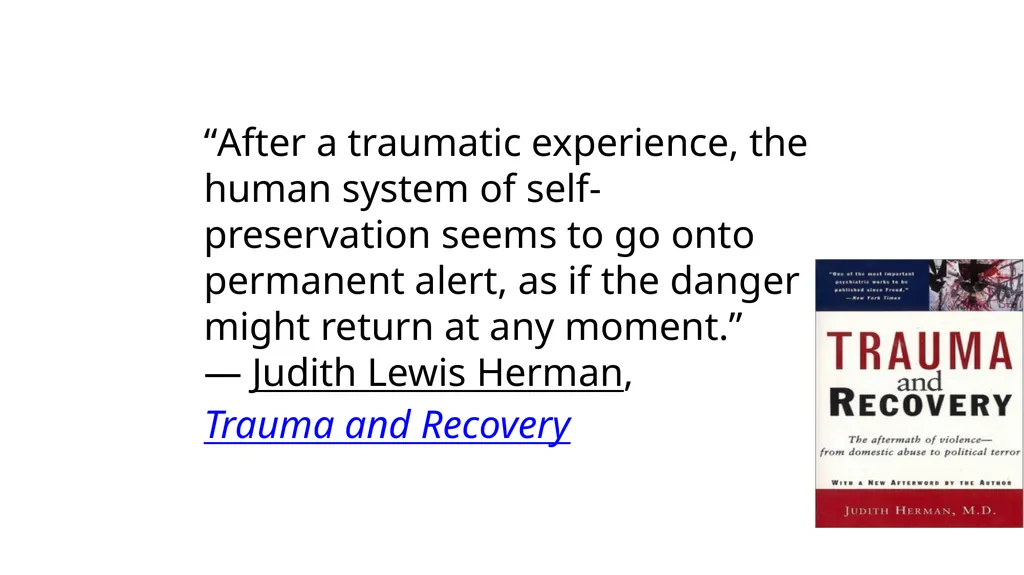
“After a traumatic experience, the human system of self-preservation seems to go onto permanent alert, as if the danger might return at any moment.”
― Judith Lewis Herman, Trauma and Recovery<br>
05
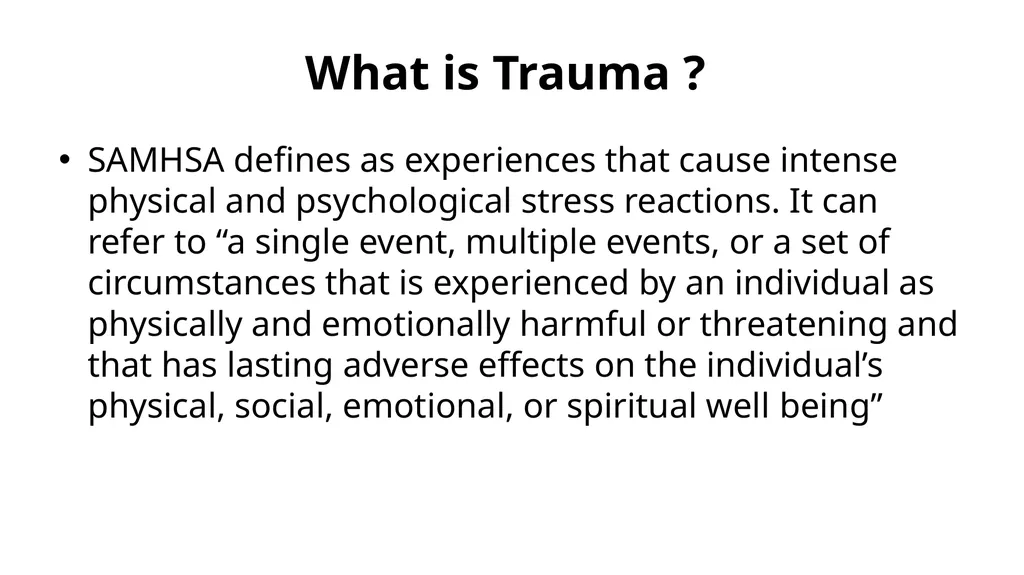
What is Trauma ? SAMHSA defines as experiences that cause intense physical and psychological stress reactions. It can refer to “a single event, multiple events, or a set of circumstances that is experienced by an individual as physically and emotionally harmful or threatening and that has lasting adverse effects on the individual’s physical, social, emotional, or spiritual well being”<br>
06
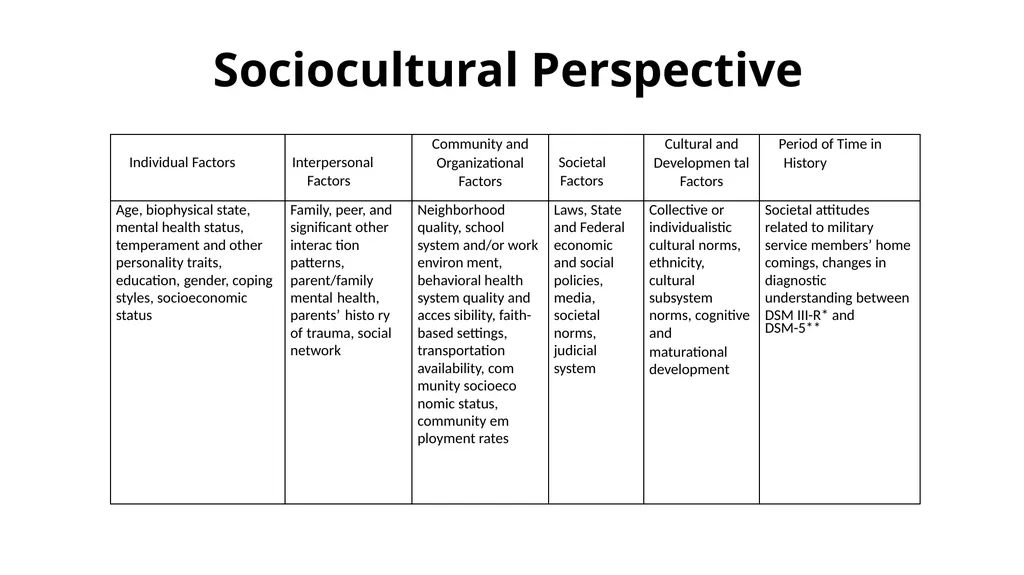
Sociocultural Perspective<br>
07
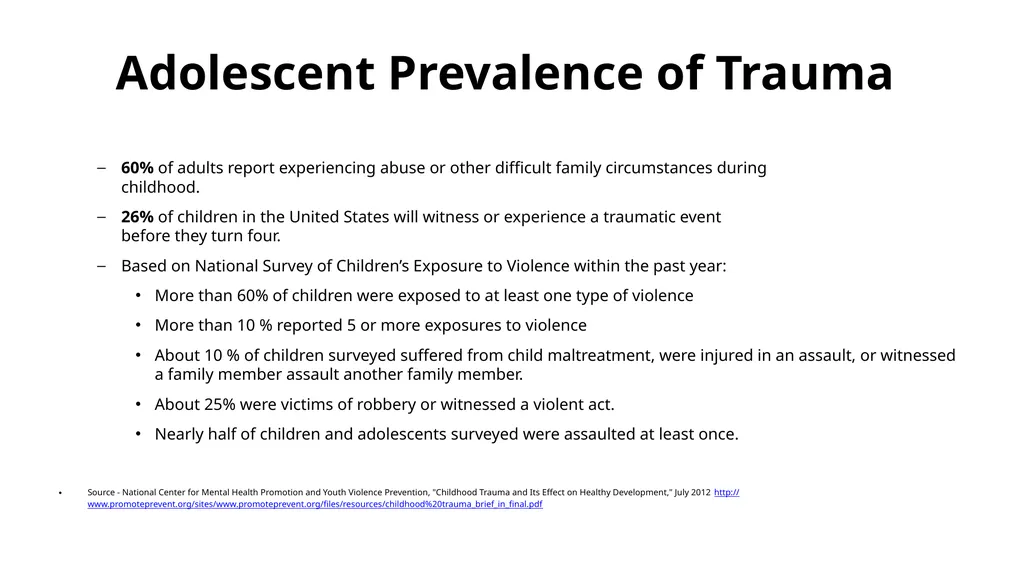
Adolescent Prevalence of Trauma 60% of adults report experiencing abuse or other difficult family circumstances during
childhood.
26% of children in the United States will witness or experience a traumatic event before they turn four.
Based on National Survey of Children’s Exposure to Violence within the past year:
More than 60% of children were exposed to at least one type of violence
More than 10 % reported 5 or more exposures to violence
About 10 % of children surveyed suffered from child maltreatment, were injured in an assault, or witnessed a family member assault another family member.
About 25% were victims of robbery or witnessed a violent act.
Nearly half of children and adolescents surveyed were assaulted at least once.
Source - National Center for Mental Health Promotion and Youth Violence Prevention, "Childhood Trauma and Its Effect on Healthy Development," July 2012 http://www.promoteprevent.org/sites/www.promoteprevent.org/files/resources/childhood%20trauma_brief_in_final.pdf<br>
26% of children in the United States will witness or experience a traumatic event before they turn four.
Based on National Survey of Children’s Exposure to Violence within the past year:
More than 60% of children were exposed to at least one type of violence
More than 10 % reported 5 or more exposures to violence
About 10 % of children surveyed suffered from child maltreatment, were injured in an assault, or witnessed a family member assault another family member.
About 25% were victims of robbery or witnessed a violent act.
Nearly half of children and adolescents surveyed were assaulted at least once.
Source - National Center for Mental Health Promotion and Youth Violence Prevention, "Childhood Trauma and Its Effect on Healthy Development," July 2012 http://www.promoteprevent.org/sites/www.promoteprevent.org/files/resources/childhood%20trauma_brief_in_final.pdf<br>
08
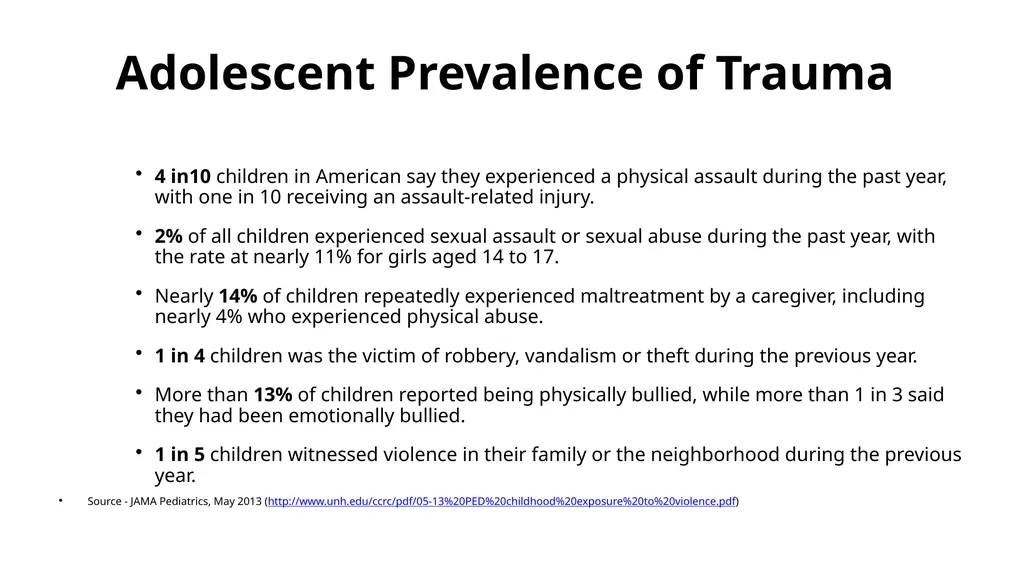
Adolescent Prevalence of Trauma 4 in10 children in American say they experienced a physical assault during the past year, with one in 10 receiving an assault-related injury.
2% of all children experienced sexual assault or sexual abuse during the past year, with the rate at nearly 11% for girls aged 14 to 17.
Nearly 14% of children repeatedly experienced maltreatment by a caregiver, including nearly 4% who experienced physical abuse.
1 in 4 children was the victim of robbery, vandalism or theft during the previous year.
More than 13% of children reported being physically bullied, while more than 1 in 3 said they had been emotionally bullied.
1 in 5 children witnessed violence in their family or the neighborhood during the previous year.
Source - JAMA Pediatrics, May 2013 (http://www.unh.edu/ccrc/pdf/05-13%20PED%20childhood%20exposure%20to%20violence.pdf)<br>
2% of all children experienced sexual assault or sexual abuse during the past year, with the rate at nearly 11% for girls aged 14 to 17.
Nearly 14% of children repeatedly experienced maltreatment by a caregiver, including nearly 4% who experienced physical abuse.
1 in 4 children was the victim of robbery, vandalism or theft during the previous year.
More than 13% of children reported being physically bullied, while more than 1 in 3 said they had been emotionally bullied.
1 in 5 children witnessed violence in their family or the neighborhood during the previous year.
Source - JAMA Pediatrics, May 2013 (http://www.unh.edu/ccrc/pdf/05-13%20PED%20childhood%20exposure%20to%20violence.pdf)<br>
09
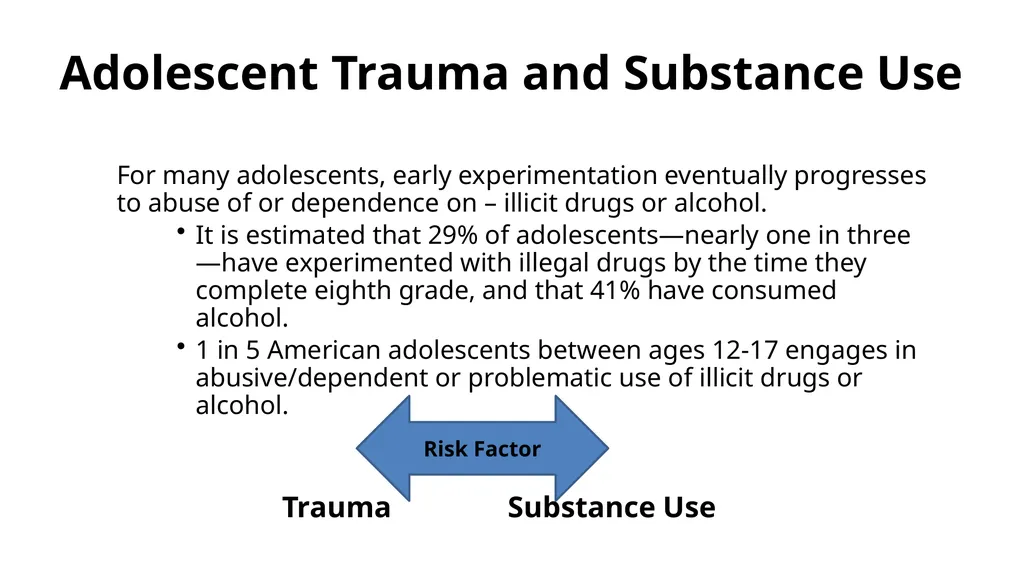
Adolescent Trauma and Substance Use For many adolescents, early experimentation eventually progresses to abuse of or dependence on – illicit drugs or alcohol.
It is estimated that 29% of adolescents—nearly one in three—have experimented with illegal drugs by the time they complete eighth grade, and that 41% have consumed alcohol.
1 in 5 American adolescents between ages 12-17 engages in abusive/dependent or problematic use of illicit drugs or alcohol.
Trauma Substance Use Risk Factor<br>
It is estimated that 29% of adolescents—nearly one in three—have experimented with illegal drugs by the time they complete eighth grade, and that 41% have consumed alcohol.
1 in 5 American adolescents between ages 12-17 engages in abusive/dependent or problematic use of illicit drugs or alcohol.
Trauma Substance Use Risk Factor<br>
10
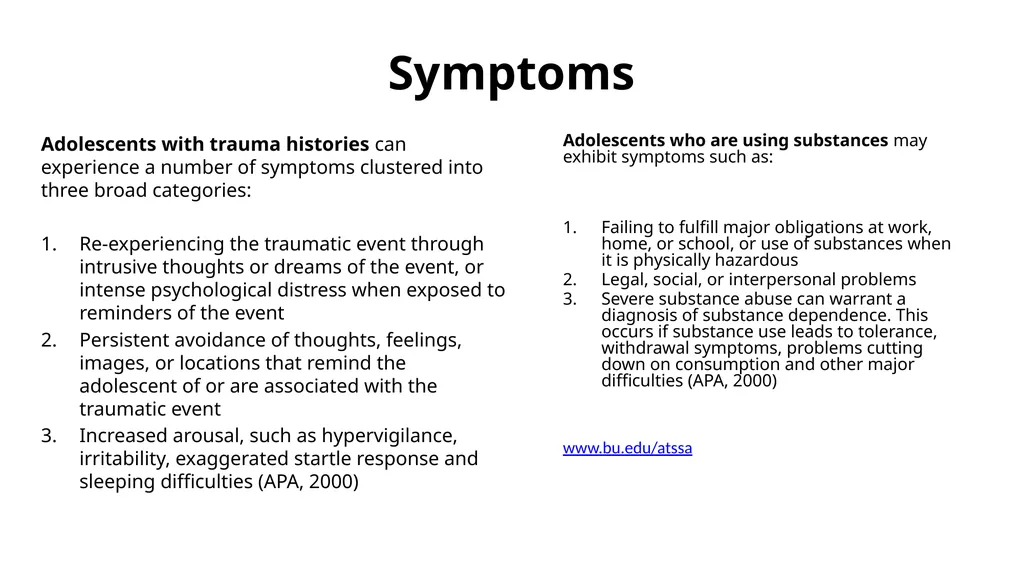
Symptoms Adolescents with trauma histories can experience a number of symptoms clustered into three broad categories:
Re-experiencing the traumatic event through intrusive thoughts or dreams of the event, or intense psychological distress when exposed to reminders of the event
Persistent avoidance of thoughts, feelings, images, or locations that remind the adolescent of or are associated with the traumatic event
Increased arousal, such as hypervigilance, irritability, exaggerated startle response and sleeping difficulties (APA, 2000) Adolescents who are using substances may exhibit symptoms such as:
Failing to fulfill major obligations at work, home, or school, or use of substances when it is physically hazardous
Legal, social, or interpersonal problems
Severe substance abuse can warrant a diagnosis of substance dependence. This occurs if substance use leads to tolerance, withdrawal symptoms, problems cutting down on consumption and other major difficulties (APA, 2000)
www.bu.edu/atssa<br>
Re-experiencing the traumatic event through intrusive thoughts or dreams of the event, or intense psychological distress when exposed to reminders of the event
Persistent avoidance of thoughts, feelings, images, or locations that remind the adolescent of or are associated with the traumatic event
Increased arousal, such as hypervigilance, irritability, exaggerated startle response and sleeping difficulties (APA, 2000) Adolescents who are using substances may exhibit symptoms such as:
Failing to fulfill major obligations at work, home, or school, or use of substances when it is physically hazardous
Legal, social, or interpersonal problems
Severe substance abuse can warrant a diagnosis of substance dependence. This occurs if substance use leads to tolerance, withdrawal symptoms, problems cutting down on consumption and other major difficulties (APA, 2000)
www.bu.edu/atssa<br>
11
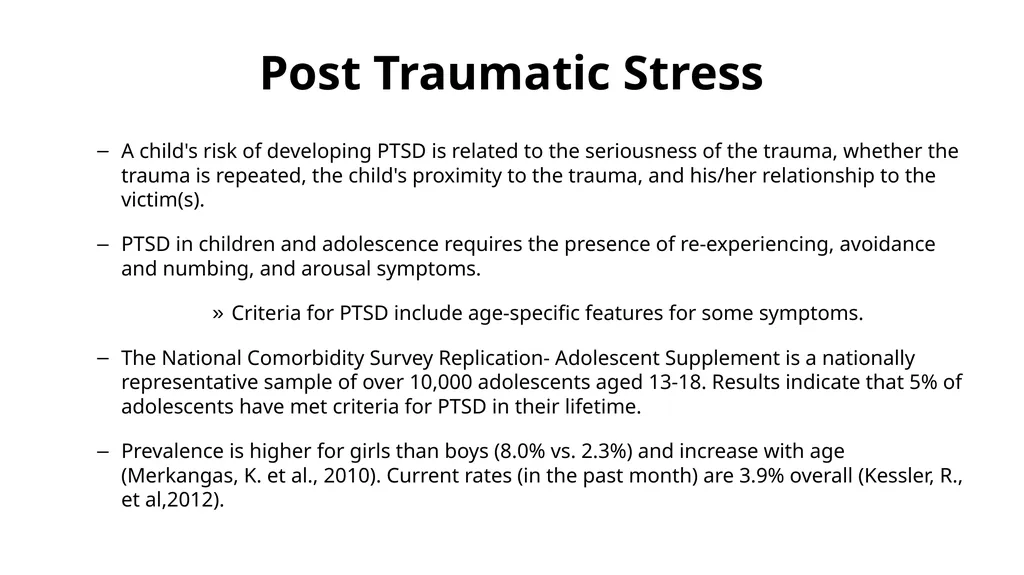
Post Traumatic Stress A child's risk of developing PTSD is related to the seriousness of the trauma, whether the trauma is repeated, the child's proximity to the trauma, and his/her relationship to the victim(s).
PTSD in children and adolescence requires the presence of re-experiencing, avoidance and numbing, and arousal symptoms.
Criteria for PTSD include age-specific features for some symptoms.
The National Comorbidity Survey Replication- Adolescent Supplement is a nationally representative sample of over 10,000 adolescents aged 13-18. Results indicate that 5% of adolescents have met criteria for PTSD in their lifetime.
Prevalence is higher for girls than boys (8.0% vs. 2.3%) and increase with age (Merkangas, K. et al., 2010). Current rates (in the past month) are 3.9% overall (Kessler, R., et al,2012).<br>
PTSD in children and adolescence requires the presence of re-experiencing, avoidance and numbing, and arousal symptoms.
Criteria for PTSD include age-specific features for some symptoms.
The National Comorbidity Survey Replication- Adolescent Supplement is a nationally representative sample of over 10,000 adolescents aged 13-18. Results indicate that 5% of adolescents have met criteria for PTSD in their lifetime.
Prevalence is higher for girls than boys (8.0% vs. 2.3%) and increase with age (Merkangas, K. et al., 2010). Current rates (in the past month) are 3.9% overall (Kessler, R., et al,2012).<br>
12
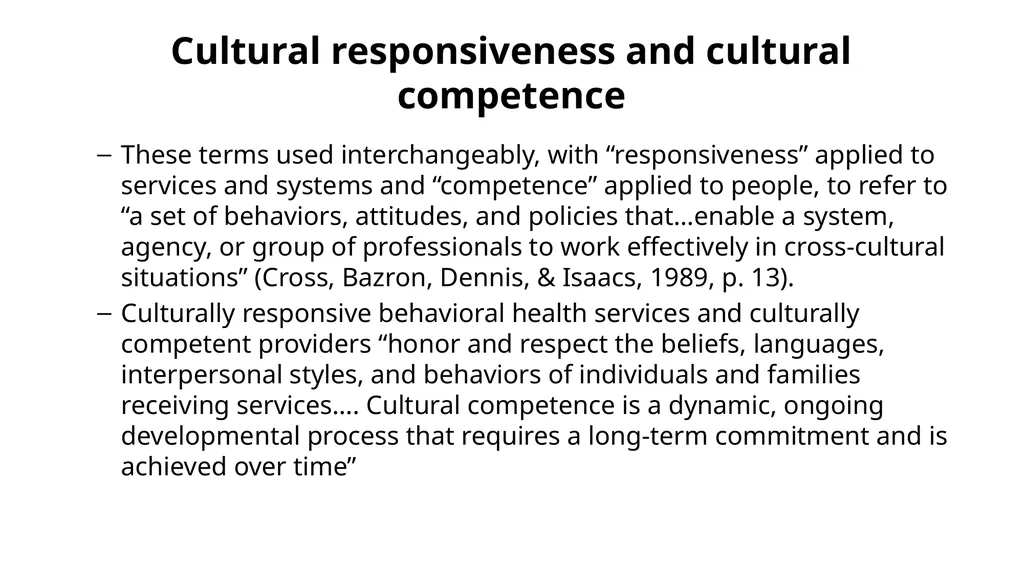
Cultural responsiveness and cultural competence These terms used interchangeably, with “responsiveness” applied to services and systems and “competence” applied to people, to refer to “a set of behaviors, attitudes, and policies that…enable a system, agency, or group of professionals to work effectively in cross-cultural situations” (Cross, Bazron, Dennis, & Isaacs, 1989, p. 13).
Culturally responsive behavioral health services and culturally competent providers “honor and respect the beliefs, languages, interpersonal styles, and behaviors of individuals and families receiving services…. Cultural competence is a dynamic, ongoing developmental process that requires a long-term commitment and is achieved over time”<br>
Culturally responsive behavioral health services and culturally competent providers “honor and respect the beliefs, languages, interpersonal styles, and behaviors of individuals and families receiving services…. Cultural competence is a dynamic, ongoing developmental process that requires a long-term commitment and is achieved over time”<br>
13
Cultural Considerations Related to Trauma and Substance Abuse National Child Traumatic Stress Network
-http://www.nctsn.org/resources/topics/culture-and-trauma
Girls
Girls entering substance abuse treatment have significant co-occurring mental health issues
Gender differences in victimization are frequently reported among substance-abusing youths, with females more likely than their male peers to have a history of child abuse, have experienced multiple types of abuse, have been sexually abused, and have more severe problems related to child abuse
Disabilities and Deaf/Hard of Hearing
Individuals with disabilities have increased rates of maltreatment
Girls with hearing loss had the highest rates, followed by girls without hearing loss<br>
-http://www.nctsn.org/resources/topics/culture-and-trauma
Girls
Girls entering substance abuse treatment have significant co-occurring mental health issues
Gender differences in victimization are frequently reported among substance-abusing youths, with females more likely than their male peers to have a history of child abuse, have experienced multiple types of abuse, have been sexually abused, and have more severe problems related to child abuse
Disabilities and Deaf/Hard of Hearing
Individuals with disabilities have increased rates of maltreatment
Girls with hearing loss had the highest rates, followed by girls without hearing loss<br>
14
Cultural Considerations Related to Trauma and Substance Abuse Sexual Minorities
Sexual minorities—lesbian, gay, bisexual, and transgendered (LGBT) youth—are especially vulnerable to mental health problems, particularly depression, loneliness, psychosomatic illness, withdrawn behavior, delinquency, and social problems
Ethnic/Racial Minorities
changing demographics in the United States and acculturation
historical trauma
culturally responsive assessment and services
inclusion of family and parental beliefs<br>
Sexual minorities—lesbian, gay, bisexual, and transgendered (LGBT) youth—are especially vulnerable to mental health problems, particularly depression, loneliness, psychosomatic illness, withdrawn behavior, delinquency, and social problems
Ethnic/Racial Minorities
changing demographics in the United States and acculturation
historical trauma
culturally responsive assessment and services
inclusion of family and parental beliefs<br>
15
A Trauma-Informed Approach A trauma-informed approach to the delivery of behavioral health services includes an understanding of trauma and an awareness of the impact it can have across settings, services, and populations. It involves viewing trauma through an ecological and cultural lens and recognizing that context plays a significant role in how individuals perceive and process traumatic events, whether acute or chronic.
May 2012, SAMHSA convened a group of national experts who identified three key elements of a trauma-informed approach: “(1) realizing the prevalence of trauma; (2) recognizing how trauma affects all individuals involved with the program, organization, or system, including its own workforce; and (3) responding by putting this knowledge into practice”<br>
May 2012, SAMHSA convened a group of national experts who identified three key elements of a trauma-informed approach: “(1) realizing the prevalence of trauma; (2) recognizing how trauma affects all individuals involved with the program, organization, or system, including its own workforce; and (3) responding by putting this knowledge into practice”<br>
16
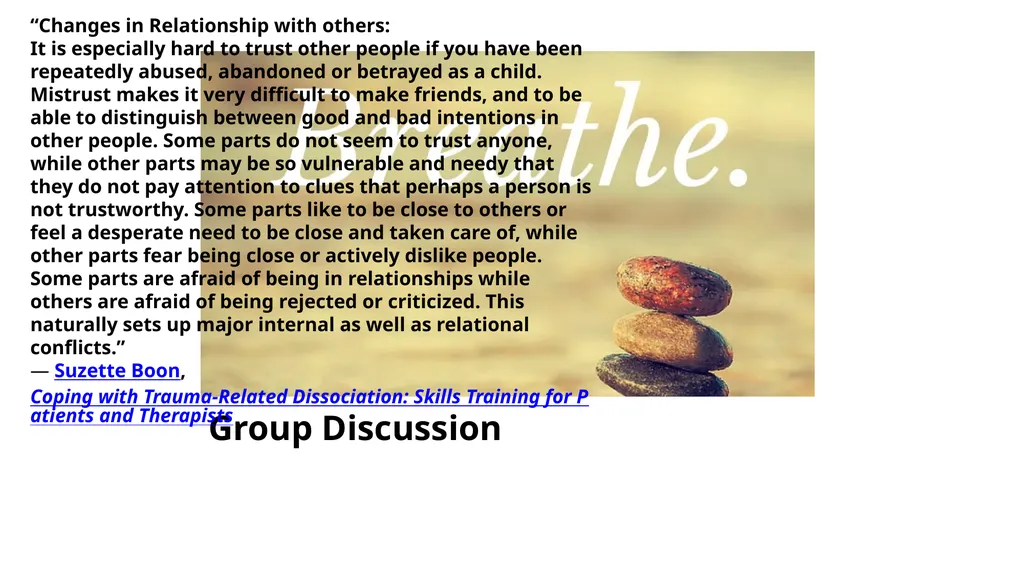
Group Discussion “Changes in Relationship with others:
It is especially hard to trust other people if you have been repeatedly abused, abandoned or betrayed as a child. Mistrust makes it very difficult to make friends, and to be able to distinguish between good and bad intentions in other people. Some parts do not seem to trust anyone, while other parts may be so vulnerable and needy that they do not pay attention to clues that perhaps a person is not trustworthy. Some parts like to be close to others or feel a desperate need to be close and taken care of, while other parts fear being close or actively dislike people. Some parts are afraid of being in relationships while others are afraid of being rejected or criticized. This naturally sets up major internal as well as relational conflicts.”
― Suzette Boon, Coping with Trauma-Related Dissociation: Skills Training for Patients and Therapists<br>
17
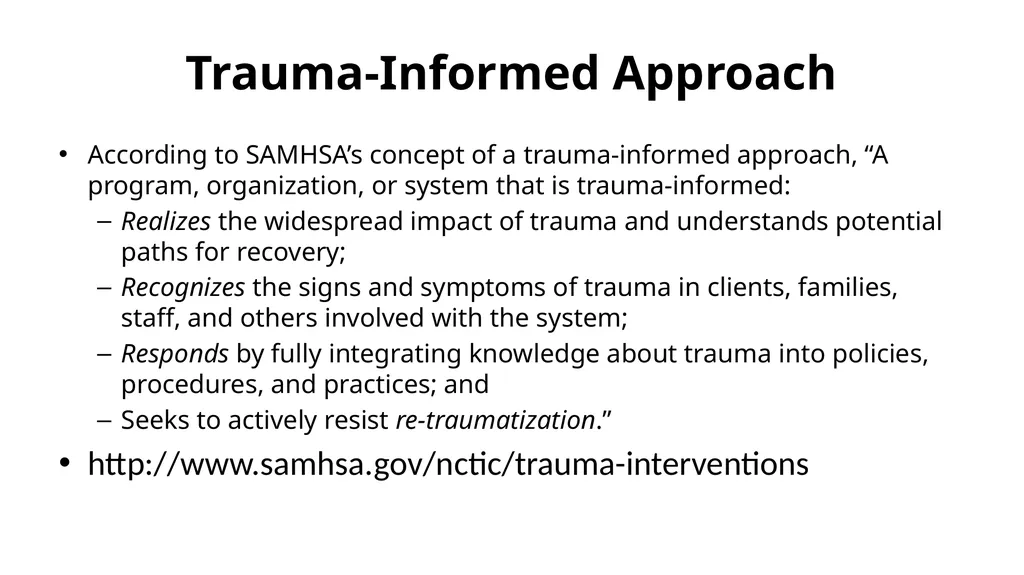
Trauma-Informed Approach According to SAMHSA’s concept of a trauma-informed approach, “A program, organization, or system that is trauma-informed:
Realizes the widespread impact of trauma and understands potential paths for recovery;
Recognizes the signs and symptoms of trauma in clients, families, staff, and others involved with the system;
Responds by fully integrating knowledge about trauma into policies, procedures, and practices; and
Seeks to actively resist re-traumatization.”
http://www.samhsa.gov/nctic/trauma-interventions<br>
Realizes the widespread impact of trauma and understands potential paths for recovery;
Recognizes the signs and symptoms of trauma in clients, families, staff, and others involved with the system;
Responds by fully integrating knowledge about trauma into policies, procedures, and practices; and
Seeks to actively resist re-traumatization.”
http://www.samhsa.gov/nctic/trauma-interventions<br>
18
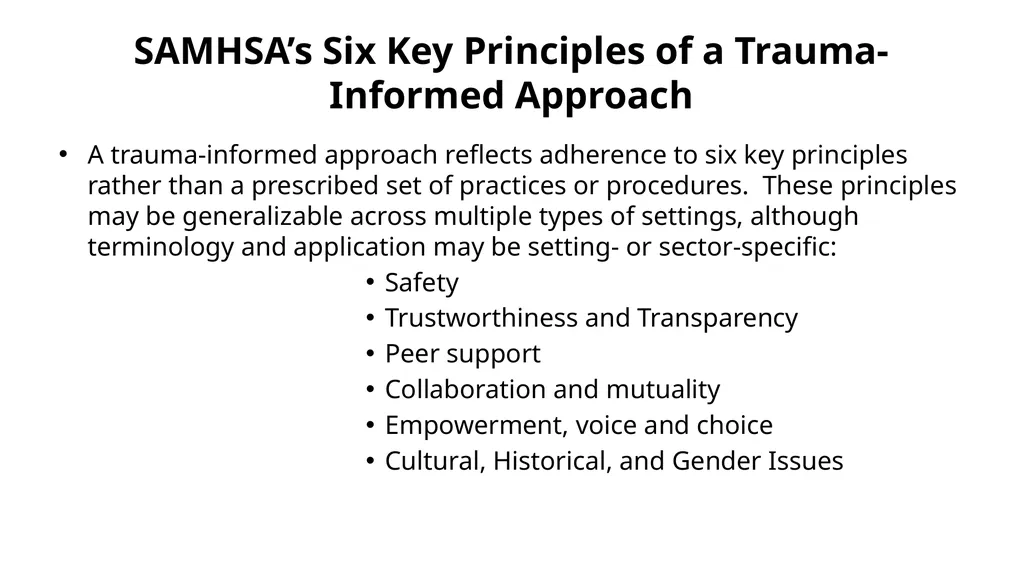
SAMHSA’s Six Key Principles of a Trauma-Informed Approach A trauma-informed approach reflects adherence to six key principles rather than a prescribed set of practices or procedures. These principles may be generalizable across multiple types of settings, although terminology and application may be setting- or sector-specific:
Safety
Trustworthiness and Transparency
Peer support
Collaboration and mutuality
Empowerment, voice and choice
Cultural, Historical, and Gender Issues<br>
Safety
Trustworthiness and Transparency
Peer support
Collaboration and mutuality
Empowerment, voice and choice
Cultural, Historical, and Gender Issues<br>
19
V
Establish a culture that fully reflects each of the five core values in each contact, physical setting, relationship, and activity and that this culture is evident in the experiences of staff as well as consumers, then the program’s culture is trauma-informed.<br>
20
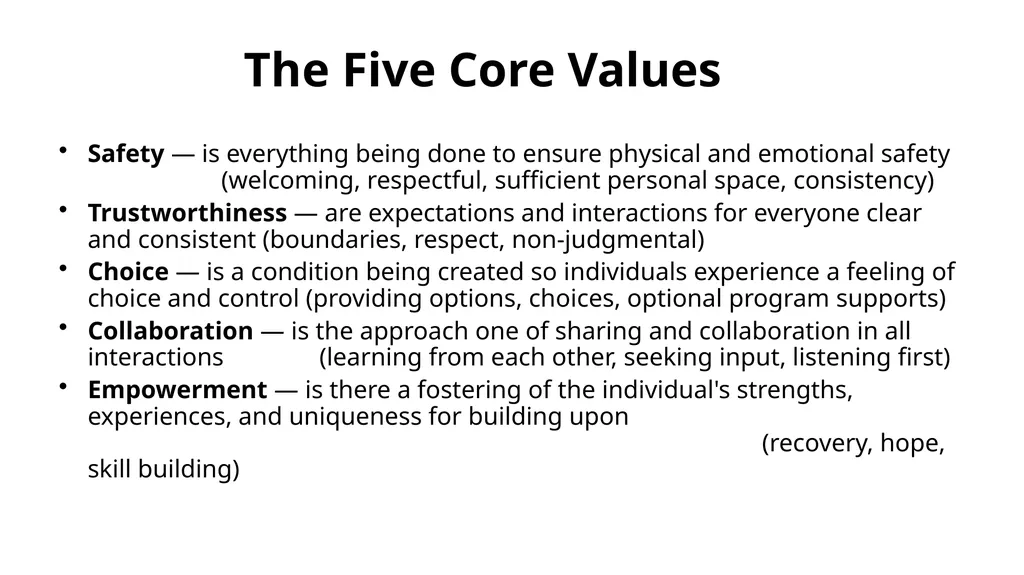
The Five Core Values re Safety — is everything being done to ensure physical and emotional safety (welcoming, respectful, sufficient personal space, consistency)
Trustworthiness — are expectations and interactions for everyone clear and consistent (boundaries, respect, non-judgmental)
Choice — is a condition being created so individuals experience a feeling of choice and control (providing options, choices, optional program supports)
Collaboration — is the approach one of sharing and collaboration in all interactions (learning from each other, seeking input, listening first)
Empowerment — is there a fostering of the individual's strengths, experiences, and uniqueness for building upon (recovery, hope, skill building)<br>
Trustworthiness — are expectations and interactions for everyone clear and consistent (boundaries, respect, non-judgmental)
Choice — is a condition being created so individuals experience a feeling of choice and control (providing options, choices, optional program supports)
Collaboration — is the approach one of sharing and collaboration in all interactions (learning from each other, seeking input, listening first)
Empowerment — is there a fostering of the individual's strengths, experiences, and uniqueness for building upon (recovery, hope, skill building)<br>
21
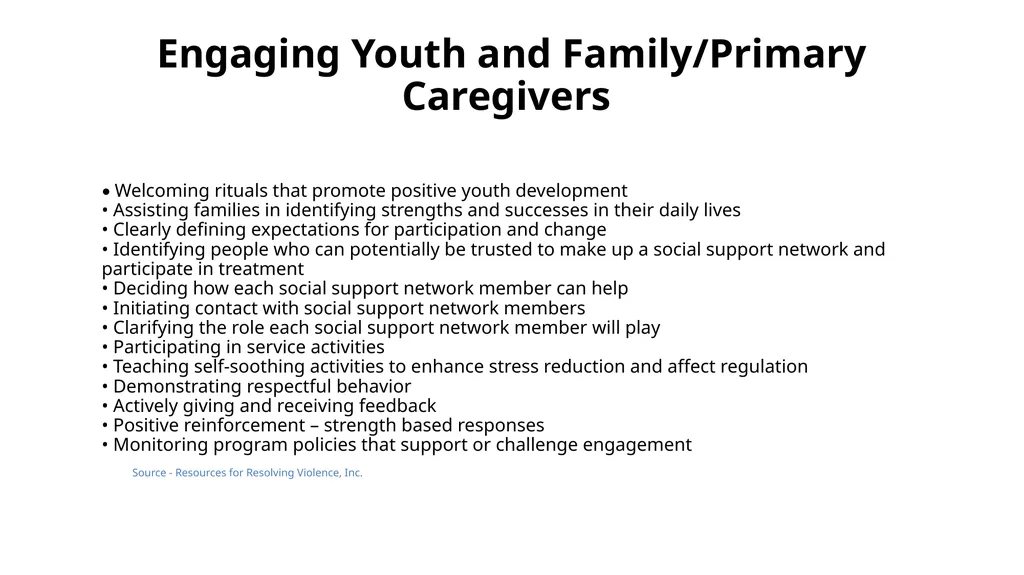
Engaging Youth and Family/Primary Caregivers • Welcoming rituals that promote positive youth development
• Assisting families in identifying strengths and successes in their daily lives
• Clearly defining expectations for participation and change
• Identifying people who can potentially be trusted to make up a social support network and participate in treatment
• Deciding how each social support network member can help
• Initiating contact with social support network members
• Clarifying the role each social support network member will play
• Participating in service activities
• Teaching self-soothing activities to enhance stress reduction and affect regulation
• Demonstrating respectful behavior
• Actively giving and receiving feedback
• Positive reinforcement – strength based responses
• Monitoring program policies that support or challenge engagement
Source - Resources for Resolving Violence, Inc.<br>
Source - Resources for Resolving Violence, Inc.<br>
22
Group Discussion “These problems are real, and you can't turn off real life. So I won't try. Instead, I'll give you a set of tools to help you deal with real life.”
― Sean Covey, The 7 Habits Of Highly Effective Teens<br>
23
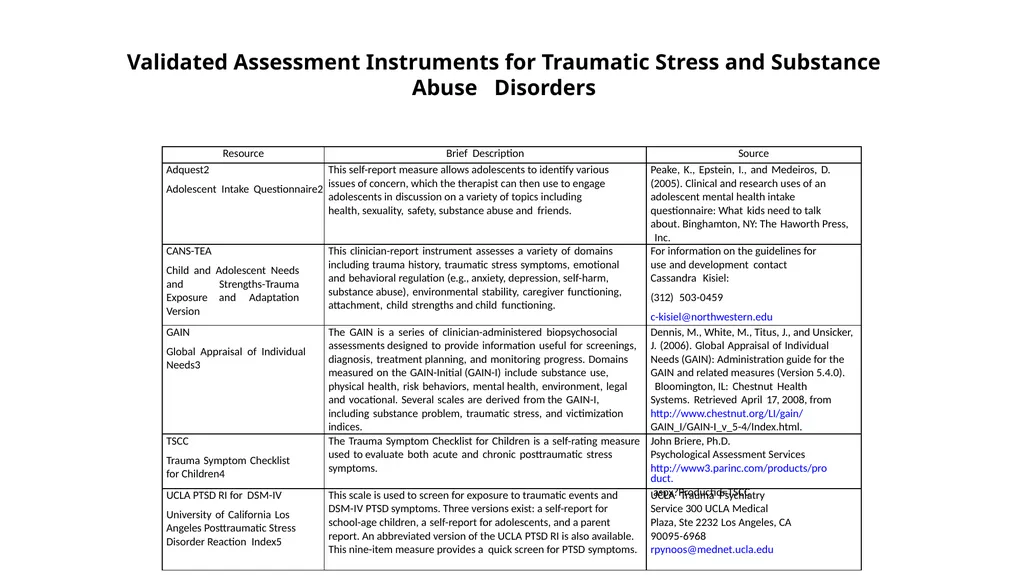
Validated Assessment Instruments for Traumatic Stress and Substance Abuse Disorders<br>
24
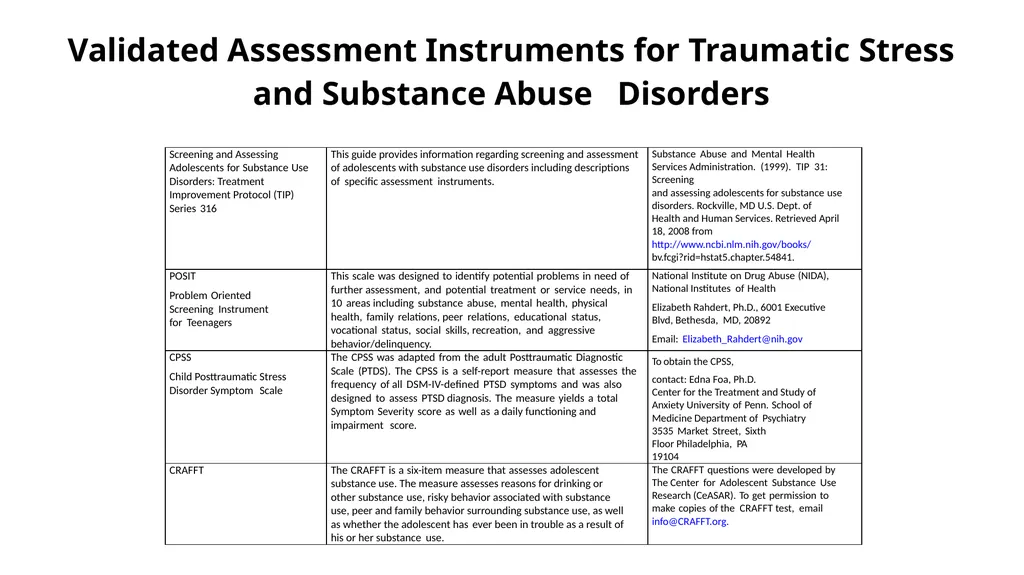
Validated Assessment Instruments for Traumatic Stress and Substance Abuse Disorders<br>
25
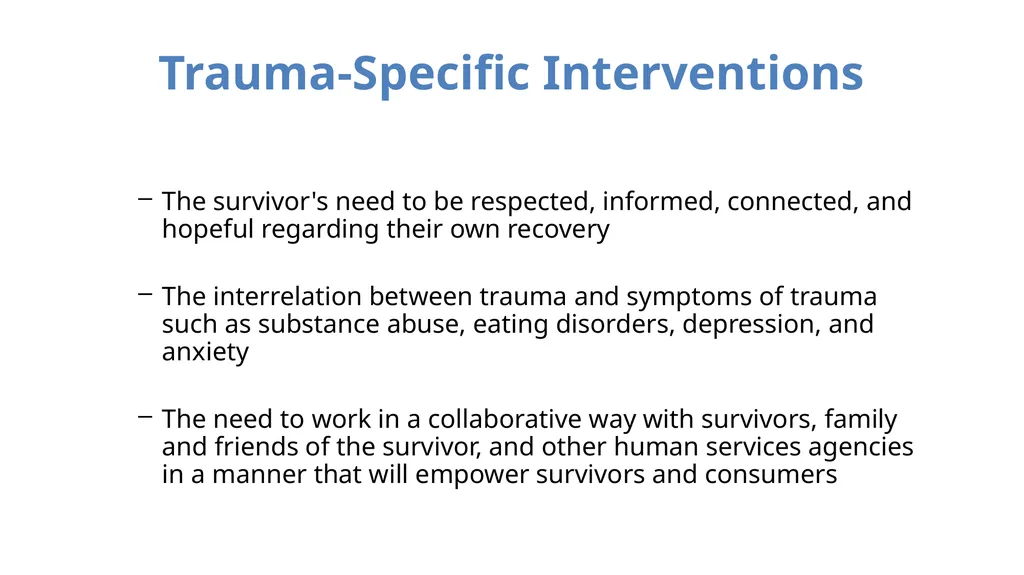
Trauma-Specific Interventions The survivor's need to be respected, informed, connected, and hopeful regarding their own recovery
The interrelation between trauma and symptoms of trauma such as substance abuse, eating disorders, depression, and anxiety
The need to work in a collaborative way with survivors, family and friends of the survivor, and other human services agencies in a manner that will empower survivors and consumers<br>
The interrelation between trauma and symptoms of trauma such as substance abuse, eating disorders, depression, and anxiety
The need to work in a collaborative way with survivors, family and friends of the survivor, and other human services agencies in a manner that will empower survivors and consumers<br>
26
Adolescent
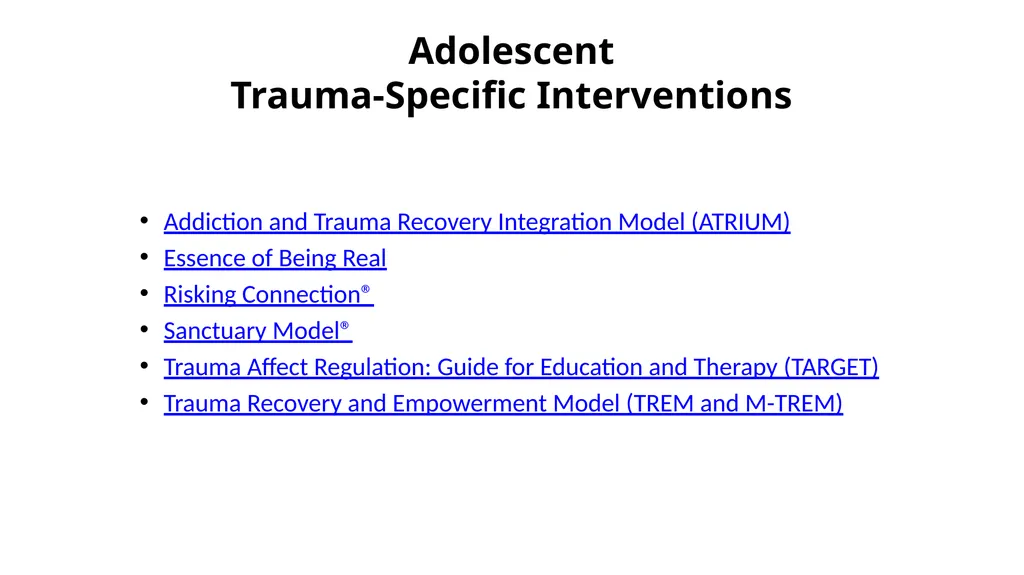
Trauma-Specific Interventions Addiction and Trauma Recovery Integration Model (ATRIUM)
Essence of Being Real
Risking Connection®
Sanctuary Model®
Trauma Affect Regulation: Guide for Education and Therapy (TARGET)
Trauma Recovery and Empowerment Model (TREM and M-TREM)<br>
Essence of Being Real
Risking Connection®
Sanctuary Model®
Trauma Affect Regulation: Guide for Education and Therapy (TARGET)
Trauma Recovery and Empowerment Model (TREM and M-TREM)<br>
27
Group Discussion Based on today’s workshop and discussions – 1) Discuss 1-2 follow up changes, skills, action items and/or resources 2) Anticipated impact of each<br>
28
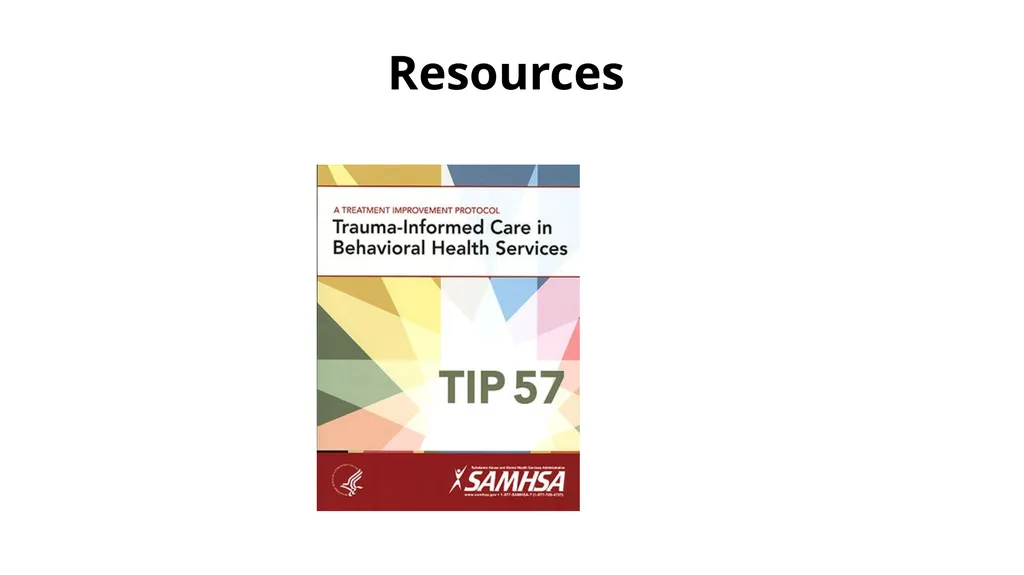
Resources<br>
29
Resources National Center for Trauma-Informed Care offers consultation and technical assistance to stimulate and support interest in developing approaches to eliminate the use of seclusion, restraints, and other coercive practices and to further develop the knowledge base related to the implementation of trauma-informed approaches, consistent with SAMHSA’s conceptual framework for trauma and trauma-informed practice, in publicly funded systems and programs.
NCTIC@NASMHPD.org<br>
NCTIC@NASMHPD.org<br>
30
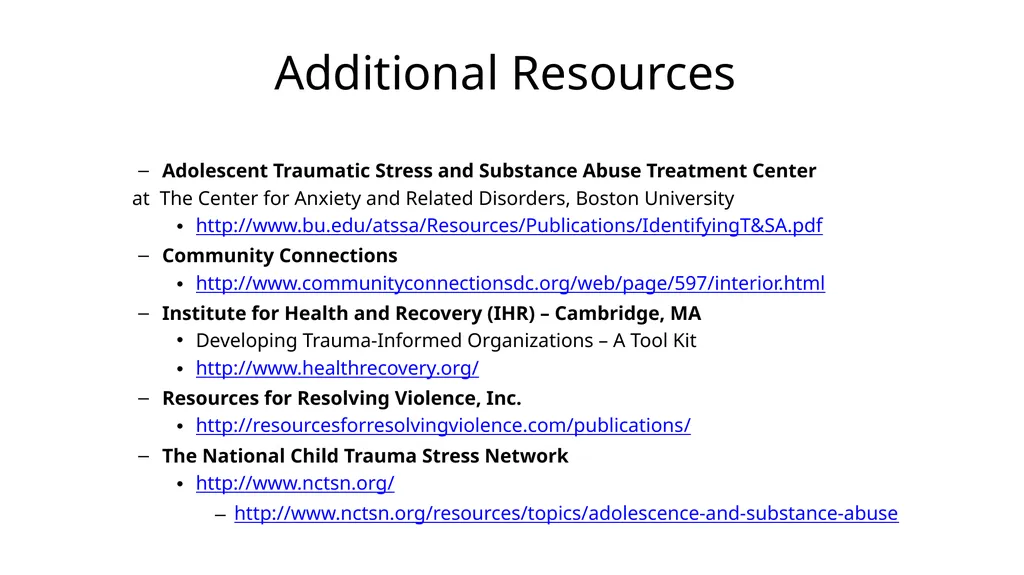
Additional Resources Adolescent Traumatic Stress and Substance Abuse Treatment Center
at The Center for Anxiety and Related Disorders, Boston University
http://www.bu.edu/atssa/Resources/Publications/IdentifyingT&SA.pdf
Community Connections
http://www.communityconnectionsdc.org/web/page/597/interior.html
Institute for Health and Recovery (IHR) – Cambridge, MA
Developing Trauma-Informed Organizations – A Tool Kit
http://www.healthrecovery.org/
Resources for Resolving Violence, Inc.
http://resourcesforresolvingviolence.com/publications/
The National Child Trauma Stress Network
http://www.nctsn.org/
http://www.nctsn.org/resources/topics/adolescence-and-substance-abuse<br>
at The Center for Anxiety and Related Disorders, Boston University
http://www.bu.edu/atssa/Resources/Publications/IdentifyingT&SA.pdf
Community Connections
http://www.communityconnectionsdc.org/web/page/597/interior.html
Institute for Health and Recovery (IHR) – Cambridge, MA
Developing Trauma-Informed Organizations – A Tool Kit
http://www.healthrecovery.org/
Resources for Resolving Violence, Inc.
http://resourcesforresolvingviolence.com/publications/
The National Child Trauma Stress Network
http://www.nctsn.org/
http://www.nctsn.org/resources/topics/adolescence-and-substance-abuse<br>
31
Questions, Comments and/or Feedback?<br>
32
Thank you Carolyn Castro-Donlan
Castro-Donlan Consulting, LLC
CCDConsulting@gmail.com
www.linkedin.com/in/ccdconsulting/<br>
Castro-Donlan Consulting, LLC
CCDConsulting@gmail.com
www.linkedin.com/in/ccdconsulting/<br>