
Travel Management Essentials GSA SmartPay® Erin
KB
Published · 40 slides · 0 views
1 / 1




Description
Travel Management Essentials GSA SmartPay Erin VanDagna GSA SmartPay Training Agenda Introduction to the GSA SmartPay Travel Card Travel Card Legislation and Policies Types of GSA SmartPay Travel Cards Roles and Responsibilities Best
Related Topics
Share
Embed code
Download this presentation From Below
"Travel Management Essentials GSA SmartPay® Erin" is the property of its rightful owner. Permission is granted to download and print the materials on this website for personal, non-commercial use only, and to display it on your personal computer provided you do not modify the materials and that you retain all copyright notices contained in the materials. By downloading content from our website, you accept the terms of this agreement.
Presentation Transcript
01
Travel Management Essentials
GSA SmartPay®
Erin VanDagna<br>
02
GSA SmartPay® Training Agenda Introduction to the
GSA SmartPay® Travel Card
Travel Card Legislation and Policies
Types of GSA SmartPay® Travel Cards
Roles and Responsibilities
Best Practices in Travel Card Management<br>
Travel Card Legislation and Policies
Types of GSA SmartPay® Travel Cards
Roles and Responsibilities
Best Practices in Travel Card Management<br>
03
Introduction to the
GSA SmartPay® Travel Card<br>
04
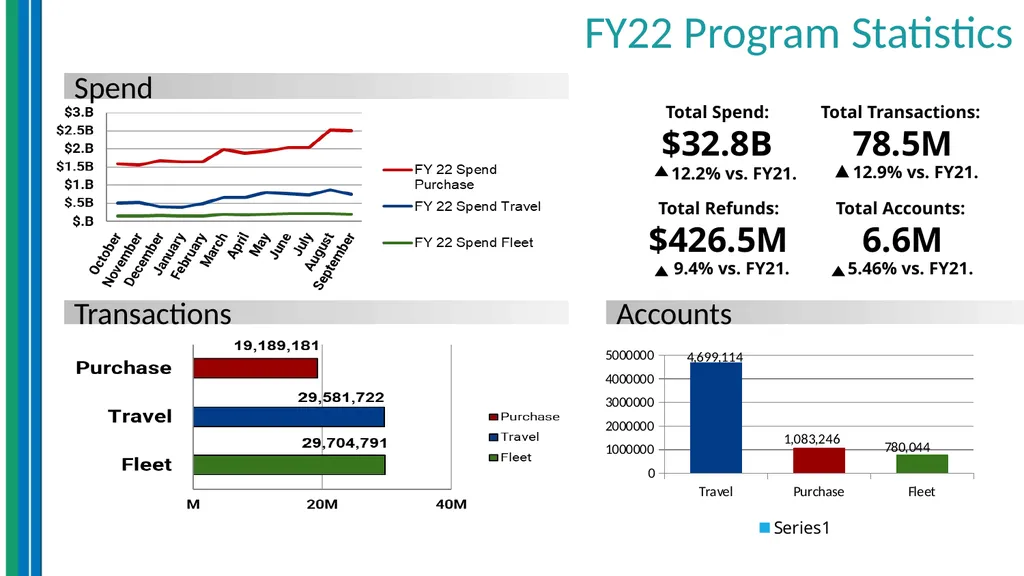
FY22 Program Statistics Spend Transactions Accounts<br>
05
Travel Card Legislation and Policies<br>
06
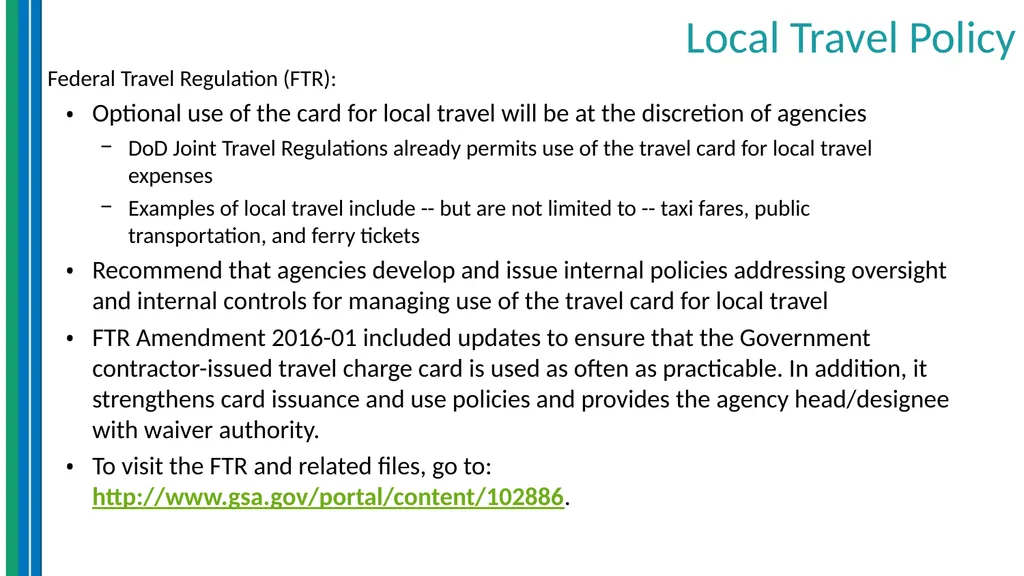
Local Travel Policy Federal Travel Regulation (FTR):
Optional use of the card for local travel will be at the discretion of agencies
DoD Joint Travel Regulations already permits use of the travel card for local travel expenses
Examples of local travel include -- but are not limited to -- taxi fares, public transportation, and ferry tickets
Recommend that agencies develop and issue internal policies addressing oversight and internal controls for managing use of the travel card for local travel
FTR Amendment 2016-01 included updates to ensure that the Government contractor-issued travel charge card is used as often as practicable. In addition, it strengthens card issuance and use policies and provides the agency head/designee with waiver authority.
To visit the FTR and related files, go to: http://www.gsa.gov/portal/content/102886.<br>
Optional use of the card for local travel will be at the discretion of agencies
DoD Joint Travel Regulations already permits use of the travel card for local travel expenses
Examples of local travel include -- but are not limited to -- taxi fares, public transportation, and ferry tickets
Recommend that agencies develop and issue internal policies addressing oversight and internal controls for managing use of the travel card for local travel
FTR Amendment 2016-01 included updates to ensure that the Government contractor-issued travel charge card is used as often as practicable. In addition, it strengthens card issuance and use policies and provides the agency head/designee with waiver authority.
To visit the FTR and related files, go to: http://www.gsa.gov/portal/content/102886.<br>
07
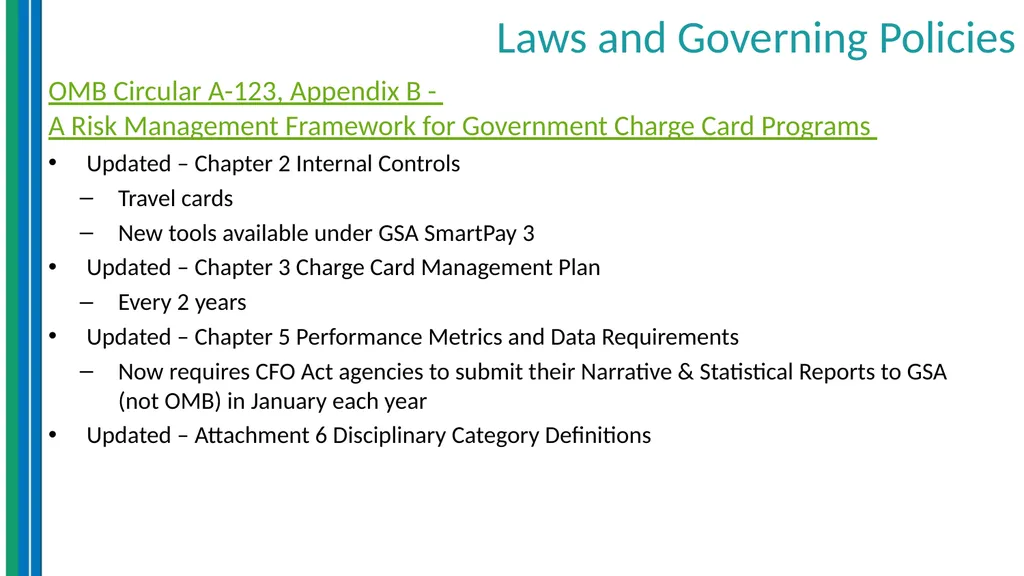
Laws and Governing Policies OMB Circular A-123, Appendix B - A Risk Management Framework for Government Charge Card Programs
Updated – Chapter 2 Internal Controls
Travel cards
New tools available under GSA SmartPay 3
Updated – Chapter 3 Charge Card Management Plan
Every 2 years
Updated – Chapter 5 Performance Metrics and Data Requirements
Now requires CFO Act agencies to submit their Narrative & Statistical Reports to GSA (not OMB) in January each year
Updated – Attachment 6 Disciplinary Category Definitions<br>
Updated – Chapter 2 Internal Controls
Travel cards
New tools available under GSA SmartPay 3
Updated – Chapter 3 Charge Card Management Plan
Every 2 years
Updated – Chapter 5 Performance Metrics and Data Requirements
Now requires CFO Act agencies to submit their Narrative & Statistical Reports to GSA (not OMB) in January each year
Updated – Attachment 6 Disciplinary Category Definitions<br>
08
Laws and Governing Policies OMB Memorandum M-13-21, Implementation of Charge Card Abuse Prevention Act of 2012
Serves as a response to the Government Charge Card Abuse Prevention Act and provides supplemental guidance to OMB Circular A-123, Appendix B
Provides an overview of the following aspects of compliance:
Safeguards and internal controls
Reports on violations and penalties for violators
Inspector General (IG) risk assessments/audits*
Effective date September 6, 2013
Part of the most recent Circular update<br>
Serves as a response to the Government Charge Card Abuse Prevention Act and provides supplemental guidance to OMB Circular A-123, Appendix B
Provides an overview of the following aspects of compliance:
Safeguards and internal controls
Reports on violations and penalties for violators
Inspector General (IG) risk assessments/audits*
Effective date September 6, 2013
Part of the most recent Circular update<br>
09
Laws and Governing Policies Government Charge Card Abuse Prevention Act of 2012 (P.L. 112-194)
Requires that all federal agencies establish certain safeguards and internal controls for government charge card programs
Requires that all federal agencies establish penalties for violations, including dismissal when circumstances warrant
Increases oversight by requiring that each agency’s Inspector General (IG) periodically conduct risk assessments/audits to identify fraud and improper use of government payment solutions
Effective date October 5, 2012
Now part of the most current Circular update<br>
Requires that all federal agencies establish certain safeguards and internal controls for government charge card programs
Requires that all federal agencies establish penalties for violations, including dismissal when circumstances warrant
Increases oversight by requiring that each agency’s Inspector General (IG) periodically conduct risk assessments/audits to identify fraud and improper use of government payment solutions
Effective date October 5, 2012
Now part of the most current Circular update<br>
10
Laws and Governing Policies Travel and Transportation Reform Act of 1998 (P.L. 105-264)
Mandates that employees use the government travel card for all payments of expenses related to official government travel
Some exemptions from mandatory use of the travel card may be granted in accordance with the Federal Travel Regulation (FTR), 41 Code of Federal Regulations (CFR) §§ 300 – 304
Effective date October 19, 1998<br>
Mandates that employees use the government travel card for all payments of expenses related to official government travel
Some exemptions from mandatory use of the travel card may be granted in accordance with the Federal Travel Regulation (FTR), 41 Code of Federal Regulations (CFR) §§ 300 – 304
Effective date October 19, 1998<br>
11
Laws and Governing Policies FY18 NDAA Title XVIII
FY18 National Defense Authorization Act (NDAA) Sec. 1806. Reporting Requirements:
“The head of each Federal Agency…shall submit a report to the Director of the Office of Management and Budget on that agency’s activities to implement this title.”
CCCM provided a reporting template for agency use due to OMB on December 12, 2018. The report template addresses an agency’s implementation actions described in FY18 NDAA Title XVIII in the following areas:
How the agency is expanding the use of data analytics.
What the agency has done to improve information sharing.
How improper payments have been addressed at the agency.<br>
FY18 National Defense Authorization Act (NDAA) Sec. 1806. Reporting Requirements:
“The head of each Federal Agency…shall submit a report to the Director of the Office of Management and Budget on that agency’s activities to implement this title.”
CCCM provided a reporting template for agency use due to OMB on December 12, 2018. The report template addresses an agency’s implementation actions described in FY18 NDAA Title XVIII in the following areas:
How the agency is expanding the use of data analytics.
What the agency has done to improve information sharing.
How improper payments have been addressed at the agency.<br>
12
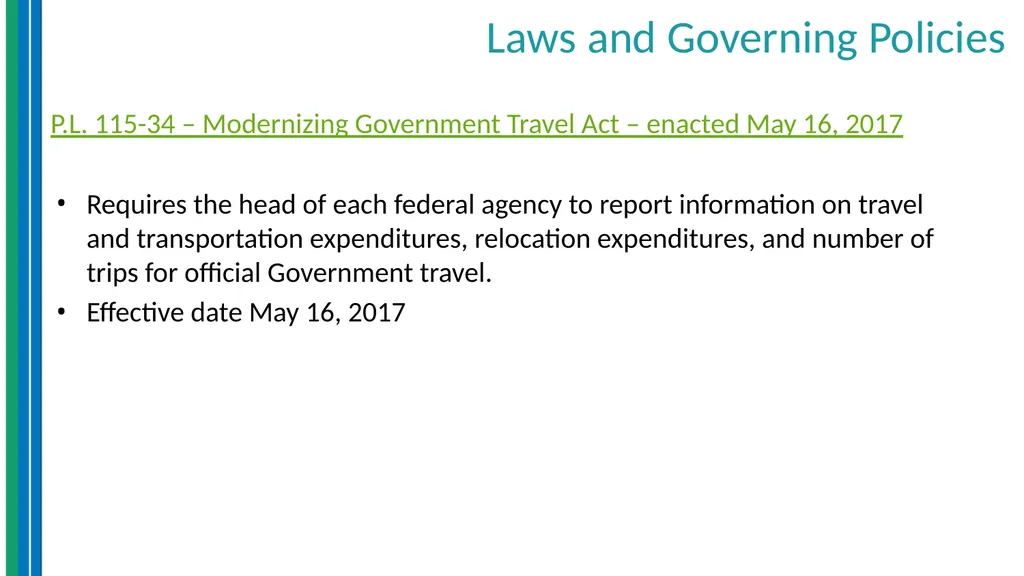
Laws and Governing Policies P.L. 115-34 – Modernizing Government Travel Act – enacted May 16, 2017
Requires the head of each federal agency to report information on travel and transportation expenditures, relocation expenditures, and number of trips for official Government travel.
Effective date May 16, 2017<br>
Requires the head of each federal agency to report information on travel and transportation expenditures, relocation expenditures, and number of trips for official Government travel.
Effective date May 16, 2017<br>
13
Types of GSA SmartPay® Travel Cards<br>
14
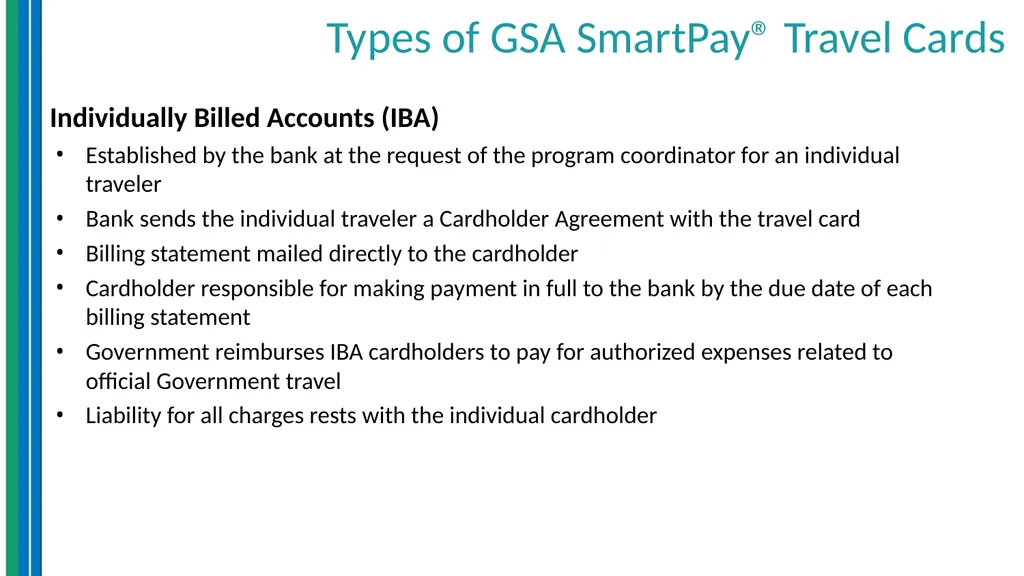
Types of GSA SmartPay® Travel Cards Individually Billed Accounts (IBA)
Established by the bank at the request of the program coordinator for an individual traveler
Bank sends the individual traveler a Cardholder Agreement with the travel card
Billing statement mailed directly to the cardholder
Cardholder responsible for making payment in full to the bank by the due date of each billing statement
Government reimburses IBA cardholders to pay for authorized expenses related to official Government travel
Liability for all charges rests with the individual cardholder<br>
Established by the bank at the request of the program coordinator for an individual traveler
Bank sends the individual traveler a Cardholder Agreement with the travel card
Billing statement mailed directly to the cardholder
Cardholder responsible for making payment in full to the bank by the due date of each billing statement
Government reimburses IBA cardholders to pay for authorized expenses related to official Government travel
Liability for all charges rests with the individual cardholder<br>
15
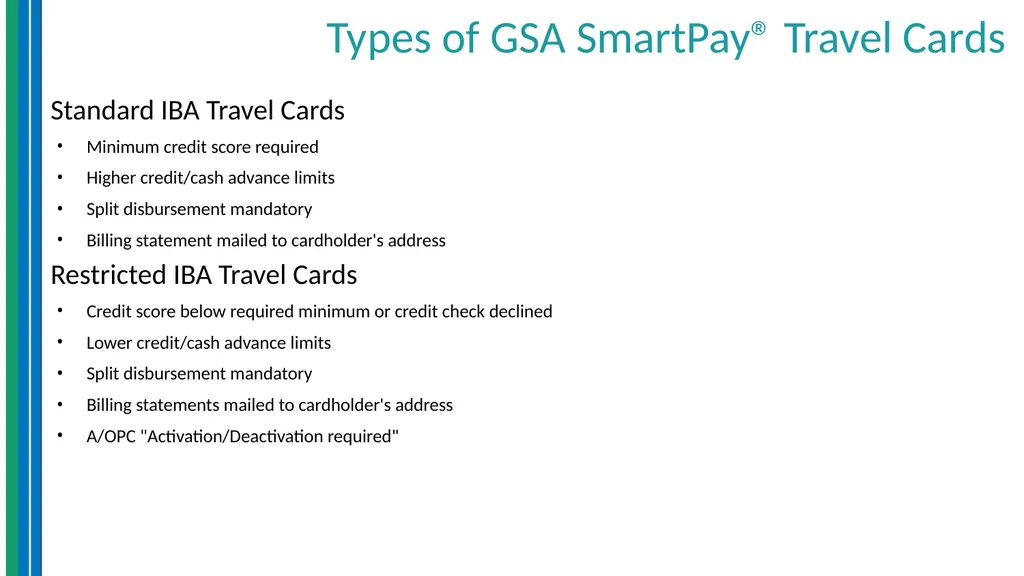
Types of GSA SmartPay® Travel Cards Standard IBA Travel Cards
Minimum credit score required
Higher credit/cash advance limits
Split disbursement mandatory
Billing statement mailed to cardholder's address
Restricted IBA Travel Cards
Credit score below required minimum or credit check declined
Lower credit/cash advance limits
Split disbursement mandatory
Billing statements mailed to cardholder's address
A/OPC "Activation/Deactivation required"<br>
Minimum credit score required
Higher credit/cash advance limits
Split disbursement mandatory
Billing statement mailed to cardholder's address
Restricted IBA Travel Cards
Credit score below required minimum or credit check declined
Lower credit/cash advance limits
Split disbursement mandatory
Billing statements mailed to cardholder's address
A/OPC "Activation/Deactivation required"<br>
16
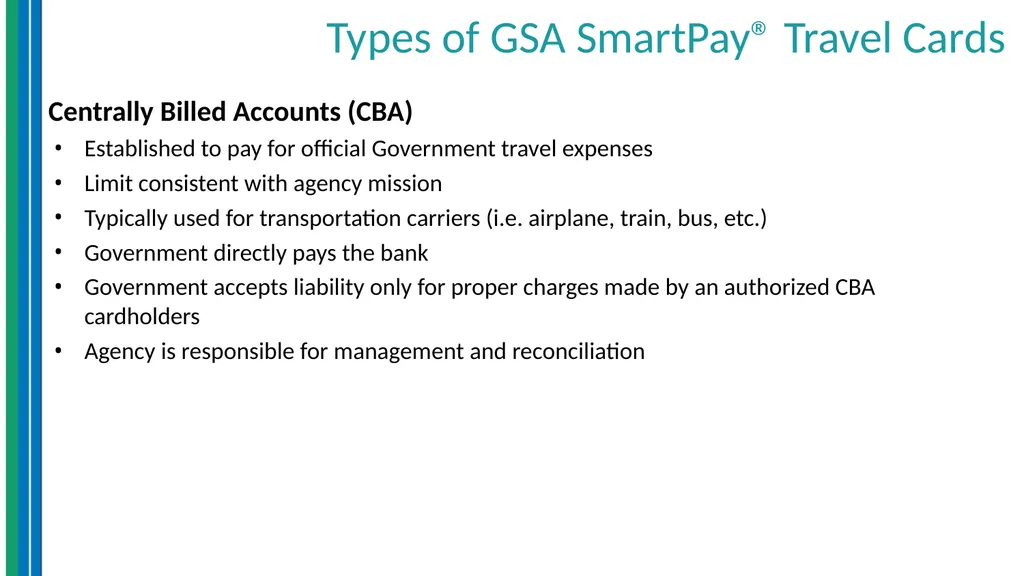
Types of GSA SmartPay® Travel Cards Centrally Billed Accounts (CBA)
Established to pay for official Government travel expenses
Limit consistent with agency mission
Typically used for transportation carriers (i.e. airplane, train, bus, etc.)
Government directly pays the bank
Government accepts liability only for proper charges made by an authorized CBA cardholders
Agency is responsible for management and reconciliation<br>
Established to pay for official Government travel expenses
Limit consistent with agency mission
Typically used for transportation carriers (i.e. airplane, train, bus, etc.)
Government directly pays the bank
Government accepts liability only for proper charges made by an authorized CBA cardholders
Agency is responsible for management and reconciliation<br>
17
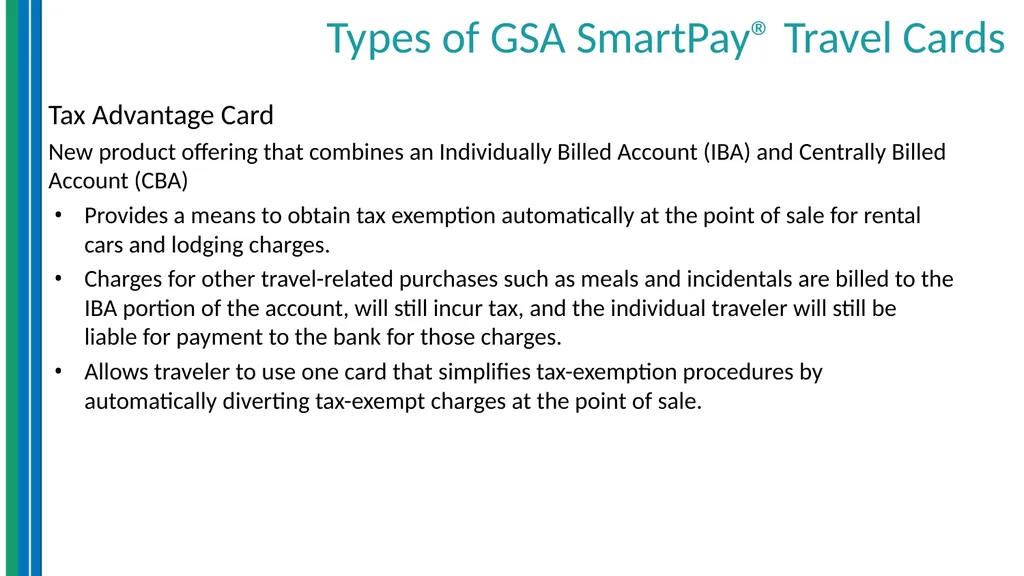
Types of GSA SmartPay® Travel Cards Tax Advantage Card
New product offering that combines an Individually Billed Account (IBA) and Centrally Billed Account (CBA)
Provides a means to obtain tax exemption automatically at the point of sale for rental cars and lodging charges.
Charges for other travel-related purchases such as meals and incidentals are billed to the IBA portion of the account, will still incur tax, and the individual traveler will still be liable for payment to the bank for those charges.
Allows traveler to use one card that simplifies tax-exemption procedures by automatically diverting tax-exempt charges at the point of sale.<br>
New product offering that combines an Individually Billed Account (IBA) and Centrally Billed Account (CBA)
Provides a means to obtain tax exemption automatically at the point of sale for rental cars and lodging charges.
Charges for other travel-related purchases such as meals and incidentals are billed to the IBA portion of the account, will still incur tax, and the individual traveler will still be liable for payment to the bank for those charges.
Allows traveler to use one card that simplifies tax-exemption procedures by automatically diverting tax-exempt charges at the point of sale.<br>
18
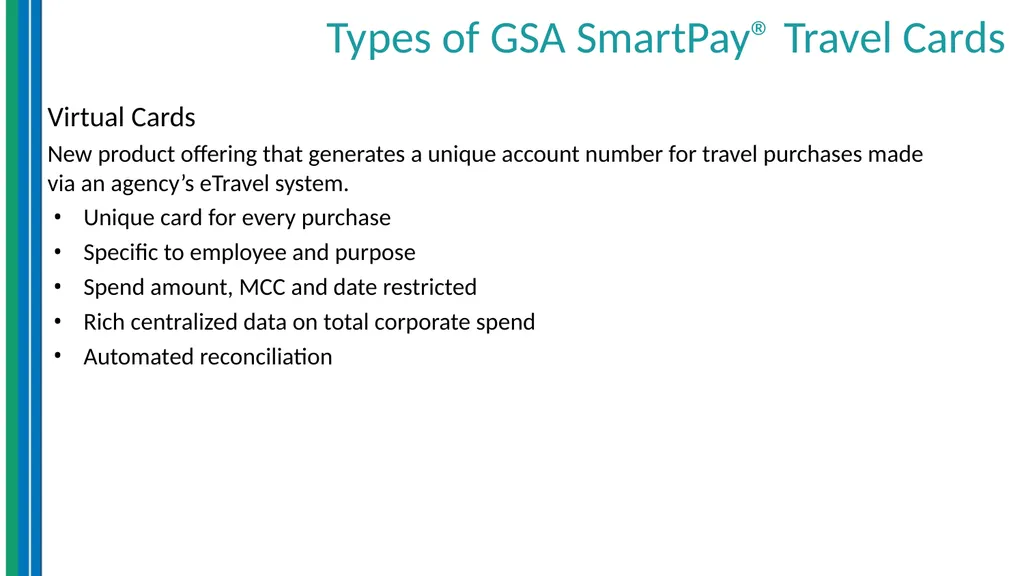
Types of GSA SmartPay® Travel Cards Virtual Cards
New product offering that generates a unique account number for travel purchases made via an agency’s eTravel system.
Unique card for every purchase
Specific to employee and purpose
Spend amount, MCC and date restricted
Rich centralized data on total corporate spend
Automated reconciliation<br>
New product offering that generates a unique account number for travel purchases made via an agency’s eTravel system.
Unique card for every purchase
Specific to employee and purpose
Spend amount, MCC and date restricted
Rich centralized data on total corporate spend
Automated reconciliation<br>
19
Roles and Responsibilities<br>
20
Agency Roles and Responsibilities When establishing a GSA SmartPay® Travel Card Program, agencies:
Designate an Agency/Organization Program Coordinator (A/OPC)
Identify account holders
Designate a billing and disputes office<br>
Designate an Agency/Organization Program Coordinator (A/OPC)
Identify account holders
Designate a billing and disputes office<br>
21
A/OPC Roles and Responsibilities Agency/Organization Program Coordinators (A/OPC) are responsible for the overall management/oversight of the accounts. They act as liaisons between agency management, GSA SmartPay® contractor banks, and cardholders. Roles may differ, but responsibilities could include:
Managing the GSA SmartPay® Travel Card program and promoting the proper use of travel cards
Auditing travel card accounts and taking appropriate action in the instances of fraud, waste, or abuse
Resolving travel card issues, as required
Developing agency/organization-specific policies and procedures, as necessary<br>
Managing the GSA SmartPay® Travel Card program and promoting the proper use of travel cards
Auditing travel card accounts and taking appropriate action in the instances of fraud, waste, or abuse
Resolving travel card issues, as required
Developing agency/organization-specific policies and procedures, as necessary<br>
22
AO Roles and Responsibilities Approving Officials (AO) are typically the account holder’s supervisor and assures proper use of the travel card. They play key roles in preventing fraud, abuse, and misuse. Roles may differ, but responsibilities could include:
Reviewing and approving all GSA SmartPay® travel vouchers
Verifying charges were within scope of government travel
Monitoring for and resolving all questionable charges
Verifying receipt of purchases and/or transactions<br>
Reviewing and approving all GSA SmartPay® travel vouchers
Verifying charges were within scope of government travel
Monitoring for and resolving all questionable charges
Verifying receipt of purchases and/or transactions<br>
23
Cardholder Roles and Responsibilities Cardholders must use the GSA SmartPay® travel card in accordance with agency policy and government regulations. Cardholders should:
Secure the travel card and immediately report a lost or stolen card
Monitor and track expenses, as well as maintain receipts, in accordance with agency policy
Use the card ethically - for official travel expenses only
Ensure vouchers are submitted in a timely manner and submit full payment for each undisputed bill
Keep up to date with program and agency-specific training requirements and communications from A/OPCs (and take appropriate action, as necessary)<br>
Secure the travel card and immediately report a lost or stolen card
Monitor and track expenses, as well as maintain receipts, in accordance with agency policy
Use the card ethically - for official travel expenses only
Ensure vouchers are submitted in a timely manner and submit full payment for each undisputed bill
Keep up to date with program and agency-specific training requirements and communications from A/OPCs (and take appropriate action, as necessary)<br>
24
Cardholder Roles and Responsibilities Cardholders must NEVER:
Use the GSA SmartPay® Travel Card for personal use
Obtain ATM advances that exceed expected out-of-pocket expenditures
Allow monthly bill to become overdue; this could result in suspension or cancellation
Wait for receipt of the monthly bill to file claims
Pay for another employee’s travel card expenses
Write Personal Identification Numbers (PIN) on the GSA SmartPay® charge card<br>
Use the GSA SmartPay® Travel Card for personal use
Obtain ATM advances that exceed expected out-of-pocket expenditures
Allow monthly bill to become overdue; this could result in suspension or cancellation
Wait for receipt of the monthly bill to file claims
Pay for another employee’s travel card expenses
Write Personal Identification Numbers (PIN) on the GSA SmartPay® charge card<br>
25
Bank Roles and Responsibilities The GSA SmartPay® Program contractor banks (Citibank, and U.S. Bank) have important responsibilities, which include:
Paying the merchants for credit card transactions
Establishing accounts and issuing charge cards
Preparing monthly statements for the cardholders
Providing A/OPC or AO with the ability to view current statements, payment history, and account information to make payments electronically
Issuing required reports to A/OPCs
Providing assistance with audits and investigations<br>
Paying the merchants for credit card transactions
Establishing accounts and issuing charge cards
Preparing monthly statements for the cardholders
Providing A/OPC or AO with the ability to view current statements, payment history, and account information to make payments electronically
Issuing required reports to A/OPCs
Providing assistance with audits and investigations<br>
26
Best Practices in Travel Card Management<br>
27
Communicate with Cardholders Successful GSA SmartPay® Travel Card Programs communicate travel policy, procedures, and updates with their cardholders. For example, consider:
Publishing “Frequently Asked Questions” on the agency/organization’s internal website
Creating a monthly newsletter for updates on travel policies and procedures<br>
Publishing “Frequently Asked Questions” on the agency/organization’s internal website
Creating a monthly newsletter for updates on travel policies and procedures<br>
28
Opportunities for Increased Savings By using the GSA SmartPay® travel card, there are opportunities for increased savings to the Federal government. Agencies should:
Emphasize that use of the GSA SmartPay® travel card for official Federal government travel expenses is required by the Federal Travel Regulations and benefits agencies from a refund perspective
Leverage GSA SmartPay® contract bank processes to reduce improperly assessed state taxes on IBA travel cards<br>
Emphasize that use of the GSA SmartPay® travel card for official Federal government travel expenses is required by the Federal Travel Regulations and benefits agencies from a refund perspective
Leverage GSA SmartPay® contract bank processes to reduce improperly assessed state taxes on IBA travel cards<br>
29
Tax Exemption Savings GSA’s Center for Charge Card Management (CCCM) maintains a list of tax-exempt states. For a complete listing of states, requirements, and forms, visit the GSA SmartPay® website. Please note:
In accordance with the Supremacy clause of the U.S. Constitution, CBA charge cards are always exempt from taxes in all 50 states and U.S. territories; however, some states require CBA tax exemption forms for CBA travel cards
IBA charge cards are exempt from taxes in some states<br>
In accordance with the Supremacy clause of the U.S. Constitution, CBA charge cards are always exempt from taxes in all 50 states and U.S. territories; however, some states require CBA tax exemption forms for CBA travel cards
IBA charge cards are exempt from taxes in some states<br>
30
Mitigating Abuse and Misuse Abuse and misuse impacts travel card performance and refund earning potential. Mitigation strategies include:
Implementing proper training
Emphasizing standards of conduct/ethics and clearly state consequences for misuse
Monitoring authorization controls and setting reasonable credit and transaction limits
Reviewing card activity and restricting spend use through Merchant Category Code (MCC) blocks
Managing delinquency
Deactivating cards, as appropriate<br>
Implementing proper training
Emphasizing standards of conduct/ethics and clearly state consequences for misuse
Monitoring authorization controls and setting reasonable credit and transaction limits
Reviewing card activity and restricting spend use through Merchant Category Code (MCC) blocks
Managing delinquency
Deactivating cards, as appropriate<br>
31
Fulfilling Training Requirements OMB Circular A-123, Appendix B discusses training requirements. Cardholders must take mandatory training and A/OPCs should:
Ensure cardholders fulfill training requirements
Provide comprehensive in-person training/orientation for new cardholders, if possible
Engage in bank-sponsored training
Ensure training is easily accessible
Address standards of conduct/ethics and clearly state consequences for misuse<br>
Ensure cardholders fulfill training requirements
Provide comprehensive in-person training/orientation for new cardholders, if possible
Engage in bank-sponsored training
Ensure training is easily accessible
Address standards of conduct/ethics and clearly state consequences for misuse<br>
32
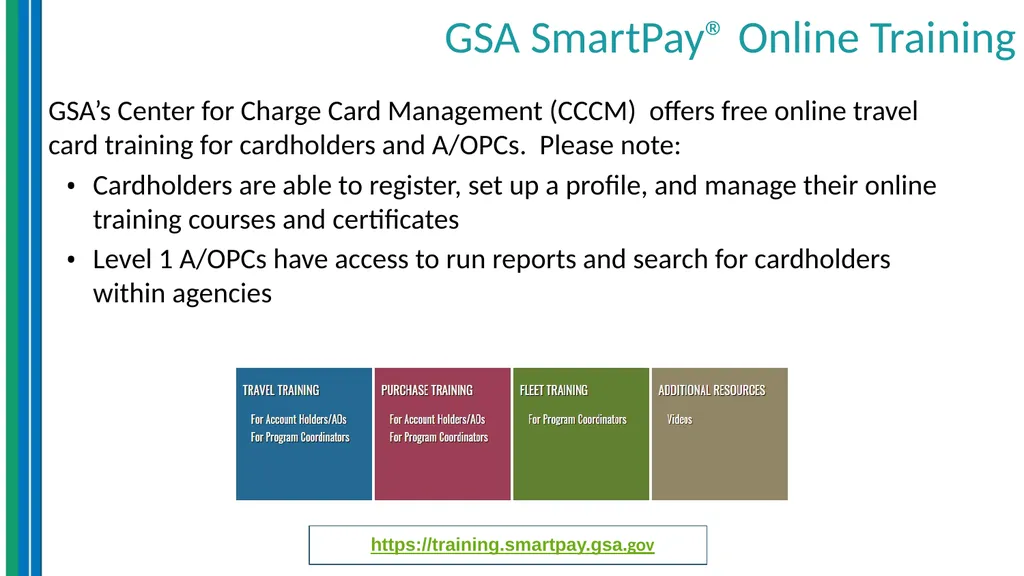
GSA SmartPay® Online Training GSA’s Center for Charge Card Management (CCCM) offers free online travel card training for cardholders and A/OPCs. Please note:
Cardholders are able to register, set up a profile, and manage their online training courses and certificates
Level 1 A/OPCs have access to run reports and search for cardholders within agencies<br>
Cardholders are able to register, set up a profile, and manage their online training courses and certificates
Level 1 A/OPCs have access to run reports and search for cardholders within agencies<br>
33
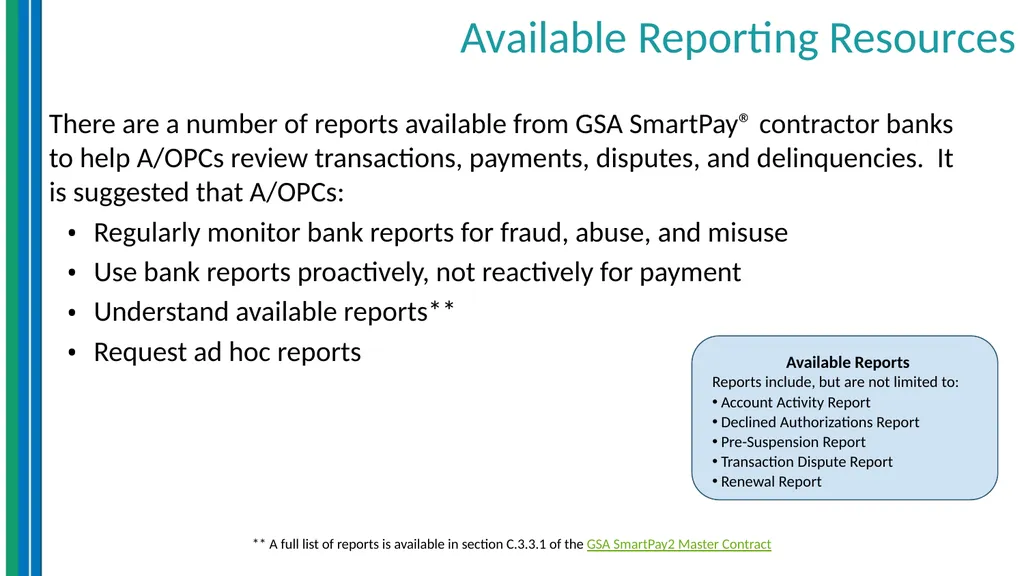
Available Reporting Resources There are a number of reports available from GSA SmartPay® contractor banks to help A/OPCs review transactions, payments, disputes, and delinquencies. It is suggested that A/OPCs:
Regularly monitor bank reports for fraud, abuse, and misuse
Use bank reports proactively, not reactively for payment
Understand available reports**
Request ad hoc reports ** A full list of reports is available in section C.3.3.1 of the GSA SmartPay2 Master Contract<br>
Regularly monitor bank reports for fraud, abuse, and misuse
Use bank reports proactively, not reactively for payment
Understand available reports**
Request ad hoc reports ** A full list of reports is available in section C.3.3.1 of the GSA SmartPay2 Master Contract<br>
34
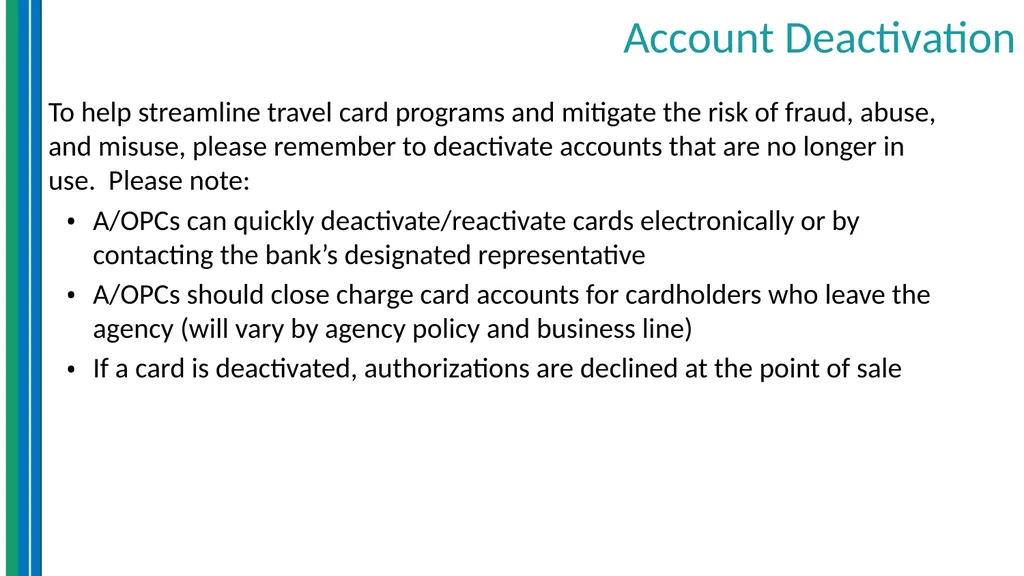
Account Deactivation To help streamline travel card programs and mitigate the risk of fraud, abuse, and misuse, please remember to deactivate accounts that are no longer in use. Please note:
A/OPCs can quickly deactivate/reactivate cards electronically or by contacting the bank’s designated representative
A/OPCs should close charge card accounts for cardholders who leave the agency (will vary by agency policy and business line)
If a card is deactivated, authorizations are declined at the point of sale<br>
A/OPCs can quickly deactivate/reactivate cards electronically or by contacting the bank’s designated representative
A/OPCs should close charge card accounts for cardholders who leave the agency (will vary by agency policy and business line)
If a card is deactivated, authorizations are declined at the point of sale<br>
35
Contact Information<br>
36
GSA Contact Information GSA SmartPay® Program
Helpline: (703) 605-2808
Website: http://www.smartpay.gsa.gov
Email: gsa_smartpay@gsa.gov
GSA SmartPay®’s Social Media Pages:
Twitter
Facebook
LinkedIn<br>
Helpline: (703) 605-2808
Website: http://www.smartpay.gsa.gov
Email: gsa_smartpay@gsa.gov
GSA SmartPay®’s Social Media Pages:
LinkedIn<br>
37
Bank Contact Information Bank Contact Information:
Citibank
Customer Service: (800) 790-7206
U.S. Bank Customer Service: (888) 994-6722<br>
Citibank
Customer Service: (800) 790-7206
U.S. Bank Customer Service: (888) 994-6722<br>
38
Audience Questions<br>
39
Thank you for your time and attention! Contact Information
Erin VanDagna
Erin.VanDagna@gsa.gov<br>
Erin.VanDagna@gsa.gov<br>
40
GSA Starmark<br>