
Trees and Binary Trees Become Rich Force Others to
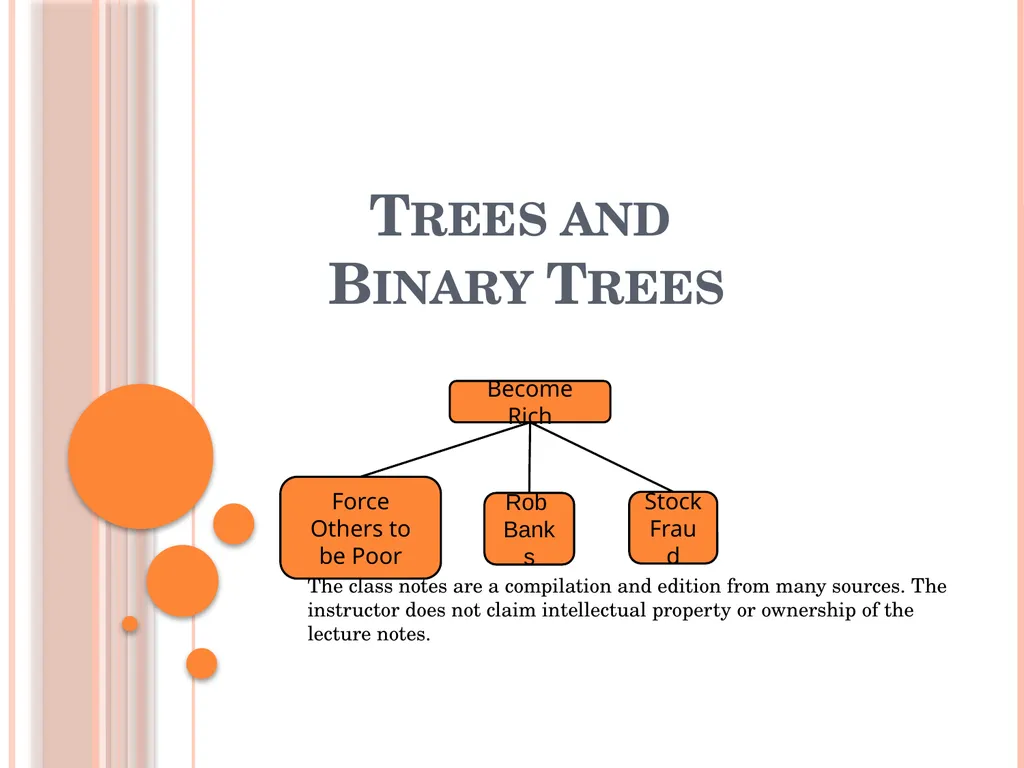
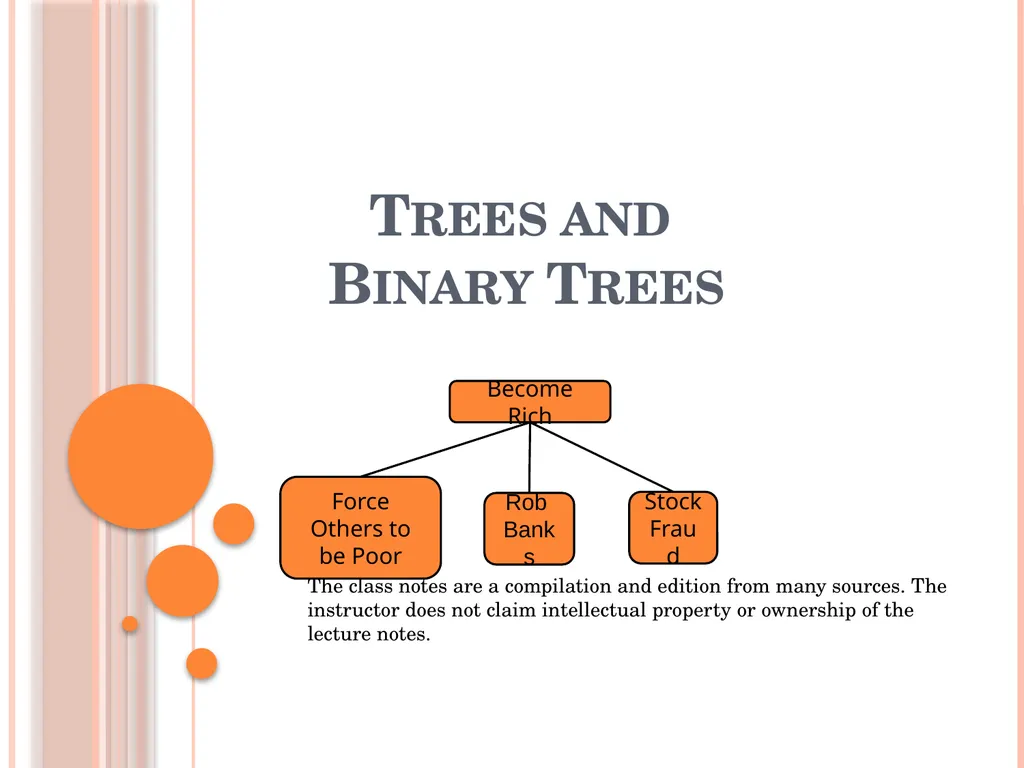
Description: Trees and Binary Trees Become Rich Force Others to be Poor Rob Banks Stock Fraud The class notes are a compilation and edition from many sources. The instructor does not claim intellectual property or ownership of the lecture notes. Nature
Related Topics
Download Presentation
"Trees and Binary Trees Become Rich Force Others to" is the property of its rightful owner. Permission is granted to download and print the materials on this website for personal, non-commercial use only, and to display it on your personal computer provided you do not modify the materials and that you retain all copyright notices contained in the materials. By downloading content from our website, you accept the terms of this agreement.
Presentation Transcript
slide1. Trees and
Binary Trees Become Rich Force Others to be Poor Rob
Banks Stock
Fraud The class notes are a compilation and edition from many sources. The instructor does not claim intellectual property or ownership of the lecture notes.<br>
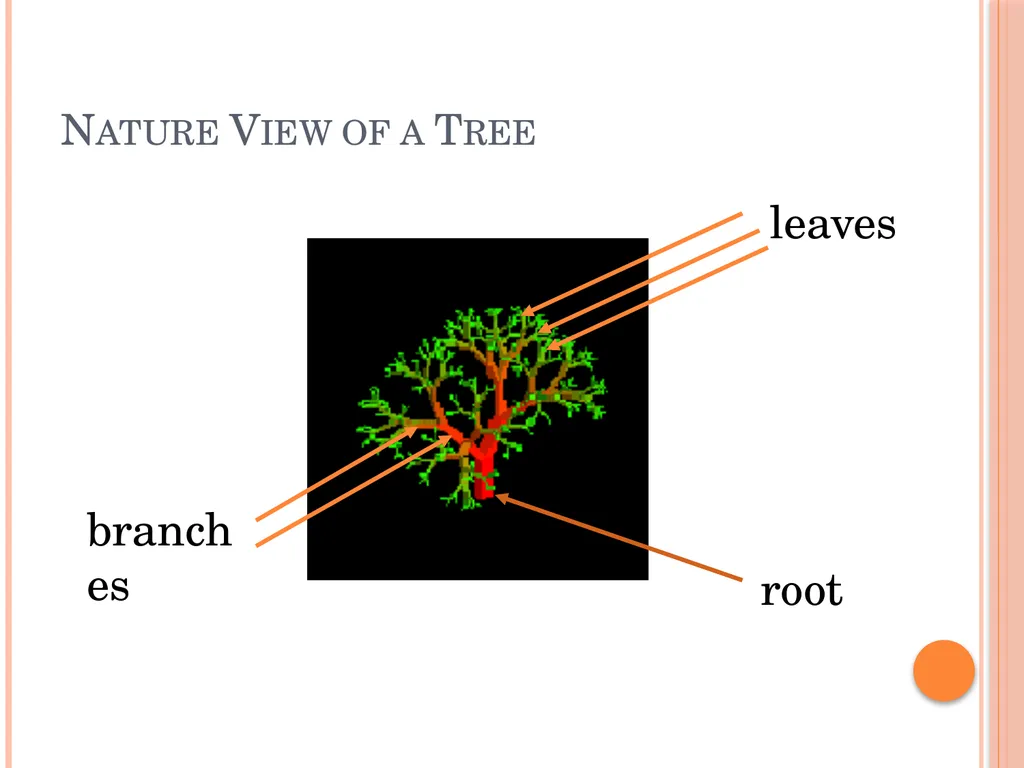
slide2. Nature View of a Tree branches leaves root<br>
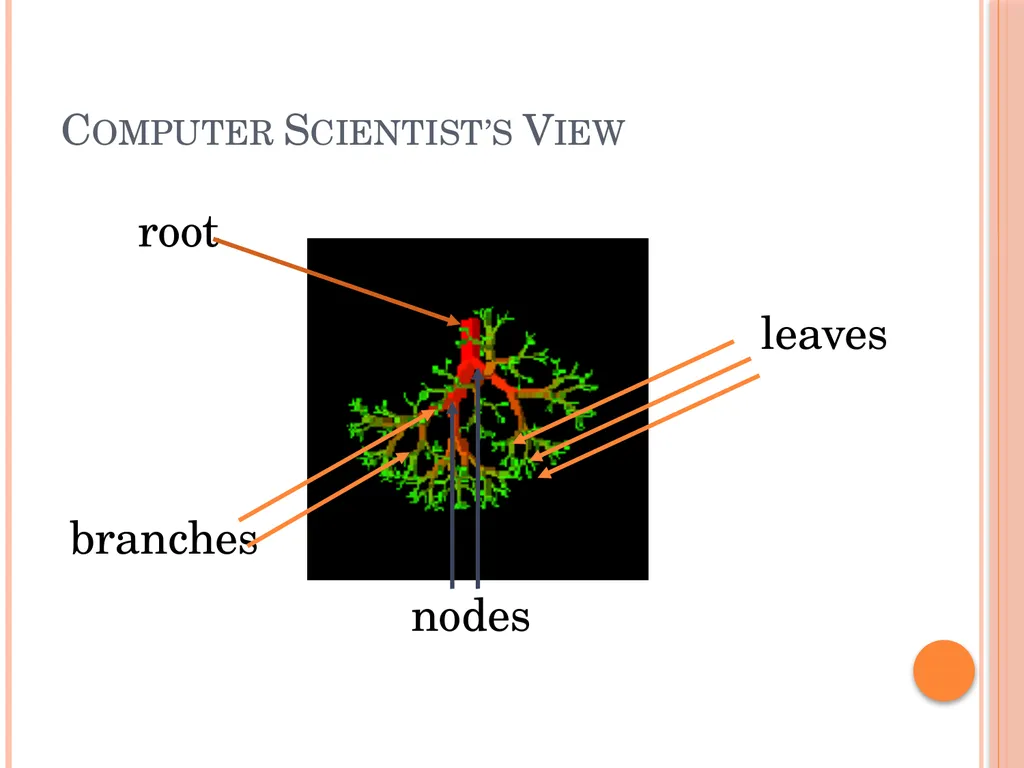
slide3. Computer Scientist’s View branches leaves<br>
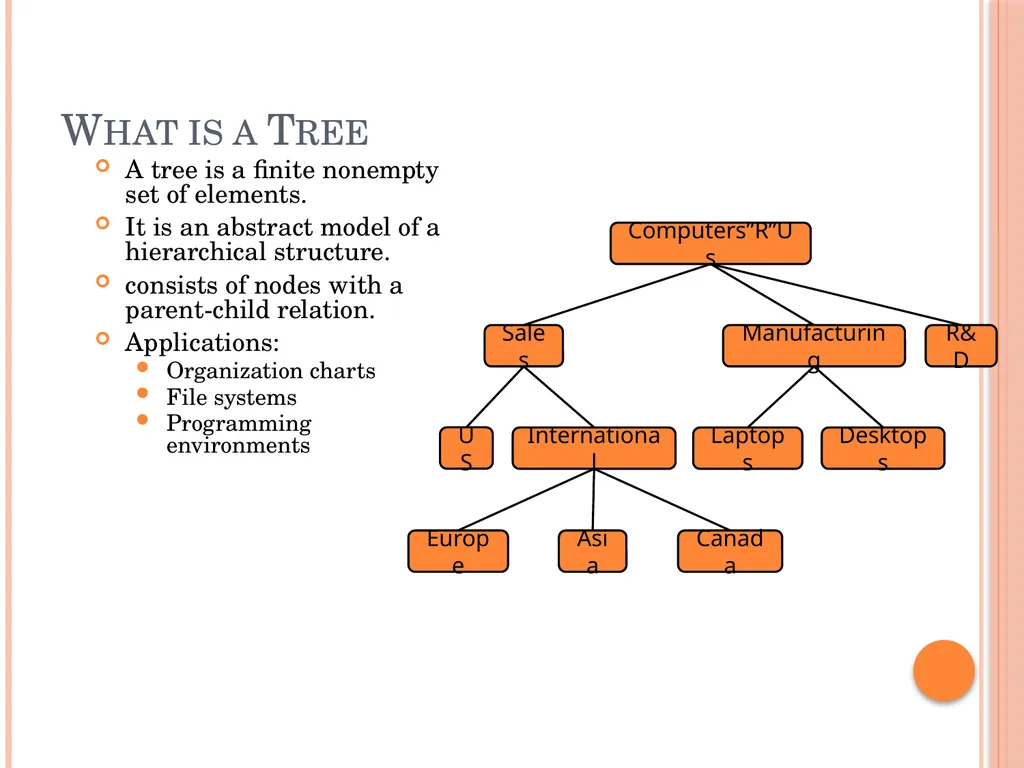
slide4. What is a Tree A tree is a finite nonempty set of elements.
It is an abstract model of a hierarchical structure.
consists of nodes with a parent-child relation.
Applications:
Organization charts
File systems
Programming environments<br>
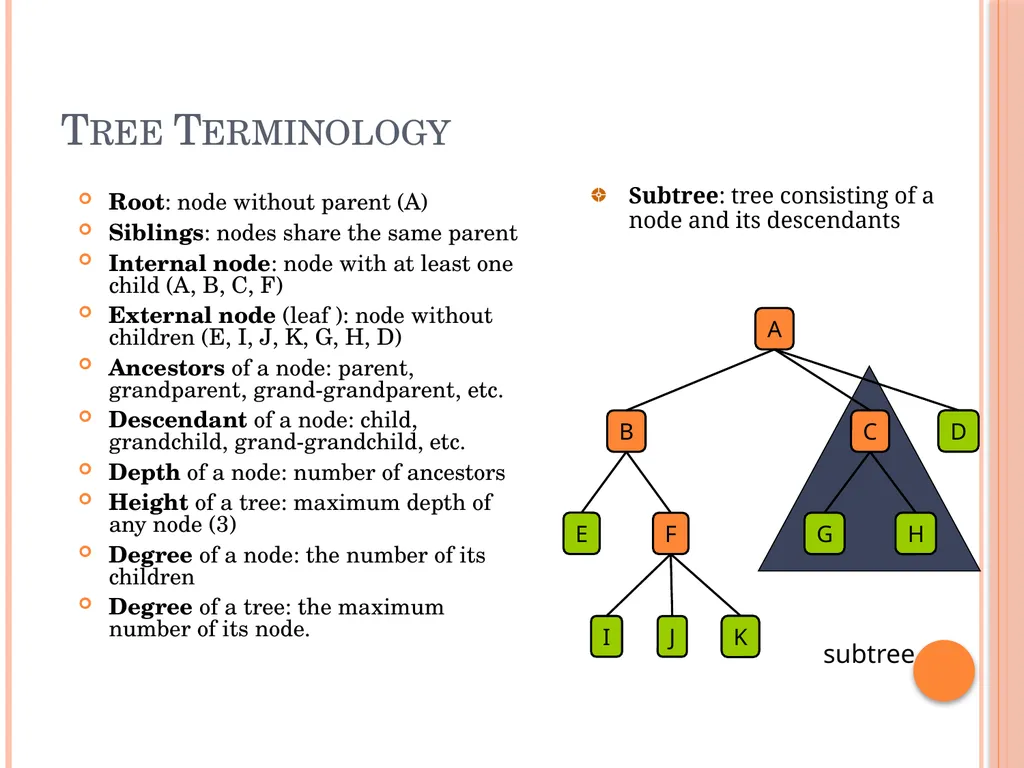
slide5. subtree Tree Terminology Root: node without parent (A)
Siblings: nodes share the same parent
Internal node: node with at least one child (A, B, C, F)
External node (leaf ): node without children (E, I, J, K, G, H, D)
Ancestors of a node: parent, grandparent, grand-grandparent, etc.
Descendant of a node: child, grandchild, grand-grandchild, etc.
Depth of a node: number of ancestors
Height of a tree: maximum depth of any node (3)
Degree of a node: the number of its children
Degree of a tree: the maximum number of its node. Subtree: tree consisting of a node and its descendants<br>
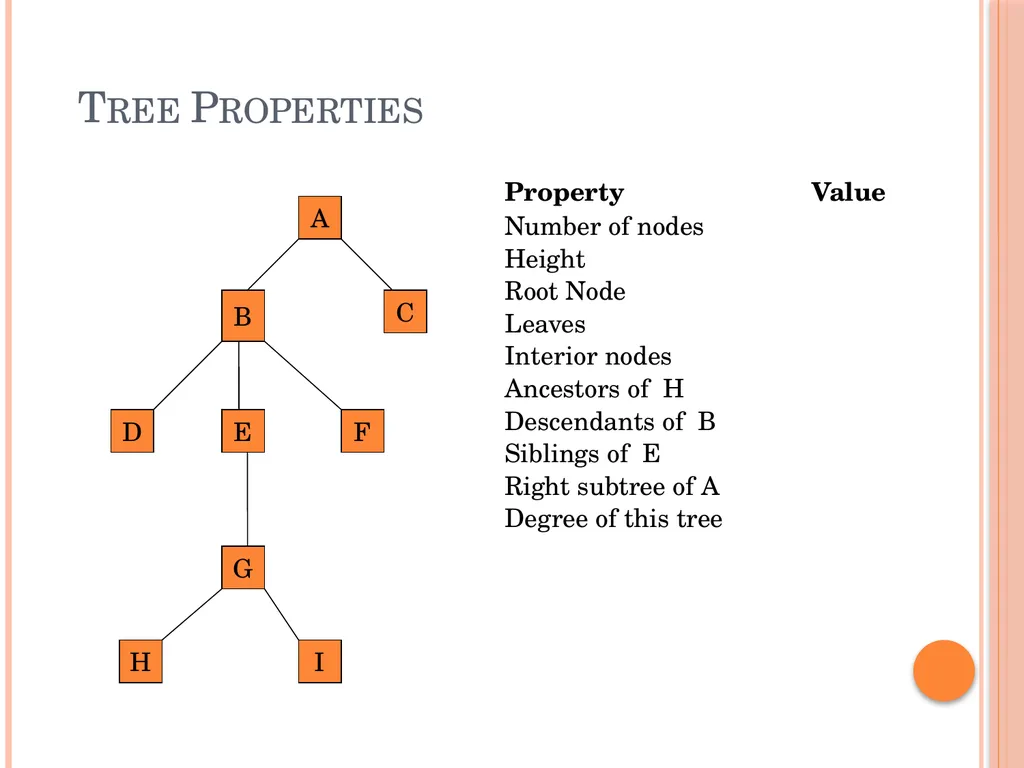
slide6. Tree Properties Property Value
Number of nodes
Height
Root Node
Leaves
Interior nodes
Ancestors of H
Descendants of B
Siblings of E
Right subtree of A
Degree of this tree<br>
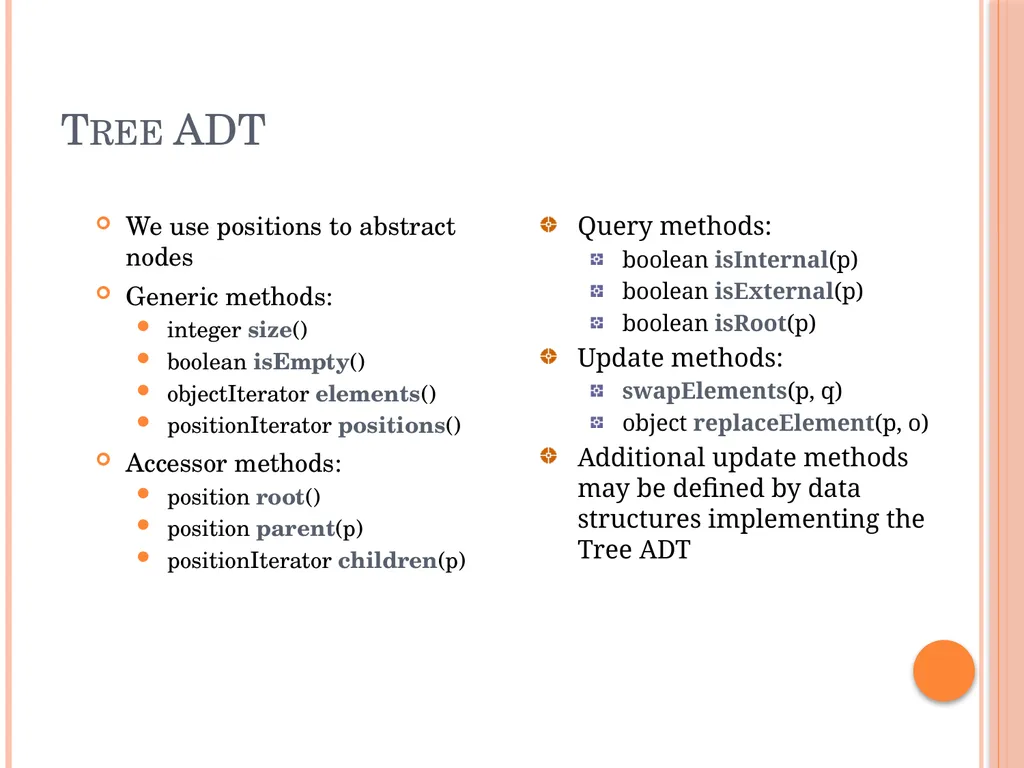
slide7. Tree ADT We use positions to abstract nodes
Generic methods:
integer size()
boolean isEmpty()
objectIterator elements()
positionIterator positions()
Accessor methods:
position root()
position parent(p)
positionIterator children(p) Query methods:
boolean isInternal(p)
boolean isExternal(p)
boolean isRoot(p)
Update methods:
swapElements(p, q)
object replaceElement(p, o)
Additional update methods may be defined by data structures implementing the Tree ADT<br>
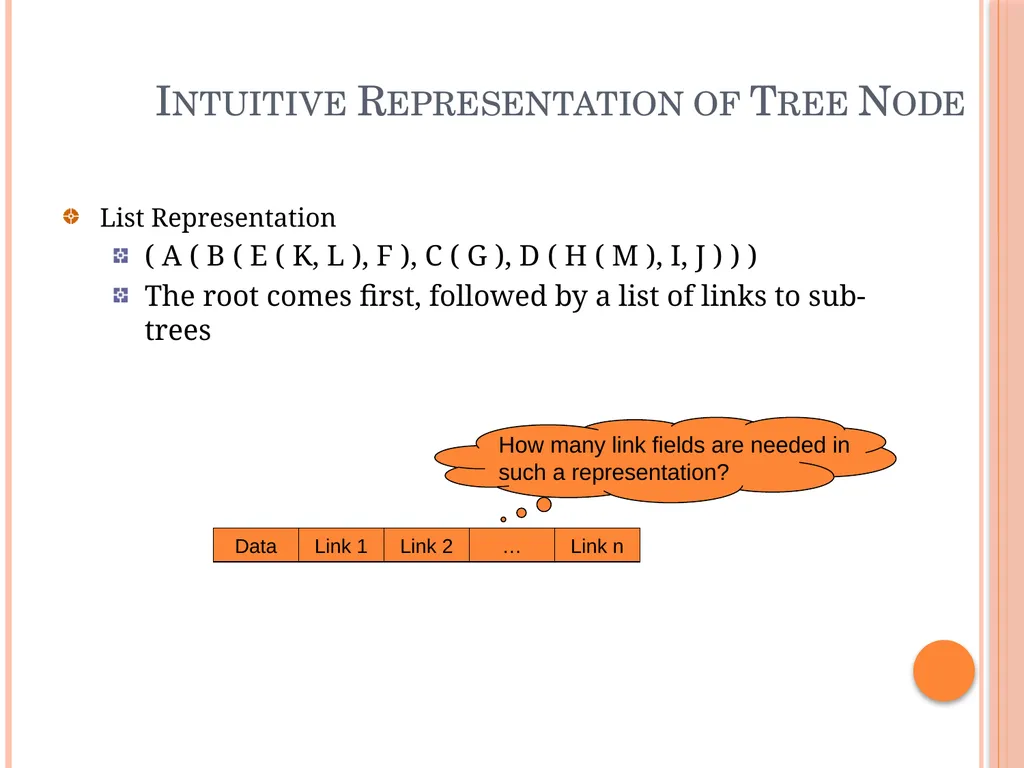
slide8. Intuitive Representation of Tree Node List Representation
( A ( B ( E ( K, L ), F ), C ( G ), D ( H ( M ), I, J ) ) )
The root comes first, followed by a list of links to sub-trees How many link fields are needed in
such a representation?<br>
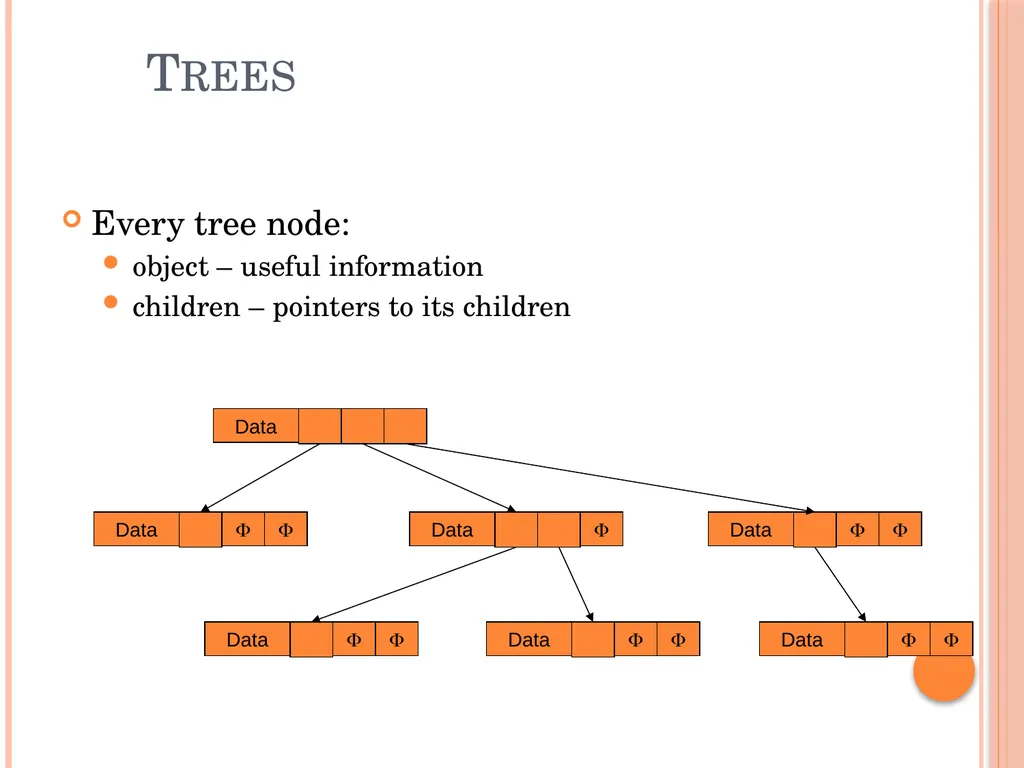
slide9. Trees Every tree node:
object – useful information
children – pointers to its children<br>
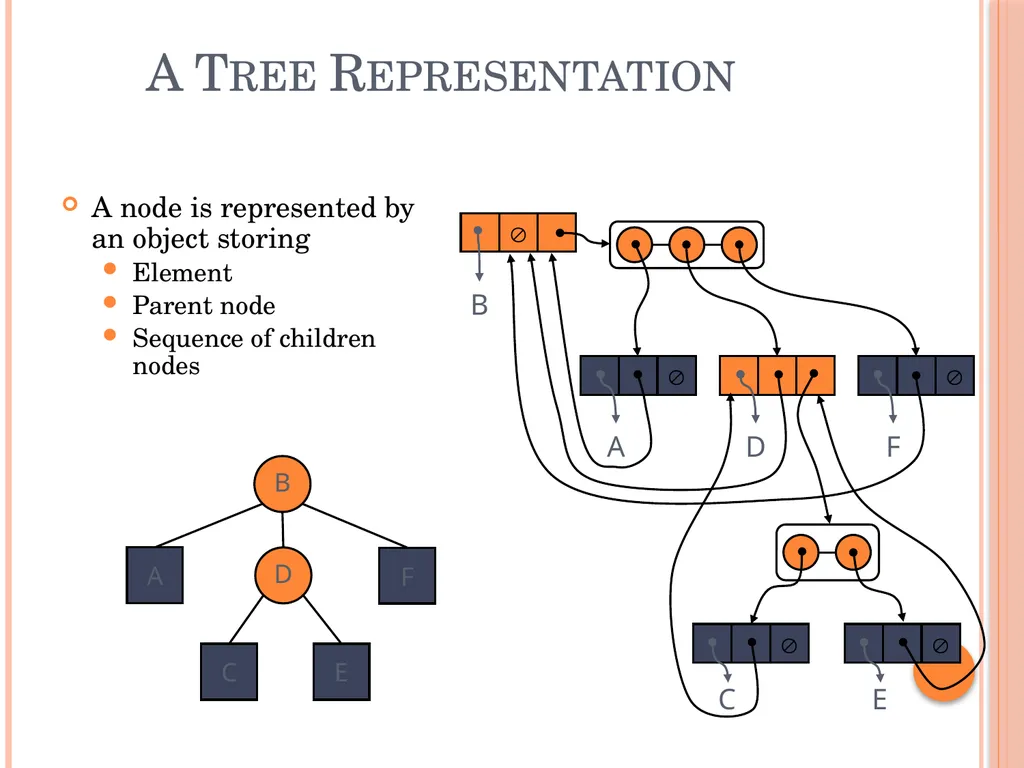
slide10. A Tree Representation A node is represented by an object storing
Element
Parent node
Sequence of children nodes<br>
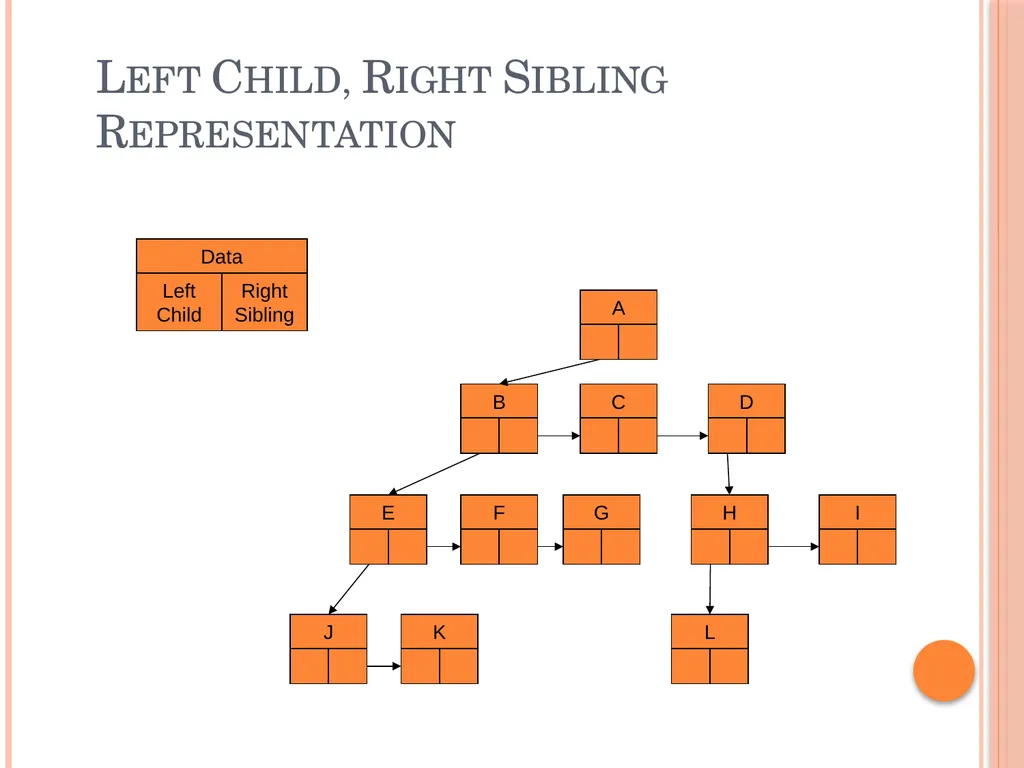
slide11. Left Child, Right Sibling Representation<br>
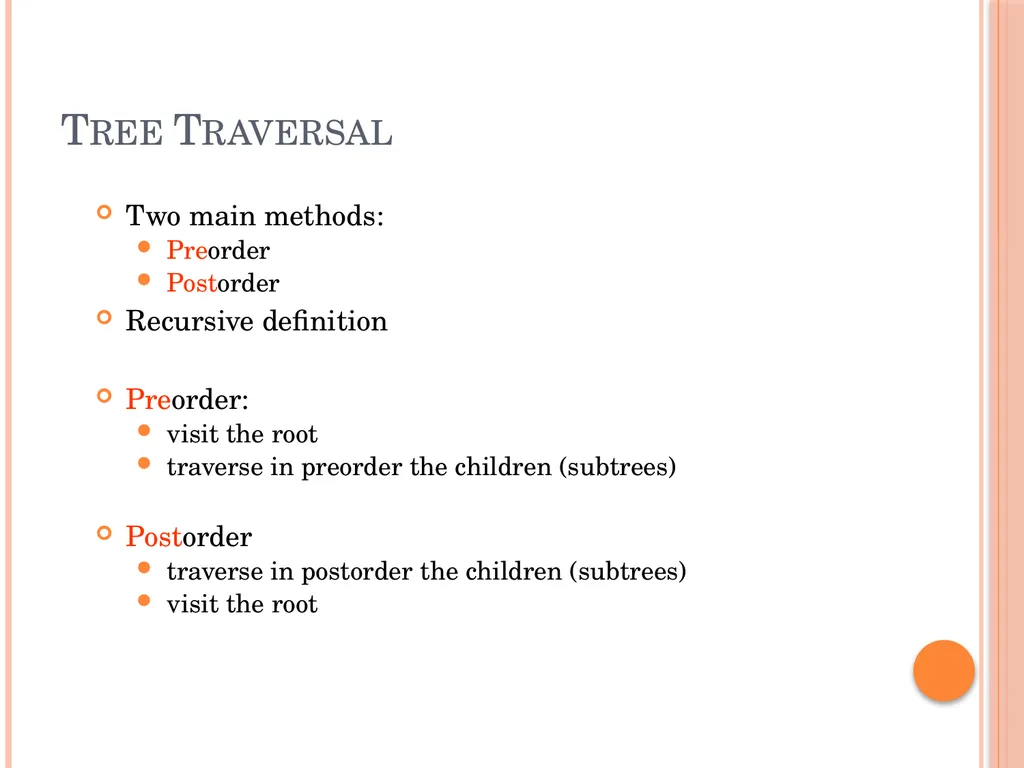
slide12. Tree Traversal Two main methods:
Preorder
Postorder
Recursive definition
Preorder:
visit the root
traverse in preorder the children (subtrees)
Postorder
traverse in postorder the children (subtrees)
visit the root<br>
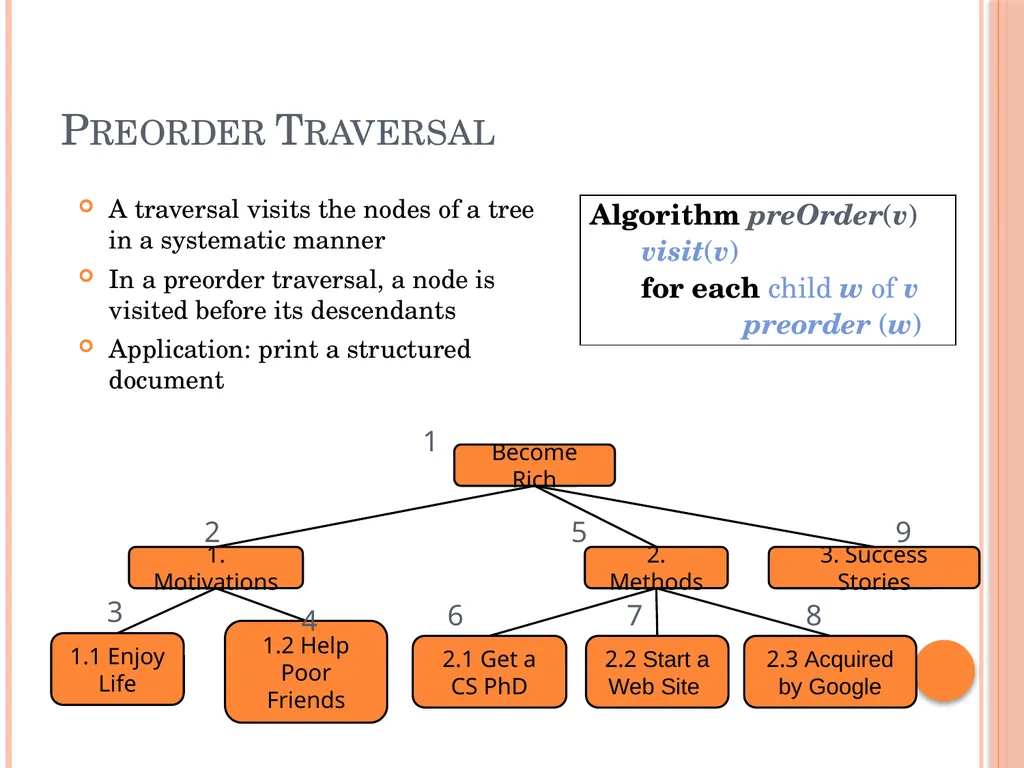
slide13. Preorder Traversal A traversal visits the nodes of a tree in a systematic manner
In a preorder traversal, a node is visited before its descendants
Application: print a structured document Algorithm preOrder(v)
visit(v)
for each child w of v
preorder (w)<br>
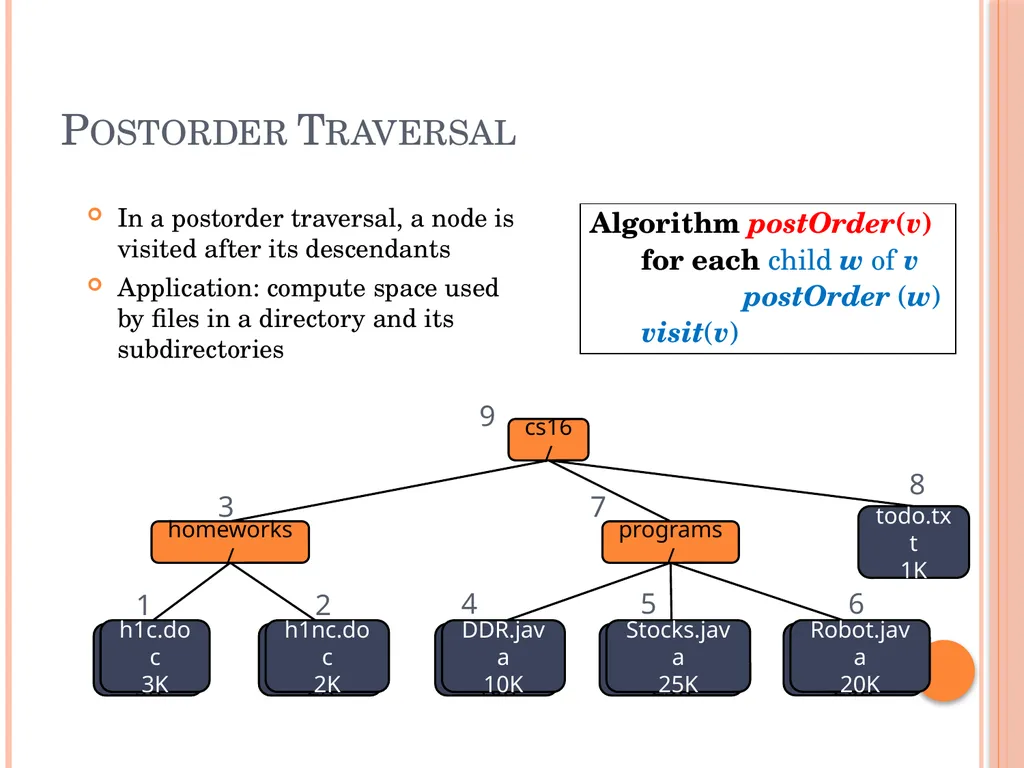
slide14. Postorder Traversal In a postorder traversal, a node is visited after its descendants
Application: compute space used by files in a directory and its subdirectories Algorithm postOrder(v)
for each child w of v
postOrder (w)
visit(v)<br>
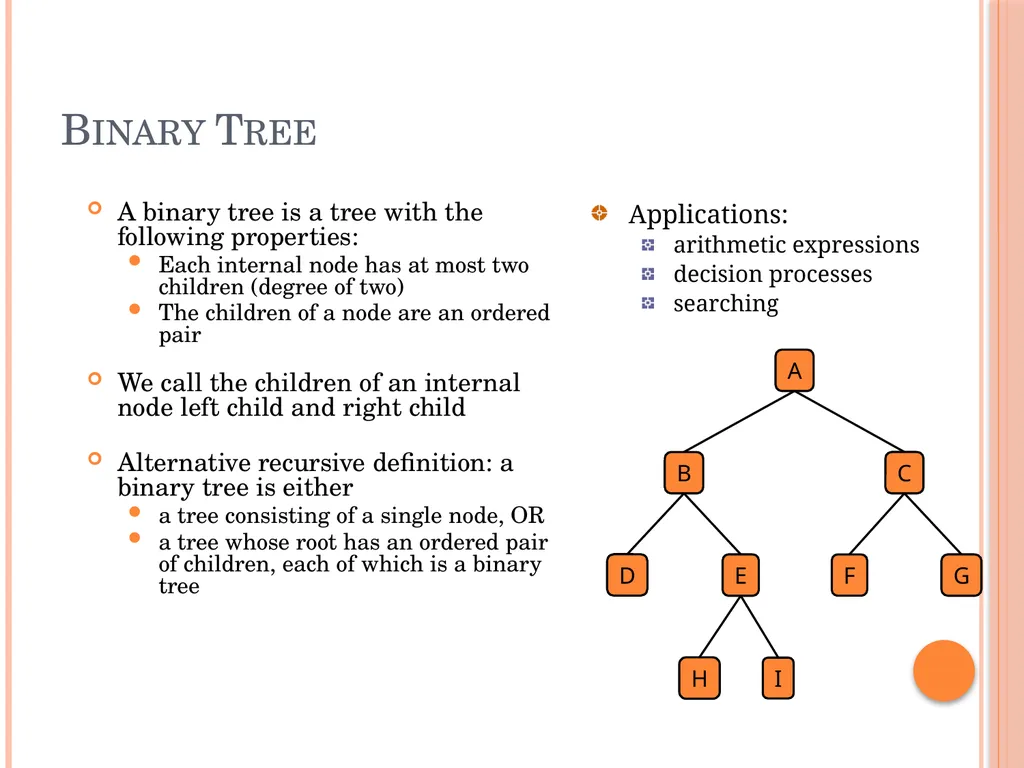
slide15. Binary Tree A binary tree is a tree with the following properties:
Each internal node has at most two children (degree of two)
The children of a node are an ordered pair
We call the children of an internal node left child and right child
Alternative recursive definition: a binary tree is either
a tree consisting of a single node, OR
a tree whose root has an ordered pair of children, each of which is a binary tree Applications:
arithmetic expressions
decision processes
searching A B C F G D E H I<br>
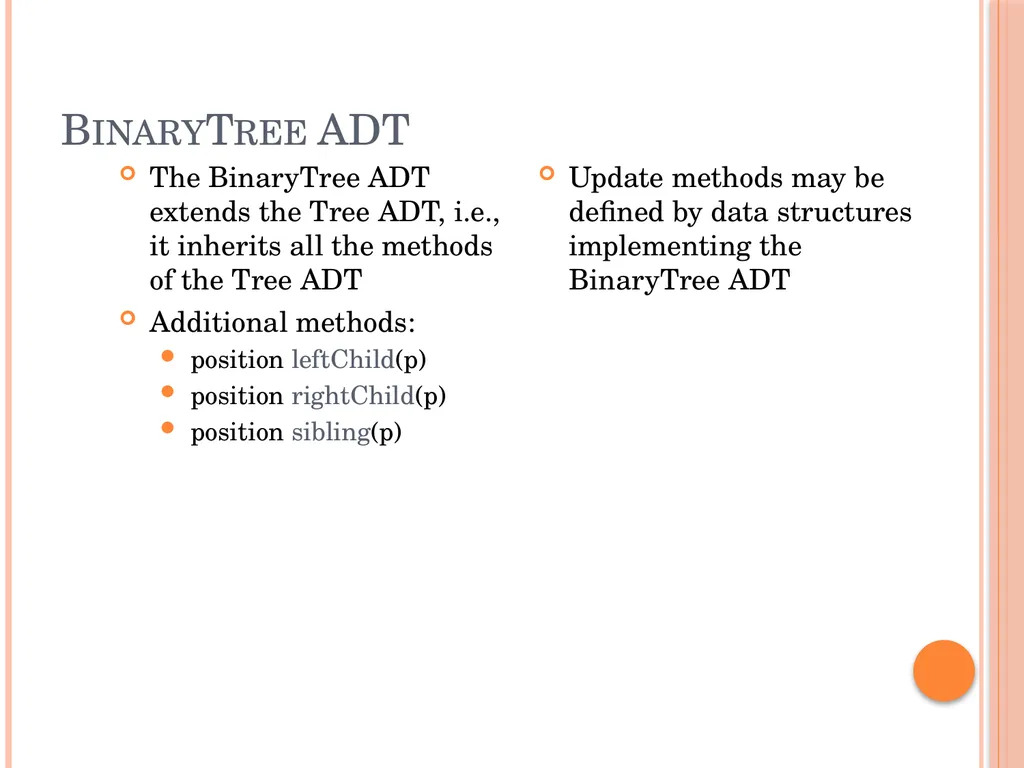
slide16. BinaryTree ADT The BinaryTree ADT extends the Tree ADT, i.e., it inherits all the methods of the Tree ADT
Additional methods:
position leftChild(p)
position rightChild(p)
position sibling(p) Update methods may be defined by data structures implementing the BinaryTree ADT<br>
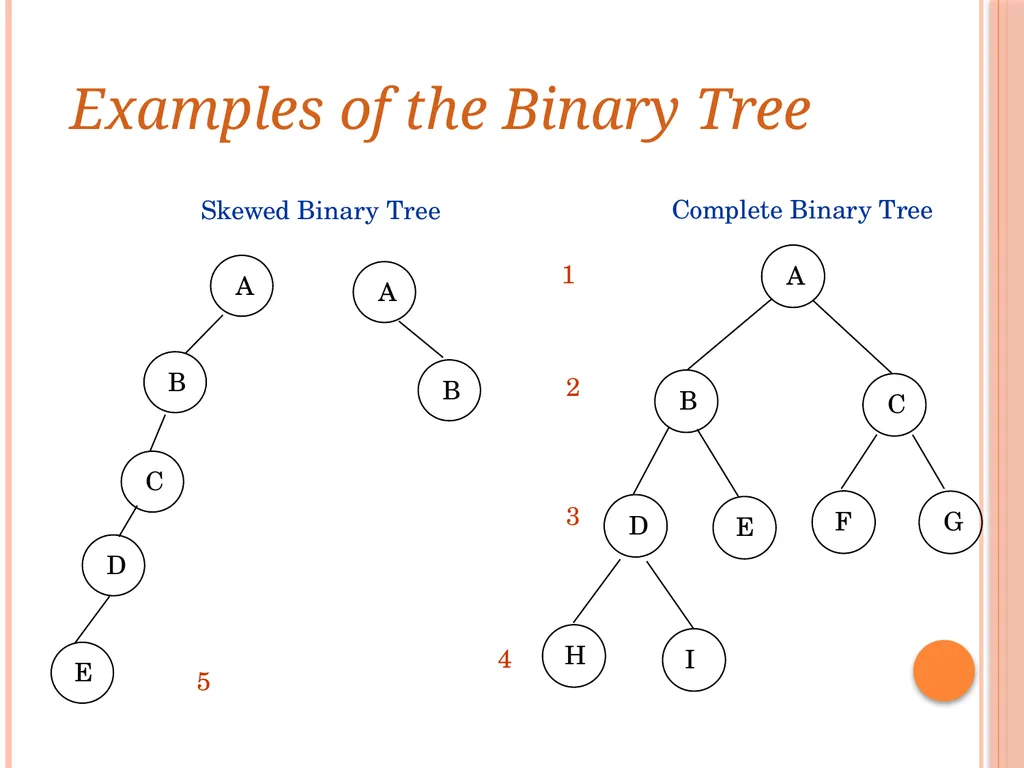
slide17. Examples of the Binary Tree<br>
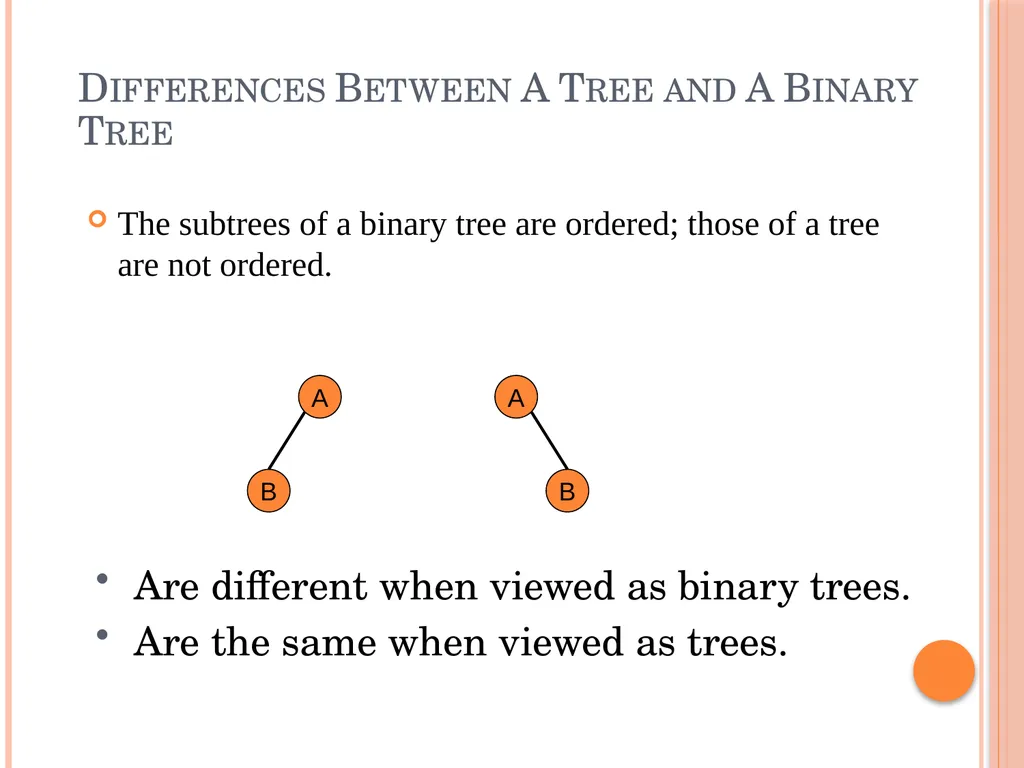
slide18. Differences Between A Tree and A Binary Tree The subtrees of a binary tree are ordered; those of a tree are not ordered. Are different when viewed as binary trees.
Are the same when viewed as trees.<br>
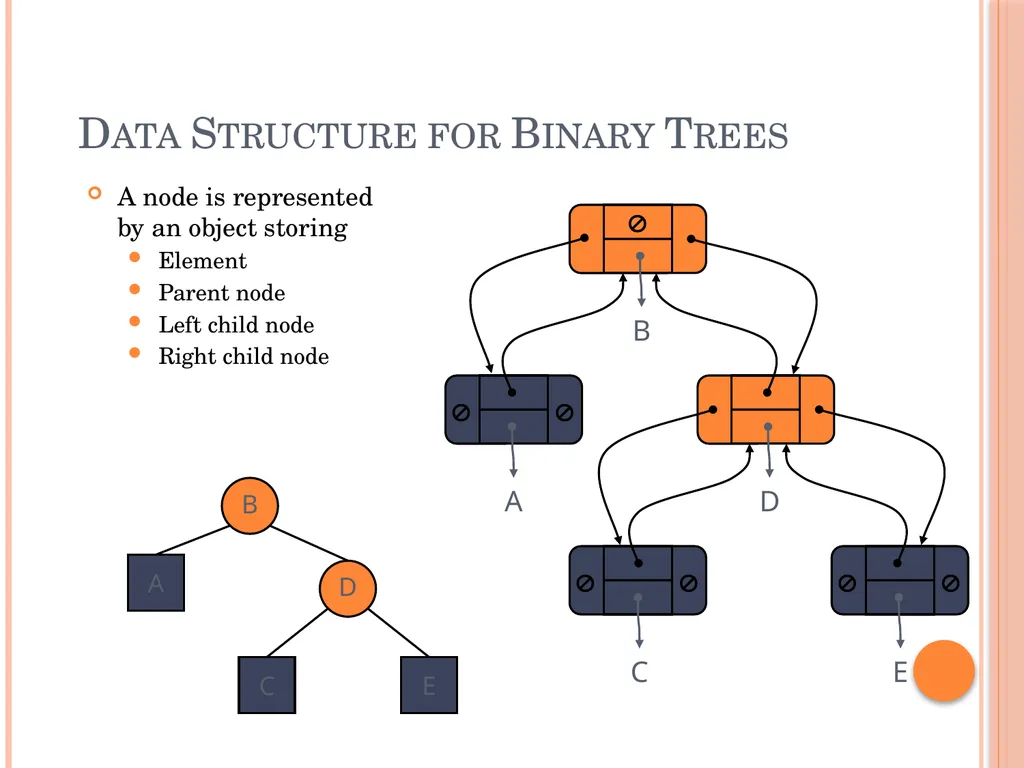
slide19. Data Structure for Binary Trees A node is represented by an object storing
Element
Parent node
Left child node
Right child node<br>
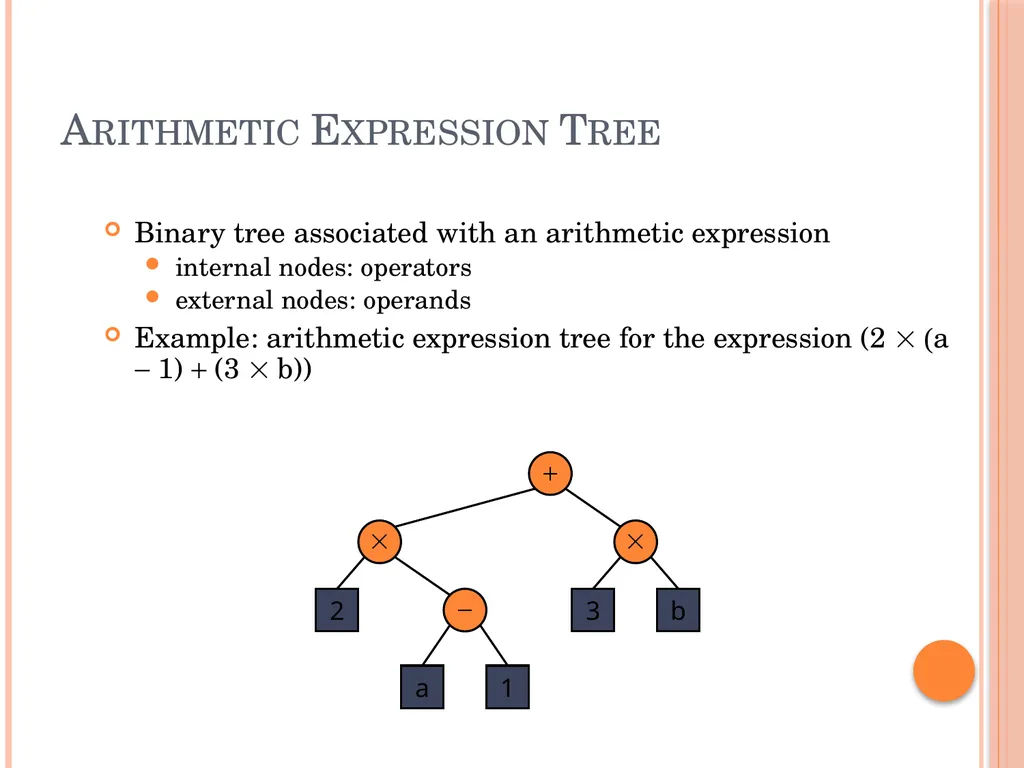
slide20. Arithmetic Expression Tree Binary tree associated with an arithmetic expression
internal nodes: operators
external nodes: operands
Example: arithmetic expression tree for the expression (2 (a - 1) + (3 b))<br>
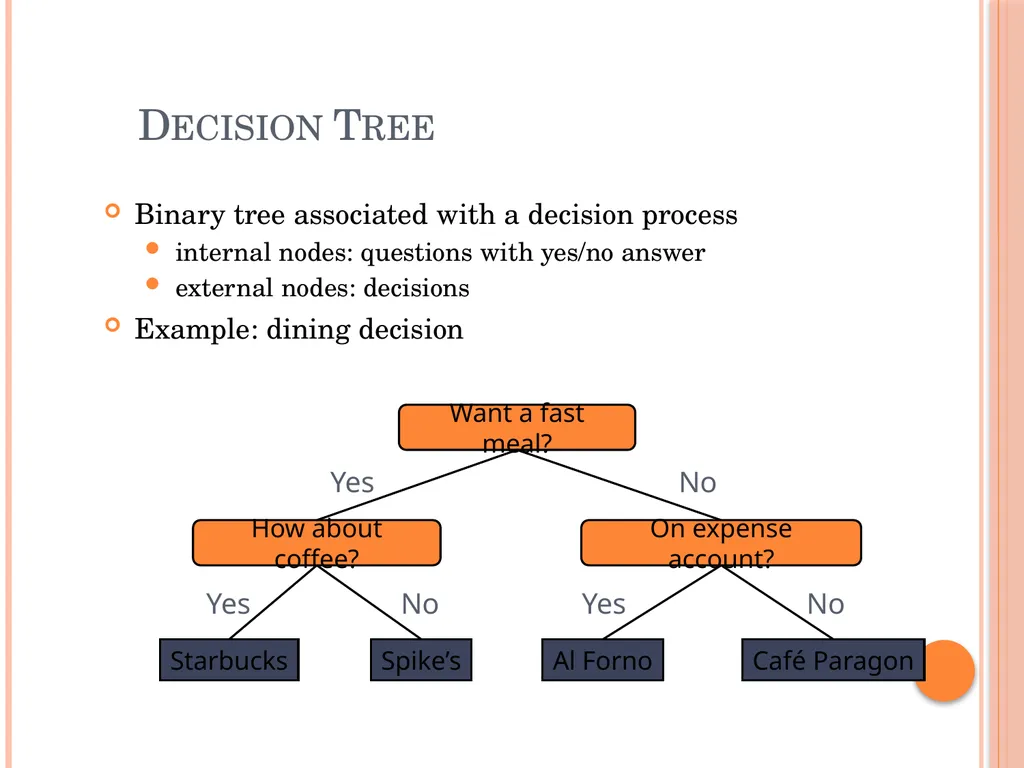
slide21. Decision Tree Binary tree associated with a decision process
internal nodes: questions with yes/no answer
external nodes: decisions
Example: dining decision Want a fast meal? How about coffee? On expense account? Starbucks Spike’s Al Forno Café Paragon Yes No Yes No Yes No<br>
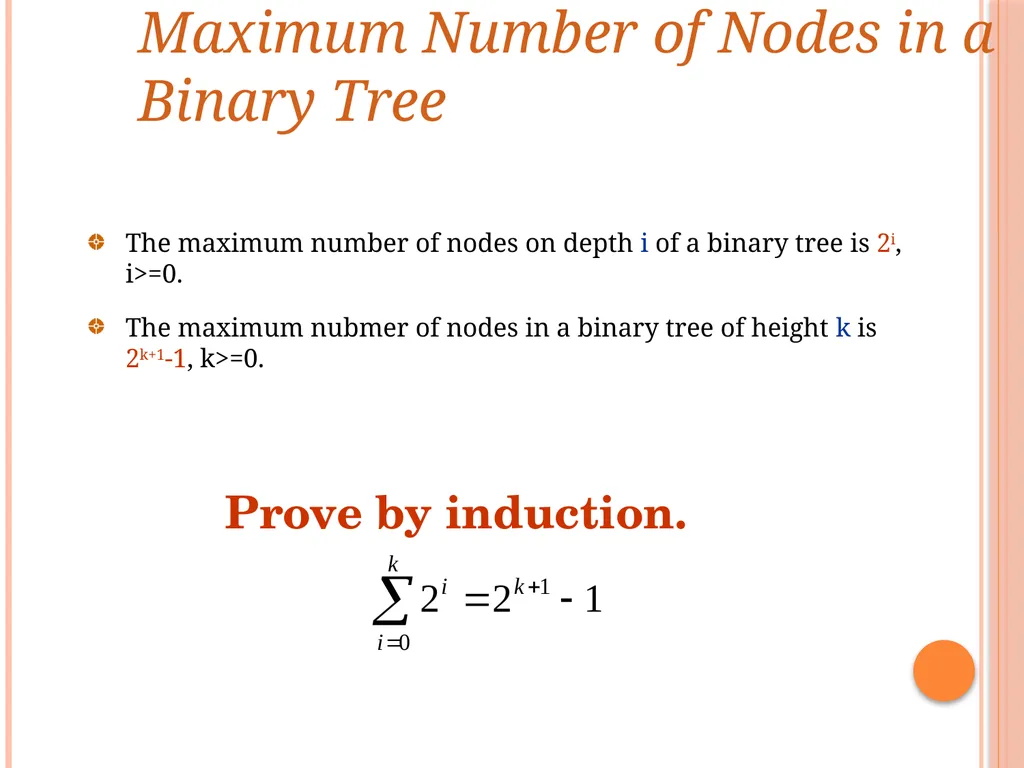
slide22. Maximum Number of Nodes in a Binary Tree The maximum number of nodes on depth i of a binary tree is 2i, i>=0.
The maximum nubmer of nodes in a binary tree of height k is 2k+1-1, k>=0. Prove by induction.<br>
slide23. Relations between Number of Leaf Nodes and Nodes of Degree 2 For any nonempty binary tree, T, if n0 is the number of leaf nodes and n2 the number of nodes of degree 2, then n0=n2+1
PROOF:
Let n and B denote the total number of nodes and branches in T.
Let n0, n1, n2 represent the nodes with no children, single child, and two children respectively.
B+1=n
B=n1+2n2
n=n0+n1+n2 n1+2n2+1= n n0=n2+1<br>
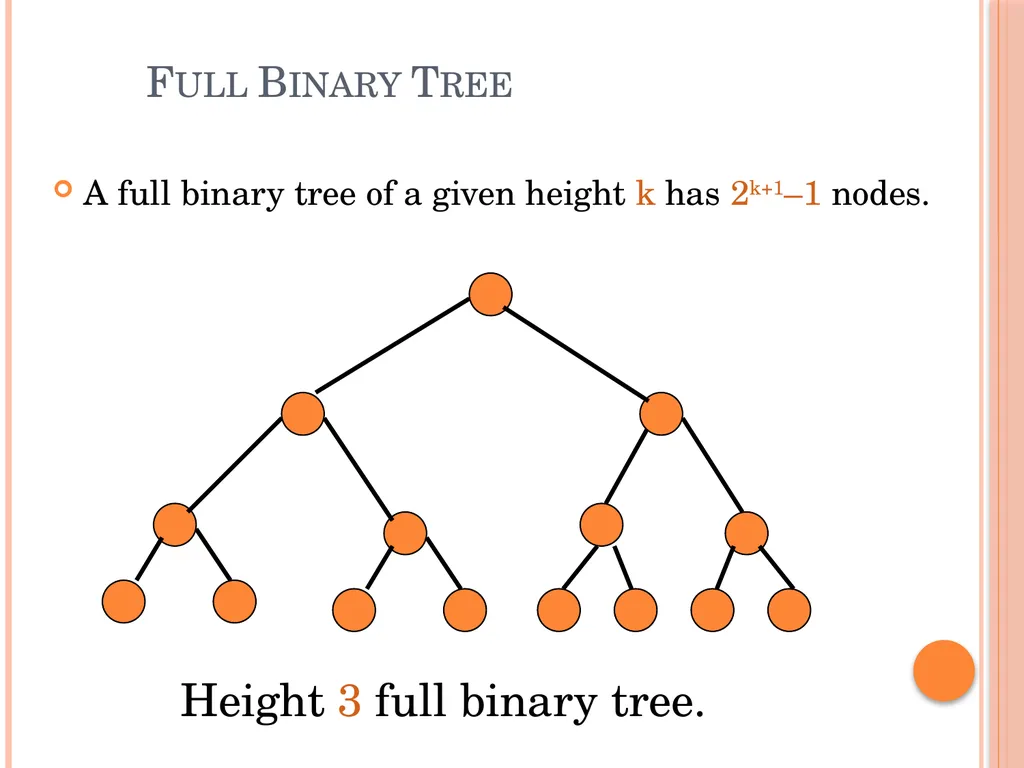
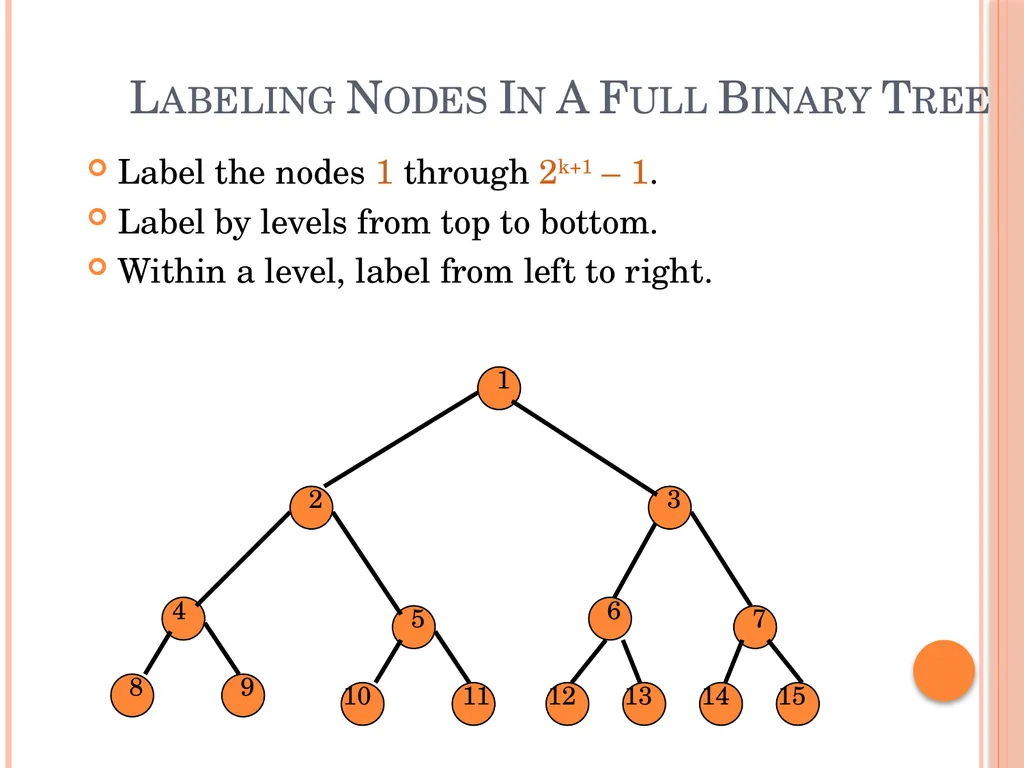
slide24. Full Binary Tree A full binary tree of a given height k has 2k+1–1 nodes.<br>
slide25. Labeling Nodes In A Full Binary Tree Label the nodes 1 through 2k+1 – 1.
Label by levels from top to bottom.
Within a level, label from left to right. 1 2 3 4 5 6 7 8 9 10 11 12 13 14 15<br>
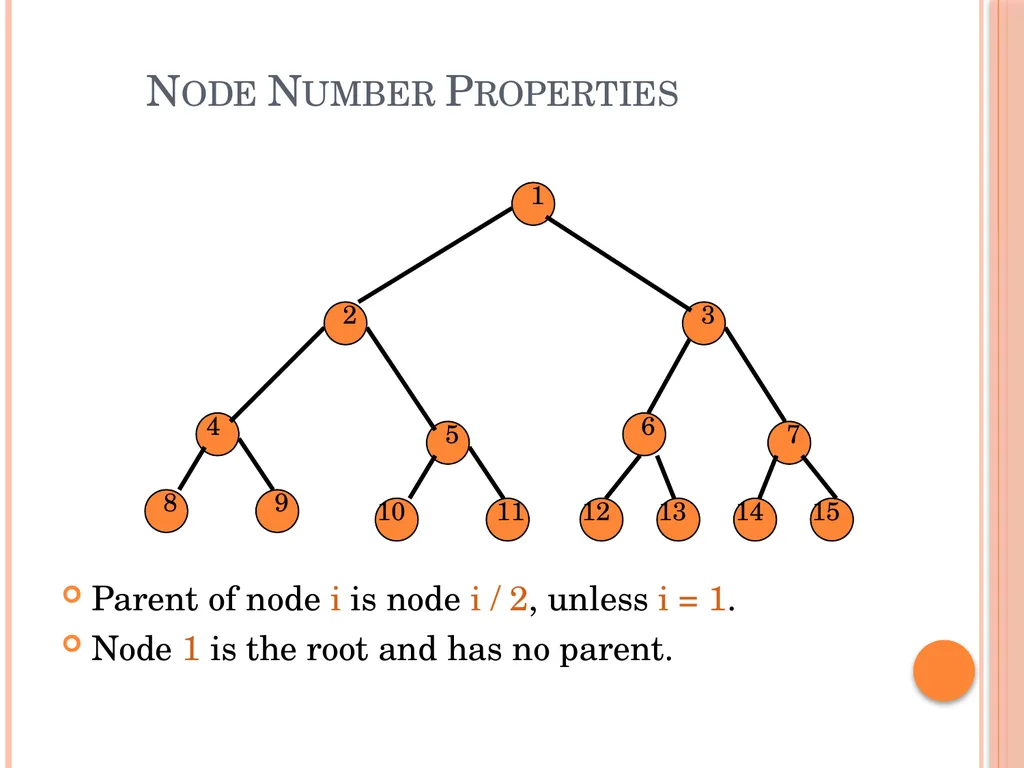
slide26. Node Number Properties Parent of node i is node i / 2, unless i = 1.
Node 1 is the root and has no parent.<br>
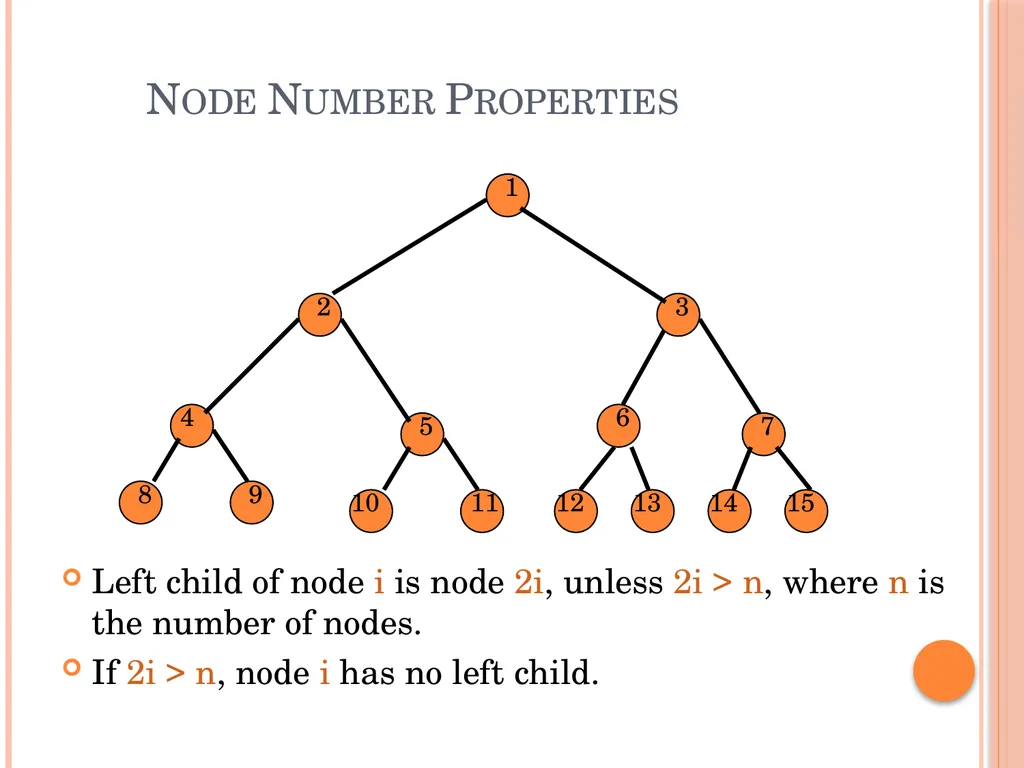
slide27. Node Number Properties Left child of node i is node 2i, unless 2i > n, where n is the number of nodes.
If 2i > n, node i has no left child.<br>
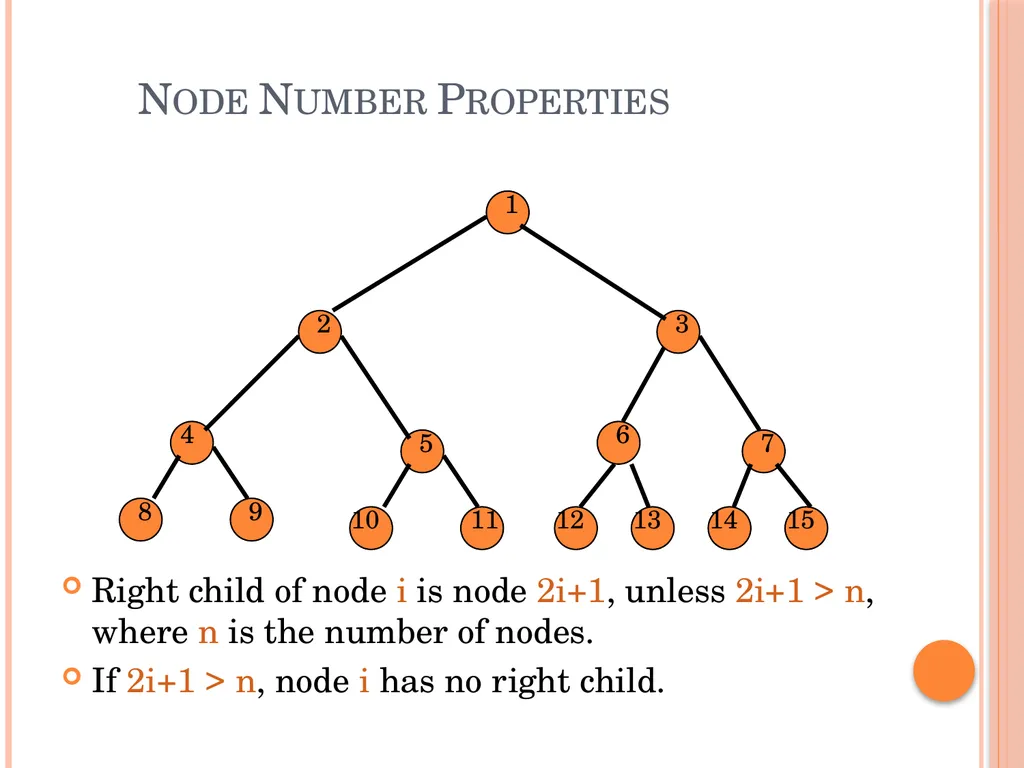
slide28. Node Number Properties Right child of node i is node 2i+1, unless 2i+1 > n, where n is the number of nodes.
If 2i+1 > n, node i has no right child.<br>
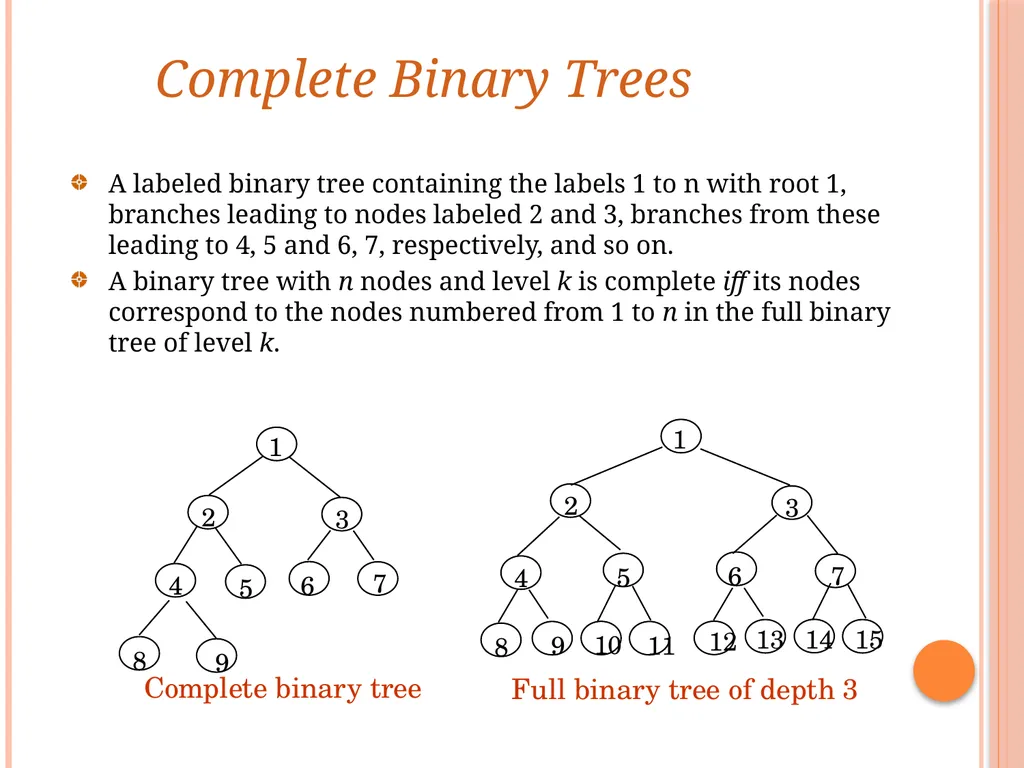
slide29. Complete Binary Trees A labeled binary tree containing the labels 1 to n with root 1, branches leading to nodes labeled 2 and 3, branches from these leading to 4, 5 and 6, 7, respectively, and so on.
A binary tree with n nodes and level k is complete iff its nodes correspond to the nodes numbered from 1 to n in the full binary tree of level k.<br>
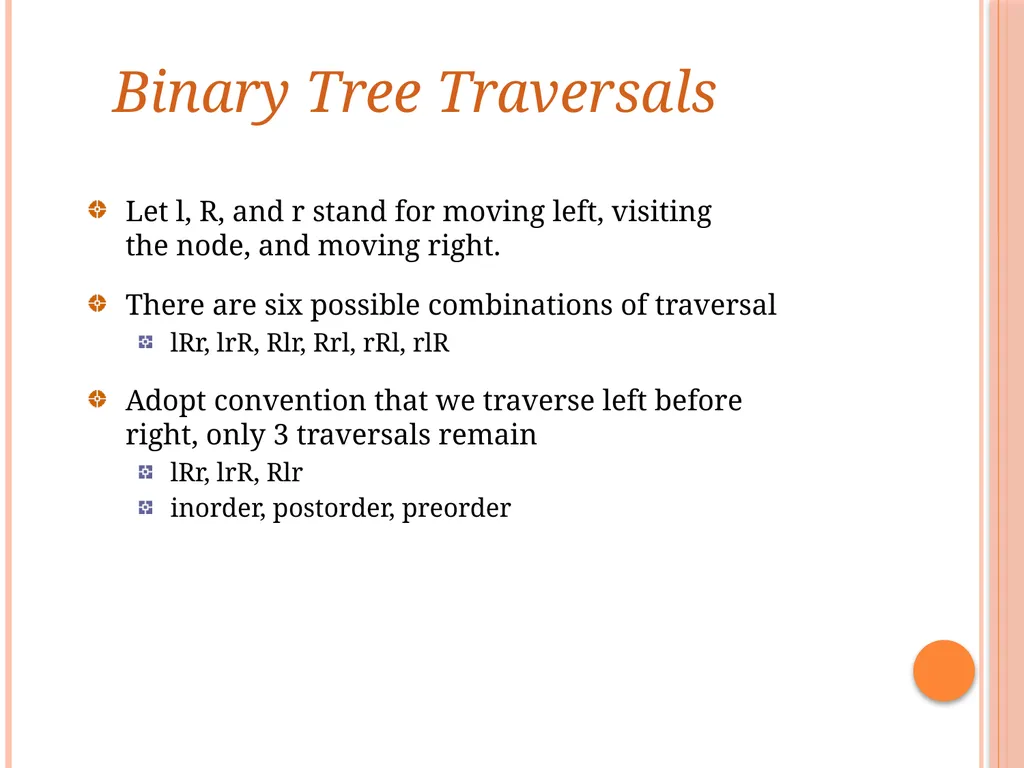
slide30. Binary Tree Traversals Let l, R, and r stand for moving left, visiting the node, and moving right.
There are six possible combinations of traversal
lRr, lrR, Rlr, Rrl, rRl, rlR
Adopt convention that we traverse left before right, only 3 traversals remain
lRr, lrR, Rlr
inorder, postorder, preorder<br>
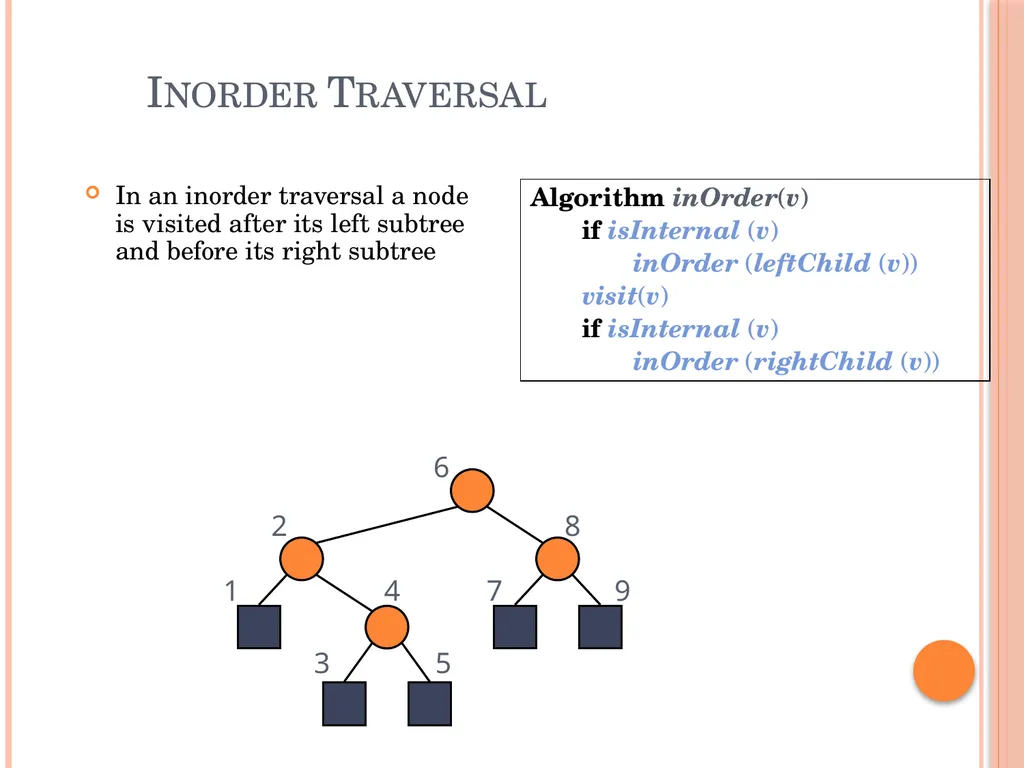
slide31. Inorder Traversal In an inorder traversal a node is visited after its left subtree and before its right subtree Algorithm inOrder(v)
if isInternal (v)
inOrder (leftChild (v))
visit(v)
if isInternal (v)
inOrder (rightChild (v))<br>
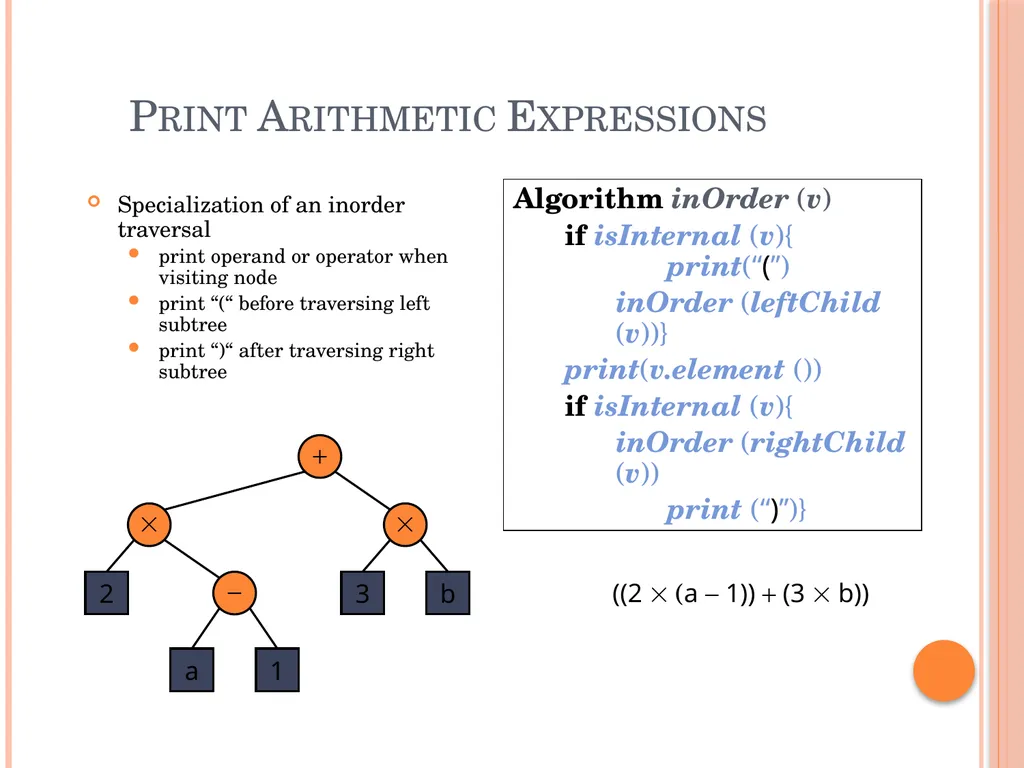
slide32. Print Arithmetic Expressions Specialization of an inorder traversal
print operand or operator when visiting node
print “(“ before traversing left subtree
print “)“ after traversing right subtree Algorithm inOrder (v)
if isInternal (v){ print(“(’’)
inOrder (leftChild (v))}
print(v.element ())
if isInternal (v){
inOrder (rightChild (v))
print (“)’’)} ((2 (a - 1)) + (3 b))<br>
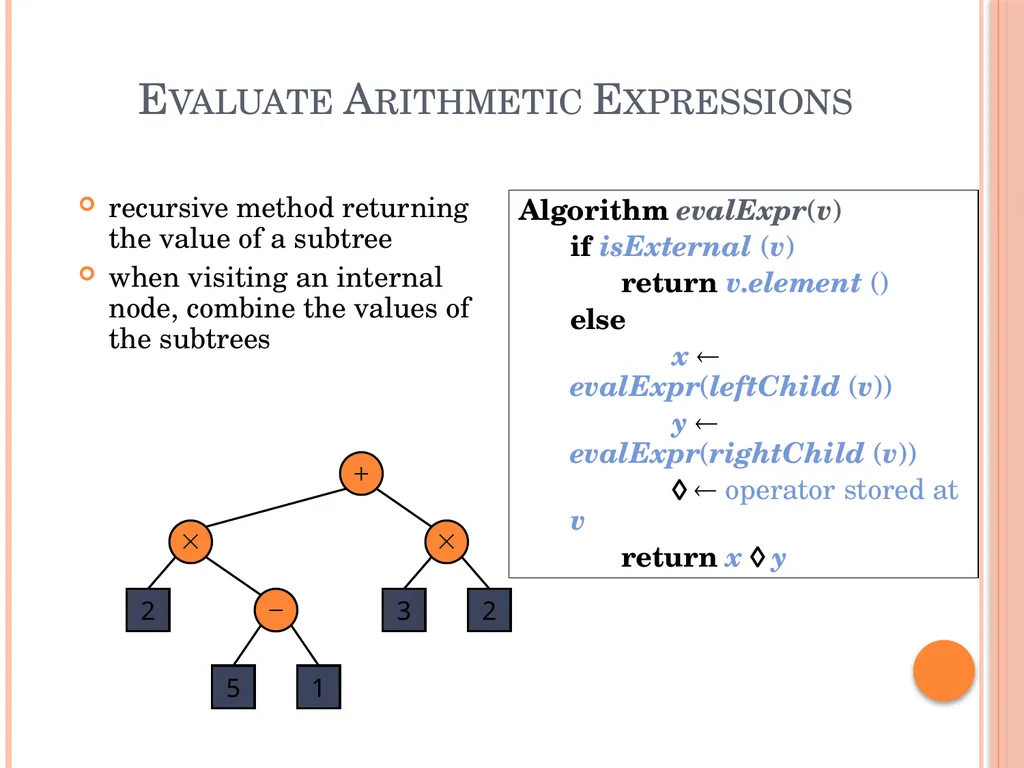
slide33. Evaluate Arithmetic Expressions recursive method returning the value of a subtree
when visiting an internal node, combine the values of the subtrees Algorithm evalExpr(v)
if isExternal (v)
return v.element ()
else
x evalExpr(leftChild (v))
y evalExpr(rightChild (v))
operator stored at v
return x y<br>
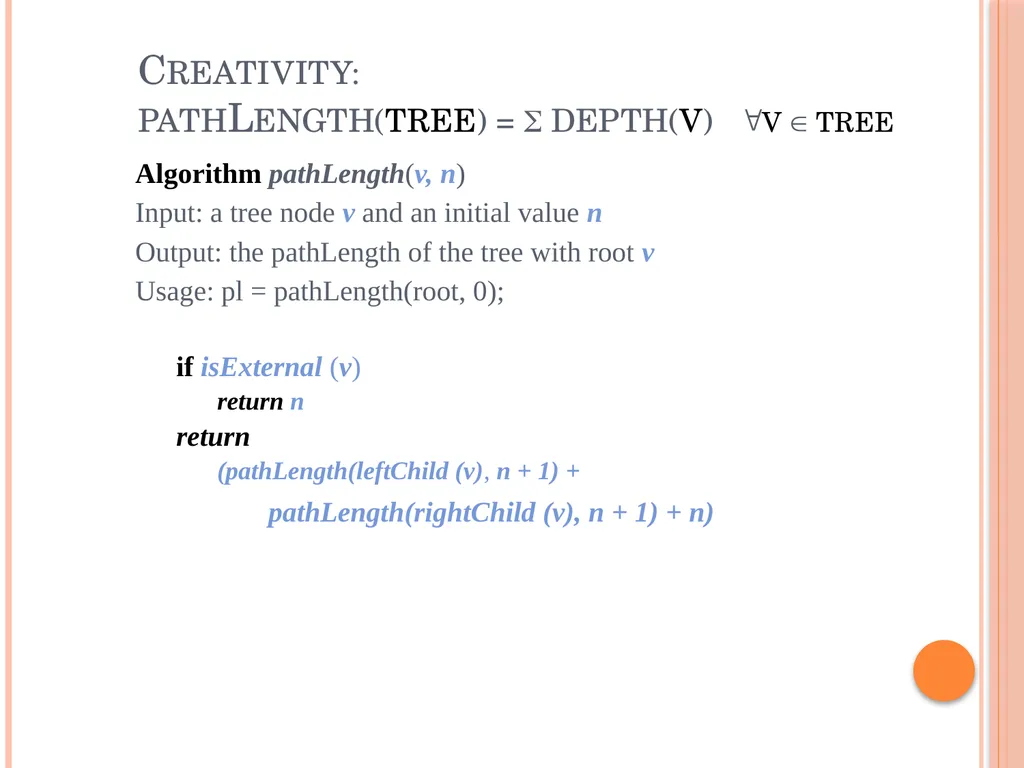
slide34. Creativity: pathLength(tree) = depth(v) v tree Algorithm pathLength(v, n)
Input: a tree node v and an initial value n
Output: the pathLength of the tree with root v
Usage: pl = pathLength(root, 0);
if isExternal (v)
return n
return
(pathLength(leftChild (v), n + 1) +
pathLength(rightChild (v), n + 1) + n)<br>
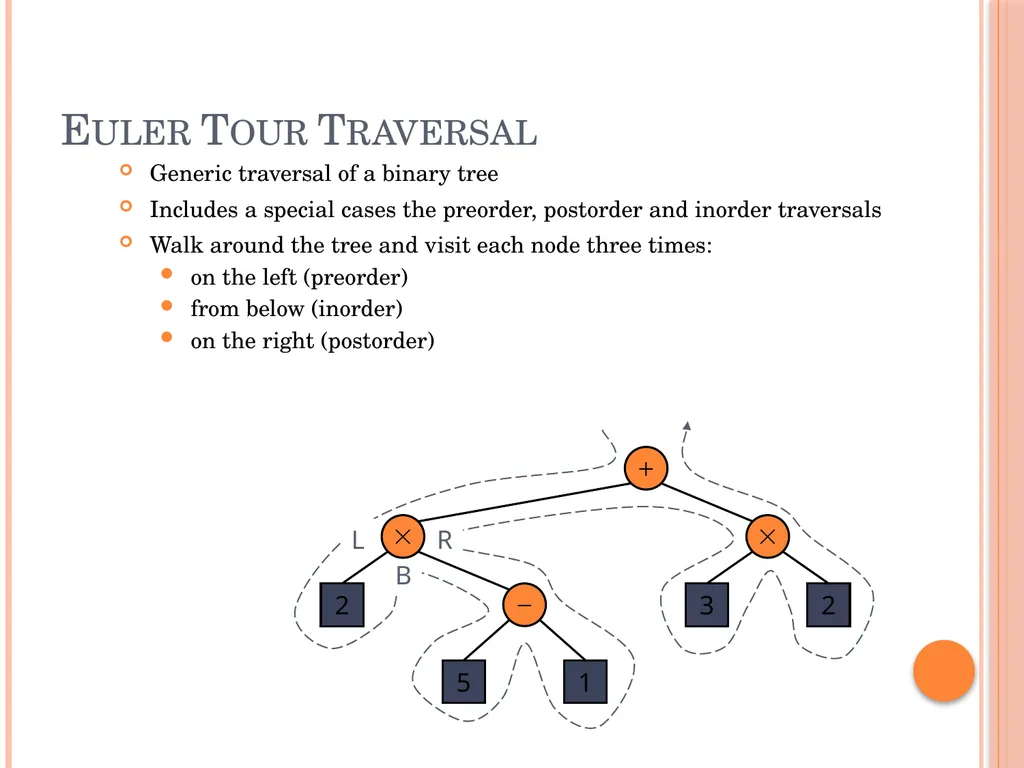
slide35. Euler Tour Traversal Generic traversal of a binary tree
Includes a special cases the preorder, postorder and inorder traversals
Walk around the tree and visit each node three times:
on the left (preorder)
from below (inorder)
on the right (postorder)<br>
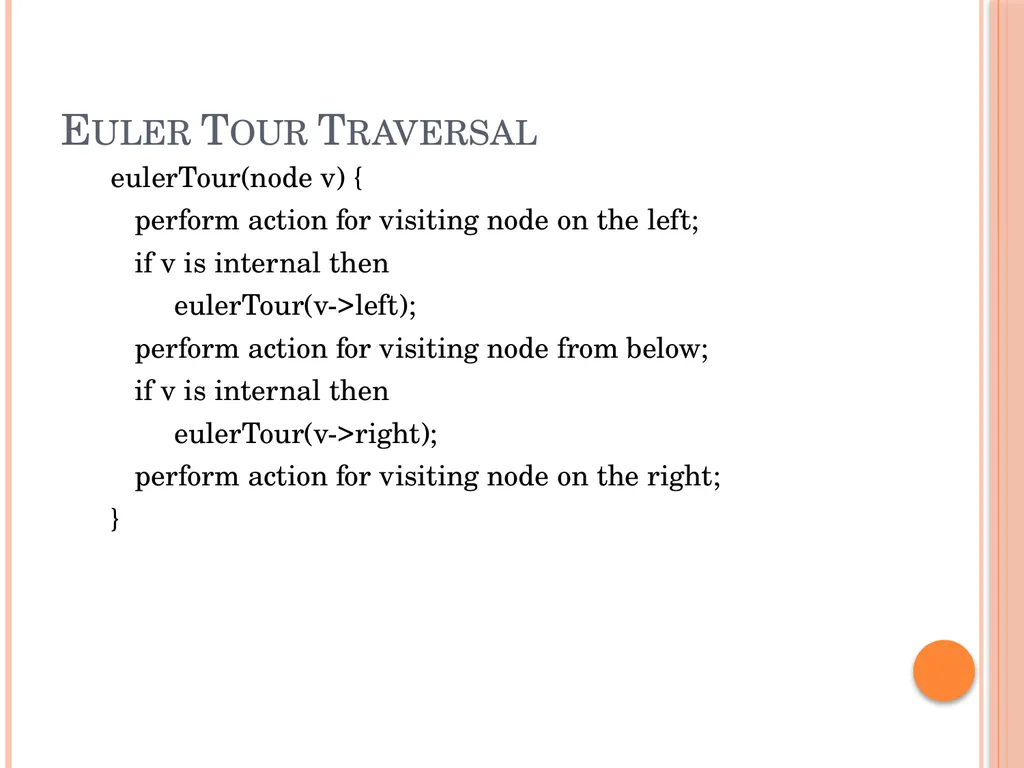
slide36. Euler Tour Traversal eulerTour(node v) {
perform action for visiting node on the left;
if v is internal then
eulerTour(v->left);
perform action for visiting node from below;
if v is internal then
eulerTour(v->right);
perform action for visiting node on the right;
}<br>
slide37. Tree<br>
slide38. Binary Tree sebuah pengorganisasian secara hirarki dari beberapa buah simpul, dimana masing-masing simpul tidak mempunyai anak lebih dari 2.
Simpul yang berada di bawah sebuah simpul dinamakan anak dari simpul tersebut.
Simpul yang berada di atas sebuah simpul dinamakan induk dari simpul tersebut.<br>
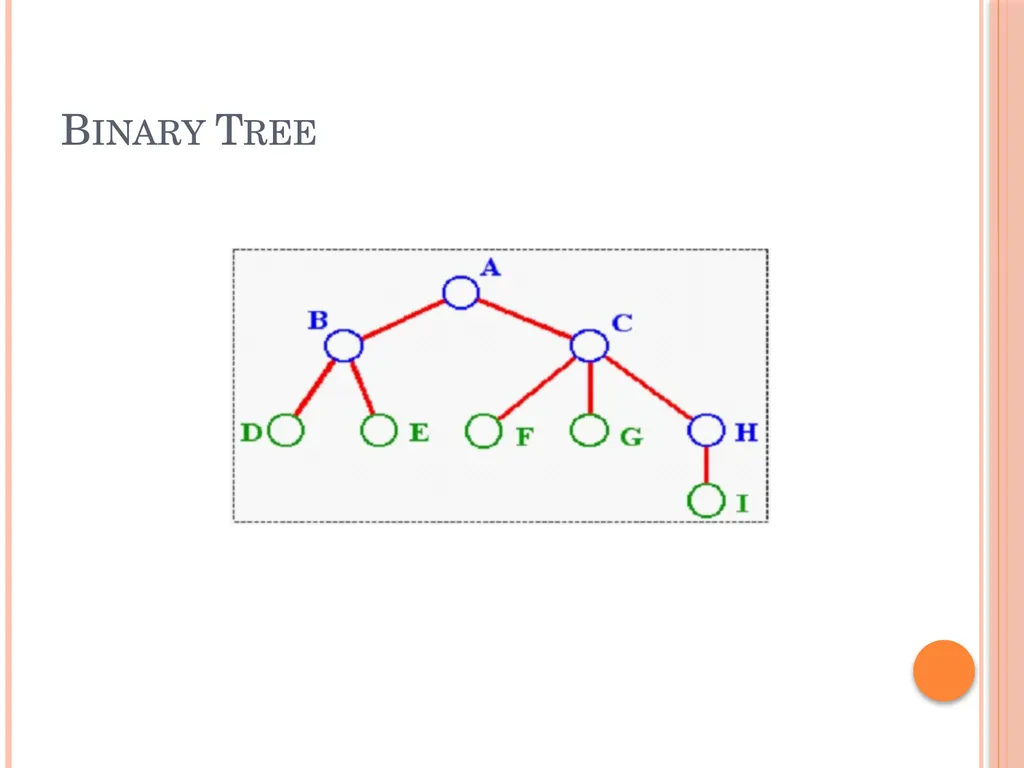
slide39. Binary Tree<br>
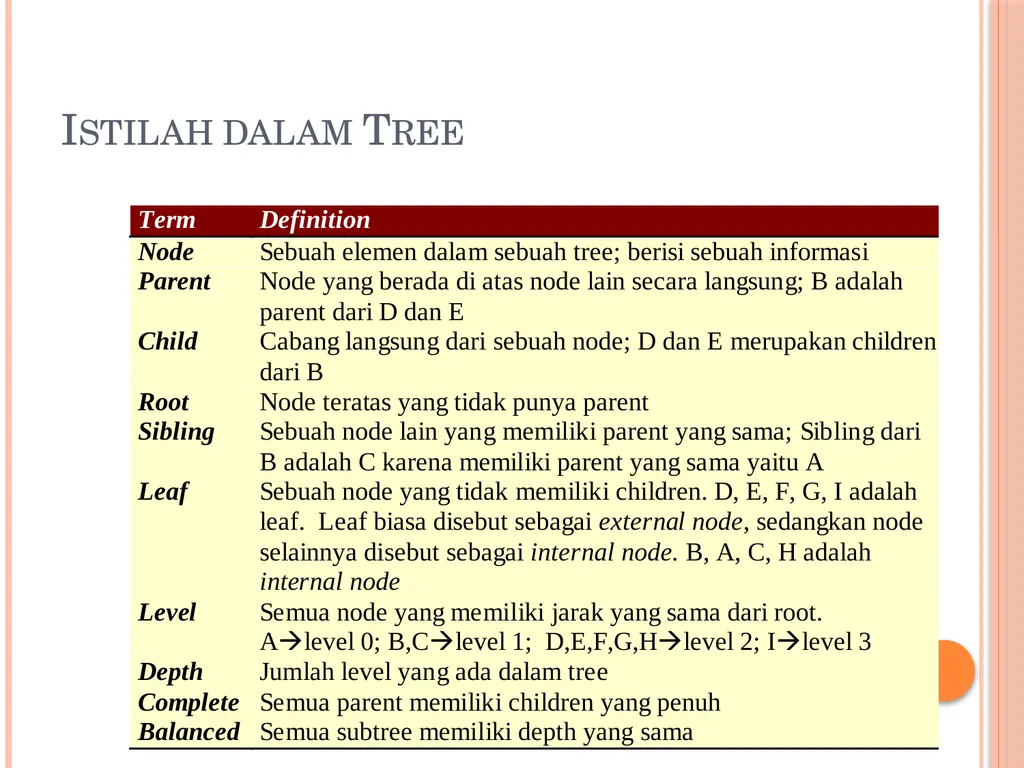
slide40. Istilah dalam Tree<br>
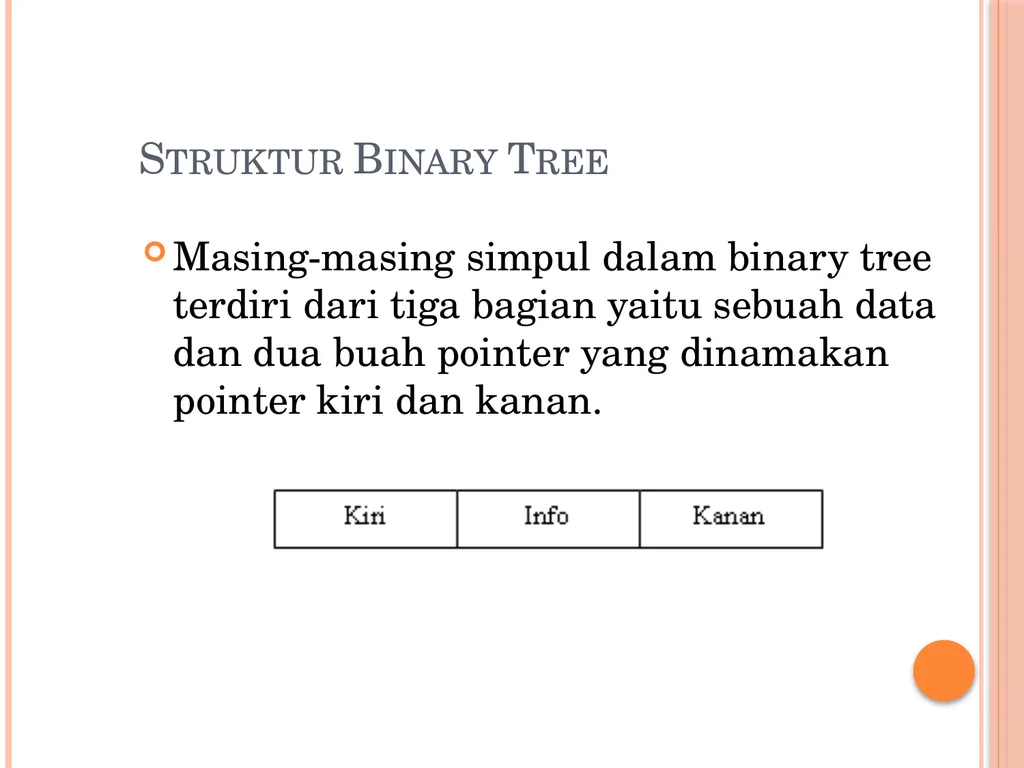
slide41. Struktur Binary Tree Masing-masing simpul dalam binary tree terdiri dari tiga bagian yaitu sebuah data dan dua buah pointer yang dinamakan pointer kiri dan kanan.<br>
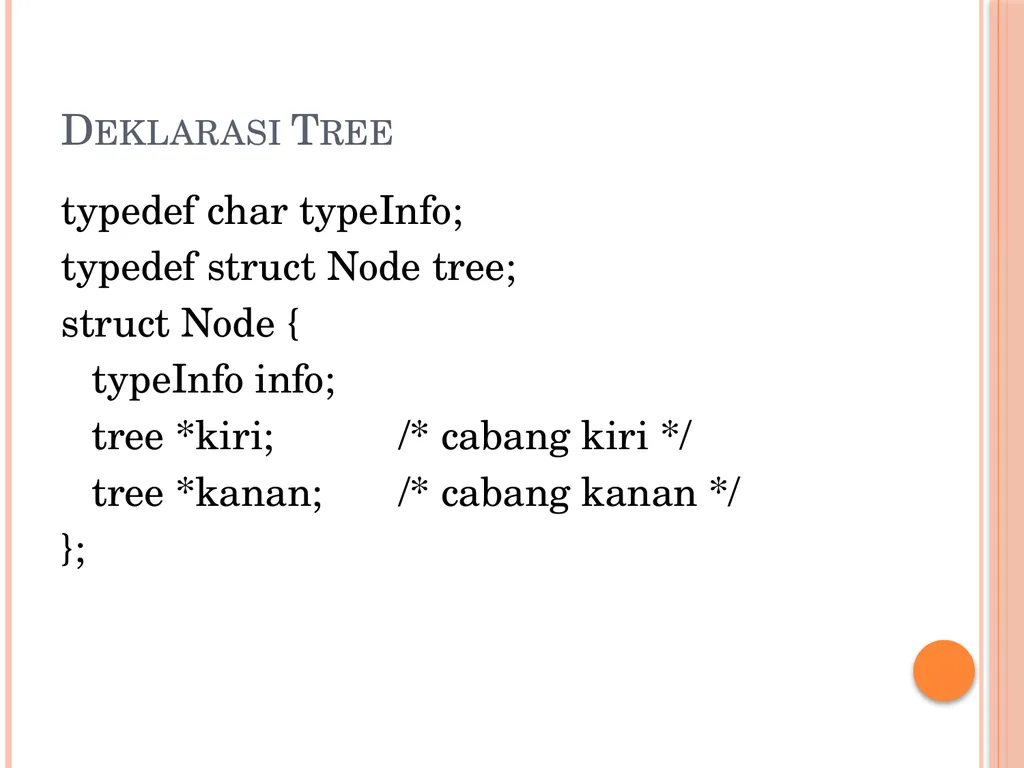
slide42. Deklarasi Tree typedef char typeInfo;
typedef struct Node tree;
struct Node {
typeInfo info;
tree *kiri; /* cabang kiri */
tree *kanan; /* cabang kanan */
};<br>
slide43. Pembentukan Tree Dapat dilakukan dengan dua cara : rekursif dan non rekursif
Perlu memperhatikan kapan suatu node akan dipasang sebagai node kiri dan kapan sebagai node kanan.
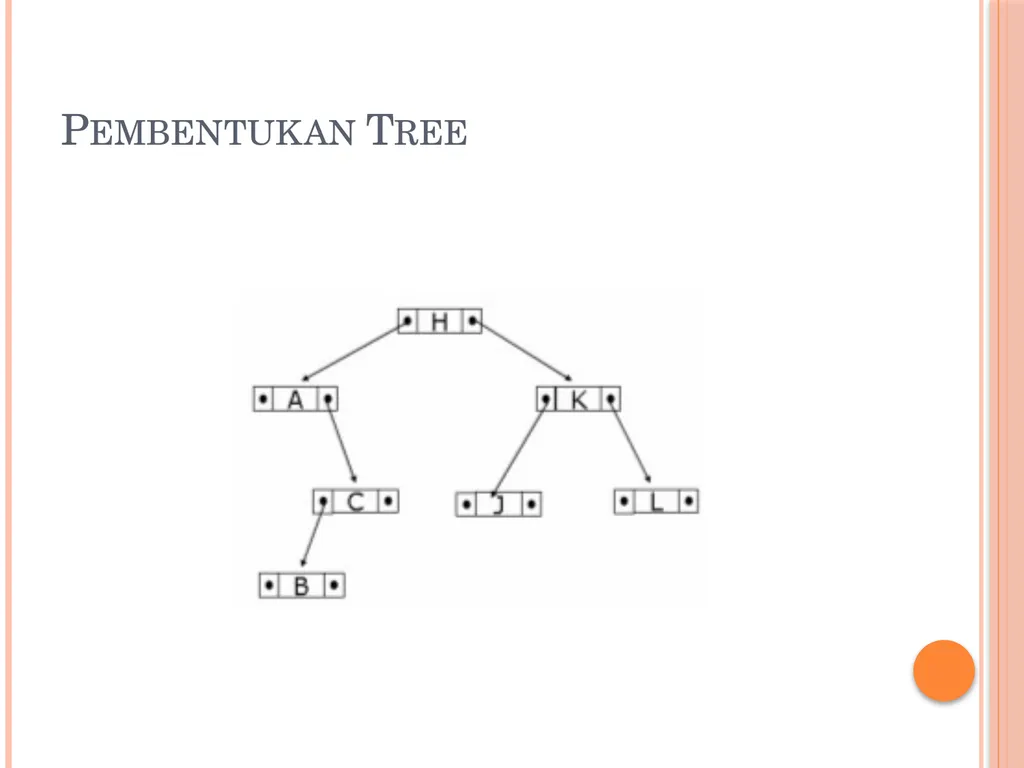
Misalnya ditentukan, node yang berisi info yang nilainya “lebih besar” dari parent akan ditempatkan di sebelah kanan dan yang “lebih kecil” di sebelah kiri.
Sebagai contoh jika kita memiliki informasi “HKACBLJ” maka pohon biner yang terbentuk<br>
slide44. Pembentukan Tree<br>
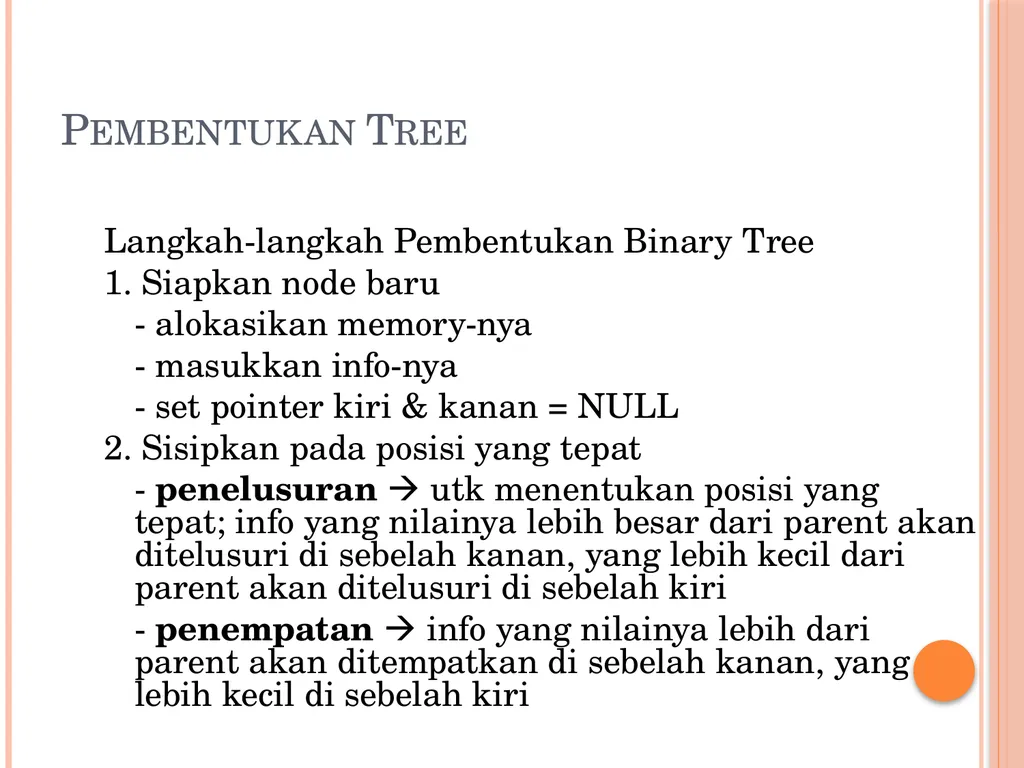
slide45. Pembentukan Tree Langkah-langkah Pembentukan Binary Tree
1. Siapkan node baru
- alokasikan memory-nya
- masukkan info-nya
- set pointer kiri & kanan = NULL
2. Sisipkan pada posisi yang tepat
- penelusuran utk menentukan posisi yang tepat; info yang nilainya lebih besar dari parent akan ditelusuri di sebelah kanan, yang lebih kecil dari parent akan ditelusuri di sebelah kiri
- penempatan info yang nilainya lebih dari parent akan ditempatkan di sebelah kanan, yang lebih kecil di sebelah kiri<br>
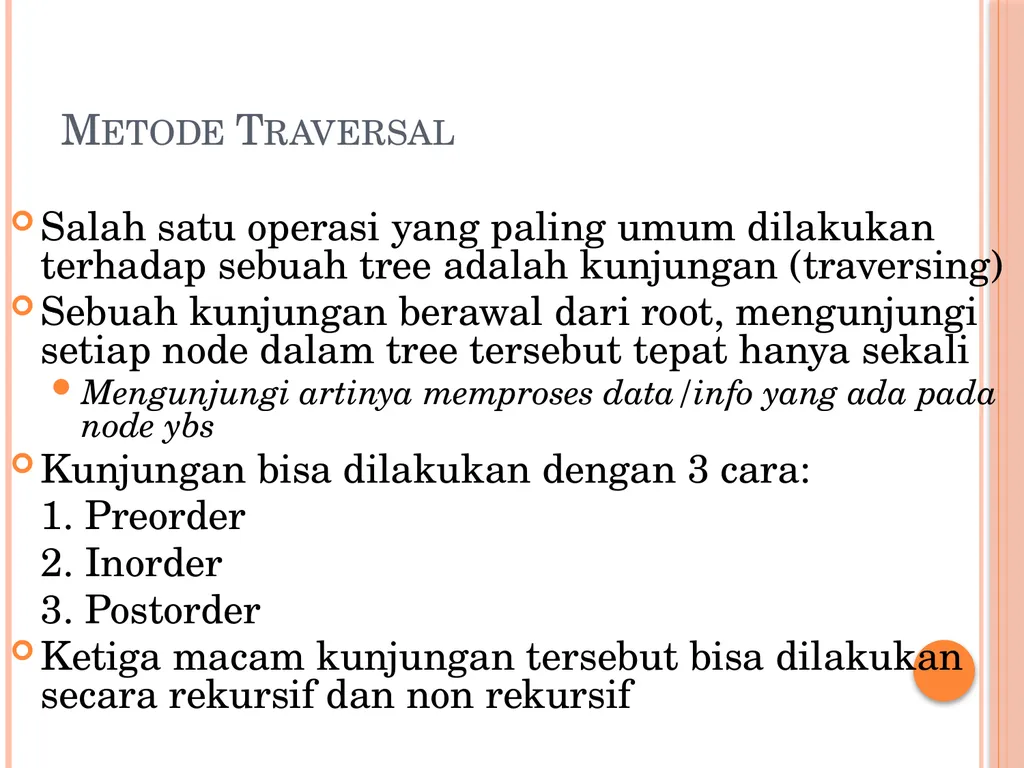
slide46. Metode Traversal Salah satu operasi yang paling umum dilakukan terhadap sebuah tree adalah kunjungan (traversing)
Sebuah kunjungan berawal dari root, mengunjungi setiap node dalam tree tersebut tepat hanya sekali
Mengunjungi artinya memproses data/info yang ada pada node ybs
Kunjungan bisa dilakukan dengan 3 cara:
1. Preorder
2. Inorder
3. Postorder
Ketiga macam kunjungan tersebut bisa dilakukan secara rekursif dan non rekursif<br>
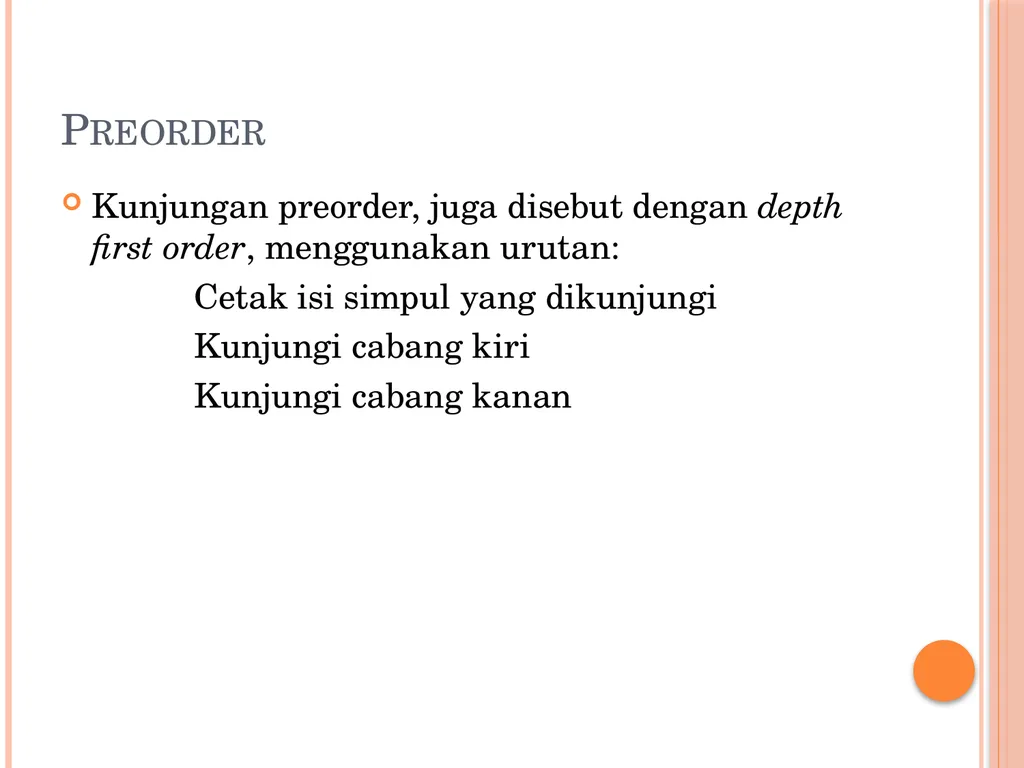
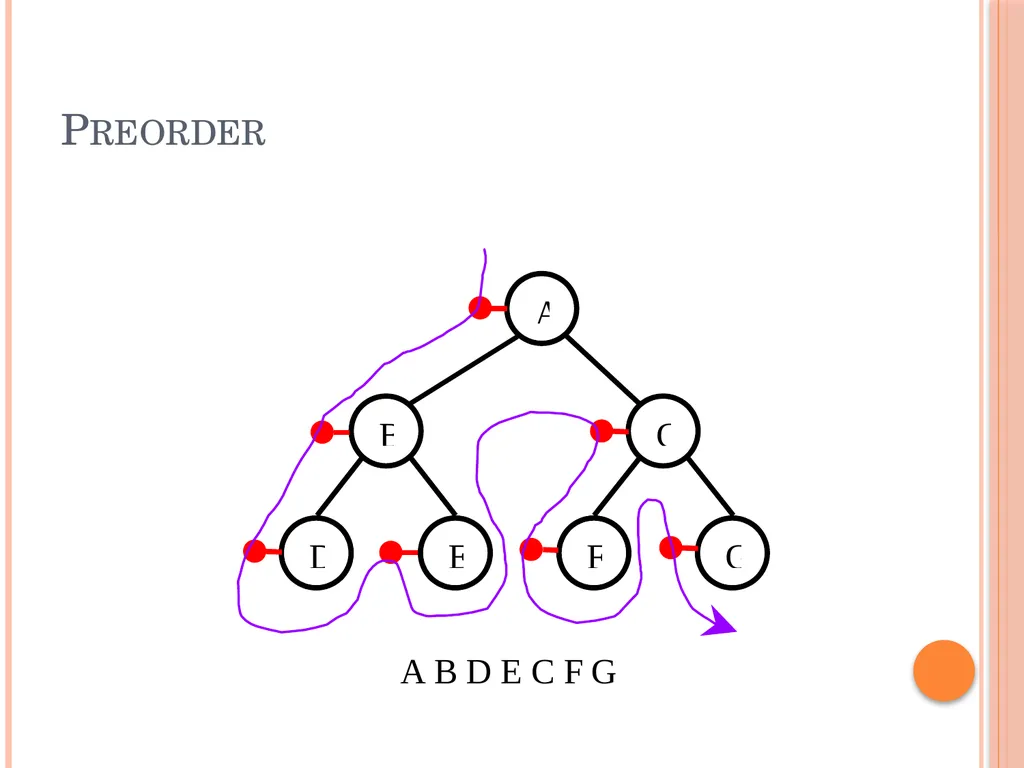
slide47. Preorder Kunjungan preorder, juga disebut dengan depth first order, menggunakan urutan:
Cetak isi simpul yang dikunjungi
Kunjungi cabang kiri
Kunjungi cabang kanan<br>
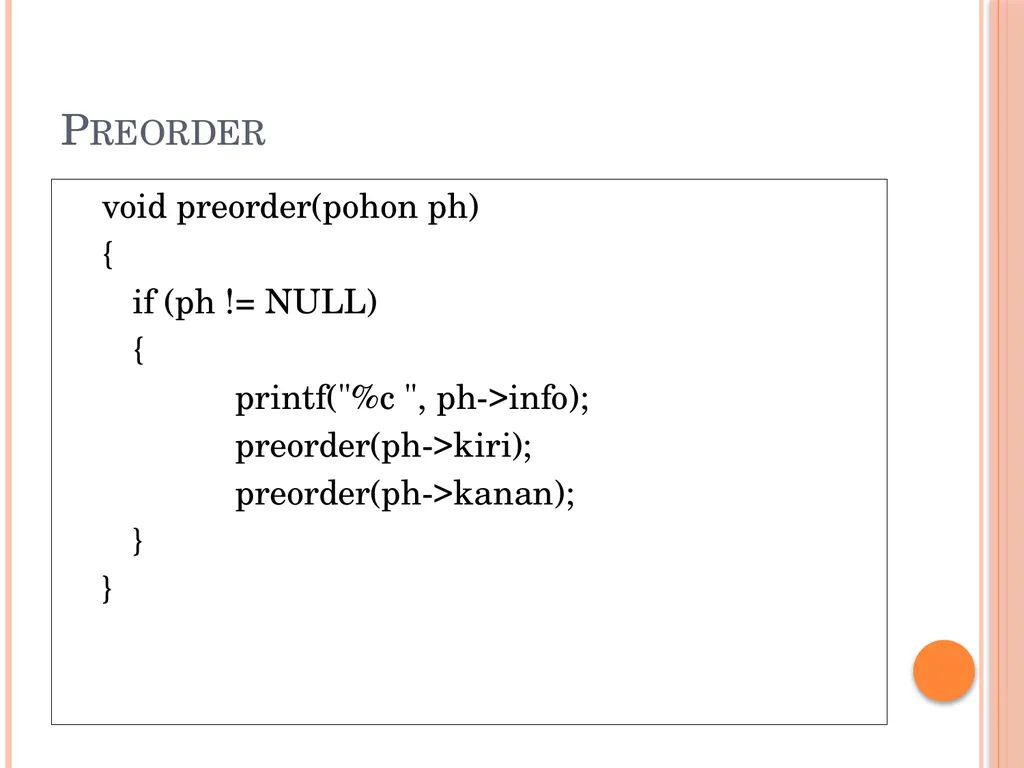
slide48. Preorder void preorder(pohon ph)
{
if (ph != NULL)
{
printf("%c ", ph->info);
preorder(ph->kiri);
preorder(ph->kanan);
}
}<br>
slide49. Preorder<br>
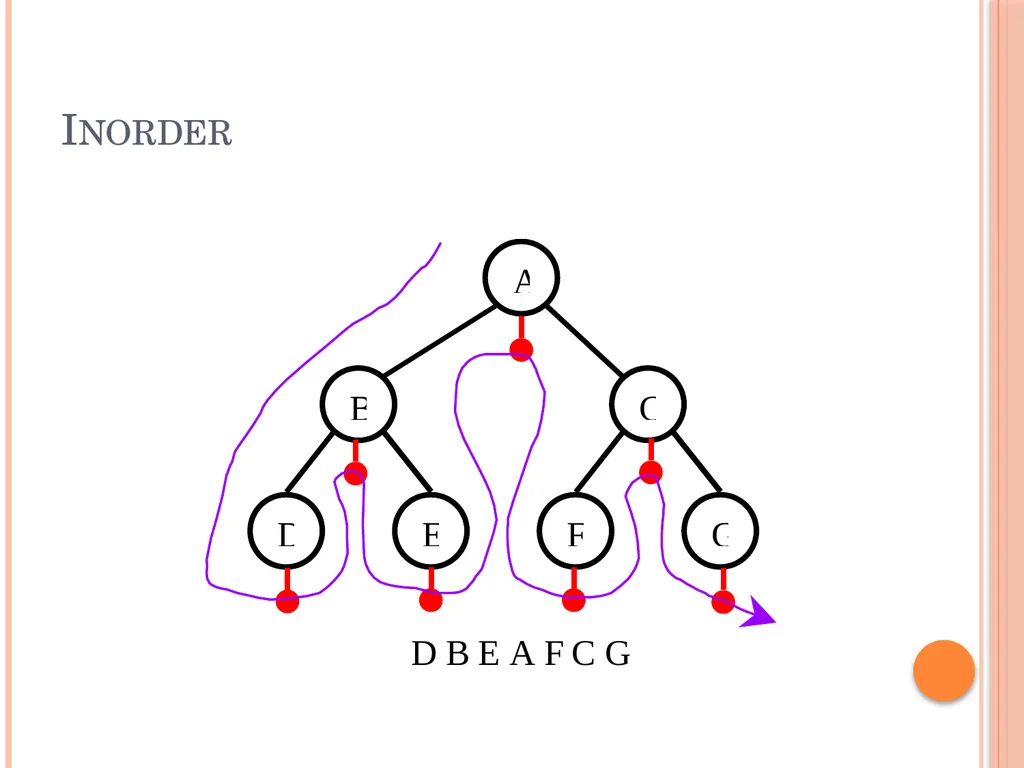
slide50. Inorder Kunjungan secara inorder, juga sering disebut dengan symmetric order, menggunakan urutan:
Kunjungi cabang kiri
Cetak isi simpul yang dikunjungi
Kunjungi cabang kanan<br>
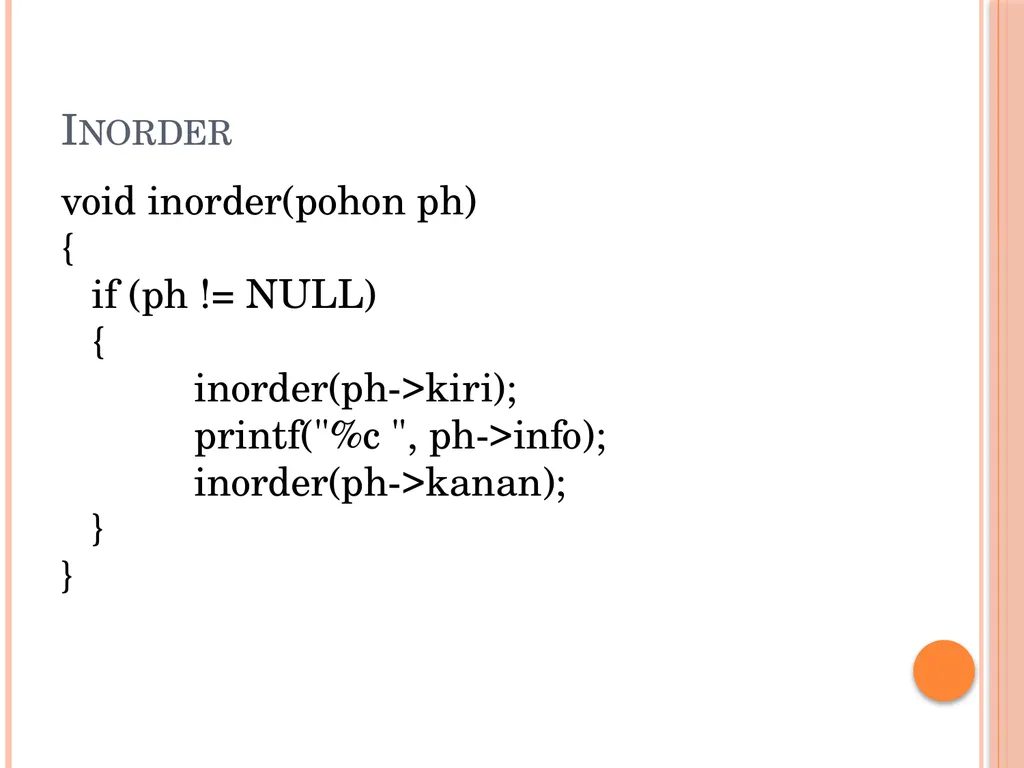
slide51. Inorder void inorder(pohon ph)
{
if (ph != NULL)
{
inorder(ph->kiri);
printf("%c ", ph->info);
inorder(ph->kanan);
}
}<br>
slide52. Inorder<br>
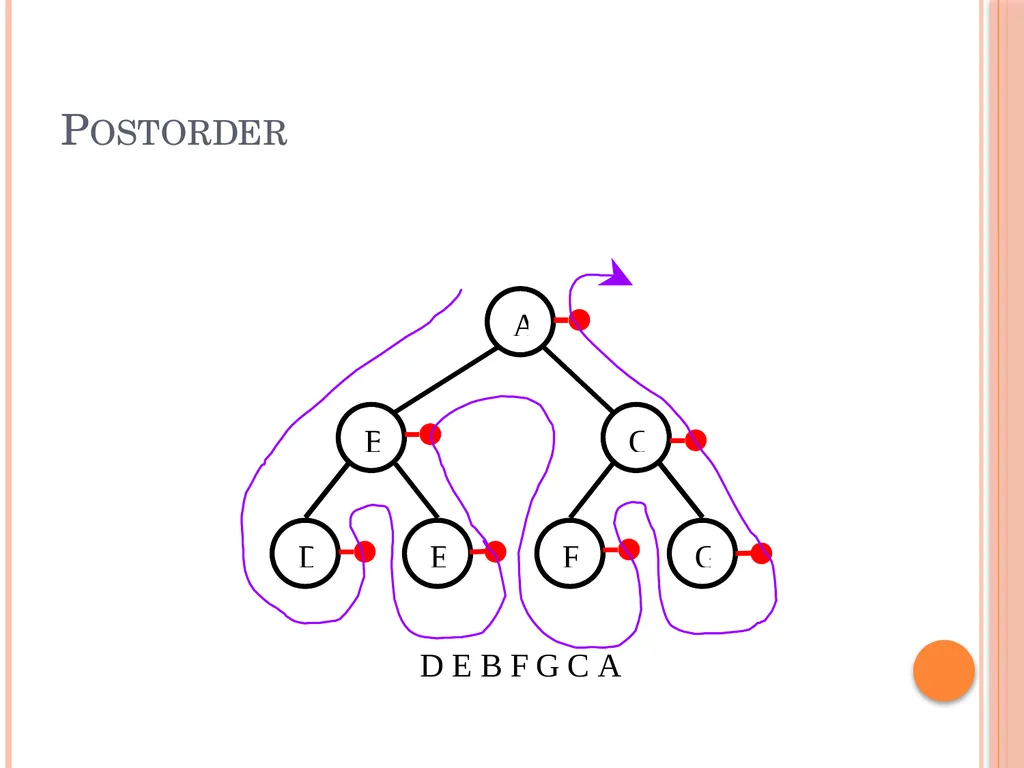
slide53. Postorder Kunjungan secara postorder menggunakan urutan:
Kunjungi cabang kiri
Kunjungi cabang kanan
Cetak isi simpul yang dikunjungi<br>
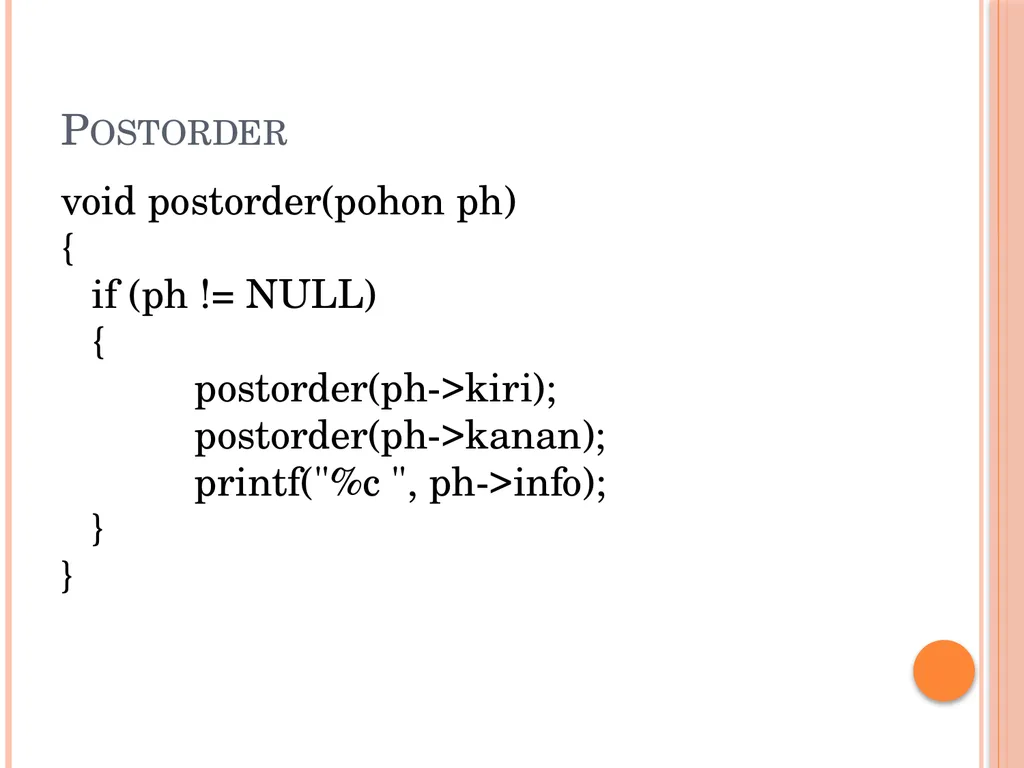
slide54. Postorder void postorder(pohon ph)
{
if (ph != NULL)
{
postorder(ph->kiri);
postorder(ph->kanan);
printf("%c ", ph->info);
}
}<br>
slide55. Postorder<br>
slide56. References http://www.cse.unt.edu/~huangyan/3110/Lectures/Trees.ppt<br>
Banks Stock
Fraud The class notes are a compilation and edition from many sources. The instructor does not claim intellectual property or ownership of the lecture notes.<br>
slide2. Nature View of a Tree branches leaves root<br>
slide3. Computer Scientist’s View branches leaves<br>
slide4. What is a Tree A tree is a finite nonempty set of elements.
It is an abstract model of a hierarchical structure.
consists of nodes with a parent-child relation.
Applications:
Organization charts
File systems
Programming environments<br>
slide5. subtree Tree Terminology Root: node without parent (A)
Siblings: nodes share the same parent
Internal node: node with at least one child (A, B, C, F)
External node (leaf ): node without children (E, I, J, K, G, H, D)
Ancestors of a node: parent, grandparent, grand-grandparent, etc.
Descendant of a node: child, grandchild, grand-grandchild, etc.
Depth of a node: number of ancestors
Height of a tree: maximum depth of any node (3)
Degree of a node: the number of its children
Degree of a tree: the maximum number of its node. Subtree: tree consisting of a node and its descendants<br>
slide6. Tree Properties Property Value
Number of nodes
Height
Root Node
Leaves
Interior nodes
Ancestors of H
Descendants of B
Siblings of E
Right subtree of A
Degree of this tree<br>
slide7. Tree ADT We use positions to abstract nodes
Generic methods:
integer size()
boolean isEmpty()
objectIterator elements()
positionIterator positions()
Accessor methods:
position root()
position parent(p)
positionIterator children(p) Query methods:
boolean isInternal(p)
boolean isExternal(p)
boolean isRoot(p)
Update methods:
swapElements(p, q)
object replaceElement(p, o)
Additional update methods may be defined by data structures implementing the Tree ADT<br>
slide8. Intuitive Representation of Tree Node List Representation
( A ( B ( E ( K, L ), F ), C ( G ), D ( H ( M ), I, J ) ) )
The root comes first, followed by a list of links to sub-trees How many link fields are needed in
such a representation?<br>
slide9. Trees Every tree node:
object – useful information
children – pointers to its children<br>
slide10. A Tree Representation A node is represented by an object storing
Element
Parent node
Sequence of children nodes<br>
slide11. Left Child, Right Sibling Representation<br>
slide12. Tree Traversal Two main methods:
Preorder
Postorder
Recursive definition
Preorder:
visit the root
traverse in preorder the children (subtrees)
Postorder
traverse in postorder the children (subtrees)
visit the root<br>
slide13. Preorder Traversal A traversal visits the nodes of a tree in a systematic manner
In a preorder traversal, a node is visited before its descendants
Application: print a structured document Algorithm preOrder(v)
visit(v)
for each child w of v
preorder (w)<br>
slide14. Postorder Traversal In a postorder traversal, a node is visited after its descendants
Application: compute space used by files in a directory and its subdirectories Algorithm postOrder(v)
for each child w of v
postOrder (w)
visit(v)<br>
slide15. Binary Tree A binary tree is a tree with the following properties:
Each internal node has at most two children (degree of two)
The children of a node are an ordered pair
We call the children of an internal node left child and right child
Alternative recursive definition: a binary tree is either
a tree consisting of a single node, OR
a tree whose root has an ordered pair of children, each of which is a binary tree Applications:
arithmetic expressions
decision processes
searching A B C F G D E H I<br>
slide16. BinaryTree ADT The BinaryTree ADT extends the Tree ADT, i.e., it inherits all the methods of the Tree ADT
Additional methods:
position leftChild(p)
position rightChild(p)
position sibling(p) Update methods may be defined by data structures implementing the BinaryTree ADT<br>
slide17. Examples of the Binary Tree<br>
slide18. Differences Between A Tree and A Binary Tree The subtrees of a binary tree are ordered; those of a tree are not ordered. Are different when viewed as binary trees.
Are the same when viewed as trees.<br>
slide19. Data Structure for Binary Trees A node is represented by an object storing
Element
Parent node
Left child node
Right child node<br>
slide20. Arithmetic Expression Tree Binary tree associated with an arithmetic expression
internal nodes: operators
external nodes: operands
Example: arithmetic expression tree for the expression (2 (a - 1) + (3 b))<br>
slide21. Decision Tree Binary tree associated with a decision process
internal nodes: questions with yes/no answer
external nodes: decisions
Example: dining decision Want a fast meal? How about coffee? On expense account? Starbucks Spike’s Al Forno Café Paragon Yes No Yes No Yes No<br>
slide22. Maximum Number of Nodes in a Binary Tree The maximum number of nodes on depth i of a binary tree is 2i, i>=0.
The maximum nubmer of nodes in a binary tree of height k is 2k+1-1, k>=0. Prove by induction.<br>
slide23. Relations between Number of Leaf Nodes and Nodes of Degree 2 For any nonempty binary tree, T, if n0 is the number of leaf nodes and n2 the number of nodes of degree 2, then n0=n2+1
PROOF:
Let n and B denote the total number of nodes and branches in T.
Let n0, n1, n2 represent the nodes with no children, single child, and two children respectively.
B+1=n
B=n1+2n2
n=n0+n1+n2 n1+2n2+1= n n0=n2+1<br>
slide24. Full Binary Tree A full binary tree of a given height k has 2k+1–1 nodes.<br>
slide25. Labeling Nodes In A Full Binary Tree Label the nodes 1 through 2k+1 – 1.
Label by levels from top to bottom.
Within a level, label from left to right. 1 2 3 4 5 6 7 8 9 10 11 12 13 14 15<br>
slide26. Node Number Properties Parent of node i is node i / 2, unless i = 1.
Node 1 is the root and has no parent.<br>
slide27. Node Number Properties Left child of node i is node 2i, unless 2i > n, where n is the number of nodes.
If 2i > n, node i has no left child.<br>
slide28. Node Number Properties Right child of node i is node 2i+1, unless 2i+1 > n, where n is the number of nodes.
If 2i+1 > n, node i has no right child.<br>
slide29. Complete Binary Trees A labeled binary tree containing the labels 1 to n with root 1, branches leading to nodes labeled 2 and 3, branches from these leading to 4, 5 and 6, 7, respectively, and so on.
A binary tree with n nodes and level k is complete iff its nodes correspond to the nodes numbered from 1 to n in the full binary tree of level k.<br>
slide30. Binary Tree Traversals Let l, R, and r stand for moving left, visiting the node, and moving right.
There are six possible combinations of traversal
lRr, lrR, Rlr, Rrl, rRl, rlR
Adopt convention that we traverse left before right, only 3 traversals remain
lRr, lrR, Rlr
inorder, postorder, preorder<br>
slide31. Inorder Traversal In an inorder traversal a node is visited after its left subtree and before its right subtree Algorithm inOrder(v)
if isInternal (v)
inOrder (leftChild (v))
visit(v)
if isInternal (v)
inOrder (rightChild (v))<br>
slide32. Print Arithmetic Expressions Specialization of an inorder traversal
print operand or operator when visiting node
print “(“ before traversing left subtree
print “)“ after traversing right subtree Algorithm inOrder (v)
if isInternal (v){ print(“(’’)
inOrder (leftChild (v))}
print(v.element ())
if isInternal (v){
inOrder (rightChild (v))
print (“)’’)} ((2 (a - 1)) + (3 b))<br>
slide33. Evaluate Arithmetic Expressions recursive method returning the value of a subtree
when visiting an internal node, combine the values of the subtrees Algorithm evalExpr(v)
if isExternal (v)
return v.element ()
else
x evalExpr(leftChild (v))
y evalExpr(rightChild (v))
operator stored at v
return x y<br>
slide34. Creativity: pathLength(tree) = depth(v) v tree Algorithm pathLength(v, n)
Input: a tree node v and an initial value n
Output: the pathLength of the tree with root v
Usage: pl = pathLength(root, 0);
if isExternal (v)
return n
return
(pathLength(leftChild (v), n + 1) +
pathLength(rightChild (v), n + 1) + n)<br>
slide35. Euler Tour Traversal Generic traversal of a binary tree
Includes a special cases the preorder, postorder and inorder traversals
Walk around the tree and visit each node three times:
on the left (preorder)
from below (inorder)
on the right (postorder)<br>
slide36. Euler Tour Traversal eulerTour(node v) {
perform action for visiting node on the left;
if v is internal then
eulerTour(v->left);
perform action for visiting node from below;
if v is internal then
eulerTour(v->right);
perform action for visiting node on the right;
}<br>
slide37. Tree<br>
slide38. Binary Tree sebuah pengorganisasian secara hirarki dari beberapa buah simpul, dimana masing-masing simpul tidak mempunyai anak lebih dari 2.
Simpul yang berada di bawah sebuah simpul dinamakan anak dari simpul tersebut.
Simpul yang berada di atas sebuah simpul dinamakan induk dari simpul tersebut.<br>
slide39. Binary Tree<br>
slide40. Istilah dalam Tree<br>
slide41. Struktur Binary Tree Masing-masing simpul dalam binary tree terdiri dari tiga bagian yaitu sebuah data dan dua buah pointer yang dinamakan pointer kiri dan kanan.<br>
slide42. Deklarasi Tree typedef char typeInfo;
typedef struct Node tree;
struct Node {
typeInfo info;
tree *kiri; /* cabang kiri */
tree *kanan; /* cabang kanan */
};<br>
slide43. Pembentukan Tree Dapat dilakukan dengan dua cara : rekursif dan non rekursif
Perlu memperhatikan kapan suatu node akan dipasang sebagai node kiri dan kapan sebagai node kanan.
Misalnya ditentukan, node yang berisi info yang nilainya “lebih besar” dari parent akan ditempatkan di sebelah kanan dan yang “lebih kecil” di sebelah kiri.
Sebagai contoh jika kita memiliki informasi “HKACBLJ” maka pohon biner yang terbentuk<br>
slide44. Pembentukan Tree<br>
slide45. Pembentukan Tree Langkah-langkah Pembentukan Binary Tree
1. Siapkan node baru
- alokasikan memory-nya
- masukkan info-nya
- set pointer kiri & kanan = NULL
2. Sisipkan pada posisi yang tepat
- penelusuran utk menentukan posisi yang tepat; info yang nilainya lebih besar dari parent akan ditelusuri di sebelah kanan, yang lebih kecil dari parent akan ditelusuri di sebelah kiri
- penempatan info yang nilainya lebih dari parent akan ditempatkan di sebelah kanan, yang lebih kecil di sebelah kiri<br>
slide46. Metode Traversal Salah satu operasi yang paling umum dilakukan terhadap sebuah tree adalah kunjungan (traversing)
Sebuah kunjungan berawal dari root, mengunjungi setiap node dalam tree tersebut tepat hanya sekali
Mengunjungi artinya memproses data/info yang ada pada node ybs
Kunjungan bisa dilakukan dengan 3 cara:
1. Preorder
2. Inorder
3. Postorder
Ketiga macam kunjungan tersebut bisa dilakukan secara rekursif dan non rekursif<br>
slide47. Preorder Kunjungan preorder, juga disebut dengan depth first order, menggunakan urutan:
Cetak isi simpul yang dikunjungi
Kunjungi cabang kiri
Kunjungi cabang kanan<br>
slide48. Preorder void preorder(pohon ph)
{
if (ph != NULL)
{
printf("%c ", ph->info);
preorder(ph->kiri);
preorder(ph->kanan);
}
}<br>
slide49. Preorder<br>
slide50. Inorder Kunjungan secara inorder, juga sering disebut dengan symmetric order, menggunakan urutan:
Kunjungi cabang kiri
Cetak isi simpul yang dikunjungi
Kunjungi cabang kanan<br>
slide51. Inorder void inorder(pohon ph)
{
if (ph != NULL)
{
inorder(ph->kiri);
printf("%c ", ph->info);
inorder(ph->kanan);
}
}<br>
slide52. Inorder<br>
slide53. Postorder Kunjungan secara postorder menggunakan urutan:
Kunjungi cabang kiri
Kunjungi cabang kanan
Cetak isi simpul yang dikunjungi<br>
slide54. Postorder void postorder(pohon ph)
{
if (ph != NULL)
{
postorder(ph->kiri);
postorder(ph->kanan);
printf("%c ", ph->info);
}
}<br>
slide55. Postorder<br>
slide56. References http://www.cse.unt.edu/~huangyan/3110/Lectures/Trees.ppt<br>