"TRIBULUS TERRESTIS ; synonym: Tribulus lanuginosus" is the property of its rightful owner. Permission is granted to
download and print the materials on this website for personal, non-commercial use only, and to display it
on your personal computer provided you do not modify the materials and that you retain all copyright
notices contained in the materials. By downloading content from our website, you accept the terms of this
agreement.
Presentation Transcript
01
TRIBULUS TERRESTIS ; synonym: Tribulus lanuginosus
Family: Zygophyllaceae.
English & Indian Names: Puncture vine, Land caltrops, Devil’s thorn
San.Bahukantaka, Gokshura, Trikantaka, Svadukantaka
Hindi: Gokharu
Kan : Neggila mullu
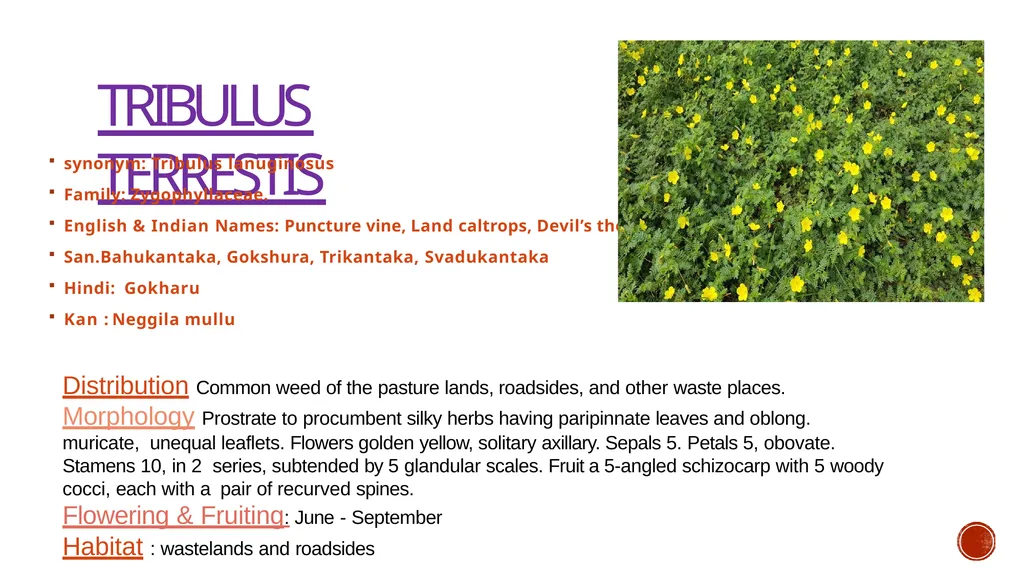
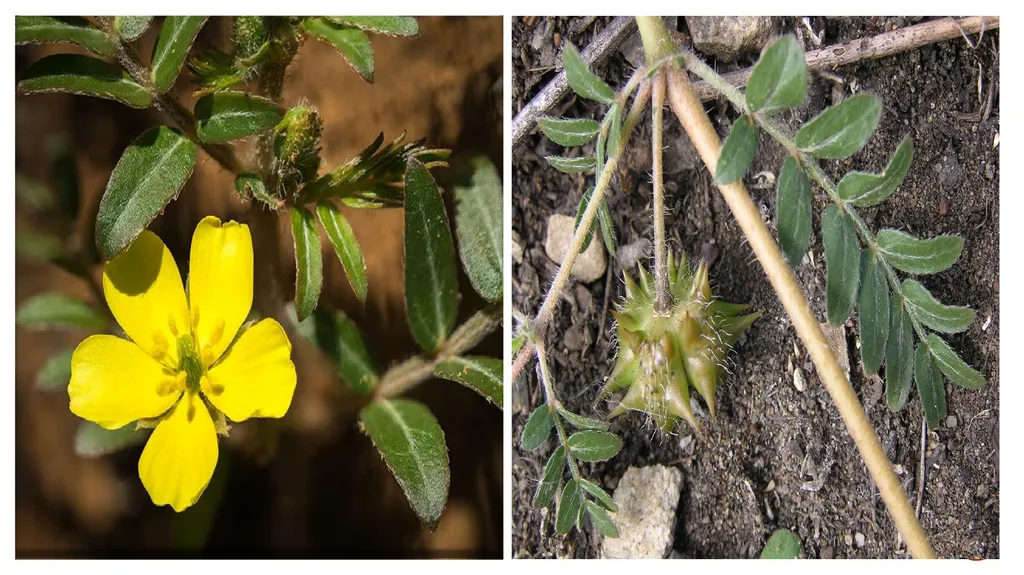
Distribution Common weed of the pasture lands, roadsides, and other waste places. Morphology Prostrate to procumbent silky herbs having paripinnate leaves and oblong. muricate, unequal leaflets. Flowers golden yellow, solitary axillary. Sepals 5. Petals 5, obovate. Stamens 10, in 2 series, subtended by 5 glandular scales. Fruit a 5-angled schizocarp with 5 woody cocci, each with a pair of recurved spines.
Flowering & Fruiting: June - September
Habitat : wastelands and roadsides<br>
02
Significant Indian Ethnobotanical Practices Leaves: Leaf extract taken for expelling worms.,
Fruits: Fruit decoction given for urinary tract infection, oedema and urinary stones. Fruit ash applied for checking swelling and rheumatism.
Mixture of its fruits powdered with roots of Solanum melongena consumed with milk for checking
back pain and disc problems.
mixture of its powdered fruits along with ‘triphala’ and long pepper in proportion of 5:3:1 given with
honey as a household remedy for ulcers.
Fruit decoction given twice a day for expelling renal calculi and to check burning sensation during urination
Seeds: seed decoction considered useful as an tonic and for checking habitual abortion. Also, its decoction with coriander seeds good against kidney and bladder stones.for checking diabetoes.
Decoction of its seeds with that of Hordeum vulgare given thrice a day for checking urine blockage
Mixture of its powdered seeds, coriander and rhizome of Musa paradisiaca given with milk for overcoming diseases during pregnancy.<br>
03
Active Constituents : Found to contain saponins, glycosides, flavonoids, alkaloids, and tanning The saponins of neotigogenin, tigogenin, gitogenin, neohecogenin, hecogenin, diosgenin, ruscogenin, sarsasapogenin, and chlorogenin (plant), campesterol, stigmasterol, tigogenin, neotigogenin and â-sitosterol (root).
Biological Activity: Antimicrobial and anticancer properties have been found to be positive.
Major Ayurvedic Formulations: Goksburadi Guggul, Bonnisan, Confido, Diabecon, Geriforte, Himplasia, Renalka, Rumalaya, Rumalaya forte, Speman, Tentex Royal, Digyton. Geriforte, Dasamularista, Brhatyadi kashaya, Himasagara taila, Vastyamayantaka ghrta, Gokshuradi kvatha, Gokshuradi guggulu, Gokshuradi avaleha, Gokshuradi churna, Sahacaraditaila, Dasamula kvatha, Dasamula churna, Draksadi churna, Abhayarista,<br>
04
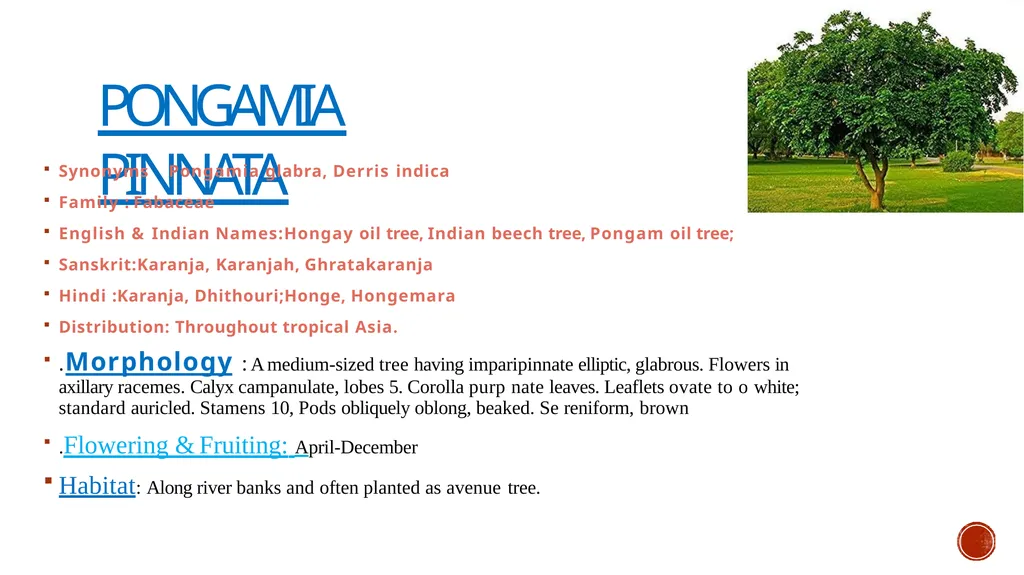
PONGAMIA PINNATA Synonyms Pongamia glabra, Derris indica
Family : Fabaceae
English & Indian Names:Hongay oil tree, Indian beech tree, Pongam oil tree;
Sanskrit:Karanja, Karanjah, Ghratakaranja
Hindi :Karanja, Dhithouri;Honge, Hongemara
Distribution: Throughout tropical Asia.
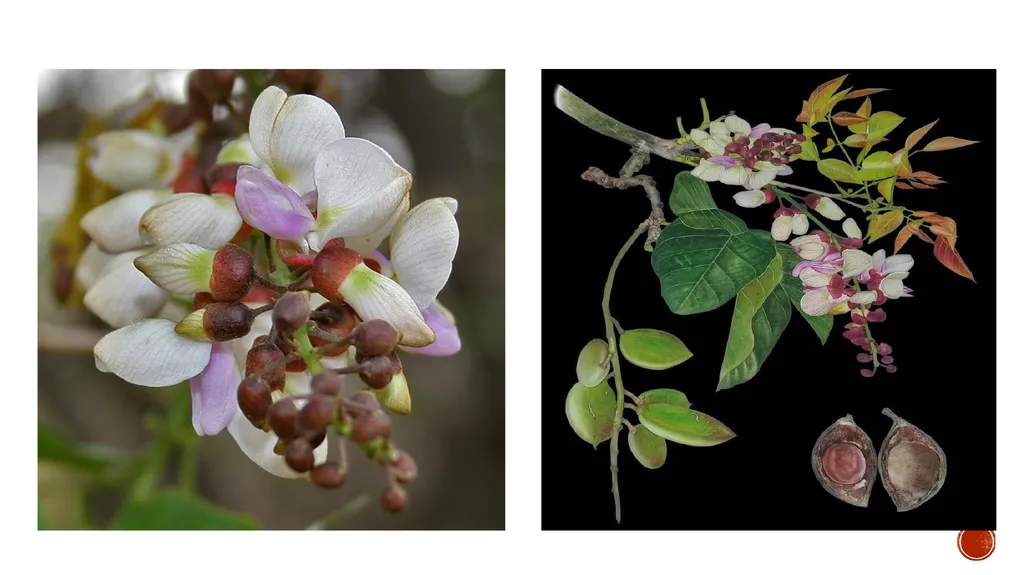
.Morphology : A medium-sized tree having imparipinnate elliptic, glabrous. Flowers in axillary racemes. Calyx campanulate, lobes 5. Corolla purp nate leaves. Leaflets ovate to o white; standard auricled. Stamens 10, Pods obliquely oblong, beaked. Se reniform, brown
.Flowering & Fruiting: April-December
Habitat: Along river banks and often planted as avenue tree.<br>
05
Significant Indian Ethnobotanical Practices
Bark: (i) Decoction of bark useful against cold, headache, acidity and infection in lacrating mothers.
(ii) Decoction of bark used as body wash for curing skin diseases and scabies
(iii) Decoction of bark used for curing menstrual and digestive disorders.
iv) Paste of bark applied externally as an antidote for snake bite.
(v) Infusion of bark considered useful for bleeding piles, beri-beri and diabetes.
Leaves: (1) Juice of leaves given to check cold, cough, diarrhoea, dyspepsia, gonorrhoea and leprosy
(ii) Medicated bath with hot infusion of its leaves considered useful for relieving rheumatic pains and for gonorrhoea.
(iii) Extract of its leaves have also been found to be useful against leucoderma, leprosy. Leaves; lumbago, muscular and articular rheumatism.<br>
06
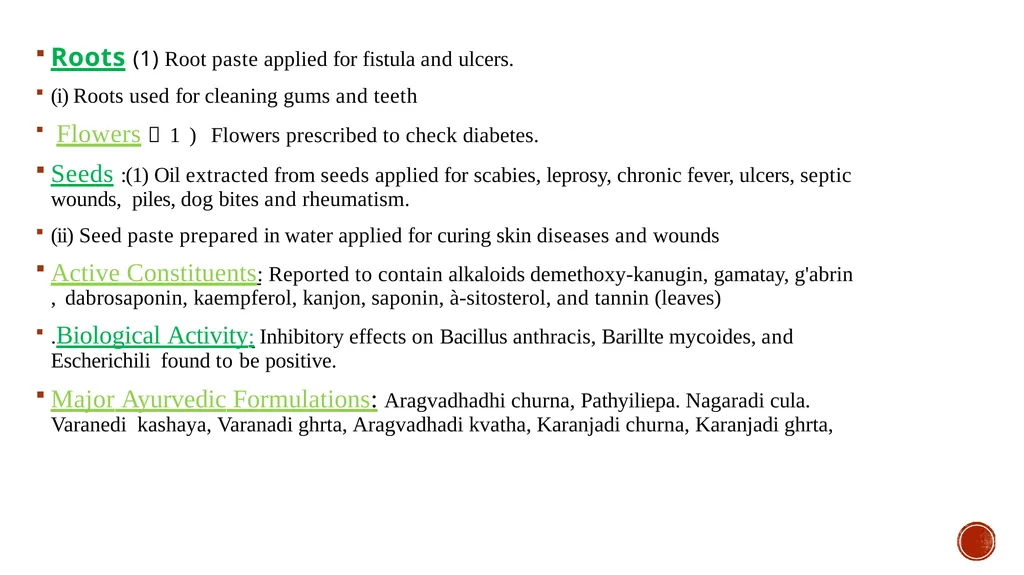
Roots (1) Root paste applied for fistula and ulcers.
(i) Roots used for cleaning gums and teeth
Flowers 1) Flowers prescribed to check diabetes.
Seeds :(1) Oil extracted from seeds applied for scabies, leprosy, chronic fever, ulcers, septic wounds, piles, dog bites and rheumatism.
(ii) Seed paste prepared in water applied for curing skin diseases and wounds
Active Constituents: Reported to contain alkaloids demethoxy-kanugin, gamatay, g'abrin , dabrosaponin, kaempferol, kanjon, saponin, à-sitosterol, and tannin (leaves)
.Biological Activity: Inhibitory effects on Bacillus anthracis, Barillte mycoides, and Escherichili found to be positive.
Major Ayurvedic Formulations: Aragvadhadhi churna, Pathyiliepa. Nagaradi cula. Varanedi kashaya, Varanadi ghrta, Aragvadhadi kvatha, Karanjadi churna, Karanjadi ghrta,<br>