Trump’s ethnonationalism: America’s problem or a
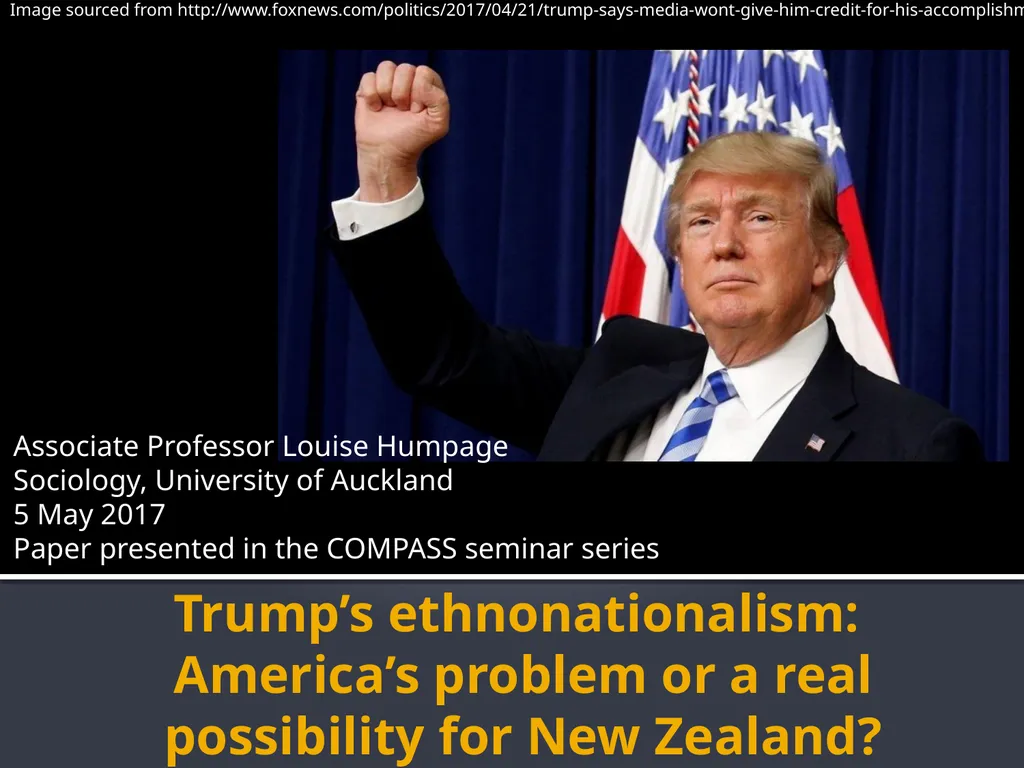
Description: Trumps ethnonationalism: Americas problem or a real possibility for New Zealand? Image sourced from http:www.foxnews.compolitics20170421trump-says-media-wont-give-him-credit-for-his-accomplishments.html Associate Professor Louise
Related Topics
Download Presentation
"Trump’s ethnonationalism: America’s problem or a" is the property of its rightful owner. Permission is granted to download and print the materials on this website for personal, non-commercial use only, and to display it on your personal computer provided you do not modify the materials and that you retain all copyright notices contained in the materials. By downloading content from our website, you accept the terms of this agreement.
Presentation Transcript
slide1. Trump’s ethnonationalism: America’s problem or a real possibility for New Zealand? Image sourced from http://www.foxnews.com/politics/2017/04/21/trump-says-media-wont-give-him-credit-for-his-accomplishments.html Associate Professor Louise Humpage
Sociology, University of Auckland
5 May 2017
Paper presented in the COMPASS seminar series<br>
slide2. Thanks Barry Milne and Clark Tipene have been a great help in preparing this and related papers based on the ISSP 2015 data
Thanks also to funders of the ISSP survey (including UoA Faculty of Arts PBRF fund)<br>
slide3. Trump regards American identity as reflecting Anglo-Protestant culture and thus ‘only certain groups, principally Anglo-Saxons, possess the moral qualities and cultural values that are inherently American’ (Citron et al., 2001: 254-55)
He accuses naturalised immigrants as retaining stronger loyalties elsewhere and, more controversially, that birth within US borders does not guarantee loyalty to the American nation-state
Questioned President Obama’s American citizenship and eligibility of his rival for the Republican Party’s 2016 nomination, Ted Cruz, who was born in Canada to an American mother and a Cuban father
Said a federal judge was biased against him in a fraud case because the judge was born in Indiana to Mexican immigrants
Said Florida Senator Marco Rubio favoured amnesty for undocumented immigrants because he is the son of Cuban immigrants Trump’s ethnonationalist views on national identity Image sourced from https://jaxpsychogeo.com/west-riverside-avondale/trump-campaign-office/<br>
slide4. Trump also blames immigration policy for:
allowing the ‘wrong’ types of people into the country (e.g. Mexican immigrants are all ‘criminals, drug dealers, rapists’) and threatening US jobs and social security
for increasing numbers of Muslims gaining permanent residency - noting that the man behind the 2016 Pulse Nightclub attack in Florida was the son of Afghani immigrants, Trump said ‘[w]e cannot continue to allow thousands upon thousands of people to pour into our country, many of whom have the same thought process as this savage killer’ Trump’s ethnonationalist views on national identity a wall between Mexico and the US
deporting undocumented Mexican immigrants
abolishing automatic US citizenship for children born to such immigrants immigration bans targeting Muslim-majority countries<br>
slide5. American national identity National identity relies on citizens viewing themselves as a group, sharing something in common with others they do not know personally: an ‘imagined political community’ (Anderson 1991).
In the US, naturalised citizens officially need only to endorse the national creed to become ‘American’ = ‘civic nationalism’ = membership based on shared rights/obligations, political institutions and values
But in practice these civic ideals often accompanied by strong public views about nationalism based on descent and ethno-cultural traits … Image sourced from http://www.flags.net/UNST.htm<br>
slide6. American national identity Since 1990, American scholars have been studying what the public believes constitutes a ‘real’ American - this tells us about ‘the boundaries [Americans] set to determine who is fully in the group and who is not’ (Theiss-Morse 2012:4)
In surveys, they distinguish between:
Ascriptive items that are difficult (e.g. English language, belief in God) or impossible (e.g. being born in US) for immigrants to meet
Civic items that in theory all members in the political community can achieve (e.g. having US citizenship or respect for political institutions) exclusive, ethnocultural view of national identity because citizens are
believed to share certain characteristics, such as race, ethnicity, and language more inclusive cultural pluralist or incorporationist model where citizenship
rights are separated from ethnicity/culture<br>
slide7. Schildkraut (2014) reports that most US studies find civic notions of American identity more widely endorsed than ascriptive ones. However:
Speaking English is considered important by most Americans
Ascriptive ideas strengthened after the terrorist attacks on 11 September 2011
Citron et al (1990) predicted a backlash if strong emphasis was placed on preserving group differences because many white Americans associate multiculturalism with special and unjustly favourable treatment for other ethnic groups
Age, education and political orientation are most important in explaining ethnonationalist views, challenging perceptions that ‘increasing racial or ethnic diversity is eroding consensus on what being American means’ (Schildkraut 2014: 448)
Racial minorities were more likely than white Americans to view ethnocultural items as important to making someone a true American (high degree of religiosity amongst black and Latino Americans? Greater need amongst minority group members to assert their belonging through rigid rules for membership than majority group members whose belonging is never questioned?) American national identity<br>
slide8. The rapidly changing demographic context United States
In 2014, ‘ethnic minorities’ represented 38% of the entire US population, up from 33% in 2004 (already the majority in four states and Washington DC).
Overseas-born proportion of population almost trebled to 14% between 1965 and 2015, with fundamental changes in the source regions of immigrants over the same period from Europe to South/Central America, Asia, and Africa.
The US remains home to more Christians than any other country and only 0.9% of the US population identifies as Muslim but the Christian proportion declined from 78% in 2007 to 71% in 2014. New Zealand
By 2013, 25 per cent of the NZ population was born overseas.
The ‘Asian’ population rapidly increased by 33 percentage points to 12% of the population over the same period.
The Muslim population increased by 28 percentage points from 2006, but still represents only 1.2% of the NZ population.<br>
slide9. Peters’ ethnonationalist views on national identity NZ First Party leader, Winston Peters, has articulated ethnonationlist concerns about (Asian) immigration since 1996: Image sourced from https://www.whaleoil.co.nz/2014/05/winston-peters-deals-media-enquiries/ We ‘need to keep a tight lid on immigration if we are to avoid NZ’s identity, values and heritage being swamped’ (2002, cited in Skilling 2012: 370) We need to ‘put a wall around this country to ensure that we do not have a flood of immigrants competing with us with respect to social services, education and health’ (2002, cited in Skilling 2012: 370) Proposes that all applicants be interviewed to ensure they embody ‘New Zealand’ attitudes because: ‘We want them to salute our flag, respect our laws, honour our institutions and, above all, don’t bring absolutely anti-women attitudes with them, treating women like cattle, like fourth-class citizens’ (2016, cited Kirk 2016)<br>
slide10. NZ views on immigration Other parties have also proposed reductions to immigration:
BUT McMillan (2010) argues that immigration has not been a ‘political wedge’ as in the US or Europe since both Centre-Left and Centre-Right governments in NZ agree that skilled migrants are economically necessary to counter population ageing and significant emigration
AND
NZ First itself is a Centrist party that has supported both Left and Right governments, while anti-immigration sentiment was only one factor behind its electoral success in 1996 National government will restrict the ability of lower-skilled migrants to apply to and stay in NZ (arguably shifting towards a guest-worker type programme) Labour Party leader Andrew Little vows to slash immigration by ‘tens of thousands’ in order to give the country a ‘breather’. He promised ‘immigration that meets the genuine shortage of skills that we've got, not just the open slather policy we've got right now’ (cited in NZ Herald 2017) Green Party promises to cap overall net migration at 1 per cent of the population, including returning New Zealanders<br>
slide11. NZ views on immigration New Zealanders generally believe immigration has a positive impact YET support reduced immigration
Big improvements in attitudes towards Asian immigrants after 1996, though a hardening between 2012-2015 (Butcher et al 2015)
NZES data since 1990 suggests consistently high support for restricting immigration (Skilling 2012)
Older people more likely to believe immigration had increased a lot in the last five years and support for immigration restrictions (Ipsos 2016)
NZ First and National voters more likely to want to restrict immigration ( Ipsos, 2016; Gower, 2016).
NZ born (especially Māori) and immigrants who arrived before 1999 (more likely from UK/Europe) tend to be less positive towards immigration/immigrants (Spoonley et al 2007; Ipsos 2016; MBIE 2017)
Unemployment trends unrelated to attitudes towards immigrants but more general perceptions of relative disadvantage may e.g housing affordability (Ward et al. 2011).<br>
slide12. NZ national identity Studies generally show New Zealanders articulate an internationally strong multicultural/bicultural ideology
Several older studies (e.g. Gendall et al 2007; Ward et al 2011) find a majority believe immigrants should be able to maintain their traditional culture while also adopting NZ culture and only a minority think immigrants should give up their original culture
At least two-thirds of Ipsos (2016) respondents agreed that: it’s a good thing for society to be made up of people from different races; migrants make an important contribution to New Zealand’s culture and society; migrants make New Zealand more productive and innovative; and migrants have qualities they admire
Sibley and Liu (2007) found Māori and Pākehā respondents unified in terms of their associations with national symbols with Pākehā respondents strongly associating both Pākehā and Māori New Zealanders with NZ
YET immigrants often feel left out of bicultural relationship (MSD 2008) and Pākehā often feel ‘disadvantaged’ by it (Terruhn, 2014) Image sourced from https://en.wikipedia.org/wiki/Flag_of_New_Zealand<br>
slide13. Methods The International Social Survey Programme module on citizenship, run as part of the ‘Social Attitudes Survey New Zealand’ in 2015, included 6 ascriptive and 4 civic items that allow us to ask:
Is ‘truly being a New Zealander’ more closely associated with exclusive, ascriptive signifiers or more inclusive, civic items?
Have these associations changed since 2003?
Are there any differences in the above responses across varied social groups?<br>
slide14. Methods The 2015 survey was sent to 2500 individuals (aged 18 years and older) randomly selected from the electoral roll, with 901 returning surveys (36% response rate).
Reflecting the electoral roll, the sample was older and contained fewer individuals of Māori descent than found in the general population, while also under-representing those from Auckland and those living in deprived areas and over-representing those in rural areas
Weightings were computed to deal with these issues but caution is still needed when cross-tabulating data by: place of birth, ethnicity, political affiliation, party vote in 2014, age and current financial situation.
Statistical significance was tested using Chi-square – only significant findings discussed<br>
slide16. <br>
slide17. <br>
slide18. ½ of the 2015 survey respondents who placed themselves on the political scale identified as Centrist (compared to 19% identifying as Left and 30% on the Right).
¼ of the total sample could or would not locate themselves on the political scale. <br>
slide19. 15% of survey respondents who indicated voting preferences said they did not/were not eligible to vote <br>
slide20. ! ! ! ! <br>
slide21. <br>
slide22. Conclusions ISSP data from 2015 shows that the boundaries of NZ identity are relatively permeable and have overall become a little more inclusive than in 2003
Feeling like a New Zealander and other civic items were rated most highly by respondents as identifiers of truly being a New Zealander
There are nonetheless strongly exclusive views that true New Zealanders should be born in NZ and, to a lesser degree, have NZ ancestry, particularly amongst:
those aged over 61 and (in some cases) under 35
politically Right, Centre or ambivalent (especially those voting for NZ First)
those born in NZ
Māori
Combined these groups could provide sufficient electoral support to see NZ First become part of government again and put ethno-nationalist ideas into policy<br>
slide23. Conclusions The findings further indicate that NZ’s current ‘laissez-faire’ approach to multiculturalism within the context of the bicultural project may be insufficient in the long-term to avoid the growth of ethno-nationalist feelings that further exclude migrants (and Māori) from the national imaginary
While NZ attitudes were relatively inclusive overall, radical institutional change is needed to avoid the divisive ethnonationalism evident in the US and Europe. This requires:
A form of bi-nationalism providing Māori more certainty about the ongoing role of the Treaty of Waitangi and power-sharing
AND
A more dynamic multicultural policy that actively supports and welcomes immigrants to NZ
AND
A process of collective reflection on colonialism, ongoing institutional racism and historical representations of national identity that encourages Pākehā to acknowledge their privilege within NZ society without recourse to blame<br>
Sociology, University of Auckland
5 May 2017
Paper presented in the COMPASS seminar series<br>
slide2. Thanks Barry Milne and Clark Tipene have been a great help in preparing this and related papers based on the ISSP 2015 data
Thanks also to funders of the ISSP survey (including UoA Faculty of Arts PBRF fund)<br>
slide3. Trump regards American identity as reflecting Anglo-Protestant culture and thus ‘only certain groups, principally Anglo-Saxons, possess the moral qualities and cultural values that are inherently American’ (Citron et al., 2001: 254-55)
He accuses naturalised immigrants as retaining stronger loyalties elsewhere and, more controversially, that birth within US borders does not guarantee loyalty to the American nation-state
Questioned President Obama’s American citizenship and eligibility of his rival for the Republican Party’s 2016 nomination, Ted Cruz, who was born in Canada to an American mother and a Cuban father
Said a federal judge was biased against him in a fraud case because the judge was born in Indiana to Mexican immigrants
Said Florida Senator Marco Rubio favoured amnesty for undocumented immigrants because he is the son of Cuban immigrants Trump’s ethnonationalist views on national identity Image sourced from https://jaxpsychogeo.com/west-riverside-avondale/trump-campaign-office/<br>
slide4. Trump also blames immigration policy for:
allowing the ‘wrong’ types of people into the country (e.g. Mexican immigrants are all ‘criminals, drug dealers, rapists’) and threatening US jobs and social security
for increasing numbers of Muslims gaining permanent residency - noting that the man behind the 2016 Pulse Nightclub attack in Florida was the son of Afghani immigrants, Trump said ‘[w]e cannot continue to allow thousands upon thousands of people to pour into our country, many of whom have the same thought process as this savage killer’ Trump’s ethnonationalist views on national identity a wall between Mexico and the US
deporting undocumented Mexican immigrants
abolishing automatic US citizenship for children born to such immigrants immigration bans targeting Muslim-majority countries<br>
slide5. American national identity National identity relies on citizens viewing themselves as a group, sharing something in common with others they do not know personally: an ‘imagined political community’ (Anderson 1991).
In the US, naturalised citizens officially need only to endorse the national creed to become ‘American’ = ‘civic nationalism’ = membership based on shared rights/obligations, political institutions and values
But in practice these civic ideals often accompanied by strong public views about nationalism based on descent and ethno-cultural traits … Image sourced from http://www.flags.net/UNST.htm<br>
slide6. American national identity Since 1990, American scholars have been studying what the public believes constitutes a ‘real’ American - this tells us about ‘the boundaries [Americans] set to determine who is fully in the group and who is not’ (Theiss-Morse 2012:4)
In surveys, they distinguish between:
Ascriptive items that are difficult (e.g. English language, belief in God) or impossible (e.g. being born in US) for immigrants to meet
Civic items that in theory all members in the political community can achieve (e.g. having US citizenship or respect for political institutions) exclusive, ethnocultural view of national identity because citizens are
believed to share certain characteristics, such as race, ethnicity, and language more inclusive cultural pluralist or incorporationist model where citizenship
rights are separated from ethnicity/culture<br>
slide7. Schildkraut (2014) reports that most US studies find civic notions of American identity more widely endorsed than ascriptive ones. However:
Speaking English is considered important by most Americans
Ascriptive ideas strengthened after the terrorist attacks on 11 September 2011
Citron et al (1990) predicted a backlash if strong emphasis was placed on preserving group differences because many white Americans associate multiculturalism with special and unjustly favourable treatment for other ethnic groups
Age, education and political orientation are most important in explaining ethnonationalist views, challenging perceptions that ‘increasing racial or ethnic diversity is eroding consensus on what being American means’ (Schildkraut 2014: 448)
Racial minorities were more likely than white Americans to view ethnocultural items as important to making someone a true American (high degree of religiosity amongst black and Latino Americans? Greater need amongst minority group members to assert their belonging through rigid rules for membership than majority group members whose belonging is never questioned?) American national identity<br>
slide8. The rapidly changing demographic context United States
In 2014, ‘ethnic minorities’ represented 38% of the entire US population, up from 33% in 2004 (already the majority in four states and Washington DC).
Overseas-born proportion of population almost trebled to 14% between 1965 and 2015, with fundamental changes in the source regions of immigrants over the same period from Europe to South/Central America, Asia, and Africa.
The US remains home to more Christians than any other country and only 0.9% of the US population identifies as Muslim but the Christian proportion declined from 78% in 2007 to 71% in 2014. New Zealand
By 2013, 25 per cent of the NZ population was born overseas.
The ‘Asian’ population rapidly increased by 33 percentage points to 12% of the population over the same period.
The Muslim population increased by 28 percentage points from 2006, but still represents only 1.2% of the NZ population.<br>
slide9. Peters’ ethnonationalist views on national identity NZ First Party leader, Winston Peters, has articulated ethnonationlist concerns about (Asian) immigration since 1996: Image sourced from https://www.whaleoil.co.nz/2014/05/winston-peters-deals-media-enquiries/ We ‘need to keep a tight lid on immigration if we are to avoid NZ’s identity, values and heritage being swamped’ (2002, cited in Skilling 2012: 370) We need to ‘put a wall around this country to ensure that we do not have a flood of immigrants competing with us with respect to social services, education and health’ (2002, cited in Skilling 2012: 370) Proposes that all applicants be interviewed to ensure they embody ‘New Zealand’ attitudes because: ‘We want them to salute our flag, respect our laws, honour our institutions and, above all, don’t bring absolutely anti-women attitudes with them, treating women like cattle, like fourth-class citizens’ (2016, cited Kirk 2016)<br>
slide10. NZ views on immigration Other parties have also proposed reductions to immigration:
BUT McMillan (2010) argues that immigration has not been a ‘political wedge’ as in the US or Europe since both Centre-Left and Centre-Right governments in NZ agree that skilled migrants are economically necessary to counter population ageing and significant emigration
AND
NZ First itself is a Centrist party that has supported both Left and Right governments, while anti-immigration sentiment was only one factor behind its electoral success in 1996 National government will restrict the ability of lower-skilled migrants to apply to and stay in NZ (arguably shifting towards a guest-worker type programme) Labour Party leader Andrew Little vows to slash immigration by ‘tens of thousands’ in order to give the country a ‘breather’. He promised ‘immigration that meets the genuine shortage of skills that we've got, not just the open slather policy we've got right now’ (cited in NZ Herald 2017) Green Party promises to cap overall net migration at 1 per cent of the population, including returning New Zealanders<br>
slide11. NZ views on immigration New Zealanders generally believe immigration has a positive impact YET support reduced immigration
Big improvements in attitudes towards Asian immigrants after 1996, though a hardening between 2012-2015 (Butcher et al 2015)
NZES data since 1990 suggests consistently high support for restricting immigration (Skilling 2012)
Older people more likely to believe immigration had increased a lot in the last five years and support for immigration restrictions (Ipsos 2016)
NZ First and National voters more likely to want to restrict immigration ( Ipsos, 2016; Gower, 2016).
NZ born (especially Māori) and immigrants who arrived before 1999 (more likely from UK/Europe) tend to be less positive towards immigration/immigrants (Spoonley et al 2007; Ipsos 2016; MBIE 2017)
Unemployment trends unrelated to attitudes towards immigrants but more general perceptions of relative disadvantage may e.g housing affordability (Ward et al. 2011).<br>
slide12. NZ national identity Studies generally show New Zealanders articulate an internationally strong multicultural/bicultural ideology
Several older studies (e.g. Gendall et al 2007; Ward et al 2011) find a majority believe immigrants should be able to maintain their traditional culture while also adopting NZ culture and only a minority think immigrants should give up their original culture
At least two-thirds of Ipsos (2016) respondents agreed that: it’s a good thing for society to be made up of people from different races; migrants make an important contribution to New Zealand’s culture and society; migrants make New Zealand more productive and innovative; and migrants have qualities they admire
Sibley and Liu (2007) found Māori and Pākehā respondents unified in terms of their associations with national symbols with Pākehā respondents strongly associating both Pākehā and Māori New Zealanders with NZ
YET immigrants often feel left out of bicultural relationship (MSD 2008) and Pākehā often feel ‘disadvantaged’ by it (Terruhn, 2014) Image sourced from https://en.wikipedia.org/wiki/Flag_of_New_Zealand<br>
slide13. Methods The International Social Survey Programme module on citizenship, run as part of the ‘Social Attitudes Survey New Zealand’ in 2015, included 6 ascriptive and 4 civic items that allow us to ask:
Is ‘truly being a New Zealander’ more closely associated with exclusive, ascriptive signifiers or more inclusive, civic items?
Have these associations changed since 2003?
Are there any differences in the above responses across varied social groups?<br>
slide14. Methods The 2015 survey was sent to 2500 individuals (aged 18 years and older) randomly selected from the electoral roll, with 901 returning surveys (36% response rate).
Reflecting the electoral roll, the sample was older and contained fewer individuals of Māori descent than found in the general population, while also under-representing those from Auckland and those living in deprived areas and over-representing those in rural areas
Weightings were computed to deal with these issues but caution is still needed when cross-tabulating data by: place of birth, ethnicity, political affiliation, party vote in 2014, age and current financial situation.
Statistical significance was tested using Chi-square – only significant findings discussed<br>
slide16. <br>
slide17. <br>
slide18. ½ of the 2015 survey respondents who placed themselves on the political scale identified as Centrist (compared to 19% identifying as Left and 30% on the Right).
¼ of the total sample could or would not locate themselves on the political scale. <br>
slide19. 15% of survey respondents who indicated voting preferences said they did not/were not eligible to vote <br>
slide20. ! ! ! ! <br>
slide21. <br>
slide22. Conclusions ISSP data from 2015 shows that the boundaries of NZ identity are relatively permeable and have overall become a little more inclusive than in 2003
Feeling like a New Zealander and other civic items were rated most highly by respondents as identifiers of truly being a New Zealander
There are nonetheless strongly exclusive views that true New Zealanders should be born in NZ and, to a lesser degree, have NZ ancestry, particularly amongst:
those aged over 61 and (in some cases) under 35
politically Right, Centre or ambivalent (especially those voting for NZ First)
those born in NZ
Māori
Combined these groups could provide sufficient electoral support to see NZ First become part of government again and put ethno-nationalist ideas into policy<br>
slide23. Conclusions The findings further indicate that NZ’s current ‘laissez-faire’ approach to multiculturalism within the context of the bicultural project may be insufficient in the long-term to avoid the growth of ethno-nationalist feelings that further exclude migrants (and Māori) from the national imaginary
While NZ attitudes were relatively inclusive overall, radical institutional change is needed to avoid the divisive ethnonationalism evident in the US and Europe. This requires:
A form of bi-nationalism providing Māori more certainty about the ongoing role of the Treaty of Waitangi and power-sharing
AND
A more dynamic multicultural policy that actively supports and welcomes immigrants to NZ
AND
A process of collective reflection on colonialism, ongoing institutional racism and historical representations of national identity that encourages Pākehā to acknowledge their privilege within NZ society without recourse to blame<br>