
Trust Management of Services in Cloud

Description: Trust Management of Services in Cloud Environments: Obstacles and Solutions Paper by: Talal H. Noor, Quan Z. Sheng, Sherali Zeadally, and Jian Yu Presentation by: Jeremy Tate Outline Could Definition Types of Clouds Service Level Agreements
Related Topics
Download Presentation
"Trust Management of Services in Cloud" is the property of its rightful owner. Permission is granted to download and print the materials on this website for personal, non-commercial use only, and to display it on your personal computer provided you do not modify the materials and that you retain all copyright notices contained in the materials. By downloading content from our website, you accept the terms of this agreement.
Presentation Transcript
slide1. Trust Management of Services in Cloud Environments:
Obstacles and Solutions Paper by: Talal H. Noor, Quan Z. Sheng, Sherali Zeadally, and Jian Yu
Presentation by: Jeremy Tate<br>
slide2. Outline Could Definition
Types of Clouds
Service Level Agreements
Trust management models of Clouds
Analytical Framework for Trust Management
Prototypes
Real-world examples<br>
slide3. Cloud Definition
Delivering network resources (typically from a data center) to a user as a service
Users log into the service (website) to gain access<br>
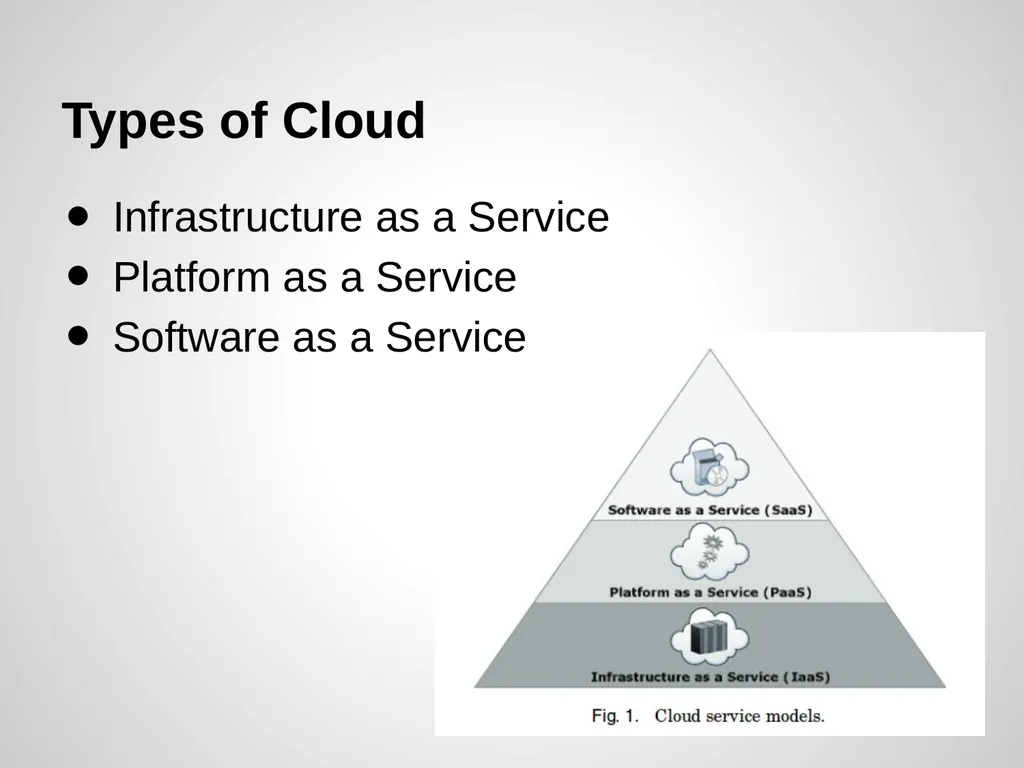
slide4. Types of Cloud Infrastructure as a Service
Platform as a Service
Software as a Service<br>
slide5. Infrastructure as a Service (IaaS) Provides full virtual servers/storage/networking to a user
Allows user to install exact operating system, software, and architecture for a specified project
Amazon Elastic Compute Cloud (EC2) and Simple Storage Service (S3)<br>
slide6. Platform as a Service (PaaS) Provides a service container for the deployment of an application
Customer deploys select software/applications but does not control infrastructure
Microsoft Azure, Google Apps<br>
slide7. Software as a Service (SaaS) Service provider provides all services and the user provides content
User has no control over software or infrastructure
Google Docs and Facebook<br>
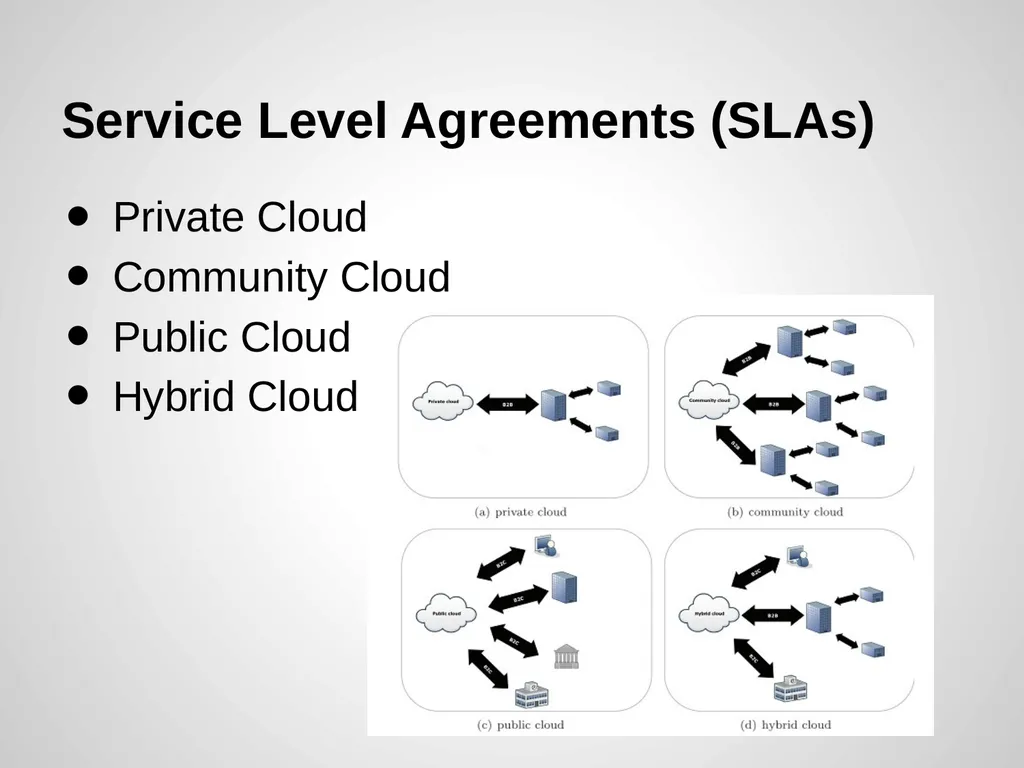
slide8. Service Level Agreements (SLAs) Private Cloud
Community Cloud
Public Cloud
Hybrid Cloud<br>
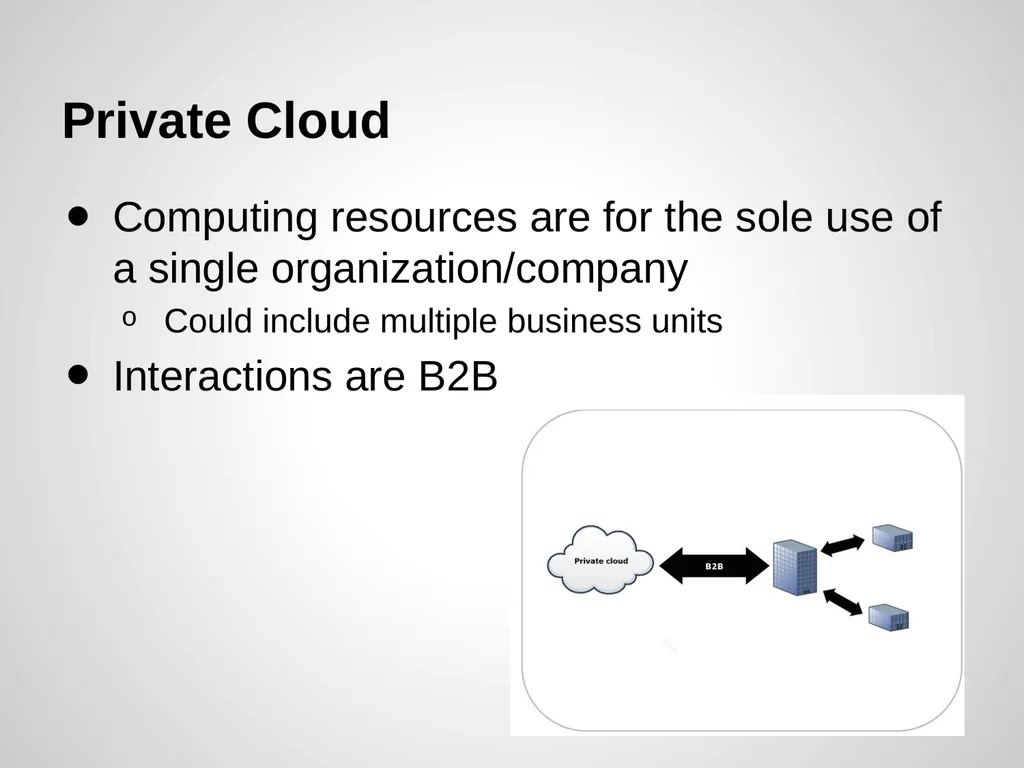
slide9. Private Cloud Computing resources are for the sole use of a single organization/company
Could include multiple business units
Interactions are B2B<br>
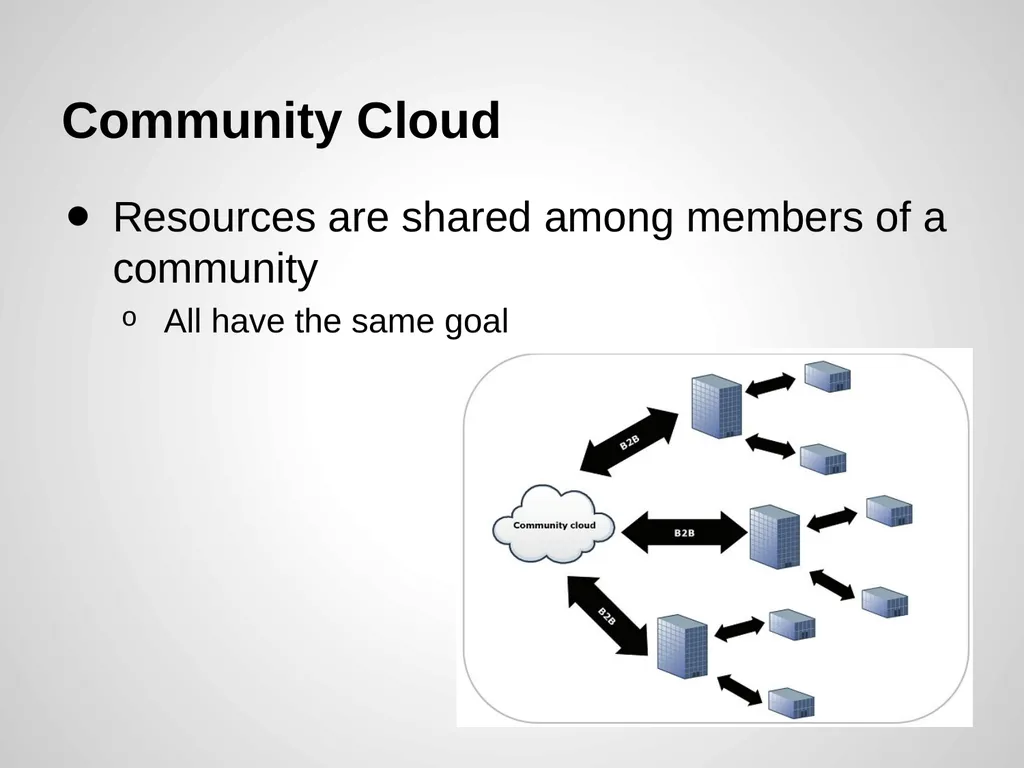
slide10. Community Cloud Resources are shared among members of a community
All have the same goal<br>
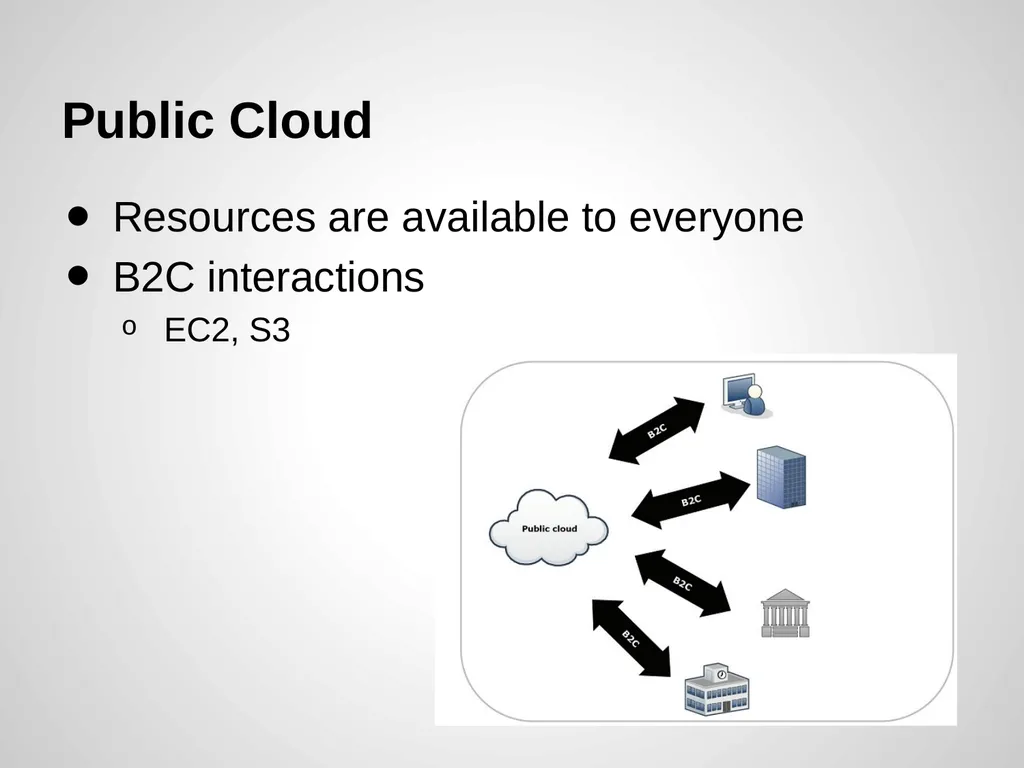
slide11. Public Cloud Resources are available to everyone
B2C interactions
EC2, S3<br>
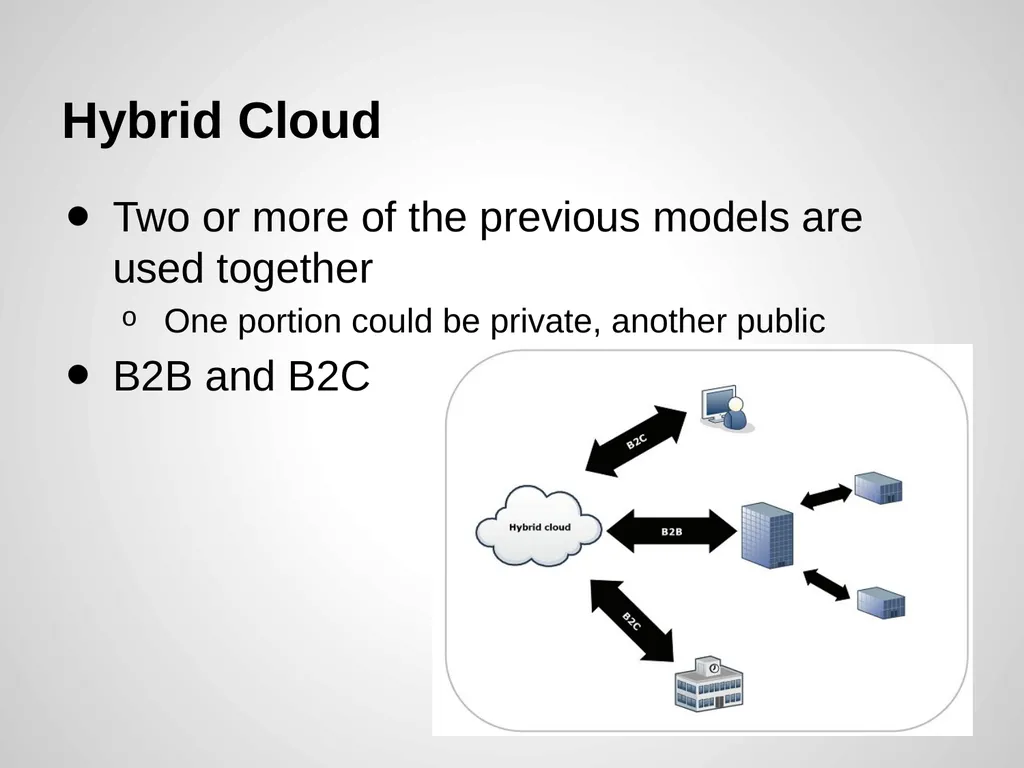
slide12. Hybrid Cloud Two or more of the previous models are used together
One portion could be private, another public
B2B and B2C<br>
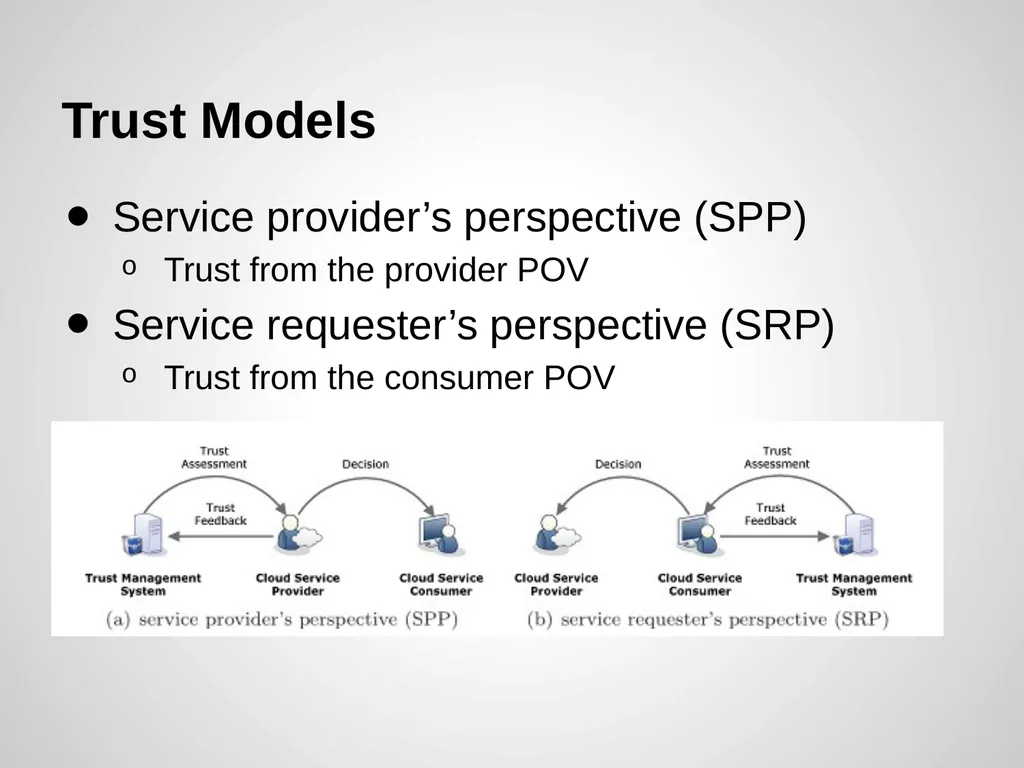
slide13. Trust Models Service provider’s perspective (SPP)
Trust from the provider POV
Service requester’s perspective (SRP)
Trust from the consumer POV<br>
slide14. Techniques Policy as a Trust Management technique
Recommendation as a TM technique
Reputation as a TM technique
Prediction as a TM technique<br>
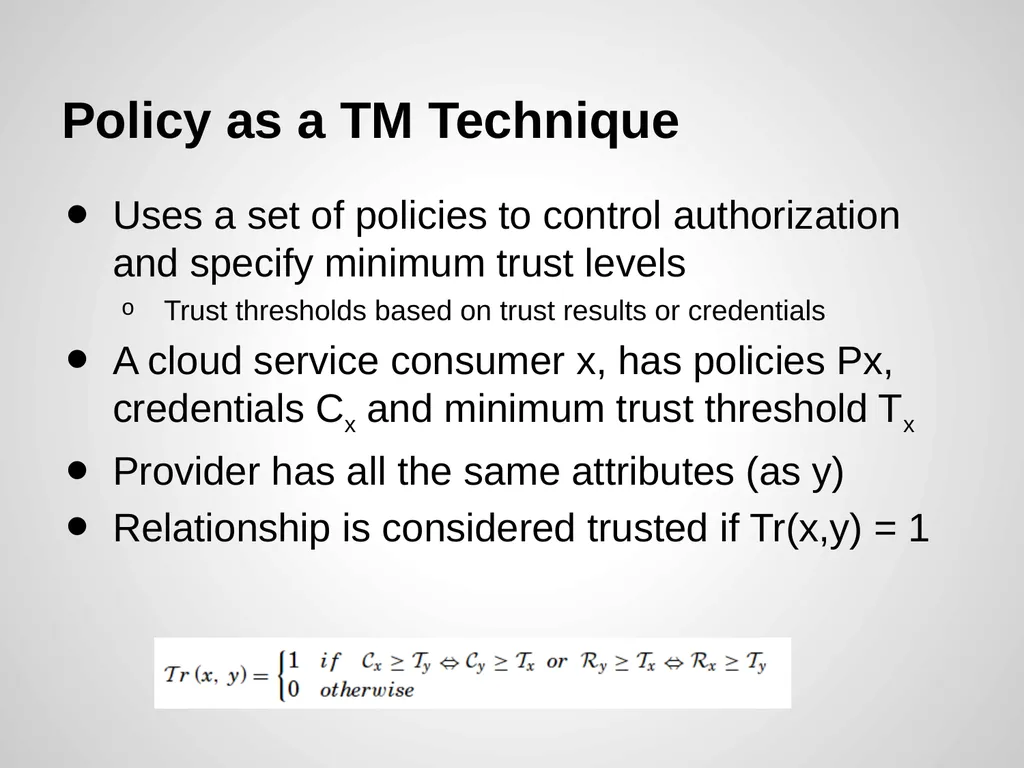
slide15. Policy as a TM Technique Uses a set of policies to control authorization and specify minimum trust levels
Trust thresholds based on trust results or credentials
A cloud service consumer x, has policies Px, credentials Cx and minimum trust threshold Tx
Provider has all the same attributes (as y)
Relationship is considered trusted if Tr(x,y) = 1<br>
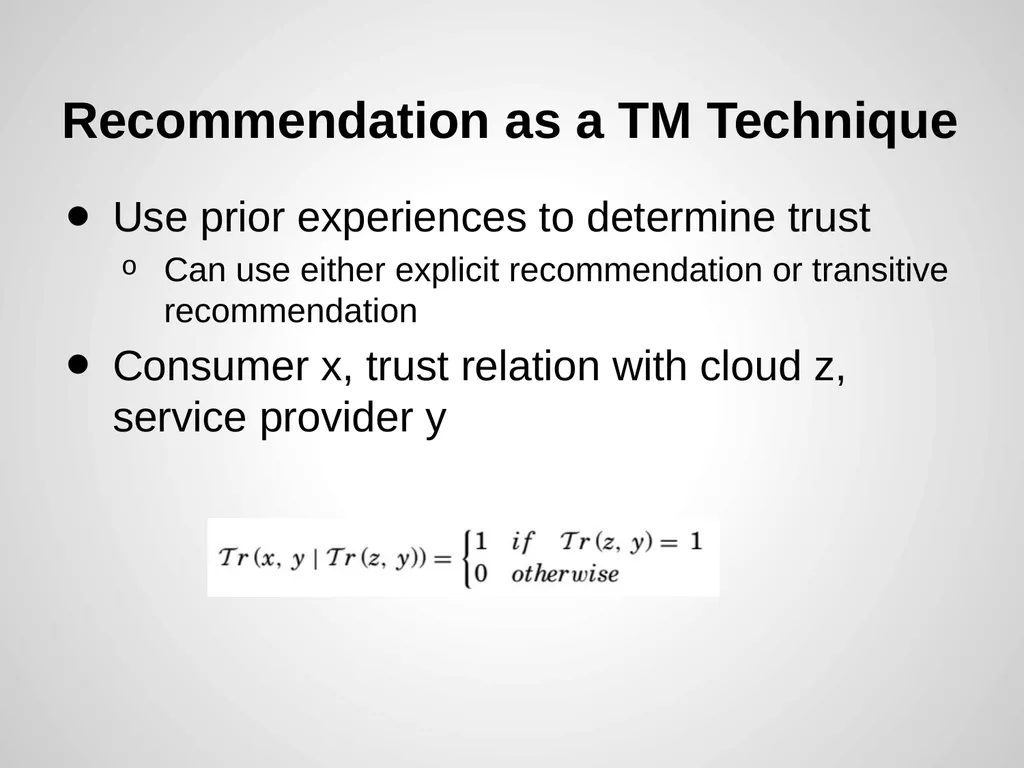
slide16. Recommendation as a TM Technique Use prior experiences to determine trust
Can use either explicit recommendation or transitive recommendation
Consumer x, trust relation with cloud z, service provider y<br>
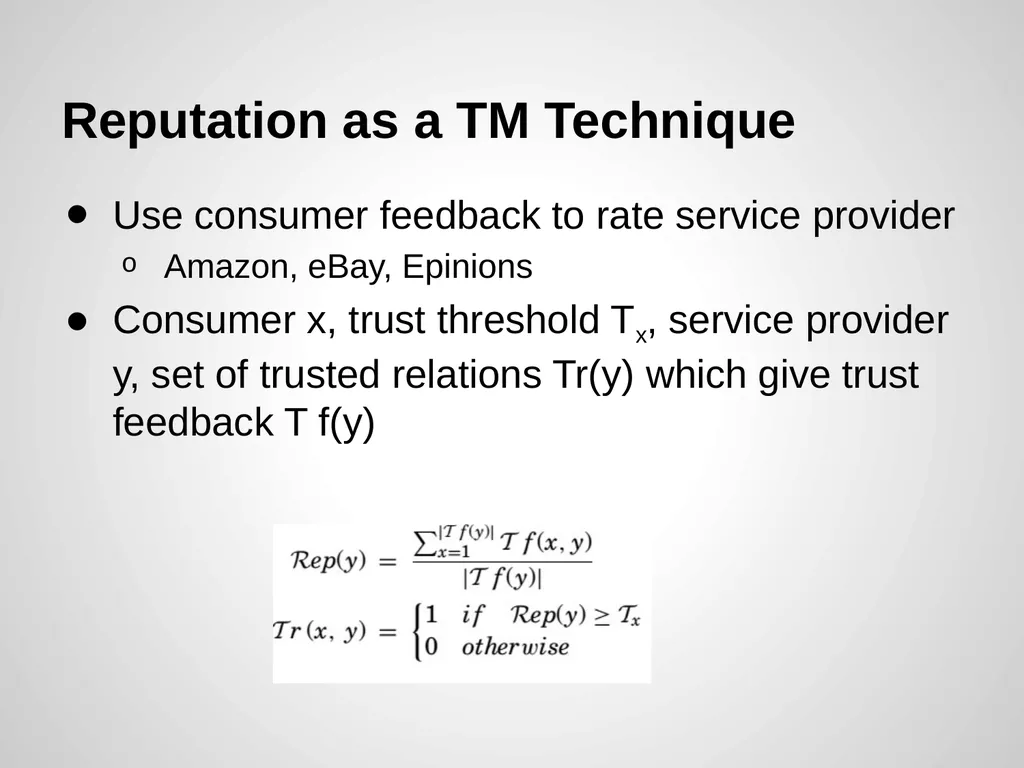
slide17. Reputation as a TM Technique Use consumer feedback to rate service provider
Amazon, eBay, Epinions
Consumer x, trust threshold Tx, service provider y, set of trusted relations Tr(y) which give trust feedback T f(y)<br>
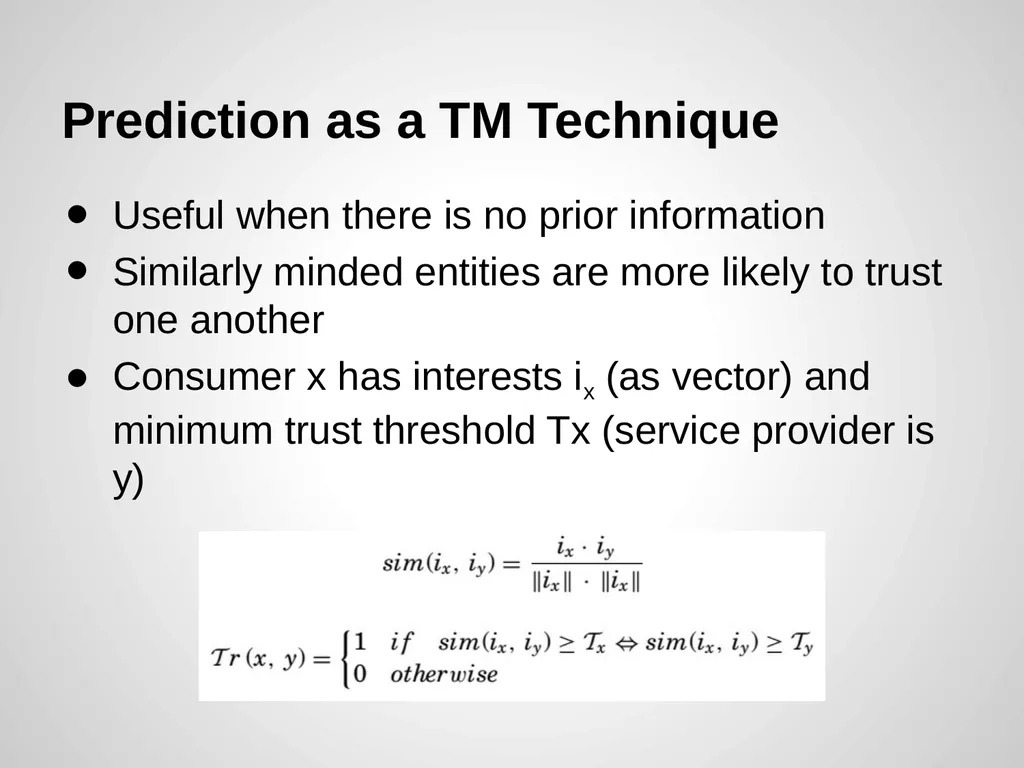
slide18. Prediction as a TM Technique Useful when there is no prior information
Similarly minded entities are more likely to trust one another
Consumer x has interests ix (as vector) and minimum trust threshold Tx (service provider is y)<br>
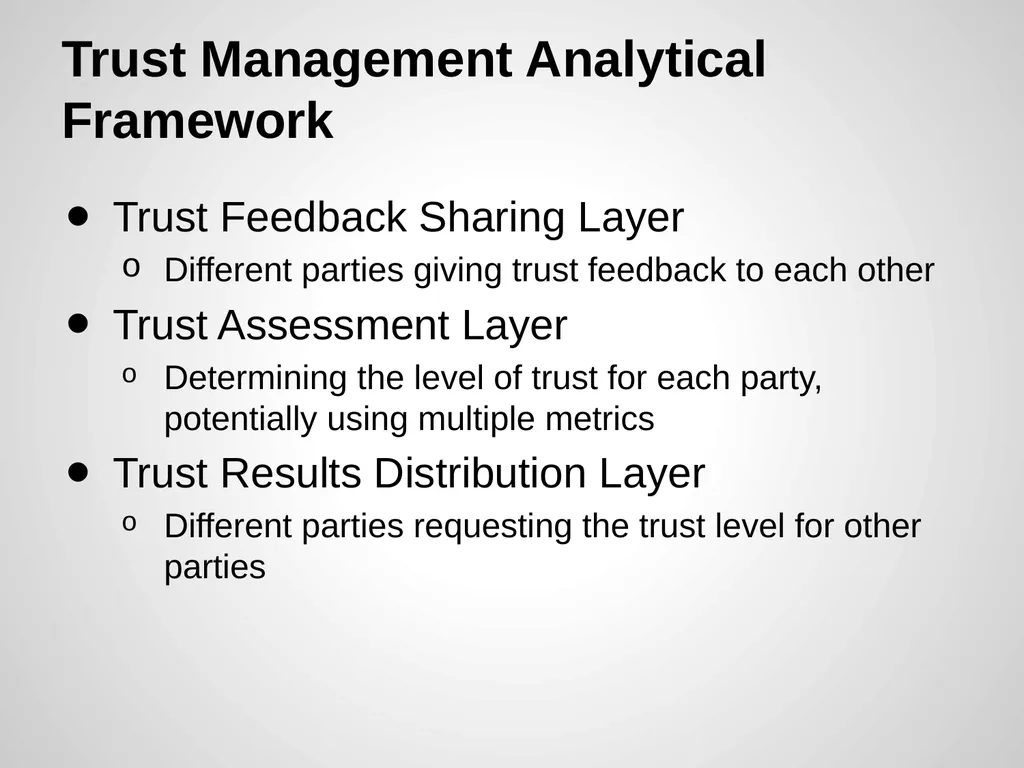
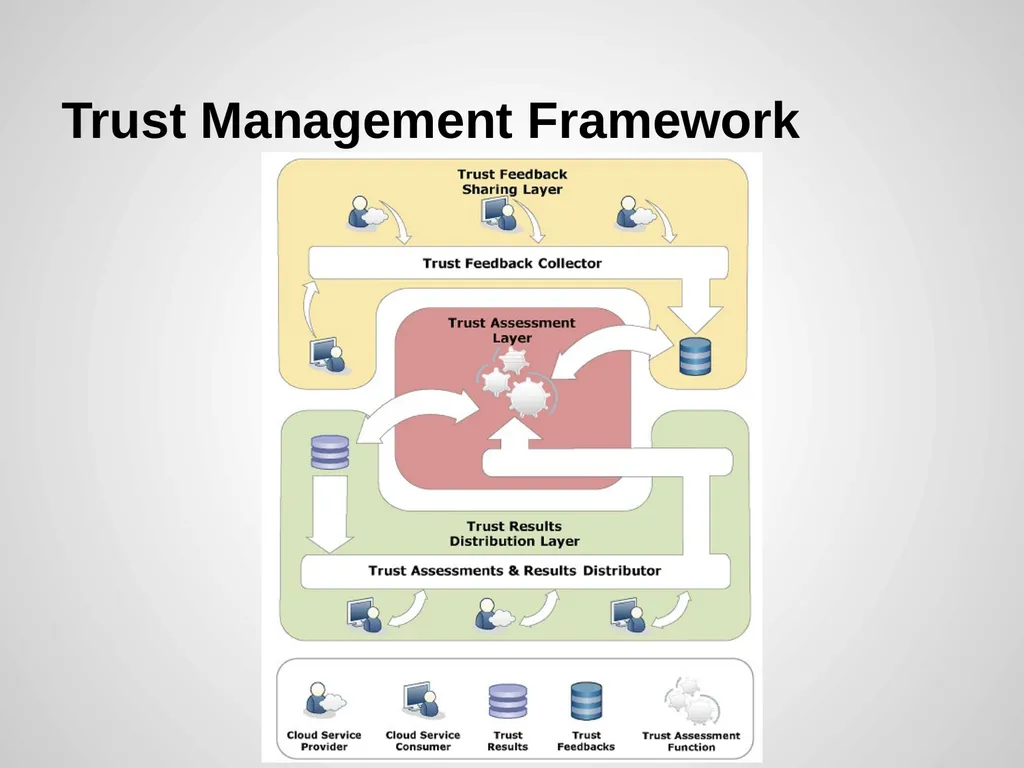
slide19. Trust Management Analytical Framework Trust Feedback Sharing Layer
Different parties giving trust feedback to each other
Trust Assessment Layer
Determining the level of trust for each party, potentially using multiple metrics
Trust Results Distribution Layer
Different parties requesting the trust level for other parties<br>
slide20. Trust Management Framework<br>
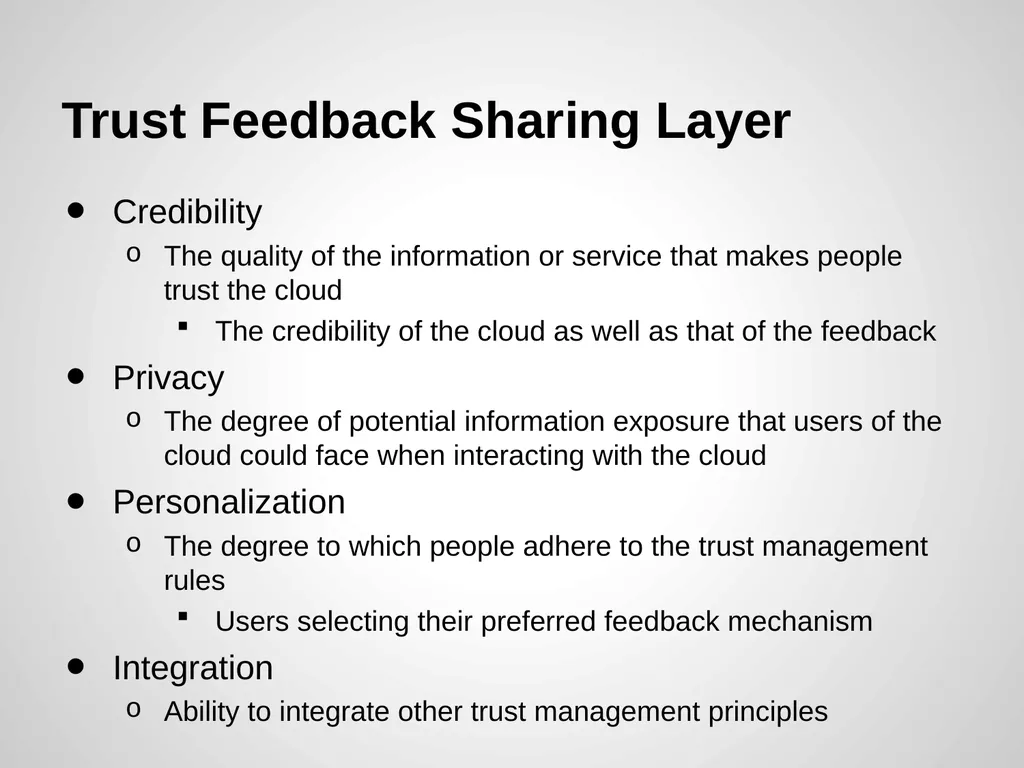
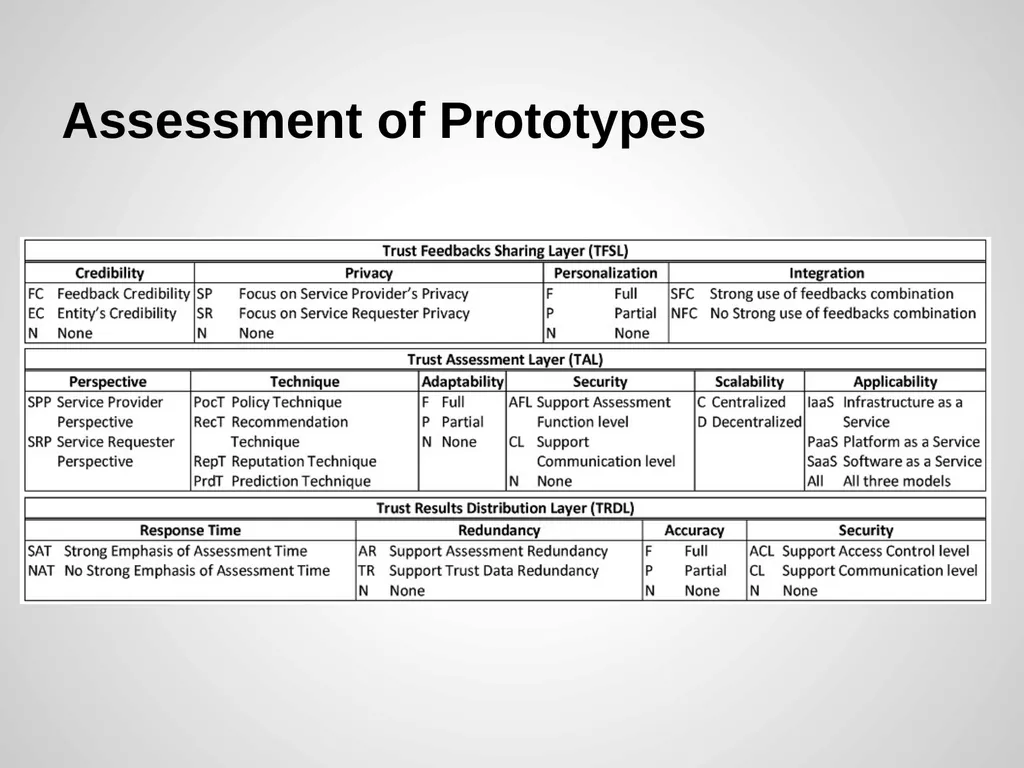
slide21. Trust Feedback Sharing Layer Credibility
The quality of the information or service that makes people trust the cloud
The credibility of the cloud as well as that of the feedback
Privacy
The degree of potential information exposure that users of the cloud could face when interacting with the cloud
Personalization
The degree to which people adhere to the trust management rules
Users selecting their preferred feedback mechanism
Integration
Ability to integrate other trust management principles<br>
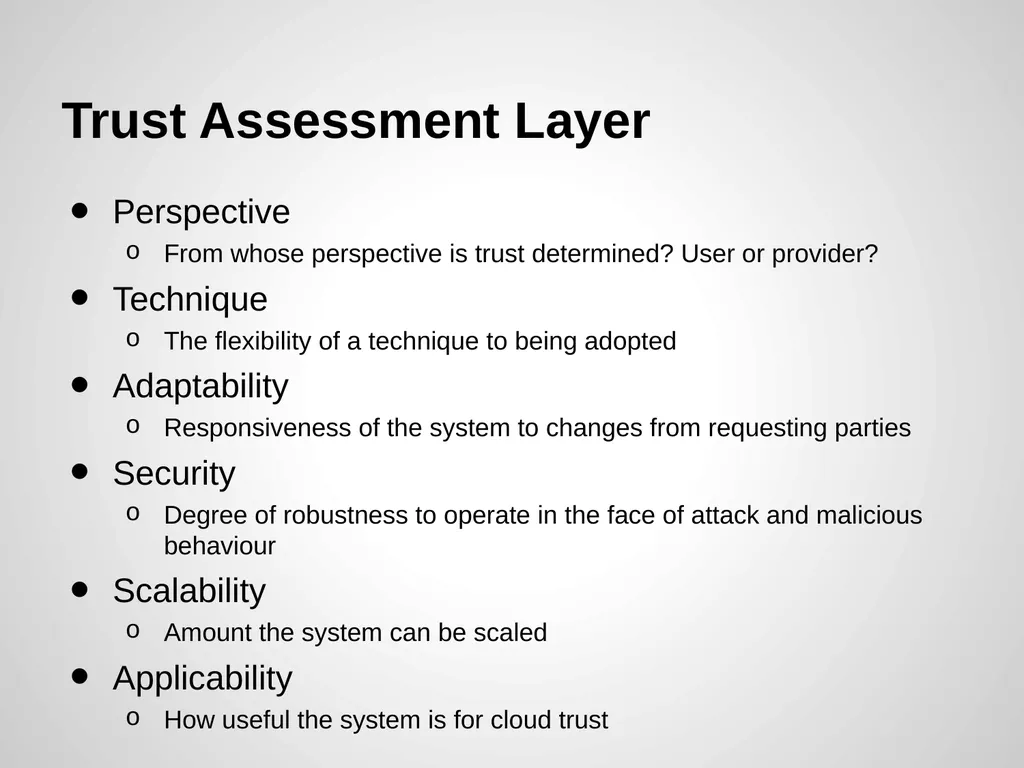
slide22. Trust Assessment Layer Perspective
From whose perspective is trust determined? User or provider?
Technique
The flexibility of a technique to being adopted
Adaptability
Responsiveness of the system to changes from requesting parties
Security
Degree of robustness to operate in the face of attack and malicious behaviour
Scalability
Amount the system can be scaled
Applicability
How useful the system is for cloud trust<br>
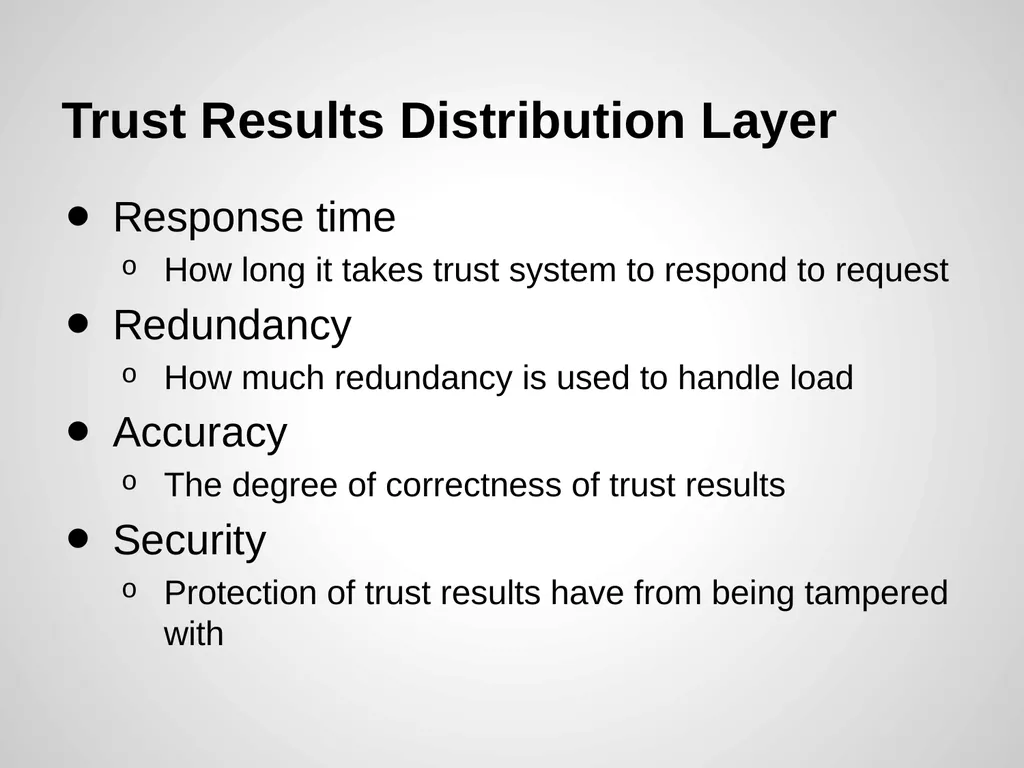
slide23. Trust Results Distribution Layer Response time
How long it takes trust system to respond to request
Redundancy
How much redundancy is used to handle load
Accuracy
The degree of correctness of trust results
Security
Protection of trust results have from being tampered with<br>
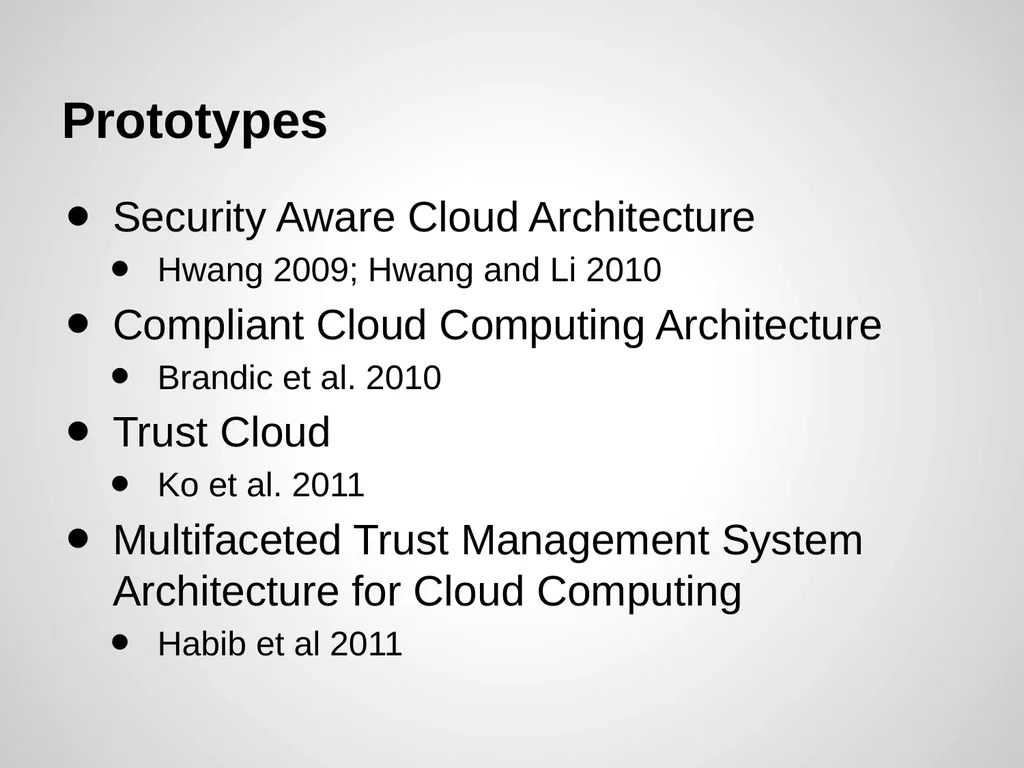
slide24. Prototypes Security Aware Cloud Architecture
Hwang 2009; Hwang and Li 2010
Compliant Cloud Computing Architecture
Brandic et al. 2010
Trust Cloud
Ko et al. 2011
Multifaceted Trust Management System Architecture for Cloud Computing
Habib et al 2011<br>
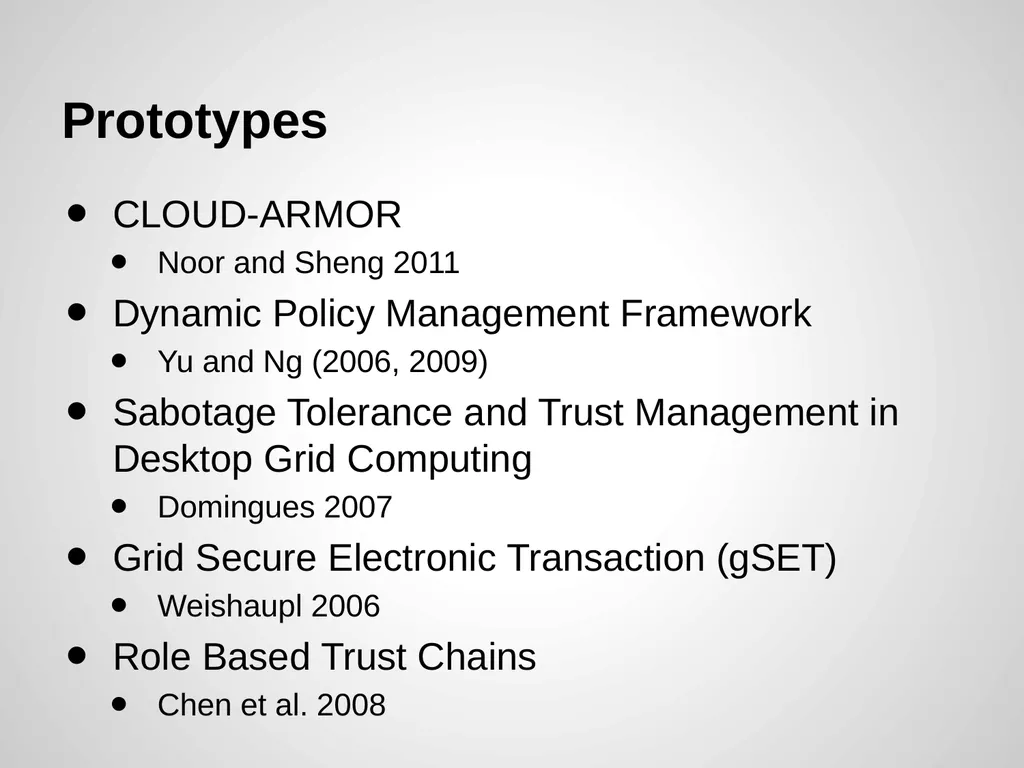
slide25. Prototypes CLOUD-ARMOR
Noor and Sheng 2011
Dynamic Policy Management Framework
Yu and Ng (2006, 2009)
Sabotage Tolerance and Trust Management in Desktop Grid Computing
Domingues 2007
Grid Secure Electronic Transaction (gSET)
Weishaupl 2006
Role Based Trust Chains
Chen et al. 2008<br>
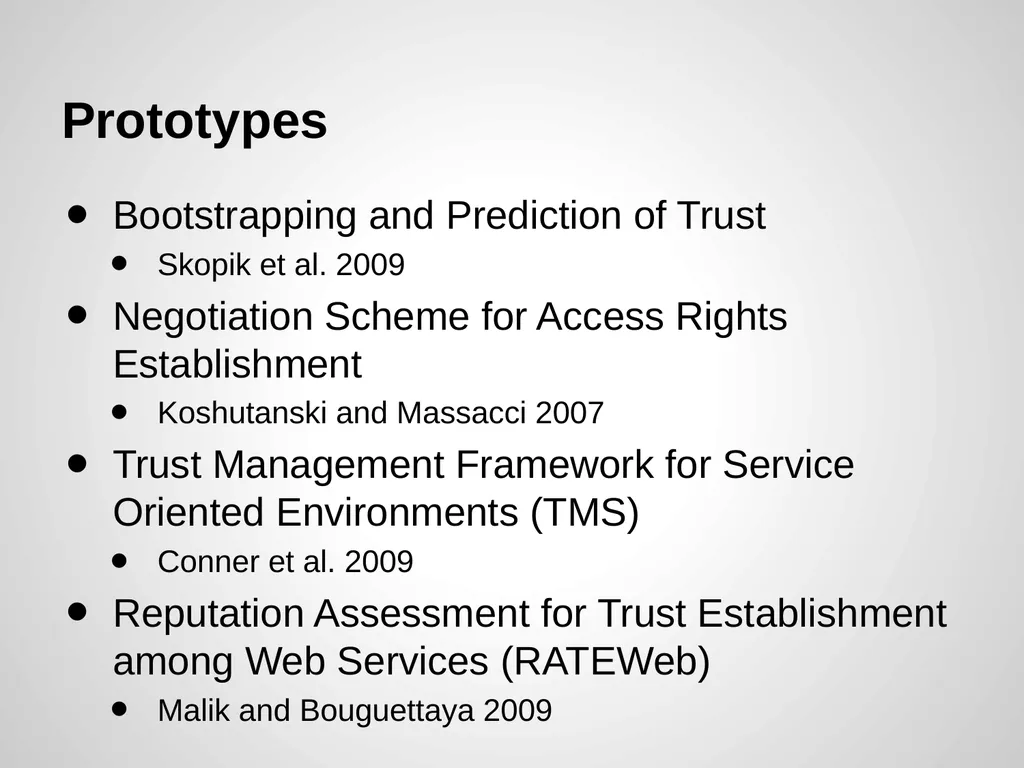
slide26. Prototypes Bootstrapping and Prediction of Trust
Skopik et al. 2009
Negotiation Scheme for Access Rights Establishment
Koshutanski and Massacci 2007
Trust Management Framework for Service Oriented Environments (TMS)
Conner et al. 2009
Reputation Assessment for Trust Establishment among Web Services (RATEWeb)
Malik and Bouguettaya 2009<br>
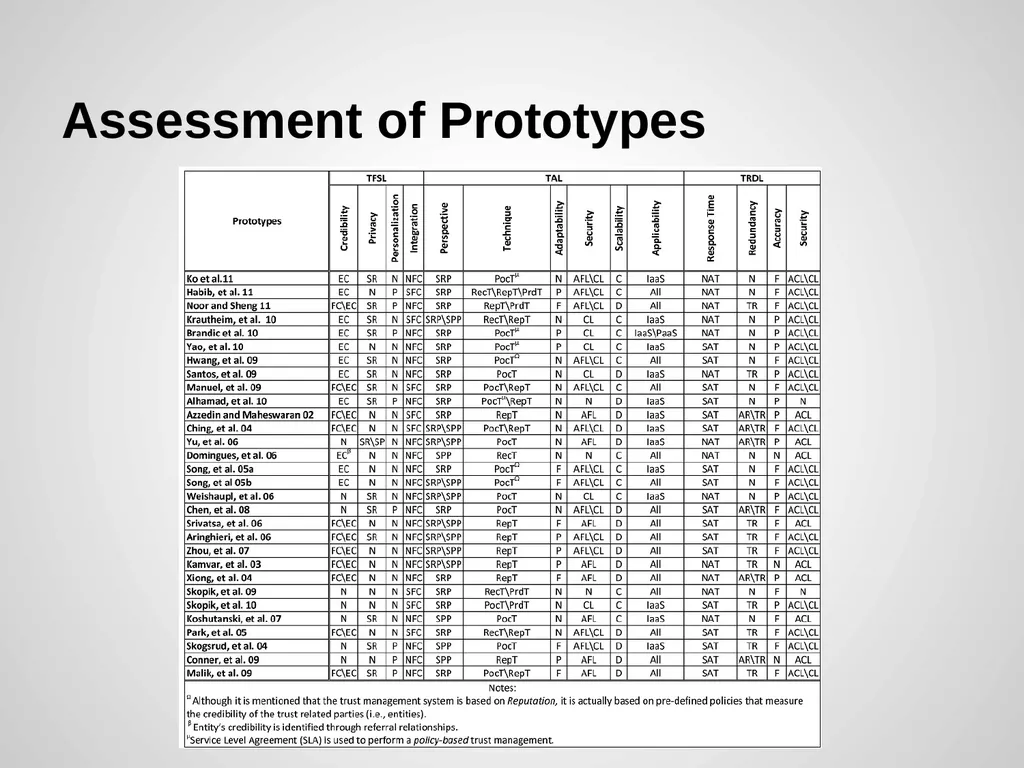
slide27. Assessment of Prototypes<br>
slide28. Assessment of Prototypes<br>
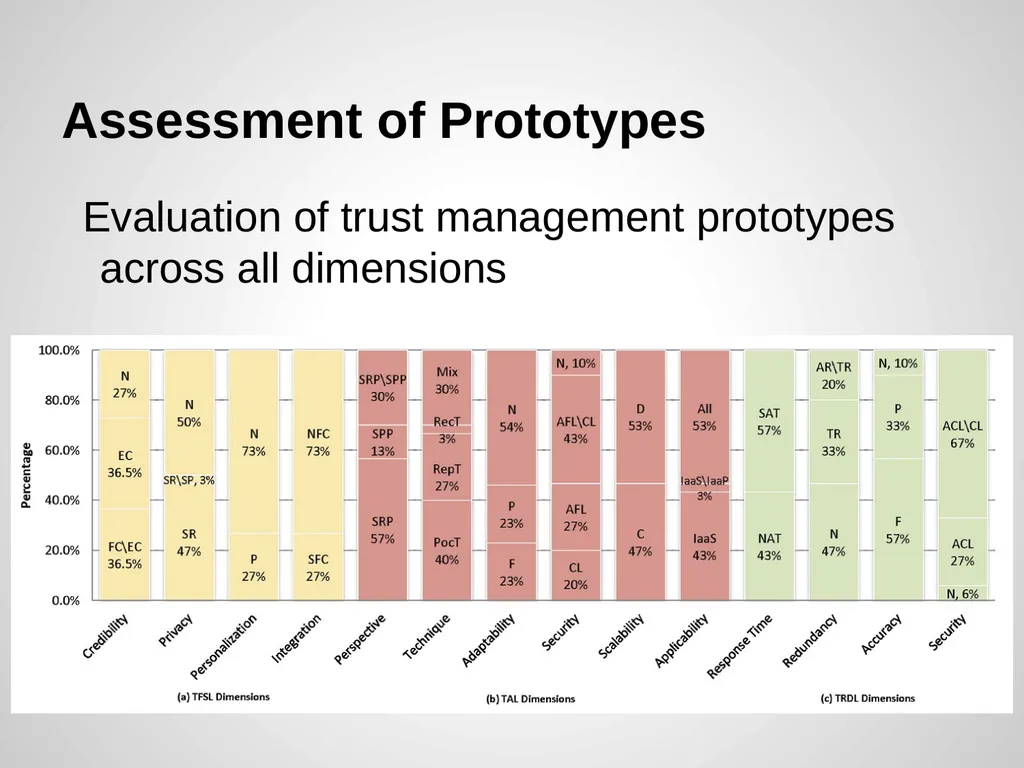
slide29. Assessment of Prototypes Evaluation of trust management prototypes across all dimensions<br>
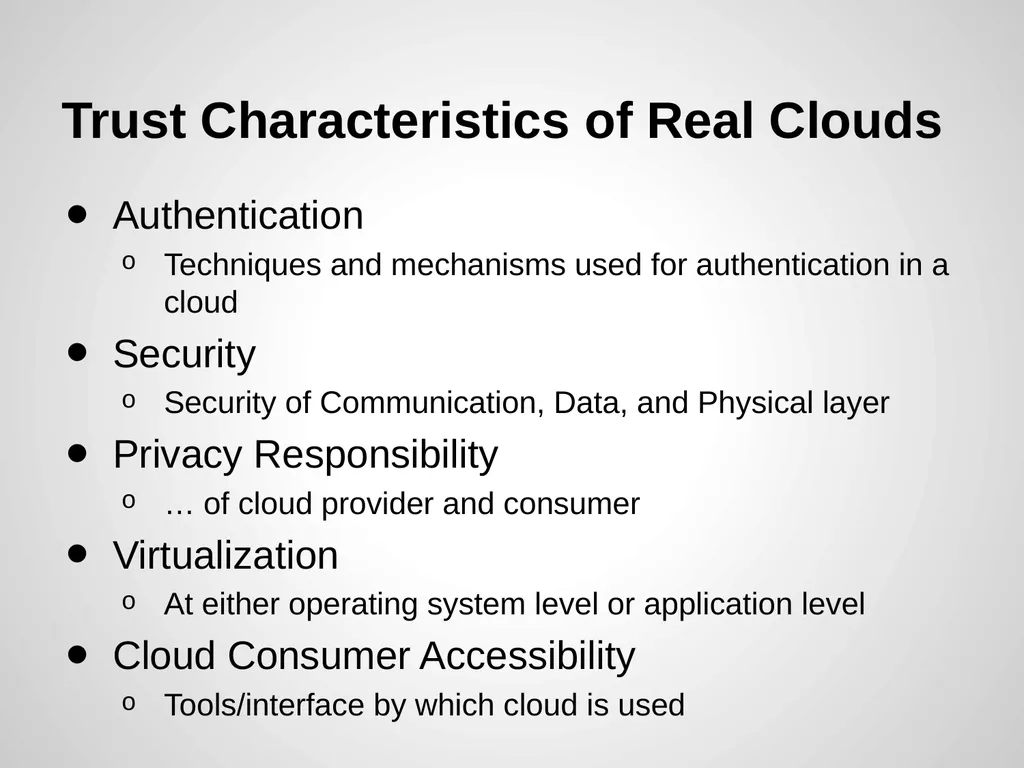
slide30. Trust Characteristics of Real Clouds Authentication
Techniques and mechanisms used for authentication in a cloud
Security
Security of Communication, Data, and Physical layer
Privacy Responsibility
… of cloud provider and consumer
Virtualization
At either operating system level or application level
Cloud Consumer Accessibility
Tools/interface by which cloud is used<br>
slide31. Real Clouds Microsoft
Google
Amazon
IBM
targeting mostly B2B users<br>
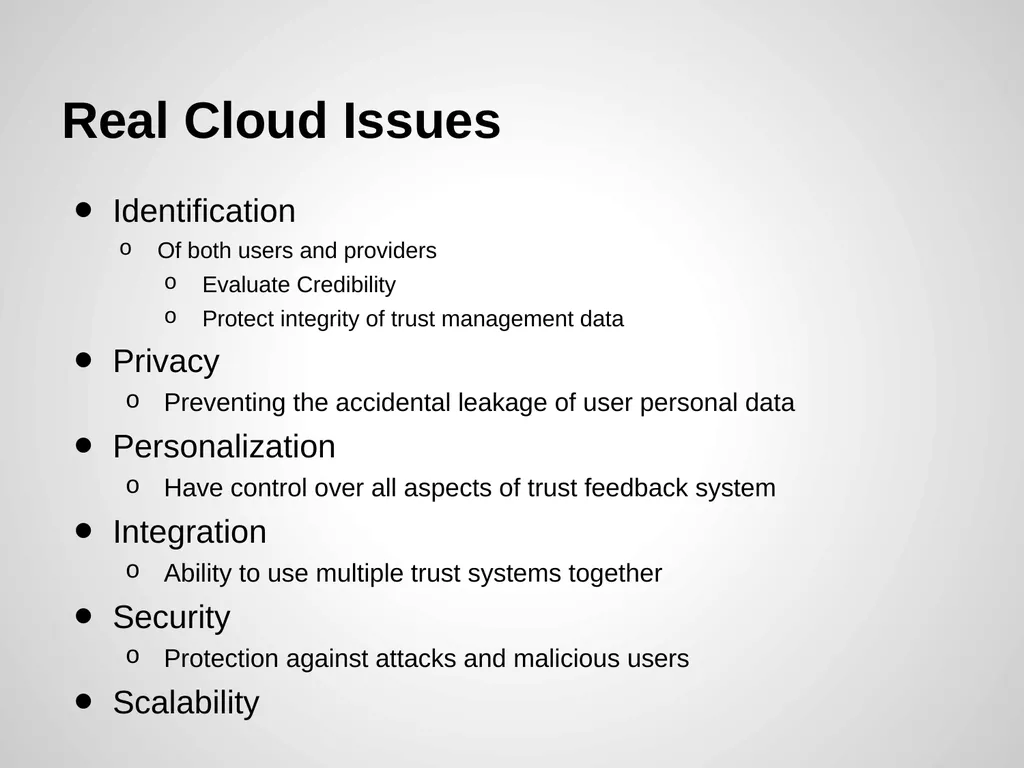
slide32. Real Cloud Issues Identification
Of both users and providers
Evaluate Credibility
Protect integrity of trust management data
Privacy
Preventing the accidental leakage of user personal data
Personalization
Have control over all aspects of trust feedback system
Integration
Ability to use multiple trust systems together
Security
Protection against attacks and malicious users
Scalability<br>
Obstacles and Solutions Paper by: Talal H. Noor, Quan Z. Sheng, Sherali Zeadally, and Jian Yu
Presentation by: Jeremy Tate<br>
slide2. Outline Could Definition
Types of Clouds
Service Level Agreements
Trust management models of Clouds
Analytical Framework for Trust Management
Prototypes
Real-world examples<br>
slide3. Cloud Definition
Delivering network resources (typically from a data center) to a user as a service
Users log into the service (website) to gain access<br>
slide4. Types of Cloud Infrastructure as a Service
Platform as a Service
Software as a Service<br>
slide5. Infrastructure as a Service (IaaS) Provides full virtual servers/storage/networking to a user
Allows user to install exact operating system, software, and architecture for a specified project
Amazon Elastic Compute Cloud (EC2) and Simple Storage Service (S3)<br>
slide6. Platform as a Service (PaaS) Provides a service container for the deployment of an application
Customer deploys select software/applications but does not control infrastructure
Microsoft Azure, Google Apps<br>
slide7. Software as a Service (SaaS) Service provider provides all services and the user provides content
User has no control over software or infrastructure
Google Docs and Facebook<br>
slide8. Service Level Agreements (SLAs) Private Cloud
Community Cloud
Public Cloud
Hybrid Cloud<br>
slide9. Private Cloud Computing resources are for the sole use of a single organization/company
Could include multiple business units
Interactions are B2B<br>
slide10. Community Cloud Resources are shared among members of a community
All have the same goal<br>
slide11. Public Cloud Resources are available to everyone
B2C interactions
EC2, S3<br>
slide12. Hybrid Cloud Two or more of the previous models are used together
One portion could be private, another public
B2B and B2C<br>
slide13. Trust Models Service provider’s perspective (SPP)
Trust from the provider POV
Service requester’s perspective (SRP)
Trust from the consumer POV<br>
slide14. Techniques Policy as a Trust Management technique
Recommendation as a TM technique
Reputation as a TM technique
Prediction as a TM technique<br>
slide15. Policy as a TM Technique Uses a set of policies to control authorization and specify minimum trust levels
Trust thresholds based on trust results or credentials
A cloud service consumer x, has policies Px, credentials Cx and minimum trust threshold Tx
Provider has all the same attributes (as y)
Relationship is considered trusted if Tr(x,y) = 1<br>
slide16. Recommendation as a TM Technique Use prior experiences to determine trust
Can use either explicit recommendation or transitive recommendation
Consumer x, trust relation with cloud z, service provider y<br>
slide17. Reputation as a TM Technique Use consumer feedback to rate service provider
Amazon, eBay, Epinions
Consumer x, trust threshold Tx, service provider y, set of trusted relations Tr(y) which give trust feedback T f(y)<br>
slide18. Prediction as a TM Technique Useful when there is no prior information
Similarly minded entities are more likely to trust one another
Consumer x has interests ix (as vector) and minimum trust threshold Tx (service provider is y)<br>
slide19. Trust Management Analytical Framework Trust Feedback Sharing Layer
Different parties giving trust feedback to each other
Trust Assessment Layer
Determining the level of trust for each party, potentially using multiple metrics
Trust Results Distribution Layer
Different parties requesting the trust level for other parties<br>
slide20. Trust Management Framework<br>
slide21. Trust Feedback Sharing Layer Credibility
The quality of the information or service that makes people trust the cloud
The credibility of the cloud as well as that of the feedback
Privacy
The degree of potential information exposure that users of the cloud could face when interacting with the cloud
Personalization
The degree to which people adhere to the trust management rules
Users selecting their preferred feedback mechanism
Integration
Ability to integrate other trust management principles<br>
slide22. Trust Assessment Layer Perspective
From whose perspective is trust determined? User or provider?
Technique
The flexibility of a technique to being adopted
Adaptability
Responsiveness of the system to changes from requesting parties
Security
Degree of robustness to operate in the face of attack and malicious behaviour
Scalability
Amount the system can be scaled
Applicability
How useful the system is for cloud trust<br>
slide23. Trust Results Distribution Layer Response time
How long it takes trust system to respond to request
Redundancy
How much redundancy is used to handle load
Accuracy
The degree of correctness of trust results
Security
Protection of trust results have from being tampered with<br>
slide24. Prototypes Security Aware Cloud Architecture
Hwang 2009; Hwang and Li 2010
Compliant Cloud Computing Architecture
Brandic et al. 2010
Trust Cloud
Ko et al. 2011
Multifaceted Trust Management System Architecture for Cloud Computing
Habib et al 2011<br>
slide25. Prototypes CLOUD-ARMOR
Noor and Sheng 2011
Dynamic Policy Management Framework
Yu and Ng (2006, 2009)
Sabotage Tolerance and Trust Management in Desktop Grid Computing
Domingues 2007
Grid Secure Electronic Transaction (gSET)
Weishaupl 2006
Role Based Trust Chains
Chen et al. 2008<br>
slide26. Prototypes Bootstrapping and Prediction of Trust
Skopik et al. 2009
Negotiation Scheme for Access Rights Establishment
Koshutanski and Massacci 2007
Trust Management Framework for Service Oriented Environments (TMS)
Conner et al. 2009
Reputation Assessment for Trust Establishment among Web Services (RATEWeb)
Malik and Bouguettaya 2009<br>
slide27. Assessment of Prototypes<br>
slide28. Assessment of Prototypes<br>
slide29. Assessment of Prototypes Evaluation of trust management prototypes across all dimensions<br>
slide30. Trust Characteristics of Real Clouds Authentication
Techniques and mechanisms used for authentication in a cloud
Security
Security of Communication, Data, and Physical layer
Privacy Responsibility
… of cloud provider and consumer
Virtualization
At either operating system level or application level
Cloud Consumer Accessibility
Tools/interface by which cloud is used<br>
slide31. Real Clouds Microsoft
Amazon
IBM
targeting mostly B2B users<br>
slide32. Real Cloud Issues Identification
Of both users and providers
Evaluate Credibility
Protect integrity of trust management data
Privacy
Preventing the accidental leakage of user personal data
Personalization
Have control over all aspects of trust feedback system
Integration
Ability to use multiple trust systems together
Security
Protection against attacks and malicious users
Scalability<br>