
TS-1 Foundation Course in Tourism Unit 3 –

Description: TS-1 Foundation Course in Tourism Unit 3 Historical Evolution Development Unit 4 Tourism Systems Unit 5 Tourism Constitutents Block-1: Tourism Phenomenon (3 Units) Course Counsellor: Dr. Mou Roy Email ID: duttamouyahoo.com TS 1
Related Topics
Download Presentation
"TS-1 Foundation Course in Tourism Unit 3 –" is the property of its rightful owner. Permission is granted to download and print the materials on this website for personal, non-commercial use only, and to display it on your personal computer provided you do not modify the materials and that you retain all copyright notices contained in the materials. By downloading content from our website, you accept the terms of this agreement.
Presentation Transcript
slide1. TS-1
Foundation Course in Tourism Unit 3 – Historical Evolution & Development
Unit 4 – Tourism Systems
Unit 5 – Tourism Constitutents
Block-1: Tourism Phenomenon
(3 Units)
Course Counsellor: Dr. Mou Roy Email ID: dutta_mou@yahoo.com<br>
slide2. TS 1 UNIT 3 Historical Evolution and Development
Understanding history is essential because present has evolved out of it and for better future we have to analyse past carefully
Different views, methods, and trends were followed in history writing right from the olden days
One has to understand the transition period from travel to modern tourism<br>
slide3. NEED FOR HISTORY OF TOURISM Understanding the history of tourism is possible by understanding the phenomenon in a particular society at a particular time
History of tourism helps us to understand a dynamic model of tourism development
Help in developing the theoretical framework within which the data on tourism can be verified
Understanding the history of tourism helps in developing tourism as an academic discipline
Careful analysis of history of tourism helps in
(i) Identification of sources of data
(ii) Use of both written and oral history<br>
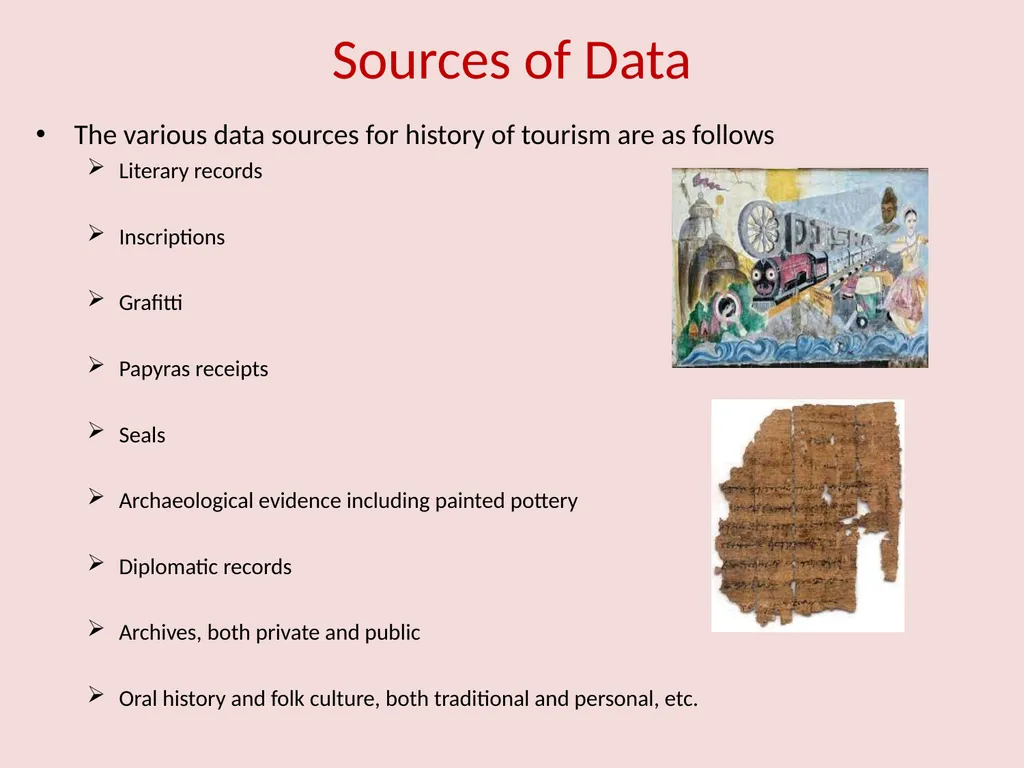
slide4. Sources of Data The various data sources for history of tourism are as follows
Literary records
Inscriptions
Grafitti
Papyras receipts
Seals
Archaeological evidence including painted pottery
Diplomatic records
Archives, both private and public
Oral history and folk culture, both traditional and personal, etc.<br>
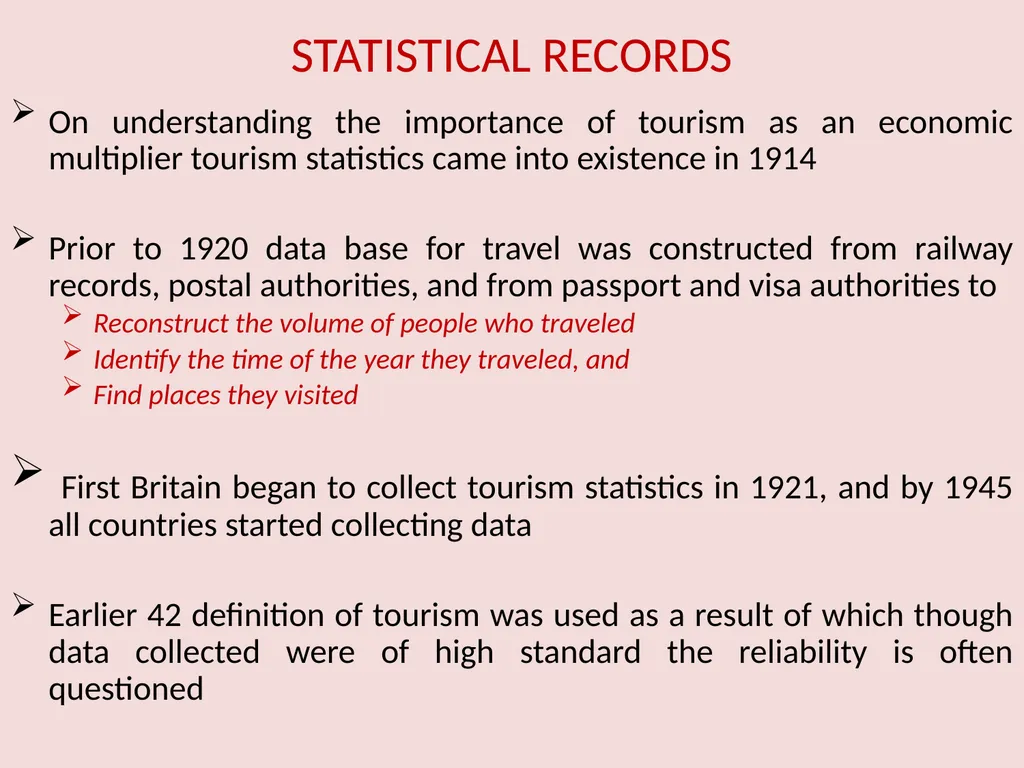
slide5. STATISTICAL RECORDS On understanding the importance of tourism as an economic multiplier tourism statistics came into existence in 1914
Prior to 1920 data base for travel was constructed from railway records, postal authorities, and from passport and visa authorities to
Reconstruct the volume of people who traveled
Identify the time of the year they traveled, and
Find places they visited
First Britain began to collect tourism statistics in 1921, and by 1945 all countries started collecting data
Earlier 42 definition of tourism was used as a result of which though data collected were of high standard the reliability is often questioned<br>
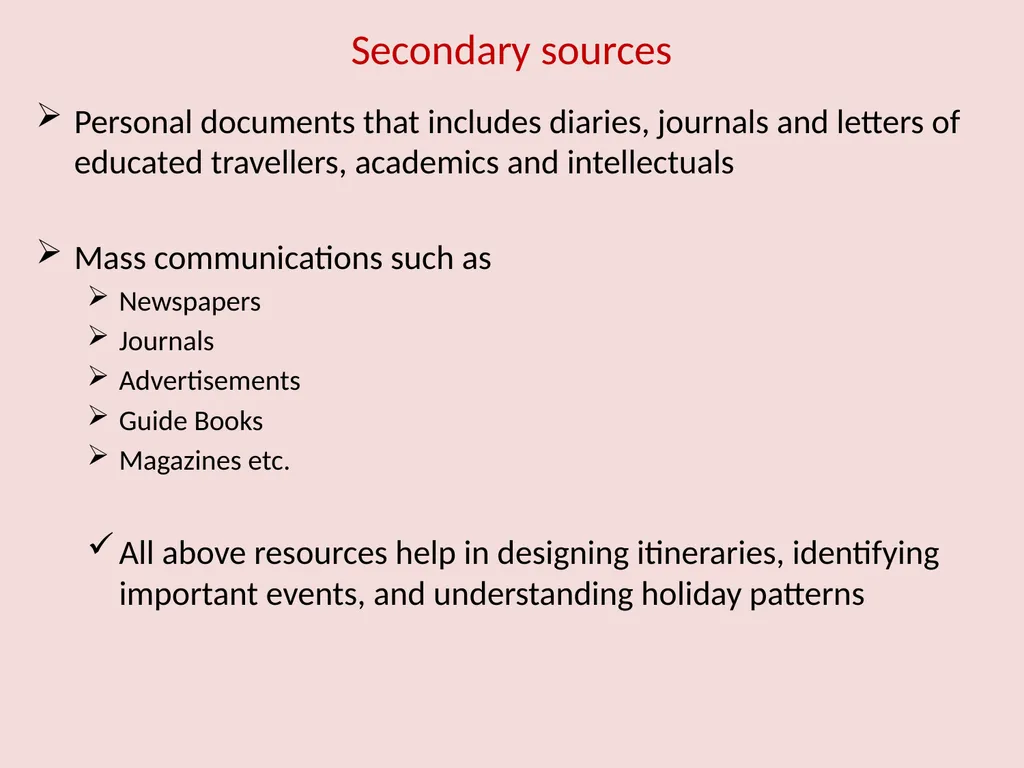
slide6. Secondary sources Personal documents that includes diaries, journals and letters of educated travellers, academics and intellectuals
Mass communications such as
Newspapers
Journals
Advertisements
Guide Books
Magazines etc.
All above resources help in designing itineraries, identifying important events, and understanding holiday patterns<br>
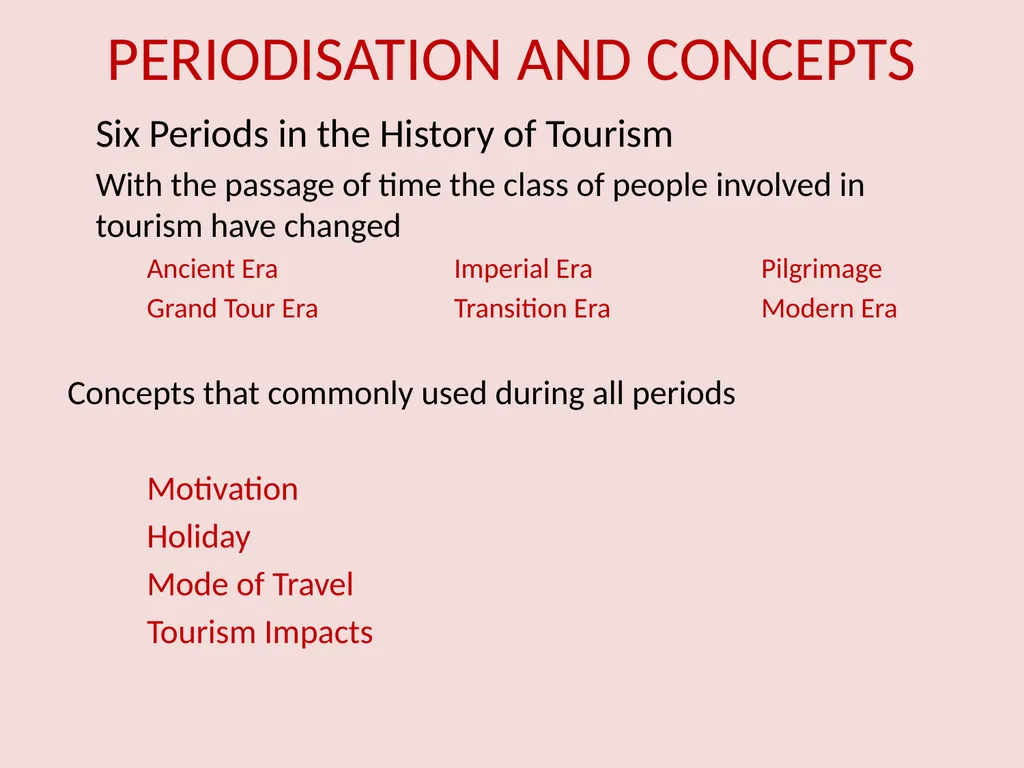
slide7. PERIODISATION AND CONCEPTS Six Periods in the History of Tourism
With the passage of time the class of people involved in tourism have changed
Ancient Era Imperial Era Pilgrimage
Grand Tour Era Transition Era Modern Era
Concepts that commonly used during all periods
Motivation
Holiday
Mode of Travel
Tourism Impacts<br>
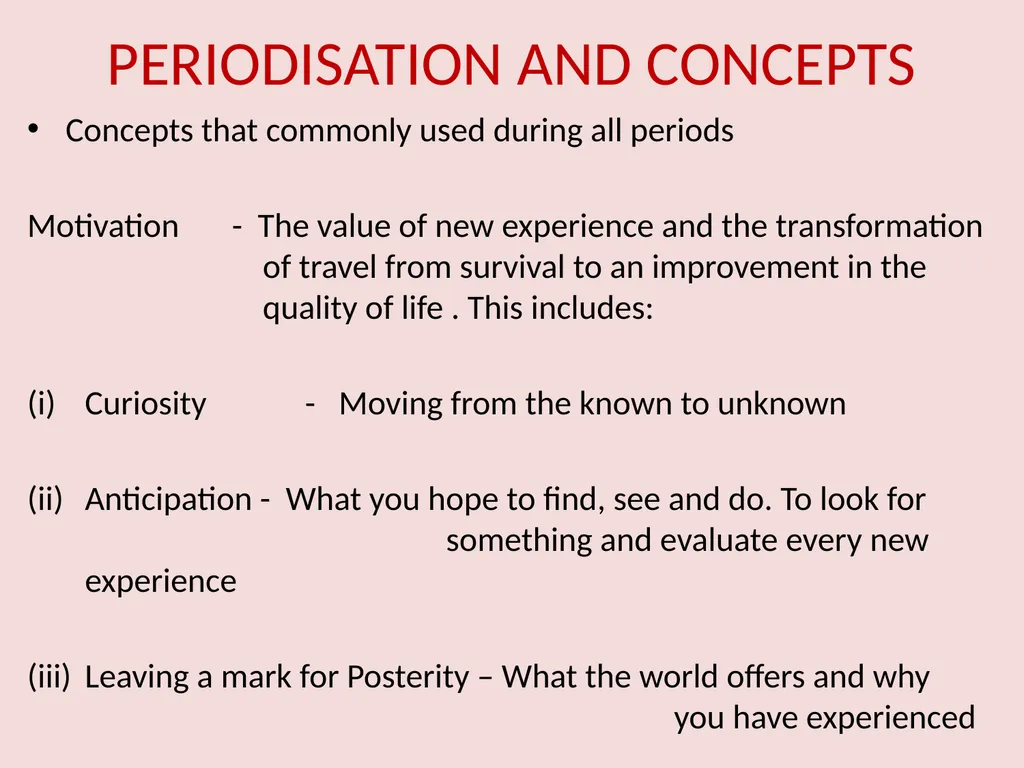
slide8. PERIODISATION AND CONCEPTS Concepts that commonly used during all periods
Motivation - The value of new experience and the transformation of travel from survival to an improvement in the quality of life . This includes:
Curiosity - Moving from the known to unknown
Anticipation - What you hope to find, see and do. To look for something and evaluate every new experience
Leaving a mark for Posterity – What the world offers and why you have experienced<br>
slide9. PERIODISATION AND CONCEPTS Holiday
This has two Sources
(i) Religious: In Europe a day was set aside, at the end of a work cycle, for religious rituals and this day was called a HOLY DAY. In time, saints days and certain other observances were added to the number of holidays when no work was done and everyone celebrated
(ii)Secular: The secular tradition was a part of the Imperial system when the state granted public holidays to celebrate Imperial glory. On these holidays no work was done and the people participated in feasting and fun. Public games and spectator sports were the highlights on such occasions
In Time, the religious and secular combined and the day of rest became a part of all societies<br>
slide10. PERIODISATION AND CONCEPTS MODE OF TRAVEL
was the state of the art in terms of transport networks and routes, vehicles, cost of travel, documentation and safe passage, wayside facilities and conveniences to the traveller
TOURISM IMPACTS
The influence of tourism not only on the life- style of the people but in bringing about changes in consumption and production as well as wealth<br>
slide11. ANCIENT PERIOD Difficult and dangerous overland and sea journeys were taken
Non availability of wayside facilities made journeys very costly
Specific paths and routes were developed and used by traders and pilgrims
Development of specialised vehicles for travel over land and on water
Growth of urban centers and cities along river banks and coastline in Mesopotamia, China, and India
Travel followed networks, resting places and food resources were provided along these routes
Commercial centers came into existence and scope of travel to distant parts of the world increased
As frequency of travel increased wagons for goods and chariots for passengers were introduced
Paths and routes were developed and trees were planted for shade
More travel resulted in knowledge of wealth at distant places<br>
slide12. EARLY EMPIRES Egyptian Civilisation and Phoenicians
Egyptian civilisation attracted many tourists, Light house of Alexandria was considered one of the seven wonders of the Ancient world
Both men and women enjoyed travelling to places, on arrival at destination there was a celebratory feast, often with a sacrifice for thanks giving
Tourists season is from April to November, people travelled long distances to see glorious monuments of Egypt and returned with souvenirs to show to friends at home
Phoenicians explored extended the boundaries, they also developed overland facilities and trunk routes for travels
Money was used as a form of exchange which helped in easy travel as food and services was purchased instead of carrying them all ways
The Persian Empire
As Persian empire expanded over a large area they improved their travel infrastructure
Roads were designed, carrier wagons with four wheel with cover overhead were designed for comfortable travel thus method for comfortable travel was introduced<br>
slide13. EARLY EMPIRES GREEKS
Maritime expertise of Greeks helped in developing tourism
Currency exchange system that enabled exchange outside Greek states was introduced and Greek became common language in the Mediterranean
Festivals were hosted to attract travellers and Olympic games held to display creative athletic skills in honour of the God Zeus
Tragedies and comedies of Greek theatre attracted many travellers
Scholars, Philosophers, Physicians, and men of Science visited Greece to learn and expand their skills
Athens became a famous destination, hospitality facilities were provided along with entertainment shows to its visitors, guide services and travel tips were also provided to the travellers<br>
slide14. EARLY EMPIRES The Romans
The Romans also flourished in hospitality sector
Planned network of roads called “Appian ways” and waterways were popular
As wealth and prosperity of Roman citizens increased, they took interest in
knowing more about culture of people they brought under their control
Games and gladiatorial contents were popular events
Greek temples, sanctuaries, and works of art became sight – seeing spots
Roman visitors were much attracted to the seven wonders of the world
Mineral springs were closely associated with shrines as a result both travellers and pilgrims were attracted towards them
Literary references also attracted certain educated travellers towards Roman empire<br>
slide15. EARLY EMPIRES India
Wonder and wealth of India attracted Greek and Hebrew Scholars
India’s geographical location made it as an important part of the world
Mahabharat reveals about fairs and Arthashastra reflects the protection and importance given to merchants, safety for passengers and goods, exchange rates for various metals and price regulations
Trade overland and on inland waterways was well developed
Buddhist Sangha established the tradition of the pilgrimage, Panthagars were provided for mendicant traveller
Monastries attracted the monk, the merchant, and the layman
Horses, elephants and camels were used as common mode of transport
Serais were designed to accommodate foreigners, and entertainment facilities were also provided with due controls
Mile stones, baolis, sarais and network of roads from olden days clearly exhibits the travel culture and importance provided to tourists visiting India<br>
slide16. SILK ROUTE Silk Route – vital link in the East/ West movement of the people began in 2000 B. C
Meeting to exchange silk, muslin, fine glass, tea, rice and spices, exchange of ideas and production process were some of the main activities facilitated by silk route
Though stages of journey was short and very hard due to climate and topography in terms of wealth, it was most rewarding
Navigation was done by stars in absence of course of stream or river
Revenue was collected from travellers, larger state provided more facilities and also earned more income through taxing travellers
Ideas and new techniques crossed borders of various countries due to travellers of silk route
With fall of empires setback to trade and commerce was visible leading to less travel<br>
slide17. COMPLEX CHARACTER OF TOURISM Due to complexities of motivations, needs, and satisfaction, tourism emerged as an amalgam of phenomena and practices rather than a single or unique orientation
Inter- relationships arises from movement of people and their stay at different places further encouraged tourism
Tourism gave rise to activities which are distinct from the resident and working population
Tourists movements are temporary and relatively short term with intention to return to place of residence after travel is completed
Destinations are chosen for a particular attraction which could be business, vocational or pleasure related<br>
slide18. PILGRIMAGE Journey undertaken for betterment on the spiritual and material plane
In traditional societies, pilgrimage earned god’s grace and moral leadership in the community because sacred rituals and texts sanctified certain places associated with divine revelation. This was common in all religion
Pilgrims added to our knowledge of geography, culture, and traditional beliefs of other societies in the world
Special itineraries are prepared and tours are conducted for pilgrimage purpose in countries like India which contributes a lot of benefits to tourism
Kumbh Mela, navagraha circuits in Tamilnadu India are some fine examples of pilgrimage tourism<br>
slide19. GRAND TOUR Circuit of Western Europe undertaken by a wealthy social elite for culture, education and pleasure
People of rich class only undertook such tours
CHARACTERISTICS OF GRAND TOUR
Can be defined in terms of class, that determine the places visited and mode of travel
Can be defined by the destinations on the itinerary
Oxford English Dictionary defines Grand Tour as tour of the principal cities and places of interest in Europe, formerly said to be an essential part of the education of young men of good birth and fortune
Career, Education, Culture, literary, Health, Scientific, Business and Economic are main motivations. Often, more than one reasons are found as motivations
Tours and length of stay at destinations depends upon seasons, and availability of tourism resources
It provided a base for emergence of tourism industry, guide books, and travel organiser
Tourism became a family affair and soon women travellers began to travel<br>
slide20. TRANSITION TO MODERN TOURISM Main reason for transition to modern tourism is due to:
Revolutionary changes in technology
personal income rise due to industralisation
organised tours conducted for the inexperienced traveller
MODERN TOURISM IN INDIA
Middle class and working people undertook travel in huge number due to well established rail networks throughout India
Leave Travel Concession (LTC), concession to students, youths encouraged people to travel extensively
Western comforts were provided to international travellers at major destinations through ITDC
Plans were made to develop many famous tourist destination in big ways
Organisations like TAAI (Travel Agents Association of India), IATO (Indian Association of Tour Operators) played their role
State Tourism Development Corporations were set up to provide further boost to tourism
New markets and diverse products like adventure sports, fairs, festivals, golf were encouraged
Tourism education was offered at many educational institutes and IITTM (Indian Institute of Tourism and Travel Management) was set up to train tourism administrators<br>
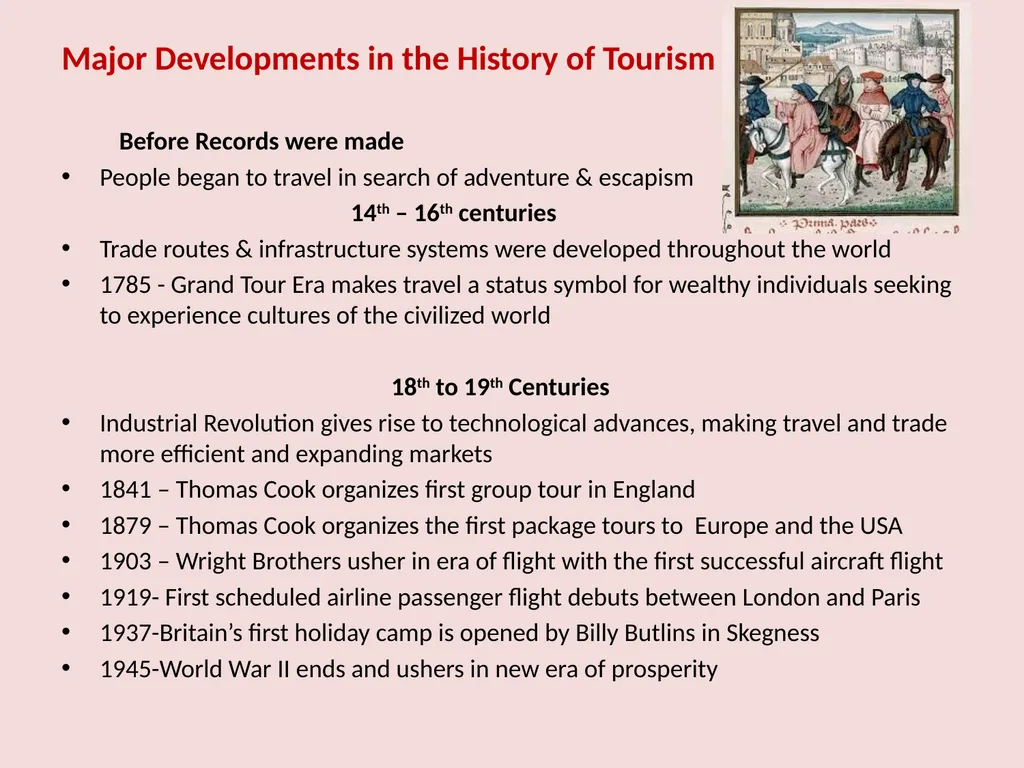
slide21. Major Developments in the History of Tourism Before Records were made
People began to travel in search of adventure & escapism
14th – 16th centuries
Trade routes & infrastructure systems were developed throughout the world
1785 - Grand Tour Era makes travel a status symbol for wealthy individuals seeking to experience cultures of the civilized world
18th to 19th Centuries
Industrial Revolution gives rise to technological advances, making travel and trade more efficient and expanding markets
1841 – Thomas Cook organizes first group tour in England
1879 – Thomas Cook organizes the first package tours to Europe and the USA
1903 – Wright Brothers usher in era of flight with the first successful aircraft flight
1919- First scheduled airline passenger flight debuts between London and Paris
1937-Britain’s first holiday camp is opened by Billy Butlins in Skegness
1945-World War II ends and ushers in new era of prosperity<br>
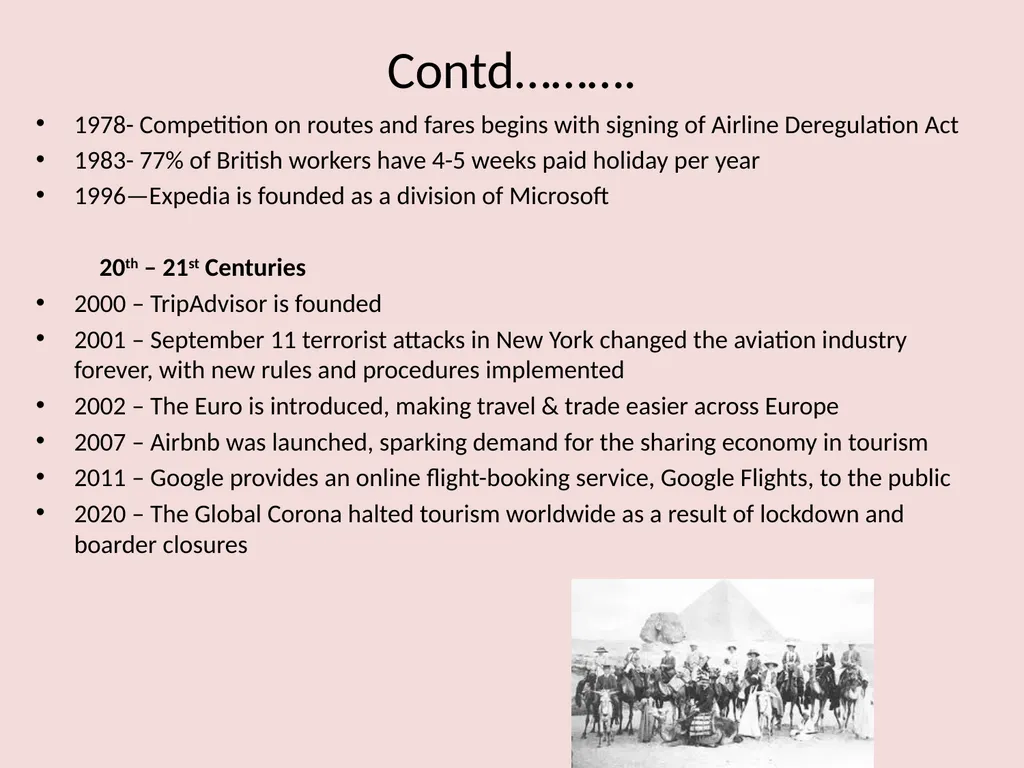
slide22. Contd………. 1978- Competition on routes and fares begins with signing of Airline Deregulation Act
1983- 77% of British workers have 4-5 weeks paid holiday per year
1996—Expedia is founded as a division of Microsoft
20th – 21st Centuries
2000 – TripAdvisor is founded
2001 – September 11 terrorist attacks in New York changed the aviation industry forever, with new rules and procedures implemented
2002 – The Euro is introduced, making travel & trade easier across Europe
2007 – Airbnb was launched, sparking demand for the sharing economy in tourism
2011 – Google provides an online flight-booking service, Google Flights, to the public
2020 – The Global Corona halted tourism worldwide as a result of lockdown and boarder closures<br>
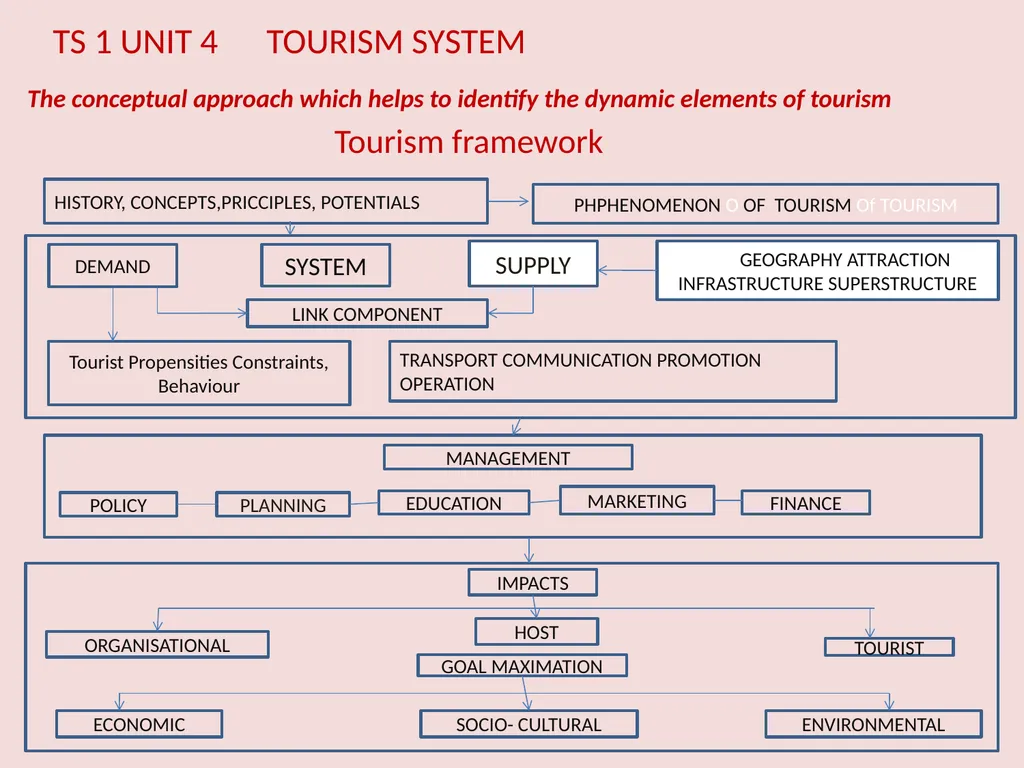
slide23. TS 1 UNIT 4 TOURISM SYSTEM The conceptual approach which helps to identify the dynamic elements of tourism
Tourism framework HISTORY, CONCEPTS,PRICCIPLES, POTENTIALS SUPPLY PHPHENOMENON O OF TOURISM Of TOURISM DEMAND SYSTEM Tourist Propensities Constraints, Behaviour GEOGEOGRAPHY ATTRACTION INFRASTRUCTURE SUPERSTRUCTURE MANAGEMENT POLICY TRANSPORT COMMUNICATION PROMOTION
OPERATION TOURIST ORGANISATIONAL IMPACTS HOST PLANNING EDUCATION MARKETING FINANCE ENVIRONMENTAL SOCIO- CULTURAL ECONOMIC GOAL MAXIMATION LINK COMPONENT<br>
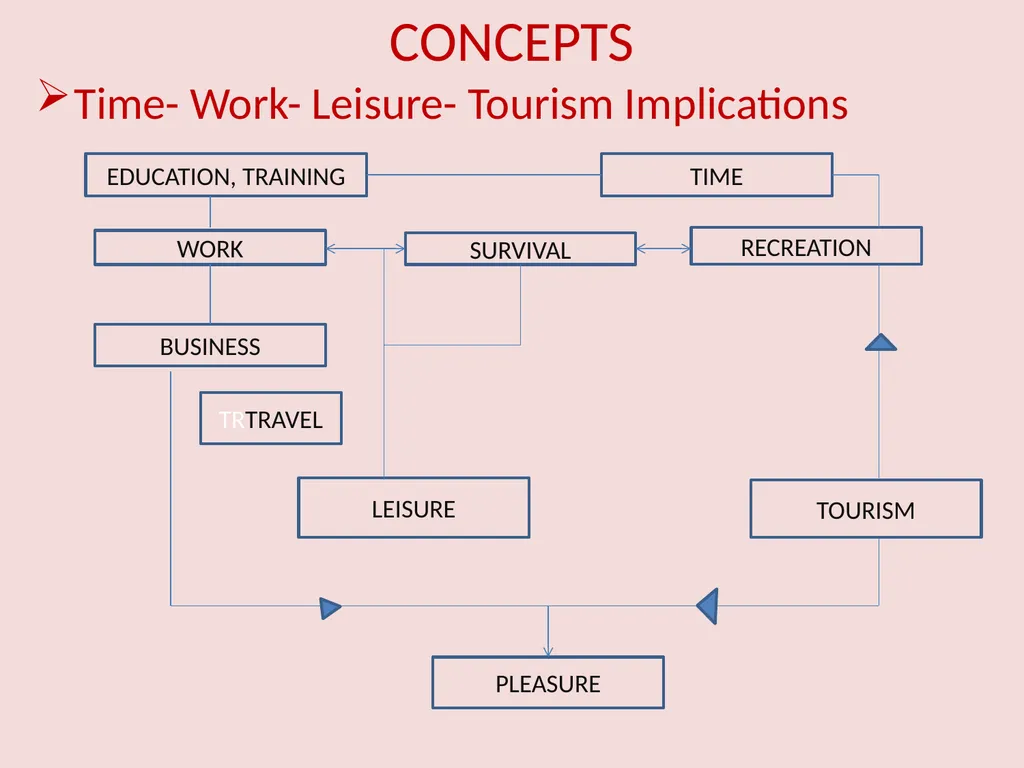
slide24. CONCEPTS Time- Work- Leisure- Tourism Implications EDUCATION, TRAINING WORK TIME BUSINESS TRTRAVEL SURVIVAL RECREATION LEISURE PLEASURE TOURISM<br>
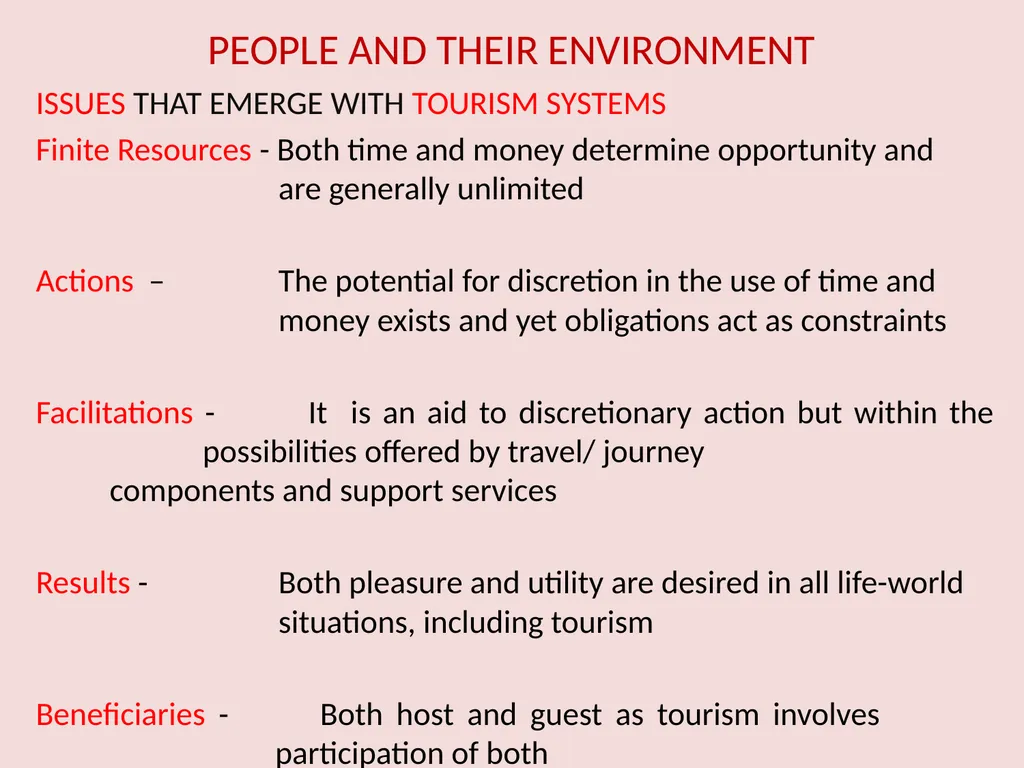
slide25. PEOPLE AND THEIR ENVIRONMENT ISSUES THAT EMERGE WITH TOURISM SYSTEMS
Finite Resources - Both time and money determine opportunity and are generally unlimited
Actions – The potential for discretion in the use of time and money exists and yet obligations act as constraints
Facilitations - It is an aid to discretionary action but within the possibilities offered by travel/ journey components and support services
Results - Both pleasure and utility are desired in all life-world situations, including tourism
Beneficiaries - Both host and guest as tourism involves participation of both<br>
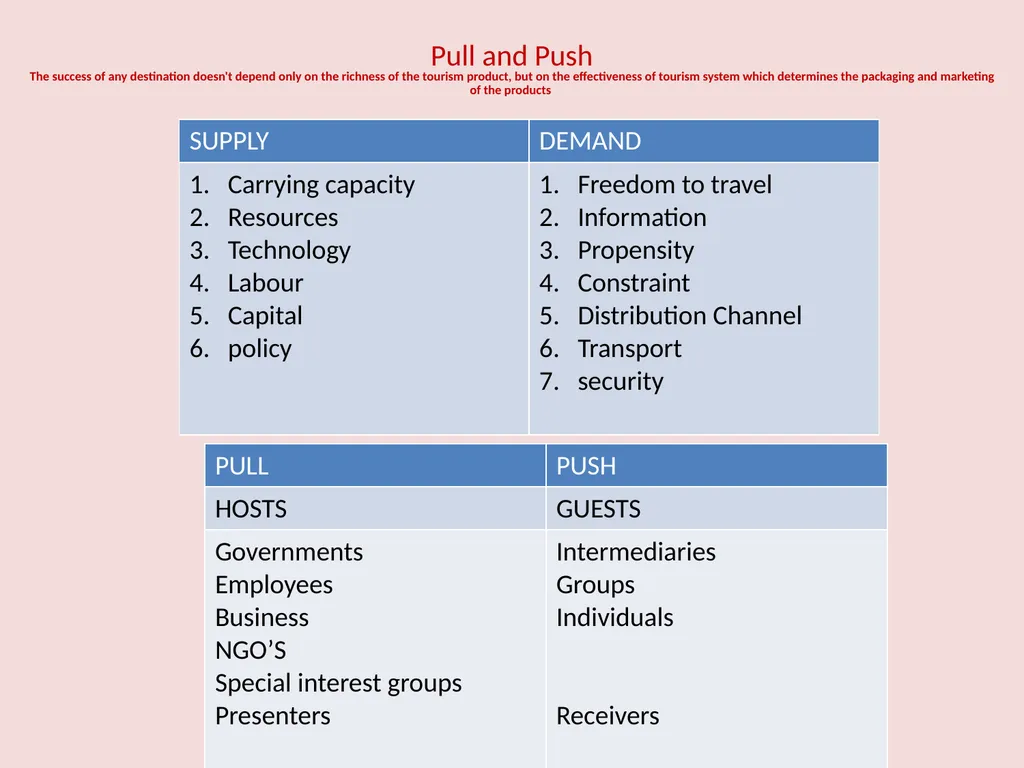
slide26. Pull and Push The success of any destination doesn't depend only on the richness of the tourism product, but on the effectiveness of tourism system which determines the packaging and marketing of the products<br>
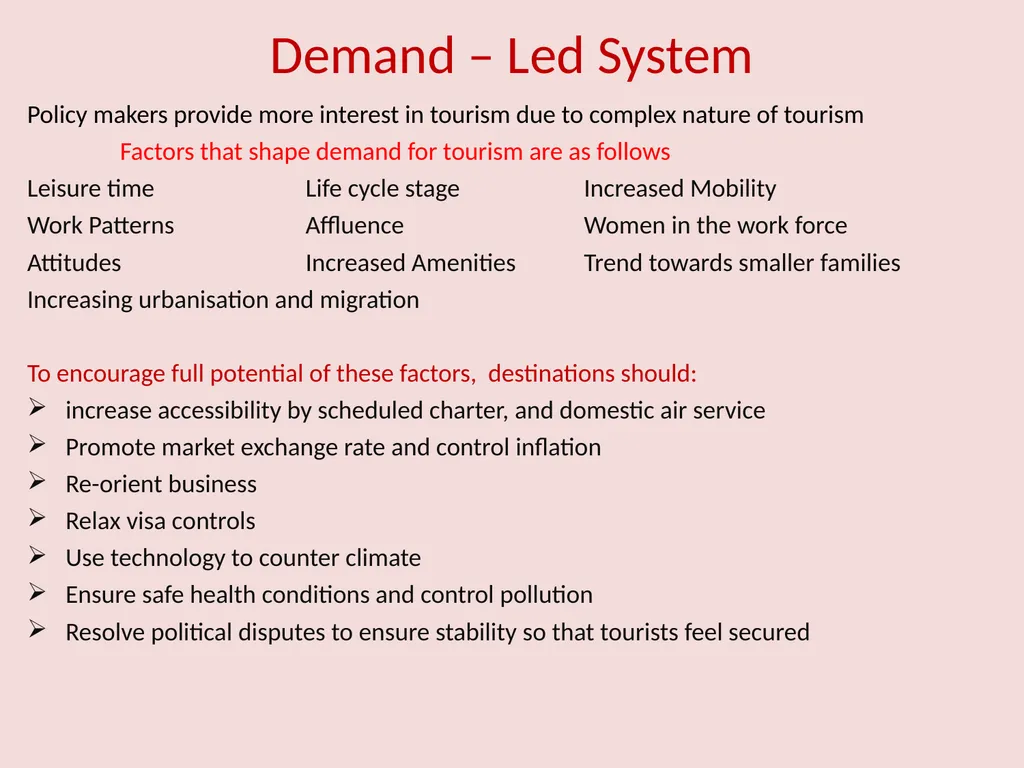
slide27. Demand – Led System Policy makers provide more interest in tourism due to complex nature of tourism
Factors that shape demand for tourism are as follows
Leisure time Life cycle stage Increased Mobility
Work Patterns Affluence Women in the work force
Attitudes Increased Amenities Trend towards smaller families
Increasing urbanisation and migration
To encourage full potential of these factors, destinations should:
increase accessibility by scheduled charter, and domestic air service
Promote market exchange rate and control inflation
Re-orient business
Relax visa controls
Use technology to counter climate
Ensure safe health conditions and control pollution
Resolve political disputes to ensure stability so that tourists feel secured<br>
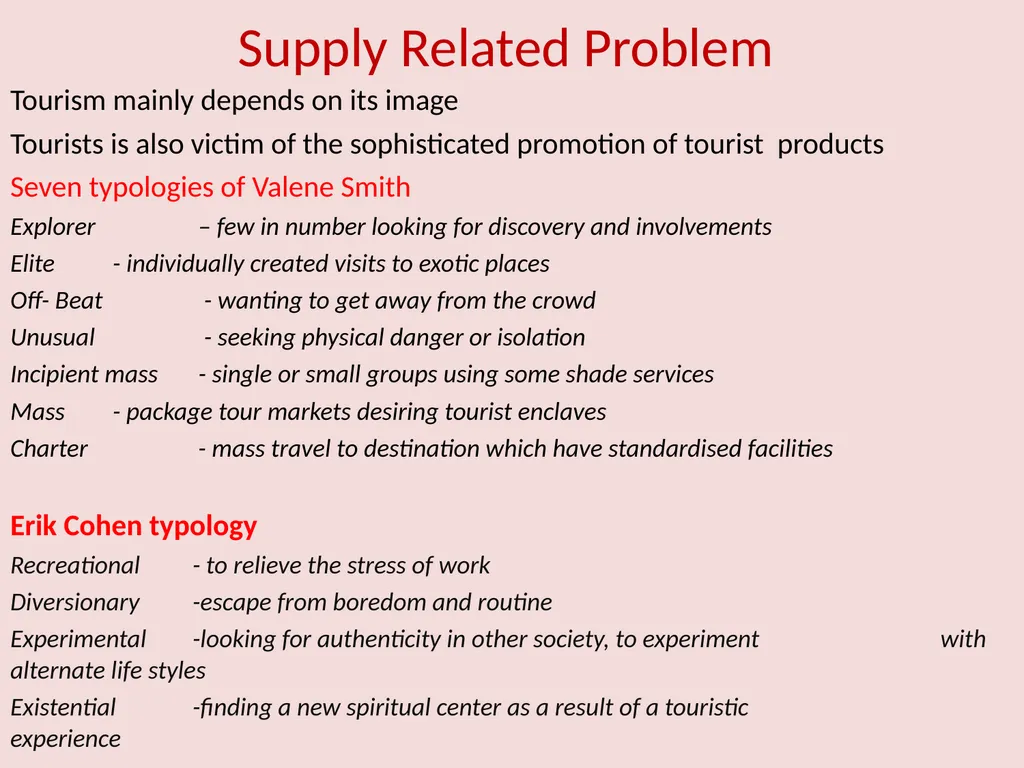
slide28. Supply Related Problem Tourism mainly depends on its image
Tourists is also victim of the sophisticated promotion of tourist products
Seven typologies of Valene Smith
Explorer – few in number looking for discovery and involvements
Elite - individually created visits to exotic places
Off- Beat - wanting to get away from the crowd
Unusual - seeking physical danger or isolation
Incipient mass - single or small groups using some shade services
Mass - package tour markets desiring tourist enclaves
Charter - mass travel to destination which have standardised facilities
Erik Cohen typology
Recreational - to relieve the stress of work
Diversionary -escape from boredom and routine
Experimental -looking for authenticity in other society, to experiment with alternate life styles
Existential -finding a new spiritual center as a result of a touristic experience<br>
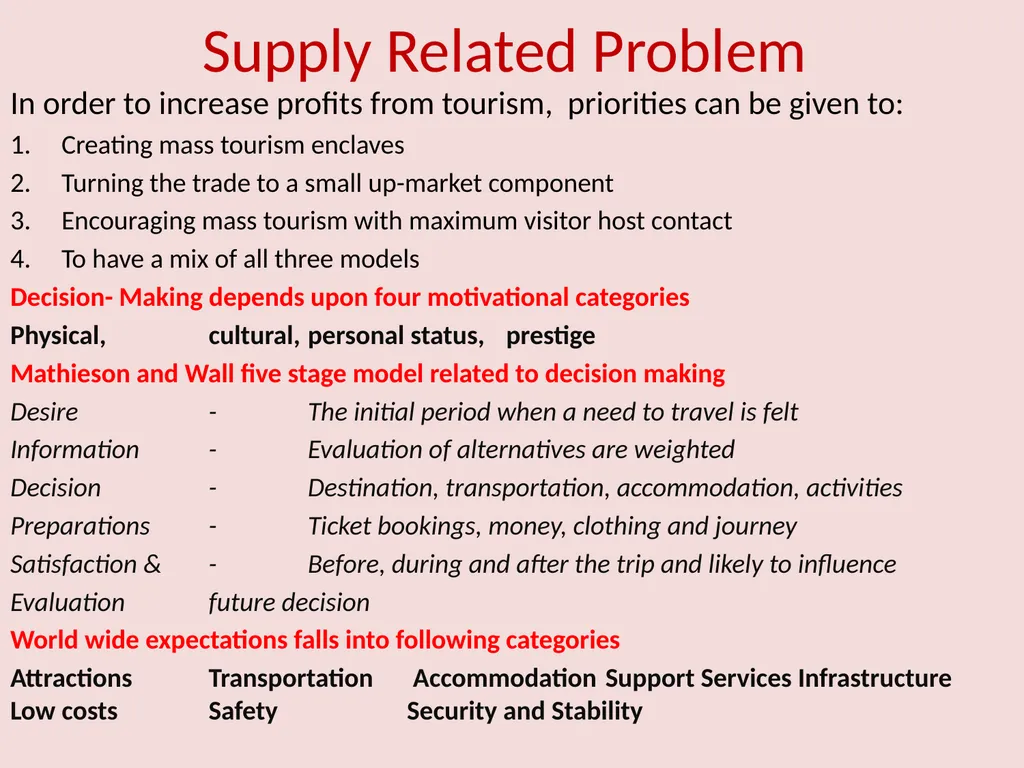
slide29. Supply Related Problem In order to increase profits from tourism, priorities can be given to:
Creating mass tourism enclaves
Turning the trade to a small up-market component
Encouraging mass tourism with maximum visitor host contact
To have a mix of all three models
Decision- Making depends upon four motivational categories
Physical, cultural, personal status, prestige
Mathieson and Wall five stage model related to decision making
Desire - The initial period when a need to travel is felt
Information - Evaluation of alternatives are weighted
Decision - Destination, transportation, accommodation, activities
Preparations - Ticket bookings, money, clothing and journey
Satisfaction & - Before, during and after the trip and likely to influence
Evaluation future decision
World wide expectations falls into following categories
Attractions Transportation Accommodation Support Services Infrastructure Low costs Safety Security and Stability<br>
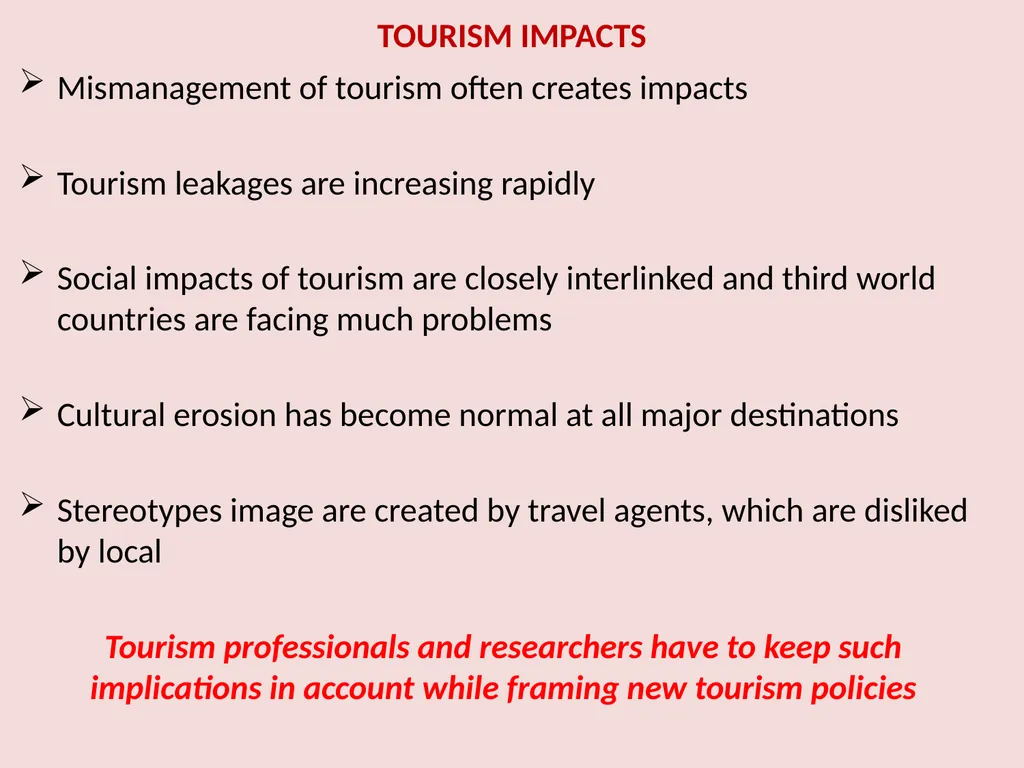
slide30. TOURISM IMPACTS Mismanagement of tourism often creates impacts
Tourism leakages are increasing rapidly
Social impacts of tourism are closely interlinked and third world countries are facing much problems
Cultural erosion has become normal at all major destinations
Stereotypes image are created by travel agents, which are disliked by local
Tourism professionals and researchers have to keep such implications in account while framing new tourism policies<br>
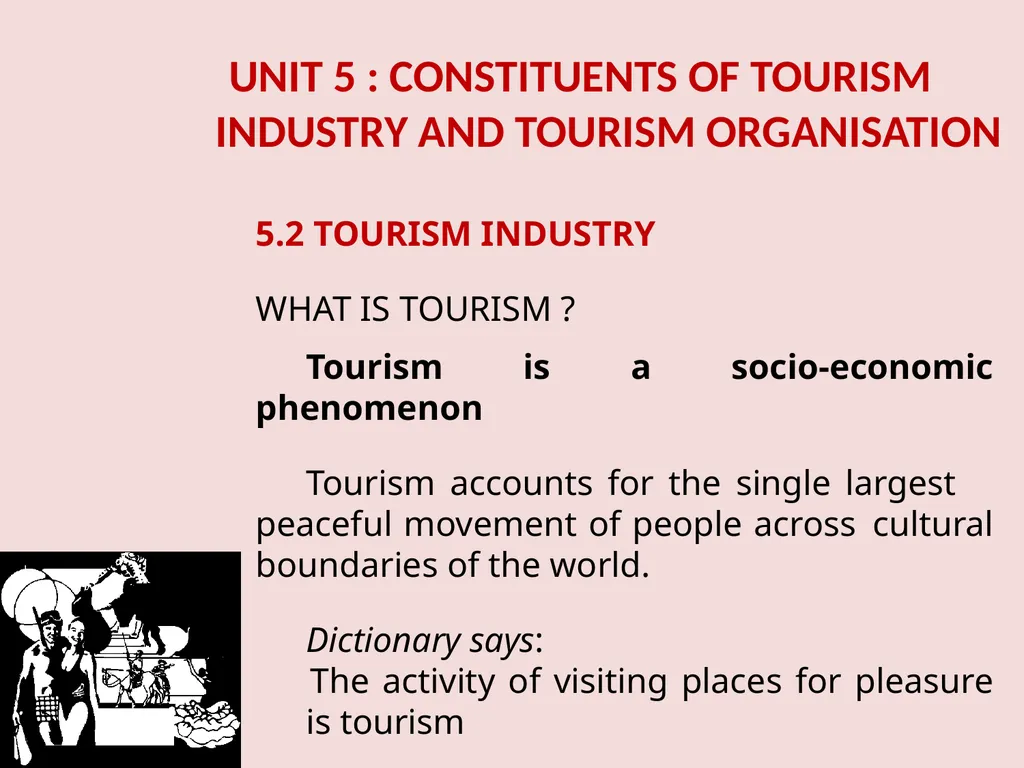
slide31. UNIT 5 : CONSTITUENTS OF TOURISM INDUSTRY AND TOURISM ORGANISATION 5.2 TOURISM INDUSTRY
WHAT IS TOURISM ?
Tourism is a socio-economic phenomenon
Tourism accounts for the single largest peaceful movement of people across cultural boundaries of the world.
Dictionary says:
The activity of visiting places for pleasure is tourism<br>
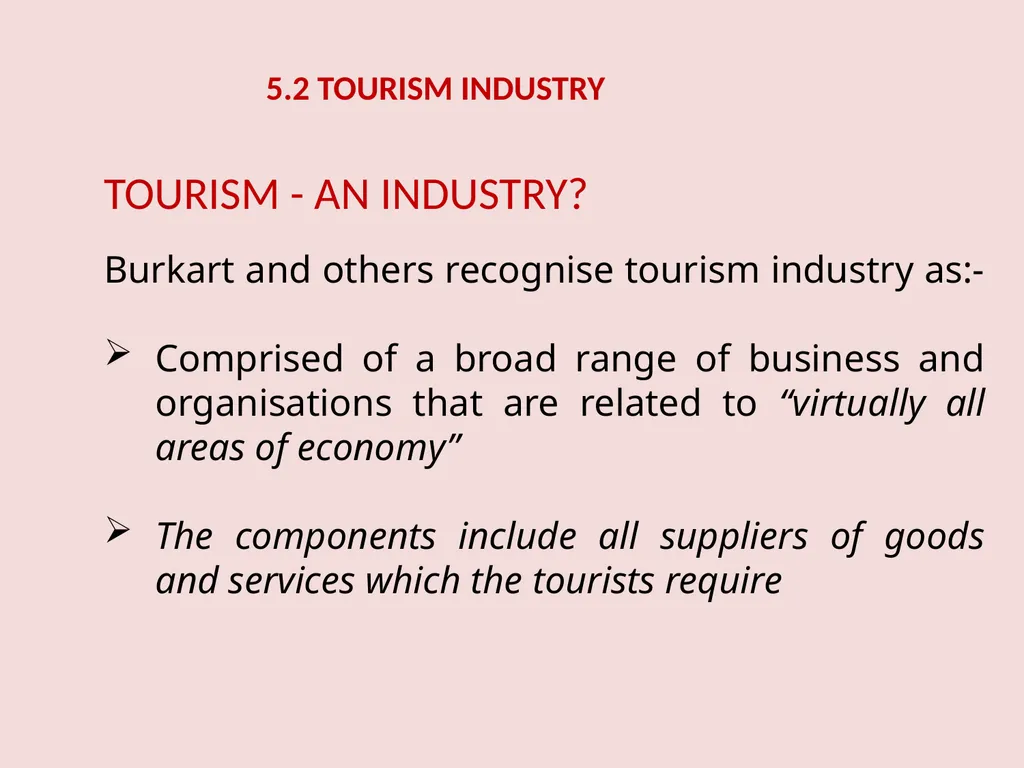
slide32. 5.2 TOURISM INDUSTRY TOURISM - AN INDUSTRY?
Burkart and others recognise tourism industry as:-
Comprised of a broad range of business and organisations that are related to “virtually all areas of economy”
The components include all suppliers of goods and services which the tourists require<br>
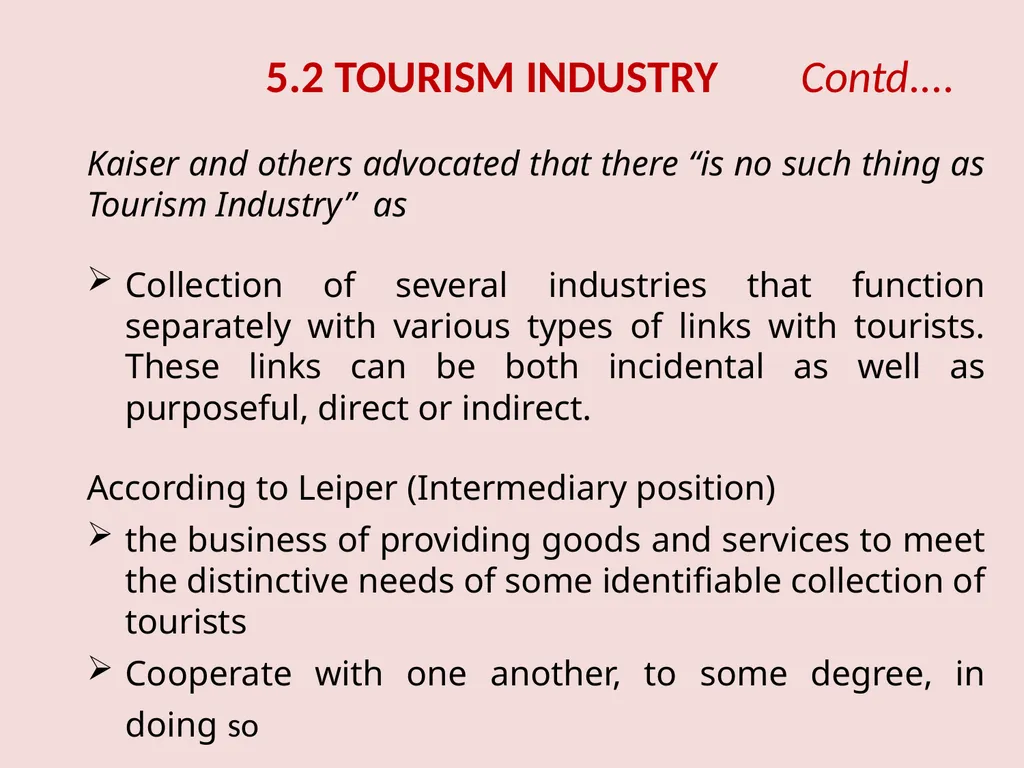
slide33. 5.2 TOURISM INDUSTRY Contd.... Kaiser and others advocated that there “is no such thing as Tourism Industry” as
Collection of several industries that function separately with various types of links with tourists. These links can be both incidental as well as purposeful, direct or indirect.
According to Leiper (Intermediary position)
the business of providing goods and services to meet the distinctive needs of some identifiable collection of tourists
Cooperate with one another, to some degree, in doing so<br>
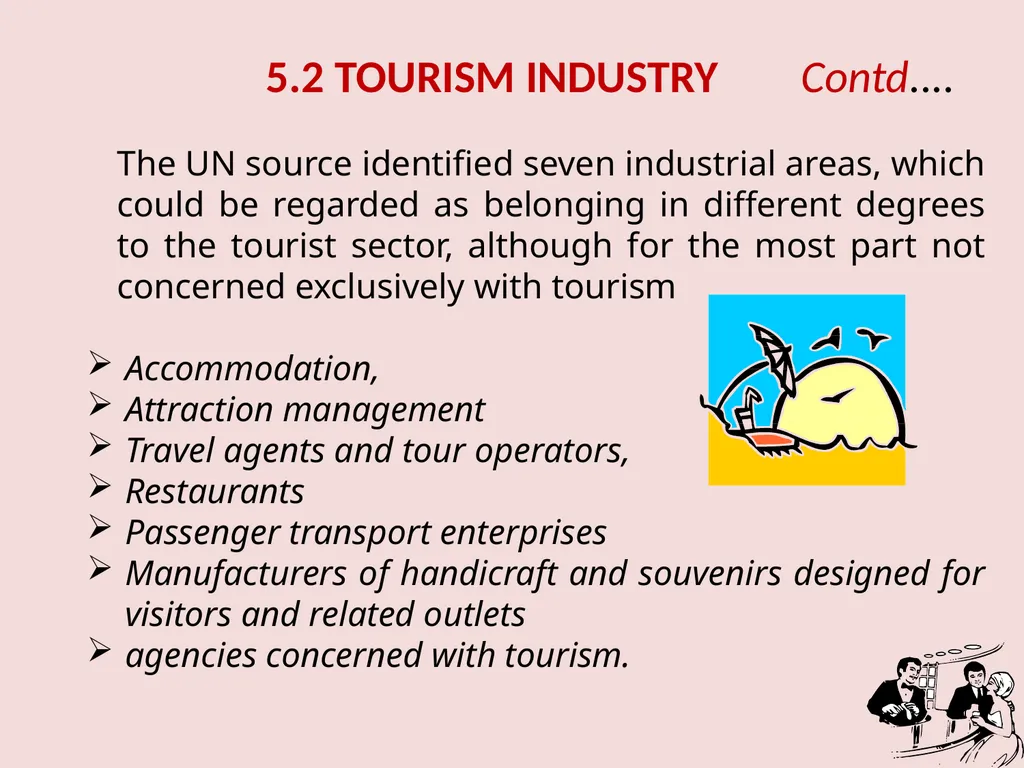
slide34. 5.2 TOURISM INDUSTRY Contd.... The UN source identified seven industrial areas, which could be regarded as belonging in different degrees to the tourist sector, although for the most part not concerned exclusively with tourism
Accommodation,
Attraction management
Travel agents and tour operators,
Restaurants
Passenger transport enterprises
Manufacturers of handicraft and souvenirs designed for visitors and related outlets
agencies concerned with tourism.<br>
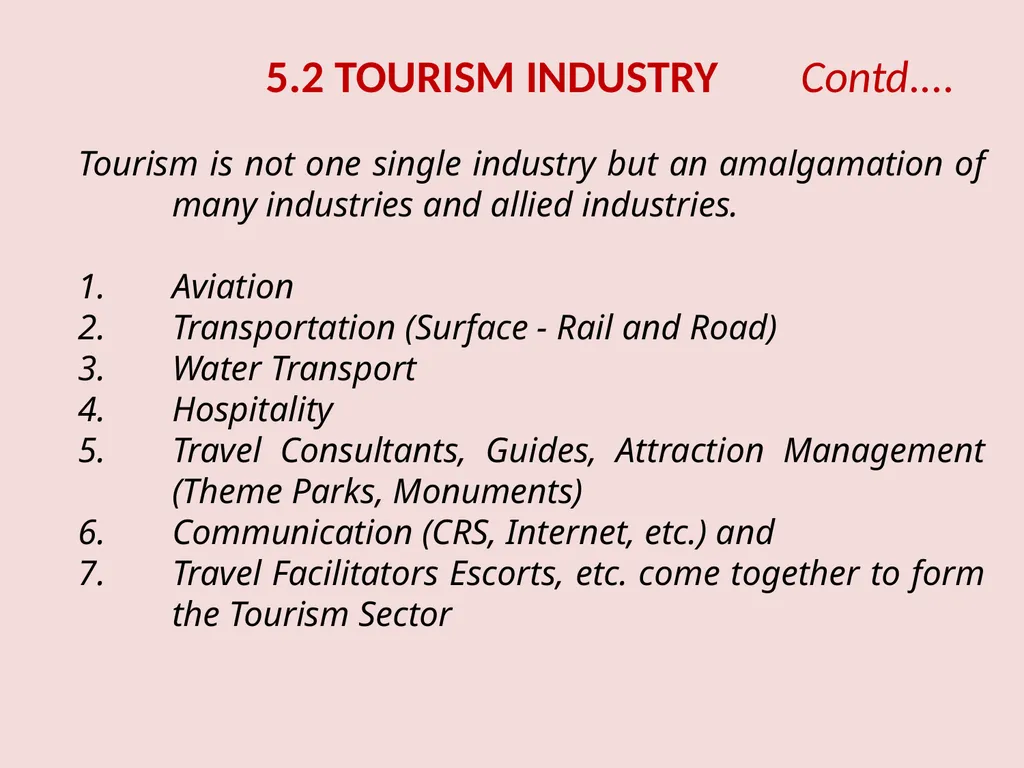
slide35. 5.2 TOURISM INDUSTRY Contd.... Tourism is not one single industry but an amalgamation of many industries and allied industries.
Aviation
Transportation (Surface - Rail and Road)
Water Transport
Hospitality
Travel Consultants, Guides, Attraction Management (Theme Parks, Monuments)
Communication (CRS, Internet, etc.) and
Travel Facilitators Escorts, etc. come together to form the Tourism Sector<br>
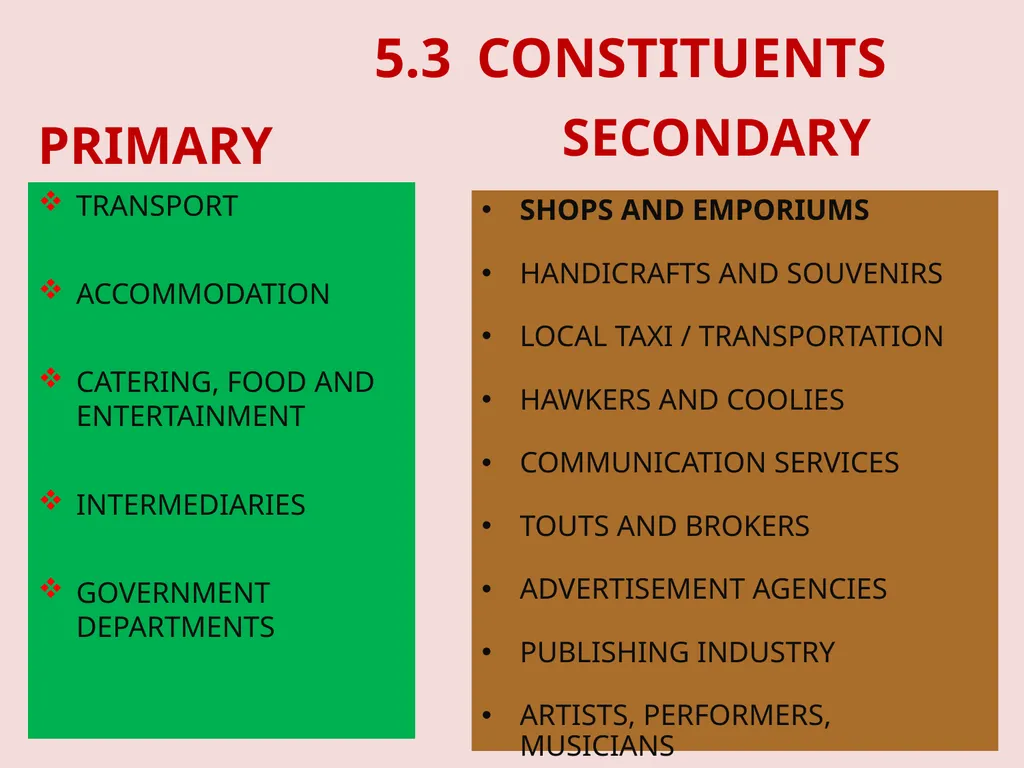
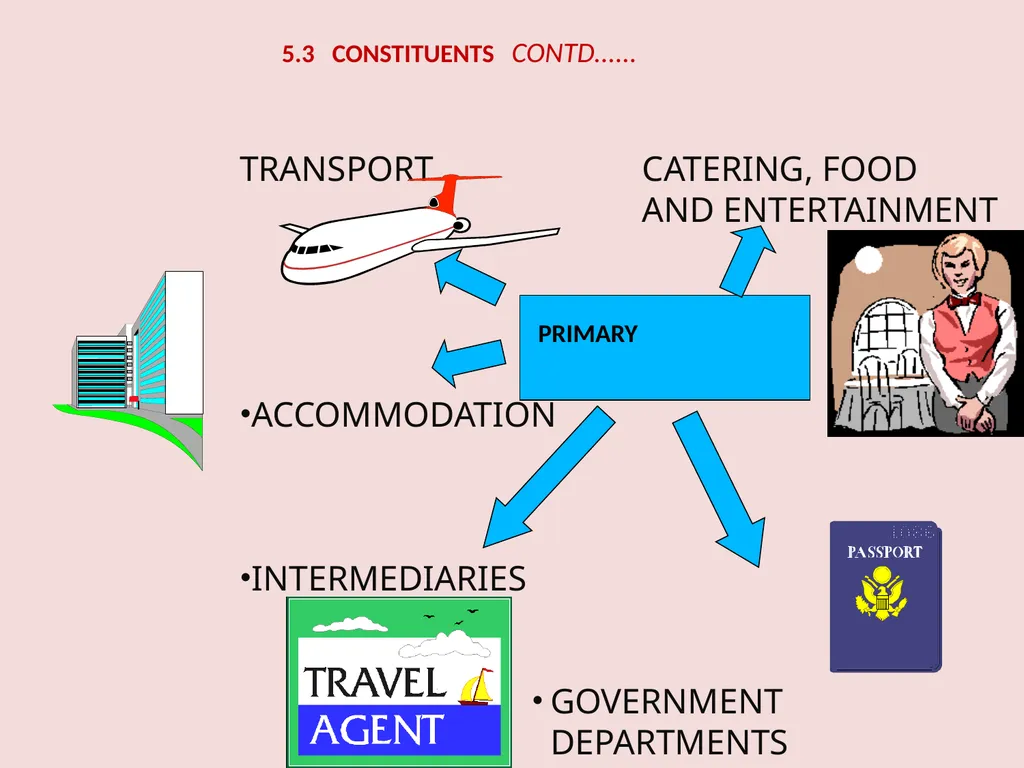
slide36. PRIMARY SECONDARY 5.3 CONSTITUENTS TRANSPORT
ACCOMMODATION
CATERING, FOOD AND ENTERTAINMENT
INTERMEDIARIES
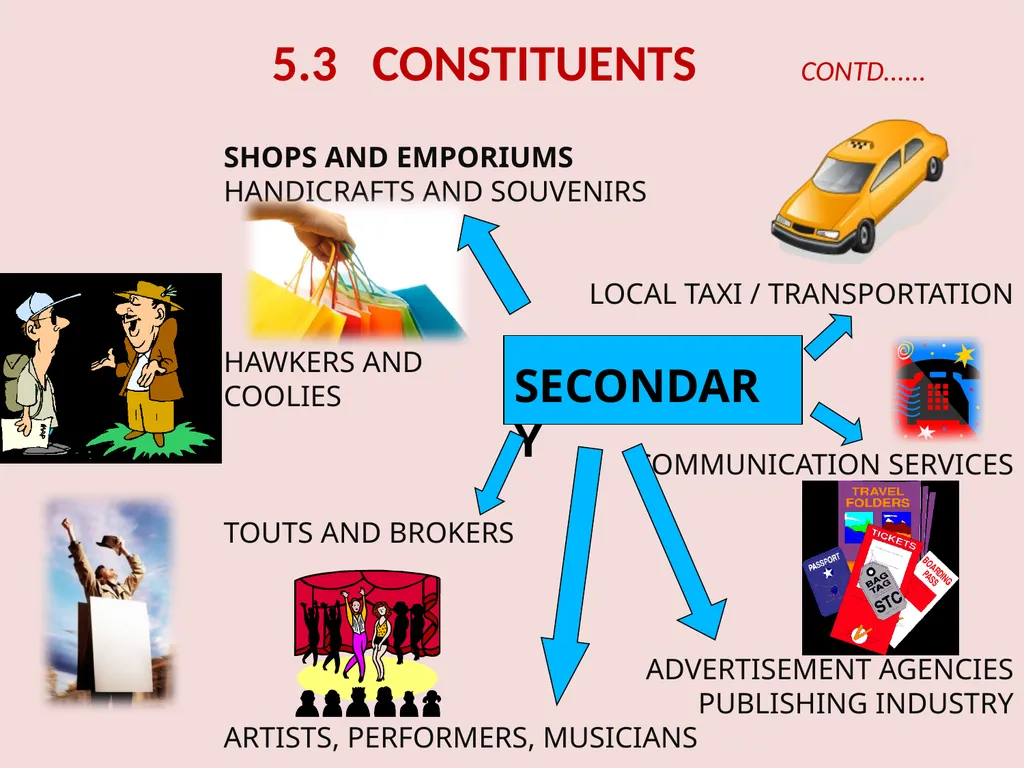
GOVERNMENT DEPARTMENTS SHOPS AND EMPORIUMS
HANDICRAFTS AND SOUVENIRS
LOCAL TAXI / TRANSPORTATION
HAWKERS AND COOLIES
COMMUNICATION SERVICES
TOUTS AND BROKERS
ADVERTISEMENT AGENCIES
PUBLISHING INDUSTRY
ARTISTS, PERFORMERS, MUSICIANS<br>
slide37. 5.3 CONSTITUENTS CONTD...... TRANSPORT CATERING, FOOD
AND ENTERTAINMENT
ACCOMMODATION
INTERMEDIARIES
GOVERNMENT DEPARTMENTS PRIMARY<br>
slide38. 5.3 CONSTITUENTS CONTD...... SECONDARY SHOPS AND EMPORIUMS
HANDICRAFTS AND SOUVENIRS
LOCAL TAXI / TRANSPORTATION
HAWKERS AND
COOLIES
COMMUNICATION SERVICES
TOUTS AND BROKERS
ADVERTISEMENT AGENCIES
PUBLISHING INDUSTRY
ARTISTS, PERFORMERS, MUSICIANS<br>
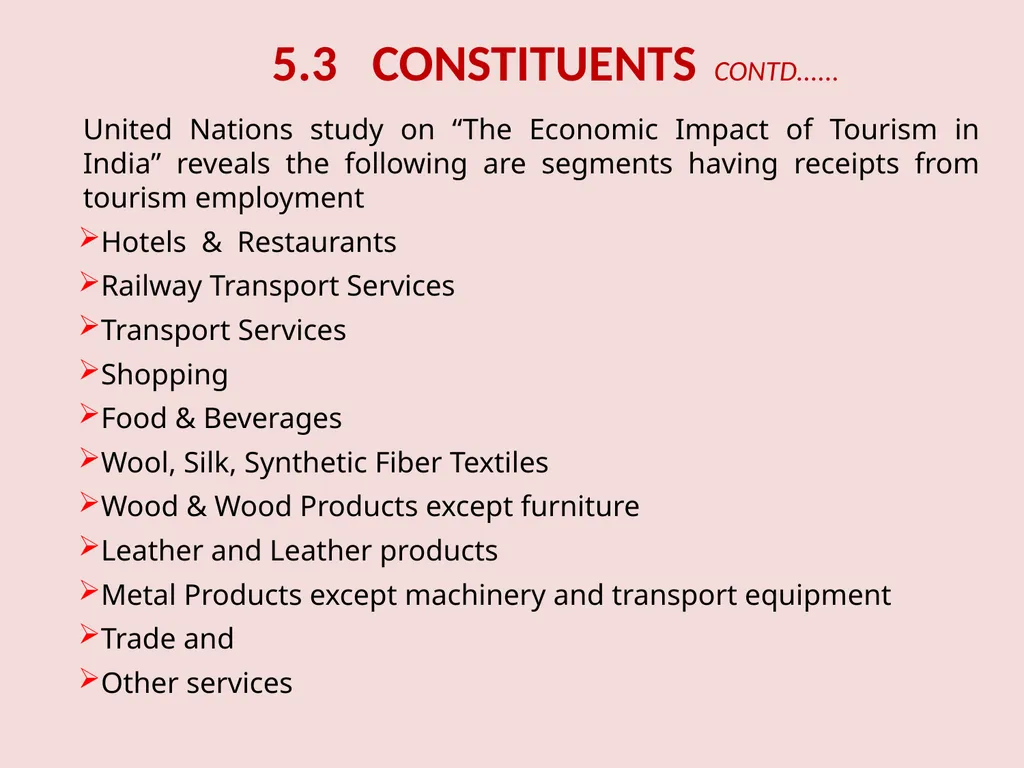
slide39. United Nations study on “The Economic Impact of Tourism in India” reveals the following are segments having receipts from tourism employment
Hotels & Restaurants
Railway Transport Services
Transport Services
Shopping
Food & Beverages
Wool, Silk, Synthetic Fiber Textiles
Wood & Wood Products except furniture
Leather and Leather products
Metal Products except machinery and transport equipment
Trade and
Other services 5.3 CONSTITUENTS CONTD......<br>
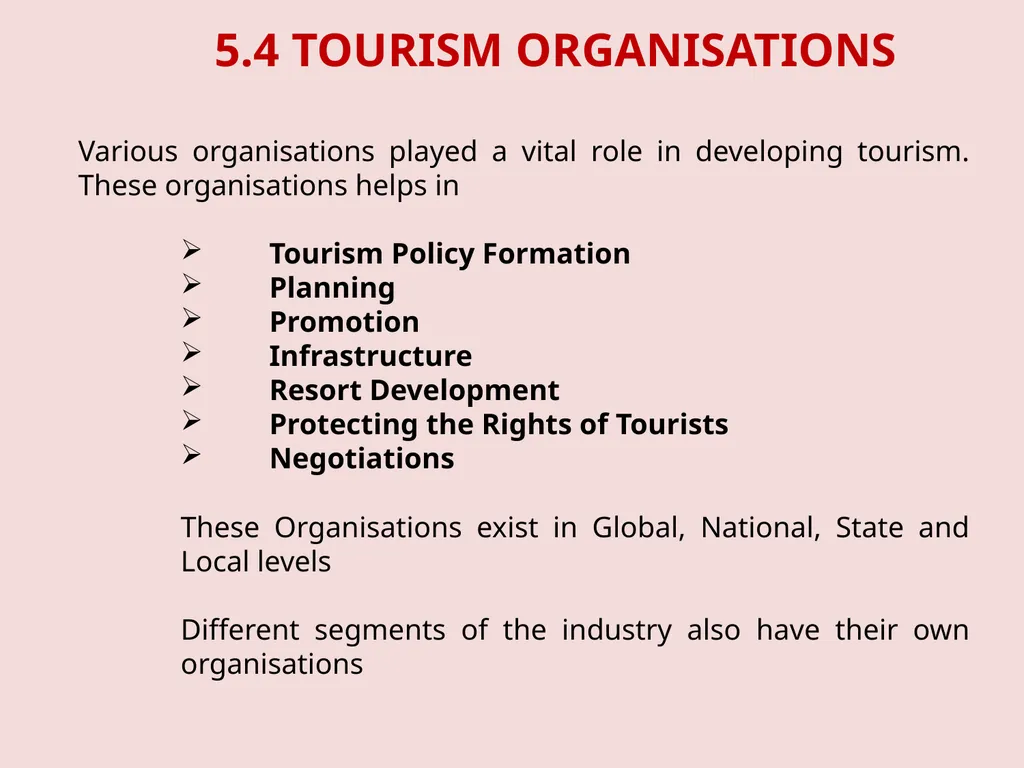
slide40. Various organisations played a vital role in developing tourism. These organisations helps in
Tourism Policy Formation
Planning
Promotion
Infrastructure
Resort Development
Protecting the Rights of Tourists
Negotiations
These Organisations exist in Global, National, State and Local levels
Different segments of the industry also have their own organisations 5.4 TOURISM ORGANISATIONS<br>
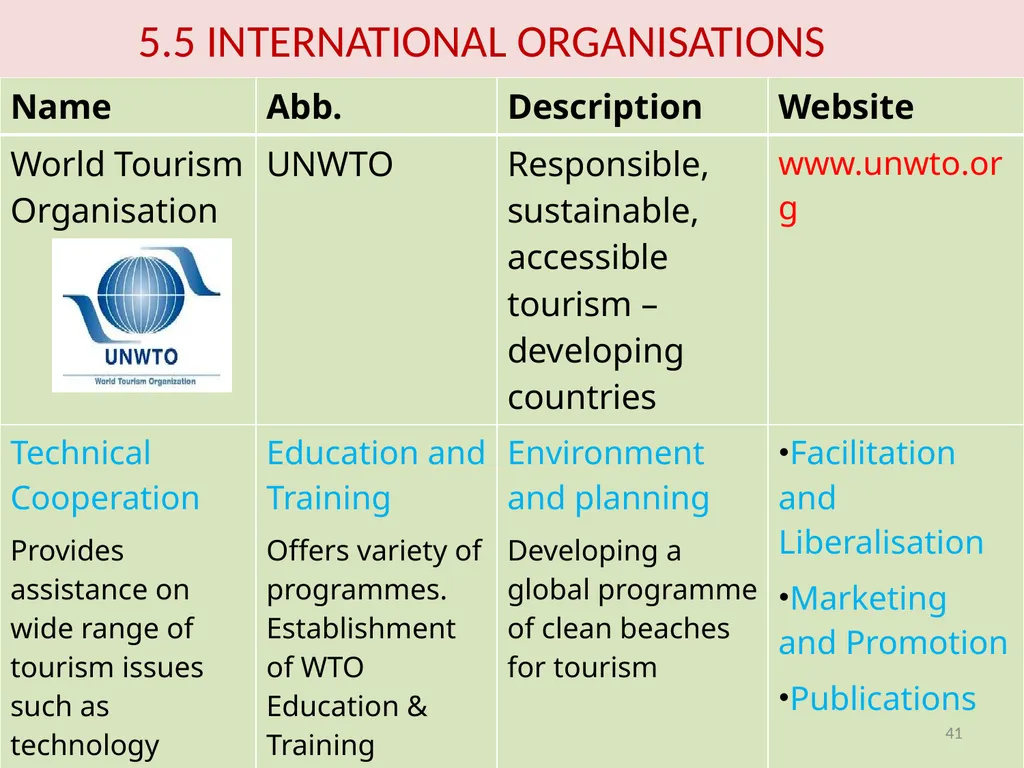
slide41. 5.5 INTERNATIONAL ORGANISATIONS 41<br>
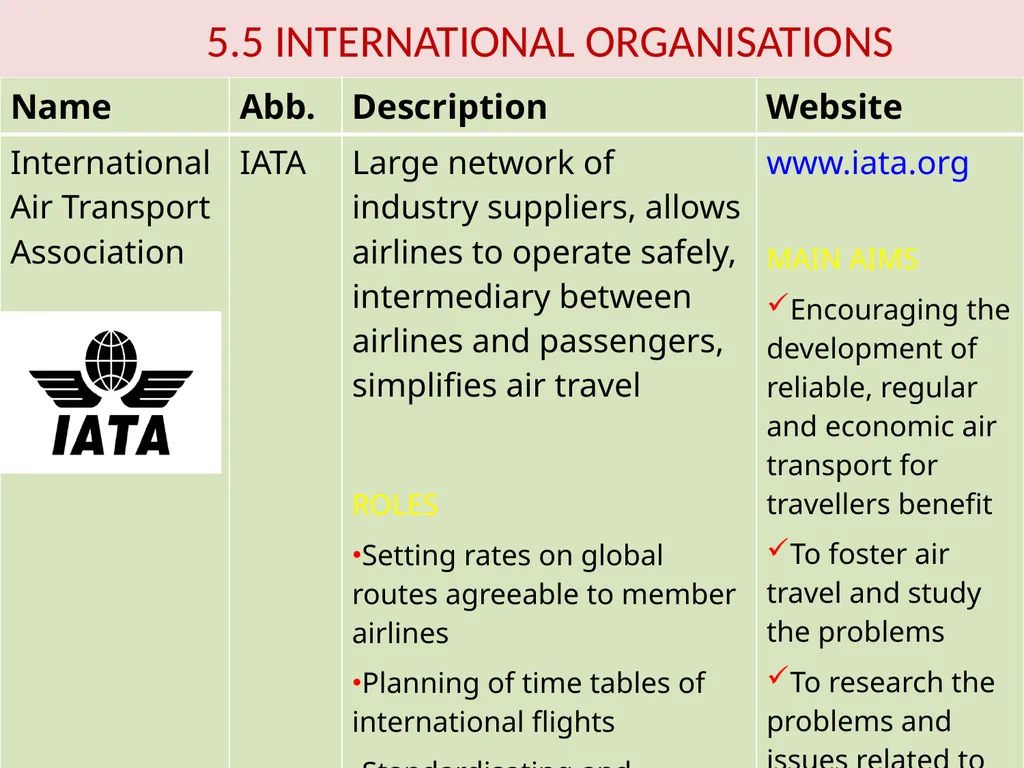
slide42. 5.5 INTERNATIONAL ORGANISATIONS 42<br>
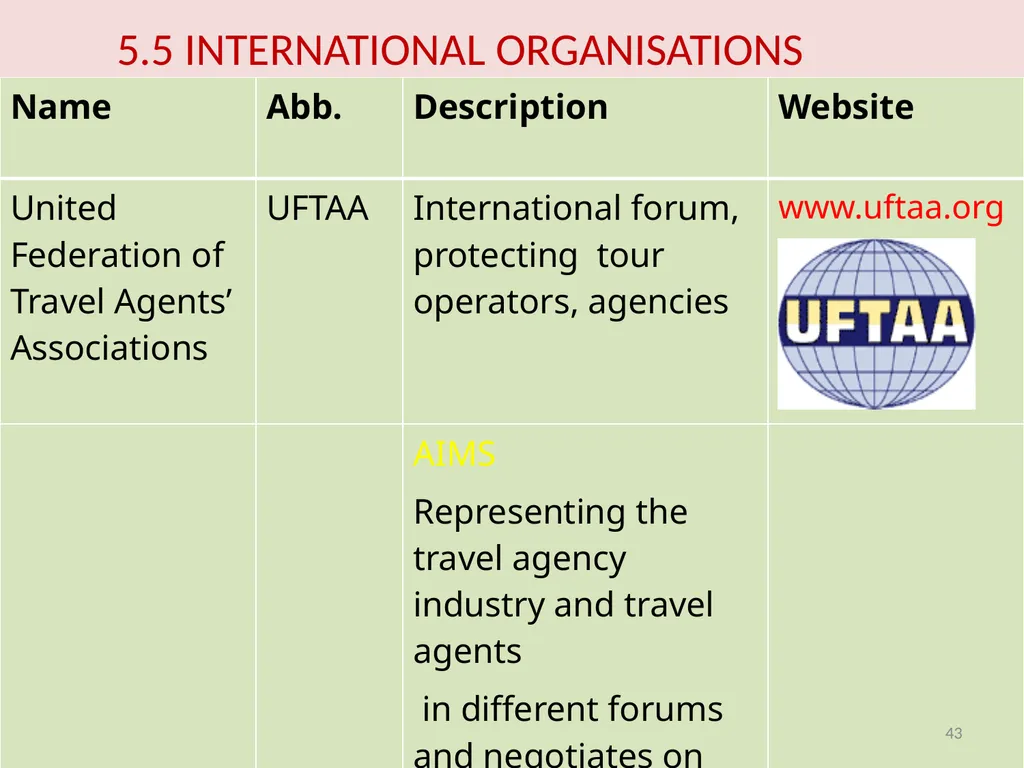
slide43. 5.5 INTERNATIONAL ORGANISATIONS 43<br>
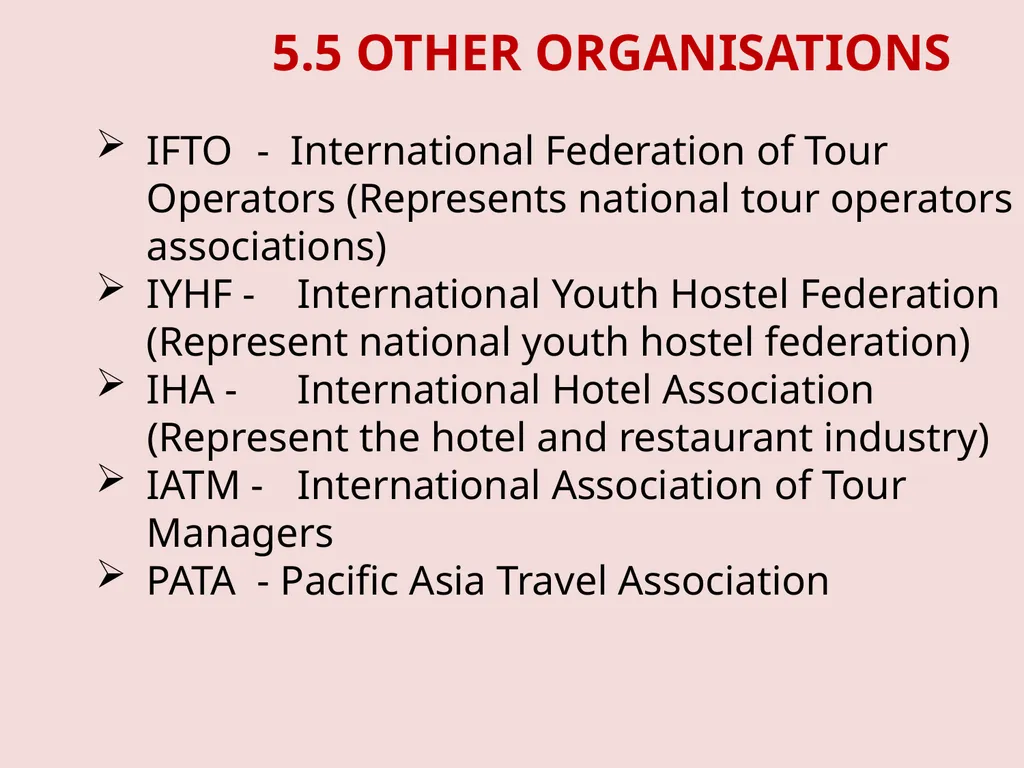
slide44. IFTO - International Federation of Tour Operators (Represents national tour operators associations)
IYHF - International Youth Hostel Federation (Represent national youth hostel federation)
IHA - International Hotel Association
(Represent the hotel and restaurant industry)
IATM - International Association of Tour Managers
PATA - Pacific Asia Travel Association 5.5 OTHER ORGANISATIONS<br>
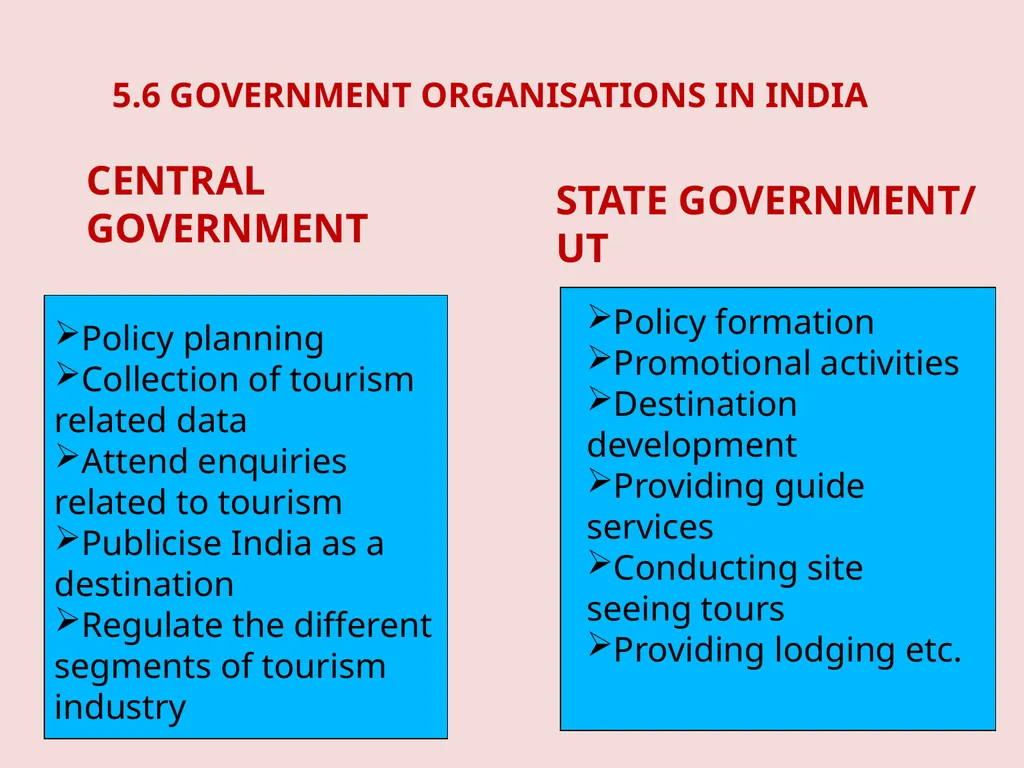
slide45. 5.6 GOVERNMENT ORGANISATIONS IN INDIA CENTRAL GOVERNMENT Policy planning
Collection of tourism related data
Attend enquiries related to tourism
Publicise India as a destination
Regulate the different segments of tourism industry STATE GOVERNMENT/ UT Policy formation
Promotional activities
Destination development
Providing guide services
Conducting site seeing tours
Providing lodging etc.<br>
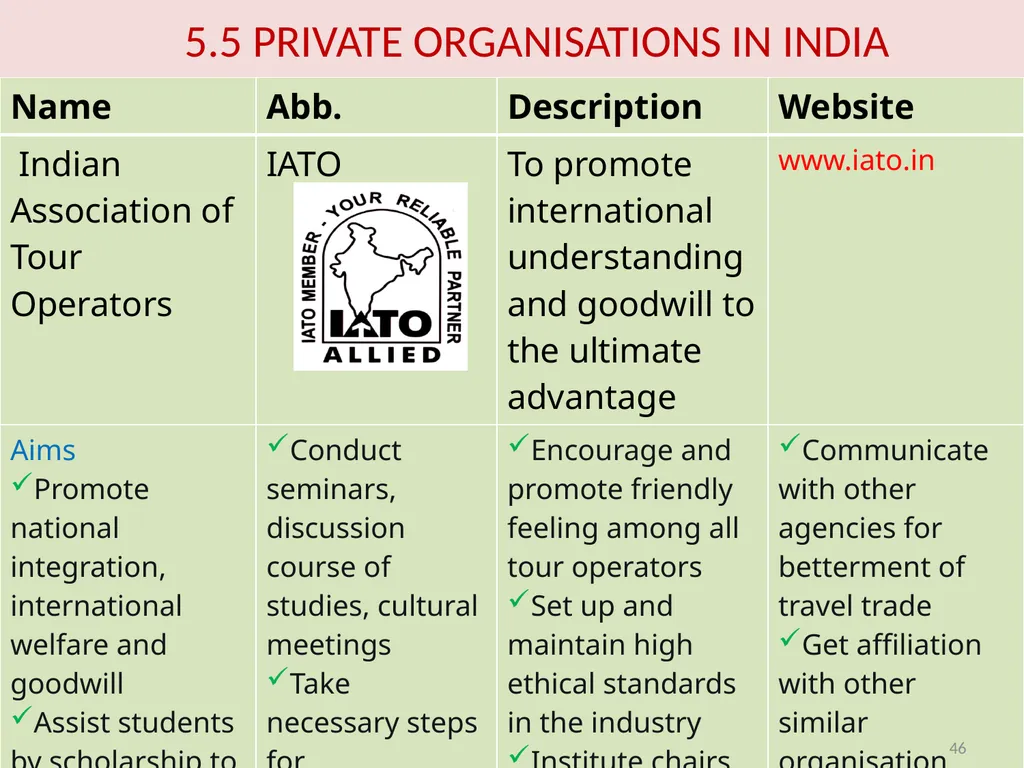
slide46. 5.5 PRIVATE ORGANISATIONS IN INDIA 46<br>
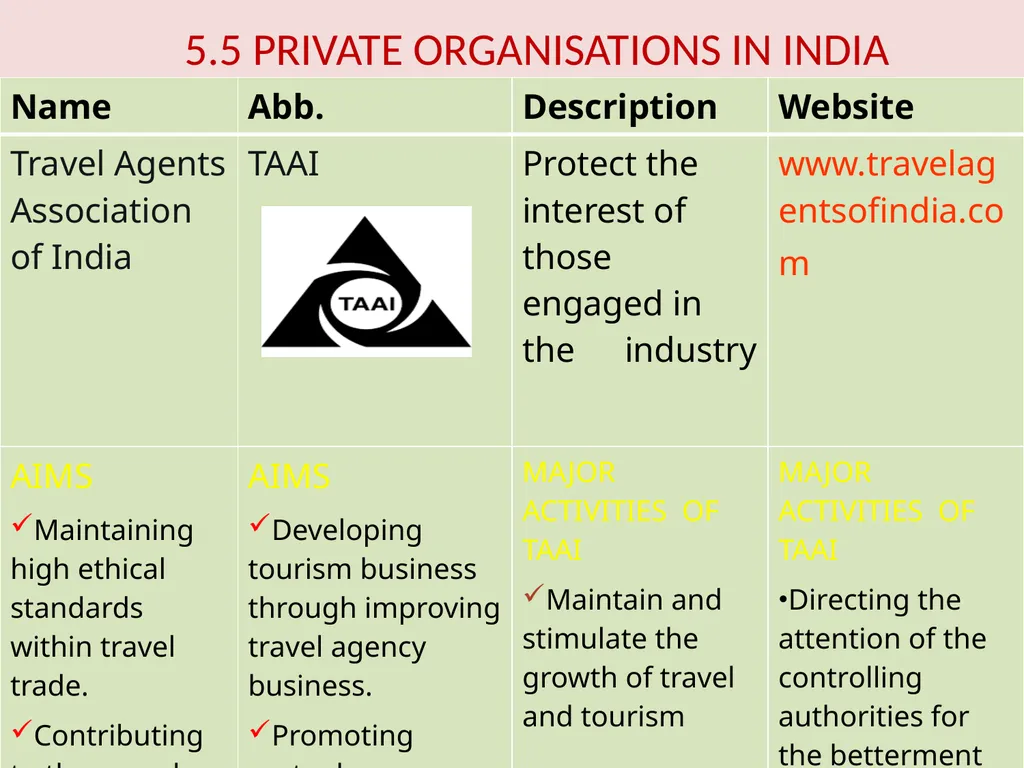
slide47. 5.5 PRIVATE ORGANISATIONS IN INDIA 47<br>
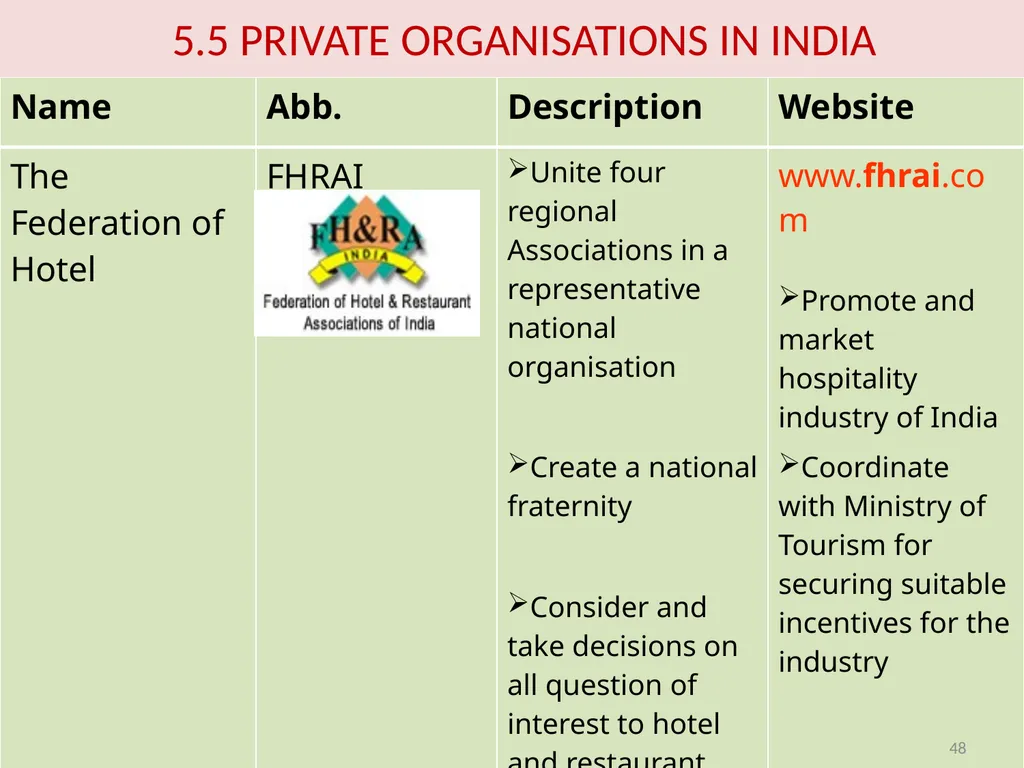
slide48. 5.5 PRIVATE ORGANISATIONS IN INDIA 48<br>
Unit 4 – Tourism Systems
Unit 5 – Tourism Constitutents
Block-1: Tourism Phenomenon
(3 Units)
Course Counsellor: Dr. Mou Roy Email ID: dutta_mou@yahoo.com<br>
slide2. TS 1 UNIT 3 Historical Evolution and Development
Understanding history is essential because present has evolved out of it and for better future we have to analyse past carefully
Different views, methods, and trends were followed in history writing right from the olden days
One has to understand the transition period from travel to modern tourism<br>
slide3. NEED FOR HISTORY OF TOURISM Understanding the history of tourism is possible by understanding the phenomenon in a particular society at a particular time
History of tourism helps us to understand a dynamic model of tourism development
Help in developing the theoretical framework within which the data on tourism can be verified
Understanding the history of tourism helps in developing tourism as an academic discipline
Careful analysis of history of tourism helps in
(i) Identification of sources of data
(ii) Use of both written and oral history<br>
slide4. Sources of Data The various data sources for history of tourism are as follows
Literary records
Inscriptions
Grafitti
Papyras receipts
Seals
Archaeological evidence including painted pottery
Diplomatic records
Archives, both private and public
Oral history and folk culture, both traditional and personal, etc.<br>
slide5. STATISTICAL RECORDS On understanding the importance of tourism as an economic multiplier tourism statistics came into existence in 1914
Prior to 1920 data base for travel was constructed from railway records, postal authorities, and from passport and visa authorities to
Reconstruct the volume of people who traveled
Identify the time of the year they traveled, and
Find places they visited
First Britain began to collect tourism statistics in 1921, and by 1945 all countries started collecting data
Earlier 42 definition of tourism was used as a result of which though data collected were of high standard the reliability is often questioned<br>
slide6. Secondary sources Personal documents that includes diaries, journals and letters of educated travellers, academics and intellectuals
Mass communications such as
Newspapers
Journals
Advertisements
Guide Books
Magazines etc.
All above resources help in designing itineraries, identifying important events, and understanding holiday patterns<br>
slide7. PERIODISATION AND CONCEPTS Six Periods in the History of Tourism
With the passage of time the class of people involved in tourism have changed
Ancient Era Imperial Era Pilgrimage
Grand Tour Era Transition Era Modern Era
Concepts that commonly used during all periods
Motivation
Holiday
Mode of Travel
Tourism Impacts<br>
slide8. PERIODISATION AND CONCEPTS Concepts that commonly used during all periods
Motivation - The value of new experience and the transformation of travel from survival to an improvement in the quality of life . This includes:
Curiosity - Moving from the known to unknown
Anticipation - What you hope to find, see and do. To look for something and evaluate every new experience
Leaving a mark for Posterity – What the world offers and why you have experienced<br>
slide9. PERIODISATION AND CONCEPTS Holiday
This has two Sources
(i) Religious: In Europe a day was set aside, at the end of a work cycle, for religious rituals and this day was called a HOLY DAY. In time, saints days and certain other observances were added to the number of holidays when no work was done and everyone celebrated
(ii)Secular: The secular tradition was a part of the Imperial system when the state granted public holidays to celebrate Imperial glory. On these holidays no work was done and the people participated in feasting and fun. Public games and spectator sports were the highlights on such occasions
In Time, the religious and secular combined and the day of rest became a part of all societies<br>
slide10. PERIODISATION AND CONCEPTS MODE OF TRAVEL
was the state of the art in terms of transport networks and routes, vehicles, cost of travel, documentation and safe passage, wayside facilities and conveniences to the traveller
TOURISM IMPACTS
The influence of tourism not only on the life- style of the people but in bringing about changes in consumption and production as well as wealth<br>
slide11. ANCIENT PERIOD Difficult and dangerous overland and sea journeys were taken
Non availability of wayside facilities made journeys very costly
Specific paths and routes were developed and used by traders and pilgrims
Development of specialised vehicles for travel over land and on water
Growth of urban centers and cities along river banks and coastline in Mesopotamia, China, and India
Travel followed networks, resting places and food resources were provided along these routes
Commercial centers came into existence and scope of travel to distant parts of the world increased
As frequency of travel increased wagons for goods and chariots for passengers were introduced
Paths and routes were developed and trees were planted for shade
More travel resulted in knowledge of wealth at distant places<br>
slide12. EARLY EMPIRES Egyptian Civilisation and Phoenicians
Egyptian civilisation attracted many tourists, Light house of Alexandria was considered one of the seven wonders of the Ancient world
Both men and women enjoyed travelling to places, on arrival at destination there was a celebratory feast, often with a sacrifice for thanks giving
Tourists season is from April to November, people travelled long distances to see glorious monuments of Egypt and returned with souvenirs to show to friends at home
Phoenicians explored extended the boundaries, they also developed overland facilities and trunk routes for travels
Money was used as a form of exchange which helped in easy travel as food and services was purchased instead of carrying them all ways
The Persian Empire
As Persian empire expanded over a large area they improved their travel infrastructure
Roads were designed, carrier wagons with four wheel with cover overhead were designed for comfortable travel thus method for comfortable travel was introduced<br>
slide13. EARLY EMPIRES GREEKS
Maritime expertise of Greeks helped in developing tourism
Currency exchange system that enabled exchange outside Greek states was introduced and Greek became common language in the Mediterranean
Festivals were hosted to attract travellers and Olympic games held to display creative athletic skills in honour of the God Zeus
Tragedies and comedies of Greek theatre attracted many travellers
Scholars, Philosophers, Physicians, and men of Science visited Greece to learn and expand their skills
Athens became a famous destination, hospitality facilities were provided along with entertainment shows to its visitors, guide services and travel tips were also provided to the travellers<br>
slide14. EARLY EMPIRES The Romans
The Romans also flourished in hospitality sector
Planned network of roads called “Appian ways” and waterways were popular
As wealth and prosperity of Roman citizens increased, they took interest in
knowing more about culture of people they brought under their control
Games and gladiatorial contents were popular events
Greek temples, sanctuaries, and works of art became sight – seeing spots
Roman visitors were much attracted to the seven wonders of the world
Mineral springs were closely associated with shrines as a result both travellers and pilgrims were attracted towards them
Literary references also attracted certain educated travellers towards Roman empire<br>
slide15. EARLY EMPIRES India
Wonder and wealth of India attracted Greek and Hebrew Scholars
India’s geographical location made it as an important part of the world
Mahabharat reveals about fairs and Arthashastra reflects the protection and importance given to merchants, safety for passengers and goods, exchange rates for various metals and price regulations
Trade overland and on inland waterways was well developed
Buddhist Sangha established the tradition of the pilgrimage, Panthagars were provided for mendicant traveller
Monastries attracted the monk, the merchant, and the layman
Horses, elephants and camels were used as common mode of transport
Serais were designed to accommodate foreigners, and entertainment facilities were also provided with due controls
Mile stones, baolis, sarais and network of roads from olden days clearly exhibits the travel culture and importance provided to tourists visiting India<br>
slide16. SILK ROUTE Silk Route – vital link in the East/ West movement of the people began in 2000 B. C
Meeting to exchange silk, muslin, fine glass, tea, rice and spices, exchange of ideas and production process were some of the main activities facilitated by silk route
Though stages of journey was short and very hard due to climate and topography in terms of wealth, it was most rewarding
Navigation was done by stars in absence of course of stream or river
Revenue was collected from travellers, larger state provided more facilities and also earned more income through taxing travellers
Ideas and new techniques crossed borders of various countries due to travellers of silk route
With fall of empires setback to trade and commerce was visible leading to less travel<br>
slide17. COMPLEX CHARACTER OF TOURISM Due to complexities of motivations, needs, and satisfaction, tourism emerged as an amalgam of phenomena and practices rather than a single or unique orientation
Inter- relationships arises from movement of people and their stay at different places further encouraged tourism
Tourism gave rise to activities which are distinct from the resident and working population
Tourists movements are temporary and relatively short term with intention to return to place of residence after travel is completed
Destinations are chosen for a particular attraction which could be business, vocational or pleasure related<br>
slide18. PILGRIMAGE Journey undertaken for betterment on the spiritual and material plane
In traditional societies, pilgrimage earned god’s grace and moral leadership in the community because sacred rituals and texts sanctified certain places associated with divine revelation. This was common in all religion
Pilgrims added to our knowledge of geography, culture, and traditional beliefs of other societies in the world
Special itineraries are prepared and tours are conducted for pilgrimage purpose in countries like India which contributes a lot of benefits to tourism
Kumbh Mela, navagraha circuits in Tamilnadu India are some fine examples of pilgrimage tourism<br>
slide19. GRAND TOUR Circuit of Western Europe undertaken by a wealthy social elite for culture, education and pleasure
People of rich class only undertook such tours
CHARACTERISTICS OF GRAND TOUR
Can be defined in terms of class, that determine the places visited and mode of travel
Can be defined by the destinations on the itinerary
Oxford English Dictionary defines Grand Tour as tour of the principal cities and places of interest in Europe, formerly said to be an essential part of the education of young men of good birth and fortune
Career, Education, Culture, literary, Health, Scientific, Business and Economic are main motivations. Often, more than one reasons are found as motivations
Tours and length of stay at destinations depends upon seasons, and availability of tourism resources
It provided a base for emergence of tourism industry, guide books, and travel organiser
Tourism became a family affair and soon women travellers began to travel<br>
slide20. TRANSITION TO MODERN TOURISM Main reason for transition to modern tourism is due to:
Revolutionary changes in technology
personal income rise due to industralisation
organised tours conducted for the inexperienced traveller
MODERN TOURISM IN INDIA
Middle class and working people undertook travel in huge number due to well established rail networks throughout India
Leave Travel Concession (LTC), concession to students, youths encouraged people to travel extensively
Western comforts were provided to international travellers at major destinations through ITDC
Plans were made to develop many famous tourist destination in big ways
Organisations like TAAI (Travel Agents Association of India), IATO (Indian Association of Tour Operators) played their role
State Tourism Development Corporations were set up to provide further boost to tourism
New markets and diverse products like adventure sports, fairs, festivals, golf were encouraged
Tourism education was offered at many educational institutes and IITTM (Indian Institute of Tourism and Travel Management) was set up to train tourism administrators<br>
slide21. Major Developments in the History of Tourism Before Records were made
People began to travel in search of adventure & escapism
14th – 16th centuries
Trade routes & infrastructure systems were developed throughout the world
1785 - Grand Tour Era makes travel a status symbol for wealthy individuals seeking to experience cultures of the civilized world
18th to 19th Centuries
Industrial Revolution gives rise to technological advances, making travel and trade more efficient and expanding markets
1841 – Thomas Cook organizes first group tour in England
1879 – Thomas Cook organizes the first package tours to Europe and the USA
1903 – Wright Brothers usher in era of flight with the first successful aircraft flight
1919- First scheduled airline passenger flight debuts between London and Paris
1937-Britain’s first holiday camp is opened by Billy Butlins in Skegness
1945-World War II ends and ushers in new era of prosperity<br>
slide22. Contd………. 1978- Competition on routes and fares begins with signing of Airline Deregulation Act
1983- 77% of British workers have 4-5 weeks paid holiday per year
1996—Expedia is founded as a division of Microsoft
20th – 21st Centuries
2000 – TripAdvisor is founded
2001 – September 11 terrorist attacks in New York changed the aviation industry forever, with new rules and procedures implemented
2002 – The Euro is introduced, making travel & trade easier across Europe
2007 – Airbnb was launched, sparking demand for the sharing economy in tourism
2011 – Google provides an online flight-booking service, Google Flights, to the public
2020 – The Global Corona halted tourism worldwide as a result of lockdown and boarder closures<br>
slide23. TS 1 UNIT 4 TOURISM SYSTEM The conceptual approach which helps to identify the dynamic elements of tourism
Tourism framework HISTORY, CONCEPTS,PRICCIPLES, POTENTIALS SUPPLY PHPHENOMENON O OF TOURISM Of TOURISM DEMAND SYSTEM Tourist Propensities Constraints, Behaviour GEOGEOGRAPHY ATTRACTION INFRASTRUCTURE SUPERSTRUCTURE MANAGEMENT POLICY TRANSPORT COMMUNICATION PROMOTION
OPERATION TOURIST ORGANISATIONAL IMPACTS HOST PLANNING EDUCATION MARKETING FINANCE ENVIRONMENTAL SOCIO- CULTURAL ECONOMIC GOAL MAXIMATION LINK COMPONENT<br>
slide24. CONCEPTS Time- Work- Leisure- Tourism Implications EDUCATION, TRAINING WORK TIME BUSINESS TRTRAVEL SURVIVAL RECREATION LEISURE PLEASURE TOURISM<br>
slide25. PEOPLE AND THEIR ENVIRONMENT ISSUES THAT EMERGE WITH TOURISM SYSTEMS
Finite Resources - Both time and money determine opportunity and are generally unlimited
Actions – The potential for discretion in the use of time and money exists and yet obligations act as constraints
Facilitations - It is an aid to discretionary action but within the possibilities offered by travel/ journey components and support services
Results - Both pleasure and utility are desired in all life-world situations, including tourism
Beneficiaries - Both host and guest as tourism involves participation of both<br>
slide26. Pull and Push The success of any destination doesn't depend only on the richness of the tourism product, but on the effectiveness of tourism system which determines the packaging and marketing of the products<br>
slide27. Demand – Led System Policy makers provide more interest in tourism due to complex nature of tourism
Factors that shape demand for tourism are as follows
Leisure time Life cycle stage Increased Mobility
Work Patterns Affluence Women in the work force
Attitudes Increased Amenities Trend towards smaller families
Increasing urbanisation and migration
To encourage full potential of these factors, destinations should:
increase accessibility by scheduled charter, and domestic air service
Promote market exchange rate and control inflation
Re-orient business
Relax visa controls
Use technology to counter climate
Ensure safe health conditions and control pollution
Resolve political disputes to ensure stability so that tourists feel secured<br>
slide28. Supply Related Problem Tourism mainly depends on its image
Tourists is also victim of the sophisticated promotion of tourist products
Seven typologies of Valene Smith
Explorer – few in number looking for discovery and involvements
Elite - individually created visits to exotic places
Off- Beat - wanting to get away from the crowd
Unusual - seeking physical danger or isolation
Incipient mass - single or small groups using some shade services
Mass - package tour markets desiring tourist enclaves
Charter - mass travel to destination which have standardised facilities
Erik Cohen typology
Recreational - to relieve the stress of work
Diversionary -escape from boredom and routine
Experimental -looking for authenticity in other society, to experiment with alternate life styles
Existential -finding a new spiritual center as a result of a touristic experience<br>
slide29. Supply Related Problem In order to increase profits from tourism, priorities can be given to:
Creating mass tourism enclaves
Turning the trade to a small up-market component
Encouraging mass tourism with maximum visitor host contact
To have a mix of all three models
Decision- Making depends upon four motivational categories
Physical, cultural, personal status, prestige
Mathieson and Wall five stage model related to decision making
Desire - The initial period when a need to travel is felt
Information - Evaluation of alternatives are weighted
Decision - Destination, transportation, accommodation, activities
Preparations - Ticket bookings, money, clothing and journey
Satisfaction & - Before, during and after the trip and likely to influence
Evaluation future decision
World wide expectations falls into following categories
Attractions Transportation Accommodation Support Services Infrastructure Low costs Safety Security and Stability<br>
slide30. TOURISM IMPACTS Mismanagement of tourism often creates impacts
Tourism leakages are increasing rapidly
Social impacts of tourism are closely interlinked and third world countries are facing much problems
Cultural erosion has become normal at all major destinations
Stereotypes image are created by travel agents, which are disliked by local
Tourism professionals and researchers have to keep such implications in account while framing new tourism policies<br>
slide31. UNIT 5 : CONSTITUENTS OF TOURISM INDUSTRY AND TOURISM ORGANISATION 5.2 TOURISM INDUSTRY
WHAT IS TOURISM ?
Tourism is a socio-economic phenomenon
Tourism accounts for the single largest peaceful movement of people across cultural boundaries of the world.
Dictionary says:
The activity of visiting places for pleasure is tourism<br>
slide32. 5.2 TOURISM INDUSTRY TOURISM - AN INDUSTRY?
Burkart and others recognise tourism industry as:-
Comprised of a broad range of business and organisations that are related to “virtually all areas of economy”
The components include all suppliers of goods and services which the tourists require<br>
slide33. 5.2 TOURISM INDUSTRY Contd.... Kaiser and others advocated that there “is no such thing as Tourism Industry” as
Collection of several industries that function separately with various types of links with tourists. These links can be both incidental as well as purposeful, direct or indirect.
According to Leiper (Intermediary position)
the business of providing goods and services to meet the distinctive needs of some identifiable collection of tourists
Cooperate with one another, to some degree, in doing so<br>
slide34. 5.2 TOURISM INDUSTRY Contd.... The UN source identified seven industrial areas, which could be regarded as belonging in different degrees to the tourist sector, although for the most part not concerned exclusively with tourism
Accommodation,
Attraction management
Travel agents and tour operators,
Restaurants
Passenger transport enterprises
Manufacturers of handicraft and souvenirs designed for visitors and related outlets
agencies concerned with tourism.<br>
slide35. 5.2 TOURISM INDUSTRY Contd.... Tourism is not one single industry but an amalgamation of many industries and allied industries.
Aviation
Transportation (Surface - Rail and Road)
Water Transport
Hospitality
Travel Consultants, Guides, Attraction Management (Theme Parks, Monuments)
Communication (CRS, Internet, etc.) and
Travel Facilitators Escorts, etc. come together to form the Tourism Sector<br>
slide36. PRIMARY SECONDARY 5.3 CONSTITUENTS TRANSPORT
ACCOMMODATION
CATERING, FOOD AND ENTERTAINMENT
INTERMEDIARIES
GOVERNMENT DEPARTMENTS SHOPS AND EMPORIUMS
HANDICRAFTS AND SOUVENIRS
LOCAL TAXI / TRANSPORTATION
HAWKERS AND COOLIES
COMMUNICATION SERVICES
TOUTS AND BROKERS
ADVERTISEMENT AGENCIES
PUBLISHING INDUSTRY
ARTISTS, PERFORMERS, MUSICIANS<br>
slide37. 5.3 CONSTITUENTS CONTD...... TRANSPORT CATERING, FOOD
AND ENTERTAINMENT
ACCOMMODATION
INTERMEDIARIES
GOVERNMENT DEPARTMENTS PRIMARY<br>
slide38. 5.3 CONSTITUENTS CONTD...... SECONDARY SHOPS AND EMPORIUMS
HANDICRAFTS AND SOUVENIRS
LOCAL TAXI / TRANSPORTATION
HAWKERS AND
COOLIES
COMMUNICATION SERVICES
TOUTS AND BROKERS
ADVERTISEMENT AGENCIES
PUBLISHING INDUSTRY
ARTISTS, PERFORMERS, MUSICIANS<br>
slide39. United Nations study on “The Economic Impact of Tourism in India” reveals the following are segments having receipts from tourism employment
Hotels & Restaurants
Railway Transport Services
Transport Services
Shopping
Food & Beverages
Wool, Silk, Synthetic Fiber Textiles
Wood & Wood Products except furniture
Leather and Leather products
Metal Products except machinery and transport equipment
Trade and
Other services 5.3 CONSTITUENTS CONTD......<br>
slide40. Various organisations played a vital role in developing tourism. These organisations helps in
Tourism Policy Formation
Planning
Promotion
Infrastructure
Resort Development
Protecting the Rights of Tourists
Negotiations
These Organisations exist in Global, National, State and Local levels
Different segments of the industry also have their own organisations 5.4 TOURISM ORGANISATIONS<br>
slide41. 5.5 INTERNATIONAL ORGANISATIONS 41<br>
slide42. 5.5 INTERNATIONAL ORGANISATIONS 42<br>
slide43. 5.5 INTERNATIONAL ORGANISATIONS 43<br>
slide44. IFTO - International Federation of Tour Operators (Represents national tour operators associations)
IYHF - International Youth Hostel Federation (Represent national youth hostel federation)
IHA - International Hotel Association
(Represent the hotel and restaurant industry)
IATM - International Association of Tour Managers
PATA - Pacific Asia Travel Association 5.5 OTHER ORGANISATIONS<br>
slide45. 5.6 GOVERNMENT ORGANISATIONS IN INDIA CENTRAL GOVERNMENT Policy planning
Collection of tourism related data
Attend enquiries related to tourism
Publicise India as a destination
Regulate the different segments of tourism industry STATE GOVERNMENT/ UT Policy formation
Promotional activities
Destination development
Providing guide services
Conducting site seeing tours
Providing lodging etc.<br>
slide46. 5.5 PRIVATE ORGANISATIONS IN INDIA 46<br>
slide47. 5.5 PRIVATE ORGANISATIONS IN INDIA 47<br>
slide48. 5.5 PRIVATE ORGANISATIONS IN INDIA 48<br>