
TS INTRODUCTION THE CLINICAL ASSESSMENT OF
OM
Published · 51 slides · 0 views

1 / 1
Description
TS INTRODUCTION THE CLINICAL ASSESSMENT OF INFANTS, PRESCHOOLERS AND THEIR FAMILIES Adapted by Grace Sameve Julie Chilton Chapter A.4 Companion PowerPoint Presentation Sarah Mares Sarah Woodgate The IACAPAP Textbook of Child and
Related Topics
Share
Embed code
Download this presentation From Below
"TS INTRODUCTION THE CLINICAL ASSESSMENT OF" is the property of its rightful owner. Permission is granted to download and print the materials on this website for personal, non-commercial use only, and to display it on your personal computer provided you do not modify the materials and that you retain all copyright notices contained in the materials. By downloading content from our website, you accept the terms of this agreement.
Presentation Transcript
01
TS INTRODUCTION THE CLINICAL ASSESSMENT OF INFANTS,
PRESCHOOLERS AND THEIR FAMILIES Adapted by Grace Sameve & Julie Chilton Chapter A.4 Companion PowerPoint Presentation Sarah Mares & Sarah
Woodgate<br>
PRESCHOOLERS AND THEIR FAMILIES Adapted by Grace Sameve & Julie Chilton Chapter A.4 Companion PowerPoint Presentation Sarah Mares & Sarah
Woodgate<br>
02
The “IACAPAP Textbook of Child and Adolescent Mental Health” is available at the IACAPAP website http://iacapap.org/iacapap-textbook-of-child-and-adolescent-mental-health
Please note that this book and its companion PowerPoint are:
· Free and no registration is required to read or download it
· This is an open-access publication under the Creative Commons Attribution Non- commercial License. According to this, use, distribution and reproduction in any medium are allowed without prior permission provided the original work is properly cited and the use is non-commercial.<br>
03
Clinical Assessment of Infants, Pre-Schoolers and Their Families
Outline Early Relationships
Attachment Theory
Clinical Assessment
Parent Interactions
Developmental Assessment
Formulation
Diagnosis
Medical Settings
Assessing Risk
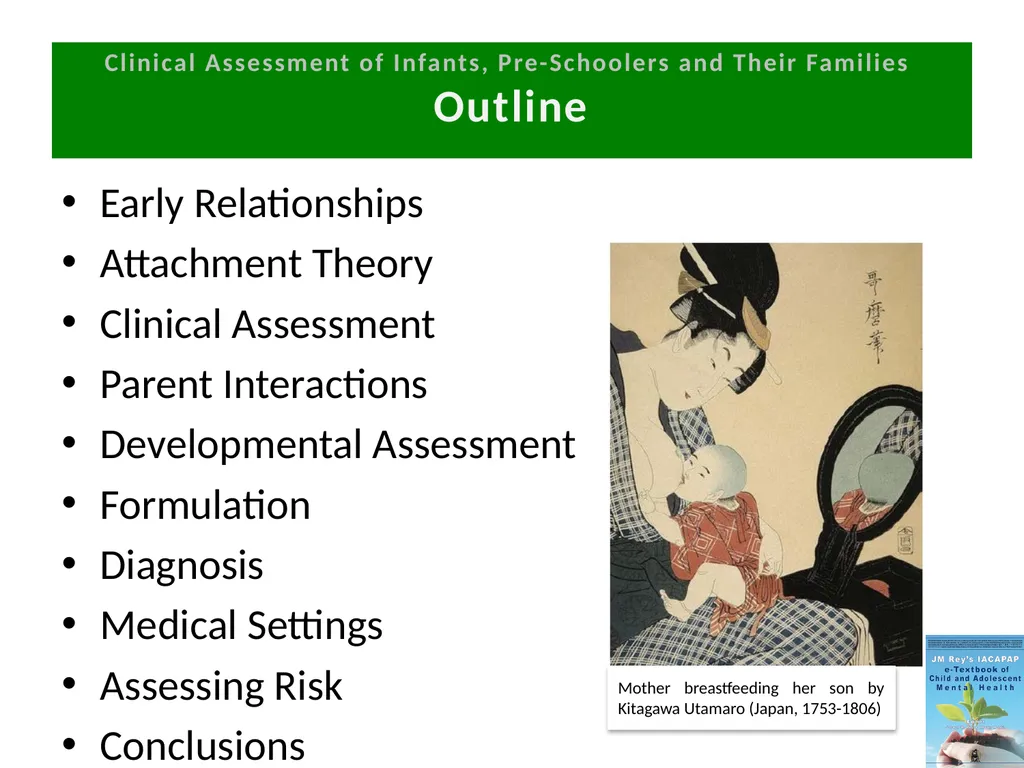
Conclusions Mother breastfeeding her son by Kitagawa Utamaro (Japan, 1753-1806)<br>
Attachment Theory
Clinical Assessment
Parent Interactions
Developmental Assessment
Formulation
Diagnosis
Medical Settings
Assessing Risk
Conclusions Mother breastfeeding her son by Kitagawa Utamaro (Japan, 1753-1806)<br>
04
Clinical Assessment of Infants, Pre-Schoolers and Their Families
Psychologically Healthy Infant Ability to form close and secure interpersonal relationships
Drive to explore environment and learn
Context of family, community and cultural expectations
Healthy social and emotional development<br>
Drive to explore environment and learn
Context of family, community and cultural expectations
Healthy social and emotional development<br>
05
Clinical Assessment of Infants, Pre-Schoolers and Their Families
Infants: Importance of Early Relationships Born ready to relate
Crucial role of family
Genetically and biologically programmed
Parenting quality
Social and physical circumstances
Sensitive and critical periods https://www.zerotothree.org/<br>
Crucial role of family
Genetically and biologically programmed
Parenting quality
Social and physical circumstances
Sensitive and critical periods https://www.zerotothree.org/<br>
06
Clinical Assessment of Infants, Pre-Schoolers and Their Families
Importance of Early Relationships 1st Year
Basics for language
Attachment relationships
2nd Year
Language and symbolic play
Mobility exploration, cognition, independence
3rd & 4th Years
Consolidation, refinement, expansion
Sense of self<br>
Basics for language
Attachment relationships
2nd Year
Language and symbolic play
Mobility exploration, cognition, independence
3rd & 4th Years
Consolidation, refinement, expansion
Sense of self<br>
07
Clinical Assessment of Infants, Pre-Schoolers and Their Families
Early Relationships: Cultural Context Core questions:
How are needs met?
Who is meeting these needs?
How is sense of self, agency and obligation supported?
How are they socialized?
What is cultural context?<br>
How are needs met?
Who is meeting these needs?
How is sense of self, agency and obligation supported?
How are they socialized?
What is cultural context?<br>
08
Clinical Assessment of Infants, Pre-Schoolers and Their Families
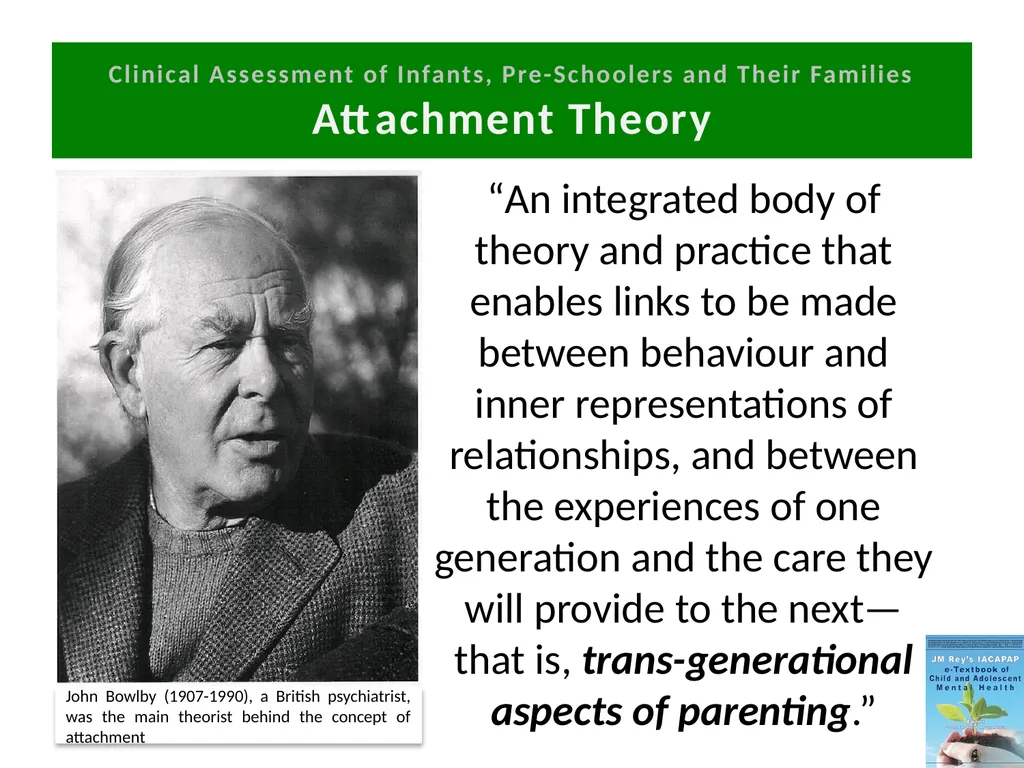
Attachment Theory “An integrated body of theory and practice that enables links to be made between behaviour and inner representations of relationships, and between the experiences of one generation and the care they will provide to the next—that is, trans-generational aspects of parenting.” John Bowlby (1907-1990), a British psychiatrist, was the main theorist behind the concept of attachment<br>
09
Clinical Assessment of Infants, Pre-Schoolers and Their Families
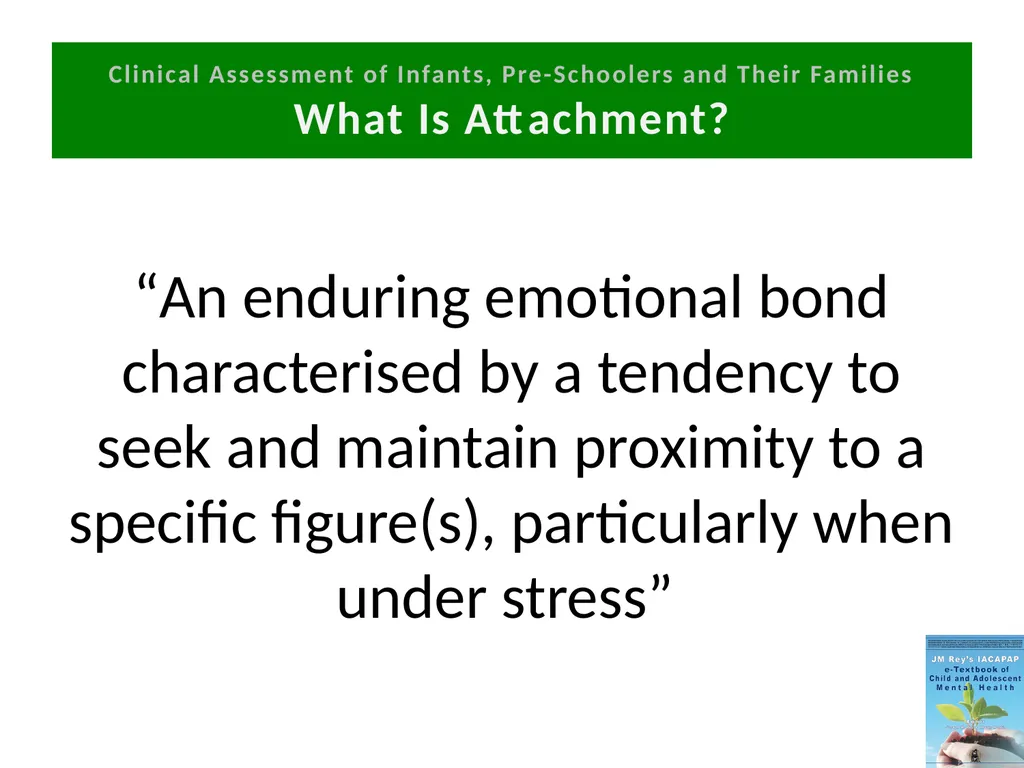
What Is Attachment? “An enduring emotional bond characterised by a tendency to seek and maintain proximity to a specific figure(s), particularly when under stress”<br>
10
Clinical Assessment of Infants, Pre-Schoolers and Their Families
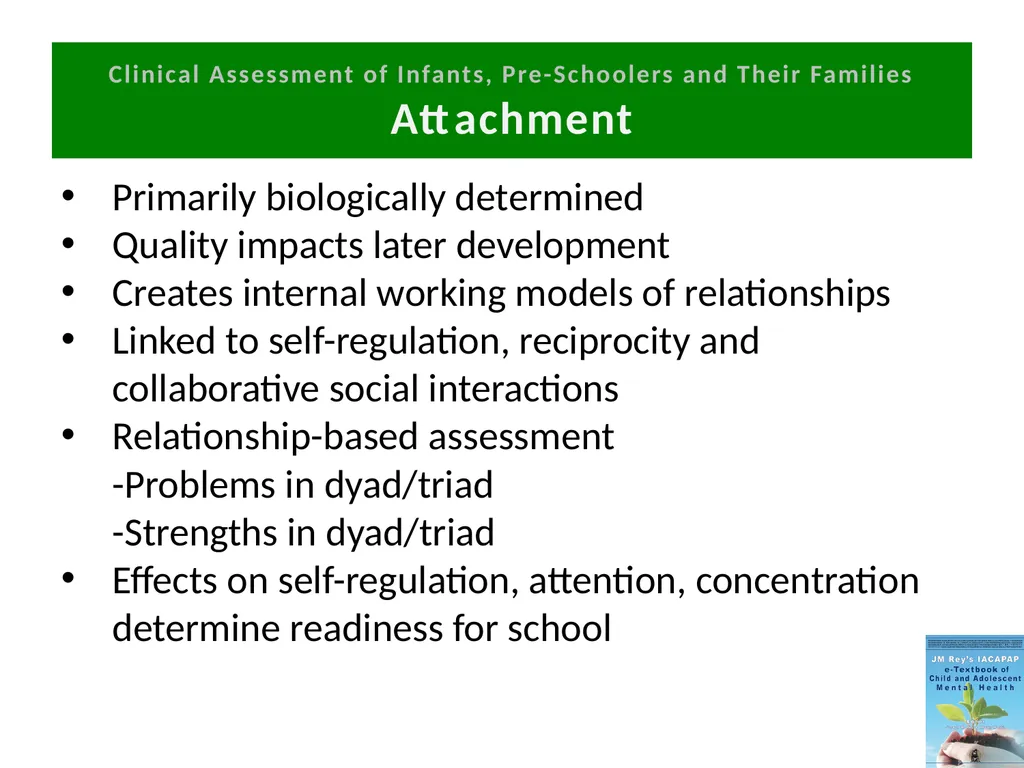
Attachment Primarily biologically determined
Quality impacts later development
Creates internal working models of relationships
Linked to self-regulation, reciprocity and collaborative social interactions
Relationship-based assessment
-Problems in dyad/triad
-Strengths in dyad/triad
Effects on self-regulation, attention, concentration determine readiness for school<br>
11
Clinical Assessment of Infants, Pre-Schoolers and Their Families
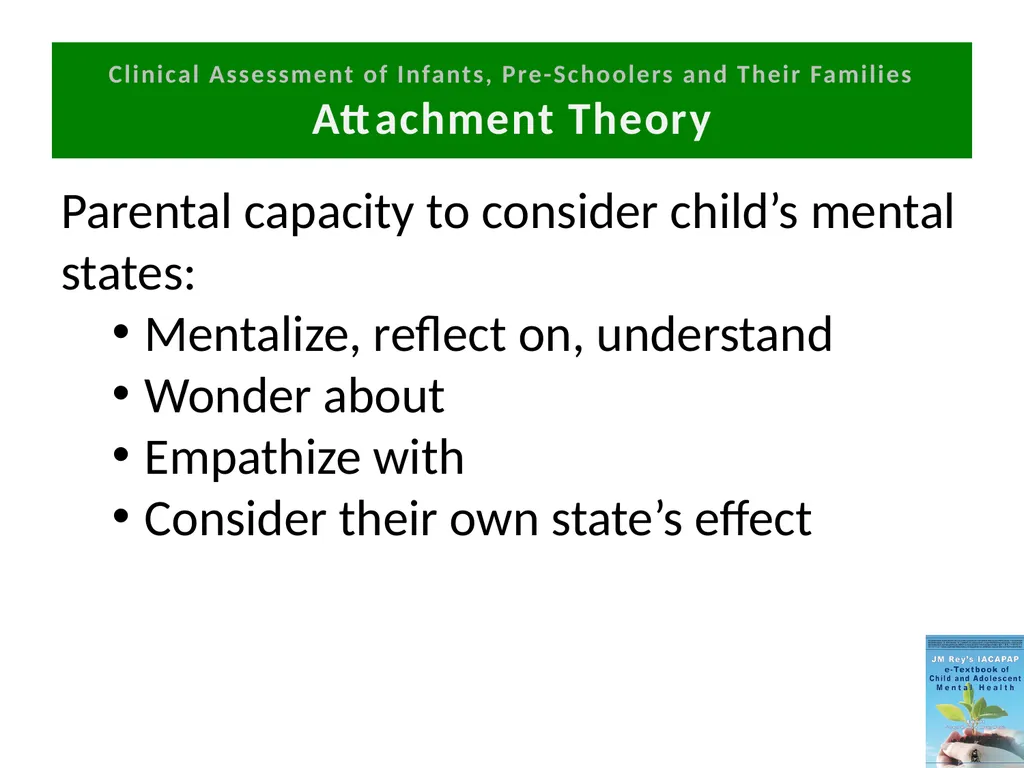
Attachment Theory Parental capacity to consider child’s mental states:
Mentalize, reflect on, understand
Wonder about
Empathize with
Consider their own state’s effect<br>
Mentalize, reflect on, understand
Wonder about
Empathize with
Consider their own state’s effect<br>
12
Clinical Assessment of Infants, Pre-Schoolers and Their Families
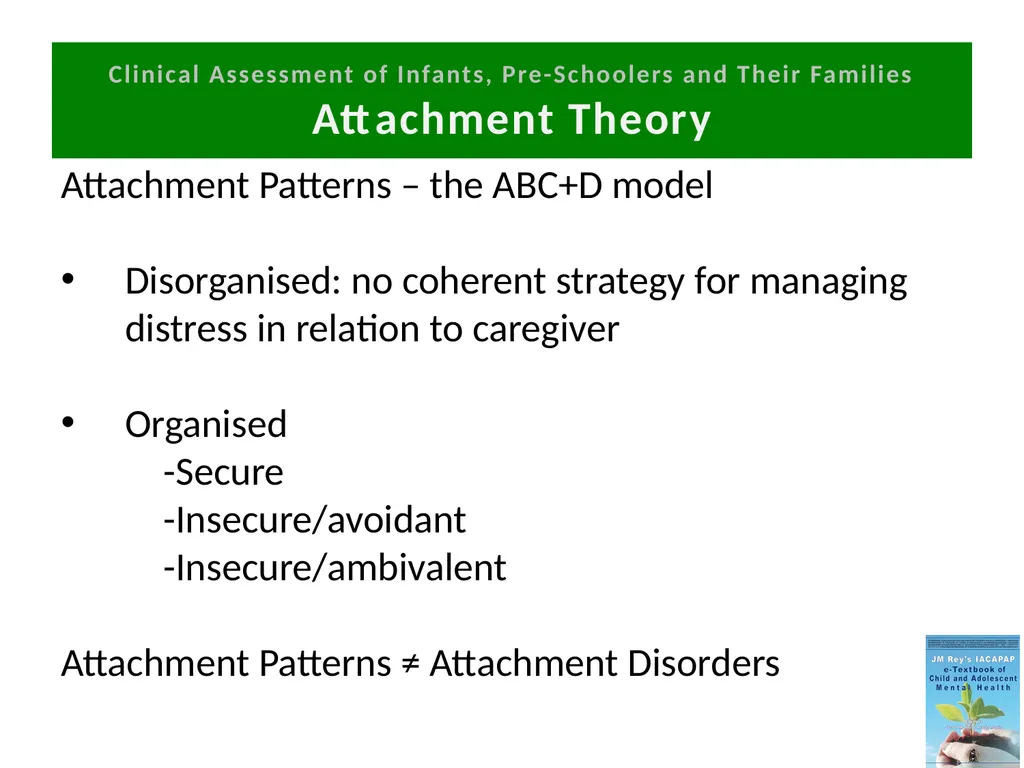
Attachment Theory Attachment Patterns – the ABC+D model
Disorganised: no coherent strategy for managing distress in relation to caregiver
Organised
-Secure
-Insecure/avoidant
-Insecure/ambivalent
Attachment Patterns ≠ Attachment Disorders<br>
Disorganised: no coherent strategy for managing distress in relation to caregiver
Organised
-Secure
-Insecure/avoidant
-Insecure/ambivalent
Attachment Patterns ≠ Attachment Disorders<br>
13
https://www.circleofsecurityinternational.com/<br>
14
Clinical Assessment of Infants, Pre-Schoolers and Their Families
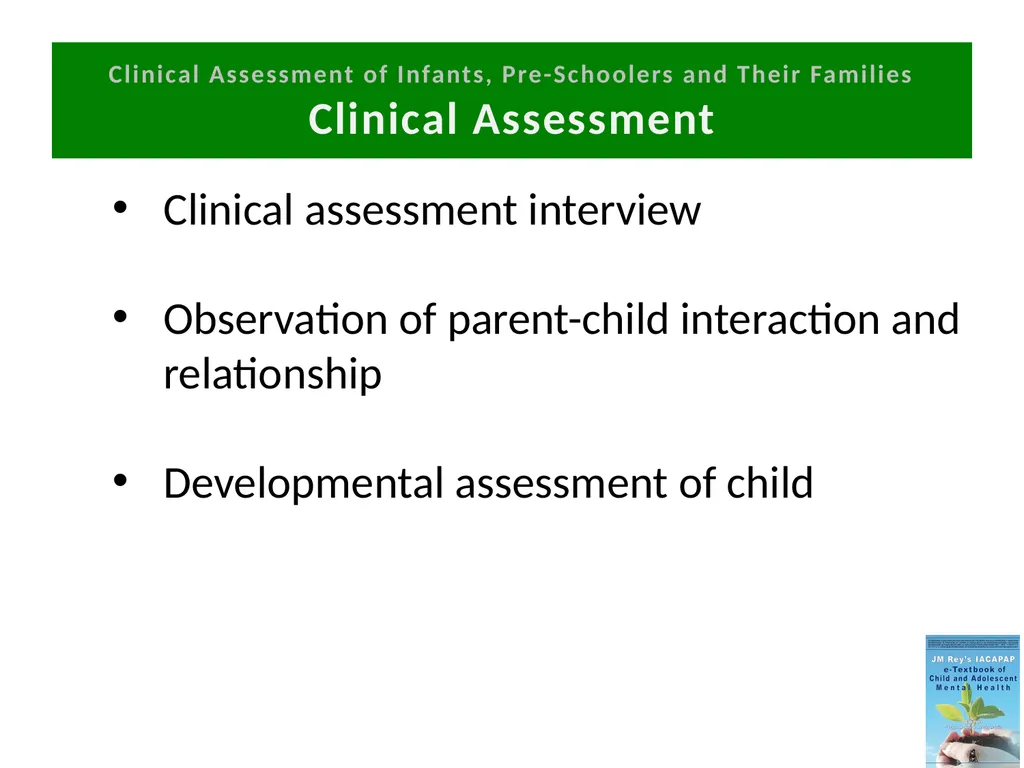
Clinical Assessment Clinical assessment interview
Observation of parent-child interaction and relationship
Developmental assessment of child<br>
Observation of parent-child interaction and relationship
Developmental assessment of child<br>
15
Clinical Assessment of Infants, Pre-Schoolers and Their Families
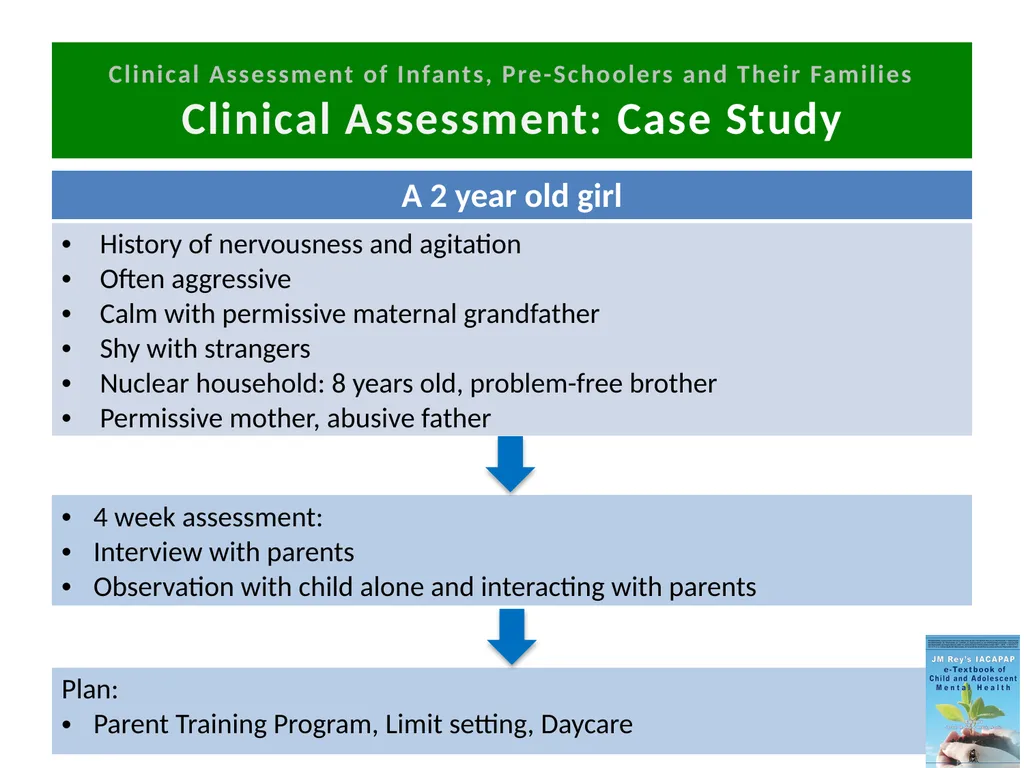
Clinical Assessment: Case Study A two year-old girl
Alloanamnesa
Observation<br>
Alloanamnesa
Observation<br>
16
Clinical Assessment of Infants, Pre-Schoolers and Their Families
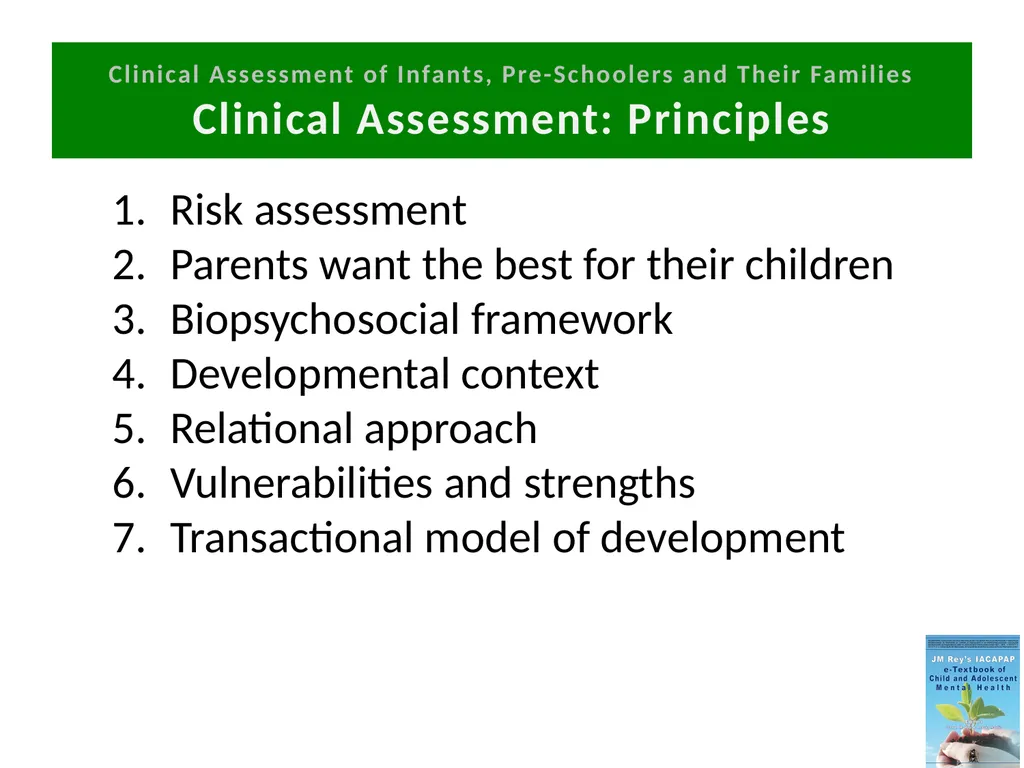
Clinical Assessment: Principles Risk assessment
Parents want the best for their children
Biopsychosocial framework
Developmental context
Relational approach
Vulnerabilities and strengths
Transactional model of development<br>
Parents want the best for their children
Biopsychosocial framework
Developmental context
Relational approach
Vulnerabilities and strengths
Transactional model of development<br>
17
Clinical Assessment of Infants, Pre-Schoolers and Their Families
Clinical Assessment Sources
Referring agent
Family
Observations
Medical and Developmental tests
Past reports
Clinician impression Varied settings
Aim to identify and understand problems of:
Individual
Family
System<br>
Referring agent
Family
Observations
Medical and Developmental tests
Past reports
Clinician impression Varied settings
Aim to identify and understand problems of:
Individual
Family
System<br>
18
Clinical Assessment of Infants, Pre-Schoolers and Their Families
Clinical Assessment Key considerations:
‘Parents are experts with their child’s best interests at heart’
Non-judgmental listening
Genuine curiosity
Observation of behavior and interactions
Understand first, advise last<br>
‘Parents are experts with their child’s best interests at heart’
Non-judgmental listening
Genuine curiosity
Observation of behavior and interactions
Understand first, advise last<br>
19
Clinical Assessment of Infants, Pre-Schoolers and Their Families
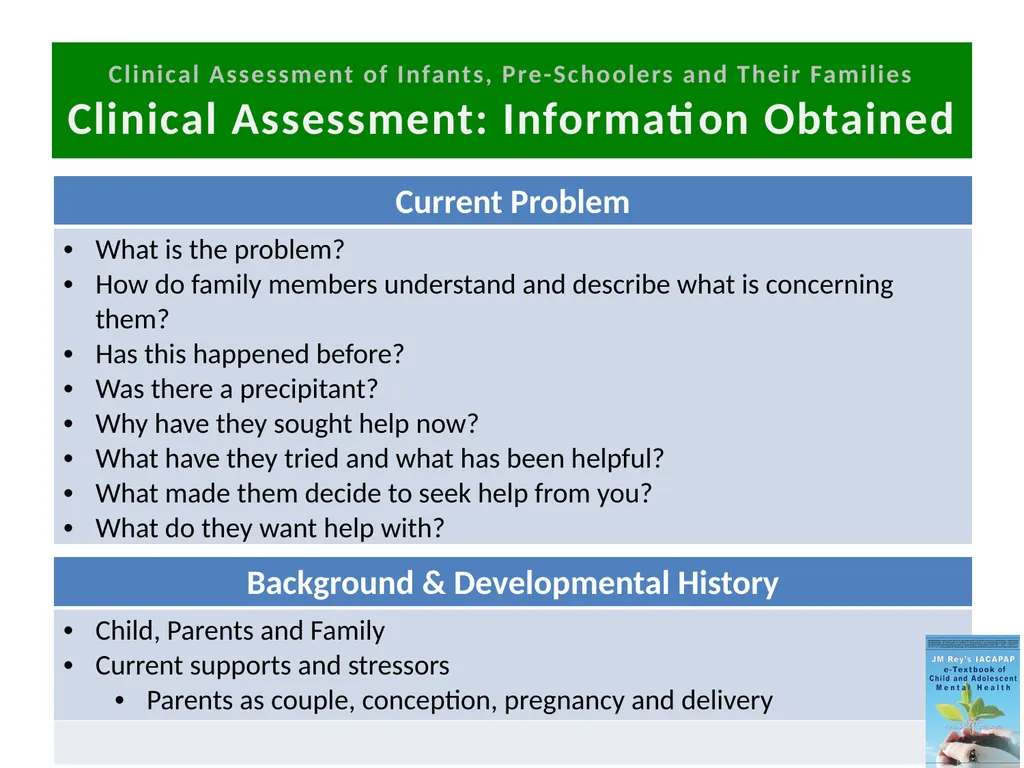
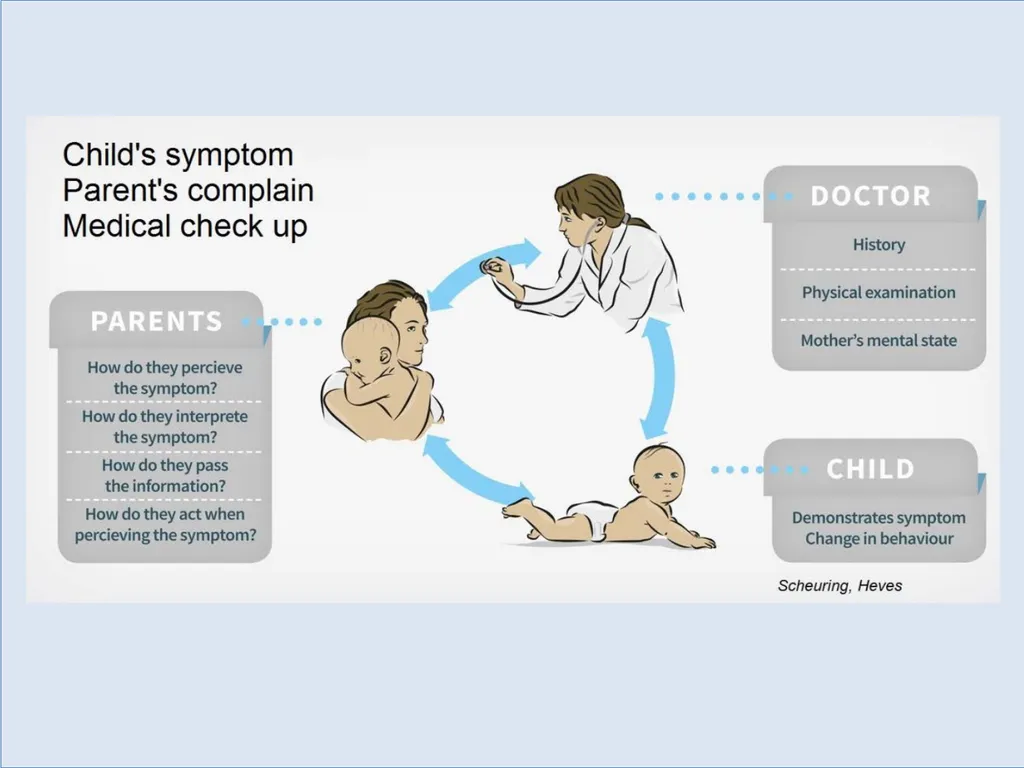
Clinical Assessment: Information Obtained<br>
20
Clinical Assessment of Infants, Pre-Schoolers and Their Families
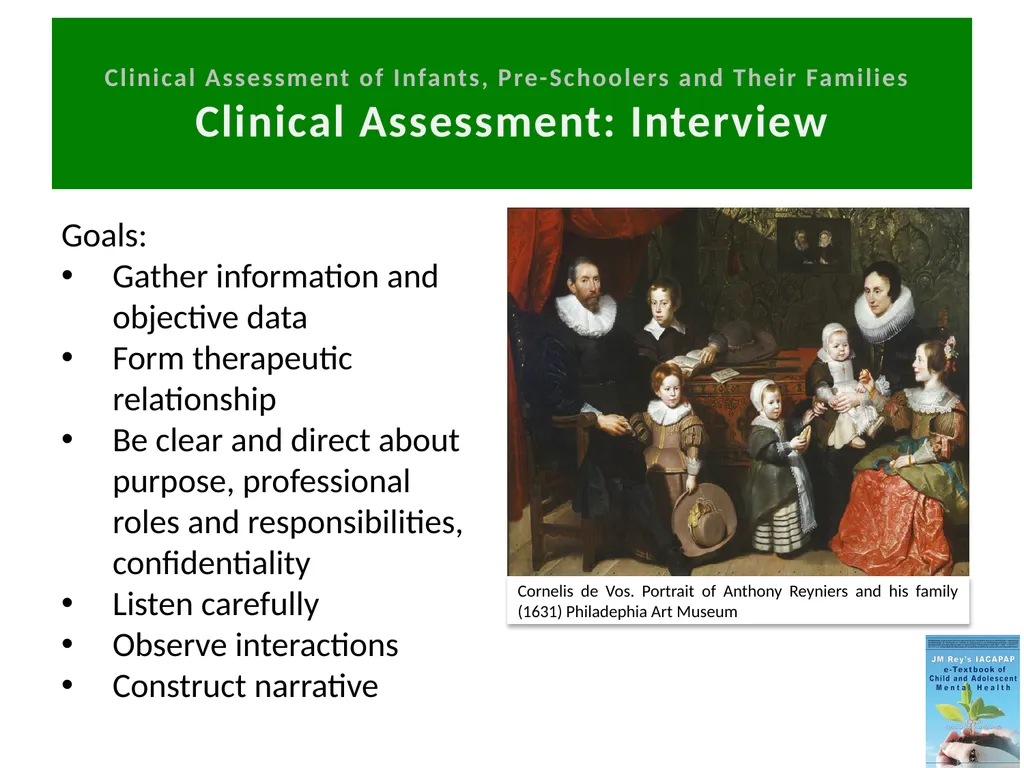
Clinical Assessment: Interview Goals:
Gather information and objective data
Form therapeutic relationship
Be clear and direct about purpose, professional roles and responsibilities, confidentiality
Listen carefully
Observe interactions
Construct narrative Cornelis de Vos. Portrait of Anthony Reyniers and his family (1631) Philadephia Art Museum<br>
21
Clinical Assessment of Infants, Pre-Schoolers and Their Families
Clinical Assessment:
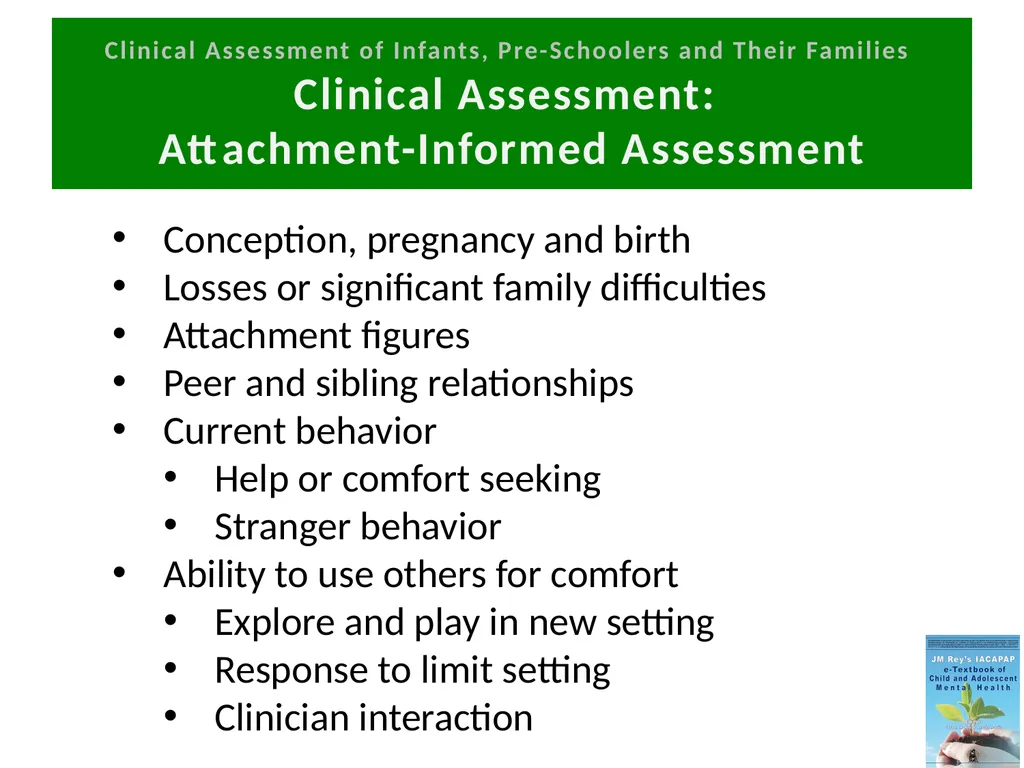
Attachment-Informed Assessment Conception, pregnancy and birth
Losses or significant family difficulties
Attachment figures
Peer and sibling relationships
Current behavior
Help or comfort seeking
Stranger behavior
Ability to use others for comfort
Explore and play in new setting
Response to limit setting
Clinician interaction<br>
Losses or significant family difficulties
Attachment figures
Peer and sibling relationships
Current behavior
Help or comfort seeking
Stranger behavior
Ability to use others for comfort
Explore and play in new setting
Response to limit setting
Clinician interaction<br>
22
Clinical Assessment of Infants, Pre-Schoolers and Their Families
Clinical Assessment:
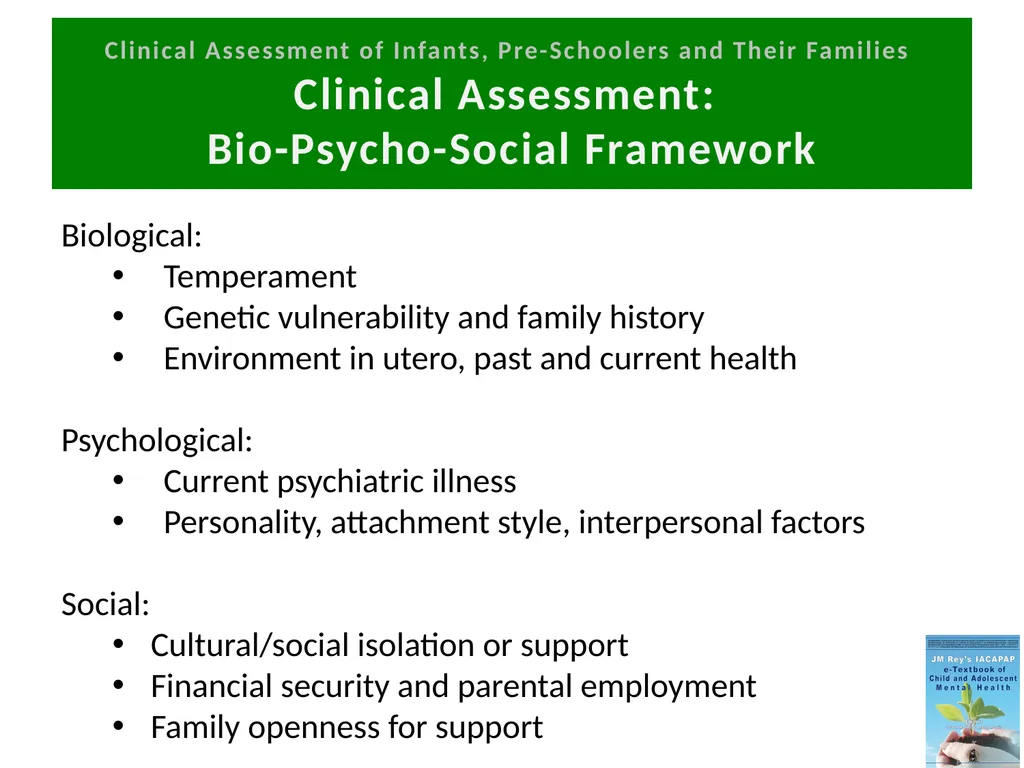
Bio-Psycho-Social Framework Biological:
Temperament
Genetic vulnerability and family history
Environment in utero, past and current health
Psychological:
Current psychiatric illness
Personality, attachment style, interpersonal factors
Social:
Cultural/social isolation or support
Financial security and parental employment
Family openness for support<br>
23
Clinical Assessment of Infants, Pre-Schoolers and Their Families
Clinical Assessment:
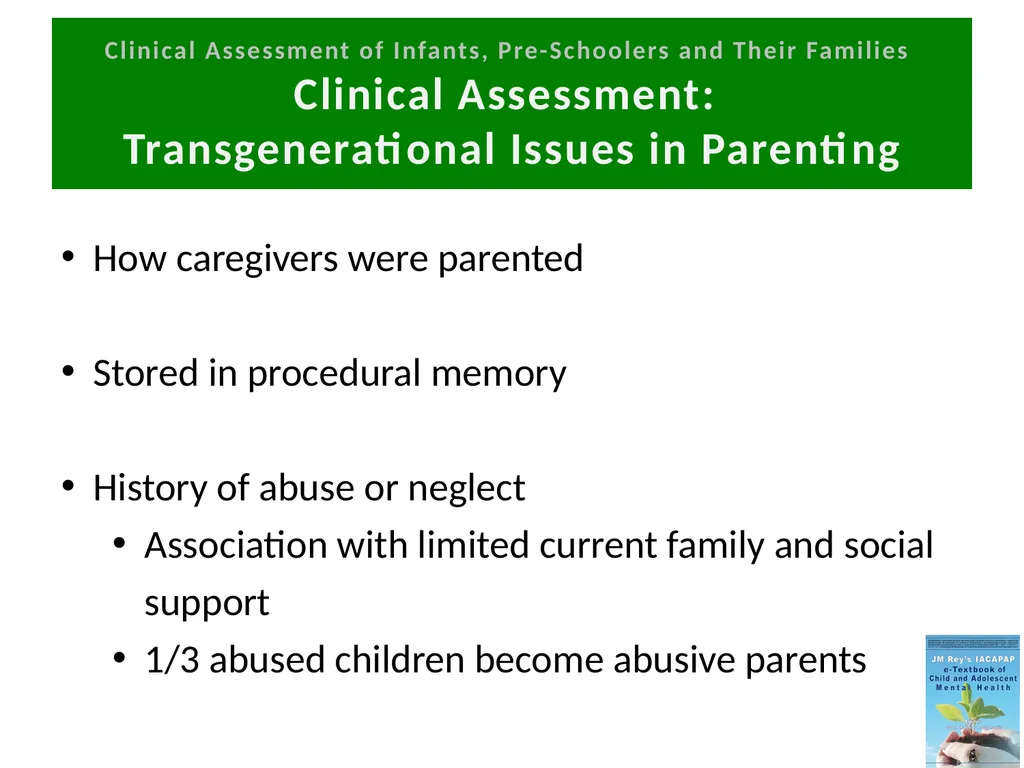
Transgenerational Issues in Parenting How caregivers were parented
Stored in procedural memory
History of abuse or neglect
Association with limited current family and social support
1/3 abused children become abusive parents<br>
Stored in procedural memory
History of abuse or neglect
Association with limited current family and social support
1/3 abused children become abusive parents<br>
24
Clinical Assessment of Infants, Pre-Schoolers and Their Families
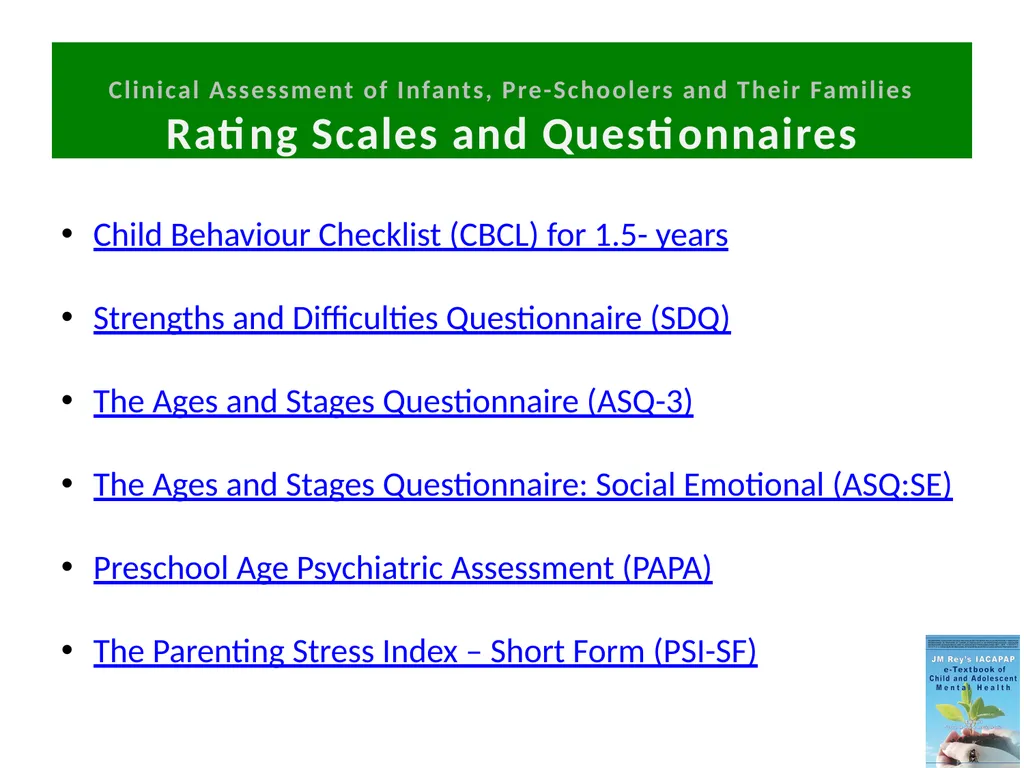
Rating Scales and Questionnaires Child Behaviour Checklist (CBCL) for 1.5- years
Strengths and Difficulties Questionnaire (SDQ)
The Ages and Stages Questionnaire (ASQ-3)
The Ages and Stages Questionnaire: Social Emotional (ASQ:SE)
Preschool Age Psychiatric Assessment (PAPA)
The Parenting Stress Index – Short Form (PSI-SF)<br>
Strengths and Difficulties Questionnaire (SDQ)
The Ages and Stages Questionnaire (ASQ-3)
The Ages and Stages Questionnaire: Social Emotional (ASQ:SE)
Preschool Age Psychiatric Assessment (PAPA)
The Parenting Stress Index – Short Form (PSI-SF)<br>
25
Clinical Assessment of Infants, Pre-Schoolers and Their Families
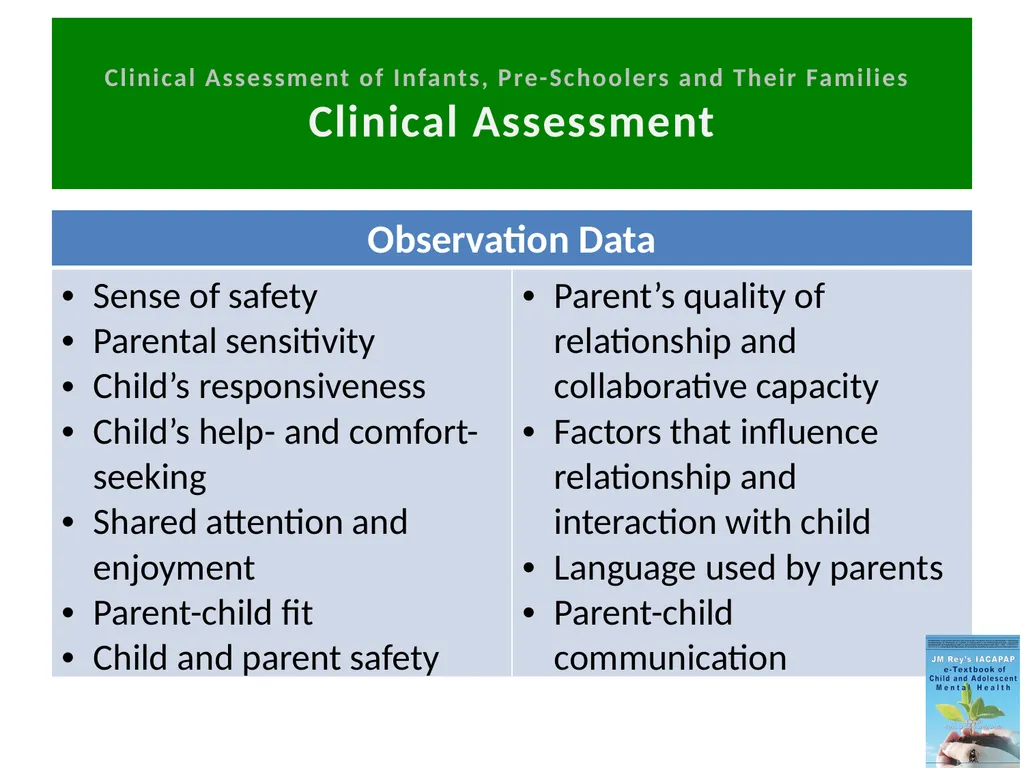
Clinical Assessment<br>
26
Clinical Assessment of Infants, Pre-Schoolers and Their Families
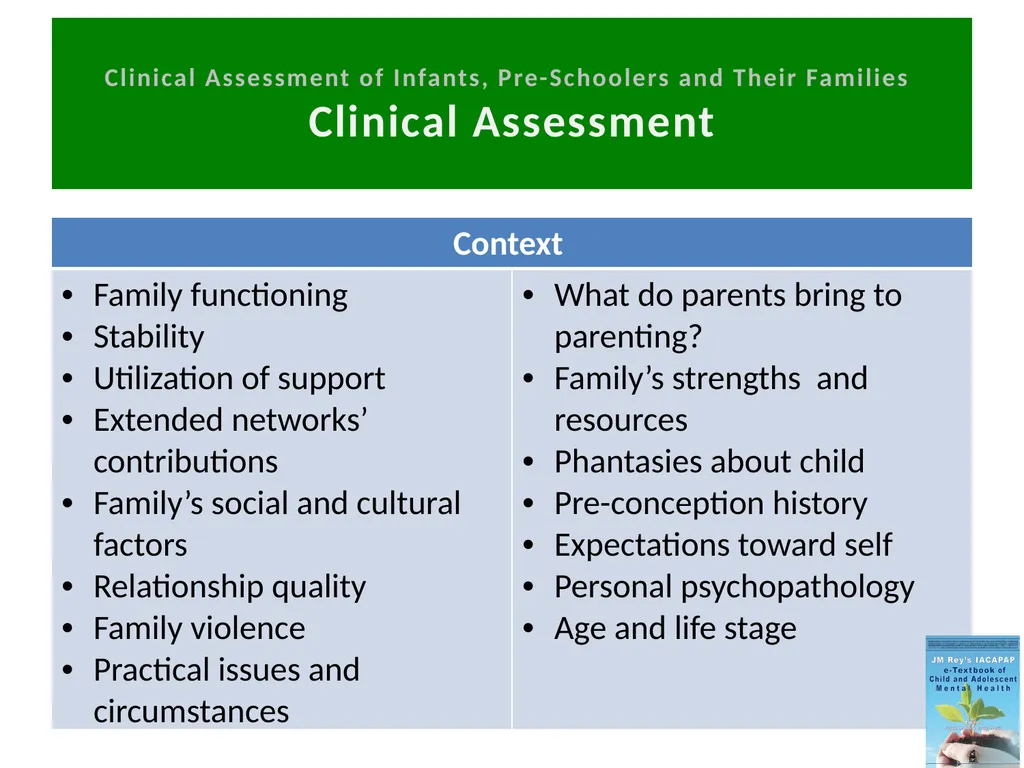
Clinical Assessment<br>
27
Clinical Assessment of Infants, Pre-Schoolers and Their Families
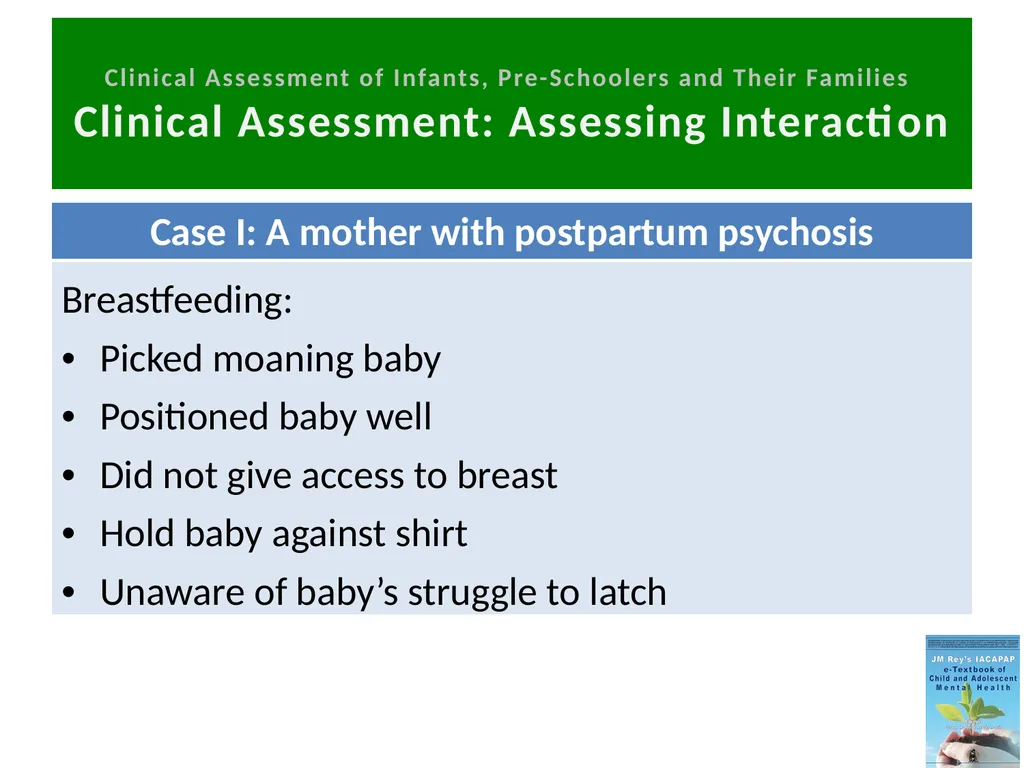
Clinical Assessment: Assessing Interaction<br>
28
Clinical Assessment of Infants, Pre-Schoolers and Their Families
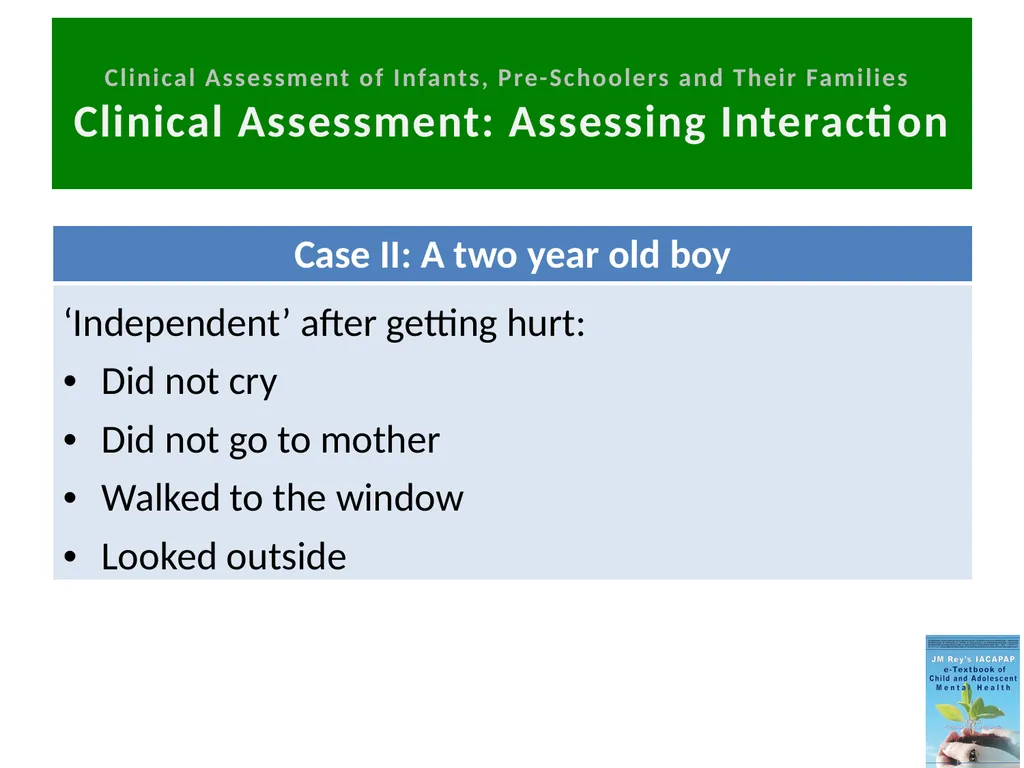
Clinical Assessment: Assessing Interaction<br>
29
Clinical Assessment of Infants, Pre-Schoolers and Their Families
Clinical Assessment: Assessing Interaction<br>
30
Clinical Assessment of Infants, Pre-Schoolers and Their Families
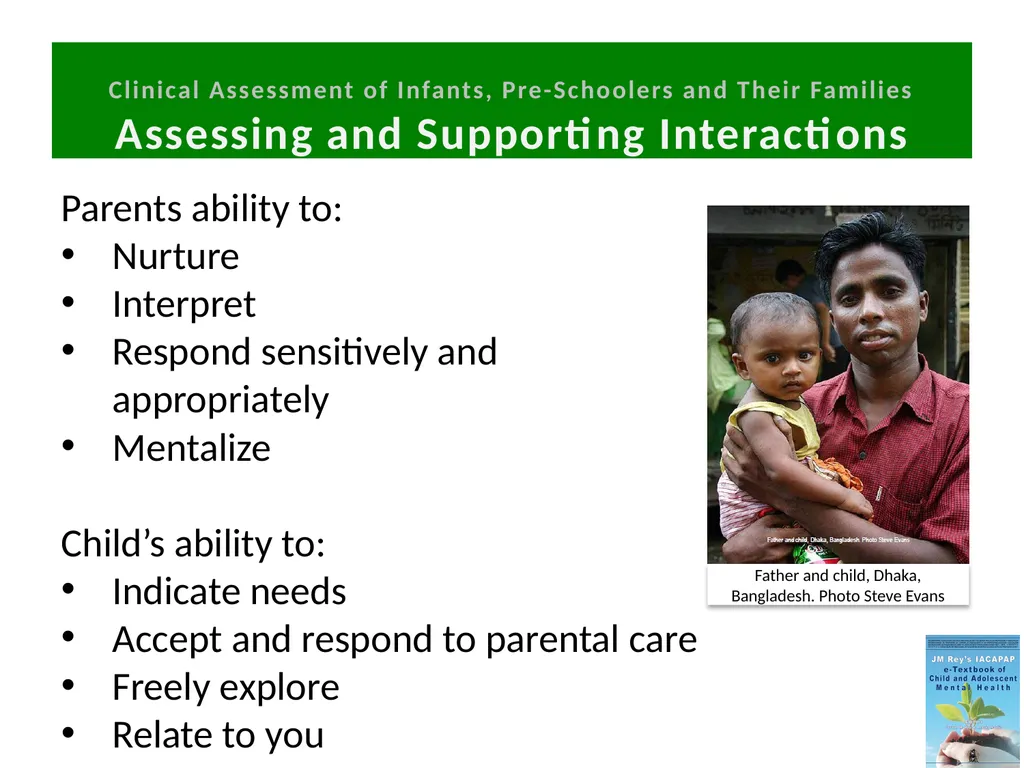
Assessing and Supporting Interactions Parents ability to:
Nurture
Interpret
Respond sensitively and appropriately
Mentalize
Child’s ability to:
Indicate needs
Accept and respond to parental care
Freely explore
Relate to you Father and child, Dhaka, Bangladesh. Photo Steve Evans<br>
Nurture
Interpret
Respond sensitively and appropriately
Mentalize
Child’s ability to:
Indicate needs
Accept and respond to parental care
Freely explore
Relate to you Father and child, Dhaka, Bangladesh. Photo Steve Evans<br>
31
Clinical Assessment of Infants, Pre-Schoolers and Their Families
Reflective or Mentalizing Capacity “Holding mind in mind”
“The capacity to think about feeling and feel about thinking”
Linked to the intergenerational transmission of attachment security
Parent development Interview
Appreciation that the child has an experience separate from parent’s<br>
“The capacity to think about feeling and feel about thinking”
Linked to the intergenerational transmission of attachment security
Parent development Interview
Appreciation that the child has an experience separate from parent’s<br>
32
Clinical Assessment of Infants, Pre-Schoolers and Their Families
Semi-Structured Play Assessment:
Modified Crowell Procedure Observation of:
Child’s persistence
Use of caregiver for support
Ability and willingness to ask for help
Fine and gross motor skills
Degree of enjoyment, ease and pleasure in interaction Children 12-60 months
30-45 minutes
Play with varying degrees of frustration
Identification of strengths and weaknesses
Focus
Problem solving
Play and enjoyment
Informal attachment assessment<br>
33
Clinical Assessment of Infants, Pre-Schoolers and Their Families
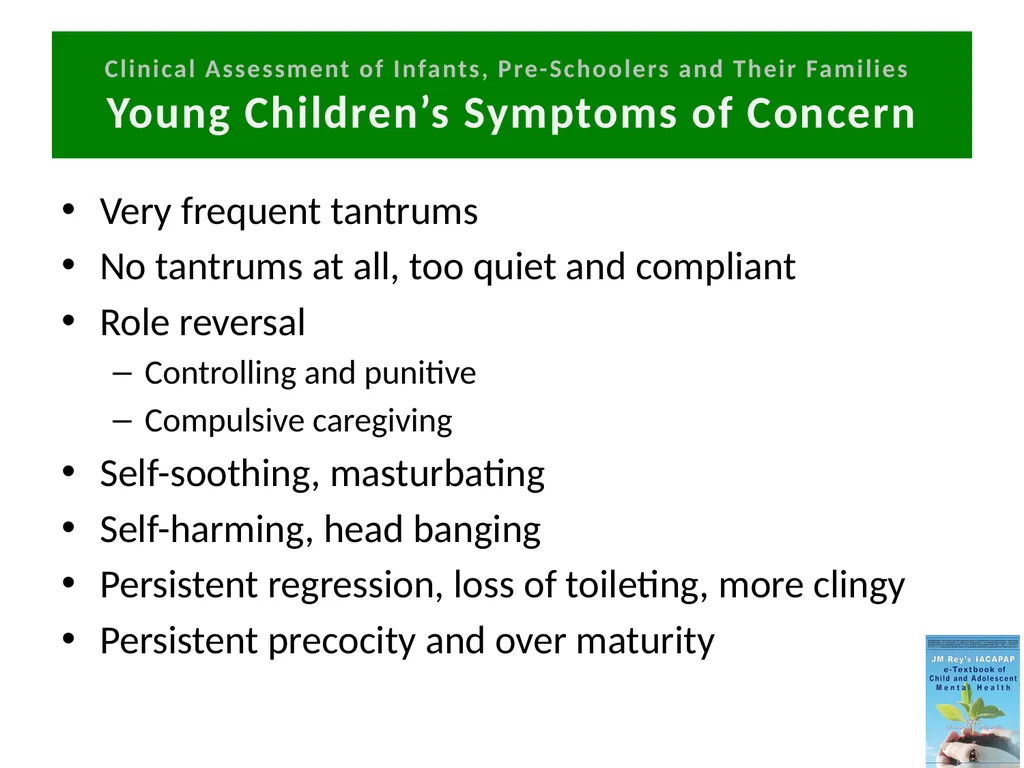
Young Children’s Symptoms of Concern Very frequent tantrums
No tantrums at all, too quiet and compliant
Role reversal
Controlling and punitive
Compulsive caregiving
Self-soothing, masturbating
Self-harming, head banging
Persistent regression, loss of toileting, more clingy
Persistent precocity and over maturity<br>
No tantrums at all, too quiet and compliant
Role reversal
Controlling and punitive
Compulsive caregiving
Self-soothing, masturbating
Self-harming, head banging
Persistent regression, loss of toileting, more clingy
Persistent precocity and over maturity<br>
34
Clinical Assessment of Infants, Pre-Schoolers and Their Families
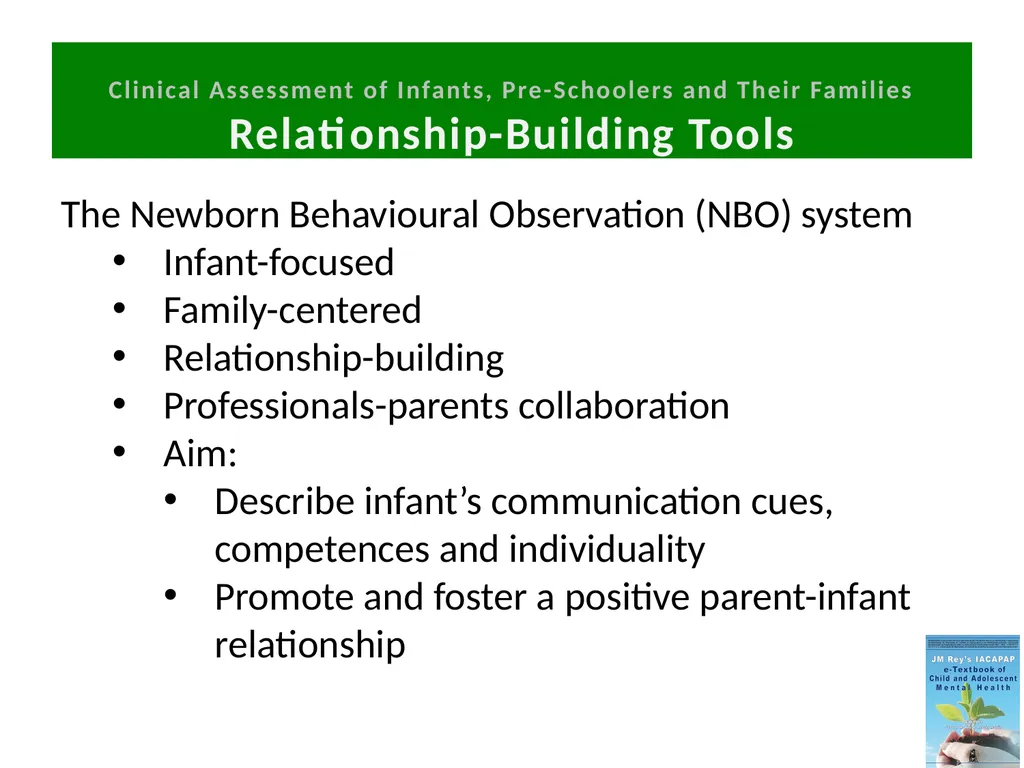
Relationship-Building Tools The Newborn Behavioural Observation (NBO) system
Infant-focused
Family-centered
Relationship-building
Professionals-parents collaboration
Aim:
Describe infant’s communication cues, competences and individuality
Promote and foster a positive parent-infant relationship<br>
Infant-focused
Family-centered
Relationship-building
Professionals-parents collaboration
Aim:
Describe infant’s communication cues, competences and individuality
Promote and foster a positive parent-infant relationship<br>
35
Clinical Assessment of Infants, Pre-Schoolers and Their Families
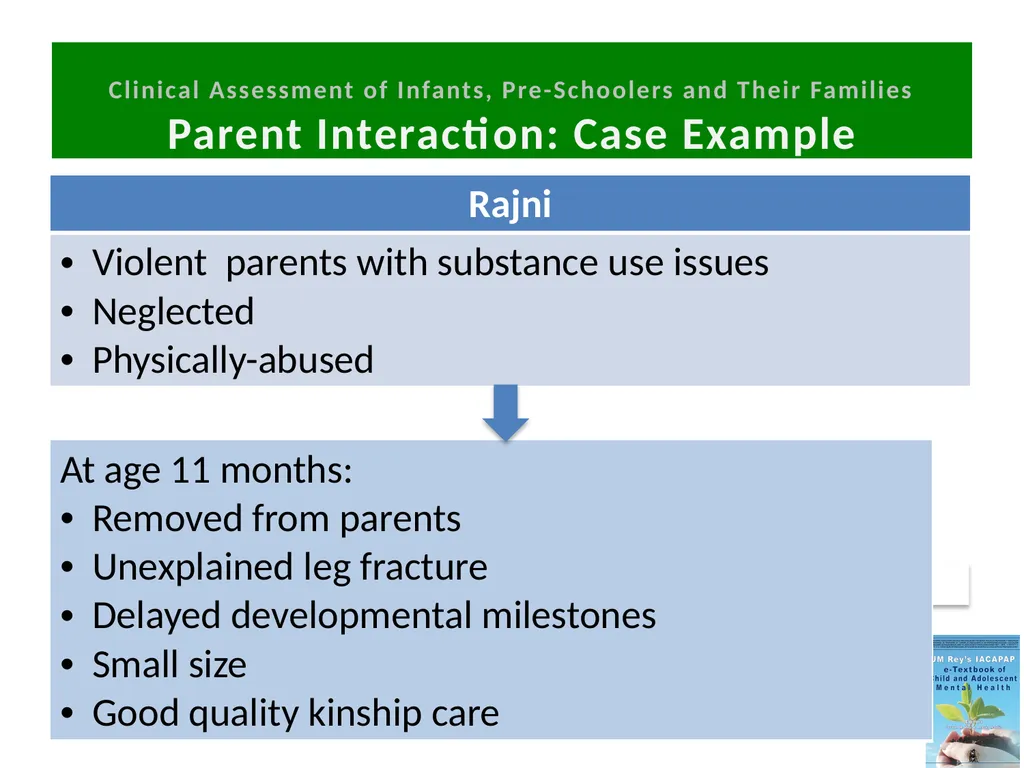
Parent Interaction: Case Example<br>
36
Clinical Assessment of Infants, Pre-Schoolers and Their Families
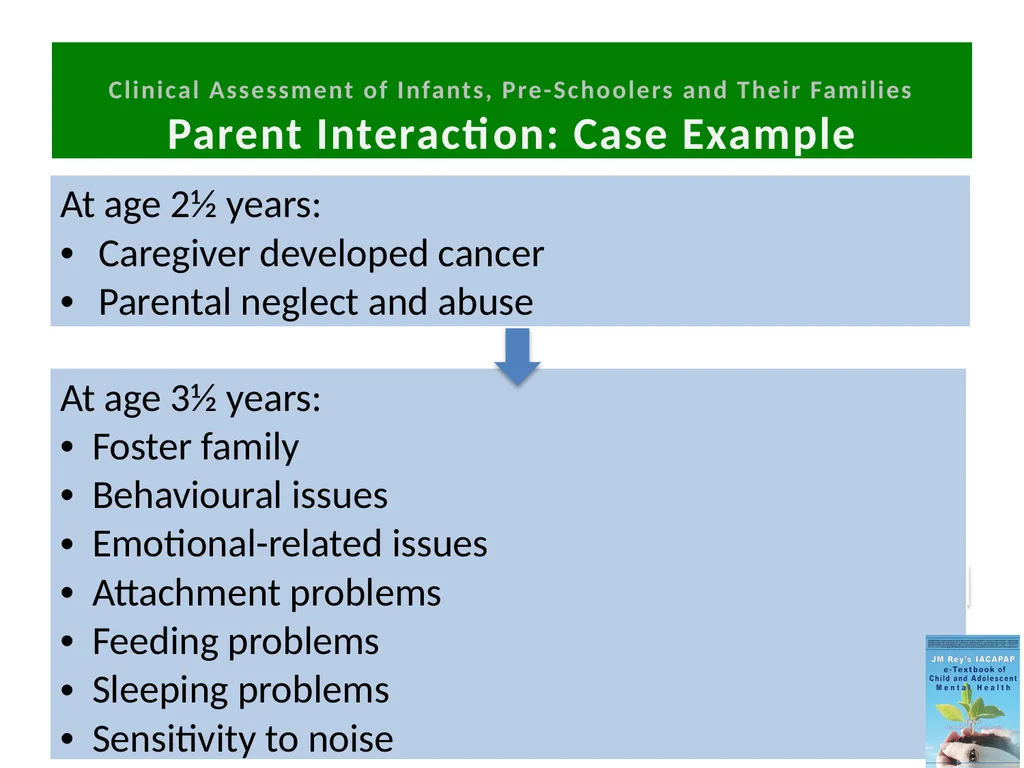
Parent Interaction: Case Example<br>
37
Clinical Assessment of Infants, Pre-Schoolers and Their Families
Developmental Assessment Varies depending on:
Purpose
Family’s needs & concerns
Clinician’s skills
Instruments:
The Neonatal Behavioral Assessment Scale (NBAS)
The Bayley Scales of Infant Development (BSID)
The Wechsler Preschool and Primary Scale of Intelligence (WPPSI)
The Vineland Adaptive Behaviour Scales<br>
Purpose
Family’s needs & concerns
Clinician’s skills
Instruments:
The Neonatal Behavioral Assessment Scale (NBAS)
The Bayley Scales of Infant Development (BSID)
The Wechsler Preschool and Primary Scale of Intelligence (WPPSI)
The Vineland Adaptive Behaviour Scales<br>
38
Clinical Assessment of Infants, Pre-Schoolers and Their Families
Formulation Basis of Formulation:
Why presenting now?
Why do they need a clinician?
The 4 Ps:
Summary of contributing factors
Predisposing
Precipitating
Perpetuating
Protective<br>
Why presenting now?
Why do they need a clinician?
The 4 Ps:
Summary of contributing factors
Predisposing
Precipitating
Perpetuating
Protective<br>
39
https://www.zerotothree.org/<br>
40
Clinical Assessment of Infants, Pre-Schoolers and Their Families
Diagnosis Challenges:
Period of rapid development and change
Relationship & interaction-focused
Context dependent behavior
Limited first-person information
Identification of parental issues
Societal stigma
Aids in:
Explaining difficulties
More complete formulation
Treatment recommendations
Inter-professional communication<br>
41
The Clinical Assessment of Infants, Pre-Schoolers and Their Families
Infants and Parents in Medical Settings<br>
42
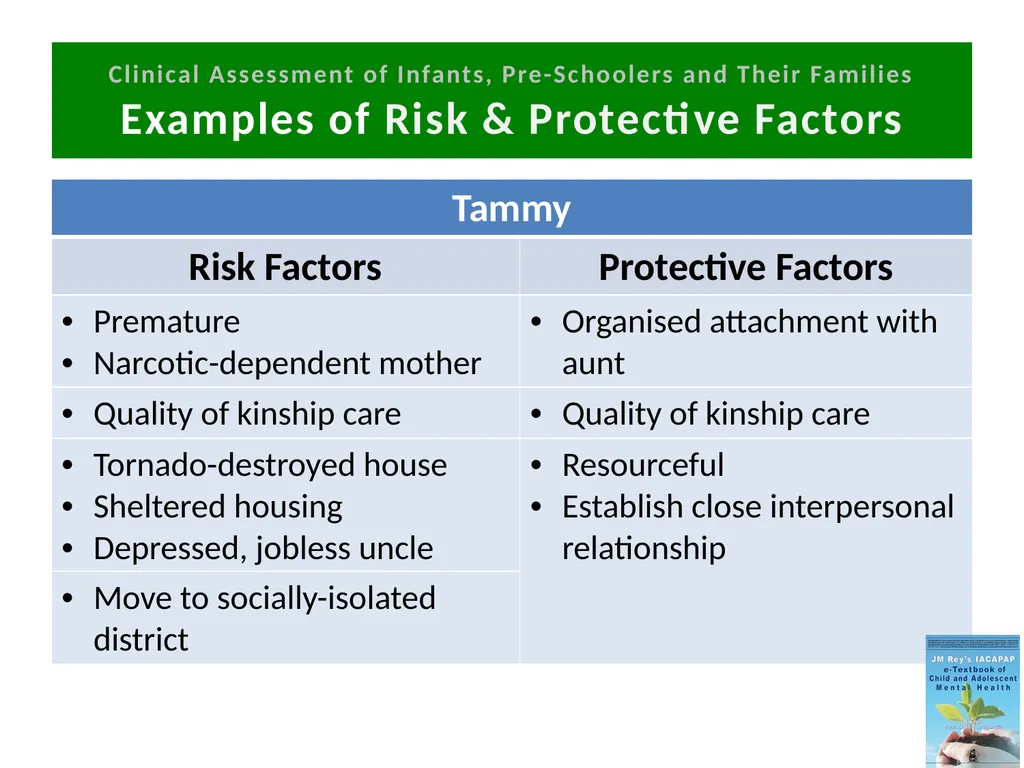
Clinical Assessment of Infants, Pre-Schoolers and Their Families
Examples of Risk & Protective Factors<br>
43
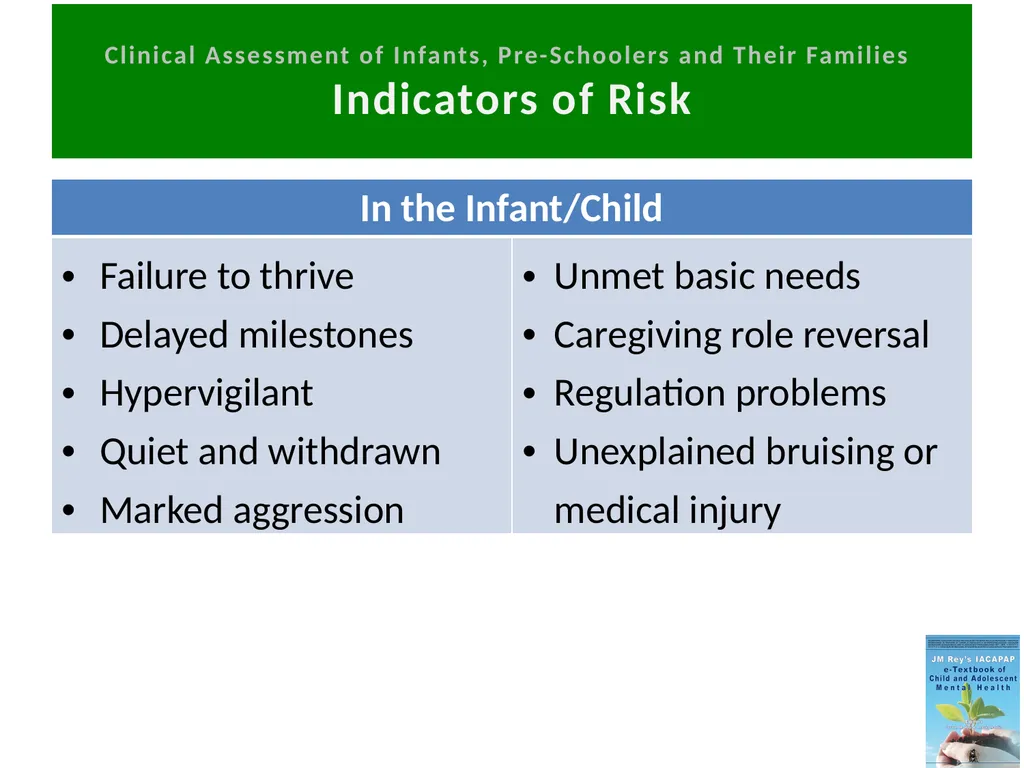
Clinical Assessment of Infants, Pre-Schoolers and Their Families
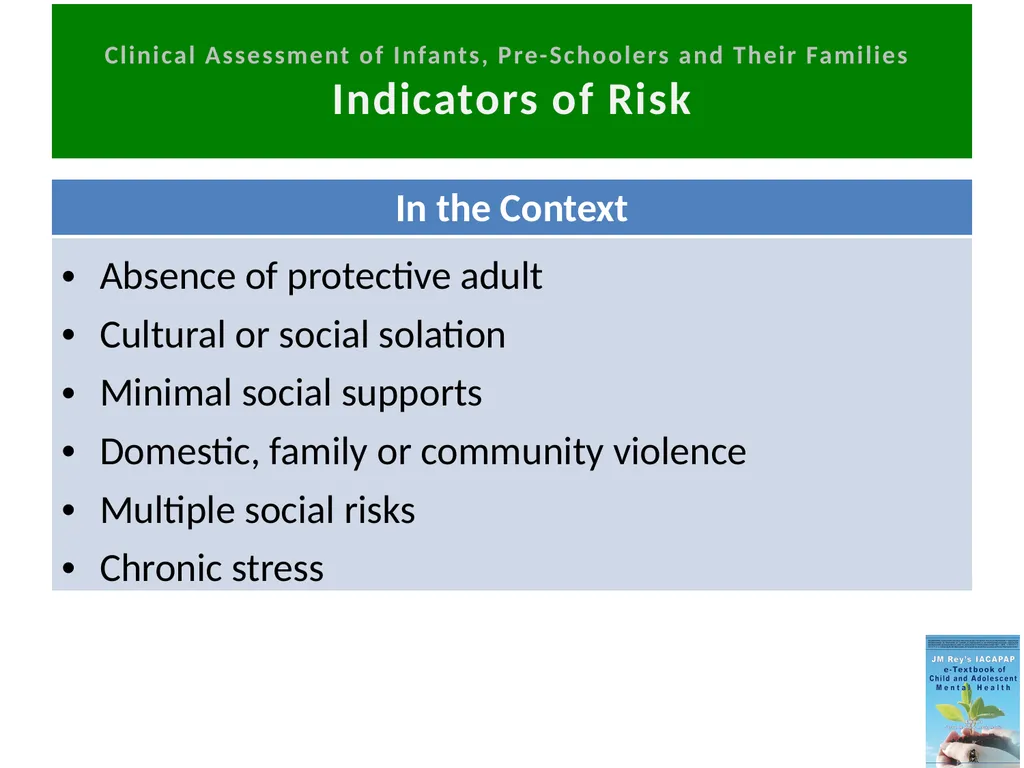
Indicators of Risk<br>
44
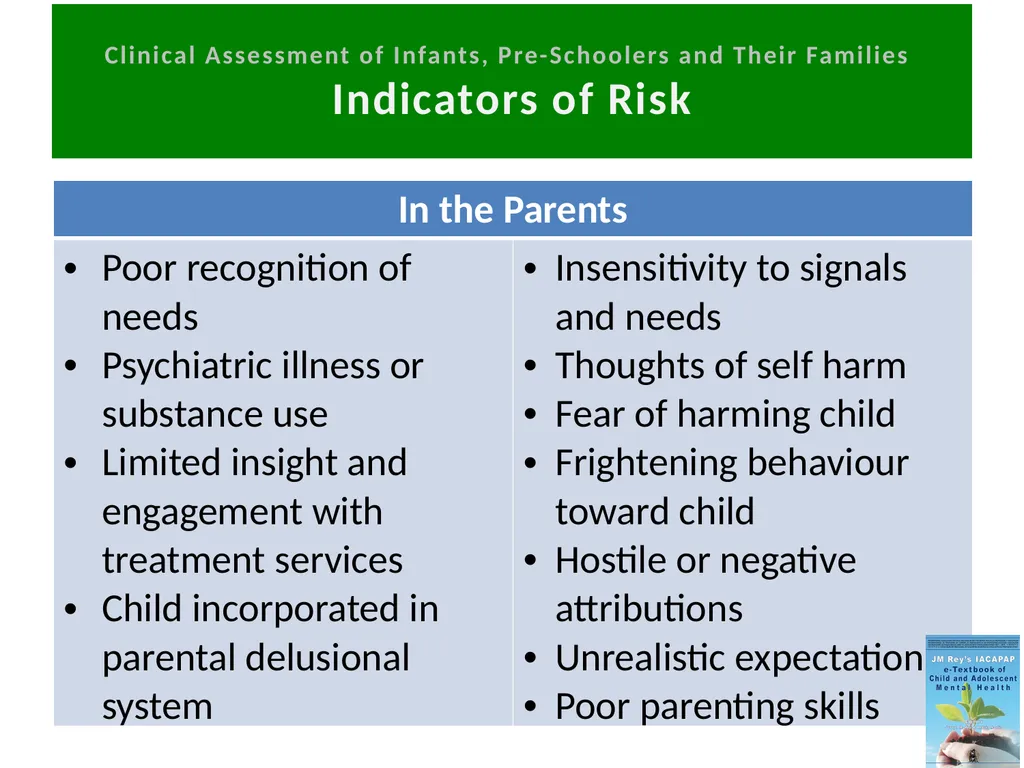
Clinical Assessment of Infants, Pre-Schoolers and Their Families
Indicators of Risk<br>
45
Clinical Assessment of Infants, Pre-Schoolers and Their Families
Indicators of Risk<br>
46
Clinical Assessment of Infants, Pre-Schoolers and Their Families
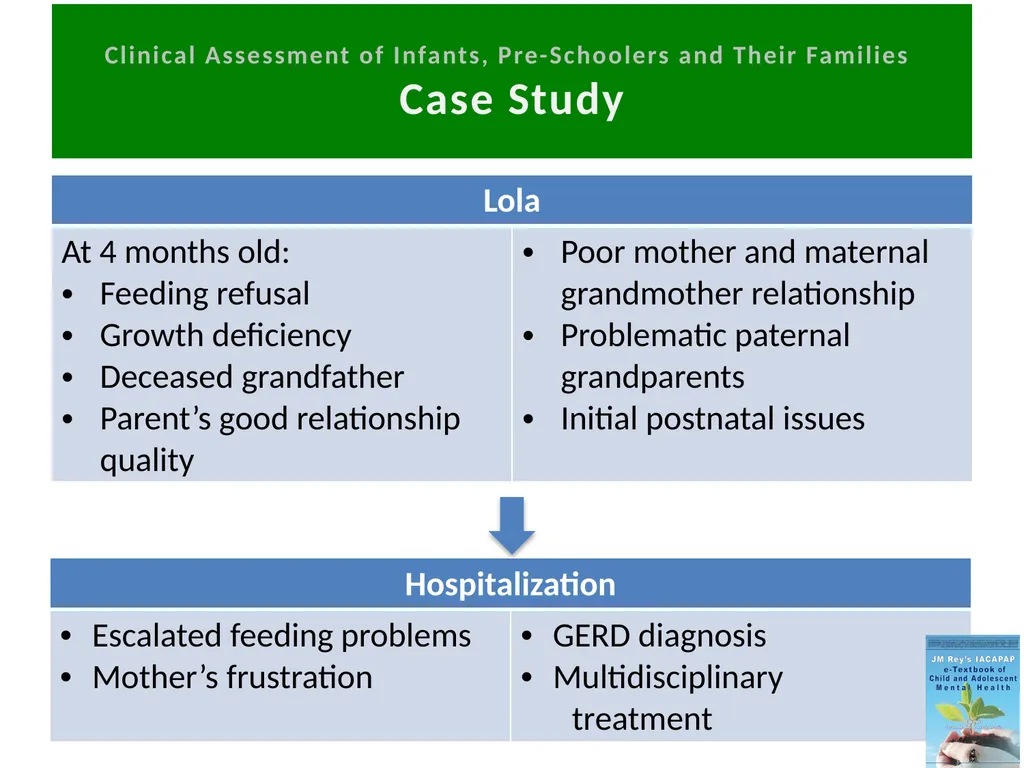
Case Study<br>
47
Clinical Assessment of Infants, Pre-Schoolers and Their Families
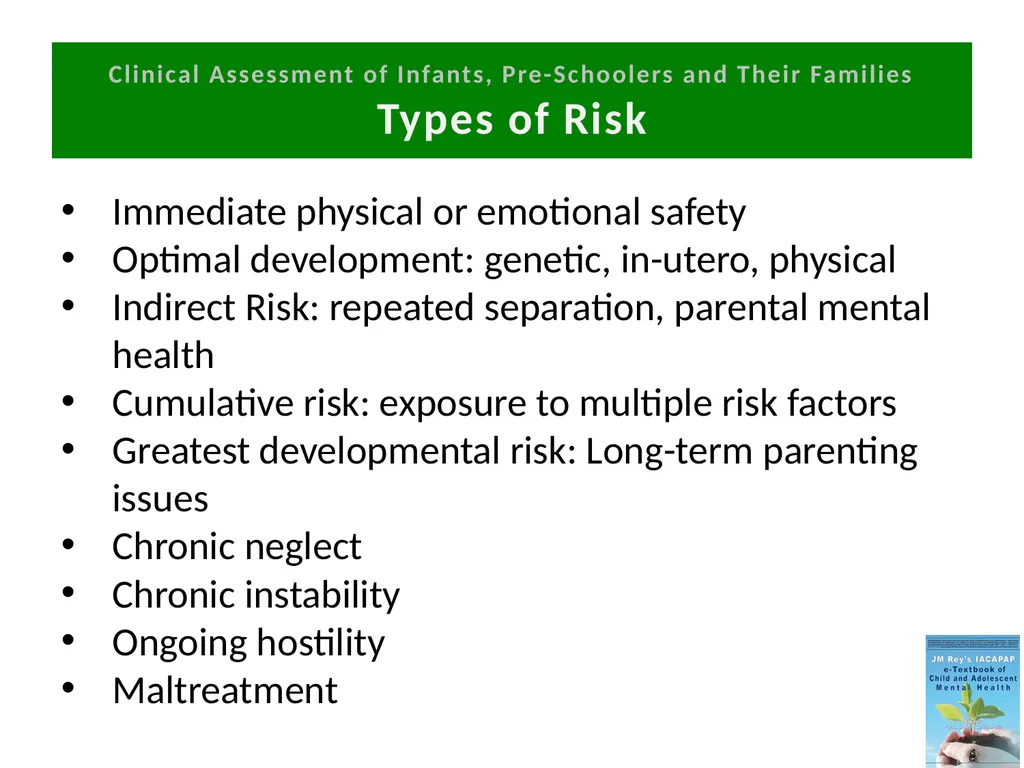
Types of Risk Immediate physical or emotional safety
Optimal development: genetic, in-utero, physical
Indirect Risk: repeated separation, parental mental health
Cumulative risk: exposure to multiple risk factors
Greatest developmental risk: Long-term parenting issues
Chronic neglect
Chronic instability
Ongoing hostility
Maltreatment<br>
Optimal development: genetic, in-utero, physical
Indirect Risk: repeated separation, parental mental health
Cumulative risk: exposure to multiple risk factors
Greatest developmental risk: Long-term parenting issues
Chronic neglect
Chronic instability
Ongoing hostility
Maltreatment<br>
48
Clinical Assessment of Infants, Pre-Schoolers and Their Families
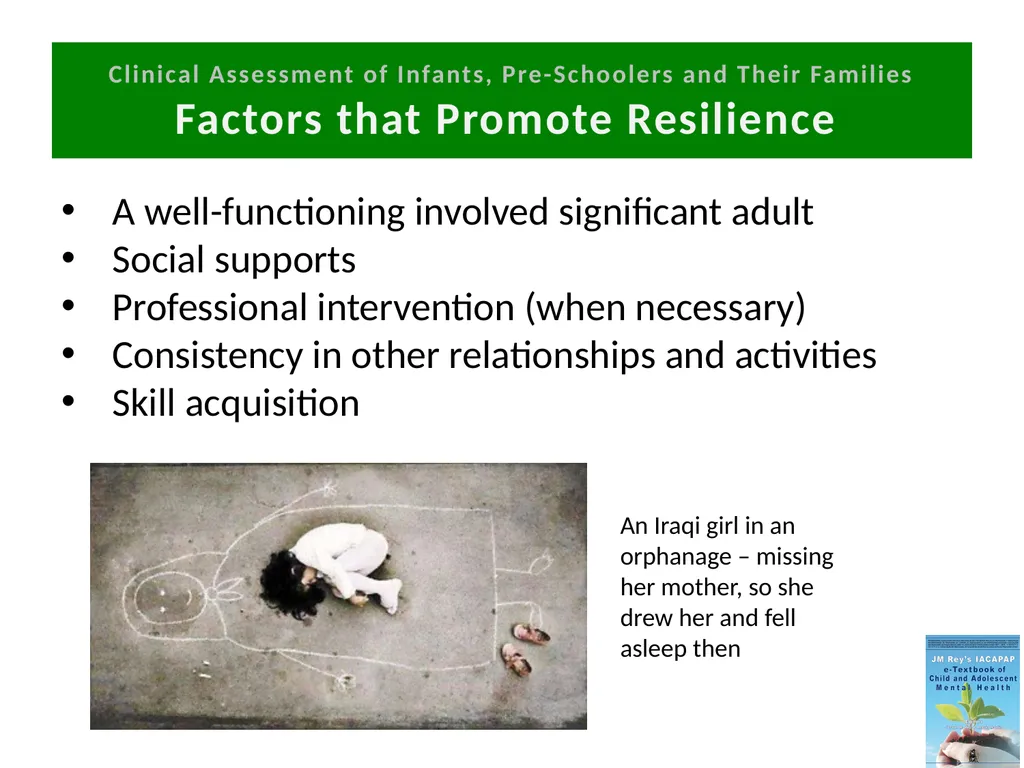
Factors that Promote Resilience An Iraqi girl in an orphanage – missing her mother, so she drew her and fell asleep then A well-functioning involved significant adult
Social supports
Professional intervention (when necessary)
Consistency in other relationships and activities
Skill acquisition<br>
Social supports
Professional intervention (when necessary)
Consistency in other relationships and activities
Skill acquisition<br>
49
Clinical Assessment of Infants, Pre-Schoolers and Their Families
Conclusion Various contexts and reasons for assessment
Comprehensive assessment:
Relational- & developmental-
focused
Bio-psycho-social factors
Strengths & vulnerabilities
Consideration of risk
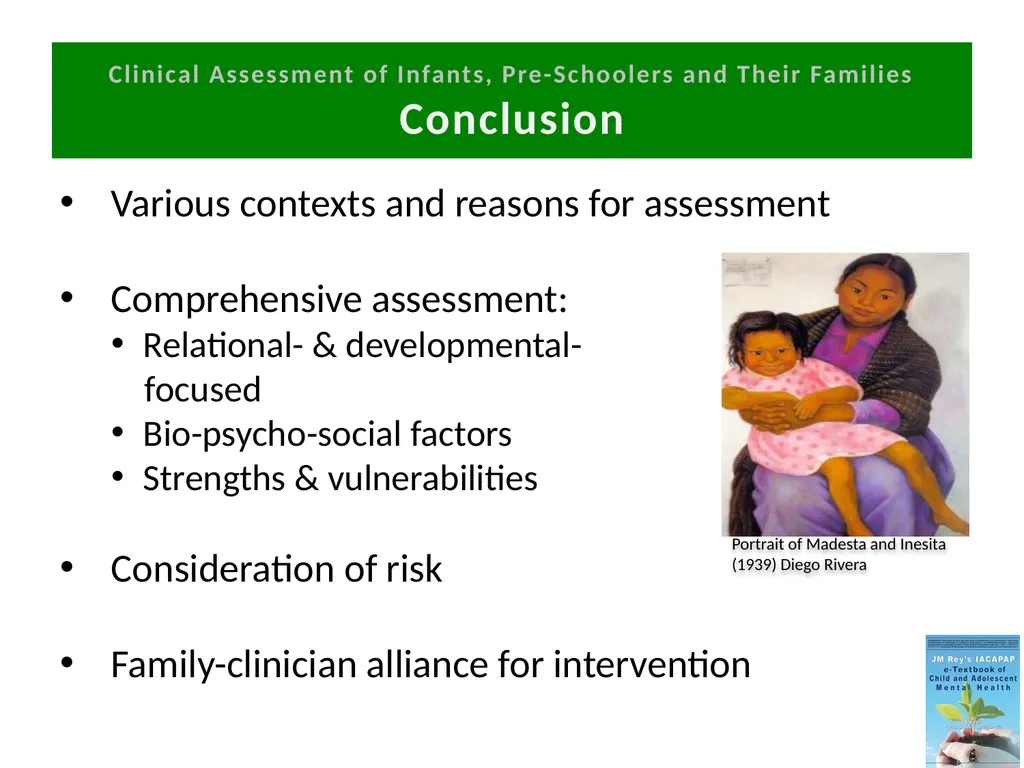
Family-clinician alliance for intervention Portrait of Madesta and Inesita (1939) Diego Rivera<br>
Comprehensive assessment:
Relational- & developmental-
focused
Bio-psycho-social factors
Strengths & vulnerabilities
Consideration of risk
Family-clinician alliance for intervention Portrait of Madesta and Inesita (1939) Diego Rivera<br>
50
Clinical Assessment of Infants, Pre-Schoolers and Their Families
Additional Resources Center on the Developing Child
Center on the Developing Child’s inBrief Series
Zero to Three
Adverse Childhood Experiences Study
Care for Child Development
https://www.futurelearn.com/courses/babies-in-mind
Mares, S., Newman, L., and Warren, B. (2011). Clinical skills in infant mental health: The first three years (2nd ed.). Melbourne, AUS: ACER Press
World Association for Infant Mental Health<br>
51
Clinical Assessment of Infants, Pre-Schoolers and Their Families
Thank You!<br>