Tutorial - Propositional Logic Foundations of Computing Science 1 INDIAN INSTITUTE OF TECHNOLOGY KHARAGPUR Pallab Dasgupta Professor, Dept. of Computer Sc Engg Questions 1. Express the following statements as propositional logic formulae.
"Tutorial - Propositional Logic Foundations of" is the property of its rightful owner. Permission is granted to
download and print the materials on this website for personal, non-commercial use only, and to display it
on your personal computer provided you do not modify the materials and that you retain all copyright
notices contained in the materials. By downloading content from our website, you accept the terms of this
agreement.
Presentation Transcript
01
Tutorial - Propositional Logic Foundations of Computing Science 1 INDIAN INSTITUTE OF TECHNOLOGY KHARAGPUR Pallab Dasgupta
Professor,
Dept. of Computer Sc & Engg<br>
02
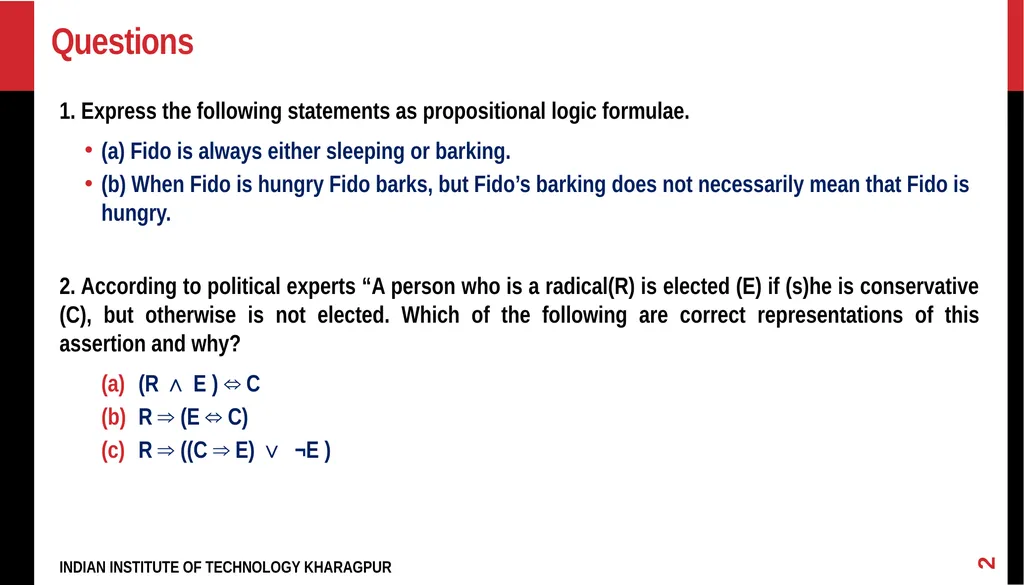
Questions 1. Express the following statements as propositional logic formulae.
(a) Fido is always either sleeping or barking.
(b) When Fido is hungry Fido barks, but Fido’s barking does not necessarily mean that Fido is hungry.
2. According to political experts “A person who is a radical(R) is elected (E) if (s)he is conservative (C), but otherwise is not elected. Which of the following are correct representations of this assertion and why?
(R ∧ E ) ⇔ C
R ⇒ (E ⇔ C)
R ⇒ ((C ⇒ E) ∨ ¬E ) INDIAN INSTITUTE OF TECHNOLOGY KHARAGPUR 2<br>
03
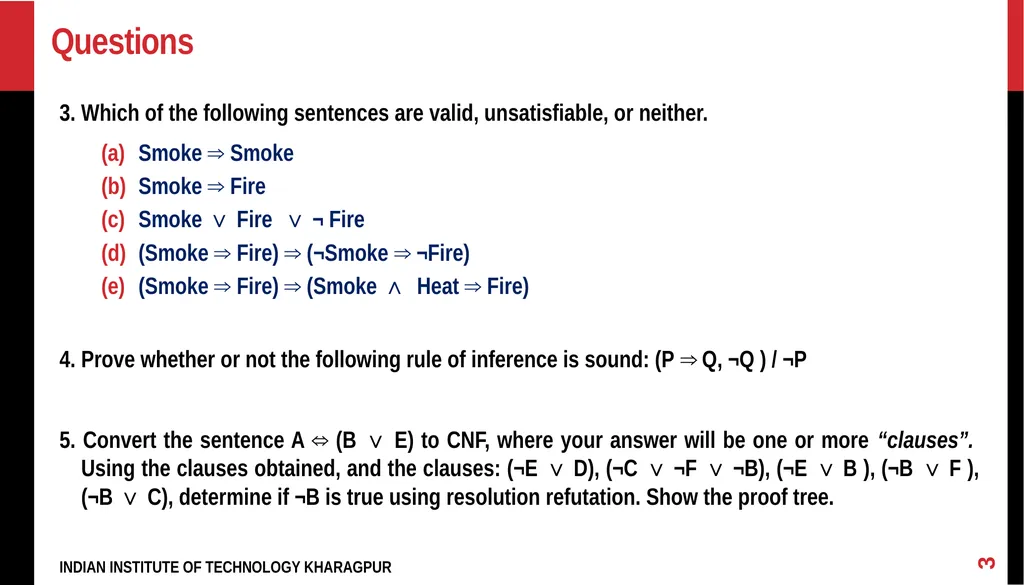
Questions 3. Which of the following sentences are valid, unsatisfiable, or neither.
Smoke ⇒ Smoke
Smoke ⇒ Fire
Smoke ∨ Fire ∨ ¬ Fire
(Smoke ⇒ Fire) ⇒ (¬Smoke ⇒ ¬Fire)
(Smoke ⇒ Fire) ⇒ (Smoke ∧ Heat ⇒ Fire)
4. Prove whether or not the following rule of inference is sound: (P ⇒ Q, ¬Q ) / ¬P
5. Convert the sentence A ⇔ (B ∨ E) to CNF, where your answer will be one or more “clauses”. Using the clauses obtained, and the clauses: (¬E ∨ D), (¬C ∨ ¬F ∨ ¬B), (¬E ∨ B ), (¬B ∨ F ), (¬B ∨ C), determine if ¬B is true using resolution refutation. Show the proof tree. INDIAN INSTITUTE OF TECHNOLOGY KHARAGPUR 3<br>
04
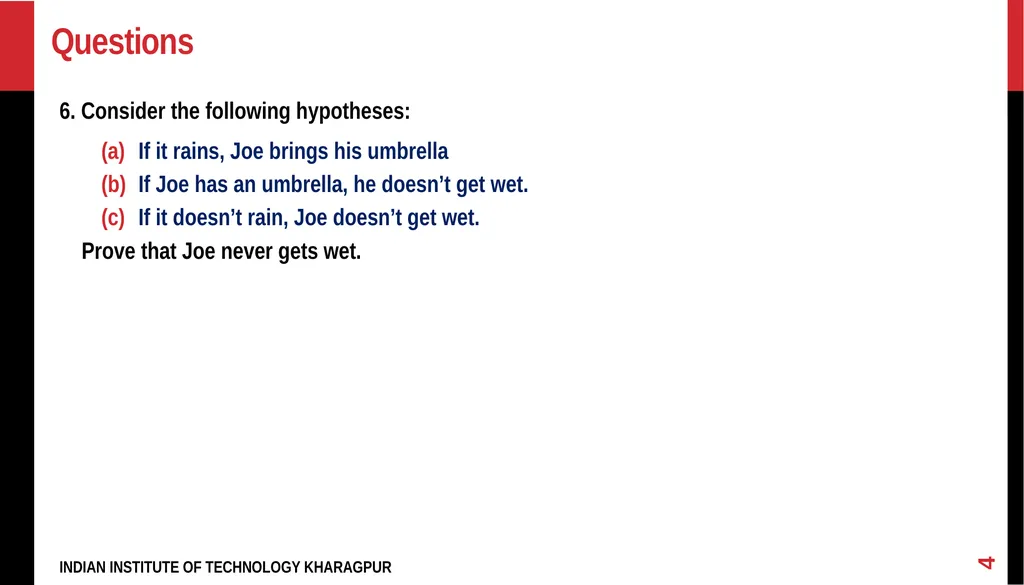
6. Consider the following hypotheses:
If it rains, Joe brings his umbrella
If Joe has an umbrella, he doesn’t get wet.
If it doesn’t rain, Joe doesn’t get wet.
Prove that Joe never gets wet. INDIAN INSTITUTE OF TECHNOLOGY KHARAGPUR 4 Questions<br>
05
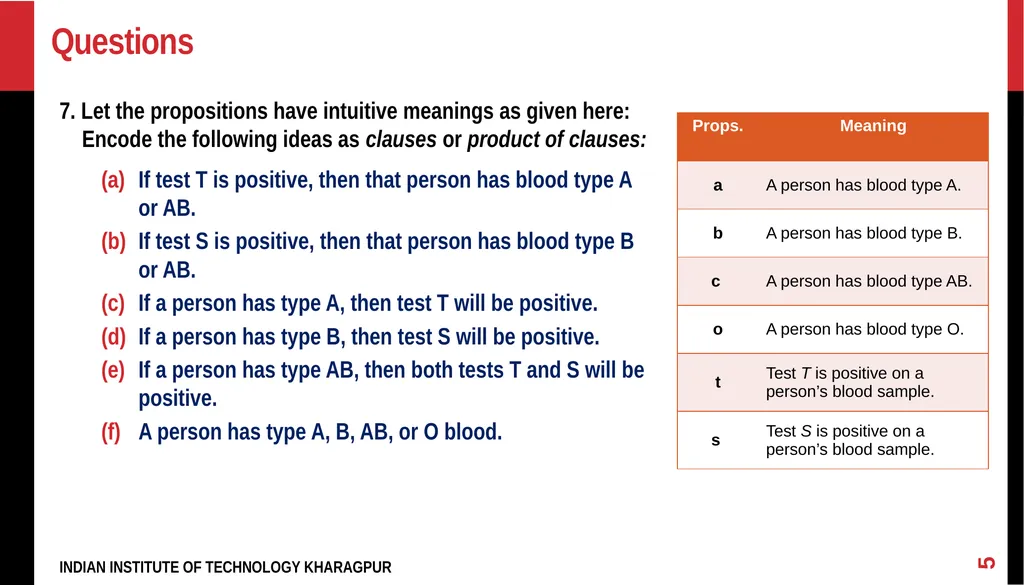
7. Let the propositions have intuitive meanings as given here: Encode the following ideas as clauses or product of clauses:
If test T is positive, then that person has blood type A or AB.
If test S is positive, then that person has blood type B or AB.
If a person has type A, then test T will be positive.
If a person has type B, then test S will be positive.
If a person has type AB, then both tests T and S will be positive.
A person has type A, B, AB, or O blood. INDIAN INSTITUTE OF TECHNOLOGY KHARAGPUR 5 Questions<br>