Two Classes of Indo-European verb: Functional
Description: Two Classes of Indo-European verb: Functional distinctions Ilya Yakubovich (Russian Academy of Sciences University of Marburg) Structure of the Talk mi- and xa-conjugations in PIE: Status quaestionis Preterit of the xa-conjugation: New
Related Topics
Download Presentation
"Two Classes of Indo-European verb: Functional" is the property of its rightful owner. Permission is granted to download and print the materials on this website for personal, non-commercial use only, and to display it on your personal computer provided you do not modify the materials and that you retain all copyright notices contained in the materials. By downloading content from our website, you accept the terms of this agreement.
Presentation Transcript
slide1. Two Classes of Indo-European verb:Functional distinctions Ilya Yakubovich
(Russian Academy of Sciences / University of Marburg)<br>
slide2. Structure of the Talk mi- and xa-conjugations in PIE: Status quaestionis
Preterit of the xa-conjugation: New formal discoveries (largely based on Kümmel 2018).
Interpreting the new empirical results in functional terms.<br>
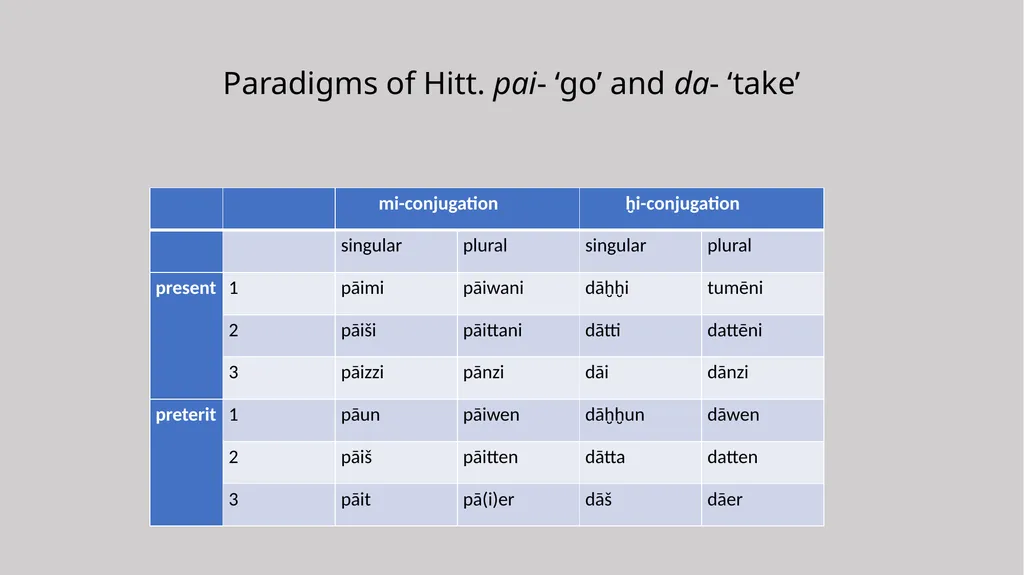
slide3. Paradigms of Hitt. pai- ‘go’ and da- ‘take’<br>
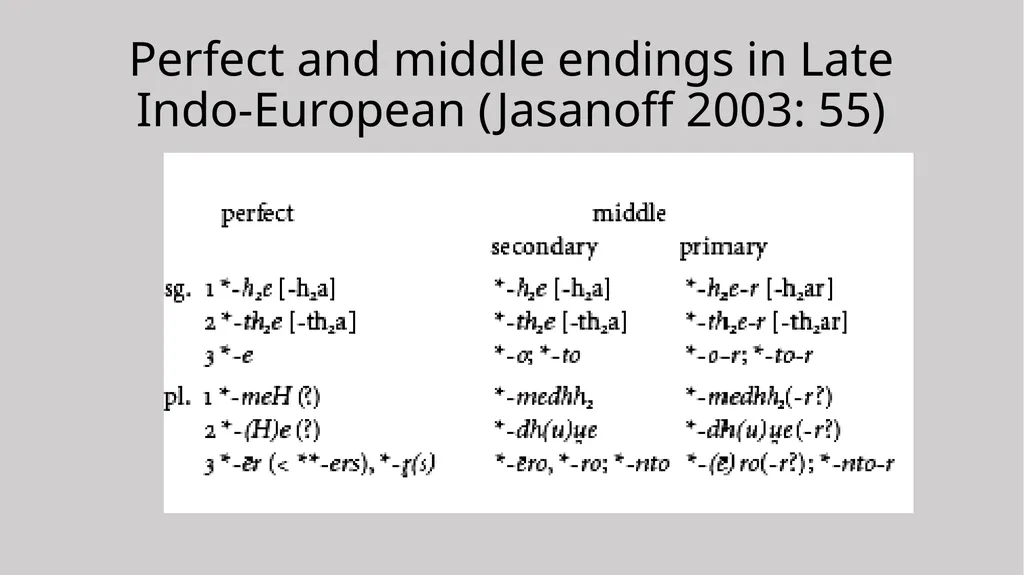
slide4. Perfect and middle endings in Late Indo-European (Jasanoff 2003: 55)<br>
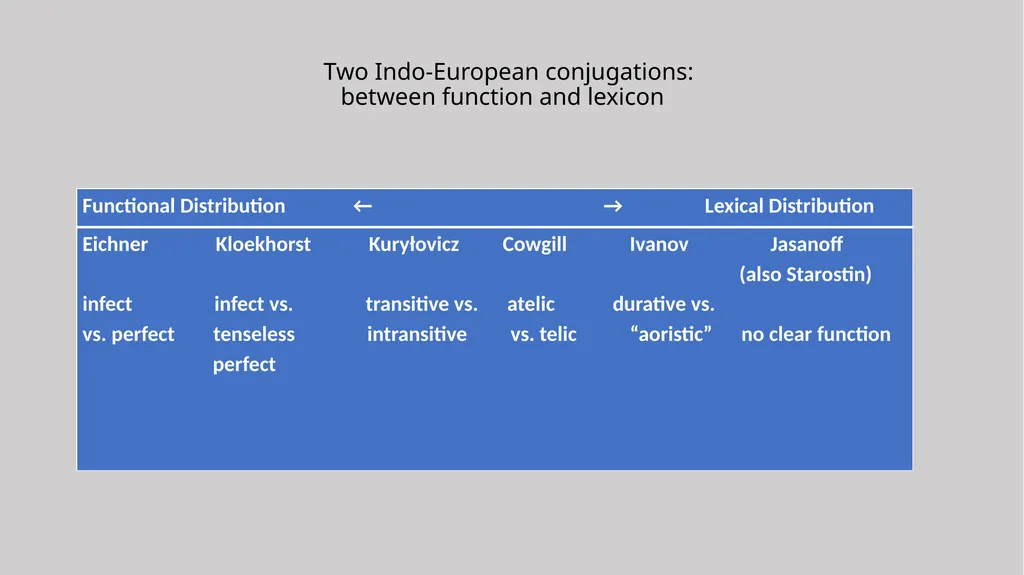
slide5. Two Indo-European conjugations: between function and lexicon<br>
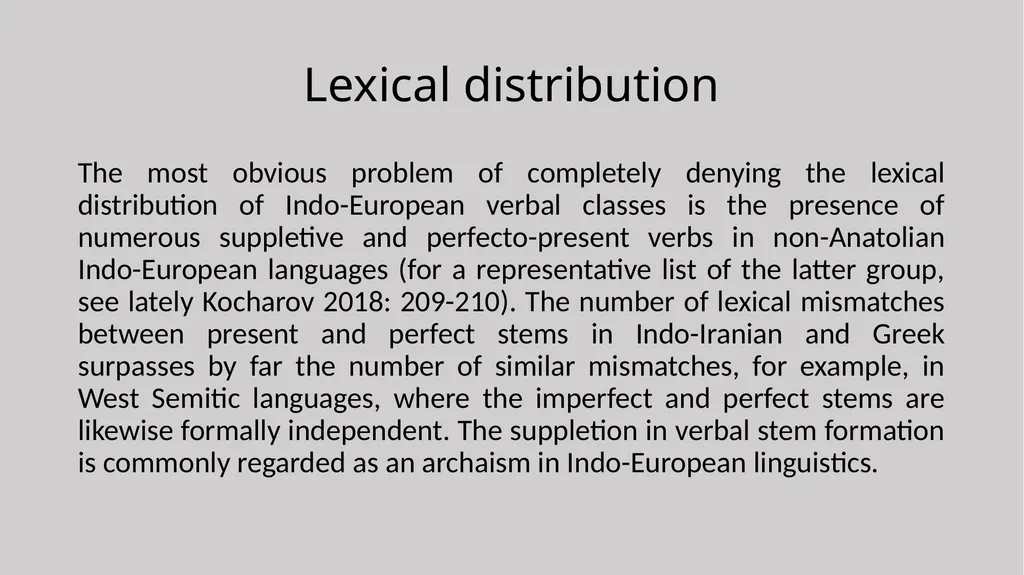
slide6. Lexical distribution The most obvious problem of completely denying the lexical distribution of Indo-European verbal classes is the presence of numerous suppletive and perfecto-present verbs in non-Anatolian Indo-European languages (for a representative list of the latter group, see lately Kocharov 2018: 209-210). The number of lexical mismatches between present and perfect stems in Indo-Iranian and Greek surpasses by far the number of similar mismatches, for example, in West Semitic languages, where the imperfect and perfect stems are likewise formally independent. The suppletion in verbal stem formation is commonly regarded as an archaism in Indo-European linguistics.<br>
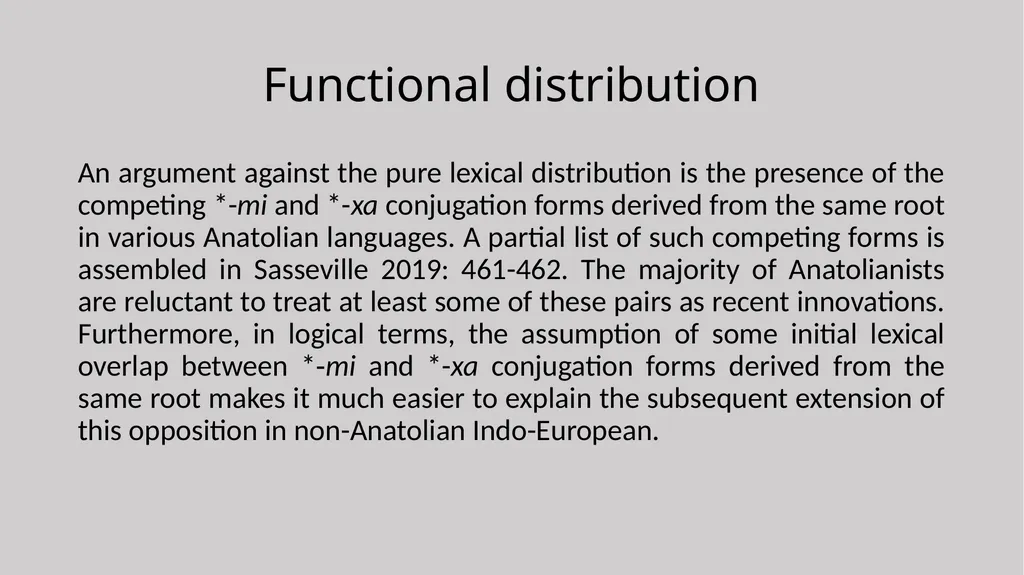
slide7. Functional distribution An argument against the pure lexical distribution is the presence of the competing *-mi and *-xa conjugation forms derived from the same root in various Anatolian languages. A partial list of such competing forms is assembled in Sasseville 2019: 461-462. The majority of Anatolianists are reluctant to treat at least some of these pairs as recent innovations. Furthermore, in logical terms, the assumption of some initial lexical overlap between *‑mi and *-xa conjugation forms derived from the same root makes it much easier to explain the subsequent extension of this opposition in non-Anatolian Indo-European.<br>
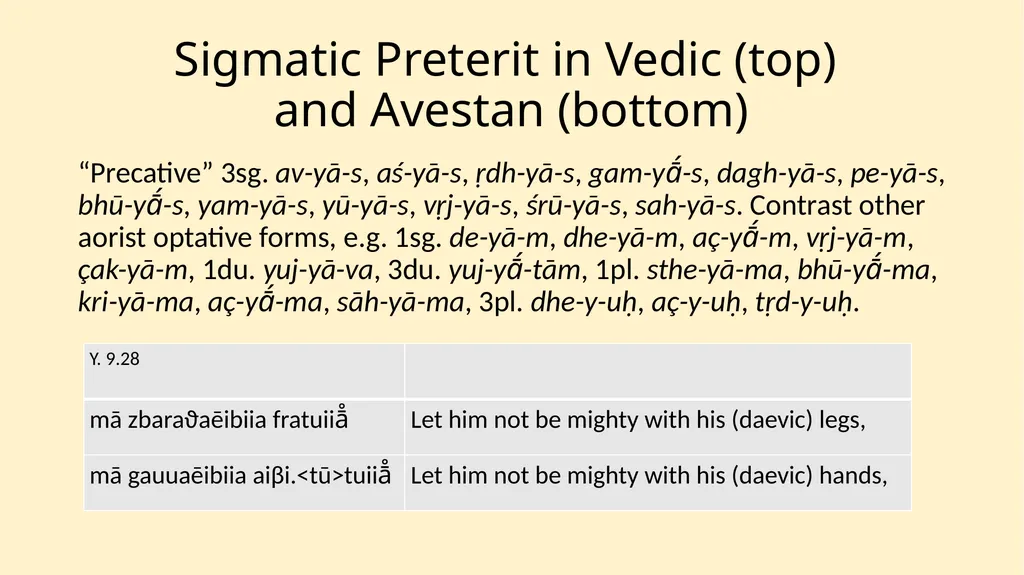
slide8. Sigmatic Preterit in Vedic (top) and Avestan (bottom) “Precative” 3sg. av-yā-s, aś-yā-s, ṛdh-yā-s, gam-yā́-s, dagh-yā-s, pe-yā-s, bhū-yā́-s, yam-yā-s, yū-yā-s, vṛj-yā-s, śrū-yā-s, sah-yā-s. Contrast other aorist optative forms, e.g. 1sg. de-yā-m, dhe-yā-m, aç-yā́-m, vṛj-yā-m, çak-yā-m, 1du. yuj-yā-va, 3du. yuj-yā́-tām, 1pl. sthe-yā-ma, bhū-yā́-ma, kri-yā-ma, aç-yā́-ma, sāh-yā-ma, 3pl. dhe-y-uḥ, aç-y-uḥ, tṛd-y-uḥ.<br>
slide9. Parallels in Anatolian and Tocharian<br>
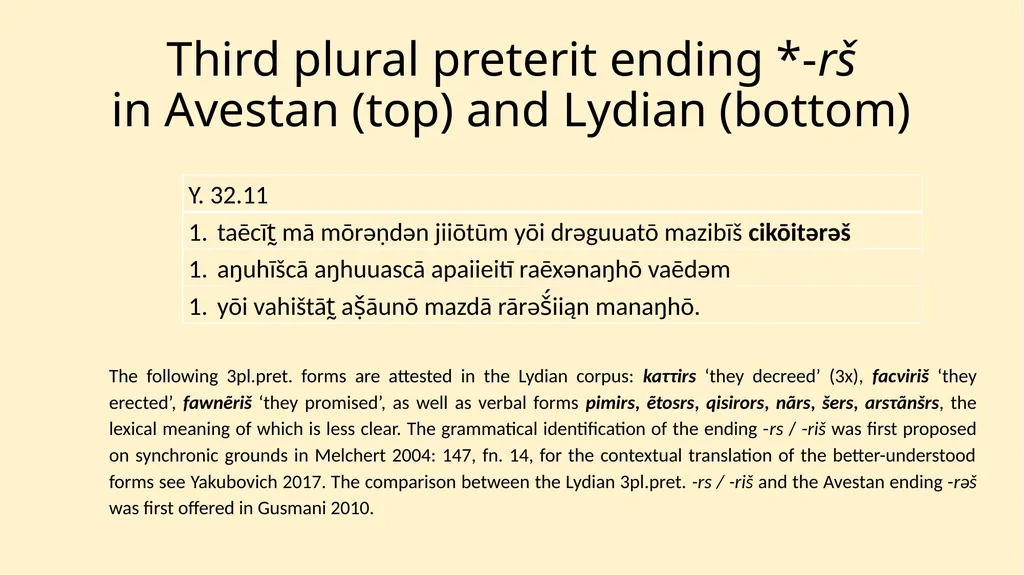
slide10. Third plural preterit ending *-ršin Avestan (top) and Lydian (bottom) The following 3pl.pret. forms are attested in the Lydian corpus: kaττirs ‘they decreed’ (3x), facνiriš ‘they erected’, fawnẽriš ‘they promised’, as well as verbal forms pimirs, ẽtosrs, qisirors, nãrs, šers, arsτãnšrs, the lexical meaning of which is less clear. The grammatical identification of the ending -rs / -riš was first proposed on synchronic grounds in Melchert 2004: 147, fn. 14, for the contextual translation of the better-understood forms see Yakubovich 2017. The comparison between the Lydian 3pl.pret. -rs / -riš and the Avestan ending -rəš was first offered in Gusmani 2010.<br>
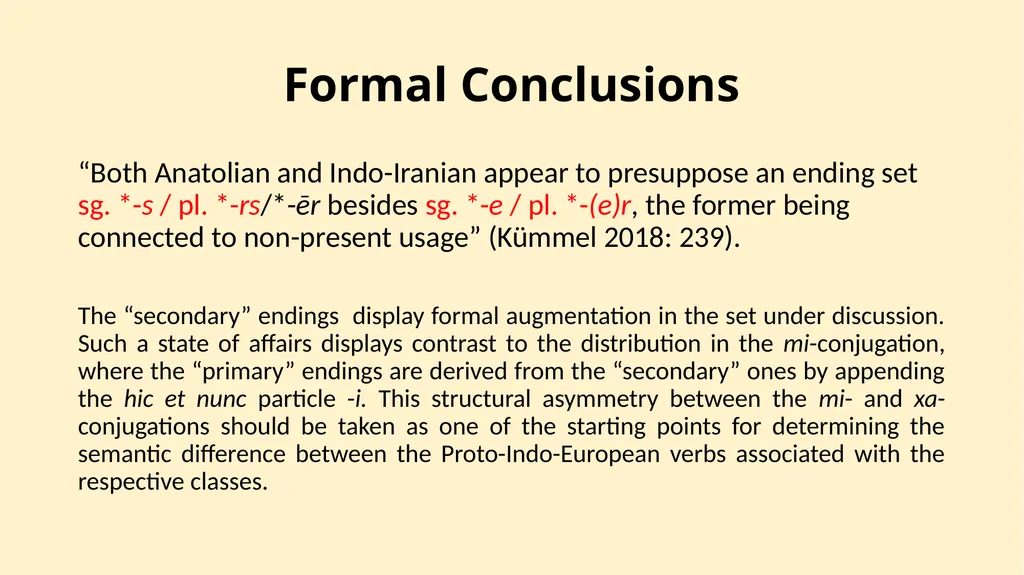
slide11. Formal Conclusions “Both Anatolian and Indo-Iranian appear to presuppose an ending set sg. *-s / pl. *-rs/*-ēr besides sg. *-e / pl. *-(e)r, the former being connected to non-present usage” (Kümmel 2018: 239).
The “secondary” endings display formal augmentation in the set under discussion. Such a state of affairs displays contrast to the distribution in the mi-conjugation, where the “primary” endings are derived from the “secondary” ones by appending the hic et nunc particle -i. This structural asymmetry between the mi- and xa-conjugations should be taken as one of the starting points for determining the semantic difference between the Proto-Indo-European verbs associated with the respective classes.<br>
slide12. Tense as a Late IE / Anatolian innovation? In both Anatolian and Late Indo-European, the system of verbal endings underwent radical innovations. In Anatolian, the the analogical spread of the hic et nunc element -i transformed the xa-conjugation into the ḫi-conjugation. In Late Indo-European, the original “secondary” endings of the mi-conjugation heavily influenced the pluperfect. Both innovations made the system of endings more symmetrical. The likely functional correlate of these processes was the rise of the category of tense.
The lack of similarity, or even shared proportion between the “primary” and “secondary” endings of the -mi and -xa conjugations in Indo-Anatolian, suggests that the contrast between “primary” and “secondary” endings did not have a uniform meaning for both conjugations. This is in turn compatible with the hypothesis that they marked idiosyncratic grammatical aspects, which interacted with the lexical aspects of the respective verbal classes.<br>
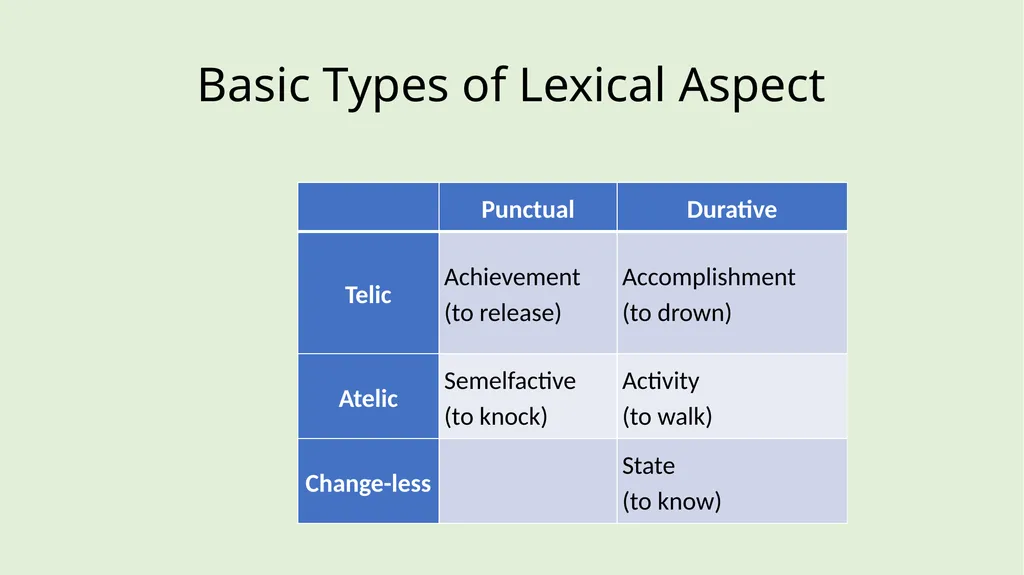
slide13. Basic Types of Lexical Aspect<br>
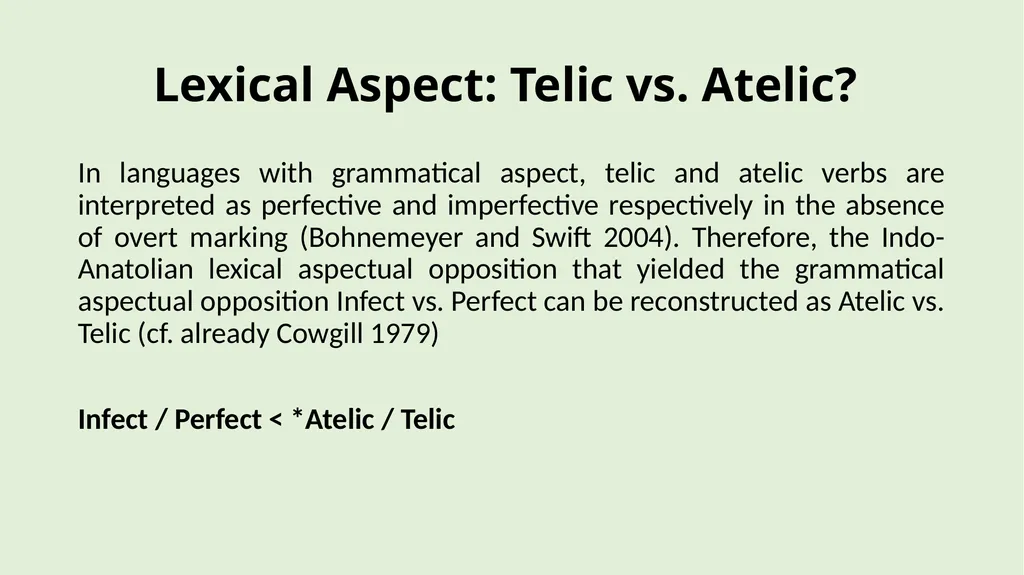
slide14. Lexical Aspect: Telic vs. Atelic? In languages with grammatical aspect, telic and atelic verbs are interpreted as perfective and imperfective respectively in the absence of overt marking (Bohnemeyer and Swift 2004). Therefore, the Indo-Anatolian lexical aspectual opposition that yielded the grammatical aspectual opposition Infect vs. Perfect can be reconstructed as Atelic vs. Telic (cf. already Cowgill 1979)
Infect / Perfect < *Atelic / Telic<br>
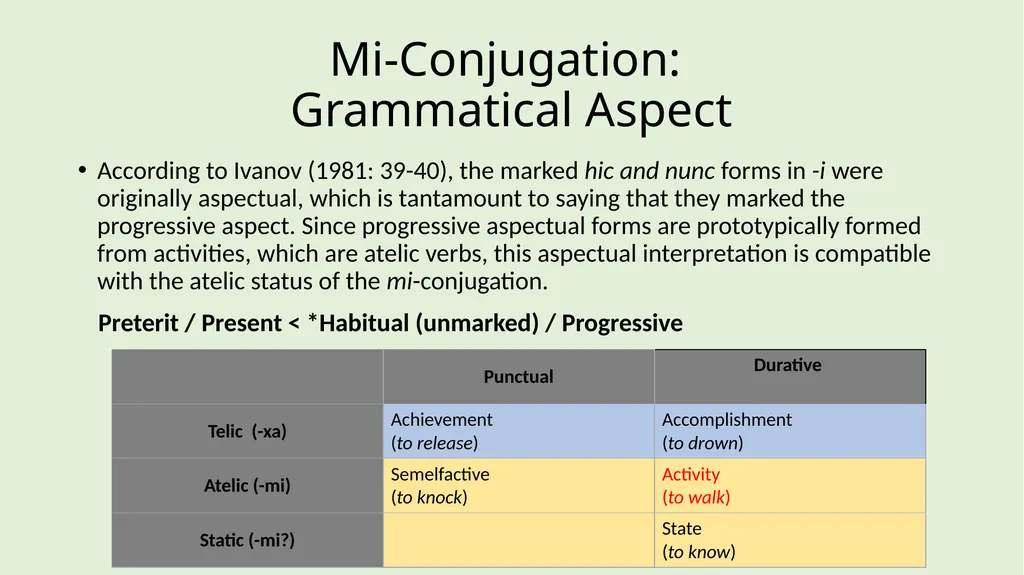
slide15. Mi-Conjugation: Grammatical Aspect According to Ivanov (1981: 39-40), the marked hic and nunc forms in -i were originally aspectual, which is tantamount to saying that they marked the progressive aspect. Since progressive aspectual forms are prototypically formed from activities, which are atelic verbs, this aspectual interpretation is compatible with the atelic status of the mi-conjugation.
Preterit / Present < *Habitual (unmarked) / Progressive<br>
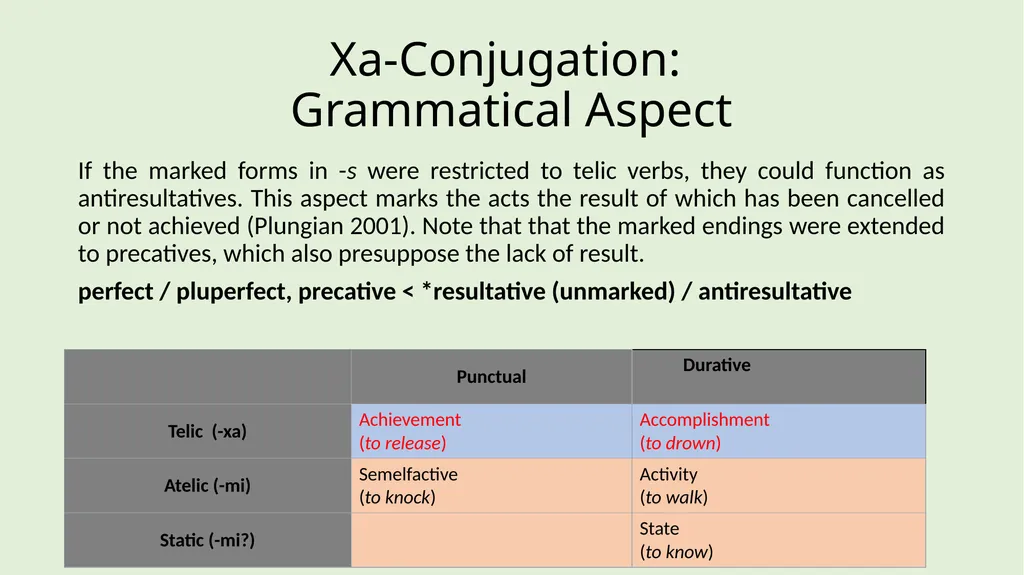
slide16. Xa-Conjugation: Grammatical Aspect If the marked forms in -s were restricted to telic verbs, they could function as antiresultatives. This aspect marks the acts the result of which has been cancelled or not achieved (Plungian 2001). Note that that the marked endings were extended to precatives, which also presuppose the lack of result.
perfect / pluperfect, precative < *resultative (unmarked) / antiresultative<br>
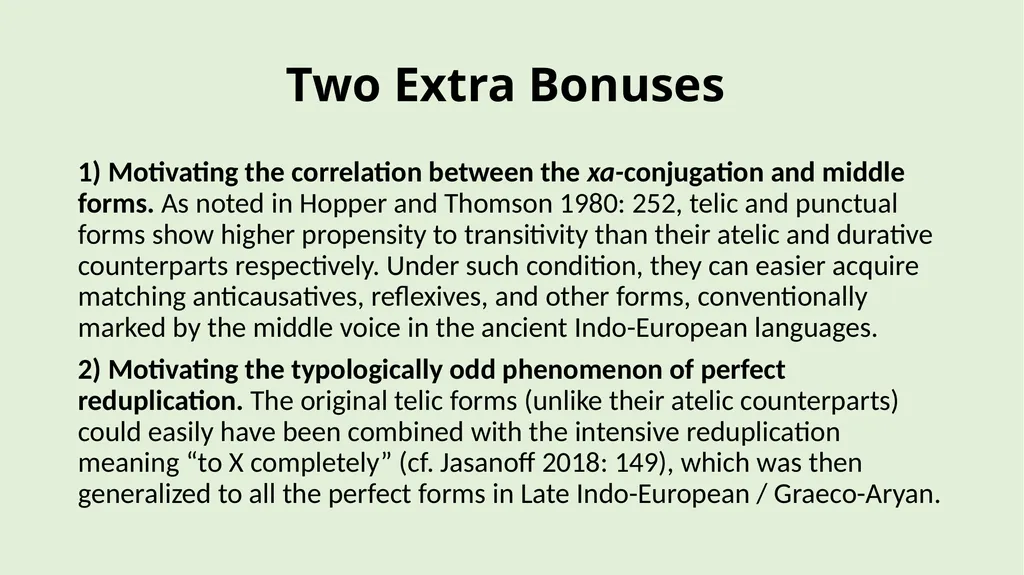
slide17. Two Extra Bonuses 1) Motivating the correlation between the xa-conjugation and middle forms. As noted in Hopper and Thomson 1980: 252, telic and punctual forms show higher propensity to transitivity than their atelic and durative counterparts respectively. Under such condition, they can easier acquire matching anticausatives, reflexives, and other forms, conventionally marked by the middle voice in the ancient Indo-European languages.
2) Motivating the typologically odd phenomenon of perfect reduplication. The original telic forms (unlike their atelic counterparts) could easily have been combined with the intensive reduplication meaning “to X completely” (cf. Jasanoff 2018: 149), which was then generalized to all the perfect forms in Late Indo-European / Graeco-Aryan.<br>
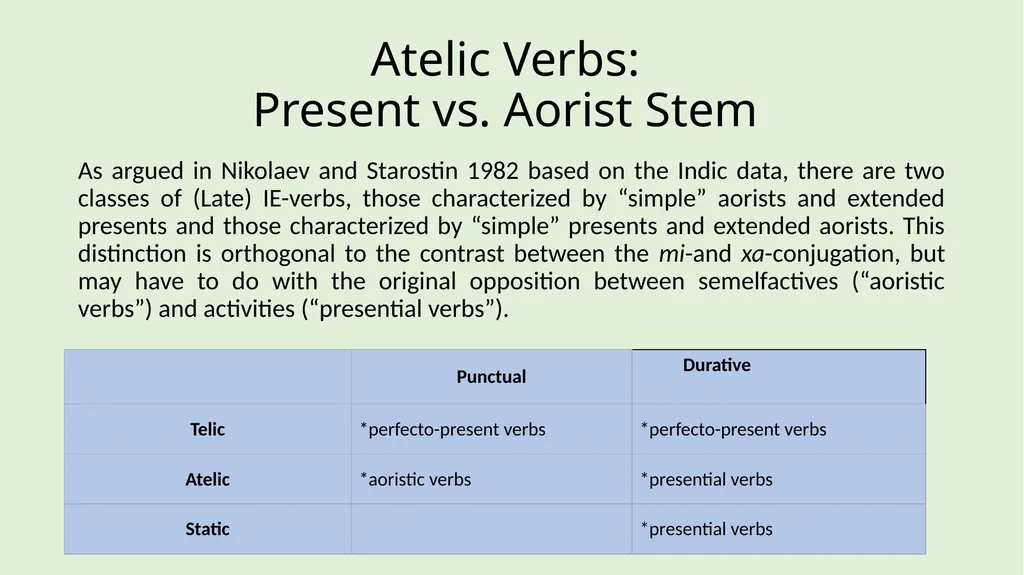
slide18. Atelic Verbs: Present vs. Aorist Stem As argued in Nikolaev and Starostin 1982 based on the Indic data, there are two classes of (Late) IE-verbs, those characterized by “simple” aorists and extended presents and those characterized by “simple” presents and extended aorists. This distinction is orthogonal to the contrast between the mi-and xa-conjugation, but may have to do with the original opposition between semelfactives (“aoristic verbs”) and activities (“presential verbs”).<br>

(Russian Academy of Sciences / University of Marburg)<br>
slide2. Structure of the Talk mi- and xa-conjugations in PIE: Status quaestionis
Preterit of the xa-conjugation: New formal discoveries (largely based on Kümmel 2018).
Interpreting the new empirical results in functional terms.<br>
slide3. Paradigms of Hitt. pai- ‘go’ and da- ‘take’<br>
slide4. Perfect and middle endings in Late Indo-European (Jasanoff 2003: 55)<br>
slide5. Two Indo-European conjugations: between function and lexicon<br>
slide6. Lexical distribution The most obvious problem of completely denying the lexical distribution of Indo-European verbal classes is the presence of numerous suppletive and perfecto-present verbs in non-Anatolian Indo-European languages (for a representative list of the latter group, see lately Kocharov 2018: 209-210). The number of lexical mismatches between present and perfect stems in Indo-Iranian and Greek surpasses by far the number of similar mismatches, for example, in West Semitic languages, where the imperfect and perfect stems are likewise formally independent. The suppletion in verbal stem formation is commonly regarded as an archaism in Indo-European linguistics.<br>
slide7. Functional distribution An argument against the pure lexical distribution is the presence of the competing *-mi and *-xa conjugation forms derived from the same root in various Anatolian languages. A partial list of such competing forms is assembled in Sasseville 2019: 461-462. The majority of Anatolianists are reluctant to treat at least some of these pairs as recent innovations. Furthermore, in logical terms, the assumption of some initial lexical overlap between *‑mi and *-xa conjugation forms derived from the same root makes it much easier to explain the subsequent extension of this opposition in non-Anatolian Indo-European.<br>
slide8. Sigmatic Preterit in Vedic (top) and Avestan (bottom) “Precative” 3sg. av-yā-s, aś-yā-s, ṛdh-yā-s, gam-yā́-s, dagh-yā-s, pe-yā-s, bhū-yā́-s, yam-yā-s, yū-yā-s, vṛj-yā-s, śrū-yā-s, sah-yā-s. Contrast other aorist optative forms, e.g. 1sg. de-yā-m, dhe-yā-m, aç-yā́-m, vṛj-yā-m, çak-yā-m, 1du. yuj-yā-va, 3du. yuj-yā́-tām, 1pl. sthe-yā-ma, bhū-yā́-ma, kri-yā-ma, aç-yā́-ma, sāh-yā-ma, 3pl. dhe-y-uḥ, aç-y-uḥ, tṛd-y-uḥ.<br>
slide9. Parallels in Anatolian and Tocharian<br>
slide10. Third plural preterit ending *-ršin Avestan (top) and Lydian (bottom) The following 3pl.pret. forms are attested in the Lydian corpus: kaττirs ‘they decreed’ (3x), facνiriš ‘they erected’, fawnẽriš ‘they promised’, as well as verbal forms pimirs, ẽtosrs, qisirors, nãrs, šers, arsτãnšrs, the lexical meaning of which is less clear. The grammatical identification of the ending -rs / -riš was first proposed on synchronic grounds in Melchert 2004: 147, fn. 14, for the contextual translation of the better-understood forms see Yakubovich 2017. The comparison between the Lydian 3pl.pret. -rs / -riš and the Avestan ending -rəš was first offered in Gusmani 2010.<br>
slide11. Formal Conclusions “Both Anatolian and Indo-Iranian appear to presuppose an ending set sg. *-s / pl. *-rs/*-ēr besides sg. *-e / pl. *-(e)r, the former being connected to non-present usage” (Kümmel 2018: 239).
The “secondary” endings display formal augmentation in the set under discussion. Such a state of affairs displays contrast to the distribution in the mi-conjugation, where the “primary” endings are derived from the “secondary” ones by appending the hic et nunc particle -i. This structural asymmetry between the mi- and xa-conjugations should be taken as one of the starting points for determining the semantic difference between the Proto-Indo-European verbs associated with the respective classes.<br>
slide12. Tense as a Late IE / Anatolian innovation? In both Anatolian and Late Indo-European, the system of verbal endings underwent radical innovations. In Anatolian, the the analogical spread of the hic et nunc element -i transformed the xa-conjugation into the ḫi-conjugation. In Late Indo-European, the original “secondary” endings of the mi-conjugation heavily influenced the pluperfect. Both innovations made the system of endings more symmetrical. The likely functional correlate of these processes was the rise of the category of tense.
The lack of similarity, or even shared proportion between the “primary” and “secondary” endings of the -mi and -xa conjugations in Indo-Anatolian, suggests that the contrast between “primary” and “secondary” endings did not have a uniform meaning for both conjugations. This is in turn compatible with the hypothesis that they marked idiosyncratic grammatical aspects, which interacted with the lexical aspects of the respective verbal classes.<br>
slide13. Basic Types of Lexical Aspect<br>
slide14. Lexical Aspect: Telic vs. Atelic? In languages with grammatical aspect, telic and atelic verbs are interpreted as perfective and imperfective respectively in the absence of overt marking (Bohnemeyer and Swift 2004). Therefore, the Indo-Anatolian lexical aspectual opposition that yielded the grammatical aspectual opposition Infect vs. Perfect can be reconstructed as Atelic vs. Telic (cf. already Cowgill 1979)
Infect / Perfect < *Atelic / Telic<br>
slide15. Mi-Conjugation: Grammatical Aspect According to Ivanov (1981: 39-40), the marked hic and nunc forms in -i were originally aspectual, which is tantamount to saying that they marked the progressive aspect. Since progressive aspectual forms are prototypically formed from activities, which are atelic verbs, this aspectual interpretation is compatible with the atelic status of the mi-conjugation.
Preterit / Present < *Habitual (unmarked) / Progressive<br>
slide16. Xa-Conjugation: Grammatical Aspect If the marked forms in -s were restricted to telic verbs, they could function as antiresultatives. This aspect marks the acts the result of which has been cancelled or not achieved (Plungian 2001). Note that that the marked endings were extended to precatives, which also presuppose the lack of result.
perfect / pluperfect, precative < *resultative (unmarked) / antiresultative<br>
slide17. Two Extra Bonuses 1) Motivating the correlation between the xa-conjugation and middle forms. As noted in Hopper and Thomson 1980: 252, telic and punctual forms show higher propensity to transitivity than their atelic and durative counterparts respectively. Under such condition, they can easier acquire matching anticausatives, reflexives, and other forms, conventionally marked by the middle voice in the ancient Indo-European languages.
2) Motivating the typologically odd phenomenon of perfect reduplication. The original telic forms (unlike their atelic counterparts) could easily have been combined with the intensive reduplication meaning “to X completely” (cf. Jasanoff 2018: 149), which was then generalized to all the perfect forms in Late Indo-European / Graeco-Aryan.<br>
slide18. Atelic Verbs: Present vs. Aorist Stem As argued in Nikolaev and Starostin 1982 based on the Indic data, there are two classes of (Late) IE-verbs, those characterized by “simple” aorists and extended presents and those characterized by “simple” presents and extended aorists. This distinction is orthogonal to the contrast between the mi-and xa-conjugation, but may have to do with the original opposition between semelfactives (“aoristic verbs”) and activities (“presential verbs”).<br>