
Type 1 NBFC exemption proposals Draft RBI



Description: Type 1 NBFC exemption proposals Draft RBI Amendment Directions Bangalore: 4, Union Street, Infantry Rd, Shivaji Nagar, Bengaluru- 560 001 Phone: 033 40010157 2281 3742 Email: bengaluruvinodkothari.com Overview of Non-Banking Sector in
Related Topics
Download Presentation
"Type 1 NBFC exemption proposals Draft RBI" is the property of its rightful owner. Permission is granted to download and print the materials on this website for personal, non-commercial use only, and to display it on your personal computer provided you do not modify the materials and that you retain all copyright notices contained in the materials. By downloading content from our website, you accept the terms of this agreement.
Presentation Transcript
slide1. Type 1 NBFC exemption proposals
Draft RBI Amendment Directions Bangalore:
4, Union Street, Infantry Rd,
Shivaji Nagar,
Bengaluru- 560 001
Phone: 033 40010157/ 2281 3742
Email: bengaluru@vinodkothari.com<br>
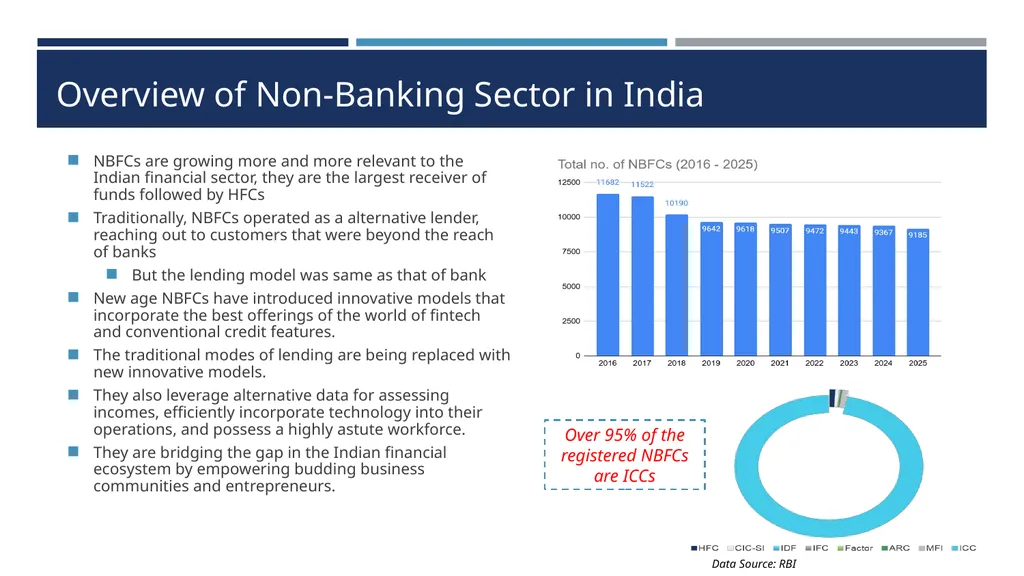
slide2. Overview of Non-Banking Sector in India NBFCs are growing more and more relevant to the Indian financial sector, they are the largest receiver of funds followed by HFCs
Traditionally, NBFCs operated as a alternative lender, reaching out to customers that were beyond the reach of banks
But the lending model was same as that of bank
New age NBFCs have introduced innovative models that incorporate the best offerings of the world of fintech and conventional credit features.
The traditional modes of lending are being replaced with new innovative models.
They also leverage alternative data for assessing incomes, efficiently incorporate technology into their operations, and possess a highly astute workforce.
They are bridging the gap in the Indian financial ecosystem by empowering budding business communities and entrepreneurs. Over 95% of the registered NBFCs are ICCs Data Source: RBI<br>
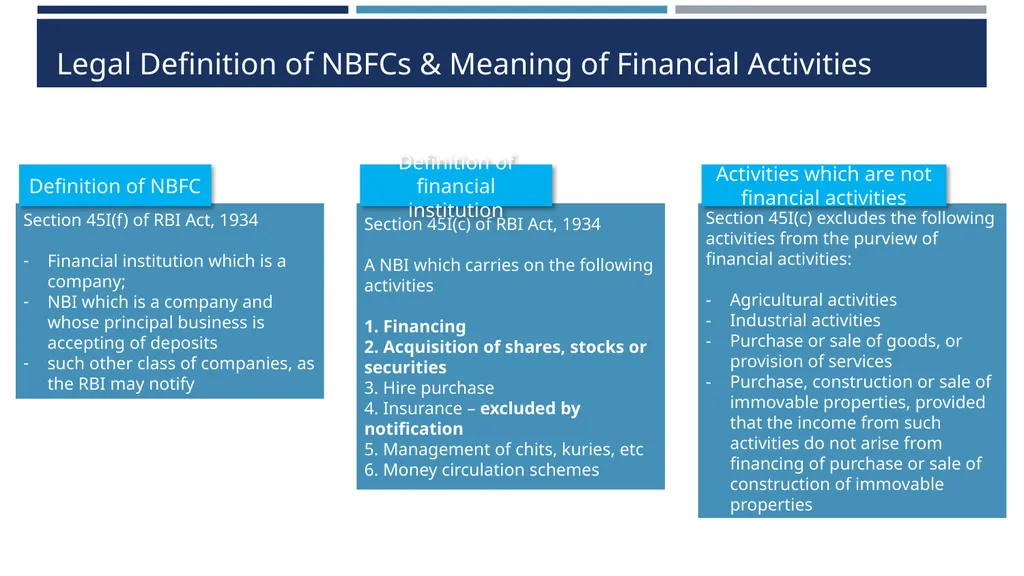
slide3. Legal Definition of NBFCs & Meaning of Financial Activities Section 45I(f) of RBI Act, 1934
Financial institution which is a company;
NBI which is a company and whose principal business is accepting of deposits
such other class of companies, as the RBI may notify Definition of NBFC Section 45I(c) of RBI Act, 1934
A NBI which carries on the following activities
1. Financing
2. Acquisition of shares, stocks or securities
3. Hire purchase
4. Insurance – excluded by notification
5. Management of chits, kuries, etc
6. Money circulation schemes Definition of financial institution Section 45I(c) excludes the following activities from the purview of financial activities:
Agricultural activities
Industrial activities
Purchase or sale of goods, or provision of services
Purchase, construction or sale of immovable properties, provided that the income from such activities do not arise from financing of purchase or sale of construction of immovable properties Activities which are not financial activities<br>
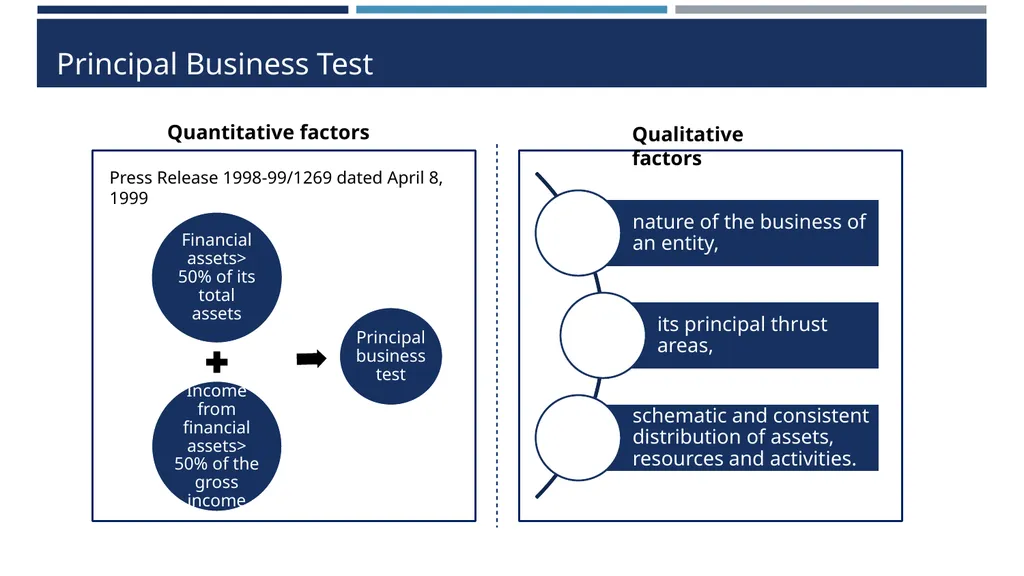
slide4. Principal Business Test Quantitative factors Qualitative factors Press Release 1998-99/1269 dated April 8, 1999<br>
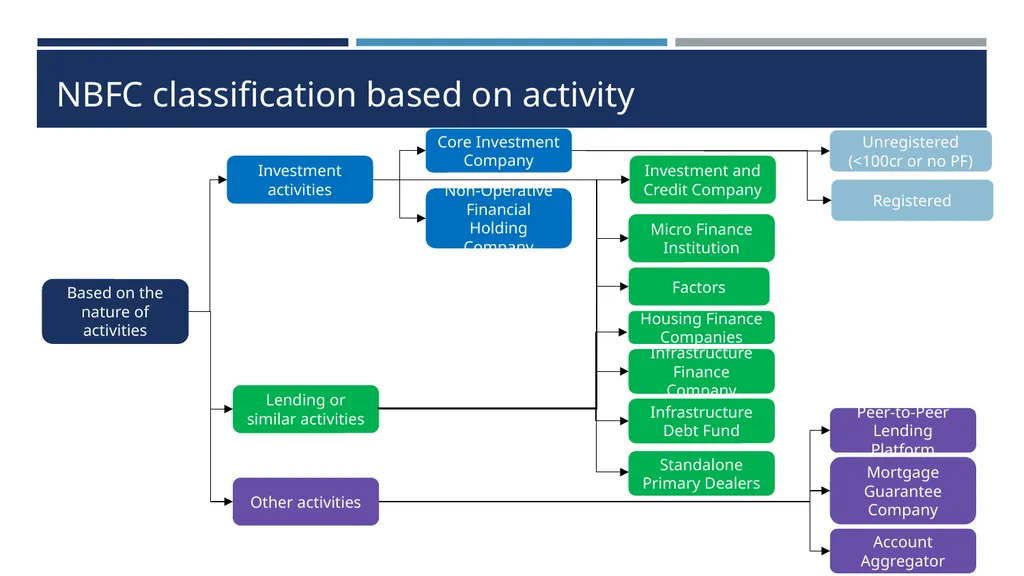
slide5. Based on the nature of activities Investment activities Lending or similar activities Core Investment Company Non-Operative Financial Holding Company Other activities Micro Finance Institution Factors Housing Finance Companies Infrastructure Finance Company Infrastructure Debt Fund Peer-to-Peer Lending Platform Account Aggregator Standalone Primary Dealers Mortgage Guarantee Company Investment and Credit Company Registered Unregistered
(<100cr or no PF) NBFC classification based on activity<br>
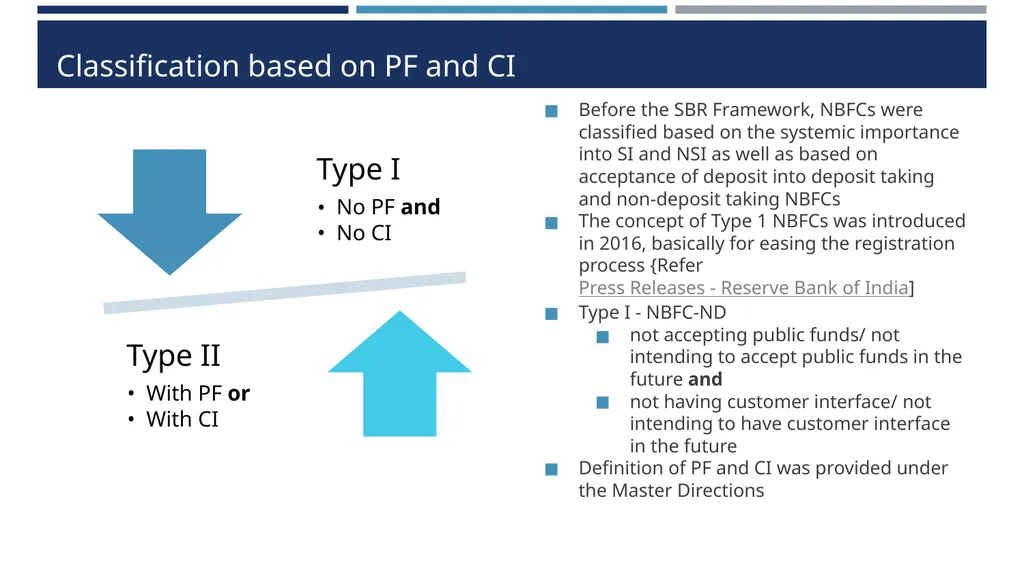
slide6. Classification based on PF and CI Before the SBR Framework, NBFCs were classified based on the systemic importance into SI and NSI as well as based on acceptance of deposit into deposit taking and non-deposit taking NBFCs
The concept of Type 1 NBFCs was introduced in 2016, basically for easing the registration process {Refer Press Releases - Reserve Bank of India]
Type I - NBFC-ND
not accepting public funds/ not intending to accept public funds in the future and
not having customer interface/ not intending to have customer interface in the future
Definition of PF and CI was provided under the Master Directions<br>
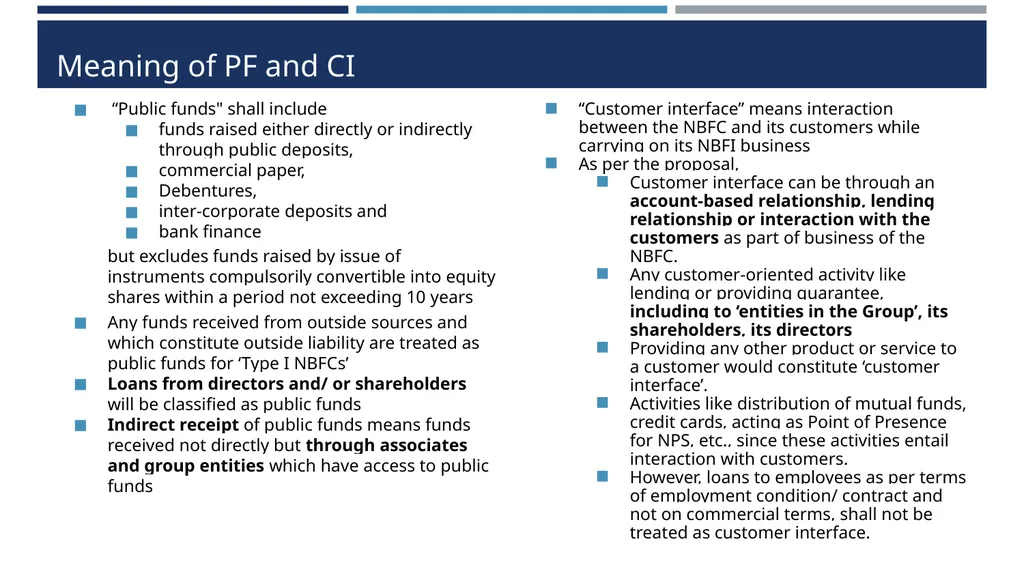
slide7. Meaning of PF and CI “Public funds" shall include
funds raised either directly or indirectly through public deposits,
commercial paper,
Debentures,
inter-corporate deposits and
bank finance
but excludes funds raised by issue of instruments compulsorily convertible into equity shares within a period not exceeding 10 years
Any funds received from outside sources and which constitute outside liability are treated as public funds for ‘Type I NBFCs’
Loans from directors and/ or shareholders will be classified as public funds
Indirect receipt of public funds means funds received not directly but through associates and group entities which have access to public funds “Customer interface” means interaction between the NBFC and its customers while carrying on its NBFI business
As per the proposal,
Customer interface can be through an account-based relationship, lending relationship or interaction with the customers as part of business of the NBFC.
Any customer-oriented activity like lending or providing guarantee, including to ‘entities in the Group’, its shareholders, its directors
Providing any other product or service to a customer would constitute ‘customer interface’.
Activities like distribution of mutual funds, credit cards, acting as Point of Presence for NPS, etc., since these activities entail interaction with customers.
However, loans to employees as per terms of employment condition/ contract and not on commercial terms, shall not be treated as customer interface.<br>
slide8. Exemption from registration to type 1 NBFC<br>
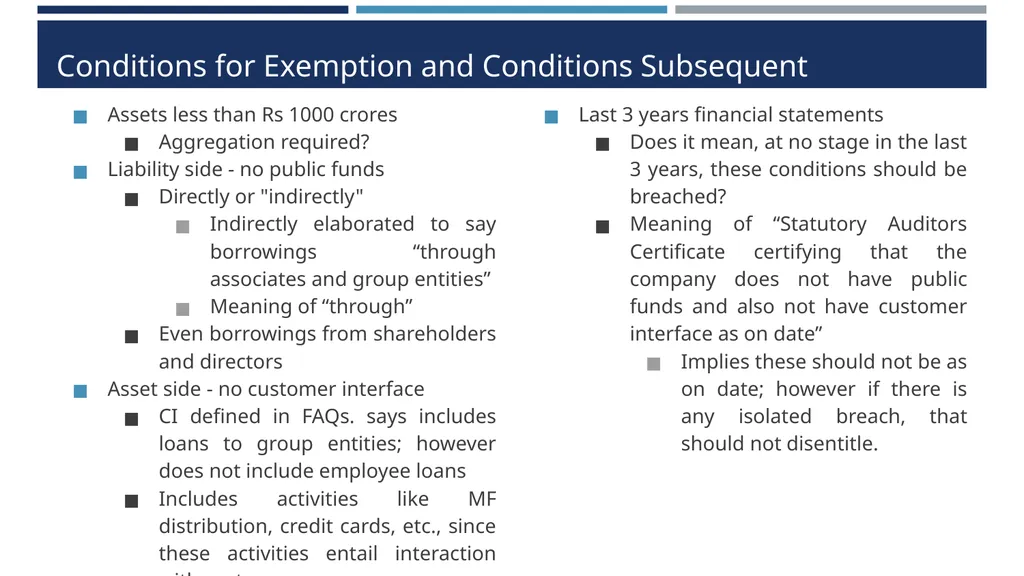
slide9. Conditions for Exemption and Conditions Subsequent Last 3 years financial statements
Does it mean, at no stage in the last 3 years, these conditions should be breached?
Meaning of “Statutory Auditors Certificate certifying that the company does not have public funds and also not have customer interface as on date”
Implies these should not be as on date; however if there is any isolated breach, that should not disentitle. Assets less than Rs 1000 crores
Aggregation required?
Liability side - no public funds
Directly or "indirectly"
Indirectly elaborated to say borrowings “through associates and group entities”
Meaning of “through”
Even borrowings from shareholders and directors
Asset side - no customer interface
CI defined in FAQs. says includes loans to group entities; however does not include employee loans
Includes activities like MF distribution, credit cards, etc., since these activities entail interaction with customers<br>
slide10. Asset Size: Less than ₹1,000 crores Customer Interface: Must not have or intend to have any customer interface. This includes lending or providing guarantees to group entities. Statutory Auditors Certificate: SAC certifying that the company does not have public funds and also not have customer interface as on date. Governance: a. The Board must pass an upfront resolution, as also annually thereafter, confirming the entity will not avail PF or have CI during the year
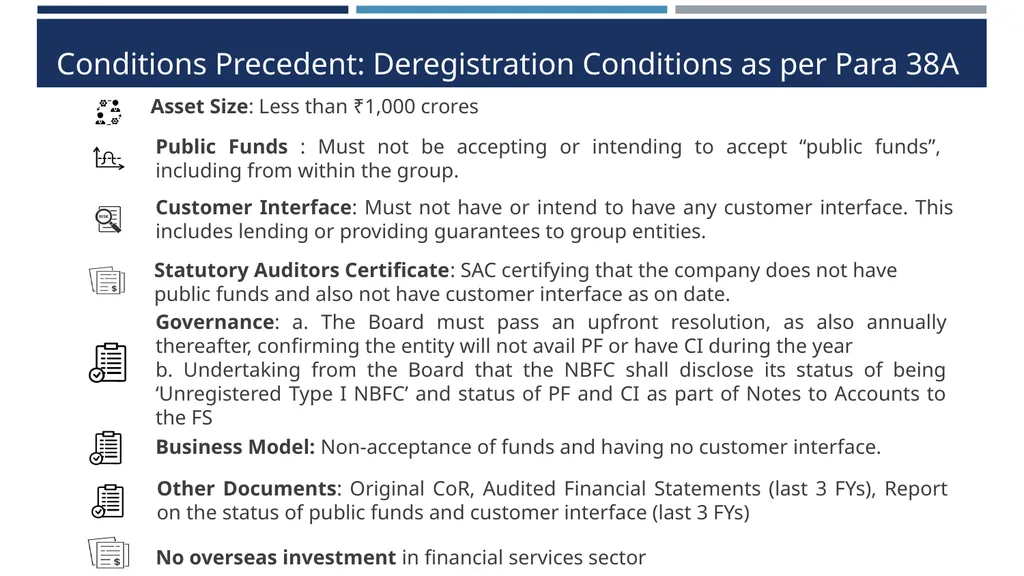
b. Undertaking from the Board that the NBFC shall disclose its status of being ‘Unregistered Type I NBFC’ and status of PF and CI as part of Notes to Accounts to the FS Business Model: Non-acceptance of funds and having no customer interface. Other Documents: Original CoR, Audited Financial Statements (last 3 FYs), Report on the status of public funds and customer interface (last 3 FYs) Public Funds : Must not be accepting or intending to accept “public funds”, including from within the group. No overseas investment in financial services sector Conditions Precedent: Deregistration Conditions as per Para 38A<br>
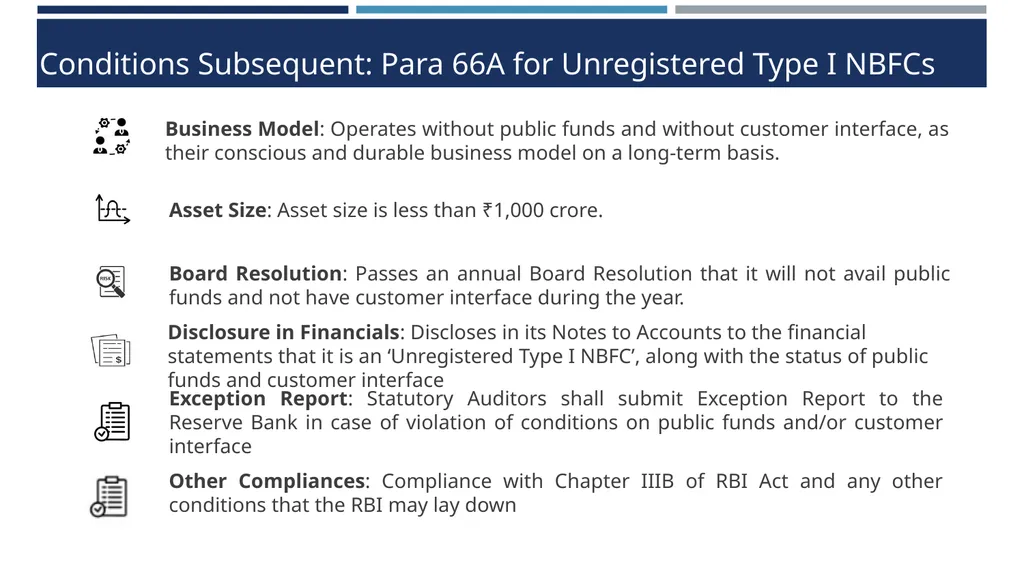
slide11. Conditions Subsequent: Para 66A for Unregistered Type I NBFCs Business Model: Operates without public funds and without customer interface, as their conscious and durable business model on a long-term basis. Asset Size: Asset size is less than ₹1,000 crore. Board Resolution: Passes an annual Board Resolution that it will not avail public funds and not have customer interface during the year. Disclosure in Financials: Discloses in its Notes to Accounts to the financial statements that it is an ‘Unregistered Type I NBFC’, along with the status of public funds and customer interface Exception Report: Statutory Auditors shall submit Exception Report to the Reserve Bank in case of violation of conditions on public funds and/or customer interface Other Compliances: Compliance with Chapter IIIB of RBI Act and any other conditions that the RBI may lay down<br>
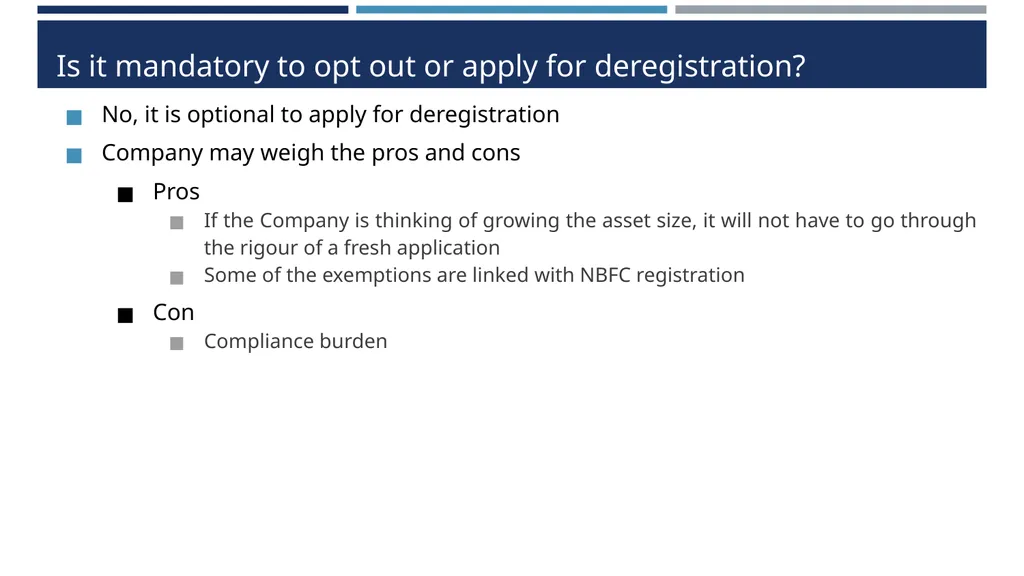
slide12. Is it mandatory to opt out or apply for deregistration? No, it is optional to apply for deregistration
Company may weigh the pros and cons
Pros
If the Company is thinking of growing the asset size, it will not have to go through the rigour of a fresh application
Some of the exemptions are linked with NBFC registration
Con
Compliance burden<br>
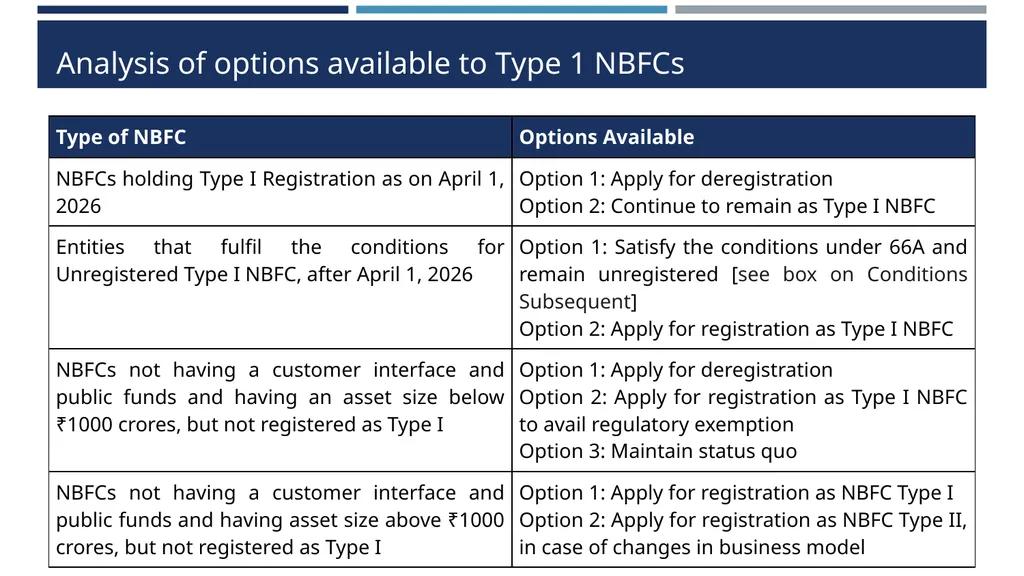
slide13. Analysis of options available to Type 1 NBFCs<br>
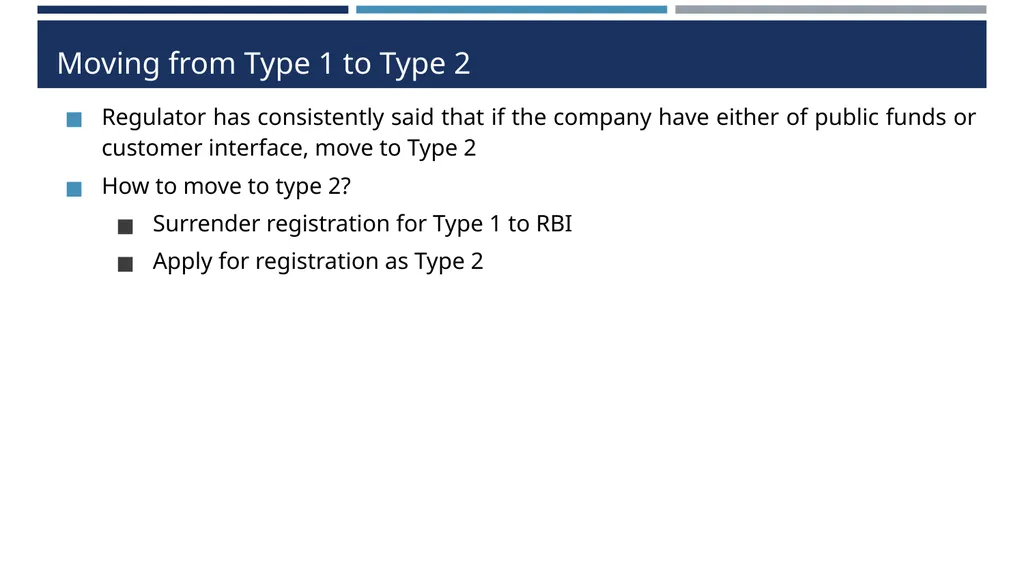
slide14. Moving from Type 1 to Type 2 Regulator has consistently said that if the company have either of public funds or customer interface, move to Type 2
How to move to type 2?
Surrender registration for Type 1 to RBI
Apply for registration as Type 2<br>
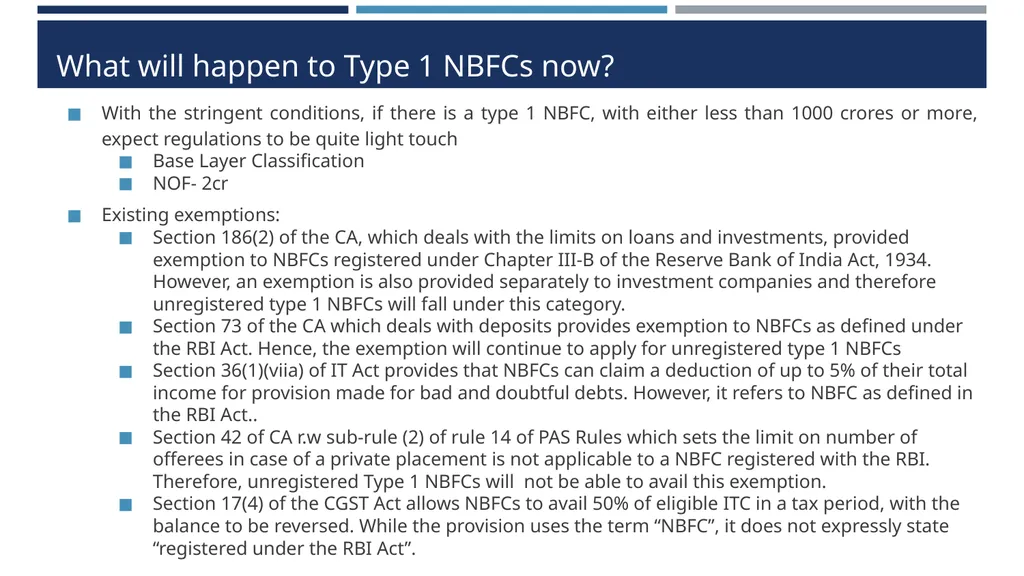
slide15. What will happen to Type 1 NBFCs now? With the stringent conditions, if there is a type 1 NBFC, with either less than 1000 crores or more, expect regulations to be quite light touch
Base Layer Classification
NOF- 2cr
Existing exemptions:
Section 186(2) of the CA, which deals with the limits on loans and investments, provided exemption to NBFCs registered under Chapter III-B of the Reserve Bank of India Act, 1934. However, an exemption is also provided separately to investment companies and therefore unregistered type 1 NBFCs will fall under this category.
Section 73 of the CA which deals with deposits provides exemption to NBFCs as defined under the RBI Act. Hence, the exemption will continue to apply for unregistered type 1 NBFCs
Section 36(1)(viia) of IT Act provides that NBFCs can claim a deduction of up to 5% of their total income for provision made for bad and doubtful debts. However, it refers to NBFC as defined in the RBI Act..
Section 42 of CA r.w sub-rule (2) of rule 14 of PAS Rules which sets the limit on number of offerees in case of a private placement is not applicable to a NBFC registered with the RBI. Therefore, unregistered Type 1 NBFCs will not be able to avail this exemption.
Section 17(4) of the CGST Act allows NBFCs to avail 50% of eligible ITC in a tax period, with the balance to be reversed. While the provision uses the term “NBFC”, it does not expressly state “registered under the RBI Act”.<br>
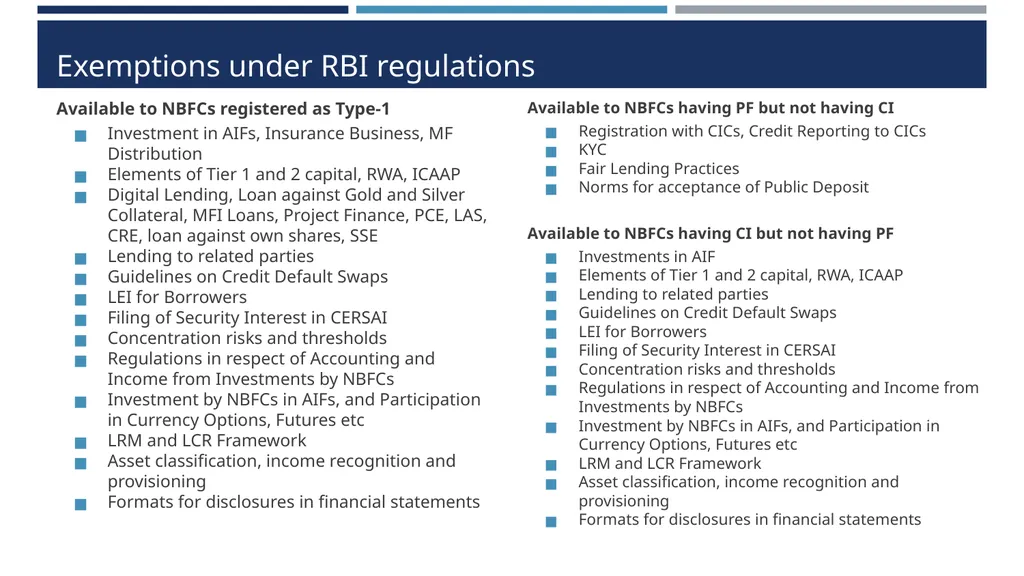
slide16. Exemptions under RBI regulations Available to NBFCs registered as Type-1
Investment in AIFs, Insurance Business, MF Distribution
Elements of Tier 1 and 2 capital, RWA, ICAAP
Digital Lending, Loan against Gold and Silver Collateral, MFI Loans, Project Finance, PCE, LAS, CRE, loan against own shares, SSE
Lending to related parties
Guidelines on Credit Default Swaps
LEI for Borrowers
Filing of Security Interest in CERSAI
Concentration risks and thresholds
Regulations in respect of Accounting and Income from Investments by NBFCs
Investment by NBFCs in AIFs, and Participation in Currency Options, Futures etc
LRM and LCR Framework
Asset classification, income recognition and provisioning
Formats for disclosures in financial statements Available to NBFCs having PF but not having CI
Registration with CICs, Credit Reporting to CICs
KYC
Fair Lending Practices
Norms for acceptance of Public Deposit
Available to NBFCs having CI but not having PF
Investments in AIF
Elements of Tier 1 and 2 capital, RWA, ICAAP
Lending to related parties
Guidelines on Credit Default Swaps
LEI for Borrowers
Filing of Security Interest in CERSAI
Concentration risks and thresholds
Regulations in respect of Accounting and Income from Investments by NBFCs
Investment by NBFCs in AIFs, and Participation in Currency Options, Futures etc
LRM and LCR Framework
Asset classification, income recognition and provisioning
Formats for disclosures in financial statements<br>
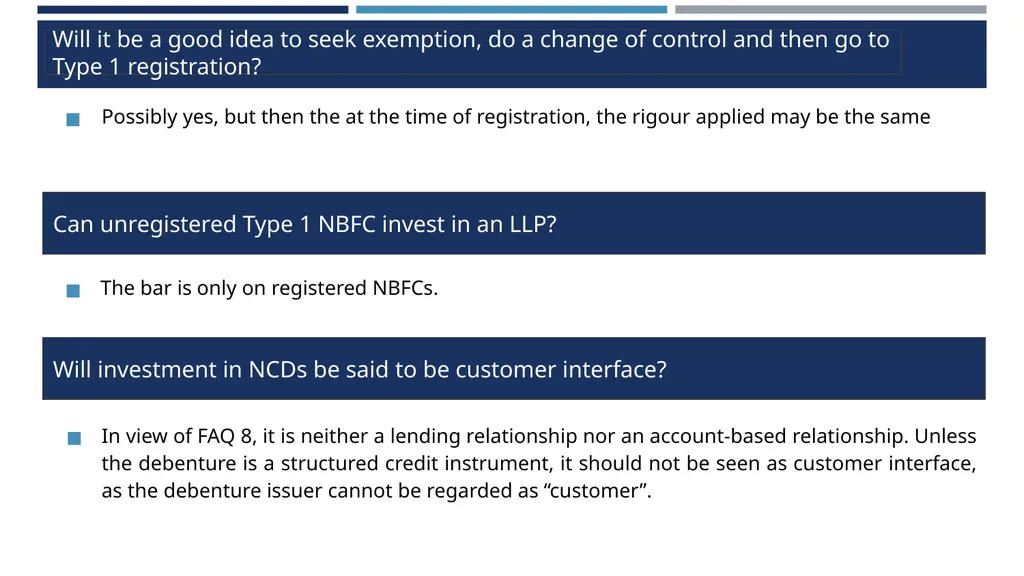
slide17. Will it be a good idea to seek exemption, do a change of control and then go to Type 1 registration? Possibly yes, but then the at the time of registration, the rigour applied may be the same Can unregistered Type 1 NBFC invest in an LLP? The bar is only on registered NBFCs. Will investment in NCDs be said to be customer interface? In view of FAQ 8, it is neither a lending relationship nor an account-based relationship. Unless the debenture is a structured credit instrument, it should not be seen as customer interface, as the debenture issuer cannot be regarded as “customer”.<br>
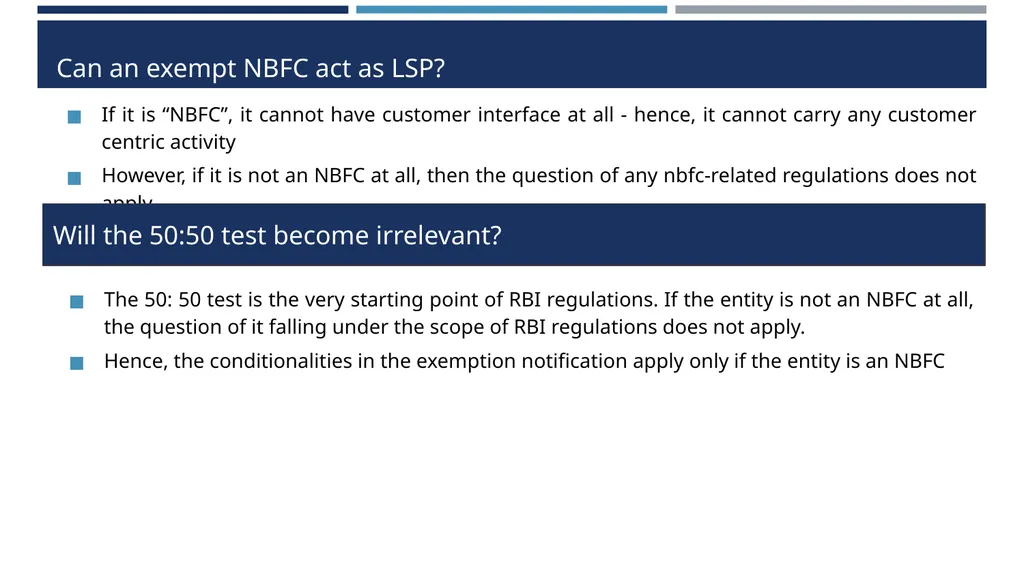
slide18. Can an exempt NBFC act as LSP? If it is “NBFC”, it cannot have customer interface at all - hence, it cannot carry any customer centric activity
However, if it is not an NBFC at all, then the question of any nbfc-related regulations does not apply Will the 50:50 test become irrelevant? The 50: 50 test is the very starting point of RBI regulations. If the entity is not an NBFC at all, the question of it falling under the scope of RBI regulations does not apply.
Hence, the conditionalities in the exemption notification apply only if the entity is an NBFC<br>
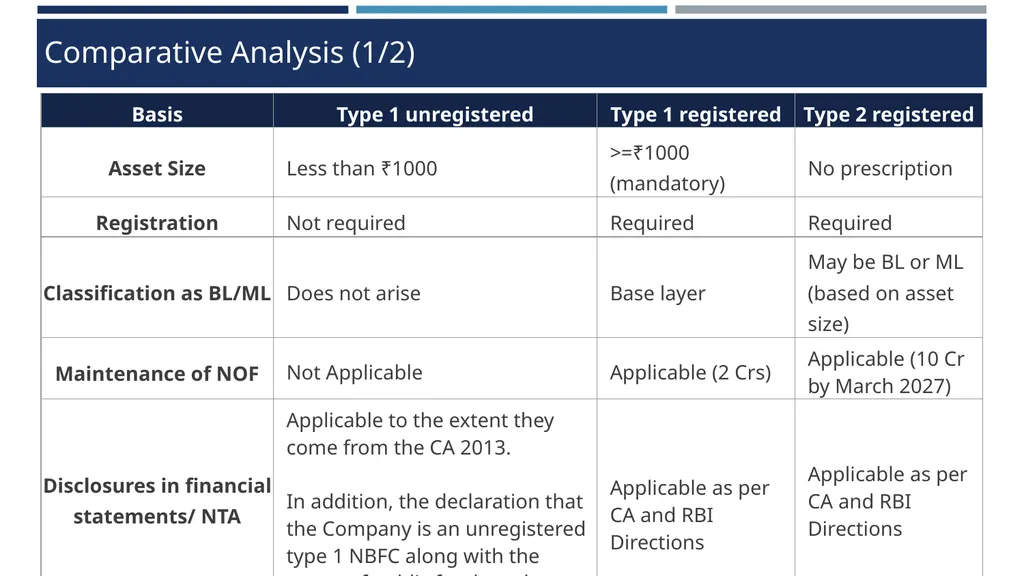
slide19. Comparative Analysis (1/2)<br>
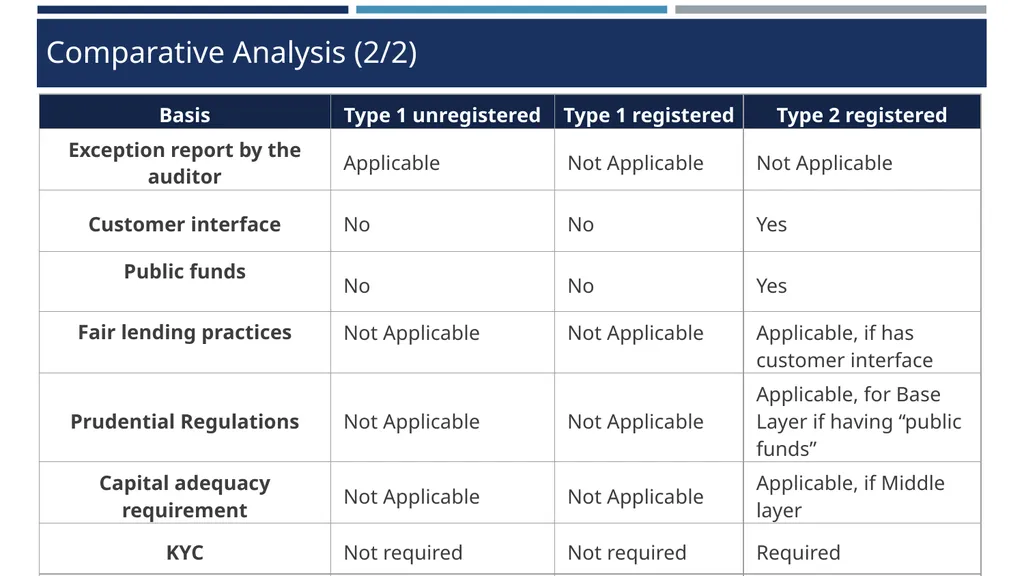
slide20. Comparative Analysis (2/2)<br>
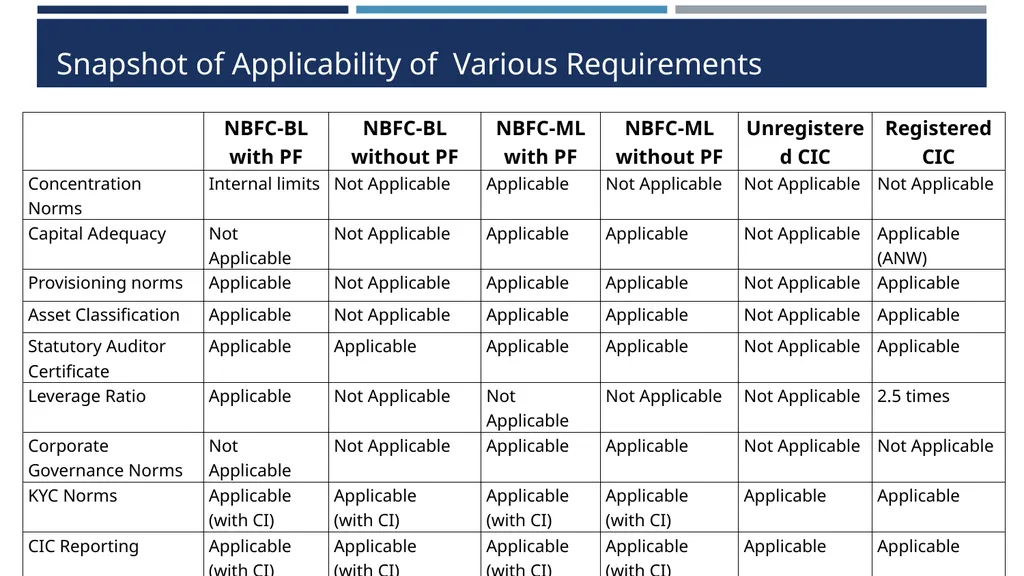
slide21. Snapshot of Applicability of Various Requirements<br>
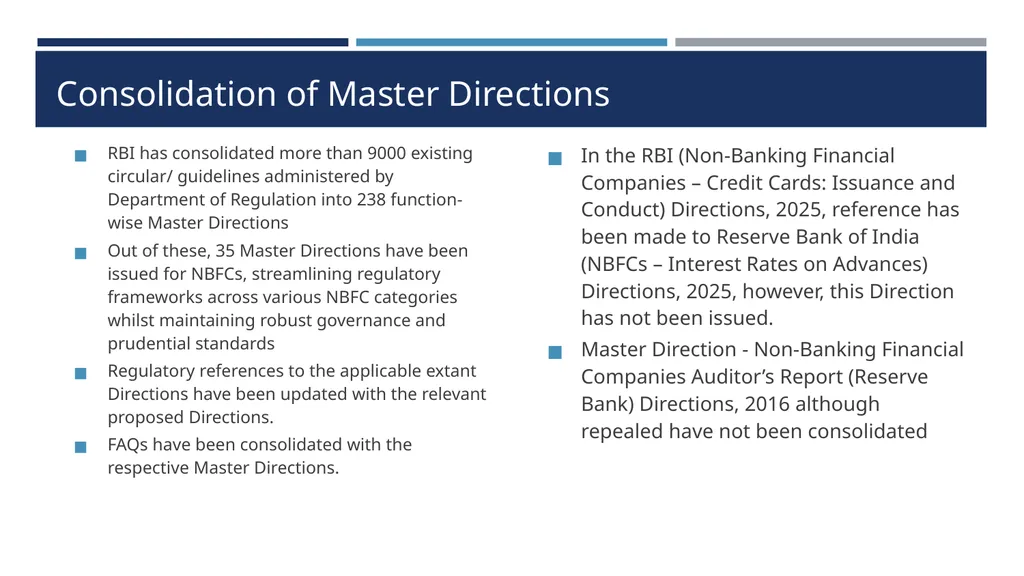
slide22. Consolidation of Master Directions RBI has consolidated more than 9000 existing circular/ guidelines administered by Department of Regulation into 238 function-wise Master Directions
Out of these, 35 Master Directions have been issued for NBFCs, streamlining regulatory frameworks across various NBFC categories whilst maintaining robust governance and prudential standards
Regulatory references to the applicable extant Directions have been updated with the relevant proposed Directions.
FAQs have been consolidated with the respective Master Directions. In the RBI (Non-Banking Financial Companies – Credit Cards: Issuance and Conduct) Directions, 2025, reference has been made to Reserve Bank of India (NBFCs – Interest Rates on Advances) Directions, 2025, however, this Direction has not been issued.
Master Direction - Non-Banking Financial Companies Auditor’s Report (Reserve Bank) Directions, 2016 although repealed have not been consolidated<br>
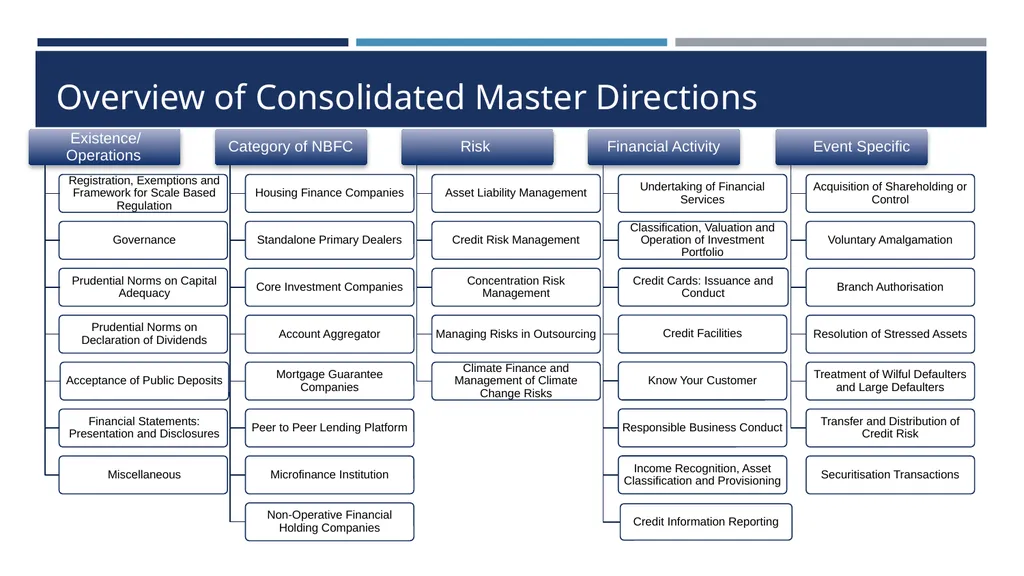
slide23. Overview of Consolidated Master Directions<br>
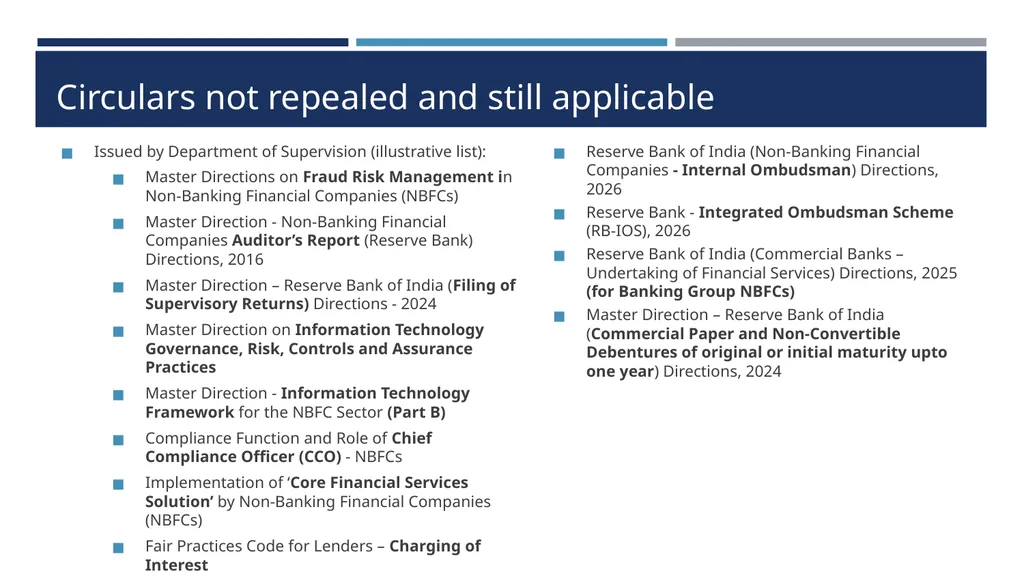
slide24. Circulars not repealed and still applicable Issued by Department of Supervision (illustrative list):
Master Directions on Fraud Risk Management in Non-Banking Financial Companies (NBFCs)
Master Direction - Non-Banking Financial Companies Auditor’s Report (Reserve Bank) Directions, 2016
Master Direction – Reserve Bank of India (Filing of Supervisory Returns) Directions - 2024
Master Direction on Information Technology Governance, Risk, Controls and Assurance Practices
Master Direction - Information Technology Framework for the NBFC Sector (Part B)
Compliance Function and Role of Chief Compliance Officer (CCO) - NBFCs
Implementation of ‘Core Financial Services Solution’ by Non-Banking Financial Companies (NBFCs)
Fair Practices Code for Lenders – Charging of Interest Reserve Bank of India (Non-Banking Financial Companies - Internal Ombudsman) Directions, 2026
Reserve Bank - Integrated Ombudsman Scheme (RB-IOS), 2026
Reserve Bank of India (Commercial Banks – Undertaking of Financial Services) Directions, 2025 (for Banking Group NBFCs)
Master Direction – Reserve Bank of India (Commercial Paper and Non-Convertible Debentures of original or initial maturity upto one year) Directions, 2024<br>
slide25. Thank You! Vinod Kothari Consultants Pvt. Ltd. Connect with us!<br>
Draft RBI Amendment Directions Bangalore:
4, Union Street, Infantry Rd,
Shivaji Nagar,
Bengaluru- 560 001
Phone: 033 40010157/ 2281 3742
Email: bengaluru@vinodkothari.com<br>
slide2. Overview of Non-Banking Sector in India NBFCs are growing more and more relevant to the Indian financial sector, they are the largest receiver of funds followed by HFCs
Traditionally, NBFCs operated as a alternative lender, reaching out to customers that were beyond the reach of banks
But the lending model was same as that of bank
New age NBFCs have introduced innovative models that incorporate the best offerings of the world of fintech and conventional credit features.
The traditional modes of lending are being replaced with new innovative models.
They also leverage alternative data for assessing incomes, efficiently incorporate technology into their operations, and possess a highly astute workforce.
They are bridging the gap in the Indian financial ecosystem by empowering budding business communities and entrepreneurs. Over 95% of the registered NBFCs are ICCs Data Source: RBI<br>
slide3. Legal Definition of NBFCs & Meaning of Financial Activities Section 45I(f) of RBI Act, 1934
Financial institution which is a company;
NBI which is a company and whose principal business is accepting of deposits
such other class of companies, as the RBI may notify Definition of NBFC Section 45I(c) of RBI Act, 1934
A NBI which carries on the following activities
1. Financing
2. Acquisition of shares, stocks or securities
3. Hire purchase
4. Insurance – excluded by notification
5. Management of chits, kuries, etc
6. Money circulation schemes Definition of financial institution Section 45I(c) excludes the following activities from the purview of financial activities:
Agricultural activities
Industrial activities
Purchase or sale of goods, or provision of services
Purchase, construction or sale of immovable properties, provided that the income from such activities do not arise from financing of purchase or sale of construction of immovable properties Activities which are not financial activities<br>
slide4. Principal Business Test Quantitative factors Qualitative factors Press Release 1998-99/1269 dated April 8, 1999<br>
slide5. Based on the nature of activities Investment activities Lending or similar activities Core Investment Company Non-Operative Financial Holding Company Other activities Micro Finance Institution Factors Housing Finance Companies Infrastructure Finance Company Infrastructure Debt Fund Peer-to-Peer Lending Platform Account Aggregator Standalone Primary Dealers Mortgage Guarantee Company Investment and Credit Company Registered Unregistered
(<100cr or no PF) NBFC classification based on activity<br>
slide6. Classification based on PF and CI Before the SBR Framework, NBFCs were classified based on the systemic importance into SI and NSI as well as based on acceptance of deposit into deposit taking and non-deposit taking NBFCs
The concept of Type 1 NBFCs was introduced in 2016, basically for easing the registration process {Refer Press Releases - Reserve Bank of India]
Type I - NBFC-ND
not accepting public funds/ not intending to accept public funds in the future and
not having customer interface/ not intending to have customer interface in the future
Definition of PF and CI was provided under the Master Directions<br>
slide7. Meaning of PF and CI “Public funds" shall include
funds raised either directly or indirectly through public deposits,
commercial paper,
Debentures,
inter-corporate deposits and
bank finance
but excludes funds raised by issue of instruments compulsorily convertible into equity shares within a period not exceeding 10 years
Any funds received from outside sources and which constitute outside liability are treated as public funds for ‘Type I NBFCs’
Loans from directors and/ or shareholders will be classified as public funds
Indirect receipt of public funds means funds received not directly but through associates and group entities which have access to public funds “Customer interface” means interaction between the NBFC and its customers while carrying on its NBFI business
As per the proposal,
Customer interface can be through an account-based relationship, lending relationship or interaction with the customers as part of business of the NBFC.
Any customer-oriented activity like lending or providing guarantee, including to ‘entities in the Group’, its shareholders, its directors
Providing any other product or service to a customer would constitute ‘customer interface’.
Activities like distribution of mutual funds, credit cards, acting as Point of Presence for NPS, etc., since these activities entail interaction with customers.
However, loans to employees as per terms of employment condition/ contract and not on commercial terms, shall not be treated as customer interface.<br>
slide8. Exemption from registration to type 1 NBFC<br>
slide9. Conditions for Exemption and Conditions Subsequent Last 3 years financial statements
Does it mean, at no stage in the last 3 years, these conditions should be breached?
Meaning of “Statutory Auditors Certificate certifying that the company does not have public funds and also not have customer interface as on date”
Implies these should not be as on date; however if there is any isolated breach, that should not disentitle. Assets less than Rs 1000 crores
Aggregation required?
Liability side - no public funds
Directly or "indirectly"
Indirectly elaborated to say borrowings “through associates and group entities”
Meaning of “through”
Even borrowings from shareholders and directors
Asset side - no customer interface
CI defined in FAQs. says includes loans to group entities; however does not include employee loans
Includes activities like MF distribution, credit cards, etc., since these activities entail interaction with customers<br>
slide10. Asset Size: Less than ₹1,000 crores Customer Interface: Must not have or intend to have any customer interface. This includes lending or providing guarantees to group entities. Statutory Auditors Certificate: SAC certifying that the company does not have public funds and also not have customer interface as on date. Governance: a. The Board must pass an upfront resolution, as also annually thereafter, confirming the entity will not avail PF or have CI during the year
b. Undertaking from the Board that the NBFC shall disclose its status of being ‘Unregistered Type I NBFC’ and status of PF and CI as part of Notes to Accounts to the FS Business Model: Non-acceptance of funds and having no customer interface. Other Documents: Original CoR, Audited Financial Statements (last 3 FYs), Report on the status of public funds and customer interface (last 3 FYs) Public Funds : Must not be accepting or intending to accept “public funds”, including from within the group. No overseas investment in financial services sector Conditions Precedent: Deregistration Conditions as per Para 38A<br>
slide11. Conditions Subsequent: Para 66A for Unregistered Type I NBFCs Business Model: Operates without public funds and without customer interface, as their conscious and durable business model on a long-term basis. Asset Size: Asset size is less than ₹1,000 crore. Board Resolution: Passes an annual Board Resolution that it will not avail public funds and not have customer interface during the year. Disclosure in Financials: Discloses in its Notes to Accounts to the financial statements that it is an ‘Unregistered Type I NBFC’, along with the status of public funds and customer interface Exception Report: Statutory Auditors shall submit Exception Report to the Reserve Bank in case of violation of conditions on public funds and/or customer interface Other Compliances: Compliance with Chapter IIIB of RBI Act and any other conditions that the RBI may lay down<br>
slide12. Is it mandatory to opt out or apply for deregistration? No, it is optional to apply for deregistration
Company may weigh the pros and cons
Pros
If the Company is thinking of growing the asset size, it will not have to go through the rigour of a fresh application
Some of the exemptions are linked with NBFC registration
Con
Compliance burden<br>
slide13. Analysis of options available to Type 1 NBFCs<br>
slide14. Moving from Type 1 to Type 2 Regulator has consistently said that if the company have either of public funds or customer interface, move to Type 2
How to move to type 2?
Surrender registration for Type 1 to RBI
Apply for registration as Type 2<br>
slide15. What will happen to Type 1 NBFCs now? With the stringent conditions, if there is a type 1 NBFC, with either less than 1000 crores or more, expect regulations to be quite light touch
Base Layer Classification
NOF- 2cr
Existing exemptions:
Section 186(2) of the CA, which deals with the limits on loans and investments, provided exemption to NBFCs registered under Chapter III-B of the Reserve Bank of India Act, 1934. However, an exemption is also provided separately to investment companies and therefore unregistered type 1 NBFCs will fall under this category.
Section 73 of the CA which deals with deposits provides exemption to NBFCs as defined under the RBI Act. Hence, the exemption will continue to apply for unregistered type 1 NBFCs
Section 36(1)(viia) of IT Act provides that NBFCs can claim a deduction of up to 5% of their total income for provision made for bad and doubtful debts. However, it refers to NBFC as defined in the RBI Act..
Section 42 of CA r.w sub-rule (2) of rule 14 of PAS Rules which sets the limit on number of offerees in case of a private placement is not applicable to a NBFC registered with the RBI. Therefore, unregistered Type 1 NBFCs will not be able to avail this exemption.
Section 17(4) of the CGST Act allows NBFCs to avail 50% of eligible ITC in a tax period, with the balance to be reversed. While the provision uses the term “NBFC”, it does not expressly state “registered under the RBI Act”.<br>
slide16. Exemptions under RBI regulations Available to NBFCs registered as Type-1
Investment in AIFs, Insurance Business, MF Distribution
Elements of Tier 1 and 2 capital, RWA, ICAAP
Digital Lending, Loan against Gold and Silver Collateral, MFI Loans, Project Finance, PCE, LAS, CRE, loan against own shares, SSE
Lending to related parties
Guidelines on Credit Default Swaps
LEI for Borrowers
Filing of Security Interest in CERSAI
Concentration risks and thresholds
Regulations in respect of Accounting and Income from Investments by NBFCs
Investment by NBFCs in AIFs, and Participation in Currency Options, Futures etc
LRM and LCR Framework
Asset classification, income recognition and provisioning
Formats for disclosures in financial statements Available to NBFCs having PF but not having CI
Registration with CICs, Credit Reporting to CICs
KYC
Fair Lending Practices
Norms for acceptance of Public Deposit
Available to NBFCs having CI but not having PF
Investments in AIF
Elements of Tier 1 and 2 capital, RWA, ICAAP
Lending to related parties
Guidelines on Credit Default Swaps
LEI for Borrowers
Filing of Security Interest in CERSAI
Concentration risks and thresholds
Regulations in respect of Accounting and Income from Investments by NBFCs
Investment by NBFCs in AIFs, and Participation in Currency Options, Futures etc
LRM and LCR Framework
Asset classification, income recognition and provisioning
Formats for disclosures in financial statements<br>
slide17. Will it be a good idea to seek exemption, do a change of control and then go to Type 1 registration? Possibly yes, but then the at the time of registration, the rigour applied may be the same Can unregistered Type 1 NBFC invest in an LLP? The bar is only on registered NBFCs. Will investment in NCDs be said to be customer interface? In view of FAQ 8, it is neither a lending relationship nor an account-based relationship. Unless the debenture is a structured credit instrument, it should not be seen as customer interface, as the debenture issuer cannot be regarded as “customer”.<br>
slide18. Can an exempt NBFC act as LSP? If it is “NBFC”, it cannot have customer interface at all - hence, it cannot carry any customer centric activity
However, if it is not an NBFC at all, then the question of any nbfc-related regulations does not apply Will the 50:50 test become irrelevant? The 50: 50 test is the very starting point of RBI regulations. If the entity is not an NBFC at all, the question of it falling under the scope of RBI regulations does not apply.
Hence, the conditionalities in the exemption notification apply only if the entity is an NBFC<br>
slide19. Comparative Analysis (1/2)<br>
slide20. Comparative Analysis (2/2)<br>
slide21. Snapshot of Applicability of Various Requirements<br>
slide22. Consolidation of Master Directions RBI has consolidated more than 9000 existing circular/ guidelines administered by Department of Regulation into 238 function-wise Master Directions
Out of these, 35 Master Directions have been issued for NBFCs, streamlining regulatory frameworks across various NBFC categories whilst maintaining robust governance and prudential standards
Regulatory references to the applicable extant Directions have been updated with the relevant proposed Directions.
FAQs have been consolidated with the respective Master Directions. In the RBI (Non-Banking Financial Companies – Credit Cards: Issuance and Conduct) Directions, 2025, reference has been made to Reserve Bank of India (NBFCs – Interest Rates on Advances) Directions, 2025, however, this Direction has not been issued.
Master Direction - Non-Banking Financial Companies Auditor’s Report (Reserve Bank) Directions, 2016 although repealed have not been consolidated<br>
slide23. Overview of Consolidated Master Directions<br>
slide24. Circulars not repealed and still applicable Issued by Department of Supervision (illustrative list):
Master Directions on Fraud Risk Management in Non-Banking Financial Companies (NBFCs)
Master Direction - Non-Banking Financial Companies Auditor’s Report (Reserve Bank) Directions, 2016
Master Direction – Reserve Bank of India (Filing of Supervisory Returns) Directions - 2024
Master Direction on Information Technology Governance, Risk, Controls and Assurance Practices
Master Direction - Information Technology Framework for the NBFC Sector (Part B)
Compliance Function and Role of Chief Compliance Officer (CCO) - NBFCs
Implementation of ‘Core Financial Services Solution’ by Non-Banking Financial Companies (NBFCs)
Fair Practices Code for Lenders – Charging of Interest Reserve Bank of India (Non-Banking Financial Companies - Internal Ombudsman) Directions, 2026
Reserve Bank - Integrated Ombudsman Scheme (RB-IOS), 2026
Reserve Bank of India (Commercial Banks – Undertaking of Financial Services) Directions, 2025 (for Banking Group NBFCs)
Master Direction – Reserve Bank of India (Commercial Paper and Non-Convertible Debentures of original or initial maturity upto one year) Directions, 2024<br>
slide25. Thank You! Vinod Kothari Consultants Pvt. Ltd. Connect with us!<br>